
Quick summary: 9 best MarketMuse alternatives
- Scalenut: Better for end-to-end SEO and GEO execution, connecting planning, content creation, optimization, auditing, AI visibility tracking, and publishing.
- Frase: Better for quickly producing briefs and articles with SERP research, AI drafting, live SEO and GEO scoring, and CMS publishing.
- Clearscope: Better for writer-friendly content optimization with clear grading, term recommendations, readability feedback, content monitoring, and AI visibility tracking.
- Surfer SEO: Better for real-time content scoring, automated optimization, and identifying existing pages that need refreshing.
- AccuRanker: Better for daily and on-demand rank tracking, pixel positions, SERP feature analysis, AI Overview monitoring, and LLM visibility tracking.
- Ahrefs: Better for broader SEO research covering keywords, backlinks, competitors, site audits, rankings, content opportunities, and AI brand visibility.
- AthenaHQ: Better for dedicated GEO programs that need visibility tracking across 8+ AI platforms, sentiment analysis, competitor benchmarking, and citation insights.
- Writesonic: Better for combining AI content production, SEO optimization, site auditing, AI visibility monitoring, and agentic GEO workflows.
- seoClarity: Better for enterprise teams that need rank intelligence, technical SEO, content optimization, competitive research, and AI search visibility at scale.
MarketMuse may show you what content to prioritize, but your team still has to turn that insight into published, measurable work. That gap matters if you are stitching together separate tools for drafting, optimization, rank tracking, CMS publishing, or AI visibility.
The right MarketMuse alternative is not the platform with the longest feature list. It is the one that removes the biggest bottleneck in your workflow. This guide compares 9 MarketMuse alternatives across SEO, GEO, content intelligence, pricing, usability, and execution, helping you shortlist the right fit.
What is MarketMuse? Why are teams considering an alternative to MarketMuse?
MarketMuse is an AI-powered content intelligence platform for content research, planning, and optimization. It offers site-level content analysis, Topic Authority, Personalized Difficulty, competitive insights, content briefs, and optimization recommendations.
MarketMuse is strong in strategic planning, but it may not fit every team’s budget or workflow. Recent MarketMuse review feedback on G2 and Capterra points to pricing, usability, and data overload as common concerns.
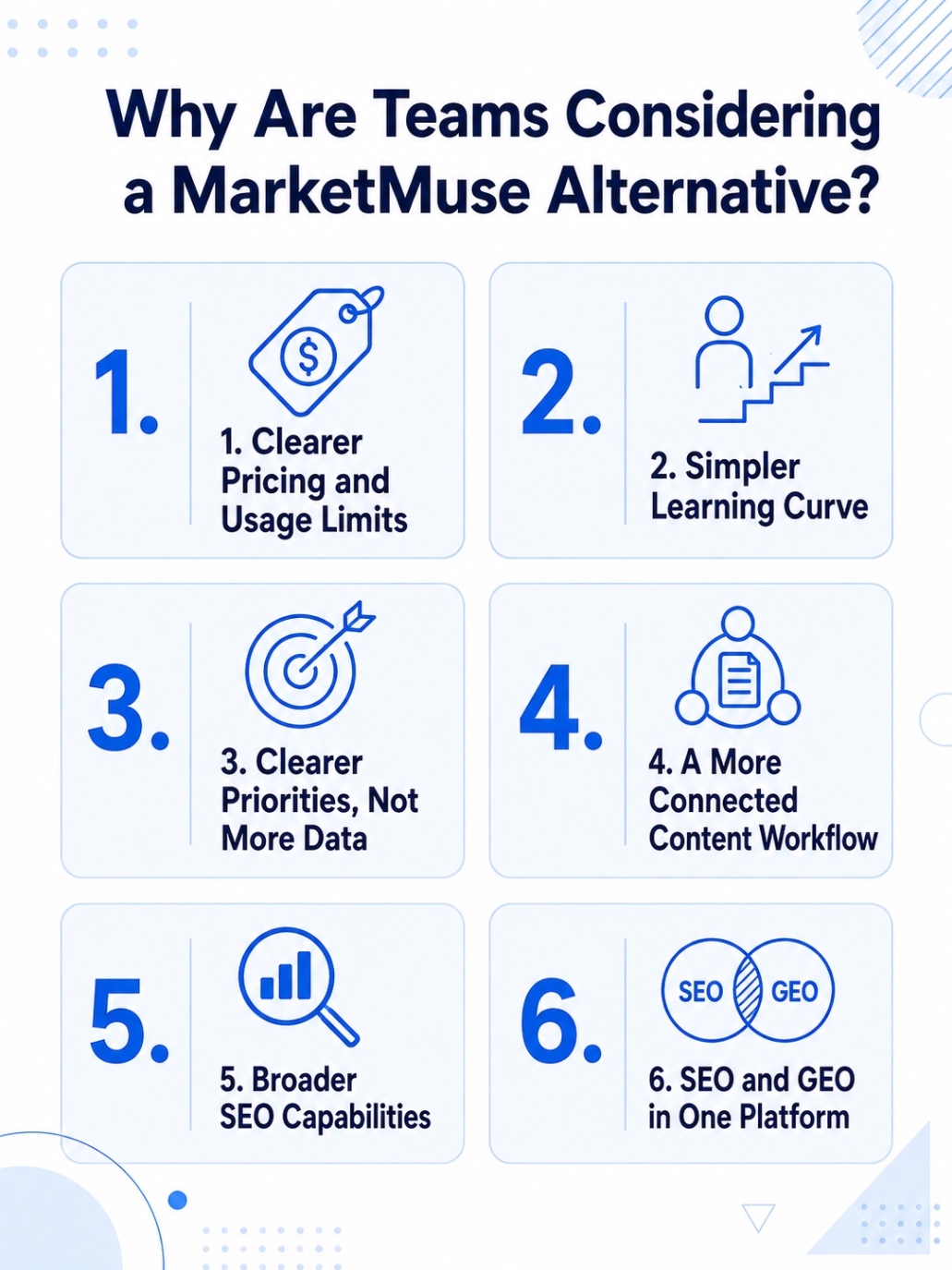
Here are 6 reasons teams may consider an alternative.
1. You need clearer pricing and usage limits
MarketMuse pricing is not publicly displayed for its paid plans. Plans also differ by queries, tracked topics, briefs, strategy documents, and user seats.
The free plan includes 1 user and 10 monthly queries but excludes content briefs and tracked topics. Verified reviewers have also raised concerns about pricing and credit costs.
2. You prefer a simpler learning curve
MarketMuse provides extensive topical and competitive data, but some users find the platform overwhelming or difficult to navigate.
Teams that want writers to get started quickly may prefer a simpler interface with less onboarding.
3. You want clearer priorities, not more data
MarketMuse can uncover topic gaps, competitive weaknesses, and optimization opportunities. Teams must still decide which recommendation deserves attention first.
Some alternatives turn these insights into prioritized content briefs, refresh opportunities, and optimization tasks.
4. You need a more connected content workflow
MarketMuse focuses heavily on research, planning, and optimization. Some teams also want AI-assisted drafting, internal linking, collaboration, refreshing, publishing, and performance monitoring in the same workflow.
A more connected platform can reduce tool switching and speed up execution.
5. You need broader SEO capabilities
MarketMuse does not replace tools for rank tracking, technical audits, backlink analysis, comprehensive keyword research, or competitor traffic analysis.
A broader SEO platform may be more practical when content optimization is only 1 part of your search workflow.
6. You want SEO and GEO capabilities together
Teams now need to monitor visibility across traditional and AI search, including prompts, citations, AI share of voice, sentiment, competitors, and AI referral traffic.
Platforms that connect these insights with content creation and optimization make it easier to act on SEO and GEO opportunities from 1 place.
MarketMuse remains a strong choice for topic modeling, content inventory analysis, and portfolio-level planning. The right alternative depends on the capabilities, limits, and workflows your team prioritizes.
Want a deeper look at its strengths, limitations, and user feedback? Read our complete MarketMuse review for 2026.
How we evaluated the best MarketMuse alternatives?
We assessed every tool against the same 7 criteria using current product documentation, pricing pages, and customer feedback. The comparison focuses on how each platform performs in practical SEO, content, and GEO workflows.
Here's what we focused on:
- Content intelligence: Topic modeling, competitive analysis, content gaps, briefs, scoring, and content-prioritization capabilities.
- SEO and GEO features: Keyword research, rank tracking, audits, optimization, prompt monitoring, citations, sentiment, and AI visibility analysis.
- Usability: Setup time, learning curve, interface quality, collaboration, and ease of adoption across teams.
- Workflow coverage: Support for planning, creating, optimizing, refreshing, linking, publishing, and monitoring content.
- Pricing transparency: Public pricing, free trials, usage limits, user seats, add-ons, and potential costs as content volume increases.
- Scalability: Support for multiple users, domains, workspaces, reporting, integrations, APIs, and enterprise requirements.
- User feedback: Recent G2 and Capterra feedback helped identify recurring strengths, limitations, usability issues, and support quality.
Disclosure: Scalenut is our product. We evaluated it against the same criteria as every other platform in this comparison.
Still refining your evaluation criteria? Use this framework for choosing an AI brand visibility tool based on platform coverage, pricing, and workflow fit.
9 best MarketMuse alternatives for SEO, content, and AI visibility in 2026
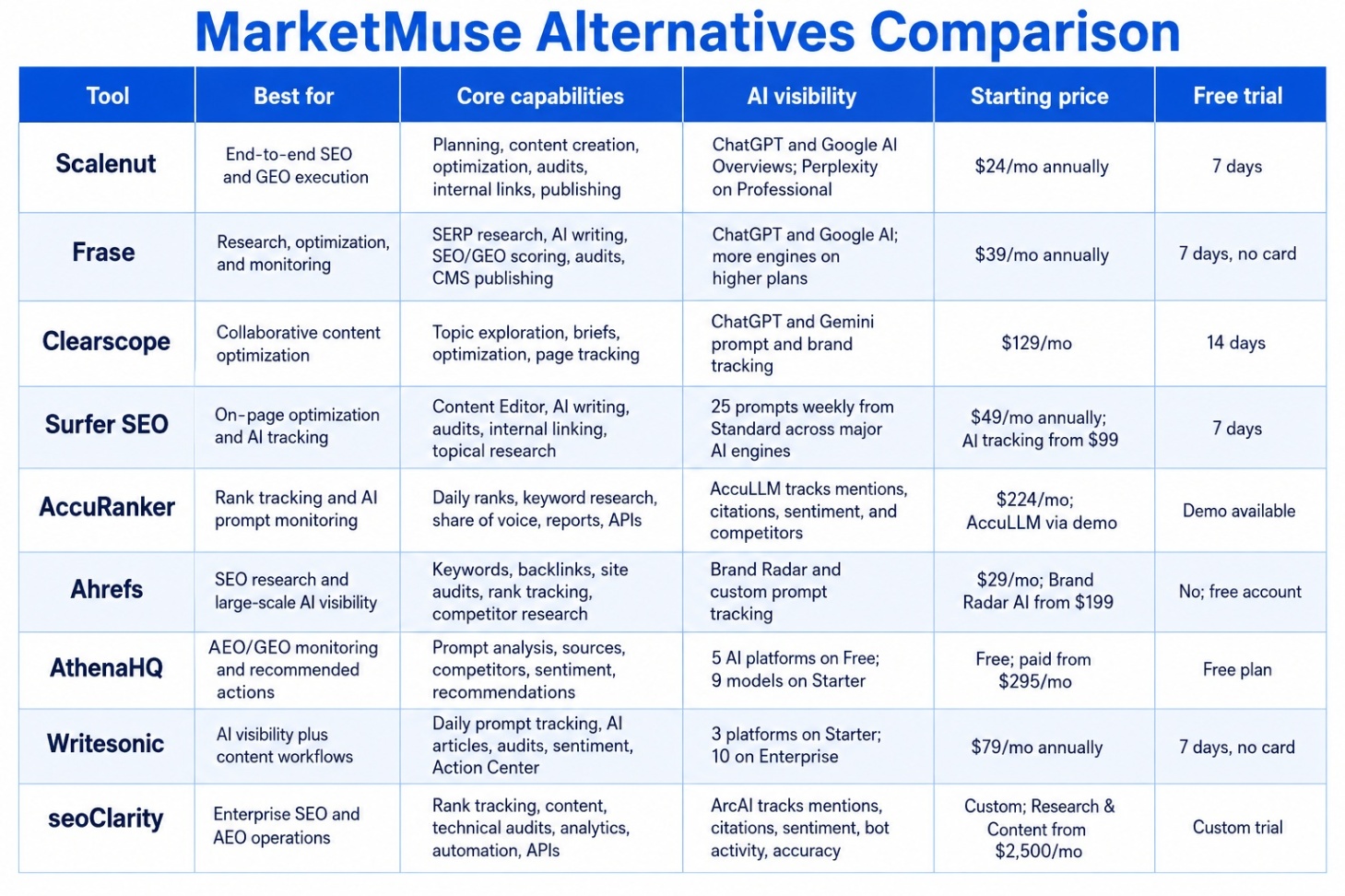
The 9 best alternatives to MarketMuse are Scalenut, Frase, Clearscope, Surfer SEO, AccuRanker, Ahrefs, AthenaHQ, Writesonic, and seoClarity.
Let’s compare these 9 MarketMuse competitors based on their capabilities, limitations, pricing, and ideal use cases.
1. Scalenut - Best for end-to-end SEO and GEO execution (G2: 4.7/5 from 316 reviews)
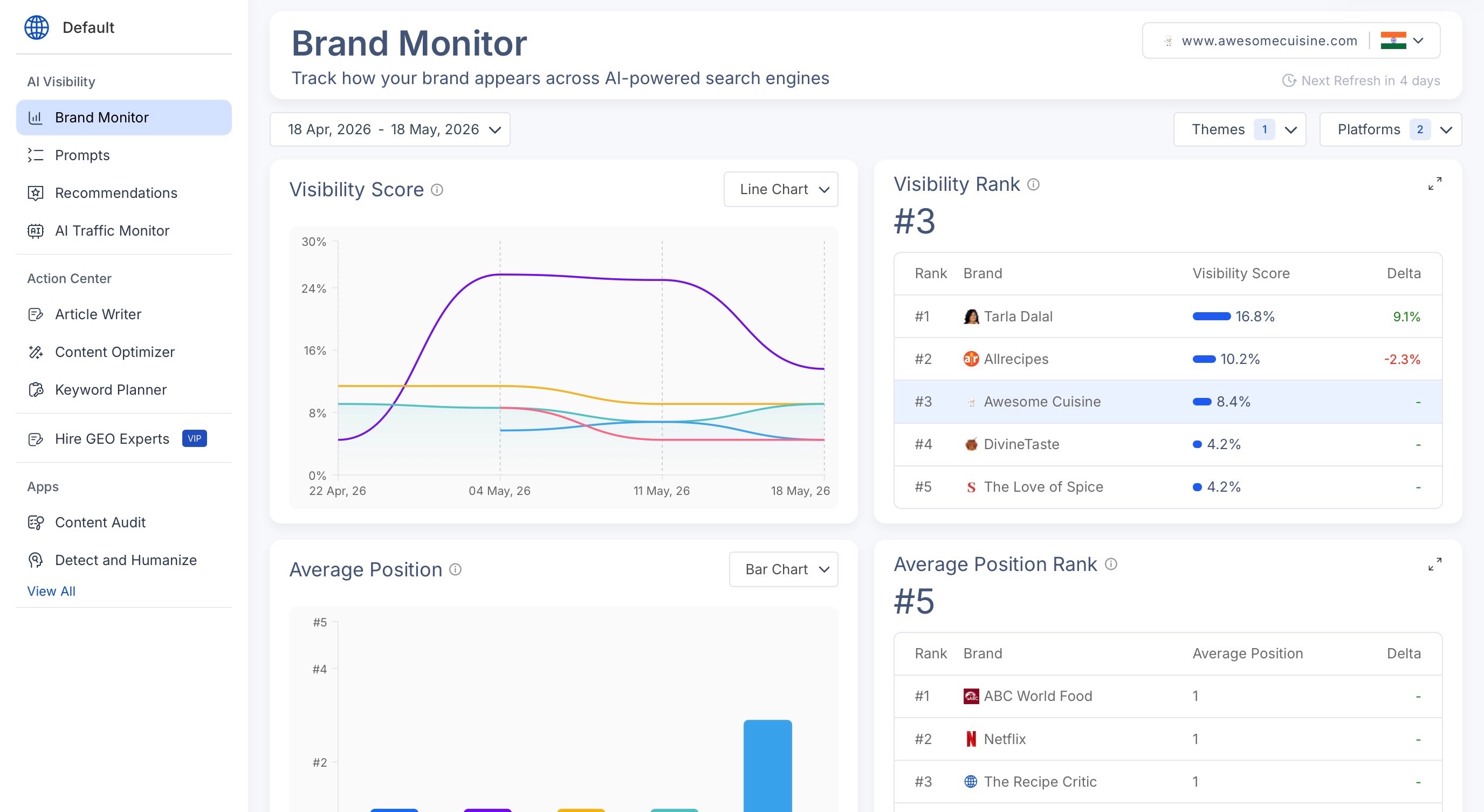
Scalenut is an SEO and GEO platform that connects content planning, creation, optimization, auditing, internal linking, publishing, and AI visibility. It helps teams identify visibility gaps and act on them without moving between several disconnected tools.
Key capabilities
- AI Visibility: Tracks brand mentions, prompts, citations, competitors, sentiment, share of voice, and visibility trends across supported AI platforms.
- GEO content creation: Creates research-backed articles using SERP data, prompt insights, brand voice, and optimization recommendations.
- Content Optimizer: Improves keyword coverage, prompt coverage, metadata, schema, and overall SEO and GEO readiness.
- Content Audit: Identifies underperforming pages, content gaps, traffic changes, and AI visibility opportunities.
- Execution tools: Includes keyword clustering, internal linking, OnPage Pro, and automatic publishing to WordPress and Shopify.
Why choose it over MarketMuse?
MarketMuse is particularly strong at site-level topic modeling and content prioritization. Scalenut is a better fit when you want to move directly from identifying an opportunity to creating, optimizing, refreshing, linking, and publishing the content.
It also connects SEO execution with AI visibility tracking. Teams can monitor where their brand appears across supported AI platforms, analyze prompts and citations, compare competitors, and use those insights to guide content updates.
Where it falls short
- MarketMuse offers deeper portfolio-level metrics, including Topic Authority, Personalized Difficulty, Competitive Advantage, and Potential Value.
- AI-engine coverage varies by plan. Perplexity starts with Professional, while standard visibility tracking refreshes weekly.
Pricing
- Starter: $59/month or $24/month with annual billing
- Plus: $89/month or $36/month with annual billing
- Professional: $199/month or $80/month with annual billing
- VIP Service: Custom pricing
Scalenut offers a 7-day free trial. The annual prices currently reflect a promotional discount.
Who should use it?
Scalenut is best suited to content teams, in-house marketers, and agencies that want SEO and GEO insights connected to practical execution. It is particularly useful for teams that want to create, optimize, refresh, publish, and monitor content from one platform.
Want to see the platform in real workflows? Explore our hands-on Scalenut review for SEO and GEO.
2. Frase – Best for fast SERP research, briefs, and AI-assisted execution (G2: 4.8/5 from 309 reviews)
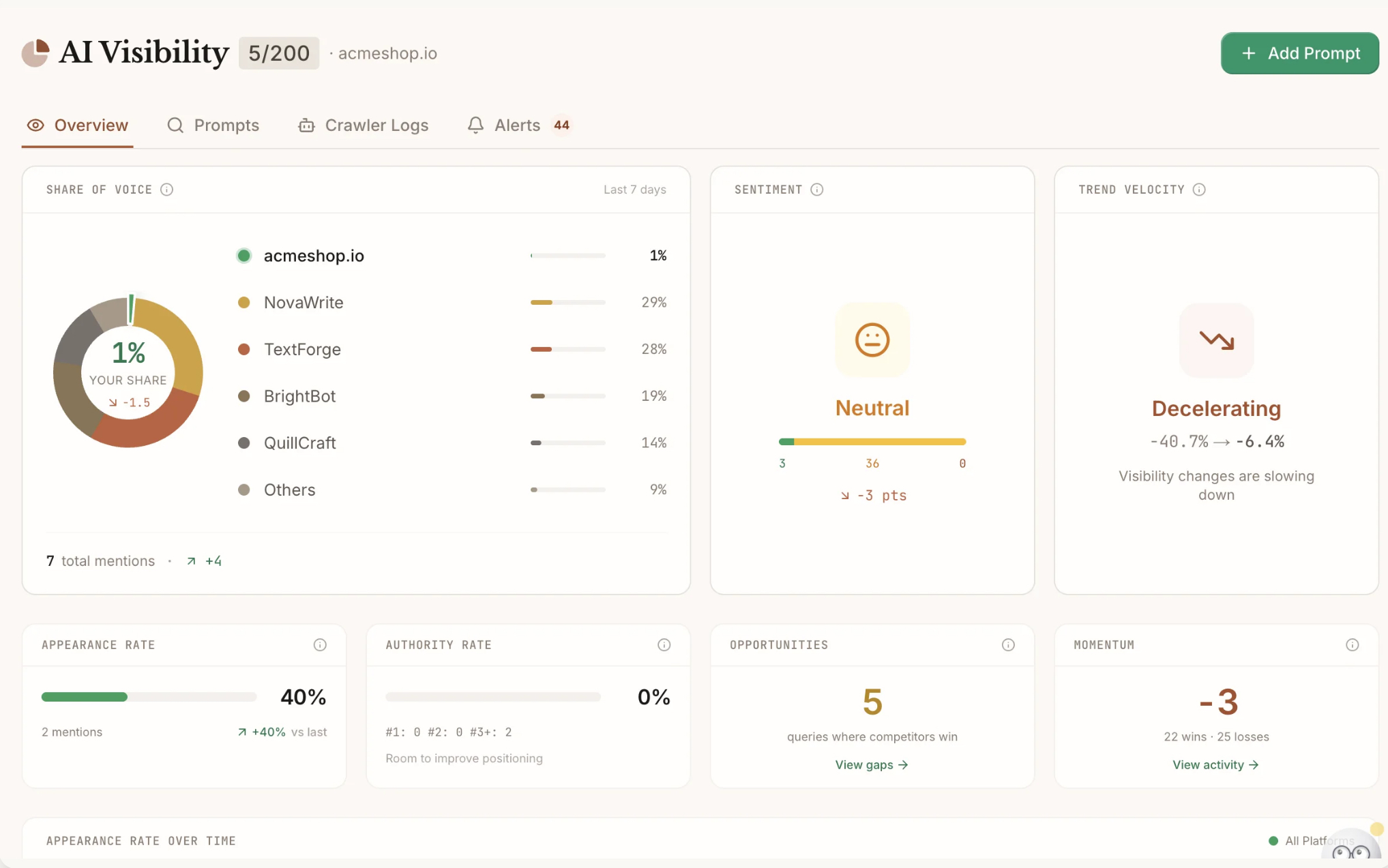
Frase combines SERP research, content creation, SEO and GEO optimization, publishing, and performance monitoring. It helps teams move from keyword research to an optimized, publish-ready draft within one platform.
Key capabilities
- Live SERP and competitor analysis
- AI-generated briefs, drafts, and images
- SEO and GEO content scoring
- Site audits and internal linking suggestions
- AI visibility tracking across major platforms
- CMS publishing and content-decay monitoring
Why choose it over MarketMuse?
For teams comparing MarketMuse vs Frase, Frase offers a more execution-focused workflow. Writers can research competitors, build a brief, create and optimize content, publish it, and monitor performance without switching platforms.
It also provides public pricing and a 7-day free trial, making costs easier to evaluate before purchase.
Where it falls short
- MarketMuse offers deeper portfolio-level insights through metrics such as Topic Authority, Personalized Difficulty, Competitive Advantage, and Potential Value.
- Frase limits articles, audit pages, monitored pages, seats, and domains by plan. AI visibility coverage is also tiered across plans.
Pricing
- Starter: $49/month or $39/month billed annually
- Professional: $129/month or $103/month billed annually
- Scale: $299/month or $239/month billed annually
- Enterprise: Custom pricing
- A 7-day free trial is available without a credit card
Who should use it?
Frase suits content teams, agencies, and in-house marketers that want a faster workflow from SERP research to publishing and performance monitoring. Teams focused primarily on advanced site-level content strategy may prefer MarketMuse.
Considering Frase for your content workflow? Read our 2026 Frase review covering its features, pricing, strengths, and limitations.
3. Clearscope - Best for content optimization and editorial collaboration (G2: 4.9/5 from 92 reviews)
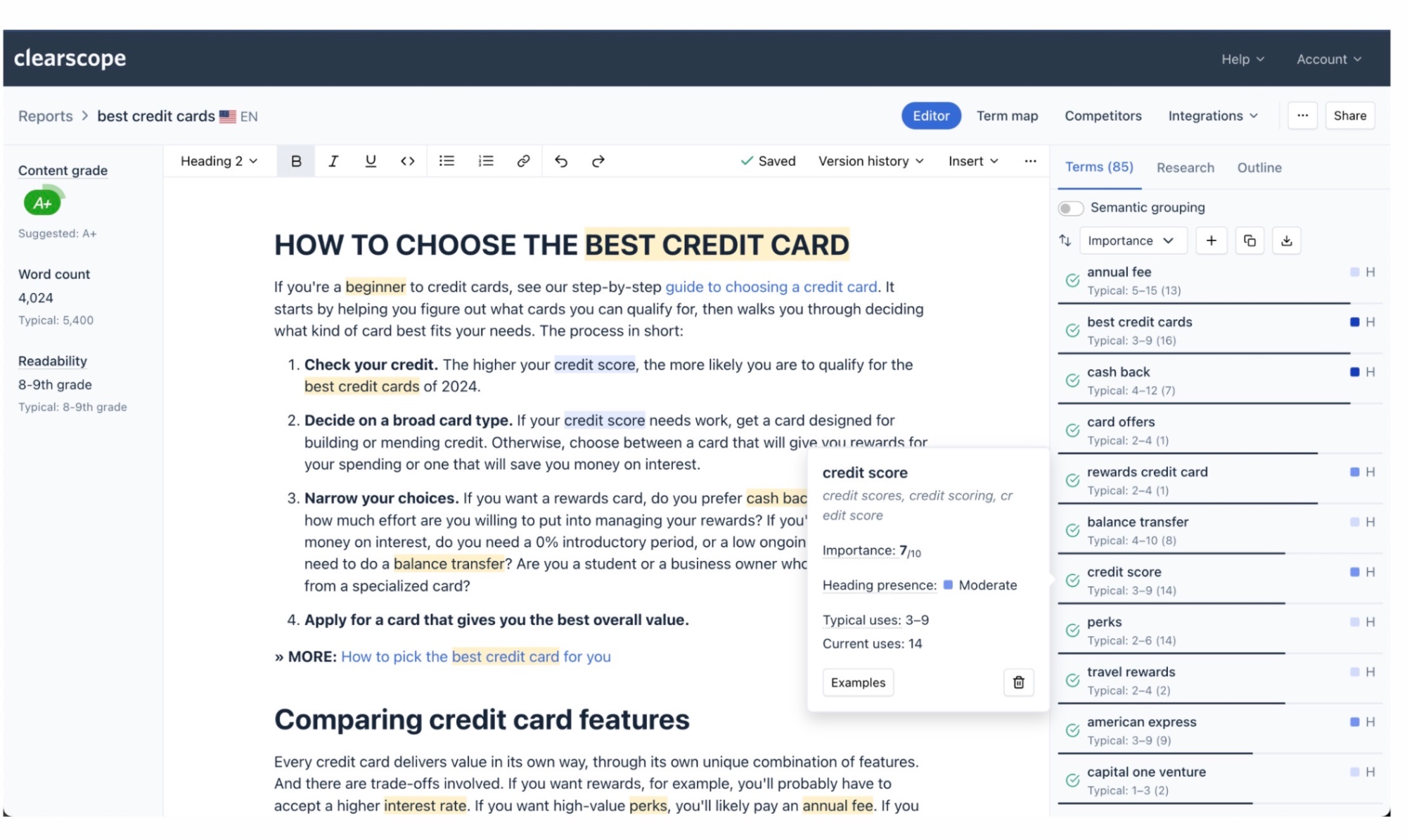
Clearscope helps teams research topics, optimize drafts, monitor published pages, and track AI search visibility. Its editor provides real-time term recommendations, content grades, readability data, and competitor insights.
Key capabilities
- Topic research and competitor analysis
- Real-time content scoring and term recommendations
- AI-assisted drafting and AI Term Presence analysis
- Content Inventory with Google Search Console data
- Internal linking and anchor text recommendations
- Prompt Tracking across ChatGPT, Gemini, and Claude
- Google Docs, Microsoft Word, and WordPress integrations
Why choose it over MarketMuse?
For teams comparing MarketMuse vs Clearscope, Clearscope offers a simpler, writer-focused optimization workflow. Editors can share drafts and optimize content within familiar writing tools.
Every plan also includes unlimited users and projects, making collaboration costs more predictable. Its Prompt Tracking feature adds brand mention rates, competitor visibility, recent responses, and 90-day trends across supported AI platforms.
Where it falls short
- MarketMuse provides deeper site-level planning and prioritization through metrics such as Topic Authority, Personalized Difficulty, Competitive Advantage, and Potential Value.
- Clearscope does not replace a broader SEO platform for backlink research, technical site audits, or comprehensive rank tracking.
- The Essentials plan limits users to 20 monthly Topic Explorations, 20 Drafts, 50 Tracked Prompts, and 50 Pages. Business raises most limits but still includes only 20 monthly Drafts.
Pricing
- Essentials: $129/month
- Business: $399/month
- Enterprise: Custom pricing
- All plans include unlimited users and projects
- A 14-day free trial is available
Who should use it?
Clearscope suits editorial teams, agencies, and SEO teams that prioritize straightforward content optimization, shared workflows, and AI prompt tracking. Teams needing a broader SEO toolkit or higher drafting volume at a lower price may prefer another option.
Need a closer look at its editor, content monitoring, and GEO capabilities? Explore our complete Clearscope review.
4. Surfer SEO - Best for real-time content optimization and AI search tracking (G2: 4.8/5 from 546 reviews)
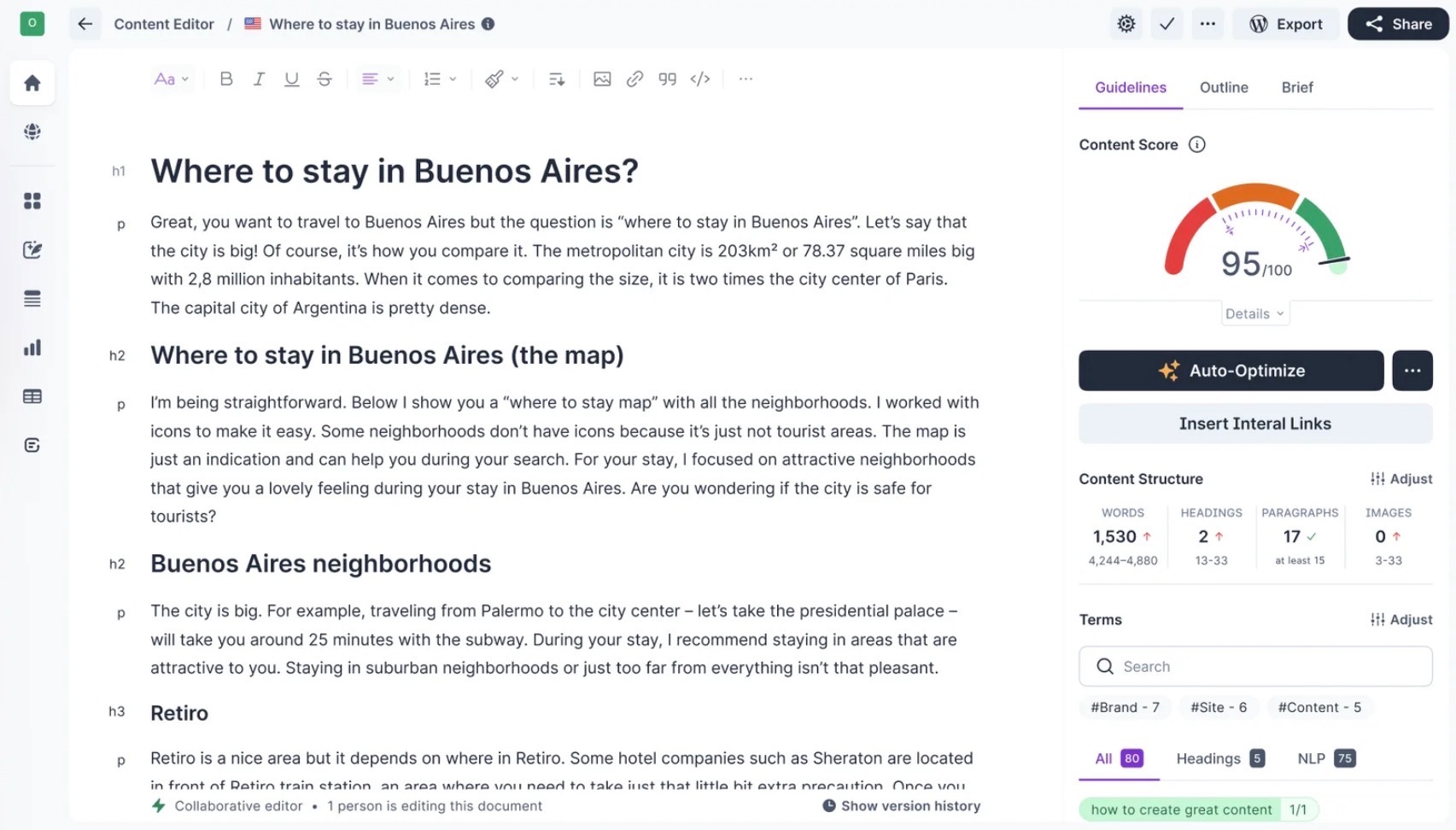
Surfer SEO combines SERP-based content optimization with keyword research, content auditing, internal linking, and AI visibility tracking. Its Content Editor provides live recommendations for terms, structure, word count, and topical coverage.
Key capabilities
- Content Editor with real-time Content Scores
- Keyword Research and Topical Map
- SERP Analyzer and content gap analysis
- Content Audit and ranking-drop alerts
- Auto-Optimize, Surfy, Humanizer, and plagiarism checking
- Internal linking and cannibalization reports
- AI visibility tracking across ChatGPT, Perplexity, Gemini, Google AI Mode, and AI Overviews
- WordPress, Google Docs, Contentful, and Zapier integrations
Why choose it over MarketMuse?
In a MarketMuse vs Surfer SEO comparison, Surfer provides a more hands-on workflow for optimizing individual pages. Writers receive real-time guidance and can apply recommendations directly within the editor.
Surfer also connects content optimization with AI visibility data. Depending on the plan, teams can track mention gaps, sentiment, citations, Visibility Score, and competitor Share of Voice across supported AI platforms.
Where it falls short
- MarketMuse provides deeper site-level topic modeling, content prioritization, and personalized difficulty metrics.
- Discovery does not include keyword research, Topical Map, Content Audit, SERP Analyzer, or AI prompt tracking.
- AI tracking is plan-dependent. Standard tracks 25 prompts in ChatGPT weekly, while multi-platform daily tracking starts with Pro.
Pricing
- Discovery: $59/month or $49/month billed annually
- Standard: $119/month or $99/month billed annually
- Pro: $219/month or $182/month billed annually
- Peace of Mind: $359/month or $299/month billed annually
- Enterprise: From $999/month
- New accounts receive a 7-day trial of the Pro plan
Who should use it?
Surfer suits writers, SEO teams, and agencies that want detailed page-level optimization with built-in AI visibility tracking. Teams focused primarily on portfolio-level planning and content prioritization may prefer MarketMuse.
Want to know whether its optimization and AI tracking justify the cost? Read our Surfer SEO review for 2026.
5. AccuRanker - Best for high-volume rank tracking and SERP reporting (G2: 4.8/5 from 233 reviews)
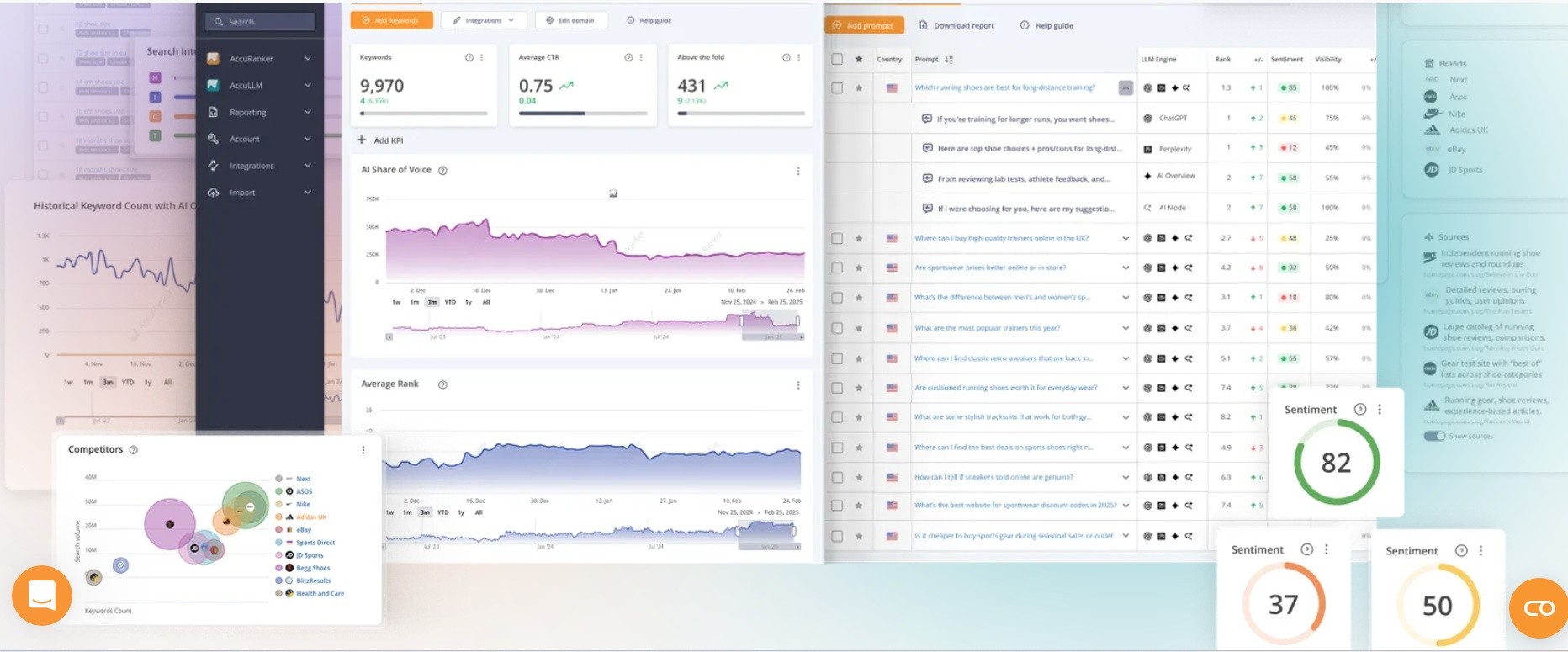
AccuRanker is a dedicated rank-tracking platform for monitoring keyword positions, SERP features, competitors, and organic Share of Voice. Its AccuLLM product extends this reporting to AI-generated answers.
Key capabilities
- Daily keyword ranking updates
- On-demand domain refreshes every 2 hours
- Local and country-level rank tracking
- Pixel position, CTR, and AI Share of Voice metrics
- SERP feature and competitor monitoring
- Keyword tagging, filtering, and search intent classification
- Automated reports, forecasting, and data exports
- AccuLLM tracking for ChatGPT, Perplexity, AI Overviews, and AI Mode
- Brand mentions, citations, sentiment, and AI competitor benchmarking
Why choose it over MarketMuse?
For teams comparing AccuRanker vs MarketMuse, AccuRanker is the stronger choice when accurate rank tracking and performance reporting are the priorities. It provides daily movement data, granular SERP analysis, scalable keyword monitoring, and scheduled stakeholder reports.
AccuLLM also helps teams measure brand visibility, citations, sentiment, and competitor performance across supported AI search experiences.
Where it falls short
- AccuRanker does not provide content briefs, content scoring, AI writing, or page-level optimization recommendations.
- It does not replace a broader SEO platform for backlink analysis or technical site audits.
- The entry plan starts at 2,000 keywords, making it expensive for smaller sites with limited tracking needs.
- AccuLLM is presented as a separate product, so the core AccuRanker subscription should not be assumed to include AI prompt tracking.
Pricing
- Professional: From $249/month or $224/month billed annually for 2,000 keywords
- Expert: From $849/month or $764/month billed annually for 10,000 keywords
- Enterprise: Custom pricing for more than 25,000 keywords
- Annual billing provides a 10% discount
- AccuLLM pricing is listed separately based on prompt requirements
Who should use it?
AccuRanker suits agencies, consultants, and in-house SEO teams managing large keyword portfolios across multiple markets. It works as a complementary measurement platform rather than a direct replacement for MarketMuse’s content strategy and optimization capabilities.
Comparing dedicated tracking platforms? Explore the best SEO competitor rank trackers before committing to AccuRanker.
6. Ahrefs - Best for backlink analysis, SEO research, and AI visibility (G2: 4.5/5 from 713 reviews)
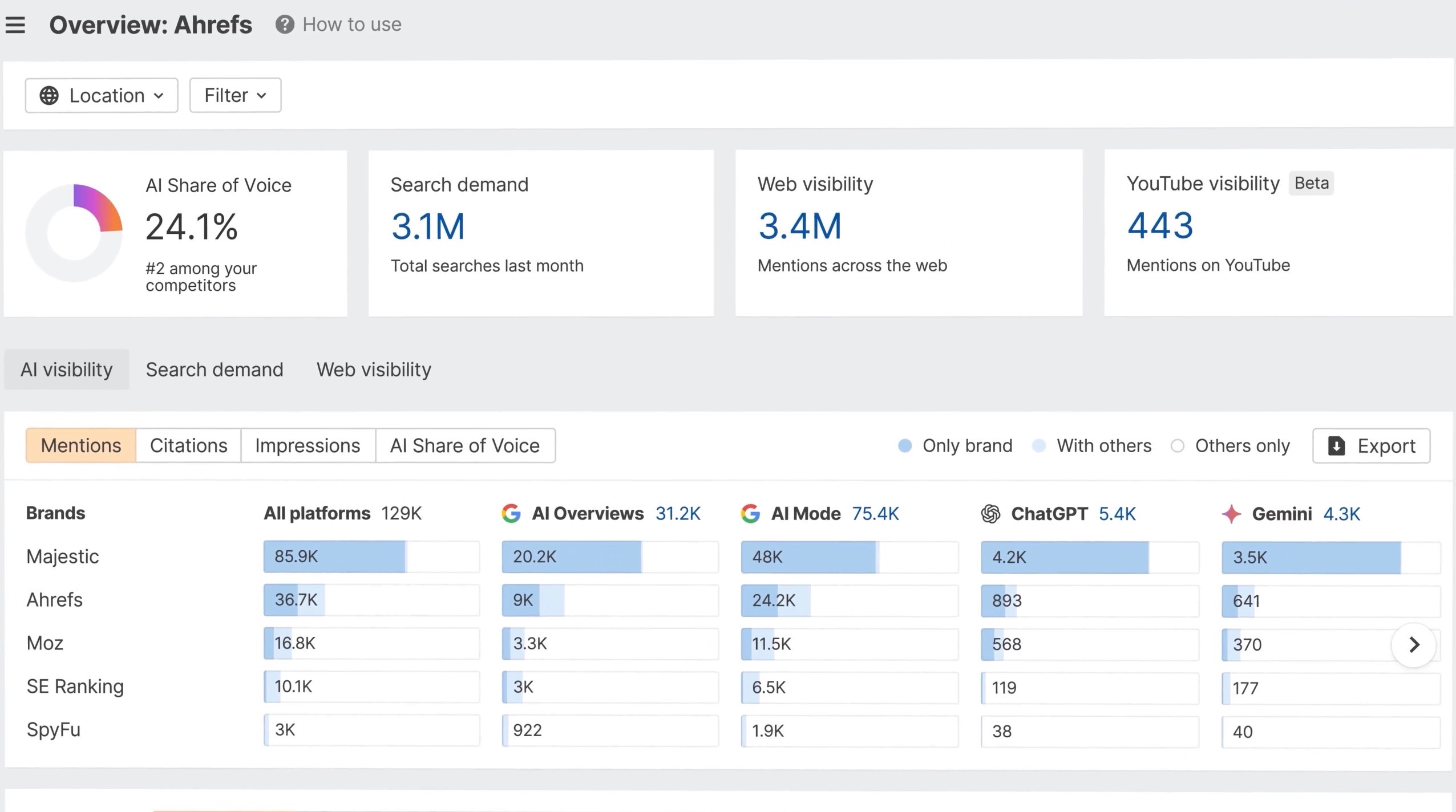
Ahrefs is a broad SEO platform covering keyword research, backlinks, competitor analysis, technical audits, rank tracking, and content research. It now adds AI visibility monitoring through Brand Radar and content optimization through AI Content Helper.
Key capabilities
- Site Explorer for backlink and competitor research
- Keywords Explorer with clustering, intent, and SERP analysis
- Site Audit for technical SEO issues
- Rank Tracker and SERP history
- Content Explorer and content gap analysis
- Brand Radar for AI mentions, citations, and competitor visibility
- Custom prompt tracking with daily updates
- AI Content Helper for search intent and topical coverage
- API and MCP access
Why choose it over MarketMuse?
In an Ahrefs vs MarketMuse comparison, Ahrefs provides broader SEO capabilities. Teams can research keywords, analyze backlinks, audit technical issues, monitor rankings, and evaluate competitors within the same platform.
Brand Radar also tracks visibility across ChatGPT, Perplexity, Gemini, Copilot, Google AI Mode, and AI Overviews. This makes Ahrefs more suitable for teams that need conventional SEO data and AI visibility together.
Where it falls short
- MarketMuse offers deeper content inventory analysis, topic authority modeling, personalized difficulty, and portfolio-level prioritization.
- AI Content Helper is not included in the core plans. It costs $99/month for 50 documents, while the complete Content Kit costs $299/month.
- Lite, Standard, and Advanced include only 1 user. Additional users cost $40, $60, or $80 per month, respectively.
- Rank Tracker updates weekly across standard plans.
Pricing
- Starter: $29/month
- Lite: $129/month
- Standard: $249/month
- Advanced: $449/month
- Enterprise: $1,499/month with an annual commitment
- Annual billing saves up to 17%
- Standalone Brand Radar starts at $199/month
- Ahrefs Free provides limited Site Explorer and Site Audit access
Who should use it?
Ahrefs suits SEO teams and agencies that need backlink data, keyword research, technical auditing, rank tracking, and AI visibility. Teams focused mainly on content planning and portfolio-level optimization may prefer MarketMuse.
Need a closer head-to-head breakdown? See how Ahrefs compares with Scalenut for SEO and AI visibility.
7. AthenaHQ - Best for AI visibility tracking and action-focused GEO workflows (G2: 4.9/5 from 38 reviews)
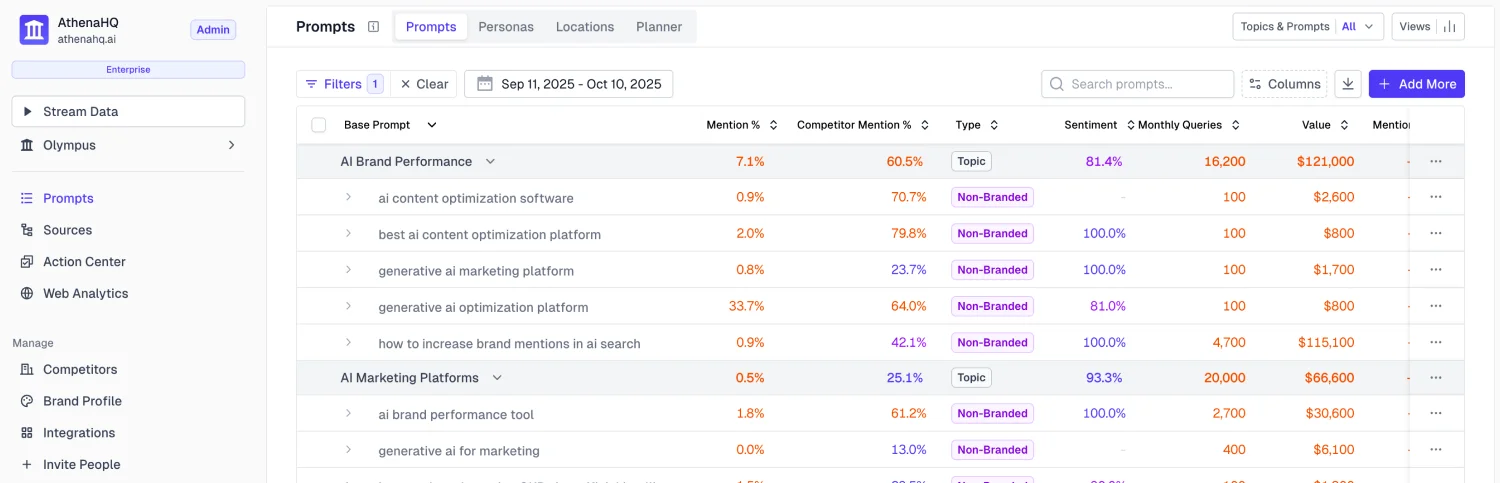
AthenaHQ is an AEO and GEO platform that tracks how brands appear across AI-generated answers. It combines prompt monitoring, competitor analysis, citation intelligence, sentiment, and content recommendations.
Key capabilities
- Visibility tracking across up to 9 AI platforms
- Prompt and response analysis
- Brand sentiment and competitor benchmarking
- Citation and source analysis
- Prompt volume estimation
- On-page and off-page recommendations
- Content optimization agent
- GA4, Google Search Console, Shopify, and Webflow integrations
- Athena AI agent for querying account data
- Unlimited users across plans
Why choose it over MarketMuse?
An AthenaHQ vs MarketMuse comparison comes down to AI visibility versus traditional content intelligence. AthenaHQ provides broader AI-platform monitoring, including ChatGPT, Perplexity, Gemini, Claude, Copilot, Grok, Google AI Mode, and AI Overviews.
It also connects visibility data with citations, sentiment, competitors, and specific on-page or off-page actions. MarketMuse remains better suited to topic modeling, content planning, and prioritizing pages across an existing content library.
Where it falls short
- AthenaHQ does not replace traditional keyword research, rank tracking, technical auditing, or portfolio-level content planning.
- Starter is limited to 3,600 credits, with 1 credit consumed per AI response. Monitoring a prompt across multiple platforms therefore uses multiple credits.
- API access and additional credits cost extra on Starter.
- Multi-region tracking, persona targeting, advanced content optimization, BI integrations, and the Athena Citation Engine are limited to Enterprise.
Pricing
- Essential: Free with 300 credits and 5 AI platforms
- Starter: $295/month with 3,600 credits and visibility across 9 models
- Enterprise: Custom pricing and credit limits
- Annual billing provides a 17% discount
- Starter includes unlimited users, but API access and extra credits are paid add-ons
Who should use it?
AthenaHQ suits brands, agencies, and marketing teams that need multi-platform AI visibility tracking with recommendations for improving mentions and citations. It is less suitable for teams seeking a complete traditional SEO or content-planning platform.
Considering AthenaHQ for a dedicated GEO program? Read our AthenaHQ review covering pricing, capabilities, and limitations.
8. Writesonic - Best for AI content creation and GEO tracking in one platform (G2: 4.7/5 from 2,123 reviews)
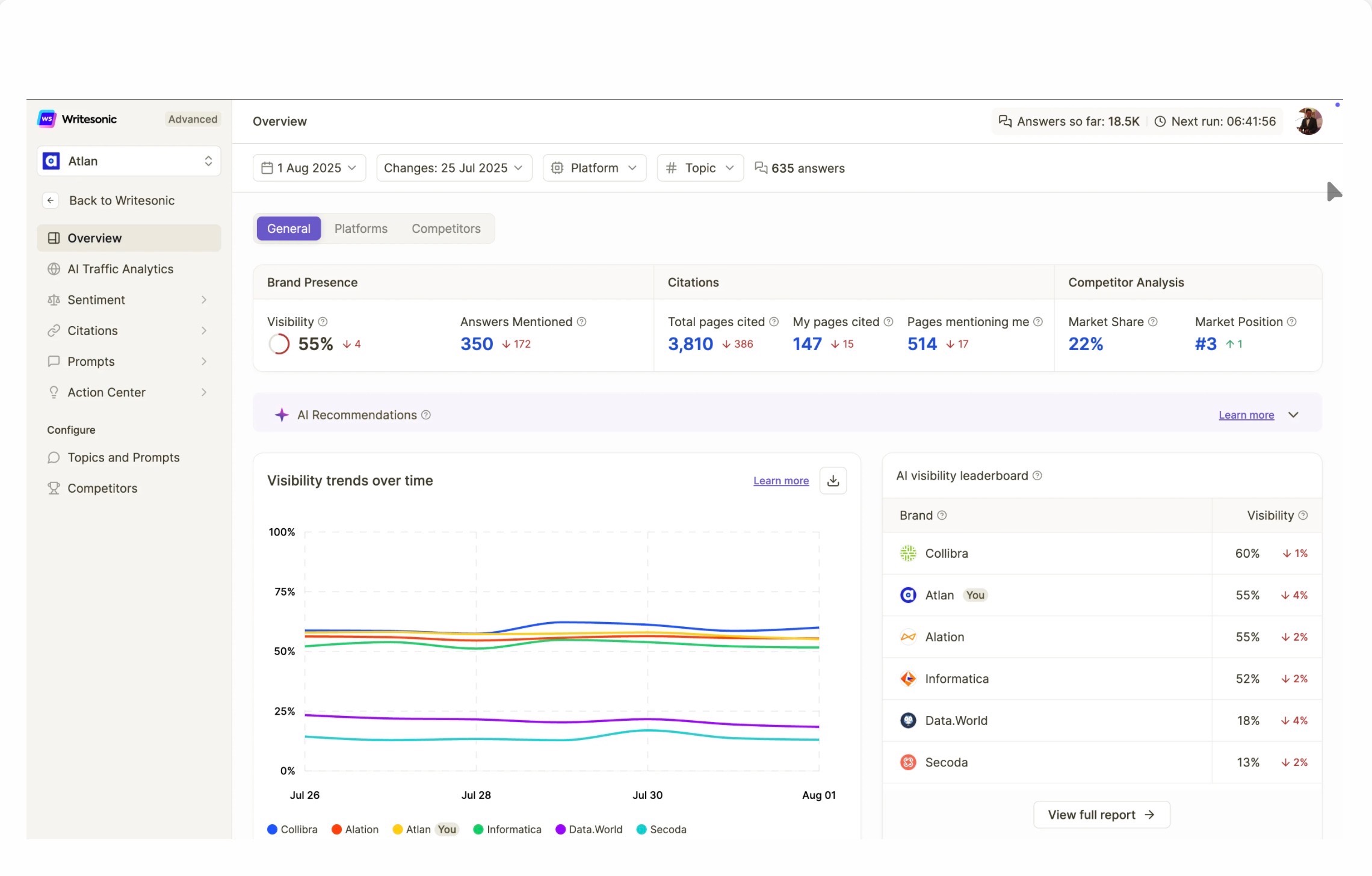
Writesonic combines AI content creation, SEO auditing, AI visibility tracking, and GEO recommendations. Teams can identify visibility gaps, create or refresh content, and monitor the results within the same platform.
Key capabilities
- AI Article Writer with research and internal linking
- SEO content optimization and site audits
- Daily prompt and response tracking
- Brand visibility, citation, and competitor analysis
- AI bot and crawler monitoring
- On-page and off-page recommendations
- Action Center for prioritizing visibility gaps
- Google Analytics, Google Search Console, WordPress, Looker Studio, API, and MCP integrations
Why choose it over MarketMuse?
Writesonic provides a more execution-focused workflow. Teams can move from AI visibility analysis to content creation, page refreshes, technical fixes, and citation outreach without relying on separate tools.
Its self-serve plans also include AI articles, site audits, and daily tracking across ChatGPT, Gemini, and Google AI Overviews. Enterprise expands monitoring to 10 AI platforms.
Where it falls short
- MarketMuse provides deeper portfolio-level planning through Topic Authority, Personalized Difficulty, Competitive Advantage, and Potential Value.
- Starter, Basic, and Growth track only ChatGPT, Gemini, and Google AI Overviews. Perplexity, Claude, AI Mode, Copilot, Grok, DeepSeek, and Meta AI require Enterprise.
- Sentiment analysis starts with Growth, while full Action Center access is limited to Enterprise.
- Self-serve plans have tight user and project limits. Growth includes 3 users and 2 projects.
Pricing
- Starter: $99/month or $79/month billed annually
- Basic: $249/month or $199/month billed annually
- Growth: $499/month or $399/month billed annually
- Enterprise: Custom pricing
- A 7-day free trial is available without a credit card
Who should use it?
Writesonic suits content and growth teams that want AI content production, SEO auditing, and GEO monitoring in one workflow. Teams focused primarily on advanced content planning and portfolio prioritization may prefer MarketMuse.
Want to know whether its combined content and GEO workflow delivers enough value? Read our complete Writesonic review.
9. seoClarity - Best for enterprise SEO, technical optimization, and AI search intelligence (G2: 4.5/5 from 215 reviews)
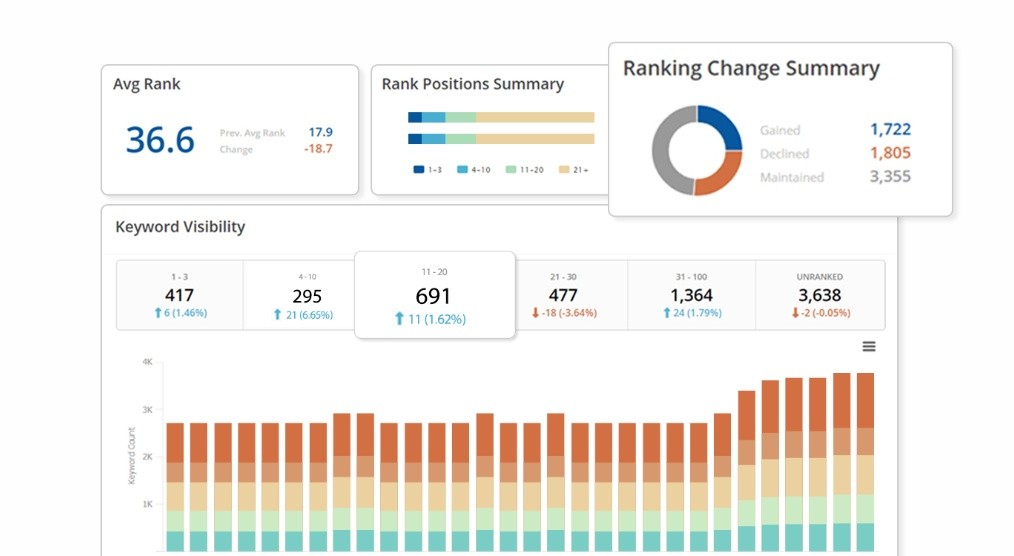
seoClarity is an enterprise SEO and AEO platform covering keyword research, rankings, technical SEO, content optimization, reporting, and AI visibility. It is built for large sites managing multiple domains, markets, and teams.
Key capabilities
- Daily or weekly enterprise rank tracking
- Keyword, competitor, and content gap research
- Technical crawling, log-file analysis, and page-speed monitoring
- Content Fusion briefs and optimization recommendations
- Content Guard for monitoring page changes
- ArcAI tracking for mentions, citations, sentiment, and competitors
- AI visibility tracking across 9 supported platforms
- ClarityAutomate for schema, page, link, and SEO changes
- APIs, MCP, BI tools, and enterprise data integrations
Why choose it over MarketMuse?
seoClarity covers a wider enterprise SEO workflow. It combines rank tracking, technical auditing, content optimization, analytics, reporting, AI visibility, and optional no-code SEO execution.
ArcAI tracks AI search performance across ChatGPT, Gemini, Perplexity, Claude, Copilot, DeepSeek, Grok, Google AI Mode, and AI Overviews. MarketMuse remains more specialized in content inventory analysis, topical authority, and portfolio prioritization.
Where it falls short
- seoClarity is significantly more expensive than most MarketMuse competitors and requires a custom sales process.
- Its breadth creates a steeper learning curve. G2 users frequently mention interface complexity, data overload, and the need for onboarding.
- ArcAI visibility is updated weekly by default. Daily tracking is available but depends on the package.
- ClarityAutomate and some advanced execution capabilities are optional add-ons.
Pricing
- Rankings: Custom pricing with a minimum of 2,000 keyword queries
- Research & Content: Starts at $2,500/month
- Technical SEO: Starts at $3,200/month
- Enterprise: Starts at $4,500/month
- Final pricing depends on tracked domains, keywords, integrations, and services
Who should use it?
seoClarity suits enterprise brands, publishers, and agencies managing complex websites across multiple markets. Smaller teams that only need content planning or optimization are unlikely to justify its cost and implementation requirements.
Evaluating an enterprise rollout? Review our seoClarity pricing, capabilities, and implementation verdict.
Which MarketMuse alternative should you choose?
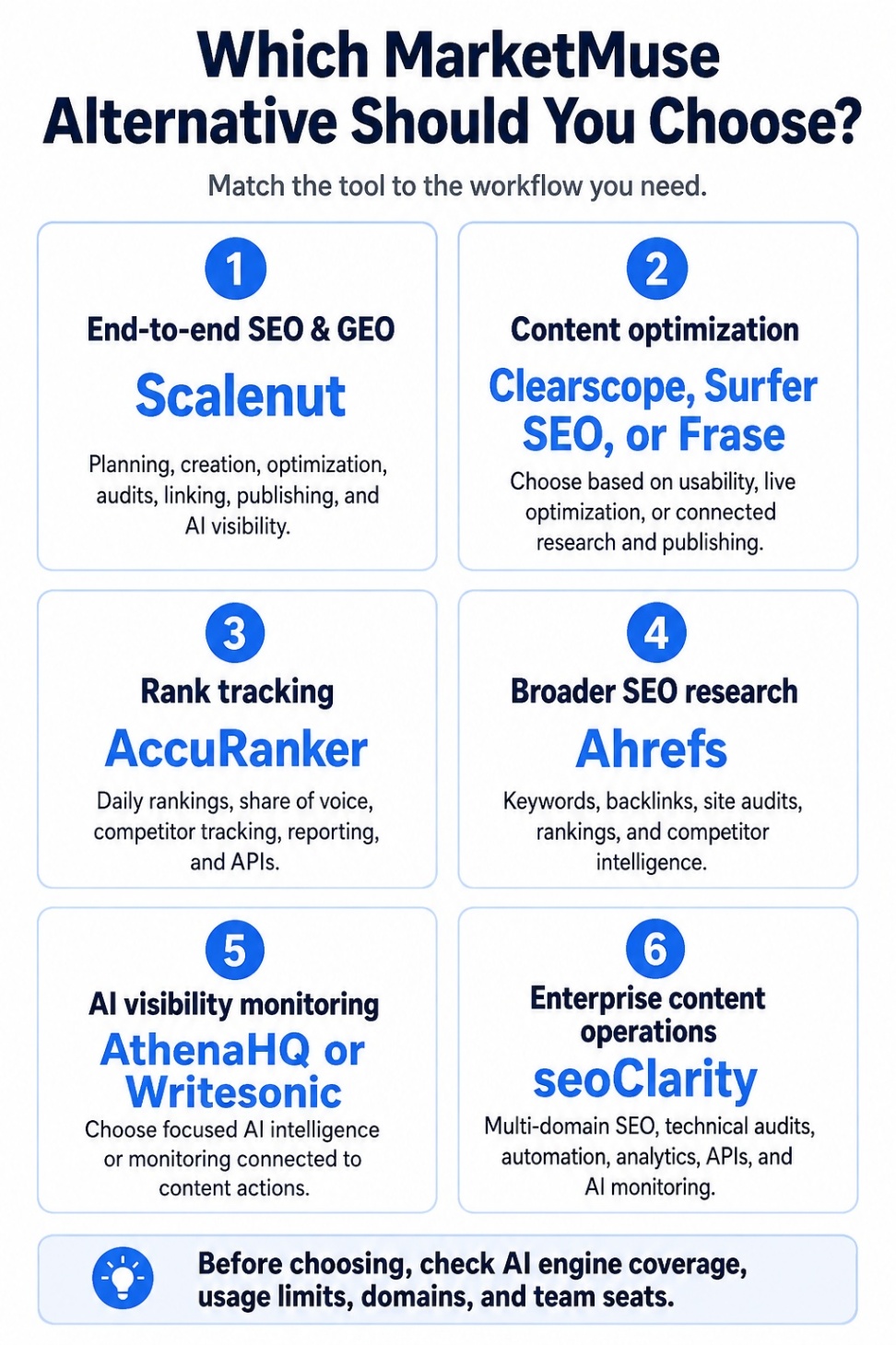
The right choice depends on the workflow you need to improve, the depth of data required, and your budget. A specialized platform may offer better value when you only need one core capability.
Here are the best-fit tools for 6 common use cases:
1. End-to-end SEO and GEO execution: Choose Scalenut if you want planning, content creation, optimization, audits, internal linking, publishing, and AI visibility tracking in one workflow. Perplexity tracking requires the Professional plan, so confirm the platform coverage you need.
2. Content optimization: Choose Clearscope for usability and collaboration, Surfer SEO for live optimization and on-page automation, or Frase for a workflow that connects SERP research, drafting, auditing, and publishing.
3. Rank tracking: Choose AccuRanker for daily rank updates, share-of-voice metrics, competitor tracking, reporting, and API access. AccuLLM adds AI mentions, citations, and sentiment tracking, but its pricing is available through a demo.
4. Broader SEO research: Choose Ahrefs if keyword research, backlink analysis, site audits, rank tracking, and competitor intelligence are your priorities. Its complete Brand Radar AI platform starts separately at $199 per month.
5. AI visibility monitoring: Choose AthenaHQ for focused prompt, citation, source, competitor, and sentiment intelligence. Choose Writesonic when daily monitoring also needs to connect with AI content, site audits, and recommended actions.
6. Enterprise content operations: Choose seoClarity for multi-domain rank tracking, technical SEO, content optimization, automation, analytics, APIs, and AI search monitoring. Its pricing and implementation model make it better suited to large organizations.
Before choosing, confirm the plan includes the required AI engines, usage limits, domains, and team seats, as these factors can significantly change the actual cost.
Need a wider shortlist before deciding? Compare the best AI tools for SEO and AEO in 2026 by workflow and use case.
Conclusion
Choose a MarketMuse alternative based on the biggest gap in your content creation process. When testing an optimization tool, assess how its artificial intelligence and machine learning capabilities improve content quality, streamline execution, and support visibility in search engine results.
Shortlist 2 content tools and test each on 1 existing article and 1 new brief. Compare setup time, output quality, team effort, and changes in search engine rankings, then choose the platform that delivers the clearest gains without adding unnecessary complexity.
Frequently asked questions
What is the best MarketMuse alternative in 2026?
Scalenut is the strongest overall option for teams wanting SEO and GEO execution in one workflow. It combines keyword planning, content creation, optimization, auditing, internal linking, AI visibility tracking, and publishing, while MarketMuse remains stronger for proprietary content intelligence.
Is there a free alternative to MarketMuse?
No tool in this list provides a complete MarketMuse replacement for free. MarketMuse itself offers a limited free plan with 10 monthly queries. Most alternatives provide free trials, limited checkers, or restricted features before requiring a paid subscription.
Which MarketMuse alternative is best for SEO and GEO?
Scalenut is best suited to teams that want traditional SEO and GEO in the same platform. It connects keyword planning, content production, on-page optimization, prompt and citation tracking, competitor monitoring, AI traffic analysis, and publishing within one workflow.
Is MarketMuse or Frase better for content teams?
MarketMuse is better for site-level topic modeling, personalized difficulty, and strategic content prioritization. Frase is better for faster execution because it combines SERP research, brief creation, AI drafting, live SEO and GEO scoring, site audits, and CMS publishing.
How do MarketMuse, Clearscope, and Surfer SEO differ?
MarketMuse focuses on site-level planning and proprietary topic intelligence. Clearscope prioritizes writer-friendly content grading, term recommendations, and inventory monitoring. Surfer SEO focuses on real-time optimization, automated refreshes, content audits, and performance tracking for individual pages.
Can Ahrefs completely replace MarketMuse?
Ahrefs can replace MarketMuse when your priority is keyword research, backlink analysis, competitor intelligence, site auditing, rank tracking, and AI brand visibility. It does not replicate MarketMuse’s proprietary Topic Authority, Personalized Difficulty, or portfolio-level content planning metrics.
Does MarketMuse track visibility across AI search platforms?
MarketMuse’s public product pages emphasize topic modeling, content inventory, briefs, competitor analysis, and optimization. They do not currently list dedicated cross-platform tracking for prompts, mentions, citations, or sentiment across ChatGPT, Gemini, Perplexity, and similar AI platforms.
Which MarketMuse alternative is best for rank tracking?
AccuRanker is the strongest choice for dedicated rank tracking. It provides daily and on-demand keyword updates, pixel-position data, SERP feature monitoring, AI Overview tracking, competitor analysis, and AccuLLM for measuring visibility across AI-generated answers over time.
Is MarketMuse worth the cost for small content teams?
MarketMuse can justify its cost when a team regularly uses content inventory, Topic Authority, Personalized Difficulty, competitive analysis, and strategic briefs. Smaller teams focused on writing and optimization should compare workflow coverage, query limits, user seats, and pricing first.
Which MarketMuse alternative is best for enterprise SEO?
seoClarity is the strongest option for large enterprises needing rank intelligence, technical SEO, content optimization, automation, competitive research, and AI search visibility at scale. MarketMuse remains preferable when the primary requirement is deep content planning rather than broader enterprise SEO operations.


.svg)


.webp)