Quick summary
- ChatGPT currently uses multiple OpenAI models, not one universal model. Its standard experience primarily runs on the GPT-5.6 family, with GPT-6 options available to eligible users.
- Free and Go users default to GPT-5.6 Luna, OpenAI’s fastest model in the GPT-5.6 family.
- Eligible paid users use GPT-5.6 Sol, the flagship GPT-5.6 model for complex work such as coding, research, science, and knowledge tasks.
- Higher-tier users can access Pro models, including GPT-5.6 Sol Pro and GPT-6 Pro, powered by GPT-6 Astra, depending on their plan.
- ChatGPT and the OpenAI API do not offer identical model access. Models such as GPT-5.6 Terra are available through products like ChatGPT Work, Codex, and the API rather than standard ChatGPT conversations.
ChatGPT is no longer powered by one AI model. Depending on your plan and the reasoning level you choose, your conversation may run on GPT-5.6 Luna, GPT-5.6 Sol, a Pro model, or GPT-6 Pro.
That makes the question “What AI model does ChatGPT use?” more complicated than it was a few years ago. This guide breaks down the current ChatGPT model lineup, which models different users get, how the lineup has evolved since GPT-3.5, and which option makes the most sense for different types of tasks.
What AI model does ChatGPT use currently?
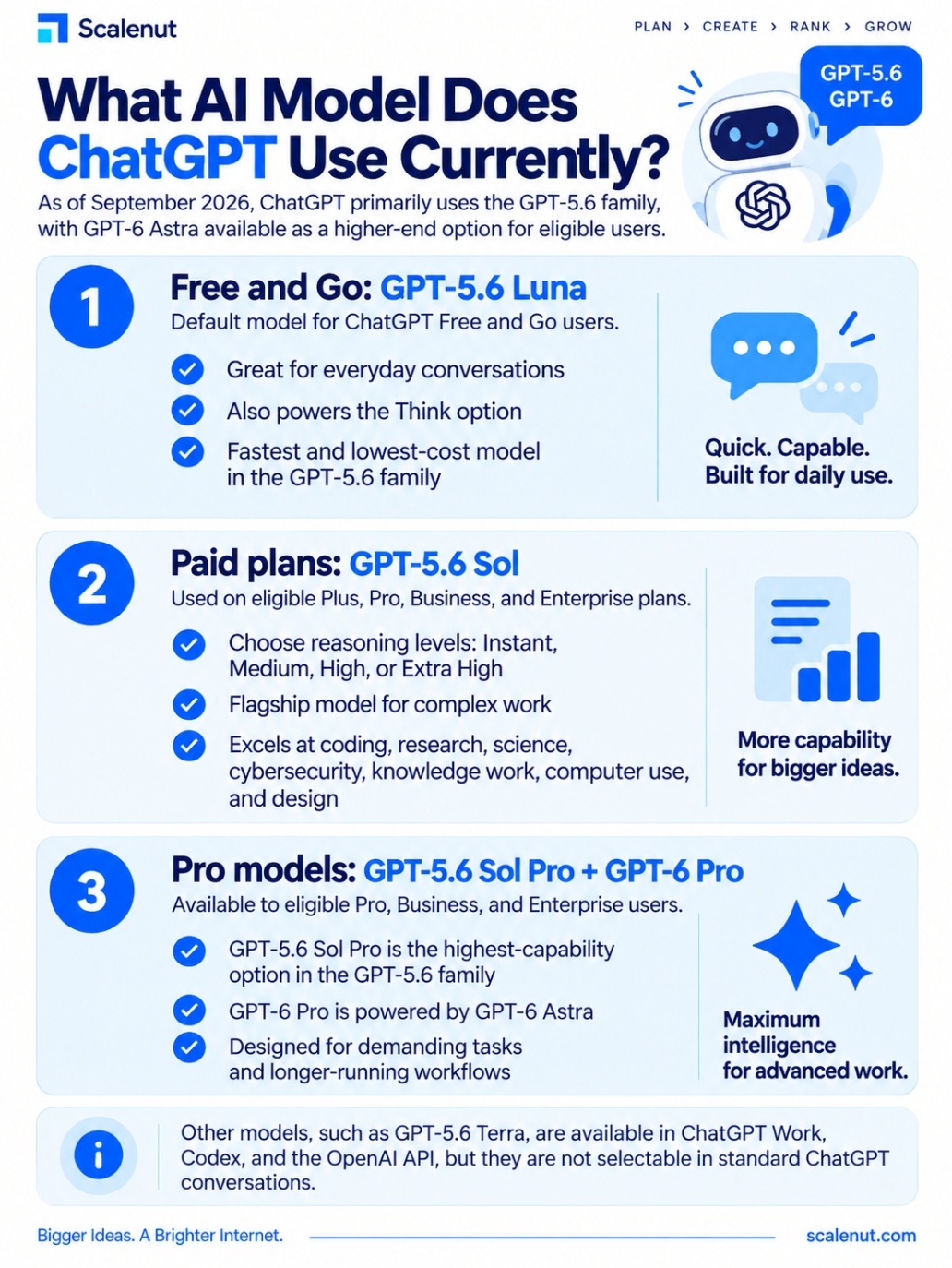
As of September 2026, ChatGPT primarily uses models from OpenAI's GPT-5.6 family, with GPT-6 Astra available as a higher-end option for eligible users. In standard ChatGPT conversations, Free and Go users use GPT-5.6 Luna, while eligible paid users get GPT-5.6 Sol. Pro-level users may also have access to GPT-5.6 Sol Pro and GPT-6 Pro, which is powered by GPT-6 Astra.
Here is how the current ChatGPT model lineup breaks down:
1. Free and Go: GPT-5.6 Luna
GPT-5.6 Luna is the default model for ChatGPT Free and Go users. It powers everyday conversations as well as the Think option for questions that require more reasoning.
Luna is the fastest and lowest-cost model in the GPT-5.6 family, designed to provide capable responses while keeping ChatGPT responsive for everyday use.
2. Paid plans: GPT-5.6 Sol
GPT-5.6 Sol powers standard ChatGPT on eligible paid plans, including Plus, Pro, Business, and Enterprise.
Depending on the plan, users can choose reasoning levels such as Instant, Medium, High, and Extra High. These settings adjust how much reasoning Sol applies rather than switching to a completely different underlying model.
OpenAI positions Sol as the flagship GPT-5.6 model for complex work across coding, research, science, cybersecurity, knowledge work, computer use, and design.
3. Pro models: GPT-5.6 Sol Pro and GPT-6 Pro
For more demanding tasks, eligible users can access Pro models.
GPT-5.6 Sol Pro is the highest-capability option in the GPT-5.6 family. Eligible Pro, Business, and Enterprise users can also access GPT-6 Pro, powered by GPT-6 Astra, for difficult tasks and longer-running workflows.
Other GPT-5.6 models, such as Terra, are available in products including ChatGPT Work, Codex, and the OpenAI API, but Terra is not selectable in standard ChatGPT conversations.
ChatGPT model evolution timeline (2022–2026)
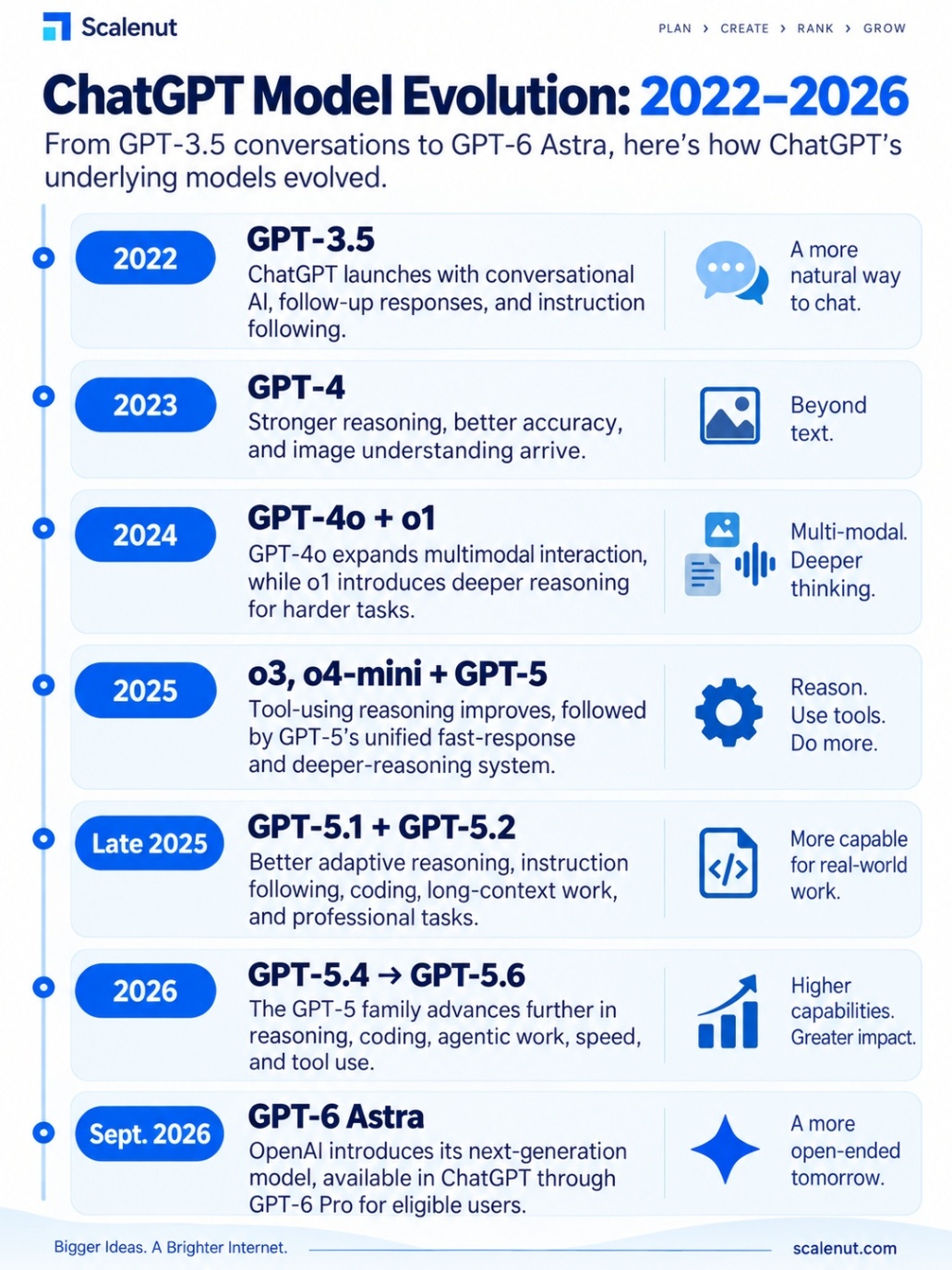
ChatGPT has gone through several major model generations since its launch in 2022. The progression has not been completely linear. Alongside the GPT series, OpenAI also introduced the o-series of reasoning models, which helped shape the deeper reasoning capabilities later integrated into GPT-5 and subsequent models.
Here are the major milestones in ChatGPT's model evolution:
2022: GPT-3.5 launches ChatGPT
ChatGPT launched in November 2022 using a model from the GPT-3.5 series.
- Established the conversational format that made ChatGPT widely accessible.
- Could answer follow-up questions, follow instructions, and maintain context across a conversation.
- Used reinforcement learning from human feedback (RLHF) to improve conversational behavior.
2023: GPT-4 brings stronger reasoning and multimodal capabilities
OpenAI added GPT-4 to ChatGPT Plus in March 2023.
- Improved reasoning, instruction following, and accuracy over GPT-3.5.
- Could handle more complex academic and professional tasks.
- Introduced multimodal capabilities, with GPT-4 able to accept both text and image generation inputs.
2024: GPT-4o and the o1 reasoning series
In May 2024, OpenAI introduced GPT-4o, with the "o" standing for "omni."
- Improved speed while supporting text, vision, and audio interactions.
- Made more advanced ChatGPT capabilities available to free users.
- Enabled more natural multimodal interactions across different types of input.
Later that year, OpenAI introduced o1, a separate model series designed to spend more time reasoning before answering. This marked an important shift toward models built specifically for harder problems in areas such as math, science, and coding.
2025: o3, o4-mini, and the GPT-5 generation
OpenAI continued developing its reasoning models in 2025 with o3 and o4-mini. These models could combine deeper reasoning with ChatGPT tools such as web search, file analysis, Python, and visual understanding.
The bigger shift came in August with GPT-5. Instead of making users choose between a fast model and a reasoning model for every task, GPT-5 introduced a unified system that could decide when to answer quickly and when to apply deeper reasoning.
OpenAI followed GPT-5 with rapid updates:
- GPT-5.1 improved adaptive reasoning and instruction following.
- GPT-5.2, released in December 2025, focused heavily on professional knowledge work, long-context tasks, coding, tool use, and multi-step projects.
2026: GPT-5.4, GPT-5.5, and the GPT-5.6 family
OpenAI accelerated the GPT-5 series further in 2026.
GPT-5.4, released in March, strengthened reasoning, coding, tool use, and professional workflows. GPT-5.5 followed in April with stronger agentic capabilities, allowing the model to work more independently across coding, research, data analysis, documents, and software tools.
In July, OpenAI introduced the GPT-5.6 family, consisting of:
- Sol, the flagship model for complex work.
- Terra, designed to balance capability, speed, and cost.
- Luna, the fastest and most affordable model in the family.
GPT-5.6 now forms the foundation of much of the current ChatGPT experience, although the exact model available depends on the user's plan and the ChatGPT product being used.
September 2026: GPT-6 Astra arrives
In September 2026, OpenAI introduced GPT-6 Astra, its next major model generation.
Astra is designed for demanding end-to-end work across areas such as reasoning, code generation, deep research, computer use, science, cybersecurity, and professional tasks. In standard ChatGPT, eligible users can access Astra through GPT-6 Pro, while availability across ChatGPT Work, Codex, and the API varies by plan.
This means ChatGPT's evolution is no longer simply a sequence of one model replacing another. The platform now uses a broader model lineup, with different models optimized for everyday conversations, deeper reasoning, professional work, speed, and advanced tasks.
What do ChatGPT's Instant, Medium, High, Extra High, and Pro options mean?
ChatGPT's Instant, Medium, High, and Extra High options control how much reasoning the model applies to a task. On eligible paid plans, they are powered by GPT-5.6 Sol rather than separate GPT models.
- Instant: Fast responses for everyday questions and straightforward tasks.
- Medium: Standard reasoning for tasks that need more thought.
- High: Extended reasoning for more complex questions and analysis.
- Extra High: The highest reasoning level available with GPT-5.6 Sol.
- Pro: Uses higher-capability models, including GPT-5.6 Sol Pro and, on eligible plans, GPT-6 Pro, for difficult and longer-running tasks.
Free and Go users follow a slightly different setup. Their default model is GPT-5.6 Luna, and selecting Think gives Luna more reasoning effort for harder questions.
So, choosing a higher reasoning level does not necessarily mean switching to a newer GPT generation. It primarily changes how much processing and reasoning ChatGPT applies before responding.
Can you still use older ChatGPT models like GPT-4o and GPT-5.2?
In most cases, no. OpenAI retired GPT-4o, GPT-4.1, GPT-4.1 mini, o4-mini, and the original GPT-5 models from ChatGPT on February 13, 2026. GPT-5.1 followed on March 11, and GPT-5.2 Instant, Thinking, and Pro were retired from ChatGPT on June 12, 2026.
Retirement from ChatGPT does not always mean a model disappears everywhere. Some older models can remain available through the OpenAI API even after they are removed from the ChatGPT interface, so ChatGPT model availability and API model availability should be treated separately.
Does ChatGPT use the same models as the OpenAI API?
Not exactly. ChatGPT and the OpenAI API can use some of the same underlying models, but they offer different model access and are designed for different ways of using AI.
ChatGPT is the user-facing application. OpenAI automatically provides models based on your plan and the ChatGPT experience you are using. For example, Free and Go users currently use GPT-5.6 Luna, while eligible paid users get GPT-5.6 Sol. Some higher-tier plans also provide GPT-6 Pro, powered by GPT-6 Astra.
The OpenAI API is built for developers who want to integrate OpenAI models into their own apps, products, and workflows. Its current flagship lineup includes:
- GPT-6 Astra for the hardest end-to-end work.
- GPT-5.6 Sol for complex professional and reasoning tasks.
- GPT-5.6 Terra for balancing capability and cost.
- GPT-5.6 Luna for faster, lower-cost, high-volume workloads.
This gives developers more direct control over which model they use based on factors such as capability, speed, and cost.
So, while ChatGPT and the API share parts of the same model family, the models available and how you access them are not identical.
Which ChatGPT model should you use?
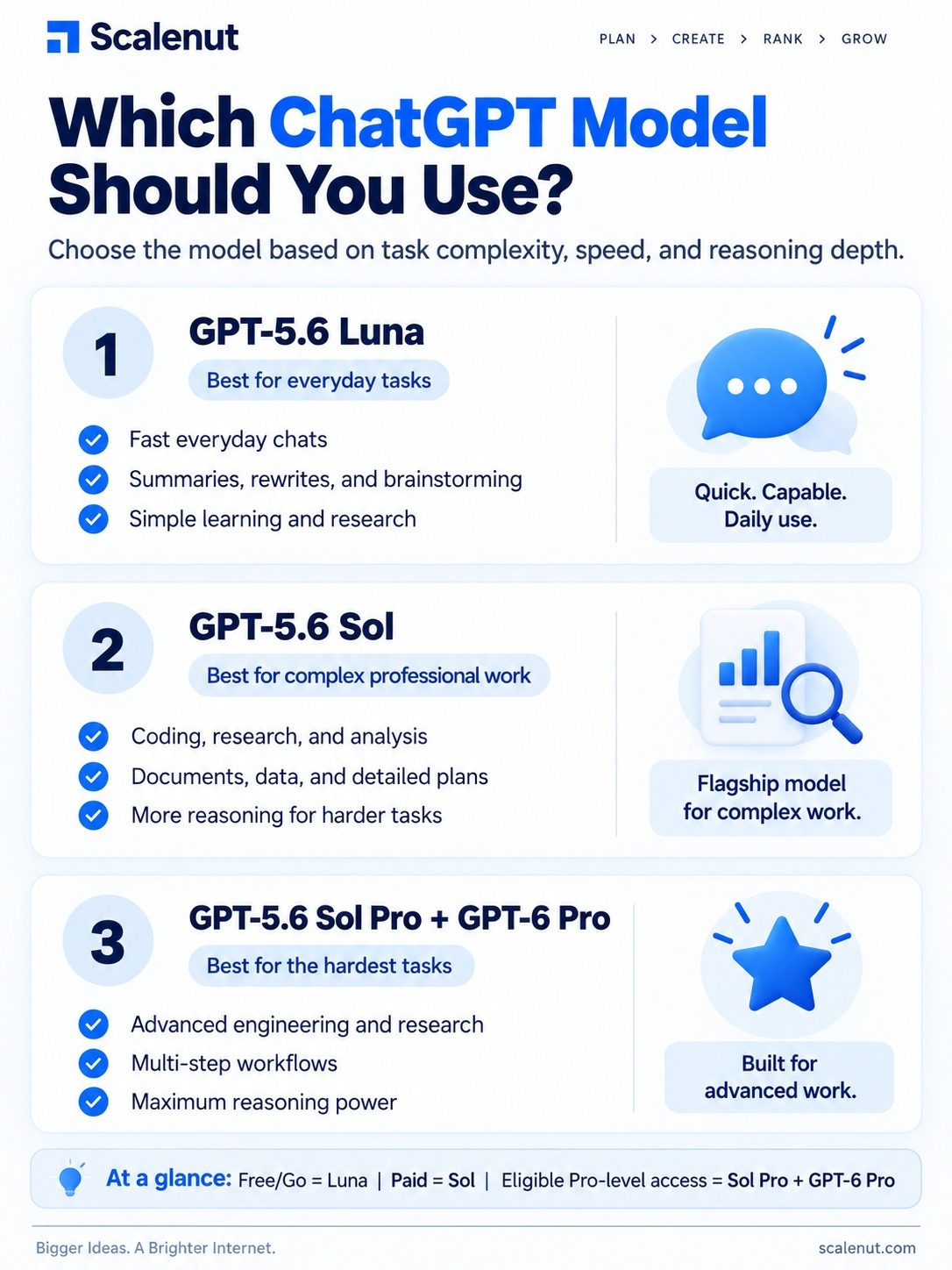
The best ChatGPT model depends less on your use case, profession and more on how complex the task is and how much reasoning it requires. OpenAI's current lineup ranges from faster models for everyday questions to Pro models designed for demanding, longer-running work.
1. GPT-5.6 Luna for everyday tasks
For Free and Go users, GPT-5.6 Luna is designed for fast, everyday ChatGPT use.
It is well suited for tasks such as:
- Answering general questions.
- Summarizing and rewriting text.
- Brainstorming ideas.
- Drafting emails and simple content.
- Getting help with everyday learning or research.
Free and Go users can also select Think when a question requires more reasoning. Think still uses GPT-5.6 Luna but allows it to spend more effort on the response.
2. GPT-5.6 Sol for complex professional work
GPT-5.6 Sol is the flagship GPT-5.6 model available on eligible paid plans. It is better suited to different tasks that require deeper reasoning, more complex analysis, or sustained professional work.
Examples include:
- Writing and debugging code.
- Analyzing documents and data.
- Conducting research.
- Working through complex technical or scientific questions.
- Creating detailed strategies, reports, and plans.
- Using tools such as web search, file analysis, and computer use.
Paid users can also adjust Sol's reasoning level from Instant through higher reasoning modes, depending on their plan.
3. GPT-5.6 Sol Pro and GPT-6 Pro for the hardest tasks
For particularly difficult or longer-running work, eligible users can choose a Pro model.
GPT-5.6 Sol Pro is the highest-capability option within the GPT-5.6 family, while GPT-6 Pro, powered by GPT-6 Astra, provides access to OpenAI's newer flagship generation on eligible plans.
These models are better suited to demanding tasks such as:
- Complex coding and software engineering.
- Advanced research and scientific analysis.
- Multi-step professional workflows.
- Cybersecurity and technical problem-solving.
- Specific tasks requiring extensive reasoning across many steps.
For most everyday questions, however, you do not necessarily need the highest-capability model. ChatGPT's current model options are designed to let users balance speed and reasoning depth based on the task.
Conclusion
ChatGPT no longer runs on one universal artificial intelligence model. In 2026, it primarily uses GPT-5.6 Luna for Free and Go users, GPT-5.6 Sol for eligible paid plans, and Pro models such as GPT-5.6 Sol Pro and the new model GPT-6 Pro for more demanding work. Understanding these differences helps you choose the right reasoning level and model for the task instead of assuming every ChatGPT conversation uses the same underlying AI.
Frequently asked questions
What type of AI model does ChatGPT use in 2026?
As of September 2026, ChatGPT primarily uses OpenAI’s GPT-5.6 family. Free and Go users default to GPT-5.6 Luna, eligible paid users get GPT-5.6 Sol, and some Pro-level plans can access GPT-5.6 Sol Pro or GPT-6 Pro.
How do I know which ChatGPT model I'm using?
Check the model picker or reasoning controls shown in your ChatGPT account. Free and Go users default to GPT-5.6 Luna, while eligible paid users can use GPT-5.6 Sol reasoning levels. Pro-level access may also include GPT-5.6 Sol Pro or GPT-6 Pro.
What model does free ChatGPT use?
Free and Go users currently default to GPT-5.6 Luna. It handles everyday ChatGPT conversations and also powers the Think option for harder questions. These plans do not include GPT-5.6 Sol, which is reserved for eligible paid ChatGPT plans.
Does ChatGPT use GPT-6?
Yes, but only for eligible users. GPT-6 Astra is available in standard ChatGPT through GPT-6 Pro on eligible Pro, Business, and Enterprise plans. Other users primarily interact with GPT-5.6 Luna or GPT-5.6 Sol, depending on their plan and available reasoning options.
Is ChatGPT an AI model or an application?
ChatGPT is an AI application, not a single model. It uses underlying OpenAI models to interpret prompts and generate responses. In 2026, those models include GPT-5.6 Luna, GPT-5.6 Sol, GPT-5.6 Sol Pro, and GPT-6 Pro on eligible plans.
Does ChatGPT use the same models as the OpenAI API?
Not exactly. ChatGPT and the OpenAI API share some underlying models, but access differs. The API offers GPT-5.6 Sol, Terra, and Luna directly to developers, while standard ChatGPT assigns models and reasoning options according to the user’s plan and product experience.
Can I still use older ChatGPT models like GPT-4o and GPT-5.2?
Most older ChatGPT large language models are no longer selectable in standard ChatGPT. GPT-4o and several other models were retired in February 2026, followed by GPT-5.1 and GPT-5.2 later that year. Some retired ChatGPT models can remain available through the OpenAI API.
Which was the first ChatGPT model ever?
The first model of ChatGPT launched on November 30, 2022, using a model from OpenAI’s GPT-3.5 series. OpenAI described it as a conversational model fine-tuned from GPT-3.5 using reinforcement learning from human feedback (RLHF).
Which is the most expensive ChatGPT model?
ChatGPT models are not priced individually. However, GPT-6 Pro, powered by GPT-6 Astra, is the highest-tier model available in standard ChatGPT and requires eligible Pro, Business, or Enterprise access. API pricing for GPT-6 Astra is $10 per million input tokens and $50 per million output tokens.


.svg)


.webp)