Quick summary: How do you measure AEO ROI?
- Start with directly measurable outcomes: Track AI Assistant sessions, conversions, pipeline, and revenue where the AI touchpoint is captured. GA4 now classifies recognized AI referrals under a dedicated AI Assistant channel.
- Track visibility separately from revenue: Mentions, citations, citation share, Share of Voice, prompt coverage, and position show whether AEO is gaining traction, but they should not be treated as financial ROI.
- Calculate ROI using attributable revenue:
AEO ROI = (AEO-attributed revenue − AEO investment) ÷ AEO investment × 100 - Use supporting signals for zero-click influence: Self-reported AI discovery, CRM notes, and branded-search growth can strengthen the case for AEO influence, but they should be reported separately unless a clear attribution path exists.
- Measure against your own baseline: Keep the same core prompt set, track performance over time, and evaluate revenue over a period that matches the client’s buying cycle. Search Console’s Generative AI report can add Google AI Overview and AI Mode impression data where available.
AEO ROI is easier to measure in 2026 than it was a year ago, but it is still easy to overstate. GA4 now has a dedicated AI Assistant channel for recognized referrals, while Search Console can report impressions from AI Overviews and AI Mode for eligible properties.
The gap is what happens without a measurable click. A buyer may discover a brand in ChatGPT, return later through Google or direct traffic, and leave no clean AI attribution trail.
This guide shows how to separate measurable revenue, AI influence, and visibility signals so you can report AEO ROI to clients without inventing precision.
Why is AEO ROI harder to measure than SEO ROI?
AEO is measurable, but the path from visibility to revenue is often less direct than with traditional SEO.
With SEO, you can usually follow a clearer sequence:
Search impression → click → website session → conversion → revenue
AEO can break that trail earlier. Someone might discover your brand in ChatGPT or Gemini, never click the cited page, and later return through branded search or direct traffic. Analytics will usually credit the channel that brought them to the site, not the earlier AI exposure.
Direct AI traffic is easier to track. Since May 13, 2026, GA4 automatically groups recognized referrals from AI assistants such as ChatGPT, Gemini, and Claude into an AI Assistant channel using the ai-assistant medium.
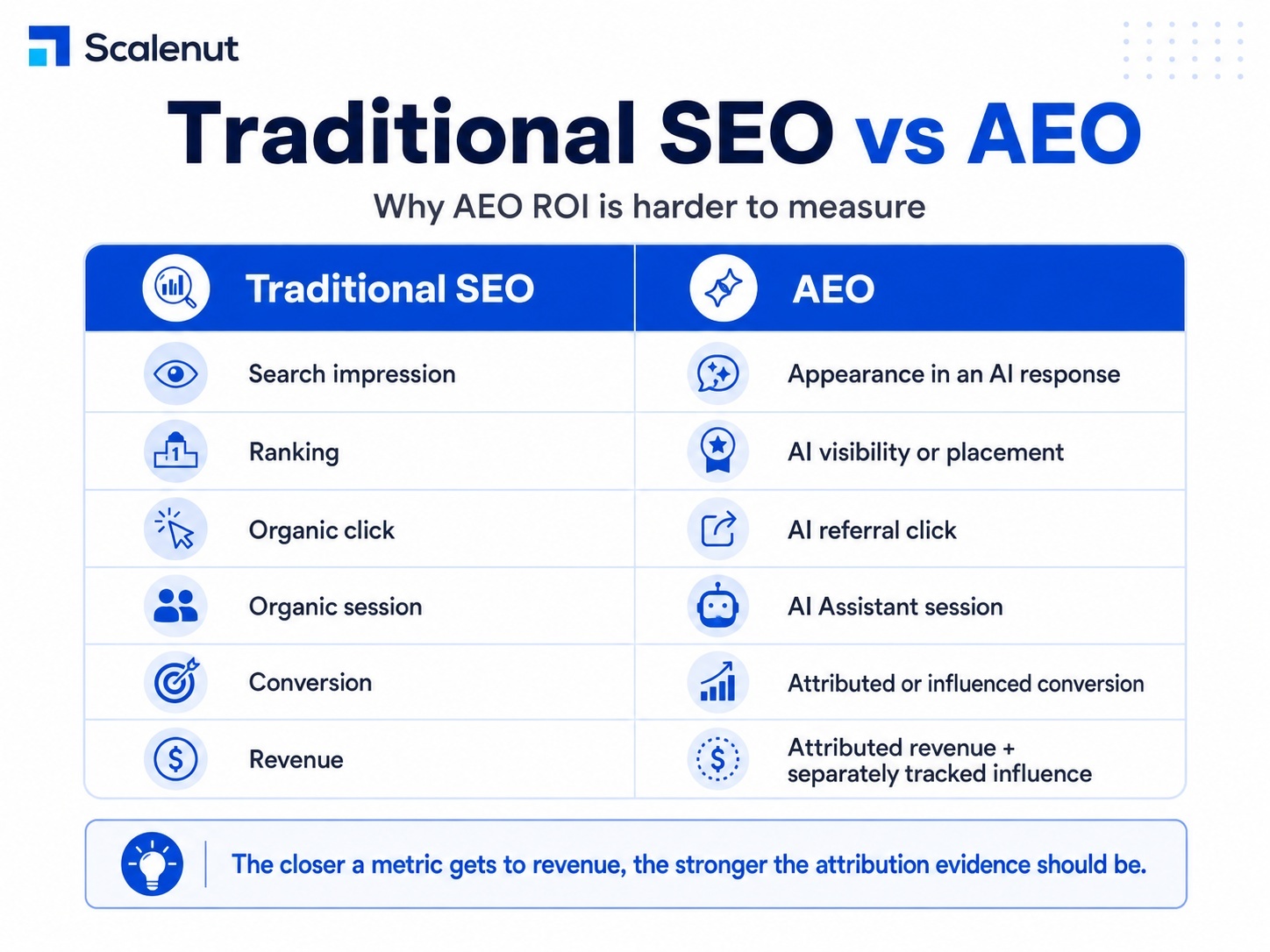
The harder part is measuring what happens without a trackable click. That is why AEO ROI measurement should separate direct attribution, supporting evidence, and proxy signals instead of treating every mention, citation, or rise in branded search as revenue.
The closer a metric gets to revenue, the stronger the attribution evidence should be.
Want a deeper view of how the two channels differ? Explore the key AEO vs SEO differences.
What are the most important metrics to track when evaluating the success of AEO campaigns?
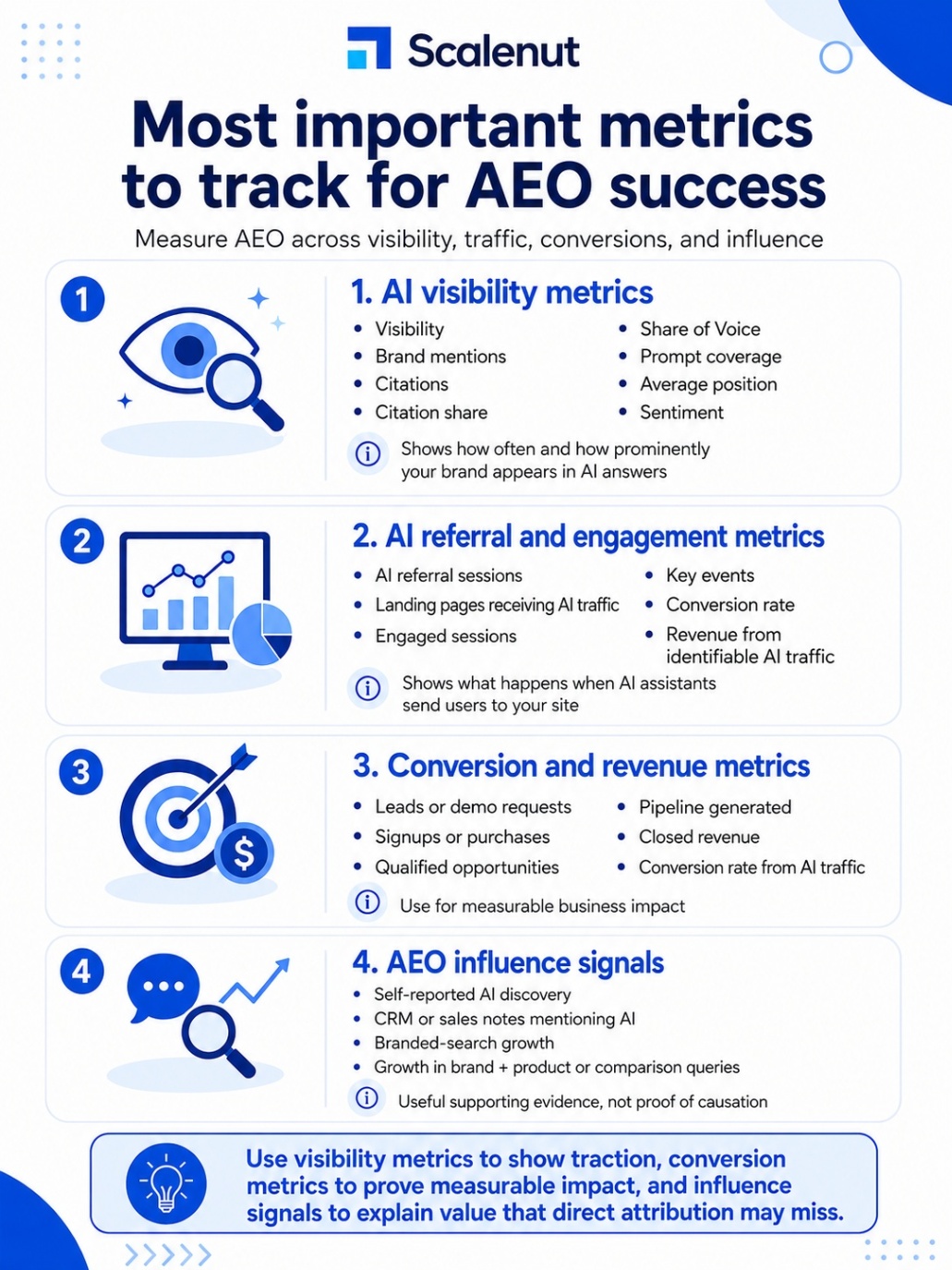
AEO success needs to be measured across visibility, traffic, conversions, and influence. The important part is knowing which AEO metrics show progress and which ones can genuinely support an ROI claim.
Here are the key metrics to track.
1. AI visibility metrics
These show how often and how prominently your brand appears in AI answers.
Track:
- Visibility: How often your brand appears across tracked responses.
- Brand mentions: How often your brand is named, with or without a link.
- Citations: How often your website is referenced as a source.
- Citation share: Your share of citations within a tracked theme or prompt set.
- Share of Voice: How often your brand appears compared with competitors.
- Prompt coverage: The percentage of priority prompts where your brand appears.
- Average position: Your placement in list-based AI responses.
- Sentiment: Whether AI engines describe your brand positively, neutrally, or negatively.
Scalenut tracks these metrics at brand and prompt level, including mentions, citations, Share of Voice, position, sentiment, and citation share.
These are strong indicators of AEO visibility, but they are not financial ROI metrics.
2. AI referral and engagement metrics
These show what happens when an AI assistant actually sends someone to your site.
Track:
- AI referral sessions
- landing pages receiving AI traffic
- engaged sessions
- key events
- conversion rate
- revenue from identifiable AI traffic
Since May 13, 2026, GA4 automatically groups recognized referrals from assistants such as ChatGPT, Gemini, and Claude into an AI Assistant channel using the ai-assistant medium.
The limitation is simple: GA4 can only identify the AI source when a trackable referral reaches the site.
3. Conversion and revenue metrics
These connect AEO activity with business outcomes.
Depending on the business model, track:
- leads or demo requests
- signups or purchases
- qualified opportunities
- pipeline generated
- closed revenue
- conversion rate from AI traffic
Only call revenue AI-attributed when there is a captured link between the AI touchpoint and the conversion, such as:
AI referral → landing page → demo request → CRM opportunity → closed customer
That is much stronger than assuming revenue increased because citations did.
4. AEO influence signals
Some AI exposure never produces a measurable click, so teams also need supporting signals.
Useful examples include:
- self-reported discovery through ChatGPT, Gemini, or Perplexity
- CRM or sales notes mentioning AI discovery
- branded-search growth
- growth in brand + product, feature, or comparison queries
Google Search Console's branded and non-branded query filter can help track branded-search trends, although Google notes that classifications may occasionally be incorrect.
These signals can support an AEO influence case, but they should not be treated as proof of causation.
Use visibility metrics to show whether AEO is gaining traction, conversion metrics to prove measurable business impact, and influence signals to explain value that direct attribution may miss.
Need a deeper framework for benchmarking mentions, citations, and Share of Voice? Explore these AI visibility metrics.
Can you explain the step-by-step process to calculate the return on investment for AEO strategies?
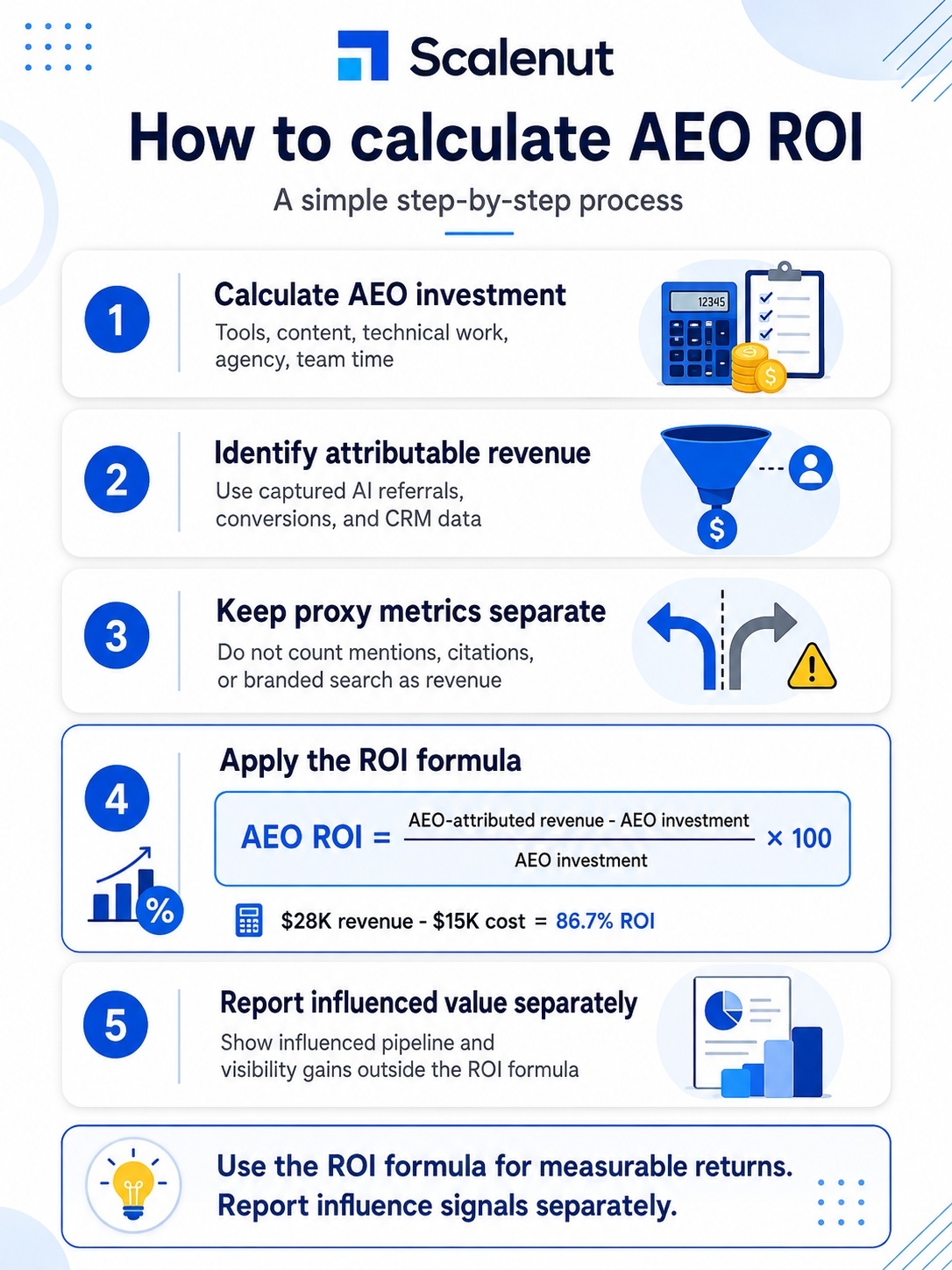
AEO ROI should compare the financial return you can reasonably connect to answer engine optimization with the full cost of running the program. The mistake is trying to turn every mention, citation, or visibility gain into a dollar value.
For client reporting, use a consistent attribution rule and keep directly measurable returns separate from broader influence.
Here is a practical way to calculate it.
1. Calculate the full AEO investment
Start with everything spent on AEO during the measurement period, including:
- AI visibility and SEO tools
- content creation and refreshes
- technical or development work
- agency or consultant fees
- internal team time
- measurement and reporting work
Use the same cost categories each reporting period so ROI comparisons remain consistent.
2. Identify the revenue you can reasonably attribute to AEO
Start with journeys where an AI touchpoint is actually captured.
For example:
AI Assistant referral → landing page → demo request → opportunity → closed customer
GA4 now automatically classifies recognized AI referrals under its AI Assistant channel. Its attribution reports can assign key-event and revenue credit across captured touchpoints using data-driven or last-click models.
For B2B clients, CRM data can take this further. HubSpot, for example, supports contact, deal, and revenue attribution reports based on recorded interactions.
Agree on the attribution model before reporting results. Otherwise, the same customer journey can produce different revenue numbers depending on how credit is assigned.
3. Keep visibility and proxy metrics outside the ROI formula
Do not assign arbitrary monetary values to:
- brand mentions
- citations
- Share of Voice
- prompt coverage
- branded-search growth
- direct traffic changes
These metrics are useful for showing AEO progress or possible influence, but they are not revenue by themselves.
If a prospect explicitly says they discovered the brand through ChatGPT or Gemini, record that as AI-influenced revenue unless you also have a captured interaction that supports direct attribution.
4. Apply the AEO ROI formula
A simple revenue-based calculation is:
AEO ROI = (AEO-attributed revenue − AEO investment) ÷ AEO investment × 100
For example, if a client spends $15,000 on AEO and you can attribute $28,000 in revenue to it:
($28,000 − $15,000) ÷ $15,000 × 100 = 86.7% ROI
HubSpot uses the same basic structure for campaign ROI, comparing revenue or attributed revenue with campaign spend.
For businesses where margins matter, a stricter financial view uses gross profit or contribution margin instead of topline revenue. Revenue-based ROI can overstate the return when the cost of delivering the product or service is significant.
Whichever approach the client already uses, document it and use it consistently.
5. Report AI-influenced value separately
Your final report might look like this:
- AEO-attributed revenue: $28,000
- AEO investment: $15,000
- Directly measurable ROI: 86.7%
- AI-influenced pipeline: $40,000
- Citation share: 18% → 29%
- AI Share of Voice: 21% → 30%
This gives stakeholders the financial result without hiding the wider impact AEO may be having on discovery and consideration.
The goal is not to produce the biggest possible ROI number. It is to produce one you can explain and defend when a client asks where the revenue came from.
Want the broader strategy behind these measurement inputs? See how answer engine optimization works across prompts, content, citations, and AI answers.
How do you set up an AEO ROI measurement workflow?
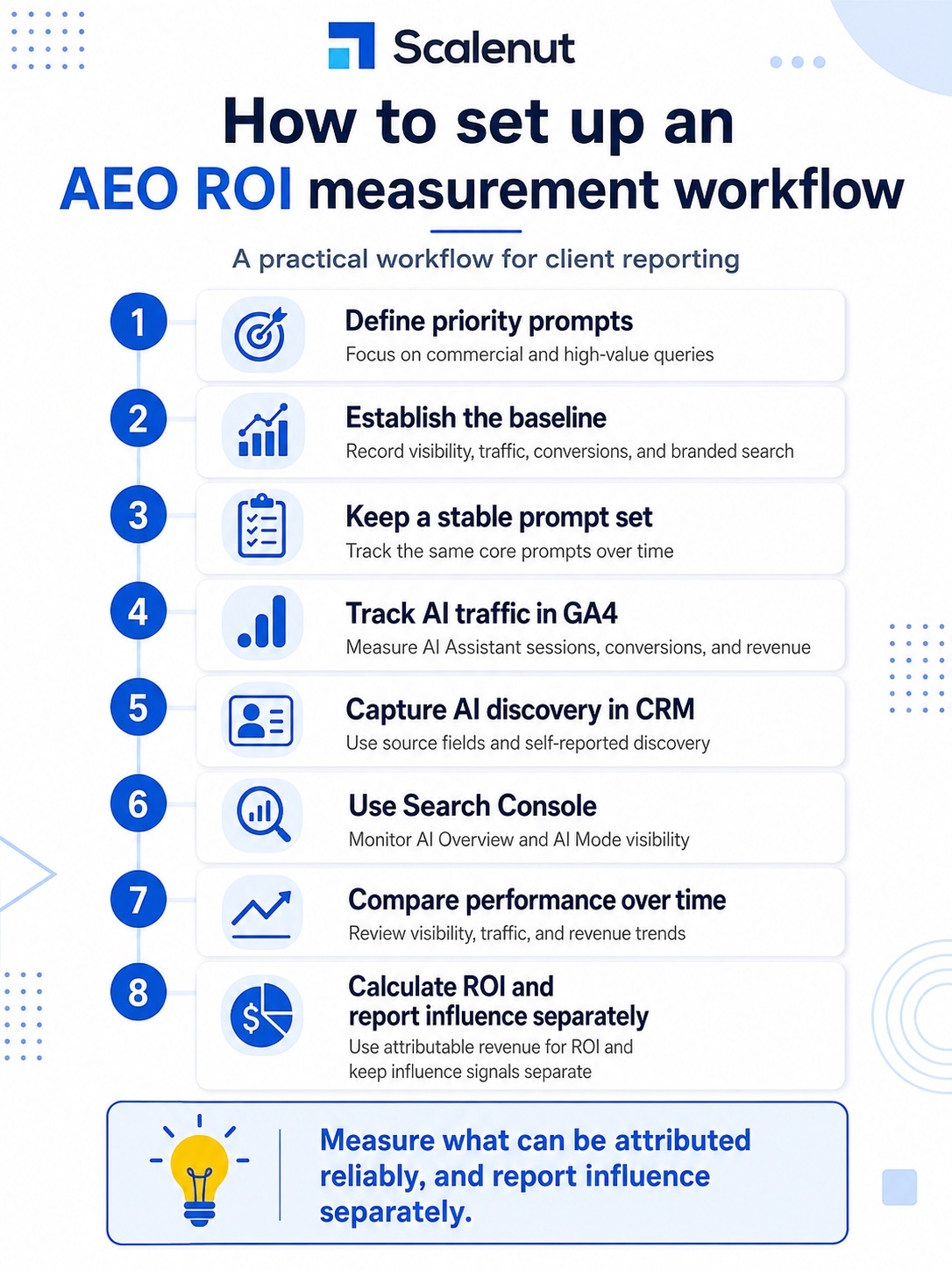
A reliable AEO ROI workflow starts before you optimize anything. You need a fixed set of prompts, a baseline, consistent analytics, and clear rules for what counts as attributed versus influenced revenue.
Here is a practical workflow you can use for client reporting.
1. Define the prompts that matter
Start with prompts tied to how the client's audience actually researches and buys, such as:
- problem and pain-point questions
- category searches
- product or service comparisons
- alternatives
- recommendations
- purchase-intent questions
- branded questions
Prioritize prompts with real commercial or strategic value rather than adding hundreds simply to make the dataset larger.
2. Establish the baseline
Before making major AEO changes, record the starting point for:
- AI visibility
- mentions and citations
- Share of Voice
- prompt coverage
- average position where relevant
- AI referral traffic
- conversions and revenue
- branded-search performance
This gives you something meaningful to compare against later. For client work, your own historical baseline is usually more useful than a generic industry benchmark.
3. Keep a stable core prompt set
AI answers vary between executions, so consistency matters.
Maintain a fixed benchmark set for ongoing reporting and track newly discovered prompts separately. Otherwise, a rise in visibility may simply reflect that you changed the questions being measured.
Scalenut lets teams manually add and group prompts, track repeated executions, and view visibility, mentions, citations, position, competitors, and performance over time for individual prompts.
4. Track identifiable AI traffic in GA4
Use GA4 to measure what happens when an AI assistant actually sends someone to the client's website.
Since May 13, 2026, GA4 automatically categorizes recognized referrals from services such as ChatGPT, Gemini, and Claude under its AI Assistant channel with the ai-assistant medium.
Track:
- AI Assistant sessions
- landing pages
- key events
- conversion rate
- attributed revenue where available
For clients with longer journeys, GA4's attribution reports can also show how credit changes between data-driven and last-click models.
Remember that GA4 only helps when an AI touchpoint is actually captured. Zero-click AI discovery can still disappear from the analytics trail.
5. Capture AI discovery in your CRM
Add a simple source field or “How did you hear about us?” question to lead forms, onboarding, or sales qualification.
Include options such as:
- ChatGPT
- Gemini
- Perplexity
- social media
- referral
- other
Sales teams can also record AI discovery when prospects mention it during calls.
This will not give you perfect attribution, but it provides stronger evidence of AI influence than trying to infer it from direct traffic.
6. Use Search Console for Google AI visibility
For properties that have access, Google's Generative AI Performance report now shows impressions from AI Overviews and AI Mode. Teams can break the data down by page, country, device, and date. Google is still rolling the report out to a subset of site owners.
Use it to identify:
- pages gaining AI visibility
- pages losing impressions
- changes in Google AI exposure over time
Treat this as visibility data, not revenue attribution.
For branded demand, the regular Search performance report also supports branded versus non-branded query filtering on eligible properties.
One practical reporting check: Google recorded a logging issue that reduced reported Generative AI Search impressions from August 13–17, 2026. Always check Search Console's data-anomalies log before explaining an unusual client dip.
7. Compare performance over time
Review the same core metrics against the original baseline at consistent intervals.
For example:
Visibility: 24% → 35%
Citation share: 15% → 22%
AI Assistant sessions: 420 → 690
AI conversions: 11 → 18
Attributed revenue: $8,000 → $14,000
Do not automatically claim that every improvement was caused by AEO. Look for a consistent pattern across visibility, traffic, and business outcomes.
8. Calculate ROI and report influence separately
At the end of the reporting period, use captured revenue and the full AEO investment to calculate directly measurable ROI.
Then report separately:
- AI-influenced pipeline
- self-reported AI discovery
- branded-search trends
- visibility and citation gains
This keeps the financial number defensible while still showing the wider effect AEO may be having.
A good AEO measurement workflow does not try to eliminate every attribution gap. It makes those gaps visible, measures what can be measured reliably, and keeps supporting signals separate from proven revenue.
Ready to turn the measurement workflow into execution? Use this AI search optimization checklist to close prompt and citation gaps.
How can you measure AEO performance with Scalenut?
Scalenut covers the AI visibility and diagnostic layer of AEO measurement, helping you see where a client's brand appears, why competitors are outperforming it, and what to improve next.
You can use it to:
- Track AI visibility: Monitor Visibility Score, Share of Voice, Average Position, and performance across supported AI engines to establish a baseline and track changes over time.
- Analyze prompts and citations: See which prompts mention or cite the brand, the URLs and domains AI engines reference, query fan-outs, sentiment, and where competitors appear instead.
- Find visibility gaps: Recommendations highlight high-value prompts where competitors are cited but the client is missing, along with content, backlink, and community opportunities.
- Turn insights into action: Use Scalenut's Article Writer, Content Optimizer, and Prompt Coverage tools to create or improve content around the gaps you identify.
- Monitor AI traffic signals: With Cloudflare connected, AI Traffic Monitor can separate human referral traffic from AI crawler activity and show which pages attract AI attention.
For ROI reporting, keep the roles clear: use Scalenut to measure and improve AI visibility, then use GA4 and CRM data to connect that performance with conversions, pipeline, and revenue.
Want help turning AI visibility data into a practical growth strategy? Book a free strategy call with Scalenut.
What are the common mistakes when measuring AEO ROI?
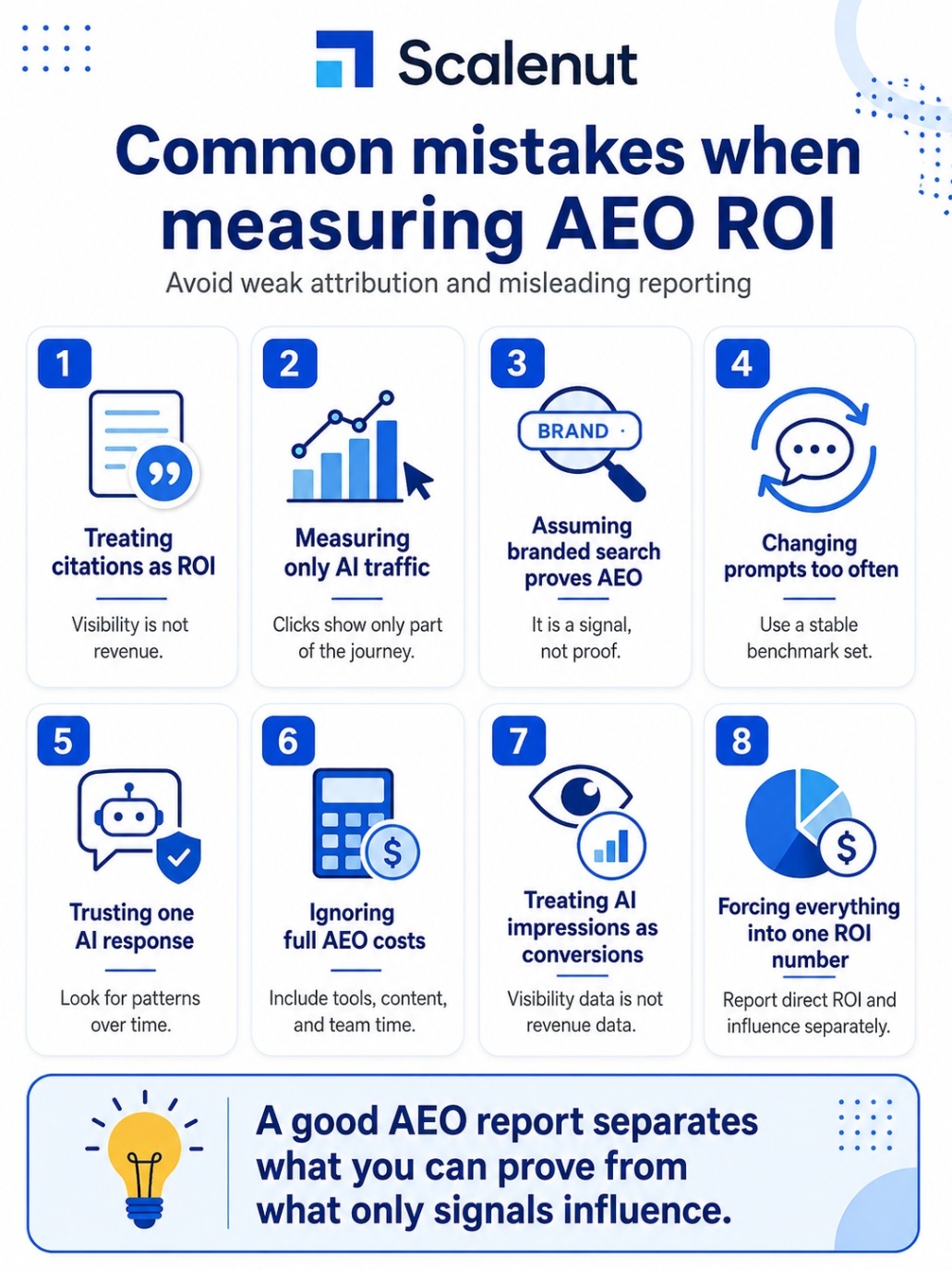
Most AEO reporting problems come from mixing visibility, attribution, and revenue into the same number. For clients, that can make results look impressive but difficult to defend.
Here are the mistakes to avoid.
1. Treating mentions and citations as ROI
More mentions, citations, or Share of Voice can show that AEO visibility is improving. They do not tell you how much revenue that visibility generated.
Scalenut, for example, tracks mentions and citations separately because a brand can be named without its website being cited.
Use these as leading indicators, not financial returns.
2. Measuring only AI referral traffic
AI referral traffic is useful, but it captures only journeys where someone actually clicks from a recognized AI assistant.
GA4 now automatically classifies recognized AI referrals under its AI Assistant channel. However, a user who discovers a brand in an AI answer and later returns through another channel may leave no captured AI referral in that journey.
Pair referral data with CRM and self-reported discovery instead of treating traffic as the full picture.
3. Assuming branded-search or direct-traffic growth was caused by AEO
A rise in branded searches after AI visibility improves is worth watching, but it does not prove causation.
PR, paid campaigns, social activity, product launches, and other marketing can produce the same movement. Report branded-search growth as supporting evidence, not AI-attributed revenue.
The same applies even more strongly to direct traffic.
4. Changing the tracked prompts every reporting period
If you measure one prompt set in January and a substantially different set in March, the change in visibility is difficult to interpret.
Maintain a stable group of priority prompts for benchmarking and add new discovery prompts separately. Tools such as Scalenut retain prompt-level visibility, execution, citation, and positioning data that can be compared over time.
5. Treating one AI response as representative
AI answers can vary between executions, platforms, locations, and over time.
Do not tell a client they “rank #1 in ChatGPT” because the brand appeared first in one response. Look for patterns across repeated executions and a consistent prompt set instead.
6. Ignoring the full cost of AEO
Counting only the subscription cost of an AEO tool will inflate ROI.
Include the meaningful costs involved in the program, such as:
- content creation and refreshes
- tools
- technical work
- agency or consultant fees
- internal team time
Use the same cost categories each reporting period so comparisons remain consistent.
7. Treating Search Console AI impressions as conversions
Google's Generative AI Performance report can show impressions from AI Overviews and AI Mode, including changes by page, date, country, and device. It does not turn those impressions into revenue attribution.
Use it to measure Google AI visibility, then rely on analytics and CRM data for downstream business outcomes.
Also check Google's data-anomalies log before explaining sudden changes. For example, a logging issue reduced reported Generative AI Search impressions from August 13–17, 2026.
8. Forcing every AEO benefit into one ROI number
Not everything needs to be monetized.
A stronger client report can show:
Direct ROI: attributable revenue versus AEO cost
Influence: verified AI-assisted discovery or pipeline
Leading indicators: visibility, citations, Share of Voice, and prompt coverage
That gives clients a clearer picture without assigning invented dollar values to signals that cannot yet be directly attributed.
Good AEO reporting is not about claiming credit for every positive movement. It is about making clear what you can prove, what you can reasonably support, and what is still only a signal.
Choosing your measurement stack next? Use these AI search tool buyer checks to compare tracking depth, data quality, reporting, and execution.
How should you report AEO ROI to clients or leadership?
AEO reports should lead with business outcomes, then use influence and visibility metrics to explain what changed. Avoid giving clients a long list of AI metrics without showing how they connect to commercial impact.
A simple 3-layer structure works well:
- Financial outcomes: AEO-attributed revenue, AEO investment, ROI, conversions, and attributable pipeline. GA4 attribution reports can show key events and revenue credited to captured marketing touchpoints, while CRM attribution tools such as HubSpot can connect recorded interactions with deal and revenue outcomes.
- AI influence: Self-reported AI discovery, verified AI-influenced opportunities, and branded-search trends. Search Console can separate branded and non-branded queries, but branded-search growth should still be treated as supporting evidence rather than proof that AEO caused the increase.
- Leading indicators: AI visibility, citations, Share of Voice, prompt coverage, and sentiment. These explain whether the client's presence in AI answers is improving, but they should remain outside the ROI calculation.
A client summary could look like this:
AEO-attributed revenue: $42,000
AEO investment: $25,000
Direct ROI: 68%
AI Share of Voice: 21% → 30%
Citation share: 18% → 27%
Verified AI-influenced opportunities: 11
The reporting rule is straightforward: lead with what you can financially attribute, use influence data for context, and use visibility metrics to explain the direction of AEO performance.
Managing AEO reporting across multiple clients? Compare these AI visibility tools for agencies for monitoring and client reporting workflows.
How long should you measure AEO before evaluating ROI?
There is no fixed AEO ROI timeline that works for every client. Visibility may change before revenue does, so evaluate performance in stages rather than expecting one metric to prove success immediately.
- Early indicators: Track changes in mentions, citations, Share of Voice, prompt coverage, and position.
- Traffic and conversion signals: Once enough data builds, review AI referral sessions, leads, and conversion activity.
- Pipeline and revenue: Measure these over a period that reflects the client's actual buying cycle. A business with a long B2B sales process will naturally need more time before AEO-influenced opportunities turn into closed revenue.
Your analytics setup should reflect that cycle too. GA4 lets teams set key-event lookback windows of 30, 60, or 90 days for most conversion events, which determines how far back a captured touchpoint can receive attribution credit.
For client reporting, show visibility gains early, add conversion trends as data builds, and evaluate ROI over a window long enough to capture the client's real path to purchase.
Want to know which signals to watch as AEO performance develops? Explore the key AI visibility success metrics that matter over time.
Frequently asked questions
How does measuring the ROI of AEO differ from traditional SEO ROI measurement methods?
Traditional SEO ROI often follows a clearer path from search engines to organic search clicks, sessions, conversions, and revenue. AEO adds zero-click discovery, so traditional SEO metrics alone are insufficient. You need direct attribution plus supporting signals from traditional search and AI visibility.
What tools or software are best for tracking and analyzing AEO performance and ROI?
Content marketing teams typically need several tools working together. Use Scalenut for brand visibility across large language models, GA4 for identifiable AI referral traffic, Search Console for Google AI impressions, and a CRM for lead, pipeline, and revenue attribution.
Which types of content or optimizations typically yield the highest ROI in answer engine optimization?
Prioritize content that closely matches user intent and supports buying decisions, such as comparisons, alternatives, use cases, pricing, and product pages. Your content strategy should also improve answer clarity, featured snippets eligibility, and schema markup where relevant, without assuming markup guarantees AI citations.
What are industry benchmarks for AEO ROI, and how should I compare my results?
There is no reliable universal benchmark for answer engine optimization or generative engine optimization ROI. Compare your citation rate, visibility, conversions, attributed revenue, and costs against your own baseline and a stable competitor set rather than applying a generic industry percentage.
How can I accurately measure the ROI of answer engine optimization efforts for my website?
For effective AEO measurement, calculate the full program cost and compare it with revenue linked to captured artificial intelligence touchpoints. Keep citations, mentions, branded-search trends, and other influence signals outside the financial formula unless you have evidence connecting them directly to revenue.
How do you measure AEO ROI when users see your brand in an AI answer but do not click?
When AI exposure produces no click, use self-reported discovery, CRM source fields, and sales notes. If the user later arrives through search engine results or traditional search results, analytics may credit that channel, so report the earlier AI exposure as influenced rather than directly attributed.
Which AEO metrics should be included in the ROI calculation, and which should be treated as leading indicators?
Put attributable revenue and the full AEO investment inside the ROI formula. Treat mentions, citations, Share of Voice, prompt coverage, sentiment, and branded-search growth as leading or influence indicators. They help explain performance, but they should not be converted into revenue without evidence.
Can GA4 track conversions and revenue from ChatGPT, Gemini, Claude, and other AI assistants?
Yes, when ChatGPT, Gemini, Claude, or another recognized assistant sends a trackable referral. GA4 now classifies qualifying visits under its AI Assistant channel and can measure downstream key events and revenue. It cannot identify every zero-click AI discovery journey that converts later.
How long should you track AEO performance before evaluating ROI?
Track AEO long enough to match the client’s buying cycle. Visibility metrics may move before referral traffic, pipeline, or revenue. Report early changes in mentions and citations, then evaluate conversions and ROI only after enough downstream customer data has accumulated to support a meaningful comparison.
How should you report AI-influenced pipeline or revenue when direct attribution is unavailable?
Report AI-influenced pipeline only when supporting evidence exists, such as self-reported discovery, CRM source data, or a captured AI interaction. Keep it separate from directly attributed revenue so clients can distinguish measurable financial return from broader evidence that AI contributed to discovery or consideration.


.svg)


.webp)