
.jpg)
What Is Share Of Voice And How Do You Increase It?

Key Highlights
- Share of voice (SOV) is a key digital marketing metric that measures your brand's visibility compared to competitors.
- Understanding your brand's share of voice is crucial for predicting future market share and boosting brand awareness.
- Tracking brand mentions across various media channels like social media, SEO, and PR provides a complete picture of your market presence.
- The best practices to increase your market presence include building topical authority, creating comprehensive content, and targeting high-value keywords.
- AI search is transforming SOV measurement, making it essential to monitor and optimize for this evolving channel.
Understanding your brand's position is more critical than ever. This is where share of voice comes in. It's a powerful metric that shows your visibility in the market compared to your rivals. A higher share of voice often leads to a greater market share, but it's not just about being the loudest. It’s about strategically owning the conversations that matter to your audience. Calculating your brand’s share of voice helps you refine your marketing and grow your influence.
What Is Share of Voice?
Share of voice (SOV) is a measure of the market conversation your brand owns compared to your competitors. It essentially quantifies your brand’s presence in the spaces where your audience is most active. Are people talking about you, or are they discussing your rivals? This metric is vital because it directly impacts customer awareness, perception, and buying decisions. A strong SOV indicates that your digital marketing efforts are effective and that you are a significant player in your industry.
What Is Share of Voice in SEO?
In the context of search engine optimization, SEO share of voice measures your brand’s visibility in organic search results for a specific set of keywords. It's your portion of the total clicks or impressions for terms relevant to your industry.
This metric, often called "share of search," goes beyond simple rankings. It gives you a clear picture of how much of the organic search landscape you control compared to your competitors.
A high SEO share of voice means your brand’s visibility is strong, and you are capturing a significant amount of organic traffic. Tracking this helps you understand your performance and find gaps in your keyword strategy.
What Is Share of Voice in AI Search?
AI share of voice represents your brand's presence within the answers generated by AI-powered search engines. As users increasingly turn to AI for information, being mentioned in these results is becoming a critical component of digital visibility.
This metric is measured by analyzing how often your brand appears in AI-generated summaries and responses. The voice data gathered from these platforms provides unique SOV data that traditional search metrics might miss.
Understanding your AI share of voice is essential for future-proofing your brand. It reflects your authority and relevance in the eyes of AI algorithms, directly influencing your visibility in next-generation search engine results.
Why Does Share of Voice Matters for Marketing and SEO?

Measuring share of voice adds valuable context to your performance data, showing where your brand stands in the industry. By tracking brand conversations, you can assess marketing effectiveness and refine your digital strategy. A strong SEO share of voice boosts brand recognition and market position, helping you understand competitors and spot growth opportunities.
Below, we’ll cover why this metric is essential for modern marketers.
1. Competitive Visibility
Regularly monitoring your share of voice is a powerful form of competitive analysis. It shows you exactly where you stand against your rivals across different marketing channels. You can see who is gaining ground, where their messaging is most effective, and which channels they dominate.
This insight into your competitive landscape is invaluable for strategic planning. Share of voice measures provide the data needed to identify gaps in your own strategy and pinpoint opportunities to outperform others. For example, you might discover a competitor has low brand visibility on a platform where your target audience is highly active.
By tracking your brand's mentions and comparing them to competitors, you gain a clear understanding of your brand visibility. This intelligence allows you to make data-driven decisions, refine your messaging, and allocate resources to the areas that offer the greatest potential for impact.
2. Predicts Market Growth
Share of voice is a powerful leading indicator of future market growth. When you consistently own a larger portion of the conversation than your current share of market, growth tends to follow.
This predictive power makes SOV a critical metric for strategic resource allocation. For example, if your brand has a 20% market share, aiming for a share of voice greater than 20% creates the conditions necessary for expansion. This concept, known as "excess share of voice," suggests that investing in brand visibility pays tangible dividends.
Essentially, by increasing your market presence in conversations today, you are building the brand recognition and authority that will drive sales tomorrow. This connection transforms SOV from a simple vanity metric into a strategic tool for forecasting and achieving long-term market growth.
3. Identifies Content and SEO Gaps
Analyzing your SEO share of voice helps you uncover valuable gaps in your content marketing strategy. When you see competitors outranking you in search results for relevant keywords, it signals an opportunity to create better, more comprehensive content on those topics.
This analysis allows you to pinpoint specific areas where your competitors are dominating the conversation. Are they ranking for high-intent keywords you've overlooked? Is their content more thorough or better optimized? Answering these questions can guide your content creation efforts.
By identifying these weaknesses, you can refine your strategy to reclaim your rightful place in the search results. Following best practices for SEO and content marketing, you can systematically close these gaps, improve your visibility, and capture a larger share of the organic search landscape.
4. Measures Authority in AI Search
As AI-powered search engines become more prevalent, your AI share of voice is a direct reflection of your brand authority. These advanced systems synthesize information from countless sources to provide answers, and they tend to favor brands that are seen as credible experts in their field.
If your brand consistently appears in AI-generated search engine results, it's a strong signal that you have established significant authority. This visibility is built on a foundation of high-quality content, a strong media presence, and positive brand mentions across the web.
Therefore, tracking your AI share of voice is not just about measuring visibility; it's about gauging your brand authority in a new and evolving digital ecosystem. A strong performance in this area indicates that your efforts to build a reputable and trustworthy brand are paying off.
What Is a Good Share of Voice Percentage?
A good share of voice (SOV) depends on your industry, competition level, and marketing goals. However, there are some general benchmarks marketers commonly use:
- 10–20% SOV: A solid starting point for smaller brands or newer websites entering a competitive space.
- 20–30% SOV: Indicates strong visibility and growing authority compared to competitors.
- 30–50% SOV: Shows market leadership within a niche or topic cluster.
- 50%+ SOV: Dominant presence where your brand captures the majority of attention in that market.
In SEO and content marketing, even 10–20% share of voice across your target keyword set can be considered healthy, especially in competitive industries.
Many marketers also track Share of Voice vs. Market Share. A common rule of thumb is:
- If your SOV is higher than your market share, your brand is likely positioned for future growth.
Ultimately, the goal isn’t just hitting a specific percentage but consistently increasing your visibility relative to competitors over time.
What Are the Types of Share of Voice?
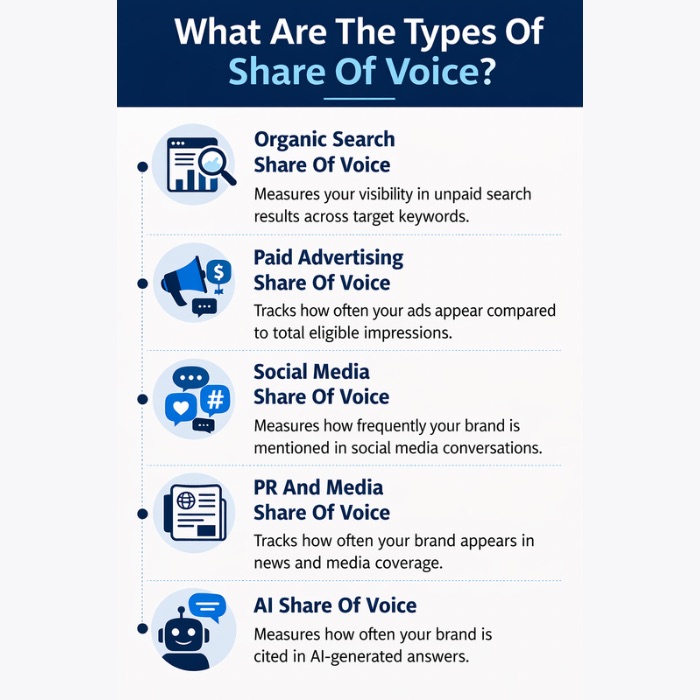
Share of voice isn’t a universal metric; its meaning and measurement vary by context and channel. Understanding each type is key to assessing your brand’s visibility and impact. Every channel, like organic search, paid ads, and social media, offers a unique view of your presence. Analyzing SOV by channel provides deeper insights into your marketing performance.
Here are the main types of share of voice to consider.
1. Organic Search Share of Voice
Organic search share of voice, also known as SEO share of voice, measures your brand's visibility within unpaid search results. It quantifies how much of the search landscape you own for a set of relevant keywords compared to your competitors.
This metric is calculated by analyzing your rankings and click-through rates for target keywords. A higher SEO share of voice indicates that you are capturing a larger portion of the available organic traffic for conversations important to your business.
Specialized SEO tools are necessary to accurately measure your presence in organic search. They track your visibility across thousands of keywords, providing a clear picture of how you stack up against the competition and identifying opportunities to drive more organic traffic.
2. Paid Advertising Share of Voice
Paid advertising share of voice, often called PPC share of voice, focuses on your brand's visibility within paid search results. The primary metric used to measure this is impression share, which is available in platforms like Google Ads.
Impression share tells you the percentage of ad impressions your campaigns received compared to the total number they were eligible to receive. For example, if your ads were eligible to show 1,000 times but only appeared 700 times, your impression share would be 70%.
This data is crucial for understanding your competitiveness in paid channels. A low impression share might indicate that your bids are too low or your ad quality needs improvement. By monitoring your PPC share of voice, you can optimize your campaigns to capture more ad impressions and stay ahead of competitors bidding on the same keywords.
3. Social Media Share of Voice
Social media share of voice reflects your brand's portion of the conversation happening across various social platforms. It's a direct measure of your presence and influence within your industry's social ecosystem.
To calculate this, you need to use social listening tools to track social media mentions, hashtags, and engagement metrics for your brand and your competitors. These tools scan posts, comments, and shares across platforms like X (formerly Twitter), Facebook, and Instagram.
Beyond just counting mentions, a thorough analysis includes sentiment analysis to understand the tone of the conversation. Are the mentions positive, negative, or neutral? This qualitative data provides deeper context, helping you understand brand perception and the effectiveness of your social media strategy.
4. PR and Media Share of Voice
PR and media share of voice measures how frequently your brand appears in news articles, press releases, and other forms of media coverage compared to your industry rivals. This metric is a key indicator of your public relations effectiveness.
Tracking your media share of voice requires media monitoring tools that can scan thousands of online publications, from major news outlets to niche industry blogs. These tools capture brand mentions and help you quantify your media presence.
A strong PR share of voice demonstrates that your brand is considered newsworthy and relevant by journalists and publishers. It helps you understand the impact of events like product launches or crises on your brand reputation and overall visibility in the media landscape.
5. AI Share of Voice
A newer, but increasingly important, metric is AI share of voice. This measures your brand’s visibility within the answers and summaries generated by AI search tools. As these technologies become integrated into digital channels, appearing in their results is crucial.
This type of SOV analysis involves scrutinizing AI-generated search results to see how often your brand is cited as a source or mentioned in a response. The voice data collected from these platforms gives a forward-looking view of your brand's authority.
Monitoring your AI share of voice is essential for staying competitive in a changing digital landscape. It provides insight into how AI algorithms perceive your brand's relevance and expertise, which will increasingly influence overall online visibility.
How to Measure Share of Voice?
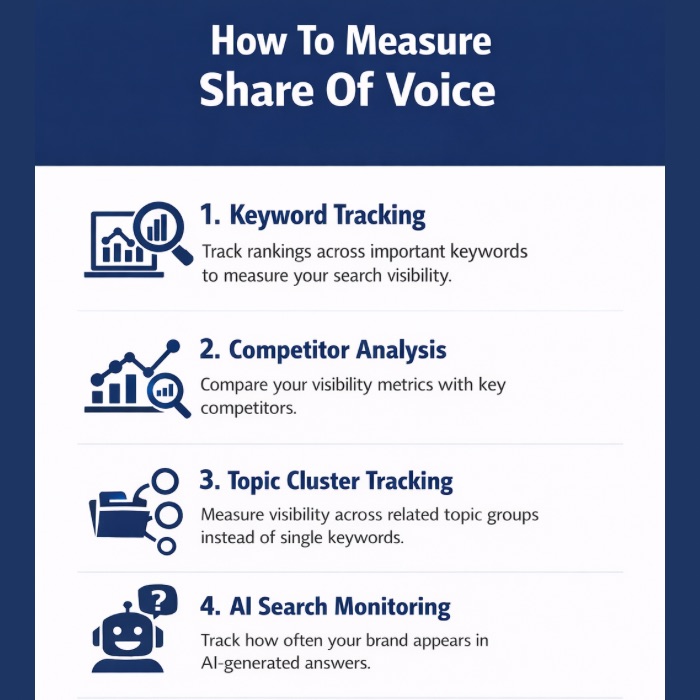
To accurately measure share of voice, define your market and key competitors. Use keyword tracking and competitive analysis to gather data. Manual measurement is impractical due to data volume; instead, use social listening tools and SEO platforms for automation. These tools simplify data collection, allowing you to focus on analysis and strategy.
Here are some key measurement methods.
1. Keyword Tracking
Keyword tracking is the foundation of measuring your SEO share of voice. This process involves monitoring your website's ranking in organic search for a list of relevant keywords that are crucial to your business.
By tracking these keywords, you can see how your visibility in search results changes over time. More importantly, you can compare your performance directly against your competitors for the same set of terms.
Specialized SEO tools collect this SOV data and calculate your visibility share. This allows you to identify which keywords you dominate, where competitors are stronger, and where new opportunities exist to capture more of the organic search conversation.
2. Competitor Analysis
A thorough competitor analysis is central to understanding your share of voice. This involves identifying your direct and indirect rivals and systematically tracking their presence across the same channels you monitor for your own brand.
By benchmarking your share of voice metrics against theirs, you can determine your relative market position. This process turns raw data into actionable competitive intelligence, revealing your competitors' strategies, strengths, and weaknesses.
Are they investing heavily in a particular channel? Is their messaging resonating more effectively on social media? This analysis helps you answer these questions and adjust your strategy to gain a competitive edge and improve your share of voice.
3. Topic Cluster Tracking
Topic cluster tracking offers a more advanced approach to share of voice analysis, especially for content marketing. Instead of tracking individual keywords, this method focuses on your brand's visibility across a group of related topics or "topic clusters."
By organizing your content around central pillar pages and related cluster content, you can aim to dominate the search results for an entire subject area, not just a few keywords. Tracking your SOV at the topic level shows how authoritative your brand is on subjects core to your business.
This approach provides a more holistic view of your brand's visibility. A strong presence across an entire topic cluster signals to search engines that you are an expert, which can significantly boost your rankings and overall share of voice.
4. AI Search Monitoring
Monitoring your presence in AI search is a forward-thinking way to measure your share of voice. This involves regularly checking how AI-powered search engines and chatbots respond to queries relevant to your industry and brand.
The goal is to gather voice data on how often your brand is mentioned, cited, or recommended in AI-generated answers. This is a new frontier in digital marketing, and establishing a baseline for your AI share of voice now will be a significant advantage.
While specific tools for this are still emerging, you can manually query AI systems and document the results. These share of voice measures provide early insights into your brand’s authority and will become increasingly critical as AI search adoption grows.
How to Calculate Share of Voice?
Calculating share of voice helps you understand how much brand visibility your brand has compared to competitors across search, media, or AI platforms. By measuring your presence against the total market visibility, you can clearly see whether your brand is leading, competing closely, or falling behind.
Basic Share Of Voice Formula
The standard formula used to calculate share of voice is:
SOV = (Your Brand Metric ÷ Total Market Metric) × 100
This formula can be applied to different marketing metrics depending on what you want to measure, such as search visibility, brand mentions, or traffic.
Example Calculation
Imagine your brand receives 2,000 organic visits from a group of tracked keywords. The total organic traffic for those keywords across all competitors is 10,000 visits.
Using the formula:
(2,000 ÷ 10,000) × 100 = 20%
This means your brand holds 20 percent share of voice for that keyword set.
Different Metrics Used For SOV
Share of voice can be calculated using different data points depending on the channel you want to analyze. Common metrics include:
- Impressions
- Traffic
- Mentions
- Keyword rankings
- AI citations
Using multiple metrics gives a more complete view of how visible your brand is across search engines, media coverage, and AI-generated answers.
How to Increase Share of Voice? (7 Best Strategies)
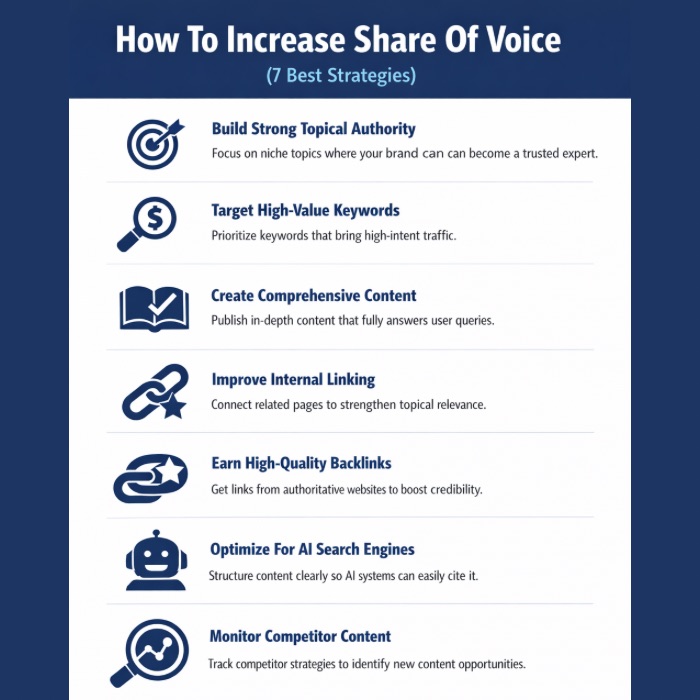
Increasing your share of voice takes a strategic, consistent effort across multiple channels. It’s not about being the loudest; it’s about creating campaigns that resonate and build momentum with your audience. From building niche authority to optimizing for new search technologies, here are seven effective strategies you can use now.
1. Build Strong Topical Authority
One of the most effective ways to increase your brand's share of voice is to build strong topical authority. Instead of trying to compete on every front, identify specific niche topics within your industry where you can become the undisputed expert. This focused content marketing approach builds credibility and brand awareness.
Start by identifying questions your audience is asking that are not well-answered by competitors. Use this as a foundation to create in-depth, high-quality content that addresses these gaps. By consistently providing value on a specific subject, you will start to "own" that conversation.
Over time, this strategy establishes your company as the go-to source for information on that topic, naturally boosting your share of voice.
- Identify underserved topics through social listening and customer feedback.
- Create comprehensive content backed by research and expert insights.
- Promote your expertise to solidify your position as a thought leader.
2. Target High-Value Keywords
Targeting high-value keywords is essential for improving your SEO share of voice. These are the search terms your target audience uses when they are looking for solutions, information, or products like yours. Focusing your efforts here ensures you are visible at critical moments in the customer journey.
Rather than chasing keywords with the highest search volume, prioritize terms that show strong commercial or informational intent. Ranking for these keywords in organic search puts your brand directly in front of a motivated audience, increasing both traffic and authority.
Dominating the search results for these terms is a direct path to a greater share of the conversation.
- Conduct keyword research to find terms with high relevance and intent.
- Analyze competitor rankings to identify strategic opportunities.
- Create and optimize content specifically designed to rank for these keywords.
3. Create Comprehensive Content
Creating comprehensive content that thoroughly covers a topic is a powerful way to enhance your brand's visibility. Search engines and users alike favor content that provides complete answers and deep insights. This approach positions your brand as a helpful and authoritative resource.
Instead of creating short, superficial articles, invest in long-form guides, detailed tutorials, and data-backed reports. These marketing efforts not only attract more backlinks and social shares but also keep users on your page longer, signaling to search engines that your content is valuable.
This commitment to quality in your content marketing will set you apart from competitors and significantly boost your presence.
- Address all aspects of a topic to become a one-stop resource.
- Use data, examples, and expert quotes to add depth and credibility.
- Update content regularly to ensure it remains accurate and relevant.
4. Improve Internal Linking
A smart internal linking strategy is a simple yet highly effective way to boost your SEO share of voice. Internal links connect your content, guide users through your website, and distribute authority (or "link equity") across your pages. This helps search engines understand the structure of your site and which pages are most important.
By linking from high-authority pages to newer or less visible ones, you can help them rank better in search results. This practice improves the user experience by making it easier for visitors to find related information, which can increase overall website traffic.
This tactic requires minimal resources but can yield significant improvements in your organic traffic and visibility.
- Link from relevant, high-traffic pages to pages you want to boost.
- Use descriptive anchor text that tells users and search engines what the linked page is about.
- Create topic clusters to build a strong, interconnected web of content.
5. Earn High-Quality Backlinks
Earning high-quality backlinks is a cornerstone of building brand authority and improving your position in search engine results. When reputable websites link to your content, it acts as a vote of confidence, signaling to search engines that your brand is a credible source of information.
These backlinks can come from various sources, including media coverage, guest posts on industry blogs, and features in expert roundups. A strong backlink profile not only boosts your SEO but also contributes to your media share of voice by increasing your brand's presence across the web.
Focus on creating valuable, link-worthy content that other sites will want to reference.
- Develop original research or data-driven studies that others will want to cite.
- Engage in digital PR to get your content featured in online publications.
- Build relationships with journalists, bloggers, and influencers in your niche.
6. Optimize for AI Search Engines
Optimizing for AI search engines is no longer optional; it's a critical component of modern digital marketing. As more users rely on AI for answers, ensuring your brand appears in these results is key to maintaining and growing your brand visibility. This involves creating content that is clear, concise, and structured for easy parsing by AI.
AI algorithms often pull from sources they deem authoritative and trustworthy. Building your brand's expertise and credibility through high-quality content and positive mentions across the web is the first step. The voice data from these platforms will become an increasingly important metric.
Adapting your strategy now will ensure you are well-positioned for the future of search.
- Use natural language and answer questions directly in your content.
- Structure content with clear headings, lists, and summaries.
- Focus on building overall brand authority and trustworthiness online.
7. Monitor Competitor Content
Continuously monitoring competitor content is essential for gaining a competitive edge and increasing your share of voice. By keeping a close eye on what your rivals are publishing, you can identify their content strategies, spot gaps in their coverage, and discover opportunities to create something better.
Use social listening and SEO tools to track the competitor content that performs best. Analyze why it's successful: Is it the topic, format, or promotion strategy? This competitive intelligence can inform your own content plan and help you make more strategic decisions.
This proactive approach allows you to react quickly to their moves and find ways to outmaneuver them.
- Set up alerts to be notified when competitors publish new content.
- Analyze the topics and keywords they are targeting.
- Identify content formats that are working well for them and adapt them for your brand.
What Are The Best Tools To Measure Share Of Voice?
Tracking share of voice requires tools that can monitor your visibility across search results, competitors, and increasingly, AI-generated answers. The right platform helps you quantify how often your brand appears compared to others and identify opportunities to improve that visibility.
Below are some of the best tools marketers use to measure share of voice and uncover competitive insights.
1. Scalenut

Scalenut helps brands measure and improve their share of voice across both traditional search and AI-driven platforms. Its AI Visibility tools track how often your brand appears in AI-generated responses and compare that visibility with competitors.
Key capabilities include:
- Track brand visibility across AI search platforms
- Identify prompts and topics where competitors dominate
- Discover content gaps affecting your share of voice
- Build a content roadmap to increase visibility
Because it combines visibility insights with content execution tools, teams can quickly turn share of voice insights into optimized content that improves their presence across search and AI answers.
Want to see how Scalenut can help you measure and grow your share of voice? Book a demo today!
2. Semrush
Semrush offers share of voice tracking through its Position Tracking and competitive analysis tools. It measures your visibility across a selected set of keywords and compares it with competitors.
Key capabilities include:
- Keyword-level share of voice tracking
- Competitive domain comparisons
- SERP feature visibility insights
- Historical performance trends
This makes it useful for understanding how much organic visibility your site captures across a target keyword set.
3. Brandwatch
Brandwatch focuses on share of voice across social media and online conversations. It analyzes brand mentions across multiple channels to help marketers understand their presence in digital discussions.
Key capabilities include:
- Social media mention tracking
- Competitor conversation analysis
- Sentiment and brand perception insights
- Real-time monitoring of brand visibility
This tool is particularly valuable for companies looking to track share of voice beyond search engines.
Conclusion
Understanding and leveraging Share of Voice can significantly enhance your market presence and brand authority. By focusing on this crucial metric, you can gain insights into your competitive landscape, predict market trends, and identify gaps in your content strategy. Whether through organic search, paid advertising, or social media, increasing your Share of Voice not only boosts visibility but also positions you as a leader in your industry.
Remember, the goal is to create comprehensive content that resonates with your audience and effectively communicates your brand's value. If you're ready to take your marketing strategy to the next level, don’t hesitate to reach out for a consultation!
Frequently Asked Questions
What is the definition of share of voice?
Share of voice is a digital marketing metric that measures your brand’s visibility relative to your competitors. It is calculated by tracking the mentions of your brand across various channels and comparing that to the total conversation. A higher SOV often correlates with greater brand awareness and can be a predictor of future market share.
What is the importance of share of voice marketing metrics?
Share of voice metrics are vital for evaluating the effectiveness of marketing campaigns and understanding your brand visibility. They provide a clear benchmark of your market presence against competitors across all marketing channels, helping you make data-driven decisions to improve your standing and capture more of the conversation.
How can I accurately measure my brand’s share of voice online?
To accurately measure your share of voice online, you need to use digital marketing tools like social listening platforms and SEO software. These tools automate the SOV analysis process by tracking your brand's mentions and visibility against competitors, giving you a clear picture of your share of market conversations.
Which metrics or data sources should I use to track share of voice?
The share of voice measures you track depend on the channel. For paid ads, use impression share from Google Ads. For social media, track social media mentions and engagement. Other key data sources include organic keyword rankings for SEO and the number of articles for media coverage.
What steps can I take to increase my brand’s share of voice?
To increase share of voice, focus your marketing efforts on creating high-quality content marketing that builds your brand reputation. Target relevant keywords to drive website traffic, build topical authority, and monitor competitor activities to find opportunities to dominate the conversation and enhance your brand's visibility.
How does share of voice differ from share of market?
Share of voice measures your brand's portion of the conversation (voice data), while share of market measures your portion of total sales. SOV is a leading indicator that can predict future market share, whereas share of market is a lagging indicator that reflects past performance.
What are some common challenges when measuring share of voice?
Common challenges when measuring share of voice include accurately capturing all brand mentions across diverse social platforms and differentiating between relevant and irrelevant SOV data. It can also be difficult to track different aspects of a conversation, such as sentiment and context, without sophisticated tools.
How do competitors’ share of voice scores impact my brand?
A competitor's high share of voice can reduce your brand’s visibility and media presence, making it harder to reach your target audience. Conducting a competitor analysis of SOV helps you understand your market position and identify strategic weaknesses you can exploit to improve your own standing.
Are there any tools that help automate share of voice measurement?
Yes, there are many share of voice tools that automate measurement. Social listening tools like Talkwalker and Hootsuite track brand metrics across social and digital channels. SEO platforms like Semrush also automate the collection of SOV data for organic search, making the process much more efficient.


.svg)


.webp)