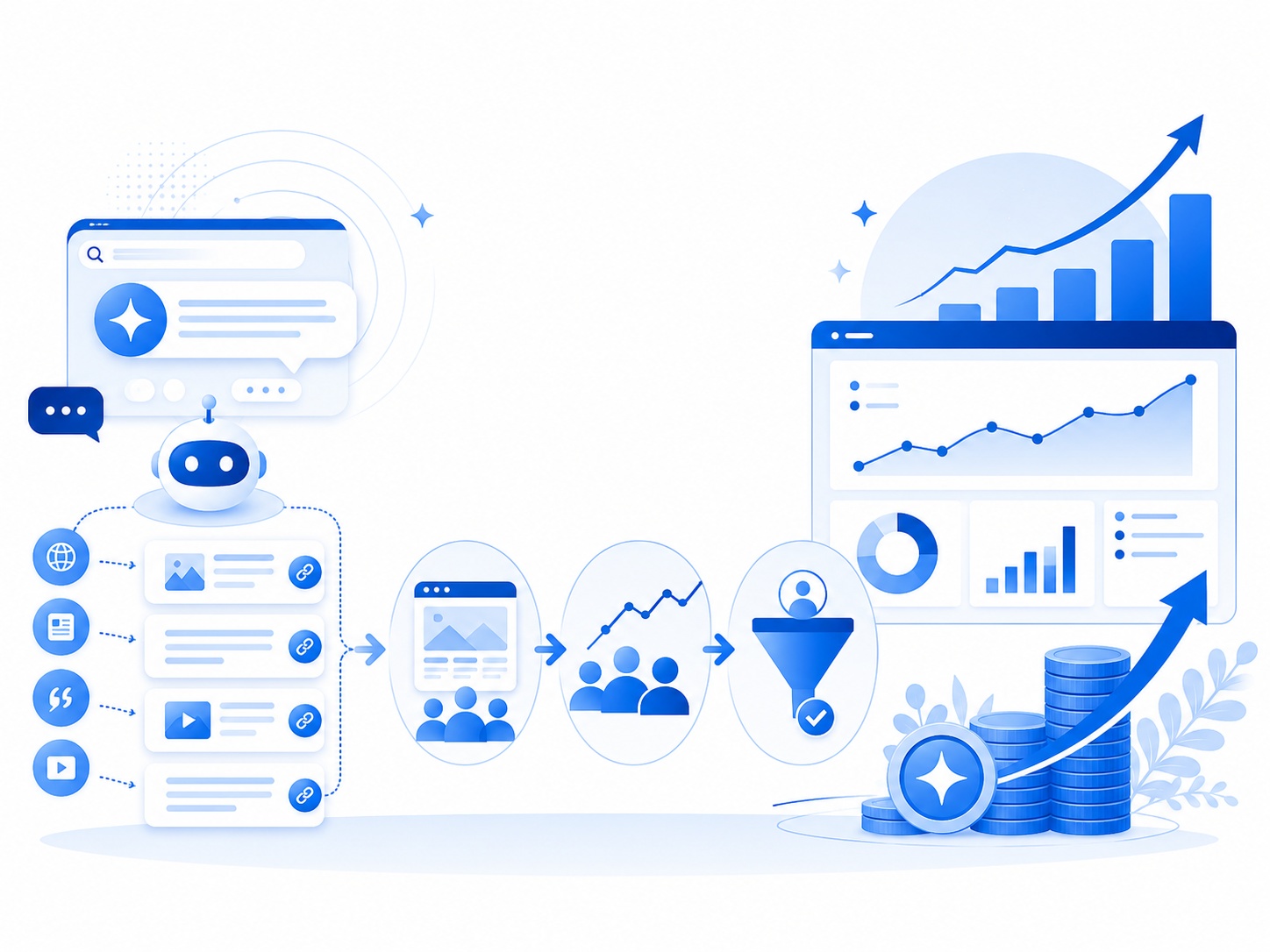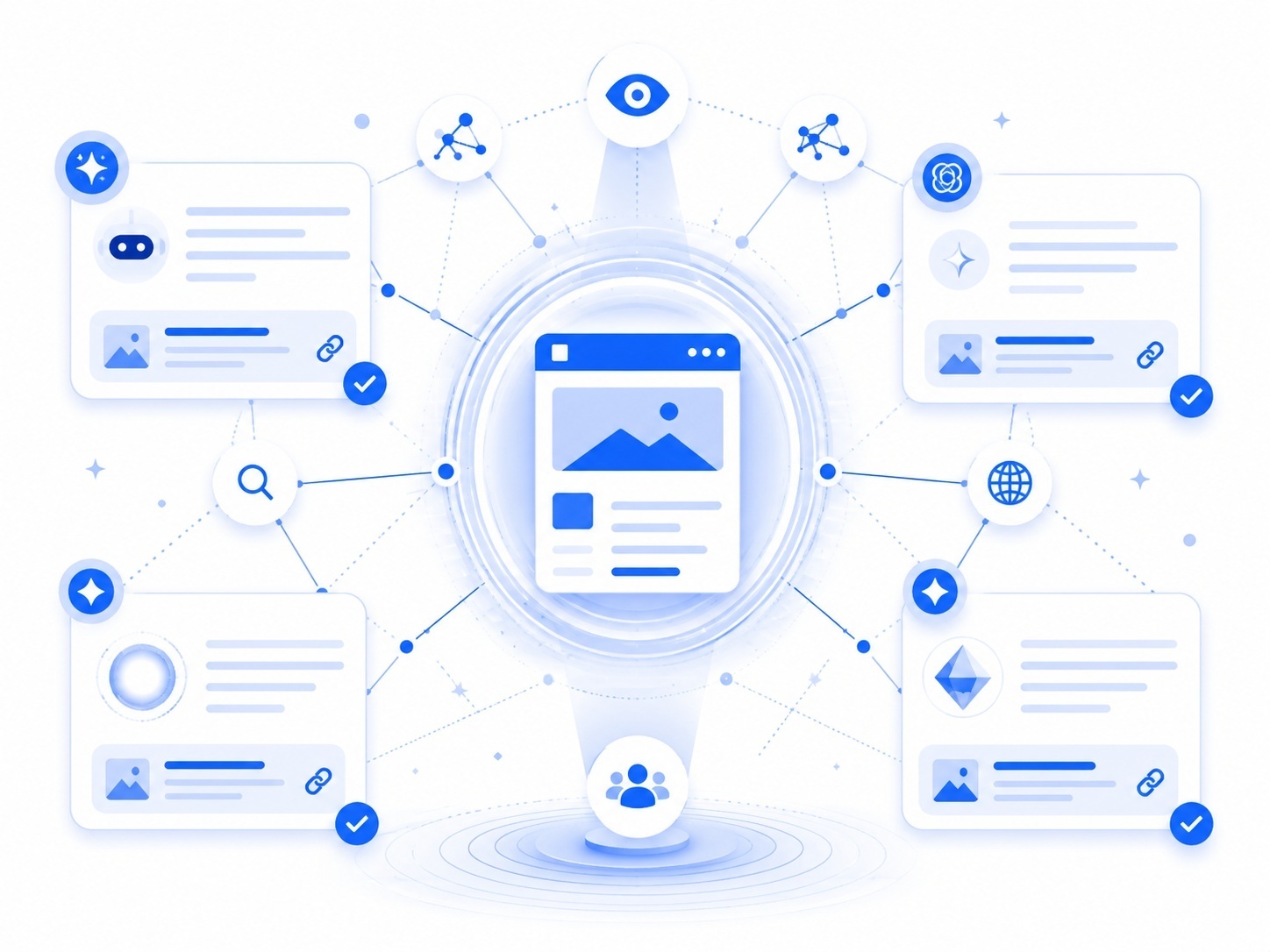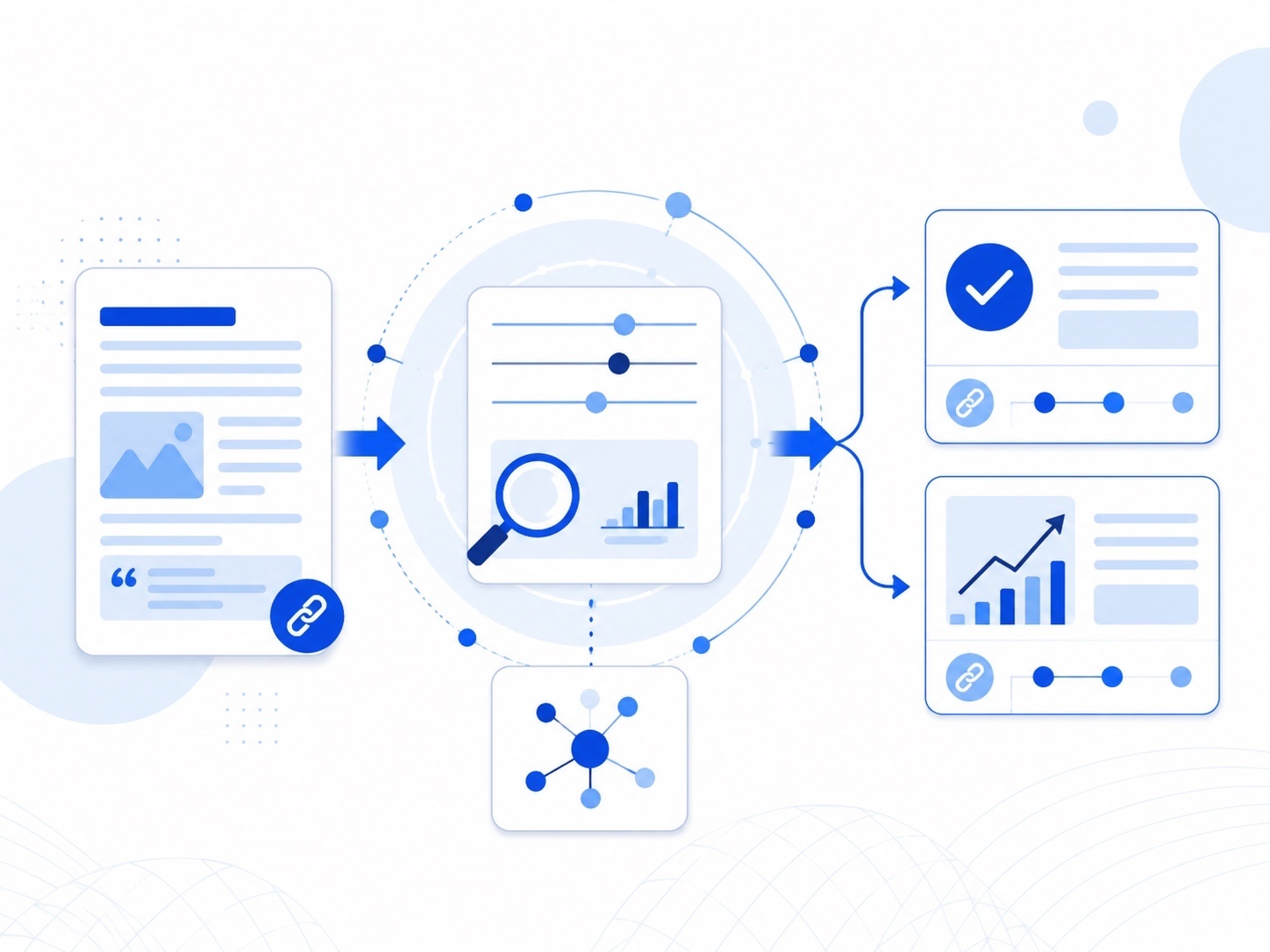
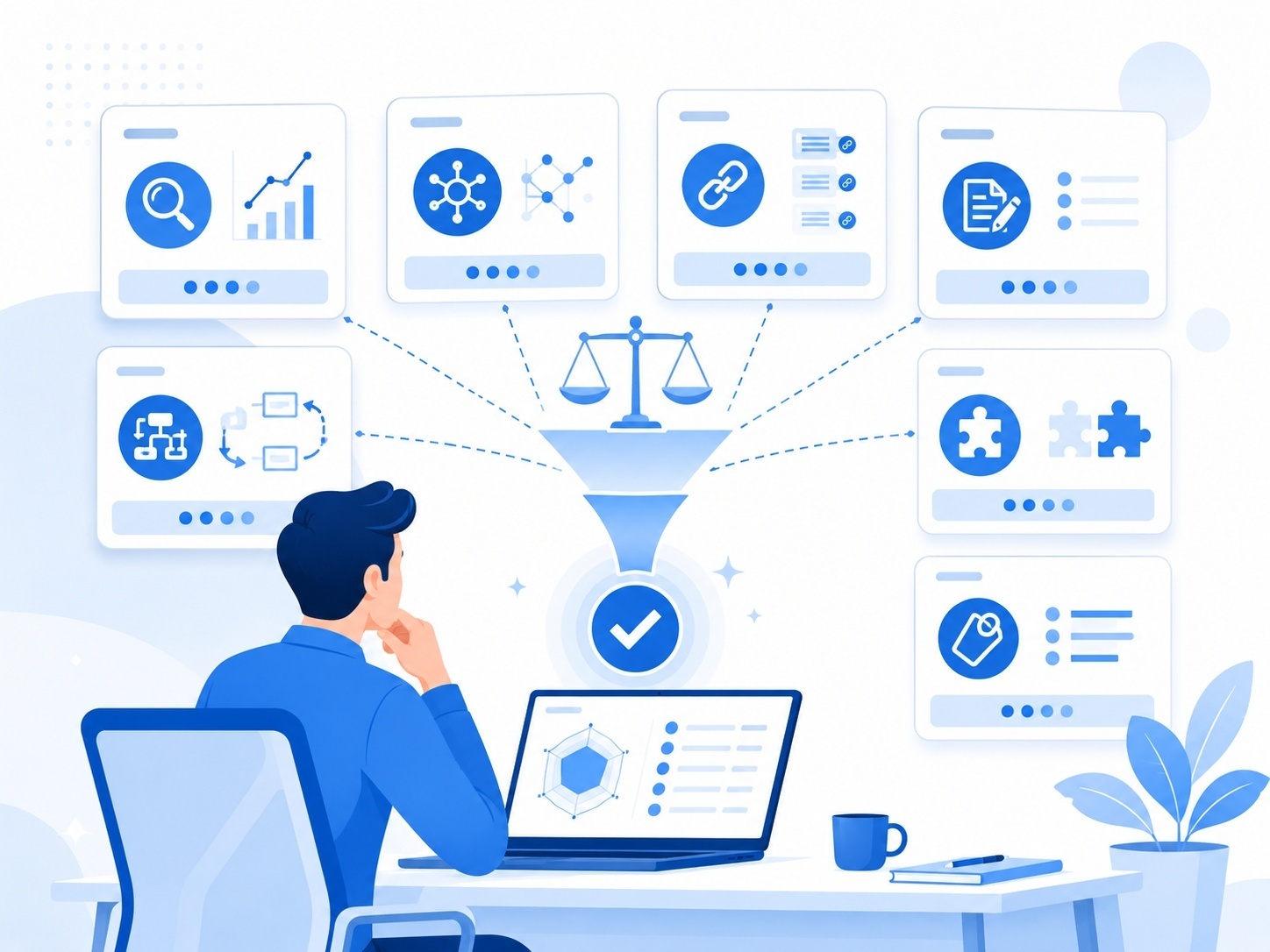
Three platforms are in your trial. All offer multi-engine tracking, competitor insights, and actionable recommendations. Yet one hides the original answers, one requires another platform to execute the work, and one becomes far more expensive once your prompts and markets are added. A fair comparison must therefore test the complete operating fit, not just the feature page.
This guide provides that process: classify each tool, apply 10 buyer checks, document evidence in a weighted scorecard, compare relevant platforms, and test every finalist with identical prompts, competitors, regions, languages, and refresh cycles.
How to compare AI search optimization tools in 5 steps
Start with your workflow and required outcome, not the vendor’s feature list.
- Define the outcome you need: Decide whether you need visibility tracking, gap diagnosis, content execution, reporting, or an end-to-end workflow.
- Shortlist tools that solve the same problem: Compare monitoring platforms with other monitoring platforms and execution tools with similar execution platforms.
- Compare their data, coverage, and execution capabilities: Check original answers, tracked prompts, citations, methodology, historical data, platform coverage, and how insights translate into action.
- Calculate the realistic cost at your expected usage: Factor in prompts, AI platforms, refresh frequency, competitors, markets, users, add-ons, and switching costs.
- Run finalists under identical trial conditions and score the results: Test the same prompts, competitors, AI platforms, regions, languages, and tracking period, preferably in parallel.
The right platform should fit your workflow, provide verifiable data, and reduce the effort required to turn insights into measurable actions.
What do AI search optimization tools actually do?
AI search optimization tools help brands measure and improve how they appear in AI-generated answers. Depending on their scope, they can track visibility, uncover citation and content gaps, recommend improvements, or help teams execute those improvements.
These tools generally fall into 3 categories:
- AI visibility monitoring tools: These platforms track how frequently a brand appears across AI search experiences and how it compares with competitors. They typically measure mentions, citations, share of voice, average position, sentiment, and prompt-level visibility trends.
- AI search optimization and execution tools: These tools identify why visibility gaps exist and help teams address them. Depending on the platform, they may support content opportunity discovery, article creation, content refreshes, on-page optimization, internal linking, and publishing.
- End-to-end SEO and GEO platforms: These platforms connect AI visibility measurement with established SEO workflows such as keyword planning, content creation, optimization, auditing, and publishing. This helps teams manage traditional and AI search performance through a connected workflow.
The key difference is where the workflow stops: monitoring tools reveal visibility gaps, execution tools help close them, and end-to-end platforms connect those actions to the broader organic search.
Want to see how measurement connects with execution? Explore how answer engine optimization works across prompts, content, citations, and AI-generated answers.
Top 10 criteria to compare AI search optimization tools
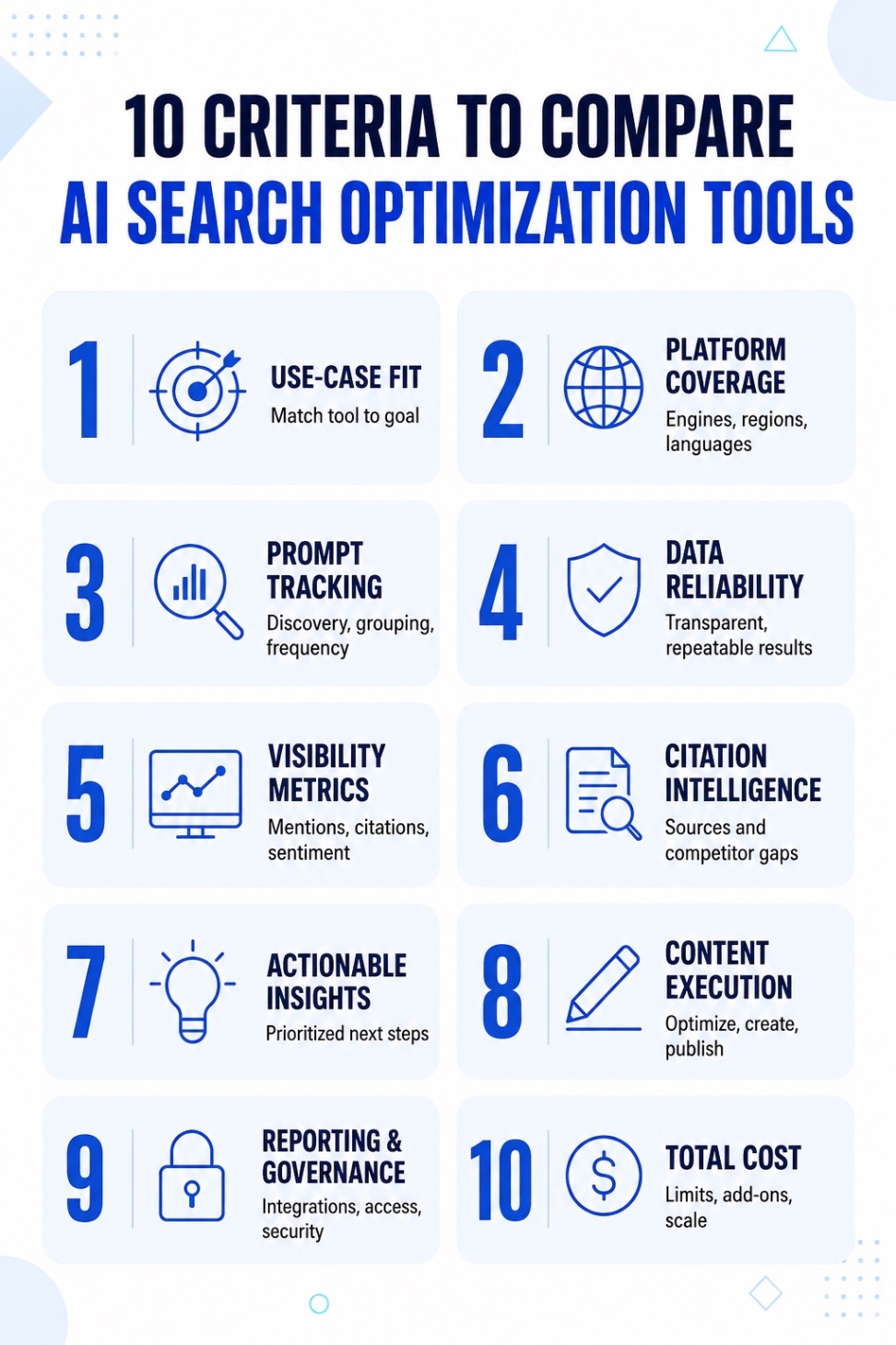
A strong comparison should reveal more than which platform has the longest feature list. It should show whether the tool collects relevant data, explains visibility gaps, and helps your team take action.
1. Fit with your primary use case
Start with the outcome your team needs. AI search optimization tools can serve different purposes, including:
- Tracking brand visibility
- Diagnosing citation and content gaps
- Monitoring competitors
- Optimizing or creating content
- Identifying technical issues
- Reporting performance to stakeholders
A visibility tracker may be enough if you already have established SEO and content workflows. If your main challenge is acting on the data, prioritize a platform that supports optimization and execution.
Also consider who will use the tool. SEO teams, content teams, PR teams, agencies, and enterprise brands often need different workflows and reporting capabilities.
2. AI platform, model, region, and language coverage
Check which AI search experiences the tool monitors, such as ChatGPT, Google AI Overviews, AI Mode, Gemini, Perplexity, Claude, and Copilot.
Do not treat the number of supported platforms as the only measure of coverage. Confirm:
- Which models or search experiences are included
- Whether results can be filtered by platform
- Which countries and languages are supported
- Whether location-specific responses can be tracked
- How frequently each platform is monitored
- Whether some platforms require higher plans or add-ons
Prioritize the platforms your audience actually uses. Broad coverage offers little value if the tool lacks reliable data for your important markets.
3. Prompt discovery and tracking capabilities
The quality of the prompt set directly affects the relevance of the insights. A platform tracking generic or poorly selected prompts can produce impressive dashboards without reflecting how potential customers research your category.
Evaluate whether the tool supports:
- Suggested prompts based on your brand, products, or market
- Manual prompt creation and bulk uploads
- Branded and non-branded prompts
- Prompt grouping, tagging, and filtering
- Segmentation by intent, funnel stage, persona, topic, or location
- Prompt popularity, demand, or prioritization data
- Separate performance tracking for individual prompts
- Daily, weekly, or custom tracking frequencies
Also check whether prompt recommendations come from observed user behavior, modeled data, search data, or automatically generated variations. These sources do not provide the same level of demand validation.
4. Data accuracy, transparency, and repeatability
A visibility score is useful only when you can inspect the data behind it. The platform should let users trace a reported metric back to the prompt and AI-generated answer that produced it.
Check whether you can view:
- The complete answer generated for each prompt
- The exact prompt, platform, model, date, and location
- Brand mentions and their placement within the answer
- Citations and source URLs
- Historical answers and changes over time
- The methodology used to calculate proprietary scores
Also verify how the data is collected:
- Does the platform query the consumer-facing AI experience, use an API, or combine multiple collection methods?
- Is the collection method the same across every supported AI platform?
- Can you trace a reported mention or citation back to the exact response that produced it?
- How does the platform account for location, model, session context, timing, and normal response variation?
Two tools can monitor the same prompt and still report different results because their collection method, model, location, timing, and sampling approach may differ.
AI-generated answers can also vary between runs. Ask whether the platform checks prompts once or multiple times, how it handles answer variation, and whether selected results can be verified manually.
Visibility scores from different vendors may use different formulas. Compare the underlying data, collection methodology, and calculation method, not just the headline numbers.
5. Depth of AI visibility metrics
Look beyond one overall visibility score. A useful platform should show both whether your brand appears and how it is represented.
Relevant metrics may include:
- Mention rate
- Citation rate
- Average brand position within answers
- Share of voice
- Sentiment
- Brand representation accuracy
- Visibility trends
- Prompt-level performance
- Performance by platform, topic, region, or persona
Mention rate and citation rate should be measured separately. An AI response may cite your website without naming the brand, or mention the brand without linking to its content.
For proprietary metrics such as answer ownership, check how the platform defines and calculates them. The metric should connect to inspectable answers rather than function as an unexplained score.
6. Citation and competitor intelligence
Citation data should show which sources influence AI-generated answers, not simply how many citations your domain receives.
Determine whether the tool reveals:
- Exact cited URLs and domains
- Pages from your website that receive citations
- Competitor pages cited for relevant prompts
- Frequently referenced publishers, forums, and third-party websites
- Prompts where competitors appear but your brand does not
- Competitor mention, position, sentiment, and citation trends
- Content or authority gaps associated with competitor visibility
The strongest tools connect the prompt, answer, cited source, and competing brand in one view. This helps teams distinguish between an on-site content gap and an off-site authority or brand mention gap.
7. Actionable recommendations and prioritization
Tracking identifies a visibility gap. Optimization requires understanding why that gap exists and what should be done next.
Check whether recommendations are tied to:
- A specific prompt or topic
- An existing page that needs improvement
- A missing page or content format
- A competitor advantage
- A technical or crawlability problem
- A citation or third-party authority opportunity
- Incorrect or incomplete brand information
- An estimated priority, effort, or potential impact
Avoid tools that provide the same generic recommendations for every visibility problem. Useful guidance should include the evidence behind the recommendation and help teams decide which action to take first.
8. Content optimization and execution capabilities
Some platforms stop after identifying an opportunity. Others help teams complete the recommended work.
Compare support for:
- Content briefs
- New article creation
- Existing content refreshes
- On-page optimization
- Topic and entity coverage
- Technical recommendations
- Internal linking
- Team collaboration and human review
- CMS publishing
- Performance monitoring after publication
Distinguish between tools that suggest an action and tools that provide the workflow to execute it. For example, identifying a weak page is different from helping a team optimize, review, publish, and monitor that page.
The better choice depends on whether your team already has separate tools and resources for execution.
9. Attribution, reporting, integrations, and governance
The platform should make AI visibility data usable beyond its own dashboard. Evaluate whether it connects with the analytics, reporting, and governance systems your team already uses.
Check for:
- AI referral traffic reporting
- AI bot visit tracking
- Frequently cited or retrieved pages
- GA4 and Google Search Console integrations
- CSV exports and API access
- Custom dashboards
- Scheduled stakeholder reports
- Alerts for significant visibility changes
- Multi-user access
- Separate client, brand, or project workspaces
- SSO, role-based permissions, audit logs, and security certifications
AI bot visits, citations, brand mentions, and referral traffic measure different behaviors. A useful reporting system should keep them separate rather than presenting them as interchangeable proof of business impact.
10. Pricing, limits, and total cost of ownership
Starting prices rarely show what a platform will cost at the scale your team requires. Build a realistic usage scenario before comparing plans.
Calculate the cost based on:
- Number of tracked prompts
- Included AI platforms
- Tracking frequency
- Number of competitors
- Countries and languages
- User seats
- Projects, brands, or domains
- Historical data retention
- API and export access
- Reporting capabilities
- Customer support and onboarding assistance
- Add-ons, usage credits, and overage charges
- Implementation, migration, and onboarding time
- Training, learning curve, and productivity costs during switching
Also account for the cost of additional tools or manual work. A lower-priced monitoring platform may become more expensive if your team still needs separate software for content optimization, reporting, and publishing.
The strongest comparison traces a complete path from prompt coverage and verifiable answer data to diagnosis, execution, and reporting. Any break in that path shows where additional tools, costs, or manual work may be required.
Need a more focused buyer checklist? See how to choose an AI brand visibility tool using coverage, answer-level evidence, execution capabilities, and total cost.
8 AI search optimization tools to compare in 2026
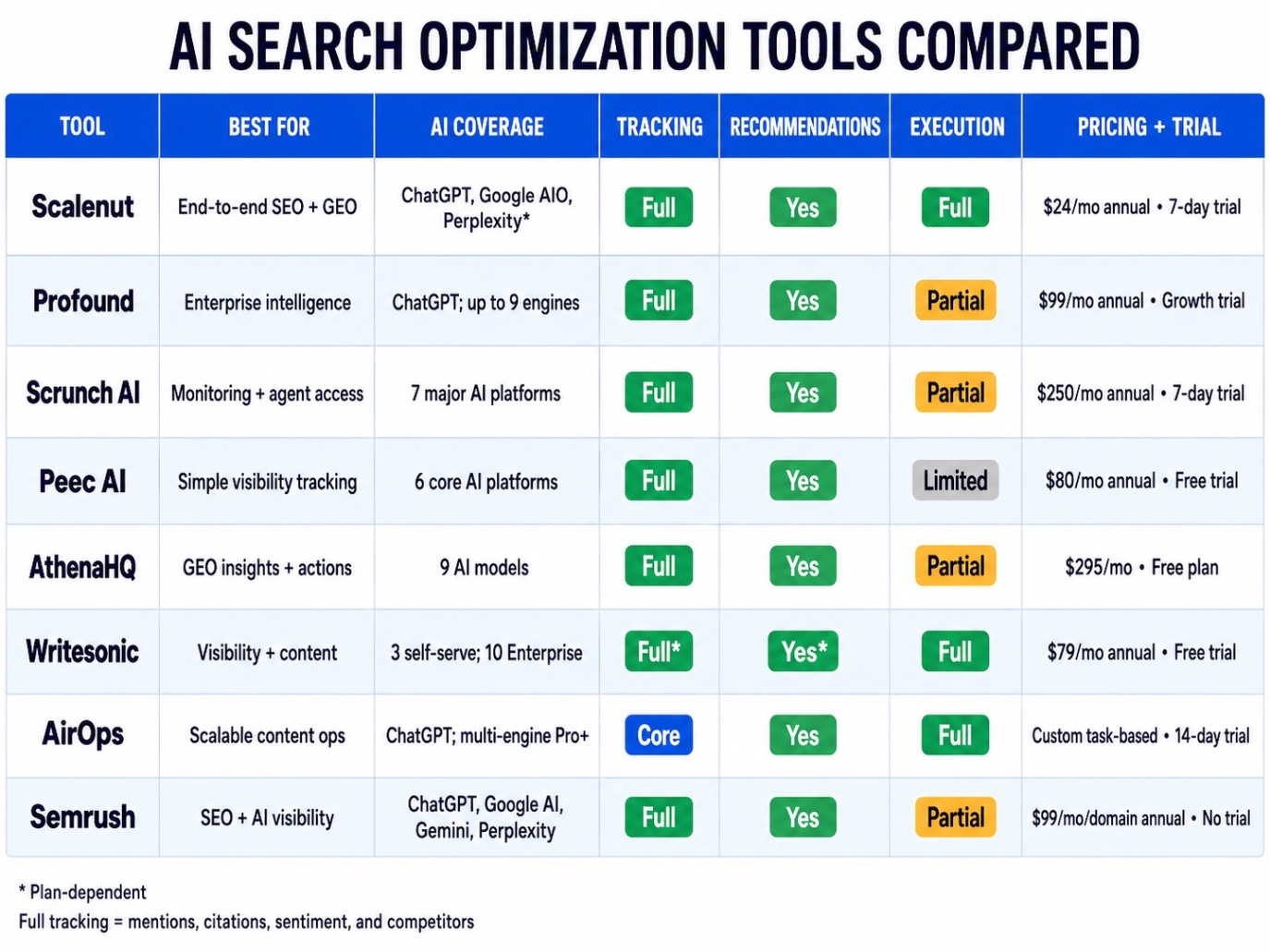
These platforms support different workflows, from focused AI visibility monitoring to enterprise intelligence and content execution. Compare tools that solve similar problems instead of treating every platform as interchangeable.
1. Scalenut: Best for end-to-end SEO and GEO execution
Scalenut tracks AI visibility, brand position, share of voice, citations, sentiment, prompt performance, competitors, AI bot activity, and referral trends.
Optimization and execution capabilities
- Plan, create, optimize, refresh, and audit content.
- Build internal links and publish to WordPress or Shopify.
Key differentiator
- Connects AI visibility insights with complete SEO and GEO execution.
Where it falls short
- Engine coverage and prompt limits vary by plan.
- Standard visibility tracking refreshes weekly.
Pricing
- Starter: $59 monthly or $24 per month billed annually.
- Plus: $89 monthly or $36 per month billed annually.
- Professional: $199 monthly or $80 per month billed annually.
- VIP Service: Custom pricing.
Who should choose it?
- Teams that want AI visibility monitoring and content execution in one platform.
Want a closer look before deciding? Read our complete Scalenut review for a hands-on breakdown of its GEO, SEO, content, and pricing capabilities.
2. Profound: Best for enterprise AI search intelligence
Profound monitors visibility, rankings, citations, sentiment, competitors, prompt demand, and AI-sourced traffic. Agent Analytics connects AI referrals with website activity.
Optimization and execution capabilities
- Generate and optimize content with Profound Agents.
- Run agents at scale through Sheets and organize actions with Aim.
Key differentiator
- Combines prompt intelligence, answer-engine monitoring, attribution, and enterprise governance.
Where it falls short
- Starter covers only ChatGPT, while Growth supports 3 answer engines.
- APIs, multiple regions, and SSO require Enterprise.
Pricing
- Starter: $99 per month, billed annually.
- Growth: $399 per month, billed annually.
- Enterprise: Custom pricing.
Who should choose it?
- Enterprise teams that need detailed AI search intelligence, attribution, and governance.
Considering Profound for an enterprise AEO program? Read our detailed Profound AI review to examine its intelligence depth, pricing, and execution limits.
3. Scrunch AI: Best for monitoring and agent accessibility
Scrunch tracks brand presence, placement, citations, sentiment, competitors, source domains, agent traffic, and AI referral traffic.
Optimization and execution capabilities
- Identify content and technical issues through Page Audits.
- Create AI-friendly versions of pages through its Agent Experience Platform.
Key differentiator
- Connects AI visibility monitoring with insights into how retrieval agents access a website.
Where it falls short
- It does not replace a complete traditional SEO platform.
- The Agent Experience Platform may require technical setup.
Pricing
- Starter: $300 monthly or $250 per month billed annually.
- Growth: $500 monthly or $417 per month billed annually.
- Enterprise: Custom pricing.
Who should choose it?
- Brands that need visibility tracking, technical diagnostics, and agent traffic data.
Need to determine whether its $250 starting price is justified? Read our in-depth Scrunch AI review covering AXP, page audits, agent analytics, and trade-offs.
4. Peec AI: Best for straightforward AI visibility tracking
Peec AI tracks mentions, average position, citations, sentiment, competitors, prompt performance, and frequently cited sources.
Optimization and execution capabilities
- Identify citation gaps and prompts where competitors appear instead.
- Use findings to prioritize content and authority-building opportunities.
Key differentiator
- Provides focused daily monitoring without the complexity of a broader SEO suite.
Where it falls short
- Built-in content creation, technical optimization, and publishing are limited.
- Most actions must be completed in other platforms.
Pricing
- Starter: $80 per month, billed annually.
- Pro: $205 per month, billed annually.
- Advanced: $420 per month, billed annually.
- Enterprise: Custom annual pricing.
Who should choose it?
- Teams that primarily need straightforward AI visibility and competitor tracking.
Considering a focused tracker instead of a complete execution platform? Read our Peec AI review for a closer look at prompt monitoring, citation data, pricing, and limitations.
5. AthenaHQ: Best for accessible GEO monitoring and recommendations
AthenaHQ tracks brand visibility, citations, sentiment, competitors, prompt responses, and conversational variations across major AI platforms.
Optimization and execution capabilities
- Identify citation gaps and receive on-page and off-page recommendations.
- Use AI-assisted content optimization to address visibility gaps.
Key differentiator
- Combines broad AI monitoring with action-oriented recommendations.
Where it falls short
- Starter supports only 1 region and language configuration.
- Advanced agents, multiple markets, and governance features require Enterprise.
Pricing
- Essential: Free.
- Starter: $295 per month, with monthly or discounted annual billing.
- Enterprise: Custom pricing.
Who should choose it?
- Teams that want broad GEO monitoring with clear recommendations.
Want to know whether AthenaHQ turns visibility gaps into useful actions? Read our AthenaHQ AI review for its pricing, strengths, limitations, and final verdict.
6. Writesonic: Best for combining AI visibility with content creation
Writesonic tracks visibility, citations, sentiment, share of voice, competitors, and prompt-level performance across AI search platforms.
Optimization and execution capabilities
- Create articles, optimize existing content, and run site audits.
- Use agentic workflows and the Action Center to address visibility gaps.
Key differentiator
- Combines AI visibility tracking with established content creation workflows.
Where it falls short
- Self-serve plans cover only ChatGPT, Gemini, and Google AI Overviews.
- Full platform coverage and execution features require Enterprise.
Pricing
- Starter: $79 per month, billed annually.
- Basic: $199 per month, billed annually.
- Growth: $399 per month, billed annually.
- Enterprise: Custom pricing.
Who should choose it?
- Content teams that want visibility tracking and content creation in one platform.
Need to know whether Writesonic can improve rankings and AI visibility? Read our Writesonic review for a closer look at its GEO and content workflows.
7. AirOps: Best for scalable content operations
AirOps monitors performance across tracked prompts and pages while highlighting on-site and off-site AI search opportunities.
Optimization and execution capabilities
- Build workflows for content creation, refreshes, research, and quality checks.
- Combine models, data sources, human reviews, and CMS delivery.
Key differentiator
- Provides configurable workflows for producing and optimizing content at scale.
Where it falls short
- It requires more setup than a standard monitoring tool.
- Solo is limited to ChatGPT insights and 1 user.
Pricing
- Insights: Starts at $0 per month.
- Solo and Pro: Paid monthly plans based on selected capacity.
- Pages and Enterprise: Custom pricing.
Who should choose it?
- Content operations teams that need flexible, repeatable execution workflows.
Wondering whether AirOps is worth the setup for scalable content operations? Read our AirOps review for its workflows, pricing, strengths, and limitations.
8. Semrush: Best for combining broader SEO with AI visibility
Semrush tracks brand mentions, AI visibility, sentiment, citations, competitors, and custom prompts. It also provides prompt research and AI-focused site audits.
Optimization and execution capabilities
- Connect AI insights with keyword research, competitor analysis, rank tracking, and technical audits.
- Access additional content tools through other Semrush plans or toolkits.
Key differentiator
- Adds AI visibility measurement to an established SEO platform.
Where it falls short
- The standalone toolkit has limited prompt and domain allowances.
- It is stronger in monitoring and auditing than complete GEO execution.
Pricing
- AI Visibility Base: $99 per month per domain, billed annually.
- Enterprise: Custom pricing.
Who should choose it?
- Existing Semrush users that want AI visibility insights alongside traditional SEO workflows.
The right shortlist depends on the workflow you need to improve. Compare monitoring tools with similar trackers and assess execution platforms by how effectively they help teams act on their findings.
Want to expand your shortlist? Compare the best AI tools for SEO and AEO by visibility tracking, optimization depth, pricing, and workflow fit.
Evaluating Semrush for SEO and AI visibility in one stack? Read our Semrush review to assess its capabilities, complexity, pricing, and potential ROI.
How we evaluated these AI search optimization tools
We compared each platform using the same core factors:
- AI search coverage: Supported AI platforms, models, regions, languages, and tracking frequency.
- Visibility measurement: Prompt tracking, mentions, citations, sentiment, competitor insights, and answer-level data.
- Optimization and execution: How effectively each tool helps teams move from identifying visibility gaps to taking action.
- Pricing and plan limits: Starting price, prompt allowances, platform access, users, projects, and important add-ons or restrictions.
- Product information: Features and pricing were checked against publicly available vendor information at the time of publication.
Which type of AI search optimization tool should you choose?
The right category depends on what your team needs to do after finding an AI visibility gap. Consider your existing resources, operational scale, and execution needs before comparing individual tools.
Here is where each type fits:
- Visibility tracker: Best for teams that already have content writers, SEO specialists, and technical resources. These tools primarily monitor prompts, mentions, positions, citations, sentiment, and competitors. Examples include Peec AI and Scrunch AI.
- Content optimization platform: Best when the main challenge is creating, refreshing, or scaling content. Look for briefs, article generation, optimization, quality checks, and repeatable production workflows. Examples include Writesonic and AirOps.
- End-to-end SEO and GEO platform: Best for teams that want to track AI visibility, identify gaps, optimize content, and publish improvements within one workflow. Scalenut is the clearest example from this list.
- Enterprise platform: Best for organizations requiring global tracking, APIs, SSO, advanced permissions, security controls, custom reporting, and dedicated support. Examples include Profound, AthenaHQ, Scrunch AI, and Semrush Enterprise.
- Agency platform: Best for teams managing multiple clients, domains, projects, users, and stakeholder reports. Useful features include separate workspaces, flexible prompt allocation, exports, and client-ready reporting. Examples include Peec AI, Writesonic, Scalenut, and Semrush.
The best tool is not the one with the longest feature list. It is the one that fits your current workflow, closes the most important operational gap, and reduces the number of platforms needed to act.
Still deciding which optimization workflow your team needs? Understand the differences between AEO and GEO before choosing a monitoring, execution, or end-to-end platform.
What common mistakes should you avoid when comparing AI search optimization tools?
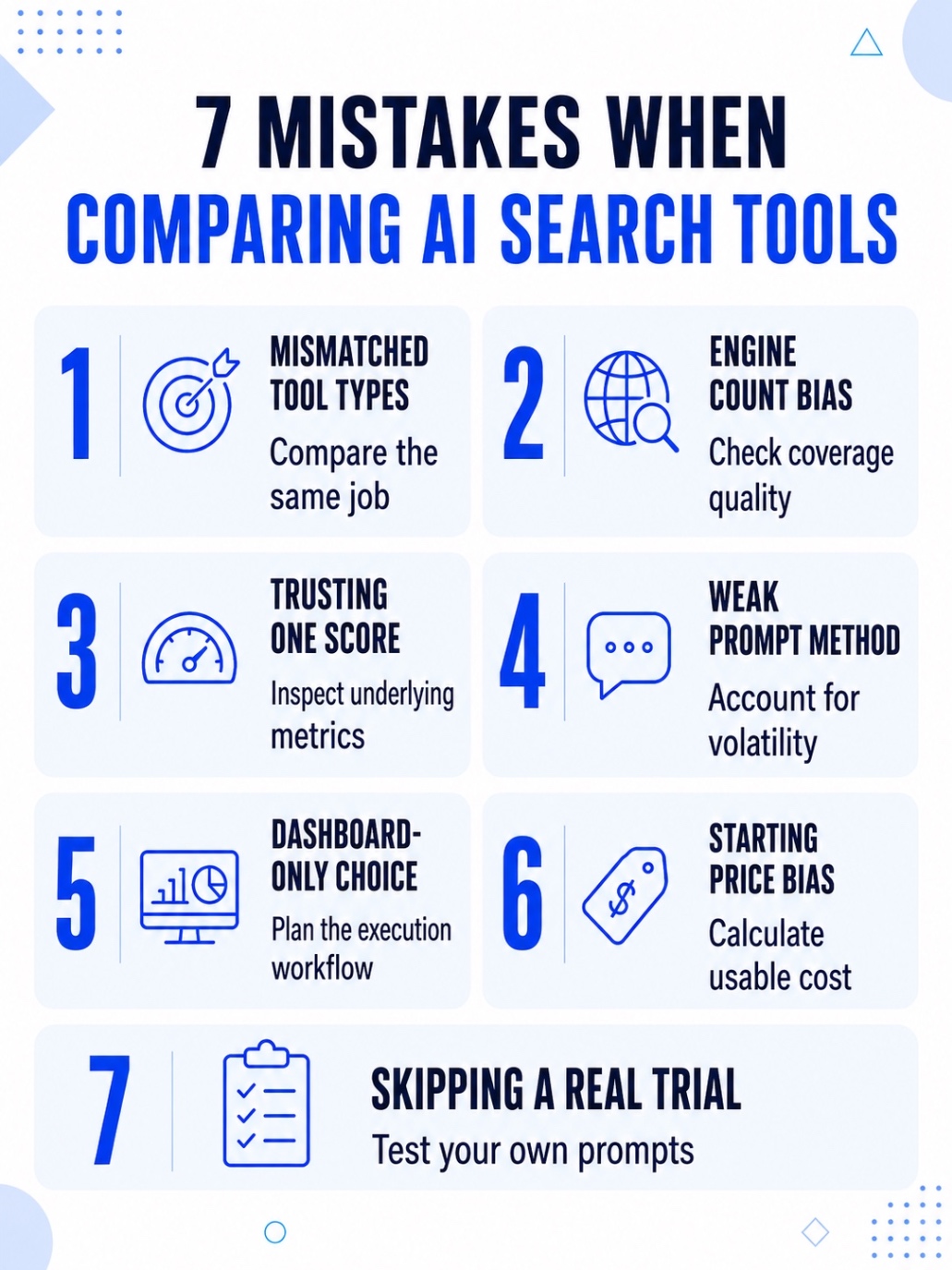
Similar-looking platforms can differ significantly in what they track, how they collect data, and whether they help teams act on insights.
Avoid these 7 common mistakes:
- Comparing tools that solve different problems: Separate visibility trackers from content optimization, technical analysis, and end-to-end execution platforms. Compare tools based on the outcome you need.
- Equating engine count with coverage quality: Check the models, regions, languages, tracking frequency, and answer-level data supported for each engine. Also confirm what your plan includes.
- Trusting one proprietary visibility score: Vendor scores use different formulas and prompt sets. Review the underlying mentions, citations, sentiment, answer placement, and prompt-level results.
- Ignoring prompt methodology and answer volatility: Examine how prompts are selected, how often they are checked, and whether original answers and historical changes are available.
- Choosing a dashboard without an execution workflow: Confirm whether the tool helps diagnose gaps and act through content optimization, technical fixes, publishing, or integrations.
- Comparing starting prices instead of usable plan costs: Calculate the price for your required prompts, engines, refresh frequency, competitors, projects, seats, and add-ons.
- Committing before running a controlled trial: Test shortlisted tools with the same prompts, competitors, AI platforms, regions, languages, and tracking period. Compare the results before committing to a plan.
A fair comparison uses the same requirements and testing conditions for every platform, exposing differences that feature lists and starting prices often hide.
Avoid letting one dashboard score drive your decision by learning which AI visibility metrics actually matter and how to verify them over time.
How should you test AI search optimization tools during a trial?
A product demo shows what the vendor wants you to see. A useful trial tests whether the platform works with your prompts, competitors, workflows, and budget.
Use this process to evaluate each shortlisted tool consistently:
- Build a representative prompt set: Include branded, non-branded, comparison, problem-aware, and purchase-intent prompts. Choose questions that reflect how customers research your category, not reworded SEO keywords.
- Use identical testing conditions and run finalists in parallel: Keep the prompt wording, competitors, AI platforms, regions, languages, tracking period, and refresh frequency consistent. Testing tools at the same time reduces differences caused by normal AI answer variation and makes their results easier to compare. Record unsupported requirements as product gaps.
- Validate selected results manually: Compare a sample of reported mentions, citations, answer positions, and source URLs with the original AI responses. Check whether the platform provides enough context to verify its metrics.
- Complete one insight-to-action workflow: Identify a visibility gap, determine the required action, and see whether the tool helps execute or route it. Note any additional tools, exports, or manual work required.
- Monitor multiple refresh cycles: Do not judge the tool from one snapshot. Track the same prompt set across several updates to see whether trends remain useful despite normal answer variation.
- Calculate costs at your expected scale: Estimate pricing using the prompts, models, refresh frequency, projects, regions, users, integrations, exports, and add-ons your team will actually need.
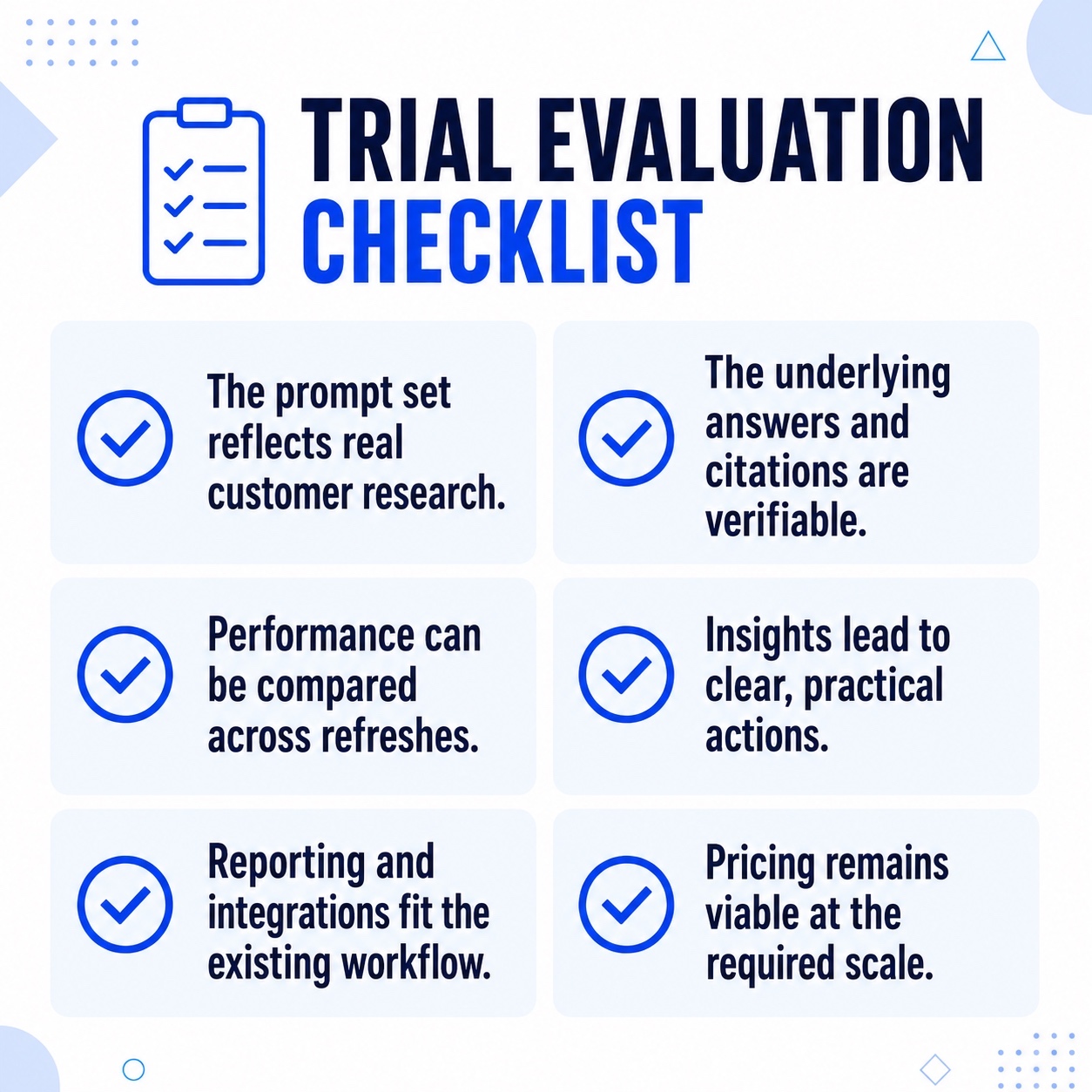
A successful trial should prove that the platform delivers trustworthy data and supports a repeatable workflow at a realistic cost.
Turn your product trial into a realistic benchmark with this step-by-step LLM visibility audit covering prompts, citations, competitors, and answer accuracy.
How can you score AI search optimization tools objectively?
A weighted scorecard makes the comparison more consistent by giving greater importance to the capabilities that matter most. It also prevents one impressive feature or low starting price from influencing the entire decision.
Use the scorecard below as a starting point, then follow these steps:
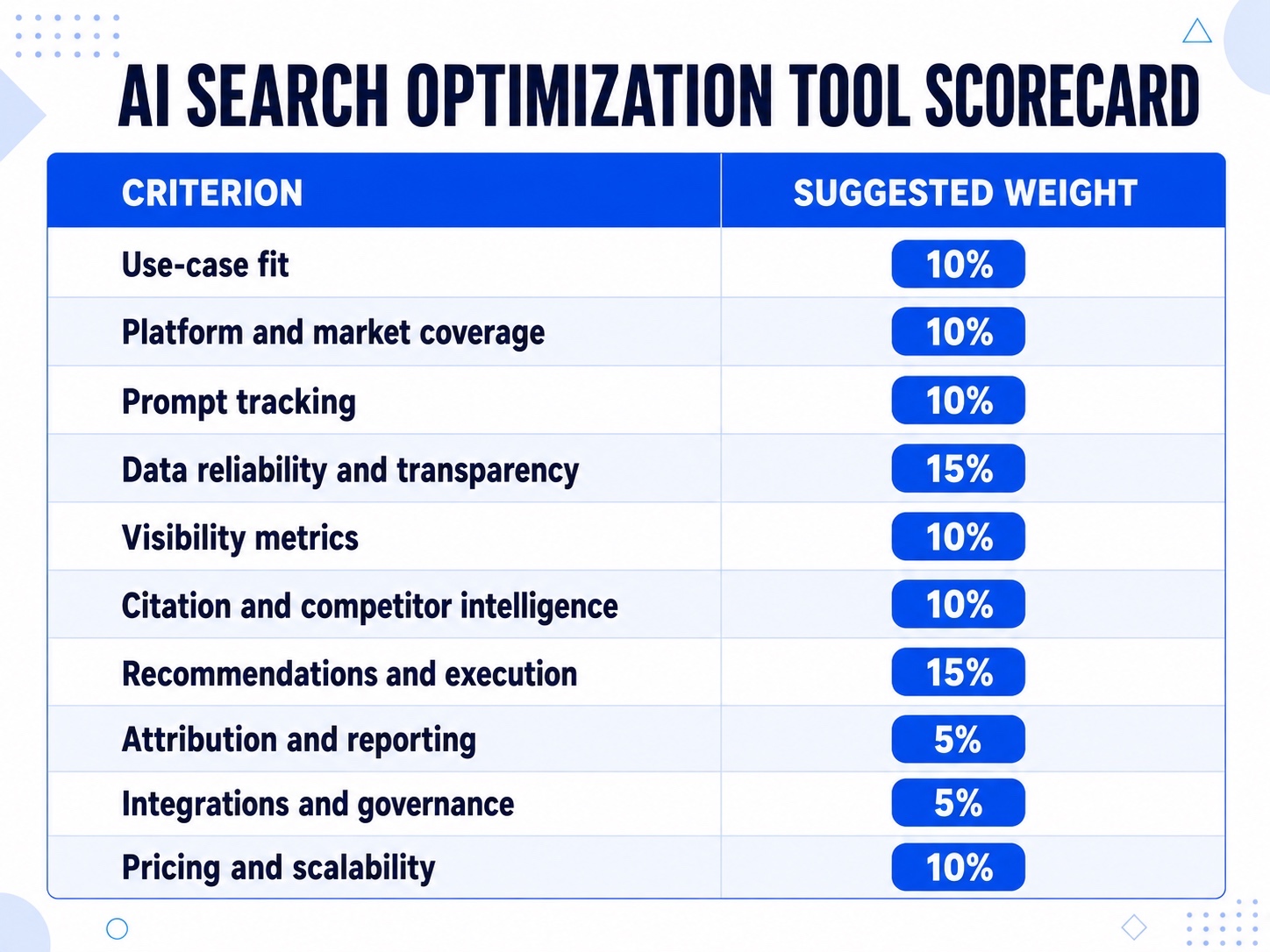
- Score each tool from 1 to 5: Use consistent definitions. A score of 1 means the requirement is missing, 3 means it is adequate, and 5 means it performs strongly and has been verified.
- Calculate the weighted points: Divide the score by 5 and multiply it by the assigned weight. For example, a score of 4 for a criterion weighted at 15% contributes 12 points.
- Adjust the weights when necessary: Keep the total at 100%, but change the distribution based on your priorities. An enterprise may prioritize governance, while a content team may place more weight on execution.
- Record evidence for every score: Support each rating with trial findings, verified features, plan limits, original answers, screenshots, or product documentation. Avoid scoring tools based only on sales claims.
- Evaluate the total in context: Add the weighted points to calculate a score out of 100. However, a high total should not outweigh weak data reliability, missing platform coverage, or essential security gaps.
The scorecard does not remove judgment. It makes the reasoning behind the final decision visible, consistent, and easier to defend.
Need stronger evidence for every score? Use these AI search visibility metrics to support ratings with consistent, measurable data.
Conclusion: How to compare AI search optimization tools before choosing one
By now you know how to pick an AI visibility tool. To summarize, start by defining the job the platform must do, then shortlist only comparable SEO tools. Score the key features against your team size, required AI engines, available SEO data, competitor research needs, learning curve, and security or reporting requirements. This prevents small businesses, SEO professionals, and larger marketing teams from paying for capabilities they cannot use. Run each free trial with the same prompts, markets, competitors, and refresh schedule, record the evidence, and check whether recommendations reflect sound best practices.
Next, complete one real workflow from content gap analysis to publication. Check whether the platform improves content structure, builds useful topic clusters, supports AI writing without weakening editorial control, and moves content generation into repeatable content production. The strongest option is the one your team can verify, operate, and afford at scale, not the one with the longest feature list. To evaluate your current visibility and build a practical SEO and GEO workflow, book a free strategy call with Scalenut.
Frequently asked questions
Why do AI search optimization tools report different visibility scores?
Scores differ because vendors use different prompt sets, models, locations, sampling frequencies, and weighting formulas. Since artificial intelligence produces variable responses, compare the original answers and methodology instead of assuming scores from separate platforms represent the same measurement.
Can AI visibility data be reliable when AI answers keep changing?
Yes, but reliability should be judged across repeated checks rather than one snapshot. AI search visibility tools should retain historical responses, record the prompt and model, and show how often a brand appears across changing AI search results.
How many prompts are enough to compare AI search optimization tools reliably?
No universal number works for every brand. Start with a representative set covering branded, non-branded, comparison, problem-aware, and purchase-intent queries. Prioritize prompts that reflect real customer research and connect directly to your content strategy and commercial goals.
How long should you test an AI search optimization tool before buying?
Run the trial across at least two refresh cycles so you can observe consistency rather than a single response snapshot. The right choice should produce repeatable insights under identical prompts, competitors, regions, languages, and tracking frequencies.
Should reported AI mentions and citations be verified manually?
Verify a sample of high-priority prompts manually, especially surprising mentions, missing citations, or major position changes. Open the original answer, confirm its cited URLs, and record the model, date, and location before treating the reported results as reliable.
Is broader AI platform coverage always better?
No. Coverage matters only when it reflects where your audience researches and buys. Confirm the exact models, regions, languages, and plan availability. Tracking many AI search engines adds little value if the relevant markets or buyer prompts are missing.
Do AI search optimization tools improve visibility or only monitor it?
Some platforms only monitor mentions, citations, and competitors. Others support generative engine optimization by identifying gaps and helping teams create, refresh, optimize, or publish content. Improvement still depends on executing those recommendations and strengthening relevance, trusted citations, and topical authority.
Can one platform replace separate SEO, GEO, and content tools?
Sometimes, provided the platform covers the required research, measurement, optimization, review, and publishing workflows. Check whether it supports existing SEO content while maintaining AI content quality. Specialized analytics, technical auditing, or enterprise reporting may still require separate tools.
How frequently should AI search visibility data be refreshed?
Daily tracking can help with active campaigns or volatile commercial prompts, while weekly updates may suit broader monitoring. Evaluate whether the refresh rate matches your decision cycle and whether historical answers are retained, since isolated checks can misrepresent LLM visibility trends.
How can teams measure the ROI of an AI search optimization tool?
Connect tool data with referral analytics, cited-page performance, conversions, assisted journeys, and brand-demand changes. Organic traffic alone will not capture every influenced visit, so report visibility trends alongside engagement and conversion evidence without claiming direct causation the data cannot prove.
What hidden costs should you check beyond the advertised price?
Check charges for additional prompts, models, countries, languages, competitors, users, workspaces, exports, APIs, history, and faster refreshes. SEO agencies should also calculate client reporting and workspace costs, because the advertised entry plan may not support real delivery requirements.
Should small teams and enterprises use the same comparison criteria?
No. Every team should examine data reliability, transparency, and workflow fit, but the weighting should change. Smaller teams may prioritize execution and usability, while enterprises often need governance, global coverage, integrations, permissions, and reporting across traditional search and AI channels.


.svg)


.webp)