.jpg)
Future of Answer Engines: 7 Shifts Reshaping AI Search

Key Highlights
- Answer engines are becoming more conversational, multimodal, personalized, and action-oriented.
- Traditional search and AI answers are increasingly converging into one search experience.
- SEO remains foundational, while AEO extends visibility into AI-generated answers, mentions, and citations.
- There is no special schema or fixed content format required for AI visibility.
- Strong content still depends on originality, clarity, trust, and solid technical SEO.
- Search performance should now be measured across rankings, AI visibility, referral traffic, engagement, and conversions.
Imagine using Search to plan a barbecue. Instead of stopping at recipes and shopping links, Google’s AI Mode can help build your grocery list, connect with Instacart, and add the ingredients directly to your cart.
That one interaction shows where answer engines are heading. They are moving beyond retrieving and summarizing information toward understanding context, connecting with other services, and helping users act. Multimodal search, personalization, persistent conversations, connected apps, and AI agents are already pushing this shift from simply answering a question to supporting more of what happens next.
This guide breaks down the 7 shifts shaping the future of answer engines and how they could change search, visibility, and user behavior.
What is the Future of Answer Engines?
The future of answer engines is moving beyond one-off AI summaries toward systems that understand richer inputs, retain context, personalize responses, and take actions. Google is already bringing multimodal queries, Personal Intelligence, search agents, and booking actions into Search. This shift is already happening at scale, with AI Mode surpassing 1 billion monthly active users. The next phase is becoming a research-and-action layer, not just an answer layer.
Future of answer engines at a glance
The shift is not simply from traditional search to AI-generated answers. Answer engines are expanding from answering individual queries to understanding context, connecting with other services, and helping users complete tasks.
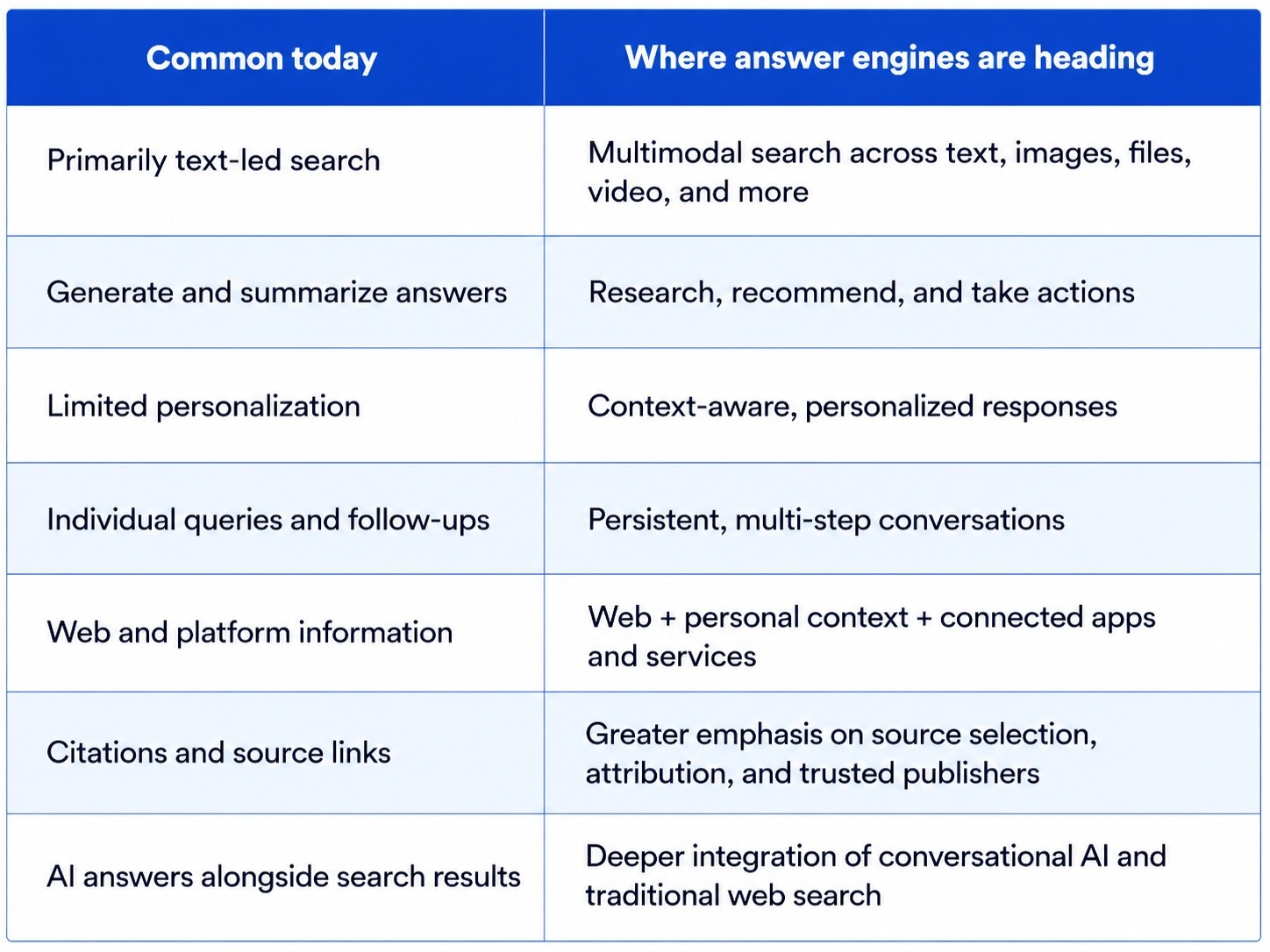
These shifts point to answer engines becoming a broader discovery and action layer, while the open web and traditional search remain part of how users verify, explore, and go deeper.
What are the 7 Trends Shaping the Future of Answer Engines?
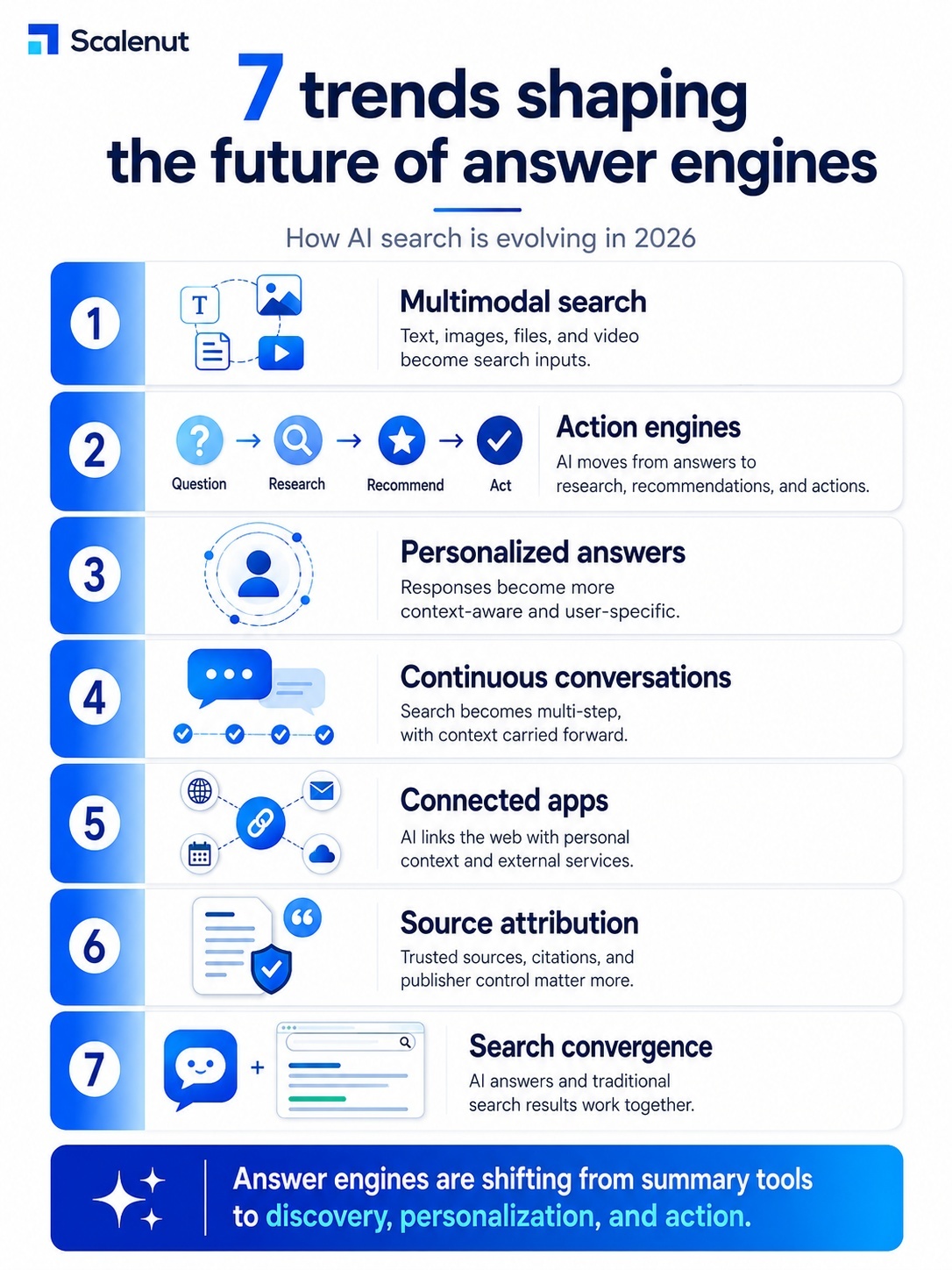
Answer engines are already moving beyond generating faster summaries. In 2026, Google and other AI platforms are adding multimodal search, persistent context, personalization, agents, connected services, and new ways to surface original sources. These changes point to a broader shift in how people will search, evaluate information, and complete tasks online.
Here are the 7 shifts shaping the future of answer engines.
1. Multimodal search will move beyond text
Answer engines are becoming capable of understanding much more than typed queries. Google’s AI Mode now supports text, images, files, videos, and browser tabs as search inputs, allowing users to describe a problem using whichever format provides the most context.
This changes both how questions are asked and how answers are delivered. Future answer experiences are likely to combine written explanations with images, interactive tools, video, product information, and other formats instead of relying on text alone.
2. Answer engines will evolve into action engines
The next major shift is from giving an answer to completing a task. Google now describes an era of “Search agents,” including information agents that can continuously research topics and capabilities that can contact businesses on a user’s behalf.
The journey is therefore expanding from question → answer to question → research → recommendation → action. Shopping is already following this pattern, with AI systems helping users research products, compare alternatives, and in some cases complete purchases without leaving the AI experience.
3. Answers will become more personalized and context-aware
Answer engines will increasingly use permitted personal context to determine what the “best” answer means for an individual user.
Google’s Personal Intelligence can connect AI Mode with services such as Gmail and Google Photos, with Google Calendar planned as another source of context. In May 2026, Google expanded Personal Intelligence to nearly 200 countries and territories across 98 languages.
This means visibility may become more contextual. The same question could surface different recommendations depending on a user’s preferences, previous activity, location, or connected information.
4. Search will become a continuous conversation
Traditional search treats each query largely as a new interaction. Answer engines are moving toward conversations where context carries from one question to the next.
Google already allows users to follow an AI Overview with another question and continue into AI Mode without losing the context of the original search. Google says this makes Search feel less like a series of individual queries and more like an ongoing conversation.
That makes follow-up questions, query refinement, and deeper exploration increasingly important parts of the search journey.
5. Answer engines will connect directly with apps and services
Future answer engines will not rely only on webpages and indexed information. They are beginning to interact directly with external services.
In July 2026, Google introduced connected apps in AI Mode, allowing users to link services such as Instacart, Canva, and YouTube Music and perform tasks like creating lists, designing projects, or building playlists from Search.
This creates a broader answer ecosystem where AI can combine information from the web, personal context, product feeds, and connected applications before helping the user act.
6. Source attribution and publisher control will become more important
As answer engines synthesize information from multiple sources, showing where that information came from becomes increasingly important for both users and publishers.
Google introduced Preferred Sources in AI Overviews and AI Mode and a “Highly Cited” label designed to surface influential original reporting.
In August 2026, Google also introduced a new Preferred Sources button that lets users prioritize publishers they trust. Google says users have already selected more than 600,000 unique sources.
For brands and publishers, future visibility will therefore involve more than being indexed. Being recognized as an original, trusted, and frequently referenced source will matter too.
7. Answer engines and traditional search will converge
Answer engines are unlikely to simply eliminate traditional search results. The clearer direction is convergence.
Google’s AI Search already combines generated answers with links, supporting articles, website recommendations, conversational follow-ups, and traditional web discovery. AI Mode itself is positioned as a bridge between a conventional search engine and conversational AI.
The future search experience is therefore likely to be hybrid: direct AI answers when they are useful, deeper web exploration when more context is needed, and agents or connected services when the user wants to take action.
Together, these shifts are changing answer engines from tools that simply summarize information into interfaces for discovering, evaluating, personalizing, and acting on information across the web.
What Is Changing About Search With AI Answer Engines?
Search is becoming more conversational and answer-led. AI Overviews and AI search experiences can synthesize information directly on the results page while still providing links for deeper exploration. For brands, visibility now extends beyond rankings and clicks to include being mentioned, cited, and surfaced within AI-generated responses.
What Are AI-Powered Answer Engines?
AI-powered answer engines such as ChatGPT, Google Gemini, and Perplexity AI use generative AI to interpret intent, retrieve information, and produce direct responses instead of only returning ranked links.
Answer engine optimization (AEO) focuses on making content clear, useful, trustworthy, and easy for these systems to understand and reference.
How Did Search Shift From Links to Direct Answers?
Search has been moving beyond the traditional list of blue links for years, from featured snippets and knowledge panels to AI Overviews and conversational search.
AI answer engines take this further by synthesizing information across multiple sources and letting users ask follow-up questions without starting a new search. Links still matter, but they increasingly sit alongside direct answers and conversational exploration.
Why Do Users Expect Instant, Conversational Results?
Users can now ask longer, more specific questions and refine them through follow-ups instead of breaking a problem into multiple searches. AI Mode also supports multimodal inputs such as text, voice, and images.
This behavior is being driven by:
- Faster access to synthesized information.
- Natural-language and follow-up questions.
- More complex and specific search queries.
- Multimodal search across text, voice, images, and other inputs.
As search becomes more conversational, content needs to answer real questions clearly while still providing enough depth for users and AI systems to explore further.
Why Are AI Answer Engines Changing How People Search?
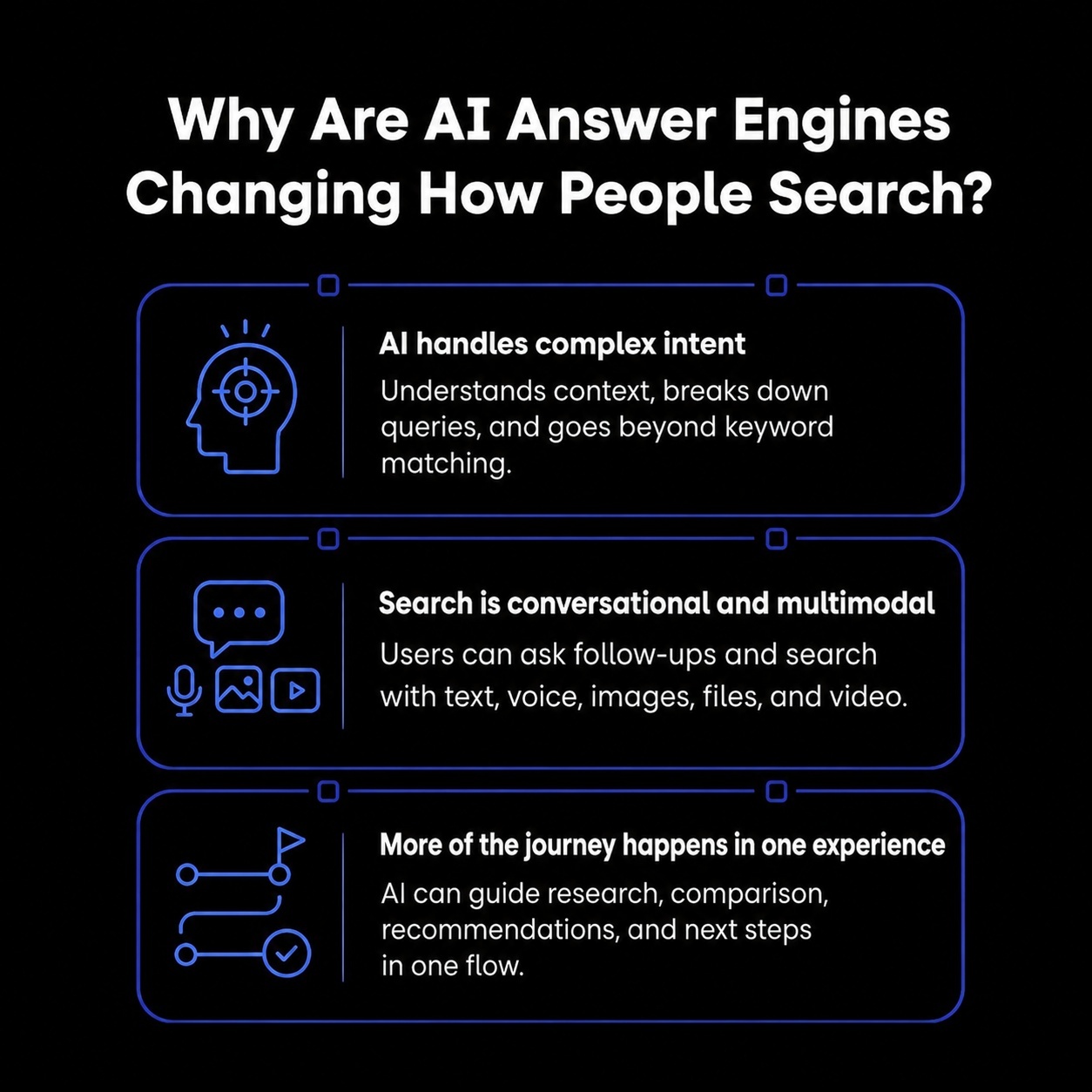
AI answer engines are changing search behavior by reducing the steps between a question and a useful response. Users can ask more complex questions, refine them through follow-ups, search across multiple formats, and increasingly take action without restarting the search journey.
1. AI Can Handle More Complex Search Intent
Modern AI search systems go beyond basic keyword matching. They can interpret context, break complex questions into subtopics, retrieve relevant information, and synthesize it into a direct response.
This makes user intent more important than exact keyword matching. Content needs to address the underlying question clearly and provide enough context for AI systems to understand when it is relevant.
2. Search Is Becoming Conversational and Multimodal
Users no longer have to reduce every need to a short keyword query. AI search supports natural-language questions, follow-ups, and increasingly multimodal inputs such as text, voice, images, files, and video.
This lowers the friction of complex searches. Instead of running several separate queries, users can describe what they need, add context, and refine the answer within the same interaction.
3. More of the Search Journey Happens in One Experience
AI search is expanding beyond finding information. Google Search can now retain context across follow-ups, personalize responses, connect with external apps, and use agents to research or help complete certain tasks.
This means users may move from question to comparison, recommendation, and action without following the traditional pattern of opening multiple search results. For brands, visibility therefore depends on more than rankings alone. Clear, authoritative, and useful content can also help earn mentions, citations, and visibility within AI-generated experiences.
How Do AI Answer Engines Work Behind the Scenes?
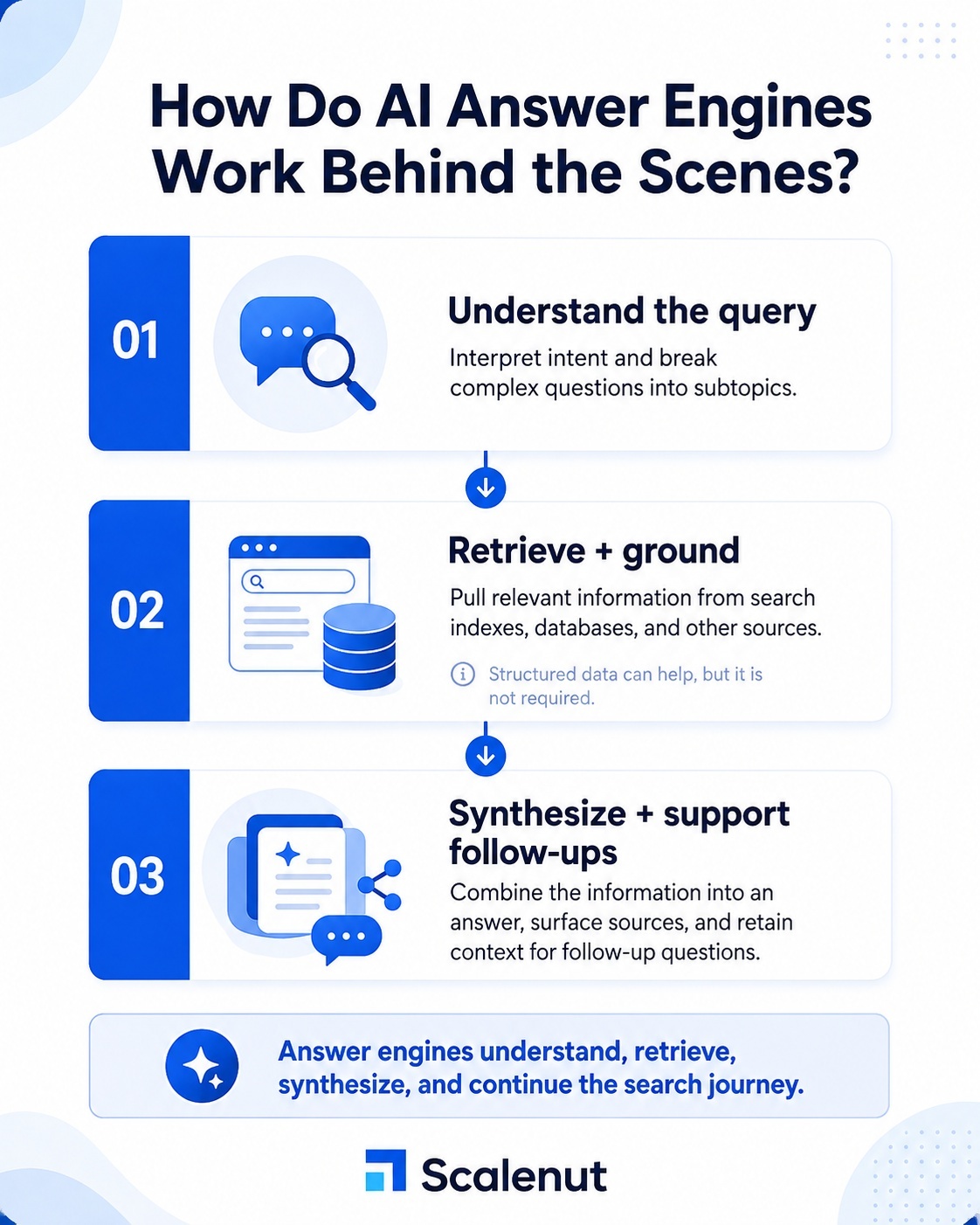
AI answer engines combine language models with retrieval systems to understand a query, find relevant information, and generate a useful response. The exact architecture differs by platform, but the process generally involves three stages.
1. Query Understanding and Decomposition
The system first interprets the user’s intent, context, and constraints. For complex questions, it may break the query into smaller subtopics and search them separately.
Google AI Mode, for example, uses query fan-out to run multiple related searches before bringing the results together.
2. Retrieval and Grounding
The answer engine retrieves relevant information from search indexes, databases, or other available sources to ground its response in current information.
This is where strong search engines and retrieval systems remain important. Structured data can help search systems understand page content and entities, but it is only one signal and is not required for AI visibility.
3. Synthesis, Sources, and Follow-Ups
The model combines the retrieved information into a response tailored to the query. Depending on the platform, it may also surface citations or supporting links so users can explore the original sources.
Conversational systems can then retain context for follow-up questions, allowing the search journey to continue without starting over.
The key shift is that answer engines do more than rank documents. They understand the question, retrieve relevant information, synthesize it, and support further exploration.
How Are Answer Engines Different From Traditional Search Engines?
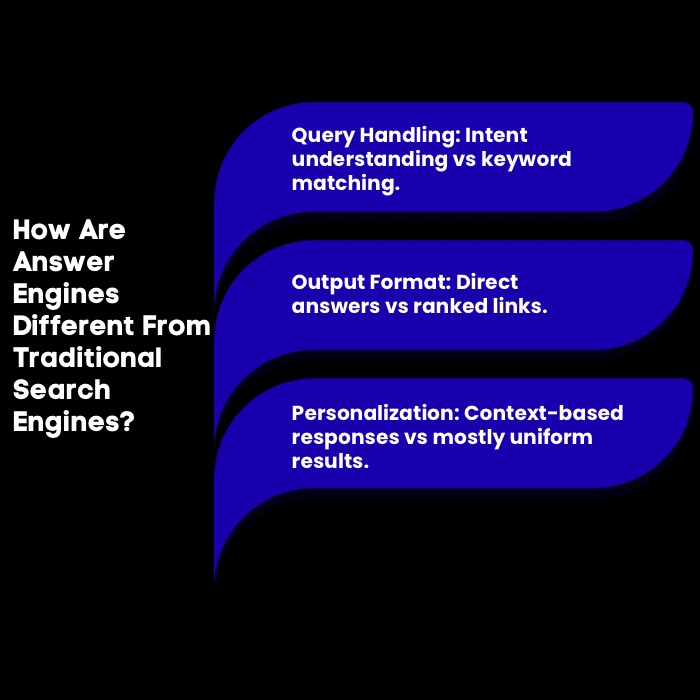
Traditional search and answer engines both aim to understand intent and surface useful information. The main difference is the experience: traditional search ranks relevant results, while answer engines synthesize information, support follow-ups, and retain context across a conversation.
1. Query Handling: Single Searches vs Complex Queries
Traditional search already interprets intent, context, and related terms. Answer engines go further by handling longer, multi-part questions and breaking them into subtopics before generating a response.
For SEO strategies, this means keywords still matter, but content also needs to cover related questions and the broader intent behind a query.
2. Output Format: Ranked Results vs Synthesized Answers
Traditional search organizes webpages, videos, products, maps, and other results for users to explore. Answer engines can combine information from multiple sources into a direct response while still linking back to supporting sources.
- Traditional search: Helps users find and compare relevant sources.
- Answer engines: Synthesize information and support follow-up questions.
The distinction is becoming less rigid as AI and traditional search increasingly merge into one experience.
3. Personalization: Search Signals vs Deeper Context
Traditional search already uses signals such as location, settings, and recent activity. Answer engines can go further by using permitted personal context to tailor the response itself.
For brands, this makes visibility more contextual. The most relevant source can vary by user, query, and situation.
The key difference is no longer simply links versus answers. It is how much synthesis, personalization, and interaction happens within the search experience itself.
How Do AI Answer Engines Impact Visibility, Clicks, and Traffic?
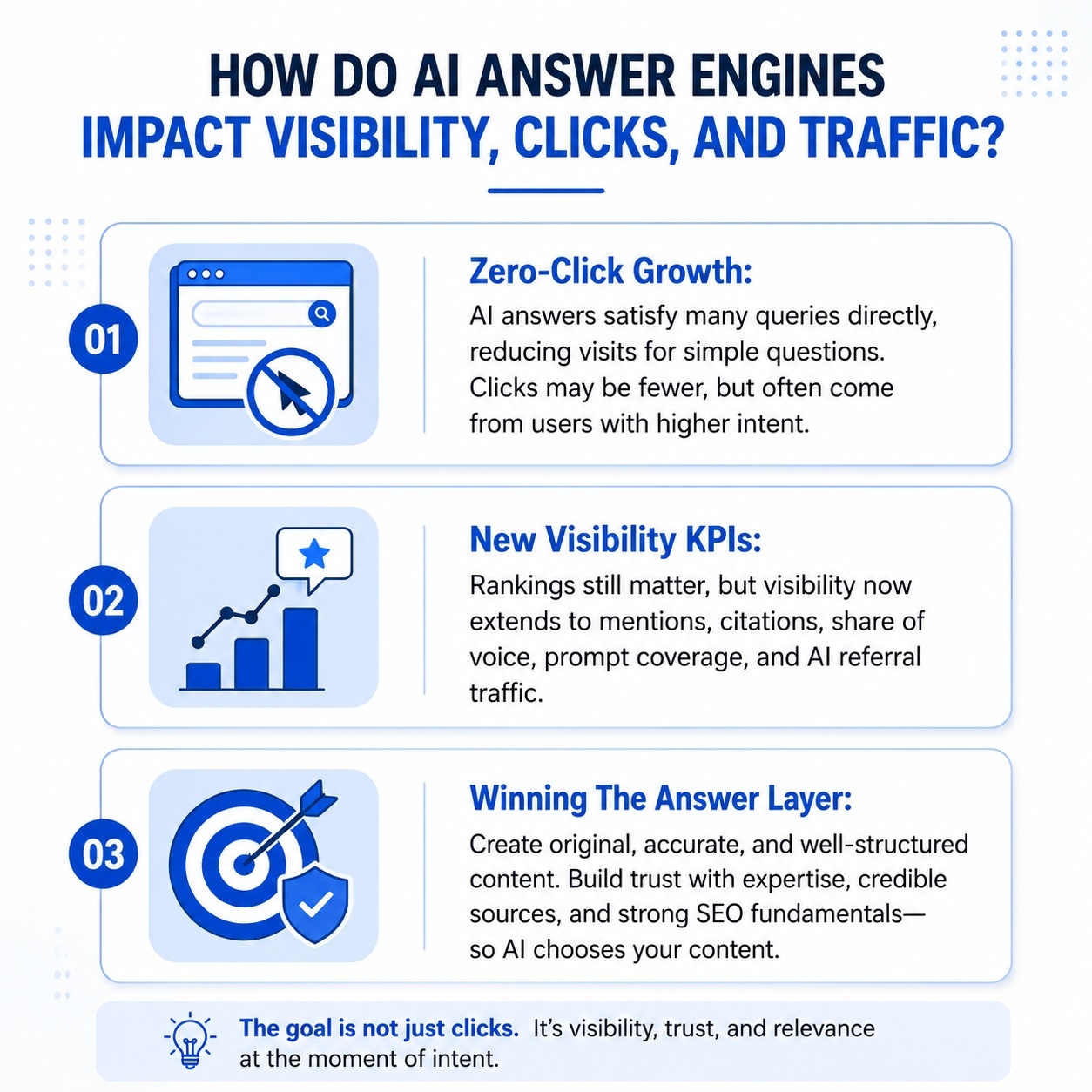
AI answer engines expand how search visibility is measured. Users may encounter a brand, source, or recommendation inside an AI response without visiting the website, while supporting links can still drive traffic. This means rankings and clicks still matter, but they no longer show the full picture.
1. AI Answers Can Change Click Patterns
AI-generated answers can satisfy part of a query directly, which may reduce the need to click for some searches. At the same time, AI experiences also surface supporting links for users who want to explore further.
Traffic volume and traffic quality can therefore move differently. Instead of assuming AI traffic always converts better, track clicks, engagement, conversions, and referral behavior separately.
2. Visibility Metrics Need to Expand
Traditional SEO metrics such as page ranking remain important, but they should be measured alongside AI visibility signals.
Useful metrics include:
- Brand mentions
- Citations
- Share of voice
- Prompt coverage
- AI referral traffic
- Engagement and conversions
Together, these show whether your brand is simply ranking or also appearing within AI-generated answers.
3. Brands Can Win by Becoming Useful Sources
AI visibility depends on whether your content is useful, trustworthy, and relevant enough to support an answer.
Focus on:
- Original value: Add data, examples, expertise, or insights competitors do not offer.
- Clear structure: Make definitions, facts, and key answers easy to find.
- Trust signals: Keep content accurate, current, and supported by credible sources.
- Strong SEO fundamentals: Maintain crawlability, internal links, and technically sound pages.
The goal is not to optimize only for clicks or citations. It is to build visibility across rankings, AI answers, referral traffic, and the actions users take afterward.
How Can You Optimize Content for AI Answer Engines Today?
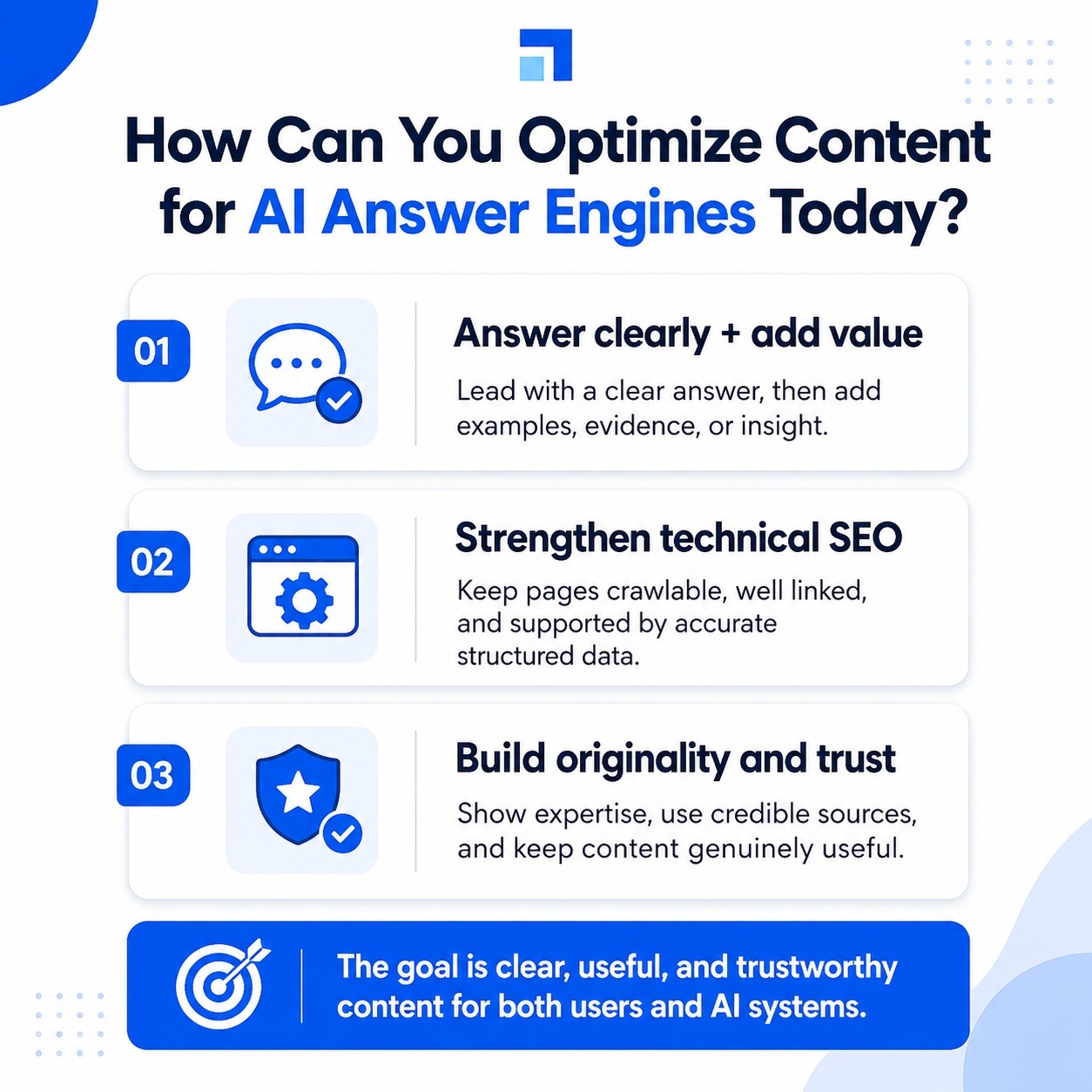
Optimizing for AI answer engines starts with strong SEO fundamentals: useful content, clear structure, technical accessibility, and trustworthy information. There is no special format or markup required for generative AI search.
1. Answer Clearly and Add Real Value
Give a direct answer when the query calls for one, then add the context, evidence, examples, or nuance users need.
- Use clear, descriptive headings.
- Make important information easy to find.
- Use bullets, tables, or short sections when they improve readability.
- Add original data, examples, expertise, or insights instead of repeating existing information.
There is no fixed word count or content format required for AI visibility.
2. Strengthen Technical SEO and Entity Clarity
Keep important pages crawlable, indexable, mobile-friendly, and connected through descriptive internal links.
Schema markup can help search engines understand content and entities, but it is not an AI visibility shortcut. Use only relevant structured data that accurately matches visible content.
Also keep brand, product, and organization information clear and consistent across your site.
3. Build Originality, Expertise, and Trust
AI search gives brands more reason to create content that adds something genuinely useful.
Focus on:
- Original value: First-hand experience, proprietary data, expert analysis, or unique examples.
- Clear authorship: Show who created the content and why their expertise matters.
- Credible evidence: Support important claims with reliable sources.
- Freshness: Update content when the topic changes, not just to refresh the date.
Backlinks still matter as part of SEO, but you do not need to chase links or mentions specifically because you think an AI system prefers them.
What Should Marketers and Businesses Do Next to Stay Visible?
Staying visible now means optimizing for both traditional search and AI-generated experiences. Strong SEO still matters, but brands also need to understand where they are being mentioned, cited, and surfaced across AI search.
1. Expand SEO Beyond Rankings and Clicks
The goal is no longer only to rank for keywords and drive traffic. Brands also need content that can surface as a useful source within AI-generated answers.
SEO and AEO should work together:
- SEO: Builds discoverability through rankings and organic traffic.
- AEO: Extends visibility into AI answers, mentions, and citations.
The strongest strategy supports both rather than treating one as a replacement for the other.
2. Measure AI Visibility Alongside SEO Performance
Traffic and rankings still matter, but they should now be tracked alongside AI-specific signals.
Monitor:
- Brand mentions
- Citations
- Share of voice
- Prompt coverage
- AI referral traffic
- Engagement and conversions
Use these signals to identify where your brand is appearing, where competitors are being surfaced instead, and which content is driving meaningful visibility.
The next step is not to abandon SEO. It is to measure and optimize the full search journey across rankings, AI answers, traffic, and conversions.
Frequently Asked Questions
What is answer engine optimization, and how is it different from SEO?
Answer engine optimization (AEO) improves how clearly your brand and content can be understood and surfaced within AI-generated answers. SEO remains focused on broader search discoverability, rankings, and traffic. The two increasingly work together rather than functioning as separate strategies.
Will answer engines replace traditional search engines?
Answer engines are unlikely to completely replace traditional search. The clearer direction is convergence, with AI-generated responses, web links, conversational follow-ups, and traditional results appearing within the same experience. Users can get direct answers while still exploring original sources when needed.
What comes after answer engines?
The next phase is increasingly agentic. Instead of only answering questions, AI systems can research across sources, compare options, connect with services, and help complete tasks. This moves search from a question-and-answer experience toward a broader research, recommendation, and action layer.
How will answer engines affect website traffic?
Answer engines can satisfy some information needs without a website visit, which may change click patterns. However, they also surface supporting links and can drive referral traffic. Brands should therefore measure AI visibility, organic traffic, engagement, and conversions instead of judging performance by clicks alone.
How can brands measure visibility in answer engines?
Track brand mentions, citations, share of voice, prompt coverage, cited pages, AI referral traffic, and downstream conversions across relevant platforms. Google Search Console now also provides dedicated Generative AI reports showing which pages receive impressions within AI Overviews, AI Mode, and generative Discover.
How do answer engines choose which sources to use?
There is no universal citation formula across answer engines. Systems use different retrieval and ranking methods to identify information relevant to a query. Brands can improve their chances by publishing useful, original, accurate content that is accessible, clearly structured, and supported by strong SEO fundamentals.
Is SEO still worth it as answer engines grow?
Yes. SEO remains foundational because search engines still need to crawl, index, understand, and surface webpages. What is changing is the definition of visibility. Brands increasingly need to monitor rankings and organic traffic alongside mentions, citations, AI visibility, and referral performance.


.svg)


.webp)