AI Overview optimization checklist
Use this checklist to improve pages with existing search or AI Overview opportunities:
- Find pages with organic visibility that are missing from relevant AI Overview citations.
- Answer the core question clearly near the beginning of the page.
- Use descriptive headings, short paragraphs, and bullets where they improve readability.
- Cover important fan-out topics and related questions naturally within the page.
- Replace vague or unsupported claims with credible evidence, examples, or original insights.
- Add clear, accurate authorship information where readers would expect it.
- Use relevant structured data that accurately matches the visible content. Do not add schema solely for AI Overviews.
- Study the sources Google repeatedly cites and look for legitimate PR, expert contribution, or brand mention opportunities.
- Refresh the page when facts, search intent, competing content, or AI Overview sources change.
- Track AI Overview impressions in Search Console where available, and use AI visibility tracking for citation, source, and competitor monitoring.
Use the checklist as an ongoing optimization process rather than expecting a citation within a fixed timeframe.
Your page can rank well in Google and still be absent from the AI Overview above it. AI Overview visibility depends on more than the exact-query ranking because Google can use query fan-out to retrieve supporting sources across related searches.
That means the goal is not simply to move higher in the blue links. You need strong SEO, useful original information, coverage of relevant subtopics, credible supporting evidence, and a way to measure citations separately from traditional rankings.
Below, we break down how to build that visibility without relying on unproven AI search hacks.
What are Google AI Overviews?
Google AI Overviews are AI-generated responses that appear in Search when Google determines they add value beyond standard results. They synthesize information from retrieved sources and provide supporting links for users who want to explore further.
Google can also use query fan-out, running multiple related searches across subtopics to find supporting information. This means a page can potentially be surfaced for a related subtopic, even if it is not the top result for the exact query.
AI Overviews now have over 2.5 billion monthly active users, making them a significant search visibility opportunity.
AI Overviews vs. featured snippets: What's the difference?
Both appear prominently in Google Search, but they work differently.
- Featured snippets extract an answer from one webpage. Google selects a relevant page and highlights an excerpt above the standard results.
- AI Overviews generate a new response. They can combine information from multiple retrieved pages and show several supporting links.
- AI Overviews can use query fan-out. Google may search related subtopics before generating the response, creating more opportunities for relevant pages to appear.
- Neither requires special markup to rank. Google automatically determines which pages to surface, and standard SEO best practices remain the foundation.
Why is it important to rank in Google AI Overviews?
AI Overviews occupy prominent SERP real estate and can introduce your content to users before they reach traditional organic results.
Ranking there can help you:
- Increase search visibility across an experience used by more than 2.5 billion people each month.
- Get discovered across related queries because query fan-out can surface supporting pages beyond the exact search term.
- Reach users researching complex topics and decisions where AI-generated summaries can guide further exploration.
- Earn qualified visits. Google reports that people who click from search pages containing AI Overviews tend to spend more time on the destination site.
The opportunity is not simply another ranking position. An AI Overview citation can put your brand directly inside the answer users see while researching a topic.
How Do You Rank in AI Overviews? 10 Proven Ways
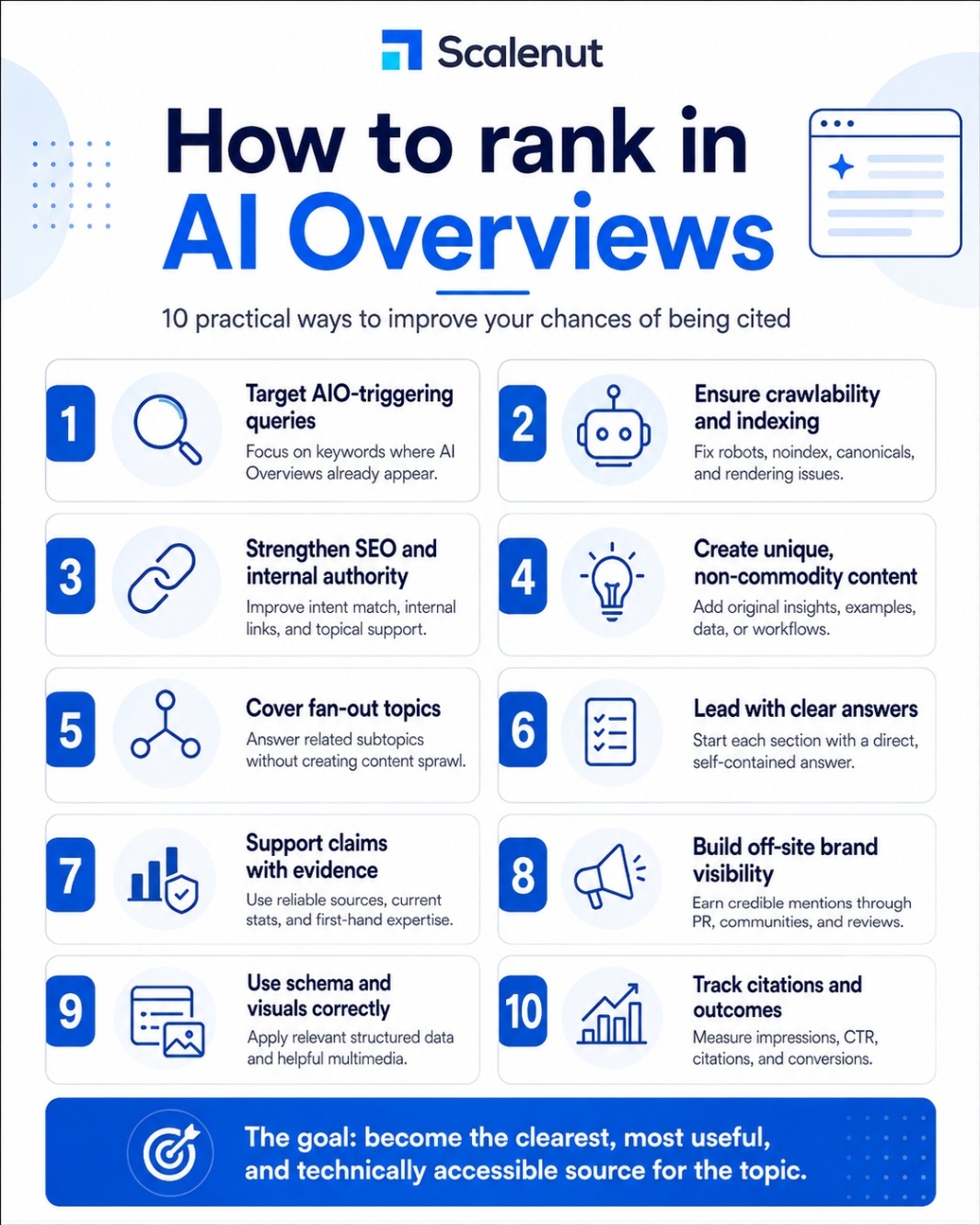
To rank in AI Overviews, create content Google can easily discover, understand, and use as a reliable source. There is no separate AI Overview ranking formula, so strong SEO, useful content, topical relevance, and clear structure still matter most.
Here are 10 practical ways to improve your chances of appearing in AI Overviews.
1. Target queries that actually trigger AI Overviews
Start with queries where Google already shows an AI Overview. Prioritize keywords where:
- Your page ranks but is not cited
- Competitors are repeatedly cited
- The query requires explanation, comparison, or evaluation
- The topic has clear business value
Do not focus only on informational queries. Commercial AI Overviews are also becoming more common, making comparison and product-research keywords valuable opportunities.
2. Make sure Google can crawl, index, and show your page
Your page must be accessible, indexed, and eligible to appear in Search before Google can use it in an AI Overview.
Check that:
- Googlebot is not blocked
- The page has no accidental
noindex - The canonical URL is correct
- Important content renders properly
- Internal links help Google discover the page
- Snippet controls are not unnecessarily restrictive
Use Google Search Console to identify indexing or rendering problems before changing the content.
3. Strengthen traditional SEO and internal authority
AI Overview optimization still starts with SEO. Improve the page's ability to rank across the topic through:
- Search intent alignment
- Strong on-page SEO
- Relevant internal links
- Supporting topical content
- Quality backlinks
- Good page experience
- Regular updates
However, ranking in the top 10 does not guarantee an AI citation. Ahrefs' 2026 study found that only about 38% of AI Overview citations came from URLs ranking in the top 10 for the same query.
4. Create unique, non-commodity content
Give Google something more useful than another rewritten version of what already ranks.
Add value through:
- Original data
- First-hand examples
- Expert insights
- Screenshots
- Case studies
- Real workflows
- Detailed comparisons
If you do not have first-hand experience, use credible third-party evidence and attribute it clearly rather than presenting research as personal testing.
5. Cover fan-out topics without creating content sprawl
Google can use query fan-out to search related questions before generating an AI Overview.
Cover the closely related subtopics a user would naturally ask next, such as:
- Cost
- Alternatives
- Limitations
- Use cases
- Comparisons
- Implementation
A Surfer study of more than 173,000 URLs found that pages ranking for both the main query and related fan-out queries were 161% more likely to appear as citations.
But do not create a separate page for every query variation. Keep related questions together unless they represent a clearly different search intent.
6. Lead sections with clear, self-contained answers
Answer each H2 or H3 directly before adding context.
A simple structure works well:
Direct answer → evidence → explanation → example
Use focused headings, short paragraphs, lists, and tables where they genuinely improve readability.
Do not artificially break content into tiny sections just for AI extraction. Google does not require special content chunking for AI Overviews.
7. Support claims with evidence and first-hand expertise
Make important claims easy to verify.
Use:
- Current statistics
- Primary sources
- Official documentation
- Expert commentary
- Real examples
- First-hand observations
For fast-changing topics such as AI search, clearly separate confirmed Google guidance from third-party research and industry correlations.
8. Build credible off-site brand visibility
Google can pull information from sources beyond your website, including publications, forums, videos, and other third-party pages.
Strengthen your external visibility through:
- Digital PR
- Expert contributions
- Industry publications
- Original research
- Relevant communities
- Podcasts and videos
- Genuine reviews and comparisons
Ahrefs found a strong correlation between branded web mentions and AI Overview visibility, although correlation does not prove that mentions directly cause higher visibility.
Focus on earning credible mentions rather than manufacturing them.
9. Use structured data and multimedia correctly
Structured data can help Google understand your content, but there is no special schema required for AI Overviews.
Use schema only when it accurately represents visible page content, such as:
- Article
- Organization
- Product
- LocalBusiness
Also use helpful visuals where they improve understanding, including charts, screenshots, diagrams, product images, and videos.
Treat schema and multimedia as supporting signals, not shortcuts to AI Overview visibility.
10. Track citations, impressions, and business outcomes
Do not measure AI Overview performance using rankings alone.
Track:
- AI visibility: citations, competing sources, and missed queries
- Search performance: impressions, rankings, clicks, and CTR
- Business impact: engaged visits, leads, conversions, and revenue
Google's Generative AI report in Search Console can show impressions from AI Overviews and AI Mode for eligible sites. Pair this with AI visibility tracking when you need query-level citation and competitor insights.
The goal is not to optimize for an AI crawler. It is to create the strongest source for the main query and its closely related questions, then track whether Google is actually using it.
How do you check if your content is being cited in AI Overviews?
You can check AI Overview citations manually, through Google Search Console, or with an AI visibility tool.
- Check manually: Search your target queries and inspect the AI Overview's supporting links for your domain. This works for a small set of keywords, but results can vary by location, device, and personalization.
- Use Search Console: Google's Generative AI performance report shows impressions from AI Overviews and AI Mode by page, country, device, and date. It is still rolling out and does not provide query-level citation tracking.
- Use Scalenut's AI Visibility Feature: Track prompts, citations, source URLs, brand mentions, and competitor visibility across supported AI engines. Scalenut refreshes visibility data weekly by default, with daily refresh available as an upgrade.
Pay particular attention to pages that already rank organically but are not cited. These are strong optimization opportunities because the page already has search relevance, and you can focus on improving its coverage, clarity, and citation-worthiness rather than starting from scratch.
Next, learn how to improve AI citations across search and answer engines once you know where your visibility gaps are.
How Google AI Overviews Actually Work (The 5-Step Process)
Understanding how ranking in the AI Overview in Google SEO actually happens makes every tactic below make sense, instead of just following a checklist blindly. Here's the process, simplified:
- Query understanding. Google parses the search query using natural language processing, identifies the entities involved (a product, a place, a concept), and infers intent: informational, commercial, or navigational.
- Source selection. Google pulls from its existing index, plus structured data sources like the Knowledge Graph, to find pages relevant to the query and its related subtopics.
- Triggering. The algorithm decides whether an AI-generated answer would genuinely serve the searcher better than standard results. This happens most often for complex or multi-part questions.
- Synthesis. Gemini generates the summary. This is where query fan-out comes in: Google doesn't just search for your exact keyword, it runs a cluster of related sub-queries, a broader version, a narrower version, a logical follow-up question, an alternate phrasing, and pulls sources for each of them. A page that only answers the exact keyword and ignores the surrounding subtopics is easy to leave out.
- Citation. The generated answer includes links back to the source pages, giving both the searcher a path to learn more and the source site a visibility and traffic opportunity.
The practical takeaway: a single, narrow answer to one exact-match query is the weakest possible target. Comprehensive content that anticipates the fan-out, the follow-up questions, the related phrasing, the "how much does this cost" and "how long does this take" a reader would naturally ask next, has a meaningfully better shot at citation.
Go deeper into AI citation tracking to measure which pages, prompts, and sources are actually driving your visibility.
Do You Need to Rank #1 to Appear in AI Overviews?
No, but ranking well clearly helps. A study by Rich Sanger and Authoritas, which analyzed over 11,000 queries, found that 46.3% of the links inside AI Overviews matched a page's top organic ranking for the exact search term. That number jumped to over 67% once the researchers accounted for related and reformulated versions of the query, meaning more than two-thirds of citations traced back to organic rankings once you factor in the full query fan-out, not just the exact keyword.
What explains the outliers: a page sitting at position 14 can still get cited if it's the single best answer to one of the fan-out subtopics, even when it has no shot at ranking #1 for the head term.
So the real target isn't "beat everyone to position one." It's "get into the top 10 for the main keyword, and be the clearest, most specific answer to at least one of the sub-questions Google is fanning out to." That second part is where most competing content stops short, and it's the part worth spending your time on.
For the broader optimization framework behind AI-generated answers, explore what AEO is and how it works.
Does this apply beyond Google? Ranking in ChatGPT, Perplexity, and other AI engines
Yes, but the retrieval systems differ. Clear, useful, well-sourced content helps across AI platforms, while each engine discovers and cites sources differently.
- ChatGPT Search can retrieve current web information and cite sources. OpenAI says publishers should allow OAI-SearchBot if they want their content to be discoverable and included in ChatGPT summaries and snippets.
- Perplexity searches the web in real time, synthesizes information from multiple sources, and links citations directly in its answers.
- Gemini can use public information from Google services such as Search and YouTube, but its responses and source selection should not be assumed to mirror Google AI Overviews exactly.
This is why GEO extends beyond traditional rankings. A brand can be visible in Google AI Overviews but absent from ChatGPT or Perplexity.
Scalenut's AI Visibility tracks mentions, citations, source URLs, and competitor visibility across ChatGPT, Google AI Overviews, Perplexity, and Claude, helping you identify platform-specific visibility gaps.
See how citation patterns differ across ChatGPT, Google AI Overviews, and Perplexity before applying the same GEO strategy everywhere.
What Kind of Keywords Trigger AI Overviews?
Not every query gets an AI Overview, and the pattern is fairly consistent. Keywords most likely to trigger one tend to be:
- Three to five words long, with informational intent
- Non-branded, rather than searches for a specific company or product name
- Lower cost-per-click, since heavily monetized commercial terms trigger AI Overviews less often (though this is shifting: commercial and transactional AI Overviews have been increasing)
- Low-to-medium keyword difficulty, rather than the most fiercely contested head terms
None of this means you should abandon competitive keywords. It means informational, longer-tail content is disproportionately likely to be your fastest path into an AI Overview, which is also usually the content that's cheapest to produce and fastest to rank.
What are the common myths about Google AI Overviews?
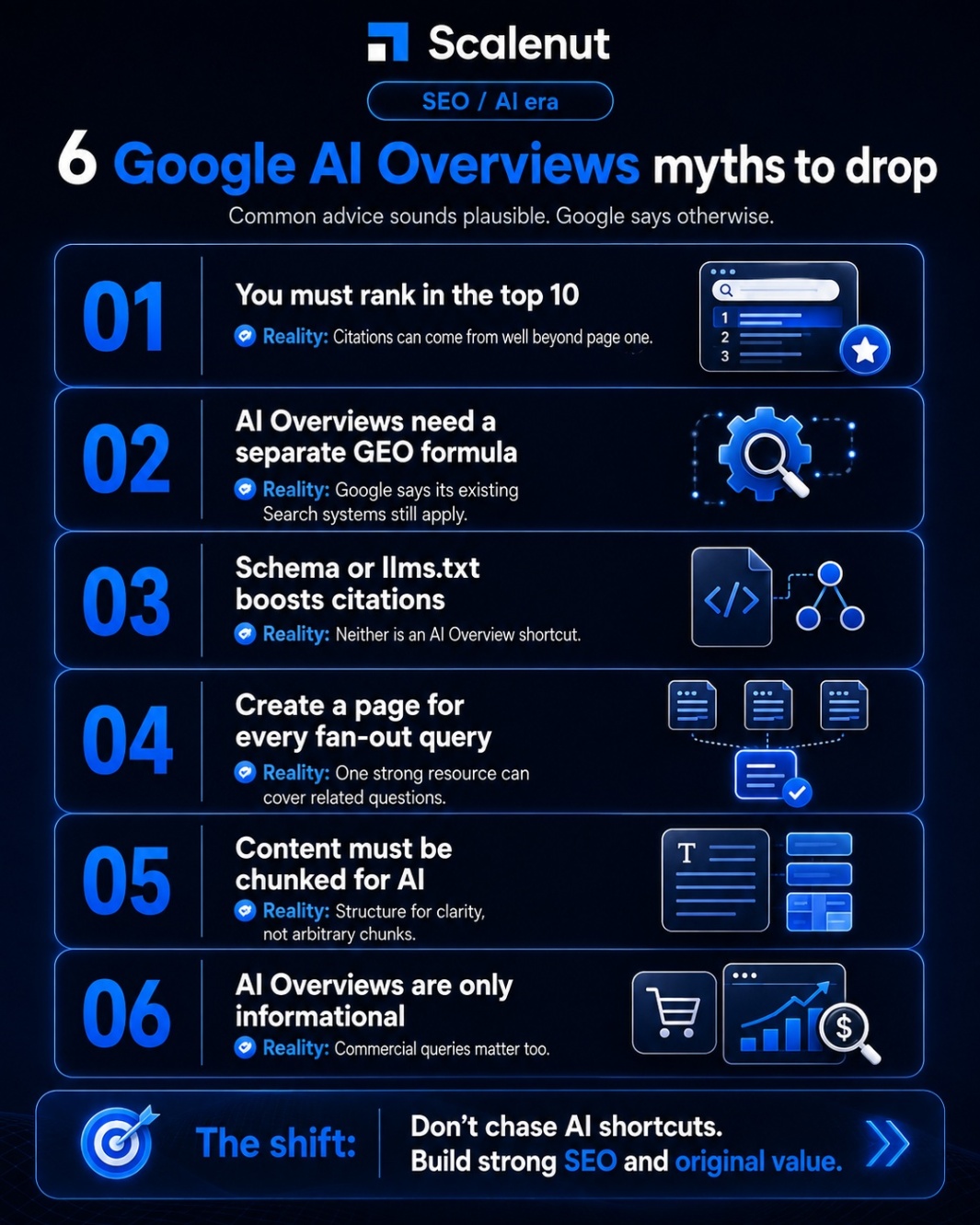
AI Overview optimization has attracted plenty of advice that sounds plausible but does not match how Google says its generative search features work. Here are the misconceptions worth avoiding.
1. Myth: You must rank in the top 10 to get cited
Strong organic rankings help, but a top-10 position is not required.
An Ahrefs study of about 4 million AI Overview URLs found that only 37.9% of cited URLs appeared within the first 10 SERP blocks for the same query. Another 31% appeared beyond the top 100.
Google can use query fan-out to retrieve sources from related searches, so visibility across the wider topic can matter as much as the exact-query ranking.
2. Myth: AI Overviews require a separate GEO ranking formula
Google says there are no additional requirements or special optimizations needed to appear in AI Overviews. Its existing Search ranking and quality systems remain the foundation.
The practical focus remains strong technical SEO, useful content, clear site structure, and information that adds something original to the topic.
3. Myth: Schema or llms.txt will improve your AI Overview rankings
Neither is an AI Overview shortcut.
Google says there is no special schema markup required for generative search and that it ignores llms.txt for Search rankings and visibility.
Continue using relevant structured data for standard SEO purposes, but do not add schema or AI-specific files expecting them to increase citations.
4. Myth: You should create a page for every fan-out query
Query fan-out matters, but that does not mean multiplying pages.
A Surfer study of more than 173,000 URLs found that pages ranking for fan-out queries were 161% more likely to be cited in AI Overviews than pages ranking only for the main query.
The better approach is to cover closely related questions naturally within a strong resource. Google specifically advises against rewriting or creating content purely to capture every AI search variation.
5. Myth: Content must be broken into tiny AI-friendly chunks
Google explicitly says there is no requirement to chunk content into small pieces for generative search. Its systems can understand multiple topics and identify relevant passages within a page.
Use short paragraphs, headings, lists, and direct answers when they improve readability, not because AI Overviews require a specific format.
6. Myth: AI Overviews only matter for informational keywords
Informational queries still dominate, but commercial search is changing quickly.
A Semrush analysis of more than 600,000 keywords found that AI Overview appearances on commercial-intent SERPs increased 71% during its six-month study period.
That makes comparisons, product research, alternatives, and other mid-funnel queries increasingly relevant AI Overview opportunities.
The common thread is simple: Google is not asking publishers to optimize for a separate AI algorithm. Strong SEO, original value, relevant topic coverage, and credible information remain more useful than chasing AEO or GEO shortcuts.
One of the most misunderstood tactics is structured data, so see what schema markup for AEO actually does and does not do.
How Long Does It Take to Rank in AI Overviews?
There's no fixed timeline, but there's a reasonable one. New, well-optimized content typically shows its first signs of traction within 60 to 90 days, and organic rankings keep compounding through months three to six as authority and backlinks build up.
AI visibility can occasionally move faster than the organic ranking behind it. Google doesn't need the same depth of trust signals to cite a well-structured page for a single subtopic that it needs to rank that same page #1 organically for a competitive head term, so it's possible to earn a citation before you've fully "won" the keyword in the traditional sense.
Why Marketers Use Scalenut to Rank in AI Overviews
Everything on that checklist is doable by hand for one page. It stops being doable by hand somewhere around the tenth page, which is exactly the point where most teams either stall out or start guessing.
Scalenut is built specifically around that gap. It's an AI visibility tracker that shows your citations and mentions across ChatGPT, Google AI Overviews, and Perplexity, paired with a GEO Action Center that turns whatever it finds, a missing citation, an uncovered subtopic, a competitor showing up where you should be, directly into a content brief instead of another item on a to-do list.
It's trusted by more than 100,000 marketers across 150+ countries, has powered over 5 million SEO blogs, and holds a 4.7/5 rating on G2 and 4.8/5 on Capterra and Trustpilot.
Try Scalenut for free and see exactly where your content stands in AI search today.
Frequently Asked Questions
How do you rank in AI-first SEO?
Build topical authority with original content that satisfies user intent and search intent. Strengthen internal linking, answer common questions, and support your SEO strategy with technical SEO and content optimization for better AI search visibility.
How do you rank in Google's AI Mode?
Optimize for Google's AI by providing accurate information from reputable sources, covering the main topic and related queries, and improving user experience. Track performance with Google Search Console as the search landscape continues evolving.
How do you beat AI Overviews?
Improve AI Overview visibility by publishing comprehensive content that answers specific questions, demonstrates topical authority, and aligns with user intent. Combine keyword research, content optimization, and a strong brand presence to increase search visibility.
What content format works best for AI Overviews?
AI Overviews favor well-structured blog posts that answer the user's question directly, include trustworthy information, cover related queries, and use clear headings, lists, and FAQs to help a large language model understand the content.
Do backlinks help with AI Overview rankings?
Yes. Backlinks from reputable sources can strengthen authority, but they're only one ranking factor. Pair them with original content, strong technical SEO, and content optimization to improve AI search visibility and long-term organic traffic.


.svg)


.webp)