.jpg)
How to Unlock SEO Success with Keyword Gap Analysis?

Key Highlights
- A keyword gap analysis reveals which keywords your competitors rank for that you don't.
- This form of competitor analysis is crucial for identifying new keyword opportunities and addressing content gaps.
- Regular keyword gap analysis refines your keyword research and overall SEO strategy.
- By targeting these gaps, you can create new content to capture more organic traffic.
- The process involves identifying competitors, exporting keyword data, and categorizing opportunities.
- This strategic approach helps improve search visibility and drive meaningful organic growth.
Are you tired of watching your competitors dominate the organic search results while your website struggles for visibility? It's a common challenge, but climbing the search rankings doesn't have to feel like an uphill battle. A powerful technique called keyword gap analysis can transform your SEO strategy. This process uncovers exactly which keywords your competitors are ranking for that you are missing. By using this data-driven approach, you can create a clear plan to improve your rankings and outperform the competition.
What Is Keyword Gap Analysis and Why Is it Important for SEO?
A keyword gap analysis is a focused SEO method that involves comparing your website’s keyword rankings with those of your competitors. The goal is to identify valuable organic keywords that they rank for, but you do not. This process also helps you pinpoint keywords where your competitors are outperforming you, revealing significant opportunities for improvement. Think of it as a strategic comparison tool specifically for keywords, helping you see where your search visibility is lacking.
This type of competitor analysis is essential for building a comprehensive SEO strategy because it highlights opportunities you might otherwise miss. For instance, you could find that multiple competitors rank for specific terms that you haven't targeted. By creating or updating your content to include these keywords, you can enhance your website's search visibility. This ultimately leads to increased organic traffic and helps you remain competitive within your niche.
What Are The Main Benefits Of Regularly Running Competitor Keyword Gap Analysis For My Website?

Regular competitor analysis saves time and resources by revealing effective keyword opportunities used by your rivals. This lets you focus on proven keywords instead of starting from scratch, so you can create content that drives results. Analyzing competitor keywords also gives you insight into your market and audience interests, helping you build a data-driven content strategy to boost organic traffic.
1. Find High-Intent Keywords You Are Missing
One of the most significant advantages of keyword gap analysis is uncovering missing keywords with high search intent that your competitors are already leveraging. These are terms your potential customers are using when they are close to making a purchase or seeking specific solutions, but your site isn't showing up in the search results for them.
Identifying these keyword opportunities is crucial for capturing valuable traffic. For example, your competitor might rank for terms with commercial or transactional intent. These users are often in the final stages of their research or are ready to take action.
By finding these gaps, you can:
- Discover keywords with high search volume you've overlooked.
- Target users with specific needs and stronger purchase intent.
- Expand your content to cover topics your audience is actively searching for.
- Create more effective paid advertising campaigns based on these high-intent terms.
2. Prioritize Quick Ranking Wins
Not all keywords are created equal. A keyword gap analysis helps you find "easy wins"—keywords that are simpler to rank for because your competitors have overlooked them or aren't targeting them effectively. These are your new ranking opportunities, especially for newer websites or businesses with limited SEO resources.
Your keyword research can specifically focus on these low-hanging fruit. These are often keywords with lower competition but clear search intent, offering a faster path to improving your position in organic search results. Prioritizing these terms allows you to build momentum and see tangible progress more quickly.
Focusing on these quick wins enables you to:
- Gain initial visibility without competing for highly difficult keywords.
- Build your site's authority gradually.
- Achieve faster improvements in your search rankings.
3. Close Topic Coverage Gaps
Your competitors' keyword strategy can reveal significant content gaps on your own website. When you see them ranking for relevant keywords that you don't, it's often a sign that you haven't covered certain topics adequately. These gaps represent missed opportunities to connect with your audience.
A keyword gap analysis provides the data needed to inform a more robust content strategy. You can see which topics are resonating within your industry and where your content is lacking. This allows you to create new articles or update existing ones to be more comprehensive and valuable.
By addressing these topic gaps, you can:
- Build topical authority in your niche.
- Create content that answers your audience's most pressing questions.
- Ensure your website is a go-to resource for your industry.
4. Grow Organic Traffic And Conversions
Ultimately, the goal of targeting new keywords is to drive meaningful organic growth. By systematically identifying and filling keyword gaps, you can significantly increase the organic traffic coming to your website. When you rank for more relevant terms, you attract more visitors who are actively looking for the products or services you offer.
This increase in targeted traffic naturally leads to higher conversion rates. When you create content that aligns with user intent—whether it's informational, commercial, or transactional—you guide visitors more effectively through the customer journey. This translates into more leads, sales, and overall business growth.
Implementing insights from your analysis helps you:
- Attract a more qualified audience.
- Improve your website's overall SEO performance.
- Achieve sustainable, long-term growth in organic traffic and conversions.
How To Do Keyword Gap Analysis Step By Step?

Following a clear, step-by-step framework ensures an effective analysis. We will walk through how to use keyword research tools to find gaps, categorize them, and turn those findings into a concrete plan for content creation and optimization.
Step 1: List Your True SEO Competitors From The SERPs
The first step in any effective keyword gap analysis is to select the right competitors. Analyzing companies outside your specific niche can lead to irrelevant keyword targets and wasted effort. Your focus should be on your true SEO competitors—the brands that consistently appear alongside you in search engine results for your target terms.
Start by identifying your direct commercial competition, the businesses you already know that offer similar products or services. However, it's also crucial to find competitors from an organic search perspective. You can use SEO tools to enter your domain and discover a list of your top organic rivals based on the number of keywords you have in common.
Step 2: Export Keyword Rankings For You And Competitors
Once you have your list of competitors, the next step is to gather the data. Using a keyword gap tool, you can enter your domain alongside up to four competitor domains. This allows the tool to compare your keyword profiles and generate a report showing how your keyword rankings overlap.
The tool will present you with a table that lists all the keywords your competitors rank for. This initial keyword list is the foundation of your analysis. From here, you can start to filter and sort the data to find specific opportunities where you are falling behind.
You can typically export this data for offline analysis. Common export options include:
- Excel spreadsheets
- CSV files
This allows you to manipulate the data, share it with your team, and integrate it into your broader keyword research process.
Step 3: Categorize Gaps (Missing, Weak, Untapped, Declining)
With your keyword data exported, it's time to analyze and categorize the gaps. Most SEO tools will automatically segment your keyword opportunities, making it easier to identify different types of content gaps. This categorization helps you prioritize your efforts effectively.
The primary categories you'll encounter are "Missing" and "Weak." Missing keywords are terms your competitors rank for, but you don't at all. Weak keywords are those where you rank, but your competitors rank significantly higher. Both represent new keyword opportunities, but they require different strategic approaches.
Additionally, some tools provide categories like:
- Untapped: Keywords at least one competitor ranks for, but you do not.
- Declining: Keywords where your rankings have dropped over time.
- Shared: Keywords where both you and your competitors rank.
Analyzing these different keyword clusters helps you build a comprehensive action plan.
Step 4: Filter By Intent (Informational, Commercial, Transactional)
Not all keyword opportunities hold the same value. To find the most valuable keywords, you must filter your list by search intent. Understanding why a user is searching for a particular term is crucial for creating content that meets their needs and drives conversions.
Search intent is generally broken down into three main categories. Informational intent means the user is looking for information ("how to clean a coffee maker"). Commercial intent signifies they are doing final research before a purchase ("best coffee beans for espresso"). Transactional intent shows they are ready to buy ("buy coffee maker online").
Filtering your keyword gaps by intent allows you to:
- Prioritize keywords that align with your business goals, like driving sales or generating leads.
- Create content that directly answers the user's query, improving engagement and satisfaction.
Step 5: Score Opportunities (Difficulty, Volume, Value, Fit)
After filtering by intent, the next step is to score your remaining keyword opportunities to decide which ones to pursue first. This involves evaluating several key metrics to find the perfect balance between effort and reward. The goal is to identify relevant keywords that you can realistically rank for.
Start by looking at keyword difficulty. This score, often on a scale of 0-100, indicates how hard it will be to rank for a term. For newer sites, focusing on keywords with a lower difficulty score is a smart strategy. Next, consider the monthly search volume to ensure the keyword can drive meaningful traffic.
Finally, assess the value and fit for your business. A keyword might have low difficulty and high volume, but if it's not relevant to your products or services, it's not a good opportunity. Score each keyword based on:
- Keyword Difficulty (KD)
- Monthly Search Volume
- Business Value (relevance and potential for conversion)
- Brand Fit
Step 6: Map Keywords To Pages (Create, Refresh, Or Consolidate)
Once you have a prioritized list of keyword opportunities, you need to develop a keyword strategy for implementation. This involves deciding whether to create new content, refresh existing pages, or consolidate multiple pages into one authoritative piece.
For "Missing" keywords where you have no relevant content, the clear path is new content creation. This could mean writing new blog posts, creating landing pages, or developing comprehensive guides. For "Weak" keywords, where you already have a page that ranks poorly, the best approach is to refresh and optimize that existing content.
Your content action plan should include:
- Create: Develop new pages for keywords you don't currently target.
- Refresh: Update and improve existing pages to boost their rankings for weak keywords.
- Consolidate: Combine multiple, weaker pages on a similar topic into a single, stronger pillar page.
Step 7: Build A 30-60-90 Day Execution Plan
Turning your analysis into action requires a structured plan. A 30-60-90 day execution plan helps you organize your SEO efforts, set realistic timelines, and ensure consistent progress toward improving your online visibility. This framework breaks down your large-scale strategy into manageable key steps.
In the first 30 days, focus on the quick wins. These are the low-difficulty, high-relevance keywords you identified. This could involve updating a few existing pages or creating one or two new pieces of high-impact content. The goal is to build momentum and start seeing early results.
Your plan could look something like this:
- Days 1-30: Target "quick win" keywords by refreshing existing content and creating 1-2 new pages.
- Days 31-60: Tackle medium-difficulty keywords and begin building out topic clusters.
- Days 61-90: Focus on more competitive terms and measure the impact of your initial efforts.
What Are the Keyword Gap Types You Should Track When You Conduct a Competitor Keyword Gap Analysis?
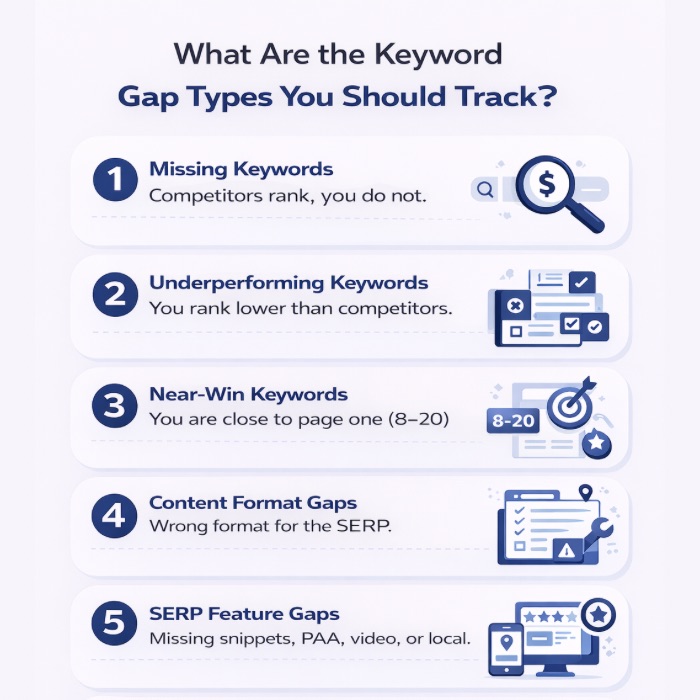
From missing keywords that your competitors dominate to underperforming terms where you have a weak presence, each type of gap requires a unique approach. By tracking these different categories, you can address your content gaps more effectively and gain a competitive edge in your competitor analysis efforts.
1. Missing Keywords (Competitors Rank, You Do Not)
The most straightforward type of gap is "missing keywords." These are search terms for which all of your analyzed competitors rank in the search results, but your website has no search rankings at all. These gaps represent a direct opportunity to expand your keyword footprint and capture new audiences.
Discovering these missing keywords is like finding a roadmap of what content you need to create. If multiple competitor ranks are high for a specific term, it signals that the topic is valuable and relevant to your shared audience. It's a clear indication that you need to create content to compete.
Addressing these gaps involves:
- Identifying the most relevant missing keywords based on intent and volume.
- Creating brand-new, high-quality content specifically targeting these terms.
- Building your site's authority on topics you haven't covered before.
2. Underperforming Keywords (You Rank, But Too Low)
Another critical category is "underperforming keywords," also known as "weak" keywords. These are terms for which both you and your competitors rank, but your keyword rankings are significantly lower. For example, your competitor might be on page one of the search engine results, while you are languishing on page three or four.
These keyword opportunities are often easier to capitalize on than missing keywords because you already have a piece of content that Google recognizes as relevant. The challenge is to improve that content so it can climb higher in the rankings. This usually involves refreshing the page with more comprehensive information or better optimization.
To improve underperforming keywords, you should:
- Analyze the top-ranking pages to see what they are doing better.
- Update your existing content with fresh data, new sections, or multimedia.
- Optimize on-page elements like titles, headers, and internal links.
3. Near-Win Keywords (Positions 8–20)
A special subset of underperforming keywords are your "near-win" or "striking distance" keywords. These are terms where you are already ranking on the cusp of the first page of search results, typically in positions 8 through 20. These represent some of the most valuable new keyword opportunities.
A small push in optimization can often be enough to move these pages onto the first page, where they will receive a dramatic increase in visibility and clicks. These ranking opportunities are low-hanging fruit because the initial hard work of getting the page recognized by search engines is already done.
To capitalize on near-win keywords, focus on:
- Refreshing the content to make it more current and comprehensive.
- Building a few high-quality internal and external links to the page to boost its authority.
4. Content Format Gaps (Listicles, Comparisons, Templates, Tools)
Sometimes the gap isn't about the keyword itself but the format of the content. A content format gap occurs when competitors are ranking with a specific type of content that you haven't created. For example, if the top results for a keyword are all "how-to" guides or video tutorials, and you only have a standard blog post, you have a format gap.
Analyzing the search results page (SERP) for your target keywords will reveal the dominant content formats. Aligning your content strategy with what users and search engines prefer for a given query is essential for ranking well. Creating relevant content in the right format can be a powerful competitive advantage.
Common content format gaps to look for include:
- Listicles ("Top 10...")
- Comparison articles ("Product A vs. Product B")
- Templates, calculators, or free tools
5. Feature Gaps (PAA, Featured Snippets, Video, Local Pack)
Finally, you should look for feature gaps related to SERP features. These are special elements on the search engine results page that go beyond the standard blue links, such as Featured Snippets, "People Also Ask" (PAA) boxes, video carousels, and the Local Pack. If your competitors are capturing these prominent spots and you aren't, you're missing out on significant search visibility.
Optimizing for SERP features can dramatically increase your click-through rate, even if you aren't the #1 organic result. Each feature requires a specific optimization strategy, such as using structured data for FAQs or providing concise, direct answers for Featured Snippets.
Identify feature gaps where your competitors are winning, like:
- Featured Snippets at the top of the page.
- Answers appearing in the "People Also Ask" section.
- Videos showing up in search results.
What Are Some Practical Ways To Use Insights From Keyword Gap Analysis To Improve My SEO Strategy?

There are several practical ways to leverage these findings, from creating entirely new pages to optimizing your existing content for quick gains. By applying these insights strategically, you can close gaps, build authority, and systematically improve your search performance.
1. Create New Pages For Net-New Intent
When your keyword gap analysis uncovers keywords that represent a completely new search intent for your site, the best course of action is content creation. These are topics you haven't covered at all, and creating new content is the only way to capture that audience.
For example, if you sell coffee beans and discover your competitors are ranking for "how to make cold brew at home," this informational intent represents a net-new opportunity. Creating a new blog post or guide targeting this keyword allows you to attract users at the top of the funnel who may later become customers.
This approach involves:
- Developing new pages, such as blog posts, guides, or landing pages.
- Targeting keyword clusters you currently have no content for.
- Expanding your website's topical relevance to cover all stages of the customer journey.
2. Update Existing Pages For Fast Gains
For your "weak" or "underperforming" keywords, the most efficient strategy is to update existing pages. Since you already have a page that Google recognizes as relevant to the topic, you can often achieve fast gains by refreshing and optimizing it. This is typically much quicker than creating a new page from scratch.
Start by analyzing the top-ranking pages for your target keyword. Identify what they cover that you don't, and look for ways to make your content more comprehensive, up-to-date, and valuable. This will improve your keyword rankings in organic search.
To update existing pages for fast gains, you should:
- Add new sections to cover subtopics you missed.
- Incorporate more relevant keywords and semantic variations.
- Update any outdated information or statistics.
3. Build Supporting Content Around Pillar Pages
A sophisticated way to use insights from your keyword gap analysis is to build out topic clusters. This involves creating a main "pillar page" on a broad topic and then developing several supporting "cluster pages" that cover more specific subtopics in detail. Your analysis can reveal content gaps that are perfect for new cluster pages.
For example, if your pillar page is "A Guide to SEO," your keyword gap analysis might reveal that competitors are ranking for long-tail keywords like "how to do local SEO" or "technical SEO checklist." These are perfect candidates for new, in-depth articles that link back to your main pillar page.
This strategy helps you:
- Organize your content, establish topical authority, and fill content gaps with targeted articles.
- Group related keyword clusters to create comprehensive content that addresses multiple user queries.
4. Add Internal Links To Transfer Authority
An often-overlooked but powerful way to use your analysis is to improve your internal linking strategy. Once you've created new content or updated existing pages, you need to link to them from other relevant pages on your site. Internal links help search engines understand the structure of your website and transfer authority between pages.
When you publish a new blog post targeting a keyword gap, find your most authoritative, high-traffic pages and add a link from them to your new content. This signals to search engines that the new page is important and can help it get indexed and ranked faster.
A strong internal linking strategy will:
- Help distribute link equity (or "link juice") throughout your site.
- Improve your website’s keyword rankings for the targeted terms.
- Guide users to other relevant content, increasing time on site.
5. Optimize For SERP Features (Snippets, FAQs, PAA)
If your keyword gap analysis reveals that competitors are dominating SERP features, you should make it a priority to optimize your content for them. Capturing a Featured Snippet or a spot in the "People Also Ask" (PAA) box can significantly boost your search visibility and drive more clicks, even if you don't rank #1 organically.
Each SERP feature requires a specific optimization tactic. For Featured Snippets, provide a clear, concise answer to a question near the top of your page. For FAQ snippets, use FAQ schema markup on your page to tell the search engine you have a list of questions and answers.
To optimize for SERP features, you can:
- Structure content with clear headings and lists.
- Add an FAQ section to your pages.
- Use schema markup to provide more context to search engines.
What Are the Top 3 Keyword Gap Analysis Tools You Should Try in 2026?
1. Scalenut’s Keyword Gap Settings For GEO

If you want keyword gap analysis that supports both classic SEO and modern AI discovery, Scalenut is a strong pick. Its Keyword Gap Settings help you compare your domain against competitors to uncover keyword opportunities you are not capturing yet, then organize those opportunities into clusters you can actually build content around.
What makes it especially relevant in 2026 is the GEO angle. Instead of treating gap analysis as just “missing keywords,” you can use it as a practical way to decide what content and authority signals will help your brand show up more consistently in AI answers, not just traditional rankings.
If you are looking for a complete SEO + GEO platform, Scalenut is the best place to start. Book a demo and see how it fits your workflow.
2. Ahrefs Keyword Gap Analysis
Ahrefs is a great choice when you want a clean, reliable way to identify keywords your competitors rank for but you do not. It is especially useful for building a focused opportunity list, filtering out noise, and spotting gaps that can be closed with a mix of new pages and targeted content updates.
3. Semrush Keyword Gap Analysis
Semrush is ideal if you want a faster, more visual competitor comparison. It helps you see overlaps, weaknesses, and missed opportunities across multiple competitors, which makes it easier to prioritize what to target first and turn your gap findings into an actionable content roadmap.
Conclusion
A keyword gap analysis serves as a powerful tool to enhance your SEO strategy. By identifying the keywords that your competitors rank for but you do not, you can uncover valuable opportunities that are essential for driving organic traffic and improving your rankings. Regularly conducting these analyses allows you to stay ahead of the competition, prioritize high-intent keywords, and address content gaps in your strategy. As you implement these insights, you will create a more robust online presence that not only attracts visitors but also converts them into loyal customers. To gain deeper insights and refine your approach, consider scheduling a free consultation with our experts today.
Frequently Asked Questions
Which free tools can I use to do keyword gap analysis?
While many premium SEO tools offer advanced keyword gap analysis features, some free keyword research tools can provide basic insights. Google Keyword Planner can help you find keyword opportunities, though it requires manual competitor research. Some freemium keyword gap tool options may also offer limited daily searches to identify organic keywords.
How can keyword gap analysis help me find keywords my competitors rank for but I don’t?
Keyword gap analysis directly answers this by comparing your domain's keyword profile against your competitors'. The core of the competitor analysis process is to generate a list of missing keywords—relevant keywords that your competitors rank for but you don't. This reveals new keyword opportunities for your content strategy.
What is the difference between keyword gap analysis and content gap analysis?
A keyword gap analysis focuses specifically on identifying keywords you are missing, while a content gap analysis looks at broader topic areas and content formats. Content gap analysis often considers the entire customer journey and search intent to find gaps in your content strategy, which may not be obvious from keywords alone.
Are there simple methods for beginners to do keyword gap analysis?
Yes, beginners can perform a simple keyword gap analysis. Start by manually searching for your main keywords on Google and listing the top-ranking competitors. Then, use beginner-friendly SEO tools to export their keyword list and compare it to yours, looking for clear new keyword opportunities with low competition.
What are the main benefits of regularly running keyword gap analysis for my website?
Regularly running a keyword gap analysis helps you continuously discover new keyword opportunities, refine your content strategy, and maintain a competitive edge. It provides valuable insights into market trends and competitor tactics, ensuring your organic search efforts are always targeted and effective for sustained growth.
What are the main benefits of regularly running keyword gap analysis for my website?
Consistently performing a keyword gap analysis allows you to adapt to changes in the search landscape. It ensures you don't fall behind as competitors target new terms. This proactive approach helps you uncover valuable insights, identify fresh keyword opportunities, and strengthen your organic search presence over time.
How to use domain analysis tool for keyword gaps?
Use a domain analysis tool by entering your domain and your competitors' domains into its keyword gap tool feature. The tool will then compare keyword rankings across the sites, generating a report that highlights the search terms your competitors rank for that you don't, guiding your SEO efforts.
How often should I update my keyword gap analysis template?
For optimal results, conduct a full keyword gap analysis quarterly to adapt to major market shifts and competitor strategy changes. However, monthly check-ins on your keyword list for high-priority segments can help you quickly spot emerging content gaps and stay ahead of the search engine curve.


.svg)


.webp)