
.jpg)
Key Highlights
- The ideal meta title length for 2026 is between 50-60 characters to avoid truncation in Google Search results.
- Search engines like Google use pixel width (around 600 pixels) rather than a strict character count to display the title tag.
- Placing your primary keyword at the beginning of the meta title can improve search rankings and user experience.
- Effective meta titles are unique to each page, match search intent, and are descriptive and concise.
- Exceeding the recommended meta title length can lead to truncation, negatively impacting SEO and click-through rates.
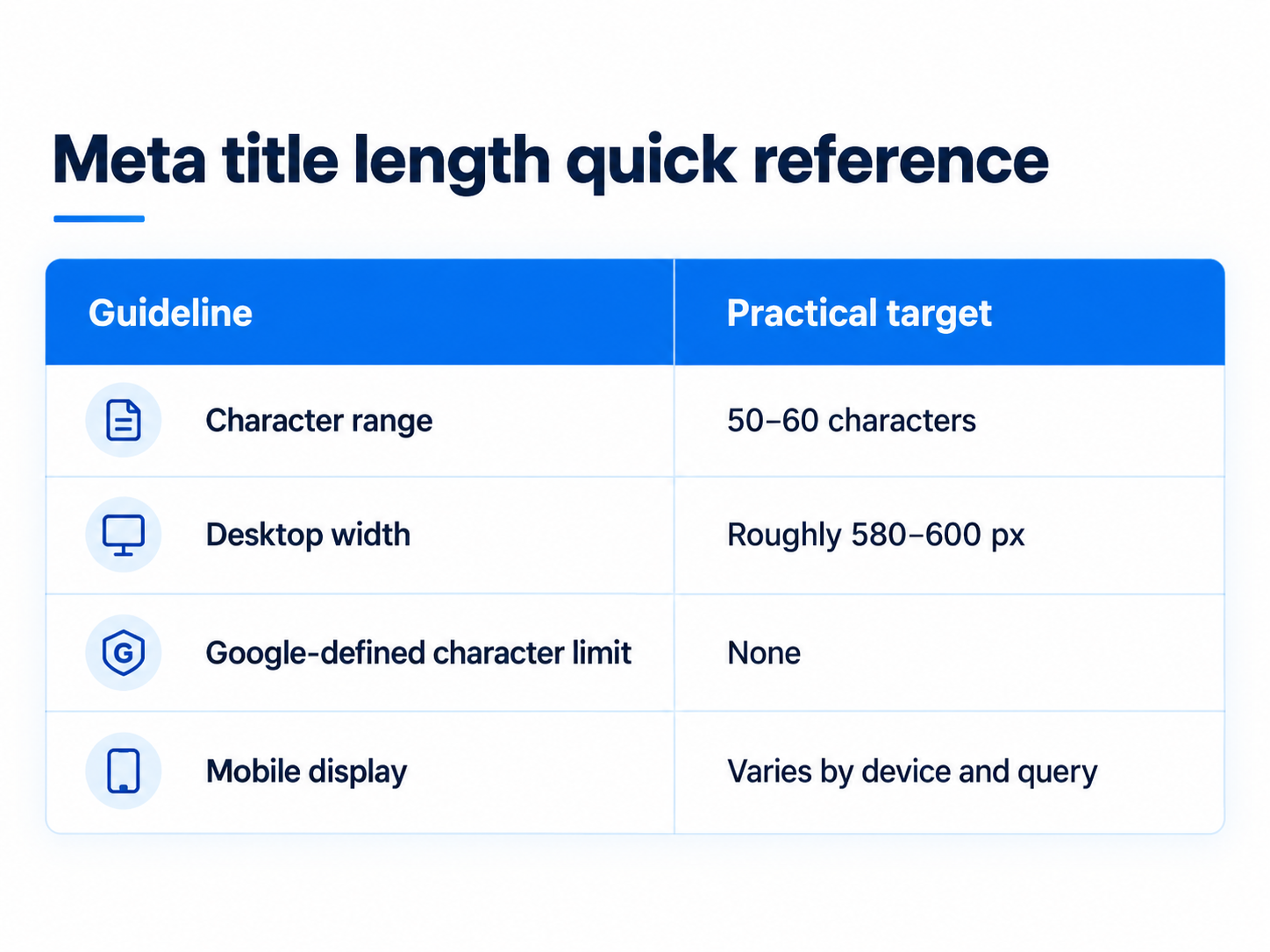
Most SEO guides still tell you to keep meta titles under 60 characters. That is useful advice, but it is not a Google rule. A 2026 analysis of more than 81,000 title tags found that 50–60 characters, or roughly 580–600 pixels, remains the practical sweet spot for desktop results, while Google sets no fixed title-length limit.
The real challenge is fitting the important words before truncation without making your title vague or overloaded. This guide breaks down the ideal meta title length for 2026, when pixel width matters more than character count, why Google may rewrite titles, and the best practices for writing clear, search-friendly titles.
What Is a Meta Title?
A meta title, technically known as a title tag, is an HTML element that specifies the title of a webpage. You see it as the clickable blue headline in search engine results pages (SERPs) and also in the tab of your web browser. This piece of metadata serves a dual purpose: it tells both users and search engines what your page is about in a clear, concise manner.
Think of the meta title tag as the digital billboard for your content. It’s a foundational piece of on-page SEO. A well-optimized title improves your visibility in search results, aligns with the user's search intent, and ultimately encourages them to click through to your website. Without a clear and compelling title, even the best content can get lost in the digital noise.
What is the Ideal Meta Title Length in 2026?
For most desktop search results, 50–60 characters or roughly 580–600 pixels is a practical target for meta titles. However, Google does not set a fixed character limit. It truncates title links as needed to fit the available device width, so character count should be treated as a guideline rather than a hard rule.
Pixel width matters because different characters take up different amounts of space. For example, a title containing several wide characters may reach the display limit sooner than another title with the same number of characters.
Mobile results can also display titles differently from desktop results, and the title Google shows can vary depending on the device and query. Keeping the most important words and primary topic early in the title is therefore more useful than optimizing for an exact character count.
Why Does Google Rewrite Meta Titles?
Google may show a different title in search results when it believes another version better represents the page or the user’s query. According to Google’s title link guidance, this can happen when:
- The title is unnecessarily long or verbose.
- The title is vague or does not accurately describe the page.
- Keywords or phrases are repeated excessively.
- Boilerplate text takes up too much of the title.
- The title and prominent on-page heading do not align clearly.
- Google determines that other page text provides a more useful title for the searcher.
Google can also build title links using your title tag, main visual title, headings, prominent page text, anchor text, and other signals. Keeping these elements clear and consistent can reduce avoidable rewrites.
Want the title, H1, and body copy to work together? Learn how to write SEO content that converts without sacrificing search relevance.
Meta Title Length Examples for SEO
Here is how title length can affect clarity and SERP display:
Example
Assessment
Meta Title Length: Best Practices for SEO in 2026
Clear, specific, and concise
Everything You Need to Know About the Best Meta Title Length and SEO Best Practices for Google in 2026
Unnecessarily long and likely to truncate
SEO Titles
Too vague to communicate a clear benefit
How to Test Meta Title Changes?
Use Google Search Console to check whether your title changes actually improve search performance.
- Start with pages that get high impressions but relatively low CTR.
- Record their main queries, clicks, impressions, CTR, and average position before making changes.
- Change one major title element at a time so you can better understand what affected performance.
- Compare results against a similar period after the update.
- Avoid changing the title again too quickly. Give the new version enough time to collect meaningful search data.
Focus on trends in clicks, impressions, and CTR rather than judging success from average position alone.
Testing your title is only one part of the picture. Use this 9-step SEO audit to find other on-page issues that could be holding the page back.
7 Meta Title Best Practices For 2026: How to Write an Effective Meta Title?
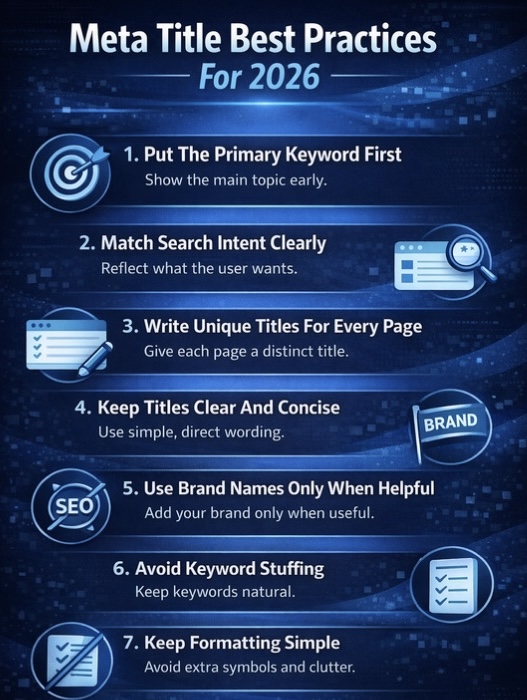
Writing an effective meta title is about making a strong first impression that drives clicks and boosts SEO. Best practices for 2026 emphasize clarity, relevance, and user intent. Using targeted keywords and communicating value attracts both search engines and users. A clear meta title signals your page’s content and helps your link stand out. Strategic keyword placement, unique phrasing, and precise language are key.
Here are 7 best practices for writing clear, effective meta titles in 2026:
1. Put The Primary Keyword Near The Beginning
Placing your primary keyword near the beginning helps users quickly understand what the page is about and keeps the main topic visible if the title is truncated. This strengthens the topical relevance of your content and can have a positive impact on your search rankings.
The importance of meta title length for search engine optimization is tied directly to visibility. Since titles can be truncated in search results, front-loading your most important term ensures it remains visible even if the rest of the title gets cut off. This helps capture the user's attention and confirms that your page matches their query. Effective keyword research is the first step to identifying the most valuable primary keyword for each page.
Still choosing the right term to lead with? Learn how to do keyword research for SEO before you finalize your title.
2. Match The Page’s Search Intent Clearly
Understanding and aligning with search intent is critical for SEO success. Your meta title must accurately reflect the "why" behind a user's search query. Is the user looking for information, comparing products, or ready to make a purchase? The title should set a clear expectation for the content they will find on the page.
When the promise of your title matches the content, it creates a positive user experience. This alignment reduces bounce rates—when a user clicks your link and immediately leaves, which is a strong signal to search engines about the relevancy of your page. A title that misleads users will quickly harm your credibility and rankings.
For example, a search for "how to fix a leaky faucet" has informational intent. A title like "DIY Guide: How to Fix a Leaky Faucet in 5 Easy Steps" is a perfect match. In contrast, a transactional title like "Buy Faucet Repair Kits Now" would be inappropriate and lead to a poor user experience for that specific search query.
3. Write Unique Titles For Every Page
Every page on your website serves a unique purpose, and its metadata should reflect that. Writing a unique title for each page is essential to avoid confusing search engines and diluting your ranking potential. Duplicate titles make it difficult for a search engine to determine which page is the most relevant for a given query, causing your own web pages to compete against each other.
This practice helps search engines accurately categorize and index your site's content. When each page has a distinct and descriptive title, it provides clear signals about the specific information available, enhancing overall site structure and relevance. This is a missed opportunity for many website owners who use generic or repeated titles.
To differentiate your titles, use page-specific modifiers or long-tail keywords. For a product category page, you might use "Men's Running Shoes," while a specific product page would be titled "Runway Pro-Max Running Shoe." This level of specificity not only helps with SEO but also guides users to the exact content they need.
If multiple pages are targeting the same query, learn how to spot and fix keyword cannibalization before they start competing with each other.
4. Keep Titles Action-Oriented, Descriptive, and Concise
An effective meta title should do more than just inform; it should entice users to click. Using action-oriented and descriptive language can make your title more engaging and compelling. But use it only when it makes the benefit clearer, and do not force it at the expense of specificity or readability.
Clarity is paramount for a good user experience. Your title should provide a concise and accurate summary of the page's content, leaving no room for ambiguity. Avoid vague or generic phrasing that fails to communicate the benefit of clicking your link. The goal is to be both informative and persuasive within the limited space available.
5. Use Brand Names Only When They Add Value
Including your brand name in the title tag can be a valuable strategy, but it should be done thoughtfully. For well-established brands, adding the name can build trust and increase click-through rates, especially for branded search queries. It reinforces brand recognition and signals authority to the user.
However, if your brand is not widely known, the brand name may just take up valuable character space that could be used for more descriptive keywords. The best practice is to place your brand name at the end of the title tag, separated by a pipe (|) or hyphen (-). This prioritizes the keywords that describe the page content, which is more important for relevance and visibility.
Consider the context. For your homepage, including the brand name is essential. For a deep-level blog post targeting a very specific informational query, the brand name adds less value than a more descriptive title. Always ask if the brand name enhances the title or simply consumes space.
6. Avoid Keyword Stuffing
Keyword stuffing is nothing but unnaturally repeating keywords in an attempt to manipulate search rankings. This outdated SEO tactic is heavily penalized by search engines and creates a terrible user experience. A title like "Emergency Plumber Dublin, Dublin Plumber, Plumber in Dublin" is spammy and will be detrimental to your SEO efforts.
Modern search engines are sophisticated enough to understand context and semantic relationships. Instead of repeating keywords, focus on writing a natural, readable title that accurately reflects your page's content. A single, well-placed primary keyword is far more effective than a title crammed with variations of the same term.
Maintaining consistency and using natural language builds trust with both users and search algorithms. A title that reads like it was written for a human will always perform better in the long run. Focus on providing clear, valuable information, and your rankings will reflect that quality.
7. Use Separators Sparingly
Separators such as pipes (|), hyphens (-), and colons (:) are perfectly acceptable in meta titles when they improve readability. Google’s title link guidance even recommends these delimiters when separating a brand name from the main title.
The issue is not the separator itself, but overusing them. Several pipes, brackets, or other symbols can make a title harder to scan and use valuable display space without adding much meaning.
Keep the structure simple. A format such as “Meta Title Length Best Practices 2026 | Scalenut” is clear and easy to understand. More complex formats with several separators or unnecessary modifiers can make the title feel cluttered.
Use separators only when they help organize the title, and prioritize clear, descriptive wording over decorative formatting.
Does Exceeding The Recommended Meta Title Length Affect SEO Rankings in 2026?
While the meta title length itself is not a direct ranking factor, exceeding the recommended limit can indirectly harm your SEO performance. When a title is too long, Google will truncate it, often replacing the end with an ellipsis (...). This can cut off important keywords or your brand name, making your title less compelling and less informative in Google Search results. A truncated title can lead to a lower click-through rate (CTR), which is a signal that can negatively influence your search rankings over time.
Instead of a strict character limit, Google uses a pixel-width limit, typically around 600 pixels. This means that a title with many wide characters (like 'M' or 'W') might be truncated even if it's under 60 characters. If your title is overly long or doesn't match the page content well, Google may also choose to rewrite it entirely. This means you lose control over your first impression. Therefore, keeping your meta title concise is a crucial best practice for maintaining control and maximizing your click-through potential.
Why Use Scalenut To Strengthen Your Entire SEO Strategy?
Scalenut is an AI-powered SEO and content marketing platform built to help you plan, create, optimize, and improve content performance in one place. From keyword research and content strategy to on-page optimization and metadata improvements, it supports the full workflow instead of solving just one small SEO task.
That means if you are working on elements like meta titles, you are not using a standalone title tool in isolation. You are improving them as part of a broader SEO process with features like content optimization, SEO analysis, and metadata recommendations.
Book a demo today to see how Scalenut helps streamline your entire SEO workflow.
Conclusion
Crafting effective meta titles is crucial for SEO success in 2026. By adhering to the recommended length and best practices, you can create titles that not only capture attention but also align with user intent and improve your search engine rankings. Remember to prioritize clarity and descriptiveness, positioning primary keywords strategically while avoiding clutter.
Regularly reviewing and updating your meta titles in response to shifting trends ensures you stay competitive. Embrace these strategies to enhance visibility and drive organic traffic to your site. If you're ready to elevate your SEO game, consider reaching out for expert guidance and a free consultation today!
Frequently Asked Questions
How long should a meta title be ideally for SEO?
The ideal meta title length for SEO is between 50 and 60 characters. This range helps ensure your full title tag is displayed in search engine rankings without being cut off. A concise and relevant title improves visibility, user experience, and click-through rates, which are all important for SEO.
Are there any recent changes to Google's guidelines for meta title length in 2026?
No. Google has not introduced a fixed character limit for meta titles in 2026. Its guidance still recommends concise, descriptive titles and notes that title links may be truncated to fit the device width. A 50–60 character range remains a practical guideline.
What is the ideal Google meta title length?
A practical Google meta title length is 50–60 characters or roughly 580–600 pixels on desktop. Google does not set a fixed maximum character limit. While there is no strict character count, this title tag length prevents your search snippet from being truncated in Google Search results, ensuring your full message is visible to users and helping to maximize clicks.
How many pixels should a meta title be to avoid truncation on SERPs?
To avoid truncation on SERPs, your meta title tag should be under 600 pixels wide for desktop displays. Since pixel width is the true measure Google uses, staying within this limit is more accurate than just counting characters. This practice ensures maximum visibility for your title in the search results.
Has the ideal meta title length changed for 2026 compared to previous years?
No. Google has not introduced a fixed title-length limit in 2026. The 50–60 character range remains a practical SEO guideline rather than an official Google requirement.
What are best practices for writing meta titles within the 2026 limits?
For effective meta tag optimization in 2026, place relevant keywords at the beginning, write a unique title for every page, match search intent, and use action-oriented language. Keeping the title concise while following these best practices can improve clarity, relevance, and click potential.
Can I preview how my meta title will appear on Google in 2026?
Yes, you can use SERP preview tools to estimate how your meta title may appear on desktop and mobile results. Since Google truncates titles based on pixel width and may rewrite them, previews are helpful guides, not exact guarantees.


.svg)


.webp)