.jpg)
Quick summary: Best platforms for optimizing content for AEO
- Scalenut: Choose it for creating and optimizing AEO content in one platform, with GEO scoring, prompt coverage recommendations, and tools for improving existing pages.
- Profound and Conductor: Consider Profound for citation-informed research, content creation, and refresh workflows through Agents. Choose Conductor for enterprise SEO content drafting and editing with Writing Assistant and Content Score.
- Scrunch AI and Otterly AI: Use these to audit existing pages and identify practical improvements. Scrunch also offers AI-optimized content delivery through AXP; Otterly’s GEO URL audits guide crawlability and content readiness fixes.
- Ahrefs Brand Radar and Semrush AI Visibility Toolkit: Choose these for citation analysis, competitor gaps, and prompt research that inform content updates. Implement the changes through your CMS or content production tools.
- Peec AI: Use it to turn visibility gaps into prioritized actions and content briefs, supported by citation data and competitor evidence. Your team handles the resulting content changes.
- AEO Vision: Consider it for lean teams that want visibility tracking, built-in content creation, and prioritized content, technical, and outreach tasks.
The AEO platform with the most data is not automatically the best choice for your content team. What matters is whether its insights lead to work you can actually use: a page audit, a content brief, targeted revisions, or a new draft.
That is how we compare the best platforms for optimizing content for AEO. Across nine tools, we look at visibility tracking, citation research, content optimization, execution support, and pricing. You will see which platforms help create or edit content, which provide recommendations, and where your team will need another tool to complete the work.
How we evaluated these AEO platforms
We compared these 9 AEO platforms using official product pages, pricing pages, and help documentation. Our research-based assessment covered:
- AI visibility tracking: Supported answer engines and refresh frequency.
- Citation analysis: Insights into cited sources and pages.
- Content optimization: Features for improving existing content.
- Execution support: Whether recommendations can be implemented inside the platform.
- Value: Pricing relative to plan limits.
Recommendations reflect documented capabilities and workflow fit, with particular attention to how each tool helps teams turn visibility insights into content improvements.
What Are The Top 9 Platforms For Optimizing Content For Answer Engine Optimization (AEO) in 2026?
The top answer engine optimization platforms are the ones that help teams do more than track mentions inside AI answers. The strongest options combine visibility tracking with prompt insights, citation monitoring, competitor benchmarking, and, in some cases, real execution support that helps turn those insights into content and optimization actions.
Below, we break down the top platforms for optimizing content for answer engine optimization (AEO), including where each one stands out, who it is best suited for, and where it may fall short.
1. Scalenut
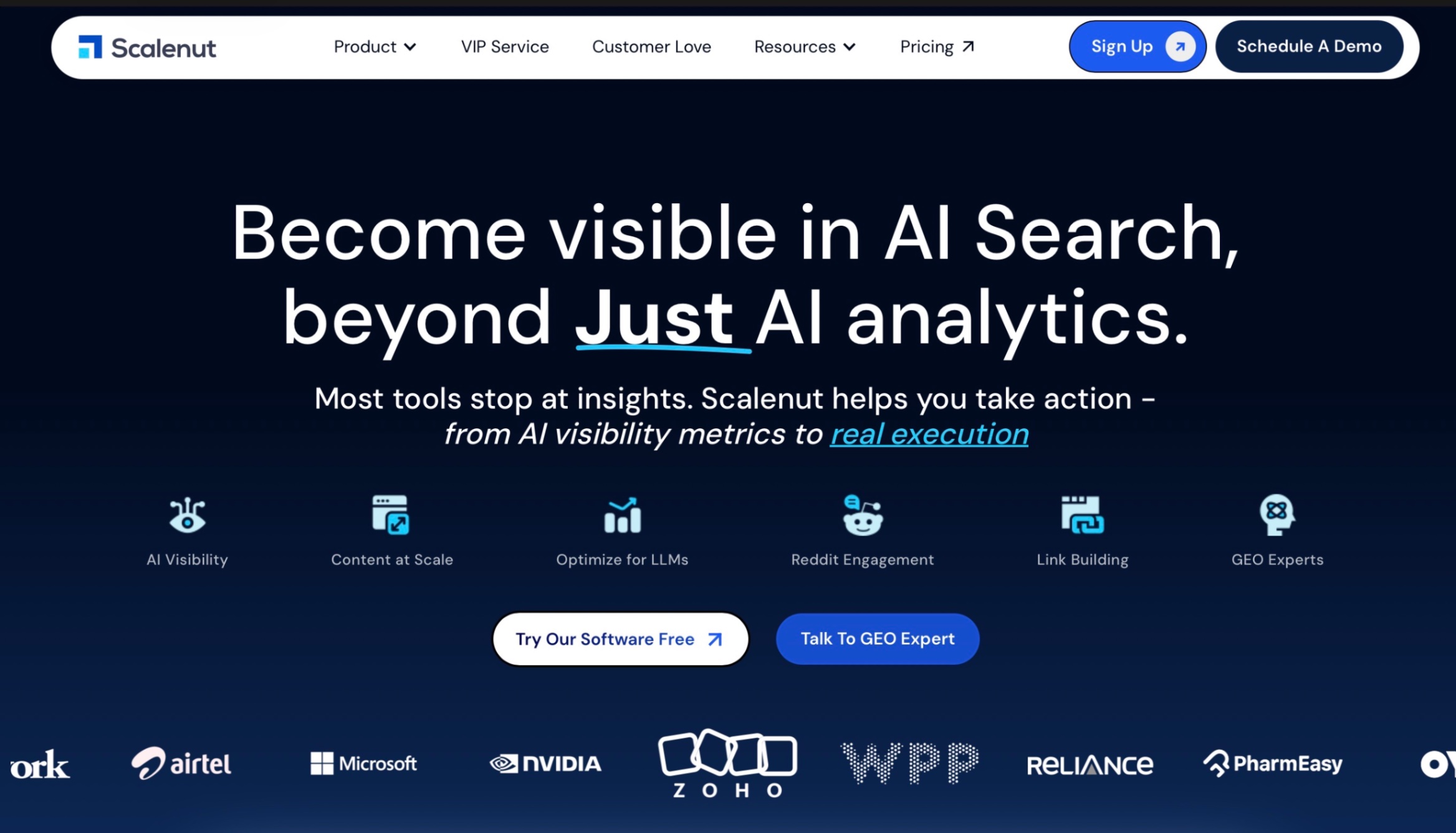
Scalenut is an SEO and GEO platform that combines AI visibility tracking with hands-on content execution, planning, and optimization in one workflow.
It is built for teams that want to understand how their brand appears in AI answers, then use those insights to improve content, authority, and organic performance.
Best For: Marketing teams, content teams, and growing brands that want one platform for AI visibility tracking, SEO research, content creation, on-page optimization, and execution.
What Are The Key AEO Services Provided By Scalenut
- Tracks brand presence across AI-generated answers on platforms such as ChatGPT and Perplexity
- Measures visibility through visibility metrics such as Visibility Score, Average Position, Share Of Voice, Visibility Heatmap, and Brand Visibility Rank
- Provides prompt-level reporting to show which prompts trigger brand mentions and where those mentions appear
- Tracks citations to reveal which sources AI systems use in generated answers
- Surfaces competitor visibility insights to show which brands appear alongside yours
- Maps query fanouts to show how prompts expand into related questions across AI experiences
- Includes sentiment analysis to classify mentions by tone
- Turns visibility gaps into action through recommendations tied to content, backlinks, and engagement opportunities
- Tracks AI bot activity and AI traffic trends, including Cloudflare-based monitoring and page-level reference patterns
What Are The Other Standout Features Of Scalenut?
- Cruise Mode supports SERP-informed outlining and drafting with GEO-aware guidance layered into the workflow
- Content Optimizer lets teams edit existing content inside Scalenut, using GEO scoring, prompt coverage, and topic and structure recommendations to guide improvements.
- AI Humanizer refines AI-written copy so it reads more naturally and feels more user-friendly
- GEO scoring identifies content gaps and provides an optimization plan, while auto-optimization supports changes to prompt coverage, keywords, meta tags, and schema.
- Keyword Planner supports topic and keyword planning for stronger authority building
- Traffic Analyzer helps identify strong performers and content update opportunities
- Content Audit flags pages that may need refreshes, consolidation, or deeper optimization
- Link Manager supports internal linking workflows
- On-Page Pro identifies issues with meta and canonical tags, external links, and image alt text, then supports reviewing and deploying fixes.
- Backlinks Marketplace adds a path to discover backlink opportunities inside the platform
Why Consider Scalenut?
- It is one of the few platforms in this category that combines AI visibility monitoring with real execution tools instead of stopping at reporting
- It helps teams move from prompt and citation insights to practical next steps in content, authority, and optimization
- It is a stronger fit for marketers who want both GEO and traditional SEO workflows connected in one place
- It reduces the need to stitch together separate tools for AI visibility, content writing, optimization, internal linking, and SEO planning
- It is especially useful for teams that want to turn AI search insights into publishable work faster, not just monitor mentions on a dashboard
Where Does Scalenut Fall Short?
- Buyers looking for a pure enterprise analytics layer may prefer a more reporting-heavy platform, while Scalenut is more execution-oriented by design
What Does Scalenut’s Pricing Look Like?
- Starter starts at $59/month
- Plus starts at $89/month
- Professional starts at $199/month
- VIP Service pricing is custom
How Do Users Rate Scalenut?
G2 Rating: 4.7/5
“I like that Scalenut is extremely user-friendly and affordable. It's a scalable way of generating customized content that's searchable and discoverable by Google and AI engines. I appreciate that it actually works, giving me the ability to drive organic traffic to my website without solely relying on a website team. The initial setup was very easy, and I rate it a 10 because I talk about it all the time.”, says Clayton S on G2.
Want to see Scalenut in action? Book a demo today!
2. Profound
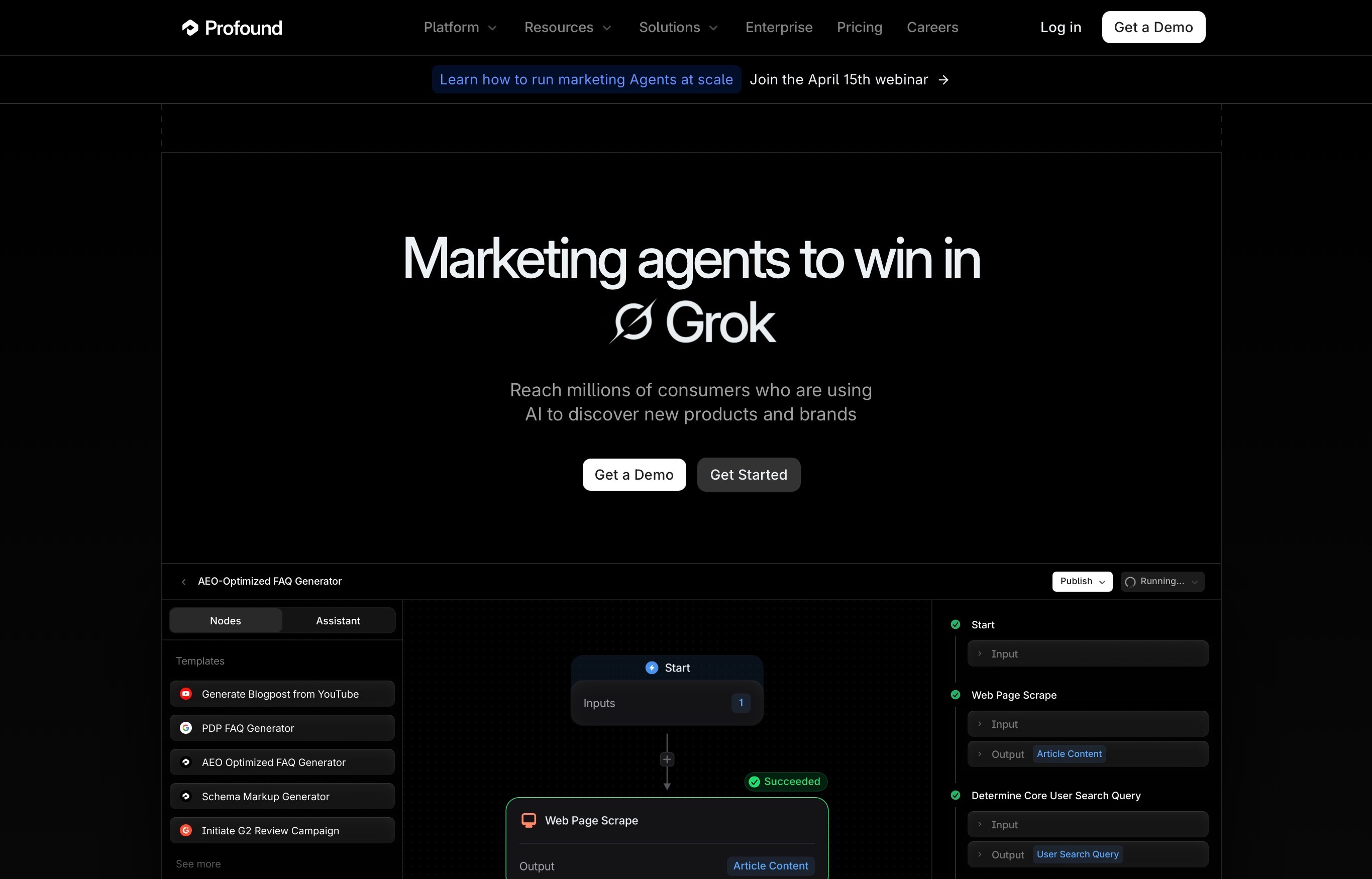
Profound is an enterprise AI visibility platform built to help brands understand how they appear across AI-generated answers and which sources influence those answers.
It is designed around tracking visibility, analyzing mentions, uncovering citations, and turning those insights into action.
Best For: Enterprise brands and larger marketing teams that need deep AI answer visibility tracking, citation intelligence, and competitive monitoring across multiple answer engines.
What Are The Key AEO Services Provided By Profound
- Tracks how often your brand appears in AI-generated answers across major answer engines
- Analyzes what AI systems are saying about your brand and target topics
- Identifies which websites and sources are influencing AI answers about your brand
- Supports prompt tracking and competitive benchmarking so teams can monitor visibility against competitors over time
- Measures AEO performance through signals such as citations, brand mentions, share of answer, and assisted conversions
What Are The Other Standout Features Of Profound?
- Supports visibility analysis across major AI surfaces including ChatGPT, Perplexity, Claude, Gemini, Microsoft Copilot, Google AI Mode, Exa Search, DeepSeek, and Google AI Overviews
- Includes sentiment tracking within its answer engine insights offering
- Agent Analytics tracks AI crawler activity and AI-referred traffic, helping teams understand which pages bots access and how referred visitors convert.
- Agents support recurring content workflows, including research, FAQ generation, new content creation, and refreshing existing content.
- Context Manager supplies brand knowledge and guidelines to help keep generated content aligned with the company’s messaging.
Why Consider Profound?
- It is built specifically for AI search visibility rather than being a traditional SEO tool adapted for the category
- It combines brand presence tracking with source-level citation insight, making it more useful for decision-making than simple mention monitoring alone
- It is well suited to organizations that need enterprise-grade reporting, governance, and operational support
- It offers deeper category-specific capabilities such as sentiment dashboards, agent analytics, and direct answer engine monitoring
Where Does Profound Fall Short?
- Pricing is not transparently listed in a self-serve format
- It is likely a stronger fit for enterprise teams than for smaller businesses looking for a lightweight or lower-cost solution
- The trial uses recommended prompts that cannot be customized, while ongoing monitoring requires a tailored package.
- AI Marketer and Agents usage is credit-based, so teams should assess the allowance needed for recurring content workflows.
What Does Profound’s Pricing Look Like?
- 7-day free trial is available for brands
- Agency Growth starts at $99/month
- Enterprise pricing is custom
How Do Users Rate Profound?
G2 Rating: 4.5/5
Wondering how to effectively combine traditional SEO with AEO? Read our blog on how to integrate traditional SEO with AEO for maximum visibility.
3. Scrunch AI
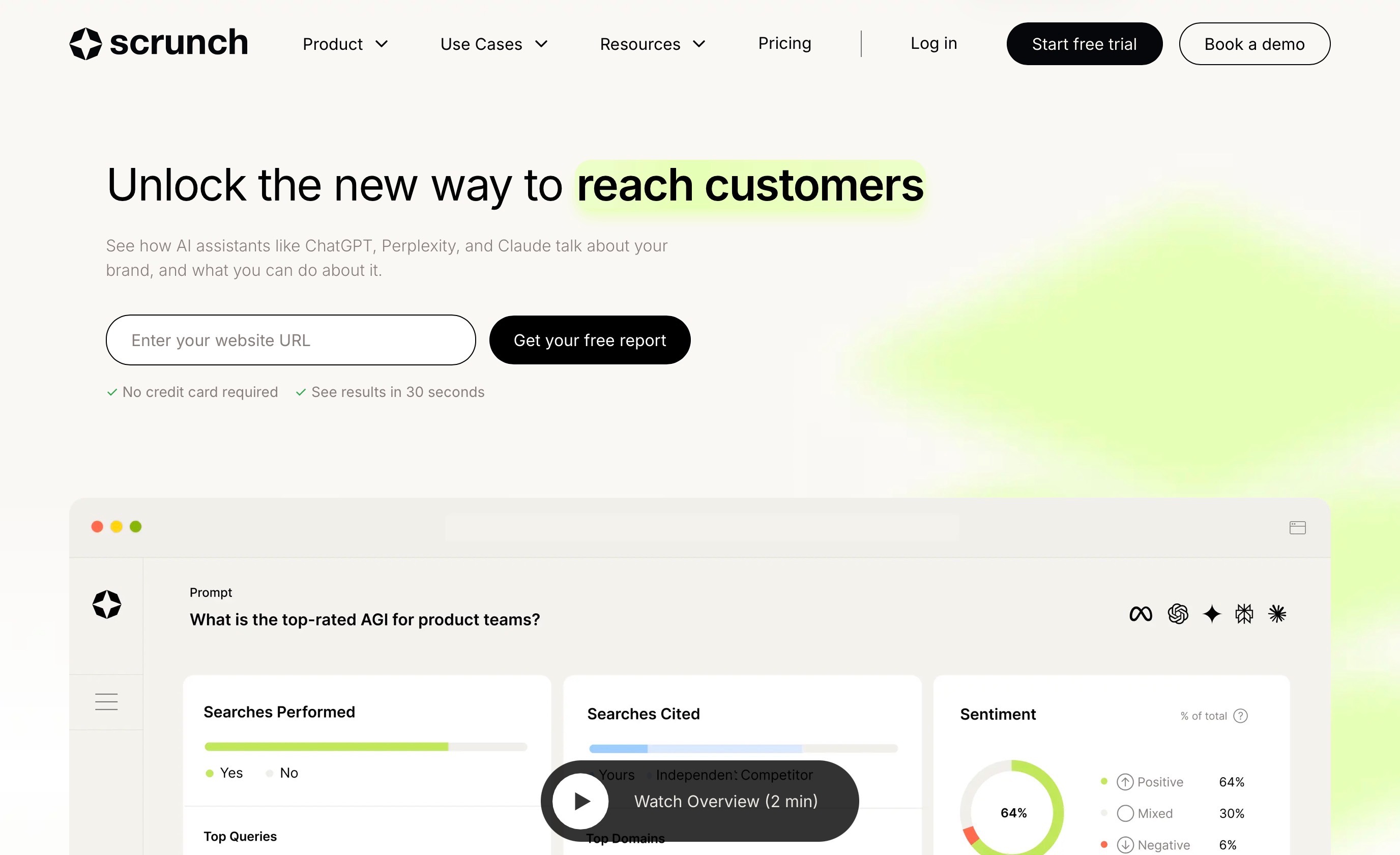
Scrunch AI is an AI search monitoring and optimization platform focused on prompts, citations, competitor visibility, and AI crawler behavior.
It is built for teams that want to measure presence across AI platforms and identify what to improve.
Best For: Growth teams, agencies, and in-house marketers that want hands-on AI search monitoring, citation tracking, and competitor benchmarking without starting with an enterprise-only pricing model.
What Are The Key AEO Services Provided By Scrunch AI?
- Tracks performance for prompts, topics, and entities across supported AI platforms
- Provides prompt analytics with trends, citations, competitors, and rankings
- Tracks citations in AI search so teams can see which sources AI platforms reference in responses
- Benchmarks visibility by competitor, persona, topic, and geography
- Page audits assess AI accessibility, readability, and alignment with tracked prompts, helping teams identify which pages need technical fixes or content improvements.
What Are The Other Standout Features Of Scrunch AI?
- Monitors AI bot crawling activity with a real-time feed and traffic trends
- Supports tracking across ChatGPT, Claude, Gemini, Perplexity, Google AI Mode, Google AI Overviews, Meta AI, and Microsoft Copilot
- Lets users filter citation reporting by domain or page-level URL
- Shows which competitors are mentioned for individual prompts and displays full prompt AI responses for review
- Includes site mapping features to identify underperforming pages and track changes over time
- Optimizer suggests changes such as clearer summaries, FAQs, and descriptive image text. With AXP, teams can create and deliver an AI-optimized version of a page to AI agents.
Why Consider Scrunch AI?
- It covers both measurement and improvement, not just visibility tracking
- It is easier to trial than many enterprise-only tools because it offers public pricing and a free trial
- It is well suited for operational teams that want granular prompt, citation, and page-level analysis in one workflow
- Its competitive visibility features go beyond simple mention counts by showing citations, trends, and platform-level competitor presence
Where Does Scrunch AI Fall Short?
- Lower-tier plans may feel restrictive for larger teams with broader monitoring needs
- Some platform coverage is still expanding, so not every answer engine may be equally supported
- Teams evaluating it for deeper enterprise use may still need a walkthrough to assess reporting depth, scale, and workflow fit
What Does Scrunch AI‘s Pricing Look Like?
- Core starts at $250/month
- Agency Core starts at $500/month
- Enterprise pricing is custom
- 7-day free trial is also available
How Do Users Rate Scrunch AI?
G2 Rating: 4.6/5
4. Ahrefs Brand Radar
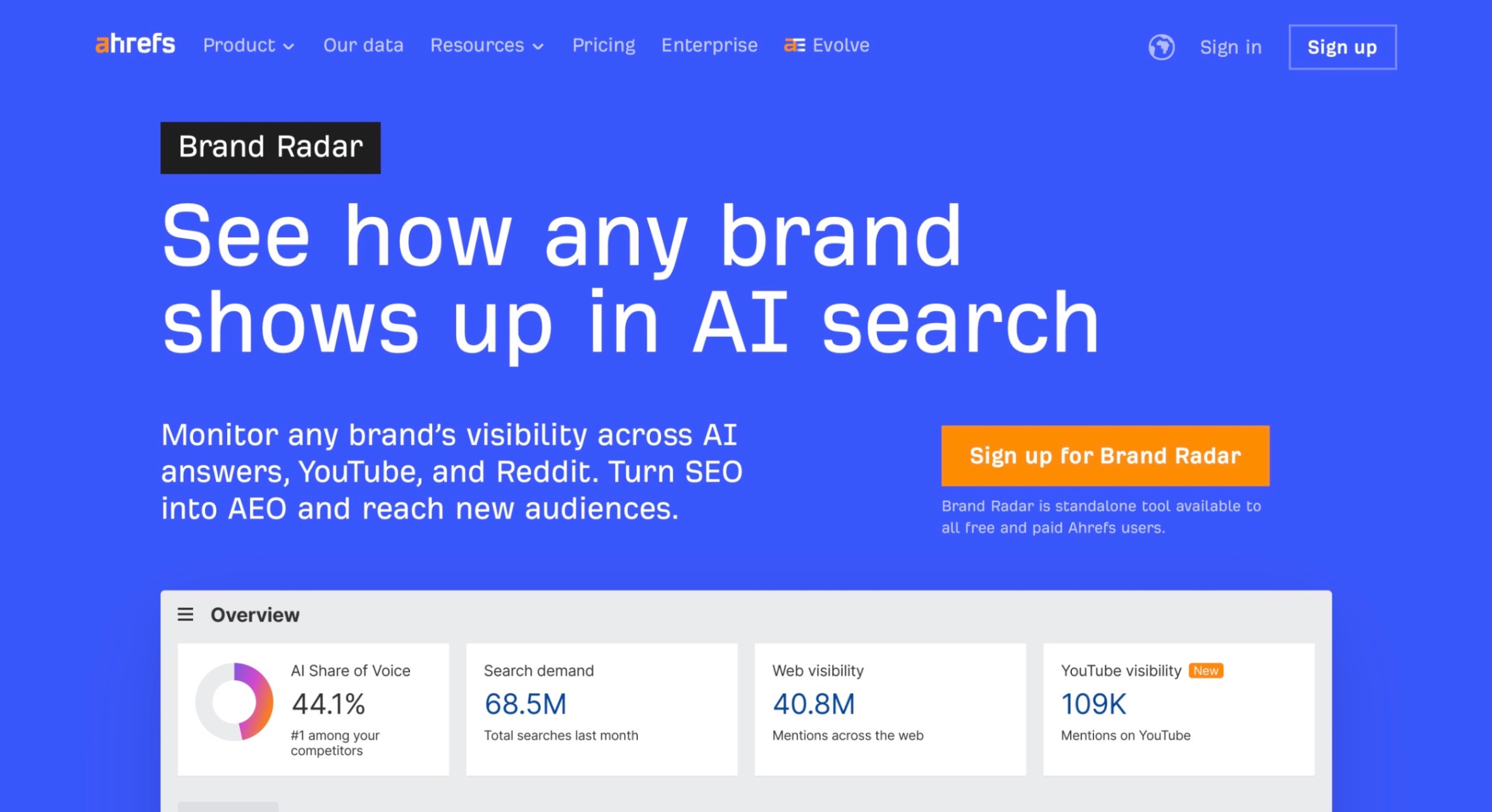
Ahrefs Brand Radar is Ahrefs’ AI visibility tool built to show how brands appear in AI search and which pages or domains get cited in AI-generated answers.
It is designed to help teams measure AI share of voice, uncover citation opportunities, and track brand visibility across a large set of search-backed prompts.
Best For: SEO teams and in-house marketers who already use Ahrefs and want AI visibility tracking tied to a broader search intelligence workflow.
What Are The Key AEO Services Provided By Ahrefs Brand Radar
- Tracks how brands appear in AI-generated answers across a very large set of search-backed prompts
- Measures AI share of voice against competitors so teams can benchmark visibility in AI search
- Identifies top cited pages and domains to show which sources are influencing AI-generated answers
- Helps teams find opportunities to earn more mentions by analyzing prompt coverage and citation patterns
- Supports custom prompt tracking for business-critical queries over time
What Are The Other Standout Features Of Ahrefs Brand Radar?
- Requires little setup to start exploring visibility for brands, products, regions, or authors
- Connects AI visibility with Ahrefs’ broader search demand and web visibility data
- Uses a documented methodology for modeled AI visibility analysis
- Lets users add and monitor custom prompts on a recurring basis
- Starts with a large prebuilt prompt universe rather than relying only on manually added prompts
Why Consider Ahrefs Brand Radar?
- It is a strong option for teams that want AI visibility data grounded in large-scale search demand
- It makes the most sense for buyers already working inside the Ahrefs ecosystem
- It can help SEO-led teams connect AI answer visibility with broader search opportunities instead of treating AEO as a separate workflow
- Its scale makes it more useful for category-level exploration than smaller prompt trackers
Where Does Ahrefs Brand Radar Fall Short?
- Brand Radar can be purchased separately from an Ahrefs SEO subscription. Costs depend on the platform indexes and custom prompt monitoring volume required.
- It may feel less accessible for smaller teams looking for a simpler or lower-cost AEO platform
- Brand Radar supplies visibility research and citation intelligence; teams implement article and page changes through their content editor or CMS.
What Does Ahrefs Brand Radar‘s Pricing Look Like?
- Starts at $199/month
How Do Users Rate Ahrefs Brand Radar?
G2 Rating: 4.5/5
Want to improve visibility in AI search results? Learn how to structure content for stronger rankings, trust, and reach in our latest blog on AEO best practices .
5. Semrush AI Visibility Toolkit
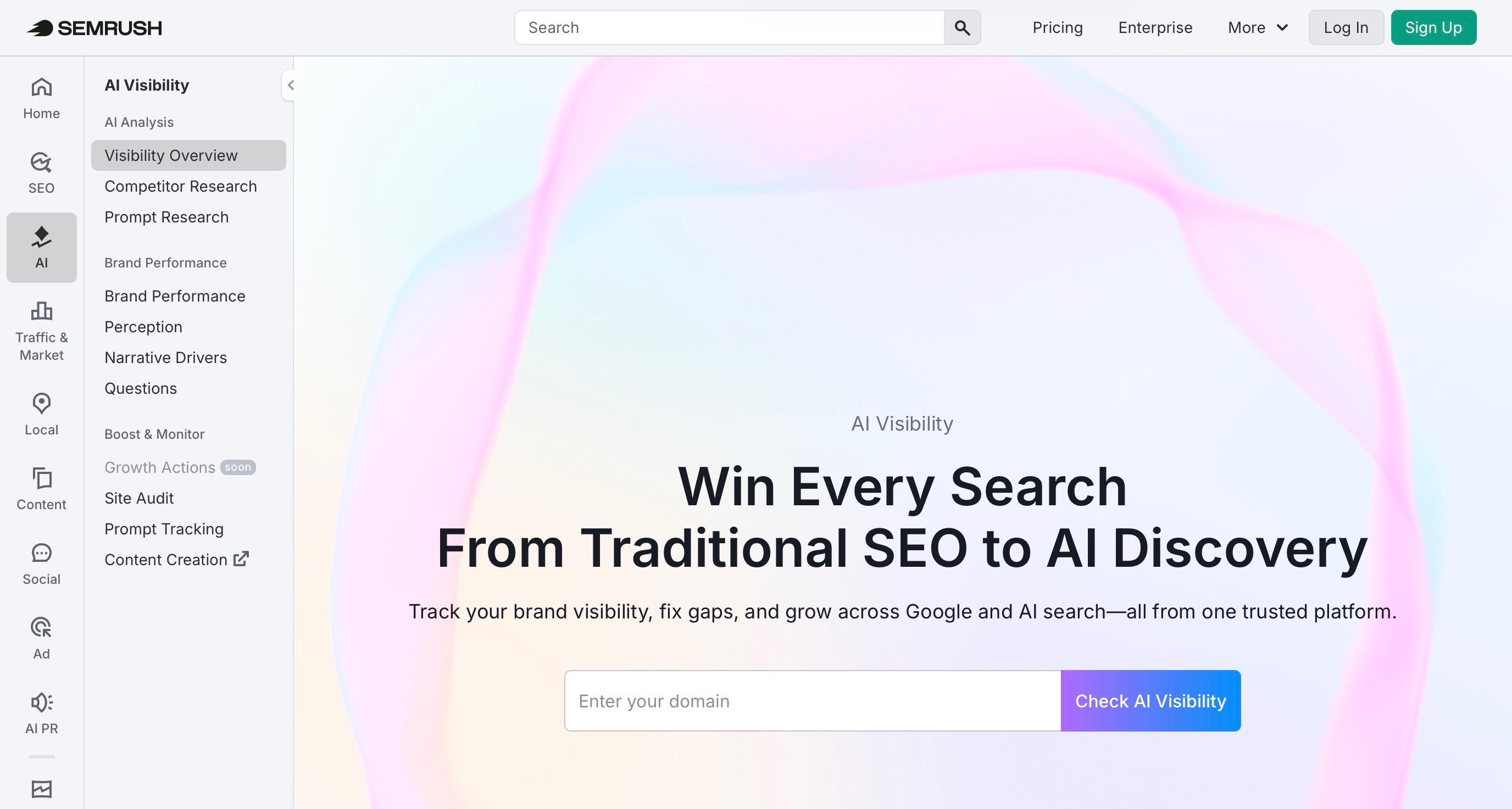
Semrush AI Visibility Toolkit is Semrush’s dedicated AI search visibility product for tracking mentions, citations, prompts, competitor performance, and brand perception across AI-driven search experiences.
It is built to help teams monitor AI visibility, find gaps, and improve performance over time within the broader Semrush ecosystem.
Best For: SMBs, agencies, and mid-market marketing teams that want AI visibility monitoring inside an established SEO and digital marketing platform.
What Are The Key AEO Services Provided By Semrush AI Visibility Toolkit
- Benchmarks your brand’s AI visibility and mentions against competitors
- Analyzes brand perception and sentiment in AI-generated search experiences
- Prompt Research provides topic-level volume, difficulty, and intent data to help teams prioritize content briefs, new pages, and updates.
- Tracks daily AI visibility for prompts that matter to your business
- Audits your site for technical issues that could block AI crawlers and limit AI visibility
What Are The Other Standout Features Of Semrush AI Visibility Toolkit?
- Lets users monitor mentions and citations and filter results by platform, source, or intent
- Highlights competitive gaps by showing where rivals appear in AI answers but your brand does not
- Turns AI visibility data into presentation-ready reports for internal teams and agencies
- Fits naturally into the larger Semrush ecosystem for teams already using it for SEO and reporting
- Brand Performance provides strategic recommendations, while competitor and prompt reports highlight visibility gaps that can inform content updates.
Why Consider Semrush AI Visibility Toolkit?
- It is a practical option for teams that want AI visibility monitoring without switching to a completely separate platform
- It is especially appealing for agencies and mid-sized teams that already work inside Semrush
- It goes beyond simple mention tracking by combining visibility, sentiment, prompt discovery, technical audits, and reporting
- It is a strong fit for teams that want to extend an existing SEO workflow into AI-driven search
Where Does Semrush AI Visibility Toolkit Fall Short?
- The toolkit supports research, audits, and recommendations; teams implement content changes through their CMS or a content production tool.
- The base subscription covers one domain and 25 tracked prompts. Additional domains, users, and prompt capacity increase the cost.
- Buyers who want a pure-play AEO platform may prefer a more specialized tool if they do not already use Semrush
What Does Semrush AI Visibility Toolkit‘s Pricing Look Like?
- Starts at $99/month
- Add ons are available at an additional cost
How Do Users Rate Semrush AI Visibility Toolkit?
No ratings yet on G2.
6. Conductor
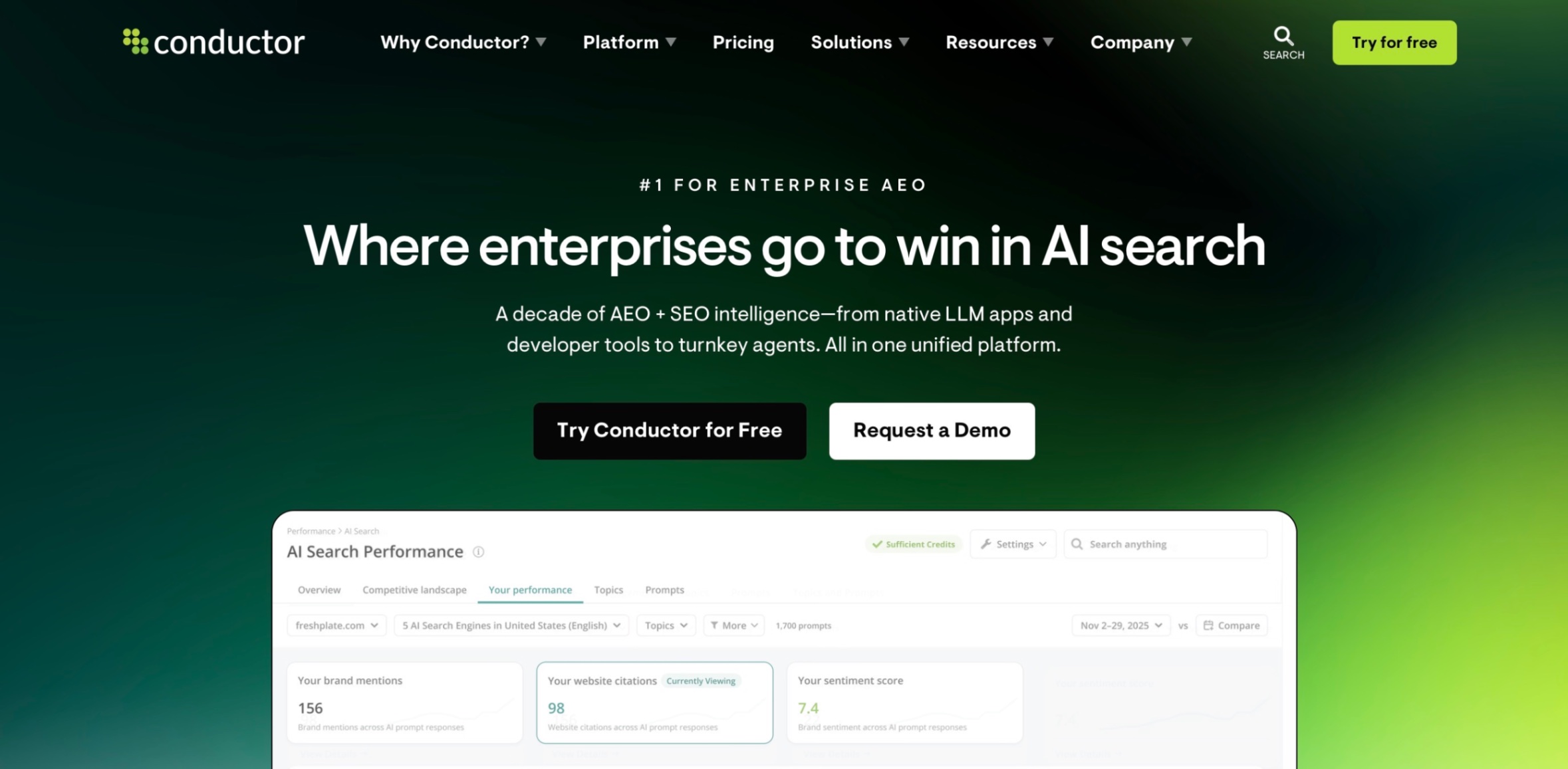
Conductor is an enterprise website optimization and intelligence platform that combines AI visibility tracking, content workflows, and technical site monitoring in one system.
It is positioned as an end-to-end AEO platform for brands that want to improve visibility across both traditional search and AI-generated answers.
Best For: Enterprise marketing teams that need AEO, SEO, content operations, and technical monitoring in one platform rather than managing separate tools.
What Are The Key AEO Services Provided By Conductor
- Tracks AI mentions and website citations so brands can measure how they appear in AI search results
- Helps teams identify content opportunities based on AI visibility and citation patterns
- Combines AI search insights with traditional SEO visibility and reporting
- Conductor’s Writing Assistant supports content creation and optimization, while Content Score evaluates topical coverage and intent alignment to guide revisions before publication.
- Includes continuous technical monitoring to help protect site health and maintain discoverability
What Are The Other Standout Features Of Conductor?
- Unifies AEO and SEO workflows inside one enterprise platform instead of splitting visibility and content work across multiple tools
- Content Profiles help apply brand requirements to content, while internal link recommendations support improving connections between relevant pages.
- Includes enterprise-grade reporting and intelligence capabilities designed for larger organizations
- Positions site monitoring as an always-on function, which is useful for enterprise teams managing large websites
- Is built as a unified platform rather than a narrow AI visibility tracker
Why Consider Conductor?
- It is a strong fit for enterprises that want one strategic platform instead of stitching together separate tools for AI visibility, content, and technical SEO
- It appears better suited than lighter AEO tools for organizations with multiple stakeholders, reporting needs, and complex site operations
- It goes beyond monitoring by tying AI visibility data to workflow execution and content creation
- It makes sense for teams that want AI search performance managed as part of a broader search strategy rather than as a separate initiative
Where Does Conductor Fall Short?
- It is primarily built for enterprise use, which may make it less accessible for small teams or budget-conscious buyers
- Pricing and usage allowances vary by package, so buyers need a quote covering AI search monitoring and Writing Assistant capacity.
- Teams looking for a lightweight prompt tracker may find it broader and more operationally heavy than they need
What Does Conductor’s Pricing Look Like?
Pricing is not publicly listed, so you’ll need to contact their team for a custom quote.
How Do Users Rate Conductor?
G2 Rating: 4.5/5
7. Otterly AI
Otterly AI is an AI search monitoring platform focused on tracking how brands are mentioned, ranked, and cited across major AI search experiences.
It is built for teams that want prompt-level visibility tracking, citation monitoring, and optimization support in a more accessible self-serve product.
Best For: Lean in-house teams, consultants, and agencies that want dedicated AI visibility monitoring with transparent pricing and lower entry costs.
What Are The Key AEO Services Provided By Otterly AI
- Tracks how AI search engines mention, rank, and cite your brand
- Monitors visibility across ChatGPT, Google AI Overviews, Perplexity, Google AI Mode, Gemini, and Copilot
- Supports prompt-based tracking so teams can follow performance for specific business-relevant queries
- Detects link citations, making it useful for teams that want to understand source visibility in AI answers
- GEO URL audits assess individual pages for AI crawlability and content readiness, helping teams prioritize access, readability, and structure fixes.
What Are The Other Standout Features Of Otterly AI?
- Offers transparent pricing with lower-cost entry plans than many enterprise-focused tools
- Includes daily tracking in paid plans
- Supports additional coverage options for platforms such as Google AI Mode and Gemini
- Serves as an accessible entry point into AI visibility monitoring for smaller teams
- Publishes research around AI citation patterns, which reinforces its focus on citation intelligence
Why Consider Otterly AI?
- It is one of the easier tools to trial and adopt if you want focused AEO monitoring without an enterprise sales process
- It is especially useful for teams that care about exact prompt tracking and link citation detection
- It offers a narrower and cleaner workflow than broader enterprise suites, which can be an advantage for small teams
- It is a strong option for agencies and operators who need practical monitoring first and can layer other execution tools around it later
Where Does Otterly AI Fall Short?
- It is more specialized than broader enterprise platforms, so teams wanting a full all-in-one AEO, SEO, and content operations suite may need additional tools
- Lower plans are prompt-limited, which may become restrictive as monitoring scope grows
- Some platform coverage depends on add-ons rather than being included by default in every plan
- Larger enterprises may prefer a more deeply integrated platform if they need broader governance, reporting, and cross-team workflows
What Does Otterly AI’s Pricing Look Like?
- Lite starts at $25/month
- Standard starts at $160/month
- Premium starts at $422/month
- Enterprise pricing is custom
How Do Users Rate Otterly AI?
G2 Rating: 4.7/5
8. Peec AI
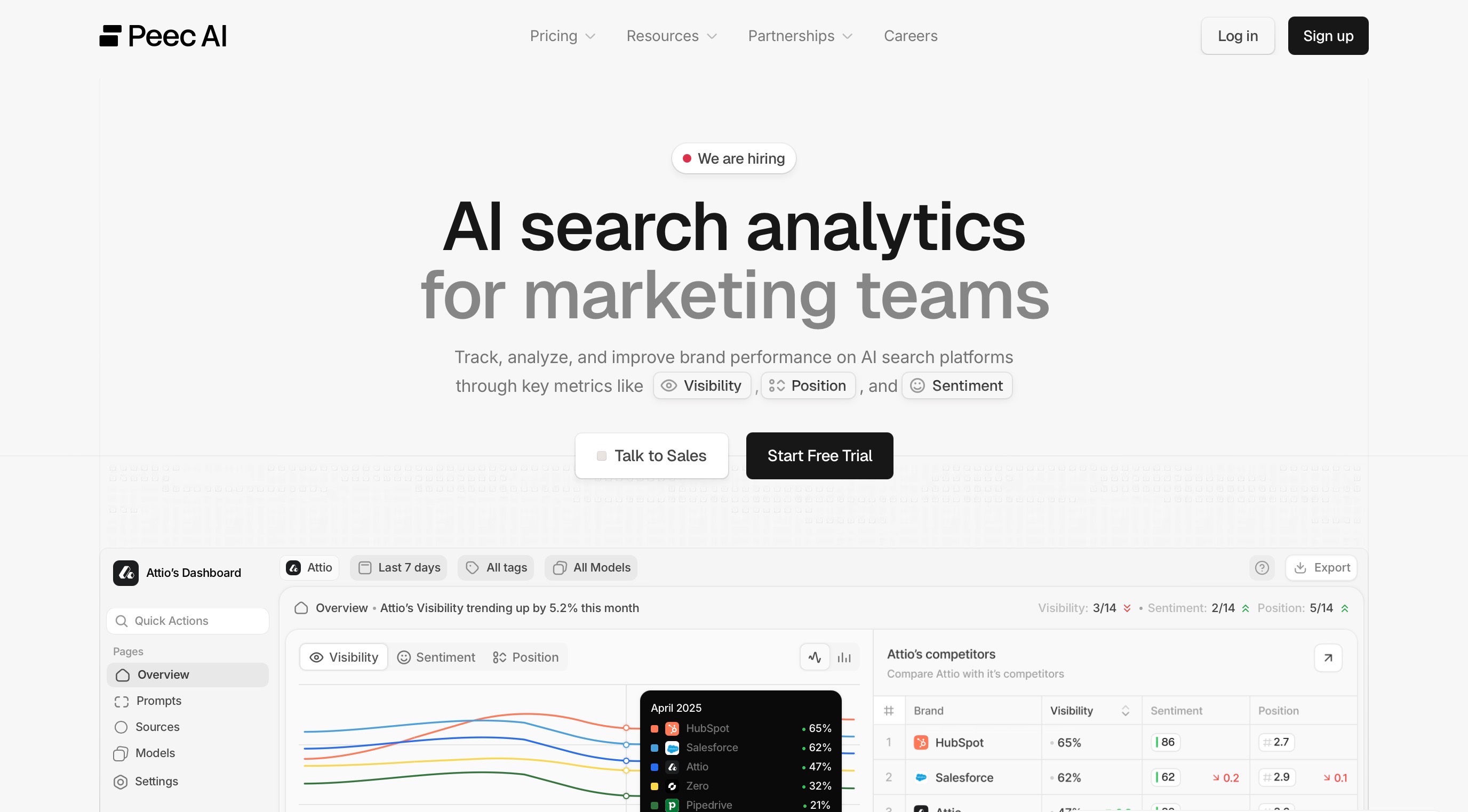
Peec AI is an AI search analytics platform built for marketing teams that want to track how their brand appears across major answer engines and use that data to improve visibility.
It focuses on AI visibility measurement, competitor benchmarking, citation intelligence, and action-oriented recommendations rather than broader SEO operations.
Best For: Marketing teams and agencies that want a focused AI visibility platform with strong multi-platform tracking, competitor benchmarking, and clear optimization direction.
What Are The Key AEO Services Provided By Peec AI?
- Tracks brand performance across platforms such as ChatGPT, Perplexity, Gemini, and DeepSeek
- Benchmarks your visibility against competitors so teams can see where they are gaining or losing ground in AI discovery
- Identifies which content and sources are being cited in AI-generated answers
- Supports platform-specific visibility tracking for environments such as Google AI Mode, Gemini, and ChatGPT
- Helps teams connect AI visibility insights to content prioritization and optimization decisions
What Are The Other Standout Features Of Peec AI?
- Offers public pricing, which makes it easier to evaluate than sales-led enterprise platforms
- Includes agency-specific pricing and positioning, making it relevant for service providers as well as in-house teams
- Emphasizes actionable recommendations, including guidance on what to create or optimize next
- Each action identifies the relevant page or topic, competitor evidence, and recommended steps, helping teams decide what to create, revise, or pursue through outreach.
- Appears designed for marketers who want a cleaner interface and faster operational insight rather than a heavyweight enterprise suite
Why Consider Peec AI?
- It is a strong fit for teams that want dedicated AI visibility analytics without buying a much broader SEO platform
- It appears especially useful for content and growth teams that want to know not just whether they are visible, but which assets are getting cited and what to improve next
- It has practical appeal for teams that care about platform-specific visibility, especially across Gemini and Google AI Mode
- Its public pricing and focused product scope make it easier to trial and shortlist than enterprise-first alternatives
Where Does Peec AI Fall Short?
- It appears more focused on AI visibility analytics than on full in-platform content execution or broader SEO operations
- Teams that want a single tool for technical SEO, content production, and AI visibility may still need complementary platforms
- Some buyers may still want to validate reporting depth and workflow fit in a demo, especially if they need enterprise-scale governance or advanced integrations
What Does Peec AI’s Pricing Look Like?
- Starter starts at $95/month
- Pro starts at $245/month
- Advanced starts at $495/month
- Enterprise pricing is custom
How Do Users Rate Peec AI?
G2 Rating: 4.7/5
9. AEO Vision
AEO Vision is a dedicated AI search visibility platform focused on prompt-level tracking, competitor analysis, citation monitoring, and sentiment insights across leading AI platforms.
It is built around helping brands measure where they appear in AI answers and where competitors or cited domains are winning source share.
Best For: Small and growing marketing teams that want AI visibility tracking, prioritized optimization tasks, and built-in content creation.
What Are The Key AEO Services Provided By AEO Vision
- Tracks brand visibility across ChatGPT, Perplexity, Gemini, Claude, and Google AI Mode
- Monitors citations and cited domains so teams can see which sources are influencing AI answers
- Supports competitor analysis with mention share, citation tracking, and head-to-head comparisons across platforms
- Includes prompt-level tracking, which allows teams to monitor visibility for the questions that matter most to their business
- Supports content creation alongside AI visibility monitoring, helping teams move from identifying gaps to producing content.
- Offers sentiment analysis as part of its AI visibility reporting
What Are The Other Standout Features Of AEO Vision?
- Auto-discovers competitors with AI, which reduces manual setup for benchmarking
- AI Task Management prioritizes content, technical, PR, and link building tasks, with effort estimates and a Kanban board for tracking progress.
- Offers a free citation insights widget and educational resources, which may help teams explore the category before committing
- Publicly signals more accessible starting pricing than many enterprise-focused alternatives
- Actionable Insights provides biweekly recommendations and content ideas tied to prompt-level visibility gaps.
Why Consider AEO Vision?
- It is a strong option for teams that want a purpose-built AEO platform without jumping straight to enterprise-only pricing
- It combines several buyer-critical capabilities in one place, including prompt tracking, citation monitoring, competitor benchmarking, and sentiment analysis
- It appears especially useful for teams that want competitive AI visibility analysis without building the framework manually
- Its pricing and product structure make it more approachable for smaller teams than many enterprise AEO platforms
Where Does AEO Vision Fall Short?
- Content creation and automated workflow allowances vary by plan.
- Larger enterprises may still prefer a platform with broader governance, integrations, or multi-team workflow depth
What Does AEO Vision’s Pricing Look Like?
- Lite starts at just $9/month
- Solo starts at $99/year
- Growth starts at $299/year
- 2 months free for annual plans
- Enterprise pricing is custom
How Do Users Rate AEO Vision?
No user ratings on G2 yet.
How Can You Use AEO Platforms In Real Workflows To Get Better Results?
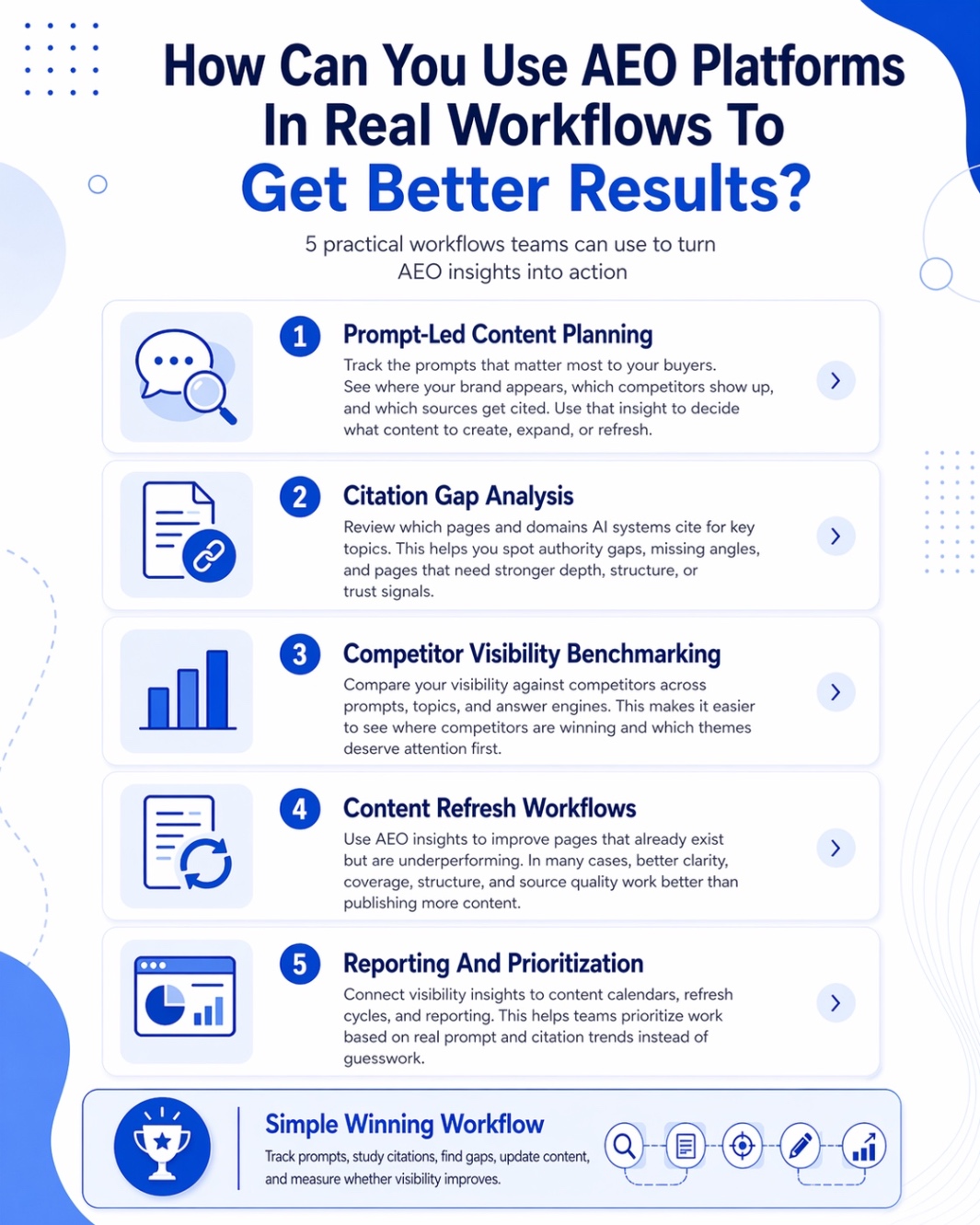
AEO platforms work best when they become part of a repeatable process, not just a dashboard. The goal is simple: track where you appear, understand why certain sources get cited, and use those insights to improve content.
Here are some of the most practical ways teams use them:
1. Prompt-Led Content Planning
Start with the prompts that matter most to your buyers. Track where your brand appears, which competitors show up, and which sources get cited. Then use that data to decide what content to create, expand, or refresh.
2. Citation Gap Analysis
Review which pages and domains AI systems cite for important topics. This helps you spot authority gaps, missing content angles, and pages that need stronger depth, structure, or trust signals.
3. Competitor Visibility Benchmarking
Compare your visibility against competitors across prompts, topics, and answer engines. This makes it easier to see where competitors are winning and which themes deserve attention first.
4. Content Refresh Workflows
Use AEO insights to update pages that already exist but are underperforming. In many cases, improving clarity, coverage, structure, and source quality is more effective than constantly publishing new content.
5. Reporting And Prioritization
For larger teams, AEO platforms can help connect visibility data to content calendars, refresh cycles, and reporting. That makes it easier to prioritize work based on real prompt and citation trends instead of guesswork.
The most effective workflow is usually the simplest one: track prompts, study citations, find gaps, update content, and measure whether visibility improves. That is where AEO platforms deliver the most value.
Which Platform Should You Choose Based On Your Team’s Needs?
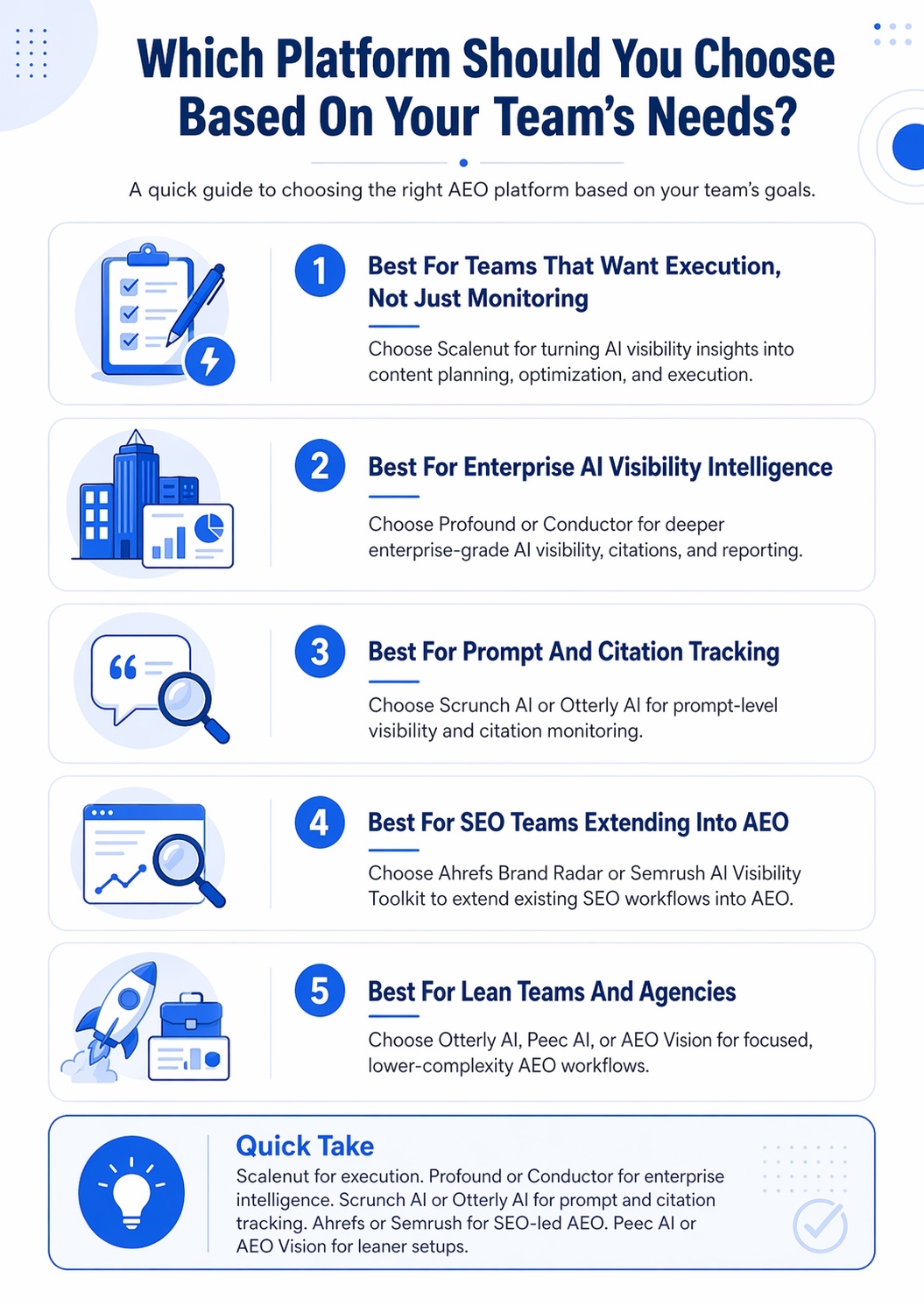
The right platform depends on what your team needs most. Some teams need execution. Others need enterprise visibility intelligence, deeper citation tracking, or a simpler self-serve workflow.
1. Best For Teams That Want Execution, Not Just Monitoring
Choose Scalenut if you want to turn AI visibility insights into actual content work. It combines monitoring with content planning, drafting, optimization, internal linking, and authority-building workflows, which makes it the strongest fit for execution-focused teams.
2. Best For Enterprise AI Visibility Intelligence
Choose Profound or Conductor if you need deeper enterprise-grade visibility intelligence. Profound is stronger for detailed answer-engine insights, citations, sentiment, and competitive monitoring. Conductor is a better fit if you want that intelligence tied to broader content workflows and technical site monitoring.
3. Best For Prompt And Citation Tracking
Choose Scrunch AI or Otterly AI if prompt-level visibility and citation tracking matter most. Scrunch AI is the stronger choice for a more operational workflow with competitor and crawler insights. Otterly AI is better if you want focused monitoring in a simpler self-serve setup.
4. Best For SEO Teams Extending Into AEO
Choose Ahrefs Brand Radar or Semrush AI Visibility Toolkit if your team already works inside a traditional SEO stack. Ahrefs Brand Radar is stronger for large-scale AI visibility benchmarking and cited-source analysis. Semrush is the better fit if you want AI visibility inside a broader SEO, reporting, and technical workflow.
5. Best For Lean Teams And Agencies
Choose Otterly AI, Peec AI, or AEO Vision if you want a more focused platform with less complexity. Otterly AI stands out for accessible monitoring, Peec AI for multi-platform visibility analytics, and AEO Vision for a dedicated AEO workflow with prompt, citation, and competitor tracking.
In simple terms: choose Scalenut for execution, Profound or Conductor for enterprise intelligence, Scrunch AI or Otterly AI for prompt and citation tracking, Ahrefs or Semrush for SEO-led AEO workflows, and Peec AI or AEO Vision for leaner setups.
What Makes A Good AEO Platform In 2026?
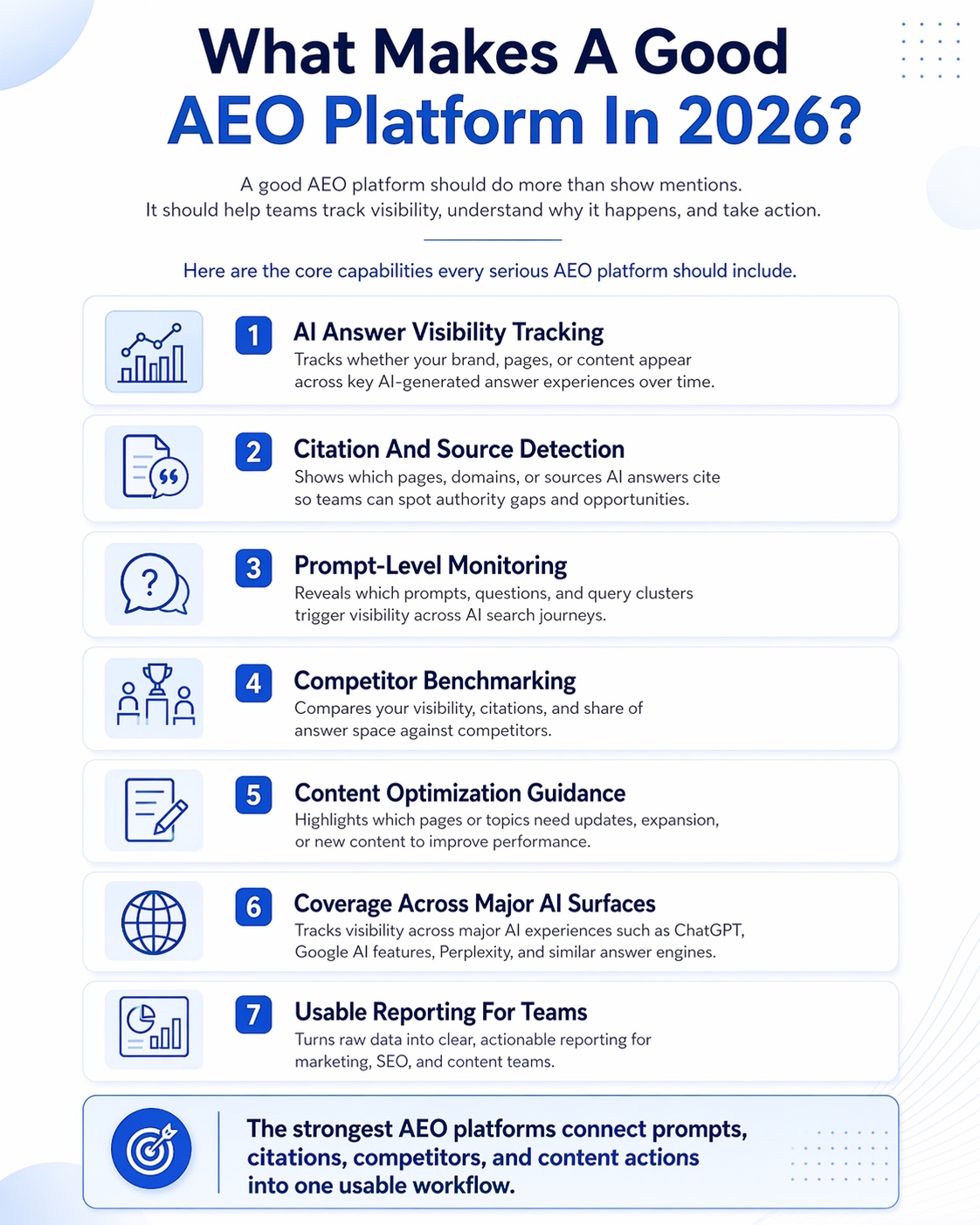
A good AEO platform in 2026 needs to do more than show whether your brand appears in AI answers. The minimum bar now is the ability to track visibility, explain why that visibility happens, and help teams act on those insights in a way that improves performance across AI-driven search experiences.
Here are the core capabilities a platform should meet before it deserves a place on a serious shortlist.
1. AI Answer Visibility Tracking
A platform should show whether your brand, pages, or content are actually appearing in AI-generated answers across the surfaces that matter. That includes measuring visibility over time, not just giving one-off snapshots.
2. Citation And Source Detection
Tracking mentions alone is not enough. Strong AEO platforms should also show which sources, pages, or domains are being cited in AI answers so teams can understand what is influencing visibility and where authority gaps exist.
3. Prompt-Level Monitoring
A useful platform should reveal which prompts, questions, or query clusters trigger visibility. Prompt-level monitoring matters because AI search behavior is shaped by longer, more specific queries and follow-up questions, not just broad keywords.
4. Competitor Benchmarking
AEO is relative, not absolute. The best platforms help teams compare their visibility, citations, and share of answer space against competitors so they can see where they are winning, where they are absent, and what to fix first.
5. Content Optimization Guidance
The platform should not stop at reporting. It should help teams identify which pages, topics, or formats deserve updates, expansion, or new content creation. That matters because cited content in AI experiences is often shaped by usefulness, structure, and content format, not just legacy rankings.
6. Coverage Across Major AI Surfaces
A good platform should track more than one environment. Buyers should expect coverage across major AI search experiences such as Google AI features, ChatGPT, Perplexity, and other relevant answer engines, because visibility patterns can differ by platform.
7. Usable Reporting For Teams
The data has to be actionable, not just impressive. Good reporting should help marketing, SEO, and content teams quickly understand what changed, where the gap is, and what action should come next. Clear, usable reporting is now part of the minimum bar.
The strongest AEO platforms do not just measure visibility. They help teams connect prompts, citations, competitors, and content actions into a workflow that can actually improve results.
Also read our blog on 10 must-have AEO tools to make sure you consistently show up in AI answers.
How To Choose The Right Platform For Optimizing Content For AEO
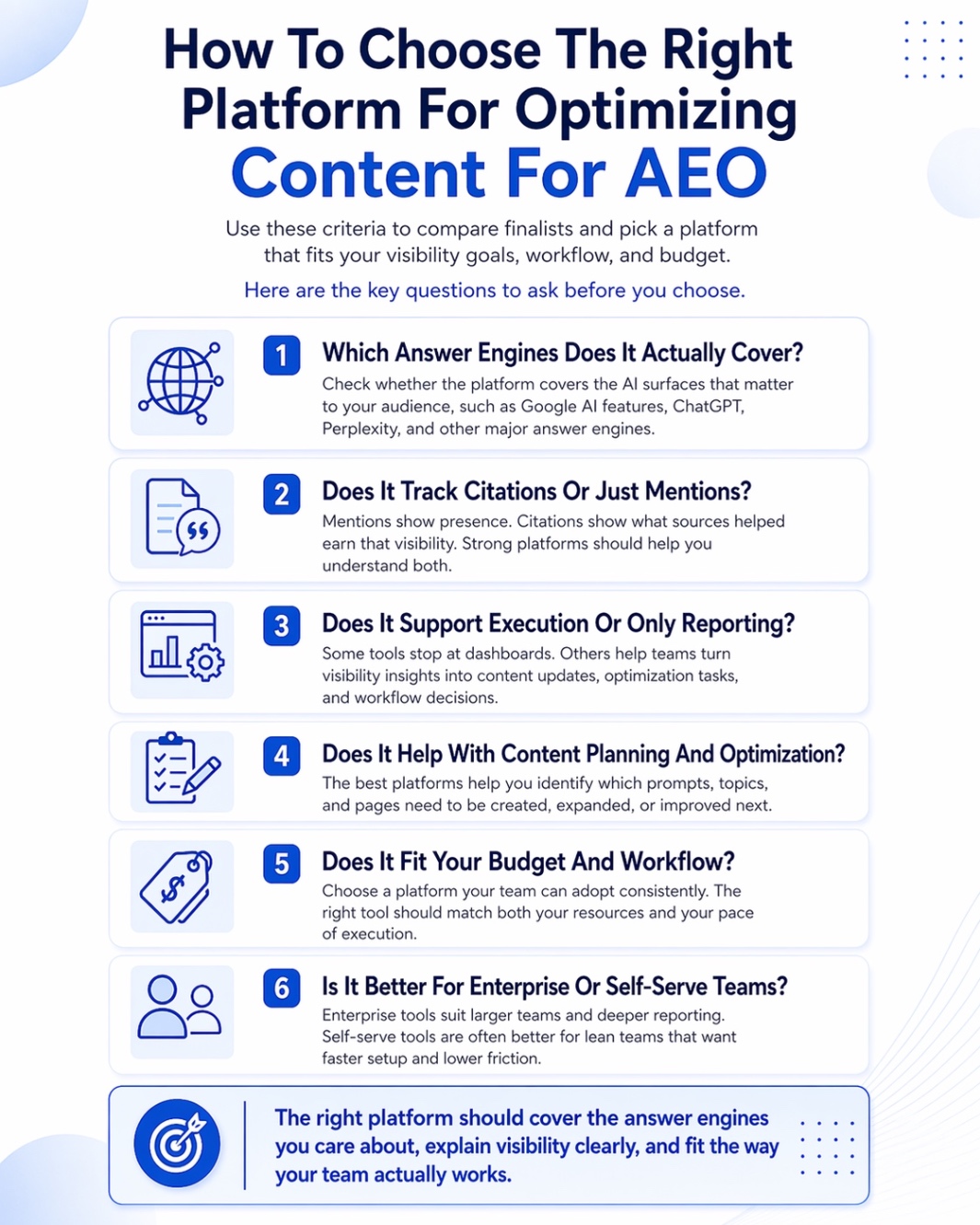
Once you have narrowed the field, the next step is to evaluate the finalists more carefully. The best AEO tool should match the answer engines you care about, the workflow your team actually uses, and the level of visibility and execution support you need.
Here are the key questions to use when comparing platforms side by side.
1. Which Answer Engines Does It Actually Cover?
Not every platform tracks the same environments. Some focus more heavily on Google AI features, while others emphasize ChatGPT, Perplexity, or broader multi-platform monitoring. If your audience discovers brands across multiple AI surfaces, narrow tools that only cover one or two environments may not be enough.
2. Does It Track Citations Or Just Mentions?
A mention tells you that your brand appeared. A citation tells you what source or page helped earn that visibility. That difference matters because citation tracking gives your team something concrete to learn from, improve, and expand on. Platforms that only report mentions can leave too much of the why unanswered.
3. Does It Support Execution Or Only Reporting?
Some tools are built mainly for dashboards, benchmarking, and visibility reporting. Others go further by helping teams turn those insights into actual content updates, optimization tasks, and workflow decisions. If your team wants to move faster, this distinction matters more than long feature lists.
4. Does It Help With Content Planning And Optimization?
A strong AEO platform should help you spot which prompts, topics, and pages deserve attention next. The most useful tools do not just show where you are visible. They also help your team decide what to update, expand, create, or optimize so visibility can improve over time.
5. Does It Fit Your Budget And Workflow?
The best platform on paper is still the wrong choice if your team will not use it consistently. Some products are built for enterprise budgets and multi-team operations, while others are designed to be self-serve and easier to adopt. A tool should match your goals, resources and speed of execution.
6. Is It Better For Enterprise Or Self-Serve Teams?
This is one of the quickest ways to filter your shortlist. Enterprise platforms are usually stronger for reporting depth, governance, and cross-functional visibility. Self-serve tools are often better for lean teams that want faster setup, simpler workflows, and lower friction. Choosing the wrong operating model can create unnecessary complexity.
A good buying decision comes from matching platform depth to team reality. The best choice is usually the one that covers the right answer engines, explains visibility clearly, and fits the way your team actually works.
Want to know the latest AEO trends and how they are reshaping search strategies? Read our latest blog on the latest AEO trends and how it’s impacting SEO in 2026.
Conclusion
The right platform depends on what your team needs most next. If execution matters most, choose a tool that connects generative engine optimization with content optimization, content generation, and real workflow actions. If measurement matters most, choose a platform that gives you stronger prompt, citation, and competitor visibility across large language models.
The next step is simple: shortlist two or three tools, test how well they support search optimization beyond standard search engine results, and see whether you need a broader platform or more dedicated AEO tools. The best answer engine optimization choice is the one your team can actually use to turn insight into action.
Frequently Asked Questions
Which AEO tools are best for improving content visibility in answer engines?
Scalenut supports content creation and optimization. Profound’s Agents handle research, content refreshes, and new drafts, while Conductor supports enterprise drafting and editing. Ahrefs Brand Radar and Semrush AI Visibility Toolkit provide prompt and citation research to guide content updates.
Can you recommend free platforms for optimizing content for AEO?
Free options include Semrush’s AI Visibility Checker for visibility snapshots and HubSpot’s AI Search Grader for brand perception checks. Scalenut offers supporting SEO tools. These help with initial assessment; ongoing prompt monitoring and integrated content optimization generally require paid software.
What is the difference between AEO and SEO?
SEO focuses on improving visibility in traditional search results, while AEO focuses on helping content appear in AI-generated answers and answer-driven search experiences. Core SEO fundamentals still matter, but AEO puts more emphasis on prompts, citations, and answer visibility.
What are the best practices for measuring and tracking AEO-specific metrics?
Track consistent prompts across the same engines and locations, measuring mentions, citations, cited pages, and competitor presence over time. For Google, use Search Console’s generative AI reports for impressions and pages, and assess referral traffic and conversions separately.
What are the best practices for keeping AEO content fresh?
Refresh content based on changing prompts, citation gaps, and user needs, not just publishing frequency. The strongest updates improve clarity, originality, usefulness, structure, and source quality rather than just adding more AI-generated content.
What criteria should I use to choose the best platform for AEO content optimization?
Start with the changes your team needs to make: editing existing pages, creating content, or diagnosing citation gaps. Then compare supported engines, prompt limits, refresh frequency, citation detail, and execution features. Check total cost, integrations, and whether recommendations require another tool.
Which platforms help optimize content for Google AI Overviews and AI Mode?
Semrush AI Visibility Toolkit and Ahrefs Brand Radar track Google AI Overviews and AI Mode. Scalenut supports Google AI Overviews tracking alongside content optimization. Use Google Search Console’s generative AI reports to verify impressions and which pages appear.
Is there a platform that combines AEO and generative engine optimization?
Yes. Scalenut is one of the clearer examples of a platform that combines AEO and generative engine optimization in one workflow. It connects AI visibility tracking with SEO planning, content creation, and optimization rather than treating them as separate tasks.
What tools or platforms help with both AEO and traditional SEO?
Scalenut, Semrush, Ahrefs, and Conductor are strong options if you want both AEO and traditional SEO support. Scalenut is more execution-focused, Semrush adds audits and reporting, Ahrefs connects visibility to search data, and Conductor supports enterprise workflows.
What are the best tools for AEO optimization in e-commerce right now?
Scalenut supports content optimization and Shopify publishing, while Profound offers product-level analysis for ChatGPT Shopping. Check whether you need content production, shopping-specific monitoring, or both. For Google, keep product details, pricing, availability, and Merchant Center data accurate.
What are your top AEO strategies to rank first on AI search engines?
There is no guaranteed way to rank first, but the strongest approach is to create helpful original content, target real user prompts, monitor citations, and remove discoverability blockers. Teams should also focus on authority, clarity, and consistent content updates.


.svg)


.webp)