
.jpg)
Your brand shows up in the AI answer. Good news? Not necessarily. If the same answer calls a competitor more complete, easier to use, or better value, you are visible but still losing the comparison.
G2’s 2026 AI Search Insight Report found that 85% of B2B software buyers think more highly of a vendor cited by AI. That makes how AI frames your brand just as important as whether it mentions you.
We compared 9 of the best GEO tools for sentiment analysis in 2026 to see which ones reveal sentiment, prompt context, citations, competitor positioning, and the sources shaping AI perception.
At A Glance: The Best GEO Tools For Sentiment Analysis
Here is a quick snapshot of what each tool is best for before we break them down in detail.
- Scalenut: Best for teams that want sentiment analysis tied directly to GEO, SEO, and content execution.
- Profound: Best for enterprise teams that need deeper sentiment diagnostics, themes, and citation visibility.
- Peec AI: Best for teams that want a simpler sentiment monitoring workflow with clear, easy-to-read metrics.
- Lumar: Best for technical SEO teams that want sentiment analysis connected to site-level diagnostics.
- Goodie: Best for brands that want sentiment tracking inside a broader end-to-end AEO workflow.
- OtterlyAI: Best for lean teams and agencies that want approachable AI sentiment and competitor monitoring.
- AthenaHQ: Best for larger teams that need sentiment analysis tied to broader AI visibility operations.
- Rankscale: Best for research-heavy teams that want deeper citation, prompt, and sentiment analysis.
- BrandInAI: Best for budget-conscious teams that want lightweight sentiment and AI visibility tracking.
How Did We Evaluate the Best GEO Tools for Sentiment Analysis?
We evaluated each GEO tool based on 5 factors that determine how useful its sentiment data is in practice:
- Sentiment Depth: Whether the tool goes beyond positive, neutral, and negative labels to provide deeper context around how AI describes a brand.
- AI Engine Coverage: Which AI platforms and search experiences the tool monitors, such as ChatGPT, Gemini, Perplexity, and Google AI Overviews.
- Citation and Source Context: Whether the tool shows the citations and sources that may be shaping how AI systems perceive and describe a brand.
- Prompt and Competitor Analysis: Whether teams can analyze sentiment at the prompt level and compare how their brand is framed against competitors.
- Actionability: Whether the platform helps teams turn sentiment findings into practical content, SEO, GEO, or brand actions.
What Are The Top GEO Tools For Sentiment Analysis In 2026?
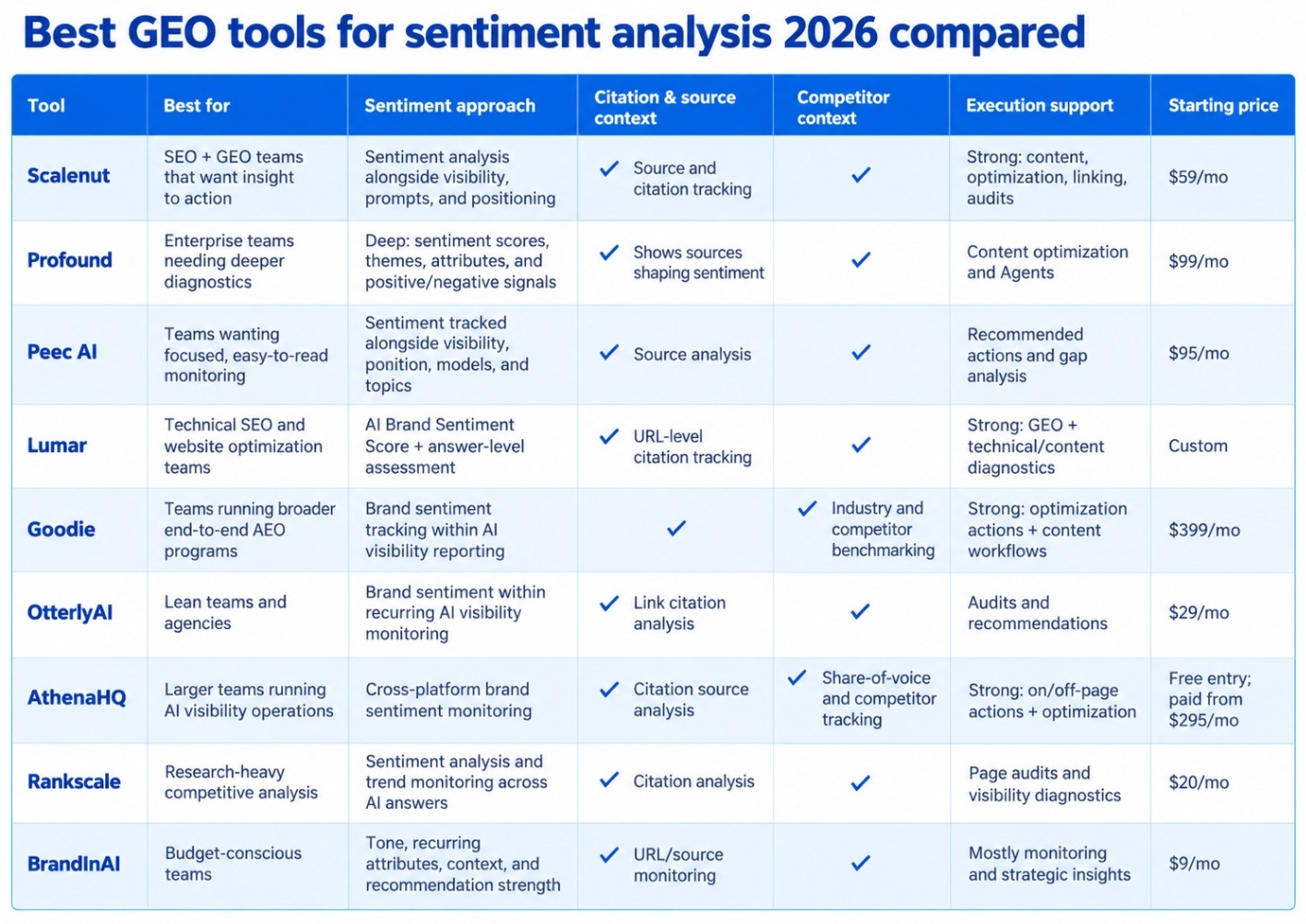
If you are comparing GEO tools, the real question is not just who tracks mentions. It is which platforms can actually help you understand how AI systems describe your brand, what is shaping that perception, and what you should do next.
Below, we break down the top GEO tools for sentiment analysis in 2026, including what each tool does best, who it is best for, where it stands out, and where it may fall short.
1. Scalenut
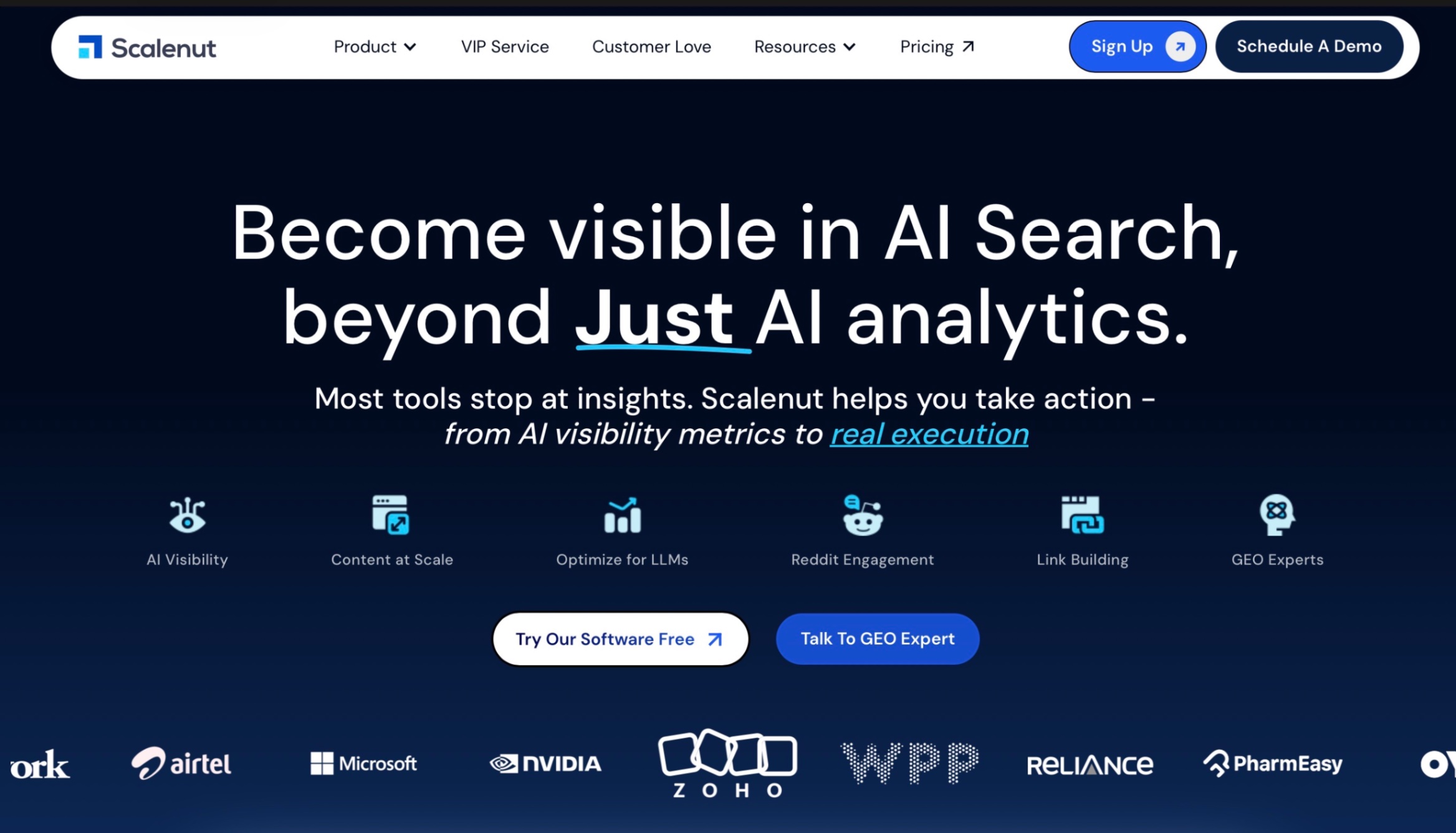
Scalenut is one of the few platforms in this category that combines AI visibility tracking with hands-on SEO execution. Instead of stopping at monitoring, it gives teams a way to turn AI visibility signals into content, optimization, linking, and authority-building actions inside the same platform.
Best For: SEO and content teams that want to track how their brand appears in AI answers, benchmark that visibility against competitors, and then act on those insights through content creation, optimization, internal linking, audits, and off-page workflows without switching tools.
What Does Scalenut Do Best?
- Combines AI visibility tracking with a broader SEO and content execution stack, which makes it more action-oriented than monitoring-only tools
- Tracks core AI visibility signals such as brand mentions, prompt coverage, visibility trends, competitor mentions, and relative positioning
- Gives teams a structured view of AI performance through metrics such as Visibility Score, Average Position, Share Of Voice, Visibility Heatmap, and Brand Visibility Rank
- Surfaces prompt-level intelligence through prompt tracking, citation tracking, competitor visibility insights, and query fanouts so teams can see where visibility is actually won or lost
- Connects AI visibility gaps to recommended next steps such as AI-led content ideas, backlink and authority suggestions, community engagement opportunities, and action paths
- Extends beyond GEO into content and SEO execution with tools such as Cruise Mode, Content Optimizer, AI Humanizer, Keyword Planner, Competitor Coverage Analysis, Traffic Analyzer, Content Audit, Link Manager, On-Page Pro, and Backlinks Marketplace
- Adds AI traffic visibility through AI bot tracking, top AI sources, most referenced pages, AI traffic trends, and Cloudflare integration for deeper monitoring
What Standout Sentiment Features Do You Get With Scalenut?
- Sentiment Analysis helps classify mentions by tone so teams can separate positive brand exposure from neutral or negative visibility
- Sentiment sits alongside prompt tracking, citations, and competitor visibility instead of being treated as a standalone score, which makes it easier to understand why perception is changing
- Brand-level metrics such as Visibility Score, Share Of Voice, and Average Position give sentiment more context by showing how often and how prominently the brand appears versus competitors
- Citation tracking adds another layer of diagnostic value because teams can connect shifts in tone to the sources AI systems are relying on
- Competitor visibility insights help teams understand which brands are being surfaced alongside theirs and where relative perception may be shifting
Why Consider Scalenut?
- Scalenut stands out because it gives teams a path from visibility insight to execution in one platform, which is still uncommon in this category
- It is a strong fit for teams that do not want to split GEO tracking, traditional SEO planning, content production, optimization, and authority work across multiple tools
- The platform is especially useful for content-led teams because it can translate AI visibility gaps into specific publishing, refresh, optimization, and linking actions
- Its AI traffic and bot-monitoring layer adds practical value by helping connect AI visibility to real site activity and page-level interaction patterns
- Scalenut has a broader ceiling than lighter GEO tools because it combines AI visibility, content creation, research, optimization, traffic analysis, technical support, and off-page workflows in one system
Where Does Scalenut Fall Short?
- Teams that only want a narrow sentiment dashboard may find Scalenut broader than necessary, because it is built as a larger GEO and SEO operating system rather than a lightweight monitoring tool
- Some of its strongest value comes from using multiple modules together, so the platform may take more ramp-up than simpler visibility-first tools
- AI visibility coverage scales by plan, so teams that need broader tracking depth may need a higher tier
What Pricing Does Scalenut Offer?
- Starter starts at $59/month
- Plus starts at $89/month
- Professional starts at $199/month
- VIP Service pricing is custom
How Do Users Rate Scalenut?
G2 Rating: 4.7/5
“I like that Scalenut is extremely user-friendly and affordable. It's a scalable way of generating customized content that's searchable and discoverable by Google and AI engines. I appreciate that it actually works, giving me the ability to drive organic traffic to my website without solely relying on a website team. The initial setup was very easy, and I rate it a 10 because I talk about it all the time.”, says Clayton S on G2.
Want to see Scalenut in action? Schedule a demo today!
2. Profound
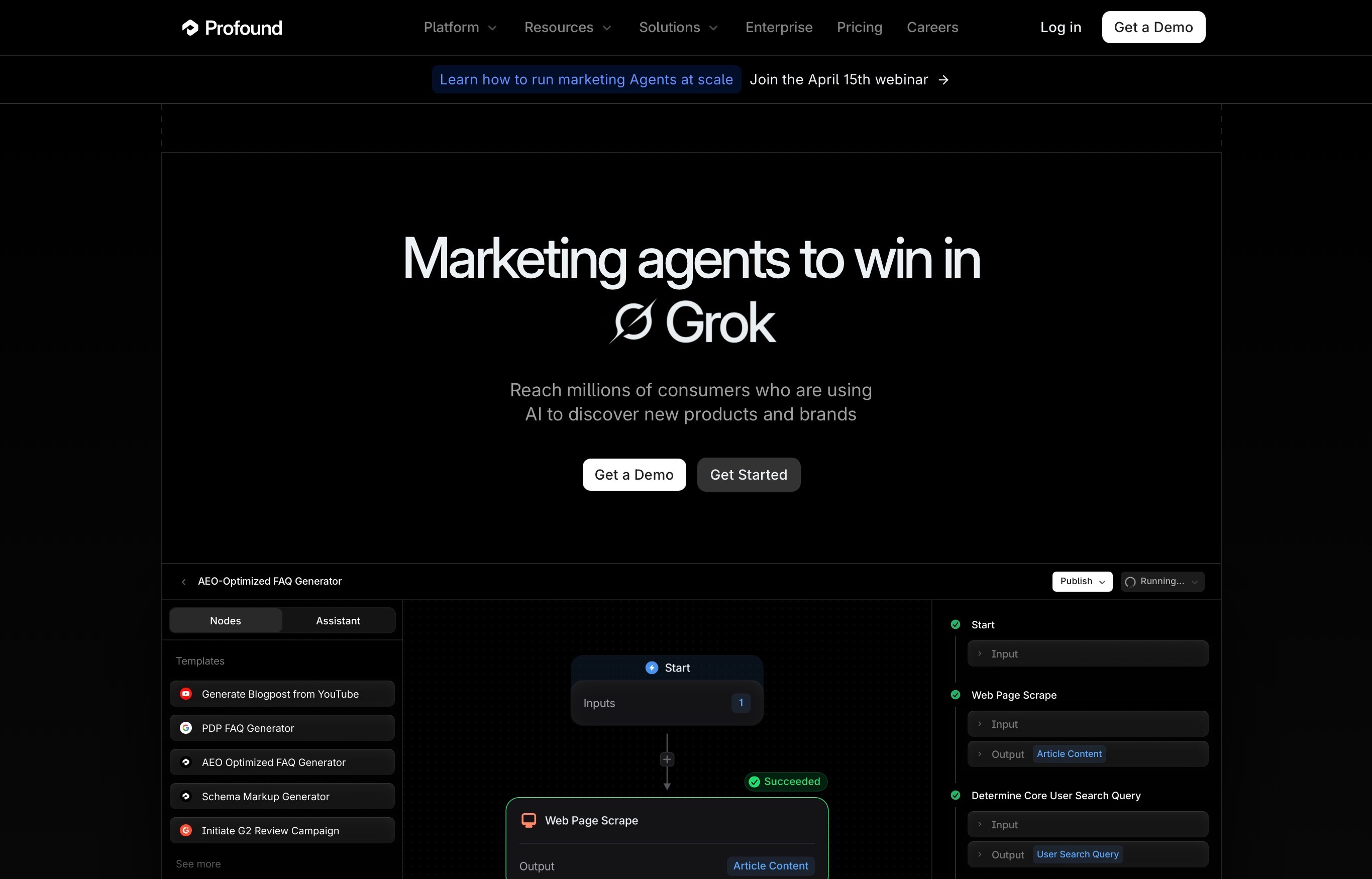
Profound is built for brands that need more than mention tracking. It is designed for teams that want deeper diagnostics across sentiment, themes, citations, competitors, and reporting.
Best For: Enterprise and advanced marketing teams that want deep AI search diagnostics, sentiment benchmarking, citation visibility, and more robust reporting across brands, competitors, topics, and markets.
What Does Profound Do Best?
- Tracks brand sentiment, citation sources, citation authority, and competitor rankings in one workflow
- Supports analysis across regions, topics, models, and audience segments
- Surfaces full AI responses so teams can review how brands are actually being described
- Combines sentiment and citation data with broader answer engine reporting
What Standout Sentiment Features Do You Get With Profound?
- A dedicated sentiment view that classifies AI responses as positive, negative, or neutral
- Auto-generated sentiment prompts based on tracked topics for both your brand and competitors
- Theme-level analysis that surfaces recurring positive and negative patterns in AI responses
- Citation visibility that helps connect sentiment patterns to the sources influencing those answers
- Filtering by time, region, topic, and audience persona for more specific analysis
Why Consider Profound?
- It is a strong fit for teams that need deeper diagnosis, not just surface-level monitoring
- It gives buyers more context by combining sentiment, themes, full responses, and citations
- It is better suited to organizations that need more flexible reporting across markets and competitors
- It stands out for teams that want to understand why AI perception is shifting, not just whether it is shifting
Where Does Profound Fall Short?
- Sentiment data relies on separate sentiment prompts, and those prompts count toward the account’s total prompt limit
- Its depth may be more than smaller teams need if they only want lightweight monitoring
- The platform’s public positioning leans more enterprise and demo-led than simple self-serve setup
What Pricing Does Profound Offer?
- Starter starts at $99/month, billed yearly
- Growth starts at $399/month, billed yearly
- Enterprise pricing is custom
How Do Users Rate Profound?
G2 Rating: 4.6/5
Still considering Profound? See how Scalenut vs Profound AI compare on AI visibility, execution, pricing, and overall fit.
3. Peec AI
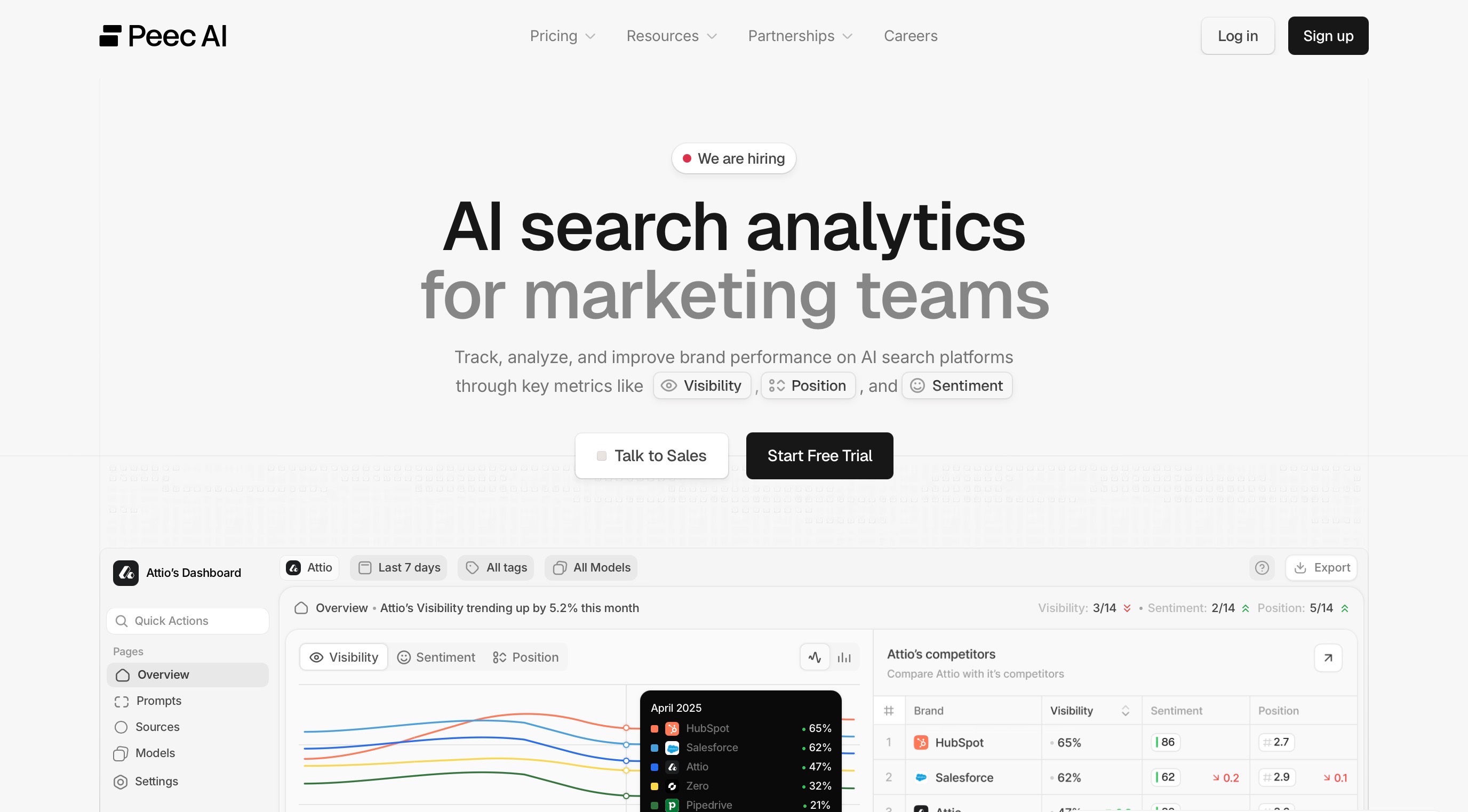
Peec AI is a more focused AI search analytics platform built around a smaller set of core metrics. Its workflow is relatively easy to follow across sentiment, visibility, prompts, sources, and recent AI chats.
Best For: Teams that want a cleaner, narrower monitoring experience with clear sentiment scoring, competitor tracking, prompt-level visibility, and source analysis without the heavier feel of a large enterprise platform. This fit is an editorial assessment based on Peec AI’s documented workflow and product structure.
What Does Peec AI Do Best?
- Tracks core brand metrics like visibility, sentiment, and position in a simple dashboard
- Shows performance across prompts and competitors from one overview
- Connects metrics to top sources and recent AI chats for added context
- Supports reporting through exports, Data Studio, and API access
What Standout Sentiment Features Do You Get With Peec AI?
- A sentiment score on a 0 to 100 scale that measures the overall tone of AI responses when your brand is mentioned
- Sentiment analysis based on the language and context used around your brand
- Brand-level sentiment tracking alongside visibility and position, which makes the metric easier to interpret
- Chat-level views that show prompts, models, mentioned brands, and sentiment scores
- Source analysis that helps users see which websites AI platforms reference across tracked prompts
Why Consider Peec AI?
- It is easier to understand than more layered enterprise platforms
- It gives teams a focused way to monitor AI search without unnecessary complexity
- It works well for buyers who want clear sentiment scoring rather than a heavily diagnostic workflow
- It adds practical value with features like Actions that help translate monitoring into next steps
Where Does Peec AI Fall Short?
- Its sentiment model appears simpler than the more theme-heavy diagnostic workflows some enterprise platforms emphasize
- Its public materials do not currently present theme-level sentiment analysis as a major differentiator
- Its API is still in beta, which may matter for teams that want a more mature developer environment
What Pricing Does Peec AI Offer?
- Starter starts at $95/month
- Pro starts at $245/month
- Advanced starts at $495/month
- Enterprise pricing is custom
How Do Users Rate Peec AI?
G2 Rating: 5/5
Like Peec AI’s focused monitoring approach? See how Scalenut vs Peec AI compare on visibility tracking, citations, execution, pricing, and value.
4. Lumar
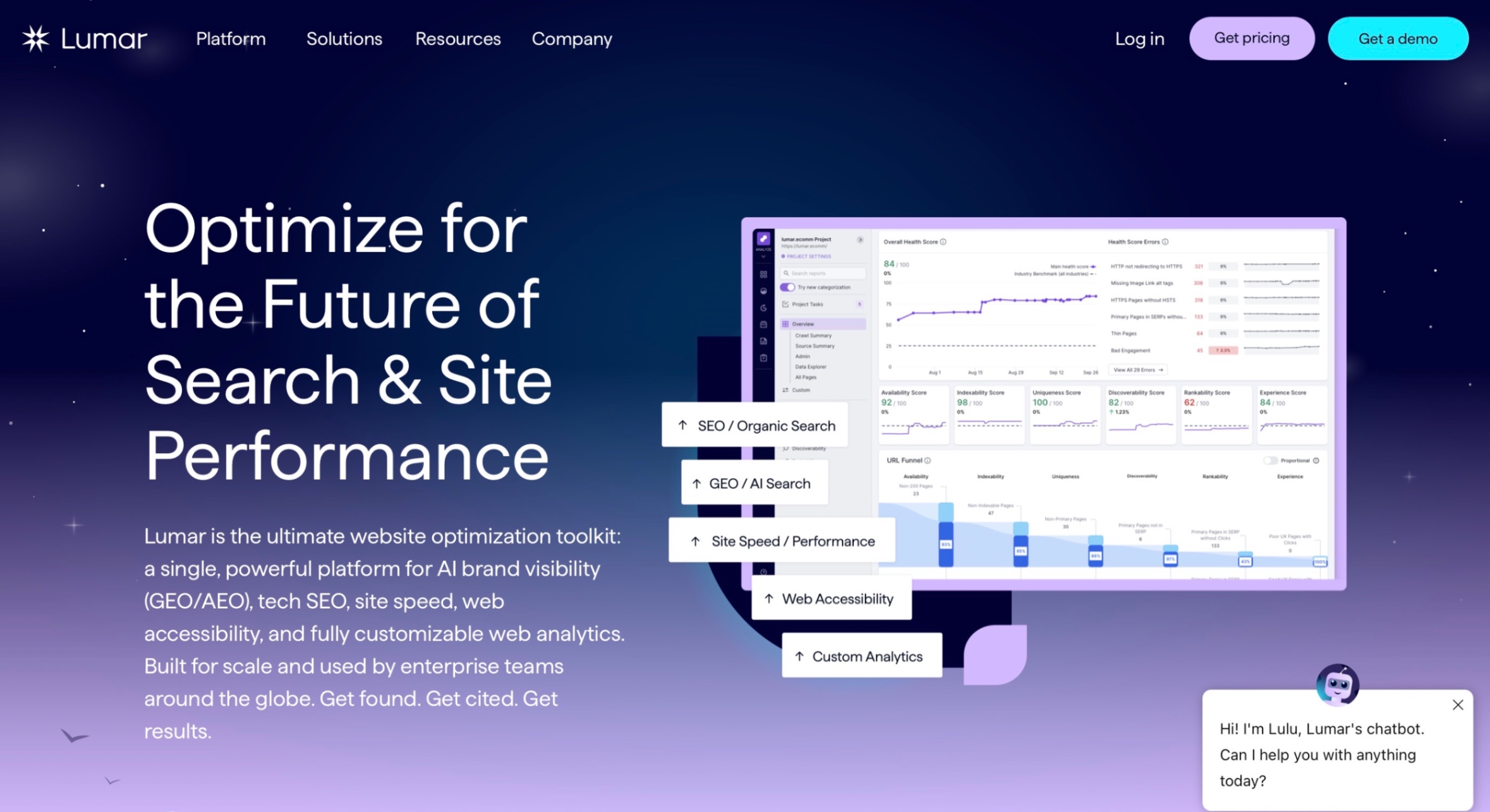
Lumar approaches AI visibility as part of a broader website intelligence and optimization workflow. It is built for teams that want sentiment, citations, competitor insights, and technical diagnostics connected in one platform.
Best For: Teams that want AI visibility and sentiment tracking tied directly to a broader GEO, SEO, and technical website optimization workflow, especially when they need more than a standalone monitoring dashboard.
What Does Lumar Do Best?
- Tracks brand visibility across major AI platforms including ChatGPT, Google AI Overviews, Gemini, Perplexity, and Claude
- Measures brand mentions, citation positions, sentiment, position, and related visibility metrics in the same workflow
- Connects AI visibility data to broader website crawl analysis and GEO or SEO diagnostics
- Surfaces competitor benchmarking, share of voice trends, and topic-level views alongside prompt tracking
What Standout Sentiment Features Do You Get With Lumar?
- An AI Brand Sentiment Score that measures how your brand is being presented by AI systems, not just whether it is mentioned
- Qualitative sentiment assessments extracted from AI answers as part of its prompt tracking workflow
- Brand citation data that helps teams connect sentiment patterns to the pages and sources shaping AI answers
- Competitor comparisons that show which brands are being cited instead of you and where topic-level weaknesses exist
- Configurable tracking on a repeatable schedule for ongoing monitoring rather than one-off checks
Why Consider Lumar?
- It is a strong fit if you want sentiment tracking connected to a broader diagnosis and optimization workflow
- It gives technical SEO, content, and marketing teams a shared environment for AI visibility analysis
- It helps teams move from visibility gaps to technical or content investigation without switching tools
- It is especially useful for organizations that want repeatable reporting across prompts, topics, competitors, and major AI engines
Where Does Lumar Fall Short?
- Its broader platform scope may feel heavier than necessary for small teams that only want lightweight AI sentiment monitoring
- Its public materials emphasize integrated diagnostics and score-based reporting more than highly detailed public breakdowns of sentiment themes
- It appears more platform-oriented and demo-led than simple self-serve monitoring tools
What Pricing Does Lumar Offer?
- Lumar offers custom pricing
How Do Users Rate Lumar?
G2 Rating: 4.6/5
5. Goodie
Goodie presents itself as an end-to-end AEO platform that moves from prompt research to monitoring, optimization, and measurement. Its visibility layer combines mentions, citations, sentiment, and competitive positioning across major AI platforms.
Best For: Teams that want a broader AI visibility workflow that combines prompt research, monitoring, competitive sentiment analysis, optimization actions, and measurement in one platform.
What Does Goodie Do Best?
- Tracks brand mentions, sentiment, and competitive positioning across major AI models
- Combines prompt research with visibility monitoring so teams can align tracking with high-intent questions in their category
- Shows share of voice, relative mention frequency, sentiment comparison, and which prompts cite competitors but not you
- Extends beyond monitoring with optimization and measurement layers in its broader platform workflow
What Standout Sentiment Features Do You Get With Goodie?
- Visibility monitoring that includes sentiment alongside brand mentions, citations, and competitive positioning
- Sentiment comparison against both direct and indirect competitors
- Prompt-level context showing where your brand is mentioned and how it is being framed in tracked AI answers
- Daily measurement across leading AI platforms, with product pages that also highlight real-time monitoring for priority areas
- Citation tracking that helps connect sentiment and visibility patterns to the sources AI systems rely on
Why Consider Goodie?
- It is a strong fit if you want a more complete workflow that goes beyond monitoring into research, optimization, and performance tracking
- It gives teams a more operational setup by combining prompt discovery, visibility monitoring, and competitor analysis
- It is useful for brands that care about sentiment and visibility but also want to act on prompt gaps and optimization opportunities
- It can appeal to teams that want one platform for both monitoring and follow-through rather than a reporting-only tool
Where Does Goodie Fall Short?
- Its broader AEO platform scope may be more than some teams need if they only want a narrow sentiment dashboard
- Its public materials clearly highlight sentiment tracking, but they do not spell out a detailed public sentiment taxonomy the way some more diagnostic-heavy tools do
- Buyers may need a closer product review to judge how much of the broader workflow they will actually use
What Pricing Does Goodie Offer?
Goodie offers custom, demo-led pricing
How Do Users Rate Goodie?
No ratings available yet.
6. OtterlyAI
OtterlyAI is an AI search monitoring and optimization platform built around prompt tracking, visibility analysis, citation tracking, and recommendations. It is designed for teams that want a practical way to see how their brand appears across AI search results and what to improve next.
Best For: Lean to mid-sized marketing teams and agencies that want clear AI search monitoring, competitor benchmarking, citation tracking, and built-in brand sentiment without jumping into a heavier enterprise workflow.
What Does OtterlyAI Do Best?
- Tracks brand visibility across major AI search experiences, including ChatGPT, Google AI Overviews, Perplexity, Gemini, and Copilot
- Lets teams build and monitor prompt libraries based on real buyer questions
- Combines monitoring with content audits and optimization recommendations
- Supports recurring reporting through regular tracking and brand reporting workflows
What Standout Sentiment Features Do You Get With OtterlyAI?
- Brand Sentiment is available across OtterlyAI accounts
- It gives users a quantified view of how positively or negatively AI search engines describe their brand
- It benchmarks brand sentiment against tracked competitors
- It includes a Net Sentiment Score that ranges from -100 to +100
- Sentiment tracking is built around how AI engines describe your brand across platforms like ChatGPT, Perplexity, Gemini, and Google AI Overviews
Why Consider OtterlyAI?
- It is a strong fit for teams that want sentiment, citations, and competitor context in a more approachable package
- It creates a clearer bridge from monitoring to action through audits, recommendations, and prompt research
- Its plan structure makes it easier for smaller teams to start and scale over time
- It is a practical option for buyers who want focused AI visibility workflows without a broader enterprise setup
Where Does OtterlyAI Fall Short?
- Some engines are positioned as add-ons rather than default coverage across all standard plans
- Its public positioning emphasizes monitoring, audits, and recommendations more than deeply layered sentiment theme analysis
- Teams that need more advanced governance or custom multi-team workflows may still need the enterprise route
What Pricing Does OtterlyAI Offer?
- Lite starts at $29/month
- Standard starts at $189/month
- Premium starts at $489/month
- Enterprise pricing is custom
How Do Users Rate OtterlyAI?
G2 Rating: 4.8/5
Considering OtterlyAI for your GEO stack? Read our full Otterly AI review for a closer look at its features, pricing, strengths, and limitations.
7. AthenaHQ
AthenaHQ positions itself as an end-to-end AEO and GEO platform for AI search. It combines brand monitoring, citation intelligence, competitor analysis, and optimization workflows in a broader operating system rather than a narrow monitoring dashboard.
Best For: Commercial and enterprise teams that want sentiment and competitor monitoring tied to citation intelligence, content optimization, and broader multi-team AI visibility workflows.
What Does AthenaHQ Do Best?
- Tracks visibility across major AI platforms, including ChatGPT, Perplexity, Google AI Overviews, AI Mode, Gemini, Claude, Copilot, and additional models
- Combines on-page and off-page GEO analysis with competitor monitoring in one platform
- Adds citation intelligence and authority tracking alongside broader visibility monitoring
- Positions itself as both a monitoring and action platform with content optimization workflows built in
What Standout Sentiment Features Do You Get With AthenaHQ?
- The platform includes real-time brand sentiment intelligence
- Its brand visibility workflows pair sentiment monitoring with brand mention tracking and competitor share of voice
- It also highlights sentiment analysis within its PR and brand monitoring workflows
- Ask Athena is positioned as a way to query sentiment scores, citation tracking, and competitor benchmarks using plain-language prompts
- The sentiment layer is tied to broader AI visibility and citation analysis rather than being treated as a standalone metric
Why Consider AthenaHQ?
- It is a strong fit if you want sentiment monitoring closely tied to citation intelligence and optimization workflows
- It offers broad model coverage and competitor benchmarking for brands that need wider market visibility
- Its enterprise setup is built for larger teams that need more support, governance, and integration depth
- It also has a self-serve entry point, which makes it more accessible than enterprise-only platforms
Where Does AthenaHQ Fall Short?
- Its public materials spread core capabilities across multiple pages, so buyers may need a closer demo to understand the full workflow
- The platform may feel broader than necessary for teams that only want a narrow sentiment dashboard
- Its public messaging emphasizes platform breadth more than a highly detailed standalone methodology for sentiment scoring
What Pricing Does AthenaHQ Offer?
- Self-Serve is listed at $295/month
- They also offer a first-month promotional price of $95/month
- Enterprise pricing is custom
How Do Users Rate AthenaHQ?
G2 Rating: 4.9/5
Not sure whether AthenaHQ’s deeper visibility intelligence fits your workflow? Compare Scalenut vs AthenaHQ before choosing.
8. Rankscale
Rankscale is an AI visibility platform built around prompt tracking, citation analysis, sentiment monitoring, and competitor benchmarking. It is designed for teams that want more diagnostic depth than a simple mention-tracking dashboard.
Best For: Teams that want strong citation analysis, competitor benchmarking, prompt research, and brand sentiment tracking in one AI visibility workflow, especially if they need a more research-driven setup.
What Does Rankscale Do Best?
- Tracks brand visibility, mentions, citations, and sentiment across multiple AI engines
- Compares brand visibility and sentiment against competitors in the same workflow
- Analyzes citation share at the domain and URL level to show which sources AI systems favor
- Includes prompt research features to help teams understand question patterns and search intent in AI search
What Standout Sentiment Features Do You Get With Rankscale?
- Tracks how AI systems describe your brand across multiple engines
- Classifies tracked responses by sentiment, including positive, neutral, and negative context
- Surfaces the keywords and descriptors shaping brand perception
- Connects sentiment analysis to citation data for added context
- Helps compare perception trends across competitors, not just your own brand
Why Consider Rankscale?
- It is a strong fit if you want sentiment, citations, and competitor analysis working together in one platform
- It offers a more research-oriented workflow than simpler visibility tools
- Its pricing is accessible enough for smaller teams but still gives room to scale
- It is especially useful for teams that care about source attribution and competitor gaps, not just raw visibility scores
Where Does Rankscale Fall Short?
- Its broader analytics workflow may feel heavier than necessary for teams that only want simple sentiment monitoring
- The platform’s feature depth may require more onboarding than a lighter dashboard-first tool
- Its credit-based structure may take more effort to manage than flatter plan models
What Pricing Does Rankscale Offer?
- Essentials starts at $20/month
- Pro starts at $99/month
- Enterprise starts at $780/month
How Do Users Rate Rankscale?
G2 Rating: 5/5
Want to go beyond SEO and start ranking in AI Overviews? Check out our list of the 8 best AI SEO agencies for AI Overview rankings.
9. BrandInAI
BrandInAI is a lighter AI brand visibility platform focused on how AI systems mention, describe, and compare your brand. It is built for teams that want a simpler way to monitor AI visibility, sentiment, and competitor positioning without adopting a broader enterprise platform.
Best For: Smaller teams, founders, and budget-conscious brands that want a simpler way to track AI brand mentions, sentiment, competitor visibility, and query-level monitoring.
What Does BrandInAI Do Best?
- Tracks brand mentions across leading LLMs and AI search environments
- Monitors how brands appear in AI-generated responses
- Lets users track specific queries tied to their brand or category
- Compares brand visibility against competitors in a more focused workflow
- Adds URL and source-level context to AI response monitoring
What Standout Sentiment Features Do You Get With BrandInAI?
- Includes AI-powered sentiment analysis for each tracked mention
- Helps brands understand how AI systems describe and frame them
- Connects sentiment insights to competitor benchmarking
- Turns AI response patterns into more comparable brand visibility signals
- Adds source and URL monitoring for added context around perception
Why Consider BrandInAI?
- It is a practical option for teams that want AI visibility and sentiment tracking without enterprise-level pricing
- It is easier to try because it includes a free tier and a low-cost paid plan
- It covers the core needs many smaller buyers care about most, including mentions, sentiment, competitor tracking, and query monitoring
- It works well for brands that want a focused AI brand monitoring layer rather than a broader optimization platform
Where Does BrandInAI Fall Short?
- Its public positioning emphasizes core monitoring and benchmarking more than deeper sentiment-theme analysis
- The platform appears narrower in scope than broader AEO or GEO suites
- Teams managing larger or more complex programs may outgrow its lighter query and credit structure more quickly
What Pricing Does BrandInAI Offer?
- Starter is free
- Premium starts at $19/month
- Professional starts at $99/month
How Do Users Rate BrandInAI?
No ratings available yet.
Which GEO Tool Is Best For Sentiment Analysis For Your Team?
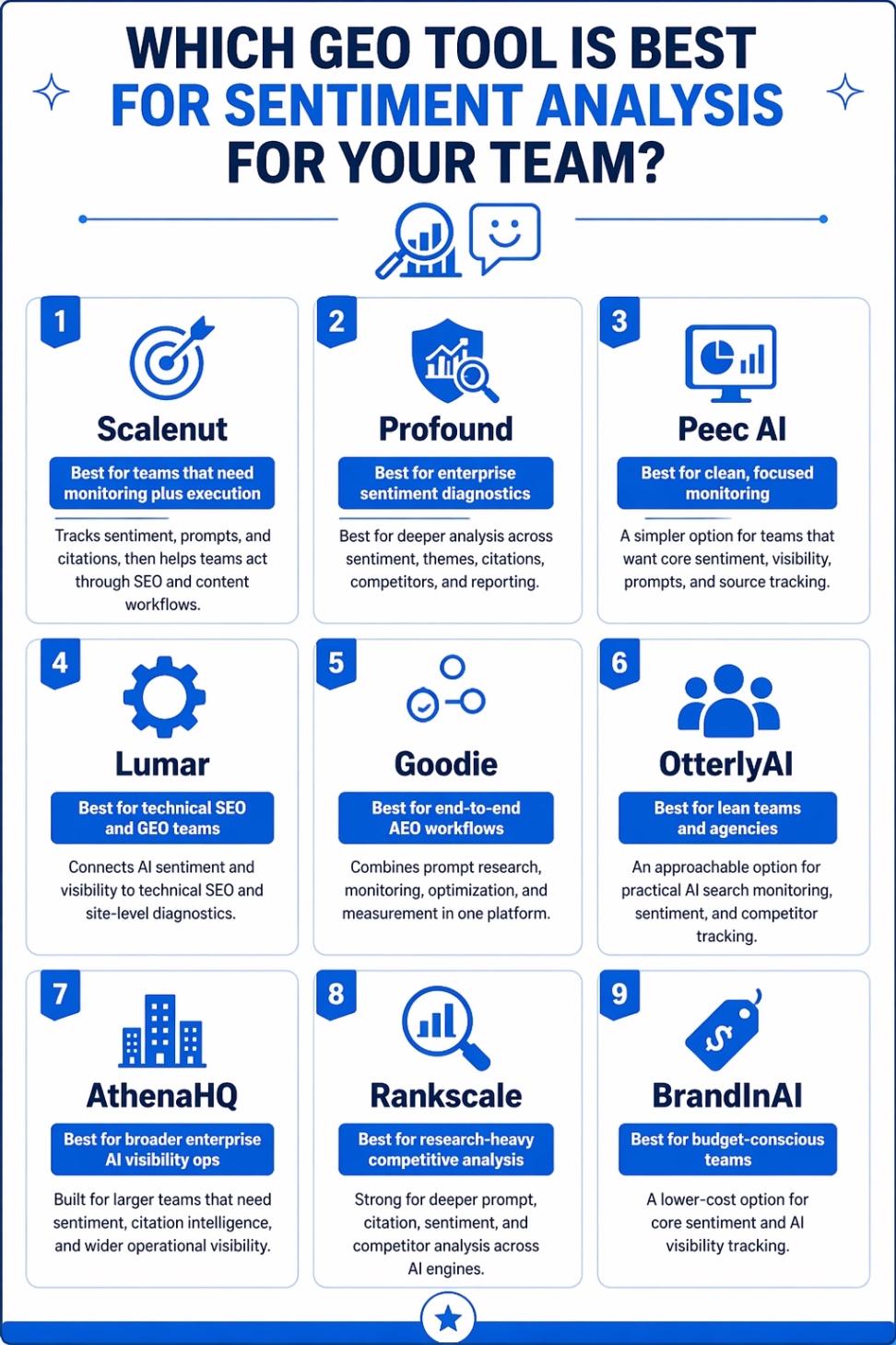
The right GEO tool depends less on who has the most features and more on what your team actually needs to do with sentiment data once you have it. Some teams need execution, some need deeper diagnostics, and some just need a cleaner way to monitor AI brand perception without added complexity.
Here are the best GEO tools for sentiment analysis based on team fit.
1. Best For Teams That Need Monitoring Plus Execution: Scalenut
Scalenut is the strongest fit for teams that want to do more than track sentiment. It is built for brands that want to monitor how they appear in AI answers, understand the prompts and citations shaping that visibility, and then act on those insights through content creation, optimization, internal linking, audits, and authority-building workflows in the same platform.
This makes it especially useful for SEO and content teams that do not want GEO reporting in one tool and execution in another.
2. Best For Enterprise Sentiment Diagnostics: Profound
Profound is the better fit for teams that want deeper analysis into why AI systems are describing their brand a certain way. It is stronger for enterprise use cases that need sentiment benchmarking, theme-level insights, citation visibility, and more advanced reporting across competitors, markets, and topics.
If your team values diagnosis over simplicity, Profound is one of the strongest options in the category.
3. Best For Clean, Focused Monitoring: Peec AI
Peec AI is a good fit for teams that want a narrower, easier-to-follow monitoring experience. Its workflow is more focused on core metrics like visibility, position, prompts, sources, and sentiment, which makes it easier to understand than broader platforms with heavier operational layers.
It is a strong choice for teams that want clarity and usability without losing the essentials.
4. Best For Technical SEO And GEO Teams: Lumar
Lumar makes the most sense for teams that want AI visibility and sentiment tracking tied closely to technical SEO and site-level diagnostics. It is better suited to organizations that want to connect AI mentions, citations, and sentiment shifts to broader website intelligence and optimization work.
For technical teams already working inside SEO and site health workflows, Lumar is a more natural fit than a lighter monitoring-only tool.
5. Best For End-To-End AEO Workflows: Goodie
Goodie is best for teams that want sentiment analysis as part of a broader AEO workflow. It combines prompt research, monitoring, competitive positioning, optimization support, and measurement, which makes it a better fit for teams that want a wider operational system rather than a narrow sentiment dashboard.
It is especially relevant for brands that want to move from prompt discovery to action in one environment.
6. Best For Lean Teams And Agencies: OtterlyAI
OtterlyAI is a strong option for leaner teams that want AI search monitoring, competitor benchmarking, citation tracking, and brand sentiment in a more approachable setup. It is easier to enter than many enterprise-focused tools and works well for agencies or smaller in-house teams that want practical reporting without too much platform heaviness.
If ease of adoption matters, OtterlyAI is one of the more accessible choices on this list.
7. Best For Broader Enterprise AI Visibility Ops: AthenaHQ
AthenaHQ is a better fit for larger teams that want sentiment monitoring tied to broader AI visibility operations. It combines brand sentiment, citation intelligence, competitor analysis, and optimization workflows in a more expansive platform, which makes it useful for teams that need wider governance and cross-functional visibility.
It is a stronger match for brands treating AI visibility as an operational priority, not just a reporting layer.
8. Best For Research-Heavy Competitive Analysis: Rankscale
Rankscale stands out for teams that want a more research-oriented workflow around prompts, citations, brand perception, and competitor tracking. It is a better fit for buyers who care deeply about source attribution, perception signals, and competitive visibility patterns across multiple AI engines.
If your team wants more analysis depth and less simplified reporting, Rankscale is worth a closer look.
9. Best For Budget-Conscious Teams: BrandInAI
BrandInAI is the easiest fit for smaller brands and budget-conscious teams that still want core sentiment tracking, competitor monitoring, and AI visibility analysis. Its simpler positioning and lower entry cost make it more approachable for teams that do not need a broader GEO or AEO operating system.
It is a practical starting point if affordability matters more than workflow depth.
The best choice comes down to team shape and workflow needs.
Also read our list of 10 best AI tools for generative engine optimization in 2026.
How To Choose The Right GEO Tool For Sentiment Analysis?
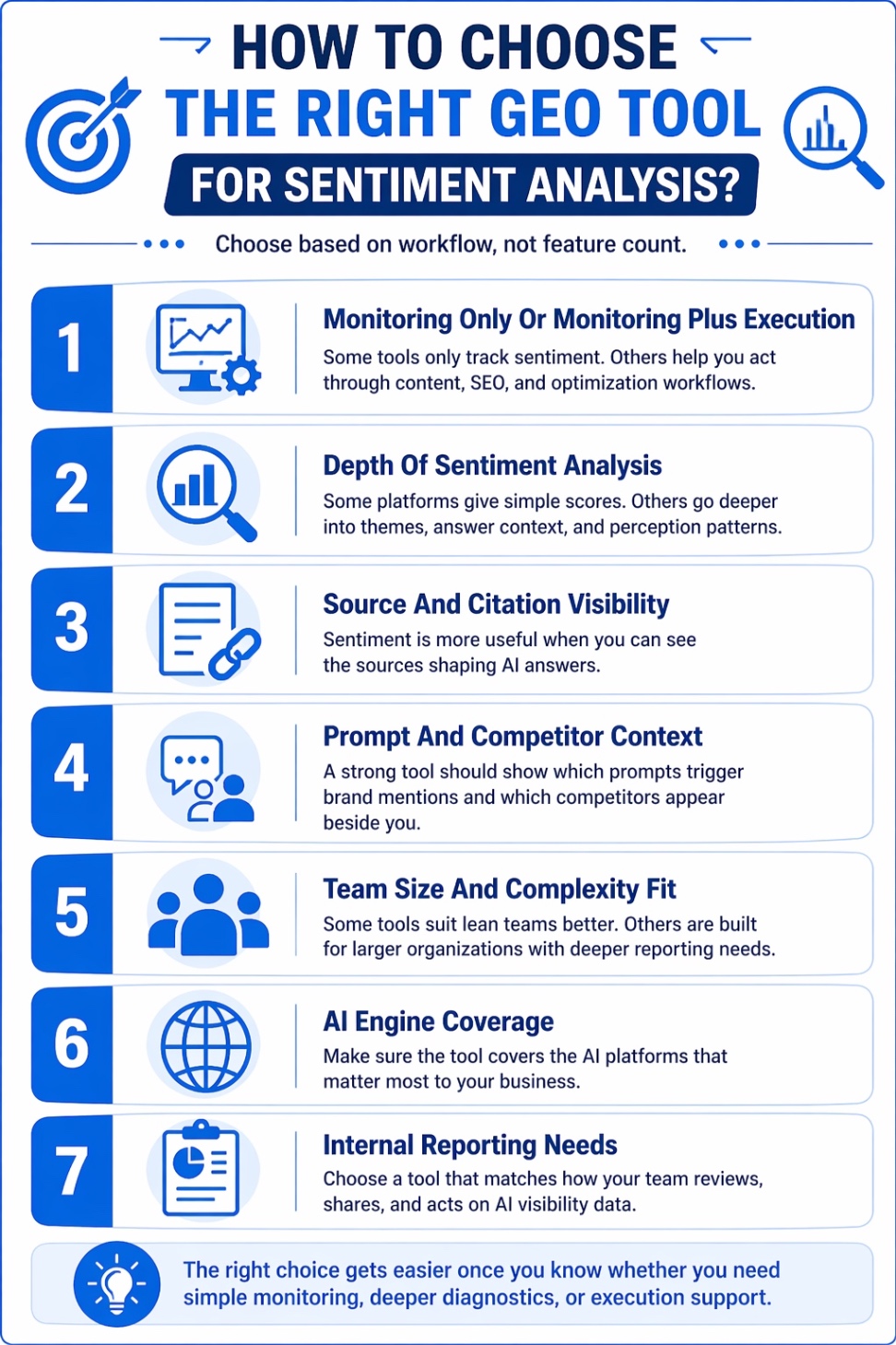
Choosing the right GEO tool is really about choosing the right workflow. The best platform is not the one with the longest feature list. It is the one that helps your team understand AI brand perception clearly and then do something useful with that insight.
Here are the key things to look at before you decide.
1. Decide Whether You Need Monitoring Only Or Monitoring Plus Execution
This is the first split that matters. Some tools are mainly built to help you monitor visibility, sentiment, citations, and competitors. Others go further and help you act on those findings through content updates, optimization, prompt research, and broader SEO workflows. If your team wants one system that connects sentiment insights to actual execution, Scalenut is a stronger fit than tools that focus mostly on monitoring and analysis.
2. Check How Deep The Sentiment Analysis Really Goes
Not every platform handles sentiment the same way. Some tools give you a clear top-level score, which is useful if you want fast reporting and easy interpretation. Others go deeper into themes, answer context, and multi-view analysis. Peec AI is more straightforward with its sentiment scoring, while Profound is better suited to teams that want sentiment alongside deeper answer engine analysis.
3. Make Sure The Tool Shows You The Sources Behind The Sentiment
Sentiment data is much more useful when you can see the citations and sources influencing AI answers. Without that, you may know your brand perception is weak but not know what is shaping it. Tools that tie brand analysis to citations or source visibility make diagnosis much more practical.
4. Look For Prompt-Level And Competitor-Level Context
A good sentiment tool should not only tell you how AI describes your brand. It should also show which prompts trigger those descriptions and which competitors are appearing beside you. That is what turns sentiment into a decision-making signal. Prompt coverage and competitor context matter because they help teams see where brand perception is being won, lost, or challenged.
5. Check Whether The Platform Matches Your Team Size And Complexity
Some tools are easier to adopt for lean teams, while others are clearly built for larger organizations with more reporting needs. OtterlyAI and Peec AI are easier entry points for smaller teams that want focused monitoring. Profound is a better fit when your team needs more layered diagnostics and enterprise-style analysis. Lumar also makes more sense when AI visibility needs to connect with a broader technical SEO and website intelligence workflow.
6. Compare AI Engine Coverage Before You Commit
Engine coverage matters because AI perception is not shaped in one place. Your brand may look different in ChatGPT, Google AI Overviews, Perplexity, Gemini, or Copilot. If your team cares about a specific mix of AI engines, check that early before choosing a platform. A tool may look strong on paper but still be the wrong fit if it does not cover the engines that matter most to your business.
7. Choose Based On What You Need To Report Internally
Some buyers need an executive-friendly scorecard. Others need deeper analysis for SEO, content, PR, or brand teams. Peec AI is easier to read quickly because its dashboard centers on a few core metrics. Profound is better when you need more analytical depth. Scalenut is stronger when the reporting needs to feed directly into execution priorities. Your internal reporting style should influence the tool you choose more than feature count alone.
The right choice usually becomes much clearer once you know whether your team needs simple monitoring, deeper diagnostics, or a platform that can turn sentiment insights into real execution.
Looking for GEO tools built specifically for ecommerce brands? Read our guide to the best GEO tools for ecommerce that can actually drive results in 2026.
Conclusion
The right GEO platform should do more than show whether your brand appears in AI answers. It should help your team understand how artificial intelligence is framing your brand, where that perception is coming from, and what to do next. That is the real difference between basic sentiment analysis tools and platforms that deliver actionable insights your team can actually use.
As you compare the best sentiment analysis tools, focus on engine coverage, prompt and competitor context, citation visibility, and each platform’s sentiment analysis capabilities. Then shortlist two or three options that match your reporting needs and workflow, book demos, and test which one gives your team the clearest path from generative engine optimization data to real action.
Frequently Asked Questions
What is brand sentiment analysis?
Brand sentiment analysis identifies whether people or AI systems describe a brand positively, negatively, or neutrally. It helps teams spot perception patterns across reviews, comments, mentions, and AI-generated answers, then track how those patterns change over time.
What should you look for in a GEO sentiment analysis tool?
Look for multi-platform AI coverage, prompt tracking, citation and source visibility, competitor benchmarking, sentiment trends, and clear reporting. The best GEO sentiment tools also help explain why perception changes and give teams practical ways to respond.
Which GEO tool combines sentiment analysis with generative engine optimization best in 2026?
Scalenut is a strong fit for teams that want sentiment analysis tied to broader GEO execution. It combines sentiment monitoring with prompt tracking, citation visibility, competitor analysis, content optimization, and SEO workflows, helping teams move from insight to action.
Are there any GEO platforms in 2026 that offer built-in sentiment analysis?
Yes. Several GEO platforms now include built-in sentiment analysis alongside AI visibility tracking. Depending on the tool, this can include positive, neutral, and negative classification, competitor comparisons, prompt-level context, citation tracking, and sentiment trends across AI engines.
What is the difference between GEO tools and traditional sentiment analysis tools?
Traditional sentiment tools usually analyze reviews, social posts, surveys, and customer feedback. GEO tools focus on how AI systems describe brands across prompts and answers, while also connecting sentiment to citations, competitors, visibility, and the sources shaping those responses.
Can brand sentiment differ across ChatGPT, Gemini, and Perplexity?
Yes. ChatGPT, Gemini, Perplexity, Claude, and other AI platforms can describe the same brand differently because their models, retrieval systems, source selection, and citation behavior differ. Multi-platform tracking helps reveal where brand perception is consistent and where it changes.
Can ChatGPT do sentiment analysis?
Yes. ChatGPT can analyze a supplied set of text and classify its tone as positive, negative, or neutral. It is useful for quick reviews and pattern detection, but ongoing brand monitoring requires consistent prompts, repeated measurements, and source context.
How accurate is AI sentiment analysis?
AI sentiment analysis can be useful at scale, but accuracy varies with the model, context, and language being analyzed. Sarcasm, ambiguity, slang, mixed sentiment, and industry-specific wording can create errors, so important findings should still be reviewed in context.
How do GEO platforms use sentiment analysis for AI conversations?
GEO platforms analyze AI-generated answers to identify how a brand is being framed across prompts and models. They may combine sentiment with mentions, citations, sources, competitor comparisons, and trend data so teams can understand both perception and its likely drivers.
What should you do if AI sentiment about your brand turns negative?
Start by reviewing the prompts, AI responses, recurring negative themes, and cited sources behind the change. Then determine whether the issue comes from outdated information, weak content, third-party coverage, or a real product problem before choosing the right response.
Which AI platforms should a GEO sentiment analysis tool monitor?
Prioritize the AI platforms your audience is most likely to use, such as ChatGPT, Gemini, Google AI Overviews, Perplexity, Claude, or Copilot. Broader coverage helps uncover cases where your brand is framed differently across engines and buyer journeys.


.svg)


.webp)