
Scalenut vs Peec AI: Which Tool Should GEO Teams Choose?

Scalenut vs Peec AI: At A Glance
- Best For AI Visibility Tracking: Scalenut for deeper visibility context, Peec AI for cleaner focused monitoring.
- Best For Competitor Benchmarking: Peec AI. It feels more direct when you want to compare brand visibility, sentiment, prompts, and average position against competitors.
- Best For Citation And Source Insights: Peec AI. It gives a clearer view of which domains, URLs, and source types AI engines rely on.
- Best For Fixing AI Visibility Gaps: Scalenut. This is where it feels stronger because you can move from insights into content creation, optimization, audits, internal linking, and SEO/GEO execution.
- Best For AI Traffic Insights: Scalenut by a small margin. Peec AI has useful crawl insights, but Scalenut feels more connected to the broader visibility and performance workflow.
- Best For Content Teams: Scalenut, especially if the goal is to create, refresh, and optimize content based on AI visibility gaps.
- Best For Tracking-Only Teams: Peec AI, especially if you already have SEO, content, and optimization workflows handled elsewhere.
- Best Overall Value: Scalenut, because it combines AI visibility tracking, AI traffic monitoring, content creation, optimization, audits, internal linking, and execution in one platform.
Peec AI has become a popular name in the AI visibility space, and honestly, I get why. For teams trying to understand how their brand appears across AI answers, prompts, competitors, sentiment, and sources, it gives a much clearer view than traditional SEO tools.
But after testing both Peec AI and Scalenut, I also noticed where the question starts to shift. At first, you want to know, “Are we showing up in AI search?” But once the gaps become clear, the bigger question is, “What do we actually do with this data, and is this tool worth the price in 2026?”
That is what this comparison is meant to answer. I’ll walk through my observations from both tools, where Peec AI genuinely feels stronger, where Scalenut has the clearer advantage, and which platform makes more sense for your team depending on whether you need focused AI visibility tracking or a fuller SEO and GEO workflow.
Scalenut vs Peec AI: Which Is the Best GEO tool in 2026? (Quick Verdict)
If I only needed a clean AI visibility tracker, Peec AI would make sense. It is focused, easy to read, and strong for monitoring prompts, competitors, sentiment, and sources. But if I had to choose one platform for overall value, I would pick Scalenut because it combines AI visibility tracking with AI traffic insights, content creation, optimization, audits, internal linking, and SEO/GEO execution.
So my take is simple: Peec AI is better for focused monitoring, while Scalenut is better if you want to track visibility and actually improve it from the same workflow.
What Is Scalenut?

Scalenut is an AI SEO and GEO platform built for teams that want to plan, create, optimize, and monitor content for both traditional search and AI search. It brings content writing, optimization, audits, internal linking, AI visibility tracking, and AI traffic insights into one workflow, which makes it useful for SEO and content teams that want to improve visibility, not just measure it.
What Is Peec AI?
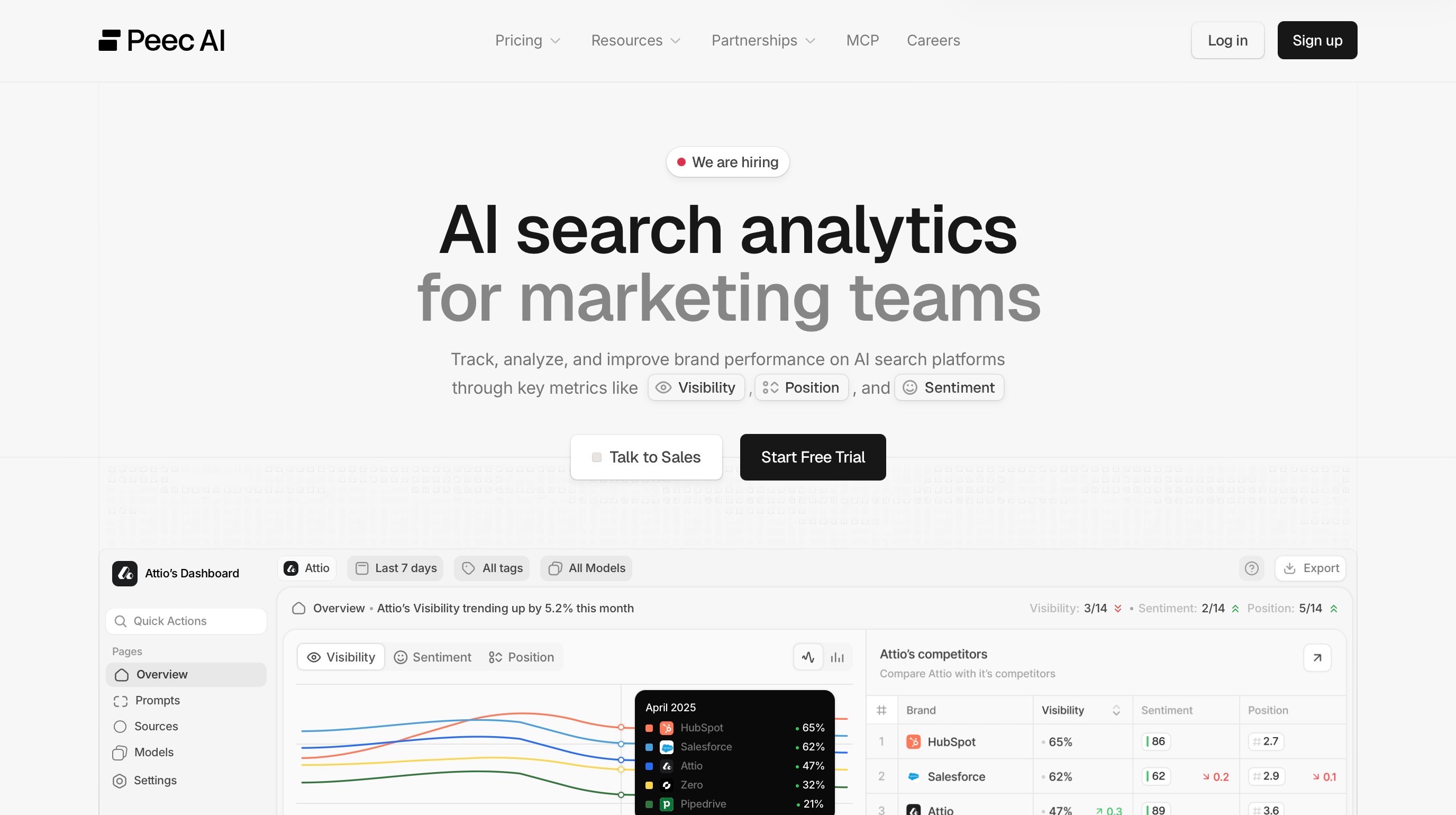
Peec AI is an AI visibility analytics platform that helps brands track how they appear across AI-generated answers. It focuses on brand mentions, prompt tracking, sentiment, competitor visibility, sources, citations, and AI response monitoring, making it useful for teams that want a clear view of their presence across AI search platforms.
Want a broader view of the market? Explore the best LLM optimization tools for improving AI visibility across search and answer engines.
Scalenut vs Peec AI: Which Platform Offers Better AI Visibility Tracking?
Before you fix AI visibility, you need to know where your brand shows up, how often it appears, which prompts trigger mentions, and whether visibility is improving or dropping.
Both Scalenut and Peec AI do this well. Peec AI feels cleaner for focused monitoring, while Scalenut gives you a more layered view of the visibility data.
Scalenut
What Stood Out:
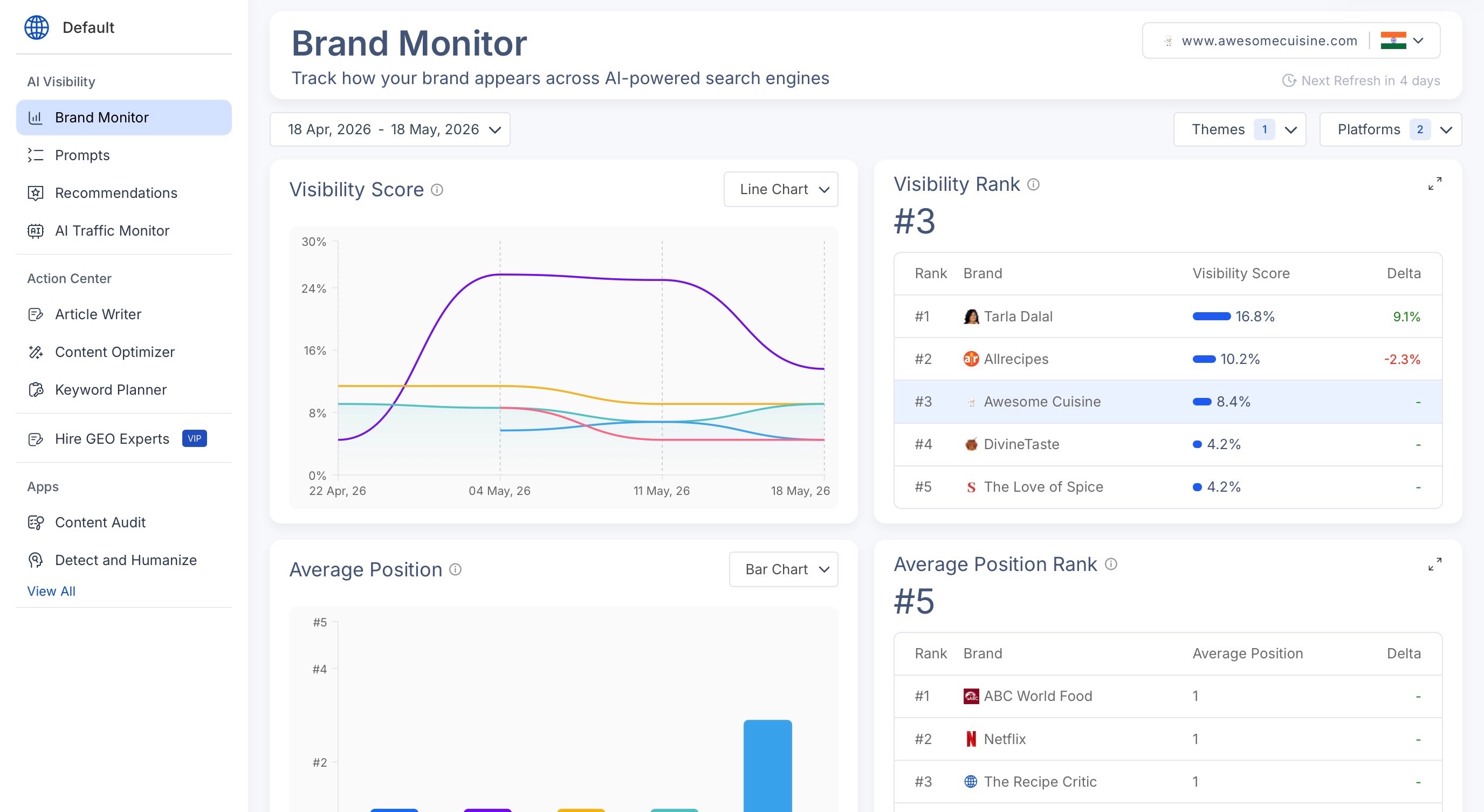
- Broader Visibility Metrics: Scalenut tracks Visibility Score, Share of Voice, Average Position, prompt-level performance, sentiment, citations, query fanouts, and visibility across AI engines.
- Better Prompt Context: What I liked is that Scalenut does not stop at one visibility score. You can see which prompts are driving mentions, where your brand appears, and how visibility changes across platforms.
- More Visibility Depth: Scalenut gives you more angles to interpret AI visibility instead of only showing whether your brand appeared or did not appear.
That makes Scalenut more useful if you want a detailed view of AI visibility across prompts, engines, and response patterns.
Where It Felt Limited:
- More To Process: The extra context is useful, but it can take a little longer to understand if you are new to AI visibility tracking.
- Not The Lightest Dashboard: If all you need is simple monitoring, Scalenut may feel like more than you need.
My Take
Scalenut feels stronger for depth. I would pick it if I wanted to understand not just whether my brand appears, but which prompts, engines, citations, and visibility patterns need attention.
Peec AI
Source: Peec AI Homepage
What Stood Out:
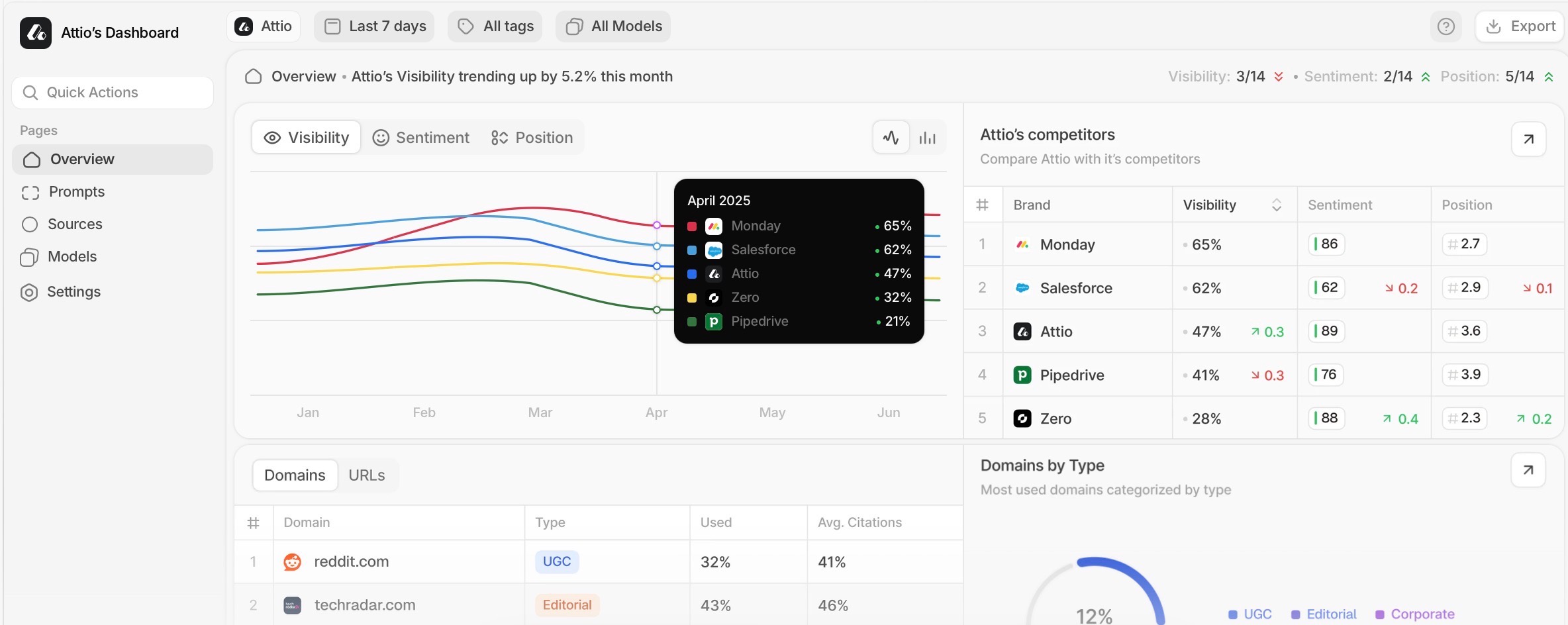
- Clean Visibility Dashboard: Peec AI gives you clear metrics like brand visibility, Share of Voice, sentiment, position, prompt performance, and recent AI responses.
- Easy Monitoring Experience: Peec AI feels simpler if your main goal is to check whether your brand is showing up in AI answers without digging through too much data.
- Useful Brand And Source Split: I like that Peec AI separates brand visibility from source visibility. Your brand can be mentioned without your website being cited, and your website can be cited without your brand being named.
That makes Peec AI helpful if your team mainly wants a clean, focused view of AI visibility.
Where It Felt Limited:
- Less Visibility Depth: Peec AI is strong for monitoring, but it does not feel as layered as Scalenut when you want to study prompt patterns, AI engine differences, and visibility movement.
- More Tracking-Led: If your question is, “Are we showing up in AI answers?” Peec AI answers that well. But if you want deeper visibility context, Scalenut gives you more to work with.
My Take
Peec AI is a strong choice if you want a focused AI visibility tracker. I would consider it if my team wanted a simple way to monitor brand visibility across AI responses.
My Verdict
If I only wanted a clean dashboard to monitor AI visibility, Peec AI would make sense. It is focused, simple, and easy to read.
But if I wanted a more layered view across prompts, engines, positions, citations, and visibility patterns, I would lean toward Scalenut.
Still comparing AI visibility options? Read our guide on the best AI visibility platform to find the right fit for your brand.
Scalenut vs Peec AI: Which Platform Helps You Understand How You Compare To Competitors?
AI visibility is not just about whether your brand appears. It is also about who appears instead of you.
This is where competitor benchmarking becomes useful. You want to know which brands show up more often, which prompts they dominate, how your Share of Voice compares, and where you are losing visibility.
Both Scalenut and Peec AI cover competitor tracking, but I found Peec AI slightly stronger for clean competitor benchmarking.
Scalenut
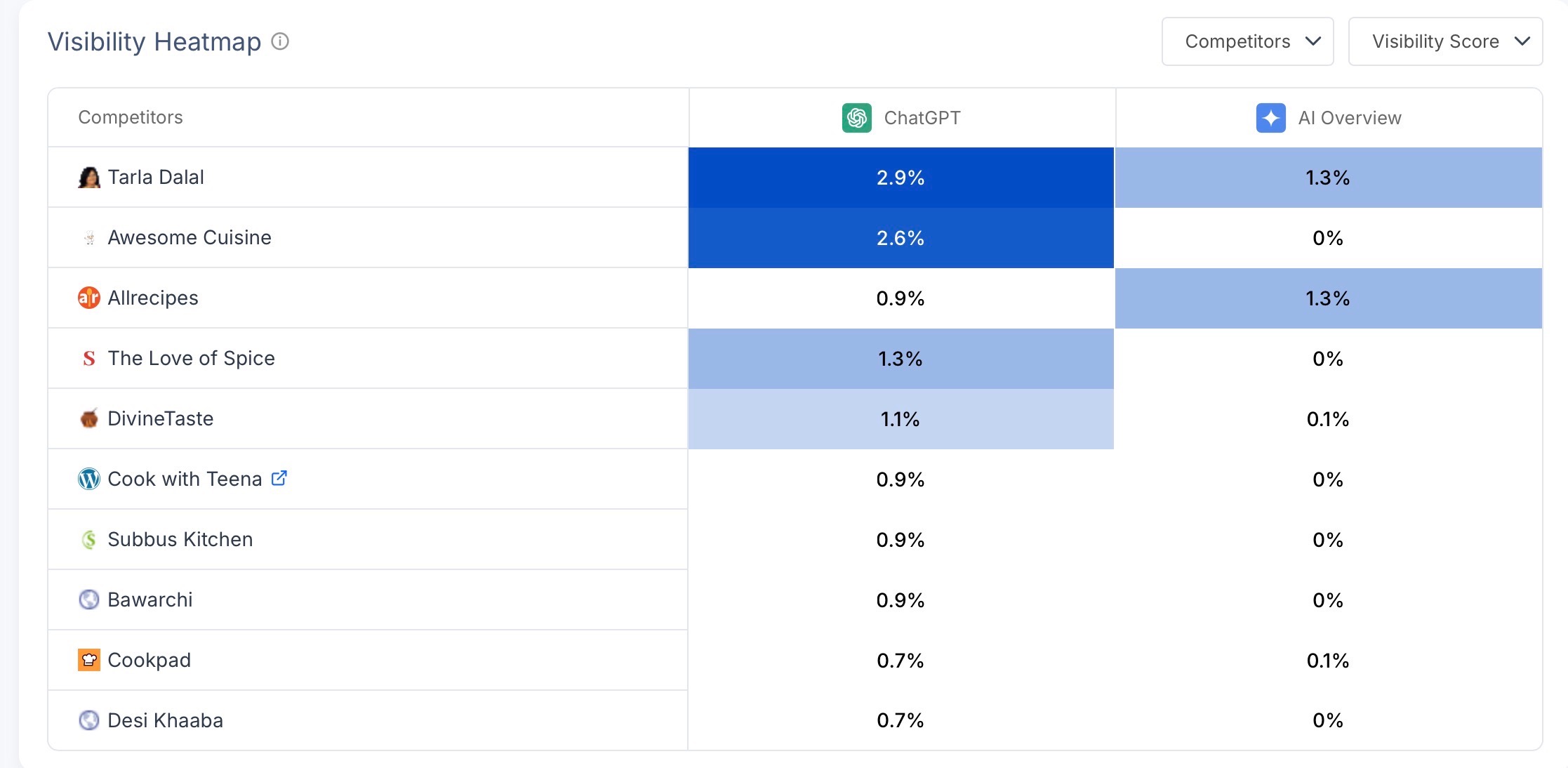
What Stood Out:
- Competitor Visibility Comparison: Scalenut lets you compare your brand’s visibility against competitors using metrics like Visibility Score, Share of Voice, Average Position, and Visibility Rank.
- Prompt-Level Competitor Context: You can see where competitors appear across AI prompts, which helps you understand whether your brand is losing visibility on specific queries or broader themes.
- Good For Broader GEO Analysis: Scalenut is helpful if you want competitor visibility data to sit alongside prompt insights, citations, and AI visibility trends.
That makes Scalenut useful if you want competitor data as part of a larger SEO and GEO view.
Where It Felt Limited:
- Not As Competitor-First: Scalenut gives you competitor insights, but the platform does not feel as centered around competitor benchmarking as Peec AI.
- More Context To Sort Through: Since Scalenut brings in visibility, prompts, citations, and other GEO signals, it may take a little more effort to isolate competitor-specific insights.
My Take
Scalenut does competitor comparison well enough, especially if you want to look at competitors as part of your overall AI visibility strategy. But if I were only judging competitor benchmarking, it feels more like one part of the larger platform rather than the main focus.
Peec AI
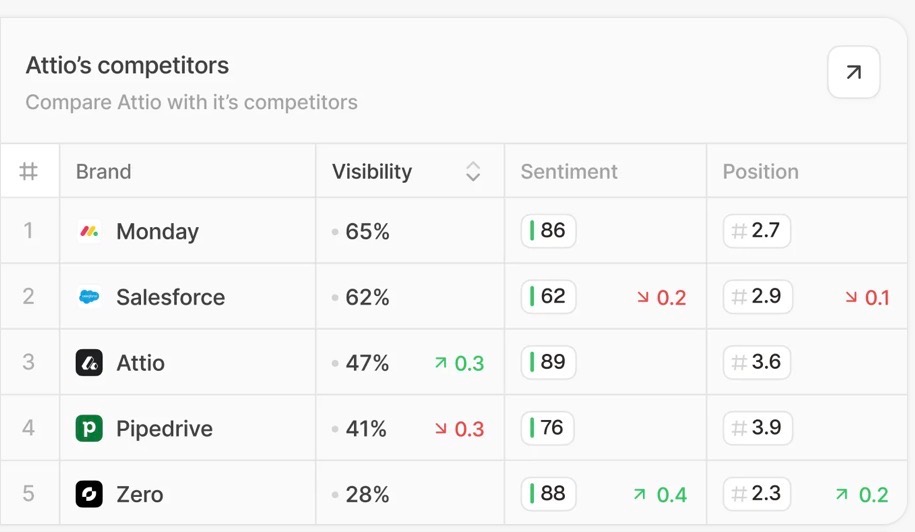
Source: Peec AI Homepage
What Stood Out:
- Clear Competitor Benchmarking: Peec AI feels more focused when it comes to comparing your brand against competitors. You can track how often competitors appear, how your visibility compares, and where they are winning across prompts.
- Share Of Voice Comparisons: I like that Peec AI makes Share of Voice easy to understand. It gives you a clearer sense of whether AI engines are mentioning your brand more or less often than the competitors you track.
- Prompt-Level Visibility Gaps: Peec AI helps you see which prompts competitors are showing up for and where your brand is missing. That is useful because competitor gaps are rarely obvious from traditional SEO data.
That makes Peec AI especially useful if your main question is, “Which competitors are AI engines recommending instead of us?”
Where It Felt Limited:
- Still Tracking-Led: Peec AI is strong at showing where competitors are ahead, but you still need to decide what to do with that information outside the tool.
- Less Useful For Execution: It helps you understand the competitive gap, but it does not give the same end-to-end content workflow to close that gap.
My Take
Peec AI has a clear edge here. It feels cleaner and more direct if your main goal is competitor benchmarking across AI answers.
My Verdict
For competitor comparison, I would give Peec AI the edge.
Scalenut gives you solid competitor visibility insights, especially inside a broader GEO workflow. But Peec AI feels more focused and easier to use when you specifically want to understand how your brand compares against competitors across prompts, mentions, positions, and Share of Voice.
If competitor visibility is your biggest priority, check out the best GEO tools for competitor analysis to see which platforms help you track where rivals are winning.
Scalenut vs Peec AI: Which Platform Gives Better Citation And Source Insights?
AI visibility is not only about whether your brand gets mentioned. It also matters where AI engines are pulling information from, which pages they cite, and whether your own content is being used as a trusted source.
This is one area where Peec AI feels especially strong. Scalenut gives you useful citation and source insights too, but Peec AI feels more detailed if your main goal is source-level analysis.
Scalenut
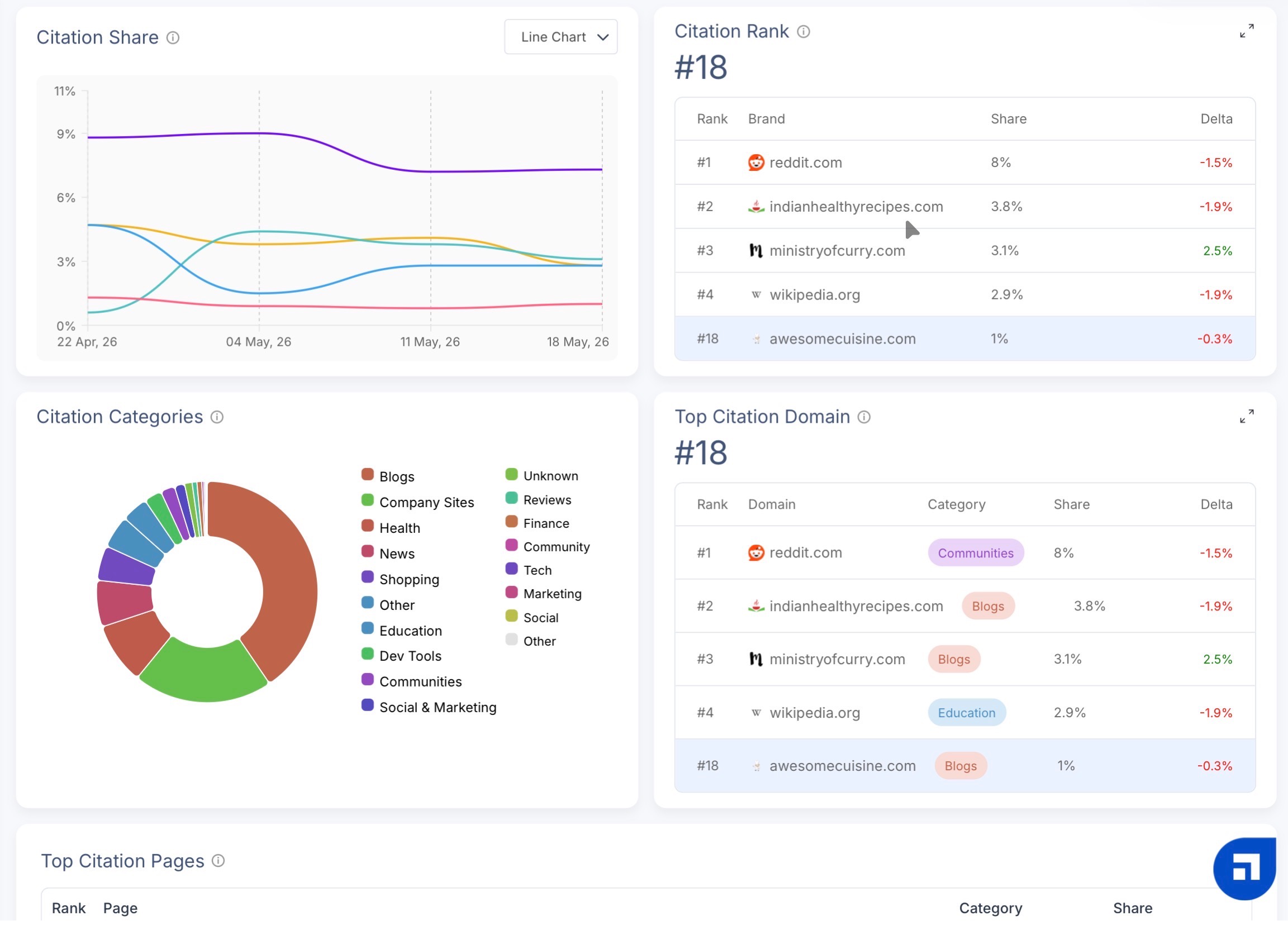
What Stood Out
- Citation And Source Tracking: Scalenut helps you see which domains and URLs influence your AI visibility. You can look at citation pages, source patterns, and the pages that seem to support your brand’s presence in AI answers.
- Useful Brand Context: What I liked here is that Scalenut does not treat citations as a separate technical metric. It connects them back to your brand visibility, prompts, and GEO performance.
- Helpful For Finding Authority Signals: Scalenut can show which sources are helping build authority around your brand, which is useful when you are trying to improve how often AI engines reference you.
That makes Scalenut helpful if you want citation insights as part of your broader GEO workflow.
Where It Felt Limited
- Not As Source-Deep As Peec AI: Scalenut gives useful citation visibility, but Peec AI feels more detailed when you want to analyze sources, URL types, and citation patterns closely.
- Better In Context Than In Isolation: Scalenut’s citation insights are most useful when you review them alongside prompts, visibility trends, and content opportunities.
My Take
Scalenut is strong if you want to understand how citations connect to brand visibility and GEO performance. But if I were only analyzing sources and citations, I would want a little more source-level detail.
Peec AI
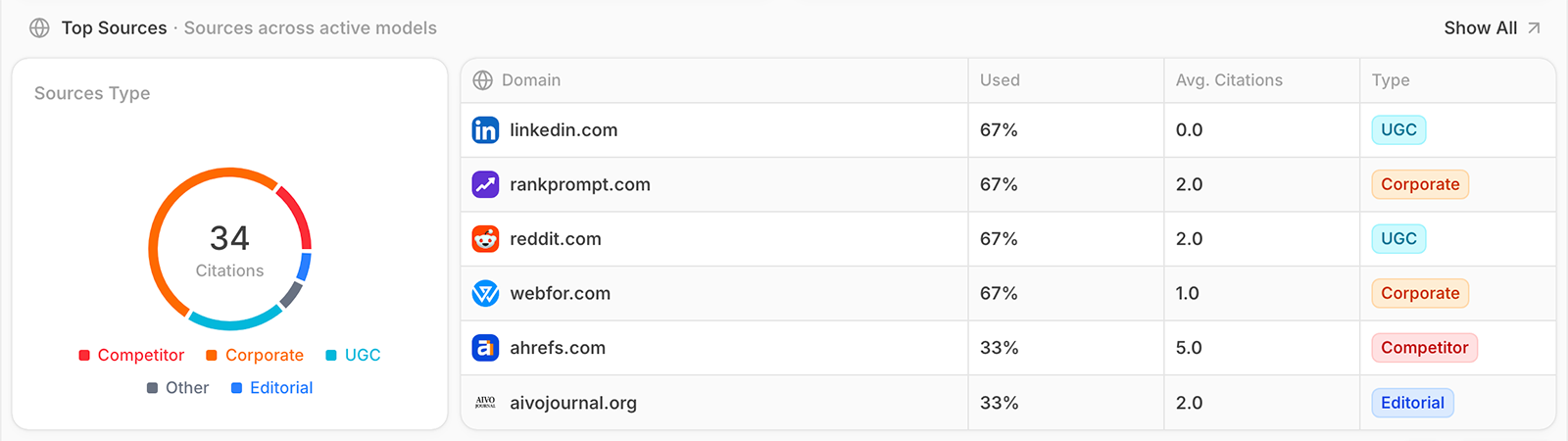
What Stood Out
- Detailed Source Visibility: Peec AI does a good job separating brand mentions from source visibility. That matters because your brand can appear in an AI answer without your site being cited, and your site can be used as a source without your brand being named.
- URL-Level Citation Insights: Peec AI lets you look at which specific pages AI models are using as sources. That is useful if you want to know whether AI engines are pulling from your homepage, comparison pages, product pages, articles, or third-party sources.
- Source Type Breakdown: I like that Peec AI categorizes sources by type, such as editorial, corporate, UGC, and other page categories. It gives you a cleaner view of what kind of content AI engines seem to trust in your space.
That makes Peec AI especially useful if your main question is, “Which sources are shaping AI answers in my category?”
Where It Felt Limited
- Still Requires Interpretation: Peec AI gives strong source data, but you still need to decide what to do with it. The platform can show you where citations are coming from, but your team still has to translate that into content, outreach, or optimization work.
- Less Connected To Content Execution: Peec AI is better at showing citation patterns than helping you directly create or optimize the content needed to win more citations.
My Take
Peec AI feels stronger for citation and source analysis. I would use it if my main goal was to understand which pages, domains, and source types AI engines are relying on.
My Verdict
For citation and source insights, I would give Peec AI the edge.
Scalenut gives you useful citation visibility, especially when you want to connect sources with broader GEO performance. But Peec AI feels more detailed and purpose-built for source-level analysis.
Looking for budget-friendly options? Compare the best GEO tools under $100/month to find a tool that fits your workflow and spend.
Scalenut vs Peec AI: Which Platform Actually Helps You Fix AI Visibility Gaps?
Finding AI visibility gaps is useful, but it is only half the work. The real question is: once the tool shows you where your brand is missing, does it help you do something about it?
This is where Scalenut has the clearest advantage over Peec AI.
Scalenut
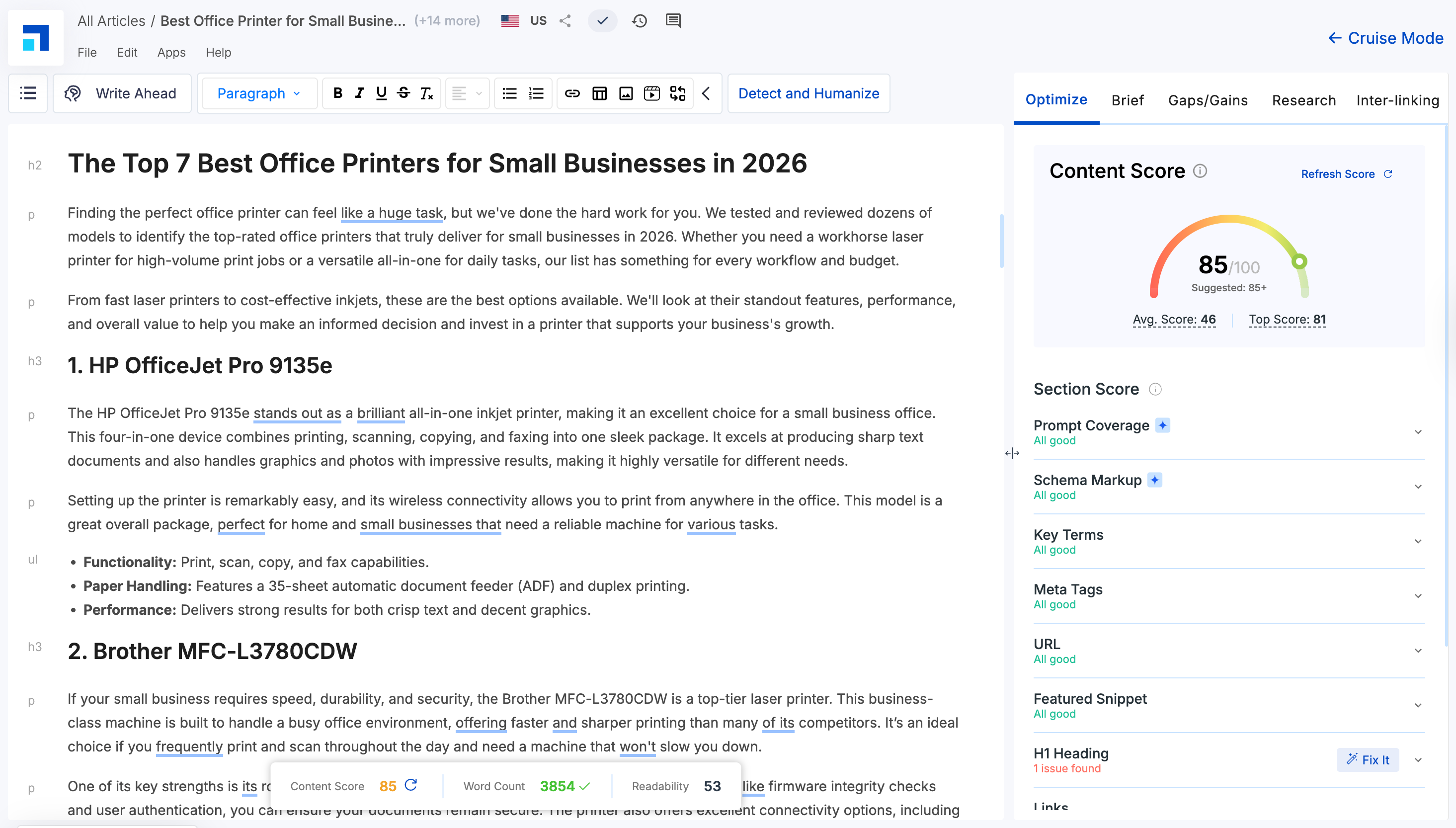
What Stood Out:
- Clearer Path From Insight To Action: Scalenut does not just show that your brand is missing from certain prompts. It helps you understand what to create, update, or strengthen to close those gaps.
- Built-In Content Creation: This is a big difference. If Scalenut finds a content gap, you can move into content creation instead of taking the insight to another tool. That makes the workflow feel more complete.
- Existing Content Optimization: Scalenut also helps with updating existing pages through content optimization, content scoring, prompt coverage, missing terms, heading improvements, and on-page fixes.
- More Execution Options: You can act on gaps through new articles, content refreshes, internal linking, backlink suggestions, and platform engagement opportunities.
That makes Scalenut much stronger if your team wants to move from “we found the gap” to “we know what to do next.”
Where It Felt Limited:
- More Workflow To Manage: Because Scalenut covers more than tracking, it can feel heavier if your team only wants a visibility dashboard.
- Best For Teams Ready To Execute: You will get the most value from Scalenut if you actually plan to create, optimize, and refresh content based on the insights.
My Take
This is where Scalenut feels clearly stronger. I would pick it if I wanted one platform to identify AI visibility gaps and then help me fix them through content and SEO execution.
Peec AI
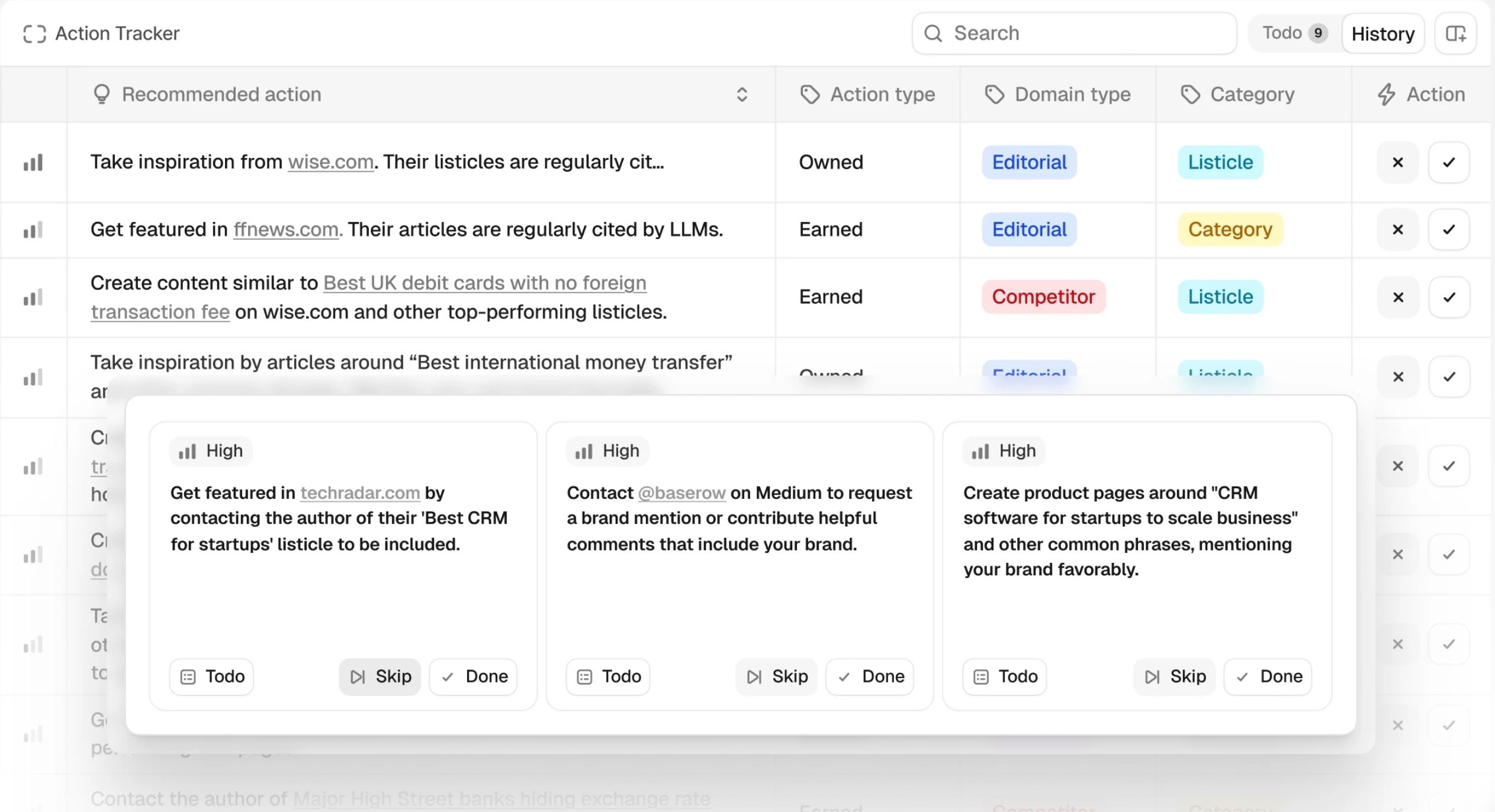
What Stood Out:
- Helpful Action Suggestions: Peec AI is not just a passive tracker. Its Actions feature can surface opportunities around content, sources, and trusted channels.
- Good Source-Led Direction: I like that Peec AI uses source data to show where your competitors are being mentioned or cited and where your brand is missing. That gives you useful direction.
- Useful For Prioritization: Peec AI can help you decide which gaps are worth looking at first, especially when the issue is tied to sources, third-party mentions, or competitor presence.
That makes Peec AI helpful for understanding what kind of gap exists and where the opportunity may be.
Where It Felt Limited:
- Less Built-In Execution: Peec AI can tell you what needs attention, but the actual content creation, optimization, internal linking, and page updates usually need to happen outside the platform.
- More Dependent On Your Existing Workflow: If your team already has writers, SEO tools, and content processes, Peec AI can fit in well. But if you need the platform to help you execute, it may feel incomplete.
My Take
Peec AI gives useful guidance, especially around source and competitor-led gaps. But I would see it more as an insights and prioritization tool than a full execution platform.
My Verdict
For fixing AI visibility gaps, Scalenut is the stronger choice.
Peec AI does a good job showing where gaps exist and what kind of opportunities you may want to explore. But Scalenut gives you more of the actual workflow needed to close those gaps through content creation, optimization, audits, internal linking, backlinks, and platform engagement.
If content creation is a big part of your GEO workflow, this guide to the best AI writing tools will help you choose the right writing stack.
Scalenut vs Peec AI: Which Platform Gives Better AI Traffic And Performance Insights?
AI visibility tracking tells you where your brand appears in AI answers. But AI traffic insights tell you something slightly different: which AI bots are actually visiting your site, which pages they access, and whether AI visibility is translating into real website activity.
Both Scalenut and Peec AI cover this better than I expected. But they approach it differently.
Scalenut
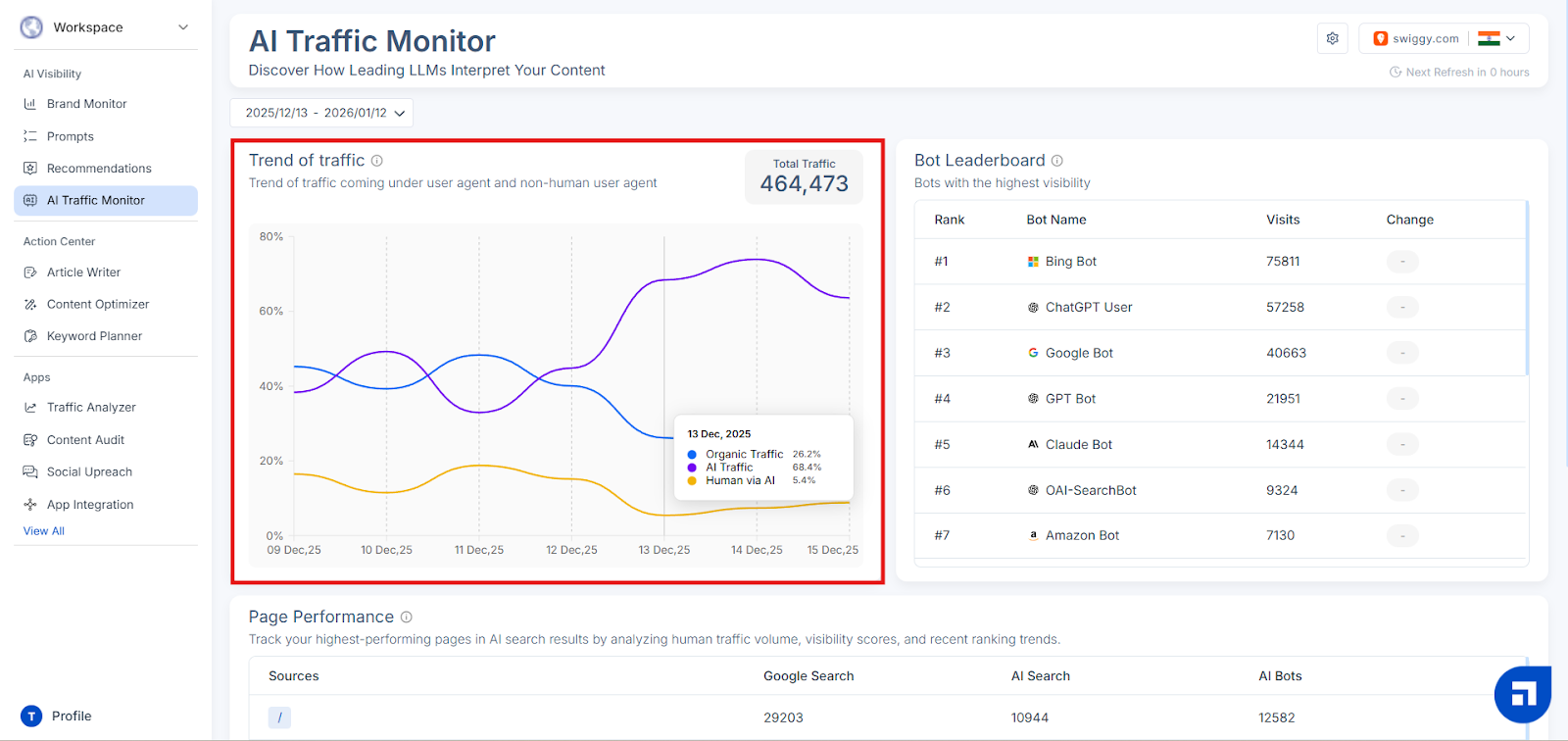
What Stood Out
- AI Bot Traffic Tracking: Scalenut’s AI Traffic Monitor helps you see how AI bots interact with your website, including visits from crawlers like GPTBot, ClaudeBot, and PerplexityBot.
- Traffic Segmentation: What I liked here is that Scalenut separates AI crawler traffic, organic search traffic, and human visits from AI responses. That makes the data more useful than a generic “bot traffic” view.
- Page-Level Performance: Scalenut also helps you identify which pages AI engines are visiting or engaging with most often, so you can understand which content is gaining traction in AI discovery.
That makes Scalenut useful if you want to connect AI visibility with actual website performance and page-level signals.
Where It Felt Limited
- Needs Setup: Since this type of tracking depends on server-side data and Cloudflare integration, it is not as simple as turning on a dashboard and getting instant insights.
- Best With Ongoing Monitoring: The value becomes clearer over time as you collect enough AI traffic patterns, crawler activity, and page-level movement.
My Take
Scalenut feels strong here because it connects AI bot activity with visibility, pages, and performance. I would use it if I wanted to understand not just whether AI engines mention my brand, but whether they are actually interacting with my site.
Peec AI
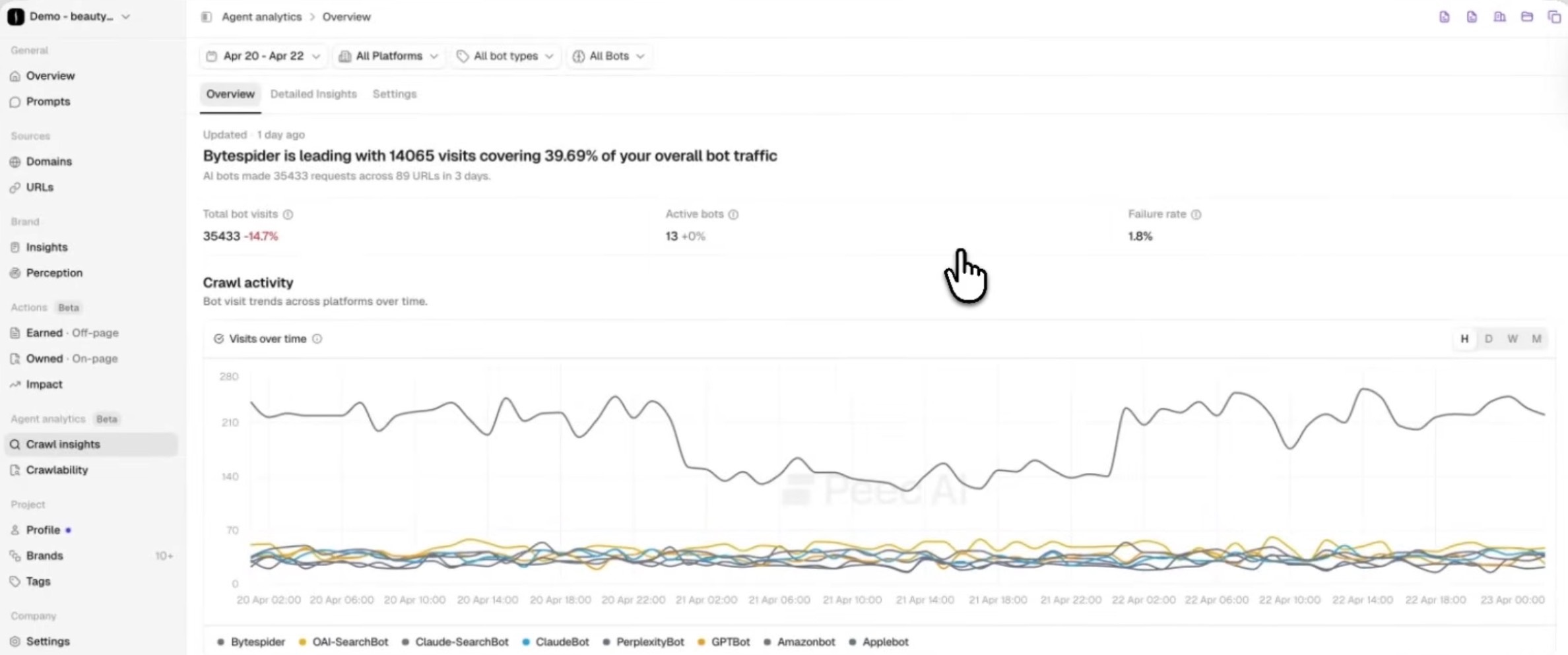
What Stood Out
- AI Bot Activity From Server Logs: Peec AI’s Crawl Insights gives visibility into AI bot activity using server logs. It shows which bots access your site, which pages and folders they visit, how often they come, and what status codes they receive.
- Useful Bot Filters: Peec AI lets you break down activity by platform, bot, bot type, and URL. That is helpful if you want to know whether traffic is coming from OpenAI, Google, Anthropic, or another AI crawler.
- Good URL-Level Detail: I like that Peec AI shows AI bot traffic at the URL level. That makes it easier to see which sections of your site are being crawled and where there may be crawlability issues.
That makes Peec AI useful if your priority is understanding AI crawler behavior in detail.
Where It Felt Limited
- Setup Can Get Technical: Peec AI supports Cloudflare Workers and server log uploads, but that also means setup may need some technical involvement.
- More Crawl-Focused Than Performance-Focused: Peec AI gives strong crawl activity insights, but Scalenut feels a little more connected to the broader performance story, especially when you want to tie AI bot visits back to visibility and page-level growth.
My Take
Peec AI is stronger than I initially expected here. Its Crawl Insights feature makes it useful for teams that want to study AI bot behavior and server-log-level activity.
My Verdict
This one is close.
If I were mainly looking at AI crawler activity and URL-level bot behavior, Peec AI would be a strong choice. Its Crawl Insights feature gives useful detail into which bots visit your site, which URLs they access, and how crawl activity changes over time.
But if I wanted AI traffic insights to connect more clearly with AI visibility, page performance, and broader GEO decision-making, I would lean toward Scalenut.
Want to compare more options before deciding? Explore the best Peec AI alternatives for GEO and AI visibility in 2026.
Scalenut vs Peec AI: Which Platform Offers Better Value For Money?
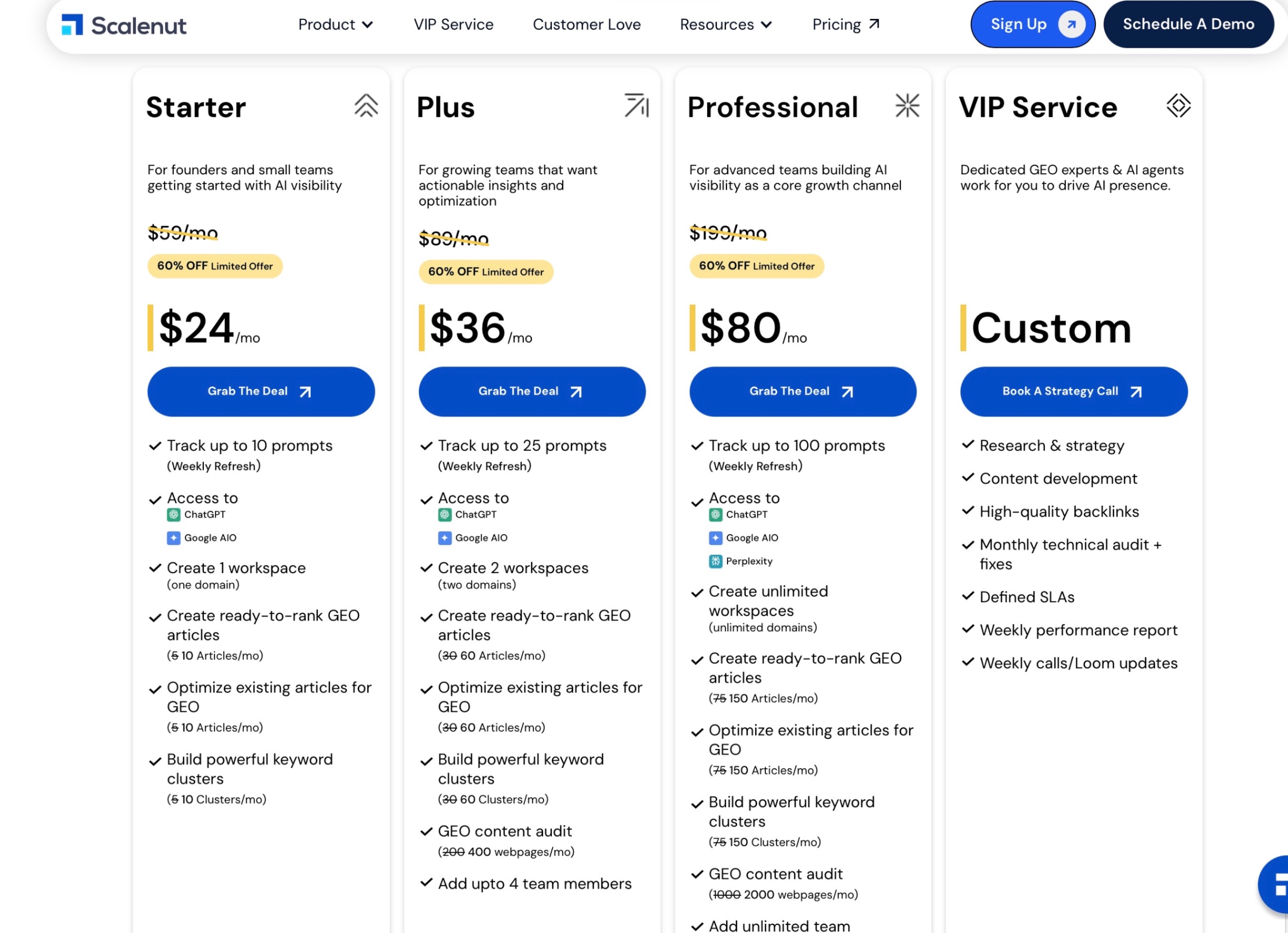
Value is not just about the lowest starting price. For this comparison, I would look at what you actually get for the money: AI visibility tracking, prompt limits, model coverage, traffic insights, content creation, optimization, audits, and how much extra work your team still has to do outside the tool.
This is where Scalenut feels stronger overall. Peec AI gives solid value if your main goal is AI visibility tracking. But if you want tracking plus execution, Scalenut gives you more in one platform.
Scalenut
What Stood Out
- More Than Just Tracking: Scalenut includes AI visibility tracking, content creation, content optimization, audits, internal linking, and AI traffic monitoring. So you are not only paying to see visibility gaps, you are also paying for the tools to act on them.
- Better Overall Workflow Value: What I like here is that Scalenut can replace parts of multiple tools. If your team already pays for a content writer, optimizer, audit tool, and AI visibility tracker separately, Scalenut starts making more sense from a value perspective.
- Good For Execution-Focused Teams: Scalenut is more useful if your team wants to create, optimize, refresh, and monitor content from the same platform.
That makes Scalenut feel like the better value if your goal is not just to measure AI visibility, but to improve it.
Where It Felt Limited
- Lower Prompt Volume On Entry Plans: If you only compare prompt tracking limits, Peec AI gives more prompt capacity on its entry plan.
- Not Ideal For Tracking-Only Teams: If your team only wants AI visibility monitoring and does not need content creation or optimization, Scalenut may feel like more than you need.
My Take
Scalenut gives better overall value for SEO and content teams because it combines tracking with execution. I would pick it if I wanted one platform for AI visibility, AI traffic insights, content creation, optimization, and GEO workflow support.
Peec AI
What Stood Out
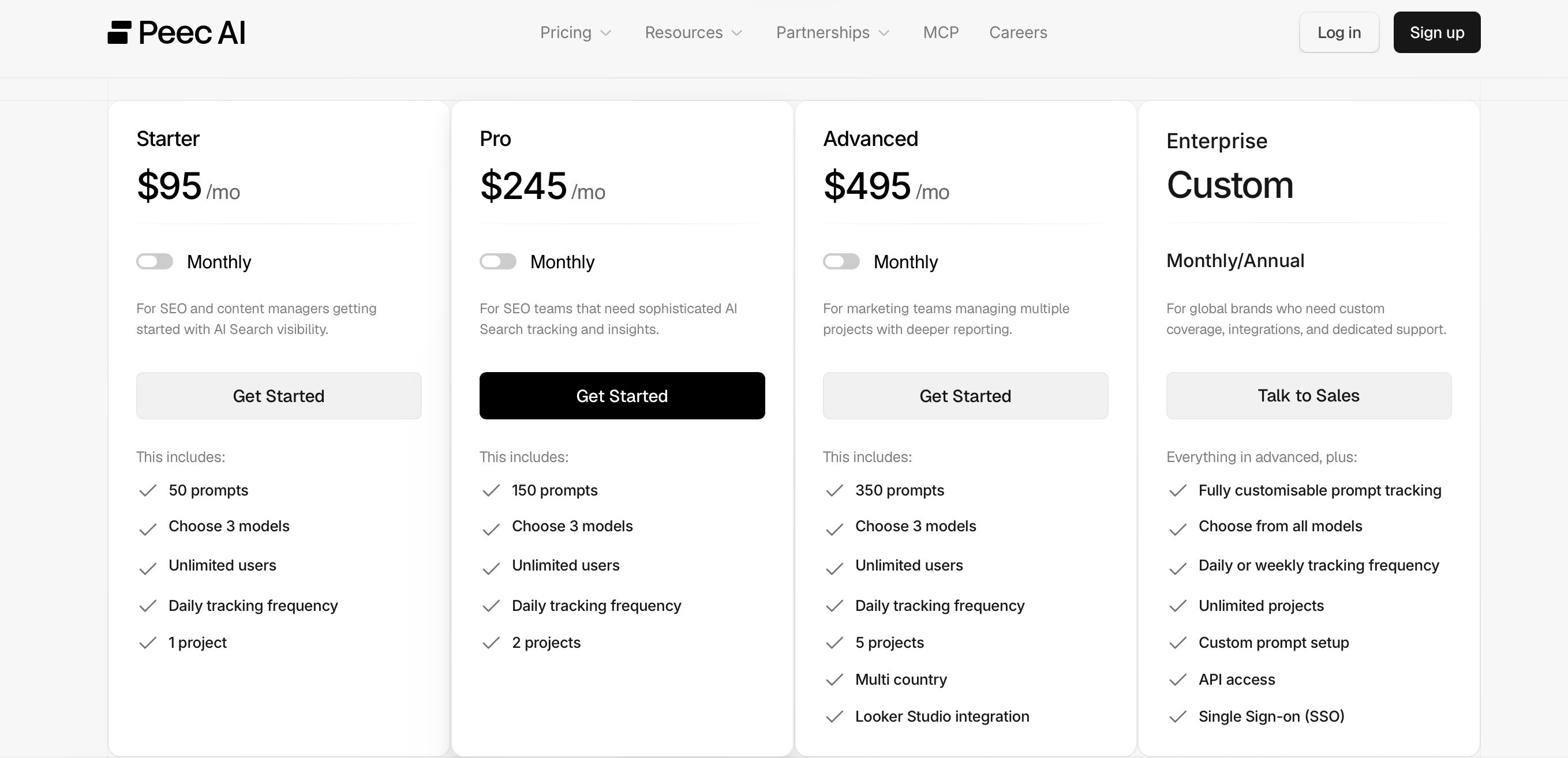
- Stronger Tracking Capacity On Starter: Peec AI’s Starter plan includes 50 prompts, 3 models, unlimited users, daily tracking, and 1 project. So if your main value metric is prompt tracking, Peec AI looks strong.
- Clean Pricing Around Monitoring: Peec AI’s pricing is mainly built around prompts, models, projects, and reporting. That makes it easier to understand if your team only needs AI visibility analytics.
- Better Fit For Reporting-Led Teams: If your writers, SEO tools, and content workflows already exist elsewhere, Peec AI can be a practical tracking layer.
That makes Peec AI a good value if your team mainly wants focused AI visibility monitoring without a full content workflow.
Where It Felt Limited
- Less Execution Included: Peec AI helps you understand visibility gaps, competitor presence, citations, and source patterns. But content creation, optimization, site audits, and page updates still need to happen outside the platform.
- Costs Can Rise With Scale: Since pricing depends on prompts, models, and projects, teams tracking many brands, markets, or AI engines may need higher tiers or add-ons.
My Take
Peec AI is good value if you mainly need AI visibility tracking and reporting. But it becomes less of an all-in-one value play if you also need content creation, optimization, and SEO execution.
My Verdict
If I were choosing only for AI visibility tracking capacity, Peec AI would be very competitive, especially because its entry plan gives more prompts and daily tracking.
But for overall value, I would choose Scalenut. The reason is simple: Scalenut gives you AI visibility tracking, AI traffic monitoring, content creation, content optimization, audits, internal linking, and execution workflows in one platform. So instead of paying only to find visibility gaps, you are also paying for the tools to start closing them.
Running GEO on a smaller budget? Check out the top GEO tools for small businesses and see which platforms offer the best value.
Where Does Scalenut Do Better Than Peec AI?
Scalenut is stronger when you want to move from tracking to execution.
Peec AI is good at showing visibility gaps, competitor gaps, and source patterns. But Scalenut feels more useful when you need to create, optimize, audit, and improve content from the same workflow.
Scalenut has the edge in:
- Content Creation: You can turn topic or prompt gaps into new content without moving to another writing tool.
- Content Optimization: You can improve existing pages with content scores, missing terms, headings, prompt coverage, and on-page suggestions.
- Content Audits: You can find pages that need updates instead of only creating new content.
- Internal Linking: You can strengthen topical connections across your site.
- AI Traffic Monitoring: You can see how AI bots interact with your site and which pages they visit.
- SEO And GEO Execution: You get visibility tracking, content creation, optimization, audits, linking, and performance insights in one place.
So if I only wanted to monitor AI visibility, Scalenut may feel like more than I need. But if I wanted to find gaps and fix them through content and SEO work, Scalenut is clearly stronger.
Want the deeper breakdown? Read our full Scalenut review to see how its GEO, SEO, content, and AI visibility features actually work.
Where Does Peec AI Do Better Than Scalenut?
Peec AI is stronger when you want focused AI visibility analytics without a full content workflow attached.
It feels cleaner for teams that already have writers, SEO tools, and optimization processes in place, and only need a sharp tracking and reporting layer.
Peec AI has the edge in:
- Focused AI Visibility Monitoring: It is clean and direct for tracking brand mentions, prompts, sentiment, and positions.
- Competitor Benchmarking: It makes competitor comparison easier to follow across visibility, sentiment, prompts, and average position.
- Source And Citation Insights: It gives a clear view of which domains, URLs, and source types AI engines rely on.
- Prompt Tracking: It keeps buyer-intent, category, and comparison prompt tracking simple.
- Sentiment Tracking: It makes it easier to monitor how AI responses describe your brand.
- Clean Reporting: The dashboard feels lighter and easier to read.
So I would not position Peec AI as weak. It is better for focused AI visibility tracking, competitor benchmarking, prompt monitoring, sentiment, and source insights.
But for overall value, I would still lean toward Scalenut because it gives you both tracking and execution in one platform.
Who Should Choose Scalenut?
Choose Scalenut if you want AI visibility tracking and the workflow to improve it.
It is a better fit for SEO teams, content teams, agencies, and GEO teams that do not want insights sitting in a separate dashboard. With Scalenut, you can track visibility, monitor AI traffic, create content, optimize existing pages, audit old content, and strengthen internal links from one place.
I would choose Scalenut if my team needed:
- Tracking Plus Execution: You can find visibility gaps and act on them.
- Content Creation And Optimization: Useful for turning prompt or topic gaps into better content.
- Content Audits: Helpful for finding pages that need updates.
- Internal Linking: Useful for strengthening topical connections.
- AI Traffic Monitoring: Helpful for seeing how AI bots interact with your site.
- One SEO And GEO Workflow: Best when you want tracking, optimization, and execution together.
So if your team wants to monitor AI visibility and improve it from the same platform, Scalenut is the better fit.
Who Should Choose Peec AI?
Choose Peec AI if your main goal is focused AI visibility analytics.
It is a better fit for teams that already have content creation, SEO, and optimization handled elsewhere, and mainly need a clean way to monitor AI visibility, prompts, competitors, sentiment analysis, and sources.
I would choose Peec AI if my team needed:
- Focused AI Visibility Monitoring: Useful for tracking where your brand appears in AI answers.
- Prompt And Sentiment Tracking: Good for monitoring buyer-intent prompts and brand perception.
- Competitor Benchmarking: Helpful for seeing how your brand compares against competitors.
- Citation And Source Visibility: Useful for understanding which domains and URLs AI engines rely on.
- Clean Reporting: Better if you want a lightweight visibility dashboard.
- A Tracking Layer For An Existing SEO Setup: Best when your execution workflow already exists elsewhere.
So if your team mainly needs AI visibility reporting, Peec AI makes sense. But if you also need content creation, optimization, audits, internal linking, and AI traffic insights, Scalenut gives better overall value.
Still evaluating Peec AI? Read our full Peec AI review to see where it works well, where it feels limited, and whether it is worth the price.
Final Verdict: Is Scalenut Or Peec AI Better?
If I only needed a focused AI visibility tracker, I would seriously consider Peec AI. It is clean, sharp, and strong for tracking prompts, competitors, sentiment, and sources. But if I had to choose one platform for overall value, I would pick Scalenut because it gives you AI visibility tracking, AI traffic insights, content creation, optimization, audits, internal linking, and SEO/GEO execution in one workflow.
So my take is simple: Peec AI is better for focused monitoring, but Scalenut is the better choice if you want to track visibility and actually improve it.
Frequently Asked Questions
Are there any other AEO tools like Peec AI?
Yes, tools like Scalenut, Scrunch AI, Profound AI, and Otterly AI also help teams monitor AI visibility, citations, prompts, and traffic. Scalenut stands out if you also need content optimization and execution.
What should I consider when choosing a Peec AI alternative?
For the best Peec AI alternatives for GEO, compare Scalenut on engine coverage, Google search support, rank tracking, AI model coverage, reporting depth, and free trial availability. Also check key features, setup effort, and whether the platform gives specific actions, not just dashboards.
Which Peec AI alternatives are best for small businesses?
If budget is the main concern, Scalenut is one of the stronger Peec.ai lower cost competitors because it includes tracking, content optimization, audits, and execution in one platform.Scrunch AI and Profound AI can work too, especially for citation analysis, competitive intelligence, and answer engine insights.
Is Peec AI still worth it compared to newer competitor tools?
Peec AI is still worth it if your team wants focused tracking, clean reporting, deeper competitor benchmarking, and source visibility. But if you need deeper insights tied to content execution or want to avoid enterprise pricing later, Scalenut may offer better overall value.
What are the top alternatives to Peec AI for AI traffic monitoring?
The best Peec AI competitor tools for AI traffic monitoring are Scalenut, Otterly AI, Scrunch AI, and Profound AI.. Scrunch and Profound are strong for bot and crawler analytics, but Scalenut offers the best overall value with AI traffic monitoring, visibility tracking, optimization, and execution.
Is Scalenut a strong alternative to Peec AI?
Yes, Scalenut is a strong alternative to Peec AI, especially if you want more than an AI visibility platform. Peec AI is useful for focused AI search visibility tracking, while Scalenut also supports content creation, optimization, audits, and execution across AI platforms.
What is the main difference between Scalenut and Peec AI?
The main difference is workflow. Peec AI is stronger for AI search analytics, prompts, sentiment, competitors, and sources. Scalenut connects those types of insights with generative engine optimization workflows, giving teams more actionable insights for content and SEO execution.
Which is better for marketing teams: Scalenut or Peec AI?
For marketing teams that mainly need visibility tracking, Peec AI makes sense. But if the goal is to create, refresh, and optimize content that reaches potential customers across search engines and AI answers, Scalenut is the best tool overall.
How does the setup process differ between Scalenut and Peec AI?
Peec AI is more straightforward if your main setup involves brands, competitors, prompts, and tracking markets. Scalenut needs a slightly broader setup because it connects AI visibility data with content workflows, audits, internal linking, and AI traffic monitoring.
Is Peec AI only a monitoring tool?
Not exactly. Peec AI is mainly built for monitoring, but it also gives valuable insights through Actions, source data, prompt gaps, and competitor visibility. The limitation is that most content creation, optimization, and page updates still need to happen outside the platform.
Which tool is better for tracking Google AI and other AI search results, Scalenut or Peec AI?
Both tools can help track brand presence across AI-led search experiences, including Google AI. Peec AI feels cleaner for focused tracking, while Scalenut gives more context by connecting visibility data with citations, AI traffic, content opportunities, and broader SEO workflows.
Which AI tool offers better value for money, Scalenut or Peec AI?
Peec AI is good value if you mainly need one of the cleaner visibility tools for monitoring prompts, sources, sentiment analysis, and competitors. Scalenut offers stronger overall value if you also care about AI search performance, AI search optimization, content audits, and execution in one platform.


.svg)


.webp)