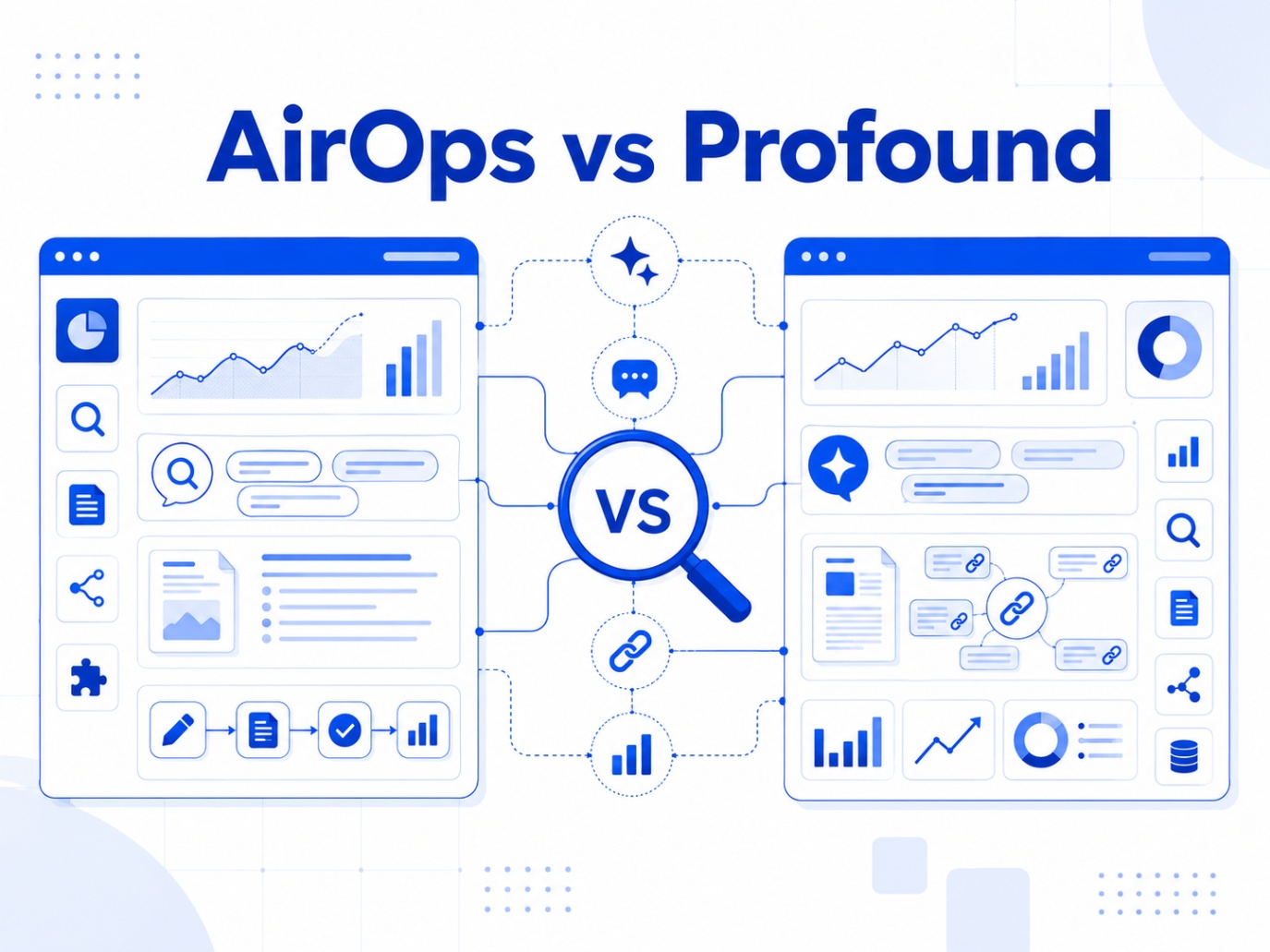
Quick summary: AirOps vs Profound
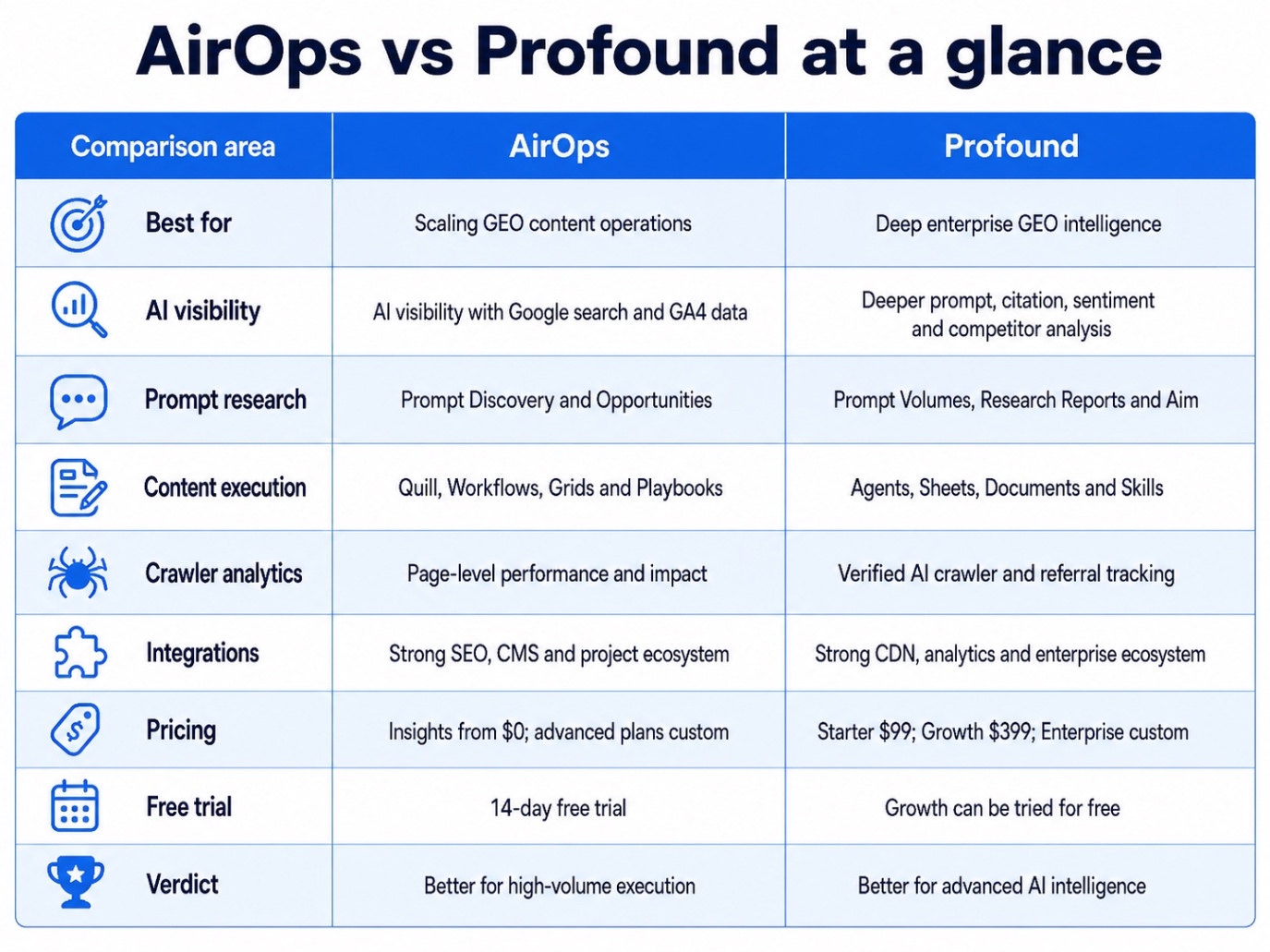
- Best fit: Choose AirOps for scalable content operations. Choose Profound for deeper answer-engine intelligence.
- AI visibility tracking: Profound offers broader platform coverage and deeper prompt, citation, sentiment, and competitor analysis. AirOps combines AI visibility with Google search data.
- Prompt research: Profound is stronger for demand intelligence. AirOps moves opportunities into execution faster.
- Content workflows: AirOps leads in workflow customization, bulk production, approvals, and CMS publishing. Profound supports more data-led execution through Agents, Sheets, Documents, and Skills.
- Impact measurement: Profound is better for verified crawler and AI referral analytics. AirOps connects page changes with citations, rankings, engagement, and conversions.
- Enterprise fit: AirOps suits SEO and content operations teams. Profound better serves cross-functional enterprise AEO programs.
- Ease of use: Profound is generally easier to adopt. AirOps offers greater flexibility but requires more setup.
- User ratings: The supplied G2 snapshots show AirOps at 4.7/5 from 130 reviews and Profound at 4.5/5 from 1,124 reviews.
- Pricing: Profound starts at $99/month with annual billing. AirOps offers Insights from $0, while advanced Pages requirements use custom pricing.
- Where both fall short: Both can become complex and costly as requirements scale. Teams wanting transparent pricing and a simpler path from AI visibility and SEO research to content creation, optimization, internal linking, and publishing may need a more unified alternative.
Both AirOps and Profound connect monitoring with execution. What separates them is how they decide what matters, how much control they give teams, and how easily results can be measured after publication.
AirOps is strongest when content operations must run across many pages and systems. Profound is strongest when teams need broader answer-engine data, demand intelligence, and crawler-level analysis. In this blog, we compare the capabilities, costs, user feedback, and trade-offs that matter before either platform becomes part of your stack. Let’s get started.
AirOps vs Profound: What does each platform do?
AirOps and Profound both combine AI search intelligence with content execution, but they are built around different strengths. AirOps centers on flexible content operations and publishing workflows, while Profound starts with deeper AI search, prompt-demand, citation, and crawler data before turning those signals into prioritized projects and automated workflows.
What is AirOps?
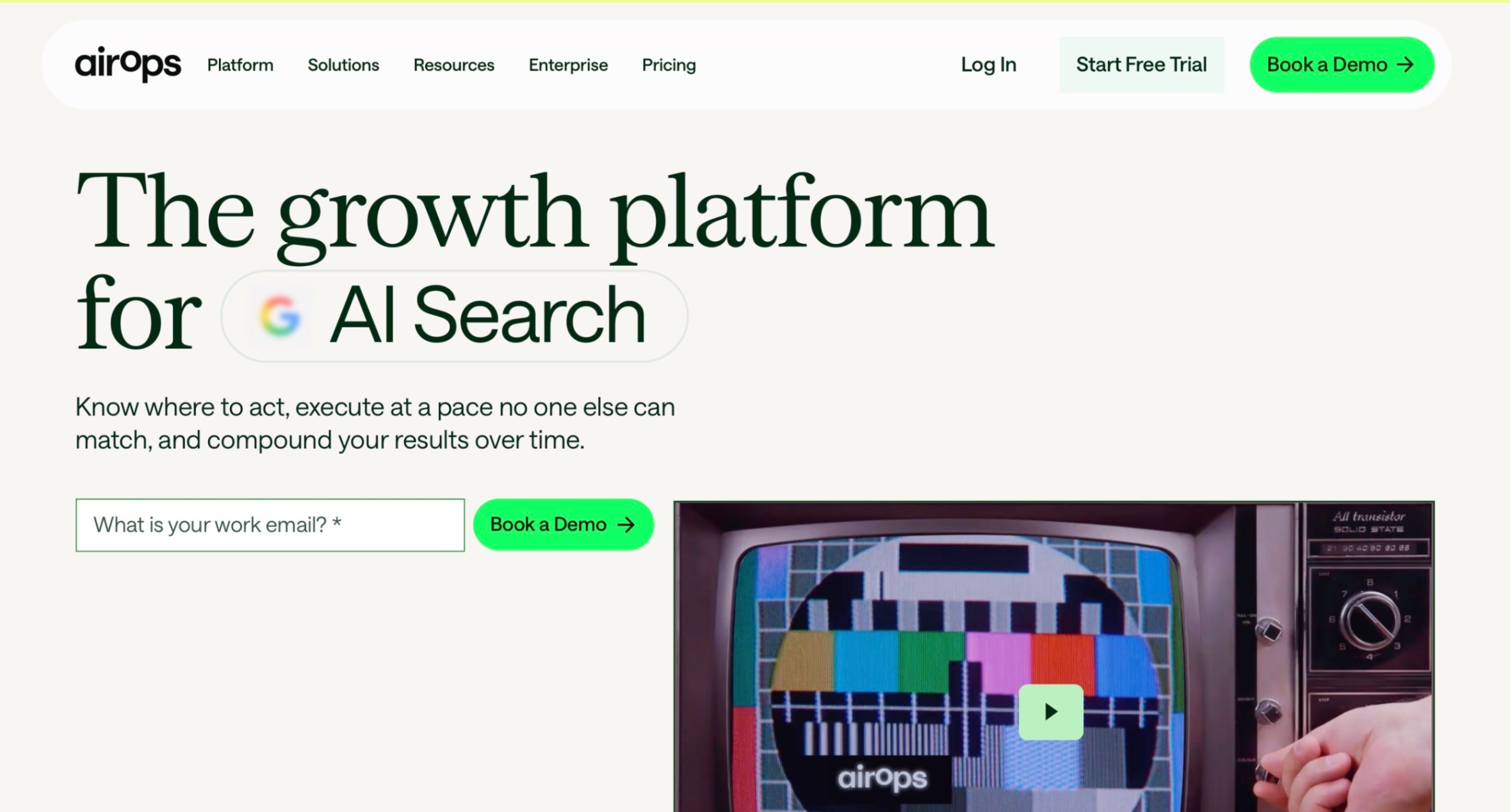
AirOps is an AI search and content operations platform for SEO and content teams that need to manage production at scale. It combines AI and Google search data with governed workflows for researching, creating, refreshing, reviewing, publishing, and measuring content across owned and third-party channels.
What are AirOps’ standout features?
- Insights and Page360: Combines AI citations, visibility data, GSC rankings, GA4 engagement, and content freshness at the URL level.
- Prompt Discovery and Opportunities: Identifies relevant prompts, content gaps, declining pages, citation gaps, and offsite opportunities worth prioritizing.
- Quill and Playbooks: Helps teams build and run reusable processes for research, briefs, content creation, refreshes, optimization, and review.
- Workflow Studio and Grids: Supports multi-step workflows with conditional logic, triggers, code steps, and human approvals. Grids run these processes across hundreds of pages or inputs.
- Brand Kits and Knowledge Bases: Grounds outputs in approved brand voice, products, audiences, regional guidance, editorial rules, and proprietary information.
- Publishing and integrations: Connects with CMS platforms, SEO tools, analytics, project management systems, and data sources to move approved content directly into existing workflows.
Want a closer look at its workflows, pricing, and limitations? Read our complete AirOps review.
What is Profound?
Profound is an AI search optimization platform that helps marketing teams monitor, understand, and improve how brands appear across answer engines. It combines AI visibility, prompt-demand, citation, sentiment, shopping, and crawler intelligence with Aim, Agents, and Sheets for prioritizing and executing AEO work.
What are Profound’s standout features?
- Answer Engine Insights: Tracks visibility, position, share of voice, citations, sentiment, sources, and competitors across supported AI platforms.
- Prompt Volumes and Prompt Research Reports: Uses aggregated conversation data to show prompt demand, related topics, intent, audience characteristics, and emerging opportunities.
- Agent Analytics: Tracks AI crawler activity, AI-sourced traffic, frequently accessed pages, response performance, and referral attribution through analytics and infrastructure integrations.
- Aim: Continuously analyzes Profound’s AI search data, brand information, website content, and competitors to recommend and prioritize high-impact projects.
- Agents and Sheets: Builds node-based workflows for research, content creation, optimization, approvals, and CMS publishing. Sheets runs these workflows across hundreds of inputs in parallel.
- Shopping: Measures how products appear in ChatGPT Shopping, including the prompts that trigger shopping results, product visibility, attributes, and checkout providers.
- Enterprise integrations and controls: Supports CMS, analytics, CDN, API, and external MCP connections alongside enterprise features such as SSO, permissions, and dedicated support.
Need a deeper look at its visibility data, Agents, pricing, and trade-offs? Read our complete Profound AI review.
What are the main differences between AirOps and Profound for AI visibility?
AirOps combines AI visibility, Google search performance, and content production in one configurable operations layer. Profound takes a broader AEO approach centered on prompt demand, brand representation in AI answers, crawler behavior, and coordinated marketing action.
Let’s look at their key differences across visibility data, opportunity discovery, content workflows, performance measurement, and enterprise adoption in detail below:
Which tool provides deeper AI visibility, citation, and platform coverage?
Both visibility tools track brand visibility across AI answers, but AirOps connects it with Google search data while Profound provides broader answer-engine coverage.
What AirOps offers
AirOps Analytics monitors ChatGPT, Gemini, Perplexity, Google AI Mode, and Google AI Overviews. It’s Solo plan is limited to ChatGPT, Pro adds multi-engine tracking, and Enterprise plan supports multiple regions, personas, and languages.
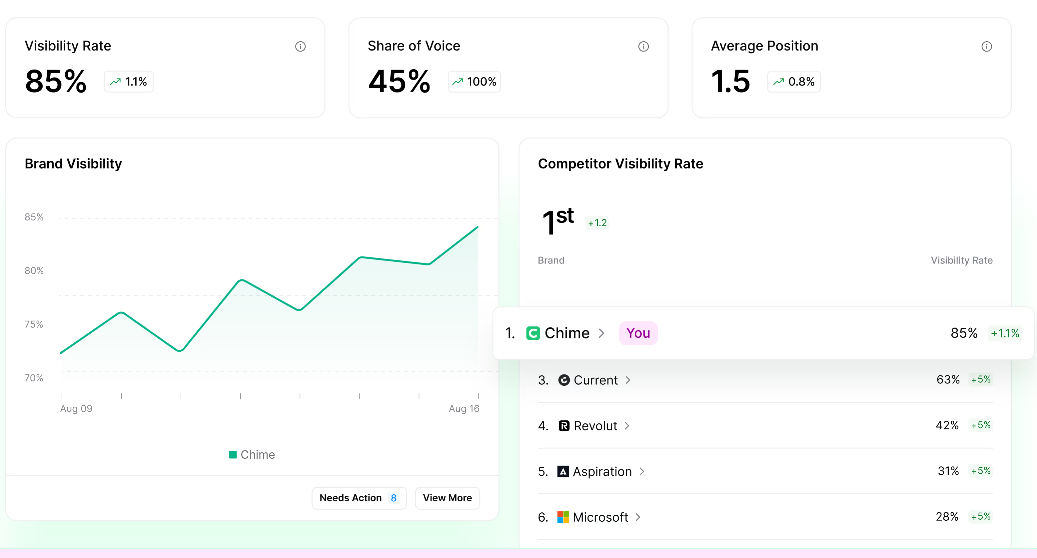
It tracks mention rate, share of voice, average position, sentiment, competitors, and complete AI responses daily. Citation analysis is available at the domain and URL level, with citation rate, share, and count.
Its main advantage is the combined view of AI visibility, Google search performance, and page-level content data.
What Profound offers
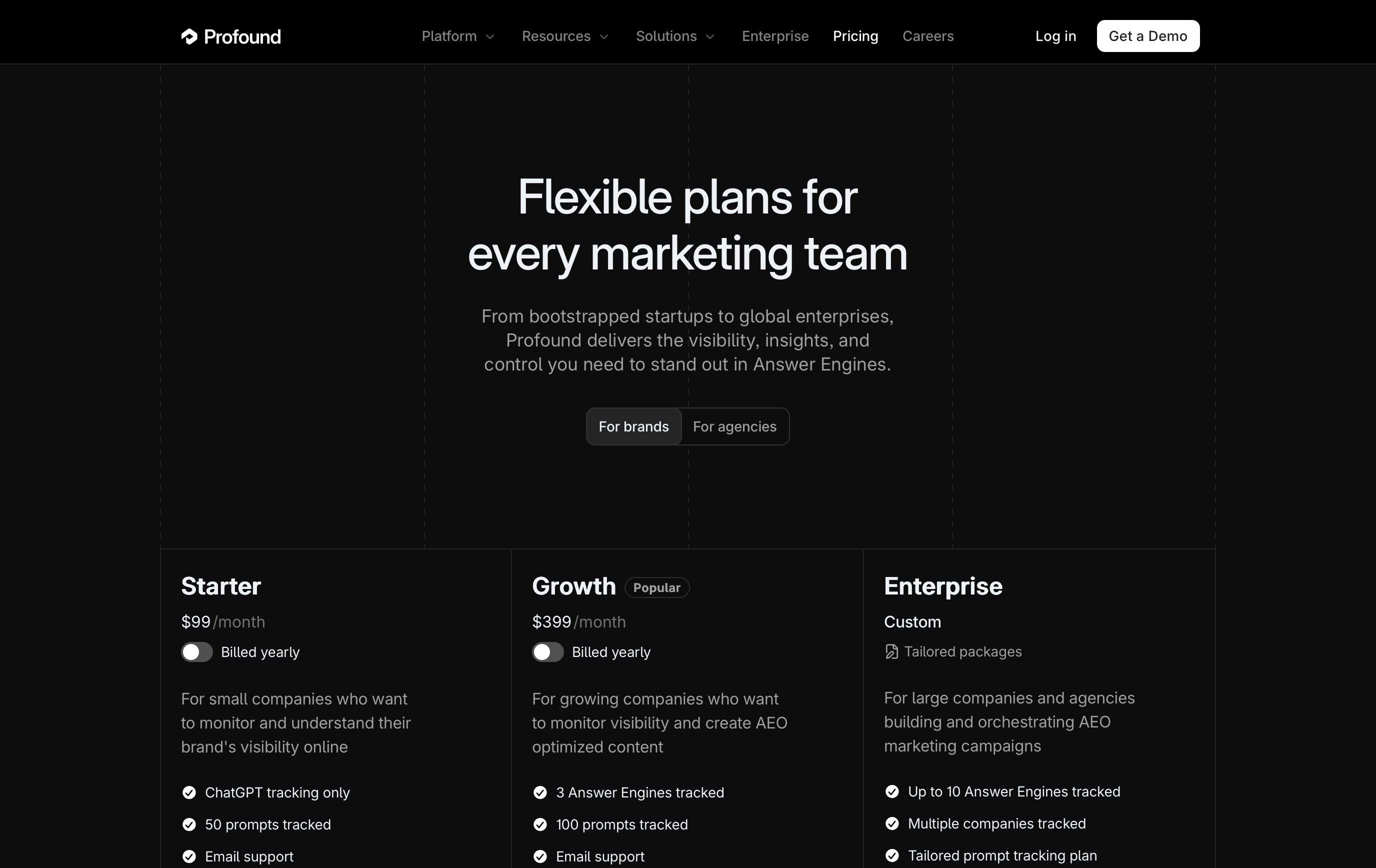
Profound tracks ChatGPT on its Starter plan, 3 answer engines on Growth, and up to 10 on Enterprise, including Claude, Gemini, Copilot, Grok, DeepSeek, Meta AI, and Google AI Mode. Starter and Growth support 1 region and language, while Enterprise offers custom coverage.
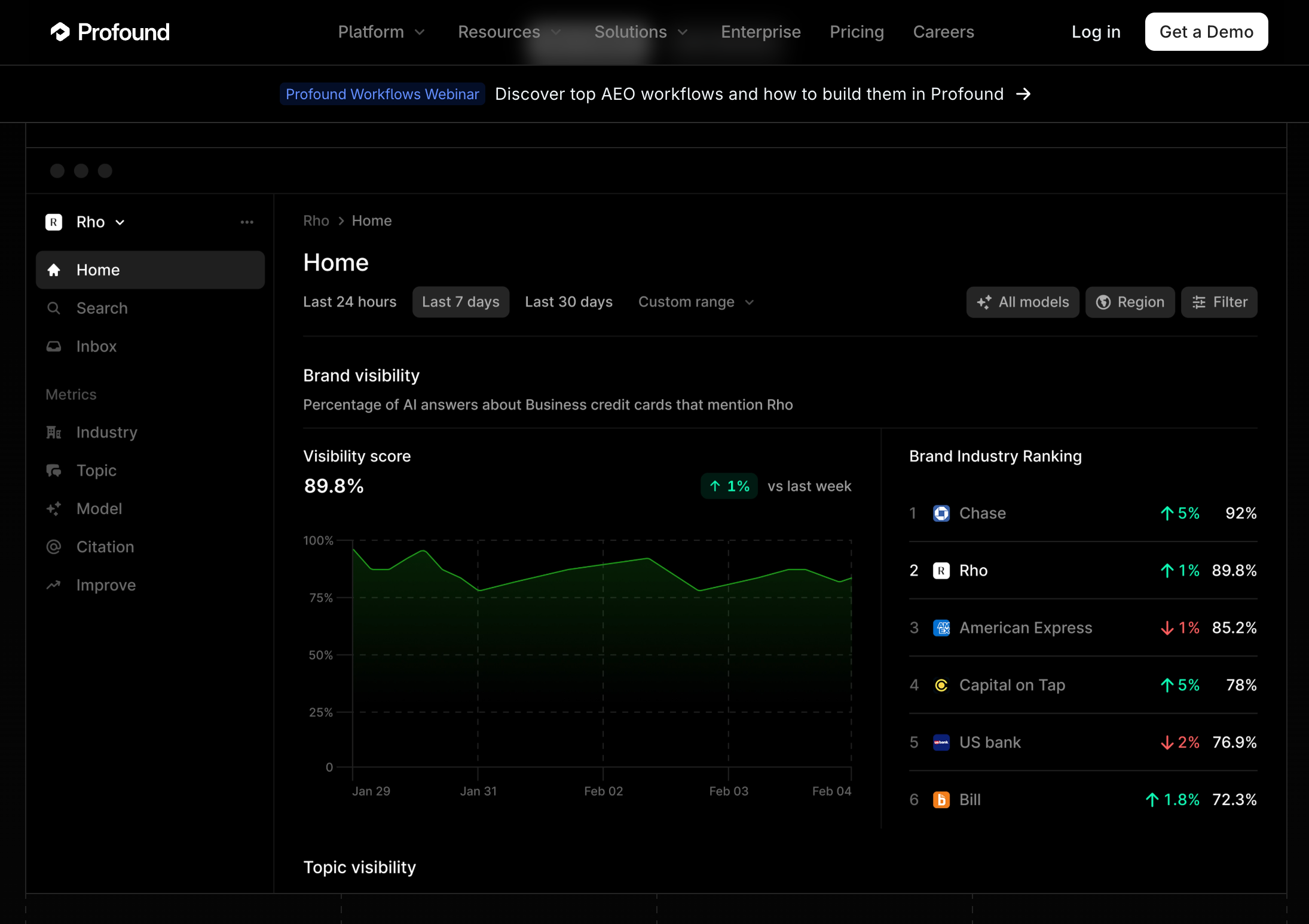
It monitors visibility, share of voice, position, sentiment, competitors, citations, and complete AI responses daily. Citation analysis covers both domains and individual pages.
Profound also captures responses directly from consumer-facing AI interfaces instead of model APIs, making its data more representative of what users see.
AirOps vs Profound: Which is better for AI visibility, citation, and platform coverage?
Profound offers deeper answer-engine intelligence through broader platform coverage and browser-based data collection. AirOps is better for SEO teams that want to analyze AI visibility alongside Google search and page performance.
Want to compare more platforms across prompts, citations, share of voice, and competitors? Explore the best AI rank tracker tools for 2026
Which tool is better for prompt research and opportunity prioritization?
Both platforms identify visibility gaps and recommend actions. AirOps is more page and content focused, while Profound analyzes a wider set of AI search signals.
What AirOps offers
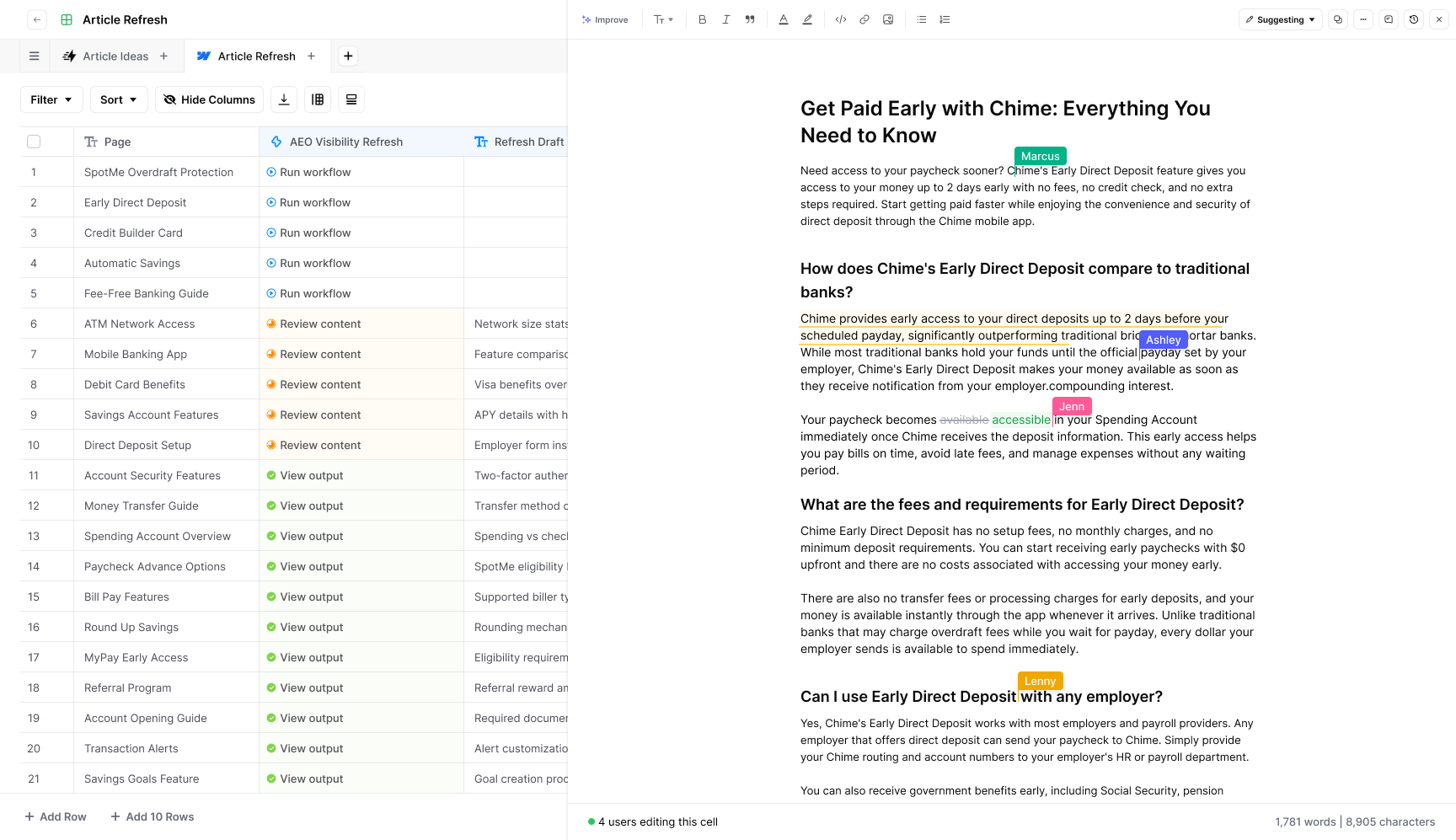
AirOps Prompt Discovery finds buyer questions using panel data, People Also Ask, search intent, and voice-of-customer sources. Prompt demand is displayed through relative volume tiers rather than exact estimates.
Opportunities recommends new content, refreshes, publisher outreach, and community engagement. It prioritizes gaps using prompt volume, competitor presence, and business relevance. Page360 adds Google Search Console performance, GA4 engagement, AI citations, and content freshness to identify high-impact pages.
Selected opportunities can be moved directly into Grids, briefs, and creation or refresh workflows. However, sentiment remediation is not a dedicated opportunity type.
What Profound offers
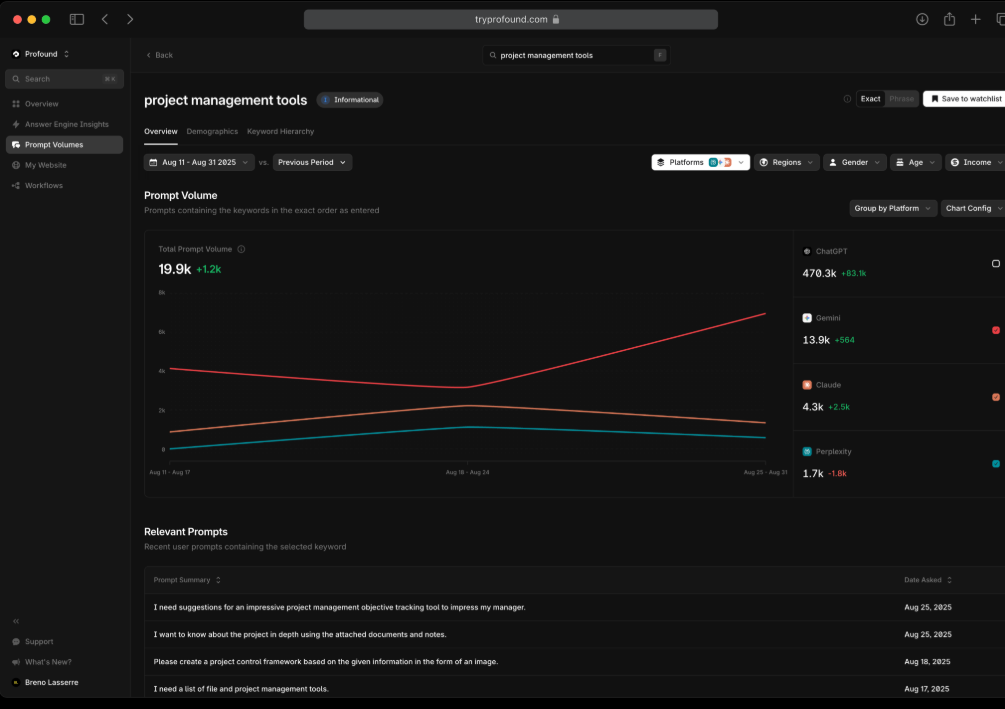
Profound Prompt Volumes analyzes real, anonymized AI conversations to estimate demand, identify trends, and classify intent. Its Enterprise-only Prompt Research Reports filter and cluster prompts by relevance, share of volume, intent, and conversation coverage.
Aim scans visibility, citations, sentiment, prompt demand, competitor performance, sitemaps, and brand data. It surfaces a ranked weekly list covering content gaps, negative sentiment, competitor gains, citation opportunities, and emerging demand. Each recommendation includes its supporting data, although Profound does not publish a fixed scoring formula.
Accepted opportunities become Projects with recommended tasks connected to Profound Agents for research, content creation, optimization, outreach, and publishing.
AirOps vs Profound: Which is better for prompt research and opportunity prioritization?
Profound is stronger for demand-backed prompt research and broader strategic prioritization. AirOps is better for SEO teams that want to prioritize existing pages and move content creation or refresh opportunities into bulk execution quickly.
Building your own high-intent prompt set? Follow this step-by-step guide to auditing brand visibility on LLMs
Which tool is better for content creation, workflow automation, and publishing?
Both platforms support content creation, refreshes, bulk automation, and direct publishing. The difference lies in workflow control and ease of implementation.
What AirOps offers
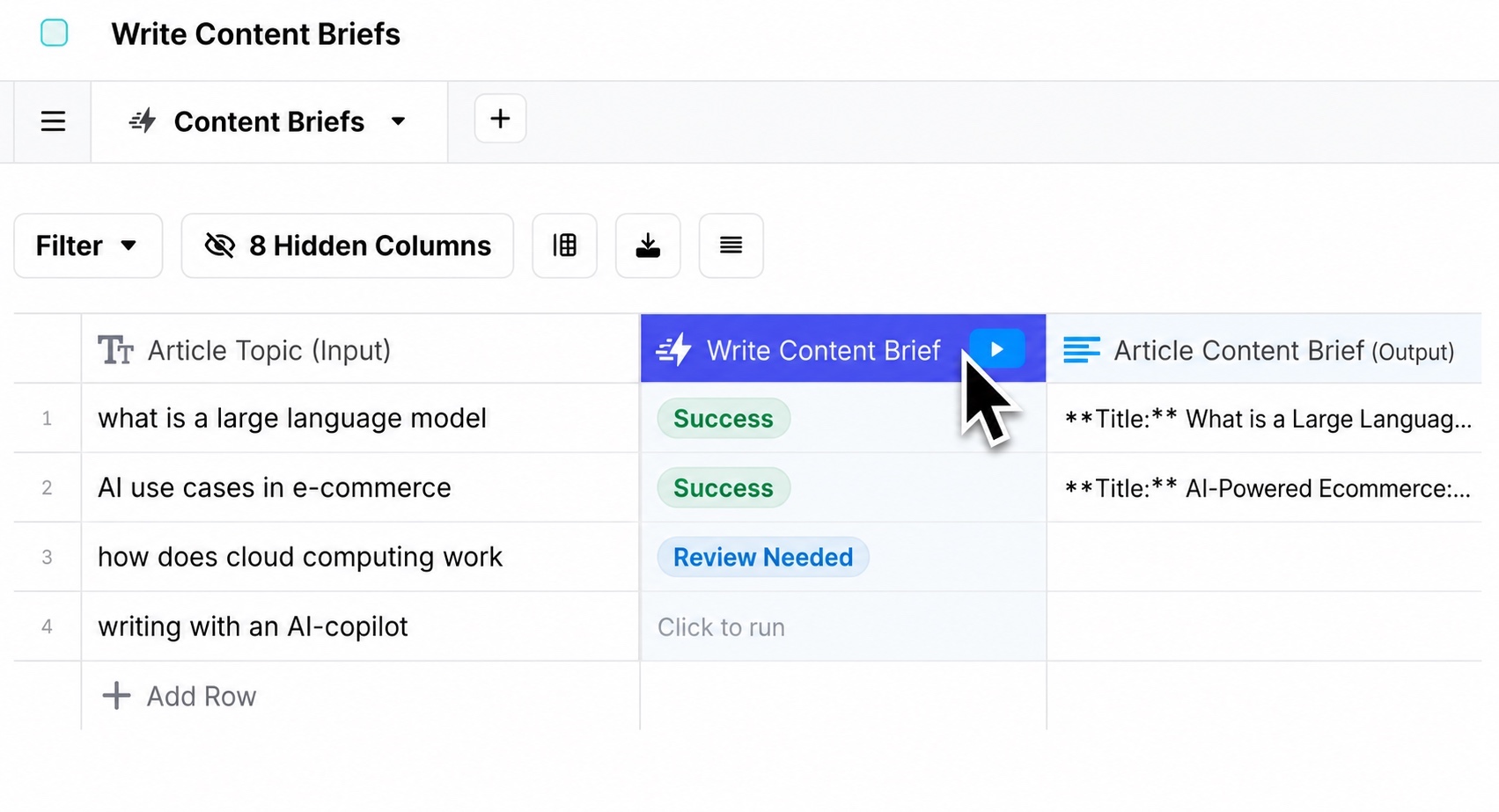
AirOps combines adaptive Playbooks with deterministic Workflows. Quill executes Playbooks from goal-based instructions, while Workflows support fixed sequences, branching logic, loops, quality checks, and human approval steps.
Grids run Playbooks and Workflows across hundreds of pages or topics. Teams can inspect intermediate outputs, compare versions, approve changes, and publish content in bulk.
Brand Kits enforce voice, audience, product, and regional rules, while Knowledge Bases ground content in proprietary information. AirOps can publish directly to platforms such as WordPress, Webflow, Contentful, Sanity, and Ghost. This provides extensive control, although advanced workflows require more initial configuration.
What Profound offers
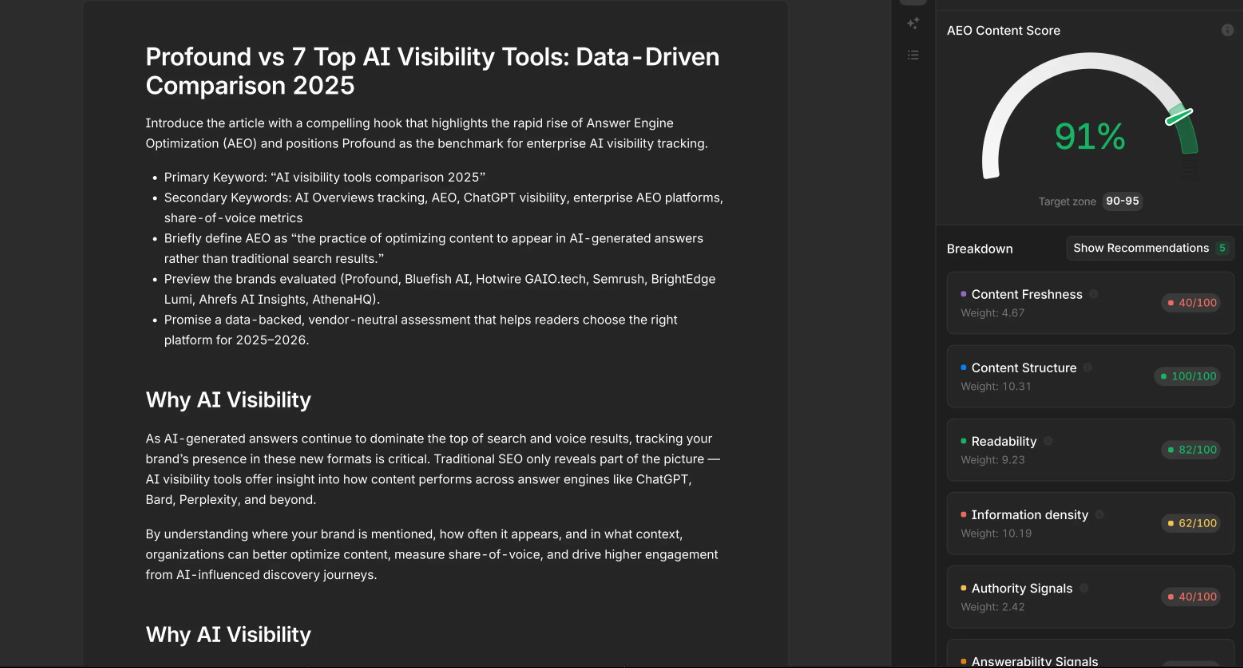
Profound Agents use prebuilt templates or a drag-and-drop builder to create articles, refresh pages, generate briefs, and conduct competitive research. Workflows support configurable nodes, API calls, iterations, and conditional branches with AND/OR logic.
Sheets runs Agents across hundreds of inputs in parallel, with every step visible and editable. Documents provides a collaborative space for reviewing Agent outputs, while Skills applies reusable writing standards, AEO rules, and content guardrails across workflows.
Agents can use Brand Kits and Knowledge Bases, include optional human approval, and publish directly to CMS platforms such as WordPress, Webflow, Contentful, Sanity, Framer, and Payload.
AirOps vs Profound: Which is better for content creation, workflow automation, and publishing?
AirOps is stronger for teams needing deeper workflow control, repeatable bulk operations, and complex content pipelines. Profound is better suited to teams that want template-led implementation, collaborative editing, and scalable AEO content workflows with less setup.
Want more options for turning insights into publish-ready content? Compare the best AI tools for content creation in 2026
Which tool better measures crawler activity and the impact of content changes?
Profound provides deeper crawler and AI referral analytics. AirOps offers a stronger view of how content updates affect both AI visibility and traditional search performance.
What AirOps offers
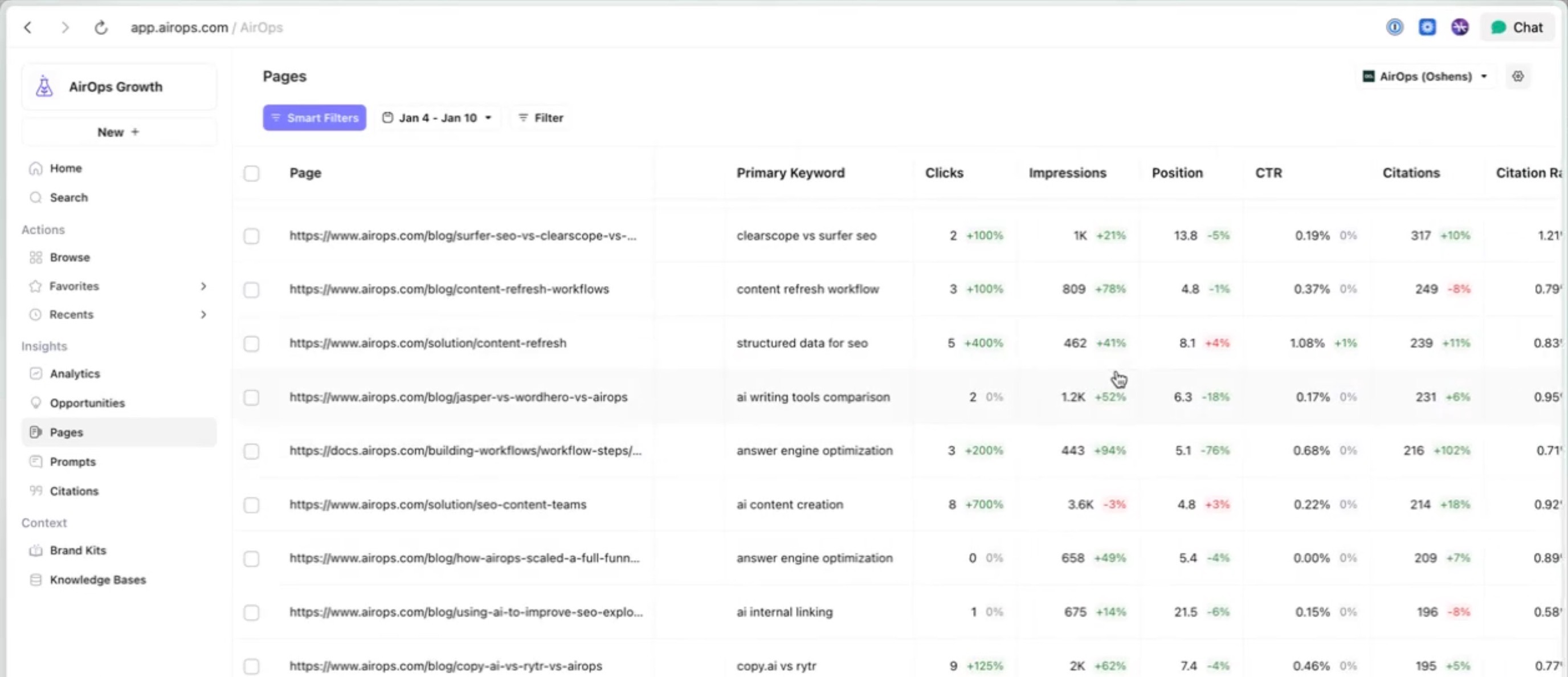
AirOps Agent Analytics uses edge and server logs from CloudFront, Cloudflare, Netlify, and Vercel to classify AI bot visits. GA4 integration tracks AI referral traffic, engagement, and conversion impact.
Page360 combines page-level citations with GSC clicks, impressions, rankings, and CTR, plus GA4 traffic and engagement. This helps teams determine whether an update improved AI citations, organic visibility, or on-page performance.
Updates published through native CMS integrations or Grids are recorded automatically. AirOps can also detect meaningful website changes, including title rewrites, schema additions, and structural updates. Teams can then compare citation, traffic, and search performance before and after each change.
What Profound offers
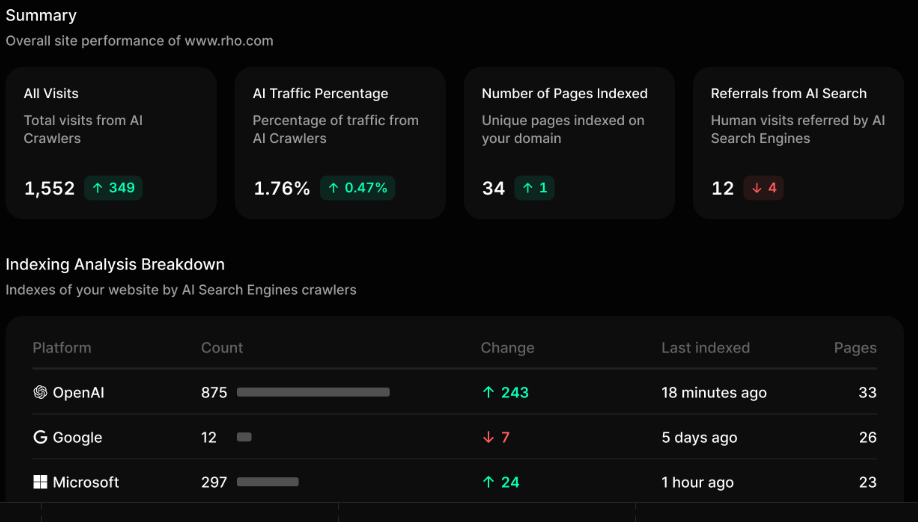
Profound Agent Analytics tracks crawler visits through server and CDN logs. It verifies legitimate AI bots, filters spoofed activity, classifies crawler intent, and reports which pages bots access, how often they return, and whether they encounter rendering or response-time issues.
Its infrastructure coverage includes AWS, Akamai, Cloudflare, Fastly, Google Cloud, Netlify, Vercel, WordPress, Shopify, and Adobe. GA4 integration connects AI crawler activity with human referrals and conversions.
Profound also combines crawler activity with page-level citations and visibility. Aim tracks actions completed within Projects, while Bot Visits and Human Referrals data can feed directly into Agents. However, Profound does not provide the same native GSC-centered page view as AirOps.
AirOps vs Profound: Which is better for crawler and content impact measurement?
Profound is better for verified crawler monitoring, technical crawlability, and AI referral attribution. AirOps is better for measuring how content changes affect citations, Google search performance, traffic, and engagement in one page-level view.
Want to understand what AI bots are doing on your website? Learn how AI user agents crawl content and how to manage them.
Which AI visibility platform offers better integrations, enterprise controls, and team fit?
Both are enterprise-ready. The deciding factor is how each platform fits your team’s operating model and technology stack.
What AirOps offers

AirOps is strongest for SEO and content operations. It connects with major CMSs, SEO platforms, GSC, project management tools, Slack, and Gmail.
Its API supports warehouse and BI pipelines, while direct SQL and private database connections suit data-heavy workflows. AirOps also provides a native MCP server for accessing visibility data, Brand Kits, Knowledge Bases, and opportunities through AI assistants.
Governance includes SSO, SOC 2 Type II compliance, Admin, Builder, and Operator roles, reusable workflows, and approval steps. Enterprise plans add unlimited seats, dedicated training, account management, and one-to-one onboarding.
What Profound offers
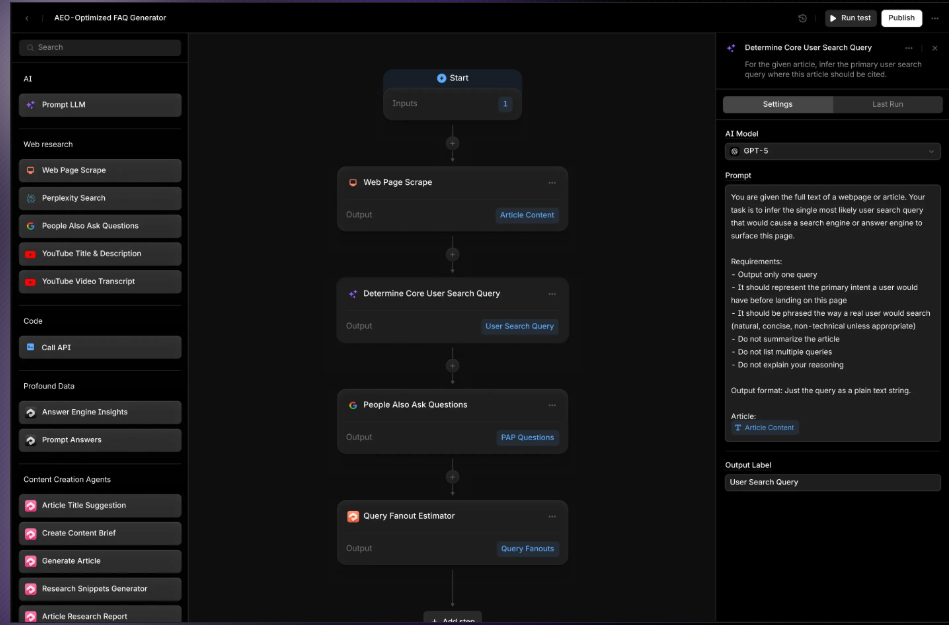
Profound connects with CMSs, GSC, Google and Adobe Analytics, DataForSEO, Looker, project management tools, communication platforms, lifecycle marketing tools, and CDNs such as Cloudflare and Akamai.
Enterprise plans include API access, CSV and JSON exports, SSO/SAML, role-based permissions, SOC 2 Type II compliance, encryption, dedicated Slack support, and a support specialist. However, Profound does not publicly document a native MCP server or direct SQL-based warehouse connectivity.
Brand Kits, Knowledge Bases, reusable Skills, Agent approval steps, and Aim’s shared Documents and Sheets help teams standardize and review work.
AirOps vs Profound: Which offers better integrations, enterprise controls, and team fit?
Choose AirOps for content-heavy SEO operations requiring deep CMS, SEO, warehouse, API, and MCP connectivity. Choose Profound for enterprise or agency teams coordinating AEO across analytics, content, brand, lifecycle marketing, and web infrastructure.
Building a broader content and GEO stack for clients? Compare the best AI tools for marketing agencies in 2026.
AirOps vs Profound pricing: Which offers better value?
What AirOps offers
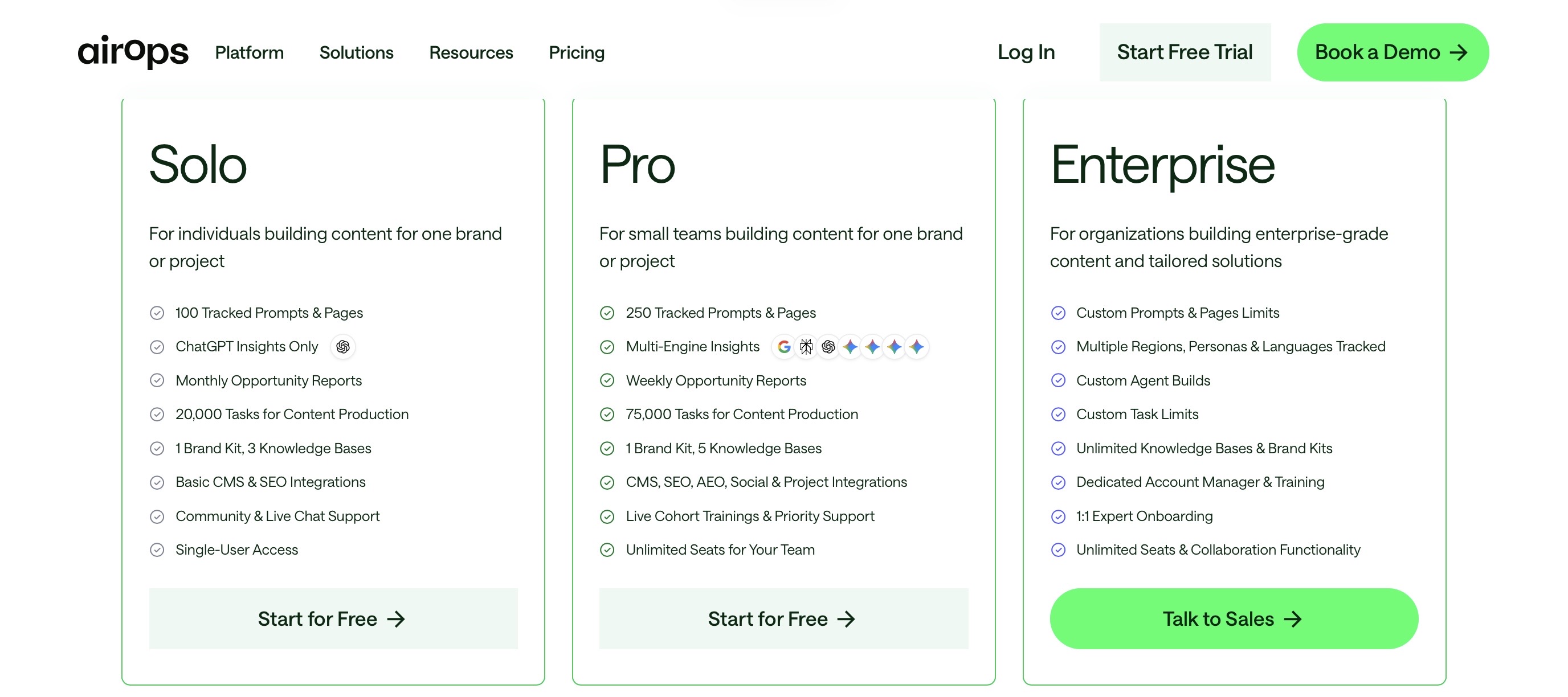
- Solo: Includes 100 tracked prompts and pages, ChatGPT insights, 20,000 tasks, one Brand Kit, three Knowledge Bases, and one user.
- Pro: Includes 250 tracked prompts and pages, multi-engine insights, 75,000 tasks, broader integrations, training, priority support, and unlimited seats.
- Enterprise: Custom pricing. Adds custom limits and agents, API access, unlimited Brand Kits and Knowledge Bases, onboarding, and dedicated support.
AirOps offers a 14-day free trial. Solo overages cost $0.025 per task.
What Profound offers
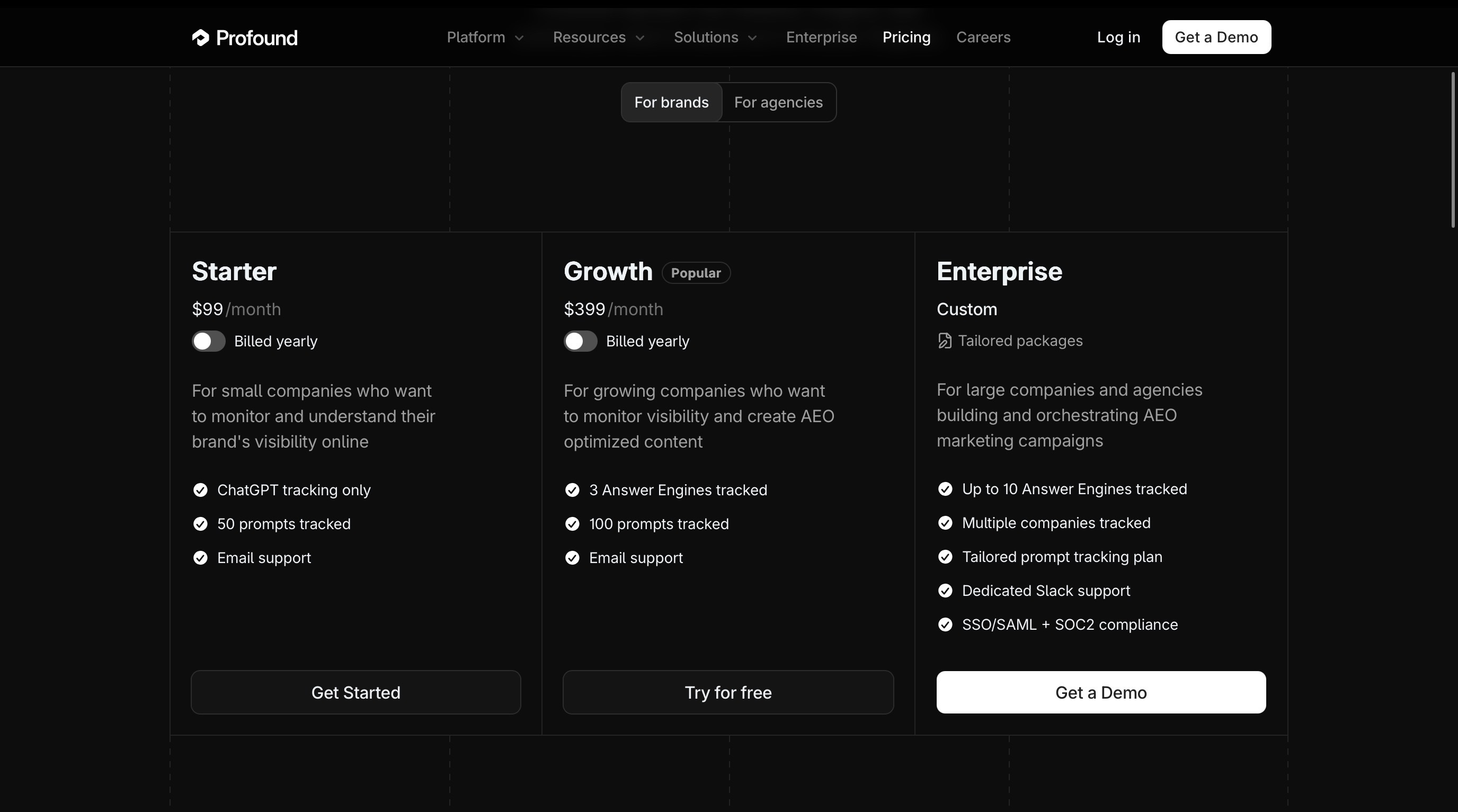
- Starter: $99/month, billed annually. Includes ChatGPT tracking, 50 prompts, 100 Agent credits, one seat, and email support.
- Growth: $399/month, billed annually. Includes three answer engines, 100 prompts, 400 Agent credits, weekly opportunities, data exports, and three seats.
- Enterprise: Custom pricing. Adds up to 10 answer engines, multiple companies, custom limits, API access, SSO/SAML, and dedicated Slack support.
Annual plans include two months free, while Growth can be tried for free.
Need a more affordable GEO stack? Compare the best GEO tools under $100 per month.
What do G2 users say about AirOps and Profound?
The supplied G2 snapshots show AirOps at 4.7/5 from 130 reviews and Profound at 4.5/5 from 1,124 reviews. AirOps has the higher average rating, while Profound’s score comes from a much larger review base.
What users say about AirOps
AirOps users frequently praise its workflow customization, scalable content production, time savings, and responsive support. Teams value being able to centralize research, writing, optimization, and publishing instead of managing disconnected tools.
“AirOps has unlocked our ability to post custom content at scale across the site,” says Stephanie M., Senior Director of Global Acquisition Marketing, on G2.
The most common concerns involve setup complexity, advanced workflow configuration, and usage costs. Some reviewers say credits can deplete quickly if teams do not monitor consumption.
“There is a bit of a learning curve upfront, especially when setting up more advanced workflows,” says Craig N., Revenue Operations Manager, on G2.
Overall, users see AirOps as powerful and flexible, but its value depends on having the time and expertise to build effective workflows.
What users say about Profound
Profound users consistently value its competitor intelligence, citation tracking, prompt-level insights, clear reporting, frequent product updates, and strategic support.
“The competitor visibility, citation and link tracking... give us a clearer picture of where we’re showing up,” says Natasha G., SEO Copywriter, on G2.
Critical feedback focuses on pricing, reporting flexibility, recommendation clarity, and the amount of configuration or interpretation required.
“Some workflows also take longer to configure than expected, and the interface can feel dense for newer users,” says Ashley W., Marketing Director, on G2.
Profound’s depth is widely appreciated, but smaller or less experienced teams may need additional onboarding and clearer workflows to realize its full value.
Verdict
AirOps earns stronger feedback for customizable content automation and production efficiency. Profound stands out for AI visibility intelligence, competitor analysis, and strategic guidance.
For workflow flexibility and scalable execution AirOps seems to be the best option. Whereas deeper AEO analysis and enterprise visibility reporting Profound is best. Test both using your actual prompts, workflows, and expected usage before committing.
AirOps vs Profound: Which offers better value for money?
Profound provides clearer pricing and more predictable monitoring costs. AirOps may offer greater value for production-heavy teams through larger task allowances, workflow automation, and unlimited Pro seats, but its unpublished prices prevent a direct cost comparison.
Choose Profound for price transparency. Choose AirOps when execution volume and team access matter more.
Where do AirOps and Profound fall short?
AirOps and Profound can both move from AI visibility insights to content execution. The trade-off is operational: AirOps favors configurable content systems, while Profound prioritizes deeper AEO intelligence and cross-functional marketing orchestration.
Where AirOps becomes limiting
AirOps can automate complex research, content refresh, creation, review, and publishing workflows. However, teams must configure and test those workflows, connect data sources, define approval steps, and monitor task consumption.
Usage is task-based, and its pricing is not transparent. AirOps also relies on integrations such as Semrush, Ahrefs, Moz, DataForSEO, and GSC for several traditional SEO inputs rather than replacing the broader SEO stack.
Where Profound becomes limiting
Profound currently supports execution through Agents, Aim, Sheets, Documents, Skills, and CMS integrations. However, access becomes restrictive as AI search visibility tracking and collaboration needs grow.
Profound’s core strength remains answer-engine intelligence, prompt demand, crawler behavior, and brand representation. Teams needing keyword clustering, SERP-based content scoring, sitewide content audits, and internal-link management may still need separate SEO tools.
The gap between AirOps and Profound
The missing piece is not content execution. It is a simpler way for SEO teams to connect AI visibility with the keyword research, writing, optimization, auditing, and internal-linking work they already perform.
Want to compare the broader alternative directly? Explore Scalenut vs AirOps or Scalenut vs Profound AI.
Where Scalenut fits
Scalenut addresses this workflow gap by combining AI Visibility with an established SEO and content toolset. Teams can monitor visibility score, share of voice, average position, sentiment, prompts, mentions, citations, content gaps, competitors, and AI traffic.
Within the same platform, they can use Keyword Planner, Article Writer, GEO AI Editor, Content Optimizer, Auto Optimizer, Content Audit, Link Manager, and WordPress, Shopify, GSC, and Cloudflare integrations.
Scalenut’s advantage is workflow continuity. Teams can identify where visibility is being lost, choose the right topic or page, create or refresh the content, improve its SEO and GEO coverage, strengthen internal links, publish, and measure performance without assembling a complex automation system.
So the decision path is clear: choose AirOps for highly configurable content operations, Profound for advanced answer-engine intelligence and enterprise AEO orchestration, and Scalenut for an integrated SEO and GEO workflow built around everyday content execution.
Want to know more about Scalenut? Read our complete Scalenut review to understand how it fits your team.
Or if you are ready to turn AI visibility into measurable search growth, book a free strategy call with Scalenut today!
Frequently Asked Questions
Which is better for enterprise GEO in 2026: AirOps or Profound?
Profound is stronger for enterprise GEO intelligence, including prompt demand, answer-engine coverage, citation analysis, competitor tracking, and AI crawler activity. AirOps is better for enterprise GEO execution through governed content workflows, bulk updates, approvals, and CMS publishing.
What are the main differences between AirOps and Profound?
Both platforms combine AI visibility insights with execution. AirOps focuses on configurable, high-volume content operations through Quill, Workflows, Grids, and Page360. Profound emphasizes answer-engine intelligence through Answer Engine Insights, Prompt Volumes, Aim, Agent Analytics, and Agents.
Which platform provides deeper AI visibility insights?
Profound provides deeper answer-engine analysis across prompts, citations, competitors, sentiment, regions, languages, and complete AI responses. AirOps offers a more unified view of AI visibility, Google Search Console performance, and GA4 data.
Which tool is better for content creation and automation?
AirOps is stronger for customizable workflows, bulk execution, approval steps, content refreshes, and CMS publishing. Profound also creates and publishes content through Agents, Sheets, Documents, and Skills, but its execution is more closely anchored to its AEO data.
Which platform is better for prompt research?
Profound is stronger for understanding prompt demand through Prompt Volumes, Research Reports, and Aim. AirOps Prompt Discovery and Opportunities are better suited to moving identified gaps directly into content workflows.
Which tool better tracks AI crawlers and referral traffic?
Profound leads in verified crawler activity and AI referral attribution through Agent Analytics and CDN integrations. AirOps is stronger at connecting content changes with page-level citations, rankings, engagement, and conversions.
Is Profound more cost-effective than AirOps?
It depends on usage. Profound starts at $99 per month with annual billing and uses prompt limits and Agent credits. AirOps Insights starts at $0, while advanced Pages requirements use custom and task-based pricing. Buyers should compare prompt volume, workflow runs, users, and implementation costs.
How do users rate AirOps and Profound?
Both currently score 4.6/5 on G2. AirOps has 118 reviews, while Profound has 335. Reviewers value AirOps’ flexibility and content workflows, while Profound receives stronger ease-of-use scores. Ratings and review totals should be rechecked before publication.
What should teams consider before choosing?
Compare AI platform coverage, prompt limits, content volume, workflow flexibility, crawler analytics, integrations, governance requirements, and usage-based costs. AirOps generally fits content operations teams, while Profound suits enterprise AEO programs requiring deeper intelligence.
Are there independent performance benchmarks comparing AirOps and Profound?
No reliable public benchmark directly compares their visibility or content performance. Teams should test both using the same prompts, pages, regions, approval process, and reporting requirements.
When should teams consider an alternative to both?
Consider another platform if you need transparent pricing and a simpler workflow connecting AI visibility, traditional SEO research, content creation, optimization, internal linking, and publishing. Both AirOps and Profound can require significant configuration or higher usage-based spending as requirements grow.
Which is better for SEO teams: AirOps or Profound?
AirOps is generally better for SEO and content operations teams that need to refresh pages, automate production, publish through a CMS, and connect AI visibility with GSC and GA4 data. Profound is better when the team’s priority is prompt demand, multi-engine visibility, citation intelligence, and crawler analysis.
Can AirOps or Profound replace traditional SEO tools?
Not completely. Neither replaces the full keyword, backlink, rank-tracking, and technical-audit capabilities of platforms such as Semrush or Ahrefs. AirOps integrates traditional SEO data more closely with content execution, while Profound remains more focused on AI search intelligence.
Can AirOps replace Profound, or do teams need both?
AirOps can replace Profound when content production and workflow automation are the main priorities. However, teams relying on Profound’s deeper prompt-demand data, broader answer-engine coverage, or crawler analytics may still need it. Using both provides broader coverage but increases cost and workflow complexity.
Do AirOps and Profound offer free trials?
AirOps offers a 14-day free trial without requiring payment details, although it can end earlier if the included tasks are exhausted. Profound allows users to try its Growth plan for free, but its pricing page does not specify the trial duration or usage limits. Enterprise plans for both require contacting sales.


.svg)


.webp)