.jpg)
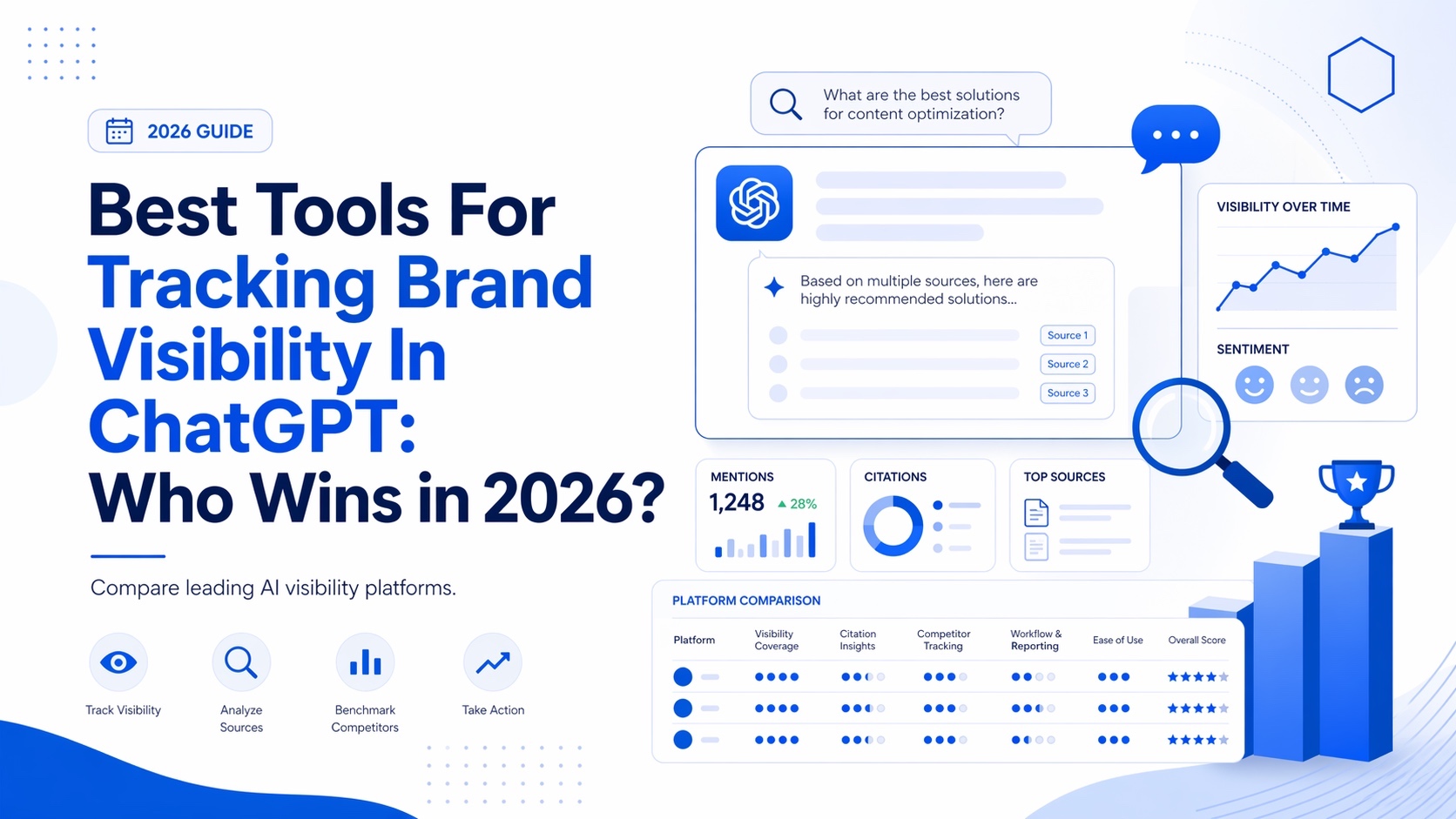
What are the Best Tools For Tracking Brand Visibility In ChatGPT?
Key Highlights
- Strong SEO performance and Google rankings do not guarantee visibility inside ChatGPT and other AI-driven answer environments.
- The best tools go beyond traditional analytics by showing where your brand appears, which prompts trigger mentions, and which sources shape AI answers.
- Features like prompt tracking, citation analysis, competitor benchmarking, and sentiment insights make visibility data more useful and actionable.
- Some platforms are built mainly for monitoring, while others also help teams execute through content optimization, SEO workflows, and authority-building actions.
- Scalenut stands out for teams that want execution support, while tools like Semrush, Profound, Similarweb, SE Ranking, and Otterly.AI each fit different workflow needs.
- The right platform should help you track share of voice across major AI engines, not just count isolated brand mentions.
- More advanced tools can also connect AI visibility with traditional web traffic, referral visits, AI bot activity, and page-level interaction signals.
- The best choice is the one that matches how your team works and makes it easier to turn AI visibility insights into next steps.
Most brands still measure visibility like it is only a Google problem. They track rankings, clicks, and traffic, then assume that strong SEO means they will also show up in ChatGPT. In reality, many brands with decent search visibility barely appear in AI-generated answers.
That is where the confusion starts. Traditional SEO tools were not built to show how often your brand is mentioned in ChatGPT, which competitors appear alongside you, what sources shape those answers, or where your visibility is actually slipping. So teams end up guessing instead of measuring.
This guide is built for that exact gap. We break down the best tools to measure ChatGPT brand mentions in search, what each one does well, and how to choose the right fit for your team.
Quick Snapshot: How These ChatGPT Visibility Tools Stand Apart
Here is a fast comparison of the clearest differentiator for each platform before we break them down in more detail.
- Scalenut: Combines AI visibility tracking with SEO and content execution, so teams can move from mentions, prompt gaps, and competitor signals straight into action.
- Semrush AI Visibility Toolkit: Brings AI visibility into a broader SEO workflow by combining prompt tracking, competitor benchmarking, sentiment analysis, technical audits, and reporting.
- Similarweb AI Brand Visibility: Stands out for market-level benchmarking by showing how often your brand appears in AI answers, which topics drive mentions, and how you compare with competitors.
- Profound: Focuses on deeper answer-engine intelligence with AI visibility tracking, response analysis, citation discovery, and broader cross-engine brand monitoring.
- Peec AI: Positions itself as a focused AI search analytics platform for marketing teams, with ChatGPT visibility tracking, competitor monitoring, citation insights, and action-oriented recommendations.
- Ahrefs Brand Radar: Its biggest strength is large-scale AI visibility benchmarking across a massive search-backed prompt universe, plus cited-page and cited-domain analysis.
- SE Ranking ChatGPT Visibility Tracker: Differentiates itself with focused ChatGPT monitoring based on actual response analysis, mention and link capture, and historical visibility data.
- Otterly.AI: Offers an accessible AI search monitoring workflow built around prompt libraries, brand mention tracking, citation monitoring, and cross-platform visibility reporting.
- Scrunch: Goes beyond monitoring by combining AI search visibility tracking with citation analysis, website optimization, and AI-ready content delivery through a broader operational platform.
What Are The 9 Best Tools For Tracking Brand Mentions In ChatGPT In 2026?
The best tools for tracking brand mentions in ChatGPT in 2026 help teams monitor visibility, analyze citations, compare competitors, and understand how often their brand appears across important prompts.
Below, we break down the best tools to monitor brand in ChatGPT answers, what each one does well, and which type of team each platform is best suited for.
1. Scalenut
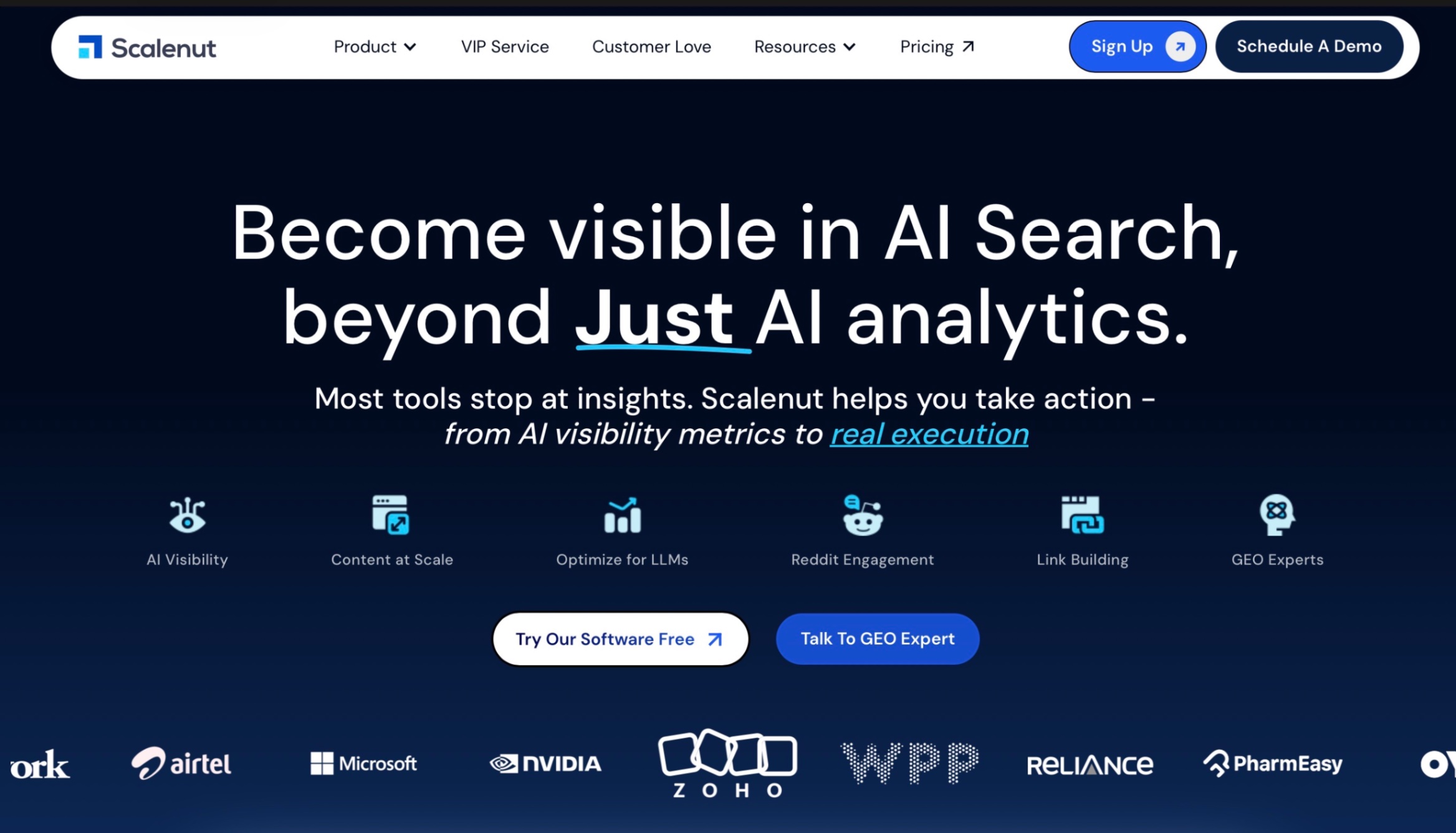
Scalenut combines AI visibility tracking with hands-on SEO execution in one platform. Instead of only showing where your brand appears in AI answers, it also helps teams act on those insights through content, optimization, authority, and traffic workflows.
Best For: Teams that want to track brand visibility in ChatGPT and other AI search environments, then turn those insights into execution through SEO research, content optimization, internal linking, and authority-building workflows.
How Does Scalenut Help With Tracking Brand Visibility In ChatGPT?
1. AI Visibility Tracking And Brand Monitoring
Scalenut helps teams track how their brand appears across AI-generated answers, including ChatGPT-focused monitoring. Instead of relying on simple mention counts, it is positioned around broader visibility measurement, helping teams understand how often they appear, how they compare with competitors, and where visibility is stronger or weaker across platforms.
2. Prompt-Level Intelligence
One of Scalenut’s more important strengths is its prompt-led visibility approach. It helps teams see which prompts and topic areas are generating brand appearances and where those appearances are missing. That makes it easier to understand where visibility is being won, where it is being lost, and which questions deserve deeper coverage.
3. Citation And Source Insights
Scalenut also connects AI visibility with source logic. It helps teams identify the sources and pages that appear to influence AI-generated answers, which is important for brands trying to improve authority, strengthen sourceworthiness, and understand what kind of content AI systems seem to trust.
4. Competitor Visibility Analysis
The platform includes competitive visibility monitoring so teams can evaluate how often other brands appear alongside them in AI answers. This makes the data more useful because it shifts the conversation from simple brand presence to relative visibility and competitive share of attention.
5. AI Traffic And Bot Monitoring
Scalenut goes beyond mention tracking by incorporating AI bot and traffic monitoring. It helps identify AI bot visits, surface top AI sources interacting with a site, highlight pages that appear to be referenced most often, and track AI traffic trends over time. For sites running on Cloudflare, it also supports deeper monitoring through Cloudflare integration.
6. Action Paths From Insight To Execution
A major part of Scalenut’s positioning is that it does not stop at reporting. It is designed to help teams move from visibility gaps to next steps, including content opportunities, authority-building ideas, and workflow recommendations that can improve performance across both SEO and AI visibility.
What Are The Other Standout Features Of Scalenut?
- Scalenut includes a broader SEO and content execution stack, not just AI visibility monitoring
- Its platform supports content drafting, on-page optimization, content scoring, and AI-humanized refinement
- It also includes keyword planning, competitor coverage analysis, traffic analysis, and content auditing
- Internal linking support, on-page benchmarking, and backlink workflows make it more actionable than a pure visibility dashboard
- Its product structure is clearly built around visibility insights plus execution support, which is a meaningful differentiator in this category
Why Consider Scalenut?
- It stands out by combining AI visibility tracking and SEO execution in one workflow
- It is a strong fit for teams that want to go from insight to action without switching between multiple tools
- It is especially practical for content, SEO, and growth teams that need both monitoring and execution support
- Its self-serve pricing model makes it easier to evaluate than tools that rely more heavily on demo-led sales
Where Does Scalenut Fall Short?
- Teams looking for pure enterprise intelligence and deeper market-level modeling may prefer a more analytics-heavy platform
- Buyers who only want a narrow mention-tracking dashboard may find Scalenut broader than they need
- Some highly specific metric labels are discussed more in supporting materials than in core high-level product positioning, so its clearest strength is the overall workflow rather than one single standout metric
What Does Scalenut’s Pricing Look Like?
- Starter starts at $59/month
- Plus starts at $89/month
- Professional starts at $199/month
- VIP Service pricing is custom
How Do Users Rate Scalenut?
G2 Rating: 4.7/5
2. Semrush AI Visibility Toolkit
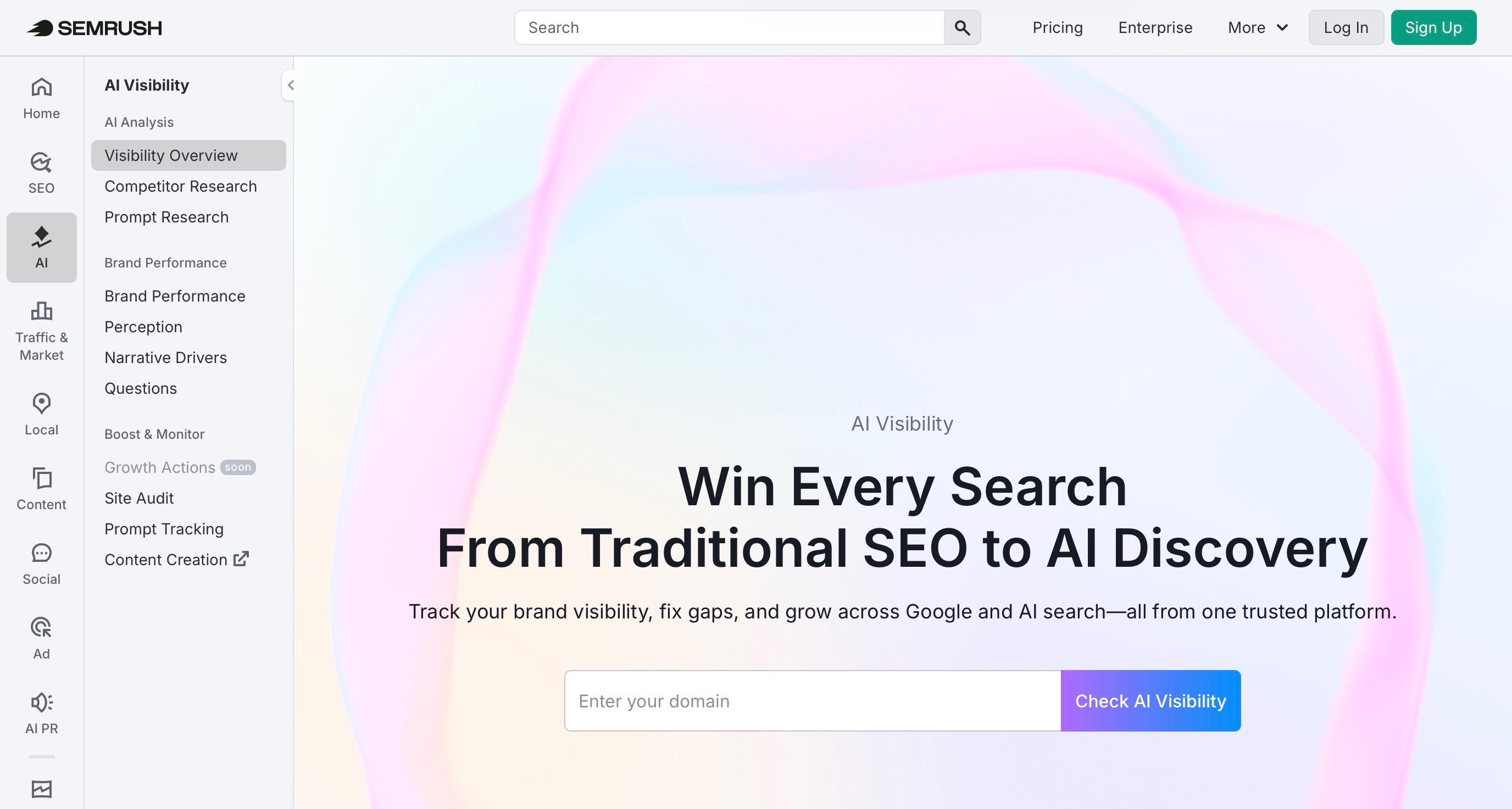
Semrush AI Visibility Toolkit helps brands measure how they appear across AI-driven search experiences. It is built for teams that want visibility tracking, competitor analysis, and reporting within a broader SEO workflow.
Best For: SEO, marketing, and agency teams that want to track brand visibility across ChatGPT and other AI search environments while connecting those insights to broader SEO and technical workflows.
How Does Semrush AI Visibility Toolkit Help With Tracking Brand Visibility In ChatGPT?
- Tracks brand visibility and mentions across AI-driven search environments, including ChatGPT
- Shows how often your brand appears in AI answers and how that visibility compares with competitors
- Helps uncover prompts and topics that matter to your business so you can monitor the conversations where visibility matters most
- Tracks daily AI visibility for the prompts you choose to monitor
- Surfaces cited pages and distribution across AI platforms, helping connect brand mentions to specific sources and content
What Are The Other Standout Features Of Semrush AI Visibility Toolkit?
- Includes brand perception and sentiment analysis against competitors
- Identifies competitive gaps and new visibility opportunities in AI search
- Audits technical issues that may block AI crawlers from accessing your site
- Turns AI visibility data into presentation-ready reports for stakeholders or clients
- Connects AI visibility work with Semrush’s wider SEO and site audit ecosystem
Why Consider Semrush AI Visibility Toolkit?
- It is a strong fit for teams that do not want a standalone AI visibility dashboard and would rather keep this work inside a broader SEO platform
- It combines tracking, benchmarking, technical diagnostics, and reporting in one place, making it useful for ongoing execution rather than one-off monitoring
- It is especially practical for agencies and in-house SEO teams that need to prove progress to clients or leadership
- It covers both visibility measurement and site readiness for AI search, which many narrower tools do not emphasize as much
Where Does Semrush AI Visibility Toolkit Fall Short?
- It is not positioned as a ChatGPT-only solution, so teams looking for a very narrow single-use tracker may find it broader than they need
- Much of its value is tied to the wider Semrush ecosystem, which may feel heavy for smaller teams that only want lightweight AI visibility monitoring
- Some advanced use cases may require higher-tier Semrush products or add-ons rather than a single simple entry point
What Does Semrush AI Visibility Toolkit‘s Pricing Look Like?
- Pro starts at $117/month
- Guru starts at $208/month
- Business starts at $416/month
- Enterprise pricing is custom
How Do Users Rate Semrush AI Visibility Toolkit?
No ratings yet on G2.
3. Similarweb AI Brand Visibility
Similarweb AI Brand Visibility helps businesses see where their brand appears in generative AI tools like ChatGPT and how that presence compares with competitors. It sits within Similarweb’s broader AI Search Intelligence offering, which also includes AI traffic analysis.
Best For: Teams that want market-level benchmarking, competitive visibility analysis, and a broader view of how brand presence in ChatGPT connects to AI-driven discovery and traffic trends.
How Does Similarweb AI Brand Visibility Help With Tracking Brand Visibility In ChatGPT?
- Shows where your brand appears in generative AI tools like ChatGPT
- Measures how your presence compares with competitors across core topics
- Tracks how often your brand appears in LLM answers as part of its AI Brand Visibility module
- Helps quantify visibility share, mention share, and citation share in AI-generated answers
- Gives teams a way to connect AI visibility measurement with broader chatbot and model coverage, not just a single-platform view
What Are The Other Standout Features Of Similarweb AI Brand Visibility?
- Includes sentiment analysis within the AI Brand Visibility module
- Comes bundled with AI Traffic capabilities that show traffic coming from major LLMs
- Supports broader AI Search Intelligence use cases beyond mention tracking, including prompts, citations, and sentiment analysis
- Benefits from Similarweb’s broader market intelligence and competitive intelligence strengths
- Extends well into sector-level benchmarking and comparative market analysis
Why Consider Similarweb AI Brand Visibility?
- It is a strong option for teams that care about competitive benchmarking as much as brand monitoring
- It connects AI visibility with AI-driven traffic, which is useful for teams trying to understand both brand presence and downstream impact
- It is especially appealing to strategy, intelligence, and leadership teams that want a wider market view instead of only prompt-by-prompt monitoring
- Its sentiment and citation-oriented metrics help teams move beyond simple mention counting
Where Does Similarweb AI Brand Visibility Fall Short?
- It appears more focused on competitive and market-level intelligence than on content execution workflows
- Teams looking for a tool tightly embedded in day-to-day SEO execution may find it less workflow-oriented than platforms built more directly around SEO operations
- Some of the broader value comes from the wider AI Search Intelligence package, so buyers may need more than one module to get the full picture
Want to improve visibility beyond ChatGPT too? Read our guide to the best AI SEO agency for AI Overview ranking and find the right partner for broader AI search growth.
4. Profound
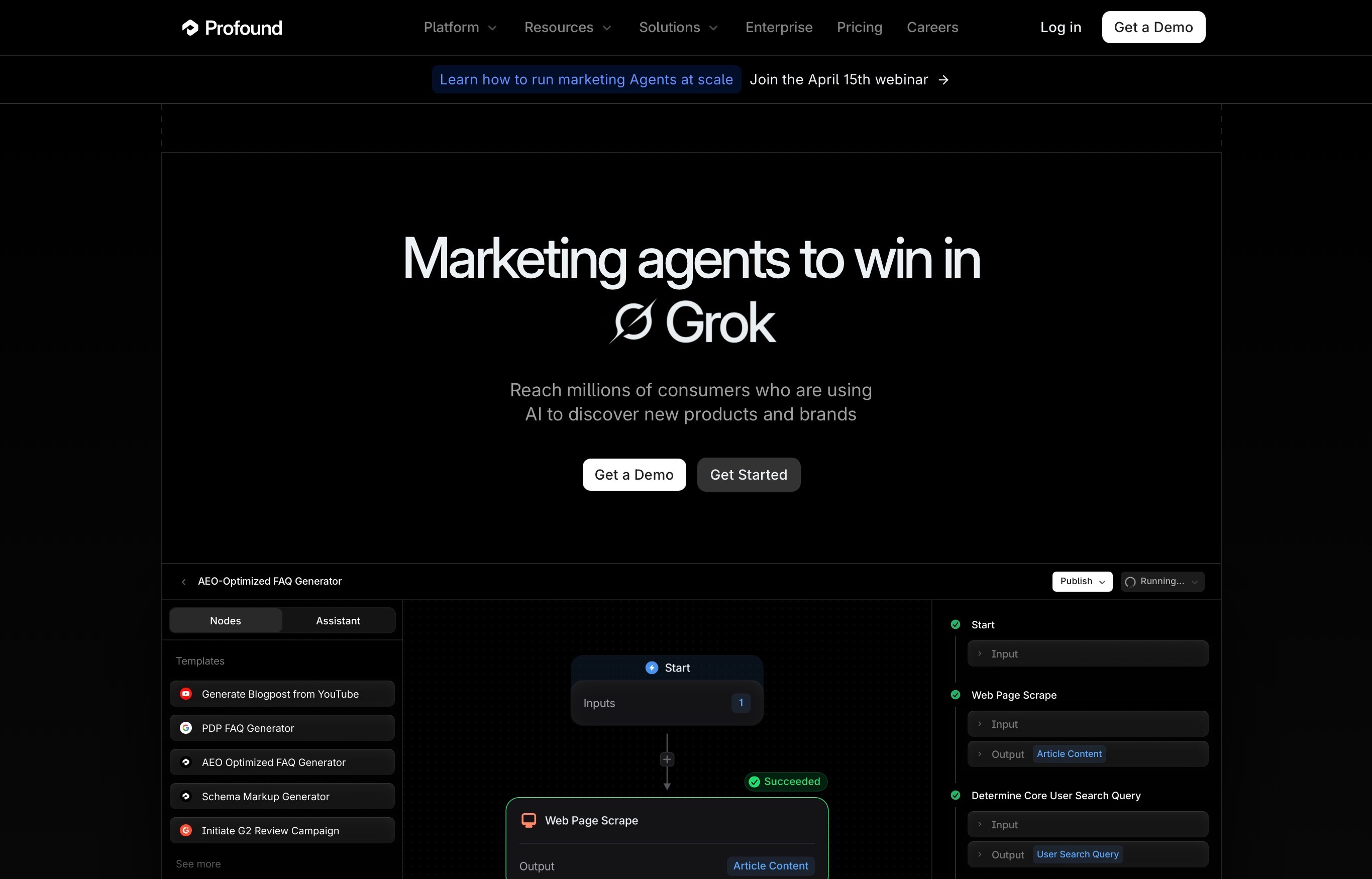
Profound is an AI visibility platform built to help brands understand how they show up across AI-generated answers. It is geared toward teams that want deeper visibility data, citation analysis, and share-of-voice insights across answer engines.
Best For: Enterprise brands and advanced marketing teams that want detailed AI visibility analysis across multiple answer engines, not just a lightweight ChatGPT monitoring tool.
How Does Profound Help With Tracking Brand Visibility In ChatGPT?
- Tracks how often your brand appears in AI answers, including ChatGPT-related answer engine use cases
- Shows where and how AI mentions your brand, helping teams understand brand presence beyond simple appearance counts
- Measures core visibility signals such as visibility score, share of voice, and average position in AI search
- Helps teams analyze the responses AI systems generate about their brand and related topics
- Includes citation analysis so brands can see which websites are shaping AI answers about them
What Are The Other Standout Features Of Profound?
- Covers multiple answer engines rather than focusing on a single platform
- Offers enhanced citation categorization to show who is influencing AI answers about your brand
- Includes dedicated support for product visibility in ChatGPT Shopping through a separate shopping dashboard
- Supports broader answer engine optimization workflows through its Answer Engine Insights product
- Also supports sentiment tracking for brands in answer engines
Why Consider Profound?
- It is a strong fit for teams that want deeper analysis than a basic mention tracker can provide
- It is particularly useful when citation quality, share of voice, and cross-engine visibility matter as much as raw brand mentions
- It appears well suited to brands with more mature AI search programs that need richer data and broader engine coverage
- Its inclusion of shopping visibility and sentiment tracking makes it broader than tools focused only on surface-level monitoring
Where Does Profound Fall Short?
- It is not positioned as a simple, lightweight ChatGPT-only tracker, so smaller teams may find it more robust than they need
- The official positioning emphasizes demo-led adoption rather than transparent self-serve simplicity, which may slow evaluation for some buyers
- Its strength is depth and breadth, which may be less appealing for teams that only want a narrow prompt-tracking workflow
What Does Profound’s Pricing Looks Like?
- Starter starts at $99/month, billed yearly
- Growth starts at $399/month, billed yearly
- Enterprise pricing is custom
How Do Users Rate Profound?
G2 Rating: 4.6/5
Want to go beyond tracking visibility and find the best platforms for optimizing content for AEO? Read our guide to the 9 best platforms for optimizing content for AEO and see who wins in 2026.
5. Peec AI
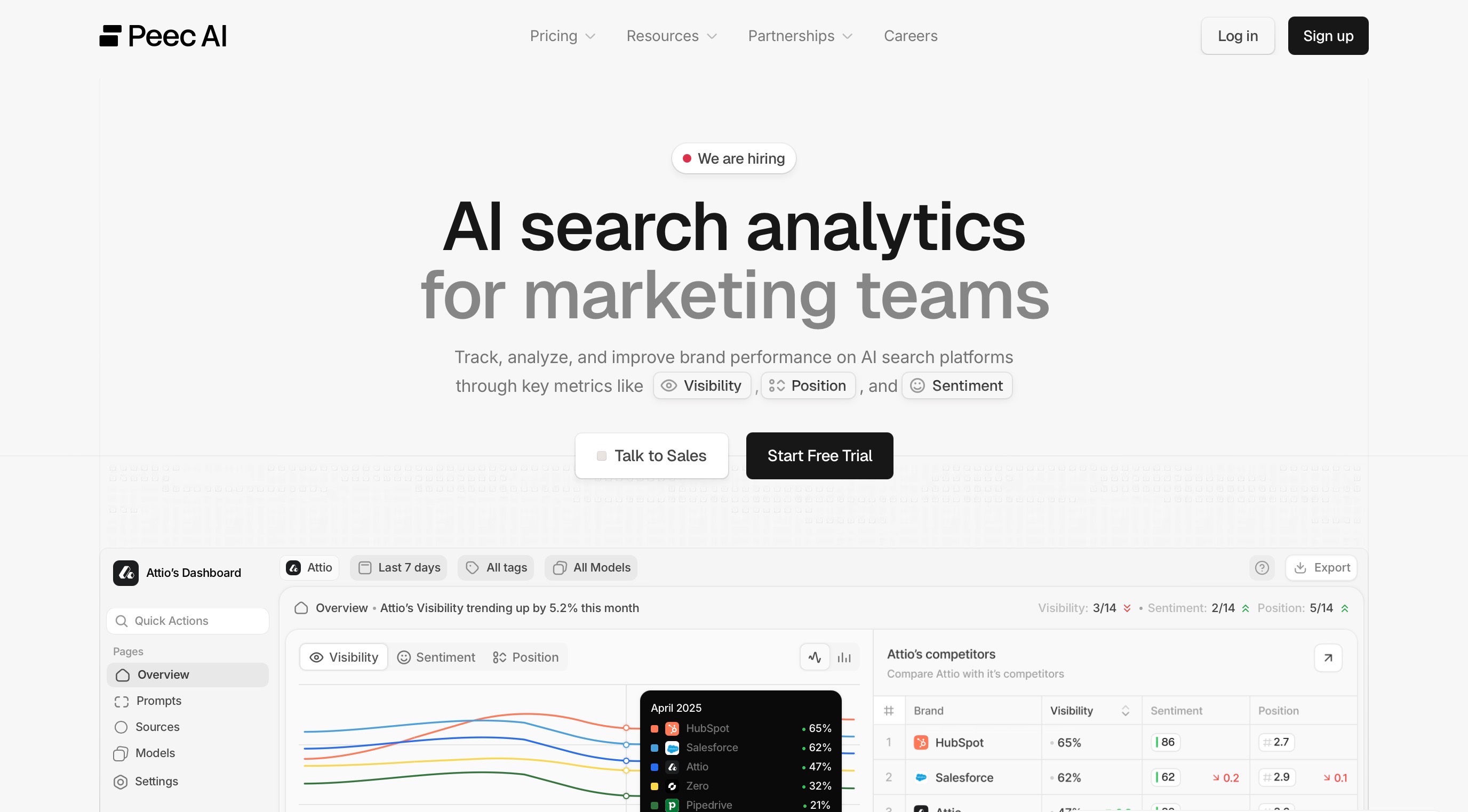
Peec AI is a dedicated AI search analytics platform for marketing teams. It is built around tracking how brands show up in ChatGPT and other AI search environments, with a strong emphasis on visibility, competitor monitoring, and actionable prompt-level insights.
Best For: Marketing teams that want a focused, easier-to-adopt platform for tracking ChatGPT visibility, monitoring competitors, and turning prompt-level data into content and optimization actions.
How Does Peec AI Help With Tracking Brand Visibility In ChatGPT?
- Tracks how your brand shows up in ChatGPT through a dedicated ChatGPT visibility tracker
- Monitors visibility, mentions, and competitor performance for the prompts you care about
- Lets teams track visibility trends over time so changes in performance are easier to spot
- Helps identify the specific sources that influence AI responses in your industry
- Supports custom prompt tracking rather than relying only on a fixed external prompt database
What Are The Other Standout Features Of Peec AI?
- Also tracks visibility across other AI environments such as Gemini and AI Mode, not just ChatGPT
- Organizes visibility work around earned, owned, and impact categories to connect monitoring with action
- Emphasizes actionable insights to help marketing teams improve visibility rather than just report on it
- Offers a documentation experience that is clear about trends, competitor movement, and source influence
- Appears to prioritize consistent prompt history over shifting datasets, which is useful for longitudinal tracking
Why Consider Peec AI?
- It is one of the more focused options for teams that specifically care about ChatGPT visibility
- The platform seems easier to understand and operationalize than more enterprise-heavy alternatives
- Custom prompt tracking makes it attractive for marketers who want to monitor a defined set of commercial prompts over time
- It is well suited to content and SEO teams that want source-level insight they can quickly turn into optimization decisions
Where Does Peec AI Fall Short?
- It appears narrower in scope than platforms built for broader enterprise intelligence across many answer engines
- Teams looking for a large prebuilt prompt universe may prefer a different model, since Peec emphasizes custom prompt tracking
- Its strength is usability and focused tracking, so teams wanting deeper market-intelligence style analysis may need a broader platform
What Does Peec AI’s Pricing Look Like?
- Starter starts at $95/month
- Pro starts at $245/month
- Advanced starts at $495/month
- Enterprise pricing is custom
How Do Users Rate Peec AI?
G2 Rating: 5/5
6. Ahrefs Brand Radar
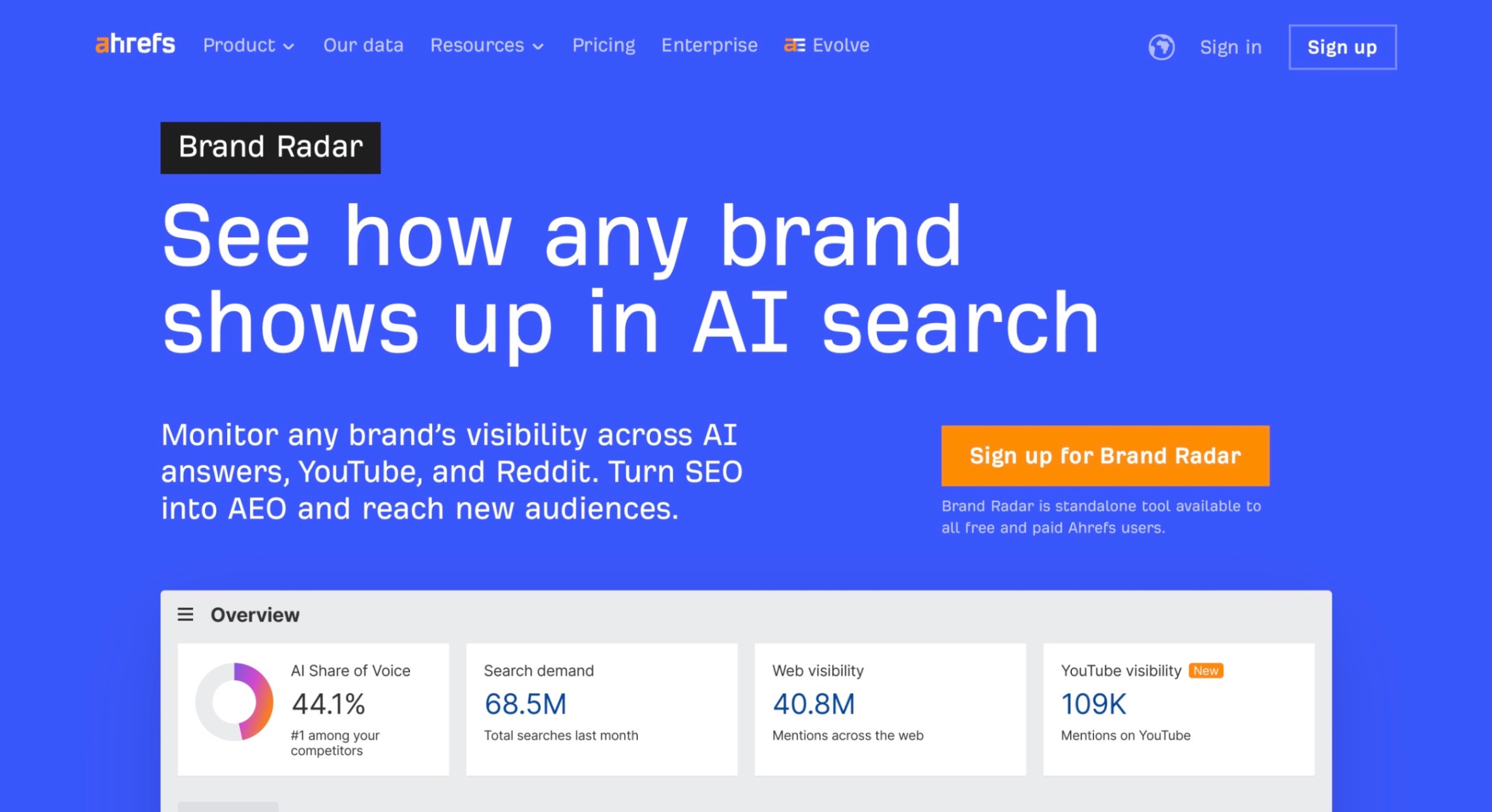
Ahrefs Brand Radar is an AI visibility tool built to show where brands appear in AI-generated answers. It combines AI mention tracking with prompt coverage, cited-page analysis, and broader Ahrefs visibility data.
Best For: Teams that want large-scale AI visibility tracking with broad prompt coverage, cited-page analysis, and competitive benchmarking tied to a wider search intelligence platform.
How Does Ahrefs Brand Radar Help With Tracking Brand Visibility In ChatGPT?
- Tracks AI mentions so you can see where your brand appears in AI-generated answers
- Lets you monitor custom prompts tied to real commercial questions and sales-driving topics
- Covers a very large prompt database built from search-backed questions rather than a small fixed prompt set
- Measures core AI visibility metrics such as mentions, citations, impressions, and AI share of voice
- Shows where your brand is mentioned across multiple AI platforms rather than limiting analysis to one environment
What Are The Other Standout Features Of Ahrefs Brand Radar?
- Includes cited pages reporting so you can see which pages and formats AI systems reference most often
- Connects AI visibility to wider brand signals such as search demand, web visibility, and video visibility
- Supports competitive analysis by letting you search for your brand, competitors, or entire topics
- Is part of the broader Ahrefs platform, which makes it easier to connect AI visibility findings with SEO research and content analysis
- Has a free AI Visibility Checker that introduces the workflow before deeper Brand Radar usage
Why Consider Ahrefs Brand Radar?
- It is one of the strongest options for teams that want scale, especially if broad prompt coverage matters to their evaluation
- It is useful for content and SEO teams that want to move from brand mention tracking into cited-page and content-format analysis
- It fits especially well if your team already uses Ahrefs and wants AI visibility inside an existing search intelligence workflow
- Its combination of AI share of voice, citations, and search-backed prompts makes it more strategic than a simple mention tracker
Where Does Ahrefs Brand Radar Fall Short?
- Its strength is breadth and scale, so teams looking for a very lightweight ChatGPT-only workflow may find it broader than they need
- It is not positioned primarily as a dedicated execution workflow for content teams, but as a visibility and intelligence layer inside a larger platform
- Some buyers may prefer a tool with a simpler self-contained AI visibility interface rather than one tied to a wider SEO suite
What Does Ahrefs Brand Radar‘s Pricing Look Like?
- Lite starts at $129/month
- Standard starts at $249/month
- Advanced starts at $449/month
- Enterprise pricing is custom
How Do Users Rate Ahrefs Brand Radar?
G2 Rating: 4.5/5
Want a partner to help improve your ChatGPT visibility, not just measure it? Read our guide to the best AI SEO agency for ChatGPT ranking in 2026.
7. SE Ranking ChatGPT Visibility Tracker
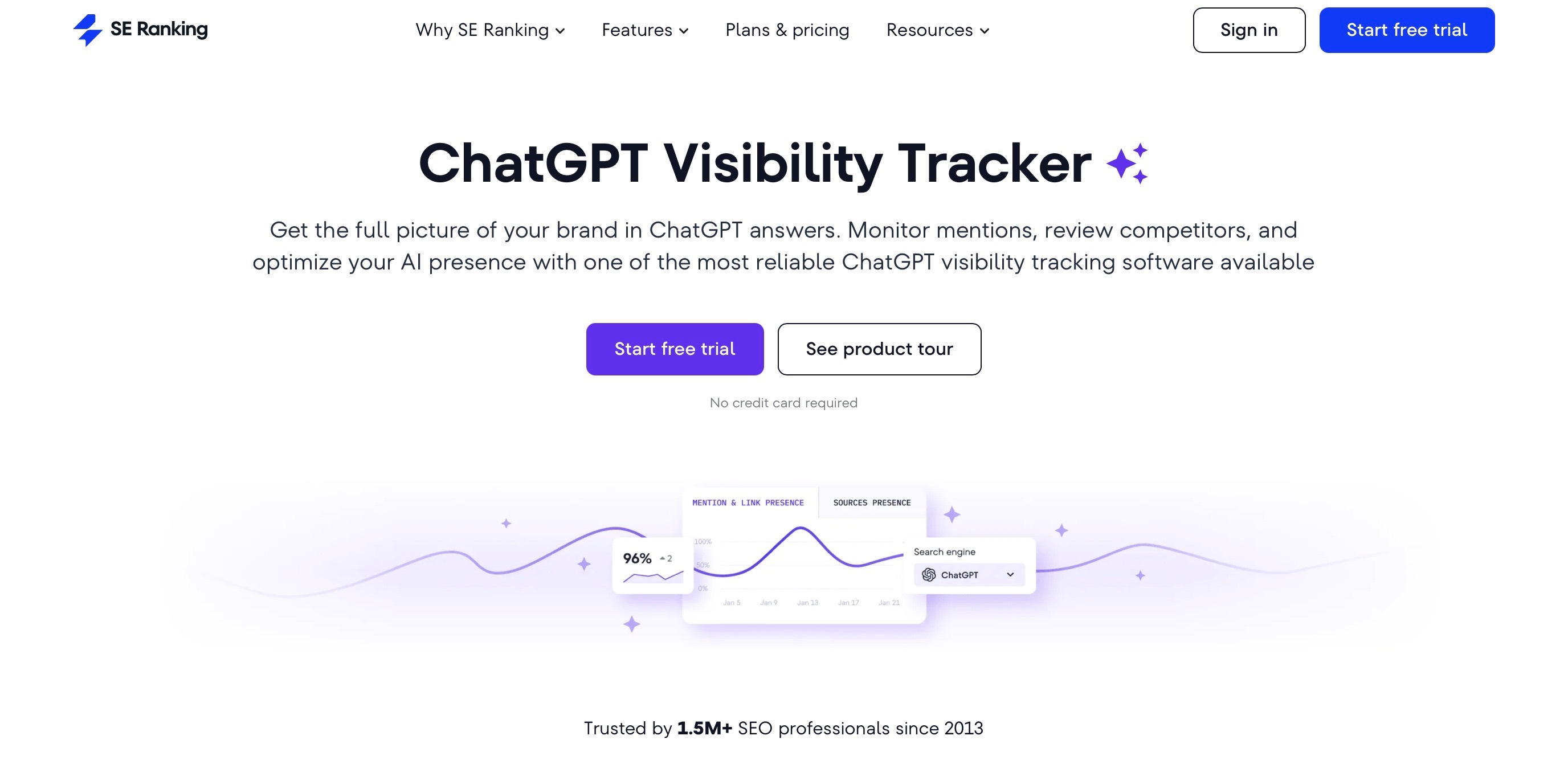
SE Ranking ChatGPT Visibility Tracker is a dedicated tool for monitoring how brands appear in ChatGPT answers. It focuses on real response analysis, mention tracking, link analysis, competitor monitoring, and historical trend data.
Best For: SEO and marketing teams that want dedicated ChatGPT tracking with competitor comparisons, linked-source analysis, and historical visibility data inside a familiar SEO tool environment.
How Does SE Ranking ChatGPT Visibility Tracker Help With Tracking Brand Visibility In ChatGPT?
- Analyzes actual ChatGPT outputs for your target prompts or keywords
- Tracks whether your brand is mentioned in ChatGPT answers
- Shows competitor mentions alongside your own so you can benchmark comparative visibility
- Collects links and mentions from responses, which helps connect visibility to cited sources
- Includes historical data so teams can track visibility changes over time
What Are The Other Standout Features Of SE Ranking ChatGPT Visibility Tracker?
- Extends beyond ChatGPT into broader AI visibility tracking across tools such as Gemini, AI Mode, AI Overviews, and Perplexity
- Tracks sentiment, key sources, and competitor benchmarks across AI platforms through SE Visible
- Fits into SE Ranking’s wider SEO environment, which can help teams connect AI visibility with more traditional search workflows
- Emphasizes high-frequency updates and real-response capture rather than static model assumptions
- Gives users multiple ways to monitor AI visibility, both through its ChatGPT-specific tracker and its wider AI visibility tooling
Why Consider SE Ranking ChatGPT Visibility Tracker?
- It is a practical option for teams that want a dedicated ChatGPT tracker without jumping straight to a heavier enterprise platform
- The combination of mentions, links, competitor tracking, and historical data makes it useful for ongoing reporting and optimization
- It works well for teams that want AI visibility monitoring alongside more traditional SEO tools in one ecosystem
- Its emphasis on real ChatGPT outputs makes the workflow feel more concrete and easier to explain internally
Where Does SE Ranking ChatGPT Visibility Tracker Fall Short?
- Its ChatGPT-specific tracker is narrower than platforms built around broader answer-engine intelligence from the start
- Some of the broader AI visibility value appears to sit across multiple SE Ranking products and experiences, not just one single tracker
- Teams looking for very deep market-level intelligence may want a platform with a stronger emphasis on wider competitive and category analysis
8. Otterly.AI
Otterly.AI is an AI search monitoring platform built to track how brands appear across ChatGPT and other AI-driven search experiences. It focuses on prompt-based monitoring, citation tracking, competitor benchmarking, and actionable brand visibility reporting.
Best For: Marketing teams and agencies that want a focused AI visibility monitoring tool with strong prompt tracking, citation monitoring, and cross-platform brand reporting.
How Does Otterly.AI Help With Tracking Brand Visibility In ChatGPT?
- Tracks brand mentions in AI search platforms such as ChatGPT by running prompt libraries that mirror real user questions
- Monitors how often your brand appears and compares that visibility against competitors over time
- Tracks website citations and source links so teams can see which content is being referenced in AI answers
- Helps identify content gaps that may be costing your brand visibility in AI search results
- Supports monitoring across multiple AI engines, so ChatGPT performance can be evaluated alongside other AI search surfaces
What Are The Other Standout Features Of Otterly.AI?
- Tracks six major AI platforms in a single dashboard, including ChatGPT, Perplexity, Google AI Overviews, Google AI Mode, Gemini, and Microsoft Copilot
- Includes AI keyword research, GEO content checks, AI crawler simulation, and referral traffic tracking as part of the broader platform
- Offers built-in recommendations that surface prioritized actions to improve brand visibility across AI search engines
- Provides brand visibility benchmarks and category-level rankings through its Brand Visibility Index
- Has transparent pricing and a free trial path, which makes it easier to evaluate than heavily demo-gated enterprise tools
Why Consider Otterly.AI?
- It is a strong fit for teams that want a purpose-built AI visibility platform without needing a full enterprise intelligence stack
- The platform combines prompt tracking, citation monitoring, and actionable recommendations in a way that feels especially practical for ongoing optimization work
- It is well suited to agencies and in-house marketing teams that need a cross-platform view of AI search visibility, not just ChatGPT alone
- Its benchmark and replay-style visibility views can help teams understand both their own trendline and the broader competitive landscape
Where Does Otterly.AI Fall Short?
- It appears more focused on monitoring and reporting than on broader enterprise-grade market intelligence
- Teams that want the deepest category-level competitive modeling or wider business intelligence context may prefer a more enterprise-oriented platform
- Its strength is focused AI search monitoring, so teams looking for a broader all-in-one SEO suite may still need separate tooling alongside it
What Does Otterly AI’s Pricing Look Like?
- Lite starts at $25/month
- Standard starts at $160/month
- Premium starts at $422/month
- Enterprise pricing is custom
How Do Users Rate Peec AI?
G2 Rating: 4.8/5
9. Scrunch
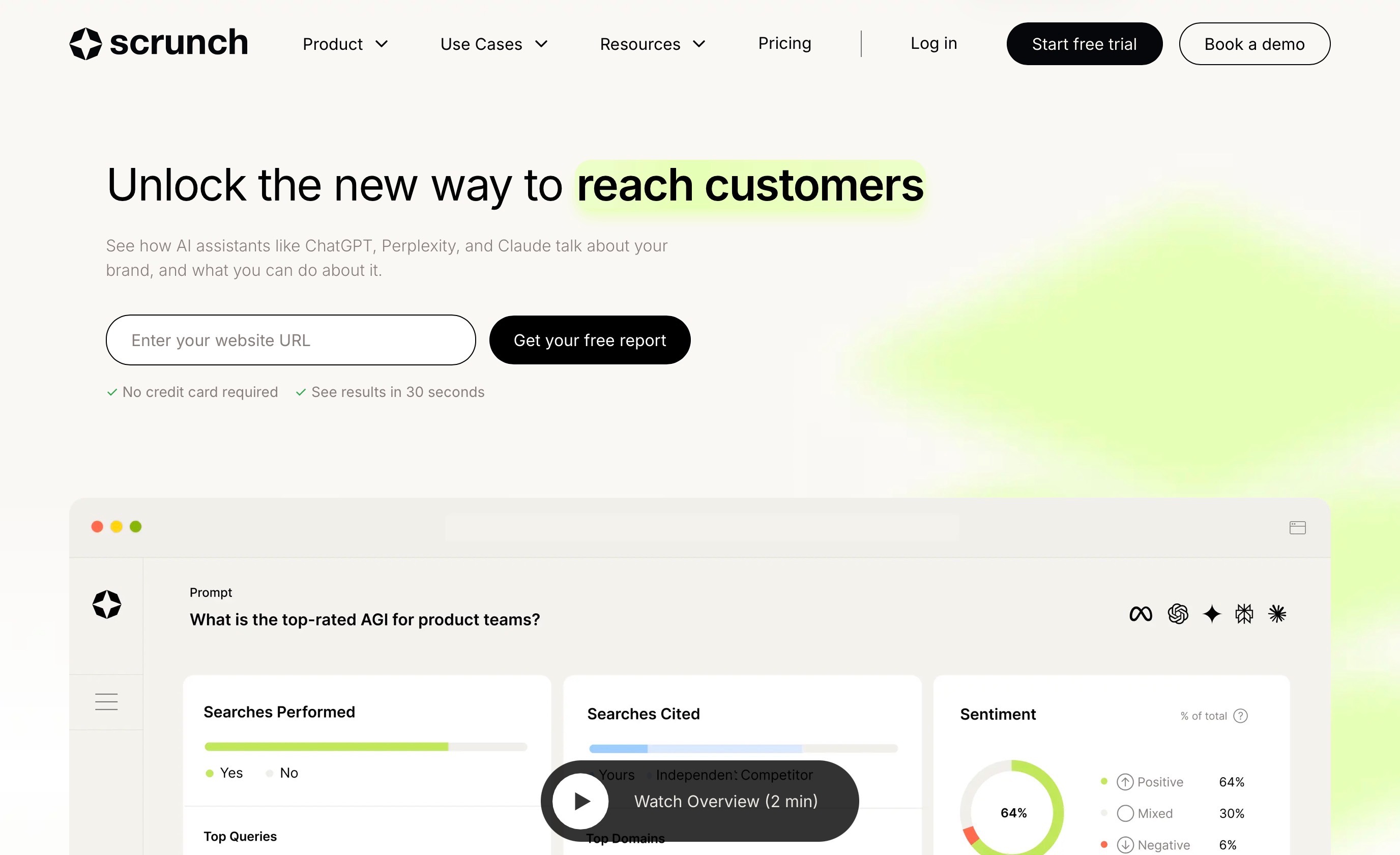
Scrunch is an AI customer experience platform designed to help brands monitor, analyze, and improve how they appear in AI search. It goes beyond basic mention tracking by combining monitoring, auditing, optimization, and AI-ready content delivery workflows.
Best For: Enterprise teams and advanced brands that want AI visibility monitoring plus technical auditing, prompt analysis, citation tracking, and AI-ready website delivery workflows.
How Does Scrunch Help With Tracking Brand Visibility In ChatGPT?
- Tracks brand presence in AI search by monitoring how often your brand appears in AI responses
- Supports prompt monitoring so teams can analyze visibility at the prompt level rather than relying on broad summary metrics
- Tracks citation sources in AI search, helping teams see which sources AI platforms link to when answering questions
- Identifies where competitors are gaining visibility through automated monitoring, citation analysis, and gap detection
- Supports ChatGPT specifically as part of a larger set of monitored AI platforms
What Are The Other Standout Features Of Scrunch?
- Covers eight major AI platforms, including ChatGPT, Claude, Gemini, Perplexity, Google AI Mode, Google AI Overviews, Meta AI, and Microsoft Copilot
- Offers four core product areas: monitoring, auditing, optimization, and content delivery through its Agent Experience Platform
- Includes an Agent Experience Platform that creates AI-friendly versions of website content for AI agents to parse more effectively
- Supports enterprise deployment with features such as SOC 2 Type II compliance, RBAC, SSO, API access, and multi-brand, multi-region support
- Emphasizes both monitoring and site-level improvement, rather than stopping at visibility reporting alone
Why Consider Scrunch?
- It is a strong option for brands that want to do more than measure AI visibility and also want tools to improve AI access, citations, and AI-ready content delivery
- Its combination of monitoring, audits, optimization, and delivery makes it broader than a simple AI mention tracker
- It appears especially well suited to enterprise teams managing multiple brands, sites, languages, or regions
- The platform’s AI-agent-focused approach is useful for brands that see AI crawlers and answer engines as a site experience challenge, not just a reporting problem
Where Does Scrunch Fall Short?
- It is more enterprise-oriented than lightweight, so smaller teams may find it heavier than they need
- The platform’s scope extends well beyond pure ChatGPT tracking, which may be more than necessary for buyers looking for a narrow single-purpose monitoring tool
- Its value proposition leans heavily toward operational maturity and technical readiness, so teams seeking a simpler self-serve visibility dashboard may prefer a more focused alternative
What Does Scrunch AI‘s Pricing Look Like?
- Lite starts at $129/month
- Standard starts at $249/month
- Advanced starts at $449/month
- Enterprise pricing is custom
How Do Users Rate Scrunch AI?
G2 Rating: 4.6/5
Curious about the model behind ChatGPT itself? Read our 2026 full guide on what AI model ChatGPT uses currently and how it works.
What Features Matter Most In A ChatGPT Visibility Tracking Tool?
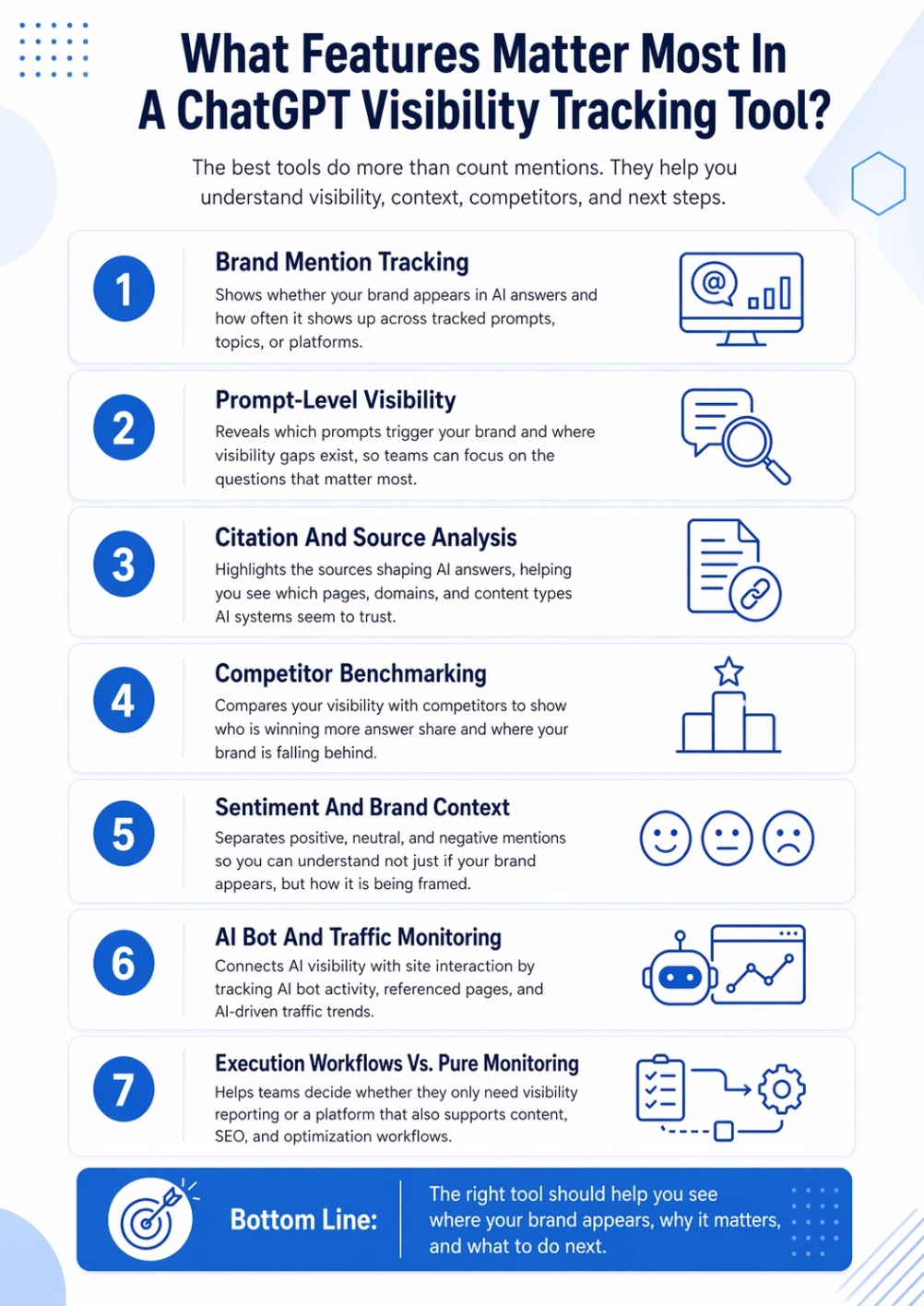
The best tools for tracking brand performance in ChatGPT results should do more than count mentions. The strongest platforms help you understand where your brand appears, why it appears, who appears beside you, and what to do next with that insight.
Here are the features that matter most when you are comparing tools in this category.
1. Brand Mention Tracking
The first thing any ChatGPT visibility tool needs to do is show whether your brand is appearing in AI answers at all. That includes basic mention frequency, but the better tools go further by showing visibility share, relative brand presence, and how often your brand is surfaced compared with competitors across tracked prompts or topics.
2. Prompt-Level Visibility
Mention data becomes much more useful when it is tied to actual prompts. Prompt-level visibility helps you see which questions trigger your brand, which ones do not, and where the gaps are. That matters because AI visibility is rarely consistent. A brand may appear for some commercial prompts and disappear for others, so prompt-level tracking is what turns broad visibility data into something actionable.
3. Citation And Source Analysis
A strong tool should also show which sources are shaping AI-generated answers. Citation and source analysis helps teams understand which domains, pages, and source types AI systems seem to trust. That matters because improving AI visibility is not just about being mentioned. It is also about understanding what content gets cited, what authority signals are working, and where your brand is missing from the source layer entirely.
4. Competitor Benchmarking
Tracking your own brand in isolation is not enough. The best tools show how your visibility compares with other brands in the same space, which competitors are winning more answer share, and where you are being outranked in AI-generated responses. That comparative view helps teams understand whether they have a minor visibility problem or a broader competitive gap.
5. Sentiment And Brand Context
Not every mention is equally valuable. Some tools now analyze sentiment and brand context so teams can separate positive exposure from neutral or negative visibility. This matters because being named in an AI answer is only useful if the surrounding context supports trust, preference, or credibility. Without sentiment and context, raw mention counts can be misleading.
6. AI Bot And Traffic Monitoring
The more advanced platforms also connect visibility to actual site interaction. AI bot and traffic monitoring can show whether AI agents are visiting your site, which pages they engage with most, and whether AI-driven traffic is rising or flattening over time. This adds an important operational layer because it helps connect brand visibility in AI answers with real crawl, referral, and page-level behavior.
7. Execution Workflows Versus Pure Monitoring
It is also worth deciding whether you want a pure monitoring tool or a platform that helps you act on what you learn. Some tools focus mainly on reporting mentions, prompts, and citations. Others pair visibility tracking with content planning, SEO optimization, technical audits, or recommendation workflows. That distinction matters because the best tool for your team is not always the one with the most data. It is often the one that makes the next step easier.
The best ChatGPT visibility tools do not just tell you whether your brand shows up. They help you understand where you are visible, why you are winning or losing, and how to turn that insight into stronger SEO and AI search performance.
Looking for expert help with execution too? Check out our guide to the top 10 AI-driven SEO agencies for ChatGPT content optimization.
Which Tool Is Best For Your Team?
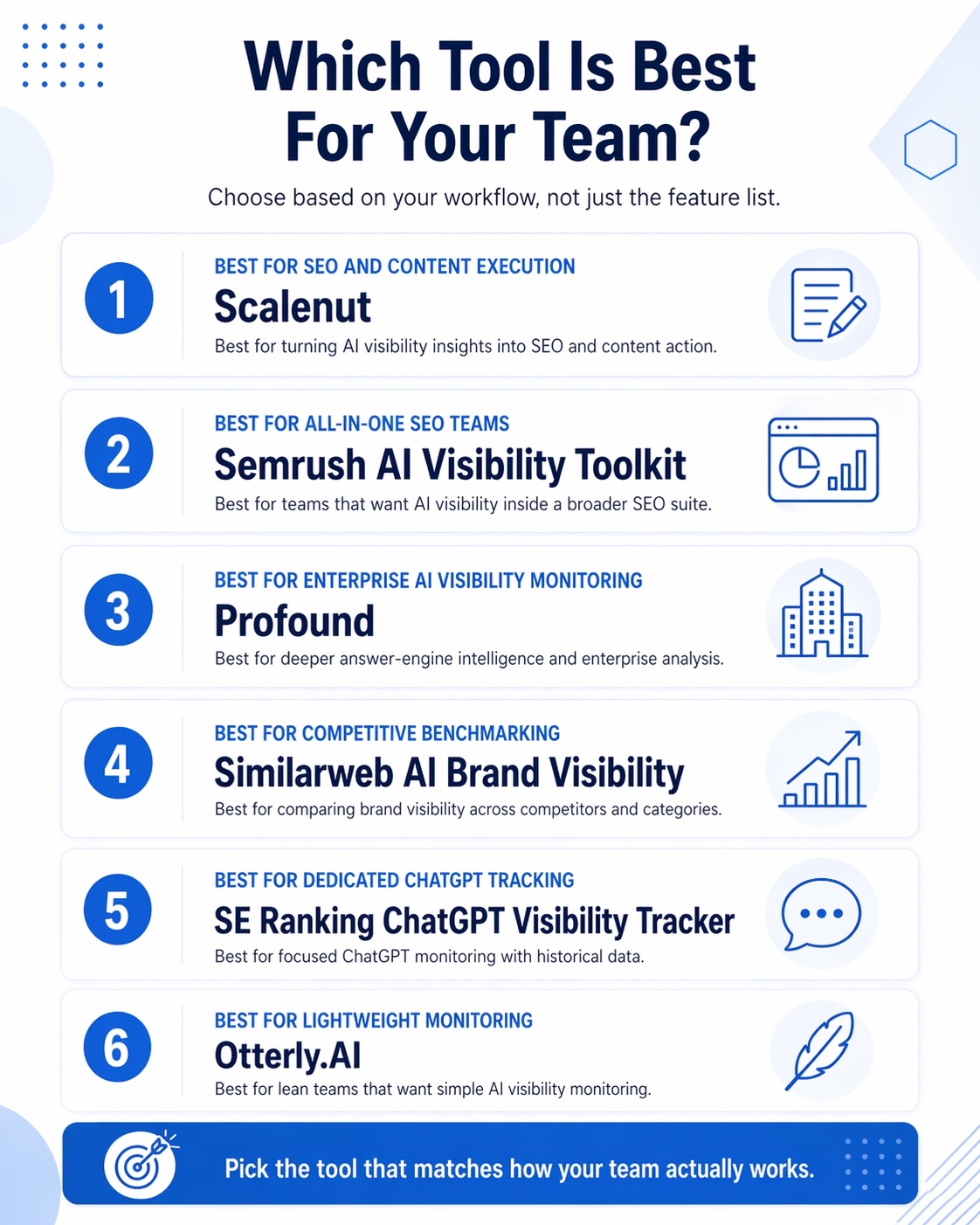
The best tools to monitor ChatGPT brand mentions depends less on hype and more on how your team actually works. Some teams need execution, some need broader SEO coverage, and some need deeper AI visibility intelligence with benchmarking or competitor analysis.
Here are the best fits based on the job you need the tool to do.
1. Best For SEO And Content Execution
Scalenut is the strongest fit for teams that want to track AI visibility and then act on it inside the same platform. Its positioning is built around AI visibility, action-oriented recommendations, and execution workflows, making it a strong choice for teams that want to move from insight to content and SEO action without switching tools.
2. Best For All-In-One SEO Teams
Semrush AI Visibility Toolkit is a better choice for teams that want AI visibility inside a broader SEO stack. It combines AI visibility tracking with competitor analysis, prompt monitoring, sentiment insights, technical auditing, and reporting, which makes it useful for marketers who want SEO and AI search monitoring in one environment.
3. Best For Enterprise AI Visibility Monitoring
Profound is the strongest fit for brands that want deeper enterprise-grade AI visibility analysis across answer engines. It is built around tracking AI visibility, analyzing AI responses, and uncovering citation patterns, which makes it a better fit for teams that want richer answer-engine intelligence rather than a lightweight monitoring layer.
4. Best For Competitive Benchmarking
Similarweb AI Brand Visibility stands out for teams that care most about benchmarking their brand against the market. It is designed to show if, how, and where a brand appears in LLM-generated content, and its broader intelligence layer makes it especially useful for comparing performance across competitors and categories.
5. Best For Dedicated ChatGPT Tracking
SE Ranking ChatGPT Visibility Tracker is the clearest fit if your main goal is focused ChatGPT monitoring. It analyzes actual ChatGPT outputs for your target keywords, captures mentions and links, and keeps historical data, which makes it a practical option for teams that want a dedicated ChatGPT workflow without moving to a heavier enterprise platform.
6. Best For Lightweight Monitoring
Otterly.AI is a strong choice for teams that want a focused monitoring tool without the weight of a broader intelligence suite. Its core value is straightforward: track brand mentions, citations, competitors, and visibility across AI search platforms through prompt-based monitoring, which makes it easier to adopt for lean teams and agencies.
The best tool is not always the one with the most features. It is the one that fits your team’s actual workflow, whether that means execution, benchmarking, dedicated ChatGPT tracking, or lightweight monitoring.
Need help beyond tools alone? Explore our guide to the best AI SEO agency for ChatGPT ranking in 2026 to find the right partner for stronger AI visibility growth.
Conclusion
Choosing the best tools to track mentions in ChatGPT comes down to what your team needs to do next. Start by narrowing your shortlist based on workflow fit. Some teams need stronger platform coverage, some need deeper citation source analysis, and others need an AI visibility tracker that can track ChatGPT mentions, your brand name, and the queries that matter most.
The best next step is to test two or three tools using your own prompts and review real ChatGPT responses. Look at reporting depth, advanced features, and how clearly each tool helps you move from visibility insight to action. The right choice is the one that helps you understand how AI systems surface your content across chat environments, not just how often you appear.
Frequently Asked Question
How can I monitor if ChatGPT mentions my brand online?
You can monitor this by using an AI visibility tool that runs tracked prompts, checks whether your brand appears in ChatGPT answers, and logs mentions over time. Tools like Scalenut, SE Ranking, Otterly.AI, and Semrush all support this kind of visibility tracking.
Which tools provide real-time alerts for ChatGPT brand mentions?
Most platforms in this category emphasize ongoing monitoring rather than clearly advertised real-time alerts. Scalenut highlights instant fixes and monitoring, while Semrush, SE Ranking, and Otterly.AI focus more on tracked visibility, prompts, citations, trends, and reporting than explicit live alerting.
Are there any free tools that track brand mentions in ChatGPT?
There are limited free options. Ahrefs offers a free AI Visibility Checker, while SE Ranking promotes a free trial for its ChatGPT Visibility Tracker. Most robust tools, including Scalenut, Semrush, and Otterly.AI, position full mention tracking inside paid products.
Can I monitor my brand's visibility in AI search results using ChatGPT tools?
Yes. Modern AI visibility platforms are built for exactly that. Scalenut tracks brand mentions, prompt coverage, visibility trends, competitors, and AI bot visits, while Semrush, SE Ranking, and Otterly.AI also monitor visibility across ChatGPT and other major AI search environments.
Are there any tools that track competitors' mentions in ChatGPT?
Yes. Competitor tracking is now a core feature in several platforms. Scalenut benchmarks competitor mentions and relative positioning, Semrush highlights competitive gaps, SE Ranking monitors competitor mentions in ChatGPT answers, and Otterly.AI compares your visibility against competing brands over time.
Is it possible to automate tracking of brand mentions in ChatGPT?
Yes. These tools automate tracking by repeatedly running saved prompts and analyzing responses for mentions, links, citations, and trends. Otterly.AI explicitly uses prompt libraries, while Scalenut, Semrush, and SE Ranking also support ongoing automated visibility monitoring across tracked prompts and topics.
How can I track which content gets cited most by ChatGPT and other AI tools?
Use a platform with citation and source tracking. Scalenut monitors AI-driven citations and referenced pages, Otterly.AI tracks website citations, Semrush surfaces cited sources and pages, and Ahrefs Brand Radar helps analyze cited pages and domains across a broad prompt universe.
Which tools provide real-time alerts for ChatGPT brand mentions?
Most tools in this category focus on ongoing monitoring rather than clearly advertised real-time alerts. Scalenut, Semrush, SE Ranking, and Otterly.AI are better described as continuous visibility tracking platforms that monitor prompts, mentions, citations, trends, and competitor activity over time.


.svg)


.webp)