.jpg)
Where Does ChatGPT Get Its Info From?
Key Highlights
- ChatGPT, a large language model, learns from extensive training data, including web content, licensed information, and human feedback.
- This artificial intelligence chatbot does not search the internet in real time by default; its knowledge is based on the data it was trained on.
- The initial question in a conversation is most likely to trigger a web search and citation, making it a critical point for visibility.
- The machine learning model often cites multiple sources, like Wikipedia and Reddit, creating clusters of information rather than relying on a single authority.
- To be cited by this AI chatbot, your content must be clear, authoritative, and answer foundational user queries effectively.
Have you ever been curious about how ChatGPT, a powerful large language model, can generate such human-like and detailed responses? The secret lies in its training. This form of artificial intelligence is built on a massive foundation of text and data, which it uses to understand context, grammar, and facts. Understanding where this information comes from is key to grasping the capabilities and limitations of natural language processing tools. This article will explore the data sources that power this revolutionary AI chatbot.
Where Does ChatGPT Get Its Data From?
ChatGPT’s ability to generate coherent and relevant text stems from its extensive training data. This machine learning model was trained on a diverse and massive dataset compiled by OpenAI. The primary source of its information is a broad snapshot of the internet, encompassing countless web pages, articles, and other publicly available text. This vast collection helps the model learn the patterns, structures, and nuances of human language. How does ChatGPT gather and learn its information? It processes this enormous dataset to recognize relationships between words and concepts.
Think of it like an individual who has read an immense library. The model doesn't just memorize information; it learns to predict the next word in a sequence based on the context it has absorbed. This process allows various AI tools like ChatGPT to construct sentences, answer questions, and even write creatively. The quality and variety of this initial training data are fundamental to its performance, providing a broad understanding of numerous topics and communication styles. The main sources of this training come from publicly available content, licensed data, and contributions from human trainers.
How Was ChatGPT Trained?
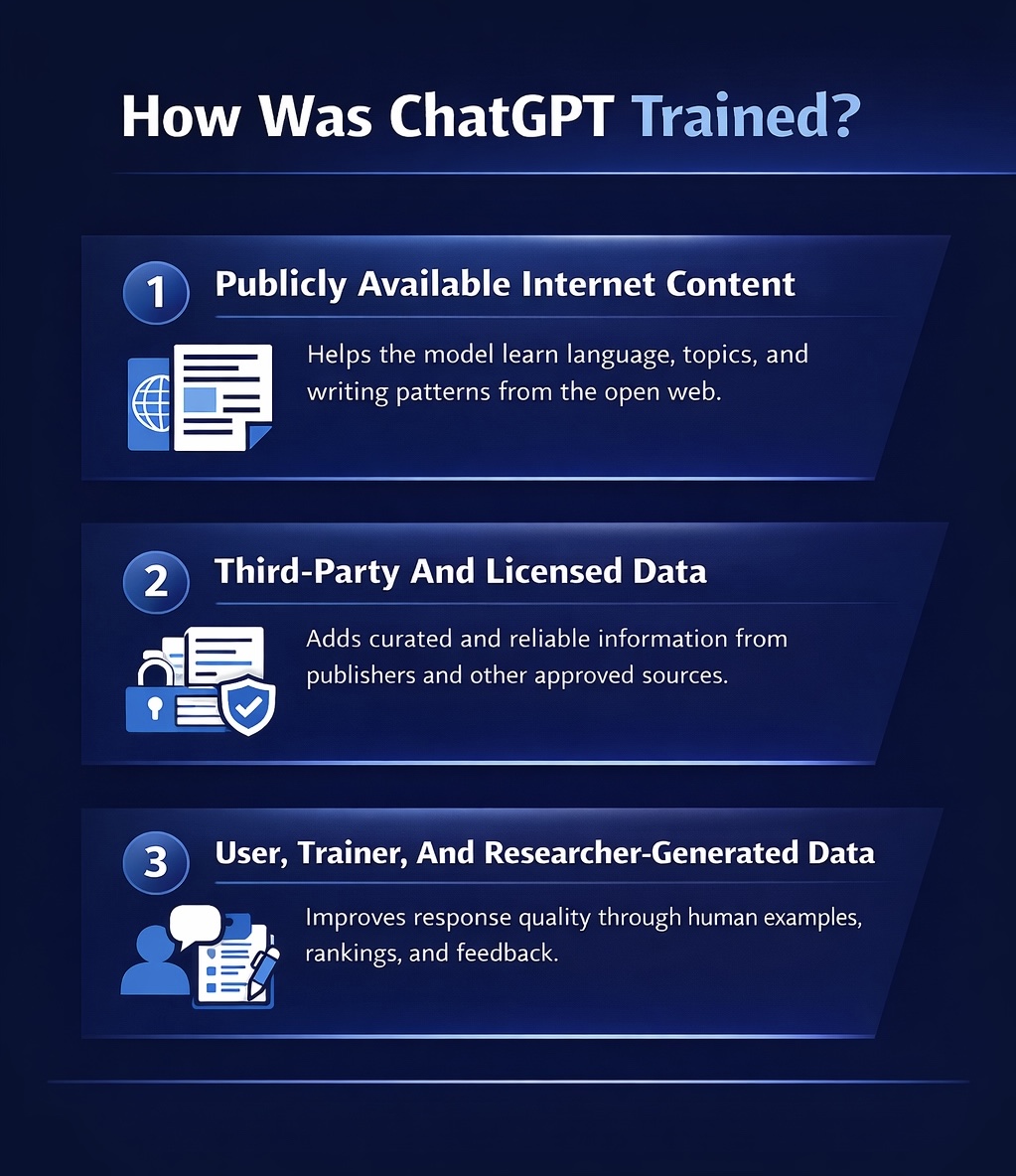
The training process for a large language model (LLM) like ChatGPT is a multi-stage endeavor rooted in deep learning. Initially, the model undergoes pre-training on a massive amount of text data. It uses a sophisticated architecture known as a transformer to learn grammar, facts, and reasoning skills by predicting the next word in a sentence.
Following this, the model is fine-tuned using human feedback. In this stage, human AI trainers provide examples of desired conversational outputs and rank the model's responses. This method, called Reinforcement Learning from Human Feedback (RLHF), helps align the AI's behavior with human expectations, making its responses more helpful and natural.
1. Publicly Available Internet Content
A significant portion of ChatGPT's knowledge base comes from publicly available content on the internet. This includes a massive collection of web pages, ranging from informational websites to personal blog posts and community forums. What sources does ChatGPT use to generate its responses? The model processes text from sources like Common Crawl, which is a massive, open repository of web data.
This exposure to diverse online content allows the model to learn about countless topics, writing styles, and conversational patterns. It absorbs information from articles, guides, and discussions, which helps it understand the context behind user queries. This is a core part of how Natural Language Processing (NLP) models develop a broad understanding of the world.
However, relying on the open internet also means the model can be exposed to a wide spectrum of information quality. The training data includes everything from expertly written articles to informal conversations, which contributes to both the model's versatility and its potential for error.
2. Third-Party And Licensed Data
Beyond the open web, ChatGPT is also trained on licensed data from third-party sources. This includes proprietary datasets that OpenAI obtains through agreements with publishers and other organizations. These curated collections often contain high-quality, structured information that helps improve the model's accuracy and reliability.
These sources can include books, academic journals, and research papers. Access to such specialized content allows the model to grasp complex subjects and technical terminology that might not be as prevalent in general web content. This is crucial for answering questions in fields like science, medicine, and law with greater precision.
The use of licensed data helps to balance the more unstructured information from the public internet. By incorporating information from reputable publishers and well-organized datasets, the model’s internal ranking of information is refined, enhancing its ability to provide factual and authoritative responses.
3. User, Trainer, And Researcher-Generated Data
Human-generated data is a critical component of ChatGPT's training, particularly during the fine-tuning stage. This process involves direct human feedback to guide the AI chatbot toward more helpful, harmless, and accurate responses. Human AI trainers play a pivotal role by creating ideal conversational examples.
These trainers write both sides of a conversation—the user's prompt and the ideal AI response—to show the generative AI model what a high-quality answer looks like. Additionally, they rank different responses generated by the model. This reinforcement learning technique teaches the model to prefer answers that are more coherent, factual, and aligned with user intent.
Researchers at OpenAI also contribute to this data pool by continuously testing the model's capabilities and identifying areas for improvement. This iterative loop of generating data, getting feedback, and refining the model is essential for advancing its performance and safety.
Does ChatGPT Search The Internet In Real Time?
A common question is: Is ChatGPT connected to the internet for real-time information? By default, standard versions of ChatGPT do not search the internet in real time. The model’s knowledge is "frozen" at the time of its last training update. This means it can't provide information about current events that have occurred since its training data was compiled. For example, it might know who won an award last year but not this week.
However, some versions of ChatGPT, particularly those available through subscription services, have a browsing feature that allows the model to perform live searches. When a user's prompt requires up-to-date information, the model can execute search queries to pull fresh data from the web. This functionality bridges the gap between its static knowledge base and the constantly evolving information on the internet, enabling it to answer questions about very recent topics.
Does ChatGPT Read Websites Like Google Does?
ChatGPT and Google Search interact with the internet in fundamentally different ways. Google uses web crawlers, which are automated bots that systematically browse the internet to index web pages. This indexed information is then retrieved and ranked by search engines when you enter a query. Google's primary function is to find and present existing information from websites.
In contrast, ChatGPT does not continuously crawl the web like a search engine. Its core knowledge comes from a static dataset of web pages and other texts that it was trained on. When versions with browsing capabilities access the internet, they are not indexing the entire web but rather performing targeted searches to find specific information needed to answer a user's prompt. It is a generative tool that creates new text based on learned patterns, whereas Google is a retrieval tool that points you to existing content.
What Sources Can ChatGPT Pull From During Live Search?
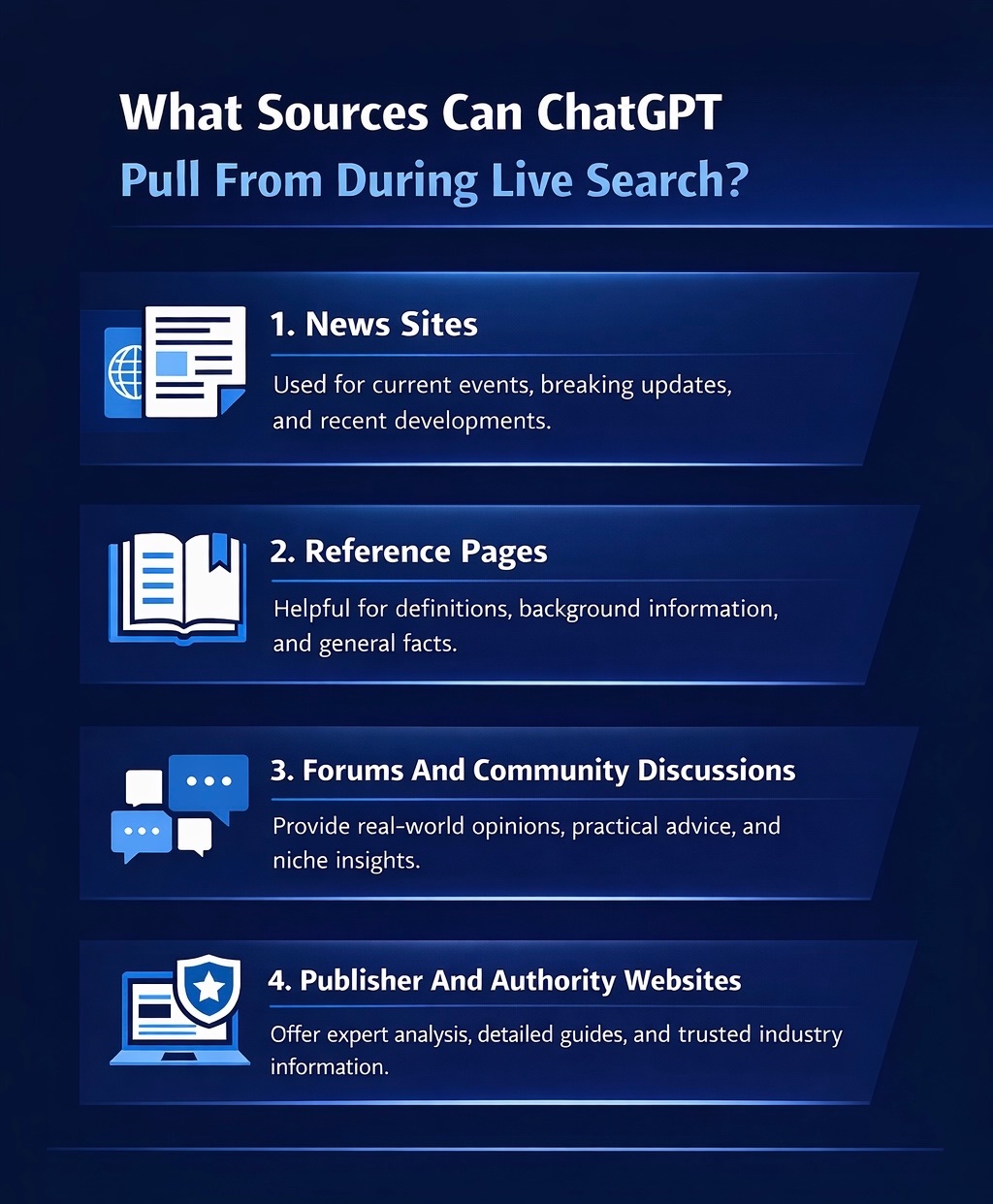
When the AI chatbot performs a live search, it prioritizes reputable sources to deliver balanced answers. It draws from news sites, authority websites, and relevant forums to incorporate factual data, expert opinions, and real-world experiences. This triangulation of information is a key strength, ensuring comprehensive responses.
The following sections will explore the main categories of sources ChatGPT utilizes during a live search.
1. News Sites
When a query relates to current events or breaking news, ChatGPT often turns to established news sites. These sources are critical for providing up-to-the-minute information that would not be present in the model's static training data. The model can access and synthesize information from various news outlets to offer a summary of recent happenings.
By pulling from reputable news organizations, the model can answer questions about politics, technology, finance, and other fast-moving topics. The search results it uses are often from globally recognized sources, which helps ensure the information is timely and credible. This allows users to get quick overviews without having to sift through multiple articles themselves.
Examples of news sources that might appear in search results include:
- Reuters
- Associated Press
- Major national and international newspapers
2. Reference Pages
For factual and definitional queries, ChatGPT frequently relies on reference pages. These are sources that act as a foundational knowledge base, offering structured and verified information on a wide array of subjects. Wikipedia is a primary example, appearing in a significant number of conversations that include citations.
These reference pages provide the model with a baseline of factual information that it can use to ground its answers. AI tools are often programmed to trust these sources for definitions, historical context, and general knowledge. This is because they are typically well-organized, comprehensive, and collaboratively edited for neutrality and accuracy.
AsOther important reference sources include:
- Government agency websites (e.g., NIH.gov)
- Academic encyclopedias and digital libraries
3. Forums And Community Discussions
To capture authentic, real-world perspectives and niche knowledge, ChatGPT also draws from forums and community discussions. User-generated content from these platforms provides insights that are often not available in traditional publications. This includes practical advice, product reviews, and personal experiences.
Sources like Reddit are particularly valuable because they host dedicated communities for virtually every topic imaginable. The model can analyze discussions to understand common problems, popular opinions, and specific solutions that have worked for others. This type of information adds a layer of authenticity and specificity to its responses.
Examples of platforms with valuable community discussions include:
- Stack Exchange for technical questions
4. Publisher And Authority Websites
For in-depth analysis and expert opinion, the AI chatbot turns to publisher and authority websites. These are trusted sources known for their expertise in a particular field, such as technology, health, or finance. These sites publish high-quality content, including reviews, guides, and research-backed articles.
Being cited alongside these authoritative domains can significantly boost a brand's credibility. The model identifies these sites as reliable sources, and their content is often used to provide detailed and nuanced answers. For instance, in a query about personal finance, the AI might pull information from top financial advice websites.
Key authority websites often include:
- Industry-leading blogs and publications
- Websites of professional organizations and research institutions
Does ChatGPT Use Private, Paywalled, Or Personal Information?
Protecting user privacy and respecting content ownership are paramount. ChatGPT is designed not to use private or personal data in its training. OpenAI takes significant measures to filter out personally identifiable information from the datasets it uses. Your conversations with the AI chatbot are not used to train future models unless you explicitly opt in, ensuring a level of security for your interactions.
Similarly, the model does not have the ability to bypass paywalled content. It can only access information that is publicly available on the internet or data that has been legally licensed for its training. If an article or research paper is behind a subscription wall, ChatGPT cannot access it. This limitation ensures that the model respects the business models of publishers and content creators while avoiding copyright infringement.
How Does ChatGPT Decide Which Sources To Cite?
When ChatGPT's browsing feature is active, it can provide citations for the information it presents. But how does it choose which sources to cite? The decision is driven by complex algorithms that evaluate the relevance and trustworthiness of a source in relation to the user's query. The model doesn't just pick one "best" source; it often triangulates information from multiple places to form a comprehensive answer. Can ChatGPT provide verified sources for its answers? Yes, when browsing is enabled, it links to the web pages it used.
This process involves an internal assessment of a source's authority on a given topic. For instance, a government health site is more likely to be cited for medical information than a random blog. The AI tools look for signals of trust, such as a site’s reputation and the quality of its content. AI citations often appear in clusters, meaning the model presents several competitive or complementary sources side-by-side, allowing users to verify the information for themselves.
What Does This Means for Your AEO Strategy?
The rise of generative AI search introduces a new field: Answer Engine Optimization (AEO). Unlike traditional SEO, where the goal is to achieve high rankings in search results, AEO focuses on being the source cited by an AI chatbot. This shift requires a different approach to content strategy.
Getting cited directly in a generated answer offers a new form of visibility. You are not just a link on a page; you are part of the answer itself. This means your content needs to be structured to directly address user questions. The following sections explore why getting cited is so important and how this new form of visibility is different.
Why Being Cited Matters?
In the age of AI-driven answers, being cited by a model like ChatGPT is a powerful endorsement. When your content is used as a source, it positions your brand as an authority on the topic. This direct citation is a strong signal of trust, as the AI has identified your content as a reliable source of information.
This new form of visibility goes beyond traditional search rankings. Instead of just appearing in a list of links, your information is integrated directly into the user's answer. This can lead to increased brand awareness and credibility, as users see your name associated with a helpful and accurate response.
Key benefits of being cited include:
- Enhanced Authority: Being chosen as a source validates your expertise.
- Increased Trust: Users are more likely to trust information that is clearly sourced.
- Direct Visibility: Your brand is placed directly in front of the user within the answer.
Why Visibility Is Different From Traditional SEO?
Traditional Search Engine Optimization (SEO) has long focused on achieving top rankings on search engine results pages (SERPs). Success is measured by your position in a list of blue links. The goal is to attract clicks by having a compelling title and meta description.
Answer Engine Optimization (AEO) represents a paradigm shift. Here, the goal is not just to rank high but to be the definitive source of information that an AI chatbot uses to construct its answer. Visibility is achieved when your content is directly cited or synthesized within the generated response. It's about becoming part of the answer itself, not just a link to it.
This means the focus moves from keyword optimization for rankings to creating content that directly and comprehensively answers a user's question. The AI model is the new intermediary, and influencing it requires a strategy centered on clarity, authority, and factual accuracy, which differs from classic SEO tactics aimed at pleasing search engines' ranking algorithms.
How To Increase The Chances Of Your Content Being Used By ChatGPT?
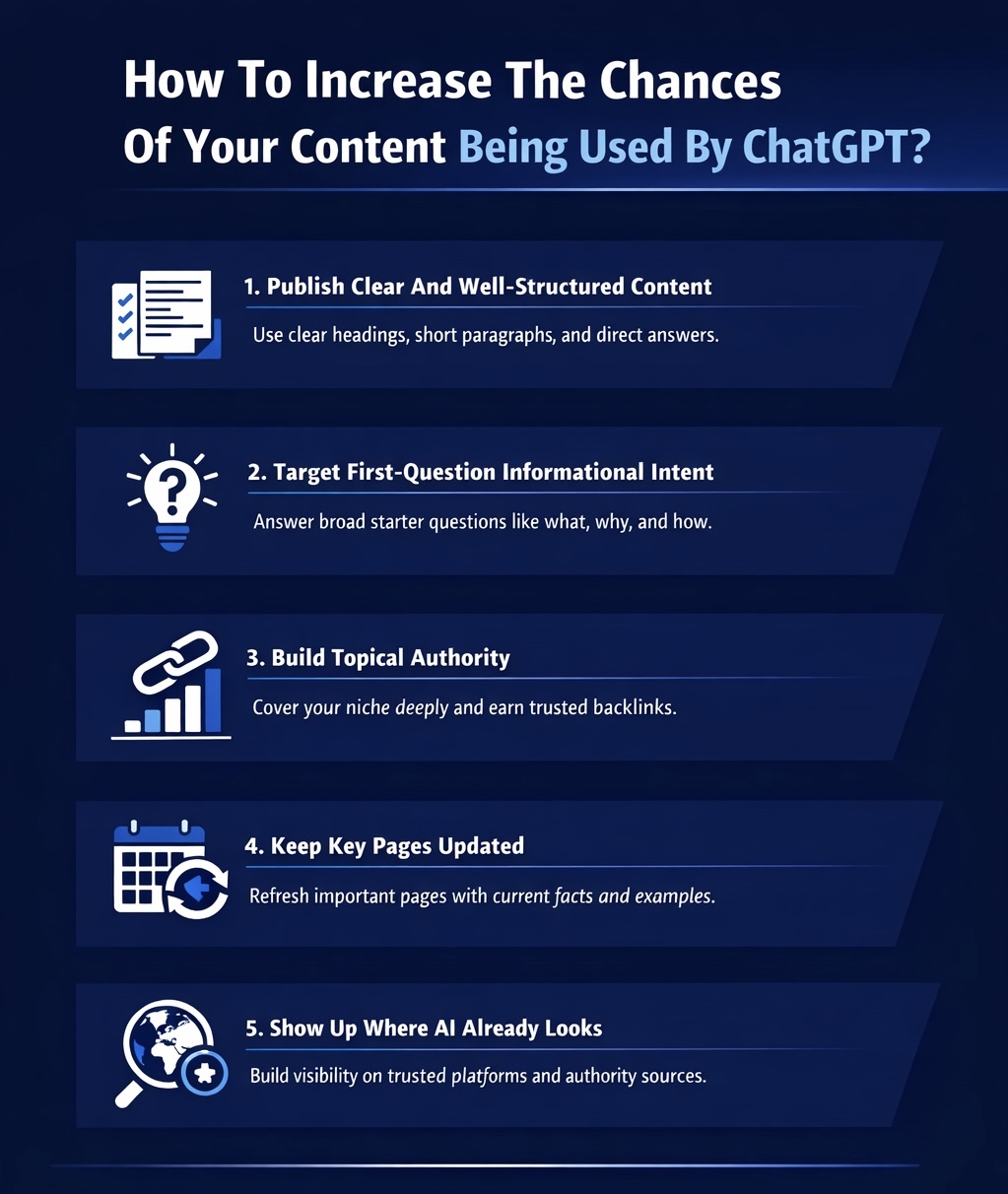
You can't directly force ChatGPT to use your business content, but you can increase the chances by creating trustworthy, authoritative, and well-structured information. Focus on clarity, accuracy, and topical authority to make your website a reliable source for AI tools.
Here are specific steps you can take to make your content more appealing to AI.
1. Publish Clear, Factual, Well-Structured Content
To be considered a reliable source by an AI chatbot, your content must be exceptionally clear, factually accurate, and well-organized. AI models are better at processing information that is easy to understand and logically structured. Use clear headings, short paragraphs, and straightforward language to present your information.
Factual accuracy is non-negotiable. Ensure that all claims are supported by evidence and that your information is up-to-date. Content that contains errors or unsubstantiated claims is likely to be ignored by AI systems that are designed to prioritize reliable sources.
A well-structured page also helps the AI parse your content effectively. This includes:
- Using descriptive H2 and H3 tags to organize topics.
- Employing bullet points and numbered lists for easy readability.
- Providing concise and direct answers to common questions.
2. Cover First-Question Informational Intent
Research shows that the first question in a user's conversation with ChatGPT is the most likely to trigger a web search and citation. These opening queries often have a broad informational intent, such as "what is X?" or "how does Y work?". To capture this prime real estate, your content should be optimized to answer these foundational questions.
Focus on creating content that addresses the initial queries a person might have when they begin exploring a topic. Think about the fundamental knowledge someone needs before they can ask more specific follow-up questions. These are the queries that AI tools are most likely to seek external information for.
By creating comprehensive, entry-level guides and explanations, you position your site as the starting point for a research journey. This aligns with how Natural Language Processing (NLP) models seek to ground their initial responses in factual, authoritative information, making your content a prime candidate for citation.
3. Build Topical Authority And Trusted Citations
Becoming a trusted source for AI tools requires building strong topical authority. This means creating a deep and comprehensive body of content around a specific subject area, rather than writing superficially about many different topics. When your site is a recognized expert in a niche, AI models are more likely to trust and cite your content.
Another key factor is earning ChatGPT citations and links from other reputable websites. These backlinks act as votes of confidence, signaling to both search engines and AI tools that your content is valuable and trustworthy. The company you keep online matters; appearing alongside other trusted domains in your field can boost your own authority.
To build topical authority, you should:
- Create content clusters that cover a topic from all angles.
- Seek opportunities for your content to be linked to by other authoritative sites.
4. Keep Important Pages Updated
The currency of your information is a critical factor in establishing trust and relevance, especially for AI systems that may perform live searches. Outdated content is less likely to be cited, particularly for topics where information changes rapidly. Regularly reviewing and updating your important pages demonstrates a commitment to accuracy.
When users pose search queries about recent developments, AI models prioritize sources that provide the most current information. If your content is stale, it will be passed over in favor of more recently updated pages. This is especially true for statistics, industry trends, and product information.
To maintain content currency, you can:
- Schedule regular content audits to identify and refresh outdated information.
- Add "last updated" dates to your pages to signal freshness to both users and AI.
5. Be Present On Sources AI Systems Already Trust
AI tools like ChatGPT already have a set of trusted sources they frequently turn to for data. Instead of trying to compete with these giants, aim to be present on them or appear alongside them. For example, Wikipedia is a top source; ensuring your company’s Wikipedia page is accurate and well-sourced is a crucial step.
Similarly, forums like Reddit are often cited for their authentic, user-generated content. Participating in relevant communities and being seen as a helpful voice can increase your visibility. The goal is to build your authority within the ecosystems that AI systems already rely on.
AI models often cite sources in clusters. Your aim should be to become a consistent "citation neighbor" to the top trusted sources in your industry.
Curious how AI engines portray your brand? Scalenut’s AI Visibility tool helps you track mentions, uncover competitor wins, spot missed opportunities, and turn those insights into action. Book a demo today!
Conclusion
In summary, understanding where ChatGPT sources its information and how it processes data is crucial for anyone looking to leverage AI for content creation or digital marketing strategies. By grasping the nuances of its training and the types of data utilized, you can enhance your content's visibility and relevance. This knowledge empowers you to create high-quality, well-structured articles that align with the needs of both users and AI systems alike. As AI continues to evolve, adapting your strategies to meet these changes will be vital. For personalized insights and assistance in optimizing your content for AI, don't hesitate to reach out for a free consultation.
Frequently Asked Questions
Does ChatGPT make up sources?
Yes, older versions of ChatGPT have been known to "hallucinate" or invent sources. While newer AI tools are improving, the AI chatbot can still sometimes generate plausible but fake citations. This is a known issue related to misinformation, and users should always verify critical sources.
Can ChatGPT use sources?
Yes, ChatGPT can use sources. The large language model learns from a vast amount of training data, and versions with browsing capabilities can access and cite live web pages. These AI tools use sources to ground their answers in factual information, especially for timely or specific queries.
How does ChatGPT source its information?
The AI chatbot sources its information primarily from its training data, which is a massive dataset of text and code from web pages and other sources. When browsing is enabled, it can also pull information directly from the internet to answer questions that require current knowledge.
What sources does ChatGPT use to generate its responses?
This artificial intelligence chatbot uses a wide range of sources, including content from the public internet, licensed data like books and articles, and information from human trainers. When browsing, the AI chatbot can pull from news sites, reference pages, forums, and authority blogs to generate its responses.
Is ChatGPT connected to the internet for real-time information?
By default, the AI chatbot is not connected to the internet for real-time information. However, premium versions of ChatGPT offer a browsing feature that allows it to connect to the internet through search engines to gather current data and answer questions about recent events.
How up-to-date is the information that ChatGPT provides?
The date information of the standard AI chatbot is limited to its last training dataset, which means it may not know about very recent current events. Versions with browsing capabilities can access up-to-date information, but the core model's knowledge has a specific cutoff date.
Can ChatGPT provide verified sources for its answers?
Yes, when using its browsing feature, the AI chatbot can provide links to verified sources it used to generate an answer. The algorithms are designed to prioritize sources that signal trust and authority, but users should still exercise critical judgment and check the provided links.
Can I make ChatGPT include information about my business?
You cannot force the AI chatbot to use your content. However, by publishing high-quality, authoritative, and well-structured content about your business and industry, you can significantly increase the visibility and likelihood that ChatGPT will cite your website as a source for relevant queries.


.svg)


.webp)