.jpg)
AI Platforms Citation Patterns: What You Should Know

Key Highlights
- Our research shows significant differences in citation mechanics and source selection among ChatGPT, Google AI Overviews, and Perplexity.
- ChatGPT heavily favors authoritative sources like Wikipedia, while Google AI Overviews and Perplexity lean on community content like Reddit.
- AI citation is crucial for brand visibility, and SEO professionals must adapt strategies to earn mentions in AI-generated answers.
- Actionable SEO strategies, such as creating high-quality hub content and engaging in relevant communities, can boost your AI citation likelihood.
- Monitoring citation frequency and share of voice across platforms is essential for tracking visibility and gaining a competitive edge.
- Data reveals that Google AI Overviews and Perplexity have a broader appetite for source types, including vendor blogs, compared to ChatGPT.
AI platforms powered by large language models are transforming how users find information, moving beyond traditional SEO and blue links. The rise of AI overviews has introduced a new dynamic: AI citations. These references are the bedrock of trust and visibility in this new search landscape.
This in-depth analysis explores the distinct AI platform citation patterns of ChatGPT, Google AI Overviews, and Perplexity, offering a clear roadmap for brands aiming to secure their place in AI-generated answers.
What Is AI Citation?
An AI citation is a reference to an external source that a generative AI model uses to support the information in its response. When you ask a search engine a question, the AI-generated summary, like Google's AI Overviews, often includes links to the websites where it found the information.
This mechanism adds a layer of transparency and credibility to the content creation process, allowing users to verify facts and explore topics in greater depth. For brands, an AI citation tool makes this measurable by showing when you are cited, where you are missing, and which sources AI engines prefer.
What Is the Role of AI Citation?
AI citation serves to enhance the credibility, accuracy, and transparency of AI-generated content. It allows models like ChatGPT and Google AI to reference reliable sources, fostering trust among users while enabling brands and website owners to leverage authoritative content for improved visibility and engagement.
What Is the Importance of AI Citation for Website Owners and Brands?
AI citations are crucial for website owners and brands as they enhance credibility, improve visibility in search results, and foster trust among users. Well-cited content can also influence rankings, drive organic traffic, and establish authority in a competitive digital landscape.
New to GEO? Check out how beginners can master GEO SEO strategies for a simple, step-by-step starting point.
What Are the Common Citation Types?
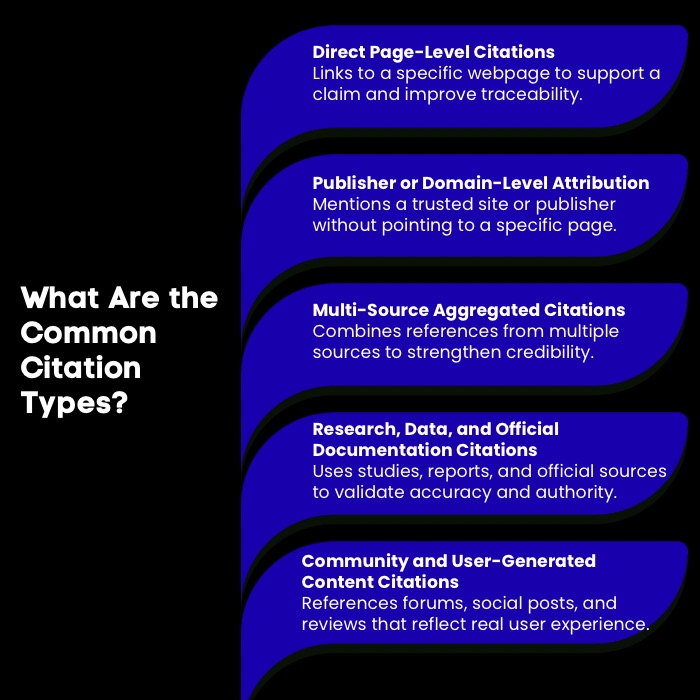
In the world of AI-generated content, citations generally fall into two categories: direct and indirect. Both citation types are important, as they contribute to the overall perception of your brand's authority and can influence organic results over time.
1. Direct Page-Level Citations
Direct page-level citations serve as a fundamental method for attributing content to specific sources within AI-generated outputs. These citations enhance transparency and allow users to trace information back to its original context, thus increasing citation quality. They play a crucial role in establishing authority signals, improving the overall credibility of AI platforms.
In an era where search visibility is paramount, making direct attributions can significantly affect website traffic and brand mentions, optimizing the content strategy of businesses. This practice aligns well with traditional SEO objectives while appealing directly to the needs of informed users.
2. Publisher Or Domain-Level Attribution
Attributing citations at the publisher or domain level plays a crucial role in establishing the credibility of AI-generated content. This method emphasizes the authority of the sources, enhancing overall citation quality. Major AI engines often rely on recognizable domains to optimize search visibility and improve trust signals in generated outputs.
When AI models reference reputable publishers, they not only boost their own credibility but also improve the content's perceived value among users. Such strategic citation practices aid in driving organic traffic and ensuring adherence to best practices in content creation.
3. Multi-Source Aggregated Citations
The utilization of multi-source aggregated citations emerges as a cornerstone in establishing a comprehensive content strategy. By synthesizing references from various credible sources, AI engines enhance the perceived authority and trustworthiness of the information presented. This method not only broadens the citation landscape but also amplifies search visibility, allowing for greater engagement from Google users and boosting organic traffic.
Furthermore, aggregating multiple references enables content creators to showcase diverse perspectives, enriching the reader's experience while supporting improved brand visibility. Ultimately, this approach fortifies the competitive advantage in search results.
4. Research, Data, And Official Documentation Citations
Citing research, data, and official documentation is crucial within AI-generated content, as it establishes authority and credibility. Different AI platforms are increasingly leveraging peer-reviewed studies, government reports, and reputable organizational data to enhance their content accuracy.
This practice not only boosts trust among users but also contributes to higher search visibility, ensuring that users find comprehensive information. Moreover, effective citation of authoritative sources can lead to increased referral traffic, as brands that utilize high-quality documentation are more likely to be prioritized in search results by major AI engines.
5. Community And User-Generated Content Citations
Citations from community and user-generated content play a vital role in enhancing AI visibility within search results. These references often stem from social media platforms, forums, and review sites, where real users share their experiences and insights. Such content can significantly influence search engine rankings, as traditional SEO practices recognize the authority signals generated through organic interactions.
This creates an ecosystem where AI engines leverage community-generated data to enrich the relevance and credibility of their outputs. Business owners should actively engage in these discussions to improve their citation quality and visibility online.
How ChatGPT, Google AI Overviews, And Perplexity Select And Cite Sources
Selecting and citing sources involves a sophisticated understanding of authority signals and relevance. AI platforms use a multi-faceted approach that fosters a competitive advantage, allowing users to navigate vast information landscapes with clarity.
ChatGPT – Source Selection Methods
Source selection methods in ChatGPT leverage advanced algorithms and large language models to determine the most relevant references for its responses. By analyzing authority signals, content credibility, and user engagement metrics, it effectively curates information that aligns with the search queries.
The process heavily relies on understanding context and sentiment, ensuring that the citations not only inform but also resonate with users. This strategic approach enhances search visibility, providing users with comprehensive coverage of topics and ultimately optimizing the experience for content creators and seekers alike.
Google AI Overviews: How References Are Aggregated And Prioritized
References in Google AI Overviews are meticulously aggregated from a variety of sources, ensuring that relevance and quality are prioritized. This involves an analytical assessment of authority signals and citation quality, which ultimately informs the content delivery to users.
By examining different data sources, Google’s AI frameworks adapt to user behavior, ensuring that the most cited and credible materials are highlighted prominently. Such strategies enhance search visibility and optimize the user's experience, aligning with trends in competitive intelligence and effective search engine strategies.
Perplexity – Real-Time Citation Approach
Perplexity distinguishes itself through its real-time citation approach, leveraging vast data sources to provide users with up-to-date information alongside relevant citations. By utilizing AI engines and dynamic content strategies, it ensures that references align closely with the context of search queries, optimizing for both accuracy and credibility.
This method enhances search visibility and establishes authority signals essential for user trust. The incorporation of sentiment analysis enriches the responses, allowing for a deeper engagement with content creators and fostering community discussions, all while maintaining a strong focus on citation quality.
What Drives Citation Decisions: Authority, Trust Signals, And Search Intent
Citations in AI-generated content hinge on several crucial factors. Authority plays a significant role, as sources with established credibility are more likely to be favored by AI engines. Trust signals, such as user engagement and expert recommendations, also impact citation decisions, enhancing a source's visibility in search results.
Additionally, understanding search intent guides AI in aligning citations with user queries, ensuring that the referenced material meets the needs of those seeking information. This multi-faceted approach helps maintain content relevance and boosts overall AI visibility.
What Gets Cited Most: Common Domains, Formats, And Content Types
Recognized domains like government websites and reputable educational institutions frequently emerge as leading sources for AI citations. Formats that best capture attention include well-researched articles, white papers, and datasets that offer actionable insights. Content types showcasing originality and depth, such as comprehensive case studies and insightful blogs, tend to garner high citation frequencies as they enhance search visibility.
Moreover, data narratives that present clear visuals or infographics can significantly boost engagement, making them popular choices for AI platforms. Ultimately, quality and relevance determine citation patterns across various AI engines.
How Citations Appear: Direct Vs Indirect Attribution And Transparency
Citations in AI-generated content can manifest in direct or indirect forms, each impacting transparency differently. Direct attribution offers clear credit to the original sources, allowing users to trace information back easily, enhancing trustworthiness and credibility.
In contrast, indirect attribution often integrates insights without explicit source identification, which can obscure the origin of the data presented. This distinction plays a crucial role in AI visibility, as users may rely more heavily on references that are clearly cited, influencing their perception of the content's authority and reliability.
What Are the Essential Citation Tracking Metrics?
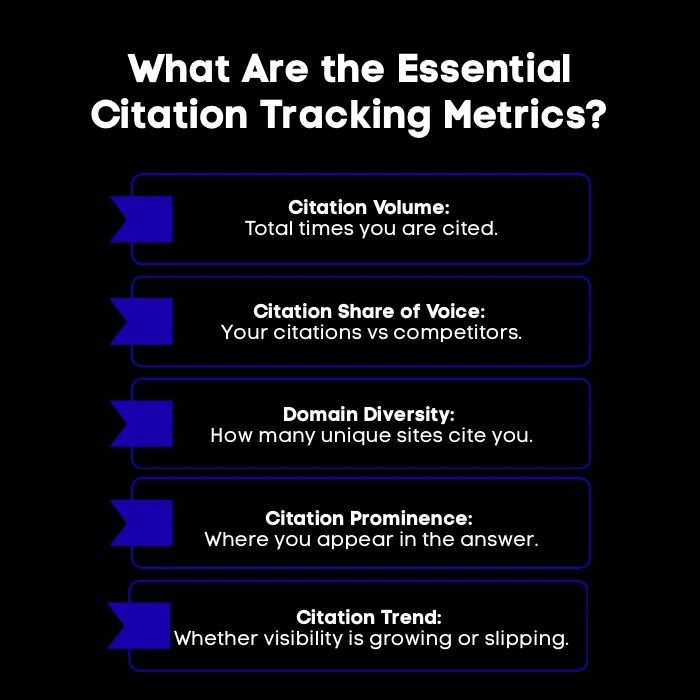
To effectively measure your brand's AI visibility, you need to go beyond traditional SEO metrics and adopt a new set of citation tracking metrics. Monitoring how and where you are cited provides critical competitive intelligence and helps you refine your strategy for major AI engines. Specialized tools are emerging to help with this.
If you are evaluating AI optimization platforms citations analytics, these metrics help you compare tools based on what actually drives visibility in AI answers.
1. Citation Volume and Frequency
Citation volume measures the total number of times your brand or domain is cited, while citation frequency tracks how often these mentions occur over a specific period. Both metrics are fundamental for any citation tracking effort, as they provide a baseline for your brand's performance in AI-generated answers. A high AI mention frequency indicates sustained relevance.
Analyzing these trends can reveal which AI platforms are giving your brand the most visibility. For example, our data shows a wide disparity in how top sources perform across different platforms. This information is crucial for allocating resources effectively.
Here is a summary of citation volume trends for a few top sources across the three platforms:
Source
ChatGPT Volume
Google AI Overviews Volume
Perplexity Volume
1.8%
2.2%
6.6%
Forbes
1.1%
0.6%
0.7%
NerdWallet
0.8%
0.6%
0.6%
Wikipedia
7.8%
0.6%
Not in Top 10
By interpreting these numbers, you can gain a competitive advantage, identifying where your efforts are paying off and where opportunities for growth lie.
2. Citation Share of Voice by Platform
In the context of AI engines, "share of voice" refers to the percentage of citations your brand captures compared to your competitors within a specific topic or platform. This visibility metric moves beyond simple volume to provide a clear picture of your competitive standing in AI-generated content.
Analyzing your citation share of voice across ChatGPT, Google AI Overviews, and Perplexity reveals which platforms your brand is dominating and where you are lagging. For example, among its top 10 sources, ChatGPT gives Wikipedia a massive 47.9% share of citations, whereas Google's AI overview citations are more evenly distributed, with Reddit holding a 21.0% share of the top 10.
Understanding this distribution is a critical SEO action point. If your competitors have a high share of voice on Perplexity, it may signal an opportunity to build your presence on niche review sites. Conversely, a low share of voice on Google AI Overviews might indicate a need to increase engagement on community forums like Reddit.
3. Unique Citing Sources and Domain Diversity
Domain diversity is a critical metric in citation tracking that measures the number of unique citing sources that reference your brand. A wide range of domains mentioning your content is a powerful signal of authority and trustworthiness to AI engines, much like a diverse backlink profile is in traditional SEO.
Having many unique citing sources indicates that your brand is recognized as an authority across different corners of the web, from news sites and blogs to forums and industry publications. This breadth not only strengthens your credibility but also helps insulate your brand from algorithm changes that might de-prioritize a single source type.
This metric is directly linked to an uplift in organic results. AI platforms that see your brand cited across a variety of high-quality domains are more likely to trust and reference your content. Therefore, a key part of your strategy should be to expand your footprint and earn mentions from a broad spectrum of relevant sources.
4. Citation Prominence in AI Responses
Citation prominence refers to how visibly a citation is displayed within an AI's response. A citation placed at the top of an answer or as the first in a list is far more valuable than one buried at the end. This placement directly influences user perception and the likelihood that a user will click through to your site.
The way different AI engines handle prominence varies. Perplexity, for example, often uses numbered, inline citations that are highly visible, while other platforms might group links more subtly. The prominence of your citation is a key factor in determining its impact on your overall AI search visibility and the traffic it can generate.
This has important implications for content creation. Crafting content that directly and comprehensively answers a user's query increases the chance of it being used as a primary source, thus earning a more prominent citation. Aim to be the definitive answer for key questions in your niche to improve your placement in search results.
5. Citation Consistency and Trend Over Time
Citation consistency measures how regularly your brand is cited over time. A one-off mention is good, but consistent citations signal sustained relevance and authority. Effective citation tracking involves monitoring these patterns to ensure your visibility isn't just a temporary spike but a lasting presence.
Conducting trend analysis on your citation data can reveal important insights. Are your citations growing, declining, or remaining flat? Are there seasonal patterns or shifts that correlate with your marketing campaigns? Understanding these trend lines helps you diagnose the health of your AI visibility strategy.
Ultimately, this long-term perspective is crucial for success. A consistent upward trend in citations is a strong indicator that your content strategy is aligned with what AI engines are looking for. By continuously monitoring and adapting, you can build and maintain a strong position in AI-generated answers and secure long-term AI visibility.
Looking for the best GEO tool? Explore 10 best AI tools for generative engine optimization in 2026 to shortlist the right platform for tracking citations and improving AI visibility.
What Are the Best Practices to Improve AI Citations?
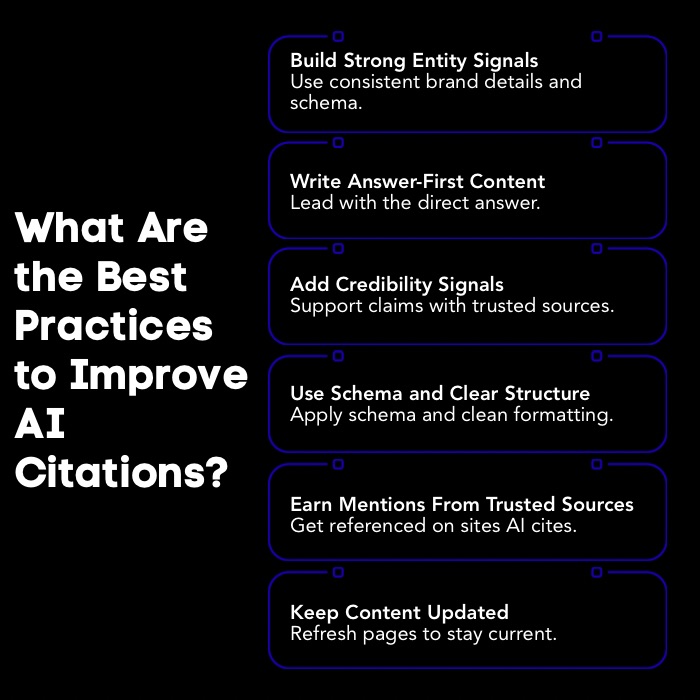
To enhance AI citations, focus on creating strong entity signals and answer-first content. Incorporate credible references and structured data through schema. Regularly update your content to maintain relevance, and seek mentions from cited sources to boost authority and trustworthiness.
1. Build Strong Entity Signals
Establishing strong entity signals is crucial for enhancing AI citations and boosting overall brand visibility. This involves clearly defining and structuring the identity of brands and products within content, which aids AI platforms in correctly attributing sources. Leveraging structured data like schema markup amplifies the effectiveness of entity recognition, making it easier for AI engines to connect with your content.
Additionally, incorporating authoritative information, such as case studies and expert opinions, can bolster trust signals, leading to improved citation frequency across various platforms and ultimately elevating search optimization efforts.
2. Write Answer-First Content
Providing immediate value through answer-first content enhances user engagement and aligns with the objectives of AI platforms. Prioritizing direct responses to search queries not only improves user satisfaction but also aids in boosting search visibility. This approach correlates with better citation frequency, as users share high-quality content that addresses their needs.
By implementing this strategy, content creators can optimize their website traffic and increase brand mentions. The focus shifts toward delivering informative, succinct answers that resonate with user intent, ultimately leading to improvements in citation quality and organic results.
3. Add Credibility And Proof
Incorporating credibility and proof into your content is essential for enhancing trust among your audience. Utilizing quality citations from authoritative sources not only strengthens your arguments but also boosts your visibility in search results. Moreover, brand mentions from recognized entities contribute to overall brand credibility.
Integrating comprehensive case studies and relevant data enhances the perceived value of your content, making it more appealing to both users and major AI engines. This strategic approach ultimately leads to improved organic traffic and higher conversion rates, solidifying your competitive advantage in a crowded digital landscape.
4. Use Schema And Clear Structure
Implementing schema markup enhances the search visibility of your content, allowing AI engines to decipher the structure and context with ease. This structured data not only boosts the likelihood of being cited by platforms like ChatGPT and Google AI but also increases your content's chances of ranking higher in organic results.
A clear and organized layout enables search engines to interpret your information efficiently, improving citation quality and ultimately driving more referral traffic. By following these best practices, you can significantly enhance your competitive advantage in citation patterns.
5. Earn Mentions From Cited Sources
Establishing connections with cited sources can significantly enhance citation effectiveness. Engaging with authoritative figures in your niche, whether through collaborations or social media interactions, fosters brand visibility and trust. When sources actively mention your content, it amplifies your authority signals, improving your positioning in search results.
Additionally, leveraging case studies and testimonials can encourage organic citations. Showcasing real-world applications of your offerings not only boosts credibility but also encourages backlinks, driving referral traffic. As AI engines prioritize authority and relevance, these mentions create a competitive advantage across traditional SEO and generative AI strategies.
6. Keep Content Updated
Continuous updates to content play a critical role in maintaining relevance within AI citation patterns. Ensuring that information remains current not only enhances citation quality but also boosts AI visibility across search results. Regularly refreshing content can improve its performance regarding traffic and engagement, ultimately giving brands a competitive advantage.
Additionally, up-to-date information signals authority to AI engines, influencing citation selection and frequency. This practice aligns with modern content strategies to optimize organic results and improve brand mentions across various platforms. Consistency in updates is essential for sustained impact.
Scalenut: Turn Citation Insights Into Actionable GEO Wins
For many teams, the best platform for SEO that tracks AI citations is the one that connects citation signals to clear content actions, not just dashboards. If your goal is to earn more mentions across ChatGPT, Google AI Overviews, and Perplexity, Scalenut helps you move from “interesting citation patterns” to a repeatable workflow for improving AI visibility. Instead of stopping at monitoring, it connects visibility signals to clear next steps so you can publish, update, and strengthen the pages most likely to be referenced in AI answers.
How Scalenut Supports Your AI Citation Strategy
- AI Visibility Tracking That Maps To Real Queries: See how your brand shows up across AI answers, then identify the prompts and themes where you are missing or underrepresented.
- Content Planning Built For Authority Signals: Turn gaps into a focused content roadmap that supports hub pages, supporting articles, and structured updates that AI systems tend to trust.
- Execution That Helps You Ship Faster: Go from research to briefs to optimized drafts without juggling multiple tools, so improvements actually get published.
- Topical Strength And Internal Context: Strengthen topical coverage and connections across your site, making it easier for both search engines and AI systems to interpret your expertise.
Book a demo to see how Scalenut can help you improve AI visibility and earn more citations.
Conclusion
In the dynamic landscape of AI platforms, understanding citation patterns enhances visibility and trustworthiness. The distinction in citation quality across various AI engines significantly influences search results, affecting how users perceive and engage with content. By employing traditional SEO practices alongside generative engine optimization strategies, businesses can harness competitive intelligence to improve brand visibility.
Ultimately, adopting a comprehensive content strategy that embraces diverse sources will lead to superior organic traffic and a stronger online presence. Prioritizing citation frequency and quality remains essential for achieving sustained success in this evolving digital environment.
Frequently Asked Questions
How do AI platforms decide which sources to cite?
AI platforms evaluate the credibility, relevance, and authority of information sources when deciding which to cite. They analyze factors such as publication date, source reputation, and expert consensus to ensure users receive accurate and trustworthy information from diverse perspectives.
Which are the platforms for aligning brand content with AI citation patterns?
Platforms that help align brand content with AI citation patterns include AI visibility and citation monitoring tools like Scalenut, SEO content optimization suites, and digital PR or brand monitoring platforms. Choose based on whether you need prompt-level citation tracking, structured content improvements, or stronger third-party authority signals.
Who benefits the most from using an AI citation verification tool?
Website owners, content creators, and researchers benefit significantly from AI citation verification tools. These tools enhance content credibility, streamline the sourcing process, and ensure accurate referencing. By maintaining trust and authority, they ultimately improve user engagement and search visibility for their platforms.
Is manual citation checking still necessary if you use AI tools?
Yes, manual citation checking remains essential even with AI tools. While these technologies can streamline the process, human oversight ensures accuracy, context relevance, and adherence to citation standards, ultimately enhancing content credibility and trustworthiness for readers and search engines alike.
What is the most cited domain across AI platforms?
The most cited domain across AI platforms is typically one that provides authoritative and relevant content. Such domains often include established academic journals, news organizations, or government websites, as they are seen as reliable sources that align with user search intents in various contexts.
Which SEO strategies help improve the chances of being mentioned in AI-generated citations?
To enhance the likelihood of being cited in AI-generated content, focus on high-quality backlinks, optimize for relevant keywords, leverage authoritative content, ensure mobile-friendliness, and maintain a strong online presence through social media engagement and consistent updates.
What are the best AI platforms for monitoring my brand’s visibility in AI citations?
To effectively monitor your brand's visibility in AI citations, consider platforms like Brandwatch, Mention, and SEMrush. These tools provide real-time tracking of mentions and citation analytics, helping you gauge the impact of your content across different AI-driven platforms.
What is the best AI optimization platform for citation analytics and comparison?
Platforms that help align brand content with AI citation patterns typically fall into three tool categories: AI visibility and citation monitoring tools (like Scalenut), SEO content optimization suites, and digital PR or brand monitoring platforms. Choose based on whether you need prompt-level citation tracking, on-page structuring, or authority-building mentions.
What are the best tools for tracking citation data AI search rankings?
The best tools for tracking citation data AI search rankings include Scalenut for prompt-level visibility and citation tracking, Profound for large-scale answer engine monitoring and citation insights, and Peec AI for brand visibility analytics across major AI platforms with competitor benchmarking.


.svg)


.webp)