

AthenaHQ AI Review: Quick Summary
- Best for: AthenaHQ is a strong fit for enterprise SEO teams, agencies, and AI visibility teams that need prompt tracking, competitor intelligence, citation analysis, reporting, and GEO actions.
- Key strength: It goes beyond monitoring with content recommendations, on-page and off-page actions, content optimization, and tools for improving AI search visibility.
- Pricing: Essential is free with 300 credits, while Starter costs $295/month with 3,600 credits. Since one credit equals one AI response, usage can add up as you track more prompts and models.
- Main limitation: AthenaHQ focuses on AI search rather than being a complete traditional SEO suite, and several advanced capabilities are reserved for Enterprise.
- Verdict: AthenaHQ is worth considering if AI visibility and GEO optimization are major priorities. If you want AI visibility alongside broader SEO + GEO planning, writing, optimization, and audits at a lower starting price, Scalenut offers a wider execution workflow.
AI visibility tools are still tricky to trust. Everyone wants to know if their brand is showing up in ChatGPT, Perplexity, Gemini, Claude, Google AI Overviews, and Google AI Mode, but there is still no perfect source of truth for tracking that data.
That is why AthenaHQ AI caught my attention. It promises to help marketing teams monitor AI visibility, track competitors, analyze citations, and find gaps that may be affecting how their brand appears in AI-generated answers.
But the real question is whether AthenaHQ AI only helps you see the problem, or whether it gives you enough direction to actually improve your visibility. That is what I’ll break down in this AthenaHQ AI review, including its features, pricing, pros, cons, user reviews, and best alternatives.
Let’s get started!
What Is AthenaHQ AI?
AthenaHQ AI is an AEO and generative engine optimization platform that helps brands track, analyze, and improve their visibility across AI search platforms.
It monitors brand mentions, prompts, competitors, citations, brand sentiment, and content gaps across ChatGPT, Perplexity, Gemini, Claude, Copilot, Grok, Google AI Mode, and AI Overviews. It also provides content recommendations and on-page and off-page GEO actions to help teams improve how their brand appears in AI-generated answers.
AthenaHQ is built for AI visibility and optimization rather than as a complete traditional SEO suite, so marketing teams may still need separate tools for broader SEO and content execution.
Who Is AthenaHQ AI Best For?
AthenaHQ AI is best for teams that are already serious about AI search visibility and need a clearer way to track brand mentions, competitors, citations, and prompt-level performance across AI engines. Here’s who should consider AthenaHQ AI for their business:
- Enterprise SEO Teams: Teams that need to track AI visibility across multiple products, competitors, markets, or regions will likely get the most value from AthenaHQ. It is built more for serious reporting and visibility analysis than basic SEO tracking.
- AI Visibility Teams: If your team already tracks AI citations, brand mentions, prompt-level performance, and competitor presence across AI engines, AthenaHQ gives you a more organized way to monitor it all.
- Agencies Selling AI Search Reporting: AthenaHQ can work well for agencies that need client-ready AI visibility reports. Its pitch and reporting features make it easier to show clients where they stand and where they can improve.
- Brands With Content Execution Resources: AthenaHQ can show you what needs attention, but it will not do all the work for you. It is most useful for brands with writers, SEO strategists, PR support, or content teams who can act on the insights.
Who Should Not Use AthenaHQ AI?
AthenaHQ AI may not be the best fit if your team needs a lower-cost AI visibility platform or a broader traditional SEO workflow alongside AI visibility.
- Small Teams With Tight Budgets: The free Essential plan includes 300 credits, but the next step is Starter at $295/month. That jump may be difficult to justify if you only need basic AI visibility tracking.
- Teams That Need A Full SEO Execution Workflow: AthenaHQ offers GEO actions and content optimization, but it does not replace a broader SEO stack for keyword planning, technical SEO, content creation, auditing, and optimization.
- Multi-Brand Or Multi-Market Teams On Lean Plans: Advanced capabilities such as multi-region and multi-language tracking are reserved for Enterprise, so complex international setups may require a higher-tier plan.
- Teams Focused Mainly On Traditional Local SEO: AthenaHQ focuses on AI search visibility, not full local SEO. You will still need other tools for map pack tracking, Google Business Profile management, and local rankings.
- Teams That Need Advanced Features On Starter: Features such as Athena Citation Engine, persona targeting, the Recommendation Engine, executive dashboards, and advanced access controls are Enterprise-only.
AthenaHQ Review: What Are the Pros And Cons of AthenaHQ AI?
AthenaHQ AI sits in an interesting spot. It is not trying to replace your SEO stack, and honestly, that is both a strength and a limitation. The platform is built more for figuring out how your brand is showing up in AI answers, where competitors are getting picked instead, and what gaps may be affecting your visibility.
That focus makes AthenaHQ useful for teams that need reporting, competitive visibility, and direction. But it also means you should not expect it to handle the full SEO or GEO workflow for you.
Let’s break down where AthenaHQ AI performs well and where it still feels limited.
AthenaHQ AI Pros: Where Does AthenaHQ Stand Out?
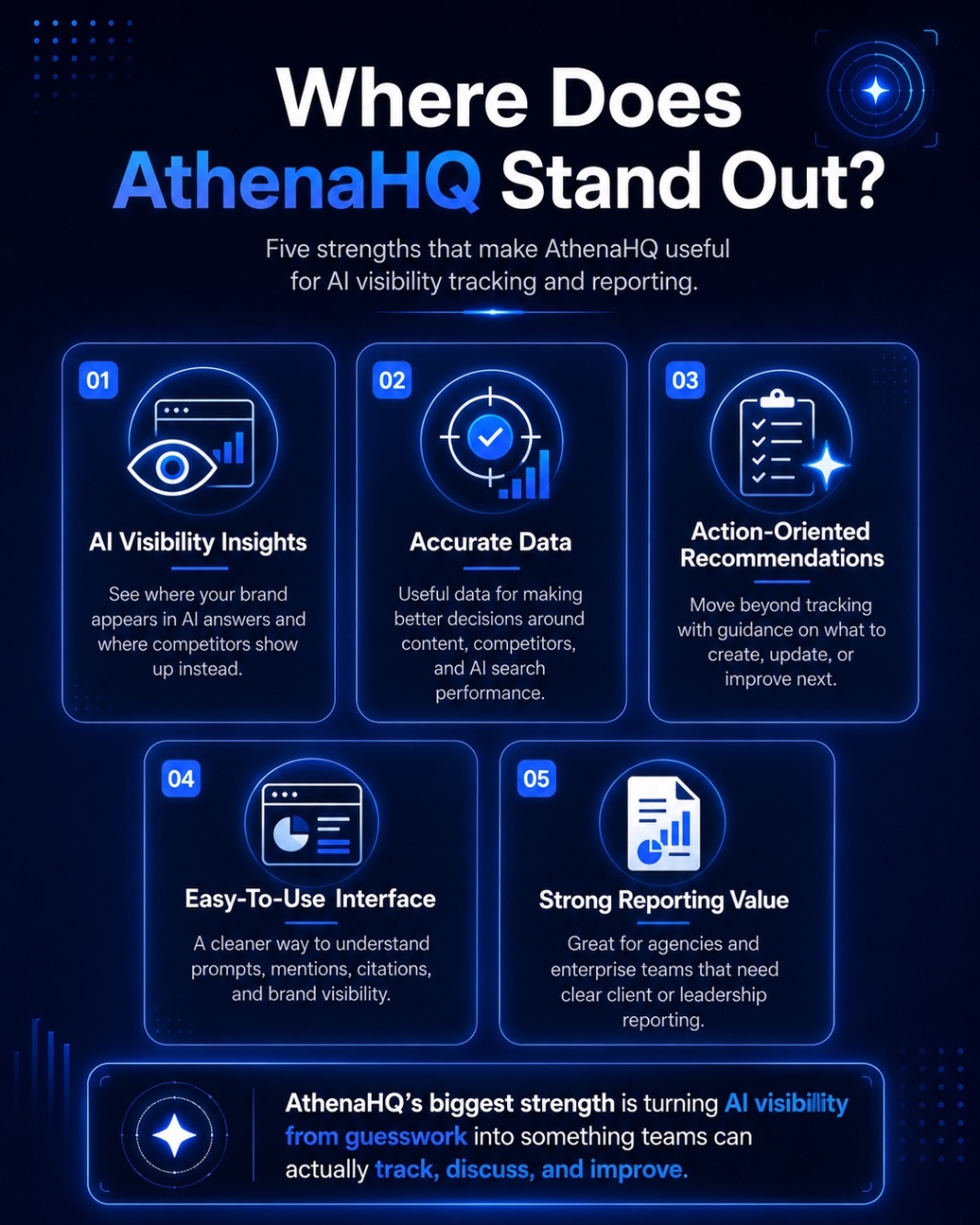
AthenaHQ’s biggest strength is that it gives structure to a messy problem. AI visibility is still hard to measure cleanly, but AthenaHQ makes it easier to see patterns across prompts, competitors, citations, and brand mentions.
Here’s where it really stands out:
- Valuable AI Visibility Insights: AthenaHQ helps you see where your brand appears in AI answers, which competitors are showing up instead, and which prompts or topics need more attention to drive better business outcomes. This is probably the main reason teams would use it.
- Accurate And Useful Data: Users seem to value AthenaHQ’s data quality, especially when they need to make decisions around content, competitors, and AI search performance. For a category that still feels fuzzy, that accuracy matters.
- Action-Oriented Recommendations: I like that AthenaHQ does not only show visibility numbers. It also tries to point teams toward what they should create, update, or improve next. That makes it more useful than a passive reporting dashboard.
- Easy-To-Use Interface: AI visibility tracking can get confusing very quickly. AthenaHQ seems to do a good job of making the data easier to understand without forcing users to dig through too many layers.
- Strong Reporting Value: This is where I think AthenaHQ makes the most sense for agencies and enterprise marketing teams. It gives them a cleaner way to explain AI visibility to clients, leadership, or internal teams without turning the report into a messy spreadsheet.
AthenaHQ’s biggest pro is that it turns AI visibility from guesswork into something teams can actually track, discuss, and start improving.
AthenaHQ AI Cons: Where AthenaHQ Falls Short?
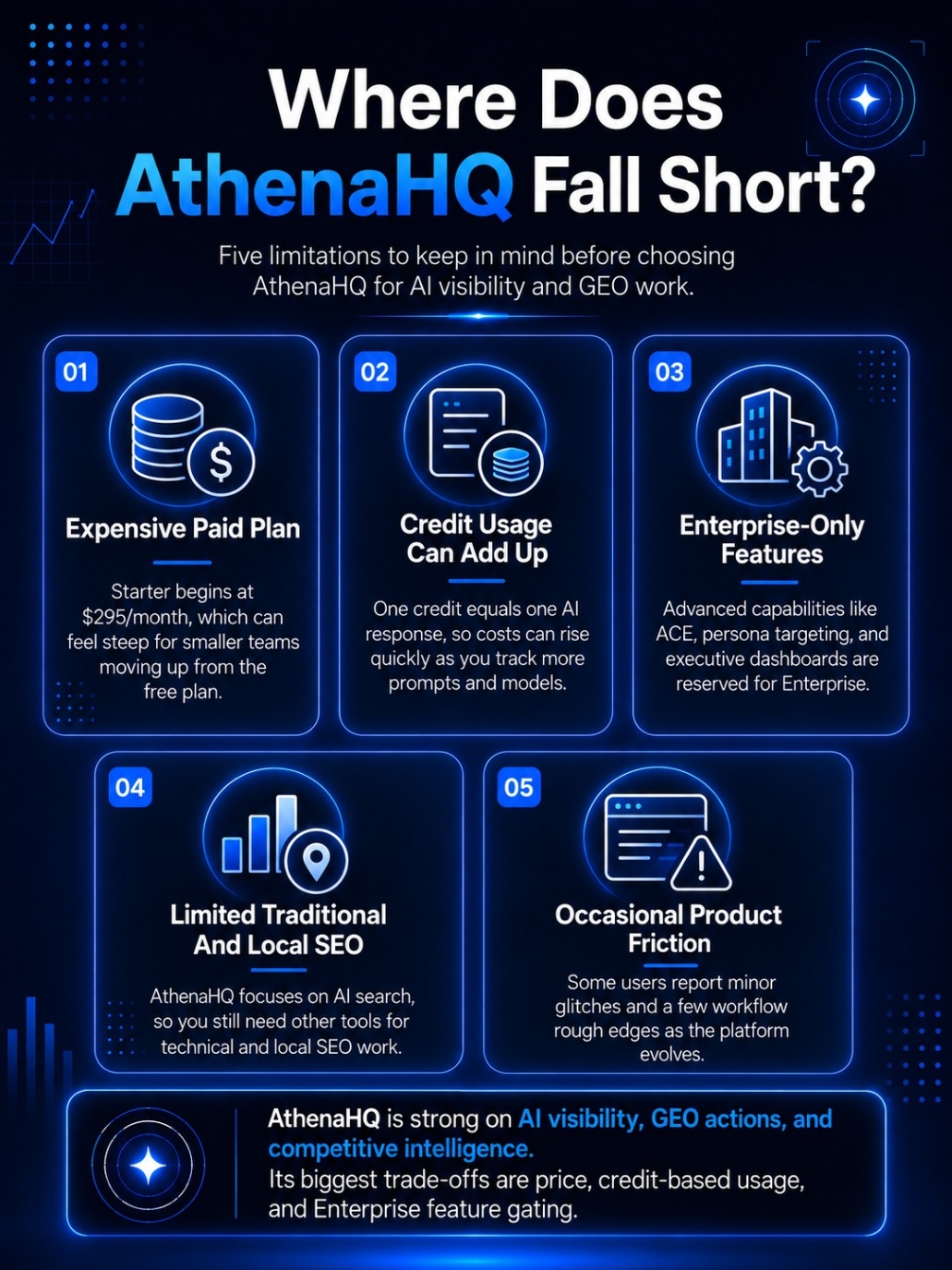
AthenaHQ has moved beyond basic monitoring with GEO actions and content optimization, but there are still a few limitations to consider.
Here’s where it falls short:
- The Paid Plan Is Expensive: Starter costs $295/month after the free Essential tier, which can be a steep jump for smaller teams.
- Credit Usage Can Be Hard To Predict: AthenaHQ charges credits per AI response, so tracking more prompts and models can increase usage quickly.
- Advanced Features Are Enterprise-Only: ACE, multi-region tracking, persona targeting, the Recommendation Engine, and advanced dashboards require an Enterprise plan.
- Multi-Brand Management Could Be Better: Some users want a more consolidated way to manage and compare multiple brands from one view.
- Limited Traditional And Local SEO Coverage: AthenaHQ focuses on AI search, so you will still need other tools for areas like map-pack tracking, technical SEO, and broader SEO execution.
- Occasional Product Friction: Some users report minor glitches as the platform continues to evolve.
Overall, AthenaHQ is strong for AI visibility, GEO actions, and competitive intelligence. Its biggest trade-offs are price, credit-based usage, and the need for additional traditional SEO tools outside AI search.
Need a leaner GEO stack? Explore the top GEO tools for small businesses in 2026 to find options that fit smaller teams and budgets.
AthenaHQ AI Features Review: What Are Its Core GEO Features?
AthenaHQ AI is not trying to be a traditional SEO platform. Its core focus is GEO: tracking how your brand appears in AI answers, which competitors are showing up instead, which sources are shaping those answers, and what gaps you need to fix.
Here are the AthenaHQ AI features that matter most from a GEO perspective.
1. Prompt Volume And Tracking
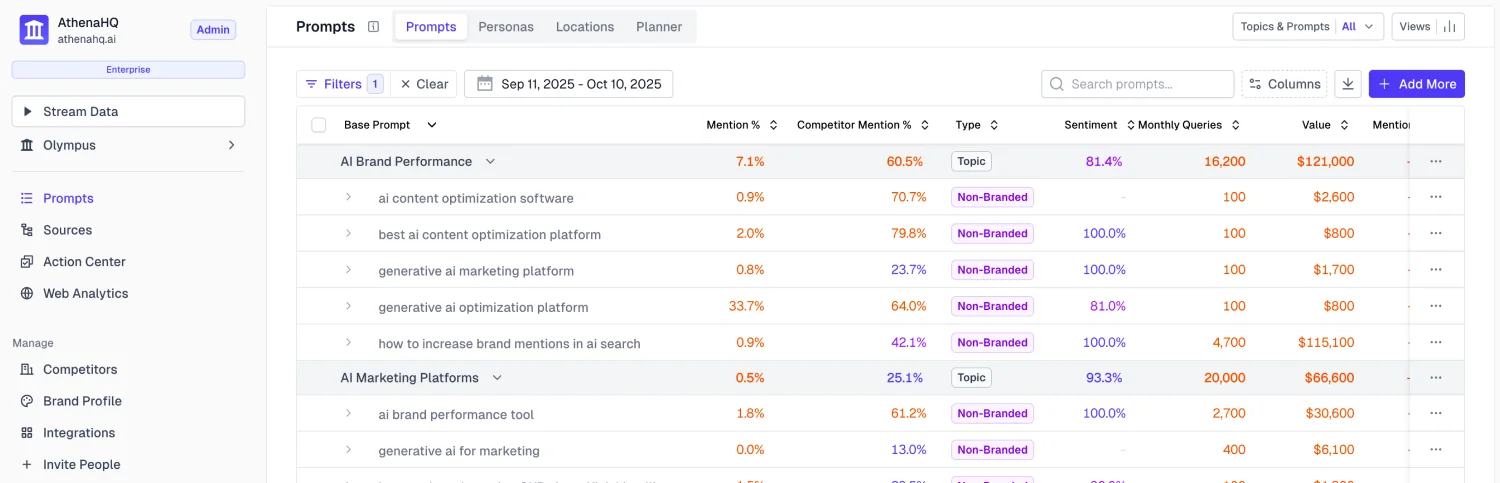
AthenaHQ helps teams identify and track the prompts that matter most to their brand across AI search platforms.
It shows where your brand appears, where competitors are winning visibility, and which high-intent prompts reveal content gaps. Prompt volume data also helps teams prioritize which queries are worth focusing on instead of treating every tracked prompt equally.
2. AI Visibility And Share Of Voice
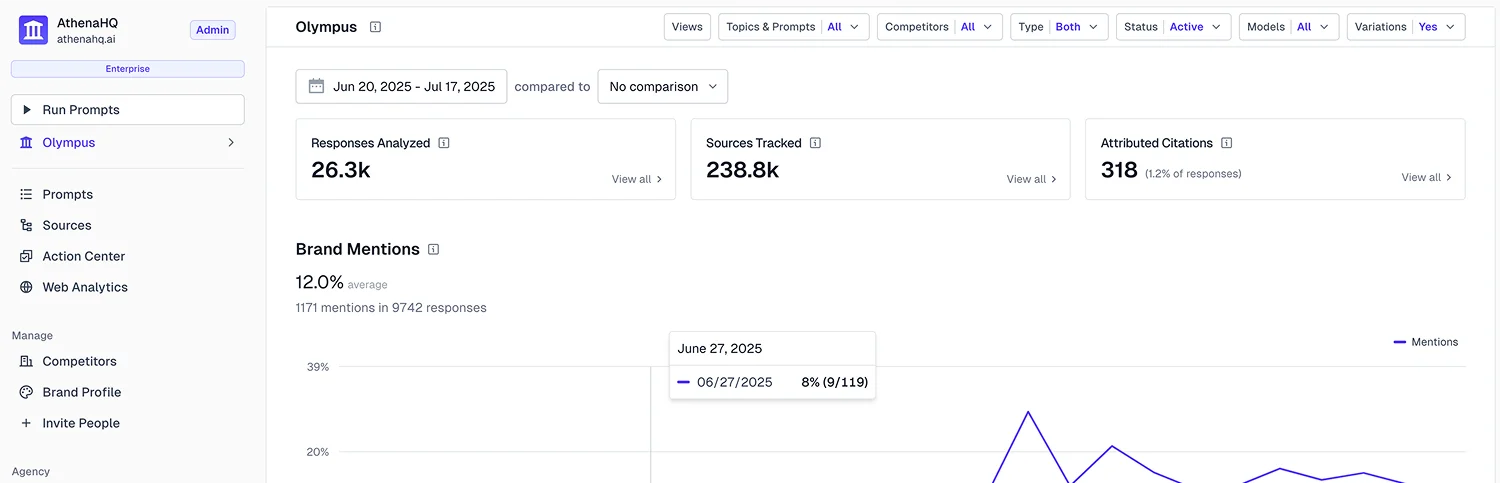
AthenaHQ also tracks how visible your brand is across AI search platforms.
This is useful because one mention in ChatGPT or Perplexity does not really prove anything. What matters is whether your brand keeps appearing across important prompts and how often competitors are being recommended instead.
This feature is helpful for spotting visibility trends, measuring share of voice, and reporting whether your AI search presence is improving over time.
For me, this is one of AthenaHQ’s stronger features because it gives teams a way to discuss AI visibility without relying only on random manual checks.
3. Competitor Benchmarking
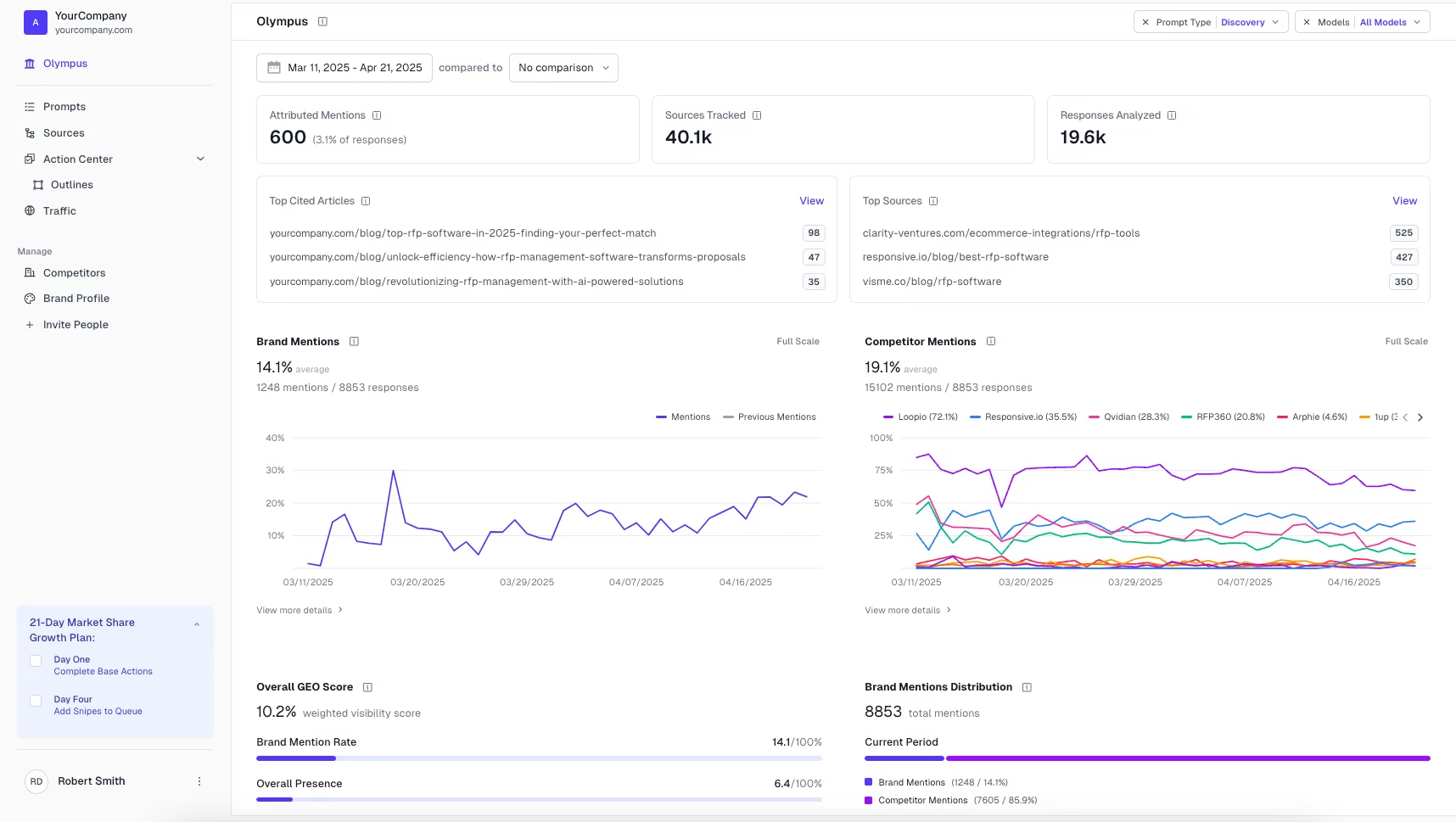
Competitor benchmarking is important because AI search is rarely brand-neutral.
A lot of AI searches are comparison-led. People ask for the best tools, top platforms, alternatives, pricing comparisons, and recommendations. So if your competitors keep showing up and you do not, that is a real visibility problem.
AthenaHQ helps you see which competitors are being mentioned, cited, and recommended across tracked prompts. For content marketers, this is useful because it shows where competitors may have better content depth, stronger third-party mentions, or clearer positioning.
This is where the tool becomes more strategic than a simple brand tracker.
Want sharper competitor tracking? Explore the best GEO tools for competitor analysis to see which platforms help you spot and close visibility gaps faster.
4. Source Intelligence And Citation Tracking
AthenaHQ shows which websites and sources AI platforms cite when answering questions about your brand or category.
This helps you identify:
- Sources already influencing AI answers
- Pages citing competitors but not your brand
- Citation gaps worth addressing
- Third-party sites worth targeting for mentions or links
AthenaHQ also connects this citation intelligence with content and off-page recommendations, helping teams move from finding influential sources to improving their chances of being cited.
5. Athena Citation Engine (ACE)
Athena Citation Engine (ACE) predicts how likely a piece of content is to be cited by AI models. It uses a proprietary machine-learning model trained on millions of AI search results to help teams prioritize content with stronger citation potential.
ACE is currently available on AthenaHQ’s Enterprise plan.
6. Sentiment Analysis
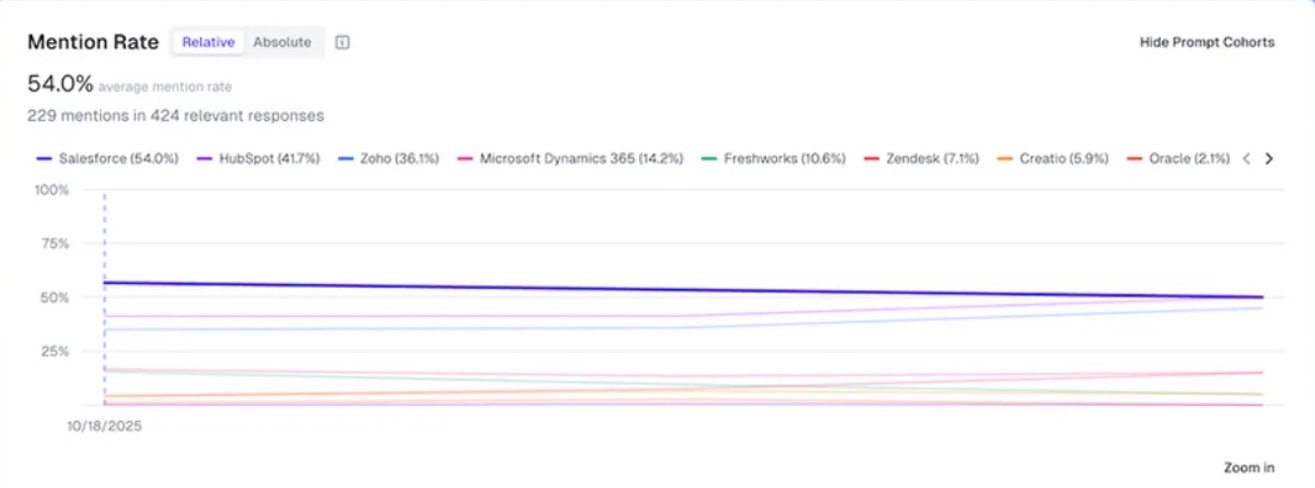
Source: AthenaHQ Blog Salesforce vs. HubSpot: Who's Dominating CRM AI Search? (AthenaHQ Breakdown)
AthenaHQ also tracks the sentiment behind brand mentions.
This matters because being visible in AI answers is not always good. If AI engines describe your product inaccurately, mention outdated pricing, ignore key features, or frame a competitor more favorably, that visibility can hurt trust.
Sentiment analysis helps you see whether your brand is being described positively, negatively, or neutrally.
I would not treat sentiment scoring as perfect, but it is useful as an early warning system. For SaaS, agencies, and enterprise brands, the way AI engines frame your brand matters just as much as whether they mention you.
Also, take a look at our list of the top GEO tools for sentiment analysis.
7. Hallucination Detection And Brand Accuracy
AthenaHQ helps identify where AI platforms misunderstand, misrepresent, or lack important information about your brand, such as outdated pricing, missing features, or incorrect positioning.
It also offers Enterprise features such as Knowledge Base and claim review and Oracle discrepancy detection to help teams spot inconsistencies between approved brand information and what AI platforms are saying.
This makes brand accuracy easier to monitor alongside visibility, citations, and sentiment.
8. Action Center And GEO Actions
AthenaHQ’s Action Center turns visibility insights into specific optimization tasks.
It recommends on-page and off-page actions based on content gaps, citations, and sources influencing AI answers. This helps teams move from identifying a visibility problem to deciding what content, citation, or authority signal needs improvement.
9. AthenaHQ Content And Optimization
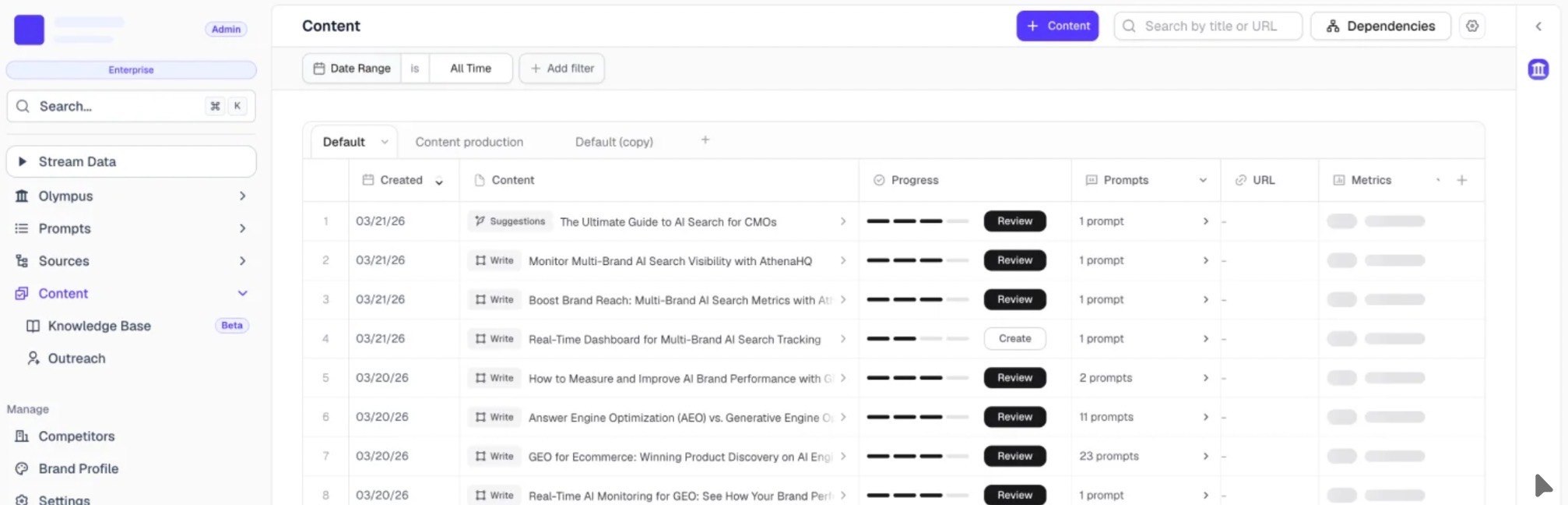
Source: AthenaHQ Content Landing Page
AthenaHQ connects AI visibility data with content improvement through recommendations, a content optimization agent, and self-learning content optimization.
These features help teams improve existing pages around citation gaps and AI search opportunities. However, AthenaHQ still does not replace a complete traditional SEO and content workflow.
10. Ask Athena AI Agent
Ask Athena is an AI copilot that lets you query your AthenaHQ data in plain language instead of digging through dashboards.
You can ask why competitors are outperforming you, which content gaps are hurting visibility, or how specific prompts are performing. Its answers draw from your prompt monitoring, citations, competitor benchmarks, sentiment, and other account data to provide targeted recommendations.
AthenaHQ AI User Reviews: What Do Users Say About AthenaHQ AI In Their Reviews?
AthenaHQ reviews are largely positive, with a 4.9/5 rating from 47 users. Users frequently praise its actionable insights, ease of use, competitor and citation data, reporting, and responsive support.
“I like that I can start from a prompt or topic gap and inspect the competitor responses and citations before a page exists,” says a G2 user.
The complaints are more specific. Users mention the complexity of the credit system, limited consolidated views for multi-brand management, gaps around traditional local SEO and map-pack visibility, and occasional minor glitches. Some reviewers also want greater visibility into prompt-volume data.
Overall, AthenaHQ gets strong feedback for turning AI visibility data into useful next steps. The main concerns are less about its core GEO capabilities and more about credit management, certain workflow limitations, and areas outside its AI-search focus.
AthenaHQ Pricing Review: Is AthenaHQ AI Worth The Price?
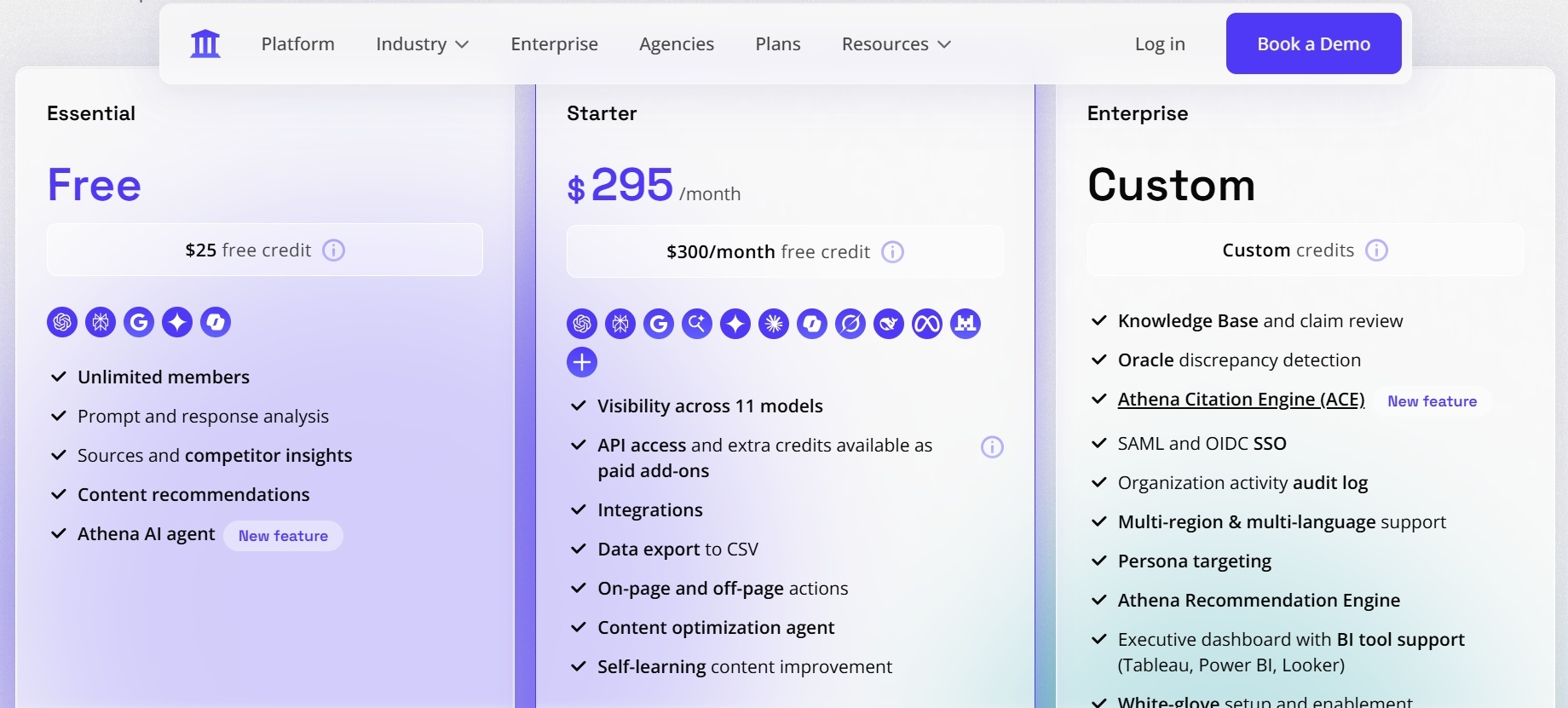
AthenaHQ offers three pricing plans:
- Essential: Free: Includes 300 credits, unlimited members, prompt and response analysis, competitor insights, content recommendations, and Athena AI.
- Starter: $295/month: Includes 3,600 credits, visibility across 11 AI models, integrations, GEO actions, and content optimization. Annual billing is 17% cheaper.
- Enterprise: Custom pricing: Adds custom credits, Athena Citation Engine, multi-region tracking, persona targeting, executive dashboards, and advanced controls.
AthenaHQ uses a credit-based model where one credit equals one AI response. API access and extra Starter credits cost additional. The free plan is useful for testing, but the jump to $295/month is significant compared with many cheap GEO tools.
For teams focused mainly on AI visibility, citations, and GEO insights, the pricing may be justified. If you also need content planning, writing, optimization, audits, and broader SEO + GEO execution, Scalenut offers a wider workflow at a lower starting price.
How Do AthenaHQ Credits Work?
AthenaHQ uses credits to measure AI responses generated while tracking prompts. The more prompts and AI models you monitor, the faster those credits can be used.
- 1 credit = 1 AI response
- Essential: Includes 300 credits
- Starter: Includes 3,600 credits per month
- Enterprise: Includes custom credit limits
- Extra Starter credits: Available as a paid add-on
For example, running 20 prompts across five AI models could use around 100 credits for a single run. This makes credit usage worth considering when deciding how many prompts and platforms you want to monitor regularly.
AthenaHQ Alternatives: How It Compares
AthenaHQ combines AI visibility tracking, citation intelligence, competitive insights, and GEO actions. However, other platforms may fit better depending on whether you need broader SEO execution, deeper enterprise analytics, simpler AI search tracking, or scalable content workflows.
1. AthenaHQ AI Vs Scalenut
Scalenut combines AI visibility tracking with a broader SEO + GEO content workflow, including planning, content creation, optimization, audits, and ongoing execution.
AthenaHQ is more specialized around AI search intelligence and GEO actions, while Scalenut is better suited to teams that want to manage visibility and content execution in one platform.
Want the deeper breakdown? Read our Scalenut vs AthenaHQ comparison to compare AI visibility, GEO execution, and overall value.
2. AthenaHQ AI Vs Profound
Profound is a broader enterprise AEO platform combining AI visibility, prompt-demand data, citation intelligence, AI crawler analytics, and automated content workflows.
AthenaHQ offers a more focused AI visibility and optimization experience, while Profound goes deeper into enterprise analytics, prompt intelligence, traffic analysis, and automation.
Want the deeper breakdown? Our AthenaHQ vs Profound comparison explores the differences in AI visibility, analytics, and GEO workflows.
3. AthenaHQ AI Vs Peec AI
Peec AI focuses on tracking and improving brand performance across AI search engines, including visibility, position, sentiment, competitors, prompts, and citations.
Both platforms now provide actionable recommendations. Peec AI leans toward streamlined AI search analytics and reporting, while AthenaHQ adds a broader optimization layer with GEO actions, content optimization, and enterprise features such as ACE.
4. AthenaHQ AI Vs AirOps
AirOps combines AI search insights with structured content workflows designed to help larger content teams research, create, refresh, and publish content at scale.
AthenaHQ is more focused on understanding and improving brand visibility across AI search, while AirOps goes deeper into repeatable content operations and workflow automation.
If you are seriously weighing these two, read our AthenaHQ vs AirOps comparison to see which approach better fits your GEO workflow.
What Is The Best AthenaHQ AI Alternative In 2026?
The best AthenaHQ AI alternative in 2026 is Scalenut, mainly if you are comparing overall value.
AthenaHQ is genuinely strong for AI visibility. It helps teams track brand mentions across AI platforms, monitor competitors, analyze citations, detect hallucinations, and get GEO recommendations. So I would not call it a basic tracking tool. It does more than that.
Where I think Scalenut gets the edge is the broader workflow you get for the price. With Scalenut, you get AI visibility tracking along with prompt discovery, GEO content creation, content optimization, audits, scoring, and execution workflows at a lower starting price. So if I wanted one platform that helps me track visibility and also work on the content side of SEO and GEO, Scalenut would feel like the more practical buy.
When To Choose AthenaHQ AI
Choose AthenaHQ AI if you mainly need:
- Deeper AI Visibility Intelligence: You want to monitor how your brand appears across multiple AI platforms and understand where you are winning or losing visibility.
- Competitor And Citation Tracking: You want to see which competitors are showing up, which sources AI engines trust, and where your brand is missing.
- Brand Accuracy Monitoring: You want to catch hallucinations, outdated claims, weak positioning, or incorrect brand mentions in AI-generated answers.
- GEO Recommendations: You want direction on which content gaps, citation gaps, or visibility issues need attention.
AthenaHQ makes the most sense when AI visibility intelligence is your main priority and the pricing fits your budget.
When To Choose Scalenut
Choose Scalenut if you want AI visibility tracking along with a broader SEO and content workflow at a more accessible price.
Scalenut gives you prompt discovery, AI visibility tracking, GEO content creation, content optimization, content audits, scoring, and execution-ready workflows. It may not match AthenaHQ one-to-one on AI engine coverage, but it gives content and SEO teams more room to plan, create, optimize, and improve visibility from one place.
If I had to put it simply: AthenaHQ is stronger as a dedicated AI visibility intelligence platform. Scalenut is the better value if you want AI visibility plus SEO and GEO execution in one workflow.
Want to compare more options before deciding? Explore the top 10 AthenaHQ AI alternatives for tracking and improving AI visibility.
Or, try Scalenut Free For 7 Days!
AthenaHQ AI Review: Final Verdict
AthenaHQ AI is a strong fit for teams that need dedicated AI visibility tracking, citation intelligence, competitor insights, brand accuracy monitoring, and GEO actions. Its recommendations and optimization features also help turn visibility gaps into next steps.
If you want AI visibility alongside broader SEO + GEO content planning, creation, optimization, and audits at a lower starting price, Scalenut offers a wider execution workflow.
Frequently Asked Questions
Is AthenaHQ AI worth it in 2026?
AthenaHQ AI is worth considering if you need dedicated AI visibility tracking, citation intelligence, competitor monitoring, and GEO recommendations. It offers strong monitoring and action features, but the $295/month Starter price may be harder to justify for teams with simpler AI visibility needs.
What does AthenaHQ AI do?
AthenaHQ helps brands monitor and improve how they appear across AI search platforms. It tracks brand mentions, prompts, citations, competitors, sentiment, and visibility gaps, then provides content recommendations and on-page or off-page actions designed to improve AI search performance.
Which AI platforms does AthenaHQ monitor?
AthenaHQ supports major AI platforms including ChatGPT, Perplexity, Google AI Overviews, Google AI Mode, Gemini, Claude, Microsoft Copilot, and Grok. Additional models are available on higher tiers or upon request, although exact platform access can vary by plan.
How much does AthenaHQ AI cost?
AthenaHQ offers a free Essential plan with 300 credits. Starter costs $295/month and includes 3,600 credits, while Enterprise uses custom pricing and credit limits. AthenaHQ currently advertises a 17% discount for annual billing. One credit equals one AI response.
Does AthenaHQ have a free plan?
Yes. AthenaHQ's Essential plan is free and includes 300 credits, unlimited members, prompt and response analysis, competitor and source insights, content recommendations, and the Athena AI agent. It is useful for testing the platform before moving to a paid plan.
How do AthenaHQ credits work?
AthenaHQ counts one credit for each AI response generated during tracking. This means usage depends on how many prompts, AI platforms, and runs you monitor. Starter includes 3,600 credits, while Enterprise offers custom credit limits based on the account setup.
Does AthenaHQ track Claude?
Yes. Claude is one of the AI platforms AthenaHQ supports for monitoring brand visibility, mentions, citations, and competitor performance. AthenaHQ also tracks platforms such as ChatGPT, Perplexity, Gemini, Google AI Overviews, Google AI Mode, Copilot, and Grok.
Is AthenaHQ good for small businesses?
AthenaHQ can work for small businesses that already consider AI visibility an important growth channel. The free Essential plan makes testing easier, but the jump to the $295/month Starter plan may be expensive for smaller teams that only need basic monitoring.
What is the Athena Citation Engine?
The Athena Citation Engine, or ACE, is AthenaHQ's proprietary system for predicting how likely a piece of content is to be cited by AI models. It uses a machine-learning model trained against millions of AI search results and is currently an Enterprise feature.
Does AthenaHQ integrate with GA4 and Google Search Console?
Yes. AthenaHQ integrates with Google Analytics 4 and Google Search Console to connect AI visibility with traffic, conversions, and traditional search performance. It also supports Shopify, Webflow, and Framer, while Enterprise customers can connect BI tools such as Tableau and Looker.
Does AthenaHQ help with content optimization?
Yes. AthenaHQ goes beyond visibility reporting with content recommendations, on-page and off-page actions, a content optimization agent, and self-learning content improvement. These features help teams turn visibility and citation gaps into specific content updates rather than only monitoring performance.
Is AthenaHQ suitable for enterprise teams?
Yes. AthenaHQ's Enterprise plan adds capabilities such as multi-region and multi-language tracking, persona targeting, ACE, the Athena Recommendation Engine, advanced access controls, SSO, executive dashboards, BI integrations, and custom credits for organizations managing more complex AI visibility programs.
What are the main limitations of AthenaHQ AI?
AthenaHQ's main limitations are its $295/month Starter price, credit-based usage, and the fact that several advanced capabilities are reserved for Enterprise. It also focuses primarily on AI search optimization, so teams may still need separate tools for broader traditional SEO workflows.
What is the best AthenaHQ AI alternative?
Scalenut is a strong AthenaHQ alternative if you need AI visibility tracking alongside GEO content creation, optimization, content audits, keyword planning, and broader SEO execution. Its annual Starter plan currently begins at $24/month, making it more accessible for content-focused teams.
What are the key features of AthenaHQ AI?
AthenaHQ's key features include AI visibility monitoring, prompt analysis, citation intelligence, competitor tracking, content recommendations, hallucination detection, on-page and off-page GEO actions, content optimization, Athena AI, and advanced Enterprise features such as ACE, persona targeting, and recommendation intelligence.
How can I get started with AthenaHQ AI?
You can start with AthenaHQ's free Essential plan, add your brand and competitors, and begin analyzing prompts, AI responses, citations, sources, and visibility gaps. The free 300-credit allowance provides a practical way to evaluate the platform before upgrading to Starter or Enterprise.
How does AthenaHQ AI compare to other GEO platforms in 2026?
AthenaHQ combines AI visibility tracking with citation intelligence, competitor monitoring, content recommendations, and GEO actions. Compared with lighter tracking tools, it offers a broader optimization workflow, while platforms like Scalenut or AirOps go further into SEO, content creation, and execution.


.svg)


.webp)