.jpg)
Key Highlights
- Both ChatSonic and ChatGPT are powerful AI chatbot tools, but they utilize different core technologies and models, affecting their performance.
- ChatSonic stands out with its real-time Google Search integration for up-to-date information, a key differentiator from ChatGPT's knowledge base.
- Each AI chatbot offers distinct advantages for content creation, with capabilities tailored to different types of tasks and output quality needs.
- The tools differ in their integration options, user interface design, and overall user experience.
- Understanding the pricing structures, including free plans and subscription costs, is crucial for choosing the right tool for your budget.
Artificial intelligence has come a long way, and AI chatbot tools are changing how we work and communicate. With so many options available, picking the right one can feel overwhelming. This guide compares two popular choices: ChatSonic and ChatGPT.
We'll explore their features, capabilities, and limitations to help you decide which AI chatbot best fits your specific needs. By understanding their natural language processing power and unique offerings, you can make an informed choice for your projects.
What Is ChatGPT and How Does It Work?
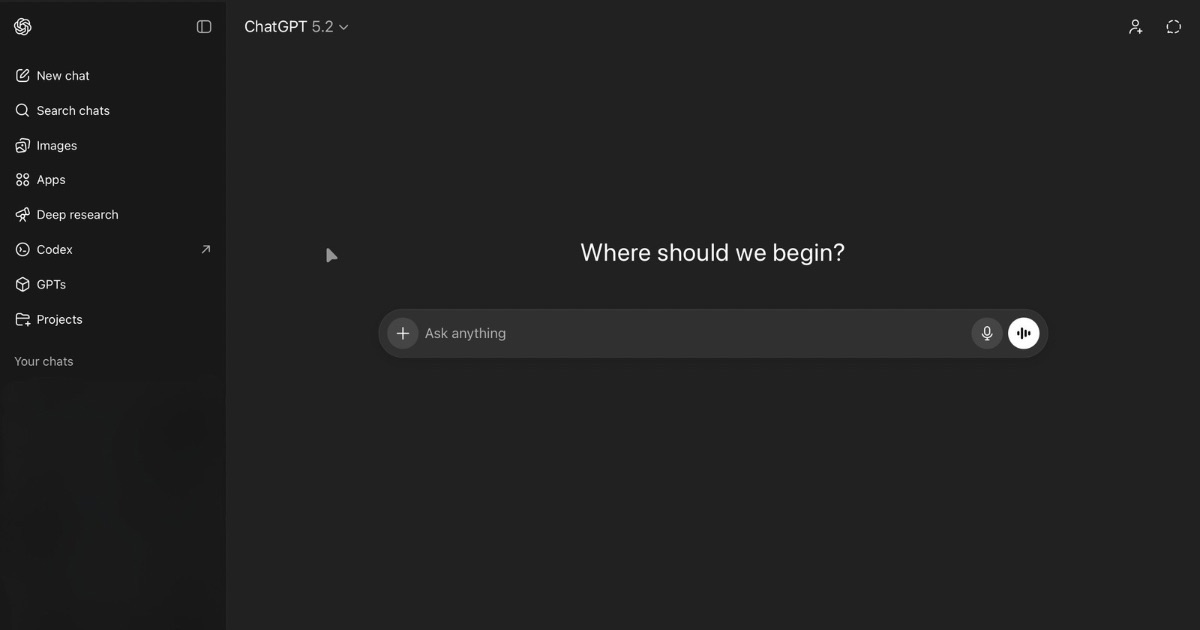
ChatGPT is a conversational AI chatbot developed by OpenAI. It uses advanced large language models (LLMs) to understand and generate human-like text. Think of it as a versatile assistant that can help with a wide range of tasks, from writing emails and brainstorming ideas to solving problems and retrieving information. Its power comes from its ability to engage in natural language processing, making conversations feel fluid and context-aware.
The way ChatGPT works is by drawing on its extensive training data, which includes a massive collection of books, websites, and other text sources. This allows the AI chatbot to understand nuances, answer follow-up questions, and provide detailed responses on many topics. While its knowledge is vast, it's important to remember that its training data has a cutoff point, meaning it might not have the latest information on current events.
What Is ChatSonic and How Does It Work?
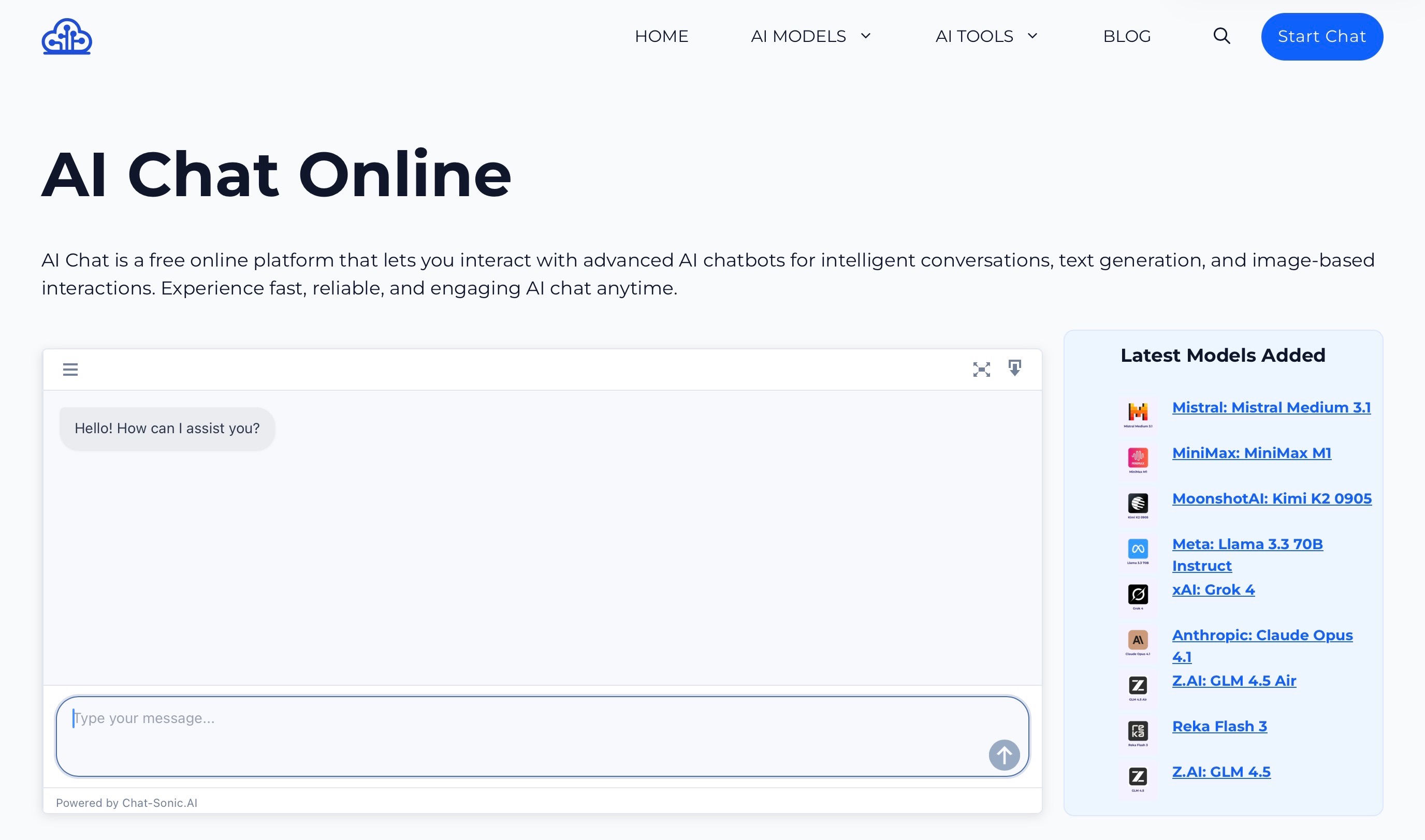
ChatSonic is another powerful AI chatbot designed to engage in human-like conversations and assist with various tasks. Developed by Writesonic, it functions as an advanced language model that understands context, answers follow-up questions, and participates in meaningful discussions. ChatSonic aims to be a versatile tool for both individuals and businesses, helping with everything from research and brainstorming to general communication needs through its natural language processing capabilities.
What sets ChatSonic apart is its integration with Google Search. Unlike some other AI chatbots, ChatSonic can access and process real-time information from the web. This means it can provide up-to-date and accurate answers on current events, recent discoveries, and pop culture trends. This direct connection to the latest data makes it a highly valuable tool for tasks that require current and factual information, giving it a unique edge.
ChatGPT vs ChatSonic: Quick Comparison Table
When you're deciding between ChatSonic ai vs ChatGPT, a side-by-side comparison of their key features can be incredibly helpful. Both AI chatbot tools are powerful, but they excel in different areas. ChatGPT is known for its strong conversational abilities and creative text generation, while ChatSonic shines with its access to real-time data and multimodal features.
Below is a quick comparison table to help you see the differences at a glance. This will give you a clearer picture of their core functionalities, from data access to pricing, helping you determine which platform aligns better with your needs.
Feature
ChatGPT
ChatSonic
Core Technology
Based on OpenAI's GPT models (e.g., GPT-4, GPT-4o)
Uses various models, including GPT-4 and its own technology
Real-Time Data
Limited to training data (no live web access in free version)
Integrated with Google Search for up-to-date information
Multimodal Input
Supports text, images, and voice (in paid versions)
Supports text, images, voice, and files
Customization
Allows creation of custom GPTs (in paid versions)
Offers personalities and templates for tailored outputs
Pricing
Offers a free plan, with paid tiers (Plus, Team, Enterprise)
Included in Writesonic's plans, with a separate Chatsonic plan available
What Are The Biggest Differences Between ChatSonic And ChatGPT?
ChatSonic and ChatGPT differ mainly in data access and features. ChatSonic connects to Google Search for real-time information, while ChatGPT’s knowledge stops at its last update. This makes ChatSonic better for tasks needing current data. Their content creation methods and user interactions also differ, with each using machine learning uniquely. The next sections detail their technology, output quality, and specific functions.
Core Technology and Model Comparison (including Chatsonic vs ChatGPT 4)
The core technology behind ChatGPT is its family of advanced language models developed by OpenAI, primarily the GPT (Generative Pre-trained Transformer) series. The free version often uses a capable model, while paid plans provide access to more powerful LLMs like GPT-4 and GPT-4o. These models are trained on vast datasets, enabling them to understand and generate sophisticated natural language.
ChatSonic, on the other hand, utilizes a combination of AI models. It can leverage powerful LLMs like GPT-4, but it also integrates other models such as Gemini and Llama. This blended approach allows it to be more flexible and adapt to different types of user queries by selecting the best-suited AI model for a given task.
This fundamental difference in their underlying machine learning architecture is a key factor in their performance. While ChatGPT relies on the consistent but static knowledge from its training data, ChatSonic's ability to pull from various models and real-time sources gives it a dynamic edge.
Real-Time Data Access and Web-Browsing Functions
One of the most critical distinctions between these two tools is their access to real-time data. ChatGPT's knowledge is based on its training data, which has a specific cutoff date. This means it cannot provide information on events or developments that have occurred since its last update, limiting its usefulness for topics that require the latest information.
In contrast, ChatSonic is designed with web-browsing functions. It integrates directly with Google Search, allowing it to pull current, date-specific information from the internet. This feature ensures that the responses you receive are not only relevant but also contain the most accurate and up-to-date details available.
For general AI chatbot purposes, this makes a huge difference. If you need to research recent news, find the latest statistics, or get information on a trending topic, ChatSonic is the more reliable choice. ChatGPT is excellent for creative tasks and general knowledge, but it falls short when you require the latest information.
Output Quality And Context Handling Differences
When it comes to output quality, both ChatGPT and ChatSonic are highly capable, thanks to their advanced natural language processing. ChatGPT is often praised for its ability to generate detailed, coherent, and contextually rich text. It excels at maintaining a conversation's flow and can produce creative and elaborate pieces of content based on user prompts.
ChatSonic also delivers high-quality output, but its strength lies in providing concise and factually accurate information, especially when leveraging its web search capabilities. For content creation that requires up-to-date data, ChatSonic often provides more reliable results. However, ChatGPT's responses can sometimes feel more nuanced and creative.
Ultimately, the better AI chatbot for you depends on what you value most. If your priority is creative writing and in-depth conversational ability, ChatGPT might be the winner. If you need quick, fact-checked information for a piece of content, ChatSonic is likely the superior option. In either case, human review is always recommended to ensure accuracy.
How Do ChatSonic AI And ChatGPT Compare On Features?
When comparing ChatSonic versus ChatGPT, it's important to consider their unique features, not just their conversational abilities. Each chatbot offers distinct tools for content creation, research, and integration. Differences include support for images and voice commands, as well as compatibility with other platforms. Understanding these features will help you choose the right AI chatbot for your needs.
Content Creation Abilities
For content creation, both ChatSonic and ChatGPT are incredibly powerful tools. ChatGPT is excellent for generating long-form content like blog posts and creative stories. Its ability to produce detailed and coherent text makes it a favorite among writers who need help brainstorming ideas or drafting entire sections of an article.
ChatSonic, integrated within the Writesonic suite, is particularly strong for marketing-focused content generation. It offers templates and features tailored for creating social media posts, product descriptions, and ad copy. Its connection to real-time data also means the content it produces, such as articles on current trends, is often more timely and factually accurate.
So, is Chatsonic a better alternative for content creation? It depends on your needs. If you require factual accuracy and templates for specific marketing tasks, ChatSonic has the edge. If you prioritize creative, long-form content and conversational depth, ChatGPT might be the better choice. The output quality of both is high, but their strengths serve different purposes.
Integration and Compatibility with Other Platforms
Integration capabilities are a major factor for users who want to incorporate an AI chatbot into their existing workflows. ChatGPT, developed by OpenAI, offers a robust API that allows developers to integrate its functionalities into various platforms and computer programs. This makes it a flexible option for businesses looking to build custom applications or enhance their customer support systems.
ChatSonic also provides integration options, including a browser extension that lets you use its features directly within your browser. As part of the Writesonic ecosystem, it is designed to work seamlessly with other marketing and content creation tools. This makes it a convenient choice for marketers and content teams who need a cohesive suite of tools.
When considering compatibility, ChatGPT's API offers more extensive possibilities for custom development. However, ChatSonic's out-of-the-box integrations, like its browser extension, provide immediate value with minimal setup. Your choice will depend on whether you need deep, custom integration or a tool that fits easily into a content-focused workflow.
Multimodal Features (Images, Voice, Files)
The ability to handle more than just text is a growing trend in AI, and multimodal features are where these advanced language models shine. ChatGPT has expanded its capabilities to include interactions with images and voice commands in its paid versions. You can upload a picture and ask questions about it or use your voice to interact with the AI chatbot.
ChatSonic also offers strong multimodal features. It allows users to upload and discuss various file types, including images, PDFs, audio files, and even webpages. This functionality is particularly useful for research and analysis, as you can ask the AI to summarize a document or describe the content of an image.
Both tools are pushing the boundaries of what an AI chatbot can do. ChatGPT's image analysis is impressive, but ChatSonic's broader support for different file types makes it a more versatile tool for tasks that involve analyzing existing content. Your choice depends on whether you need to analyze diverse file formats or have more visual-based interactions.
Which Tool Offers A Better User Experience: ChatSonic Or ChatGPT?
The user experience of an AI tool impacts your productivity and satisfaction. While both ChatSonic and ChatGPT focus on usability, their interfaces differ. A clean, intuitive design is easy to use, while confusing navigation causes frustration. We’ll compare their interface design, language support, customization options, and learning curve to help you choose the platform with the smoother user experience.
Interface Design and Usability
ChatGPT features a minimalist and straightforward interface design. It presents a simple chat window where you type your prompts and receive responses. This clean layout makes it incredibly easy to start a conversation without any distractions, contributing to a seamless user experience for new and experienced users alike.
ChatSonic's interface, being part of the larger Writesonic platform, is a bit more feature-rich. While still user-friendly, it includes additional menus and options for templates, personalities, and file uploads. This can be very helpful for structured tasks but might feel slightly more complex to a first-time user compared to ChatGPT's bare-bones design.
So, which chatbot is easier to use? For pure, uncomplicated conversation, ChatGPT is arguably the simpler chat assistant. However, if you are looking for a AI tool that guides you through specific content creation tasks with built-in features, ChatSonic's interface might feel more intuitive for those workflows.
Language Support and Customization Options
Language support is a critical factor for global users. ChatGPT supports a wide array of languages, making it an accessible AI chatbot for people around the world. Its ability to understand and generate text in numerous languages is one of its major strengths, allowing it to handle various writing tasks for a diverse user base.
ChatSonic also offers multilingual capabilities, although its primary focus has been on English. For customization, ChatSonic provides "personalities" that allow you to define a specific tone and style for the AI's responses. This is great for maintaining brand voice or tailoring content to a particular audience without having to repeat instructions in every prompt.
In comparison, ChatGPT's customization comes in the form of Custom GPTs (available in paid plans), which let you create specialized versions of the chatbot for specific needs. While more powerful, this feature is also more complex. ChatSonic's personality feature is simpler to use and effective for everyday writing tasks.
Learning Curve For New Users
For new users, the learning curve can be a deciding factor. ChatGPT is exceptionally easy to start with. Its simple, conversational interface requires virtually no training. You just open it and start typing. The user experience is intuitive, making it a great choice for anyone, regardless of their technical expertise.
ChatSonic also has a gentle learning curve, but its additional features might take a little more time to master. New users will need to familiarize themselves with its templates, personality settings, and file upload options to get the most out of the tool. While straightforward, it involves more steps than simply chatting.
Ultimately, both AI chatbot platforms are designed to be user-friendly. ChatGPT is the right choice if you want to jump right in without any setup. ChatSonic is also easy to use, but investing a small amount of time to learn its features will unlock more powerful, structured workflows, especially for content creation.
How Reliable Are ChatSonic And ChatGPT For Professional Tasks?
Reliability is essential for professional tasks. You need an AI chatbot that delivers accurate content, safeguards sensitive data, and scales with your business. Both ChatSonic and ChatGPT are strong options, but their reliability varies by task. We'll compare their accuracy, security, privacy features, and team collaboration capabilities to help you choose the right chatbot for critical work.
Accuracy in Generating Professional Content
The accuracy of an AI chatbot is crucial when generating professional content like blog posts, emails, or marketing copy. ChatGPT is highly proficient at creating well-written and coherent text based on its extensive training data. For content creators who need help with structure, style, and creative ideas, it's an invaluable assistant.
However, ChatSonic often has an edge in accuracy for content that relies on current facts and figures. Because it can access real-time information from the web, it's less likely to produce outdated or incorrect data. This makes it a more reliable choice for marketing materials, reports, or articles that need to be factually current.
So, is Chatsonic more reliable for professional tasks? It depends on the nature of the content. For fact-based writing, ChatSonic's web access gives it higher accuracy. For creative or general business writing where up-to-the-minute data isn't critical, ChatGPT's sophisticated text generation is extremely reliable.
Security, Privacy, and Data Handling
Security and privacy are paramount, especially when handling sensitive information. OpenAI has implemented several security measures for ChatGPT, particularly in its business-focused plans. The Enterprise plan, for example, offers features like data exclusion from training models and compliance certifications to ensure your data is protected.
ChatSonic, as part of the Writesonic platform, also provides security features for its users. The Enterprise plan for Writesonic includes SSO/SAML login and other measures designed to protect user data. However, the available information on its specific compliance and data handling policies is less detailed compared to OpenAI's offerings.
When choosing an AI chatbot for professional use, it's essential to review each company's privacy policy and terms of service. For organizations with strict security requirements, ChatGPT's Enterprise plan offers more explicit and robust data handling commitments, which may make it the more suitable choice for handling sensitive business information.
Reliability For Teams And Business Workflows
For team use cases, an AI chatbot must integrate smoothly into business workflows and offer features that support collaboration. ChatGPT's Team and Enterprise plans are built for this purpose. They allow for shared workspaces, custom GPTs for specific team tasks, and higher usage limits, making it a scalable solution for growing organizations.
ChatSonic also supports team collaboration through Writesonic's team features. These allow members to share documents, brand voices, and other assets within a workspace. This is particularly useful for marketing and content teams who need to maintain consistency across all their outputs, from social media to customer service responses.
Both platforms offer valuable features for team use. ChatGPT's scalability and deep integration options are ideal for businesses looking to embed AI across various departments. ChatSonic's focus on brand consistency and shared content assets makes it a strong contender for marketing and communication teams.
How Do ChatSonic And ChatGPT Compare On Pricing And Accessibility?
Pricing and accessibility often determine your choice between ChatSonic and ChatGPT. Both offer free plans, but with different feature limits. Knowing their subscription costs and features helps you make a cost-effective decision. Here’s a breakdown of their pricing, free offerings, paid plans, and which platform provides the best value for various US users, helping you balance features with affordability.
Free Plans, Subscription Costs, and Feature Limitations
ChatGPT offers a genuinely usable free plan for casual chat and everyday tasks, but it comes with usage caps and can feel slower or more restricted during peak demand. The free tier can include access to more advanced models with message limits that vary by availability. If you need higher limits and priority access, ChatGPT Plus is $20/month. For teams, OpenAI also offers business-focused plans with admin and collaboration controls, with pricing that depends on the tier and seat count.
ChatSonic is part of the Writesonic platform and is available through Writesonic plans, including their free tier in a limited form. Writesonic also offers ChatSonic-focused pricing that typically falls around $12 to $15 per month depending on whether you pay annually or monthly and what is included. The main limitation on free access is usage, such as caps on generations, credits, or output volume, which can become restrictive quickly for frequent content creation.
For general use, ChatGPT’s free plan is usually the easiest starting point for conversation and experimentation, while Plus is the most straightforward upgrade for heavier use. ChatSonic is a better fit if you want a more marketing-oriented workflow inside Writesonic and plan to generate content consistently, since serious output usually requires moving to a paid tier sooner.
Best Value Picks By User Type
The best value pick between ChatSonic and ChatGPT really comes down to your role and specific needs. Different user types will find more value in one platform over the other based on their daily tasks and budget.
For content creators and marketers, ChatSonic often presents the best value. Its integration with Google Search for up-to-date facts, along with specialized templates for marketing copy, makes it a highly efficient tool. It helps streamline the creation of timely and relevant content, which is a huge plus for this user type.
Here are some recommendations based on user type:
- Individual Users & Students: ChatGPT's free plan is an excellent starting point for research, writing assistance, and general exploration.
- Content Creators & Marketers: ChatSonic, either as a standalone subscription or part of a Writesonic plan, offers the best value with its content-focused features and real-time data access.
- Developers & Businesses: ChatGPT's paid plans (Team or Enterprise) provide the best value with their powerful API, advanced security, and collaboration features.
Which Tool Works Better For AI Search And Brand Visibility?
As AI search expands, using these tools to boost brand visibility is wise. Creating accurate, cite-worthy content improves rankings and reputation. ChatSonic and ChatGPT both aid AI search optimization but use different methods. ChatSonic’s real-time data aligns content with current trends.
We’ll compare which tool offers more reliable, citable content for blogs or articles and explain how each chatbot can enhance your optimization strategy and strengthen your brand in the evolving AI-driven search landscape.
Which Tool Produces More Cite-Worthy Content
When creating content for a blog or professional publication, using cite-worthy information is essential for credibility and SEO. ChatSonic is generally better at producing cite-worthy content because of its direct integration with Google Search. It can provide up-to-date statistics, facts, and sources, which you can then verify and reference.
ChatGPT, while excellent at generating text, draws from a static training dataset. This means it can sometimes produce plausible-sounding but incorrect or outdated information, often referred to as "hallucinations." This makes it less reliable for content that requires factual accuracy without heavy verification.
While ChatSonic provides more accurate information, it's crucial to remember that human review is always necessary. No AI is perfect. For the best results in your content creation process, use ChatSonic to gather timely data and initial drafts, but always double-check the facts before publishing to ensure your content is truly cite-worthy.
How To Use Each Tool For AI Search Optimization Workflows
You can leverage both ChatGPT and ChatSonic for your AI search and SEO workflows, but they serve different functions. ChatGPT is a powerhouse for brainstorming keywords, generating meta descriptions, creating content outlines, and even writing simple code snippets for technical SEO tasks.
ChatSonic excels in creating content that is optimized for current search trends. Since it can access Google, you can ask it to write an article based on the top-ranking results for a specific keyword. This helps ensure your content is relevant and aligned with what search engines are currently favoring, boosting your search engine rankings.
Here’s how you can use them in your optimization workflows:
- ChatGPT: Use it for initial keyword research, generating topic clusters, and drafting foundational content that doesn't rely on real-time data.
- ChatSonic: Use it to create timely articles, update existing content with the latest information, and research what's currently performing well in search results.
- Both: Use either tool to generate schema markup, write alt text for images, and brainstorm click-worthy headlines.
When Should You Use ChatSonic Instead Of ChatGPT?
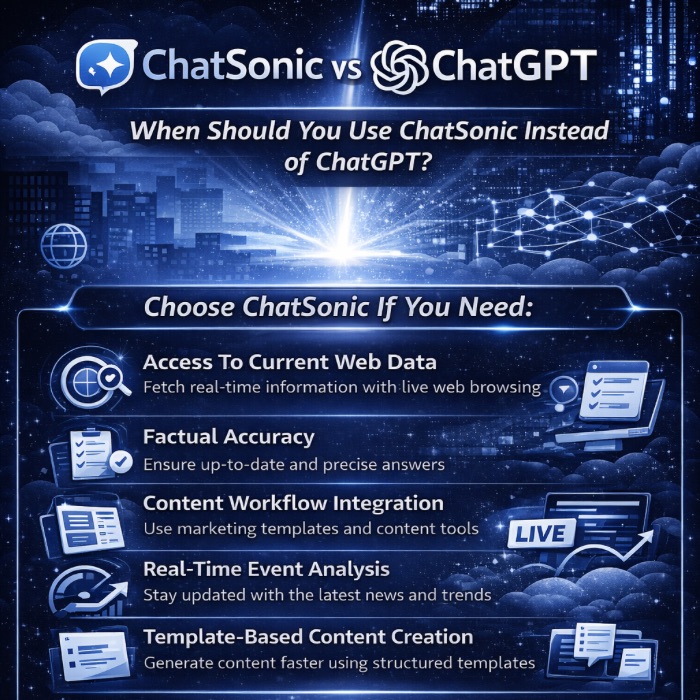
Choosing ChatSonic over ChatGPT depends on your needs. ChatSonic excels when you require real-time information, factual accuracy, and seamless integration with content workflows. Its access to current web data makes it ideal for researchers, journalists, and marketers creating timely content.
If your workflow involves generating content based on current events, analyzing web pages, or using templates for faster creation, ChatSonic is the better choice. Let’s look at scenarios where this advanced tool surpasses ChatGPT.
Best-Fit Scenarios For ChatGPT
ChatGPT excels in scenarios that require creativity, deep conversational ability, and complex problem-solving. Its advanced text generation makes it perfect for drafting long-form content, brainstorming ideas, and exploring topics in depth. The capabilities of ChatGPT are well-suited for a variety of business needs where creative input is more important than real-time data.
The powerful models from OpenAI make this AI chatbot ideal for workflows where you need a versatile assistant. It can help with writing and debugging code, translating languages, or acting as a sparring partner to refine your ideas.
Here are some best-fit scenarios for ChatGPT:
- Creative Writing: Drafting stories, scripts, or marketing copy that needs a unique voice.
- Coding and Development: Generating code snippets, debugging errors, and explaining complex programming concepts.
- General Brainstorming: Exploring new ideas for projects, business strategies, or content without the need for current data.
Ideal Workflows And Team Use Cases
Ideal workflows for ChatSonic are those centered around creating timely and fact-based content. Marketers and content creators can use it to generate blog posts about recent industry news, create social media updates on trending topics, or gather current data for reports and presentations. Its ability to analyze uploaded files also supports research-heavy tasks.
In team use cases, ChatSonic shines in collaborative content environments. A marketing team can use it to ensure all members are pulling from the latest information, maintaining factual consistency across campaigns. Its integration with the Writesonic platform allows for shared brand voices and templates, streamlining workflows.
Here are some ideal workflows and team use cases:
- Journalists & Researchers: Quickly gathering facts and sources on developing stories.
- SEO Specialists: Analyzing top-ranking pages and creating content that aligns with current search trends.
- Marketing Teams: Collaborating on timely campaigns and ensuring brand voice consistency with shared assets.
When Should You Use ChatGPT Instead Of ChatSonic?
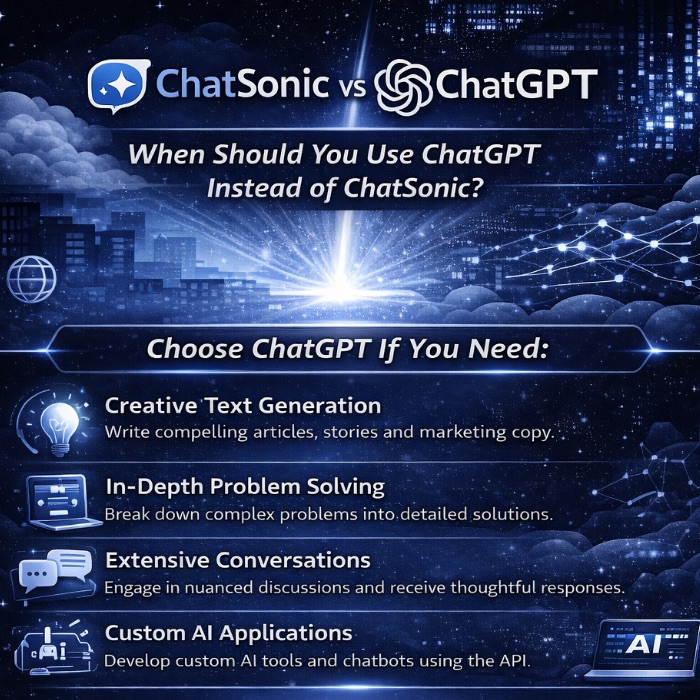
Choose ChatGPT for tasks that require creative text generation, in-depth problem-solving, or extensive conversations. Powered by advanced language models, ChatGPT excels when nuanced understanding and detailed responses matter more than real-time information.
It's ideal for brainstorming, coding, drafting long-form content, or building custom AI applications via API, making it a better choice than ChatSonic for these workflows. Let’s explore scenarios where ChatGPT’s strengths stand out.
Best-Fit Scenarios For ChatGPT
The best-fit scenarios for ChatGPT revolve around tasks that benefit from its powerful text generation and reasoning capabilities. Developed by OpenAI, this AI chatbot is perfect for situations where you need a creative partner or a knowledgeable assistant for complex topics. Its ability to generate detailed, coherent text makes it ideal for a wide range of professional and personal workflows.
From drafting intricate documents to helping you learn a new skill, ChatGPT can adapt to numerous contexts. It's particularly strong when the task is open-ended and requires a high degree of creativity or analytical depth, rather than just pulling facts from the internet.
Here are some best-fit scenarios for ChatGPT:
- Content Brainstorming and Drafting: Creating outlines, first drafts, and exploring different angles for articles, stories, or reports.
- Learning and Explanation: Asking for detailed explanations of complex subjects, from science to philosophy.
- Coding and Technical Help: Writing, debugging, and optimizing code across various programming languages.
Ideal Workflows And Team Use Cases
Ideal workflows for ChatGPT in a team setting often involve collaboration on complex projects that require creative and analytical input. For example, a development team can use a shared ChatGPT workspace to collaborate on coding problems, while a strategy team can use it to brainstorm and refine business plans. Its versatility makes it a valuable asset across different departments.
For business needs that require custom solutions, ChatGPT's API is a game-changer. Teams can build custom AI chatbot applications for internal use or customer-facing products. Unlike ChatSonic, which is more focused on content workflows, ChatGPT provides the building blocks for creating bespoke AI tools.
Here are some ideal workflows and team use cases:
- Development Teams: Collaborating on code, documentation, and technical problem-solving.
- Strategy and R&D Teams: Brainstorming new products, analyzing market trends (based on its training data), and developing strategic documents.
- Custom Application Building: Using the API to create specialized AI assistants for customer support, internal knowledge bases, or data analysis.
Conclusion
Both ChatSonic and ChatGPT offer unique features tailored to different user needs. By analyzing aspects such as core technology, output quality, and usability, you can make an informed decision about which tool suits your requirements best. Whether you prioritize real-time data access or specific integrations, understanding the strengths of each platform will help enhance your workflow and productivity.
Remember, choosing the right AI tool can significantly impact your content creation and professional tasks. To explore these options further and find the ideal fit for your needs, feel free to reach out for a free trial or consultation!
Frequently Asked Questions
Is ChatSonic the best ChatGPT alternative?
ChatSonic is a strong ChatGPT alternative, especially for users who need real-time data and content-specific features. While ChatGPT excels in creative text generation, ChatSonic's integration with Google Search and its marketing-focused tools make it the better AI chatbot for many professional content creation tasks.
Is it true that ChatSonic is like ChatGPT but with superpowers?
That's a popular way to describe it! ChatSonic builds on the natural language capabilities seen in tools like ChatGPT but adds "superpowers" like real-time web access, image generation, and voice commands. These extra features make this AI chatbot more versatile for tasks requiring current information and multimodal interactions.
What is the main difference between ChatGPT and ChatSonic?
The main difference lies in their core technology and data access. ChatGPT relies on its static training data, while ChatSonic integrates with Google Search for real-time information. This makes ChatSonic better for timely topics and ChatGPT stronger for creative tasks that don't require current data.
Is Chatsonic a better alternative to ChatGPT for content creation?
It depends on the type of content. For fact-based articles, news summaries, and marketing copy needing current data, ChatSonic is often better due to its web access. For creative, long-form content where originality is key, ChatGPT's advanced text generation might produce higher output quality.
Does Chatsonic offer any features that ChatGPT doesn’t?
Yes, ChatSonic offers several features not found in the free version of ChatGPT. These include direct integration with Google Search for real-time data, AI image generation, and more extensive multimodal support for analyzing various file types, making it a more versatile tool for certain tasks.
Is Chatsonic more reliable than ChatGPT for professional tasks?
For professional content requiring factual accuracy, ChatSonic is often more reliable due to its real-time data access. However, for businesses needing robust security and custom integrations for sensitive data, ChatGPT's Enterprise plan may offer greater reliability and compliance, depending on the specific professional task.
Is Chatsonic free or paid?
ChatSonic offers both a free plan and paid subscriptions. The free plan is included with a Writesonic account and has usage limitations. For more extensive use, you can upgrade to a paid subscription or purchase a standalone Chatsonic plan for full access to this AI chatbot's features.


.svg)


.webp)