
.jpg)
How to Help ChatGPT Discover Your Products Effectively?

Key Highlights
- Optimize your product data with natural language to make it easier for AI platforms to understand and recommend your items.
- Ensure your website is crawlable by ChatGPT's bots to appear in shopping search results.
- Implement structured data, like schema markup, to provide clear product information.
- Get on the waitlist for OpenAI’s direct product feed system for more accurate ChatGPT shopping listings.
- Encourage customer reviews to provide social proof and valuable context for AI.
- Leverage AI-driven search features now to gain a competitive edge in online retail.
Welcome to the new era of online shopping! AI platforms like ChatGPT are quickly changing how customers find and buy products. Instead of just browsing search engines, shoppers are now using natural language to ask for recommendations directly from AI. For any ecommerce business, understanding this shift toward ChatGPT product discovery is no longer optional, it's essential for success. This guide will walk you through exactly how to make sure your products get noticed in this exciting new landscape.
Understanding Product Discovery with ChatGPT
ChatGPT is transforming the way users find products by offering personalized recommendations based on conversational queries. Unlike traditional search, this generative AI can process complex requests, compare items, and surface product information from various sources, including website content and customer reviews. This creates a more dynamic and interactive shopping experience.
For ecommerce stores, adapting to this new method of AI search is a golden opportunity. By optimizing your product data for ChatGPT shopping, you can reach high-intent buyers early in their decision-making process. This proactive approach helps you stand out from the competition and ensures your products appear in relevant search results.
The Role of AI in Modern Shopping Experiences
AI is revolutionizing online shopping by enabling conversational and personalized product searches. Shoppers can now use everyday language to find exactly what they need, and generative AI delivers tailored results. Large language models analyze user intent, preferences, and budget to recommend products that fit their needs, creating a more intuitive experience.
Unlike traditional search engines, AI offers direct, curated answers instead of just links. For businesses, getting products featured in these AI-driven responses is crucial for attracting today’s shoppers.
Why ChatGPT Product Discovery Is Changing Online Retail?
The rise of ChatGPT shopping is reshaping the customer journey. Shoppers now turn to AI for product advice and comparisons, often skipping traditional search engines. To stay competitive, your online retail strategy must adapt to conversational queries where users ask detailed questions in natural language, like “What are the best noise-canceling headphones under $100?”
AI tools analyze product details and reviews to deliver thorough answers, making rich product content more crucial than ever. For retailers, this shift highlights the importance of generative engine optimization (GEO), which tailors your content for AI readability and value, and not just traditional SEO. Updating your approach now will help you remain visible as AI-driven retail expands.
How Does ChatGPT’s New Shopping Feature Work?
ChatGPT’s shopping feature is simple and conversational. Users can ask questions like, “Recommend a good waterproof coat for men under £100,” and the AI analyzes their needs. ChatGPT searches websites, product pages, and public databases to find relevant products. It then presents recommendations in a visual carousel with titles, prices, and direct links. Recommendations are selected algorithmically for relevance. Ads, when shown, are separate and clearly labeled.
For example, someone planning a gift might ask, “What are the best gifts for a home cook?” ChatGPT provides product suggestions with key features and purchase links, streamlining research and price comparison.
What Are the Essentials to Help ChatGPT Discover Your Products?
To ensure your products are visible in ChatGPT, you need to focus on a few core essentials. It all comes down to making your product data as accessible and understandable as possible for AI. This involves optimizing your website content and ensuring the technical aspects of your site are set up for AI crawlers.
Think of it as laying out a welcome mat for ChatGPT. By providing clear, structured information on your product pages, you increase the likelihood of being featured in ChatGPT product discovery results. The following sections will cover the key requirements and tools you need to get started.
What Are the Key Requirements for Your Store’s Visibility?
Yes, there are specific steps to boost your store’s visibility on ChatGPT. The most important is ensuring your website is easily crawlable; AI platforms like OpenAI’s OAI-SearchBot need access to index your products. If blocked, your listings won’t appear in AI search results, regardless of content quality.
A well-structured website with rich metadata is also essential. Adding schema markup helps AI understand key details like price, availability, and features, making recommendations more accurate.
To ensure your store gets noticed, focus on these must-have elements:
- Allow AI Crawler Access: Update your robots.txt file to grant access to OAI-SearchBot and other relevant AI crawlers.
- Implement Product Schema: Use structured data to clearly define product details like name, price, and reviews.
- Maintain Up-to-Date Listings: Ensure your product data is consistently accurate across all pages and platforms.
What Are the Tools and Resources Needed to Get Started?
Getting started with ChatGPT optimization is easy, thanks to various tools and resources. One effective step is subscribing to the OpenAI product feed, which will soon let you supply product data directly for better accuracy. Many ecommerce platforms also offer automation plugins.
For structuring your product data, use schema generators like AIOSEO for WooCommerce or Google’s Rich Results Test to create and validate schema markup. These tools simplify technical tasks so you can focus on content.
Here are some actionable resources to begin:
- Join the OpenAI Product Feed Waitlist: Sign up to be notified when you can submit your product data directly.
- Use Schema Markup Tools: Implement structured data with plugins or online generators to improve how AI understands your products.
How to Get Your Product Discovered in ChatGPT? (Step-By-Step)
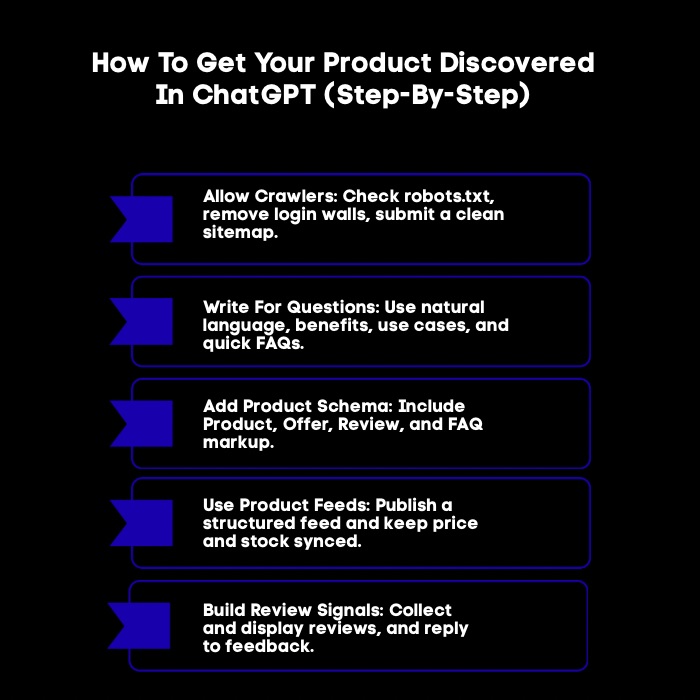
Are you ready to boost your product discovery in ChatGPT? Getting your items to appear in AI-powered search results involves a clear, actionable process. It combines some traditional SEO practices with new strategies tailored for AI. By following a few key steps, you can significantly improve your visibility and reach more customers.
This section will guide you through a step-by-step approach to optimizing your website content for ChatGPT shopping. Let's get started.
Step 1: Ensure Website Crawlability and Indexing
One of the first steps you can take is to make sure AI crawlers can access your website. Just like with Google, if AI bots can't "read" your product pages, they can't recommend your products. This is controlled by a file on your website called robots.txt. You need to check this file to ensure you aren't accidentally blocking crawlers like OpenAI's OAI-SearchBot.
A common indexing issue is having product content behind a gate, like a login wall. All essential product data, including descriptions and prices, should be publicly accessible. You should also ensure your sitemap is up-to-date and well-structured, as this helps crawlers navigate your site more efficiently. Using descriptive URLs, such as /products/eco-friendly-yoga-mat instead of /product?id=12345, also helps AI understand the content of your pages.
As a crucial technical SEO step, review your robots.txt file and add rules to allow key AI crawlers. You can use tools like Google Search Console to identify and fix any crawl errors, such as broken links or slow server response times, that might be hindering the AI search from properly indexing your website content.
Step 2: Optimize Product Descriptions for Natural Language
To make your products more visible, you need to write product descriptions that speak the language of both your customers and AI. Large language models like ChatGPT are trained to understand conversational, human-like text. This means your product content should be written in natural language, not just stuffed with keywords. Think about how you would describe the product to a friend.
Your goal is to provide detailed product descriptions that proactively answer common questions. Include information about who the product is for, its benefits, and common use cases. For example, adding phrases like "great for home workouts" or "a thoughtful gift for busy moms" provides valuable context that helps match your product to user queries. This extra product information gives AI more confidence in its recommendations.
Focusing on natural language has a direct impact on ChatGPT's recommendations. When your content clearly and conversationally explains what your product does and why it's great, you make it much easier for the AI to surface your product as a relevant solution to a user's problem.
Step 3: Implement Structured Data and Schema Markup
Another special requirement for getting recommended on ChatGPT is using structured data, often called schema markup. This is a standardized format of code that you add to your website to explicitly tell search engines and AI what your content is about. For product pages, schema can define the product's name, price, availability, and customer ratings. This metadata makes your product data much easier for AI to process.
Using schema helps AI accurately understand and represent your products. Here are some common schema types and their benefits:
Schema Type
Benefit for AI Discovery
Product
Defines core details like name, brand, and description.
Offer
Specifies price, currency, and availability (in stock/out of stock).
Review
Highlights customer ratings and testimonials, adding social proof.
FAQ
Answers common questions directly, providing valuable context.
Implementing structured data is a best practice that pays off. You can use tools like schema generators or ecommerce plugins to add it to your product pages. Once implemented, always validate your schema using tools like Google's Rich Results Test to ensure it's working correctly and that there are no errors in your website content.
Step 4: Create and Maintain OpenAI Product Feeds
Another powerful step to help ChatGPT list your products is using an OpenAI product feed. This is a structured data file containing all your product information, like titles, prices, descriptions, and more, formatted specifically for AI. While OpenAI is still developing its direct product feed system, getting on the waitlist is a proactive move. This feed will give bots direct access to your most current product content.
Once the system is live, you will need to set up your feed and keep it accurate. This involves ensuring that any changes in price, stock levels, or product details on your site are quickly reflected in the feed. Many ecommerce platforms offer automation tools that can help with this, setting custom refresh intervals to keep your ChatGPT shopping listings up-to-date without manual effort.
For best results, follow these maintenance practices:
- Regularly Audit Your Feed: Periodically check your product feed for accuracy and completeness.
- Use Automation: Leverage plugins or tools to automate updates and sync your product data seamlessly.
Step 5: Encourage Customer Reviews and Testimonials
Customer reviews are a goldmine for making your brand visibility in AI search. They provide authentic social proof and give AI models valuable context about how real people use and feel about your products. When ChatGPT analyzes your product pages, positive reviews and detailed testimonials can significantly influence its decision to recommend your item.
There are several effective methods to collect more reviews. You can offer a small incentive, like a discount on a future purchase, or set up automated post-purchase emails that kindly ask customers for their feedback. Making reviews prominent on your product pages not only helps AI but also encourages other shoppers to share their own experiences.
To fully leverage reviews for ChatGPT product discovery, consider these steps:
- Incentivize Feedback: Offer loyalty points or discounts for leaving a review.
- Automate Requests: Send follow-up emails a few days after a purchase to ask for a review.
- Showcase Reviews: Feature testimonials prominently to highlight positive feedback on product features.
- Engage with Reviewers: Respond to reviews to show you value customer feedback.
What Are the Best Strategies to Increase Product Visibility in ChatGPT Searches?
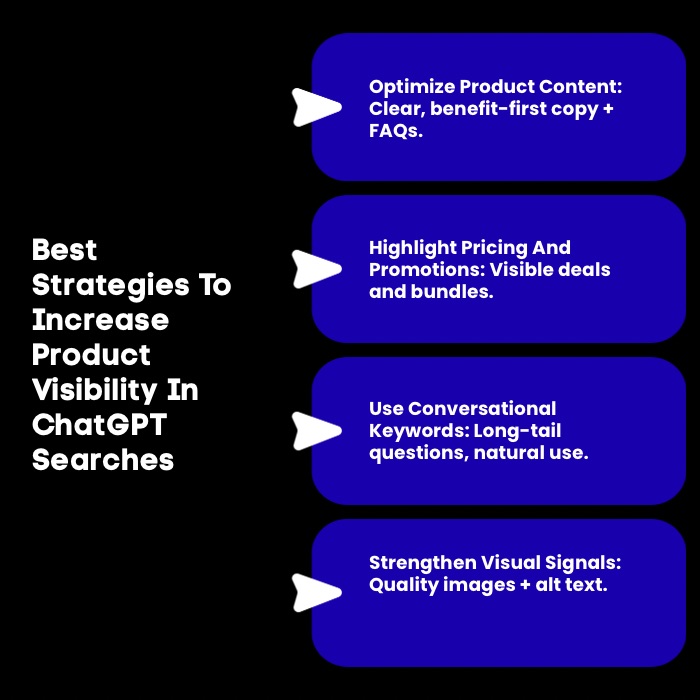
Now that you have the fundamentals down, let's explore some advanced strategies to maximize your product visibility. Boosting your rankings in ChatGPT's search results requires a thoughtful approach to optimization. It's about more than just being present; it's about standing out in a competitive AI search environment.
1. Content Optimization Techniques for Better Discovery
One of the most effective ways to boost your product’s visibility in ChatGPT searches is content optimization. This goes beyond basic SEO; focus on creating informative, natural-sounding content that directly addresses user needs. Make your website the most helpful resource for AI and human shoppers alike.
Improve your product data by writing clear descriptions that emphasize benefits, not just features. Use natural language to explain who the product is for and what problems it solves. Support your products with related content like blog posts, use cases, or detailed FAQs to give ChatGPT more context for recommendations.
Here are some top content optimization techniques:
- Write Detailed, Benefit-Focused Descriptions: Explain how your product improves the customer's life.
- Create Supporting Content: Publish blog posts, guides, and FAQs related to your products.
- Use Natural Language: Write conversationally, as if you're talking to a customer.
- Answer Common Questions: Proactively address potential customer concerns in your content.
2. Leveraging Pricing and Promotions for Enhanced Recommendations
Pricing and promotions are powerful levers to increase your chances of appearing in ChatGPT searches. AI search models often consider price as a major factor, especially when users include budget constraints in their queries, like "find me a laptop under $500." Dynamic pricing and special offers can make your products more appealing to the algorithm.
ChatGPT is designed to surface relevant promotional content in its product results. When it crawls your site and detects a sale, discount, or a "best budget choice" label, it may highlight this information in its recommendations. This makes your listing more compelling and can directly influence a user's purchasing decision within the ChatGPT shopping interface.
Here are some examples of effective price-based campaigns:
- Time-Limited Sales: Create urgency with flash sales that AI can highlight as a timely deal.
- Bundle Offers: Promote value by bundling related products, which can be presented as a smart purchase.
- Clear "Best Value" Messaging: Use clear language on your product pages to label budget-friendly options.
3. Utilizing Keywords to Enhance Discoverability
Keywords are still a crucial strategy for increasing your product's chances of appearing in ChatGPT searches, but their application is different. For AI-driven platforms, you should focus on long-tail keywords and conversational phrases that mirror how people actually ask questions. Think about the full questions a user might type into the chat, not just two or three-word search terms.
When it comes to placement, integrate these keywords naturally into your product titles, descriptions, and metadata. The key is to provide context. For example, instead of just "running shoe," use a phrase like "supportive running shoe for someone with a neutral gait." This helps the AI match your product information to very specific queries, improving your product discovery rankings.
Follow these keyword dos and don'ts for best results:
- Do: Use long-tail, conversational keywords.
- Do: Place keywords naturally within your website content.
- Don't: Stuff keywords unnaturally; it can hurt readability.
- Don't: Rely only on short, generic keywords.
4. The Role of Visual Content in Product Recognition
Visual content is another powerful strategy for increasing your product's chances in ChatGPT searches. High-quality images and videos do more than just attract human eyes; they also help AI recognize and understand your products. As AI search becomes more multimodal, it will increasingly rely on visual data to verify product features and present recommendations.
To optimize your visuals, ensure your images are high-resolution and clearly showcase the product from multiple angles. Use descriptive file names and alt text that include relevant keywords. This metadata provides another layer of product data for AI to interpret, reinforcing the information in your written SEO website content and improving your chances of appearing in ChatGPT recommendations.
Make sure to include these essential image assets:
- High-Quality Product Photos: Show the product clearly from various perspectives.
- Lifestyle Images: Display the product in use to provide context.
- Descriptive Alt Text: Use alt text to describe the image and its content for AI.
How Scalenut Helps ChatGPT Discover Your Products Faster?
If you want your products to show up in ChatGPT recommendations, you need content and product data that AI can understand, plus a way to track whether it is actually working. Scalenut combines GEO (AI visibility tracking) with SEO execution, so you can monitor how your brand appears in AI answers and then improve the pages that influence product discovery.
- Track AI Visibility: Measure presence with Visibility Score, Average Position, and Share Of Voice, plus platform heatmaps.
- Find What Triggers Recommendations: Use prompt tracking, citation tracking, and competitor insights to see which queries and sources drive visibility.
- Execute Faster: Improve pages with Cruise Mode, Content Optimizer, AI Humanizer, and Content Scoring.
- Tie Visibility To Outcomes: Monitor AI bot activity and most referenced pages to understand what AI systems rely on.
Want to see how Scalenut can improve your AI-driven product discovery? Book a demo and get a walkthrough tailored to your ecommerce site.
Conclusion
Helping ChatGPT discover your products is key in today’s digital marketplace. Optimize your website for crawlability, improve product descriptions, and use structured data to boost visibility in AI-driven searches. Leverage customer reviews and visual content to further increase recognition by ChatGPT.
As online retail evolves with AI, these strategies will enhance both product discovery and customer engagement. Contact us for a free consultation on maximizing your product visibility in ChatGPT searches!
Frequently Asked Questions
How Can You Improve Product Discovery on ChatGPT Search?
To improve product discovery, focus on optimizing your product content with natural language, implementing structured data (schema), and ensuring your website is crawlable by AI platforms. Encouraging customer reviews also provides valuable context that can boost your chances of appearing in ChatGPT's recommendations.
What are the special requirements for getting products listed on ChatGPT?
The key requirements include ensuring your website has good crawlability by allowing AI bots in your robots.txt file, using schema markup to structure your product data, and maintaining accurate listings. Joining the waitlist for the OpenAI product feed is also a recommended step for better visibility in ChatGPT shopping.
How can merchants track product discovery through ChatGPT?
Merchants can track discoverability by monitoring referral traffic in their analytics. Look for the UTM parameter utm_source=chatgpt.com to identify visitors coming from ChatGPT. Specialized analytics tools can also help measure AI visibility and track the ROI of your optimization efforts for ChatGPT product discovery.
How can you help ChatGPT discover your products in OpenAI?
Help ChatGPT discover your products by making your website content accessible to its crawlers, implementing structured data on your product pages, and writing detailed, natural-language descriptions. Also, sign up for the OpenAI product feed waitlist to provide your data directly for more accurate ChatGPT shopping results.
Does ChatGPT offer a way for merchants to set up instant checkout for their products?
ChatGPT shopping typically sends shoppers to the merchant’s website to complete their purchase. However, some merchants can enable Instant Checkout, which allows eligible users to buy directly inside ChatGPT. In both cases, the experience focuses on product discovery and comparison, then routes the shopper to checkout either in-chat or on the product page.
Can you explain how the new ChatGPT shopping research feature works for product discovery?
The ChatGPT shopping feature uses generative AI to understand a user's conversational query. It then searches accessible web content for relevant product information and provides personalized recommendations directly in the chat. These results are algorithmically selected and not paid placements, focusing on relevance and quality.


.svg)


.webp)