
.jpg)
Quick summary
- LLM brand sentiment measures portrayal, not just presence. It shows whether AI responses frame your brand positively, negatively, neutrally, or with meaningful positive and negative views.
- AI visibility and sentiment should be tracked separately. A brand can appear frequently but be described poorly, while an absent brand indicates a visibility gap rather than negative sentiment.
- Use neutral branded prompts around buyer concerns. Track themes such as pricing, support, reliability, product quality, trust, and competitor comparisons.
- Record the complete response. Capture the prompt, platform, date, brand placement, competitors, sentiment classification, and any cited sources.
- Look for recurring patterns before taking action. One negative answer may reflect normal response variation. Prioritize claims repeated across prompts, platforms, or tracking periods.
- Validate negative claims before responding. Determine whether each issue is accurate, outdated, inaccurate, isolated, or unverified.
- Improve the signals behind the narrative. Correct inaccurate information, address genuine product concerns, update important pages, publish verifiable evidence, and build an authentic review and community presence.
Your brand can appear in ChatGPT, Gemini, or Perplexity and still lose the buyer. Visibility only shows that you were mentioned. LLM brand sentiment reveals whether the answer presents you as credible, overpriced, reliable, limited, or a weaker alternative.
Tracking this portrayal helps you spot recurring strengths, negative narratives, and inaccurate claims before they affect evaluation. It also shows whether the issue may relate to your product, owned content, reviews, or third-party coverage.
This guide explains how to track sentiment across AI platforms, classify responses consistently, investigate negative claims, and improve how your brand is represented.
What Is LLM Brand Sentiment?
LLM brand sentiment is the overall perception, positive, negative, or neutral, of your brand as reflected in the content generated by large language models. When a user asks an AI platform a question about your industry or products, the AI pulls from its vast training data to formulate an answer. The way it frames your brand within that response is your LLM sentiment. It’s a direct reflection of how these AI models have learned to view your company based on the information available online.
Want to understand the visibility behind the sentiment? Learn how to track and improve brand mentions in LLMs.
Why does LLM brand sentiment matter?
AI platforms now play a growing role in product discovery and comparison. How they describe your brand can shape whether users see it as credible, suitable, or risky.
Tracking sentiment helps you identify recurring strengths, concerns, and competitive narratives across AI responses. You can then correct outdated information, strengthen supporting evidence, or address genuine product and customer issues.
Sentiment should be measured alongside visibility, citations, and share of voice. A brand may appear often but still be portrayed negatively. An absent brand, however, indicates low visibility rather than negative sentiment.
See which AI brand visibility metrics reveal whether your brand is gaining attention or losing ground to competitors.
How is LLM brand sentiment different from AI visibility and traditional sentiment?
AI visibility measures whether and how often your brand appears in AI-generated answers. It may also include citations, links, placement, competitor mentions, and share of voice, but it does not show whether the portrayal is favorable.
LLM brand sentiment measures how AI responses frame your brand. It classifies mentions as positive, negative, neutral, or mixed and can assess specific attributes such as pricing, support, reliability, and product quality.
Traditional sentiment analysis examines opinions expressed in human-written reviews, social posts, and discussions. LLM brand sentiment analyzes how AI systems synthesize available information and present the brand in generated answers.
Together, traditional sentiment shows what people say, AI visibility shows whether your brand appears, and LLM brand sentiment shows how AI turns those signals into a brand narrative.
Learn how answer engine optimization helps brands move beyond rankings to earn mentions and citations in AI answers.
What shapes your brand sentiment in LLMs?
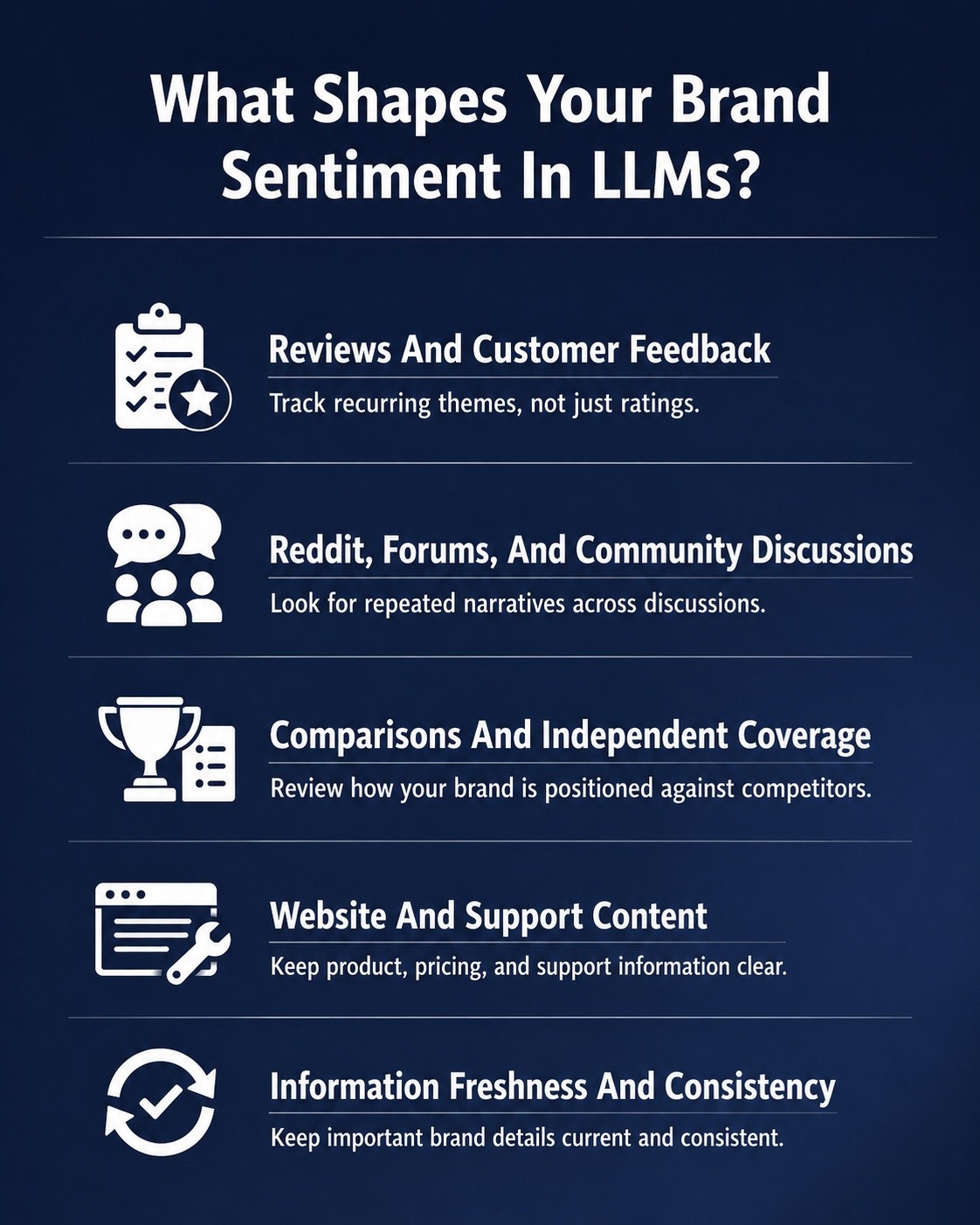
AI-generated answers may reflect training data, live web content, and cited sources. While the influence of any single uncited page is difficult to confirm, repeated narratives across your digital presence can shape how your brand is portrayed.
1. Reviews and customer feedback
Review platforms reveal how customers describe your pricing, usability, support, reliability, and product quality.
Monitor:
- Recurring positive and negative themes
- Recent shifts in customer feedback
- Differences between ratings and written reviews
- Complaints repeated across platforms
Focus on the language customers use, not just the average rating.
2. Reddit, forums, and community discussions
Community discussions show how people naturally describe your brand, compare it with competitors, and raise concerns.
Watch for:
- Repeated opinions
- Emerging complaints or misconceptions
- Competitor comparisons
- Discussions gaining sustained engagement
One comment does not establish a pattern. Look for the same narrative across multiple discussions in platforms like G2, Reddit, Capterra, and Trustpilot.
3. Comparisons and independent coverage
Comparison pages, listicles, reviews, news articles, and industry publications can influence how AI platforms position your brand.
Review:
- Whether your brand appears in relevant comparisons
- How its strengths and limitations are described
- Whether pricing and feature details are current
- Which competitors receive stronger recommendations
- Which sources appear repeatedly in AI responses
4. Your website and support content
Product pages, pricing pages, case studies, FAQs, and help articles provide first-party information about your brand.
Make sure they clearly explain:
- What your product does
- Who it is for
- Its key strengths and limitations
- Current pricing and features
- Evidence supporting important claims
Support content does not automatically create negative sentiment. Problems arise when information is outdated, unclear, or lacks context.
5. Information freshness and consistency
Conflicting details across your website, profiles, reviews, and third-party pages can make it harder for AI platforms to describe your brand accurately.
Keep important information:
- Current across owned pages
- Consistent across major listings
- Available in clear, crawlable text
- Supported by verifiable evidence
- Easy to find through internal links
No single source controls your brand narrative. Clear, current, and consistent information gives AI systems stronger evidence to work with.
Curious which sources may inform AI answers? Explore where ChatGPT gets its information.
How can you effectively track your brand sentiment in LLM-generated content?
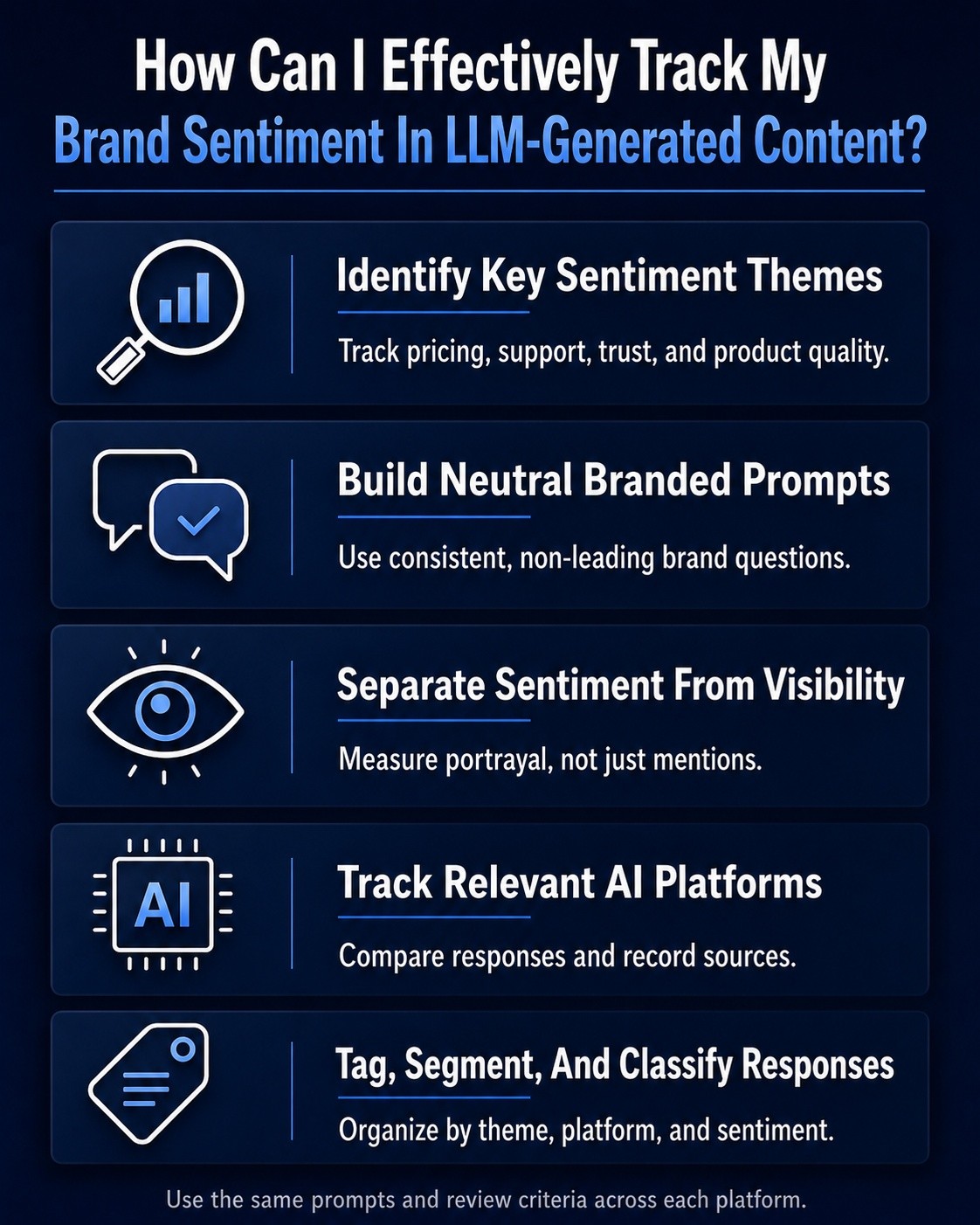
Track LLM brand sentiment using consistent prompts, platforms, and classification rules. The goal is to understand how AI systems frame your brand across important buyer concerns and how that portrayal changes over time.
1. Identify the sentiment themes that matter to your brand
Start with the attributes that influence how customers evaluate your product or service, such as:
- Product quality and reliability
- Pricing and value
- Ease of use
- Customer support
- Integrations or compatibility
- Trust and security
- Key differences from competitors
Keep the list focused. Each theme should represent a specific question your customers may ask before choosing your brand.
2. Build neutral branded prompts for each theme
Create natural questions that evaluate one theme at a time without steering the AI toward a positive or negative answer.
For example:
- How is Brand X’s customer support generally viewed?
- What are the main strengths and limitations of Brand X?
- How does Brand X compare with Brand Y for integrations?
- Is Brand X considered good value for its price?
Avoid leading prompts such as “Why is Brand X unreliable?” when measuring baseline sentiment. LLM outputs can be sensitive to prompt wording, so use the same prompt wording across platforms and tracking periods.
3. Separate sentiment prompts from visibility prompts
Visibility and sentiment measure different outcomes.
- Visibility prompts are usually broad and unbranded, such as “What are the best CRM tools for small businesses?” They show whether your brand appears.
- Sentiment prompts name your brand and examine how it is portrayed, such as “How is Brand X viewed for customer support?”
Track them separately. A brand mention is not automatically positive, while an absent brand is not automatically viewed negatively.
4. Track responses across relevant AI platforms
Monitor the AI platforms your audience is most likely to use, rather than choosing an arbitrary number. Answers may differ because platforms use different models, web retrieval systems, sources, and update schedules. ChatGPT, Claude, and Perplexity can provide web-based answers with source citations, which should also be recorded.
For each response, record:
- Exact prompt
- AI platform and model, when visible
- Date checked
- Full response
- Brand mention and placement
- Competitors mentioned
- Sentiment classification
- Sources cited
- Key statement supporting the classification
Run the same prompt set on a fixed schedule so changes can be compared consistently. An AI visibility tool can automate prompt tracking, sentiment monitoring, competitor comparison, and citation analysis across supported AI engines.
5. Tag, segment, and classify your data
Organize each AI response using the same fields:
- Prompt and sentiment theme
- AI platform and model
- Date checked
- Exact response
- Brand mentioned or absent
- Sentiment classification
- Key statement supporting the classification
- Competitors and cited sources
Classify the sentiment expressed toward your brand, not the general tone of the full response. This matters when an answer discusses several brands or praises one competitor while describing another negatively. Entity-level sentiment analysis follows the same principle by assessing sentiment attached to a specific entity.

Positive, negative, neutral, and mixed are established sentiment categories. Mixed sentiment means the text contains both positive and negative opinions, while neutral means it expresses neither clearly.
Difficult classification examples
“Brand X is affordable and easy to use, but its limited integrations may not suit larger teams.”
Classification: Mixed. The benefits and limitations are both relevant to a purchase decision.
“Brand X is a reliable option for small teams, although its reporting features are fairly basic.”
Classification: Positive. The response remains favorable overall, and the limitation does not outweigh the recommendation.
“Brand X offers content optimization, competitor analysis, and AI visibility tracking.”
Classification: Neutral. The response describes the product without praising or criticizing it.
Apply the same rules across every prompt and platform. Do not automatically label a response mixed because it contains one minor caveat. Review the overall framing, recommendation, and severity of any criticism before assigning the final classification.
Put this process into practice with our guide to monitoring brand presence in ChatGPT and Perplexity.
How to analyze negative brand sentiment in LLM responses?

A negative or mixed response is a signal to investigate, not proof of a wider reputation problem. Review the exact claim, how often it appears, and the evidence behind it before taking action.
1. Isolate the negative claim
Identify the specific criticism and tag the affected area, such as:
- Pricing
- Customer support
- Reliability
- Product quality
- Ease of use
- Integrations
- Security
Record the prompt, platform, date, full response, competitors mentioned, and cited sources. Focus on the sentiment toward your brand or a specific attribute, not the overall tone of a multi-brand answer.
2. Check whether the pattern repeats
Run the same neutral prompt again and compare the results across relevant platforms and tracking periods.
Prioritize claims that appear repeatedly. One negative response may reflect normal output variation rather than a consistent brand perception issue.
3. Review the supporting sources
When citations are available, check whether each source:
- Supports the negative claim
- Contains current information
- Provides the full context
- Appears across multiple responses
Treat citations as evidence to investigate, not proof that one page caused the entire response.
4. Validate the claim
Compare the statement with current product information, pricing, support records, and customer feedback.
Classify it as:
- Accurate and ongoing
- Accurate but outdated
- Inaccurate
- Isolated
- Unverified
5. Prioritize the most important narratives
Focus first on negative claims that:
- Appear across several prompts or platforms
- Affect trust, pricing, security, support, or reliability
- Surface in high-intent comparison queries
- Are supported by multiple independent sources
- Could influence a buyer’s decision
This helps you separate meaningful reputation risks from isolated or outdated AI responses.
Need to investigate where a recurring claim may come from? Explore AI platform citation patterns.
Which Metrics Should You Monitor For LLM Brand Sentiment?
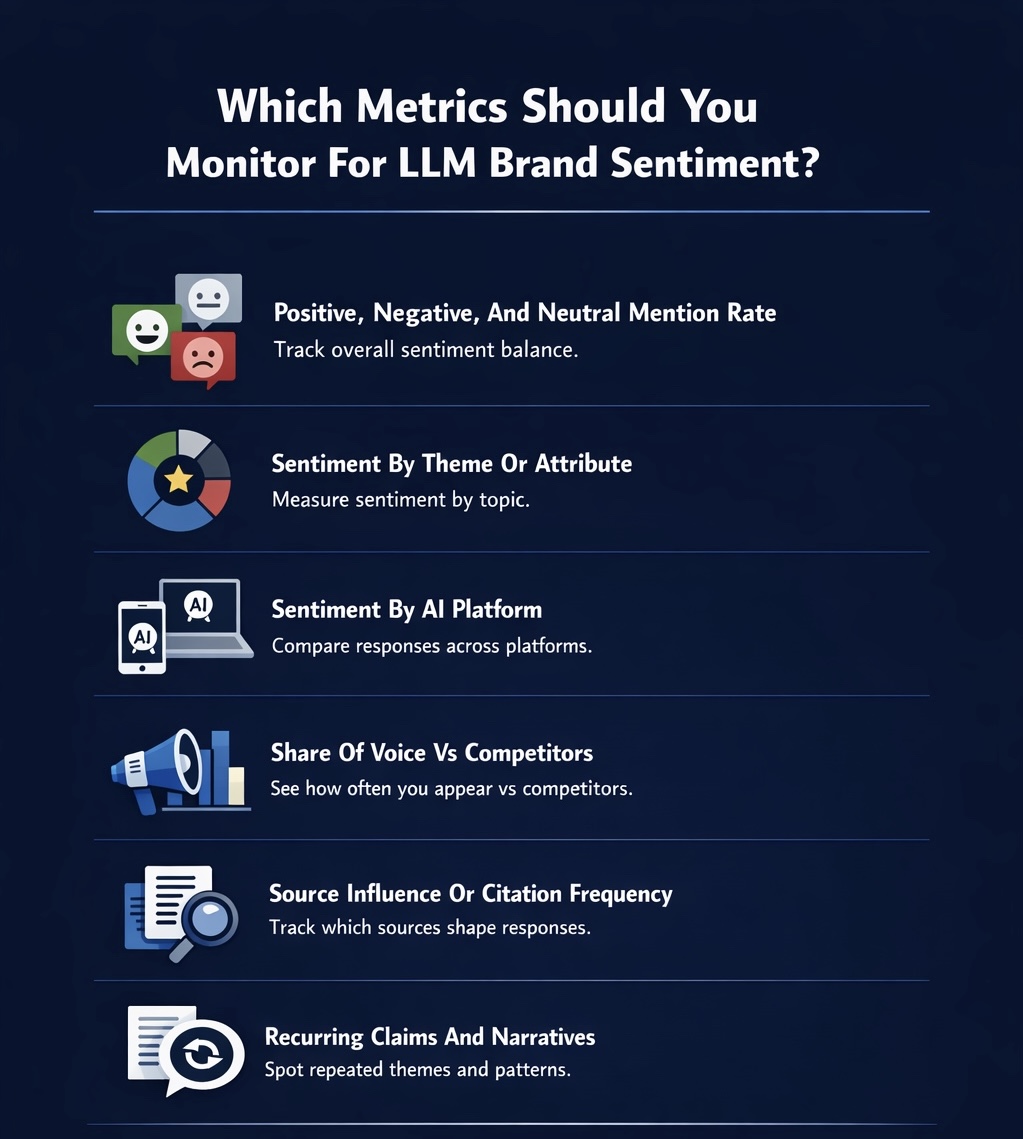
Tracking the right metrics helps you move beyond surface-level mentions and understand how AI platforms actually portray your brand. Instead of relying on one broad sentiment score, look at a mix of visibility, tone, and source-driven signals.
Here are the key metrics worth watching:
- Positive, Negative, And Neutral Mention Rate: Measure how often your brand is described positively, negatively, or neutrally across LLM responses.
- Sentiment By Theme Or Attribute: Track sentiment around specific areas like pricing, support, trust, ease of use, or product quality.
- Sentiment By AI Platform: Compare how different platforms describe your brand, since responses can vary across tools.
- Share Of Voice Vs Competitors: Monitor how often your brand appears compared to competing brands in relevant prompts.
- Source Influence Or Citation Frequency: Identify which sources are shaping AI responses and how often they are cited or reflected.
- Recurring Claims And Narratives: Watch for repeated phrases, patterns, or opinions that consistently shape brand perception.
These metrics give you a clearer view of not just whether your brand shows up, but how it is framed and why that perception is forming.
Go beyond sentiment scores with the AI search performance metrics that connect visibility, citations, prompt coverage, and traffic.
How to improve LLM brand sentiment?

Improving LLM brand sentiment starts with best practices and understanding why a negative or mixed narrative appears. Focus on correcting inaccurate information, resolving genuine issues, and making reliable evidence easier to find.
1. Correct inaccurate or outdated sources
If an AI response cites incorrect pricing, features, policies, or product details, review the original page and contact the publisher with:
- The inaccurate statement
- Correct and current information
- Supporting evidence
- A clear update request
Also fix any conflicting information on your own website. Source updates may improve future AI responses, but changes are not always reflected immediately.
2. Address genuine product and support issues
Recurring complaints may indicate a real product or customer experience problem.
Prioritize issues that:
- Appear across several prompts or sources
- Affect trust, reliability, pricing, or support
- Could influence a purchase decision
- Remain valid after internal review
Share the findings with product, support, and customer success teams. Communicate meaningful fixes through release notes, help content, or product updates.
3. Update important owned pages
Keep your product, pricing, comparison, support, and company pages current and easy to understand.
Make sure they clearly explain:
- What your product does
- Who it is designed for
- Current pricing and features
- Key strengths and limitations
- Answers to recurring customer concerns
Important information should be available in clear text and easy to find through internal links.
4. Publish verifiable evidence
Support important brand claims with evidence instead of broad promotional statements.
Useful proof includes:
- Case studies with measurable results
- Product documentation
- Customer examples
- Original research or data
- Security and compliance information
- Transparent comparison criteria
Keep every claim specific, current, and easy to verify.
5. Build an authentic review and community presence
Encourage customers to leave honest reviews without requesting a particular rating or sentiment.
Monitor relevant review sites, forums, and communities for recurring questions and concerns. Respond when you can provide useful information, but avoid promotional posting, fabricated advocacy, or attempts to suppress legitimate criticism.
Turn these findings into concrete fixes with our AI search optimization checklist.
What are the common challenges of analyzing LLM brand sentiment?

LLM sentiment analysis provides useful directional insights, but it is not a fixed or perfectly objective measurement. Keep these limitations in mind.
1. Confusing visibility with sentiment
A brand mention measures visibility, not endorsement. Your brand may appear frequently but still be described with significant caveats.
Track visibility and sentiment separately so a high mention count does not hide weak brand portrayal.
2. Using too few or leading prompts
A small or biased prompt set can produce misleading results.
Include prompts covering:
- General brand perception
- Product strengths and limitations
- Pricing and value
- Customer support
- Competitor comparisons
- Evaluation-stage concerns
Use neutral wording and keep prompts consistent across platforms and tracking periods.
3. Ignoring response variability
Answers may differ by platform, model, search mode, date, and prompt wording. The same prompt may also produce different results when repeated.
Record the platform, date, exact prompt, and full response. Look for recurring patterns instead of treating one answer as a stable result.
4. Relying only on sentiment scores
An overall score can hide important details. Read the full response to understand:
- The exact praise or criticism
- Sentiment around specific attributes
- How competitors are positioned
- Whether the brand is recommended
- Which sources support the claim
Manually review mixed or ambiguous responses instead of relying entirely on automated classification.
5. Treating AI answers or citations as definitive
AI responses can contain outdated, incomplete, or inaccurate information. A cited source should also be checked for accuracy, context, and recency.
Use sentiment findings as signals for investigation. Sustainable improvement comes from correcting inaccurate information, resolving genuine issues, and strengthening credible brand evidence.
Need a more consistent monitoring workflow? Compare the best AI search monitoring tools for prompts, sentiment, citations, and competitor tracking.
Want A Smarter Way To Improve Both AI Visibility And SEO Performance?
If you want to understand how your brand appears in AI answers and improve the SEO work behind that visibility, Scalenut brings both together in one platform. It helps you track brand presence across AI platforms, uncover the prompts and sources shaping that visibility, and turn those insights into action through tools for sentiment analysis, citation tracking, competitor monitoring, content planning, optimization, internal linking, and content improvement. Instead of stopping at visibility tracking, Scalenut helps you move from insight to execution.
Key Reasons To Consider Scalenut:
- Tracks AI Visibility Across Platforms: Monitor how often your brand appears in AI-generated answers on platforms like ChatGPT and Perplexity.
- Shows How You Compare Against Competitors: Measure visibility score, average position, share of voice, and brand visibility rank.
- Reveals Prompt-Level Insights: See which prompts trigger brand mentions and where visibility is won or lost.
- Highlights Citation Sources: Identify the sources AI systems rely on when mentioning your brand.
- Includes Sentiment Analysis: Understand whether your AI exposure is positive, neutral, or negative.
- Turns Insights Into Action: Get AI-led content ideas, authority suggestions, engagement opportunities, and next-step recommendations.
- Connects Visibility To Site Activity: Track AI bot visits, top AI sources, referenced pages, and AI traffic trends.
- Supports Full SEO Execution: Use tools for keyword planning, content optimization, auditing, internal linking, and SERP-informed content creation.
If your team wants to go beyond basic rank tracking and build a stronger presence across both search and AI discovery, Scalenut can help you do that with far more clarity and control. Book a demo to see how it fits into your workflow.
Final thoughts
Monitoring brand sentiment in large language models should lead to clear action. Use software to track brand sentiment in LLM responses, compare mention volume, and review how answer engines describe your pricing, support, reliability, and competitors. Validate recurring claims before deciding whether the issue is outdated information, weak positioning, or a genuine customer satisfaction problem.
Turn those sentiment insights into a focused digital marketing plan. Correct inaccurate sources, update high-impact pages, publish stronger evidence, and share recurring concerns with product and support teams. Traditional sentiment tools show what people say, while brand sentiment analysis and AI sentiment analysis reveal how that information reaches potential customers through AI answers, strengthening your generative engine optimization strategy.
Frequently asked questions
Is monitoring brand mentions in AI answer engines useful?
Yes. Monitoring mentions in AI answer engines shows whether your brand appears, how it is framed, and which competitors are preferred. It complements visibility data from search engines and helps identify narratives that may strengthen or weaken your brand reputation.
How is LLM sentiment tracking different from traditional sentiment tools?
Traditional sentiment tools analyze opinions in reviews, social posts, forums, and other human-written content. LLM sentiment tracking examines how generative AI synthesizes available information into an answer, including its tone, caveats, recommendations, competitor positioning, and cited sources.
How often should you monitor LLM brand sentiment?
Use a consistent schedule that matches how quickly your product, market, and source landscape change. Monthly checks may suit stable categories, while weekly monitoring is more useful during launches, pricing changes, controversies, or campaigns when sentiment shifts may occur quickly.
Can brand sentiment differ across AI platforms?
Yes. Responses can vary because platforms use different models, retrieval systems, sources, and update schedules. Compare the same neutral prompts across the platforms your audience uses, then focus on recurring sentiment trends rather than treating one response as definitive.
Is an absent brand mention considered negative sentiment?
No. An absent mention indicates a visibility gap, not negative sentiment. Record absence separately from positive, negative, neutral, or mixed classifications. This prevents low visibility from distorting your overall sentiment results and separates discoverability problems from unfavorable brand portrayal.
Can you identify which source caused a negative LLM response?
Sometimes, but not always. When an answer provides citations, check whether those pages support the claim and contain current information. Without citations, you can search for the recurring narrative, but you should not present any page as the confirmed cause.
How accurate is AI sentiment analysis?
AI sentiment analysis is useful for identifying patterns, but it is not perfectly objective. Accuracy depends on prompt wording, classification rules, response complexity, and human review. Read the complete answer and manually check mixed, comparative, sarcastic, or ambiguous language.
Which features should LLM brand monitoring software include?
Look for multi-platform prompt tracking, full-response storage, sentiment classification, competitor comparison, citation monitoring, historical data, and exportable reports. The software should let marketing teams review the evidence behind each classification rather than relying only on one automated score.


.svg)


.webp)