.jpg)
Quick Summary
- The most important AI visibility tracking success metrics are brand mention rate, citation rate, citation share, AI share of voice, prompt coverage, average position, brand accuracy, sentiment, visibility consistency, and AI-driven traffic or conversions.
- Mentions show whether your brand appears in AI answers, while citations show whether your website is used as a source. Share of voice and answer position add the competitive context needed to judge performance.
- There is no universal “good” AI visibility score. Compare your results against your own baseline, direct competitors, and the same fixed prompt set on the same AI platform.
- Reliable tracking depends on consistency. Use the same prompts, platforms, competitors, language, and location over time, then turn weak metrics into focused content, citation, or brand-accuracy improvements.
- The strongest measurement setup combines AI visibility tools with first-party data from Google Search Console and GA4, so you can connect visibility with impressions, traffic, conversions, and business impact.
Being recommended by AI can influence traffic even when users never click an AI-generated link. Similarweb found that people who saw a brand recommended in ChatGPT were 2.5x more likely to visit that brand’s website within the next seven days.
But knowing that AI visibility matters is only half the problem. You also need to know whether yours is actually improving. AI visibility tracking success metrics such as mention rate, citation share, share of voice, prompt coverage, and answer position help you measure where your brand appears, how it compares with competitors, and whether that visibility drives real business results.
Let's look at each of these in detail.
What are AI visibility tracking success metrics?
AI visibility tracking success metrics are KPIs that show how often and how prominently your brand appears in AI-generated answers across platforms such as ChatGPT, Google AI Mode, Perplexity, and Gemini. They include signals such as brand mentions, citations, share of voice, prompt coverage, answer position, sentiment, and visibility trends.
Together, these metrics show more than whether your brand is visible. They help you understand where you appear, which sources AI systems cite, how you compare with competitors, and whether that visibility contributes to search traffic, leads, or revenue.
Why traditional SEO metrics are not enough for AI visibility
Traditional SEO metrics such as rankings, clicks, impressions, and CTR show how your pages perform in conventional search, but they cannot tell you whether your brand is mentioned, cited, or recommended inside an AI-generated answer. This creates a measurement gap between traditional SEO performance and your actual visibility across AI search experiences.
That gap can hide real influence. Similarweb found that users who saw a brand recommended in an AI response were 2.5x more likely to visit its website within the next seven days, even when there was no direct AI referral to attribute. Tracking mentions, citations, share of voice, and prompt-level visibility alongside SEO metrics gives you a more complete picture of how people discover your brand.
10 Most Important AI Visibility Tracking Success Metrics in 2026
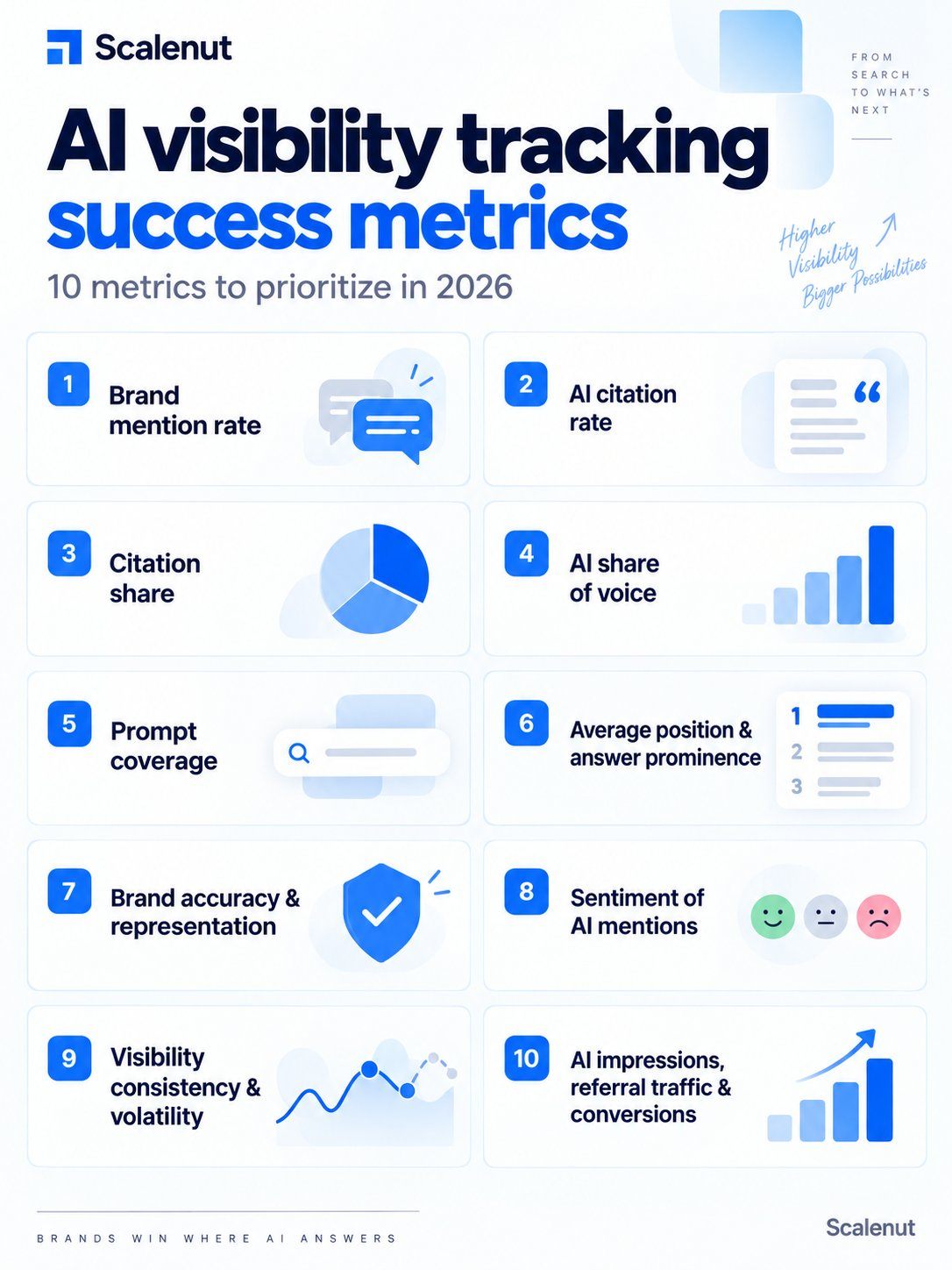
AI visibility is not one number. A strong measurement framework should show whether your brand appears in AI answers, how prominently it appears, whether your content earns citations, how you compare with competitors, and whether that visibility contributes to business results.
Here are the 10 AI search brand visibility metrics worth prioritizing in 2026.
1. Brand mention rate
Brand mention rate measures how often an AI platform names your brand across a defined set of relevant prompts. It captures visibility even when the AI response does not include a link to your website.
Brand mention rate = Prompts where your brand is mentioned ÷ Total prompts tracked × 100
Track branded and non-branded prompts separately. Branded prompts show whether AI systems recognize your company, while non-branded prompts reveal whether your brand is being surfaced for broader categories, problems, comparisons, and use cases.
Tracking mention rate through an AI visibility platform also helps you compare visibility across different AI engines instead of relying on occasional manual searches.
2. AI citation rate
AI citation rate measures how often your website is cited as a source across the prompts you track. Unlike a brand mention, a citation specifically indicates that one of your pages has been surfaced as a supporting source.
AI citation rate = Prompts containing a citation to your domain ÷ Total prompts tracked × 100
A brand can have a high mention rate but a much lower citation rate, so the two should not be treated as interchangeable. Tracking citations separately helps you identify which pages AI engines are actually using and where competitors are earning citations instead.
3. Citation share
Citation share shows how much of the available citation visibility your domain captures compared with a defined set of competitors.
Citation share = Your citations ÷ Total citations earned by you and tracked competitors × 100
For example, earning 20 citations may look strong in isolation. But if competitors collectively earn 180 citations across the same prompt set, your citation share is only 10%.
This metric provides competitive context that citation counts alone cannot. It can also reveal which competing domains or third-party sources consistently influence AI answers in your category.
4. AI share of voice
AI share of voice measures how much of the overall brand conversation you own relative to competitors.
AI share of voice = Your brand mentions ÷ Total mentions across the tracked competitor set × 100
Unlike citation share, this metric focuses on brand presence rather than source citations. It answers a simple competitive question: when AI engines discuss your category, how often does your brand appear compared with the alternatives?
Track the same competitor set over time so changes in share of voice reflect actual visibility movement rather than changes in who is being measured.
5. Prompt coverage
Prompt coverage measures how broadly your brand appears across the set of questions that matter to your audience.
Prompt coverage = Relevant prompts where your brand appears ÷ Total relevant prompts tracked × 100
This prevents a strong performance on a small group of prompts from creating a misleading picture of overall visibility. A brand might dominate five product-comparison prompts but remain absent from dozens of category, use-case, pricing, implementation, and problem-solving queries.
Group prompts by user intent so you can see where visibility is strongest and where meaningful coverage gaps remain.
6. Average position and answer prominence
Getting mentioned matters, but where your brand appears within an AI answer also affects its visibility.
Average position tracks the typical placement of your brand when several products, companies, or recommendations appear in the response.
Average position = Sum of recorded positions ÷ Total responses where your brand appears
For example, consistently appearing first or second in recommendation-style answers creates a different level of exposure than being mentioned near the bottom of a long list.
Track position alongside mention rate rather than replacing it. One measures whether you appear, while the other measures how prominently you appear.
7. Brand accuracy and representation
Visibility loses value when AI systems describe your brand incorrectly. Brand accuracy measures whether AI-generated answers correctly represent details such as your features, pricing, capabilities, integrations, target audience, and positioning.
Review tracked responses for information that is:
- Accurate
- Incomplete
- Outdated
- Incorrect
Then trace inaccurate claims back to the sources AI engines are relying on wherever possible.
Accuracy deserves its own metric because a positive answer can still contain outdated pricing or incorrect product information. Sentiment tells you how the brand is portrayed, while accuracy tells you whether that portrayal is factually correct.
8. Sentiment of AI mentions
Sentiment measures whether AI-generated responses describe your brand positively, neutrally, or negatively.
A high mention rate does not automatically mean strong visibility. An AI answer may frequently mention your company while emphasizing limitations, negative reviews, missing features, or situations where another product is a better fit.
Track changes in sentiment alongside the prompts and cited sources behind them. This makes it easier to identify whether a negative pattern stems from your own content, third-party reviews, competitor comparisons, or outdated information elsewhere on the web.
9. Visibility consistency and volatility
AI visibility can change even when you run the same or similar prompts repeatedly. Visibility consistency measures how reliably your brand continues to appear, while volatility tracks the scale of those changes over time.
Monitor changes in:
- Brand mentions
- Citations
- Average position
- Share of voice
- Sentiment
- Source selection
Rather than reacting to one missing mention, look for sustained movement across repeated measurements. A persistent decline is much more actionable than a single response changing from one run to the next.
Also break this metric down by AI platform. Strong visibility in one engine can hide weak or declining performance in another when all platforms are combined into a single score.
10. AI impressions, referral traffic, and conversions
The final layer connects AI visibility with measurable business outcomes. Visibility metrics tell you whether AI engines surface your brand, while traffic and conversion metrics help show what happens when users move from an AI experience to your website.
Track signals such as:
- AI search impressions
- AI referral sessions
- Landing pages receiving AI traffic
- Engagement rate
- Leads and sign-ups
- Conversion rate
- Revenue or assisted conversions from AI traffic
Do not judge AI visibility only by referral volume. Many AI interactions end without a click, while others may influence users who later return through branded search, direct traffic, or another channel.
The strongest measurement framework therefore combines presence, citations, competitive visibility, accuracy, consistency, and business impact, giving you a much clearer picture than any single AI visibility score can provide.
How can you measure AI visibility metrics reliably?
AI responses can change between runs, so reliable measurement depends on testing under consistent conditions rather than relying on one-off checks. Use a fixed set of relevant prompts, repeat important prompts, and track each AI platform separately so differences between engines do not get hidden in one overall score.
Separate branded and non-branded prompts, group them by intent, and keep your competitors, location, and language consistent. Most importantly, document any changes to your prompt set. Changing the prompts midway changes what you are measuring, making past and current results harder to compare accurately.
The goal is simple: keep the measurement setup consistent enough that changes in your metrics reflect real visibility trends, not changes in how you tested them.
What is a good AI visibility benchmark?
There is no universal “good” AI visibility benchmark. Mention rate, citation rate, share of voice, and visibility scores can vary widely depending on the prompts tracked, AI platform, competitor set, market, and measurement method. Peekl’s September 2026 study, for example, found that the most-mentioned local business in its sample averaged about 33% presence, but it explicitly treats this as a market snapshot, not an industry standard.
A more reliable benchmark is your previous performance + direct competitors + the same prompt set on the same AI platform. Track whether your visibility is improving over time and whether you are closing gaps against competitors, rather than chasing a single universal score.
How often should you review AI visibility tracking metrics?
There is no single reporting schedule that works for every brand. What matters is checking the same set of prompts regularly so you can spot real trends instead of reacting to one-off changes in AI responses. Monthly tracking is a practical starting point for most businesses.
Check high-value prompts more often when needed, such as after a product launch, pricing update, major content change, or sudden visibility drop. Broader reviews can happen monthly or quarterly to compare share of voice, citations, sentiment, and competitor movement over time. Tools such as Ahrefs also allow daily, weekly, or monthly prompt tracking depending on how closely you need to monitor changes.
How should you use AI visibility tracking data?
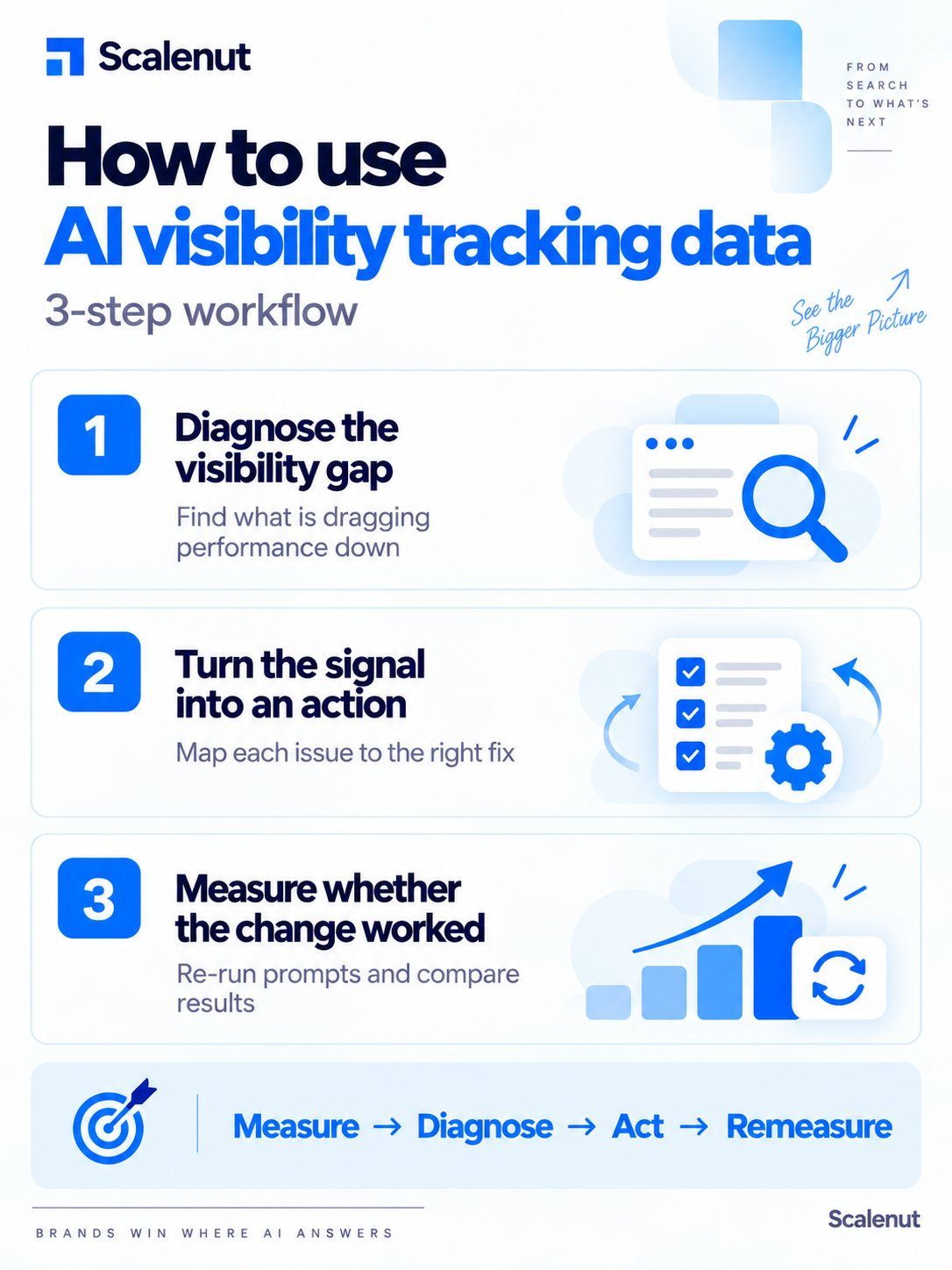
AI visibility data becomes useful when it leads to a clear action. Use it to identify where visibility is weak, fix the underlying issue, and measure whether the change improves performance.
Here is a simple three-step workflow.
1. Diagnose the visibility gap
Break weak performance down by prompt, AI platform, competitor, citation source, and brand representation. This shows whether the problem is missing coverage, weak citations, poor positioning, or inaccurate information.
2. Turn the signal into an action
Match the gap to the right fix. Refresh outdated pages, fill genuine content gaps, improve citation-worthy information, correct inaccurate brand details, or strengthen your presence on relevant third-party sources.
3. Measure whether the change worked
Re-run the same prompt set after making changes and compare mentions, citations, answer position, share of voice, traffic, and conversions with your previous baseline. Using a consistent measurement set makes it easier to separate meaningful improvement from normal AI response variation.
The goal is to create a repeatable measure → diagnose → act → remeasure cycle, so AI visibility data continuously informs what your team should improve next.
How can you improve weak AI visibility tracking success metrics?
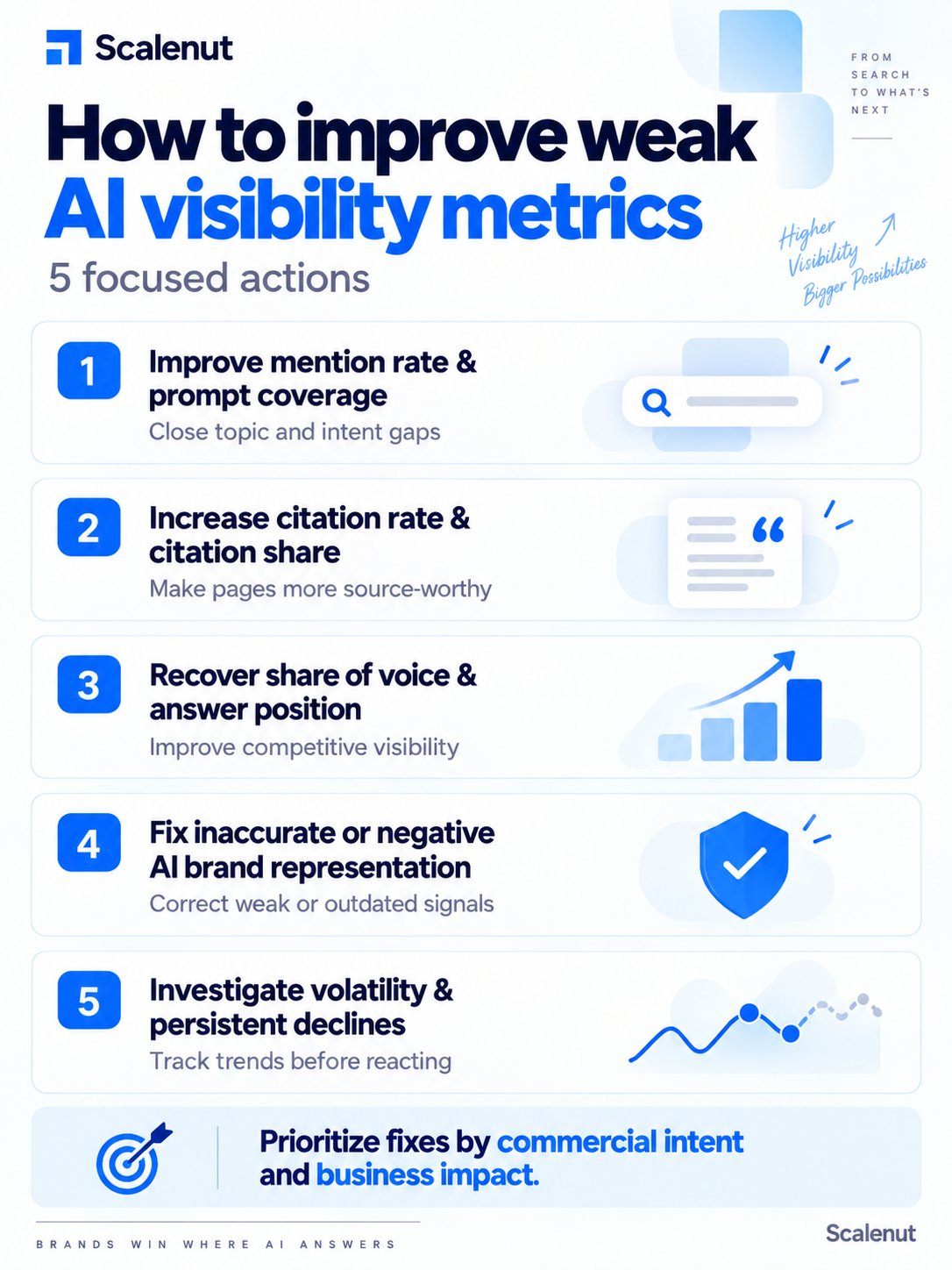
Weak AI visibility metrics should help you identify what needs fixing, whether that is content coverage, citations, competitive presence, brand representation, or visibility consistency.
Here are five focused ways to improve underperforming metrics.
1. Improve low mention rate and prompt coverage
If your brand appears across too few relevant prompts, identify the topics, use cases, and buyer questions where competitors appear but you do not. Segment these gaps by user intent to prioritize high-value comparison, recommendation, and decision-stage prompts.
Improve existing pages where the answer is weak, and create new content only when a genuine coverage gap exists. Focus on useful, differentiated information rather than simply adding more content. Google similarly recommends unique, valuable content alongside strong SEO fundamentals for generative search experiences.
2. Increase weak citation rate and citation share
If your brand gets mentioned but your website rarely earns citations, examine which competitor and third-party pages AI engines cite for the same prompts. Tracking citations helps uncover the sources and content types influencing those answers.
Strengthen relevant pages with current facts, original insights, supporting evidence, clear answers, and good crawlability. The goal is to make your content more useful as a source, not simply longer.
3. Recover lost share of voice and answer position
A declining share of voice or average position means competitors are gaining prominence. Break the decline down by AI platform and prompt cluster to identify where you are actually losing visibility.
Compare the stronger pages and brands for those prompts, then improve gaps in areas such as product information, comparisons, pricing, use cases, evidence, or third-party validation. Prioritize commercially important prompts first.
4. Fix inaccurate or negative AI brand representation
If AI platforms describe your brand incorrectly or negatively, identify the exact claim and its source where possible. Check for outdated pricing, features, positioning, reviews, or inconsistent information across your own site and frequently cited third-party sources.
Correct inaccurate first-party information and make important brand details easy to verify. Structured data can support understanding when it accurately reflects visible content, but it should complement clear, reliable information rather than replace it.
5. Investigate visibility volatility and persistent declines
Do not react to a single changed AI response. Track the same prompt set over time and compare changes in mentions, citations, position, competitors, and sources across each AI platform.
If the decline persists, investigate whether cited sources changed, competitors gained visibility, your content became outdated, or crawlability issues appeared. Platforms such as Scalenut let you examine prompt-level visibility, citations, competitors, positions, and trends together to identify where the change occurred.
Prioritize fixes by commercial intent and business impact. A visibility loss on a high-intent comparison or purchase prompt usually deserves attention before a decline on a low-value informational query.
Which tools can help track AI visibility metrics?
The right tracking setup depends on how deeply you need to measure AI visibility and whether you also want to act on those insights. Dedicated platforms can track mentions, citations, competitors, and prompts, while first-party analytics help connect AI visibility with impressions, traffic, and conversions.
Here are the main ways to track AI visibility metrics in 2026.
1. SEO and GEO platforms with AI visibility tracking
Scalenut combines SEO and GEO workflows with AI visibility tracking, making it useful for teams that want to move from measurement to content optimization within the same platform. Its AI Visibility suite currently tracks brand performance across ChatGPT, Google AI Overviews, Perplexity, and Claude.
Marketing teams can monitor metrics such as Visibility Score, Average Position, Share of Voice, Visibility Rank, citations, mentions, sentiment, prompt performance, and query fanouts. Scalenut also provides competitor insights and recommendations for content and authority building, while its Cloudflare-integrated Traffic Monitor helps distinguish human traffic from AI user agents.
2. Dedicated AI visibility monitoring tools
Dedicated AI visibility tools focus primarily on monitoring how brands appear across AI-generated answers. They typically track metrics such as brand mentions, citations, share of voice, prompt coverage, sentiment, answer position, and competitor visibility across multiple AI platforms.
These tools are useful when measurement is the main priority. However, compare how each platform calculates its visibility scores and which AI engines it supports, since methodologies can differ significantly between tools.
3. First-party data from Google Search Console and GA4
Google Search Console now provides a dedicated Generative AI performance report for AI Overviews and AI Mode. It shows how generative AI impressions change over time and which pages, countries, and devices generate those impressions, giving marketers first-party visibility data directly from Google.
GA4 complements this with an AI Assistant traffic channel that identifies recognized referrals from assistants such as ChatGPT, Gemini, and Claude. Use this data to connect AI visibility with sessions, engagement, conversions, and other business outcomes that visibility tools alone cannot measure.
4. Manual AI visibility tracking
Smaller teams can start by creating a fixed set of high-value prompts and testing them consistently across the AI platforms their audience uses. Record whether your brand is mentioned or cited, its position in the response, competing brands, sentiment, and cited sources.
You can also manually review Google AI Overviews alongside platforms such as ChatGPT and Perplexity. Manual tracking is harder to scale, but it can establish an initial baseline and help validate the results reported by automated tools.
The strongest setup combines AI visibility tracking with first-party search and analytics data, so you can measure not only where your brand appears but also what that visibility contributes to traffic and business performance.
Conclusion
AI visibility tracking works best when you look beyond a single score. Track citation frequency, mentions, share of voice, prompt coverage, position, sentiment, and conversions to understand your AI presence and shape a stronger content strategy alongside organic search, organic traffic, search volume, and overall search performance.
Because AI outputs can change as sources, retrieval systems, AI models, and training data evolve, consistent measurement matters. A reliable AI visibility toolkit helps you turn direct answers and visibility gaps into focused SEO and answer engine optimization actions, improving how your brand appears across AI experiences and Google search results.
Frequently asked questions
How can I measure the effectiveness of my AI visibility strategy?
Measure AI search visibility by tracking a fixed set of relevant prompts across the AI platforms your audience uses. Compare mention rate, citation rate, share of voice, prompt coverage, position, sentiment, and business outcomes over time to see whether visibility is improving.
What are the key AI visibility tracking success metrics?
The most useful AI visibility tracking success metrics are brand mention rate, citation rate, citation share, share of voice, prompt coverage, average position, brand accuracy, sentiment, visibility consistency, and downstream signals such as AI impressions, referral traffic, and conversions.
What is a good benchmark for AI visibility?
There is no reliable universal benchmark for AI brand visibility because results vary by industry, prompt set, platform, geography, and tracking method. Use your own baseline, direct competitors, and the same fixed prompt set to judge whether performance is improving over time.
How is an AI visibility score calculated?
An AI visibility score usually combines several signals, such as mention frequency, citations, position, prompt coverage, share of voice, or sentiment, into one number. Because platforms use different formulas and prompt sets, compare trends within the same tool rather than across tools.
What is the difference between an AI mention and a citation?
A brand mention occurs when an AI answer names your company, even without linking to your site. A citation occurs when the answer references one of your pages as a source. Track both because brand recognition and source authority are different signals.
How reliable are AI visibility tracking metrics?
AI visibility metrics are most useful as trend data rather than one-off measurements. Responses can change between runs, so use a fixed prompt set, track the same platforms consistently, repeat important prompts, and compare changes over time before drawing conclusions.
How often should you track AI visibility metrics?
For most teams, monthly tracking is a practical starting point. Check high-value prompts more often after launches, pricing changes, major content updates, or sudden visibility losses. The key is using the same prompts and measurement method so results remain comparable.
Can Google Search Console and GA4 track AI visibility?
Yes, but they measure different parts of the journey. Google Search Console reports impressions from AI Overviews and AI Mode, while GA4 identifies recognized AI referral traffic. Use them alongside visibility tools to connect AI exposure with visits and conversions.
What is the difference between SEO metrics and AI visibility metrics?
Traditional SEO metrics measure search rankings, impressions, clicks, and CTR. AI visibility metrics measure whether your brand is mentioned, cited, accurately represented, or prominently positioned inside AI-generated answers. You need both to understand visibility across traditional and AI-driven search experiences.


.svg)


.webp)