
7 Scrunch AI Alternatives to Compare Before Paying $250

Scrunch AI is strong at showing where your brand appears across AI search. It has a 4.6/5 rating from 72 G2 reviews. It tracks prompts, citations, competitors, AI-agent traffic, and content gaps, while AXP makes website content easier for AI systems to access.
But with prices starting at $250 per month, which includes just 125 unique prompts, the question soon becomes whether the value actually matches the price. It can quickly feel limited if you need more prompt capacity, broader model coverage, or a tool that helps you act on the data through content planning, creation, optimization, internal linking, and publishing.
In this guide, we compare:
- Scalenut
- Profound
- Rankability
- Peec AI
- Writesonic
- Otterly AI
- AirOps
We evaluated these top 7 Scrunch AI alternatives by pricing, model coverage, prompt and citation tracking, reporting, integrations, content execution, and workflow fit.
By the end, you’ll know exactly which Scrunch AI alternative gives your team the strongest balance of visibility, execution, and value.
Let’s get started.
Quick Comparison: 7 Scrunch AI alternatives compared
The right Scrunch AI alternative depends on whether you need deeper visibility analytics, a simpler tracking experience, lower pricing, client reporting, or tools that help you act on the insights through content creation and optimization.
Here’s a quick comparison of the top 7 Scrunch AI alternatives to consider in 2026:
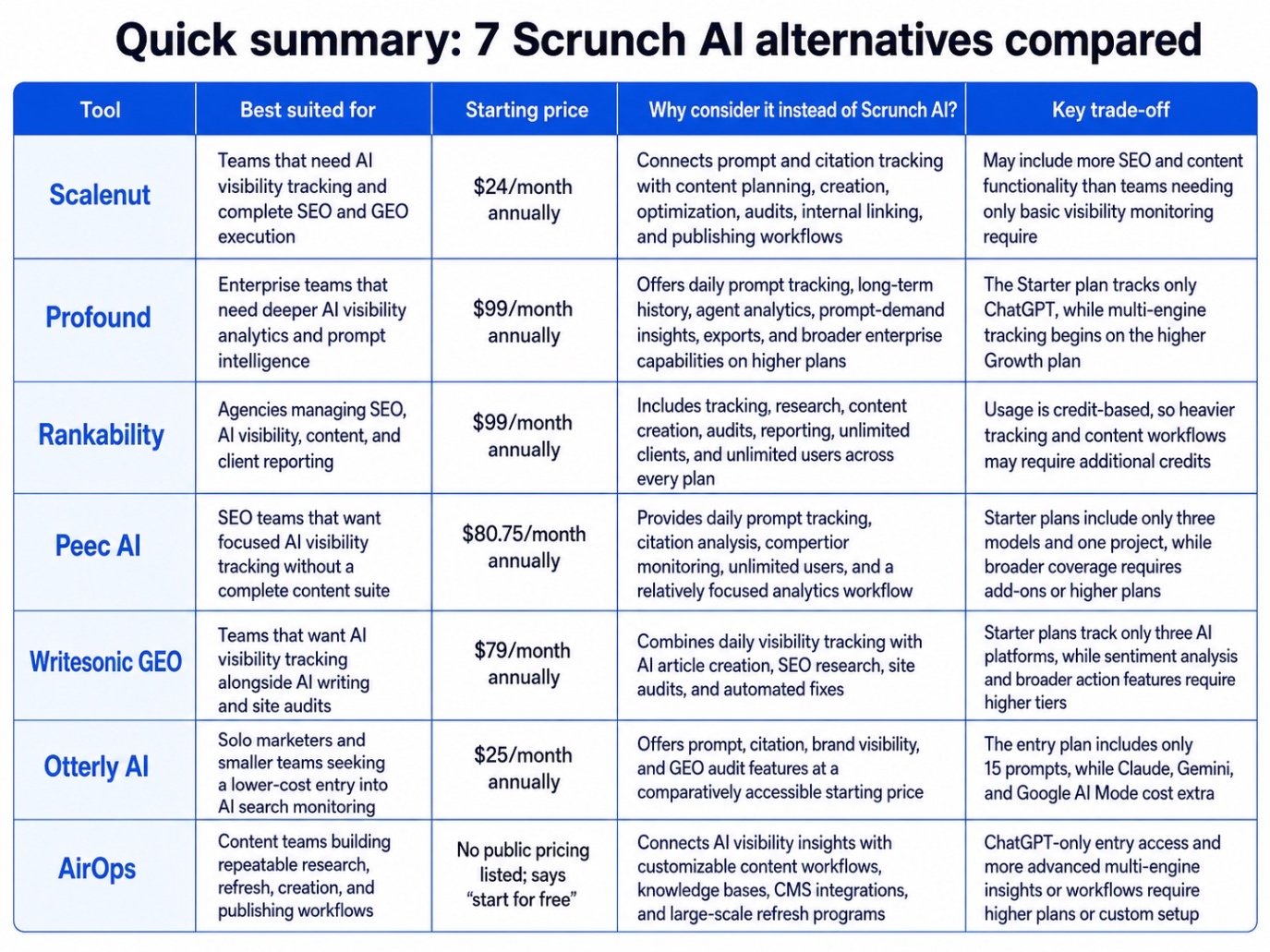
Our quick recommendation: Choose Scalenut when you need both visibility tracking and SEO or GEO execution. Consider Profound for deeper enterprise analytics, Peec AI for focused monitoring, Rankability for agency workflows, Otterly AI for a lower-cost starting point, Writesonic for AI writing and visibility in one platform, or AirOps for customizable content automation.
(Pricing and publicly listed features were checked in July 2026. Prices may vary by billing term, usage, add-ons, and plan updates.)
Still unsure about Scrunch AI? You can also check out our in-depth Scrunch AI review before comparing options.
What Are The Top Alternatives To Scrunch AI In 2026?
Finding the best Scrunch AI alternative depends on what your team needs most, whether that is deeper AI visibility tracking, better reporting, stronger content execution, or a more affordable way to monitor brand presence across AI search.
Below, I’ll break down the top Scrunch AI alternatives in 2026, including where each tool stands out, where it feels limited, and which type of team it fits best.
1. Scalenut: Best for complete SEO and GEO execution
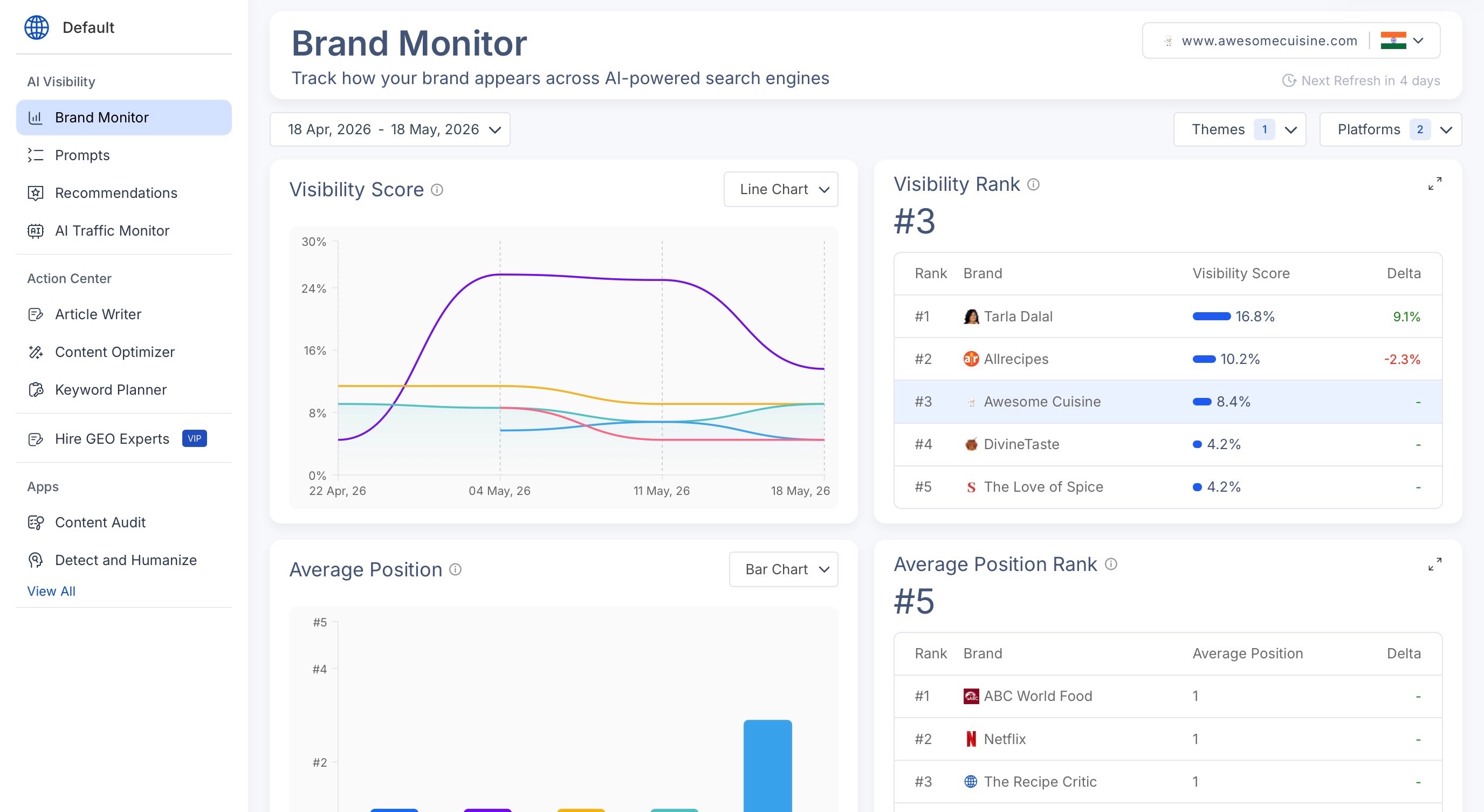
Scalenut combines AI visibility tracking with the tools needed to improve that visibility. Teams can monitor brand mentions, prompts, citations, competitors, and content gaps, then plan, create, optimize, audit, and publish content from the same platform.
What are Scalenut’s standout features?
- AI visibility tracking: Monitors brand mentions, prompt coverage, citations, historical trends, and competitor share across supported AI engines.
- GEO Action Center: Surfaces content gaps, prompt opportunities, competitive reasons, and recommended actions based on visibility data.
- GEO content engine: Includes an article writer, Content Optimizer, content audits, GEO scoring, and tools for improving existing pages.
- SEO planning and optimization: Supports keyword clustering, topic discovery, internal linking, cannibalization analysis, and on-page improvements.
- Publishing and collaboration: Connects with WordPress and Shopify and provides workspaces, team access, and publishing support depending on the plan.
Why choose Scalenut over Scrunch AI?
Scalenut is better suited to teams that want to act on AI visibility data without adding separate tools for keyword planning, writing, optimization, auditing, internal linking, and publishing.
The price difference is also significant. Scalenut currently starts at a promotional annual price of $24 per month, while Scrunch AI’s Core plan costs $250 per month. Scalenut offers a lower-cost entry into the category, although prompt limits and engine coverage vary by plan.
Where does Scrunch AI remain stronger?
Scrunch also offers AXP, which creates an AI-friendly version of website content for AI agents. Scalenut does not provide a direct equivalent to this delivery layer.
How Do Real Users Rate Scalenut?
Scalenut has a 4.7/5 rating on G2, backed by a relatively strong review base for an AI SEO and content platform.
How Much Does Scalenut Cost?
- Starter: $24/month
- Plus: $36/month
- Professional: $80/month
- VIP Service: Custom pricing
Best fit: Choose Scalenut when you need AI visibility tracking and complete SEO and GEO execution in one platform. Choose Scrunch when higher prompt capacity, specialized AI-agent monitoring, and AXP are more important than built-in content production.
Want a direct side-by-side comparison? Read Scalenut vs Scrunch AI to see which tool fits your AI visibility workflow better.
2. Profound: Best for enterprise AI visibility and prompt intelligence
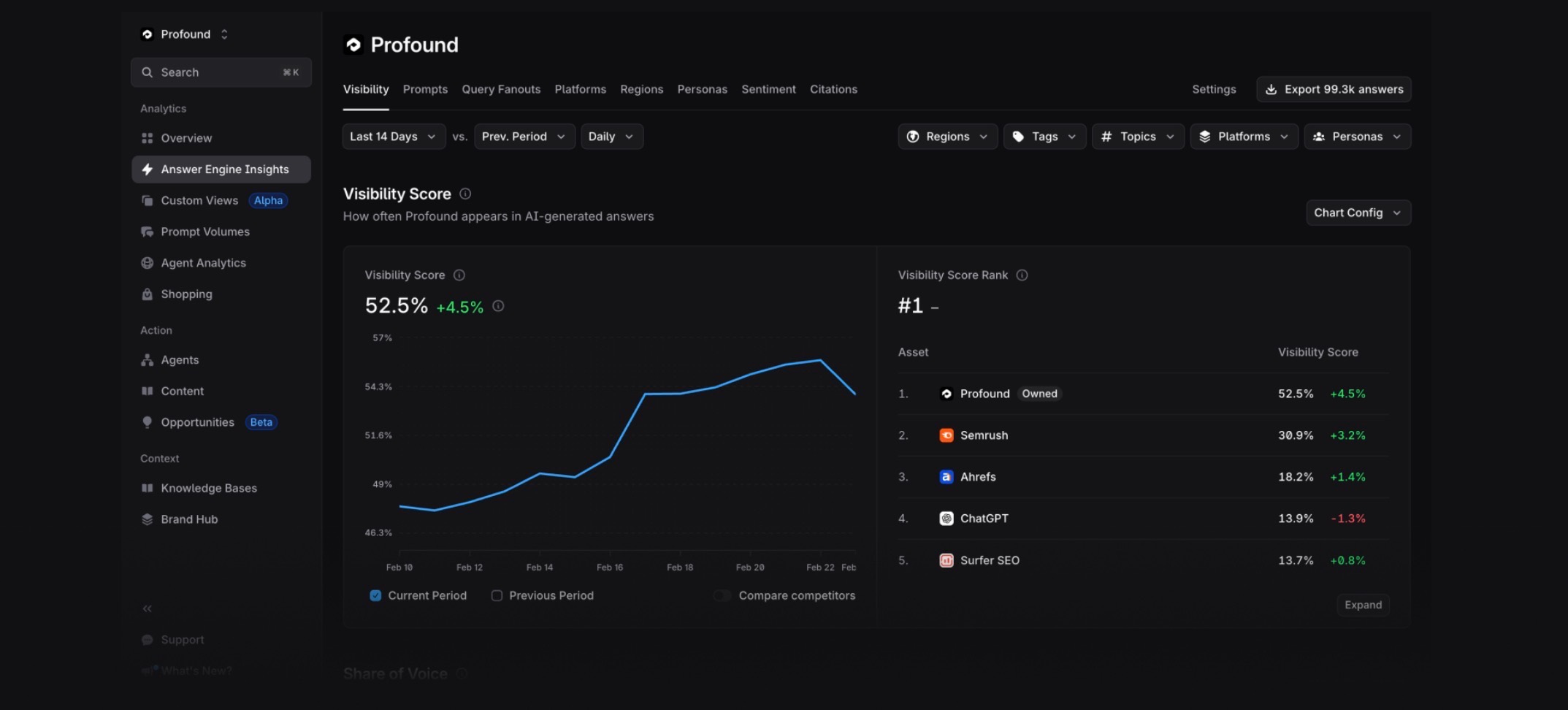
Profound is built for teams that want deeper visibility into how their brand appears across AI answer engines. It tracks mentions, citations, sentiment, competitors, prompt performance, and AI search demand across platforms like ChatGPT, Perplexity, Gemini, Claude, and Google AI Overviews.
What are Profound’s standout features?
- Answer Engine Insights: Tracks brand visibility, citations, sentiment, rankings, and competitor presence across AI-generated answers.
- Prompt Volumes: Helps teams understand what people are asking AI platforms and identify topics with measurable demand.
- Agent Analytics: Tracks AI-sourced traffic and attribution across domains, with integrations for platforms such as Cloudflare, Google Analytics, AWS, and WordPress.
- Profound Agents: Uses autonomous workflows for content generation, optimization, research, and other AEO tasks.
- Aim: Prioritizes high-impact AEO opportunities and projects based on the platform’s visibility data.
Why choose Profound over Scrunch AI?
Profound is better suited to larger organizations that need deeper prompt intelligence, long-term visibility data, exports, AI traffic attribution, and automated execution. Its Enterprise plan can track up to 10 answer engines, multiple companies, and custom prompt sets, with API access, SSO, and dedicated support.
Where does Scrunch AI remain stronger?
Scrunch may offer better value for teams that want broader tracking at a lower price than Profound’s Growth plan. Its $250 Core plan includes 125 prompts across four LLMs, while Profound Growth costs $399 per month annually for 100 prompts across three answer engines. Scrunch also offers AXP, which creates machine-readable versions of website content for AI agents.
How Much Does Profound Cost?
- Starter: $82.50/month
- Growth: $332.50/month
- Enterprise: Custom pricing
How Do Real Users Rate Profound?
Profound has a 4.6/5 rating on G2.
Best fit: Choose Profound when enterprise analytics, prompt-demand data, attribution, and automated AEO workflows justify the higher price. Choose Scrunch when you want more prompts and model coverage at a lower cost, along with dedicated agent-experience capabilities.
Choosing between enterprise AI visibility tools? Read our Profound vs Scrunch AI comparison to see which one gives better AEO value.
3. Rankability: Best for agencies managing SEO and AI visibility
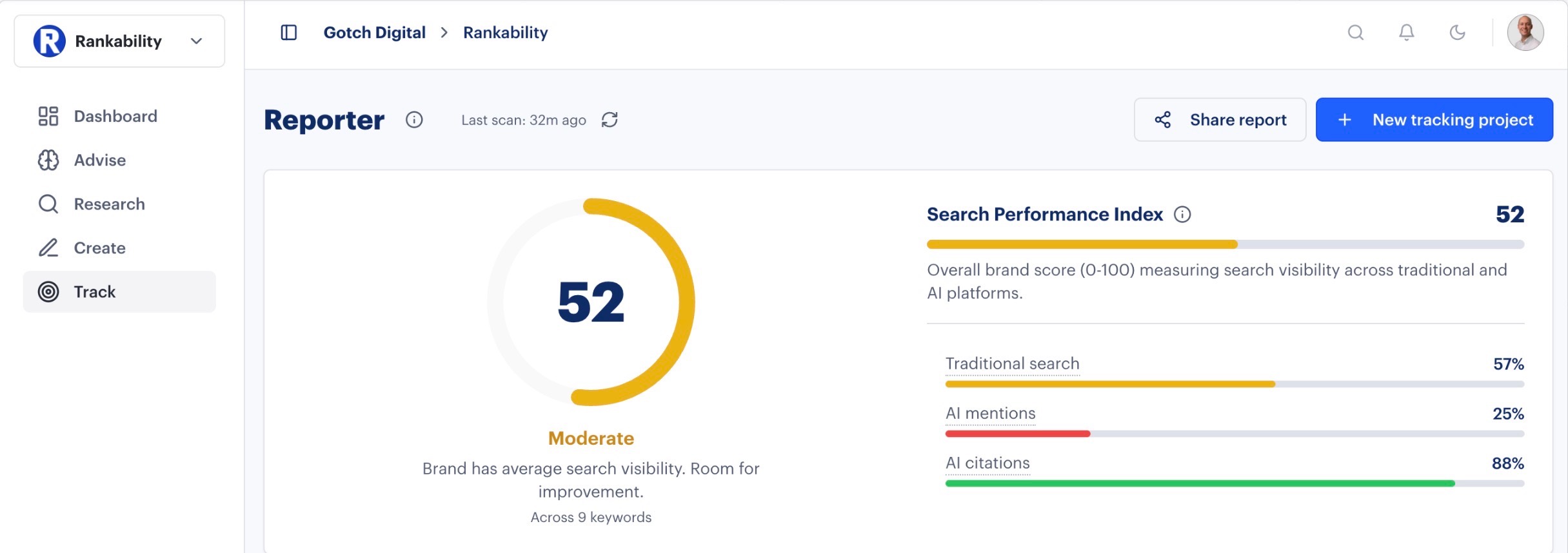
Rankability is an SEO and AI search platform built mainly for agencies that want to track visibility, create content, optimize pages, and report results from one place. What I like here is that it feels more action-focused than a basic AI visibility tracker.
What are Rankability’s standout features?
- Unified visibility tracking: Monitors rankings, brand mentions, citations, competitors, sentiment, and share of voice across traditional search, local results, video, and AI platforms.
- Search Performance Index: Combines Google rankings, AI visibility, citations, and other search signals into one score that agencies can track and explain to clients.
- Research and content workflows: Finds and clusters opportunities from Google, People Also Ask, YouTube, Reddit, trends, and AI expansion, then hands selected topics into content creation.
- Content creation and optimization: Supports briefs, drafting, competitor-based scoring, topic coverage, and prioritized recommendations.
- Agency reporting: Provides shareable, white-labeled dashboards and supports separate projects, schedules, competitors, and reporting for different clients.
- Serena AI search agent: Reviews connected business and search data to provide prioritized recommendations and action plans.
Why choose Rankability over Scrunch AI?
Rankability is better suited to agencies that want to manage the full SEO and AI visibility workflow in one place. Teams can research opportunities, create and optimize content, audit websites, monitor traditional and AI search performance, and present results through client-facing reports.
Scrunch provides visibility insights, citations, audits, and optimization recommendations, but Rankability offers a broader set of tools for producing the content and managing ongoing SEO campaigns after an opportunity is identified.
Where does Scrunch AI remain stronger?
Scrunch has a more specialized offering for AI-agent monitoring and content delivery. It tracks how AI bots crawl a website and identifies crawl issues, while AXP creates lightweight, machine-readable versions of pages for AI agents.
How Much Does Rankability AI Cost?
- Solo: $79/month
- Core: $199/month
- Team: $399/month
- Enterprise: Custom pricing
How Do Real Users Rate Rankability AI?
Rankability AI has a 5/5 rating on G2, though the review base is still smaller compared to more established tools.
Best fit: Choose Rankability when you need to manage SEO, AI visibility, content, and client reporting from one agency-focused platform. Choose Scrunch when AI-agent traffic monitoring, crawl diagnostics, and AXP matter more than a full SEO execution workflow.
4. Peec AI: Best for focused AI visibility tracking
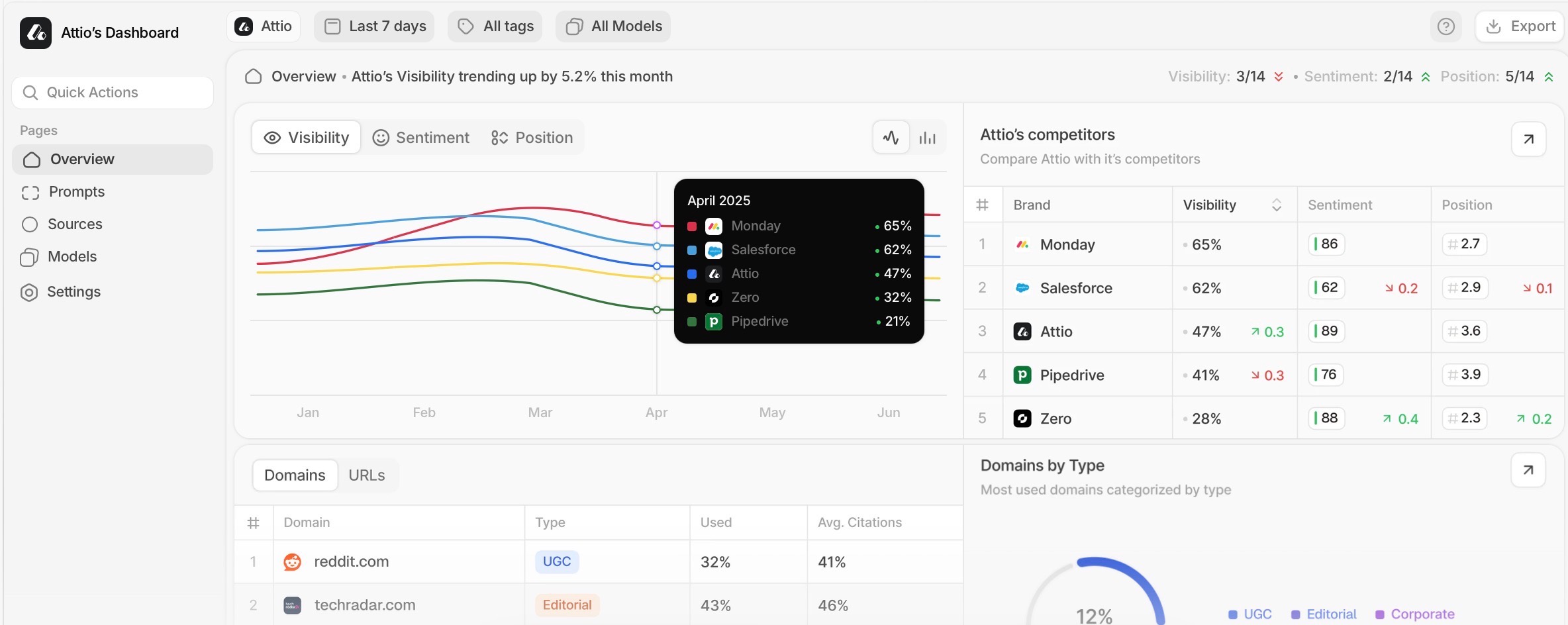
Peec AI is a focused AI search analytics tool for tracking how your brand appears across platforms like ChatGPT, Perplexity, Gemini, AI Mode, AI Overviews, and Copilot. What I like about Peec is that it keeps the experience clean instead of turning AI visibility into another crowded SEO dashboard.
What are Peec AI’s standout features?
- Daily prompt tracking: Monitors selected prompts across the AI models included in your plan.
- Visibility and position metrics: Shows how often your brand appears and where it ranks compared with competitors.
- Citation and source analysis: Identifies the domains and pages AI platforms use when generating answers.
- Sentiment tracking: Measures how positively or negatively AI responses describe your brand.
- Action recommendations: Highlights content, community, and digital PR opportunities based on frequently cited sources.
- Reporting integrations: Advanced plans include Looker Studio integration, while API access and SSO are available with Enterprise.
What Are The Cons Of Peec AI?
- Some users want broader model coverage without higher costs.
- Integrations like Google Analytics are still a common request.
- It does not offer a full built-in content workflow.
- Advanced reporting may still require exports and manual filtering.
How Do Real Users Rate Peec AI?
Peec AI has a 4.9/5 rating on G2, though its review base is still relatively small.
How Much Does Peec AI Cost?
- Starter: $80.75/month
- Pro: $208.25/month
- Advanced: $420.75/month
- Enterprise: Custom pricing
Why choose Peec AI over Scrunch AI?
Peec AI is better suited to teams that want a focused visibility tracker with unlimited users and a lower starting price. Its Starter plan includes 50 prompts, three selected models, daily tracking, and one project.
It also keeps its core workflow centered on prompts, citations, visibility, sentiment, and competitor analysis, which may suit teams that do not need Scrunch’s broader agent-monitoring and website-delivery capabilities.
Seriously considering Peec AI? Read our complete Peec AI review before you decide.
5. Writesonic GEO: Best for AI visibility tracking with content and SEO tools
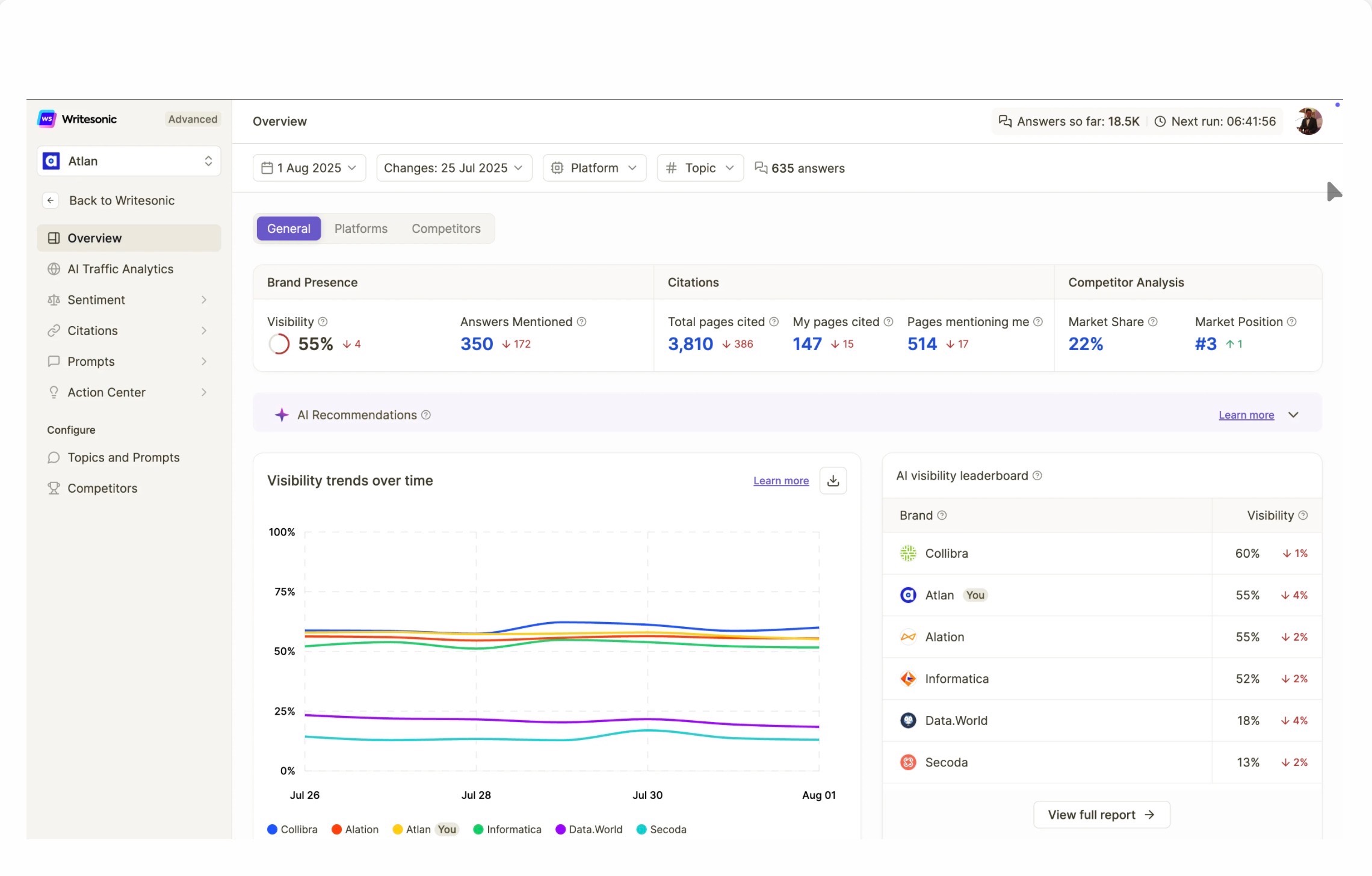
Writesonic GEO is built for teams that want AI visibility tracking and content execution in one workflow. It tracks brand visibility, prompts, citations, and brand sentiment, then connects those insights with AI writing, SEO audits, templates, and content optimization.
What are Writesonic GEO’s standout features?
- Daily AI visibility tracking: Monitors prompts, answers, citations, competitors, and brand performance across the AI platforms included in your plan.
- AI Article Writer: Creates research-backed articles using brand guidance, source material, and SEO data.
- Site audits and automatic fixes: Audits websites for SEO and AI-search issues and supports automated fixes.
- AI search research: Includes AI search-volume insights, Brand Explorer, prompt analysis, and ads monitoring, with access varying by plan.
- Action Center and agentic workflows: Helps prioritize on-page, off-page, and technical improvements, although meaningful access is concentrated in higher plans.
Why choose Writesonic GEO over Scrunch AI?
Writesonic is better suited to teams that want content creation and SEO tools alongside visibility monitoring. Even its Starter plan includes 15 AI articles and 10 site audits per month, while higher plans increase article, audit, prompt, and workflow allowances.
Scrunch provides audits, content-gap insights, and optimization guidance, but it does not include an equivalent built-in article-writing workflow.
Where does Scrunch AI remain stronger?
Scrunch has a more focused agent-experience offering. Its AXP creates parallel, machine-readable versions of website pages for AI agents and combines this with crawl-error detection, real-time bot activity, citation tracking, and competitor benchmarking. Writesonic does not advertise a direct equivalent to AXP.
How Do Real Users Rate Writesonic?
Writesonic has a 4.7/5 rating on G2, backed by a large review base.
How Much Does Writesonic GEO Cost?
- Starter: $79/month
- Basic: $199/month
- Growth: $399/month
- Enterprise: Custom pricing
Best fit: Choose Writesonic when you want AI search visibility tracking, article creation, and site auditing in one platform. Choose Scrunch when AXP and AI-agent delivery are more important than built-in content production.
Want an in-depth review? Read our complete Writesonic review to understand if it’s the right tool for your team.
6. Otterly AI: Best for lower-cost AI search monitoring
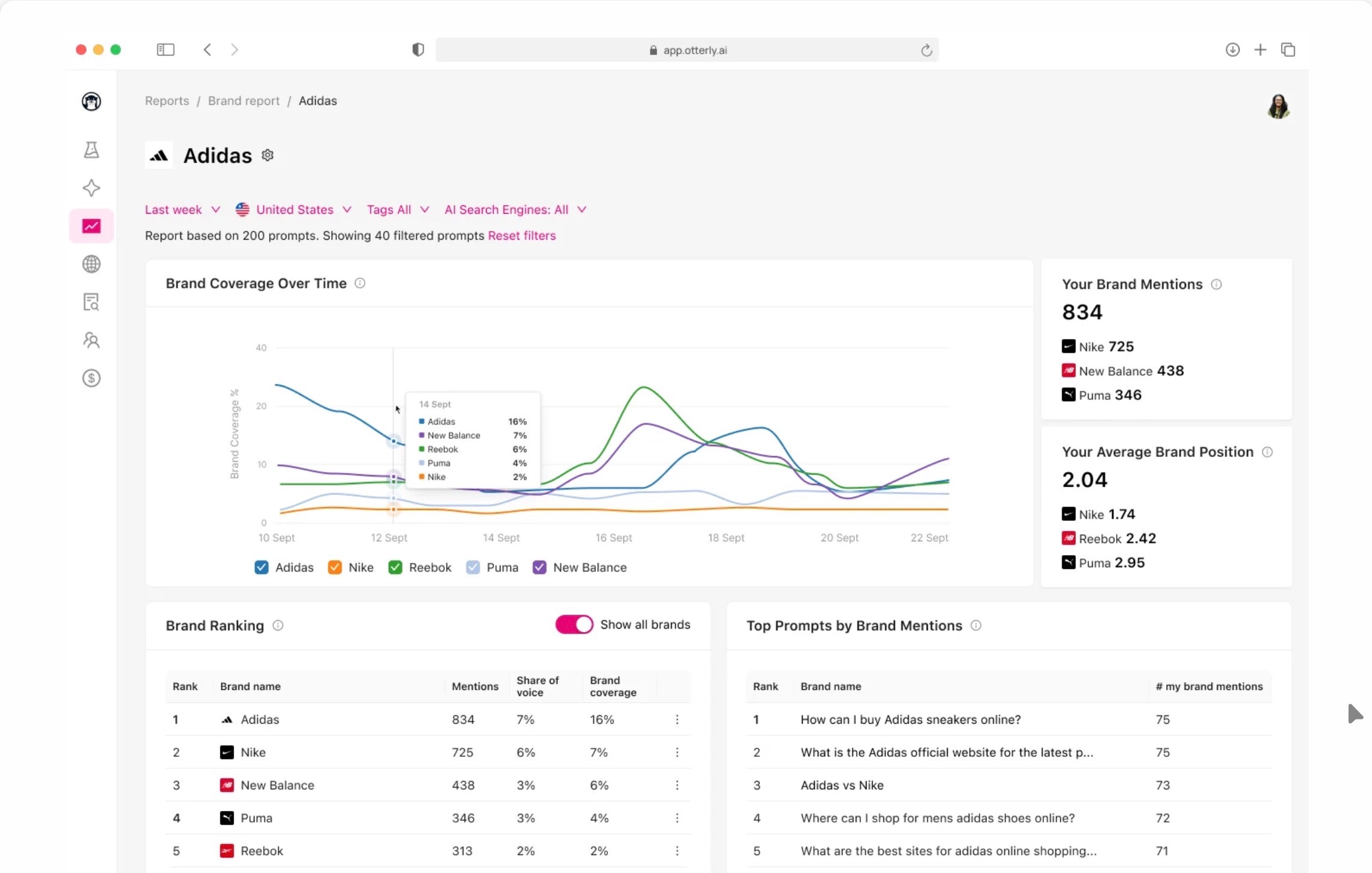
Otterly AI is a lighter AI visibility tool for tracking brand mentions, citations, prompts, and AI search presence across platforms like ChatGPT, Google AI Overviews, Perplexity, and Copilot. I’d consider it a good fit if you want practical AI search monitoring without jumping into a heavier enterprise platform.
What are Otterly AI’s standout features?
- Daily AI search monitoring: Tracks brand visibility and prompt performance across supported AI engines.
- AI prompt research: Helps identify relevant prompts and topics to add to your tracking strategy.
- Citation analysis: Shows which domains and URLs AI platforms reference in their answers.
- Brand Visibility Index: Measures how prominently a brand appears across tracked AI searches.
- GEO audits and reports: Includes page audits, optimization recommendations, detailed reports, exports, and multi-country tracking.
Why choose Otterly AI over Scrunch AI?
Otterly AI offers a considerably lower entry price for teams that mainly need visibility monitoring. Its Lite plan costs $25 per month when billed annually and includes 15 prompts, four AI engines, unlimited team members, daily tracking, and up to 1,000 GEO URL audits per month.
This makes it more accessible than Scrunch AI for solo marketers and smaller teams that do not need advanced AI-agent monitoring or website-delivery capabilities.
Where does Scrunch AI remain stronger?
Scrunch is better suited to teams that need AI-agent traffic insights, crawl diagnostics, competitor benchmarking, and AXP. Its Agent Experience Platform creates lightweight, machine-readable versions of website pages for AI agents, a capability Otterly AI does not offer directly.
How Do Real Users Rate Otterly AI?
Otterly AI has a 4.8/5 rating on G2, though the review base is still relatively small.
How Much Does Otterly AI Cost?
- Lite: $25/month
- Standard: $160/month
- Premium: $422/month
- Enterprise: Custom pricing
Why Does Otterly AI Stand Out From Scrunch AI?
Otterly AI stands out for affordability and ease of entry. Compared to Scrunch AI, it feels more approachable for small teams that want AI visibility tracking, citation insights, and GEO audits without committing to a more expensive platform.
Running GEO on a lean budget? Explore the top GEO tools for small businesses to find simpler options built for smaller teams.
7. AirOps: Best for scalable AI search and content workflows
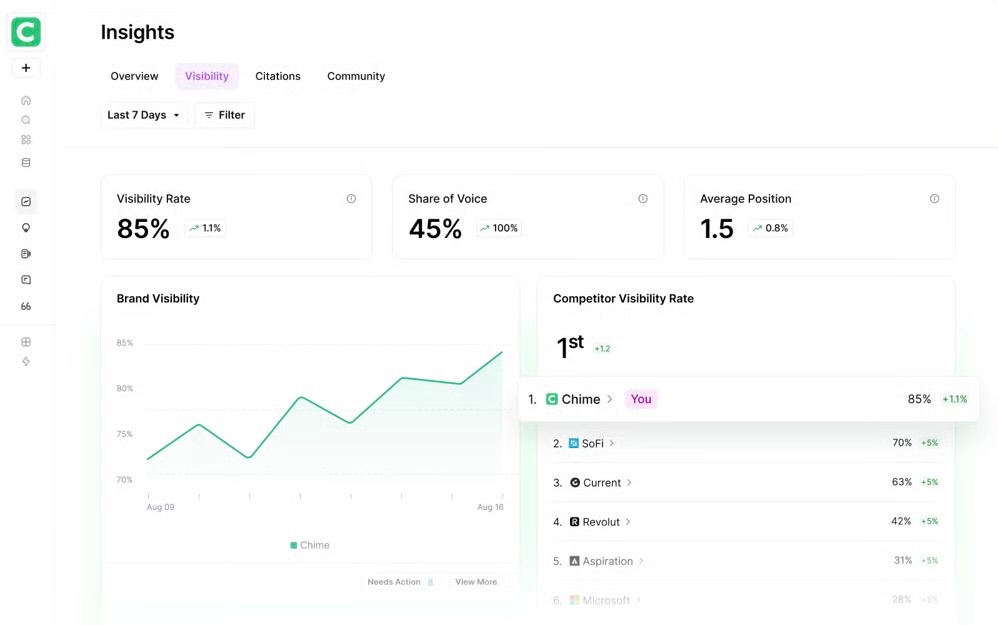
AirOps is built for teams that want to turn AI search insights into repeatable content workflows. It tracks AI visibility, finds content opportunities, and helps teams create, refresh, optimize, and publish content at scale.
What are AirOps’ standout features?
- AI search insights: Tracks prompts, pages, citations, competitors, and content opportunities, with engine coverage varying by plan.
- Quill and Workflows: Supports structured processes for research, drafting, refreshing, reviewing, and optimizing content.
- Brand Kits and Knowledge Bases: Stores brand guidance, audience context, messaging, and approved source material for use across workflows.
- Workflow integrations: Connects with CMS, SEO, AEO, social, and project management tools.
- High-volume execution: Solo includes 20,000 monthly content tasks, while Pro includes 75,000.
Why choose AirOps over Scrunch AI?
AirOps is better suited to teams that want to act on AI visibility opportunities through customizable, high-volume content workflows. Scrunch provides content-gap insights, audits, and optimization guidance, while AirOps offers a broader system for creating, refreshing, and publishing content.
Where does Scrunch AI remain stronger?
Scrunch has a more focused offering for AI-agent monitoring and website delivery. Its AXP creates lightweight, machine-readable versions of website pages, while its monitoring tools cover AI-agent traffic, crawl issues, citations, rankings, and competitors. AirOps does not advertise a direct equivalent to AXP.
How Do Real Users Rate AirOps?
AirOps has a 4.6/5 rating on G2, with users often praising its workflow automation and content scaling capabilities.
How Much Does AirOps Cost?
- Insights: $0/month
- Solo: Starts free, with task-based limits
- Pro: Starts free, with higher task limits
- Enterprise: Custom pricing
AirOps uses task-based pricing, so your final cost can change depending on workflow volume and usage.
Best fit: Choose AirOps when you need to turn AI search opportunities into scalable content operations. Choose Scrunch when AI-agent monitoring, crawl diagnostics, and AXP are higher priorities.
Comparing workflow automation with AI visibility monitoring? Read our Scrunch AI vs AirOps comparison to see where your budget fits best.
How to choose the right Scrunch AI alternative for your team?
The best Scrunch AI alternative is not necessarily the platform with the longest key feature list. It is the one that gives your team the visibility data, reporting, and execution support it will actually use.
Here are six factors to compare before choosing:
- Calculate the real cost at your required usage: Do not compare tools only by their advertised starting price. Check how many prompts, brands, users, AI models, audits, and reports your team needs, then include any add-on or overage costs. Scrunch’s own plans bundle different prompt, user, persona, and audit allowances, showing how quickly the real value can vary by usage.
- Check the AI model coverage included in your plan: Confirm that the platforms relevant to your audience, such as ChatGPT, Gemini, Claude, Perplexity, Google AI Mode, AI Overviews, and Copilot, are included rather than sold separately.
- Evaluate prompt and citation data depth: Look beyond a basic visibility score. A useful platform should show full AI responses, mention position, cited domains and URLs, competitor citations, historical changes, and performance across repeated prompts.
- Separate monitoring from execution: Some tools only show where your brand is missing. Others provide page audits and recommendations, while more complete platforms also support content planning, creation, optimization, internal linking, and publishing. Decide how much of that workflow you want in one tool.
- Review reporting, exports, and integrations: Agencies may need client-ready or white-label reports, while in-house teams may prioritize dashboards, CSV exports, APIs, analytics connections, and CMS integrations.
- Match the tool to your existing workflow: Consider whether the platform needs to replace part of your SEO stack or work alongside it. Also account for user permissions, workspaces, collaboration, and support as your team grows.
Shortlist two or three options and compare them using the same prompts, brands, AI models, and expected monthly usage. The best choice is the one that delivers the right depth without making you pay for features your team will rarely use.
Which Scrunch AI alternative is best for each use case?
The right replacement depends on what you need beyond Scrunch AI’s monitoring and recommendations.
Here are five common use cases and the alternatives that fit them best:
1. For complete SEO and GEO execution: Scalenut
Choose Scalenut when you want to move from finding visibility gaps to fixing them in the same platform. It combines AI visibility tracking with keyword planning, GEO content creation, existing-page optimization, audits, internal linking, and WordPress or Shopify publishing.
2. For enterprise analytics and AI traffic attribution: Profound
Profound is better suited to enterprise team size that need daily tracking, broader answer-engine coverage, long-term history, CSV or JSON exports, and Agent Analytics for connecting AI traffic with website activity. It offers greater analytical depth, although many advanced capabilities sit on higher-priced plans.
3. For agencies managing multiple clients: Rankability
Rankability is a strong fit for agencies that want visibility tracking, research, content creation, audits, and reporting in one workspace. Every plan includes unlimited clients and users, while monthly credits control usage across its workflows.
4. For lower-cost AI visibility monitoring: Otterly AI or Scalenut
Otterly AI is better for focused monitoring, starting at $25 per month for 15 prompts across ChatGPT, Google AI Overviews, Perplexity, and Copilot. Scalenut starts at $24 per month annually and is the stronger choice when you also need content creation and optimization alongside monitoring.
5. For scalable content workflow automation: AirOps
AirOps is best suited to content teams building repeatable creation, refresh, and off-site visibility workflows. Its customizable workflows and playbooks make it more suitable than Scrunch AI for teams prioritizing large-scale content operations over a primarily monitoring-led platform.
The best alternative is the one that supports what your team needs to do after identifying a visibility gap, whether that is reporting, optimizing, publishing, or scaling.
Looking for affordable GEO options? Compare the best GEO tools under $100/month before budget-friendly tool options in 2026.
Final Verdict
The best Scrunch AI competitor depends on what your team needs next. If you only want to monitor search results across major AI search engines, a lightweight tracker may work. But if you want search optimization, generative engine optimization, answer engine optimization, and content strategy in one workflow, choose a platform built for both tracking and execution.
Start by testing a few AI tools with your own prompts, then compare output quality, user experience, actionable insights, and how easily each AI assistant helps content creators move from data to execution. If you want actionable recommendations and an action center that supports traditional SEO plus GEO workflows, Scalenut is a strong place to start.
Frequently Asked Questions
Which Scrunch AI competitors that improve answer engine share of voice are worth considering?
Scalenut, Profound, Peec AI, and Writesonic GEO are strong Scrunch AI competitors that improve answer engine share of voice. They help track brand mentions, citations, prompt performance, and competitor visibility, while Scalenut and Writesonic also support content execution.
What are the best budget-friendly alternatives to Scrunch AI for AI traffic impact measurement?
Otterly AI and Peec AI are good budget-friendly alternatives to Scrunch AI for AI traffic impact measurement, especially if you need prompt tracking, citation monitoring, and AI visibility reports. Scalenut is better if you also want SEO execution and content optimization.
Which generative engine optimization platforms alternatives to Scrunch AI are best for content teams?
The best generative engine optimization platforms alternatives to Scrunch AI for content teams include Scalenut, Writesonic GEO, and AirOps. These tools go beyond monitoring by helping teams create, optimize, refresh, and scale content based on AI visibility and search performance gaps.
Which Scrunch AI alternative is best for GEO optimization?
Scalenut is one of the top scrunch AI competitors for GEO optimization because it combines AI visibility tracking with content planning, writing, optimization, audits, and execution. It is a stronger fit for teams that want to improve visibility, not just monitor it.
What are the best Scrunch AI alternatives in 2026?
The best Scrunch AI alternatives in 2026 include Scalenut, Profound, Rankability AI, Peec AI, Writesonic GEO, Otterly AI, SE Ranking and AirOps. Each tool fits a different need, from enterprise analytics and AI visibility tracking to content optimization and workflow automation.
How do Profound and Scrunch AI compare?
Profound is stronger for deep AI visibility analytics, prompt intelligence, citation tracking, and enterprise reporting. Scrunch AI is more focused on AI visibility monitoring, competitor insights, and agent experience capabilities, making both useful depending on how much analytics depth your team needs. But if you want complete SEO and GEO analytics and execution in one platform, Scalenut is the better choice.
Which Scrunch AI alternative is best for content execution?
Scalenut, Writesonic GEO, and AirOps are stronger choices for content execution. They go beyond tracking by helping teams create, optimize, refresh, or automate content based on AI visibility gaps, which makes them more useful for SEO and content teams.
Are there Scrunch AI alternatives for agencies?
Yes. Scalenut, Peec AI, Rankability AI and AirOps can work well for agencies depending on the workflow. Rankability is useful for client SEO workflows, Peec AI is clean for reporting, AirOps supports automation, and Scalenut connects GEO insights with content execution.
Which Scrunch AI alternative is best for simple AI visibility tracking?
Peec AI is a good choice for simple AI visibility tracking. It keeps the dashboard clean and helps teams monitor prompts, brand mentions, citations, competitors, and sentiment without adding too many extra SEO or content features.
How much does Scrunch AI cost?
Scrunch AI starts at $250 per month when billed annually or $300 month to month. Its Growth plan costs $417 annually or $500 monthly, while Enterprise uses custom pricing. Pricing and prompt allowances may change, so verify the current plan details before subscribing.
Does Scrunch AI offer a free trial?
Yes. Scrunch AI offers a seven-day free trial of its Starter plan with no credit card required. The trial includes Starter features, while enterprise-only capabilities such as SSO, the Enterprise Data API, and expanded scale are excluded.
What should you compare before choosing a Scrunch AI alternative?
Compare the total cost at your required usage, included prompts, supported AI engines, tracking frequency, citation depth, historical data, brand and user limits, reporting, exports, integrations, and whether the platform only monitors visibility or also supports content execution.
Which Scrunch AI alternative offers the broadest AI engine coverage?
Profound and Writesonic offer the broadest published coverage among these alternatives, with up to 10 AI platforms available on enterprise plans. Lower plans support fewer engines, so compare the coverage included in the plan your team can realistically afford.
Which Scrunch AI alternative is best for enterprise teams?
Profound is the strongest fit for enterprise teams prioritizing analytics depth, prompt intelligence, attribution, API access, SSO, and dedicated support. Writesonic is better suited to enterprises that also need built-in content production, site audits, and execution workflows.
Do any Scrunch AI alternatives offer AI-agent traffic monitoring or an AXP equivalent?
Profound provides Agent Analytics for AI traffic attribution, while Scalenut offers AI bot traffic insights. However, none of the seven alternatives publicly advertises a direct equivalent to Scrunch AXP, which creates AI-friendly versions of website content for agents.


.svg)


.webp)