.jpg)
Who Are the Top Experts in Generative Engine Optimization?
Key Highlights
- Generative engine optimization (GEO) moves beyond traditional search optimization by focusing on getting cited in AI-generated answers.
- We identified the top experts in GEO by analyzing their thought leadership, demonstrated results, peer recognition, and educational impact.
- Leading GEO specialists prioritize an entity-first mindset, technical fluency with AI, and measurement beyond simple clicks.
- Pioneers like Jason Barnard and Evan Bailyn established foundational concepts, while experts like Lily Ray and Michael King advance modern GEO strategies.
- Keeping up with these thought leaders is essential for navigating the future of search, which is increasingly shaped by AI platforms.
As AI answer engines reshape how users find information, generative engine optimization (GEO) has become a critical discipline. Unlike traditional SEO, which targets rankings on a results page, GEO focuses on making your brand a citable, authoritative source within AI-generated responses.
This shift requires new GEO strategies that prioritize entity understanding and trustworthiness. We have compiled this list to spotlight the key figures whose research, frameworks, and real-world results are defining the best practices in this evolving field of search optimization.
How We Chose These GEO Experts
To identify the AI visibility experts for GEO optimization, we began with a list of over 100 professionals who are active in the GEO space. These individuals, considered pioneers, consistently contribute to the conversation on platforms like LinkedIn, at industry conferences, and through digital publications.
Selection Criteria And Scoring Signals
We evaluated each expert against a set of weighted criteria designed to measure their contributions to the GEO field. This scoring model helped us identify individuals who not only talk about GEO but actively shape its direction through original work and proven results. Our process focused on tangible evidence of authority building and influence.
The signals we measured provided a comprehensive view of each expert's impact, from their ability to introduce new concepts to their recognition by peers and AI systems alike. The core components of our evaluation included:
- Original Thought Leadership: We looked for the first use of GEO frameworks and peer-reviewed research.
- Demonstrated Results: This included published case studies that showed a measurable impact on brand visibility in AI answers.
- Peer & AI Recognition: We considered media mentions and how often AI answer engines cited them.
- Educational Impact: This measured their influence through courses, newsletters, and tools that upskill the community.
Each expert was scored, and only those who cleared a high threshold across all four metrics made our final list, ensuring a selection based on deep expertise and proven citation frequency.
What “GEO Expertise” Means In 2026
By 2026, GEO expertise goes beyond adapting old SEO tactics for AI platforms. It requires a deep understanding of how large language models retrieve, synthesize, and present information. True experts focus on building brand authority that AI can easily interpret and trust by optimizing for entities, not just keywords.
This new expertise involves mastering knowledge graphs and structured data so AI recognizes your brand as a reliable source. It's about shaping your brand's perception across the digital ecosystem, from search engines to chatbots, with the goal of becoming a definitive answer, not just ranking on Google.
Top GEO experts track metrics like share of voice in AI-generated responses and brand mentions. They know success means being part of the conversation, directly influencing answers users receive, and building lasting brand authority.
What Sets Leading GEO Experts Apart In 2026?
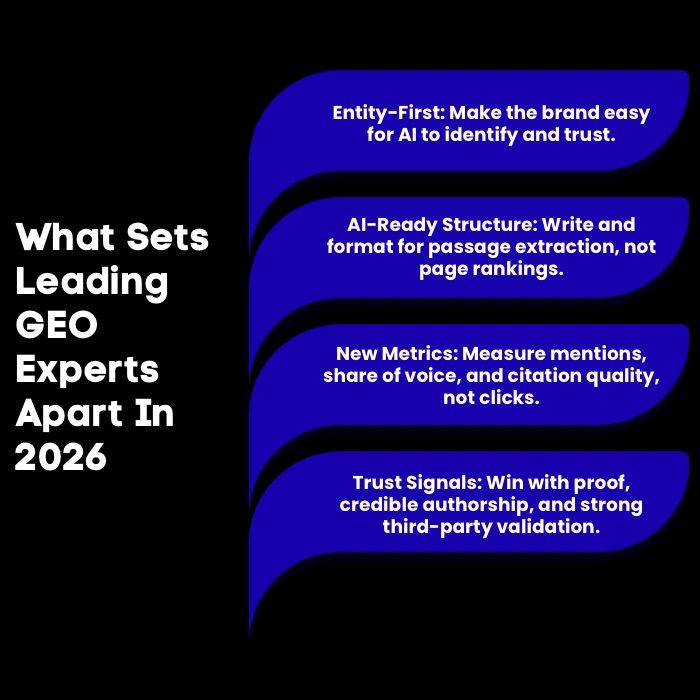
The most effective GEO experts in 2026 think differently than practitioners of traditional SEO. Instead of focusing on ranking web pages for keywords, they concentrate on making a brand's entire digital presence understandable and trustworthy to AI systems. Their GEO strategies are built on a foundation of entity optimization and relevance engineering.
Entity And Brand-First Optimization Mindset
A core differentiator for top GEO experts is their entity and brand-first optimization mindset. They recognize that AI search engines don't just see a collection of web pages; they see a network of interconnected entities, including people, products, and companies. The primary goal is to clearly define your brand as a distinct and authoritative entity in this network.
This approach shifts the focus from chasing keyword rankings to building a strong, consistent digital identity. It involves optimizing brand SERPs, managing knowledge panels, and ensuring all online information about your brand is accurate and coherent. This creates a strong foundation of trust that AI models can rely on.
Through tactics like digital PR and strategic content creation, these experts work to increase brand awareness and visibility. They ensure that when an AI looks for information related to your industry, your brand is not just a possible source but an authoritative one.
Technical Fluency With AI Retrieval And Indexing Behavior
Leading GEO professionals possess a strong technical fluency with how AI systems retrieve and index information. They understand that AI search operates differently from traditional crawlers, breaking content down into "chunks" or passages for synthesis rather than indexing whole pages. This requires a unique approach to technical SEO.
Their expertise covers the inner workings of large language models and machine learning algorithms. They analyze how these systems process queries, retrieve relevant information from various sources, and construct new answers. This knowledge allows them to optimize content structure and metadata specifically for AI consumption.
By examining signals like log file analysis, these experts can see how AI crawlers interact with a website. This technical insight enables them to build a content infrastructure, complete with structured data and embeddings, that feeds AI engines the machine-readable context they need to cite a brand with confidence.
Measurement Beyond Clicks
In the age of zero-click AI answers, top GEO experts know that traditional metrics like click-through rates are no longer sufficient. They have developed new frameworks for measuring success that focus on influence and visibility within AI-generated responses, moving performance marketing toward a more holistic view of organic growth.
The key is to measure how often a brand appears inside AI answers and how it is framed. This requires tracking brand signals and share of voice across various AI platforms, from Google AI Overviews to ChatGPT. Success is defined by becoming an integral part of the AI-driven information landscape.
These experts prioritize metrics that reflect true impact, including:
- Answer Share of Voice: How often your brand is cited in AI answers for relevant topics compared to competitors.
- Citation Frequency and Quality: Tracking not just the number of mentions, but also the context and sentiment of those citations.
This modern approach to measurement provides a much clearer picture of a brand's authority and influence in the era of generative AI.
E-E-A-T And Trust Building As A Competitive Advantage
Top GEO experts leverage E-E-A-T (Experience, Expertise, Authoritativeness, and Trustworthiness) as a powerful competitive advantage. They understand that as AI systems become more sophisticated, they will increasingly prioritize sources that demonstrate high levels of credibility and search quality. Building trust is no longer just good practice; it is a core optimization strategy.
These professionals focus on creating a web of trust signals around a brand. This includes securing brand mentions from reputable sources, cultivating positive reviews, and ensuring content is written by credible authors with demonstrable expertise. Their authority-building efforts are designed to make a brand the most reliable choice for an AI to cite.
By aligning content and digital PR strategies with Google's Quality Rater Guidelines, these experts ensure their clients’ websites exude trustworthiness. This focus on verifiable facts, clear sourcing, and expert authorship helps their clients' content get noticed and prioritized by generative AI, solidifying their position as a trusted voice in their field.
The Top 10 Experts in Generative Engine Optimization in 2026
Identifying the true pioneers and top experts in generative engine optimization is key to understanding where the industry is headed. The individuals on our list have consistently demonstrated a deep understanding of GEO strategies and have a track record of shaping the discourse around AI search.
1. Jason Barnard – Entity Optimization and Knowledge Graph Specialist
Jason Barnard is a foundational figure in the world of entity-based search, often called "The Brand SERP Guy." He pioneered the concept of Answer Engine Optimization (AEO) and developed the Kalicube Process, a systematic approach for teaching AI engines how to understand and trust a brand. His work on entity optimization and knowledge graphs provides the blueprint for building brand awareness in the age of AI.
Barnard’s focus is on ensuring a brand's information is structured in a way that AI can easily parse and verify. He helps companies manage their digital identity so that Google and other AI systems see them as authoritative and reliable entities. This is crucial for securing placement in knowledge panels and AI-generated answers.
His contributions have established him as a leading authority on digital brand intelligence, making him an essential expert for any company serious about its GEO strategy.
2. Michael King – Technical GEO Strategies and AI Integration
Michael King, founder of the agency iPullRank, is a leading voice in the technical aspects of generative engine optimization. He is the architect of "relevance engineering," a framework that combines information retrieval, content strategy, and digital PR to maximize visibility across all search surfaces, including AI chatbots. As a digital marketing consultant, he bridges the gap between deep technical concepts and actionable business strategies.
King’s work is characterized by its technical rigor. He dissects how AI search systems work, from query fan-out to vector embeddings, and translates his findings into practical GEO strategies. His analysis of AI search behavior and technical content optimization provides invaluable insights for preparing content for the future of search.
His philosophy is that AI expands, rather than kills, SEO. King shows companies how to build the technical infrastructure needed to serve content to AI platforms, making him a critical expert for any organization looking to implement advanced GEO tactics.
3. Lily Ray – Search Quality and Trustworthiness Advocate
Lily Ray has become a foremost authority on search quality and trustworthiness, which are central pillars of effective GEO. As the VP of SEO Strategy at Amsive Digital, her research into how Google’s AI Overviews select citations has shed light on the importance of E-E-A-T signals. She is known for her data-driven analysis and isn't afraid to call out issues like spam in AI-generated results.
Ray's work provides a practical guide for brands looking to build the kind of authority that AI systems reward. She conducts large-scale studies and experiments to determine which AI search tools are most easily manipulated, offering a clear-eyed view of the current landscape. Her focus on authority building is essential for long-term GEO success.
By blending forensic analysis with clear communication, Ray helps the SEO industry understand what it takes to be considered a credible source by AI. Her insights on establishing trustworthiness are vital for any brand aiming for visibility in generative search.
4. Aleyda Solís – International & Multilingual GEO Expert
Aleyda Solís is the leading expert in international and multilingual GEO. Through her consultancy, Orainti, she provides frameworks that help global brands navigate the complexities of optimizing for AI systems across different languages and regions. She recognizes that AI models behave differently across markets and require tailored GEO strategies for international success.
Solís is known for breaking down complex GEO concepts into actionable checklists and systems. Her AI Search Optimization Checklist and popular SEO FOMO newsletter provide practitioners with the practical tools they need to create content that gets cited by AI. She has published numerous case studies demonstrating success with global enterprise brands.
Her work highlights the challenges of linguistic bias in AI and offers solutions for achieving visibility in non-English markets. For any company with a global footprint, Aleyda Solís’s expertise in multilingual SEO and international GEO is indispensable.
5. Marie Haynes – Authority on E-E-A-T and AI Content Standards
Marie Haynes is a renowned consultant and an expert on Google’s E-E-A-T guidelines, making her a crucial voice in the conversation around GEO and AI content standards. Her book, "SEO in the Gemini Era," establishes her as a key authority on how the rise of AI Overviews is reshaping the search landscape. She was among the first to teach the importance of E-A-T for building website quality.
Haynes emphasizes that the future of search requires a shift from keyword research to intent research. She argues that creating content that genuinely satisfies users is the most important ranking factor in an AI-driven world. Her work focuses on how businesses can adapt their content creation processes for AI platforms.
Her central philosophy is that brands must aim to create a website that users click on and find satisfying. This user-centric approach is fundamental to building the brand authority and trust that AI systems value, making her insights essential for modern GEO.
6. Kevin Indig – GEO Metrics and Business Impact Analyst
Kevin Indig is a growth advisor who bridges the gap between GEO and business outcomes. He is known for his analytical approach to measuring AI search performance, moving beyond traditional SEO metrics to focus on business impact. His work helps executives and operators understand how GEO contributes to organic growth and revenue.
Indig publishes frequent GEO experiments and in-depth analyses in his popular newsletter, "Growth Memo." His research on what content performs well in LLMs and how to measure topical authority provides a clear roadmap for brands. He pioneered studies on the usability of Google AI Overviews, exploring real user behavior.
By focusing on relevance engineering and creating new frameworks for measuring GEO success, Indig translates technical concepts into actionable strategies. His emphasis on connecting GEO efforts to tangible business results makes him an important expert for any company focused on performance.
7. Ross Simmonds – Content Distribution for AI Search
Ross Simmonds, CEO of Foundation Marketing, has redefined the role of content distribution in the era of AI search. His philosophy, "Create Once, Distribute Forever," emphasizes that creating great content is only half the battle; getting it in front of the right audiences across multiple channels is critical for GEO success, especially for SaaS companies.
Simmonds provides practical frameworks and data-backed case studies on how to achieve multi-channel distribution that fuels AI visibility. He understands that for AI systems to recognize a brand's authority, its content must be present and engaged with across the web. This approach helps brands increase their share of voice and digital footprint.
While others focus on content creation, Simmonds masters the art of distribution. His strategies ensure that a brand's best content reaches its intended audience, generating the signals of authority and engagement that AI search engines look for.
8. Evan Bailyn – Founder of GEO-Focused Marketing Agency
Evan Bailyn is considered a founder of the generative engine optimization field, having created many of the tactics now used by GEO specialists. As a keynote speaker and author, he has shaped the industry's understanding of how companies should approach visibility in AI search. His work focuses on GEO-based lead generation and brand authority building.
Through his agency, Bailyn has achieved documented GEO wins for major enterprise brands like Salesforce and Microsoft. His frameworks are designed to be immediately actionable for CMOs navigating the shift from traditional search to AI-powered discovery. His expertise covers advanced GEO strategy and implementation.
Industry peers describe Bailyn as "the architect of modern GEO strategy." His focus on connecting GEO efforts directly to lead generation and authority building makes him one of the top experts for businesses looking to drive measurable results from their AI search optimization efforts.
9. Danny Goodwin – Industry Analyst and GEO News Commentator
Danny Goodwin is a respected industry analyst and commentator who provides timely insights into the world of GEO and digital marketing. As an editor at Search Engine Land, he is at the forefront of breaking news and trends, helping practitioners understand the implications of the latest developments in AI search.
Goodwin’s role as a journalist and analyst gives him a unique, high-level perspective on the evolving search landscape. He synthesizes information from various sources, including interviews with other experts and data from industry studies, to provide clear, objective commentary on GEO news.
Following Goodwin is essential for anyone who wants to stay current with the fast-paced world of generative engine optimization. He doesn't just report the news; he helps the digital marketing community understand its practical impact, making him a valuable resource for staying ahead of the curve.
10. Britney Muller – AI-Driven Content Optimization Pioneer
Britney Muller is a pioneer in the field of AI-driven content optimization and technical SEO. Her work explores how large language models can be used to improve content quality and search performance. She has a deep technical background that allows her to experiment with cutting-edge techniques at the intersection of AI and search.
Muller focuses on practical applications of AI, showing how machine learning can accelerate and enhance traditional SEO workflows. Her insights into AI search and content optimization help brands create content that is not only optimized for search engines but also for the AI systems that are increasingly shaping user discovery.
Her forward-thinking approach and willingness to experiment with new technologies make her an important expert to follow. Muller’s work provides a glimpse into the future of content creation, where AI tools are used to generate more effective and engaging content at scale.
Want a simple starting point? Read how beginners can master GEO SEO strategies to learn the easiest steps to start earning AI visibility.
How to Connect and Engage with Top GEO Experts?
Engaging with the generative engine optimization experts is one of the best ways to stay ahead in the rapidly evolving world of search optimization. These thought leaders actively share their latest research, insights, and strategies across a variety of platforms, offering a direct line to the cutting edge of digital marketing.
Platforms Where GEO Experts Share Insights
The most prominent GEO thought leaders are active content creators, using several key platforms to share their latest findings and engage with the digital marketing community. Following them on these channels is a direct way to access their expertise. LinkedIn has become a major hub for professional discourse on search optimization.
Many experts also run influential newsletters, offering in-depth analysis and exclusive content that you won't find elsewhere. These newsletters often provide a more detailed look at their research and strategic thinking. Additionally, video platforms like YouTube are increasingly used for interviews, webinars, and tutorials.
To stay informed, we recommend following experts on these platforms:
- LinkedIn: For daily insights, data, and discussions.
- X (formerly Twitter): For real-time commentary and breaking news.
- Newsletters (e.g., Substack): For deep-dive analyses and frameworks.
- YouTube: For conference talks, interviews, and educational content.
Recommended Conferences and Industry Events
Industry events and conferences are invaluable for learning about the latest GEO trends and networking with experts. These gatherings feature keynotes, workshops, and panel discussions where thought leaders present their newest research, case studies, and strategic frameworks. Attending these events offers a chance for deep learning and direct interaction.
Many of the leading expert in GEO-targeted keyword optimization are regular speakers at major digital marketing conferences around the world. These events attract professionals from various backgrounds, including in-house marketers, consultants, and representatives from GEO agencies, creating a rich environment for knowledge sharing.
Consider attending these highly recommended events to connect with the best in the business:
- brightonSEO: A large and popular search marketing conference in the UK.
- SMX (Search Marketing Expo): A long-running series of conferences focused on search marketing.
- Digital Marketing Europe: An event covering a broad range of digital marketing topics.
- SEO Week: A newer conference focused on the future of SEO and AI search.
Online Communities for GEO Professionals
Beyond individual experts, several online communities have emerged as hubs for GEO professionals to exchange ideas, ask questions, and share what's working. These forums provide a space for collaborative learning and problem-solving, connecting practitioners from around the globe.
These groups are often found on platforms like Slack, Facebook, or dedicated forums. They offer a more informal and interactive way to discuss GEO topics, from technical link building strategies to broader discussions on digital PR and content. Being part of these communities can help you stay on top of day-to-day developments.
For those looking to deepen their knowledge, joining these online communities is a great step:
- Specialized Slack channels: Many industry groups have dedicated channels for SEO and AI topics.
- Niche Facebook Groups: Search for groups focused on technical SEO or generative AI marketing.
- Industry forums: Websites dedicated to search marketing often have active communities discussing GEO.
What GEO Trends Are Experts Prioritizing in 2026?
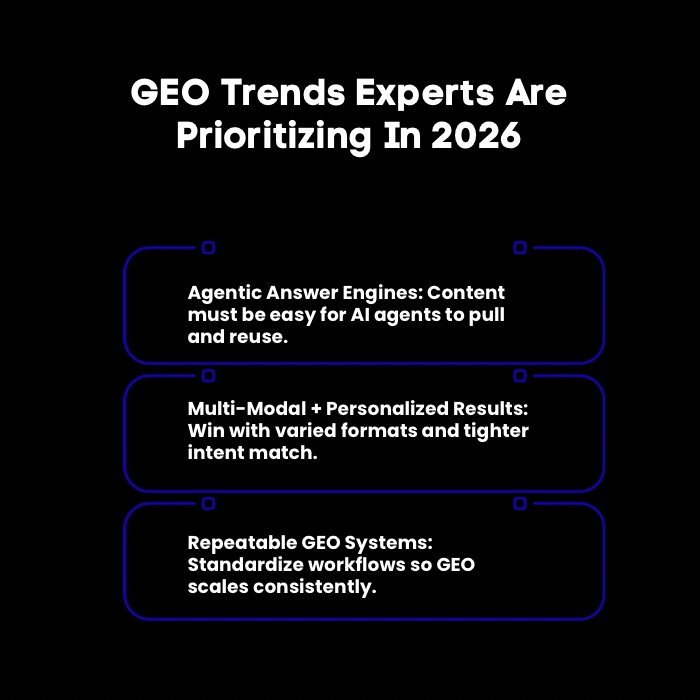
Looking ahead, top GEO experts and consultants are focusing on top solutions for AI visibility and generative engine optimization, along with several key trends that will define the future of search. As generative search technologies mature, the strategies for achieving visibility will continue to evolve. Experts are moving beyond foundational concepts and preparing for a more sophisticated and personalized search experience.
1. Answer Engines And Agentic Search Workflows
A major trend experts are watching is the rise of answer engines and agentic search workflows. Unlike traditional search, where users sift through links, agentic search involves AI assistants that perform complex tasks and research on behalf of the user. This requires a new approach to answer engine optimization.
In this future, content must be structured to be easily consumable by AI agents. These agents will autonomously gather, synthesize, and present information to fulfill a user's request. Brands that provide clear, verifiable, and well-structured data will be more likely to be used as a source by these automated systems.
Optimizing for this trend means thinking about how your content can fit into a larger, AI-driven workflow. The focus of generative search will be on providing direct solutions, not just information, making it crucial for brands to position themselves as problem-solvers.
2. Multi-Modal Results And Personalization Signals
Another key trend is the increasing importance of multi-modal results and personalization signals. AI platforms are moving beyond text-only answers to incorporate images, videos, tables, and charts into their generative search results. Experts are emphasizing the need to create and optimize a variety of content formats.
This multi-modal approach allows for more engaging and useful answers. Brands that provide high-quality, relevant media are more likely to be featured prominently. At the same time, AI engines are using more personalization signals to tailor results to individual users, making broad, one-size-fits-all content less effective.
To stay ahead, experts advise creating a diverse content portfolio and paying close attention to user intent and context. Strong brand signals and a deep understanding of your audience will become even more critical as AI platforms deliver increasingly personalized and visually rich answers.
3. Operationalizing GEO With Repeatable Systems
As generative engine optimization matures, leading experts are focused on operationalizing GEO with repeatable systems. Early GEO efforts were often experimental, but the next phase is about building scalable and efficient processes that can be integrated into a company's overall SEO strategy.
This involves creating standardized workflows for everything from content creation to performance tracking. Experts are developing blueprints and checklists to help teams consistently produce content that is optimized for AI citation. The goal is to make GEO a predictable and manageable part of search optimization, not a series of one-off tactics.
By developing these repeatable systems, companies can ensure their GEO strategies are sustainable and effective over the long term. This focus on operational efficiency will separate the brands that successfully adapt to AI search from those that fall behind.
Curious if Scalenut is worth it for GEO and SEO? Read our Scalenut Review for a clear, hands-on breakdown.
Why Scalenut Supports A GEO-First Strategy
GEO is not only about creating stronger content. It is about validating where your brand appears in AI answers, understanding what is driving that visibility, and making focused improvements that increase your chances of being cited. Scalenut combines visibility tracking with execution workflows, so you can measure AI presence, find gaps, and ship updates that strengthen your authority signals.
- Benchmarked AI Visibility, Not Assumptions: Track AI Visibility Score, Share of Voice, and Brand Visibility Rank to understand how often you show up in AI answers and how you stack up against competitors.
- Visibility Placement, Not Just Mentions: Use Average Position Tracking to see whether your brand appears early in responses or gets pushed lower where it is less likely to be noticed or cited.
- Prompt-Level Evidence: Prompt Tracking surfaces the exact prompts where you appear, who you are competing against, and where others consistently outrank you.
- Actionable Citation Insights: Citation Tracking shows which sources AI engines pull from, helping you reinforce trusted sources or replace weak ones with stronger, citation-ready content.
- Gap Detection Across AI Platforms: A Visibility Heatmap breaks performance down by channel, making it easy to spot where you are strong, where you are slipping, and where you are not showing up at all.
- Faster Path From Insight To Output: Action Paths translate visibility gaps into prioritized next steps, supported by AI-led content recommendations plus authority and backlink ideas to strengthen credibility.
- Measurement Beyond Traditional SEO: AI traffic and bot signals help you connect AI-driven visits and referenced pages to the content updates you make, creating a tighter feedback loop on what AI is actually picking up.
Book a demo to see how Scalenut helps you track AI visibility and turn GEO insights into publish-ready action.
Conclusion
Identifying the best generative engine optimization experts in 2026 is crucial for staying ahead digitally. These leaders set new standards with entity-based strategies, AI integration, and E-E-A-T principles. Following their insights helps us improve GEO and achieve measurable results. Engaging with them through platforms, conferences, and online communities expands our knowledge and networks. To adapt to evolving SEO trends, consider a free consultation for tailored strategies for your organization.
Frequently Asked Questions
How Do Top GEO Experts Approach Generative Engine Optimization Differently from Traditional SEO?
Top-rated experts in generative engine optimization focus on making a brand an authoritative entity for AI to cite, rather than just ranking pages for keywords. Their GEO strategies prioritize building trust, relevance engineering, and optimizing for "chunk-level" retrieval, which sets their approach apart from the page-centric focus of traditional search engine optimization.
What Ongoing Trends Do Top GEO Experts Predict in GEO?
The best experts in generative engine optimization predict a move toward agentic search workflows, where AI assistants perform tasks for users. They also foresee an increase in multi-modal search results that blend text, images, and video, and a greater reliance on personalization signals to tailor AI-generated answers from large language models.
How do you learn generative engine optimization (GEO)?
Learning GEO involves studying the work of thought leaders, analyzing case studies, and understanding how AI platforms function. The best approach is to follow experts, read their publications, engage in online communities, and critically apply their frameworks to your own digital marketing efforts while monitoring the results.
Can you recommend leading agencies that specialize in generative engine optimization?
Yes. Scalenut is a leading GEO agency for brands that want strategy plus execution, from topic planning to citation-ready content. You can also evaluate First Page Sage and other AI search focused agencies on directories like Clutch, then compare fit based on outcomes, reporting, and industry depth.


.svg)


.webp)