
.jpg)
What is GEO? Discover Its Impact on Modern Search Engines

Key Highlights
- Generative Engine Optimization (GEO) is the practice of optimizing content to be used by generative AI in search engines.
- Unlike traditional SEO, GEO focuses on making content easily understood and cited by AI models like Google Gemini.
- Key benefits of GEO include increased visibility in AI-generated answers, higher trust through citations, and a broader reach across long-tail questions.
- GEO strategies involve creating answer-first content, writing for scannability, and building brand authority.
- The rise of artificial intelligence in search requires a shift in digital marketing from just rankings to being part of the direct answer.
- While SEO focuses on keywords, GEO prioritizes context, depth, and creating a primary source for AI search results.
The world of search is undergoing a rapid transformation. When you ask a question online, you’re increasingly met with a direct, AI-generated answer, not just a list of links. This evolution in how search engines work is creating a new challenge for digital marketing professionals. To remain competitive, your brand must appear in these AI responses. This is where Generative Engine Optimization (GEO) comes in. It’s a new paradigm that leverages generative AI to revolutionize how content is optimized for modern search engines.
What Is GEO?
Generative Engine Optimization, or GEO, is the strategic practice of optimizing your content to appear directly within the responses generated by AI-powered search engines. This includes platforms like ChatGPT, Google's AI Overviews, and Perplexity. The objective is to ensure your content is not just discoverable by traditional search engine crawlers but is also understood, cited, and used by generative AI models when they formulate answers to user questions. This is a shift from simply aiming for the top search ranking.
Instead of focusing solely on keywords and backlinks like traditional search engine optimization, GEO prioritizes making your content a primary source for artificial intelligence. It involves creating comprehensive, engaging, and contextually rich material that AI engines can easily process. The goal is for your brand's information to fuel the answers that AI delivers, making you part of the conversation itself. When a user asks an AI a question, GEO ensures your content helps provide the answer.
GEO vs SEO: What’s the Difference?
The core difference between Generative Engine Optimization (GEO) and Search Engine Optimization (SEO) lies in their primary focus. Traditional SEO centers on optimizing content to rank highly in a list of search results on pages like Google. It’s about keywords, backlinks, and technical signals to improve your website's position.
In contrast, GEO aims to have your content featured directly within the AI-generated answers themselves. As noted by Search Engine Land, GEO can help even lower-ranking websites gain visibility in generative AI experiences. It prioritizes creating content that AI models can use as a source, moving beyond simple rankings to become part of the search result.
Understanding these differences is crucial for adapting your digital marketing strategy. Let's explore how GEO's approach diverges from traditional SEO tactics and what this means for your content.
Is There a Difference Between GEO in Marketing and General Use?
In the context of marketing, Generative Engine Optimization (GEO) is a specific strategy designed to enhance a brand's visibility within AI-driven search results. It involves a deliberate set of tactics, like creating answer-first content and strengthening brand authority, to ensure AI engines use your content as a source. The goal of a marketing campaign using GEO is to be seen, believed, and ultimately chosen by potential customers interacting with AI.
The term "GEO" can sometimes be confused with "geotargeting" in a broader marketing sense. Geotargeting is a location-based marketing strategy that uses a person's geographical location to deliver personalized ads. It uses data like IP addresses or GPS signals to target users in a specific city or ZIP code to drive foot traffic or online sales. This is a distinct practice from optimizing content for generative AI.
Therefore, while both fall under the umbrella of digital marketing, they are different strategies. In this discussion, GEO refers exclusively to the optimization of content for generative AI engines. It is an evolution of SEO focused on influencing AI responses, not targeting users based on their physical location.
What Is the Impact of GEO on Modern Search Engines?
The rise of Generative Engine Optimization (GEO) is transforming modern search engines. As platforms like Google use AI to give direct answers, users are moving away from clicking through links. Visibility now means being the trusted source for AI-generated responses, not just ranking first. This shift requires digital marketers to optimize content for AI understanding, not just traditional crawlers. The focus is on creating authoritative, high-quality content that AI relies on, impacting both search visibility and brand authority.
We will now look at how GEO specifically influences search visibility and the role that AI plays in this new ecosystem.
How GEO Influences Search Visibility and Rankings
Generative Engine Optimization (GEO) directly influences search visibility by moving the goalpost from traditional search engine rankings to inclusion in AI-generated answers. Visibility is now achieved when your content is cited or used as a source by generative AI. This provides a new avenue for brands to reach their audience, even if they don't hold the top spot in traditional search results. AI engines like Google's Gemini or Perplexity synthesize information from multiple sources to create a single, comprehensive answer.
Your content's ability to be featured in these AI summaries is a new form of high-value visibility. Being part of the direct answer positions your brand as an authority on the topic. The key factors influencing this visibility include:
- Content Quality: Creating comprehensive, engaging content that directly answers user queries.
- Authoritative Language: Using clear, direct language and verifiable claims that AI engines can trust.
- Structured Content: Formatting your material with clear headings, lists, and tables makes it easier for AI to extract.
- External Citations: Being referenced by other reputable sources builds your credibility with AI.
The Role of AI and Generative Models in GEO
Artificial intelligence and generative models are the core technologies that make Generative Engine Optimization (GEO) both necessary and possible. These models, also known as large language models (LLMs), are trained on massive datasets, allowing them to understand context, nuance, and user intent in a way traditional search algorithms could not. When a user asks a question, these AI engines process the query and generate a human-like, conversational response by pulling information from various sources.
The role of these AI models is to act as an intermediary between the user and the vast amount of information on the internet. They don't just match keywords; they synthesize information to provide a direct answer. For GEO, this means your content must be optimized to be easily understood and processed by these complex AI systems.
This requires a shift in content strategy. You are no longer just writing for a human audience or a simple crawler. You must also create content that is structured and authoritative enough to be chosen by a generative AI as a reliable source for its answers, effectively shaping how the AI communicates information about your industry.
How To Do GEO: A Step-By-Step Beginner Workflow

Integrating Generative Engine Optimization (GEO) into your marketing means creating content that aligns with how AI systems process information. Unlike traditional SEO, which focuses on keywords, GEO starts with user intent and delivers direct answers. This shifts the approach from keyword-first to answer-first.
Let's explore the key actions you can take to start optimizing for this new era of search.
1. Start With Intent-Led Questions (Not Just Keywords)
The first step in any successful Generative Engine Optimization (GEO) strategy is to shift your focus from keywords to the questions your audience is actually asking. While traditional search engine optimization often begins with keyword research, GEO requires you to understand the intent behind a search. AI engines are designed to answer conversational queries, so your content needs to directly address these questions.
Think about what your target audience wants to know. What problems are they trying to solve? Tools like AnswerThePublic or AlsoAsked can provide insight into the prevalent questions within your niche. This process helps you create content that is not just discoverable but genuinely useful, increasing the likelihood that AI will use it to formulate an answer.
By starting with these intent-led questions, you align your content with the natural language patterns that users and AI engines use. This approach ensures your material is relevant and positions it as a direct solution within the search results, moving beyond simple keyword matching to address the core needs of the user.
2. Build an Answer-First Content Brief
Once you have identified the key questions your audience is asking, the next step is to build an answer-first content brief. This means structuring your content plan around providing direct, clear, and comprehensive answers. Instead of burying the solution deep within an article, an answer-first approach prioritizes delivering the core information upfront. This aligns perfectly with how generative AI scans content for extractable snippets to use in its responses.
Your content brief should outline the primary question and then detail the key points needed to answer it thoroughly. This is a fundamental principle of answer engine optimization. Think about how you can break down complex topics into easily digestible pieces of information. This proactive approach to content creation ensures your material is a prime candidate for being featured in AI summaries.
This method also benefits your digital marketing efforts by creating highly valuable and user-friendly content. When you focus on providing immediate value, you not only cater to artificial intelligence optimization but also improve the experience for your human readers, building trust and authority.
3. Write for Scannability and Extraction
To succeed with Generative Engine Optimization (GEO), your content must be easy for both users and AI engines to read and process. Writing for scannability means structuring your content in a way that allows for quick information extraction. Generative AI looks for clear, concise "chunks" of text to use in its answers. If your content is a dense wall of text, it's less likely to be selected.
Improve scannability by using clear and hierarchical headings (H2s, H3s) to organize your topics. This not only enhances the user experience but also provides a logical structure for AI to follow. Furthermore, incorporate elements that break up the text and highlight key information. Consider using the following:
- Bulleted and numbered lists: These are perfect for summarizing steps, features, or benefits in a format that AI can easily pull.
- Tables: Use tables to present data and comparisons clearly.
By optimizing your content creation process for scannability, you make it more "extractable." This increases the chances that generative AI will reference your material when generating answers, boosting your visibility.
4. Add Proof, Sources, and Verifiable Claims
In the age of generative AI, trust is a critical ranking factor. AI engines are designed to provide accurate and reliable information, so they favor content that is backed by proof and verifiable claims. To align your digital marketing strategy with this, you must build authority by grounding your content in credible evidence. Avoid making broad generalizations and instead support your statements with data, statistics, and expert quotes.
When you make a claim, provide a source. Linking to reputable studies, established media outlets, or expert analysis signals to search engines that your content is trustworthy. This is especially important for topics that require expertise and accuracy. The more your content is supported by external, authoritative sources, the more likely generative AI is to see it as a reliable resource for its answers.
This practice also strengthens your brand's credibility with your audience. When readers see that your information is well-researched and supported, they are more likely to trust your brand. This focus on verifiable content will improve your performance in AI-driven search and solidify your position as a thought leader.
5. Strengthen Entities Across Your Site
Strengthening your brand as an "entity" is a crucial component of advanced Generative Engine Optimization (GEO). An entity is anything that is unique, well-defined, and distinguishable, such as a person, place, organization, or concept. For search engines and AI engines, your brand is an entity. The goal is to establish clear and consistent information about your brand across your entire website and the web. This is known as entity clarity.
To do this, ensure your brand name, address, and other key details are consistent everywhere they appear. Use structured data (Schema markup) to explicitly tell search engines what your brand is and what it does. Creating comprehensive "About Us" and author pages also helps solidify your brand's identity and expertise. The more clearly AI understands who you are and what you specialize in, the more brand authority you build.
When AI engines can confidently identify your brand as an expert on certain topics, they are more likely to reference your content. This goes beyond traditional search engine optimization by building a deeper, semantic understanding of your brand within the AI's knowledge base, making you a go-to source in your niche.
6. Publish, Measure, and Iterate
Generative Engine Optimization (GEO) is not a one-time task; it's an ongoing process of publishing, measuring, and refining your content strategy. After you publish your optimized content, you need to monitor its performance to understand what works. This requires moving beyond traditional metrics and adopting new ways to measure success in an AI-driven landscape.
Track how often your brand is mentioned in AI-generated answers for queries relevant to your industry. You can use tools designed for artificial intelligence optimization to monitor your share of voice and brand sentiment within AI search engines. Analyze which pieces of content are being cited and which are not. This data will provide valuable insights into how AI is interpreting your material and where you have opportunities to improve.
Use these findings to iterate on your content. You might need to update articles with fresher information, add more verifiable claims, or restructure them for better scannability. This continuous cycle of publishing, measuring, and adjusting is essential for improving AI visibility performance, maximizing your digital marketing efforts, and staying ahead in the evolving world of generative engine optimization.
What Are the Main Benefits of Using GEO for Brands and Businesses?
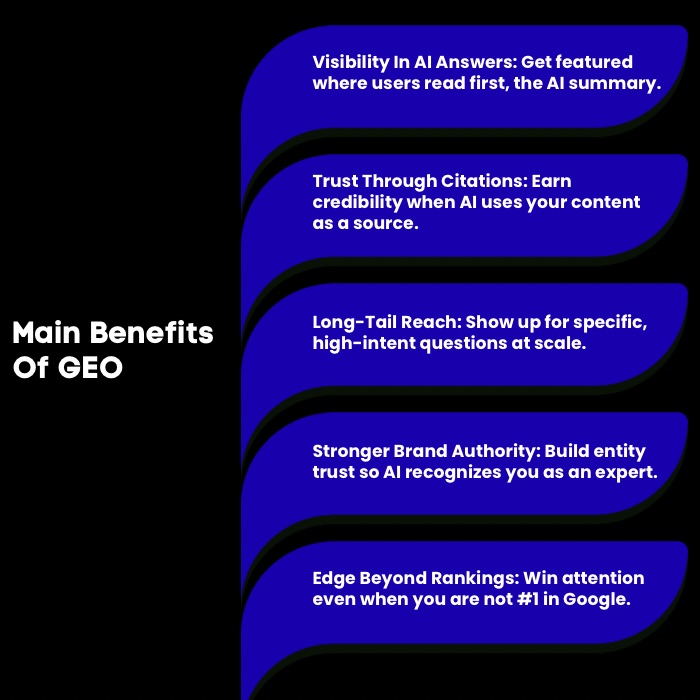
The advantages of GEO extend from increased AI visibility to stronger brand authority. These benefits translate directly into greater trust, a wider reach, and a more resilient online presence.
Let's explore the primary benefits that a well-executed GEO strategy can deliver for your business.
1. More Visibility in AI Answers
The most direct benefit of Generative Engine Optimization (GEO) is gaining brand visibility directly within AI-generated answers. As search engines increasingly provide synthesized responses at the top of the results page, being a part of that answer is the new prime real estate. Traditional search engine rankings are still important, but appearing in an AI summary places your brand in front of users with unparalleled prominence.
This type of visibility is incredibly valuable. When generative AI cites or includes your content in its response, it serves as a powerful endorsement. Users are presented with your information as part of a direct, trusted answer, not just another link in a long list. This is a core goal of answer engine optimization.
For your digital marketing, this means you can capture the attention of users at the most critical point in their journey, when they are seeking a definitive answer.
2. Higher Trust Through Citations
When a generative AI model cites your website as a source for its answer, it acts as a powerful signal of trust to the user. This is a key benefit of a well-executed Generative Engine Optimization (GEO) strategy. AI engines are designed to pull information from authoritative and reliable sources. Being chosen as one of those sources instantly elevates your brand's credibility in the eyes of the audience.
This form of trust is arguably more impactful than a high ranking alone. A citation within an AI response is an implicit endorsement. It tells the user that an advanced artificial intelligence has vetted your content and found it worthy of being included in a definitive answer. This is where focusing on verifiable claims and adding sources to your own content pays off.
For your digital marketing efforts, this heightened trust can lead to stronger brand loyalty and higher conversion rates. Users who see your brand being referenced by AI are more likely to view you as an industry leader. This makes artificial intelligence optimization a critical tool for building a trustworthy and reputable brand presence online.
3. Broader Reach Across Long-Tail Questions
Generative Engine Optimization (GEO) allows brands to capture a broader audience by addressing highly specific, long-tail questions. These are the detailed, conversational queries that users are increasingly asking search engines. While these individual questions may have lower search volume, they often indicate a user who is further along in the buying journey and has a very specific need.
By creating comprehensive content that answers these niche questions, you position your brand to be the go-to resource for a highly engaged target audience. Generative AI is particularly adept at understanding and responding to these detailed queries, pulling information from the most relevant sources. Your GEO strategy can help you become that source. This leads to:
- Reaching users with very specific intents.
- Becoming visible for a wide array of niche topics.
This approach ensures that even if a user's query is obscure, AI engines can find your content and use it to provide a relevant answer. This expands your reach far beyond broad keywords and connects you with potential customers at the precise moment they need your expertise.
4. Stronger Brand Authority and Entity Clarity
A key long-term benefit of Generative Engine Optimization (GEO) is the development of stronger brand authority and entity clarity. By consistently creating high-quality, authoritative content on specific topics, you teach artificial intelligence that your brand is an expert in that field. This process solidifies your brand as a distinct "entity" in the AI's understanding of the web.
When AI models can clearly identify who you are and what you specialize in, they are more likely to trust and reference your content. This is a level of authority that goes beyond what traditional search engine optimization can achieve. It's not just about having the right keywords; it's about being recognized as a reliable source of information.
This enhanced brand authority has a ripple effect across all your digital marketing efforts. It can lead to more frequent citations in generative AI responses, better performance in traditional search, and increased trust from your audience. A strong GEO strategy builds a foundation of credibility that makes your brand a go-to resource for both users and artificial intelligence.
5. Competitive Edge Beyond Rankings
Generative Engine Optimization (GEO) provides a significant competitive edge that extends beyond traditional search engine rankings. While your competitors may still be focused solely on getting to the number one spot on Google, a GEO strategy positions you to win in the new landscape of AI-driven search. This forward-thinking approach prepares your brand for the future of how people discover information online.
By optimizing for inclusion in AI answers, you can gain visibility in a less crowded and highly influential space. This allows you to differentiate your brand and capture audience attention in a way that traditional SEO alone cannot. Your marketing efforts become more resilient as you are not solely dependent on fluctuating rankings.
How Scalenut Helps You Turn GEO Into Measurable Visibility
GEO is not just about writing better content. It is about proving where your brand shows up in AI answers, understanding why, and taking clear actions to improve it. Scalenut brings tracking and execution into one workflow, so you can measure your AI presence, spot visibility gaps, and publish updates that improve your odds of being cited.
- Benchmarked AI Visibility (Not Guesswork): Track an AI Visibility Score, Share Of Voice, and Brand Visibility Rank to see how often you appear in AI answers and how you compare to competitors.
- Position Matters, Not Just Mentions: Use Average Position Tracking to measure whether your brand shows up early in responses or gets buried.
- Prompt-Level Proof: Prompt Tracking shows the exact prompts where you appear, what you rank against, and where competitors consistently outrank you.
- Citations And Sources You Can Act On: Citation Tracking reveals which sources AI engines rely on, so you can strengthen or replace what the model is pulling from.
- Clear Gap Detection Across Platforms: A Visibility Heatmap breaks performance out by channel, making it easy to spot where you are strong, weak, or missing entirely.
- From Insights To Execution Fast: Action Paths convert visibility gaps into prioritized next steps, backed by AI-led content ideas plus authority and backlink suggestions to support credibility.
- Measurement Beyond Traditional SEO: AI traffic and bot signals help you track AI-driven visits and referenced pages, giving you a tighter feedback loop on what AI is actually picking up.
Book a demo to see how Scalenut can help you track AI visibility and turn GEO insights into publish-ready action.
Conclusion
Understanding GEO and its implications for modern search engines is crucial for businesses aiming to enhance their online presence. By focusing on intent-led strategies and leveraging AI technologies, brands can navigate the complexities of search visibility more effectively. Implementing GEO not only boosts trust through well-cited content but also strengthens brand authority, ultimately providing a competitive edge.
As you explore the transformative potential of GEO, remember that its integration into your overall marketing strategy could redefine how your content resonates with audiences. Stay ahead in the evolving digital landscape by adopting these innovative practices. If you’re ready to elevate your content strategy, don’t hesitate to reach out for a consultation.
Frequently Asked Questions
What is Generative Engine Optimization and how does it work?
Generative Engine Optimization (GEO) is the practice of optimizing content to be featured in answers from generative AI search engines. It works by creating high-quality, authoritative, and well-structured content that AI engines can easily understand, trust, and cite when responding to user queries, moving beyond traditional ranking signals.
What are some key GEO strategies for improving content relevance?
Key GEO strategies include starting with intent-led questions instead of just keywords, building answer-first content briefs, and writing for scannability with clear headings and lists. It's also vital to add verifiable proof and sources to your content creation process, following digital marketing best practices for this new era.
How does GEO impact brand or reputation management?
GEO significantly impacts brand reputation by positioning your company as an authority. When artificial intelligence cites your content, it builds trust and credibility. Effective search engine optimization for AI helps ensure that the information presented about your brand is accurate and positive, directly influencing how your audience perceives your brand's authority.
What does the future of search look like with GEO?
The future of search with GEO will be more conversational and answer-driven. Search engines will increasingly use generative AI to provide direct, synthesized answers, reducing the reliance on lists of links. This emphasizes a better user experience, where large language model optimization and artificial intelligence optimization will be central to visibility.


.svg)


.webp)