
Profound AI Reviews: Our 30-Second Take
- Profound Goes Deep On AI Search Intelligence: It gives teams detailed visibility into prompts, citations, competitors, sentiment, AI crawler activity, and how their brand appears across answer engines.
- Execution Is Much Stronger Now: Agents, Sheets, Aim, and Projects help turn visibility gaps into research, content updates, optimization, and repeatable workflows. Profound is no longer just a monitoring platform.
- It Makes The Most Sense For Serious AEO Teams: Profound feels better suited to organizations that need deep AI search intelligence and have the resources to use its data and automation at scale.
- Pricing And Complexity Are The Main Trade-Offs: The platform has a lot of depth, which can mean a steeper learning curve. The free Trial helps, but ongoing paid brand pricing is custom.
- Scalenut Covers A Broader SEO + GEO Workflow: Scalenut feels more practical if you want AI visibility alongside keyword planning, content creation, optimization, audits, internal linking, and ongoing SEO execution in one workflow.
You are probably not considering Profound because you need another SEO dashboard. You want to know where your brand appears in ChatGPT and other AI engines, why competitors are being cited instead, and what you can actually do about those gaps.
Profound now goes much further. Its visibility intelligence is joined by Agents, Aim, Sheets, and other workflows designed to move teams from monitoring into execution. But deeper capabilities also mean more complexity, and the right fit depends heavily on your team and budget. This Profound AI review looks at where the platform genuinely delivers and where I would think twice.
What Is Profound AI And How Does It Help With AI Visibility In 2026?
Profound AI is an enterprise-focused GEO and AI visibility platform that helps brands track and improve how they appear across AI answer engines like ChatGPT, Perplexity, Gemini, and Google AI Overviews.
It has also expanded beyond monitoring. Profound now combines AI search intelligence with tools such as Agents and Aim to help teams turn visibility data into marketing and content workflows.
As of September 2026, Profound says more than 2,500 brands and one-third of the Fortune 100 use its platform. The company also raised $180 million in Series D funding at a $1.8 billion valuation.
How Does Profound AI Help?
- Tracks AI Visibility: Shows where your brand appears, how often it is mentioned, and where competitors perform better.
- Analyzes Citations And Prompts: Reveals which sources influence AI answers and what real users are asking AI platforms.
- Monitors AI Crawlers And Traffic: Agent Analytics tracks AI crawler activity and traffic coming from AI search.
- Benchmarks Competitors: Compares brand visibility, sentiment, citations, and prompt-level performance.
- Supports Execution: Agents can research, optimize, create, and publish AEO-focused content, while Aim identifies opportunities and helps coordinate marketing work.
Profound AI Key Features: How Does Profound AI Help You Track And Improve GEO?
After testing Profound AI, I would say its feature set is built for teams that want to look closely at how AI engines understand, cite, and compare their brand.
It is definitely not a lightweight AI visibility tool. There is a lot inside the platform, and that can be useful if you already know what you are looking for. But if you are new to GEO, some features may take time to connect back to actual content decisions.
Here are the Profound AI features that stood out to me.
1. Answer Engine Insights
Answer Engine Insights is one of Profound AI’s core features. It shows how your brand appears across AI answer engines, how often you get mentioned, how competitors show up, and which sources are being cited.
What I like about this feature is that it gives structure to something that is otherwise very hard to track manually. Instead of checking prompts one by one across ChatGPT, Perplexity, Gemini, or other AI platforms, you get a clearer view of where your brand stands.
a) Profound AI Competitor Benchmarking & Share of Voice
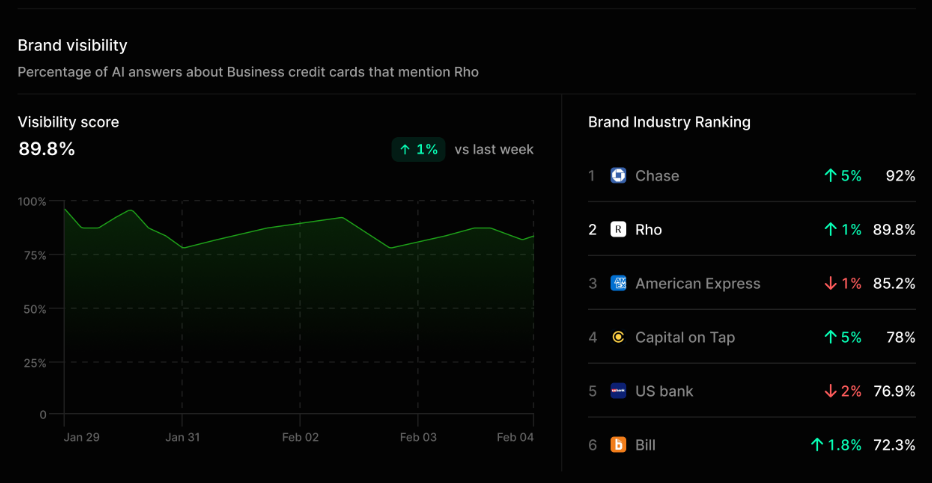
This is one of the more useful parts of the platform. Profound lets you compare your visibility against competitors, so you are not just looking at your own brand in isolation.
That matters because your brand may show up in some AI answers, but if competitors are appearing more often or getting stronger citation support, that is the real signal to pay attention to.
b) Sentiment & Keyword Insights
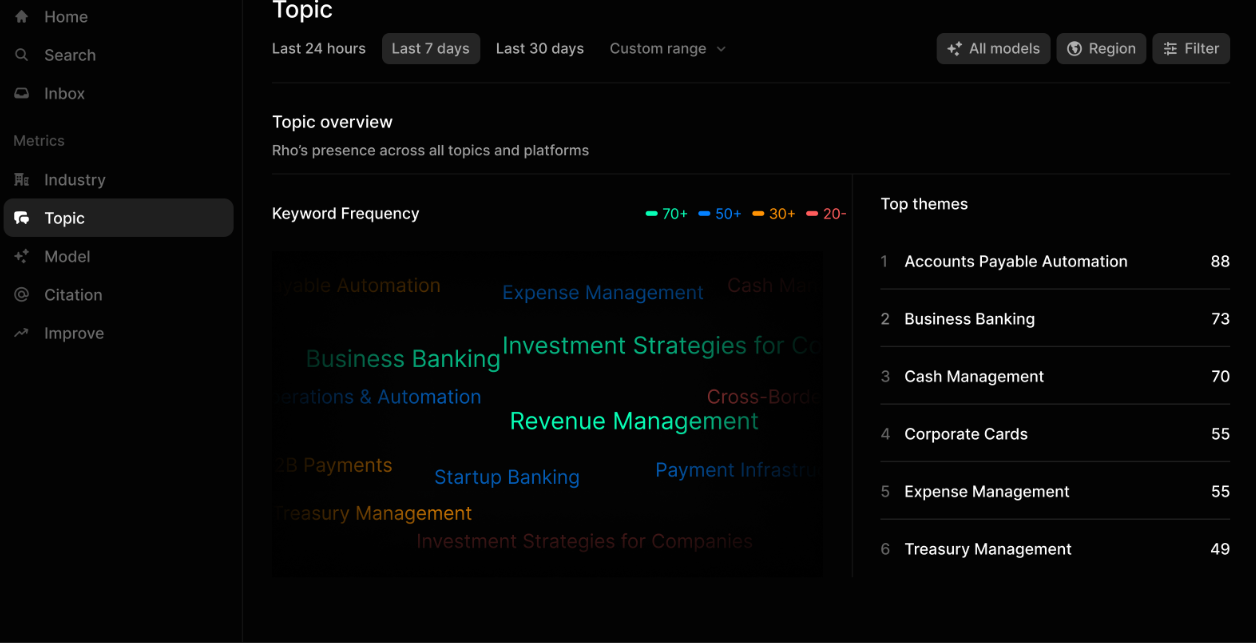
Profound also helps you see how AI engines describe your brand. This is useful because visibility alone is not enough. You also need to know whether AI tools are framing your brand correctly, neutrally, or in a way that may not match your positioning.
I would use this feature to catch outdated messaging, weak category associations, or competitor-led comparisons that need content updates.
Want to know how AI tools describe your brand? Explore the best GEO tools for sentiment analysis in 2026.
c) Citation Authority
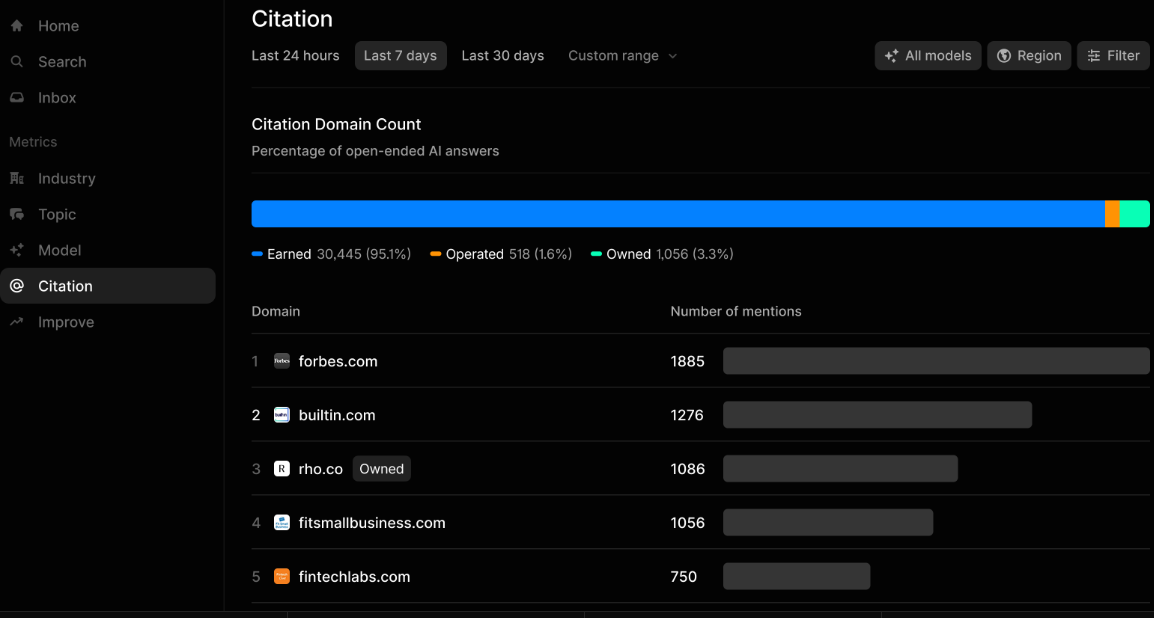
Citation tracking is where Profound starts feeling more useful for SEO and PR teams. It helps you see which sources AI engines are relying on when they answer questions in your category.
This can include your own site, third-party reviews, listicles, forums, competitor pages, or other trusted sources. If your competitors are being cited from pages where you are missing, that gives you a clear place to investigate.
d) FactCheck
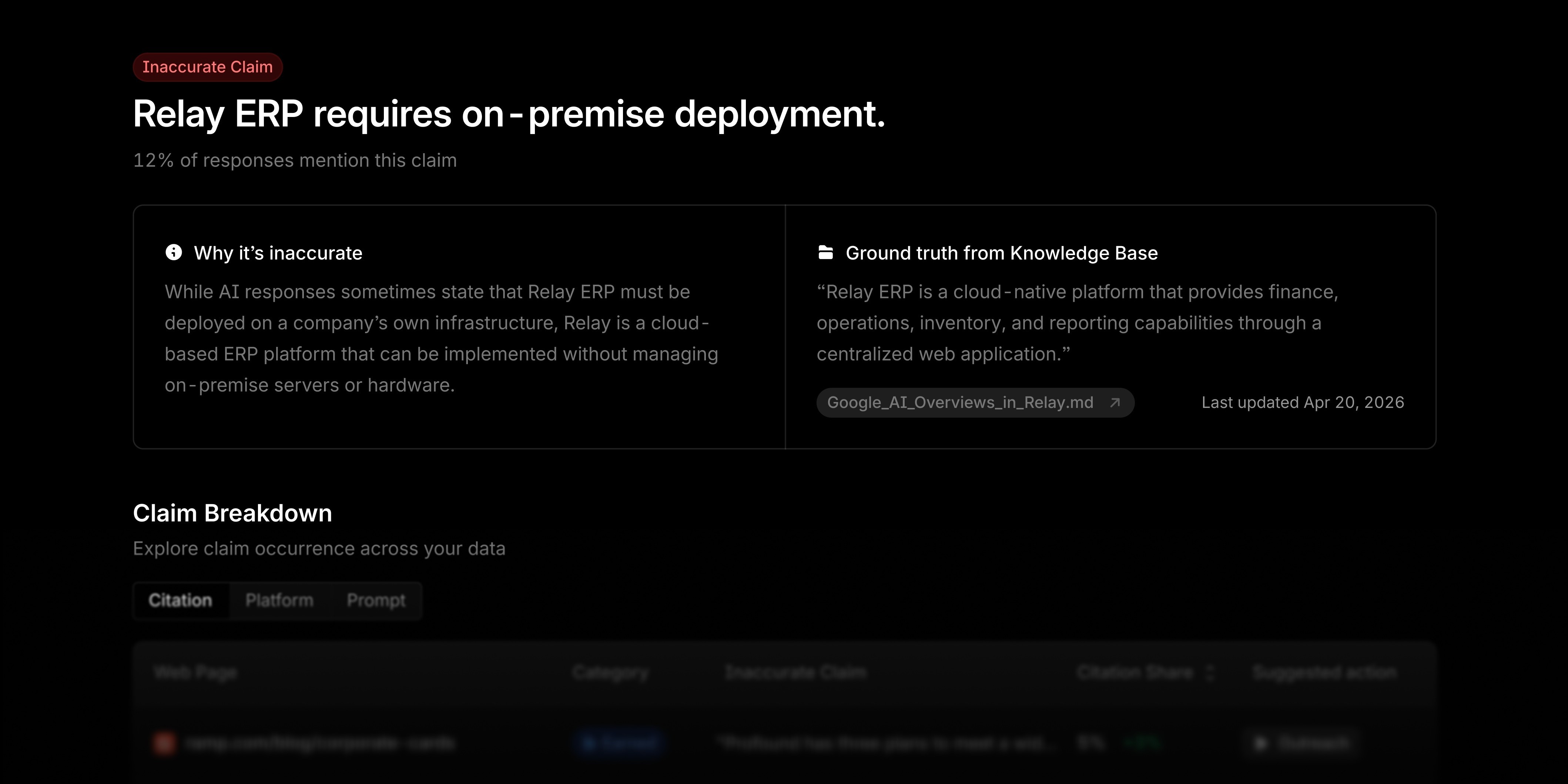
FactCheck checks AI-generated claims about your brand against your Knowledge Base and flags inaccuracies.
It also shows which citation URLs may be influencing incorrect information, helping teams trace the source of errors in pricing, product details, policies, or other brand facts.
You can then launch a Profound Agent to update content, create new content, or draft outreach to the source.
2. Agent Analytics
Agent Analytics is one of the more technical features in Profound. It helps you understand how AI bots interact with your site, which pages they visit, and how that activity may connect to AI search visibility and traffic.
I liked this feature because it goes beyond surface-level brand mentions. It helps you see whether AI systems are actually reaching your content, which is important if you want to improve AI discoverability.
a) Track AI Crawling Activity
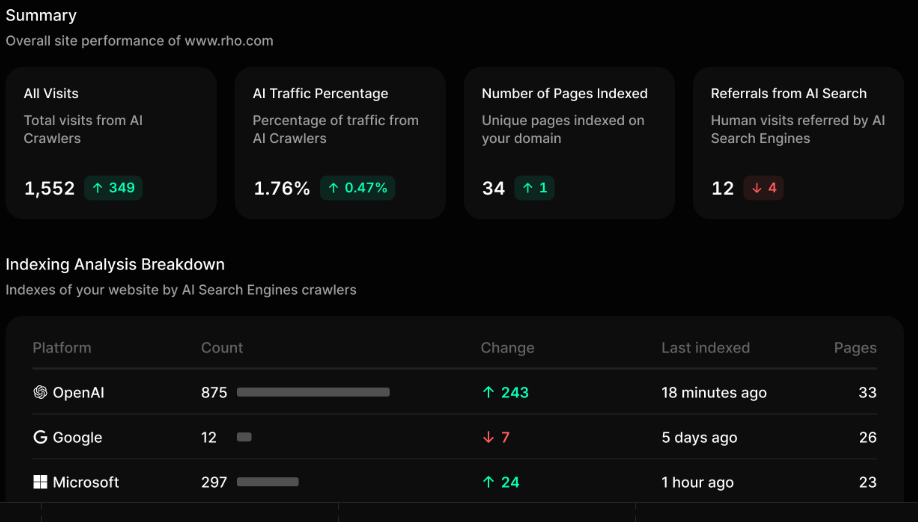
Profound shows which AI bots visit your site, which pages they access, and how often they crawl your content. It also classifies bot activity by intent, including citation, indexing, and model training.
This gives teams a clearer picture of whether AI systems are simply discovering their content or actively using it in generated answers.
b) AI Crawlability Diagnostics
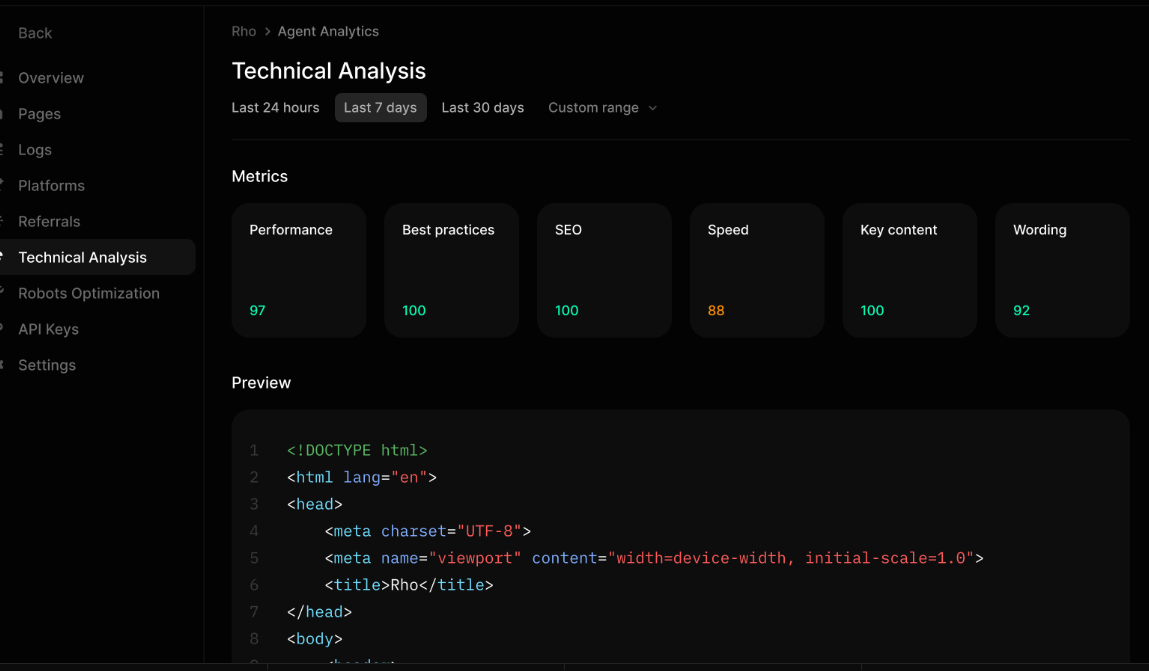
Profound also looks at whether AI systems can properly access and understand your content. This is useful because AI visibility is not only a content problem. If your site structure, page format, or technical setup makes it harder for AI crawlers to read your pages, better content alone may not be enough.
c) Content Performance Tracking
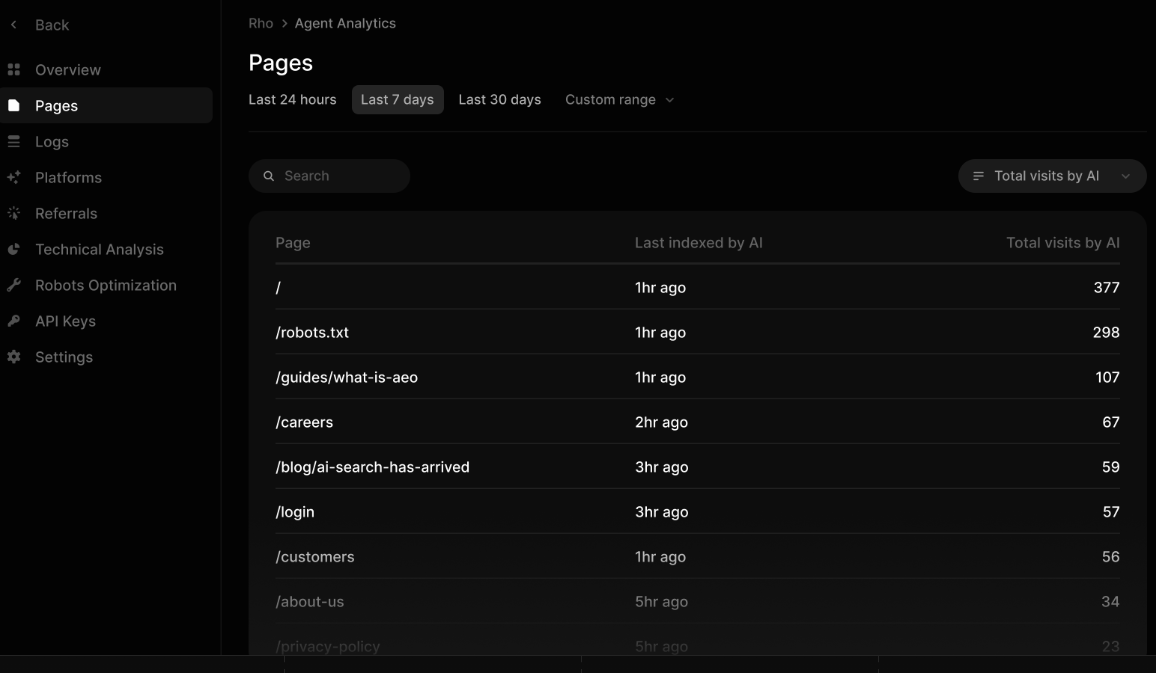
Profound can help you see which pages are contributing to AI visibility. This is useful when you want to know which content is already being picked up and which pages may need better structure, clearer answers, or stronger topical coverage.
d) Attribution & Traffic Metrics
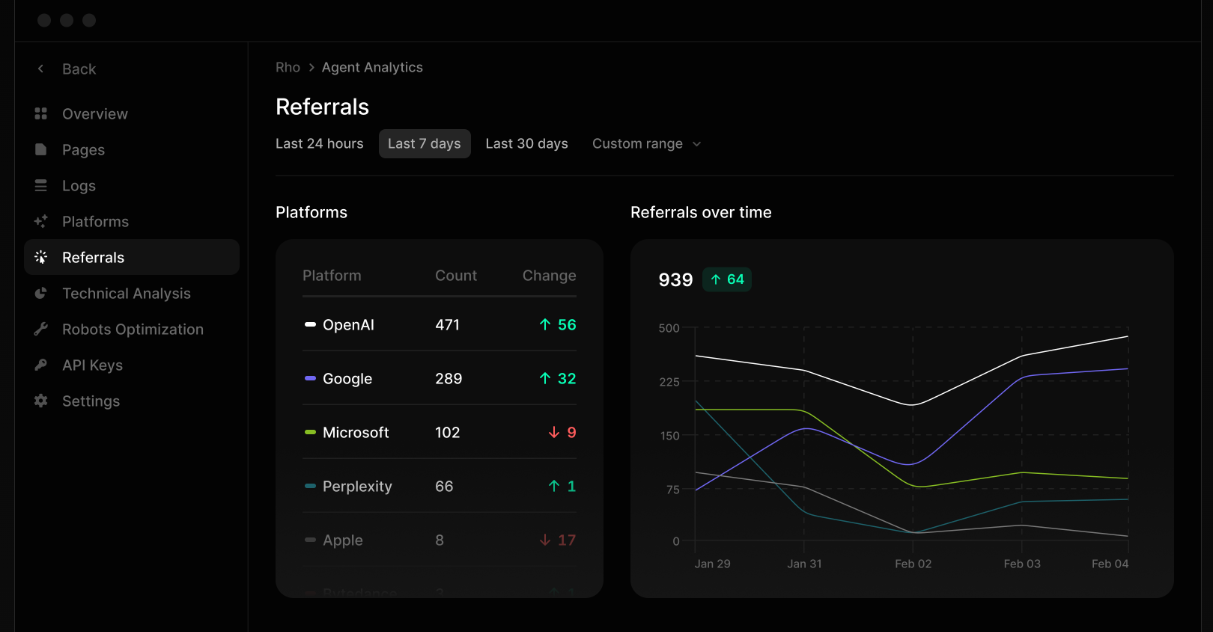
This connects AI visibility with actual website visits. I like the idea behind this because AI visibility reports can become too abstract if they are not tied to traffic or business outcomes.
That said, this is still something teams need to interpret carefully. Visibility, traffic, and conversions are connected, but they are not always the same thing.
e) Benchmarking
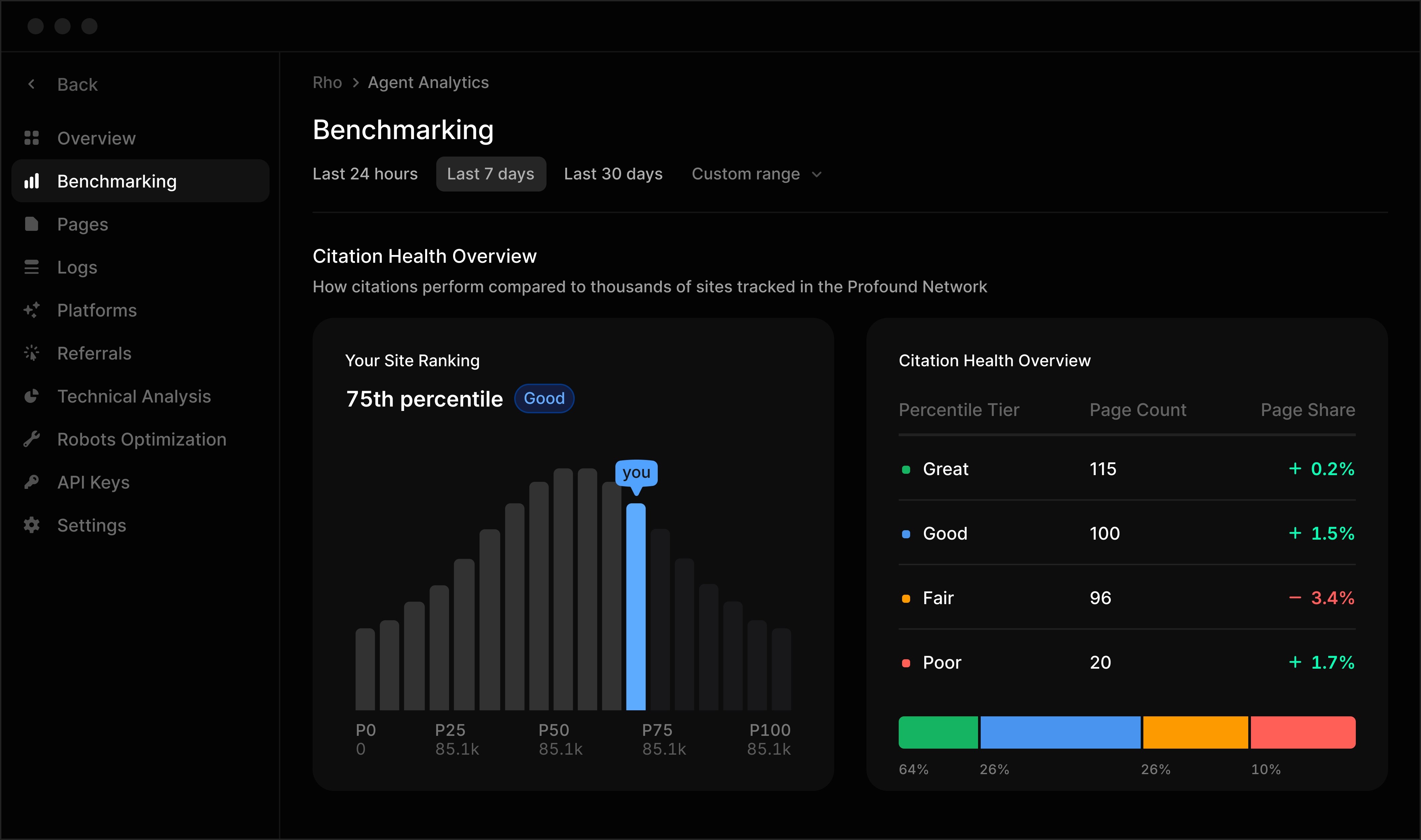
Benchmarking shows how your site and individual pages perform for AI citations compared with other pages in Profound’s network.
It gives each page a percentile-based performance rating and lets you compare results by factors such as industry and company size. I find this useful because citation counts alone lack context. Benchmarking helps you see whether a page is genuinely performing well and which pages may need more work.
Want to see where your brand appears in ChatGPT answers? Explore the best tools for tracking brand visibility in ChatGPT.
3. Prompt Volumes
Prompt Volumes is one of Profound’s more interesting features because it focuses on how people ask questions inside AI platforms.
This is different from traditional keyword research. AI prompts are usually longer, more specific, and more conversational. So this feature can help you find the kinds of questions buyers may be asking before they compare tools, products, or services.
a) Real Prompt Demand & Intent
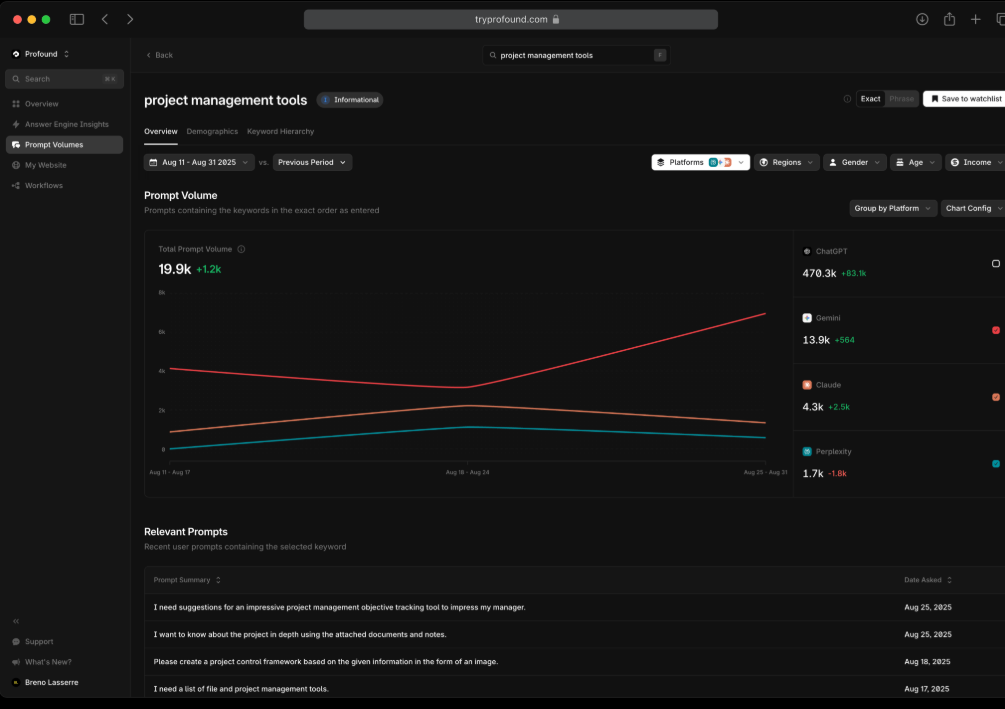
Profound shows how often topics appear in AI conversations and breaks demand down by factors such as intent, region, age, and income.
This is especially useful because it shows whether people are researching, comparing options, or moving closer to a purchase. That gives content teams more context than raw volume alone.
b) Citation & Competitor Gaps
Profound can surface real prompts that caused AI engines to cite your pages or competitor pages. This helps you identify questions where competitors are earning citations while your brand is missing.
For GEO planning, that makes the data more actionable because you can connect real audience questions with specific content and citation gaps.
c) Prompt Research & Prioritization
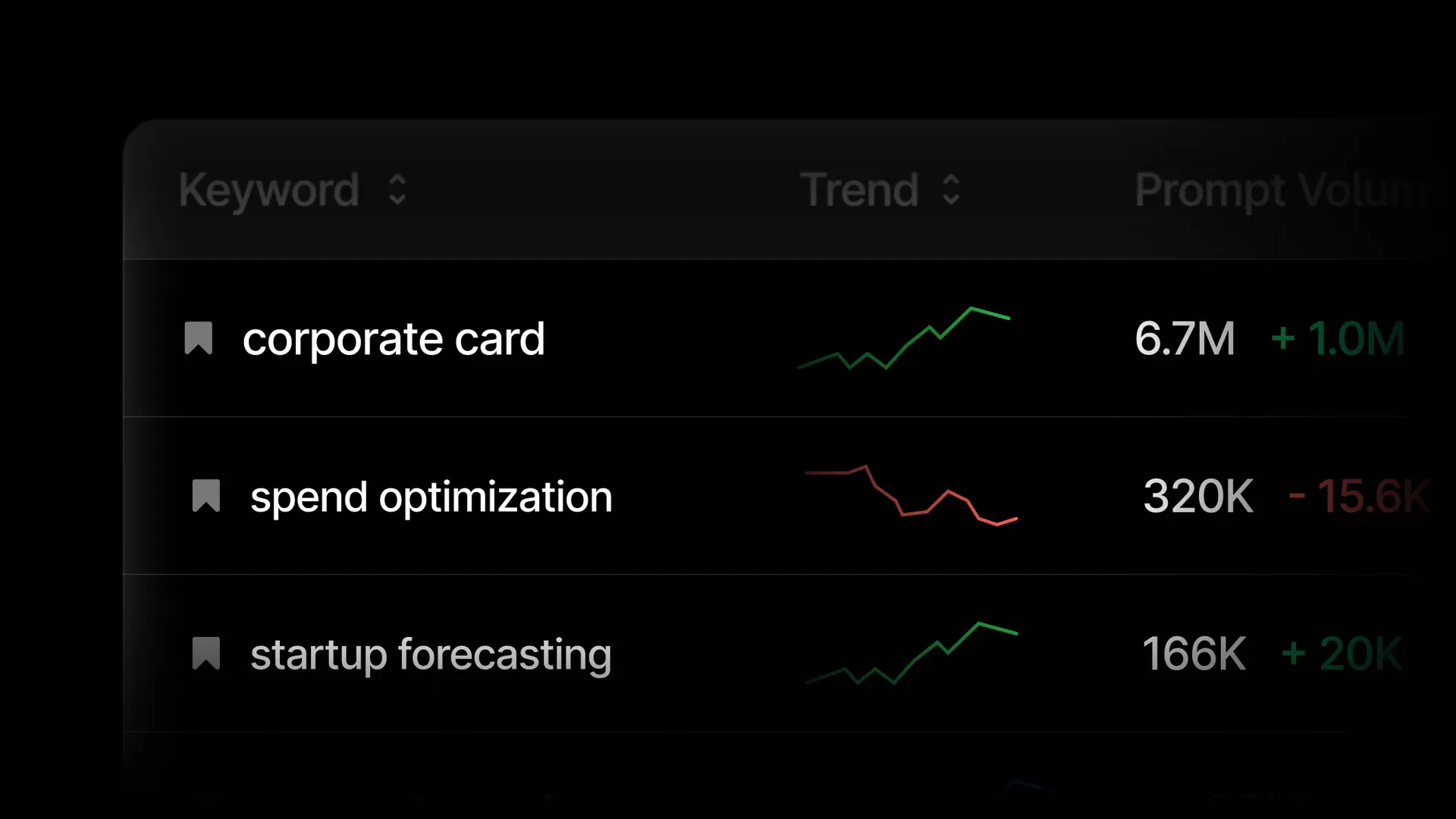
Prompt Research Reports analyze real AI conversations to uncover relevant topics and prompts you may not already be tracking. Profound clusters them by topic, classifies intent, and gives each prompt a coverage score showing how much of the conversation it represents.
I like this because the goal is not to track every possible prompt. It is to identify the conversations that matter most and prioritize content around real buyer behavior.
4. Shopping and Product Visibility Analytics
Shopping is built for brands that care about how their products show up in AI shopping and recommendation experiences.
This is more relevant for ecommerce, marketplaces, and product-led brands than for every SaaS or service business. But if AI-driven product recommendations matter in your category, this feature can be useful.
a) Shopping Visibility
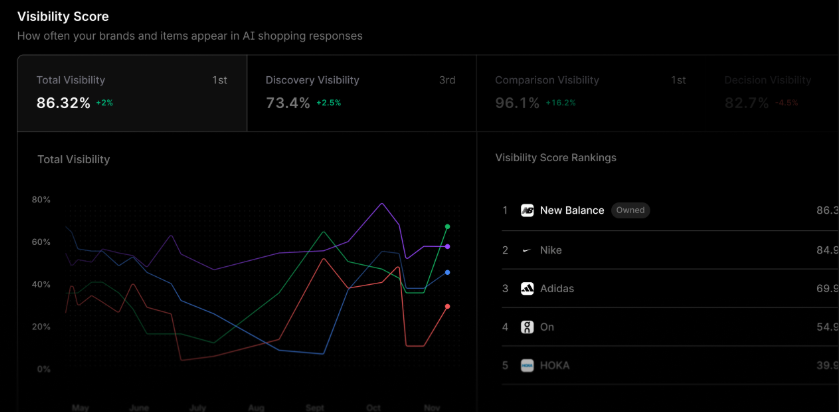
Profound helps track whether your products appear in AI shopping or recommendation-style answers. This can help you understand if your products are being surfaced when buyers ask AI tools for suggestions.
b) Attribute Accuracy
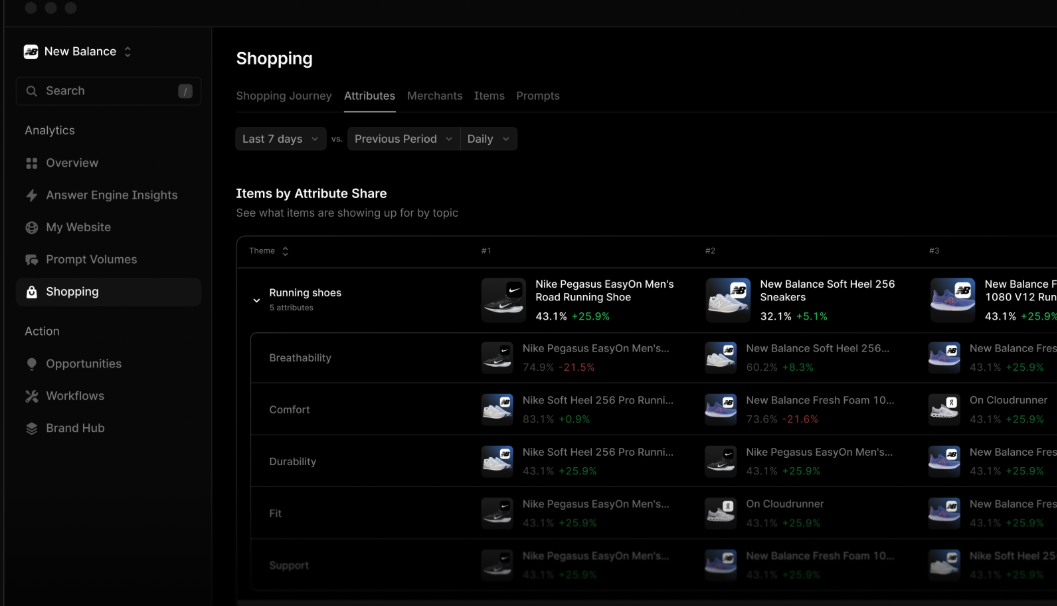
This shows how AI engines describe your products, including details like use case, category, pricing, or key features.
I like this because showing up is only half the battle. If AI tools describe your product incorrectly or miss key attributes, that can hurt how buyers understand the offer.
c) Shopper Sentiment
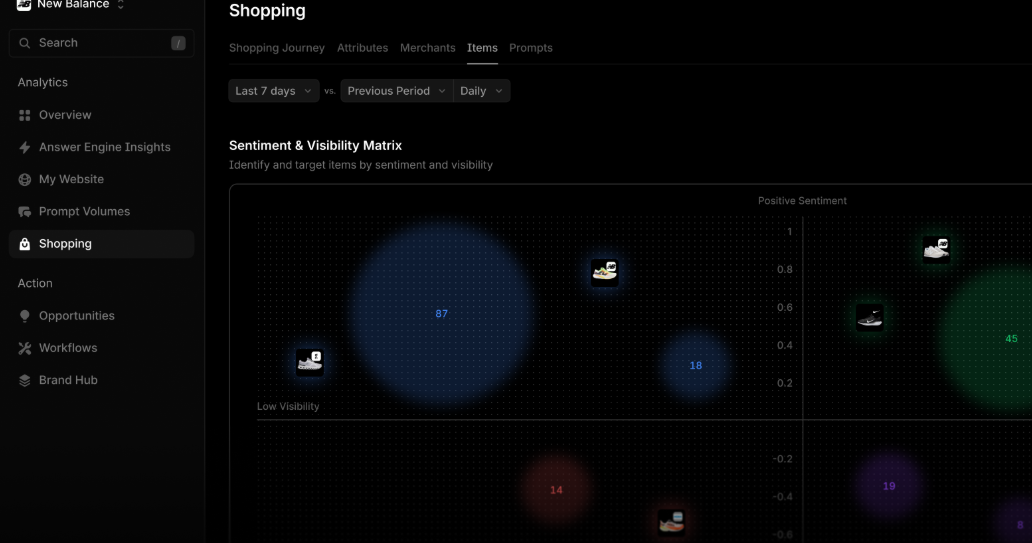
Profound also helps monitor how AI talks about your products. This is useful if you want to see whether AI-generated descriptions support trust, create doubt, or frame your product against competitors in a certain way.
d) SKU-Level Analysis
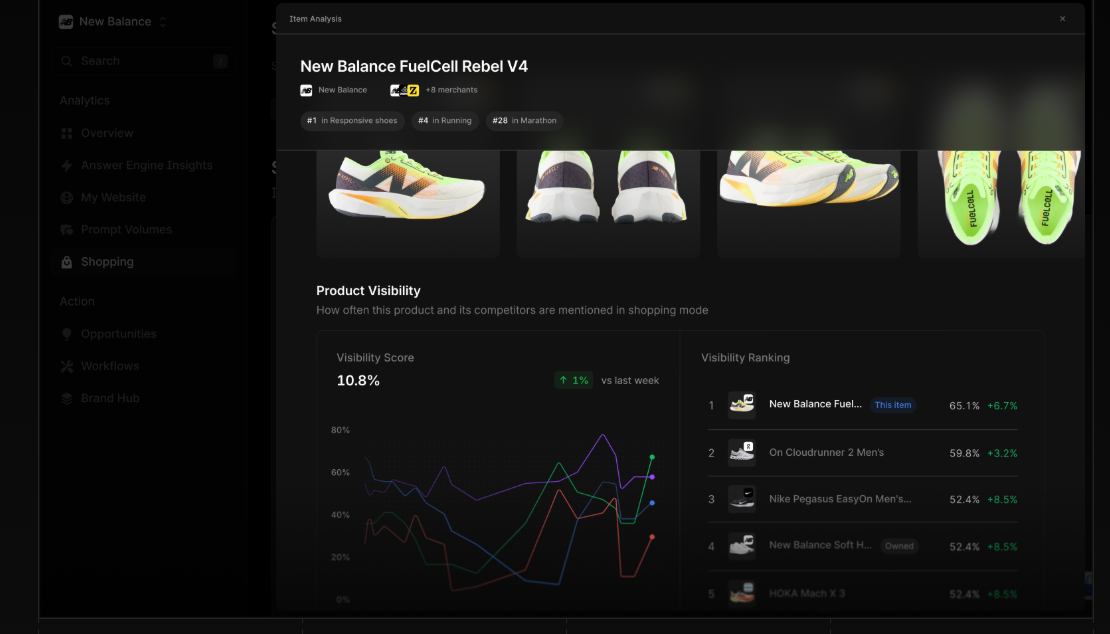
SKU-level reporting gives more granular product visibility insights instead of only showing brand-level performance. This is especially useful for ecommerce teams that need to understand which specific products are being surfaced, cited, or compared.
Profound has also expanded Shopping with deeper commerce intelligence like:
- Keyword Intelligence: Shows which prompts drive product discovery in your category.
- Shopping Mode Rate: Measures how often those queries trigger ChatGPT’s shopping experience instead of a standard text response.
- Merchant Layer: Reveals which retailers and direct stores control checkout options for your products.
- Product Feed & Structured Data: Highlights feed and markup issues that may affect how ChatGPT identifies, describes, and displays your products.
Want to improve product visibility across AI search? Explore which best GEO tools for ecommerce actually drive rankings.
5. Profound Agents And Sheets
Agents is Profound’s content workflow layer. This is where the platform moves beyond monitoring and helps teams turn AI visibility insights into content refreshes, AEO FAQs, competitive research, optimized drafts, and publishing workflows.
I like the idea behind this feature because it connects visibility data with content action. Instead of only seeing that your brand is missing from certain prompts, Agents can help turn that signal into a brief, draft, or content update.
a) Templates And Repeatable Workflows
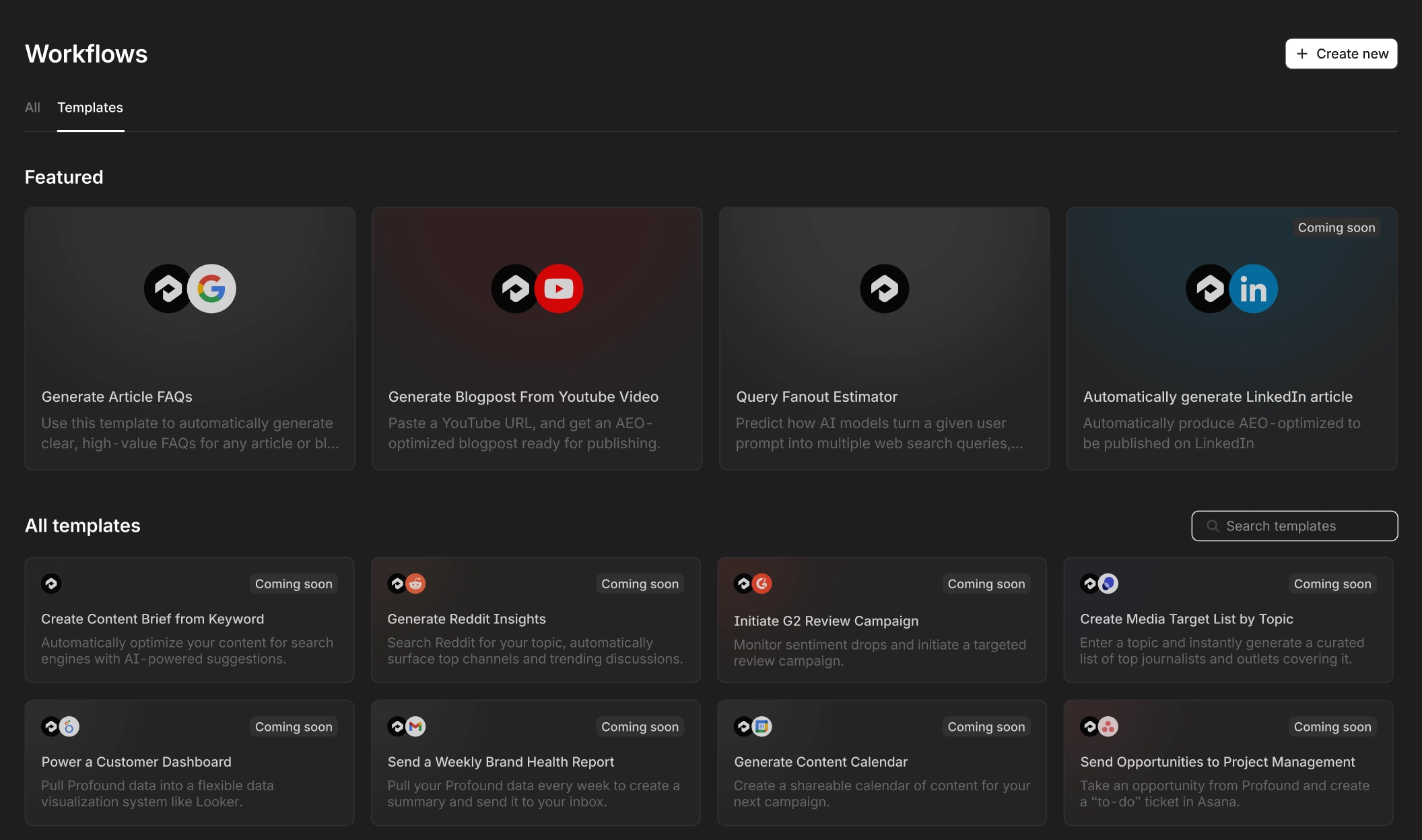
Profound provides pre-built Agent templates for workflows such as content refreshes, AEO FAQ generation, competitive research, and new content creation.
It has also added Sheets Templates for running repeatable workflows at scale. Current templates include Content Refresher, FAQ Generator, Internal Link Suggestions, Content Brief Creation, Article Translator, and PDP Optimization.
b) Integrated Research And Workflow Building
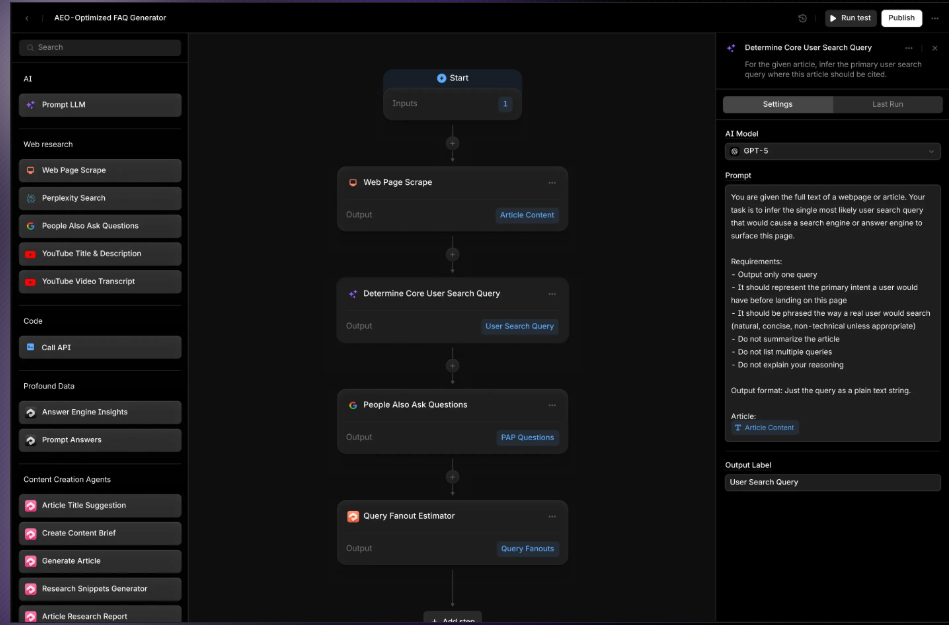
Agents can help teams build workflows that combine research, prompt insights, citation analysis, competitor data, and content steps.
This is powerful, but I would not call it a simple plug-and-play writing tool. It works better when your team already knows what kind of content process it wants to build.
c) Content Creation And Publishing
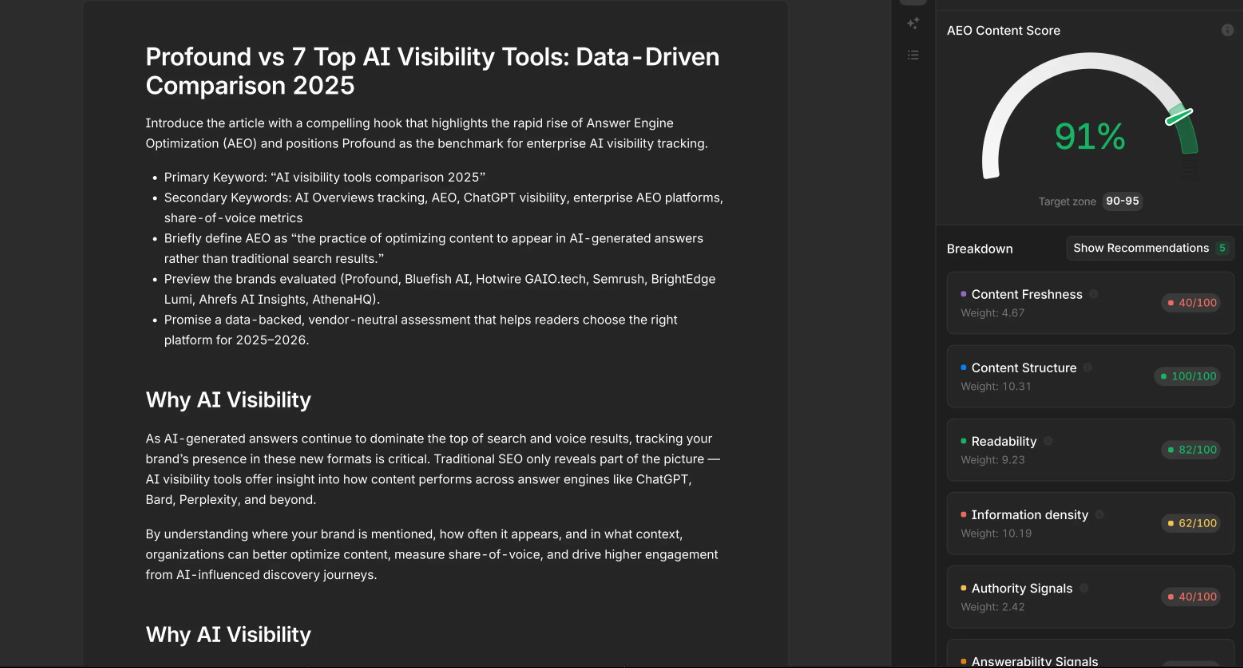
Agents can support optimized draft creation and publishing workflows.
That is useful because it connects content creation with AI visibility goals. But I would still review the output carefully. For GEO content, accuracy, originality, and positioning still matter.
d) Profound Sheets
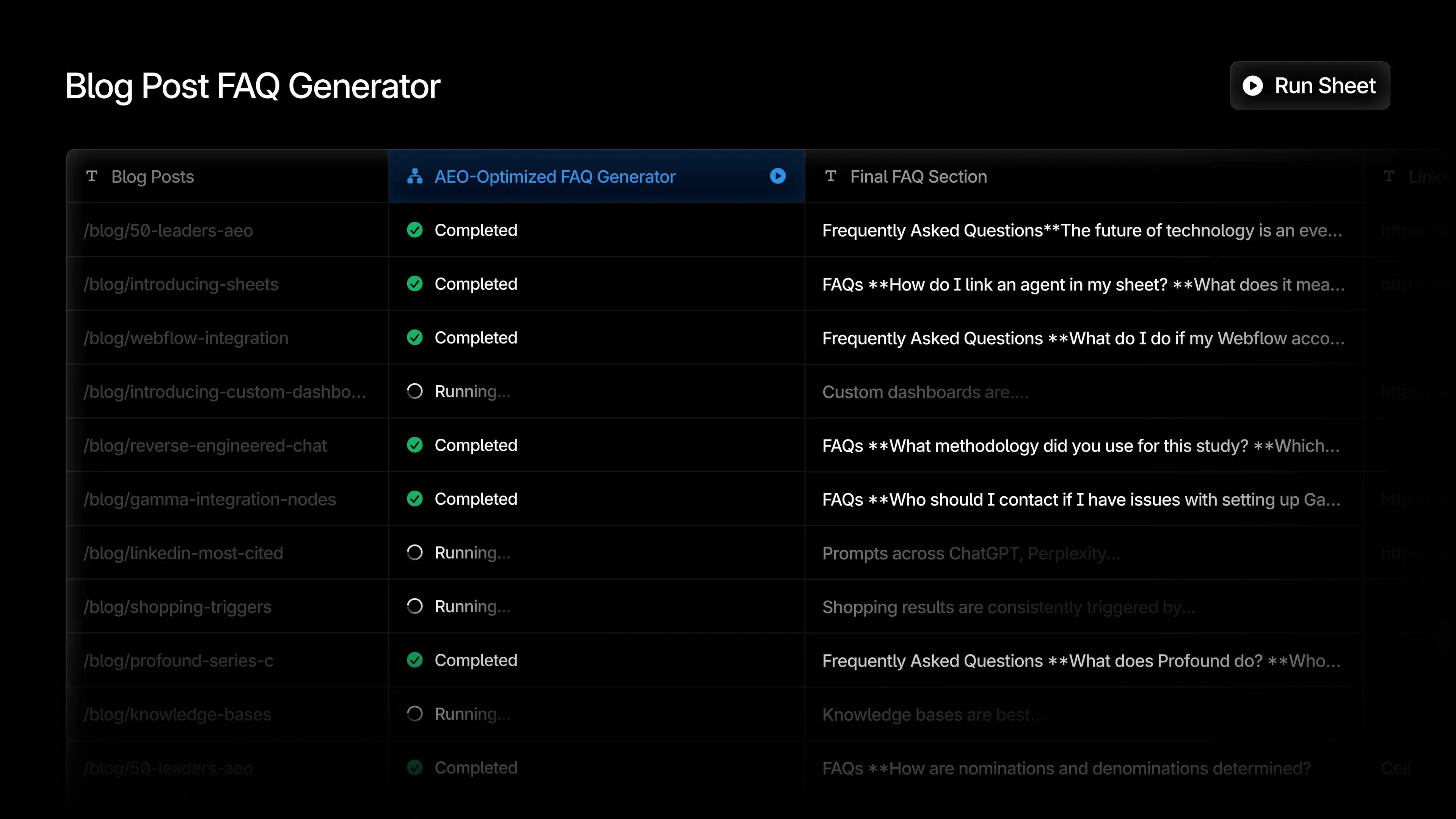
Profound Sheets lets teams run Agents across large sets of pages, prompts, keywords, or other inputs instead of triggering each workflow individually.
Each spreadsheet row acts as an input, while Agents can analyze, refresh, or generate content in parallel and return the results directly to the table. This makes Sheets useful for bulk content refreshes, AEO audits, localization, and other large-scale workflows.
6. Aim, Projects And Context Manager
Profound’s newer AI Marketer layer connects AI visibility data with strategy and execution. Instead of only showing what is happening, it helps teams identify what to work on next and move those opportunities into action.
a) Aim
Aim is Profound’s always-on background agent. It monitors signals such as visibility, citations, prompt volumes, competitors, and brand context to identify high-impact opportunities.
It then explains what changed, why it matters, and recommends where the team should focus next.
b) Projects
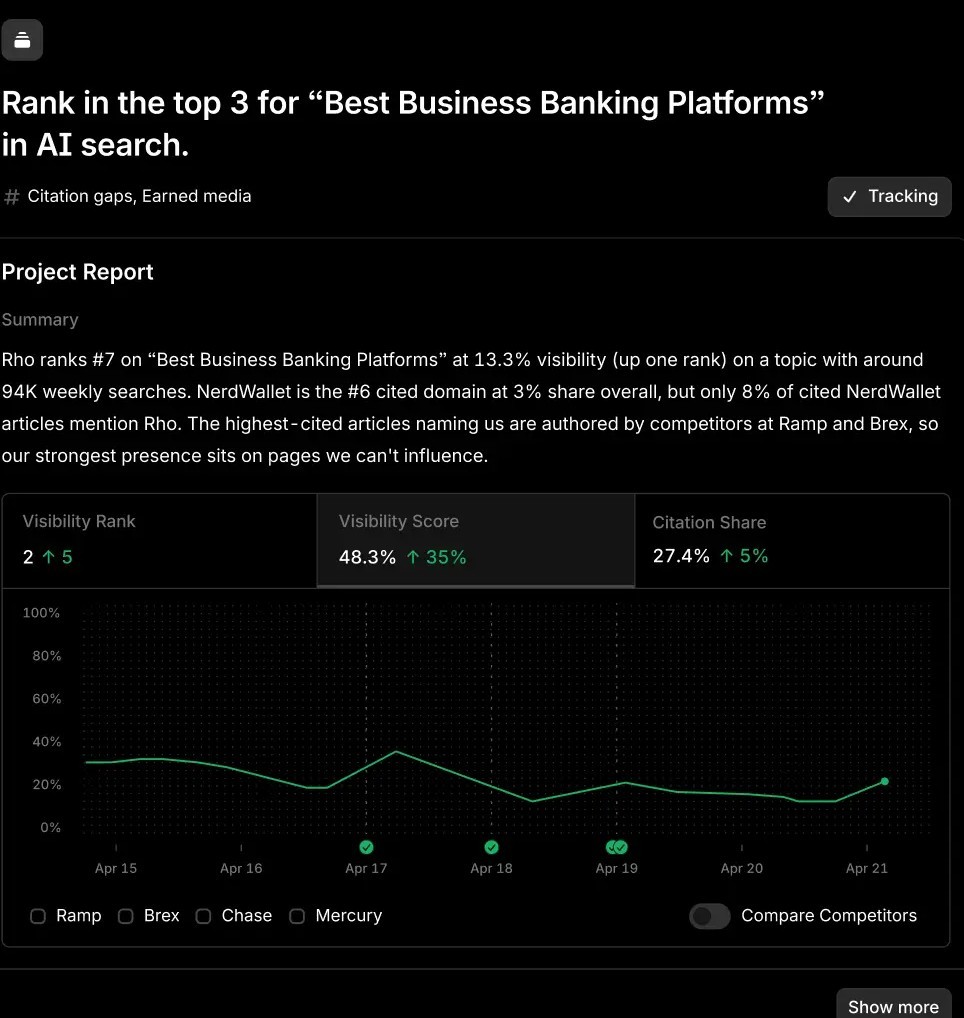
Projects turns Aim’s recommendations into structured workflows with briefs, tasks, and supporting data. Teams can refine the plan, collaborate on the work, and launch Profound Agents directly from a Project to execute tasks such as research, content creation, and optimization.
c) Context Manager
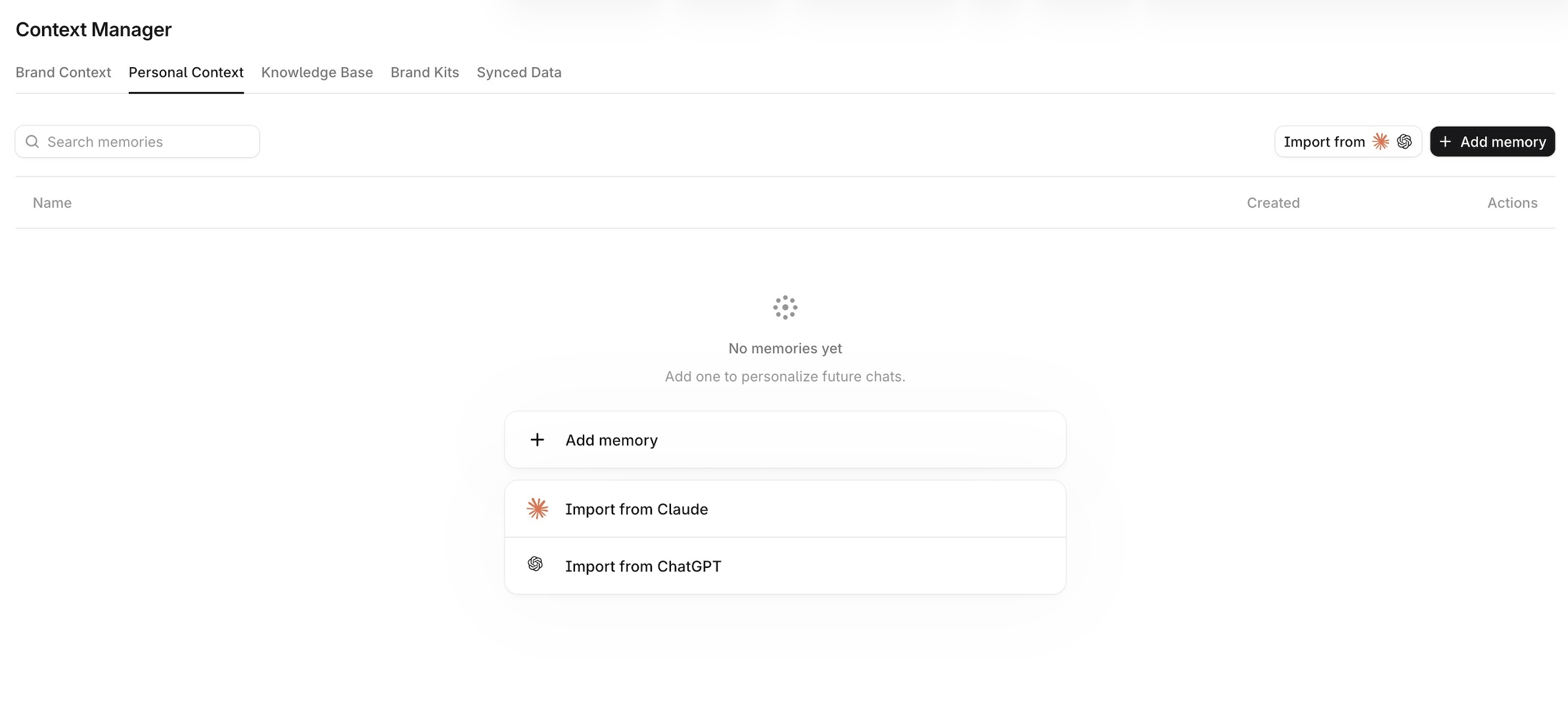
Context Manager acts as Profound’s shared memory. It stores brand positioning, audience information, strategy, preferences, and other company context from sources such as knowledge bases, brand kits, Slack, email, and Gong.
This context is then used by Aim, Projects, and Agents so teams do not have to re-explain their brand and priorities for every workflow.
Working with a tighter budget? Explore the best AEO tools under $100/month to find affordable options that still support AI visibility and content workflows.
What Are The Pros Of Profound AI?
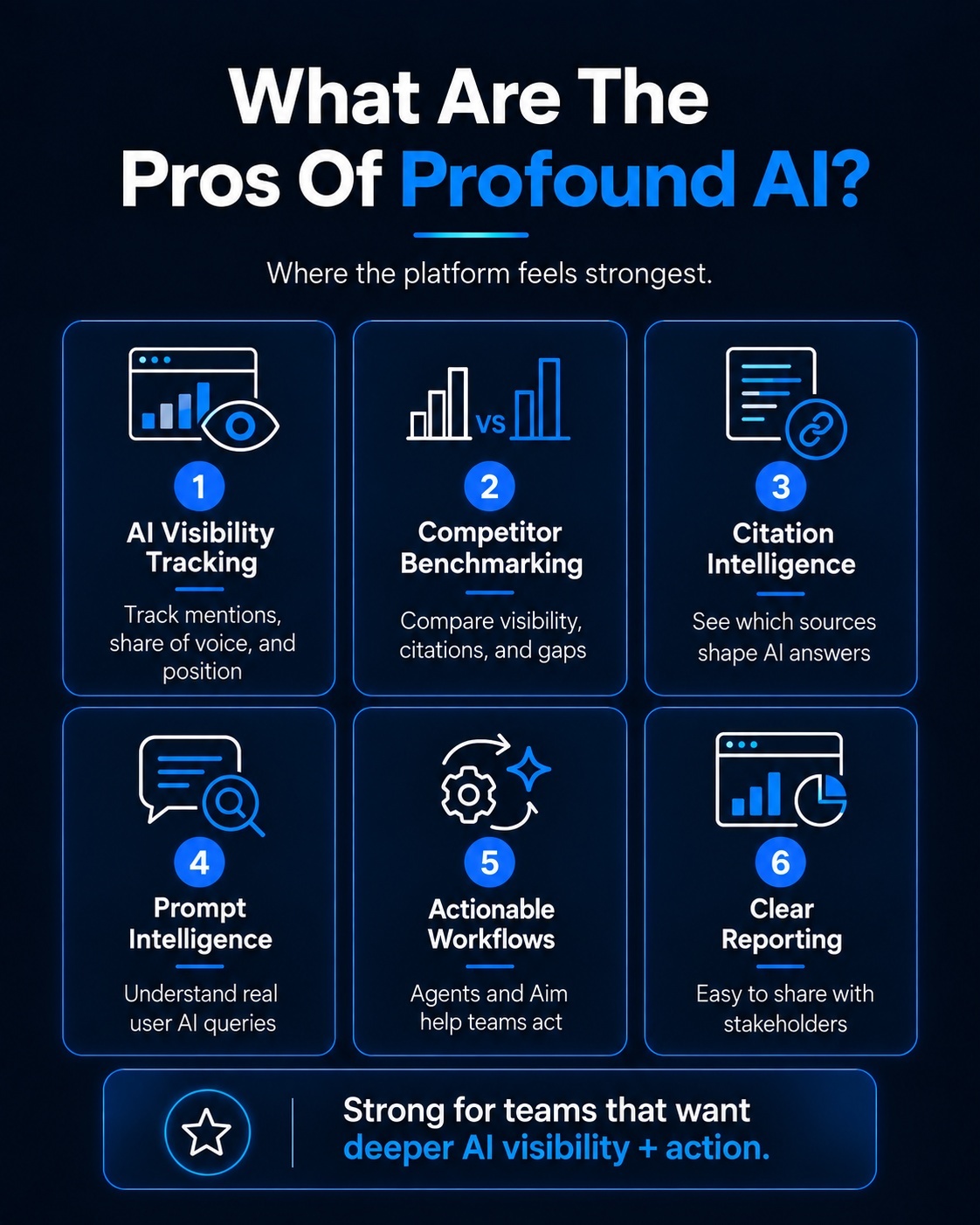
After testing Profound AI, I can see why SEO, content, and growth teams would find it useful. Its biggest strengths are the depth of its AI search data and its growing ability to turn insights into action.
1. Strong AI Visibility Tracking
Profound gives you a detailed view of how your brand appears across AI search platforms like ChatGPT, Perplexity, Claude, Gemini, Copilot, and Google AI Overviews.
You can track visibility, share of voice, sentiment, citations, and position across prompts, topics, and regions.
2. Useful Competitor Benchmarking
Profound makes it easy to compare your visibility, citations, sentiment, and prompt performance against competitors.
I find this useful because it shows not just where your brand appears, but where competitors are gaining ground and which gaps may deserve attention.
3. Detailed Citation Intelligence
Citation tracking is one of Profound’s stronger capabilities. It shows which sites and pages AI engines rely on when generating answers.
This can help teams identify citation gaps, find influential third-party sources, and guide content updates, PR, and outreach.
4. Real-User Prompt Intelligence
Prompt Volumes helps you understand what people are actually asking AI tools, including intent, trends, demographics, and citation gaps.
That gives GEO teams a stronger signal than simply turning SEO keywords into longer conversational prompts.
5. Stronger Path From Insights To Execution
Profound has become much more actionable. Agents can support research, content briefs, refreshes, FAQs, optimization, and publishing, while Aim helps identify and prioritize opportunities.
This means the platform no longer stops at showing you where visibility gaps exist.
6. Clear Reporting For Stakeholders
Profound presents AI visibility data in a way that is easier to share with content, SEO, brand, and leadership teams.
Its dashboards help explain where the brand stands, where competitors are ahead, and what needs attention without requiring every stakeholder to understand the technical details.
Overall, Profound’s biggest strength is depth. It combines AI visibility, citation, competitor, and real-prompt intelligence with a growing execution layer, making it useful for teams that want both insight and action.
What Are The Cons Of Profound AI?
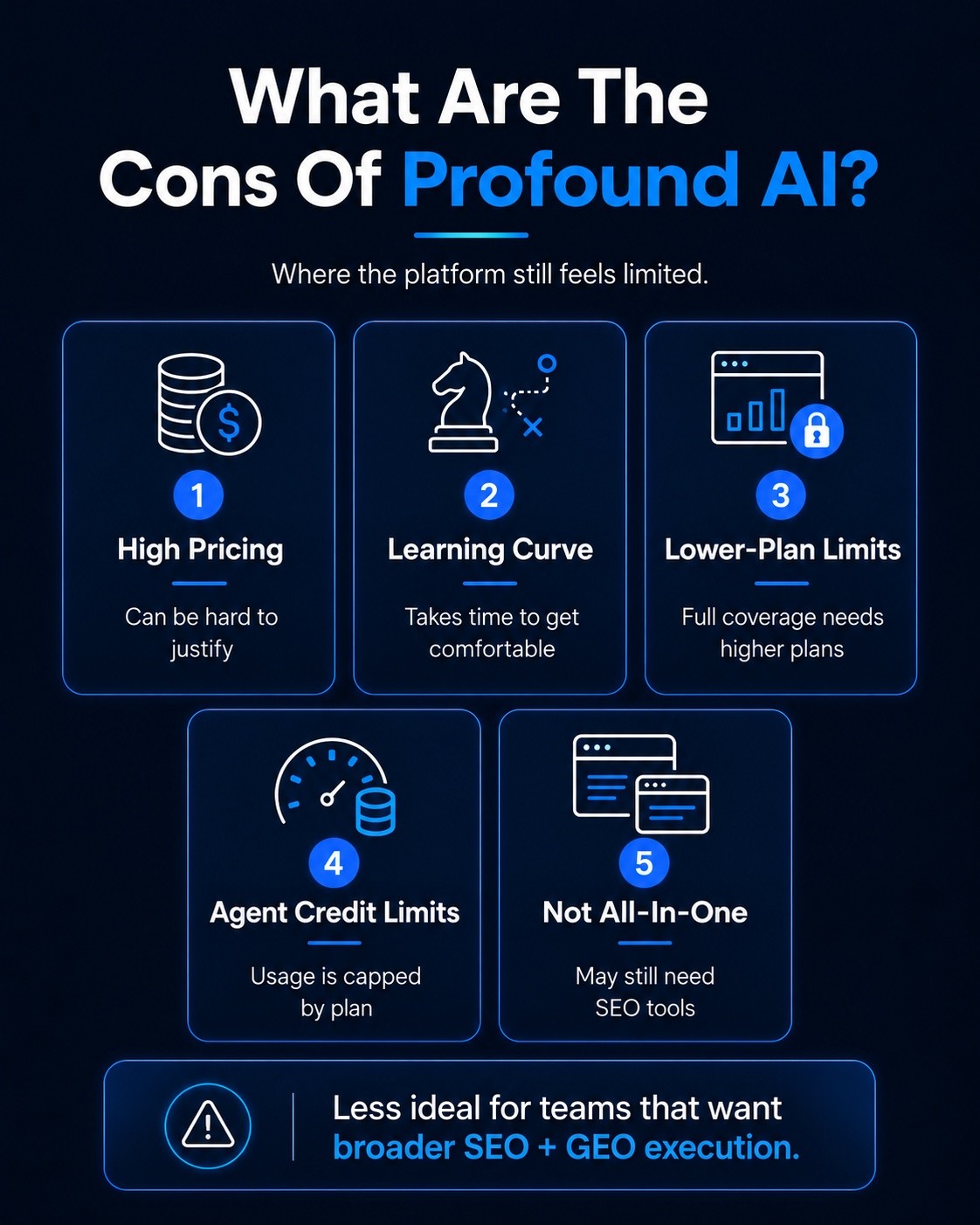
Profound has become much more capable, especially with Agents, Aim, and Sheets. But that depth also brings higher costs, plan restrictions, and more complexity than some teams may need.
Here’s where I think Profound still has limitations.
1. Pricing Can Be Hard To Justify
This is probably the clearest drawback right now. Starter costs $99/month when billed yearly, while Growth jumps to $399/month.
Recent G2 reviews also repeatedly mention pricing as a concern, particularly for smaller teams. Profound may offer a lot of depth, but you need to use that depth regularly for the cost to make sense.
2. There Is Still A Learning Curve
Profound gives you a lot of data across prompts, citations, competitors, crawlers, Agents, and AI visibility. That is useful, but it can also make the platform feel heavy when you are new to GEO.
Recent G2 users mention that it can take time to understand where to start and how to interpret all the available data. A similar concern comes up in this Peec AI vs Profound discussion on Reddit, where a user points to Profound’s steeper learning curve when sharing insights with non-technical teams.
3. Lower Plans Limit Answer Engine Coverage
Profound’s Starter plan tracks ChatGPT only. Growth expands coverage to ChatGPT, Perplexity, and Google AI Overviews, while broader tracking across up to nine answer engines requires Enterprise.
That matters if your GEO strategy depends on comparing visibility across Gemini, Claude, Copilot, Grok, AI Mode, and other platforms.
4. Agent Usage Is Credit-Based
Profound Agents are not unlimited. Starter includes 100 Agent credits per month, while Growth includes 400. Each Agent run consumes credits based on workflow complexity, including Agents run through Sheets.
For teams using Agents heavily for content refreshes, research, optimization, or scheduled workflows, usage limits are something to factor into the real cost.
5. You May Still Need A Broader SEO Workflow
Profound has closed much of its earlier execution gap with Agents, Sheets, Projects, and Aim. But its core strength is still AI search and AEO.
If your content strategy also depends on traditional keyword planning, SEO content creation, on-page optimization, audits, internal linking, and ongoing organic search execution, you may still need additional tools.
That is where Scalenut takes a broader approach by connecting SEO and GEO visibility with the workflows used to create, optimize, and maintain content.
Need a stronger writing layer to turn GEO insights into publish-ready content? Explore the best AI writing tools to use in 2026 before building your content workflow.
Profound AI Pricing Review: Is Profound AI Affordable For Smaller Teams?
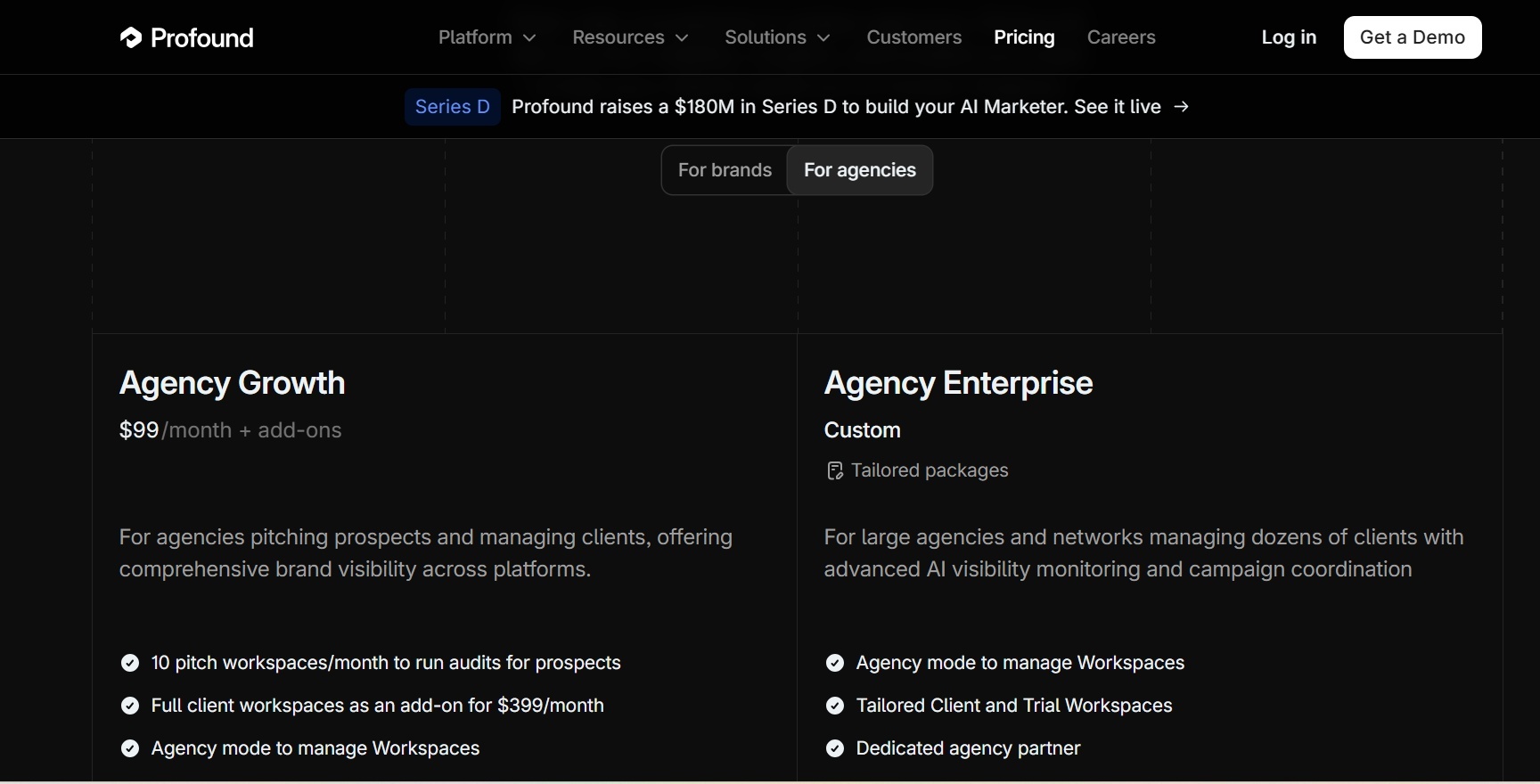
Profound currently offers separate pricing for brands and agencies.
For brands:
- Trial: Free. Includes limited AI Marketer credits, 10 prompts run once, and ChatGPT-only tracking.
- Enterprise: Custom pricing. Includes tailored prompt tracking, AI Marketer credits for the team, up to 9 answer engines, dedicated support, SSO/SAML, and SOC 2 compliance.
For agencies:
- Agency Growth: $99/month + add-ons. Includes 10 pitch workspaces per month and Agency Mode. Full client workspaces are available as a $399/month add-on.
- Agency Enterprise: Custom pricing. Includes tailored client workspaces, Agency Mode, custom packages, and dedicated agency support.
My Take: The free Trial is useful, but once you move beyond it, brand pricing jumps straight to custom Enterprise quotes. That makes Profound easier to justify for larger teams with serious AI search budgets than for smaller teams trying to compare value upfront.
If Profound feels too premium for where your team is right now, check out our list of the top GEO tools for small businesses in 2026 to find options that fit smaller budgets and leaner workflows.
Profound AI Reviews: What Are Real Users Saying About Profound AI?
Most Profound AI reviews are positive about its ability to make AI search visibility easier to measure and act on. Profound scores 4.5/5 from 1,129 reviews on G2, with users frequently praising its visibility tracking, prompt data, competitor insights, reporting, and growing Agent capabilities.
"We've been using Profound for a few months and the truth is that it has helped us quite a bit to understand how our brand appears in ChatGPT and other AIs. Before, it was all a bit of a "black box," and now we have much more visibility.", says Francisco B. on G2.
Profound no longer stops at showing where your brand appears or where competitors are ahead. Agents, integrations, and newer workflows can help teams turn those insights into content and optimization actions.
But recent reviews also highlight a few trade-offs. Pricing comes up regularly, and some users say the amount of data can take time to understand.
“It's rather expensive in comparison to other tools we've vetted but it does seem to have more insights and actionable agents than others,” says Sarah M., VP of content on G2.
Overall, current user feedback suggests Profound’s strength is no longer just visibility intelligence. It increasingly helps teams move from AI search data to action. The bigger considerations today are whether your team can justify the pricing and whether you have the time and expertise to get value from a deep platform.
Want to see which platforms handle competitor visibility better? Explore the best GEO tools for competitor analysis before choosing the right fit for your workflow.
Who Is Profound AI Best For?
Profound is best suited to teams that take AI search seriously and need deeper visibility, competitive intelligence, and workflows to act on those insights.
Here are the teams I think will get the most value:
- Enterprise Teams: A strong fit for larger brands that need broad AI engine coverage, advanced reporting, security controls, and large-scale AEO workflows.
- Mid-Market Teams: Makes sense for growing companies where AI visibility is already becoming an important part of content, brand, or acquisition strategy.
- Agencies: Useful for agencies managing multiple clients, with dedicated workspaces, pitch environments, and centralized account management.
- Smaller Teams: Worth testing through the free Trial, but the platform’s depth and custom paid brand pricing may be harder to justify with a limited GEO budget.
- SEO + GEO Teams: Profound works well for AI search intelligence and AEO execution, but teams that also need broader keyword research, SEO optimization, audits, and internal linking may still need another platform.
Overall, I see Profound as a better fit for teams building a serious AEO program than businesses that only need lightweight AI visibility tracking.
Profound AI Review: How Does Profound AI Compare With Other AI Visibility Tools?

Profound helps you track prompts, citations, competitors, and brand presence across AI answer engines. I would call it a strong option if your main goal is deep AI visibility intelligence. But here’s the catch: there are other tools that can now offer similar AI tracking features at much lower starting prices.
Want to compare more Profound AI alternatives before choosing? Explore the top 10 Profound AI competitor tools to see which one is better for your GEO workflow.]
What Is The Best Alternative To Profound AI In 2026?
Scalenut is a practical Profound AI alternative for teams that want AI visibility tracking connected to a broader SEO and GEO workflow. Profound now has a stronger execution layer of its own, but Scalenut still brings traditional SEO planning, content creation, optimization, audits, and AI visibility into one platform.
Profound AI Vs Scalenut: Which Tool Is Better For GEO?
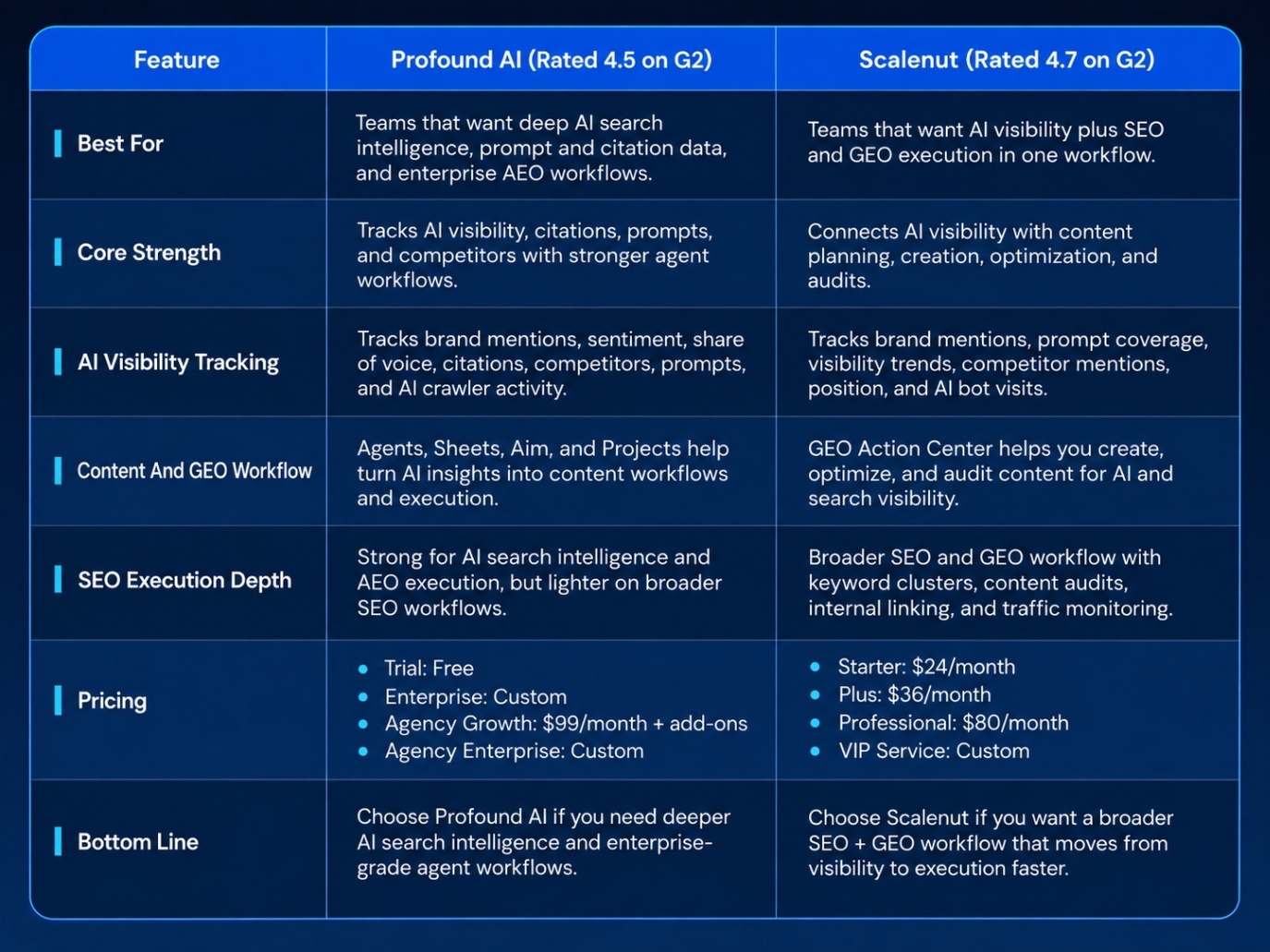
The main difference for me is scope. Profound goes deeper into enterprise AI search intelligence and agentic workflows, while Scalenut combines AI visibility with a broader SEO + GEO execution stack.
Here are the Scalenut capabilities that stand out:
- AI Visibility Tracking: Track brand mentions, Visibility Score, Share of Voice, Average Position, prompt coverage, citations, competitors, and AI bot activity.
- Prompt And Competitor Insights: See which prompts trigger your brand, where competitors appear instead, which sources are cited, and where visibility gaps create opportunities.
- GEO Action Center: Turn prompt, citation, and visibility gaps into practical recommendations for new content, updates, backlinks, and other actions.
- Content Creation And Optimization: Create GEO-ready articles, optimize existing pages, improve content scores, and strengthen topical and prompt coverage.
- Content Audits And Traffic Insights: Audit pages for SEO and GEO gaps, identify underperforming content, and connect visibility signals with traffic data.
- Broader SEO Workflow: Keyword planning, topic clusters, internal linking, on-page optimization, and publishing sit alongside the GEO features.
My Take: Profound is stronger if deep AI search intelligence and enterprise-grade agent workflows are the priority. Scalenut makes more sense to me when the goal is to manage SEO and GEO together and move from visibility insights to content execution in one workflow.
Check out our detailed guide on Scalenut vs Profound comparison to understand which GEO tool fits your workflow best.
Bottom Line: Should You Choose Profound AI Or Scalenut?
Choose Profound AI if your priority is deep AI search intelligence. It stands out for prompt data, citation analysis, competitor insights, AI crawler analytics, and agent-driven AEO workflows through Agents, Aim, Projects, and Sheets.
Choose Scalenut if you want AI visibility connected to a broader SEO + GEO execution workflow. This is where Scalenut stands out. You can move from tracking visibility and finding gaps to keyword planning, topic clustering, content creation, optimization, content audits, internal linking, and publishing without stitching together multiple SEO tools.
My Take: Profound goes deeper into AI search intelligence and enterprise AEO automation. Scalenut feels more practical for teams that want to manage both SEO and GEO from planning through execution in one platform.
Want expert help turning AI visibility insights into real GEO wins? Schedule a free call with Scalenut’s experts and build a sharper path to better search and AI visibility.
Frequently Asked Questions
How much does Profound AI cost?
Profound AI starts at $99/month for Starter when billed yearly. Growth costs $399/month, while Enterprise uses custom pricing. Starter includes 50 tracked prompts and 100 Agent credits, while Growth includes 100 prompts and 400 Agent credits per month.
Does Profound AI offer a free trial?
Profound’s current pricing page shows a “Try for free” option for the Growth plan. However, it does not publicly specify the trial length or exact terms, so teams should confirm the current trial conditions directly before signing up.
What are the main features of Profound AI?
Profound combines Answer Engine Insights, Prompt Volumes, Agent Analytics, Agents, Profound Sheets, FactCheck, and Aim. These tools help teams monitor AI visibility, analyze citations and prompts, track AI crawlers, identify inaccuracies, and turn insights into content and marketing workflows.
What AI platforms does Profound track?
Engine coverage depends on your plan. Starter currently tracks ChatGPT only, while Growth tracks three answer engines, including ChatGPT, Perplexity, and Google AI Overviews. Enterprise supports broader tracking across up to nine answer engines.
What is Profound Aim?
Profound Aim is an always-on AI marketing agent that monitors signals across the Profound platform, identifies opportunities, prioritizes work, and turns them into actionable Projects. It is designed to help teams move from AI-search data toward coordinated marketing execution.
What is Profound FactCheck?
Profound FactCheck analyzes claims AI engines make about your brand and identifies inaccurate or inconsistent information. It also helps teams understand which external sources may be influencing those claims, making it easier to find and address misinformation appearing in AI-generated answers.
What do users say about Profound AI?
Profound currently scores 4.5/5 from 1,129 G2 reviews. Users commonly praise its AI visibility data, prompt insights, competitor tracking, fast product development, and support. Recurring concerns include high pricing and the learning curve that comes with its depth.
Is Profound AI worth the investment?
Profound can be worth it for teams that need deep AI-search intelligence and have the budget and resources to use its data and Agents regularly. Smaller teams may find the $99 entry price, platform restrictions, and higher-tier costs harder to justify.
Is Profound AI suitable for small businesses or agencies?
Yes, but fit depends on your needs. Profound positions Starter for smaller companies and also offers agency plans. However, teams needing broader engine coverage, higher prompt limits, more Agent usage, or advanced enterprise capabilities may quickly need a more expensive plan.
Has Profound AI raised funding recently?
Yes. Profound raised $180 million in Series D funding at a $1.8 billion valuation in September 2026, less than seven months after its $96 million Series C. The round was co-led by Sequoia Capital and Kleiner Perkins.


.svg)


.webp)