seoClarity review: Quick summary
- Best for enterprise SEO teams: seoClarity suits global brands, multi-domain websites, and organizations managing large keyword sets across different markets.
- What it does: The platform combines rank tracking, technical SEO, content optimization, competitor research, reporting, and AI search monitoring.
- What sets it apart: ClarityAutomate helps implement on-page and technical changes, while ArcAI tracks brand visibility, citations, sentiment, and performance across AI search platforms.
- What users say: seoClarity has a 4.5 out of 5 rating based on 213 G2 reviews. Users frequently praise its customer support, data accuracy, keyword research, and reporting capabilities.
- Pricing and trial: Research & Content starts at $2,500 per month, Technical SEO at $3,200 per month, and Enterprise at $4,500 per month. A customized free trial is available after completing a demo.
- Main limitations: The platform has a steep learning curve, requires time to configure, and can become expensive once automation, AI visibility, and other add-ons are included.
- Our verdict: seoClarity is a strong choice for organizations that need enterprise-level data, automation, and reporting. Smaller teams looking for faster setup, simpler workflows, and predictable pricing may find it more complex than necessary.
Enterprise SEO teams rarely struggle with a lack of data. The harder problem is connecting rankings, technical issues, content opportunities, AI visibility, and implementation across large websites. seoClarity is designed to bring these workflows together.
Its depth is also its main trade-off. ArcAI, ClarityAutomate, advanced segmentation, and enterprise reporting offer substantial control, but they require budget, onboarding, and dedicated ownership. This review breaks down what seoClarity does, how much it costs, where it performs well, and who should consider an alternative.
What is seoClarity, and how does it help with enterprise SEO and AI search visibility?
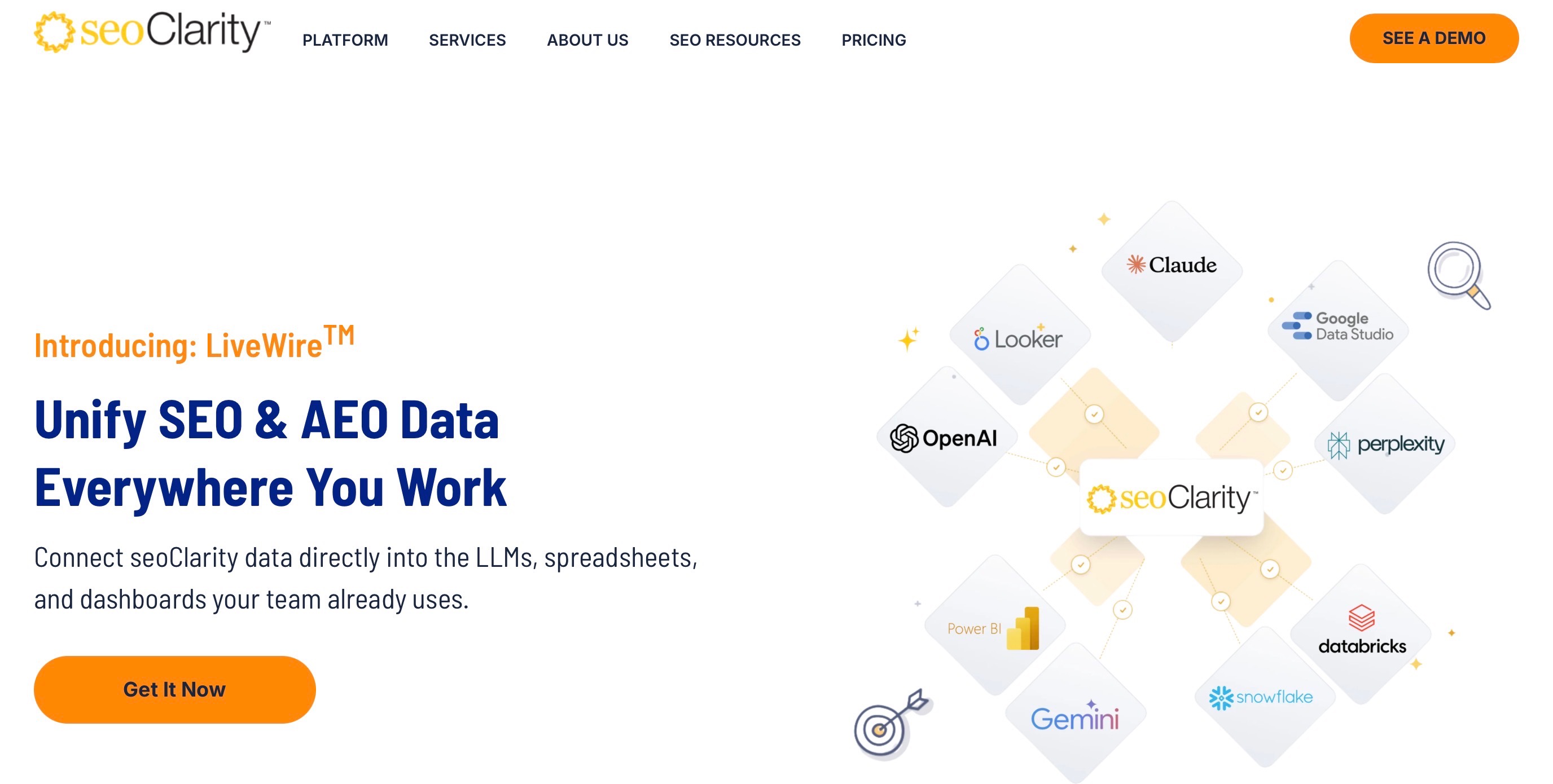
seoClarity is a unified enterprise SEO and AEO platform that helps large teams manage visibility across traditional search results and AI-generated answers. It combines rank tracking, keyword and competitor research, content optimization, technical auditing, and reporting in one system.
Its ClarityAutomate tool supports no-code SEO execution, while Clarity ArcAI tool tracks brand mentions, citations, sentiment, AI bot activity, accuracy, and AI-driven performance. This gives enterprise teams a shared system for finding opportunities, prioritizing improvements, and executing search strategies across large websites and markets.
What are the pros and cons of seoClarity?
What are seoClarity’s main advantages?
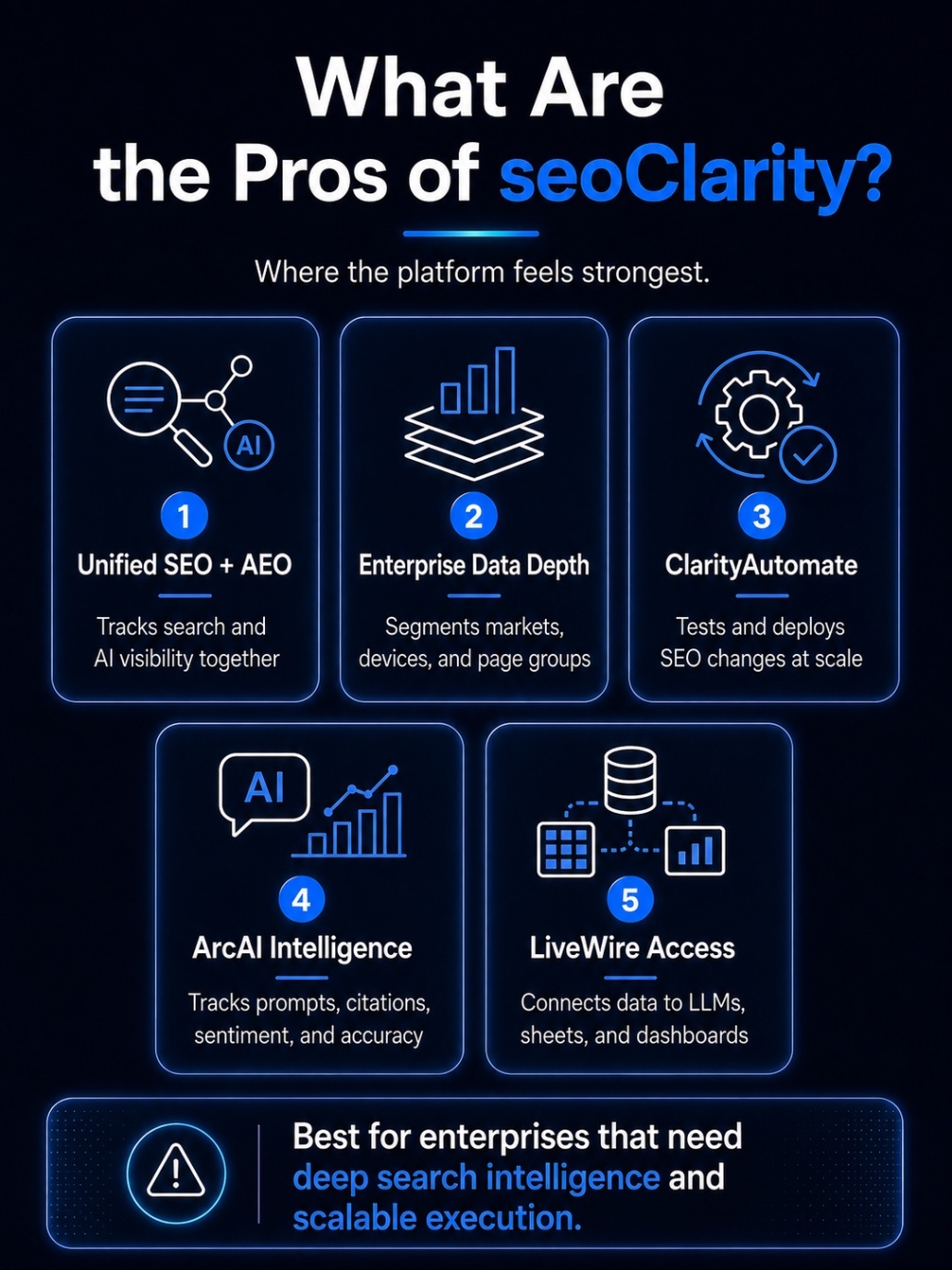
- Unified SEO and AEO platform: Combines rank tracking, content optimization, technical SEO, competitive research, AI visibility, and reporting in one ecosystem.
- Enterprise-level data depth: Supports detailed segmentation across countries, devices, markets, SERP features, business units, and page groups.
- Execution through ClarityAutomate: Lets teams test and deploy page updates, schema, internal links, and technical changes with less developer dependence.
- Broader AI-search capabilities: ArcAI covers citations, prompts, sentiment, accuracy, AI bot activity, content optimization, performance reporting, and AI shopping visibility.
- Flexible data access: LiveWire brings SEO and AEO intelligence into ChatGPT, Claude, spreadsheets, dashboards, and internal systems through MCP, plugins, and APIs.
- Strong enterprise support: Includes unlimited users, onboarding, training, ongoing support, and customizable packages for complex organizations.
Where does seoClarity fall short?
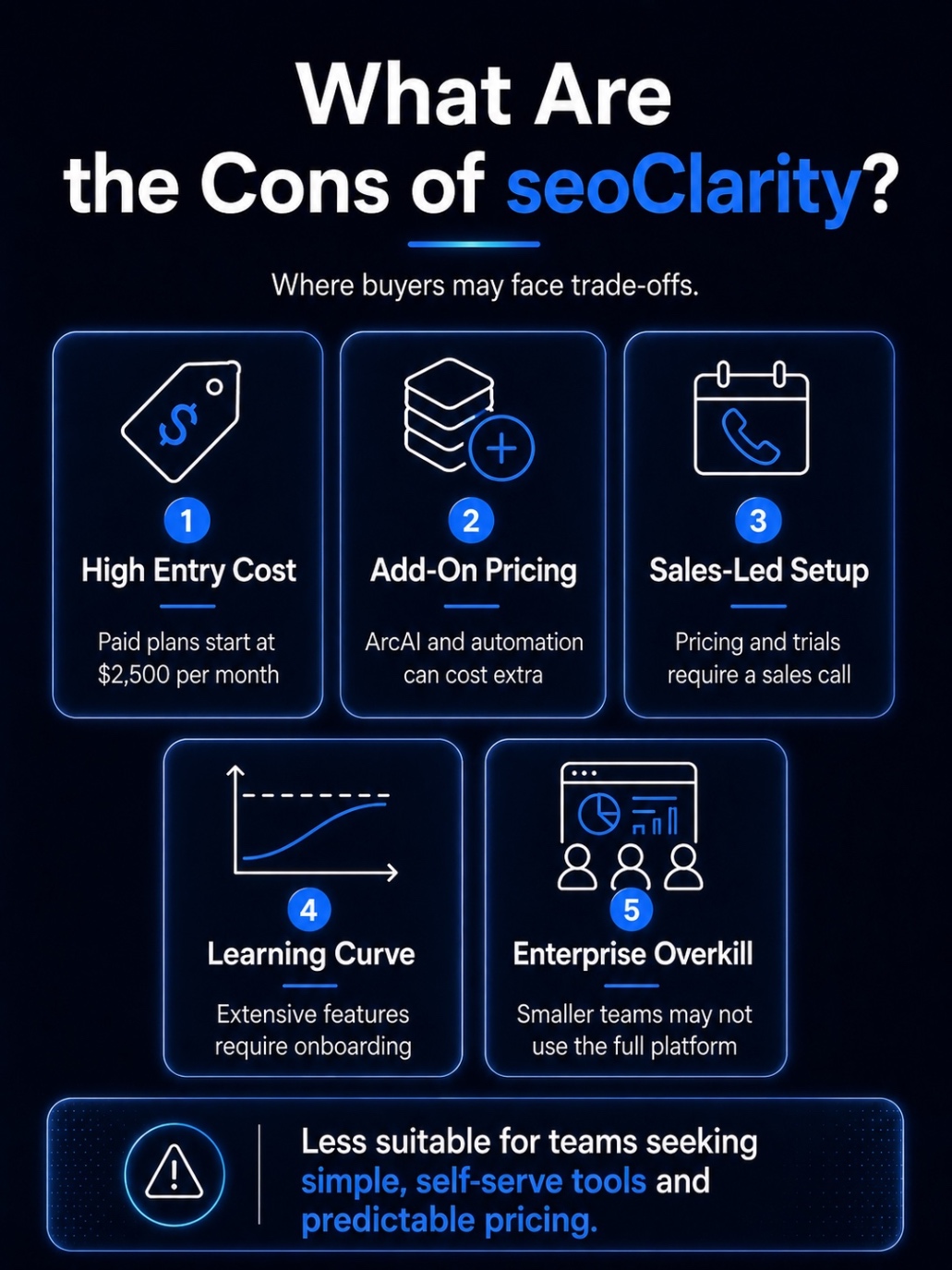
- High entry cost: Research and Content starts at $2,500 per month, while the Enterprise package begins at $4,500 per month.
- Important features cost extra: Clarity ArcAI, ClarityAutomate, on-page monitoring, and professional services are optional add-ons.
- No self-serve buying experience: Teams must speak with sales for custom pricing, add-on costs, and trial access.
- Steeper learning curve: Its extensive data, modules, and segmentation require onboarding and clearly defined workflows.
- Implementation still needs oversight: ClarityAutomate reduces development bottlenecks, but large-scale changes still require testing, approvals, and governance.
- Can be excessive for simpler needs: Smaller teams may not use enough of the platform to justify its cost and complexity.
Overall, seoClarity is strongest for enterprises that need deep SEO and AEO intelligence connected to execution. It is less suitable for smaller teams looking for a focused tool with affordable, predictable pricing.
What are the core features and capabilities of seoClarity?
seoClarity‘s capabilities span four main layers: the core SEO Platform, ClarityAutomate for implementation, Clarity ArcAI for AI-search optimization, and LiveWire for accessing seoClarity data across external tools.
1. seoClarity SEO Platform
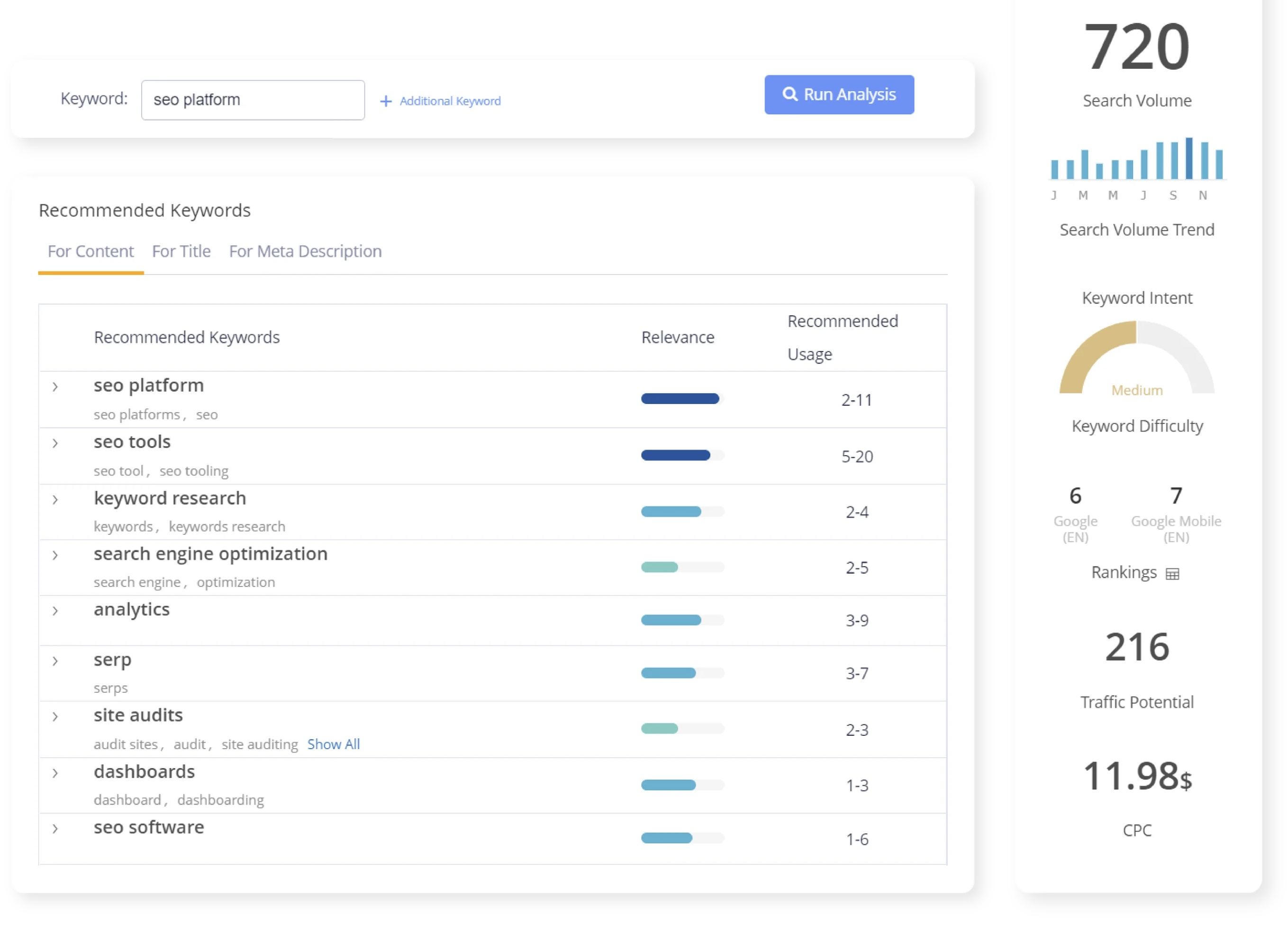
The seoClarity SEO Platform is the primary workspace for monitoring search performance, finding opportunities, diagnosing technical issues, and planning content across large websites.
Rank tracking and intelligence
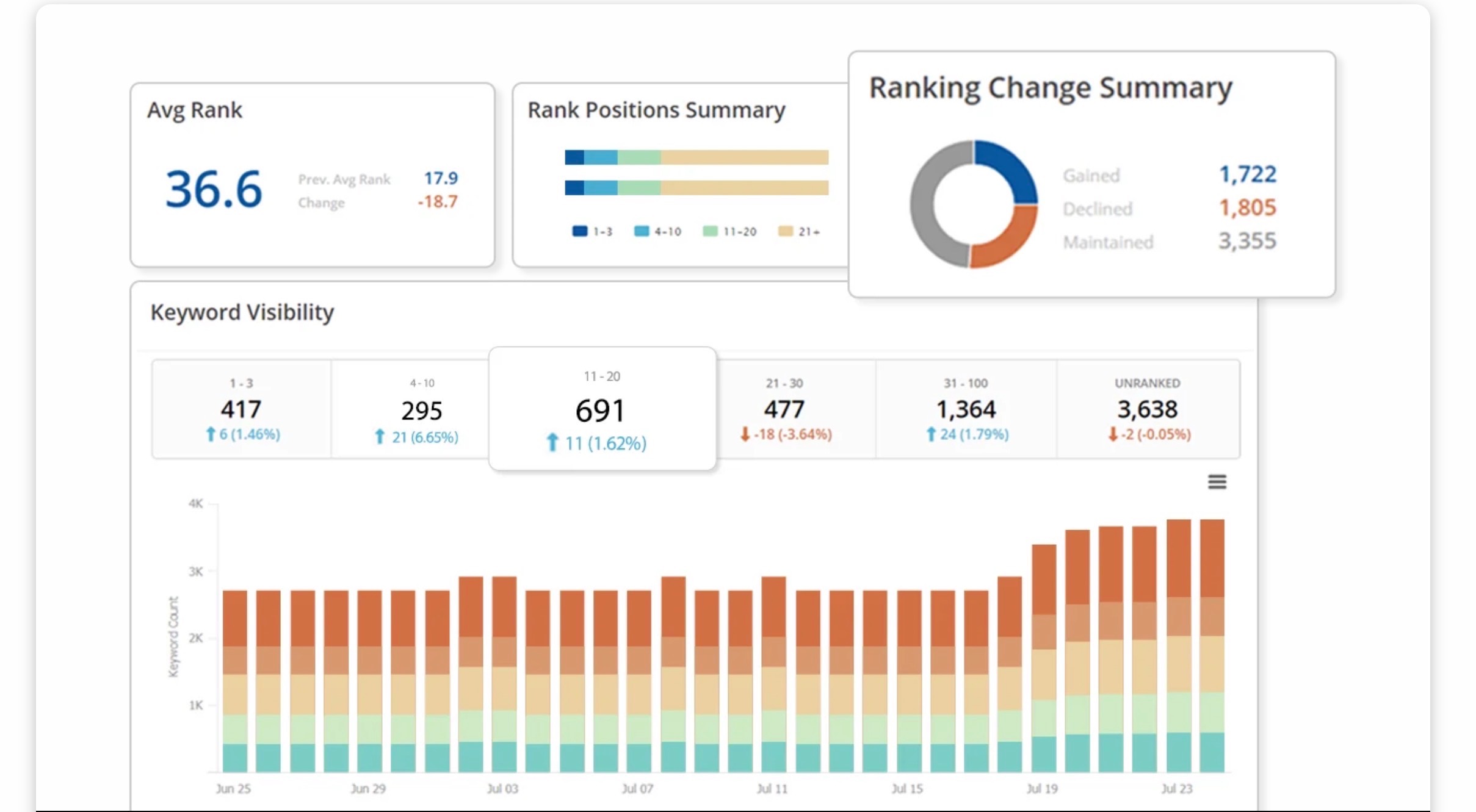
Rank Intelligence is built for organizations tracking extensive keyword portfolios across markets, devices, and search experiences. Here’s what it does:
- Daily, hourly, weekly, and on-demand ranking updates
- Tracking across countries, languages, devices, and locations
- Unlimited competitor comparisons for tracked keywords
- SERP feature, visual, video, mobile, and local rank tracking
- Segmentation by page type, market, category, device, and search feature
- Integration with Google Search Console, Google Analytics, and business metrics
This depth gives enterprise teams more control than a basic rank tracker, although packages are priced according to the number of domains and keyword queries tracked.
Want to compare more options? Explore the 7 best AI rank tracker tools to monitor AI visibility in 2026 and find the right fit for your needs.
Content creation and optimization
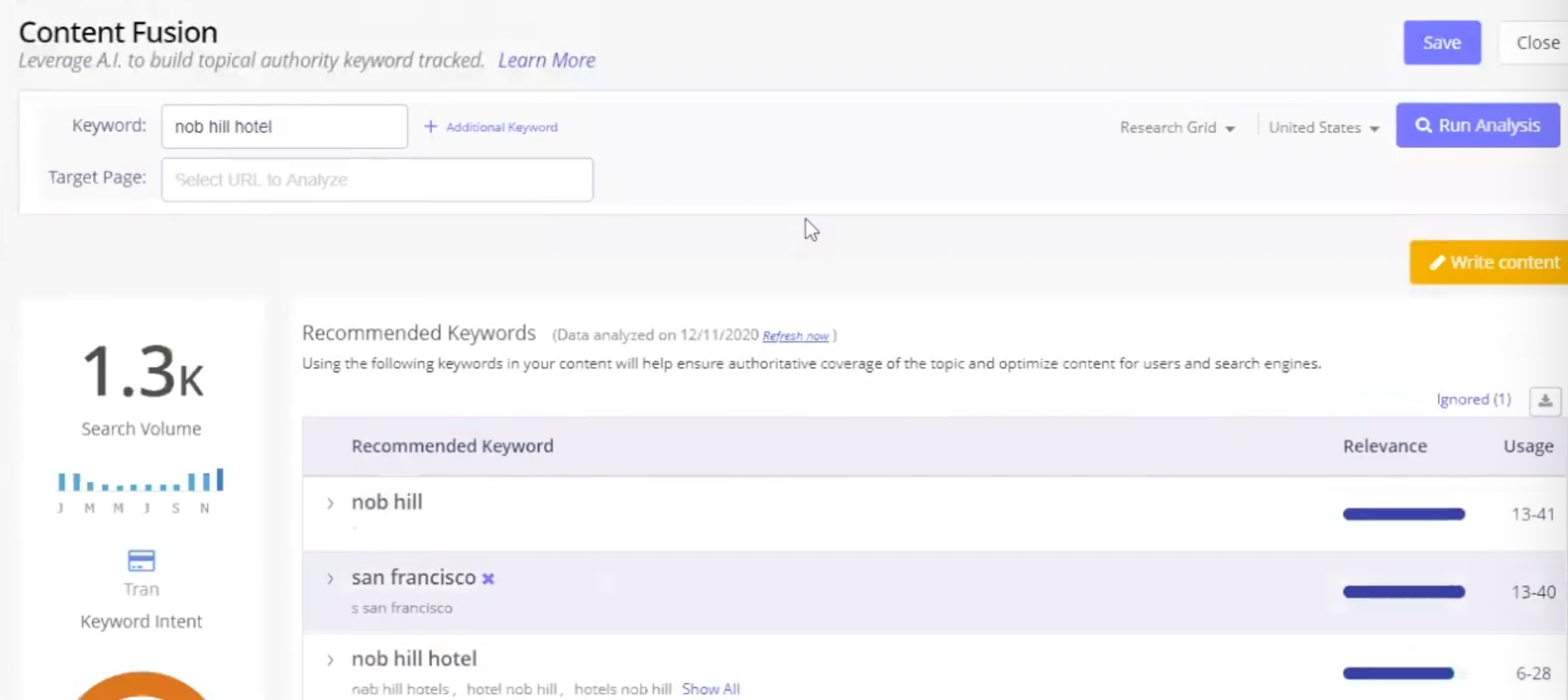
seoClarity connects content recommendations with keyword, competitor, and page-performance data. Its main content tools include Content Fusion, AI Content Writer, and SEO Content Briefs.
- Analyze and optimize new or existing content with Content Fusion
- Generate articles, landing pages, product descriptions, and other formats
- Create content briefs with recommended topics, keywords, and structure
- Measure content relevance using content scores
- Find missing topics through Content Gaps and Content Ideas
- Identify opportunities to appear in featured snippets and answer boxes
The workflow suits SEO-led content teams that want detailed optimization data inside the same platform used for research and reporting.
Technical SEO
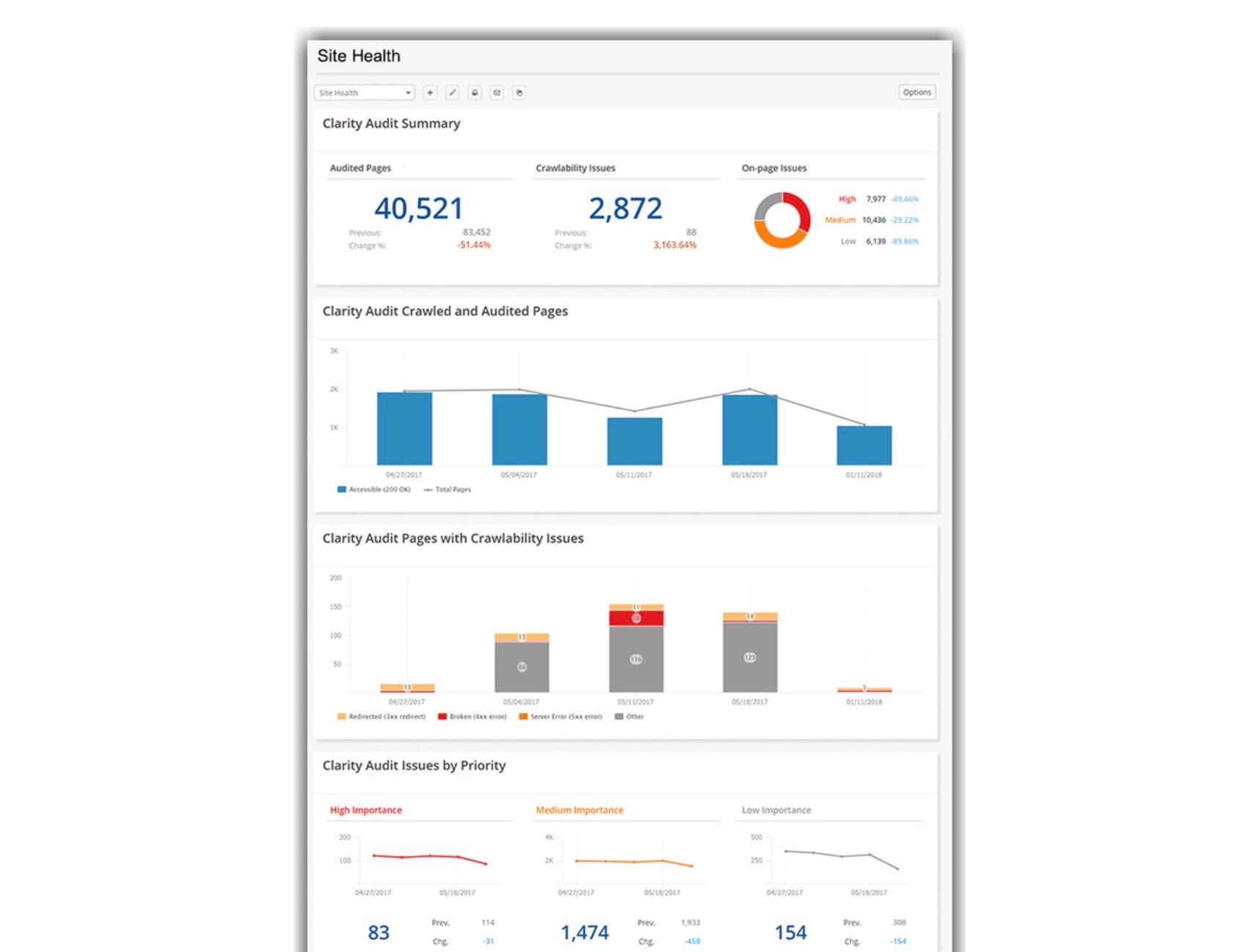
seoClarity’s technical SEO capabilities are designed for crawling and analyzing large, complex websites.
- Configurable site audits and enterprise-scale crawling
- Crawlability, indexation, page-speed, and error monitoring
- SEO Segmentation for analyzing groups of related pages
- Internal-link, orphaned-page, and broken-link analysis
- Log-file analysis for verified search-engine bot activity
- Combined crawl, ranking, traffic, and conversion data at the URL level
This helps technical teams move from finding an issue to understanding which pages and business areas are most affected.
Keyword and competitor research
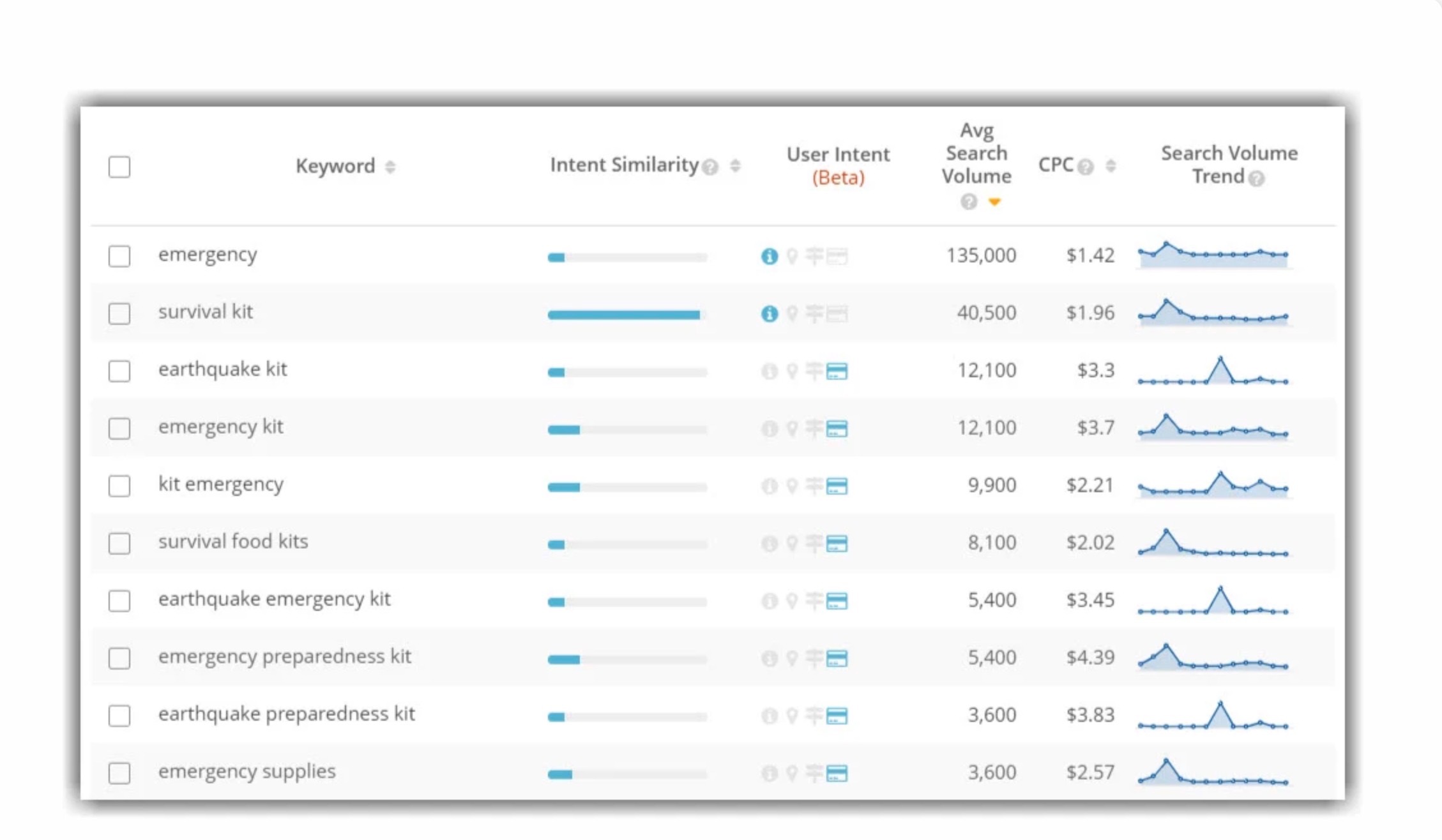
Research Grid and Topic Research help teams evaluate organic search demand, competitor performance, and content opportunities at scale.
- Discover keyword insights, topics, entities, and search-intent patterns
- Analyze competitor rankings across domains and page groups
- Find content, keyword, backlink, and internal-link gaps
- Prioritize opportunities using Keyword Difficulty
- Explore demand changes through Google Trends data
- Identify People Also Ask and Answer Box opportunities
Research Grid is particularly useful for large-scale competitive analysis because teams can evaluate domains, pages, keywords, and markets from one dataset.
Analytics and actionable insights
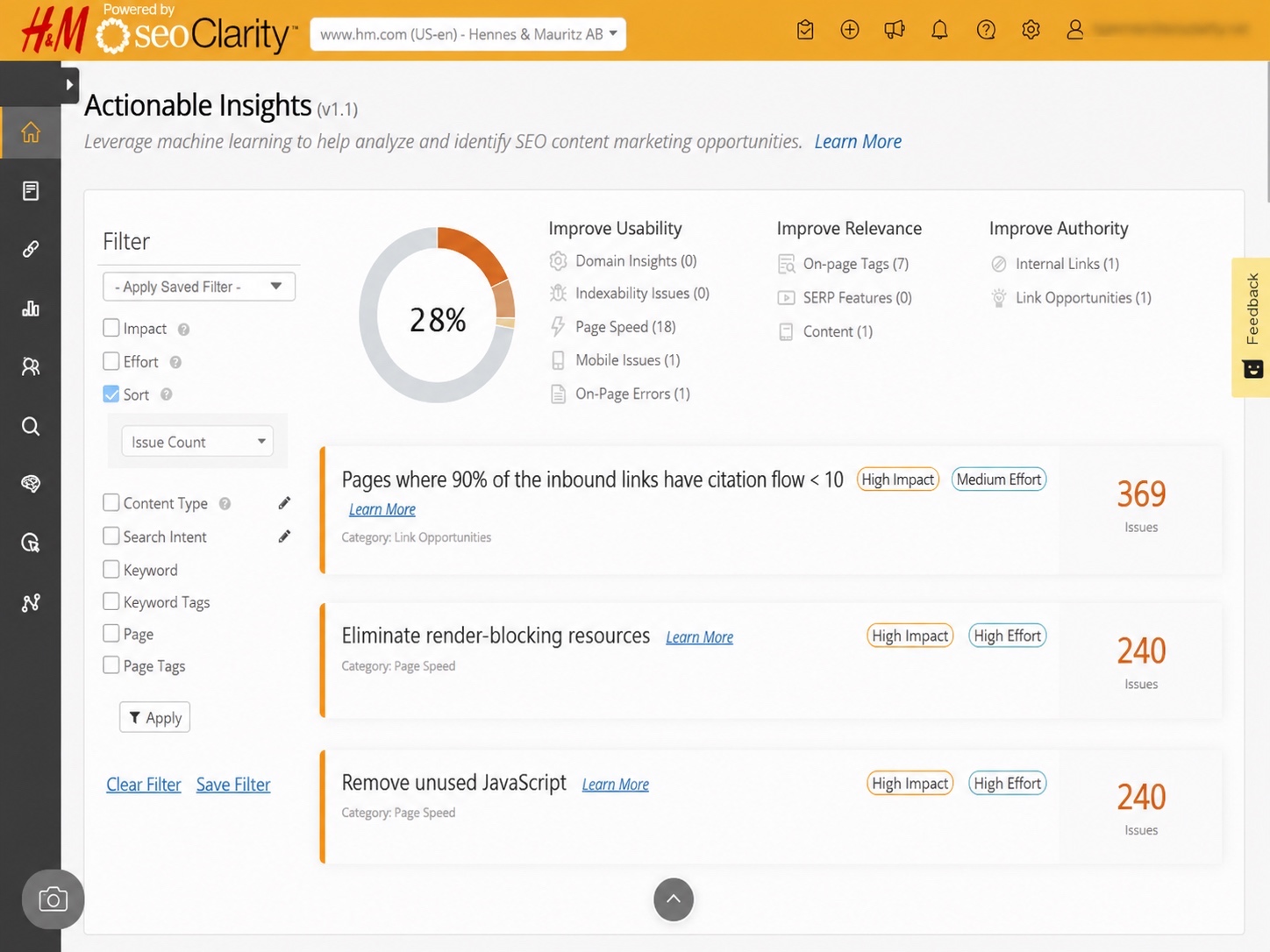
seoClarity connects rankings with traffic, conversions, and business outcomes through customizable reporting.
- Custom dashboards for markets, categories, teams, and executives
- Actionable Insights that automatically surface anomalies and opportunities
- SEO Forecasting for estimating the impact of potential ranking gains
- Site Analytics for page-level and segment-level performance analysis
- PPC and SEO integration for combined paid and organic traffic reporting
- Automated alerts and scheduled reports for cross-functional teams
The forecasting and segmentation capabilities help teams build business cases and prioritize SEO projects across departments.
2. ClarityAutomate
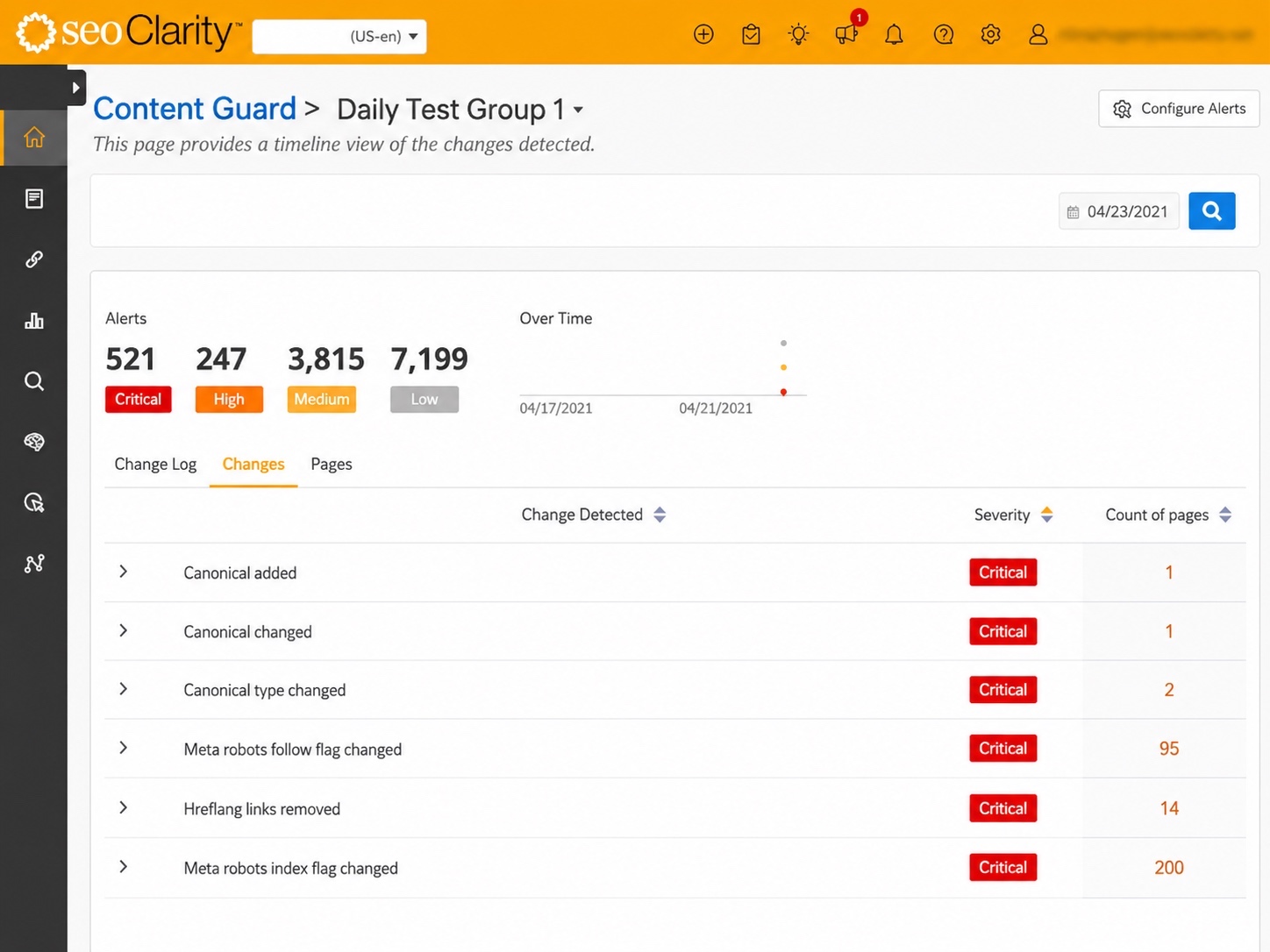
ClarityAutomate is seoClarity’s execution layer. It allows SEO teams to test and deploy selected technical, on-page, schema, and internal-linking changes without sending every update through a development backlog.
- Page Optimizer: Deploys on-page, indexation, hreflang, and technical changes.
- SEO Split Tester: Creates test and control groups, publishes changes, and measures their impact.
- Schema Optimizer: Builds, validates, implements, and maintains structured data at scale.
- Link Seeker: Identifies, creates, and publishes relevant internal links.
- Bot Optimizer: Improves how site content is exposed and delivered to AI search bots.
- ClarityAutomate Playbook: Provides workflows for common technical and on-page SEO problems.
ClarityAutomate is a strong differentiator for enterprises where implementation delays regularly slow SEO progress. However, it requires initial deployment, testing, and governance before teams can safely make large-scale changes.
3. Clarity ArcAI
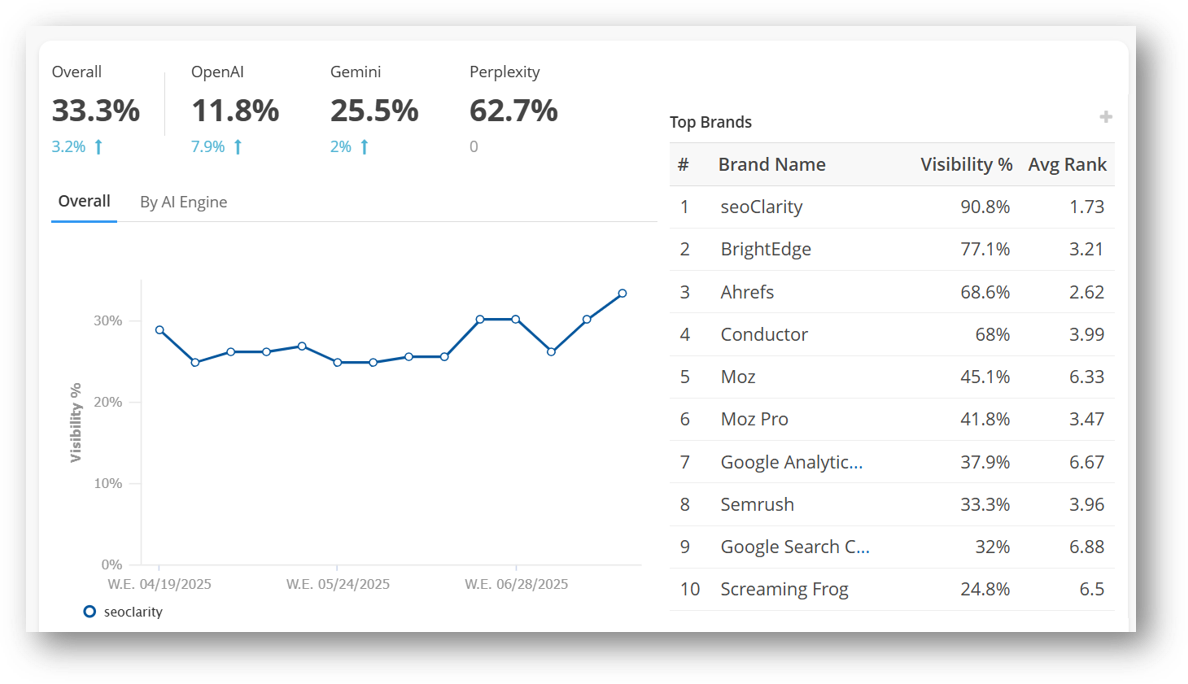
Clarity ArcAI is seoClarity’s AEO and GEO platform. ArcAI 3.0 extends the product beyond AI visibility tracking into prompt research, content optimization, performance measurement, and agent-assisted execution.
- AI visibility tracking: Monitors brand mentions, citations, sources, competitors, and visibility across major AI search engines.
- Prompt Researcher: Identifies prompts and questions based on audience demand instead of relying entirely on manually created prompt lists.
- Reveal Insights: Converts visibility data into prioritized recommendations and tasks.
- Sentiment analysis: Evaluates how AI engines describe and position a brand.
- ArcAI Accuracy: Detects false, outdated, or misleading claims in AI-generated answers.
- Content Optimizer: Compares pages with target prompts and recommends changes that could improve retrieval and citations.
- Custom Content Agents: Automates selected research and content tasks while keeping human reviewers involved.
- Performance reporting: Connects AI visibility with traffic, conversions, markets, categories, and business units.
- AI bot activity: Shows whether major AI crawlers can access important pages.
- ArcAI Indexer: Helps generative AI systems discover new and updated pages sooner.
- ArcAI Pulse: Tracks brand, competitor, and topic mentions across news sites, forums, blogs, and the wider web.
- ArcAI Shopping: Monitors SKU-level product visibility, citations, sellers, and competitive placement in AI shopping results.
ArcAI’s strongest fit is with enterprise teams that need granular monitoring, brand governance, and AI-search reporting across multiple markets or product lines.
4. LiveWire and Data Services
LiveWire is seoClarity’s data-connectivity layer. It makes the platform’s SEO and AEO intelligence available inside LLMs, spreadsheets, dashboards, and internal systems.
- Connects seoClarity data with ChatGPT, Claude, and internal AI tools through MCP
- Provides plugins for Google Sheets, Microsoft Excel, and Looker Studio
- Supports plain-language analysis of rankings, citations, competitors, and content gaps
- Validates calculations on seoClarity’s infrastructure before sending results to an LLM
- Supplies APIs for BI platforms, custom dashboards, agents, and internal workflows
- Includes Domain Research, Ranking Data, Keyword Research, and Content Analysis APIs
LiveWire is particularly useful for enterprises that want teams to access seoClarity intelligence without requiring every stakeholder to work inside the platform.
Taken together, seoClarity covers the path from SEO and AI-search analysis to content optimization, technical implementation, and enterprise reporting. Its breadth is a major advantage for mature search teams, but smaller organizations may not use enough of the platform to justify its complexity and cost.
seoClarity review: What are actual users saying about seoClarity?
seoClarity is rated 4.5 out of 5 from 213 users on G2. Users consistently praise seoClarity’s support, often highlighting responsiveness and hands-on guidance while learning the platform. Reviews also point to strong keyword research and reliable data accuracy, with many describing the toolset as comprehensive for deeper AI SEO analysis and reporting.
At the same time, platform complexity and the associated learning curve seems to be a real problem most users face.
“The tool can feel overwhelming at first for non-SEO professionals or users without training. There’s so much functionality that it takes some time to learn everything. However, the team is always available to help with onboarding and training, which makes the learning curve much easier to manage.”, says Marlene C, SEO Manager on G2.
Several users mention a complex interface and occasional data overload, which can feel overwhelming early on. Pricing is also a common concern, especially for teams that may not need the full scope of enterprise-level functionality.
How much does seoClarity cost, and is there a free trial?
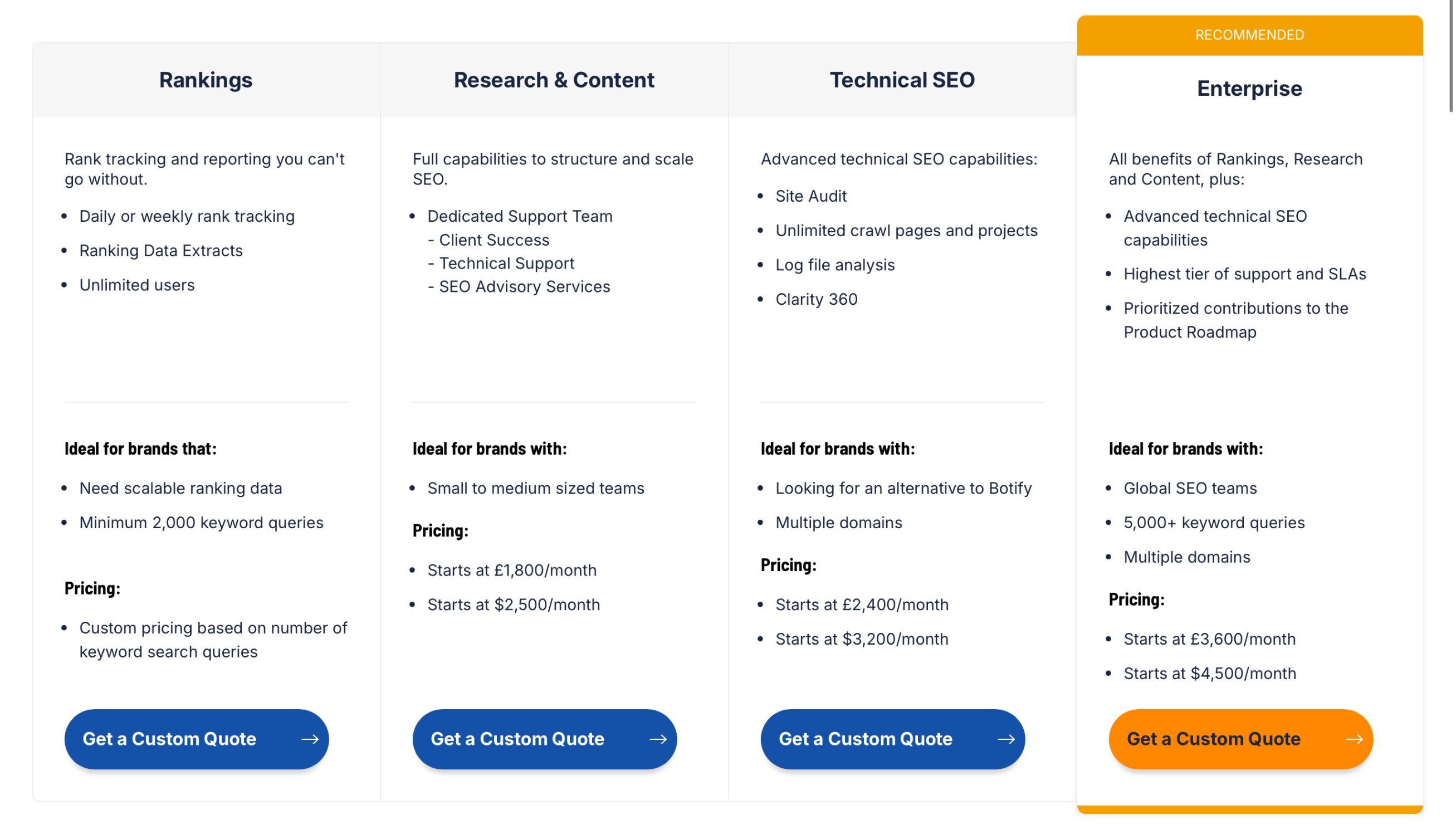
seoClarity offers 4 customizable packages. Final seoClarity pricing depends on the number of domains, tracked keywords, tracking frequency, add-ons, and services required.
- Rankings: Custom pricing. Includes daily or weekly rank tracking, data extracts, unlimited users, and a minimum of 2,000 keyword queries.
- Research and Content: From $2,500/month. Covers keyword research, content optimization, and dedicated client, technical, and SEO advisory support.
- Technical SEO: From $3,200/month. Includes site audits, unlimited crawl pages and projects, log-file analysis, and Clarity 360.
- Enterprise: From $4,500/month. Combines rankings, research, content, and advanced technical SEO with the highest support tier and SLAs.
ClarityAutomate, Clarity ArcAI, on-page change monitoring, and additional SEO services are optional add-ons with custom pricing.
seoClarity does not offer a full free plan. However, teams can request a free customized trial after a demo, with guided training and their own domain data.
It is clear that seoClarity is built for enterprise teams. The cost of seoClarity is reasonable for enterprises that can replace multiple SEO, AEO, and technical tools with one platform. However, the high entry cost and quote-based add-ons make seoClarity less practical for smaller teams seeking affordable, predictable pricing.
Not ready to spend $2,500 per month? Compare the 11 best GEO tools under $100/month for 2026 for more affordable alternatives.
Who is seoClarity best suited for?
seoClarity is best for organizations with complex websites, mature SEO programs, and content marketing teams that can use its depth. A small in-house SEO team may still be a good fit if it manages a large site and has an enterprise-level budget.
Who is seoClarity best for?
- Enterprise brands managing complex websites across multiple domains, subdomains, markets, or thousands of keyword queries.
- Global SEO teams needing granular reporting by country, device, page group, and SERP feature.
- Organizations with dedicated SEO, content, and technical teams that need shared dashboards and structured workflows.
- Teams executing technical SEO at scale through technical audits, log-file analysis, internal-link insights, and ClarityAutomate.
- Brands combining SEO with AI visibility tracking through Clarity ArcAI.
- Agencies managing enterprise clients that require scalable reporting, data exports, and stakeholder access.
Who should consider a seoClarity alternative?
- Solo marketers and smaller businesses that need affordable, self-service SEO software.
- Teams managing modest websites or keyword sets that would not use seoClarity’s enterprise-scale capabilities.
- Content teams needing a lightweight writing tool rather than a broader SEO platform.
- Organizations without dedicated SEO ownership to configure the platform and act on its insights.
- Teams wanting fixed pricing and instant signup with minimal onboarding.
- Marketers needing only rank tracking or AI visibility monitoring rather than a complete SEO operating system.
When is a GEO tool like Scalenut a better alternative to seoClarity?
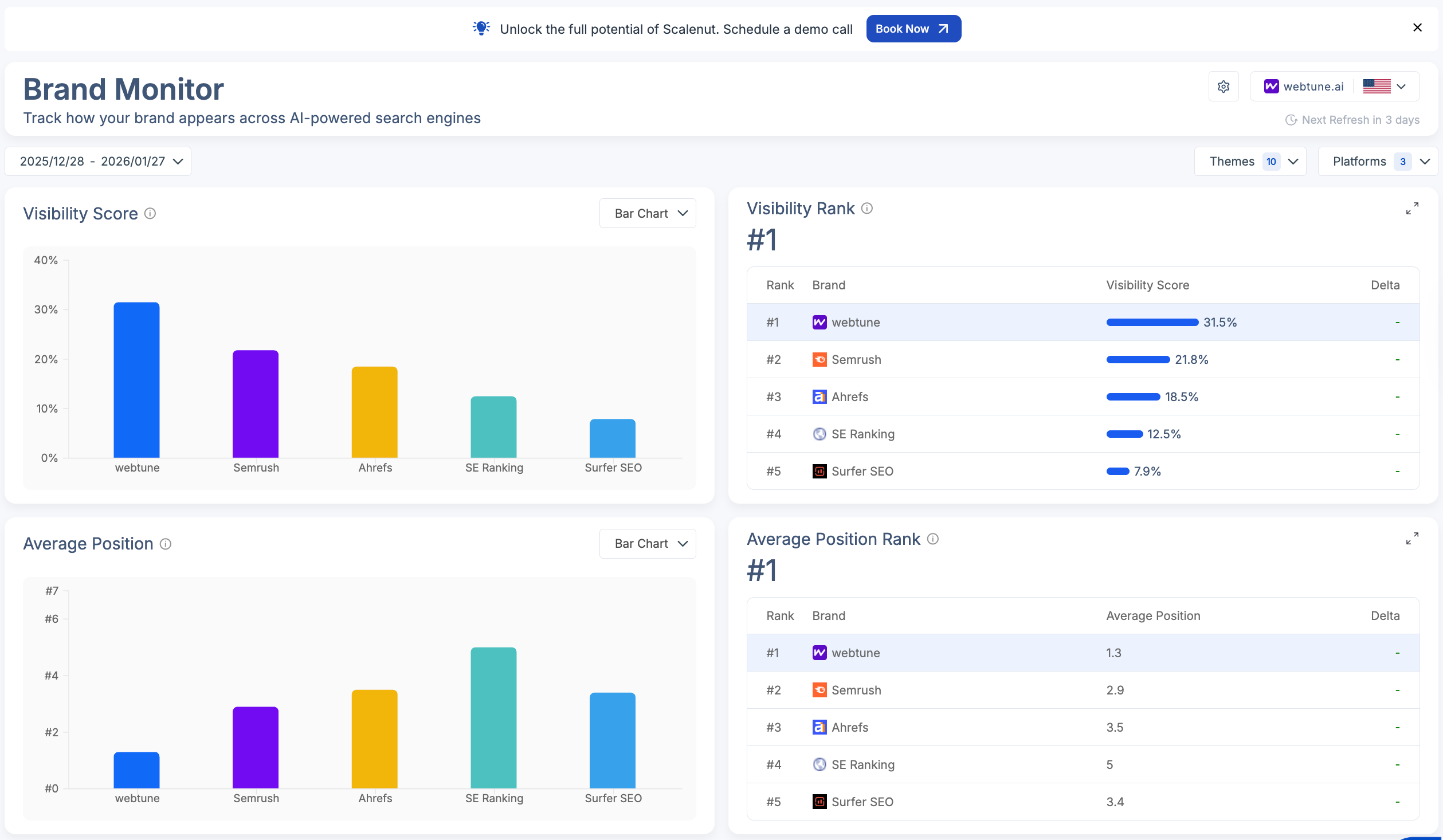
seoClarity is built for mature enterprise SEO programs that need large-scale tracking, technical analysis, custom integrations, and extensive reporting. However, that level of depth may be more than lean SEO and content teams need.
Scalenut offers a more accessible alternative by connecting AI visibility insights with the workflows used to create, optimize, and improve content. Teams can identify prompt, citation, competitor, sentiment, and traffic gaps, then move directly into content planning or optimization without adding separate SEO tools.
Scalenut may be a better fit if:
- You want visibility insights connected to action: Prompt and citation gaps can feed into article creation, content optimization, audits, internal linking, and authority-building workflows.
- You need a simpler rollout: Scalenut’s guided workflow is easier to adopt for content and SEO teams that do not have the resources to configure and maintain an enterprise platform.
- You manage SEO and GEO together: Scalenut combines keyword planning, content creation, optimization, AI visibility tracking, and AI traffic monitoring within the same platform.
- You need a more affordable entry point: With plans starting at just $24 per month when billed annually, Scalenut is a more affordable option for small businesses and solo marketers. It also offers a 7-day free trial.
Where does seoClarity remain stronger?
seoClarity remains the stronger option for enterprises that need advanced rank tracking, multi-market segmentation, log-file analysis, large-scale technical auditing, APIs, BI integrations, and highly customizable reporting. Teams with complex external reporting or data warehouse requirements may find seoClarity better suited to their infrastructure.
So, which platform is best for you?
seoClarity is the best option when enterprise SEO depth, technical control, and data infrastructure are your priorities. But if you prefer a more affordable and execution-focused workflow that connects SEO and GEO insights with content action, Scalenut is one of the best alternatives to seoClarity.
Start a free 7-day Scalenut trial to explore its AI visibility and content execution workflow.
Frequently Asked Questions
Conductor vs seoClarity: Which platform offers better reporting tools?
Both platforms offer strong reporting, but they serve different needs. seoClarity supports deep segmentation and customizable dashboards that help teams connect visibility changes to SEO results and keyword tracking trends. Conductor focuses on stakeholder-ready reporting and sharing workflows. Scalenut adds GEO reporting.
What are the main feature differences between Conductor and seoClarity?
seoClarity emphasizes enterprise analytics, automation, and AI search tracking through ArcAI, while Conductor emphasizes cross-team workflows, data integrations, and content-focused insights tied to user intent. Both support content optimization workflows, but Scalenut is more GEO-first for AI visibility execution.
Which is better for enterprise SEO management: Conductor or seoClarity?
For large organizations, both can work well. seoClarity is often positioned as an enterprise SEO solution with advanced data segmentation and SEO automation features, while Conductor emphasizes operational SEO workflows and collaboration. If teams also need hands-on professional services, Scalenut can complement execution.
seoClarity vs Brightedge: Which is better?
BrightEdge is known for executive reporting and enterprise keyword and content insights, while seoClarity emphasizes unified data, segmentation, and AI search visibility features. When comparing seoclarity compared to brightedge, the better fit depends on SEO strategy goals. Scalenut is stronger for GEO workflows.
Which is the best seoClarity alternative?
The best alternative depends on priorities and team structure. For teams that want faster execution and simpler workflows, Scalenut is a strong choice, especially when SEO efforts focus on publishing velocity and improving content quality. Conductor and BrightEdge are common enterprise alternatives.
seoClarity vs Accuranker: What is best for AI visibility in 2026?
seoClarity ArcAI is designed for AI search visibility tracking and monitoring, while AccuRanker is primarily a rank tracker with add-ons for LLM tracking. For teams focused on improving online presence through AI search optimization and content performance actions, Scalenut is typically more workflow-driven.
What are the best seoClarity alternatives?
The best seoClarity alternatives depend on your team’s priorities. Scalenut suits lean content and SEO teams that want AI visibility insights connected to content planning and SEO optimization. Semrush and Ahrefs are strong options for broad SEO research, while Conductor, BrightEdge, and Botify are closer enterprise alternatives for complex websites, technical SEO, and reporting.
Can seoClarity track AI Overviews?
Yes. seoClarity tracks which keywords trigger Google AI Overviews, whether your brand or competitors are mentioned or cited, and which pages receive links. It can also monitor visibility changes and connect AI Overview performance with rankings, traffic, and CTR at the keyword and URL levels.
How much does seoClarity cost?
seoClarity’s Research and Content package starts at $2,500 per month, Technical SEO starts at $3,200 per month, and Enterprise starts at $4,500 per month. Rank-tracking packages use custom pricing. Final costs depend on the number of domains, tracking frequency, services, add-ons, and keyword rankings monitored.
Does seoClarity offer a free trial?
Yes. seoClarity offers a complimentary customized trial after teams complete a product demo. Training is included so organizations can evaluate how the platform handles their SEO data and supports broader digital marketing workflows. However, the trial follows a sales-assisted process rather than an instant signup.
What is Clarity ArcAI?
Clarity ArcAI is seoClarity’s AI search optimization layer. It tracks brand mentions, citations, prompts, competitors, sentiment, content accuracy, AI crawler activity, and performance. It helps teams understand how AI visibility relates to search rankings and identify opportunities for building authority across AI-generated search experiences.
Is seoClarity suitable for small businesses?
seoClarity can support a smaller team managing a large or technically complex website, but it is primarily designed for enterprise SEO programs. Its pricing, configuration requirements, and learning curve may be difficult to justify for businesses that only need local SEO and local search reporting, basic search volume research, or straightforward rank tracking.
What can seoClarity automate with ClarityAutomate?
ClarityAutomate helps teams implement SEO changes in real time with less dependence on developers. It supports metadata updates, canonicals, indexation directives, hreflang, schema, internal links, content additions, and SEO split testing. Large-scale updates should still follow appropriate testing, approval, and governance processes.


.svg)


.webp)