
.jpg)
What Are The Best AI Tools For Content Creation In 2026?

Key Highlights
- AI tools are transforming content creation by streamlining workflows and making content scaling easier for marketing teams.
- The best AI tools offer features for various use cases, from generative AI for a blog post to video generation and image generation.
- Look for AI features like SEO tools, brand kit integration, and ease of use to ensure the tool fits your content strategy.
- AI can significantly speed up the writing process, helping content writers overcome the blank page and generate content ideas quickly.
- To create quality content, always combine AI-generated drafts with human creativity and editing for brand voice and accuracy.
- Many platforms offer a free plan or free trial, allowing you to test their capabilities for tasks like social media posts and video editing.
The world of artificial intelligence has grown rapidly, and one area where it's making a huge impact is content creation. For digital marketers and content creators, AI tools are a game-changer for streamlining workflows and sparking new ideas. More than 75% of marketers already use AI in some capacity. If you're looking to work smarter and stay competitive, embracing generative AI for content generation is no longer an option; it's a necessity. This guide will help you discover the best AI tools for content creation in 2026.
1. Scalenut

Scalenut is one of the best AI tools for content creation because it supports much more than draft generation. It helps marketers move from topic planning to writing, optimization, and content improvement in one workflow, making it easier to create content that is both faster to produce and stronger in search performance. For teams that want an AI tool tied closely to real content outcomes, Scalenut offers a more complete approach than standalone writing assistants.
What makes Scalenut especially useful is the way it blends AI writing with structured SEO execution. You can plan content around keyword intent, create drafts with guided workflows, optimize pages for stronger relevance, and identify existing content that needs updates. This makes it a strong choice for content marketers, SEO teams, agencies, and brands that want content creation backed by strategy instead of just automation.
Key Features
- Cruise Mode for guided outlining and draft creation using SERP-informed insights
- Content Optimizer to improve on-page relevance and strengthen SEO performance
- AI Humanizer to make AI-written content sound more natural and reader-friendly
- Content Scoring to evaluate structure, intent match, coverage, and keyword usage
- Keyword Planner for clustering keywords and building stronger content plans
- Competitor Coverage Analysis to see how competing pages structure and cover topics
- Traffic Analyzer to uncover strong performers and content growth opportunities
- Content Audit to identify pages that need refreshing, consolidation, or deeper optimization
- Link Manager to improve internal linking and strengthen content structure
- On-Page Pro to refine titles and meta descriptions based on SERP patterns
Beyond content execution, Scalenut also adds GEO and AI visibility capabilities, helping brands understand how they appear across AI-driven platforms and where they can strengthen authority over time.
Book a demo to see how Scalenut can help your team plan, create, optimize, and scale content with more confidence.
2. Jasper
Jasper is a strong AI content creation tool for marketing teams that need on-brand content across blogs, campaigns, email, social media, and web copy. It is built for teams that want to scale content production while keeping messaging consistent across channels.
Key Features
- Brand Voice to keep content aligned with your tone, style, and guidelines
- Marketing-focused AI workflows for campaign and content execution
- Support for multiple content formats across blogs, ads, emails, and social media
- Shared workspace features for collaboration and review workflows
- Brand controls and knowledge support for more consistent outputs
3. Copy.ai
Copy.ai is a useful option for teams that want fast content creation tied to broader marketing workflows. It goes beyond basic writing support by offering workflow automation, brand voice features, and tools that help teams create repeatable content processes.
Key Features
- AI workflows to automate repeatable content and marketing tasks
- Brand Voice for more consistent messaging
- AI chat, actions, and agents for structured content workflows
- Templates for different content types including blogs and marketing copy
- Support for cross-functional teams across marketing, sales, and operations
4. Writesonic
Writesonic is a good fit for teams that want AI-assisted article writing, SEO content creation, and content refresh support in one platform. It is designed for marketers who want faster content production with built-in tools for optimization and performance.
Key Features
- AI Article Writer for long-form content creation
- Content creation workflows for blogs, website copy, and marketing assets
- Built-in SEO support for optimization and content improvement
- Multiple AI writing tools for different formats and use cases
- Brand voice controls for more consistent content output
5. ChatGPT
ChatGPT is a flexible AI content creation tool for brainstorming, outlining, drafting, rewriting, and repurposing content across many formats. It works well for individuals and teams that want a general-purpose assistant for idea generation, first drafts, editing support, and research-backed writing workflows.
Key Features
- Idea generation and outlining for blogs, emails, scripts, and other content formats
- Drafting and rewriting support for faster content creation and refinement
- Web search support for timely answers and source-backed research workflows
- Data analysis capabilities for working with spreadsheets, CSVs, and structured content inputs
- Voice and multimodal interaction for more flexible content workflows
6. Surfer SEO
Surfer SEO is a strong option for teams focused on SEO-driven content creation and on-page optimization. Its platform is built around researching, writing, auditing, and optimizing content, with tools designed to help teams improve search performance while producing content more efficiently.
Key Features
- Content Editor for writing and optimizing content with guided recommendations
- Content Score to measure optimization quality and improvement opportunities
- Outline and term optimization tools to shape drafts around SEO priorities
- Audit and optimization workflows for improving existing pages
- Auto-Optimize and Humanizer features for faster refinement of content drafts
7. Frase
Frase is a content creation and optimization platform that combines research, AI writing, SEO, and GEO support in one workflow. It is useful for teams that want both content production and performance support from the same platform.
Key Features
- AI Agent for research, writing, and optimization
- SEO and GEO optimization in a combined workflow
- AI article writing for faster draft creation
- AI visibility tracking across Google and AI platforms
- Content opportunities and site audits to identify pages that need action
8. Rytr
Rytr is a simpler, budget-friendly AI writing assistant for users who want quick content generation without a complex workflow setup. It is a practical option for individuals, marketers, and small teams that need lightweight writing support.
Key Features
- Quick AI content generation for common writing tasks and formats
- Tone matching for more consistent outputs
- Plagiarism checks for cleaner content review
- Chrome extension for writing across websites and tools
- Multiple tones and language support for flexible content creation
9. Semrush Content Toolkit
Semrush Content Toolkit is a strong choice for teams that want AI content creation backed by SEO data. It combines topic research, content generation, optimization, rewriting, and publishing support in one workflow, making it useful for marketers who want content that is easier to create and better aligned with search performance.
Key Features
- Topic Finder for discovering content ideas backed by search data
- SEO Brief Generator for building outlines with keywords and competitor insights
- AI writing tools for drafting and rewriting content inside the editor
- Content Optimizer for improving SEO, tone, and readability
- Google Docs and WordPress support for smoother publishing workflows
10. Anyword
Anyword is a strong fit for marketers who want AI content creation tied to performance and brand consistency. It is built for creating blog content, ads, landing pages, emails, and social copy while helping teams apply brand voice rules and predict how content may perform before publishing.
Key Features
- AI writing for multiple content types including blogs, ads, emails, and landing pages
- Performance prediction to help choose stronger copy variations
- Brand Voice for more consistent messaging across outputs
- Content improver tools for refining drafts and boosting performance potential
- Marketing-focused workflows for faster campaign and content execution
Why Are AI Tools Important In Modern Content Creation?
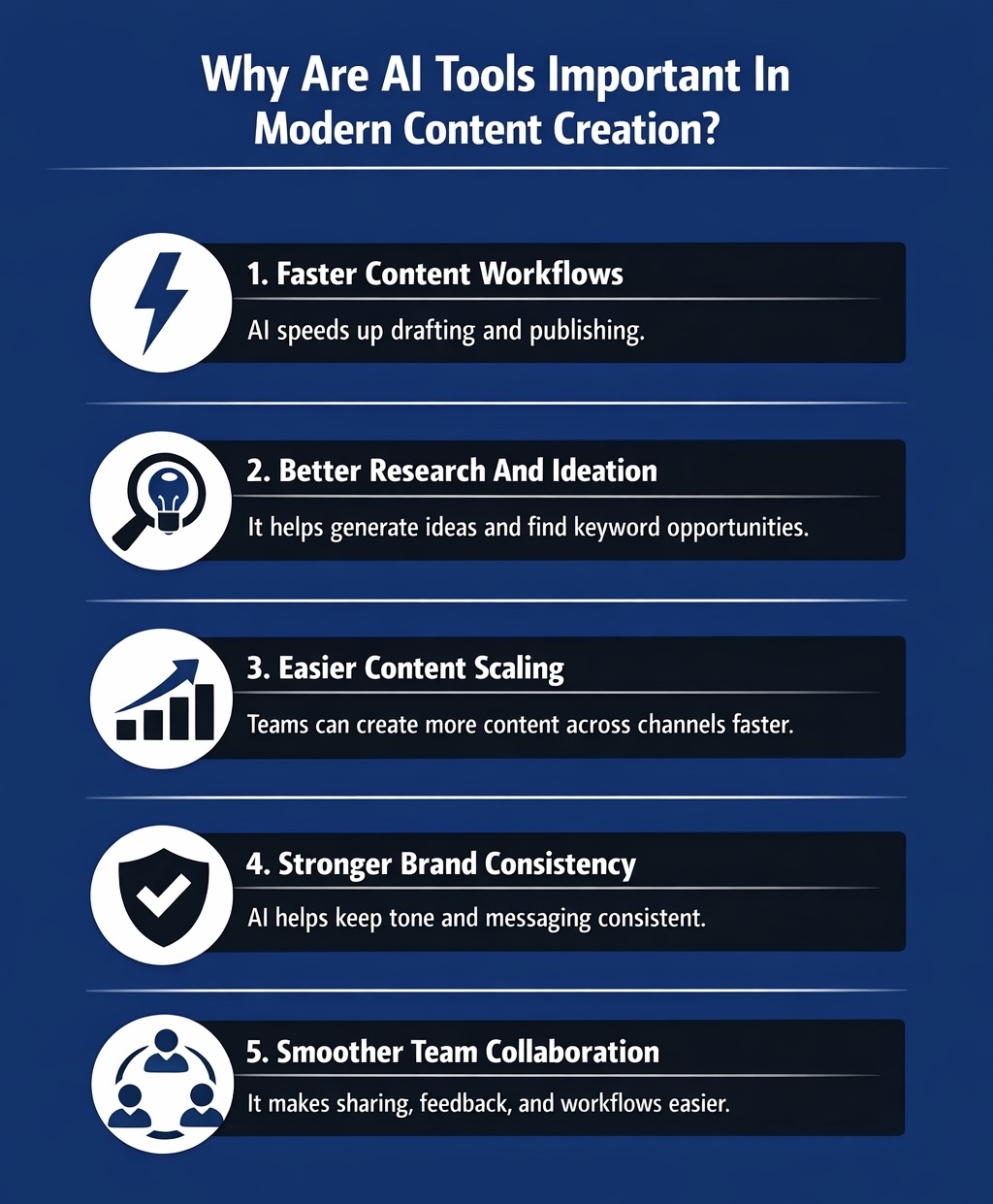
Are you unsure about using an AI assistant for content creation? Generative AI tools can transform marketing by speeding up writing and enhancing visual content. They boost efficiency by automating repetitive tasks, letting you focus on strategy and brand voice. This means you can produce high-quality content faster and more consistently.
Let's explore some of the specific advantages these tools bring.
1. Faster Content Workflows
Are you looking to get your content online more quickly? The traditional writing process can be time-consuming. A typical 500-word blog post can take around four hours to complete, and that doesn't even include creating a brief, proofreading, or handling revisions.
AI content writing tools can help you streamline workflows significantly. Instead of starting from scratch, a content writer can use an AI tool to generate a first draft in minutes. This drastically cuts down the initial content creation process, freeing up valuable time that can be reallocated to other important tasks like editing and strategy.
By automating the initial drafting phase, your team can move from idea to publication much faster. This increased speed allows you to be more agile and responsive to market trends, giving you a competitive edge and boosting overall productivity without sacrificing the final quality of your work.
2. Better Research And Ideation
Staring at a blank page can be a major hurdle for any creator. AI tools are excellent for overcoming this creative block by providing a steady stream of content ideas. Whether you need blog topics, social media post concepts, or compelling calls-to-action, an AI writing assistant can generate suggestions in seconds.
Beyond just brainstorming, these tools also enhance the research phase of content generation. Many platforms come with built-in AI features for keyword research. You can analyze search trends, find competitive keywords, and identify opportunities to make your content more discoverable by your target audience.
This combination of creative ideation and data-driven research empowers you to develop content that is not only fresh and engaging but also optimized for search performance. It streamlines the entire planning stage, ensuring your efforts are targeted and effective from the very beginning.
3. Easier Content Scaling
If your goal is to create and distribute content at a large scale, the investment in time and money can be significant. This is where AI tools truly shine, offering a streamlined approach to content scaling that manual processes simply can't match.
For marketing teams and content teams, an AI writing assistant can automate the creation of various content types. Instead of having a single content writer spend days on one long-form article, you can generate multiple pieces of content for different channels simultaneously. This allows you to expand your reach without overwhelming your internal resources.
With the help of AI, you can quickly produce:
- Product descriptions for your e-commerce platform.
- Engaging social media posts for different channels.
- Initial drafts for a series of blog articles. This ability to produce generated content quickly enables marketing teams to maintain a consistent online presence and meet growing demands effortlessly.
4. Stronger Brand Consistency
Maintaining brand consistency across all your content is crucial for building trust and recognition. However, ensuring every piece of content aligns with your brand voice can be challenging, especially when working with a large team or multiple freelancers.
AI tools are becoming increasingly effective at helping with this. Many platforms offer AI features that allow you to establish and enforce your brand voice. You can set specific tones, styles, and phrasing preferences to guide the AI assistant. Some advanced tools even offer a brand kit where you can upload style guides and key messaging.
While AI-generated content still needs a human touch to perfect the tone, these features provide a solid foundation. By using an AI assistant to produce content that is already aligned with your guidelines, you save significant editing time and ensure a more cohesive brand presence across all your marketing channels.
5. Smoother Team Collaboration
Effective collaboration is key for any successful content or marketing team. AI tools are increasingly designed with team-based workflows in mind, offering AI features that facilitate smoother communication and project management, much like familiar tools such as Google Docs.
An AI writing assistant can act as a central hub for content projects. Team members can work from the same briefs, share generated drafts, and provide feedback within the platform. This centralized approach reduces back-and-forth communication and ensures everyone is on the same page.
Here are a few ways AI enhances collaboration:
- Knowledge Sharing: Some tools have features that let marketing teams share insights and successful prompts.
- Workflow Integration: Many platforms integrate with other tools your team already uses, creating a seamless process.
- Asset Management: Teams can create and share visual content and text within a single, unified space. This makes the entire content creation cycle more efficient and cohesive for everyone involved.
What Features Should I Look For In An AI Content Creation Tool?
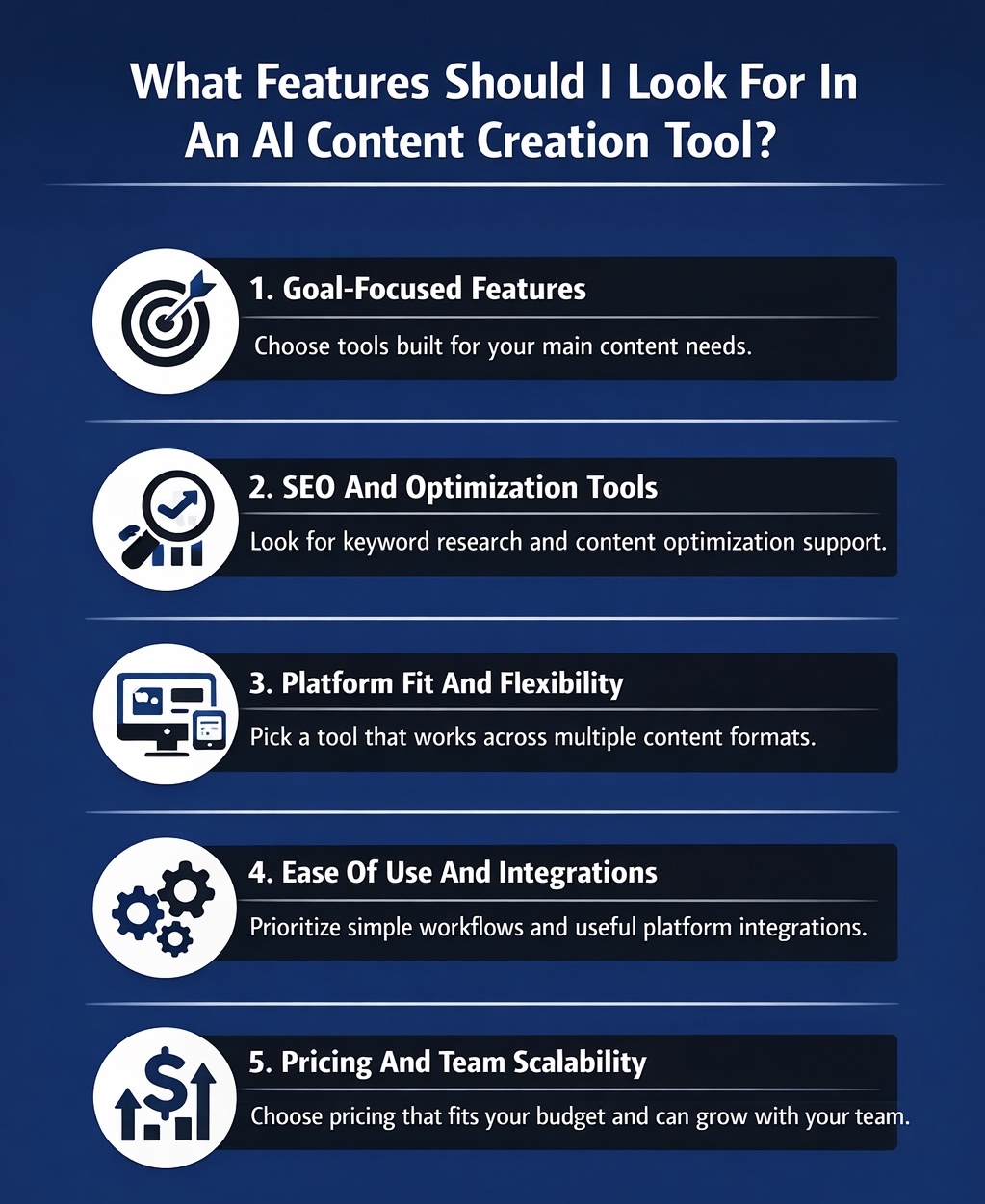
With numerous AI powered content creation platforms available, choosing the right one can be overwhelming. Focus on practical features that support your content marketing goals. Decide if you need long-form content generation with a consistent brand voice or a versatile AI for various content types. The ideal writing assistant should match your specific needs.
Let's look at the key features to prioritize.
1. Goal-Focused Features
The most effective AI tool is one that directly addresses your primary content bottlenecks. Before you choose, clearly define what you want to achieve. Are you trying to produce blog posts faster, create engaging social media content, or draft compelling ad copy? Different tools excel at different use cases.
A content writer focused on long-form articles will need a tool with robust drafting and outlining capabilities. In contrast, a social media manager will benefit more from AI features that generate short, punchy text and suggest relevant hashtags. Look for platforms that offer specialized templates or workflows for your specific needs.
To ensure a tool aligns with your goals, check for features like:
- Customizable templates for different content types.
- Brand voice controls to maintain consistency.
- Workflows designed for specific use cases, such as creating product descriptions or email campaigns. Choosing a tool with goal-focused features ensures you get the most value and impact.
2. SEO And Optimization Tools
Creating great content is only half the battle; it also needs to be discoverable. That's why built-in SEO tools are a critical feature in any modern AI content generation platform. The right tool can help you with search engine optimization from the very beginning of your content marketing process.
Look for platforms that offer comprehensive keyword research capabilities. These SEO tools should allow you to identify relevant keywords, analyze their competitiveness, and see search trends. Some advanced tools even provide optimization suggestions directly within their content editors, giving you real-time feedback on how to improve your on-page SEO. Effective SEO features streamline the optimization process, making it accessible even if you're not an expert.
3. Platform Fit And Flexibility
The best generative AI tool is one that fits your diverse content needs. Your content strategy likely involves more than just a single blog post. You need a platform flexible enough to handle various formats, from written articles to visual assets for social media.
When evaluating a tool, consider the full scope of your content generation requirements. Do you need to create social media content, long-form articles, video content, or all of the above? Some AI platforms specialize in text, while others are all-in-one solutions that include image and video creation.
Choosing a flexible tool saves you from having to subscribe to and learn multiple different platforms. A versatile AI tool allows you to maintain consistency across channels, whether you're drafting a blog post, designing a graphic for Instagram, or creating a short promotional video. This adaptability ensures the tool can grow with your content strategy.
4. Ease Of Use And Integrations
A powerful AI assistant is useless if it's too complicated to use. The ideal tool should have an intuitive interface that allows your team to get started quickly without a steep learning curve. Look for platforms with user-friendly dashboards and clear instructions that make content creation straightforward.
Integration with your existing workflow is another crucial factor. A tool that connects with software you already use, such as Google Docs or WordPress, can save a tremendous amount of time. This eliminates the need to constantly copy and paste content between different applications, creating a more seamless and efficient process.
Whether you're generating visual content or text, the platform should feel like a natural extension of your workflow. A simple user experience and robust integration capabilities ensure that your team will actually adopt and benefit from the AI assistant, rather than seeing it as another complicated tool to master.
5. Pricing And Team Scalability
Cost is always a key consideration when choosing new software. Many AI tools offer a free tier, free plan, or free trial, which is a great way to test their features before committing to a paid subscription. This allows you to see if the tool is a good fit for your team's needs without any financial risk.
As you evaluate pricing, think about team scalability. A plan that works for a solo creator might not be cost-effective for growing content teams or marketing teams. Look for pricing models that offer flexibility, such as per-seat options or custom enterprise plans that can accommodate your team as it expands.
Consider the following when assessing a tool's pricing:
- Free Version: Does the free plan offer enough functionality to properly test the tool?
- Scalability: Are there clear upgrade paths for larger teams with more advanced needs?
- Value: Does the cost align with the features and time-saving benefits the tool provides? Choosing a tool with a scalable and transparent pricing structure ensures it remains a valuable asset as your needs evolve.
How Can You Make AI-Generated Content More SEO-Friendly?
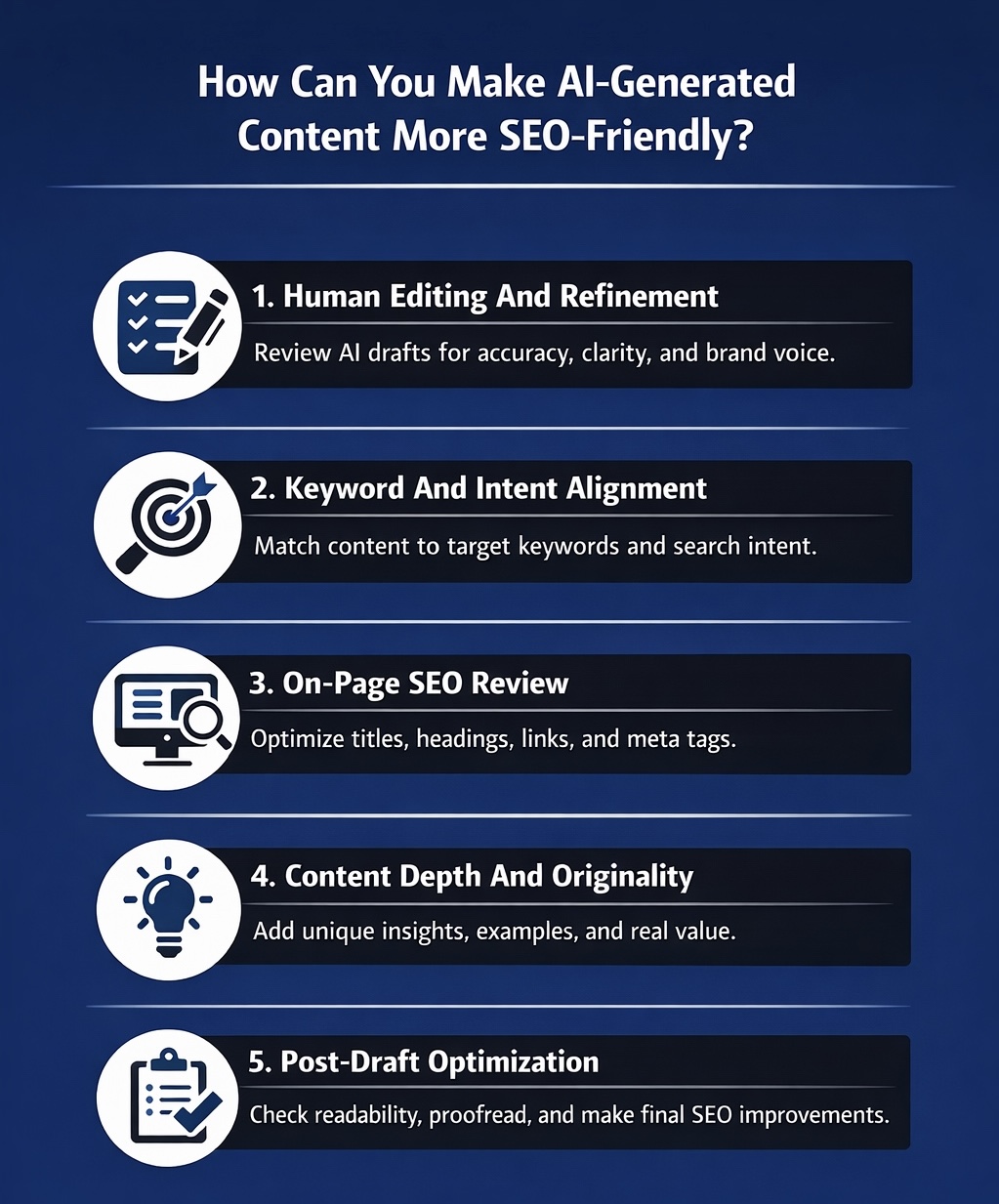
Artificial intelligence content creation tools excel at generating content, but their raw output often isn't ready for publication or SEO. To help your content rank, refine it using SEO best practices. This means more than just adding keywords—it requires a strategic approach that combines AI efficiency with human oversight. Steps like keyword research and on-page optimization can significantly improve results.
Here’s how you can enhance your AI content for better search performance.
1. Human Editing And Refinement
The most crucial step in making AI content SEO-friendly is human editing. AI tools are excellent for generating drafts quickly, but they often lack the nuance, originality, and emotional depth that connect with readers. This is where human creativity becomes indispensable.
A skilled content writer should review every piece of AI-generated text. This review process involves checking for accuracy, improving readability, and ensuring the content aligns perfectly with your brand voice. Think of the AI as a writing assistant that provides the raw materials, while the human editor shapes them into a polished, high-quality final product.
During this stage, you can also refine the SEO elements. While some SEO tools within the AI platform can guide you, a human review is necessary to ensure keywords are used naturally and the content provides genuine value to the reader. This blend of AI efficiency and human touch produces content that is both optimized and authentic.
2. Keyword And Intent Alignment
Effective search engine optimization starts with understanding what your audience is looking for. Before you even begin the content creation process with an AI tool, conduct thorough keyword research to identify the terms and phrases your target audience uses.
Once you have your target keywords, focus on search intent. Are users looking for information, a product to buy, or a comparison of different options? Your content must directly address this intent to rank well. An AI can help generate content around a keyword, but it's your job to ensure the final piece fully satisfies the user's needs.
To achieve strong alignment, follow these steps:
- Use SEO tools to identify primary and secondary keywords.
- Analyze the top-ranking content for your target keywords to understand what works.
- Structure your content to directly answer the core question behind the search query. This strategic approach ensures your content is not just keyword-rich but also genuinely helpful.
3. On-Page SEO Review
After drafting a piece of content with AI, it’s essential to perform a thorough on-page search engine optimization review. This step in the content creation process involves checking and refining the key elements that search engines use to understand and rank your page.
Start with the basics. Ensure your primary keyword is present in the title tag, meta description, and the first paragraph. Use SEO tools to check for proper header usage (H1, H2, H3s) to structure your content logically. This not only helps search engines but also improves readability for your audience.
Additionally, review internal and external linking opportunities. Linking to other relevant pages on your site can help users and search engines navigate your content, while linking to authoritative external sources can boost your credibility. Don't forget to optimize images with descriptive alt text. These small adjustments can significantly impact your search performance.
4. Content Depth And Originality
While AI can produce text quickly, it often generates content that is generic or repetitive. To stand out and rank well, your content needs to offer unique value. A key part of your content strategy should be to enhance AI-generated content with depth and originality.
A skilled content writer should take the AI draft as a starting point and build upon it. This means adding unique insights, personal experiences, expert opinions, or new data that can't be found elsewhere. Quality content goes beyond simply answering a question; it provides a comprehensive and insightful perspective that establishes your authority on the topic.
Instead of just accepting the generated content as is, ask yourself how you can make it better. Can you add a case study, a detailed example, or a practical tip? By infusing the content with original thought and deeper information, you transform a generic article into a valuable resource that both readers and search engines will appreciate.
5. Post-Draft Optimization
The optimization process doesn't end once the first draft is written. After a content writer has refined the AI-generated text, a final optimization check is needed to ensure every piece of content is polished and ready for publication.
Use SEO tools to run a final analysis of the content. These tools can check for keyword density, readability scores, and other on-page factors you might have missed. This is your last chance to catch any issues and make small tweaks that could improve your search engine ranking.
Here are a few post-draft optimization tasks to complete:
- Check Readability: Ensure sentences and paragraphs are short and easy to understand.
- Review Meta Tags: Write a compelling meta title and description to encourage clicks from search results.
- Final Proofread: Correct any spelling or grammar errors that could detract from the content's quality. This final review ensures your content is in the best possible shape to succeed.
Final Thoughts
AI is revolutionizing content marketing, but the key to success is not to replace human creativity but to augment it. The best generative AI tools act as powerful collaborators, handling the heavy lifting of content generation so you can focus on strategy and originality. By thoughtfully selecting and integrating these tools, you can accelerate production and build a more agile and innovative content engine. The future of content creation is a partnership between human insight and artificial intelligence.
Frequently Asked Questions
What is the best free AI tool for content creators?
ChatGPT is often considered the best starting point for free AI content generation. Its free plan is robust, making it an excellent AI assistant for brainstorming ideas, drafting text, and simplifying the content creation process without any initial investment.
How do AI tools improve the content creation process?
AI powered tools for content creation act as a writing assistant to streamline workflows. They accelerate content generation for everything from blog posts to video content, helping creators overcome writer's block, automate research, and produce assets much faster than manual methods.
Which are the top AI search optimization tools for content creators?
Yes, several AI tools are designed specifically for search engine optimization. Platforms like Scalenut and Surfer SEO offers advanced SEO tools for keyword research, content editing, and competitive analysis, helping you optimize your generated content throughout the content creation process for better search rankings.
What are some practical tips for using AI tools to create content faster?
For time-saving content creation, use a writing assistant to generate outlines and first drafts. A content writer can then refine this output. Utilize AI features like pre-made templates and batch content generation to streamline the content creation process and produce multiple pieces at once.
Are there AI tools that can help with email content creation?
Absolutely. Many AI writing assistant tools offer AI features specifically for email content creation. Platforms like Jasper and HubSpot can help marketing teams with content generation for marketing emails, from writing catchy subject lines to drafting entire campaigns that resonate with subscribers.
Do AI content creation tools support different formats like blogs, videos, and images?
Yes, many modern AI platforms support multiple content formats. While some tools specialize in text for a blog post, comprehensive solutions like Canva and Adobe Firefly offer image generation and video creation features, allowing you to produce a wide range of visual content efficiently.
Which are the best AI content optimization tools for search engine visibility?
Popular AI writing tools include Scalenut, Jasper, Copy.ai, and Writesonic. They help with SEO optimization, blog writing, marketing copy, and improving overall content quality efficiently.
Which is the best AI tool for writing SEO rich blog content?
The best AI tool for SEO-rich blog content is Scalenut, as it combines keyword research, NLP optimization, and content grading. Other strong options include Jasper, Writesonic, and Copy.ai for high-quality, optimized articles.


.svg)


.webp)