

AI Search Optimization Checklist: How Do You Get Cited?

AI search optimization checklist snapshot
- Define priority prompts: Focus on the questions, comparisons, alternatives, and use cases your buyers ask AI engines.
- Check current visibility: Track mentions, citations, recommendations, linked pages, competitors, and brand accuracy.
- Diagnose the gap: Identify whether the issue is content, crawlability, citations, positioning, third-party sources, or outdated information.
- Fix technical access: Make sure priority pages are indexable, accessible, internally linked, and easy for crawlers to read.
- Make content extractable: Use clear headings, direct answers, definitions, examples, FAQs, and comparison points.
- Add proof: Include screenshots, original examples, testing notes, expert input, customer insights, and honest limitations.
- Create decision-support pages: Build comparison, alternative, review, pricing, feature, use-case, and “best tools” content.
- Make pages citation-worthy: Add specific claims, fresh data, clear methodology, useful visuals, and well-structured sections.
- Clarify your brand entity: Keep product category, positioning, features, pricing, and brand descriptions consistent.
- Strengthen third-party signals: Audit review sites, directories, listicles, communities, partner pages, and industry mentions.
- Make commercial details clear: Explain pricing, plans, features, integrations, free trials, limitations, and ideal customer fit.
- Localize where relevant: Check if prompts, competitors, pricing, and sources change by market.
- Track and repeat: Monitor AI visibility, citations, sentiment, referral traffic, bot traffic, and retest after updates.
Content performance used to be easier to explain. If a page ranked well, got impressions, and earned clicks, you knew it was doing something right. Now, that same page can rank on Google but still be missing from AI answers on ChatGPT, Perplexity, Gemini, or AI Overviews.
That shift is already showing up in search behavior. A 2025 Pew Research Center analysis found that when a Google AI summary appeared, users clicked a traditional search result in only 8% of visits. So, you are not just checking rankings anymore. You need to know whether AI engines can find your content, cite your page, describe your brand accurately, and recommend you for the prompts your buyers ask.
This checklist will help you turn that into a clear workflow. We will cover what to audit, what to fix, what content to create, and how to track whether your AI search visibility is actually improving.
What is AI search optimization and how does it differ from traditional SEO?
AI search optimization is the process of improving your content so AI-powered search engines can find it, understand it, and use it in generated answers. This includes platforms like Google AI Overviews, ChatGPT, Perplexity, Gemini, Claude, and Copilot, where visibility depends on how clearly your content answers a query and how trustworthy it appears as a source.
Traditional SEO focuses on helping a page rank and earn clicks in search results. AI search optimization goes further by looking at whether AI systems can extract your answer, cite your page, recommend your brand, and describe it accurately.
Why do you need an AI search optimization checklist?
AI search visibility is not as simple as ranking for a keyword. Different AI platforms may pull from different sources, and answers can change based on the prompt, freshness, user intent, and available citations. A checklist gives your team a repeatable way to audit what is missing, fix the right pages, strengthen the right signals, and track progress without making random content updates.
What should you gather before starting AI search optimization?
Before you start optimizing, collect the inputs that show what your brand needs to be visible for, where you already have traction, and which sources AI engines may use to describe you.
You will need:
- Priority products, services, and use cases: The core offerings you want AI engines to understand, cite, and recommend.
- Main competitors: Direct competitors, category leaders, and brands that appear in “best,” “alternative,” and comparison searches.
- Existing organic landing pages: Pages that already rank, get impressions, or support important buying journeys.
- GSC queries and low-CTR pages: Queries and pages with strong impressions but weak clicks.
- Sales, support, and objection data: Real customer questions around pricing, features, integrations, use cases, and limitations.
- Review site and third-party mentions: How your brand is described across review platforms, directories, listicles, communities, and partner pages.
- Pricing, feature, comparison, and alternative pages: Key commercial pages that AI engines may use to understand your product.
- AI referral traffic and AI bot traffic data: Current traffic from AI platforms and signs that AI crawlers are accessing your site.
New to AI search optimization? Read our beginner-friendly guide on mastering SEO GEO strategies to build the right foundation before optimizing for AI search.
How to optimize for AI search? (The 15-point checklist)
1. Define the AI prompts and buyer journeys that matter
A common mistake I have noticed is that teams start with keywords and simply turn them into AI-style questions. That is a good starting point, but it is not enough. For AI search optimization, you need to understand the actual journey behind the prompt.
Start by mapping prompts across:
- Buyer intent: Identify whether the user is trying to learn, compare, shortlist, validate, or buy.
- Funnel stage: Group prompts by awareness, consideration, decision, and post-purchase needs.
- Commercial value: Include comparison, alternative, pricing, “best tool,” and use-case prompts early, not as an afterthought.
- Product and persona: Segment prompts by product line, audience type, company size, pain point, and use case.
- Market relevance: Add region-specific or industry-specific prompts if pricing, competitors, regulations, or buying behavior changes by market.
- Business priority: Focus first on prompts that can influence visibility, product understanding, brand preference, and buying decisions.
2. Check your current AI visibility before changing anything
I have seen teams jump into rewriting pages without first checking how AI engines already describe their brand. That makes it harder to know whether the issue is visibility, citations, positioning, or something else entirely. Start with a baseline first.
Track the following:
- Brand mentions: Check whether your brand appears for priority prompts across AI search platforms.
- Recommendations: See if AI engines only mention your brand or actually recommend it as a good option.
- Linked citations: Note whether your website is cited, or if AI engines are using third-party sources instead.
- Cited URLs: Record which pages are being cited, including blogs, product pages, comparison pages, or review sites.
- Competitor visibility: Identify which competitors appear more often and for what types of prompts.
- Source patterns: Look at the sources AI engines repeatedly use to shape answers in your category.
- Sentiment: Check whether the answer describes your brand positively, neutrally, or with limitations.
- Brand accuracy: Review whether your product, features, pricing, use cases, and positioning are described correctly.
3. Diagnose the type of AI visibility gap
One thing I would not skip here is diagnosis. If your brand is missing from an AI answer, the fix is not always “publish more content.” Sometimes the issue is technical access, weak positioning, poor third-party credibility, or outdated product information.
Look for the exact gap:
- Visibility gap: Your brand does not appear for important prompts where competitors show up.
- Citation gap: Your brand appears, but your website is not linked or cited.
- Recommendation gap: AI engines mention your brand, but do not recommend it as a strong option.
- Accuracy gap: Your product, pricing, features, or positioning are described incorrectly.
- Competitor gap: Competitors appear more often, rank higher in AI answers, or get stronger recommendations.
- Source gap: AI engines rely on third-party sources where your brand is missing, outdated, or poorly explained.
- Content gap: You do not have pages that directly answer comparison, alternative, pricing, use-case, or “best tool” prompts.
- Technical gap: Priority pages are hard to crawl, render, index, or extract from.
- Commercial clarity gap: Your pricing, plans, features, integrations, limitations, or ideal customer fit are not easy to verify.
4. Make priority pages crawlable, accessible, and indexable
I have noticed that content teams often focus on rewriting the visible copy first, but forget to check whether important pages can actually be crawled, indexed, and parsed properly. That part still matters because if AI search systems cannot access the page cleanly, the content may not get considered in the first place.
Check the basics first:
- Indexability: Make sure priority pages are not accidentally blocked by noindex tags, wrong canonicals, or crawl issues.
- Robots.txt access: Review whether search crawlers and relevant AI bots can access the pages you want discovered.
- Clean page rendering: Keep important content visible in the page HTML instead of hiding it behind scripts, tabs, or hard-to-load elements.
- Internal links: Link to priority product, feature, comparison, and BOFU pages from relevant blogs and landing pages.
- Sitemap health: Keep XML sitemaps updated so search engines can discover new and refreshed pages faster.
- Page response: Check that important pages load properly, return a successful status code, and do not create redirect or server errors.
- Bot restrictions: Review aggressive bot protection settings so they do not block useful crawlers from accessing public content.
5. Make your content easy to extract and summarize
Even strong content can get overlooked if the answer is buried under long intros, vague headings, or broad explanations. For AI search, your page needs to be easy to parse, summarize, and use in context.
Make each priority page easier to extract by improving:
- Direct answers: Start important sections with the clearest answer before adding context.
- Question-led headings: Use headings that match how users actually ask the question.
- Self-contained sections: Make sure each section can be understood on its own.
- Clear definitions: Define important terms, tools, features, and concepts in simple language.
- Examples: Add practical examples that show how the idea works in a real workflow.
- Comparison points: Use clear criteria when comparing tools, methods, products, or strategies.
- FAQs: Add concise answers to common questions around the topic, product, pricing, use case, or decision.
- Internal links: Connect related pages so AI engines and users can understand how your content fits together.
Want to see which platforms can help track and improve AI visibility? Explore our guide on the 11 best LLM optimization tools for AI visibility.
6. Add original insight and proof
This is where many AI search optimization efforts become too generic. If your page says the same thing every other ranking page says, there is not much reason for AI engines or readers to trust it as the better source. Google also recommends creating unique, helpful content that provides value beyond common knowledge.
Add proof that makes the content more useful:
- First-hand testing: Share what you actually tried, reviewed, compared, or observed.
- Screenshots: Use product screenshots, workflow examples, or report snapshots to support your claims.
- Real examples: Show how the advice works in a realistic SEO, GEO, or content workflow.
- Expert input: Add practical commentary from someone who understands the topic deeply.
- Benchmarks: Include performance data, before-and-after examples, or internal findings where possible.
- Customer insights: Use sales calls, reviews, support questions, or objections to make the content more grounded.
- Use-case examples: Explain how the point applies to different teams, industries, or buyer journeys.
- Honest limitations: Mention where a tactic, tool, or workflow may not be enough. This makes the content feel more trustworthy.
7. Create decision-support content
Informational content can help you get discovered, but it is usually not enough for commercial AI prompts. When users ask AI engines to compare tools, shortlist options, check alternatives, or decide what fits their use case, your content needs to help them evaluate, not just understand the topic. This is also why decision-support and comparison content is a major part of AI search optimization workflows.
Create pages that support buying decisions, such as:
- Comparison pages: Help users compare your product against direct competitors using clear, useful criteria.
- Alternative pages: Show when your product is a better fit than another tool, without sounding biased or dismissive.
- Review pages: Give honest, practical evaluations that cover features, pricing, pros, cons, and limitations.
- Pricing pages: Make plans, free trials, limits, and ideal users easy to understand.
- Feature pages: Explain what each feature does, how it works, and why it matters.
- Use-case pages: Connect your product to specific problems, teams, industries, or workflows.
- Best tools pages: Help AI engines understand where your product fits in a category.
- How to choose guides: Give buyers a clear decision framework instead of only listing options.
8. Make your content citation-worthy and click-worthy
The way I look at this is simple: getting summarized by AI is good, but getting cited and earning the click is better. For that, your content needs to offer something useful enough to reference, verify, or explore further. Research on AI search citations also shows that structured pages with definitions, facts, comparisons, and procedural steps tend to have stronger influence in generated answers.
Focus on improving:
- Specific claims: Avoid vague statements. Add clear, useful, and verifiable points.
- Fresh data: Update stats, pricing, screenshots, feature details, and examples regularly.
- Clear methodology: Explain how you tested, compared, selected, or evaluated something.
- Original assets: Add benchmarks, frameworks, comparison visuals, checklists, or real workflow examples.
- Expert input: Include practical commentary that adds more value than a basic summary.
- Citable sections: Make definitions, steps, pros and cons, and comparison criteria easy to pull into an AI answer.
- Click value: Give readers something the AI summary cannot fully replace, like screenshots, examples, templates, deeper analysis, or implementation steps.
9. Strengthen entity clarity across your site
AI engines need to understand what your brand is, what category it belongs to, who it serves, and how it is different from other options. If your own site describes the product one way on the homepage, another way on feature pages, and a third way in blogs, AI systems may struggle to represent the brand accurately.
Make your entity signals clearer by tightening:
- Brand naming: Use the same product and company name consistently across your website.
- Product category: Clearly state what the product is, such as an AI SEO platform, GEO tool, content optimization platform, or AI visibility platform.
- Positioning: Keep your core positioning consistent across homepage copy, product descriptions, comparison pages, and blog content.
- Feature names: Use the same names for key features so AI engines do not treat them as separate or unrelated capabilities.
- Pricing and plans: Keep pricing, plan names, free trial details, and feature limits consistent across commercial pages.
- Internal links: Connect related product, feature, pricing, comparison, and alternative pages so the site structure reinforces what your brand does.
- Structured data: Use relevant schema where it genuinely helps clarify your organization, product, authors, FAQs, and reviews.
- Author and reviewer details: Add credible author or reviewer information where expertise matters, especially on review, comparison, and strategy-led content.
10. Map and improve third-party sources AI engines rely on
Owned content matters, but AI engines do not only rely on your website. They may also use review sites, directories, listicles, communities, partner pages, and industry publications to understand how your brand fits into a category. So, part of AI search optimization is making sure those outside sources describe your brand accurately.
Audit the sources that shape AI answers in your category:
- Review sites: Check whether platforms like G2, Capterra, TrustRadius, or Product Hunt describe your product accurately.
- Directories and marketplaces: Update category, feature, pricing, and positioning details where your brand is listed.
- Comparison listicles: Identify pages that appear often for “best,” “alternative,” and “vs” prompts.
- Community discussions: Review Reddit, Quora, Slack groups, LinkedIn threads, and niche forums for recurring brand or competitor mentions.
- Partner and integration pages: Make sure partner pages explain what your product does and who it is for.
- Industry publications: Look for expert roundups, trend reports, podcasts, newsletters, and SaaS reviews that influence buyer research.
- Incorrect mentions: Fix outdated pricing, wrong feature descriptions, old positioning, or missing product context wherever possible.
- Source opportunities: Find credible places where your brand deserves to be included, referenced, reviewed, or compared.
11. Make commercial information easy to understand
This is especially important for SaaS brands because AI engines often answer buying-related prompts with whatever information is easiest to verify. If your pricing, features, plans, or use cases are unclear, outdated, or scattered across different pages, the answer may come from a third-party source instead of your own site.
Clarify the details buyers usually look for:
- Pricing: Keep plan prices, billing terms, and custom pricing details easy to find.
- Plan names: Use consistent plan names across pricing pages, comparison pages, blogs, and review content.
- Free trial details: Mention whether a free trial is available, how long it lasts, and what users can access.
- Feature availability: Make it clear which features are included in each plan.
- Integrations: List important integrations and explain how they support the workflow.
- Use cases: Connect the product to real problems, teams, industries, or workflows.
- Limitations: Be upfront about limits, add-ons, usage caps, or cases where the product may not be the best fit.
- Ideal customer fit: Explain who the product is best for so AI engines can match it to the right buyer intent.
- Buying FAQs: Answer common questions around pricing, onboarding, migration, support, and comparisons.
12. Adapt your AI search checks by market, not just language
If your brand serves more than one market, do not rely only on one global prompt set. AI answers can change by region because competitors, pricing, terminology, third-party sources, and buyer expectations are not always the same. A translated page is useful, but it may not be enough if the local search journey works differently.
Check market-level differences such as:
- Prompt variations: See how buyers phrase the same need across regions or languages.
- Local competitors: Identify brands that appear only in certain countries or markets.
- Regional pricing and availability: Keep pricing, currencies, plan access, and product availability accurate.
- Local sources: Review the directories, review sites, publications, marketplaces, and communities AI engines may use in that market.
- Market-specific proof: Add relevant customer stories, examples, compliance details, partner mentions, or case studies.
- Localized pages: Create market-specific pages only when the audience, offer, competitors, or search behavior meaningfully changes.
13. Add useful multimedia
Multimedia should not be added just to make the page look richer. It should help explain, prove, or simplify something the text alone cannot do well. This matters even more as AI search systems become more multimodal and can use text, images, audio, and video to understand content better.
Use multimedia where it adds real value:
- Product screenshots: Show how a feature, report, dashboard, or workflow actually looks.
- Workflow diagrams: Break down complex SEO, GEO, or AI visibility processes visually.
- Comparison graphics: Make tool comparisons, feature differences, or decision frameworks easier to scan.
- Short videos: Use videos for walkthroughs, tutorials, product demos, or process explanations.
- Captions: Add short captions that explain what the visual shows and why it matters.
- Alt text: Write clear alt text so images are easier to understand and more accessible.
- Original charts: Use internal data, benchmarks, or performance trends when you have something useful to show.
- Infographics: Turn long checklists, workflows, or frameworks into simple visuals that readers can save or share.
14. Track AI search performance without overclaiming
AI search reporting is not as fixed as traditional SEO reporting. Answers can change by platform, prompt, timing, and source availability, so avoid treating one test as the final truth. Track patterns over time instead.
Focus on:
- AI visibility: How often your brand appears across priority prompts.
- Prompt coverage: Which prompts mention, cite, or recommend your brand.
- Citations: Whether AI answers cite your owned pages or third-party sources.
- Share of voice: How your visibility compares with competitors.
- Sentiment: Whether your brand is described positively, neutrally, or with repeated limitations.
- Accuracy: Whether pricing, features, use cases, and positioning are described correctly.
- AI traffic: Referral traffic from AI platforms and visits from AI crawlers.
- Retesting: Recheck the same prompt set regularly to see what actually changed.
15. Validate each fix and repeat the optimization loop
The last step is to check whether your updates actually changed anything. AI search optimization is not a publish-and-forget task. You need to retest the same prompts, review what changed, and keep improving based on the signals that moved.
Track what happens after each update:
- Prompt retests: Run the same prompt set again after making changes.
- Citation changes: Check whether your owned pages are cited more often.
- Recommendation changes: See if your brand moves from being mentioned to being recommended.
- Accuracy improvements: Review whether AI answers describe your product, pricing, and features correctly.
- Competitor movement: Track whether competitors gained, lost, or kept visibility.
- Source changes: See if AI engines started relying on better or more relevant sources.
- Next actions: Use the results to decide whether to update the page, build new content, improve third-party signals, or leave the page as is.
Want to connect AI visibility with your existing SEO workflow? Read our guide on how to integrate AEO with traditional SEO strategies for maximum visibility.
How can content teams turn AI search optimization into a repeatable workflow?
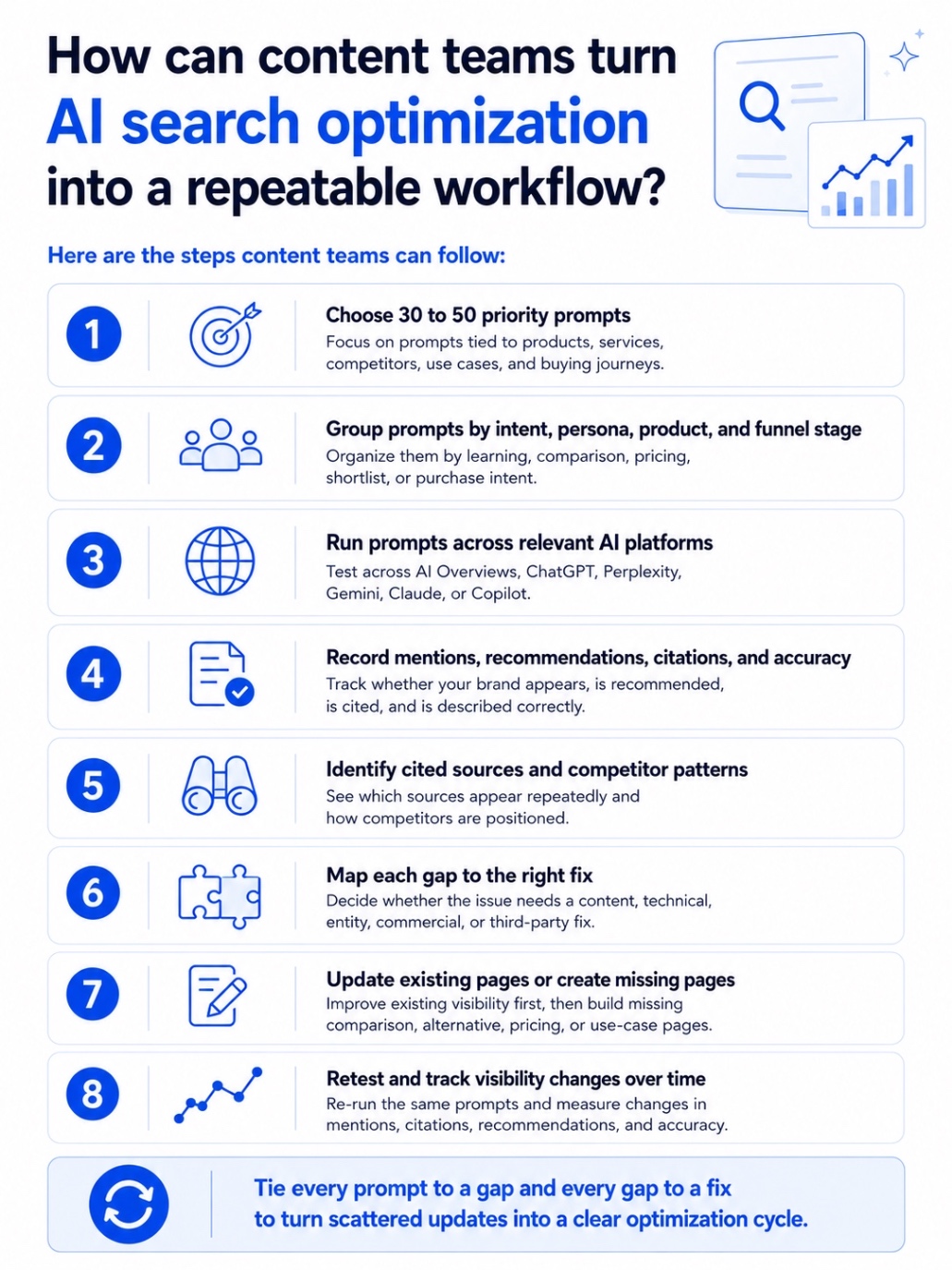
AI search optimization works better when it follows a clear workflow. Instead of updating pages randomly, start with priority prompts, check current visibility, find the gaps, and decide what needs to be fixed or created.
Here are the steps content teams can follow:
1. Choose 30 to 50 priority prompts
Start with the prompts that connect directly to your products, services, competitors, use cases, and buying journeys. Do not try to track every possible question at once.
2. Group prompts by intent, persona, product, and funnel stage
Organize prompts by what the user is trying to do. For example, learning, comparing, shortlisting, checking pricing, or validating a purchase decision.
3. Run prompts across relevant AI platforms
Test the same prompts across the AI platforms your audience is likely to use, such as AI Overviews, ChatGPT, Perplexity, Gemini, Claude, or Copilot.
4. Record mentions, recommendations, citations, and accuracy
For each prompt, note whether your brand appears, whether it is recommended, whether your website is cited, and whether the answer describes your product correctly.
5. Identify cited sources and competitor patterns
Look at which sources AI engines use repeatedly. Also check which competitors appear often, where they are cited from, and what positioning they are associated with.
6. Map each gap to the right fix
Do not treat every gap as a content gap. Some issues need technical fixes, some need clearer entity signals, some need stronger commercial pages, and some need better third-party source presence.
7. Update existing pages or create missing pages
Improve pages that already have visibility first. Then create missing comparison, alternative, pricing, use-case, or “best tool” pages where the buyer journey is not covered well enough.
8. Retest and track visibility changes over time
Run the same prompt set again after updates. Track whether mentions, citations, recommendations, sentiment, or accuracy improved.
The goal is to make AI search optimization easier to act on. When every prompt is tied to a gap and every gap is tied to a fix, your team can move from scattered updates to a clear optimization cycle.
How can Scalenut simplify AI search optimization for you?
AI search optimization becomes easier when visibility tracking and execution are connected. At Scalenut, we help teams see where their brand stands in AI search, understand what is missing, and turn those gaps into content actions.
With Scalenut, you can:
- Track AI brand presence: See how often your brand appears across AI search engines through brand mentions, prompt coverage, and visibility trends.
- Find prompt gaps: Identify the topics, prompts, and opportunity areas where your brand is missing or underrepresented.
- Benchmark competitors: Compare your brand’s share of visibility, competitor mentions, and relative positioning across AI answers.
- Track AI citations and sources: See which sources AI engines rely on and whether your owned pages are being referenced.
- Monitor sentiment: Understand whether AI answers describe your brand positively, neutrally, or with recurring limitations.
- Track AI bot visits: Monitor bot activity, source engines, and page coverage to understand how AI crawlers interact with your site.
- Optimize content for AI visibility: Use GEO-focused insights to improve existing pages, create AI-ready content, and strengthen prompt coverage.
Scalenut is not just built for GEO tracking. It brings SEO + GEO visibility tracking and execution together, so teams can understand where they stand in AI search and act on what needs to improve.
Want to simplify AI search optimization for your team? Book a strategy call with Scalenut today.
Final Thoughts
AI search optimization is not about chasing every new tactic. The better next step is to build a simple workflow: choose the prompts your buyers actually ask, check how your brand appears in AI search results, identify the gaps, and improve the pages, sources, and proof that influence those answers.
Start with your highest-value pages first. Make them easier for answer engines and large language models to understand, cite, and trust. Then keep testing the same prompts over time. That is how generative engine optimization becomes part of your larger digital marketing workflow, not just another content creation task.
Frequently Asked Questions
How can I optimize my website content for generative AI features on Google Search?
Start with crawlable, indexable, helpful, and well-structured pages. Traditional search engine optimization strategies still matter, but artificial intelligence features also need clear answers, original insight, updated information, and content that is easy to extract and summarize.
How to optimize for AI search engines?
Build a prompt set, check where your brand appears, and identify citation, content, and source gaps. Then improve the pages AI tools may use by adding clearer sections, stronger proof, better examples, and accurate product information.
What are the best practices for making my brand more visible in AI-powered search results?
The best practices include clear positioning, consistent entity signals, helpful content, updated commercial pages, review site presence, third-party mentions, and regular prompt tracking. The goal is to improve brand visibility across answers, recommendations, and citations.
Which strategies help improve ranking in AI-driven search tools like ChatGPT and Perplexity?
Focus on the prompts your buyers ask, then improve the pages and sources AI search tools may reference. Create useful comparison, alternative, review, pricing, and use-case content. Also strengthen citations, third-party mentions, and product clarity.
How does local SEO change when optimizing for AI search engines?
Local SEO for AI search needs more than a correct business profile. You also need market-specific prompts, local competitors, regional pages, reviews, directory mentions, location details, and consistent trust signals that help AI systems understand local relevance.
What should I consider when rewriting existing content for AI search optimization?
Start by checking whether the page already ranks, gets impressions, or appears in AI answers. Then improve the introduction, headings, definitions, examples, FAQs, internal links, freshness, and proof. Do not rewrite blindly without knowing the gap.
Can you explain how AI discovers and prioritizes web content in search results?
AI-powered search can use crawlable web content, retrieval systems, citations, and third-party sources to form answers. An AI model may prioritize content that is accessible, relevant, well structured, trustworthy, and supported by clear source signals.
What are the most important on-page elements for AI search visibility?
The most important on-page elements include clear headings, direct answers, crawlable content, definitions, examples, FAQs, internal links, updated information, schema where relevant, author details, and original proof. These help users and AI systems understand the page better.
How do I measure the impact of AI search optimization on my website traffic?
Track AI referral traffic, AI bot visits, brand mentions, cited URLs, recommendation rate, prompt coverage, share of voice, sentiment, and representation accuracy. Measure patterns over time instead of relying on one prompt test or one AI-generated answer.
Who should invest in an AI search optimization tool and which is the best one available in 2026?
SEO teams, content teams, SaaS brands, agencies, and businesses that depend on organic discovery should invest in an AI search optimization tool. Scalenut is a strong option for visibility tracking, citation insights, competitor benchmarking, and execution in one workflow.


.svg)


.webp)