
7 Best AI Rank Tracker Tools to Monitor AI Visibility in 2026
Best AI Rank Tackers in 2026: Quick Summary
- Best overall AI rank tracker: Scalenut is the strongest fit if you want AI visibility tracking plus content execution in one workflow.
- Best for enterprise tracking: Profound and Scrunch AI are better suited for larger teams that need advanced reporting, broader coverage, and deeper monitoring.
- Best for focused AI visibility monitoring: Peec AI is a clean option for tracking prompts, citations, competitors, sentiment, and daily visibility across selected AI models.
- Best for existing SEO suite users: Semrush AI Visibility Toolkit and Ahrefs Brand Radar make the most sense if your team already works inside those platforms.
- Best lightweight option: AIclicks is useful for smaller teams that want prompt-level AI visibility tracking with some content support.
- What to check before choosing: Look at AI platform coverage, prompt limits, citation tracking, competitor visibility, share of voice, historical trends, recommendations, and whether the tool helps you act on the data.
- Bottom line: AI visibility tracking should not stop at knowing where you appear. The real value is finding which prompts, sources, and competitors shape AI answers, then using those insights to improve your content and GEO strategy.
Traditional rank trackers were built for blue links. AI search does not work that way.
When buyers ask ChatGPT, Perplexity, Google AI Overviews, or Claude for recommendations, your brand may be mentioned, cited, ranked lower than competitors, or left out entirely. A normal keyword tracker will not show you that.
AI rank trackers fill that gap by monitoring prompts, citations, share of voice, sentiment, and competitor visibility across answer engines. This guide compares the 7 best AI rank tracker tools in 2026 and shows which one fits your workflow, budget, and execution needs.
What is an AI rank tracker?
An AI rank tracker shows how your brand appears in AI-generated answers across platforms like ChatGPT, Perplexity, Gemini, Claude, Google AI Overviews, and AI Mode. It tracks whether your brand is mentioned, cited, ranked, or recommended for important buyer prompts.
These tools usually measure brand mentions, citations, average position, share of voice, sentiment, competitor visibility, and prompt-level performance. The goal is to understand where your brand appears, how often it appears, which sources influence the answer, and which competitors show up instead.
Here is the difference between the core metrics:
- AI mentions: Whether your brand is named in an AI answer.
- AI citations: Whether the AI answer links to your website or another source that references your brand.
- AI rankings: Where your brand appears inside the AI answer compared with other brands.
- Share of voice: How often your brand appears across a tracked prompt set compared with competitors.
AI rank tracker vs traditional rank tracker: What’s the difference?
A traditional rank tracker measures where a webpage ranks in search results for a keyword. An AI rank tracker measures how your brand appears inside generated answers, where the output may include multiple brands, citations, summaries, and recommendations.
That is why AI answers cannot be tracked like normal blue-link rankings. The same prompt can change across platforms, locations, and repeated checks, so the goal is to track visibility patterns across prompts, citations, competitors, and answer context.
1. Scalenut
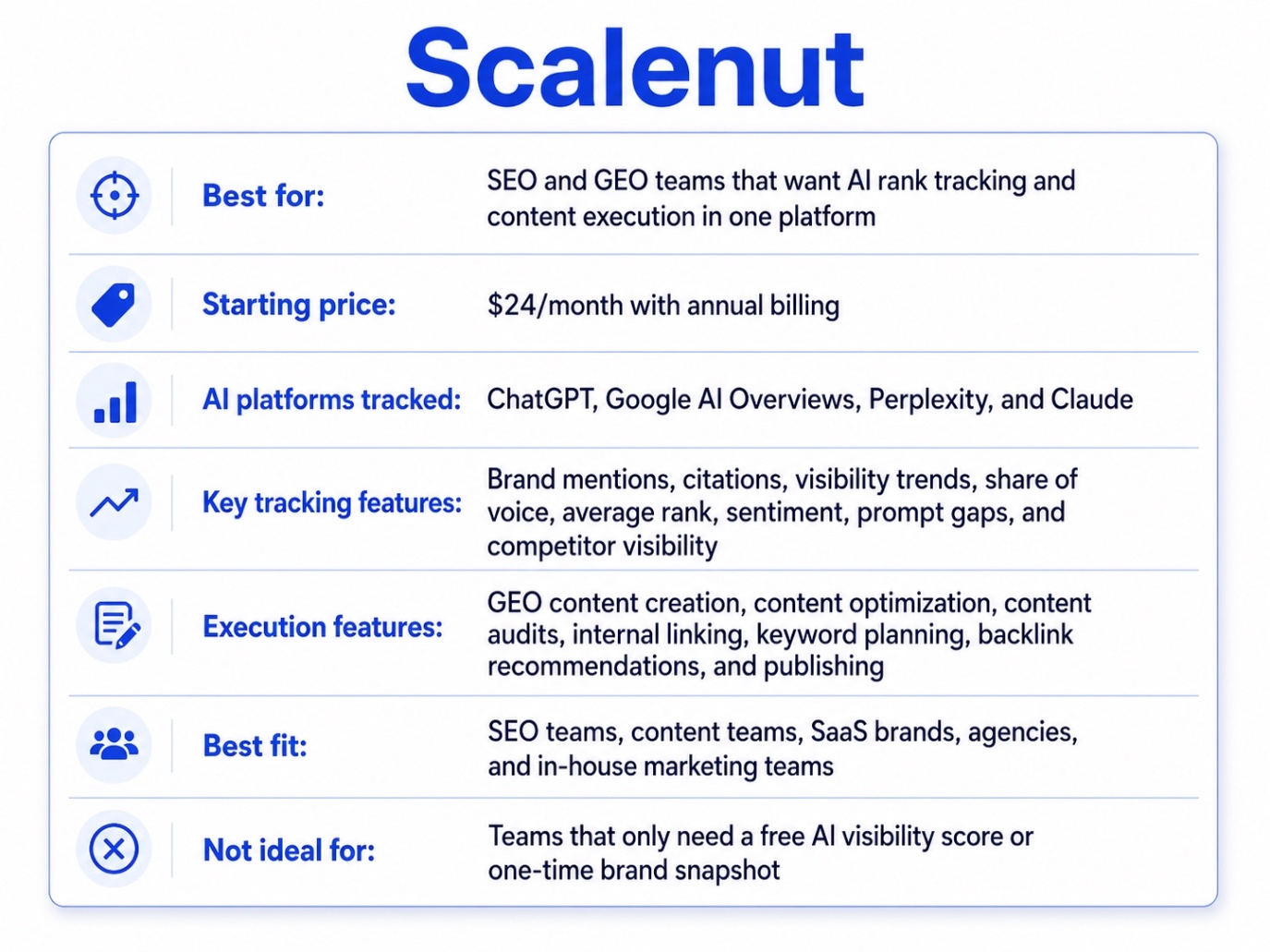
Scalenut is an AI rank tracker and GEO execution platform for teams that want to monitor AI visibility and fix content gaps in the same workflow.
Key features
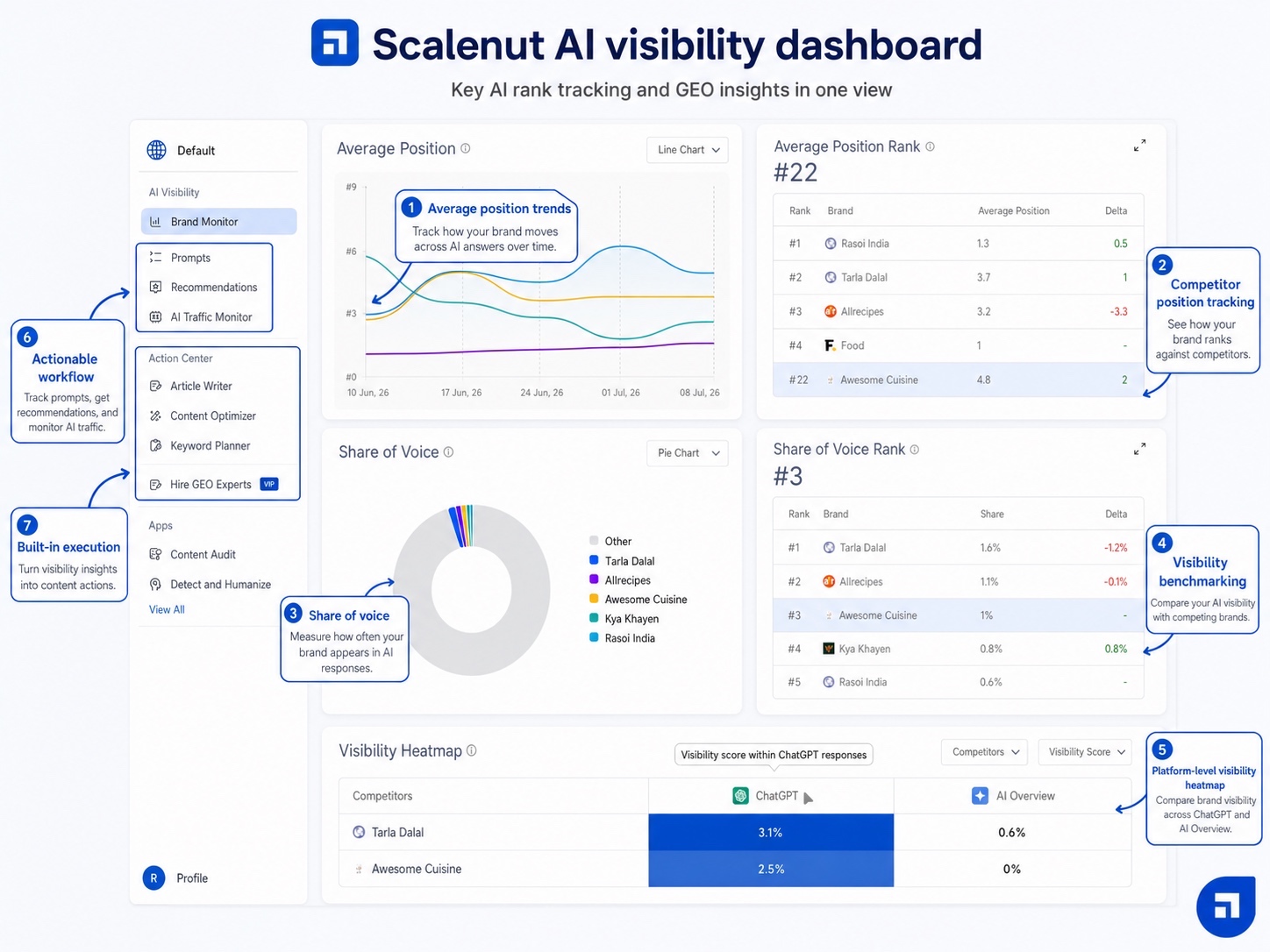
- Tracks brand mentions, citations, share of voice, average rank, sentiment, prompt gaps, and competitor visibility
- Supports tracking across ChatGPT, Google AI Overviews, Google AI Mode, Perplexity, and Claude
- Shows where your brand appears, where competitors win, and which prompts need attention
- Connects AI visibility insights with GEO content creation, optimization, audits, internal linking, and publishing
- Helps teams move from AI visibility tracking to execution without switching tools
Pros
- Combines AI rank tracking with SEO and GEO execution
- Strong fit for content teams, SEO teams, agencies, SaaS brands, and in-house marketers
- Tracks both brand visibility and competitor performance
- Useful for finding content gaps, prompt gaps, and citation opportunities
- More action-oriented than tools that only show visibility scores
Cons
- Not ideal if you only need a free one-time AI visibility snapshot
- Starter and Plus plans have lower prompt limits
- Perplexity access starts from the Professional plan in the pricing table
- May be more platform than needed for teams that only want basic monitoring
Pricing
- Starter: $24/month annually, 10 tracked prompts, ChatGPT and Google AIO.
- Plus: $36/month annually, 25 tracked prompts, ChatGPT and Google AIO.
- Professional: $80/month annually, 100 tracked prompts, ChatGPT, Google AIO, and Perplexity.
- VIP Service: Custom pricing, dedicated GEO strategy, content, backlinks, audits, and reporting.
Scalenut ratings and reviews
- G2: 4.7/5 rating from 316 reviews.
- Capterra: 4.8/5 rating from 397 reviews.
Want to know more on how Scalenut can help teams with SEO + GEO visibility tracking and execution? Book a free strategy call with Scalenut today.
2. Profound
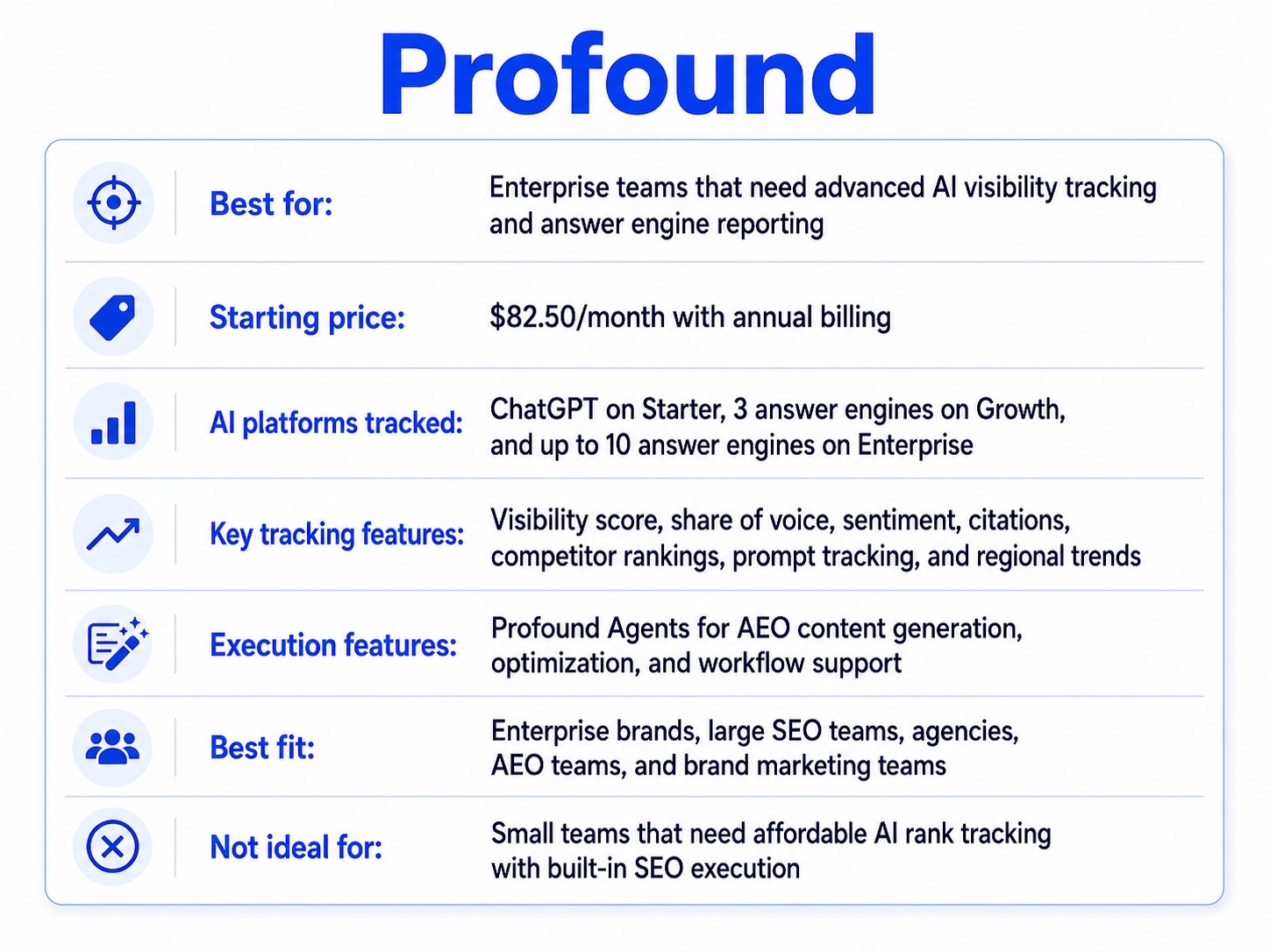
Profound is an AI visibility platform built for brands that need deeper answer engine tracking, competitor benchmarking, and enterprise-level reporting.
Key features
- Tracks prompts, citations, sentiment, share of voice, and competitor visibility
- Supports ChatGPT tracking on Starter and multiple answer engines on higher plans
- Helps teams monitor brand visibility across topics, regions, and time
- Shows which sources AI engines cite when mentioning your brand or competitors
- Includes AEO content workflows on higher plans
Pros
- Strong fit for enterprise AI visibility tracking
- Useful for monitoring citations, sentiment, competitors, and prompt performance
- Daily tracking helps teams catch visibility changes faster
- Growth and Enterprise plans support broader answer engine coverage
- Good for teams that need advanced reporting
Cons
- More expensive than most AI rank trackers
- Starter plan tracks ChatGPT only
- Growth plan is limited to 3 answer engines
- May be too advanced for smaller SEO or content teams
- Less ideal if you need built-in SEO execution beyond AEO insights
Pricing
- Starter: $82.50/month annually, 50 tracked prompts, ChatGPT only.
- Growth: $332.50/month annually, 100 tracked prompts, 3 answer engines.
- Enterprise: Custom pricing, up to 10 answer engines, multiple companies, custom prompts, Slack support, and SSO/SAML.
Profound ratings and reviews
- G2: 4.6/5 rating from 323 reviews.
- Reddit: Want to know what users actually think? Read this Reddit discussion on Profound.
3. Peec AI
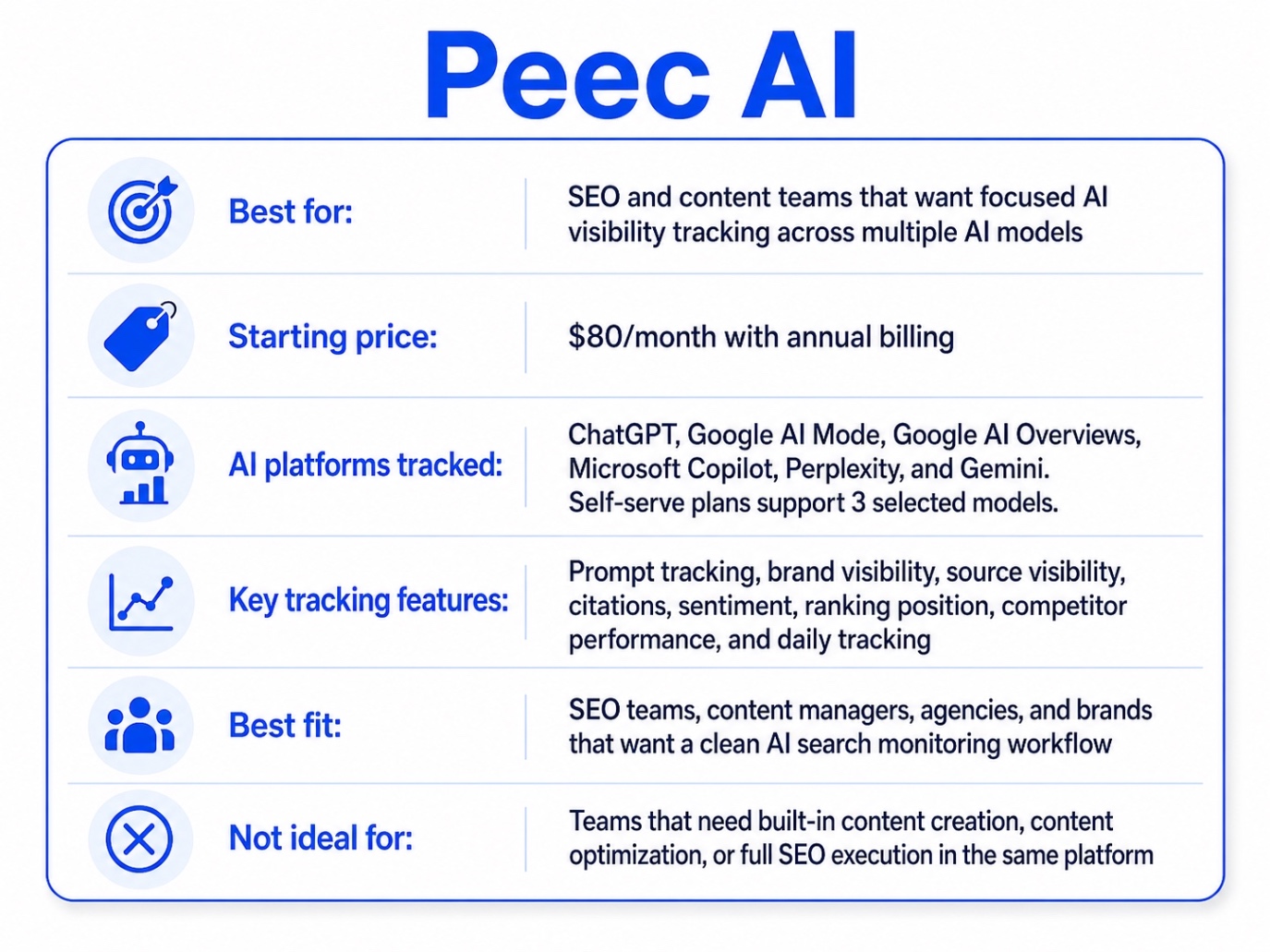
Peec AI is an AI search analytics platform for teams that want to track how their brand appears across AI answers. It is especially useful for prompt tracking, citation analysis, competitor visibility, and model-level reporting.
Key features
- Tracks brand visibility across selected AI models
- Monitors prompts, citations, sentiment, ranking position, and competitor performance
- Supports daily tracking on self-serve plans
- Lets teams choose 3 models on Starter, Pro, and Advanced plans
- Supports country, model, and audience-based visibility analysis
- Includes Looker Studio integration on the Advanced plan
Pros
- Clean and focused AI visibility dashboard
- Daily tracking across all self-serve plans
- Unlimited users across plans
- Good fit for SEO and content teams that want prompt-level monitoring
- Strong for comparing visibility across brands, models, and projects
Cons
- Self-serve plans include only 3 selected models
- Starter plan supports only 1 project
- Looker Studio integration starts on the Advanced plan
- Enterprise is needed for all models, API access, SSO, and unlimited projects
- Not built for full content execution like article creation or SEO optimization
Pricing
- Starter: $80/month annually, 50 prompts, 3 selected models, 1 project.
- Pro: $205/month annually, 150 prompts, 3 selected models, 2 projects.
- Advanced: $420/month annually, 350 prompts, 3 selected models, 5 projects.
- Enterprise: Custom pricing, all models, unlimited projects, API access, and SSO.
Peec AI ratings and reviews
- G2: 4.9/5 rating from 11 reviews.
- Reddit: Want to know what users actually think? Read this Reddit Peec AI review from an actual user.
Want to compare Peec AI with other GEO tools? Read our full guide on the best Peec AI alternatives for GEO in 2026.
4. Scrunch AI
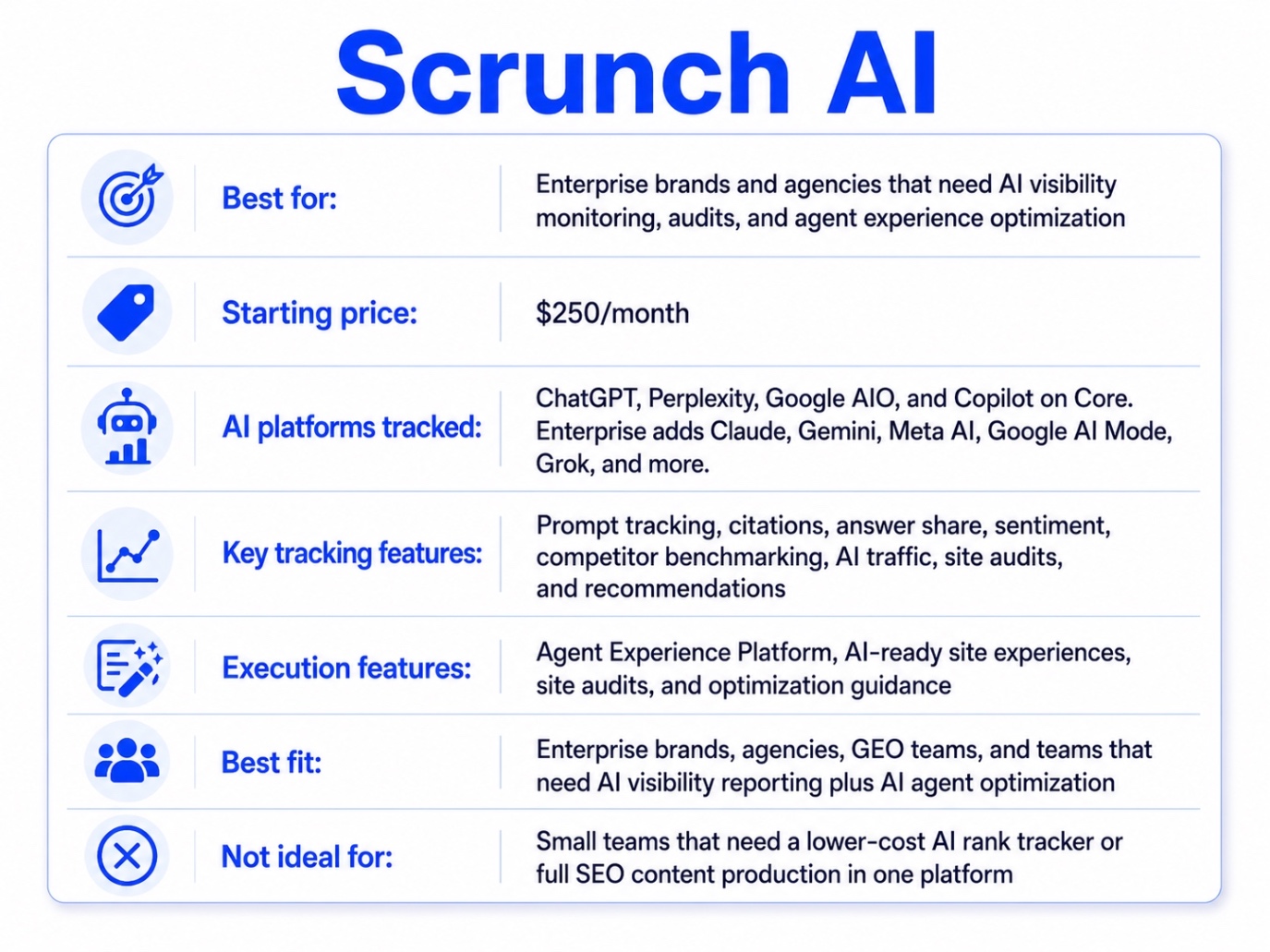
Scrunch AI is an AI visibility platform built for brands and agencies that want to monitor how they appear across AI answers, track citations, and optimize their site experience for AI agents.
Key features
- Tracks prompt performance, citations, competitors, rankings, and answer share
- Supports ChatGPT, Perplexity, Google AIO, and Copilot on Core
- Enterprise adds expanded model coverage, including Claude, Gemini, Meta AI, Google AI Mode, Google AIO, Copilot, and Grok
- Includes AI traffic monitoring, site audits, and visibility recommendations
- Offers Agent Experience Platform for delivering AI-ready website experiences
- Supports API access, SSO, and dedicated account support on Enterprise
Pros
- Strong fit for enterprise brands and agencies
- Useful for AI visibility tracking, citations, sentiment, and competitor benchmarking
- Includes site audits and optimization guidance
- Core plan supports 5 user licenses and a 7-day free trial
- Enterprise plan adds broader model coverage and API access
Cons
- Starting price is higher than many AI rank trackers
- Core plan supports only 1 brand workspace
- Claude, Gemini, Google AI Mode, Meta AI, and Grok require Enterprise
- More focused on AI visibility and agent experience than full SEO content execution
- May be too advanced for smaller teams that only need prompt monitoring
Pricing
- Core: $250/month, 125 prompts, 5 site audits, 1 brand workspace, 4 LLMs.
- Enterprise: Custom pricing, custom prompts, AXP, expanded model coverage, API access, SSO, and dedicated support.
- Agency Core: $500/month, 250 prompts, 3 brand workspaces, 3 pitch workspaces, 4 LLMs.
- Agency Enterprise: Custom pricing, custom workspaces, AXP, full site audits, 9 LLMs, and dedicated support.
Scrunch AI ratings and reviews
- G2: 4.6/5 rating from 72 reviews.
Want a deeper look before shortlisting it? Read our full Scrunch AI review for features, pricing, pros, cons, and real use cases.
5. Semrush AI Visibility Toolkit
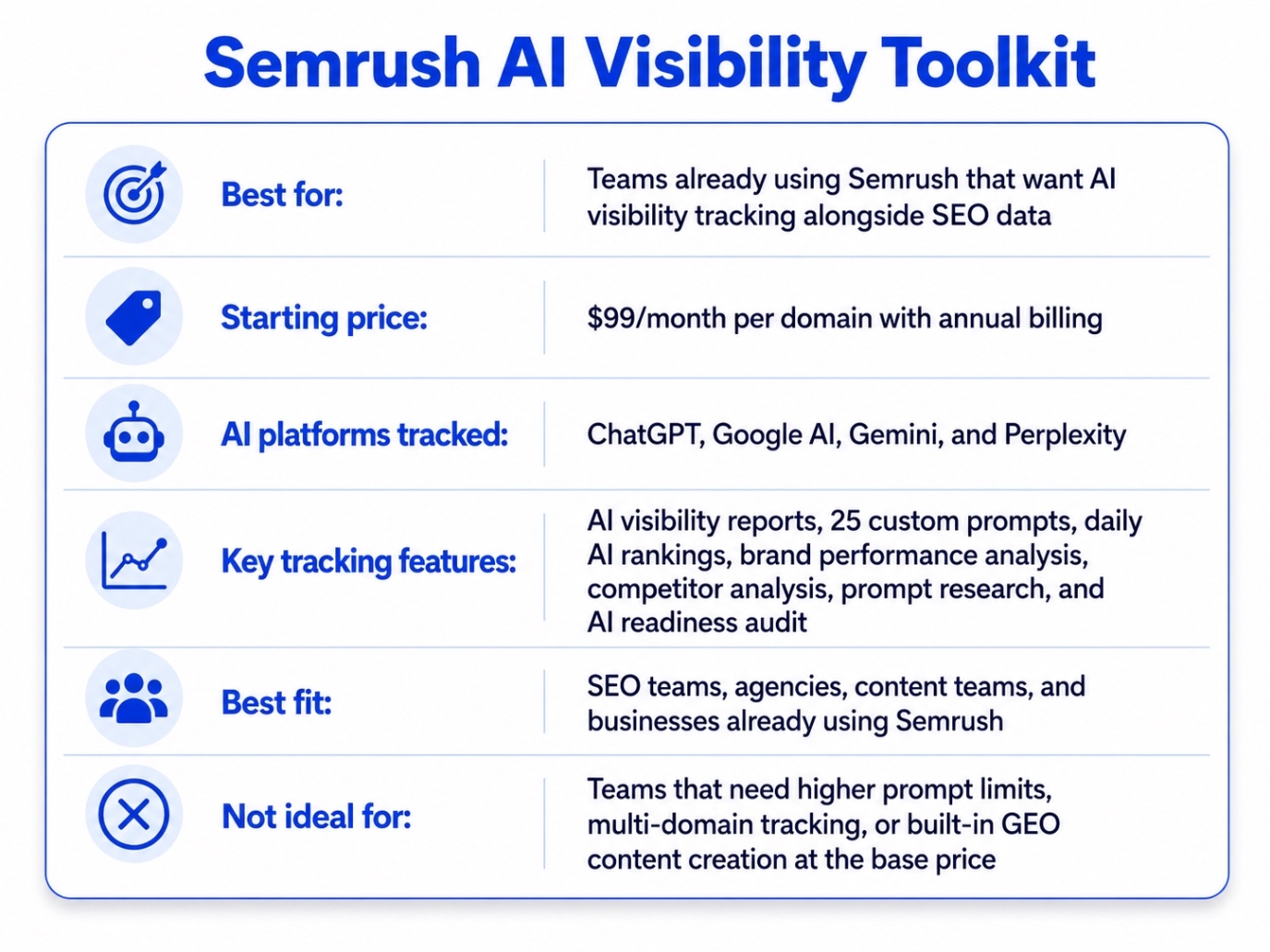
Semrush AI Visibility Toolkit is built for teams that want to track how their brand appears in AI search while keeping that data close to their existing SEO workflow.
Key features
- Tracks AI mentions across ChatGPT, Google AI, Gemini, and Perplexity
- Includes 25 custom prompts with daily AI rankings
- Provides AI visibility reports for any domain
- Includes brand performance analysis for 1 domain
- Supports AI competitor analysis and prompt research
- Includes a site audit for AI readiness
- Offers daily, weekly, and monthly data updates
Pros
- Strong fit for teams already using Semrush
- Good for combining AI visibility insights with SEO research
- Includes competitor analysis and prompt research
- Daily prompt tracking is included in the Base plan
- Useful for agencies that want AI visibility data in a familiar ecosystem
Cons
- Pricing is per domain
- Base plan includes only 25 custom prompts
- Tracking is limited to ChatGPT, Google AI, Gemini, and Perplexity
- Not a full GEO content execution platform by itself
- May become expensive for agencies managing several domains
Pricing
- Base: $99/month per domain annually, 25 custom prompts, ChatGPT, Google AI, Gemini, and Perplexity.
Semrush ratings and reviews
- G2: 4.5/5 rating from 3,500 reviews.
- Capterra: 4.6/5 rating from 2,314 reviews.
Read the full Semrush AI Toolkit review here.
6. Ahrefs Brand Radar
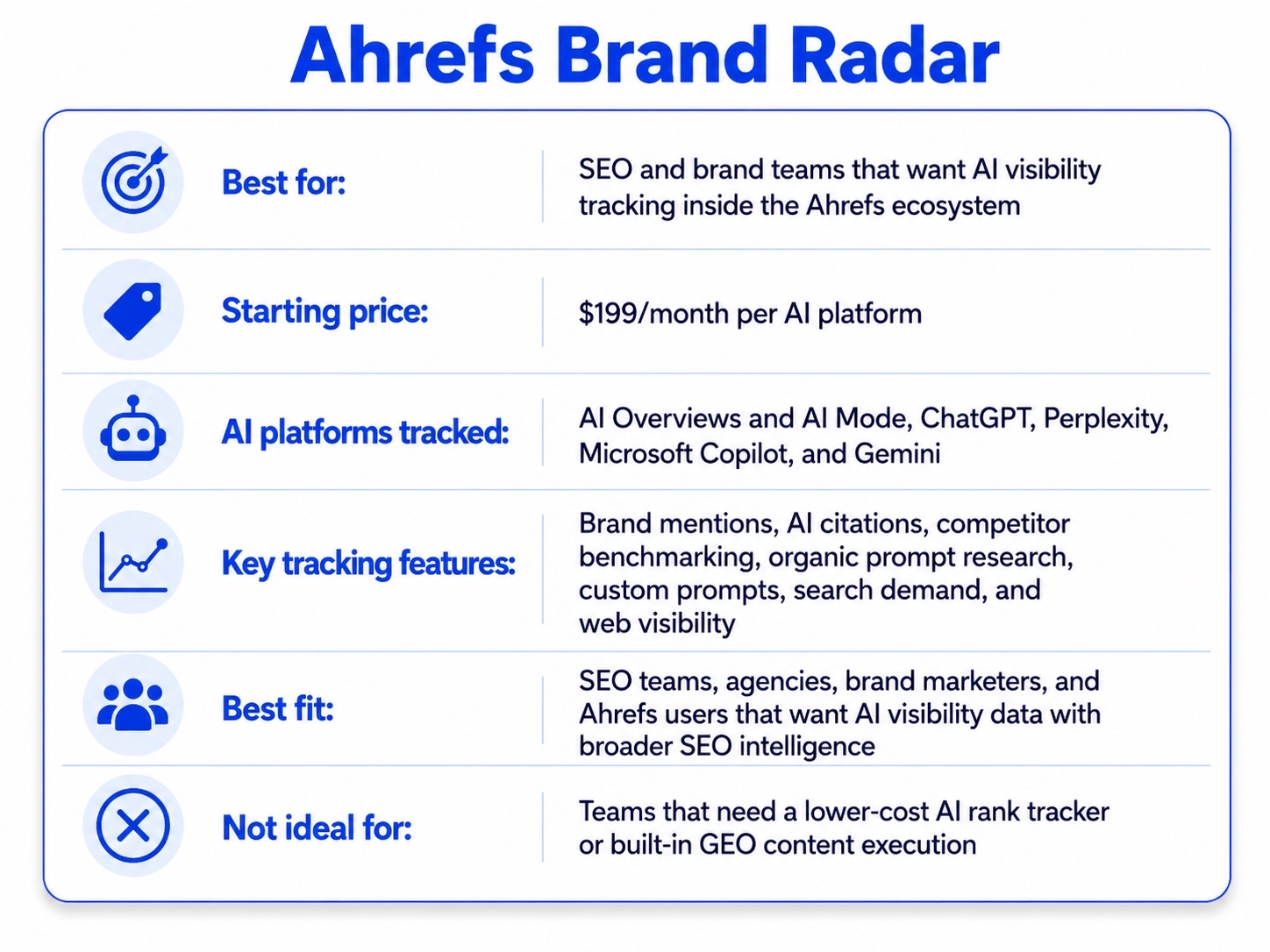
Ahrefs Brand Radar helps teams track how their brand appears across AI answers, compare visibility against competitors, and find citation opportunities inside the Ahrefs ecosystem.
Key features
- Tracks brand mentions across AI answers
- Benchmarks brand visibility against competitors
- Finds AI citations and source opportunities
- Supports custom prompt tracking
- Tracks AI Overviews and AI Mode, ChatGPT, Perplexity, Microsoft Copilot, and Gemini
- Includes search demand, web visibility, and beta access to YouTube, TikTok, and Reddit visibility
Pros
- Strong fit for teams already using Ahrefs
- Useful for AI visibility, citations, and competitor benchmarking
- Backed by Ahrefs’ broader SEO and web data
- All Platforms plan includes 2,500 custom prompt checks
- Good for teams that want AI visibility and SEO intelligence in one ecosystem
Cons
- Expensive compared with most AI rank trackers
- Pricing can increase quickly if you need multiple platforms
- Custom prompts may require extra paid tiers
- Not built as a full GEO content execution platform
- Smaller teams may find it too heavy for basic AI visibility tracking
Pricing
- Single platform: $199/month per index, one selected AI platform.
- Select platforms: $398/month in the screenshot, AI Overviews and AI Mode plus ChatGPT selected.
- All platforms: $699/month, all AI platforms and 2,500 custom prompt checks.
Ahrefs Brand Radar ratings and reviews
- G2: 4.5/5 rating from 689 Ahrefs reviews.
- Capterra: 4.7/5 rating from 579 Ahrefs reviews.
Read our Ahrefs vs Scalenut comparison to find which one fits your SEO + GEO goals best.
7. AIclicks
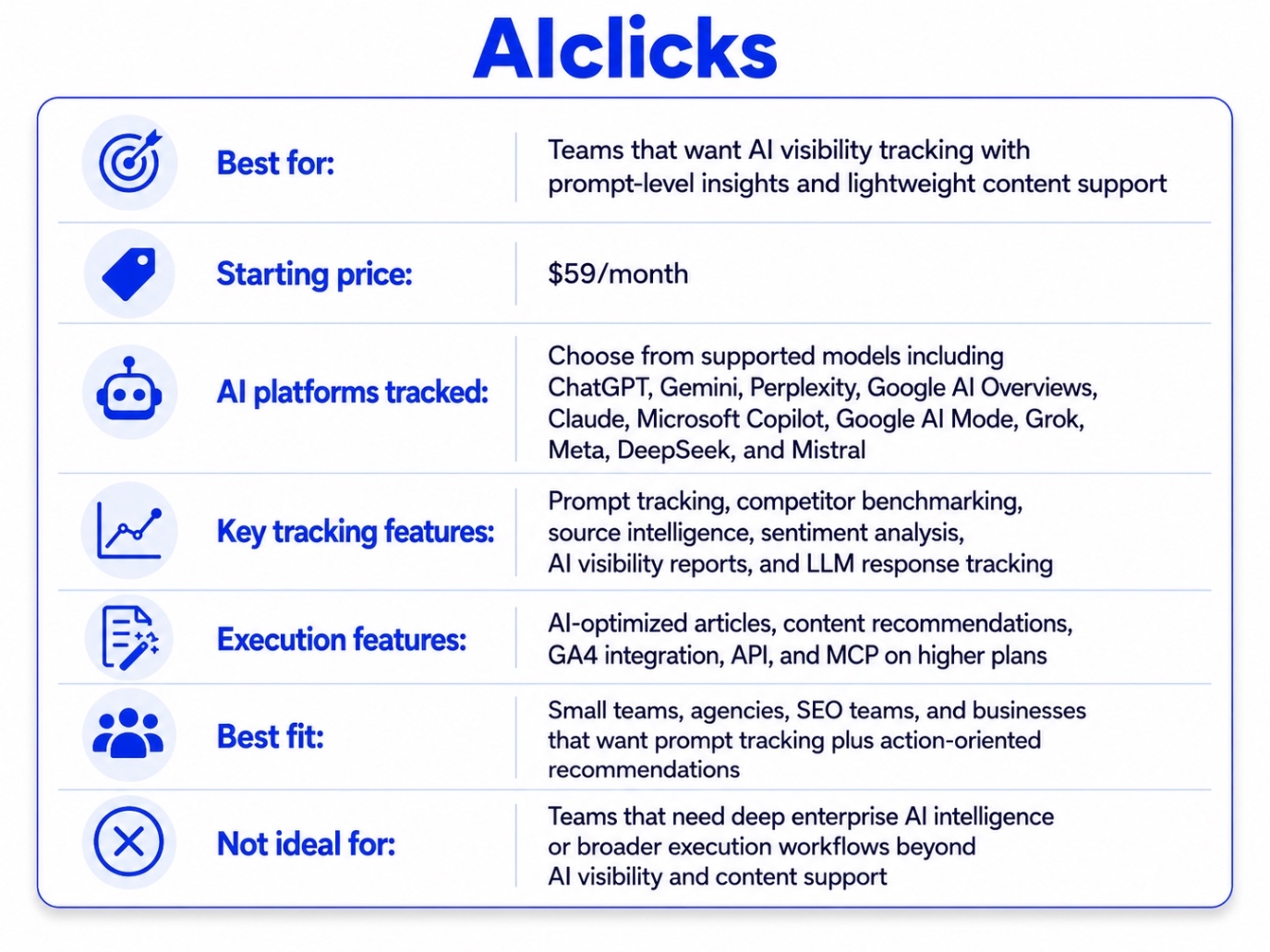
AIclicks is a GEO and AEO platform that helps teams track how their brand appears across AI answers, compare visibility against competitors, and find content actions from prompt-level data.
Key features
- Tracks prompt performance, brand visibility, citations, competitors, and sentiment
- Supports daily tracking across selected LLMs
- Lets teams choose 3 to 6 LLMs depending on the plan
- Includes LLM response limits by plan
- Offers AI-optimized articles on all paid plans
- Adds GA4, API, and MCP integrations on Pro and Business plans
Pros
- Easy entry point for AI visibility tracking
- Daily tracking is available across plans
- Useful for agencies that need prompt-level insights
- Includes AI-optimized article credits
- Higher plans support unlimited websites and countries
Cons
- Starter plan is limited to 30 tracked prompts
- Starter plan supports only 1 website and 1 country
- Model coverage depends on the plan
- Business plan is relatively expensive for smaller teams
- Not as broad as enterprise-first AI intelligence platforms
Pricing
- Starter: $59/month, 30 prompts, 3 LLMs, 1 website, 5 AI articles.
- Pro: $189/month, 150 prompts, 4 LLMs, unlimited websites, 15 AI articles.
- Business: $499/month, 300 prompts, 6 LLMs, unlimited websites, 30 AI articles.
- Enterprise: Custom pricing, custom prompts, all models, unlimited websites, and custom integrations.
AIclicks ratings and reviews
- G2: 4.9/5 rating from 34 reviews.
- Trustpilot: 4.4/5 rating from 10 reviews.
Also read our latest blog on how to audit brand visibility on LLMs and improve AI search.
What features should the best AI SEO rank tracker have?
The best AI rank tracker software should do more than tell you whether your brand appeared once. It should help you understand where you show up, why competitors are winning, which sources influence AI answers, and what to improve next.
Here are the features I’d look for before choosing the best AI SEO rank tracking software:
- Multi-engine tracking: Track visibility across more than one AI platform, such as ChatGPT, Perplexity, Claude, Gemini, Google AI Overviews, or AI Mode. ChatGPT-only tracking can miss where buyers are searching elsewhere.
- Prompt-level tracking: The tool should track real buyer prompts, not just keywords. This includes “best,” “alternative,” “comparison,” “pricing,” and problem-based prompts.
- Brand mentions and citations: A good tracker should separate mentions from citations. Your brand may be named in an answer without your website being cited.
- Competitor visibility: You need to see which competitors appear more often, where they rank, and which prompts they dominate.
- Share of voice: This shows how often your brand appears across a tracked prompt set compared with competitors. It is useful for seeing category-level visibility, not just one-off rankings.
- Sentiment analysis: Visibility is not enough if the answer describes your product poorly or inaccurately. Sentiment helps you understand how AI systems are framing your brand.
- Source tracking: The tool should show which websites, articles, review pages, forums, or third-party sources AI engines are using in their answers.
- Historical trends: AI responses change often, so you need trend data to see whether visibility is improving, declining, or just fluctuating.
- Recommendations: The best tools should explain what to fix next, such as missing pages, weak citations, poor prompt coverage, or competitor-dominated topics.
- Execution features: Tracking is only half the job. A stronger AI rank tracker should help you turn insights into content updates, new pages, optimization tasks, internal links, or GEO recommendations.
Top AI rank tracker should not stop at reporting visibility. It should help your team understand the reason behind that visibility and act on it faster.
How do you set up AI rank tracking for your brand?
AI rank tracking works best when you treat it like a repeatable measurement system, not a one-time ChatGPT check. The goal is to track the prompts your buyers actually ask, compare your brand against competitors, and use the results to improve visibility over time.
Here are the steps I’d follow before trusting the data:
- Pick the right prompts: Start with 25 to 50 prompts your buyers may actually use. Include “best,” “alternative,” “comparison,” “pricing,” “use case,” and problem-based prompts.
- Add direct competitors: Track 3 to 5 competitors that usually appear in the same buying journey. This helps you see whether your visibility is weak overall or only weak against specific brands.
- Choose relevant AI platforms: Do not track every platform just because the tool supports it. Focus on where your audience is likely searching, such as ChatGPT, Perplexity, Claude, Gemini, Google AI Overviews, or AI Mode.
- Track the core visibility metrics: Monitor mentions, citations, average position, share of voice, sentiment, and competitor visibility. Mentions show if you appear, citations show what sources are used, and share of voice shows how often you show up against competitors.
- Review the cited sources: Look at which websites AI engines cite when they mention you or your competitors. This can reveal missing comparison pages, review sites, listicles, community threads, documentation pages, or third-party sources you need to strengthen.
- Fix content gaps: Use the data to update existing pages, create missing BOFU pages, improve product explanations, add clearer comparison content, and strengthen citation-worthy sections.
- Monitor trends over time: AI answers can shift across prompts, platforms, and refresh cycles. Track movement weekly or monthly so you can separate real visibility changes from one-off answer variation.
The real value of AI rank tracking is not just knowing where your brand appears. It is knowing which prompts, competitors, and sources are shaping the answer, then using that insight to improve your visibility.
Final verdict
AI rank tracking is only useful when it helps you decide what to fix next. Start by tracking your highest-intent prompts, compare your brand against 3 to 5 competitors, review the cited sources, and look for patterns in mentions, citations, sentiment, and share of voice.
If you only need monitoring, a standalone AI visibility tool may be enough. But if your goal is to improve rankings, citations, and content visibility across AI search, choose a platform that connects tracking with content optimization, audits, internal linking, and GEO execution.
Frequently Asked Questions
What are the best AI online rank tracking tools available in 2026?
The best AI rank tracker tools in 2026 include Scalenut, Profound, Peec AI, Scrunch AI, Semrush AI Visibility Toolkit, Ahrefs Brand Radar, and AIclicks. Small teams may prefer simpler trackers, while large enterprise teams may need deeper reporting.
Can I track my brand ranking in ChatGPT?
Yes, you can track how your brand appears in ChatGPT using an AI search visibility tracker. A good tool should support brand monitoring, prompt tracking, competitor comparisons, and trend checks, though results may not update in real time.
How is AI rank tracking different from SEO rank tracking?
Traditional SEO tools track webpage search rankings, keywords, and organic traffic. AI rank tracking measures whether your brand appears inside generated answers. Unlike traditional rank tracking, it focuses on mentions, citations, answer position, and traditional SEO rank overlap.
What should an AI rank tracker measure?
A strong AI SEO rank tracking tool should measure mentions, citations, ranking position, share of voice, sentiment, competitors, cited sources, and historical data. These metrics help teams turn data analysis into actionable insights instead of isolated visibility checks.
Is AI rank tracking accurate?
AI rank tracking is useful, but not perfectly fixed because AI answers can change by prompt, platform, location, and timing. Accuracy improves when visibility monitoring uses repeated checks, consistent prompt sets, and source-level review instead of one-off manual testing.
How many prompts should I track?
Start with 25 to 50 prompts across buying intent, comparisons, alternatives, pricing, and problem-aware searches. Use keyword research to find core topics, then rewrite them as natural buyer questions that match your content strategy and sales journey.
Can AI rank trackers improve AI visibility?
Yes, but only if the tool connects tracking with action. The best visibility tools should reveal content gaps, weak citations, source opportunities, and competitor-dominated prompts so teams can improve content optimization, authority signals, and content structure.
What is the best AI search engine ranking tracking tool?
The best choice depends on your workflow. Pick an SEO platform that supports AI visibility, competitor tracking, reporting, and execution if you want fewer disconnected SEO tasks. For digital marketing teams, Scalenut is strongest when tracking and execution both matter.
Are there any good free AI rank tracker?
HubSpot AEO Grader is useful if you want a quick AI visibility snapshot. It can help you understand how your brand appears across AI answer engines, but it is not the same as a full AI rank tracker. For ongoing tracking, you still need a tool that monitors prompts, mentions, citations, competitors, rankings, and visibility trends over time.


.svg)


.webp)