How to Audit Brand Visibility on LLMs and Improve AI Search?
How to audit brand visibility on LLMs: Quick summary
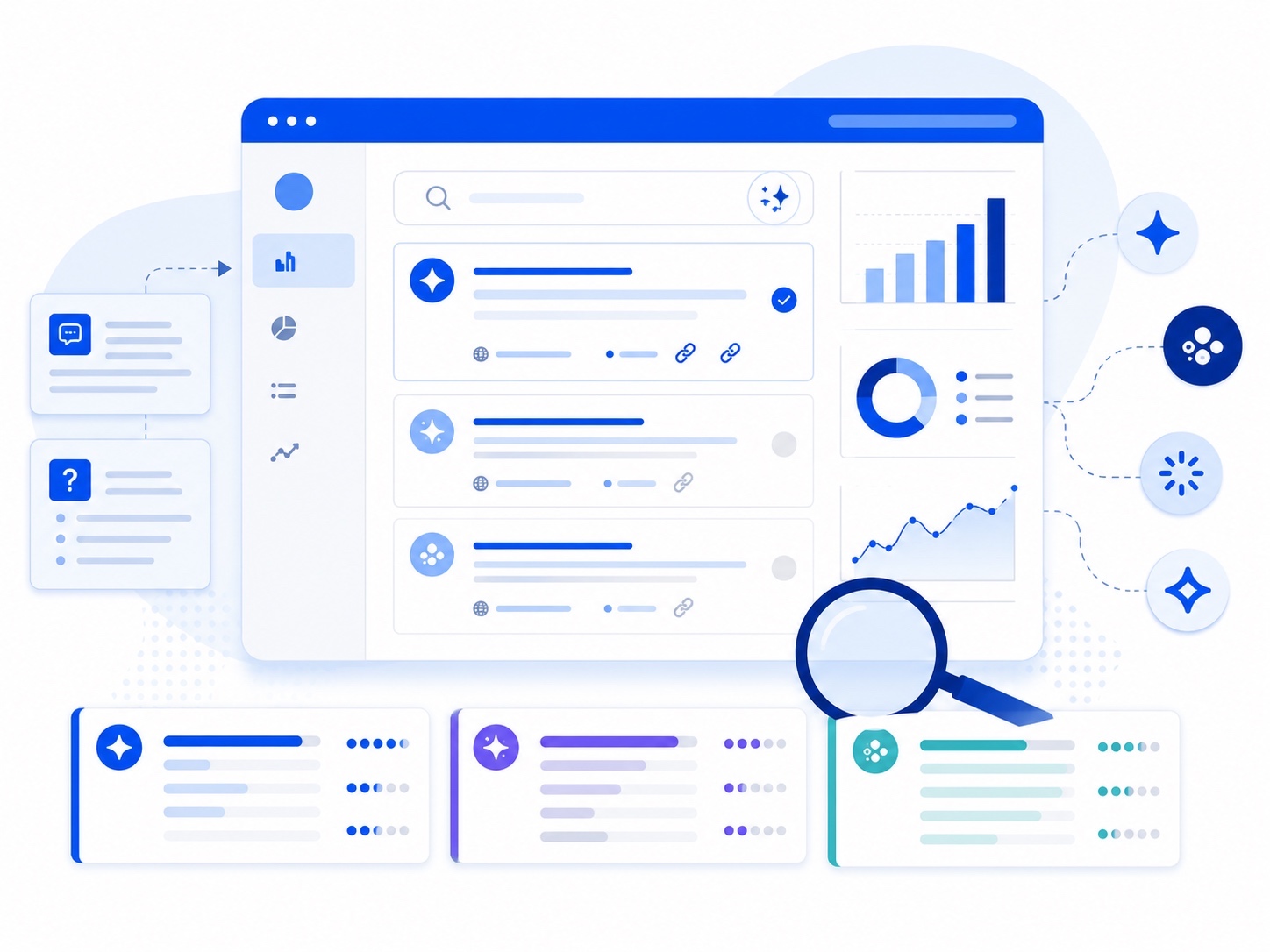
To audit brand visibility on LLMs, start by building a prompt set around real buyer questions. Test those prompts across AI platforms like ChatGPT, Perplexity, Gemini, Claude, and Google AI Overviews, then record whether your brand appears, where it appears, which competitors show up, and which sources are cited.
Next, check the quality of that visibility. Review whether AI responses describe your brand accurately, whether the sentiment is positive, neutral, or negative, and whether cited sources are current and trustworthy. Use these findings to fix unclear content, strengthen third-party mentions, improve citation-worthy pages, and track changes over time.
A buyer opens ChatGPT, Gemini, or Perplexity and asks for the best solution in your category. Your competitors show up. A few review sites get cited. Your brand is either missing, buried, or described in a way that does not fully match what you sell. That is the visibility gap most brands are only starting to notice.
Auditing brand visibility on LLMs helps you see where your brand appears in AI answers, which prompts you are missing from, how competitors are being positioned, and whether AI systems are representing your brand accurately enough to influence buyer decisions.
My goal with this blog is to help you audit your brand visibility more efficiently, so you can improve how your brand shows up in answer engines or strengthen what is already working. So, let’s get started!
What does it mean to audit brand visibility on LLMs?
Auditing brand visibility on LLMs means checking how your brand appears across AI-generated answers, not just whether your website ranks on Google. A proper audit looks at the prompts your buyers may ask, the platforms they use, the competitors that appear, the sources cited, and whether your brand is represented accurately.
Why should brands audit LLM visibility now?
- AI answers are becoming part of the buyer journey: People now use tools like ChatGPT, Perplexity, Gemini, Claude, and Google AI experiences to research products, compare options, and shortlist vendors.
- Search visibility no longer tells the full story: You may rank well on Google but still be missing from AI-generated answers, especially for category, comparison, and recommendation prompts.
- AI responses can shape perception before the click: If an AI answer describes your product incorrectly, misses key features, or recommends competitors instead, buyers may form an opinion before visiting your website.
- Third-party sources matter more: LLMs may use review sites, listicles, forums, directories, publications, and competitor pages to understand your brand. That makes off-site visibility harder to ignore.
- Competitor visibility is easier to miss manually: A brand may not appear often, but it may still win the most valuable prompts, such as “best tools for,” “alternatives to,” or “which software is better for.”
- You need a baseline before improving visibility: Without an audit, it is hard to know which prompts you already win, where competitors are stronger, which sources influence AI answers, and what content needs to be fixed first.
An LLM visibility audit gives you the starting point. It shows where your brand stands today so you can improve the prompts, sources, and content that influence how AI systems represent you.
How do you audit brand visibility on LLMs? (8-step workflow)
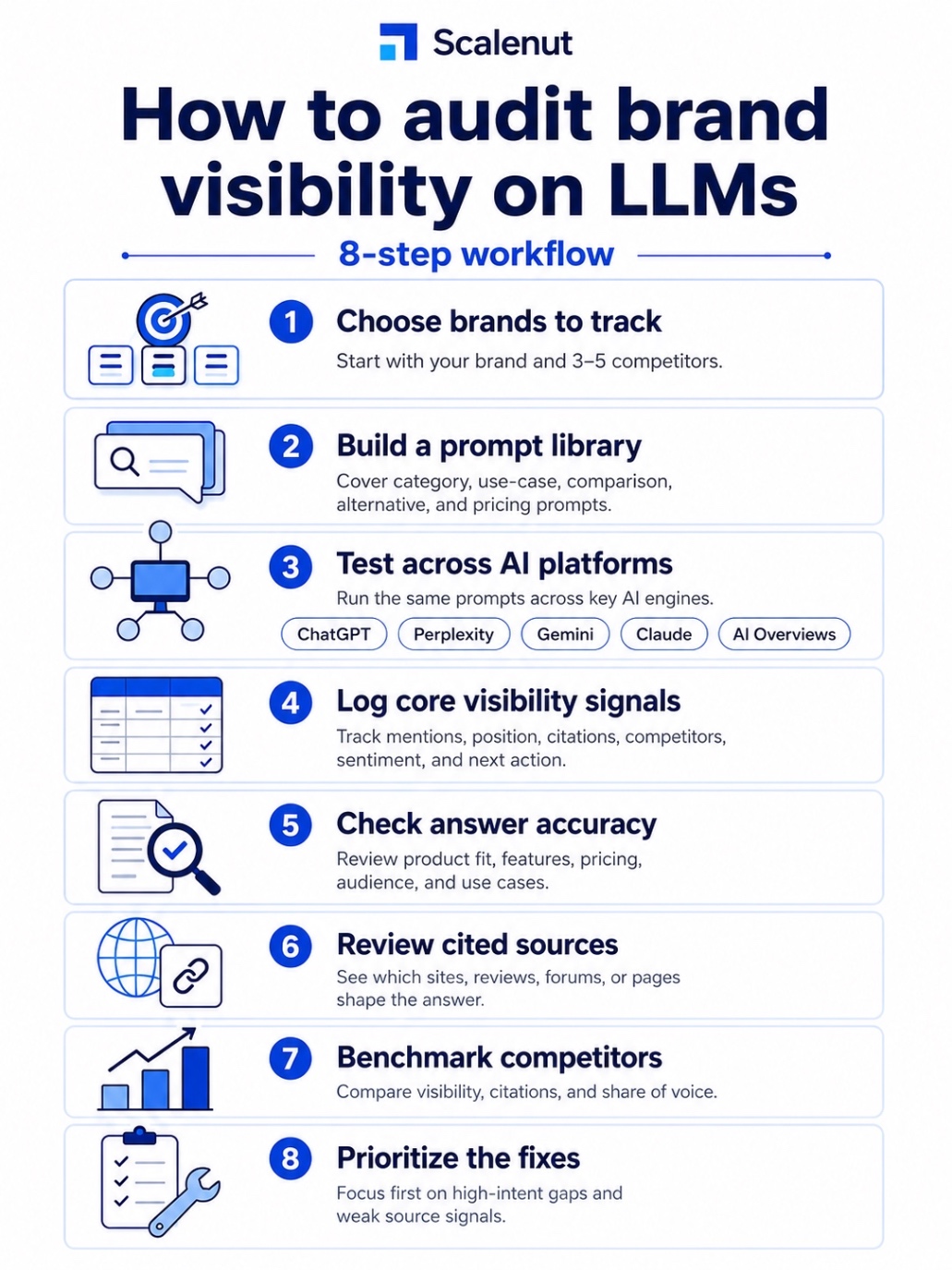
To audit brand visibility on LLMs, start by testing buyer-intent prompts across the AI platforms your audience uses. Then track where your brand appears, how it compares with competitors, which sources are cited, and what needs to be fixed.
Let’s look at these steps in detail:
Step 1: Choose the brands and competitors to track
Start with your brand and 3 to 5 competitors buyers often compare you with.
Include direct competitors, but also watch for review sites, directories, marketplaces, and publishers that appear often in AI recommendations. These sources can shape the answer even when they are not traditional SEO competitors.
Step 2: Build a prompt library around buyer intent
Your prompt set should reflect how buyers ask questions at different stages.
Include category prompts, problem-aware prompts, use-case prompts, comparison prompts, alternative prompts, pricing prompts, and persona-specific prompts. For example, instead of only testing “What is [brand]?”, also test prompts like “best tools for [use case]” or “[competitor] alternatives for small teams.”
This helps you see whether your brand appears only for branded searches or also for discovery and decision-stage prompts.
Step 3: Run the same prompts across multiple AI platforms
Test the same prompt set across ChatGPT, Perplexity, Gemini, Claude, and Google AI Overviews where relevant.
Keep the prompt wording consistent across platforms. If you change the wording, treat it as a separate prompt. This keeps the audit cleaner and makes platform-level differences easier to compare.
Step 4: Record mentions, positions, citations, and competitors
For every response, capture the core visibility signals in a sheet or AI visibility tool.
Track the prompt, platform, brand mention, mention position, competitors mentioned, citations, cited URLs, sentiment, accuracy notes, and next action. This turns the audit into structured data instead of a folder of screenshots.
Step 5: Check how accurately AI describes your brand
Visibility is useful only if the answer is accurate. Check whether the AI response gets your product category, features, pricing, target audience, use cases, and competitor comparisons right. Mark each response as accurate, partially accurate, inaccurate, or unclear.
This matters because a brand can appear in AI answers and still lose trust if the answer gives buyers the wrong impression.
Step 6: Analyze which sources AI is using
When citations are available, review the sources behind the answer.
Look for patterns in the cited URLs. AI platforms may cite your website, competitor pages, review sites, Reddit threads, YouTube videos, directories, or outdated third-party articles. If owned pages are rarely cited, your product, use-case, or comparison pages may need clearer positioning and stronger source-worthy content.
Step 7: Compare visibility against competitors
Compare how often each brand appears, where it appears, whether it gets cited, and which brand is recommended for high-intent prompts.
Do not rely only on mention count. A competitor may appear less often but win more decision-stage prompts. This is where share of voice becomes useful because it shows your visibility against competitors across a defined prompt set.
Step 8: Prioritize the gaps you need to fix
Turn the audit into a fix list. Prioritize high-intent gaps first, especially prompts where buyers ask for recommendations, comparisons, alternatives, or pricing. Common fixes include creating missing category or comparison pages, updating product information, improving entity clarity, adding proof and examples, refreshing third-party profiles, and strengthening pages that should be cited more often.
A strong LLM visibility audit should leave you with more than a visibility score. It should show which prompts you need to win, where competitors are stronger, and what content or source gaps are holding your brand back.
Want to compare manual ChatGPT audits with automated tracking? Read our guide on what are the best tools for tracking brand visibility in ChatGPT?
What should your LLM brand visibility audit template include?
Your audit template should make AI visibility easy to compare across prompts, platforms, and time. Since AI search visibility depends on generated responses instead of fixed search rankings, the goal is to track consistent patterns, not isolated checks.
What to include in your audit sheet
Your sheet should capture the prompt, AI platform, response date, brand mention, mention position, competitors mentioned, citations, cited URLs, source type, sentiment, accuracy notes, priority level, and recommended action.
Also label each prompt by intent, such as branded, category, use case, comparison, alternative, pricing, or problem-aware. This helps you see where your brand appears in the buyer journey and where it drops out.
For source type, use simple labels like owned website, competitor website, review site, publication, Reddit, YouTube, directory, marketplace, or social platform.
How should you score each prompt response?
Use a simple scoring system so the audit is easy to repeat.
- 0: Brand is not mentioned
- 1: Brand is briefly mentioned
- 2: Brand appears in the main answer
- 3: Brand is recommended or strongly positioned
You can also score citations based on whether the answer cites no source, a weak source, a relevant third-party source, or your owned page. For competitive analysis, calculate share of voice by comparing your brand mentions against total mentions across your tracked competitor set.
How often should you repeat the audit?
Re-run the audit after major updates, like new pages, pricing changes, feature launches, new reviews, or stronger competitor visibility. Each audit should answer three things: where you appear, where competitors lead, and what to fix next.
Want to go deeper into the sources behind AI answers? Check out our guide on what is citation tracking in LLMs?
What are the key factors that influence brand visibility in LLMs?
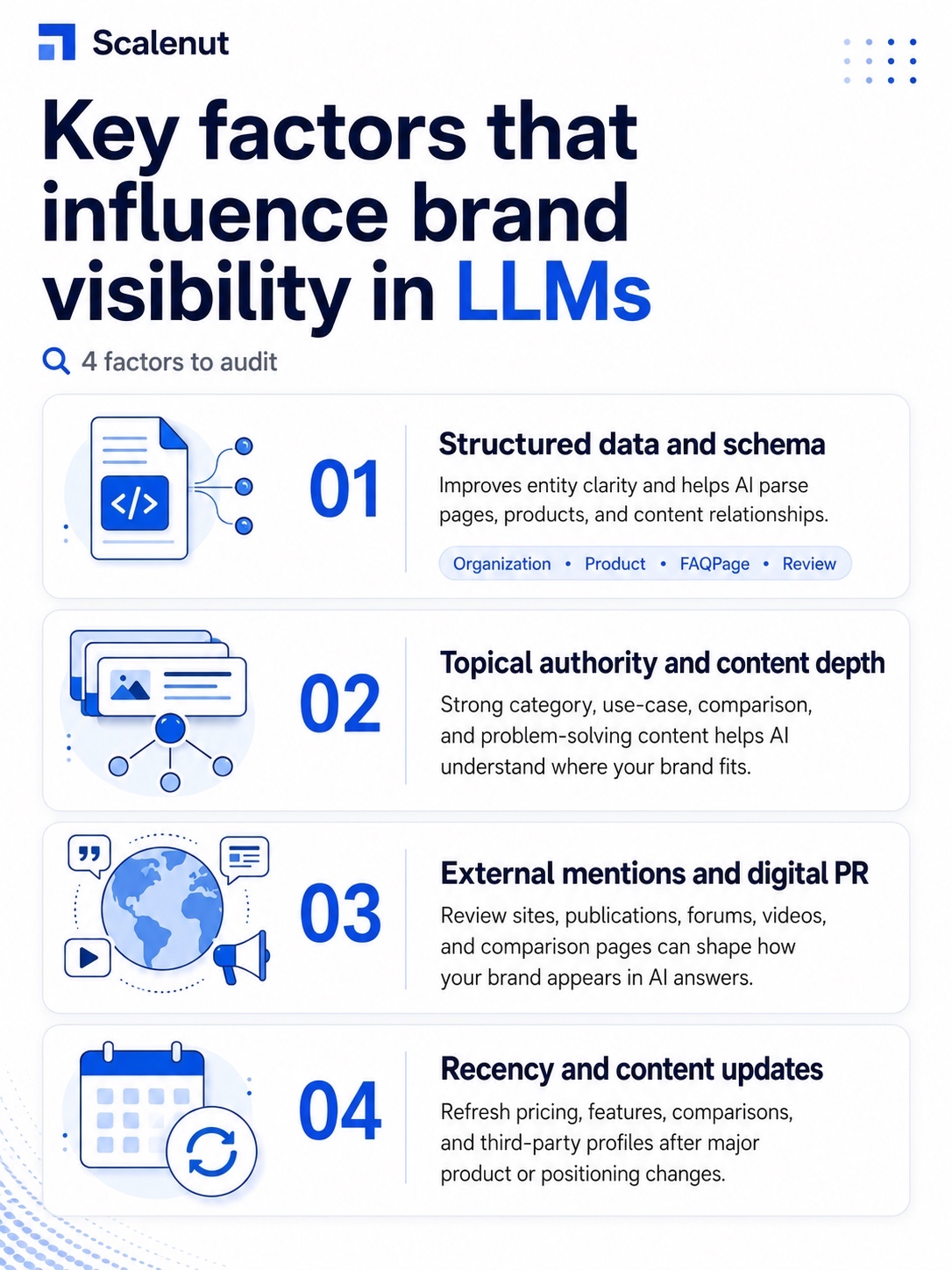
LLM visibility depends on how clearly your brand is understood, how strongly it is connected to relevant topics, and how consistently trusted sources validate that connection.
Here are the key factors to audit.
1. Structured data and schema
Structured data helps search engines understand your pages, entities, products, reviews, FAQs, authors, and organization details more clearly. For LLM visibility, schema is not a direct ranking switch. But it can improve entity clarity by making your brand, product category, and content relationships easier to parse.
Use schema types that match the page, such as Organization, Product, SoftwareApplication, FAQPage, Review, Article, BreadcrumbList, and WebPage.
2. Topical authority and content depth
LLMs need enough clear content to connect your brand with the right category, use cases, problems, and audience.
This does not mean creating thin pages for every prompt variation. It means building strong category, use-case, comparison, alternative, and problem-solving content that gives AI systems enough context to understand where your brand fits.
3. External mentions and digital PR
Your website is only one part of the signal. AI answers can also be shaped by review sites, listicles, publications, forums, communities, videos, directories, and comparison pages.
During the audit, check where your brand is mentioned outside your site, how it is described, and whether those descriptions match your current positioning.
4. Recency and content updates
Outdated information can weaken AI visibility and accuracy. AI systems may pick up old pricing, retired features, outdated comparisons, or stale third-party descriptions.
Review your product pages, comparison pages, help docs, review profiles, listicle mentions, and high-performing posts after major product, pricing, or positioning changes.
Strong LLM visibility comes from clear owned content, structured entity signals, trusted third-party validation, and consistent updates across the sources AI systems may rely on.
Want to learn how to strengthen the signals behind these factors? Read our guide on how to improve brand mentions in LLMs and win AI search.
How do you build an LLM audit prompt set?
Build your prompt set around how buyers actually ask questions before they discover, compare, and choose a product. Do not rely only on branded prompts, because they will not show whether your brand appears in broader category or decision-stage answers.
Here are the prompt types to include.
- Branded prompts: Use these to check whether AI systems understand your brand correctly. Test prompts like “What is [brand]?” or “What does [brand] do?” Look for accuracy, positioning, outdated details, and missing product context.
- Category prompts: Use these to see whether your brand appears when buyers ask for tools, products, or companies in your category. For example, “best [category] tools for [audience].”
- Problem-aware prompts: These reveal whether AI connects your brand to the problems you solve. For example, “how to solve [problem] without [legacy approach].”
- Use-case prompts: These show whether your brand appears for specific jobs buyers want done. For example, “best tools for [use case]” or “software for [team workflow].”
- Feature prompts: Use these to test visibility around important product capabilities. For example, “tools with [feature] for [audience].”
- Alternative prompts: These are important for BOFU visibility. Test prompts like “best alternatives to [competitor]” or “[competitor] alternatives for [use case].”
- Competitor comparison prompts: Use these to see how AI positions your brand against direct competitors. Test “[brand] vs [competitor]” and “[competitor A] vs [competitor B] for [specific need].”
- Pricing and value prompts: These show whether your brand appears when buyers care about budget, ROI, or plan fit. Test prompts like “affordable [category] tools for small teams” or “best value [category] software.”
A strong prompt set should cover the full buyer journey, not just the queries where your brand is already known. The more closely your prompts mirror real buyer questions, the more useful your audit will be.
Want to track which buyer prompts actually trigger brand mentions? Read our guide on the best AI search monitoring tools in 2026.
What should an LLM brand visibility audit measure?
An LLM brand visibility audit should measure whether your brand appears, how strongly it appears, how accurately it is represented, and which sources shape the answer. The goal is to move beyond simple mention tracking and understand your real presence across AI-generated responses.
Here are the metrics to track.
- Brand mention frequency: Track how often your brand appears across your prompt set. Segment this by prompt type so you can see whether you show up for branded, category, use-case, comparison, and alternative prompts.
- Mention position: Record where your brand appears in the answer. Being listed first, included in the top recommendations, or mentioned only at the bottom can mean very different things.
- Citation rate: Track how often AI platforms cite a source when mentioning your brand. Also note whether the citation points to your website, a third-party page, or a competitor-owned source.
- Share of voice: Compare your brand mentions against total mentions across your tracked competitors. This shows whether your brand is gaining or losing visibility within the category, not just in isolation.
- Sentiment: Record whether the answer describes your brand positively, neutrally, negatively, or with mixed context. This helps you catch weak positioning even when visibility looks good.
- Accuracy of brand description: Check whether AI gets your product category, features, pricing, use cases, audience, and limitations right. Visibility is not helpful if the answer misrepresents your brand.
- Source and citation quality: Review whether cited sources are current, relevant, trustworthy, and aligned with your positioning. A citation from an outdated listicle or weak third-party page may explain why AI answers are inaccurate.
- Competitor presence: Track which competitors appear, how often they appear, where they rank in the answer, and what they are recommended for. This shows the prompts where competitors have stronger AI visibility.
The best audit combines visibility, accuracy, source quality, and competitive context. That is what helps you understand not just whether your brand appears, but whether AI systems are representing it well enough to influence buyers.
What should you do after your LLM visibility audit?
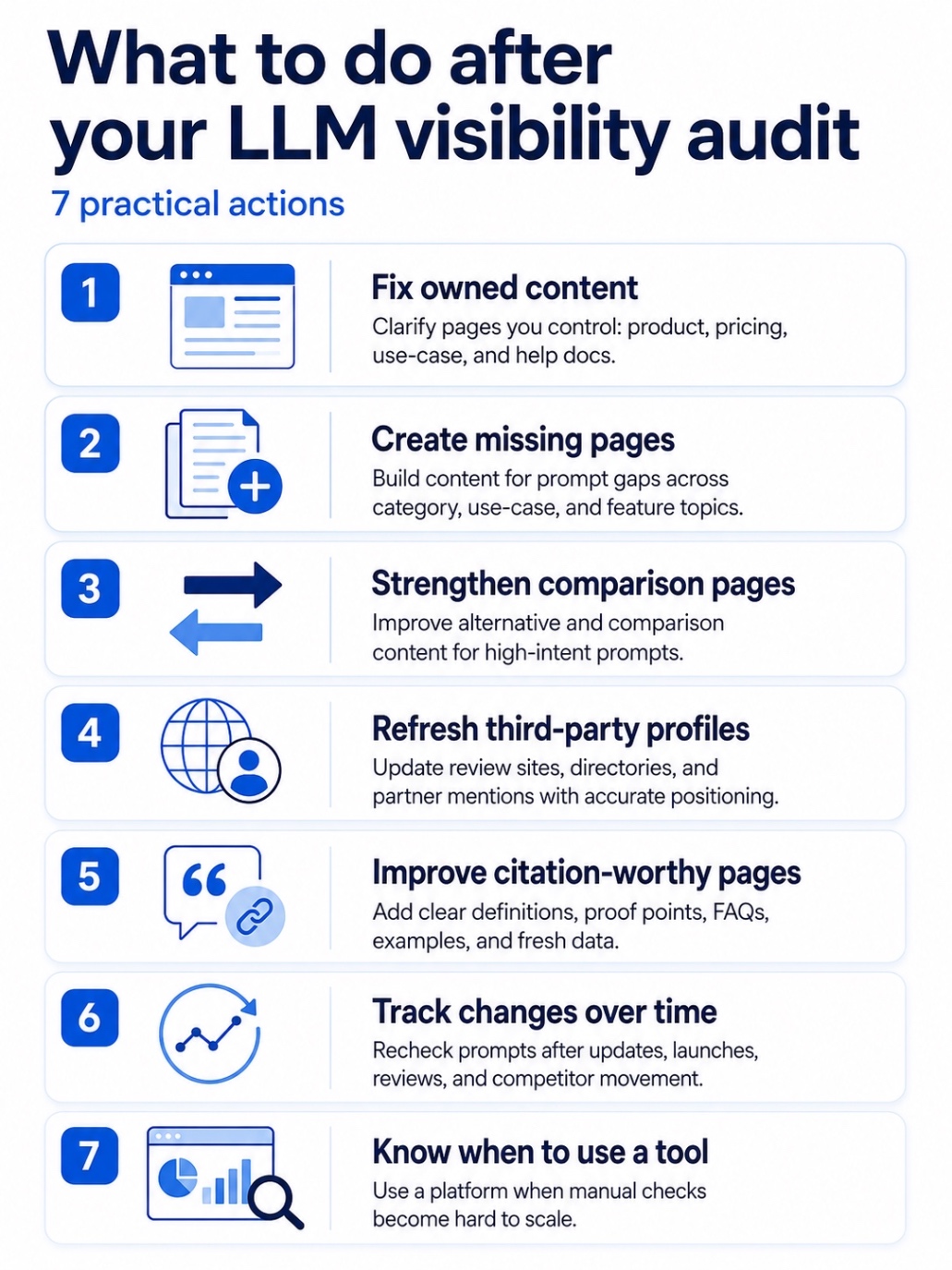
After the audit, turn every visibility gap into a clear fix. Start with prompts where your brand is missing, misrepresented, outranked by competitors, or supported by weak sources.
Here are the next steps.
1. Fix unclear owned content
Start with pages you control, such as your homepage, product pages, feature pages, use-case pages, comparison pages, pricing page, and help docs.
Make sure they clearly explain what your product does, who it is for, which problems it solves, and how it differs from competitors. Google also recommends creating helpful, reliable content for people first, which aligns with making owned content clearer and more useful.
2. Create pages for missing prompt categories
Look at the prompts where your brand did not appear.
If you are missing from category, use-case, problem-aware, or feature-based prompts, create pages that directly answer those questions. For example, if AI does not mention you for “best tools for [use case],” you may need a stronger use-case page around that workflow.
3. Strengthen comparison and alternative content
If competitors appear often in BOFU prompts, improve your comparison and alternative pages.
Cover use cases, trade-offs, pricing fit, limitations, migration concerns, and when each option makes sense. This gives AI systems clearer context for comparison-style answers.
4. Update third-party profiles and review sites
AI answers can be shaped by sources outside your website, including review platforms, directories, listicles, partner pages, community discussions, and publications.
Check whether those sources describe your brand accurately. Update profiles where possible and work on earning fresh mentions in sources your audience is likely to trust.
5. Improve citation-worthy pages
If AI mentions your brand but does not cite your owned pages, improve the pages that should support those answers.
Add clear definitions, product details, use cases, proof points, FAQs, examples, comparison context, and updated data. Make each page easier to quote, summarize, and trust.
6. Track changes over time
Do not treat the audit as a one-time project.
Rerun priority prompts after new pages, pricing changes, feature launches, new reviews, or stronger competitor visibility. Track whether mentions, citations, accuracy, sentiment, and share of voice improve.
7. Decide when to use a tool
Manual audits work for a first baseline or a small prompt set.
But once you need to monitor multiple platforms, competitors, prompt groups, citations, and changes over time, a tool is more practical. It helps you turn scattered checks into repeatable visibility tracking.
The goal after an LLM visibility audit is not just to increase mentions. It is to help AI systems understand your brand clearly, cite better sources, and represent you accurately when buyers are comparing options.
Trying to choose the right platform after your first audit? Read our guide on how to choose an AI brand visibility tool.
What are the common mistakes to avoid during an LLM visibility audit?
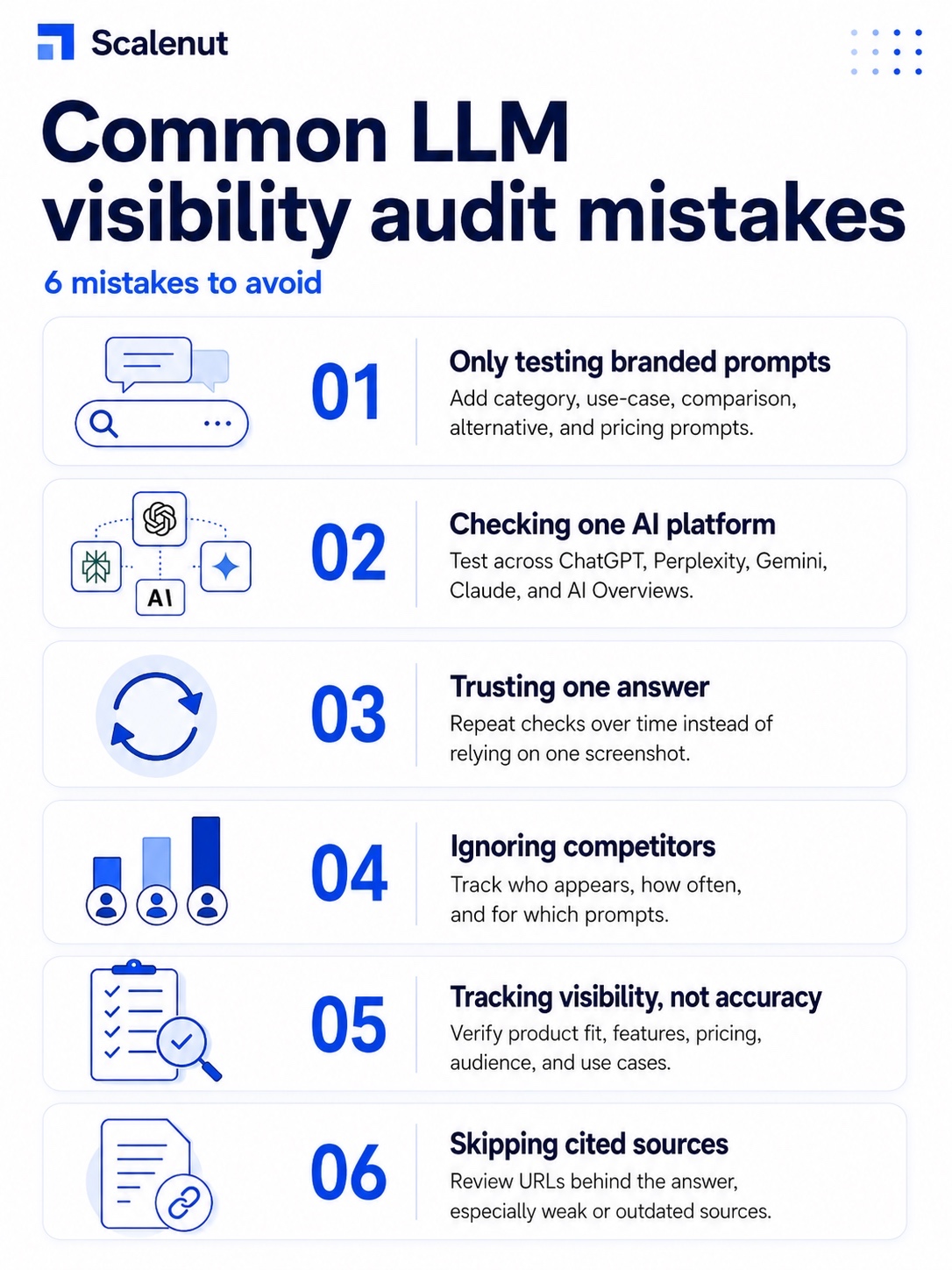
The biggest mistake is treating an LLM visibility audit like a one-time rank check. AI answers can change by platform, prompt phrasing, timing, and source availability, so your audit needs repeated checks, competitor context, and accuracy review.
Here are the mistakes to avoid.
1. Testing only branded prompts
Branded prompts show how AI describes your company, but they do not show whether buyers discover you.
Include category, use-case, problem-aware, comparison, alternative, and pricing prompts to see where your brand appears across the buyer journey.
2. Checking only one AI platform
Visibility in ChatGPT does not mean you are visible in Perplexity, Gemini, Claude, or Google AI Overviews.
Run the same prompt set across multiple platforms so you can compare where your brand appears, where it is missing, and where competitors show up instead.
3. Treating one answer as final proof
One AI answer is not enough to prove visibility.
Run repeated checks and look for patterns over time. This gives you a more reliable picture than a single screenshot because AI responses can vary across phrasing, context, timing, and platform behavior.
4. Ignoring competitor mentions
A brand mention has limited value without competitive context.
Track which competitors appear, how often they appear, where they appear, and what they are recommended for. This shows whether your brand is leading or only showing up in low-intent prompts.
5. Tracking visibility but not accuracy
Being mentioned is not always a win.
Check whether AI describes your product category, features, pricing, use cases, audience, and limitations correctly. If the answer is inaccurate, visibility can create confusion instead of demand.
6. Forgetting to review cited sources
When citations are available, review the URLs behind the answer.
If AI relies on outdated listicles, weak third-party profiles, competitor-owned pages, or old product pages, the fix may involve source cleanup, third-party updates, or stronger citation-worthy content.
Avoiding these mistakes turns the audit from a visibility check into a practical action plan. You will know where your brand appears, where competitors are stronger, and what needs to change before the next audit.
Want to understand whether AI mentions are helping or hurting your reputation? Read our guide on LLM brand sentiment and how to track it.
How does Scalenut help you audit and improve brand visibility on LLMs?
Scalenut helps turn an LLM visibility audit from a manual spreadsheet exercise into an ongoing tracking and optimization workflow. It helps you see where your brand appears, where competitors are stronger, which prompts you are missing, and what content actions to prioritize next.
Here is how Scalenut helps:
- Track AI brand presence: Monitor brand mentions, prompt coverage, visibility trends, Visibility Score, Average Position, and Share of Voice across AI responses.
- Find prompt and topic gaps: Identify the prompts, topics, and opportunity areas where your brand is missing or underrepresented.
- Benchmark against competitors: Compare your visibility with competing brands using signals like share of visibility, competitor mentions, and relative positioning.
- Review citations and response context: Use Prompt Insights to analyze rank, mentions, full AI response context, and source citations behind the answer.
- Connect insights to execution: Use visibility data to decide which pages to create, refresh, optimize, or strengthen for better AI search presence.
Want expert help turning your audit into a clear action plan? Book a free AI visibility strategy call with Scalenut to find where your brand is missing, which competitors are showing up, and what to fix next.
Final Thoughts
Auditing your brand’s presence in LLMs gives you a clearer view of how AI search engines understand, cite, and compare your brand. Start with buyer-intent prompts, track mentions, citations, competitors, sentiment, and accuracy, then identify where your content or external signals need work.
The goal is not just brand awareness. It is to build a repeatable LLM tracking process that shows what changed, why it changed, and what to fix next. Whether you use a spreadsheet first or move to an AI visibility platform, keep the audit focused on prompts that influence real buyer decisions.
Frequently Asked Questions
How do you build a prompt library around buyer intent?
Build prompts around the questions buyers ask before they discover, compare, and choose a product. Include branded, category, use-case, problem-aware, comparison, alternative, pricing, and persona-specific prompts so you can measure visibility across the full buyer journey.
Which AI platforms should you include in the audit?
Start with ChatGPT, Perplexity, Gemini, Claude, and Google AI Overviews or AI Mode. These platforms can surface different brands, citations, and recommendations, so testing only one platform gives you an incomplete view of your brand’s AI visibility.
What are the best steps to audit my brand’s visibility on large language models like ChatGPT and Gemini?
Start by choosing your brand, competitors, AI platforms, and buyer-intent prompts. Then record mentions, position, citations, sentiment, accuracy, and competitor presence. Finally, review source patterns and prioritize fixes for prompts where your brand is missing or misrepresented.
How can I check whether large language models accurately understand and represent my brand?
Ask branded, category, use-case, comparison, and alternative prompts, then review how the answer describes your product, audience, features, pricing, strengths, and limitations. Mark responses as accurate, partially accurate, inaccurate, or unclear so you can spot recurring issues.
How often should I perform a brand visibility audit on LLMs, and what signals the need for one?
Run a full audit monthly and check priority prompts weekly if AI visibility is a key channel. Re-audit after pricing changes, feature launches, new comparison pages, brand repositioning, major reviews, competitor movement, or repeated inaccurate AI answers.
Are there specific questions I should ask LLMs to test their awareness and perception of my brand?
Yes. Ask questions like “What does [brand] do?”, “Best tools for [use case],” “[brand] vs [competitor],” “Alternatives to [competitor],” and “Is [brand] good for [audience]?” These reveal awareness, positioning, sentiment, and competitive context.
How do LLM-generated search results differ from traditional SEO results in representing my brand?
Traditional SEO usually shows ranked links, titles, snippets, and pages users can compare. LLM-generated answers summarize information into a direct response, often combining multiple sources, which means your brand may be mentioned, omitted, cited, or misrepresented before the click.
How can I interpret LLM responses to determine if my brand reputation is positive, neutral, or negative?
Look at the language used around your brand. Positive responses recommend you or highlight strengths. Neutral responses only describe you. Negative responses mention limitations, weak fit, complaints, or competitor advantages. Track sentiment by prompt type to find reputation patterns.
What are the best tools for measuring brand visibility in LLMs?
The best tools help track mentions, citations, position, sentiment, share of voice, competitors, and prompt-level trends across AI platforms. Scalenut is a strong option because it connects AI visibility tracking with content optimization, prompt gaps, and execution workflows.


.svg)


.webp)