.jpg)
AI Search Volatility: How Brands Can Stay Visible?

Key Highlights
- AI search volatility refers to the frequent and unpredictable changes in how your brand appears in AI-generated answers.
- Unlike traditional SEO, where rankings are more stable, AI responses can change from one query to the next due to factors like model updates and personalization.
- Recent studies show that more than half of sources cited in AI answers can change within a single month, highlighting the instability of AI search visibility.
- Managing this volatility requires a new approach, including continuous prompt tracking and analyzing performance across different search platforms.
- Specialized SEO tools are emerging to help you monitor these fluctuations and maintain your brand's presence in AI responses.
Have you noticed your brand's presence in Google Search and other AI engines seems to change almost daily? You're not alone. This constant fluctuation is a new challenge called AI search volatility. Unlike the more predictable world of traditional search, AI search visibility can be inconsistent, making it difficult to track your performance.
Understanding why these changes happen is the first step toward building a strategy that ensures your brand stays visible in this evolving landscape.
What is AI Search Volatility?
AI search volatility refers to the unpredictable changes in how your brand appears, is positioned, or cited in AI-generated answers on platforms like Google’s AI Overviews, ChatGPT, and Perplexity. Your brand might be a top recommendation one day and missing the next for the same question. This instability is typical of current AI engines.
Volatility affects not just your presence but also how you're featured, how often you're mentioned, whether you’re highlighted as a main choice or just one of many, and if you get a direct link. Unlike traditional search results that change gradually, AI responses are highly unstable, making digital visibility more challenging to manage.
What Makes AI-Powered Search More Volatile Than Traditional Search Engines?
If you're used to traditional SEO, you might be wondering, “What causes AI search results to change so frequently?” Google rankings usually shift only with major algorithm updates, offering stability. In contrast, generative AI models are probabilistic and introduce randomness to avoid repetitive answers, causing frequent changes. As a result, your appearance can vary from query to query, making single data points unreliable.
How Does AI Impact the Volatility of Search Rankings on Google?
AI greatly increases the volatility of search visibility on Google, especially through features like AI Overviews. These summaries appear at the top of results and often answer users’ questions directly, reducing clicks on traditional links. The content and sources in AI Overviews change frequently, so your site’s inclusion isn’t guaranteed, even if your organic rankings are stable.
This adds new competition and uncertainty: even with a high ranking, the AI might feature competitors or provide answers that make your link unnecessary. You now need to manage both traditional search rankings and your presence in AI responses.
What Drives Fluctuations in AI Search Rankings?
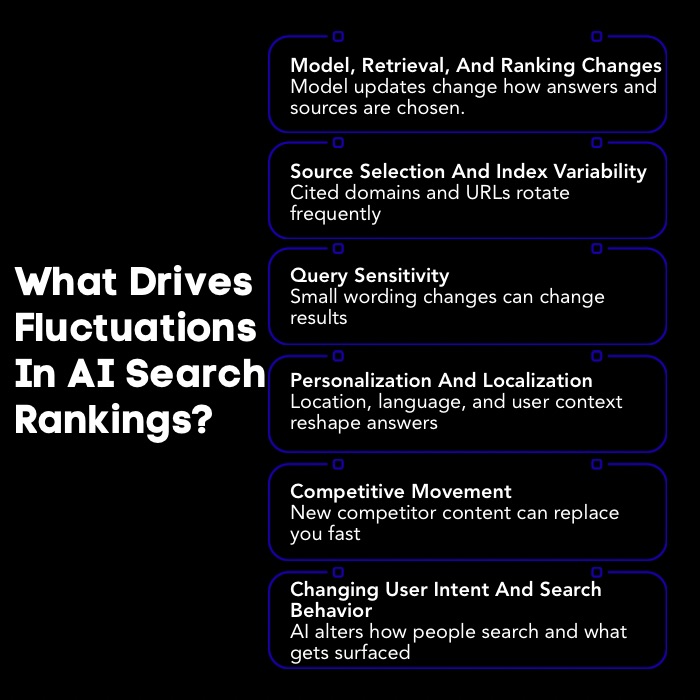
The constant changes you see in AI search results are driven by a mix of technical factors, user context, and competitive dynamics. Understanding these drivers is key to effective search optimization in the age of AI. Factors range from the AI model's internal changes to the specific user's location and search history. The following sections will break down the primary causes of this volatility.
1. Model, Retrieval, and Ranking Changes
A key reason for volatility is that AI engines are frequently updated. Each retraining can change how the model interprets questions, selects authoritative sources, and generates responses. As a result, your brand’s AI visibility score can fluctuate week to week, even without any changes on your part.
Technical updates, like adjustments to content similarity calculations, information retrieval methods, and relevance thresholds, also impact rankings. Additionally, AI platforms may use both static training data and live web searches, so the same query might yield different answers and sources at different times.
2. Source Selection and Index Variability
Another major source of volatility is how AI platforms select sources. Even with identical prompts, the system may pull from entirely different websites each time, causing frequent changes in cited URLs.
This makes visibility tracking difficult; your brand could be featured one day and swapped out for a competitor the next. Since AI continually updates its sources to reflect new information and perspectives, your content is always competing against an ever-changing set of references with every query.
3. Query Sensitivity
AI search engines are highly sensitive to how queries are phrased. Even minor wording changes can yield dramatically different results. For example, "what's a good CRM?" returns broad options, while "enterprise CRM deployment options" surfaces specialized tools. This sensitivity reflects the platform’s effort to interpret user intent, which varies with each query type: informational queries produce definitions; transactional ones show vendors and products.
Because interpretation isn’t always consistent, small changes in phrasing can make your brand appear, shift context, or disappear from results. Understanding how users phrase relevant topics is crucial for visibility.
4. Personalization and Localization
AI results aren’t one-size-fits-all. Personalization is key; AI search platforms tailor responses based on user context, such as search history and login status. Localization also matters: a query like "best accounting software" in London will highlight UK vendors, while the same question in New York features US companies.
The AI adapts answers using regional context, currency, and local business practices. These layers of personalization and localization mean two users can ask identical questions and get different results, making brand visibility across markets and segments more complex.
5. Competitive Movement
Your brand’s visibility in AI search engines depends not only on your content, but also on competitor activity. When competitors release new reports, gain media coverage, or update their sites, AI systems may shift the sources they use. In competitive markets, this creates ongoing volatility. Effective competitor tracking is essential; studies show most pages that disappear later resurface, highlighting how quickly rankings can change.
Building strong topical authority helps your brand remain a reliable source for AI systems, maintaining visibility despite new competitor content. Competitive intelligence is therefore a key part of your strategy.
6. Changing User Intent and Search Behavior Patterns
AI is reshaping user intent and search behavior. People now rely on AI for complex research, not just simple keyword searches. AI synthesizes information, compares perspectives, and streamlines research, changing how users find answers. While Google searches are still popular, tools like ChatGPT are becoming part of the process. Google’s AI Overviews often answer questions directly, reducing website visits, a trend you may notice in your analytics.
As a result, content strategies must go beyond keywords. Users interact with AI through conversations, follow-up questions, and real-time refinements. To stay visible in AI-driven results, your content must address more complex and conversational queries.
How Can You Manage AI Search Volatility With a Practical Workflow?
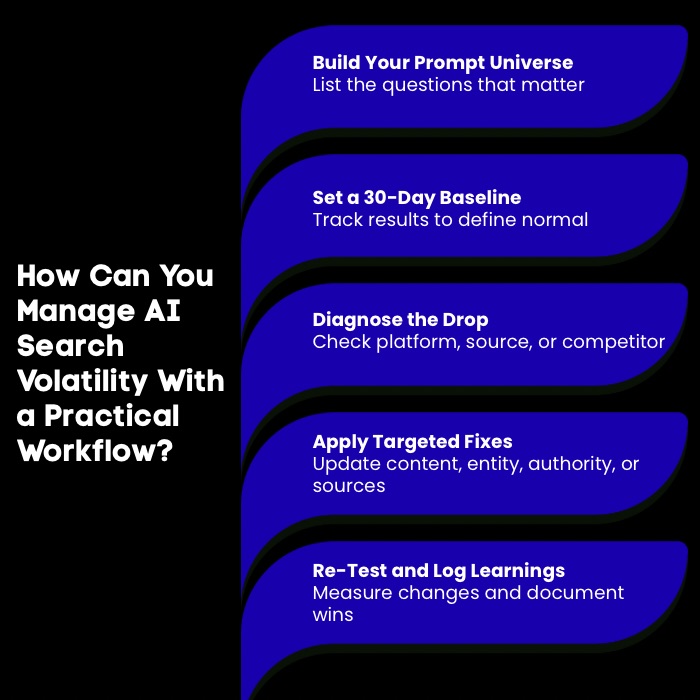
Managing AI search volatility is challenging, but a structured workflow simplifies it. Instead of resisting change, build systems that match AI’s probabilistic nature. A practical workflow helps diagnose performance drops, identify causes, and apply targeted fixes. The steps below show how to make volatility a manageable part of your strategy.
Step 1: Build Your Prompt Universe
The first step is to create a "prompt universe," which is a comprehensive set of questions and phrases your target audience might use when searching for solutions you offer. Think beyond simple keywords and consider the full range of conversational queries people might ask on different AI search platforms.
This universe should include a mix of prompt types to cover the entire customer journey. Your list should include:
- Informational queries (e.g., "What is CRM software?")
- Comparative queries (e.g., "Compare CRM A vs. CRM B")
- Transactional queries (e.g., "best CRM for a small business")
Once you have this list, you can begin systematic prompt tracking. This collection of prompts becomes the foundation for measuring your AI search visibility over time. It allows you to monitor how your brand appears for the questions that matter most to your business.
Step 2: Establish a 30-Day Baseline
After creating your prompt universe, establish a performance baseline. Because AI results can fluctuate, a single-day snapshot isn’t enough. Collect data over a period like 30 days to gauge typical visibility. Run your prompts through your chosen AI platforms daily or weekly: an AI visibility tracker can automate this. Track key metrics such as brand mentions, citations, and answer positions.
This 30-day baseline helps you separate normal fluctuations from real performance drops. Unlike Google Search Console’s stable trends, this method accounts for AI’s volatility and gives you a clearer view of your average performance.
Step 3: Diagnose Drops (Platform vs Source vs Competitor)
Once you have a baseline, you can start diagnosing any drops in your AI search performance. When you notice a dip in visibility, the cause usually falls into one of three categories: a platform-wide change, an issue with your source URLs, or a move by a competitor.
A systematic diagnosis helps you pinpoint the problem. For example, did your visibility drop on all AI platforms or just one? This could indicate a platform-specific algorithm change. Did the AI stop citing a specific page on your site? This might point to a content issue. Or did a new competitor suddenly start appearing? This signals a shift in the competitive landscape.
Step 4: Execute Fixes (Content, Entity, Authority, Sources)
After diagnosing the cause of a visibility drop, the next step is to execute targeted fixes. Your actions will depend on your diagnosis and should focus on strengthening the signals that AI models use to determine relevance and authority.
Your plan of action might include:
- Content: Refresh or update content to better match user intent or improve clarity.
- Entity: Strengthen entity signals across the web to solidify your brand's identity.
- Authority: Build topical authority by creating comprehensive content clusters.
- Sources: Work on getting your brand mentioned in the sources the AI is already pulling from.
Step 5: Re-Test and Document Learnings
The final step is to re-test and document your results. After making changes, continue tracking visibility to see if your adjustments worked. Did visibility improve for your target prompts? Use these insights to refine your strategy. Documenting what actions led to positive outcomes helps your team create a playbook for managing volatility.
Building an internal knowledge base ensures faster, more effective responses to future issues. This ongoing process turns reactive fixes into a proactive strategy, building valuable institutional knowledge and giving your brand an edge on AI platforms.
How To Reduce Volatility Risk in AI Answers?
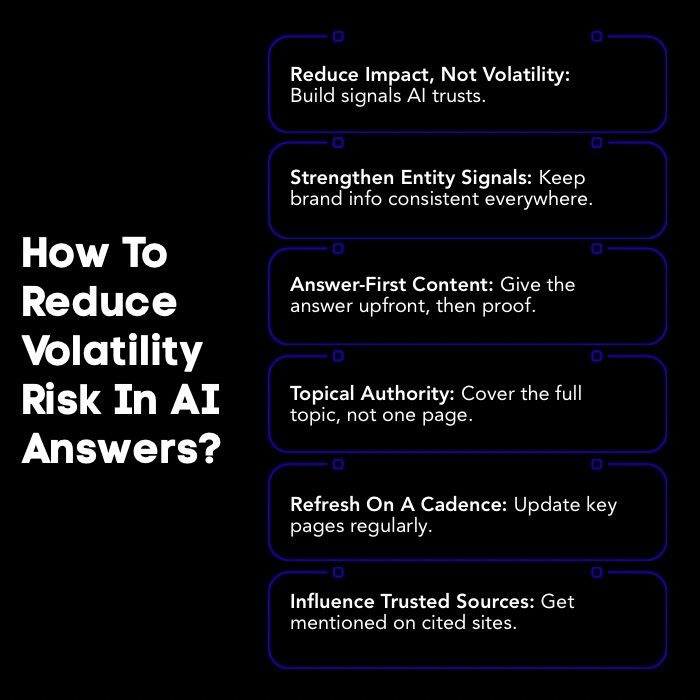
While you can’t eliminate AI search volatility, you can reduce its impact on your brand visibility. The key is making your brand and content a reliable, authoritative choice for AI-generated answers. Focus on long-term strategies to build a strong foundation and lower volatility risk.
The following tactics will help strengthen your brand’s presence and improve consistency in AI responses.
1. Strengthen Entity Signals Across The Web
One of the best ways to reduce volatility is to strengthen your entity signals. An "entity" is a clear concept like your brand, products, or key people. AI uses these signals to gauge your expertise. To boost them, keep your brand information consistent and connected across the web, and not just on your site, but also on other platforms.
Key steps include ensuring consistent brand mentions on reputable sites and building profiles on knowledge panels and sources like Wikidata. A clearer entity helps AI identify and include you in relevant answers, making your visibility more stable and predictable.
2. Publish Answer-First, Source-Backed Content
How you structure your content affects its chances of being picked up by AI. Use an "answer-first" format: start with a direct answer to the user's question, then provide supporting sources, data, and examples.
Tips include using clear question-and-answer headings and citing authoritative sources. Content optimization tools can help with this structure. Making answers easy to find and verify boosts your chances of your URL being used by AI, improving your AI visibility score.
3. Build Topical Authority, Not Single-Page Wins
Relying on a single page to rank for a high-value term is risky in the AI era. Building topical authority is a stronger strategy: create comprehensive content clusters that cover your subject in depth, not just individual keywords. Demonstrating expertise across a topic makes your brand more likely to be seen as authoritative by AI models, helping you maintain visibility across many related queries.
This approach shifts content optimization from single pages to your entire ecosystem, making your position more resilient against fluctuations in AI-driven search.
4. Refresh Content on a Cadence That Matches AI Retrieval Behavior
Fresh content is important for AI models, especially those using live web retrieval. To benefit, set a regular schedule for reviewing and updating key content.
Focus on high-priority pages losing visibility instead of rewriting everything. Update frequency depends on your industry and competition, but reviewing top pages monthly or quarterly is a solid starting point. Aligning updates with AI retrieval patterns helps maintain search rankings and visibility in AI-generated answers.
5. Influence The Sources AI Pulls From
To boost your visibility, influence the sources AI engines use. AI models pull information from various sites to generate answers. If your brand is mentioned on these trusted pages, you increase your chances of being included in AI responses.
Start by identifying websites frequently cited for your target topics through manual research or AI visibility tools. Once you have a list, pursue strategies like guest posting, digital PR, or partnerships to get your brand featured. By placing your brand on pages AI models already trust, you position yourself for inclusion in answers, even if your own site isn’t directly cited.
What Are the Top AI Visibility Tools That Help Track Volatility at Scale?
Manually tracking AI search volatility is nearly impossible for large organizations. New AI visibility tools automate this process, monitoring your presence in AI-generated answers across platforms. Unlike traditional rank trackers, these SEO tools offer continuous visibility tracking, competitive analysis, and source identification. They help manage volatility at scale and turn data into actionable insights.
Here are the top tools available today:
1. Scalenut (AI Visibility)
Scalenut offers an AI visibility tracker designed to help SEO teams navigate the complexities of AI search. The platform provides real-time insights into how your brand is appearing in AI-generated answers, allowing you to monitor performance across a wide range of prompts.
The tool focuses on providing actionable data for search visibility tracking. Its features are built to help you understand not just if you are visible, but how you are being portrayed in AI responses. Key features include:
- Tracking brand mentions and citations in AI answers.
- Monitoring share of voice against competitors.
- Identifying the sources AI models are using.
With these capabilities, Scalenut aims to equip teams with the information they need to diagnose performance drops and build a data-driven strategy. It helps you move from guessing to knowing how your brand is performing in the new landscape of AI search.
Book a demo to track your AI mentions, citations, and share of voice in Scalenut.
2. Profound AI

Profound is a platform built to help brands turn AI volatility into a competitive advantage. It provides deep insights into citation patterns and helps you understand your AI visibility across major AI platforms like ChatGPT, Perplexity, and Google AI Overviews.
The platform's visibility trackers are designed to measure "citation drift," showing how the sources cited in AI answers change over time.
By offering continuous data collection and trend analysis, Profound helps you see patterns emerge from the noise. This allows you to build a more predictable search optimization strategy that works with the probabilistic nature of AI search rather than against it.
3. Otterly.AI
Otterly.AI is another one of the emerging AI visibility tools designed to help marketers measure and improve their presence in AI-generated answers. The platform focuses on providing clear visibility metrics that show how often your brand is mentioned and cited in AI chat responses and overviews.
This tool helps you understand your performance beyond traditional Google search results. It tracks your visibility across different AI environments, giving you a holistic view of your brand's presence in the places where users are increasingly seeking information.
By monitoring these new channels, Otterly.AI provides the data needed to adapt your content and SEO strategies. It helps you identify where you are winning and where you are losing in the new landscape of AI-powered search, so you can make informed decisions to improve your visibility.
4. Semrush AI Visibility Toolkit
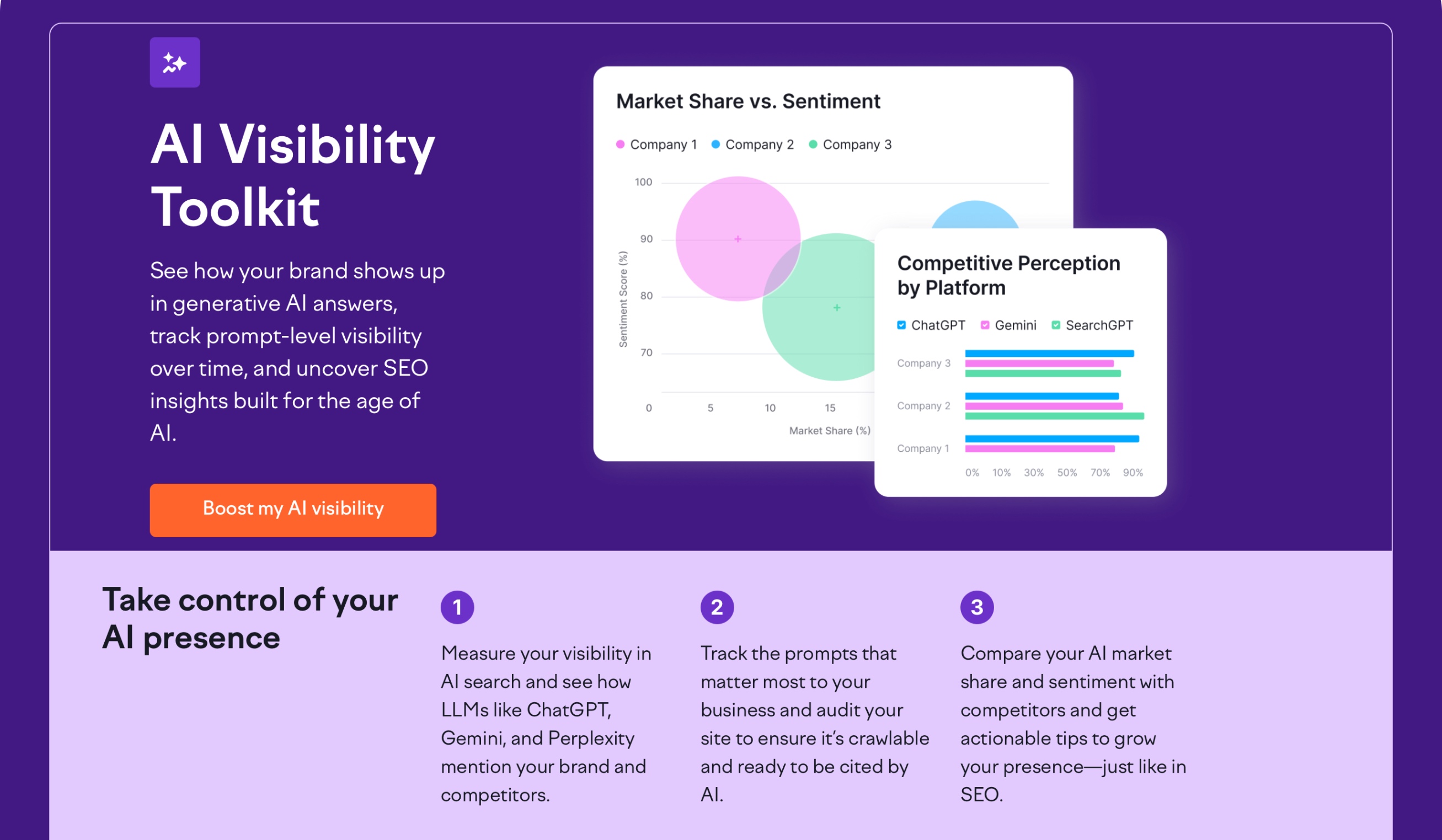
Semrush, a well-known name in the world of traditional SEO tools, has expanded its offerings with an AI toolkit designed to address the new challenges of AI search. This suite of tools helps marketers track their search visibility within AI-powered features like Google's AI Overviews.
The Semrush AI toolkit bridges the gap between traditional SEO and the new world of answer engines. It allows you to monitor how AI is impacting your organic traffic and identify opportunities to appear in AI-generated answers. Some features may include:
- Tracking visibility in AI Overviews for your target keywords.
- Analyzing which of your pages are being used as sources.
- Identifying competitor presence in AI answers.
For teams already using Semrush for their SEO efforts, this toolkit provides an integrated way to start managing and measuring their performance in the evolving search landscape.
5. AthenaHQ
AthenaHQ offers an AI visibility tracker that provides businesses with competitive intelligence on their performance in AI search. The platform is designed to give you a clear view of your brand's presence across multiple AI platforms, helping you understand where you stand against your competition.
The tool emphasizes broad platform coverage, allowing you to monitor your visibility on major answer engines simultaneously. This is crucial because, as research shows, different platforms often cite different sources. Visibility on one platform doesn't guarantee visibility on another.
With its focus on competitive intelligence, AthenaHQ helps you identify not only when your visibility drops but also who is taking your place. This information is critical for diagnosing performance issues and developing a strategy to regain your position.
Conclusion
Managing AI search volatility is crucial for maintaining SEO rankings. Understanding the causes, such as model updates and changing user intent, helps you adapt your strategy. Using a practical workflow and AI visibility tools lets you manage fluctuations and strengthen content authority. Staying informed keeps your site competitive in a fast-changing digital landscape.
Frequently Asked Questions
Why do Google AI search results change even if my site doesn’t?
Google's AI responses change frequently because AI engines are probabilistic. Factors like model updates, real-time data retrieval, and user personalization cause AI Overviews to pull from different sources. This means your search visibility can fluctuate even when your own site content remains the same.
How can I tell if AI overviews are affecting my organic rankings?
You can monitor the impact of AI Overviews by tracking click-through rates from search results in tools like Google Analytics. A drop in traffic to pages that still have high organic rankings may indicate that users are getting their answers from the AI responses instead of clicking your link.
What are the best ways to monitor AI search volatility for my brand?
The best way to monitor search volatility is to use a dedicated AI visibility tracker. These visibility tools automate the process of running prompts and tracking your brand’s visibility over time. This provides a baseline and helps you spot significant changes in your SEO visibility within AI answers.
What tools can track AI-generated search result changes over time?
Tools and platforms monitoring AI-generated search results changes over time, like Scalenut, are designed to track changes in AI search results over time. Unlike traditional rank tracking tools, these platforms monitor your mentions and citations within AI answers on Google Search and other AI platforms.
Are there platforms that monitor shifts in brand visibility due to AI search?
Yes, platforms like Scalenut are specifically designed for visibility tracking in AI search. These tools monitor your brand's presence and share of voice across different AI platforms, helping you understand how your visibility is shifting due to AI.
How are search behaviors changing because of AI responses in search results?
AI responses are teaching users to ask more complex, conversational user queries. Instead of simple keywords, people are using AI search engines for synthesis and in-depth research. This evolving search behavior requires a search optimization strategy that focuses on answering comprehensive questions rather than just targeting keywords.
How does AI search volatility affect brand visibility online?
AI search volatility makes brand visibility inconsistent because citations, recommendations, and source selection can change from one query to the next. Even if your rankings stay stable, AI answers may rotate competitors in and out, reducing predictable exposure, clicks, and share of voice.


.svg)


.webp)