
Semrush AI Toolkit Review: Is It Right For Content Teams?

Quick Verdict: Is Semrush AI Visibility Toolkit Worth It?
- Best For: SEO teams, agencies, and brands that want a clearer view of how they appear in AI-generated answers across prompts, competitors, citations, and brand sentiment.
- What It Offers: The toolkit covers AI visibility benchmarking, competitor research, prompt research, brand performance, prompt tracking, AI crawlability checks, and reporting support.
- Biggest Strength: It gives you a structured way to monitor AI search visibility instead of manually checking ChatGPT, Gemini, Google AI Mode, or Perplexity one prompt at a time.
- Biggest Limitation: It is stronger as a monitoring and reporting tool than a full execution platform. You can find visibility gaps, but your team still has to plan, write, optimize, and refresh the content that will close those gaps.
- Pricing Verdict: At $99/month per domain, the pricing makes sense for teams that already treat AI visibility as a serious reporting priority. But it can feel expensive for small businesses, solo marketers, and creators, especially if they need more domains, prompts, or users.
- Best Alternative For Content Teams: For content teams that want better overall value, Scalenut makes more sense because it combines AI visibility insights with content planning, writing, optimization, audits, and SEO + GEO execution workflows in one platform.
AI visibility tools are no longer a “nice to have” for SEO teams. In a GEO-focused era, it is not enough to know where you rank on Google. You also need to know whether your brand appears in AI-generated answers, which prompts mention you, which competitors are getting cited, and whether AI platforms can actually access your content.
That is where Semrush AI Visibility Toolkit caught my attention. After testing it firsthand, I can see why SEO teams may find it useful. It helps track AI visibility, brand mentions, competitor gaps, prompt performance, sentiment, and AI crawlability in a more structured way than manually checking AI search results one by one. But the bigger question is this: is monitoring alone enough for content teams?
In this Semrush AI Toolkit Review, I’ll break down what the tool does, its key features, pricing, limitations, and whether the $99/month investment makes sense. I’ll also share the best alternative for content teams that need more than AI visibility monitoring and want a stronger workflow for content planning, optimization, and SEO + GEO execution.
Let’s get started!
What Is Semrush AI Visibility Toolkit And How Does It Help With GEO?
Semrush AI Visibility Toolkit is an AI search visibility tool that helps brands track how they appear in AI-generated answers. Unlike Semrush’s regular SEO Toolkit, which focuses on traditional SEO metrics like rankings, keywords, backlinks, and site health, this toolkit is built around AI mentions, citations, prompts, competitor visibility, brand sentiment, and AI crawlability.
Here’s how Semrush AI Visibility Toolkit can support a GEO workflow:
- AI Visibility Benchmarking: See how often your brand appears in AI-generated answers and where it is being cited.
- Prompt Opportunity Discovery: Find relevant prompts, topics, and search intent patterns that are worth targeting for AI visibility.
- Competitor Gap Analysis: Compare your brand against competitors and spot prompts or topics where they show up but you do not.
- Brand Perception Tracking: Understand how AI platforms describe your brand through sentiment analysis, share of voice, and recurring narrative themes.
- High-Value Prompt Monitoring: Track important prompts over time across platforms like ChatGPT, Google AI Mode, and Gemini.
- AI Crawlability Checks: Identify technical issues that may stop AI crawlers from accessing your content.
- GEO Reporting Support: Use mentions, citations, visibility trends, competitor gaps, and sentiment data to explain AI visibility performance to clients or internal teams.
Semrush AI Visibility Toolkit Pricing Review: Is It Worth The Investment?
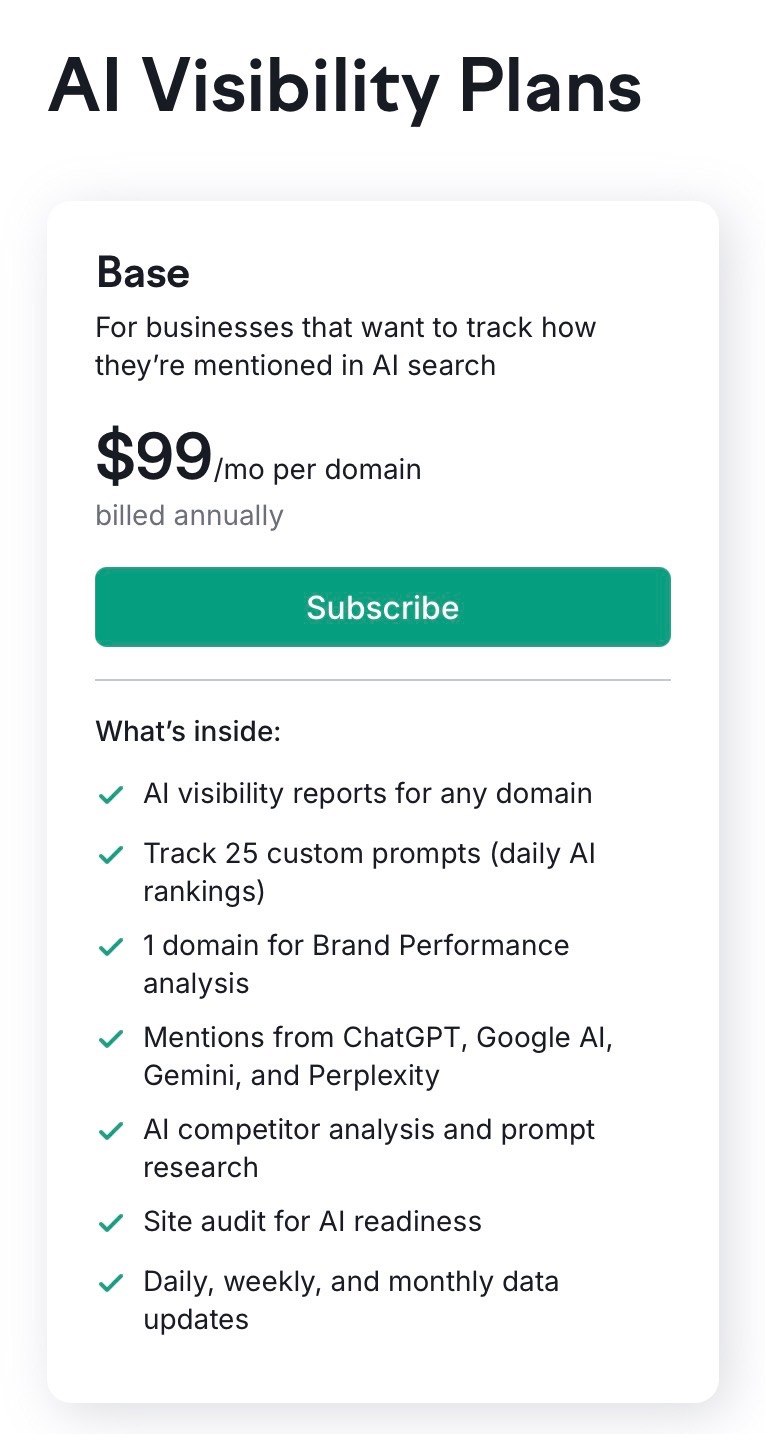
Semrush AI Visibility Toolkit starts at $99/month per domain, billed annually. You can buy it as a standalone AI visibility toolkit, add it to an existing Semrush subscription, or access AI visibility features through Semrush One if you want SEO and AI visibility together.
For one focused brand, the pricing feels reasonable compared to many enterprise GEO tools. It gives you a practical way to track AI mentions, prompt visibility, competitor presence, and AI search readiness without moving into custom enterprise pricing.
That said, it can feel expensive for small businesses, solo marketers, and individual creators, especially if AI visibility is still an experimental channel for them. The cost also increases if you need more domains, more prompts, or additional user access. For add-on users, pricing can start at $45/month, depending on the setup.
My honest take: the pricing makes sense if AI visibility is already a serious reporting and strategy priority for your team. But if you also need content planning, optimization, refreshing, and execution, you may still need another tool alongside it.
Want more budget-friendly options? Check out the best GEO tools under $100/month for 2026 to see which platforms offer the strongest value before you invest.
Semrush AI Visibility Toolkit Features: Which Features Really Stand Out In 2026?
Before you invest in Semrush AI Visibility Toolkit, it is important to understand what the tool actually offers and whether those features match your team’s AI visibility needs. Its core features include Visibility Overview, Competitor Research, Prompt Research, Brand Performance, Prompt Tracking, AI Search Site Audit, and Reporting and Exports.
Here’s the complete feature breakdown:
1. Visibility Overview
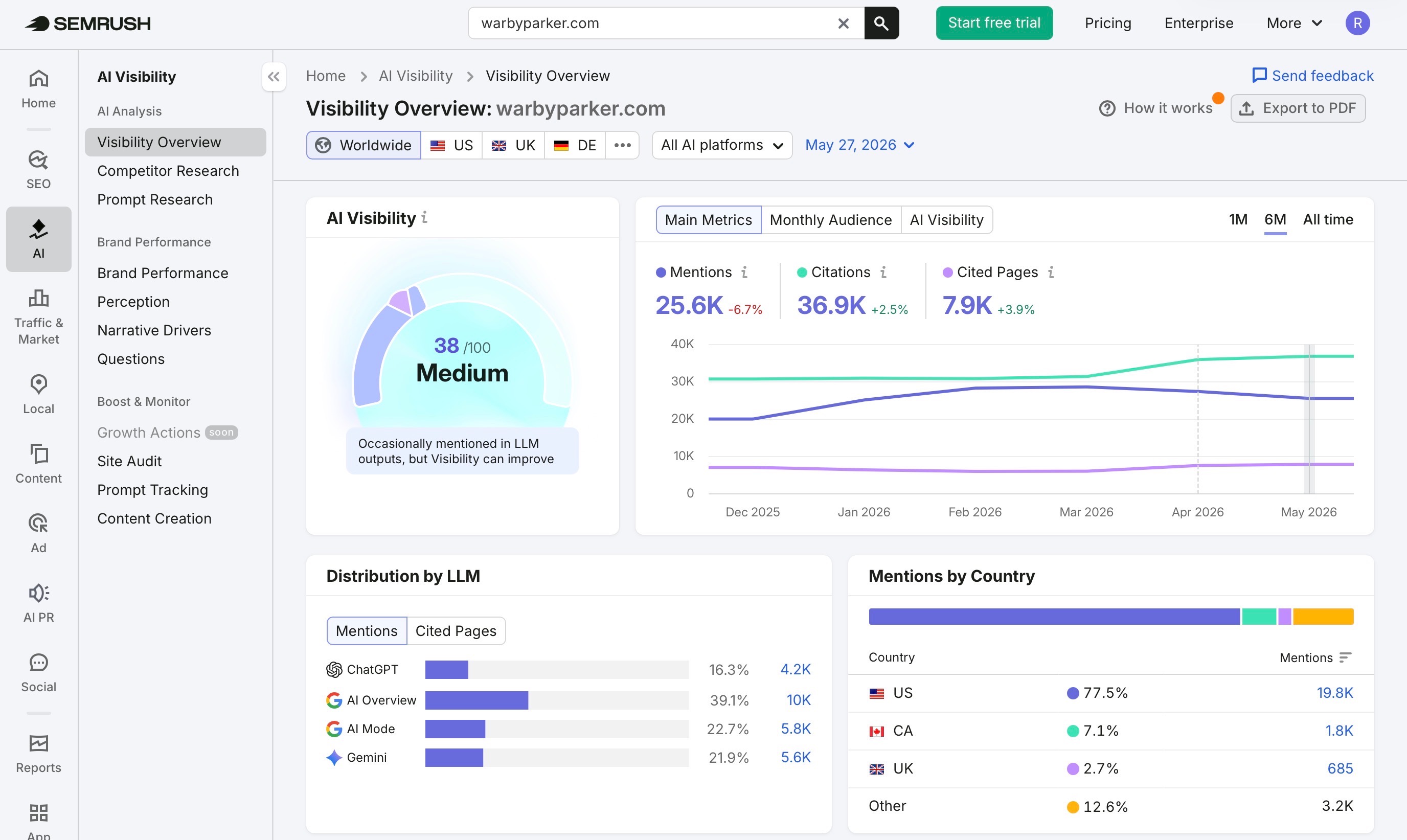
Visibility Overview gives you a quick benchmark of your brand’s presence in AI search.
It shows your AI Visibility Score, brand mentions, citations, cited pages, visibility trends, and breakdowns by platform and country. This is useful because you do not have to manually check different AI tools one prompt at a time.
What I like here is that it gives you a clear starting point. You can see where your brand is showing up, where it is missing, and which areas may need more attention.
That said, I would treat the score as directional. It is helpful for spotting trends and gaps, but it is not the same as clicks, rankings, or conversions from Google Search Console.
Want to compare beyond Semrush? Explore the best tools for monitoring AI Overviews in 2026 and see which platforms are actually worth tracking.
2. Competitor Research
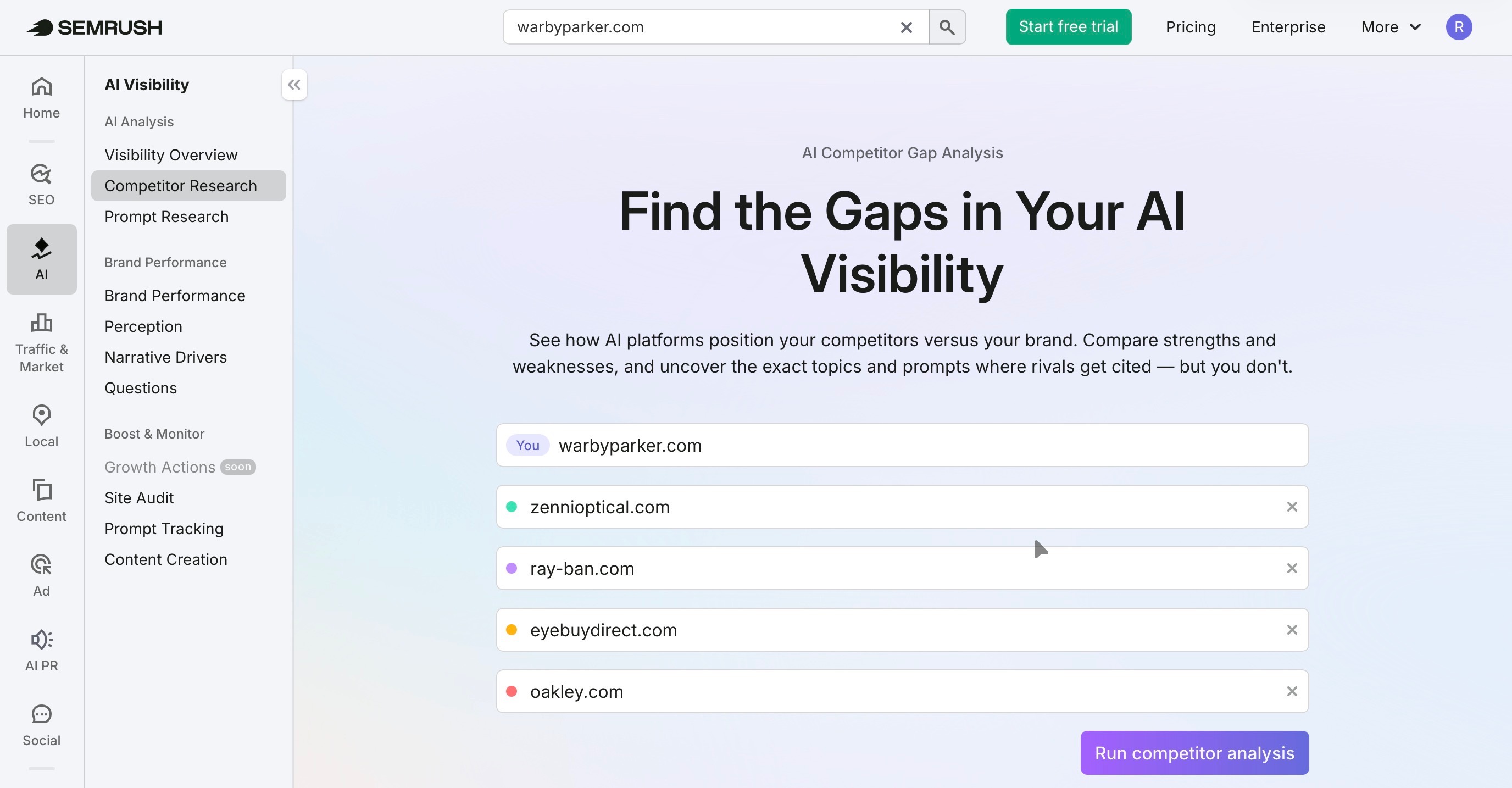
Competitor Research lets you compare your AI visibility against competing brands.
You can see how your mentions, citations, and topic coverage compare with competitors. This makes the data easier to understand because AI visibility does not mean much in isolation. You need to know whether your competitors are showing up more often for the same kinds of prompts.
This feature is especially useful for content planning. If competitors keep appearing for comparison, alternative, or “best tool” prompts where your brand is missing, that is a clear content gap worth acting on.
Want sharper competitor visibility insights? Explore the best GEO tools for competitor analysis to see which platforms help you spot AI search gaps faster.
3. Prompt Research
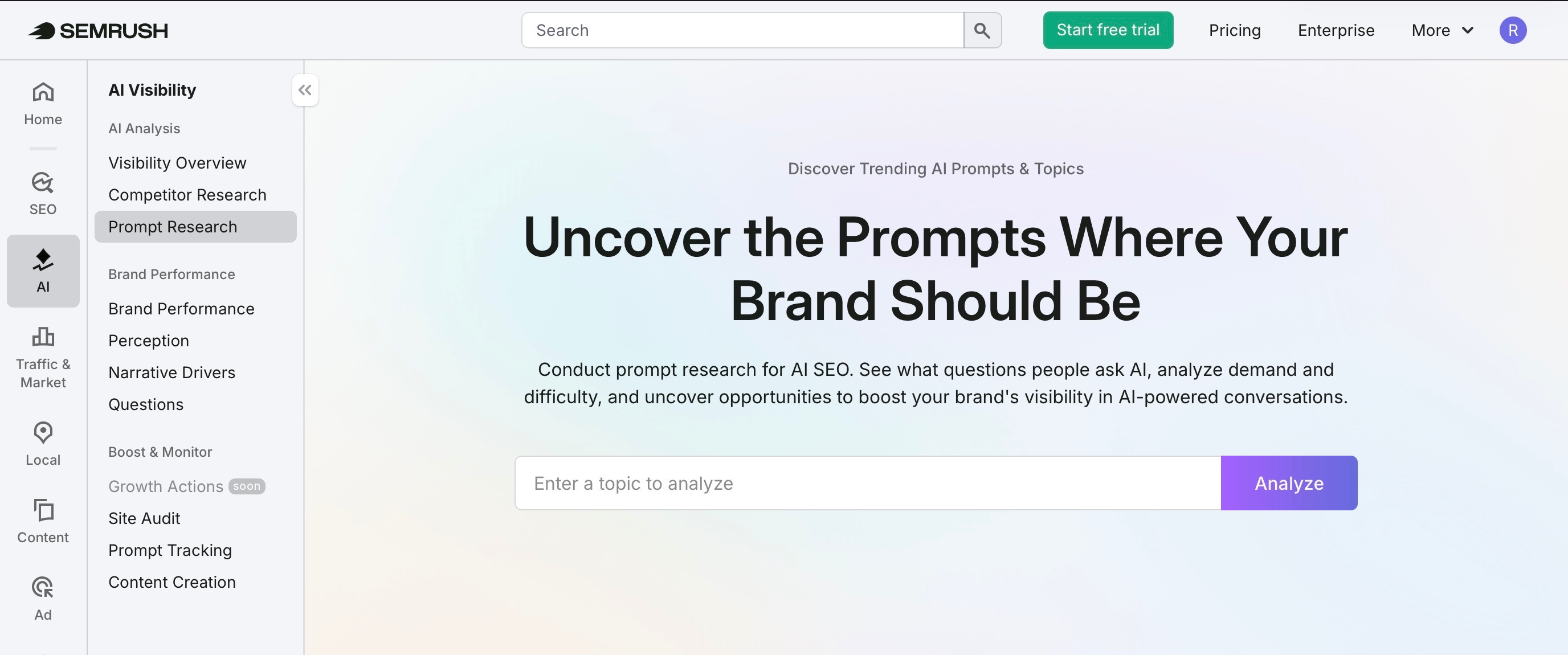
Prompt Research works like keyword research for AI search.
Instead of only looking at search keywords, it helps you find the prompts, topics, intent types, mentioned brands, and source domains that show up in AI-generated answers. This is useful for understanding how people may ask questions in ChatGPT, Gemini, Google AI Overviews, AI Mode, and similar platforms.
What I like about this feature is that it feels closer to real AI search behavior. You are not just looking at a broad keyword. You can find more specific buying, comparison, and task-based prompts that can guide new content or content refreshes.
The limitation is that research is still only the first step. Semrush can show you what to target, but your team still needs to create and optimize the content separately.
4. Brand Performance
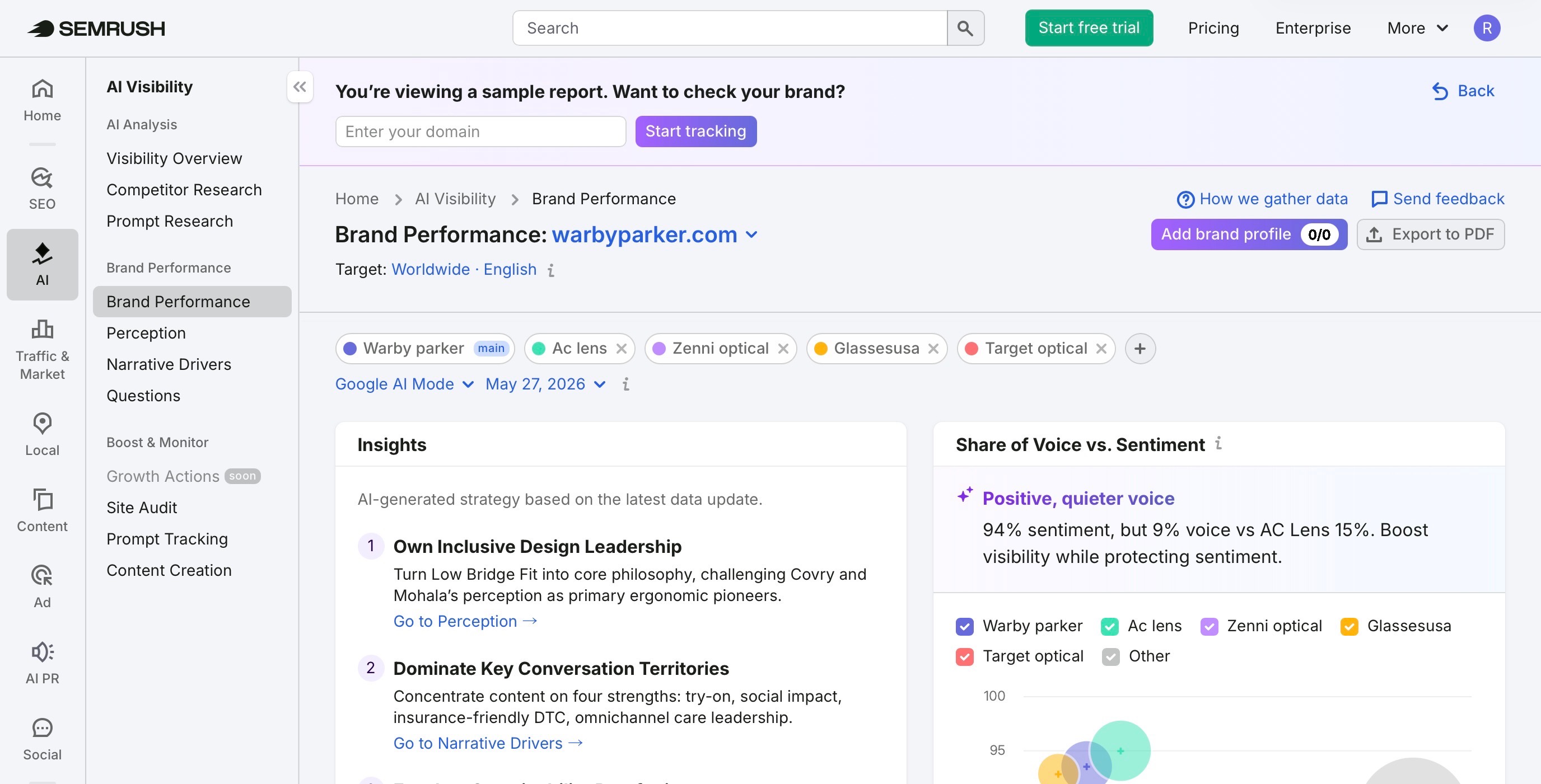
Brand Performance looks at how AI platforms describe your brand, not just whether they mention it.
It covers share of voice, sentiment, perception, narrative drivers, audience questions, and competitor comparisons. This matters because visibility alone is not enough. Your brand could appear often, but still be described in a vague, neutral, or less favorable way than competitors.
The narrative angle is genuinely useful. If AI tools keep associating competitors with attributes like “affordable,” “easy to use,” or “enterprise-ready,” while your brand is not connected to those terms, that points to a messaging or content gap.
Still, I would not use sentiment data blindly. It is useful for spotting patterns, but I’d validate it against actual AI answers, customer feedback, and sales conversations.
5. Prompt Tracking
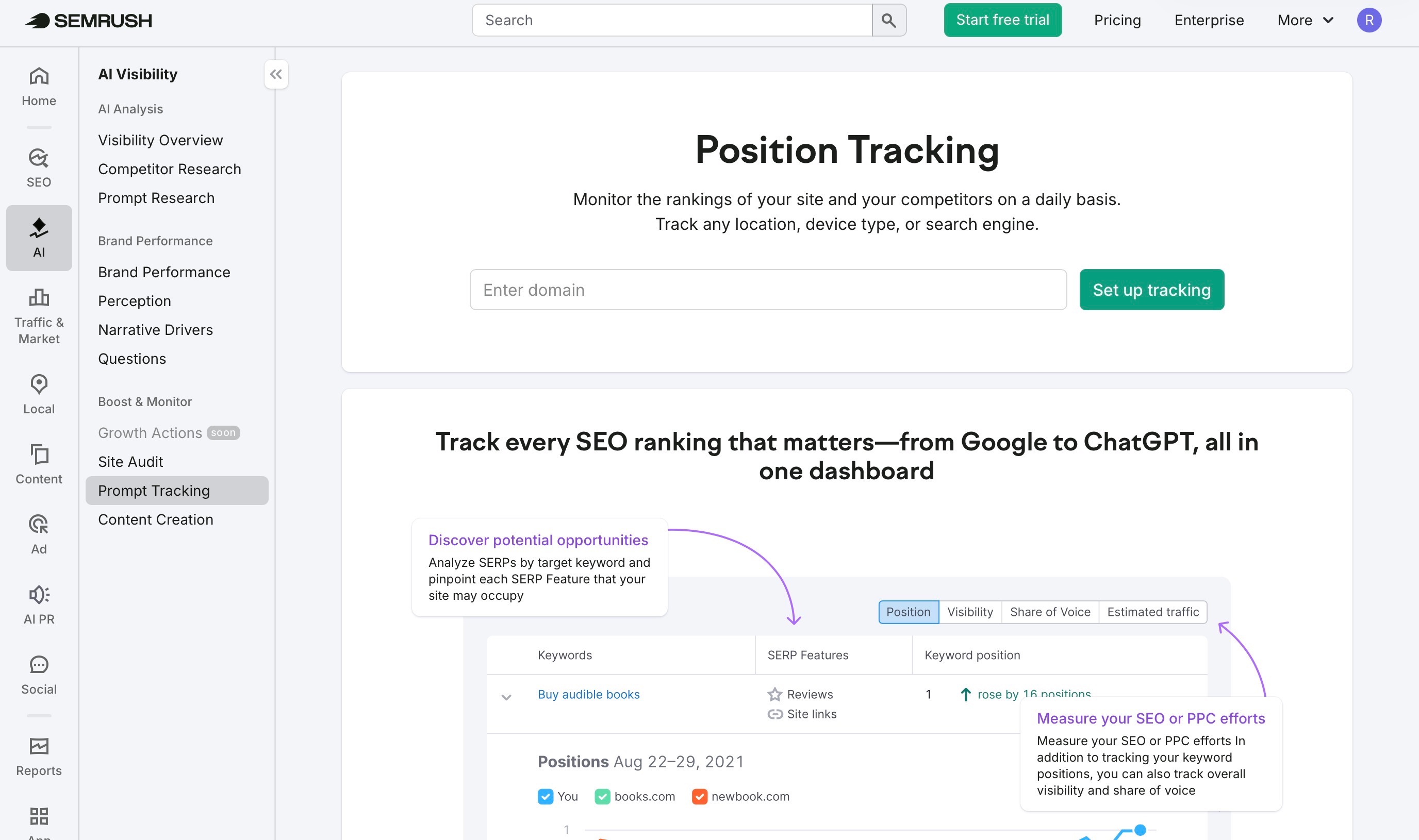
Prompt Tracking lets you monitor selected high-value prompts over time.
This is helpful once you know which prompts matter most to your brand. For example, if you care about prompts like “best AI SEO tools” or “[competitor] alternatives,” you can track whether your brand starts appearing more often after you publish or update content.
I see this as one of the more performance-focused features in the toolkit. Prompt Research helps you find opportunities, while Prompt Tracking helps you see whether your visibility is improving.
The only catch is capacity. The standalone AI Visibility Toolkit includes 25 tracked prompts, which may be enough for a focused brand but could feel limited for agencies or teams managing multiple products.
6. AI Search Site Audit

AI Search Site Audit checks whether AI crawlers can access your website and whether technical issues could affect your visibility in AI-generated answers.
This is a practical feature because GEO is not only about content. If important pages are blocked from AI crawlers, your content may struggle to appear even if it is well written and optimized.
I like that Semrush includes this technical layer because many AI visibility tools focus mostly on mentions and prompts. This gives SEO teams something more concrete to fix.
But again, it is diagnostic. The tool can show crawlability issues, but your team still has to fix them and connect those fixes back to content quality, internal linking, schema, and broader SEO strategy.
Where Does Semrush AI Visibility Toolkit Still Feel Limited?
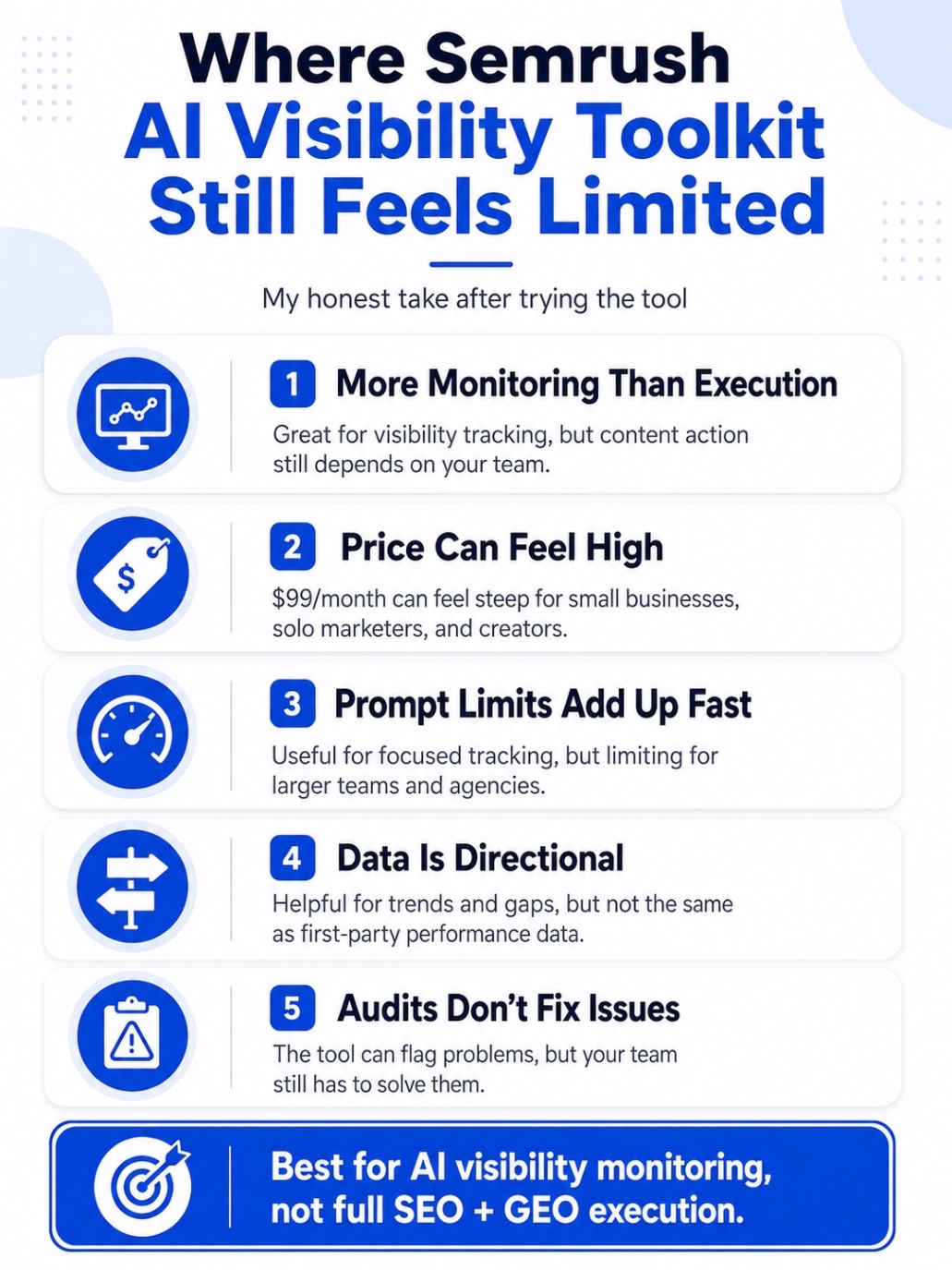
After trying Semrush AI Visibility Toolkit, I’d say it is useful for understanding AI visibility, but it does not solve the full GEO workflow on its own.
Here are the main limitations I noticed:
1. It Is More Useful For Monitoring Than Execution
The toolkit helps you spot visibility gaps, competitor mentions, prompt opportunities, sentiment patterns, and crawlability issues. But once you have those insights, your team still has to decide what content to create, update, optimize, or restructure.
That is the biggest limitation for me. It tells you what is happening, but it does not fully help you turn those insights into a complete SEO & GEO execution workflow.
2. Pricing Can Feel High For Smaller Teams
The $99/month starting price is reasonable compared to many enterprise GEO platforms. But for small businesses, solo marketers, and individual creators, it can still feel like a lot, especially if AI visibility is not yet a proven growth channel for them.
The cost can also increase if you need more domains, more prompts, or additional users.
3. Prompt Tracking May Feel Limited As You Scale
Prompt Tracking is useful, but the base limit may feel restrictive once you start tracking multiple product categories, competitor prompts, BOFU prompts, and client accounts.
For a focused brand, it may be enough. For agencies or larger content teams, you may need more room pretty quickly.
4. The Data Still Needs Interpretation
I would not treat AI visibility data the same way I treat Google Search Console data. The scores, mentions, and prompt insights are helpful for spotting patterns, but they are still directional.
You still need to look at the actual AI answers, compare them with customer behavior, and decide which gaps are worth acting on.
5. Site Audit Finds Issues, But Your Team Has To Fix Them
The AI Search Site Audit is a helpful technical check, especially for spotting crawlability problems. But like any audit, it only shows the issues.
Your team still has to fix crawler access, technical SEO issues, internal linking gaps, schema problems, and content quality issues before those insights can actually improve visibility.
Semrush AI Visibility Toolkit vs Scalenut: What Makes Scalenut a Better Alternative to Semrush AI Visibility Toolkit?
Semrush AI Visibility Toolkit is useful for tracking how your brand appears in AI search. But Scalenut has an advantage when your team needs to move from visibility gaps to actual content execution.
Here are the Scalenut features that make it stand out:
1. AI Visibility Tracking And Brand Monitoring
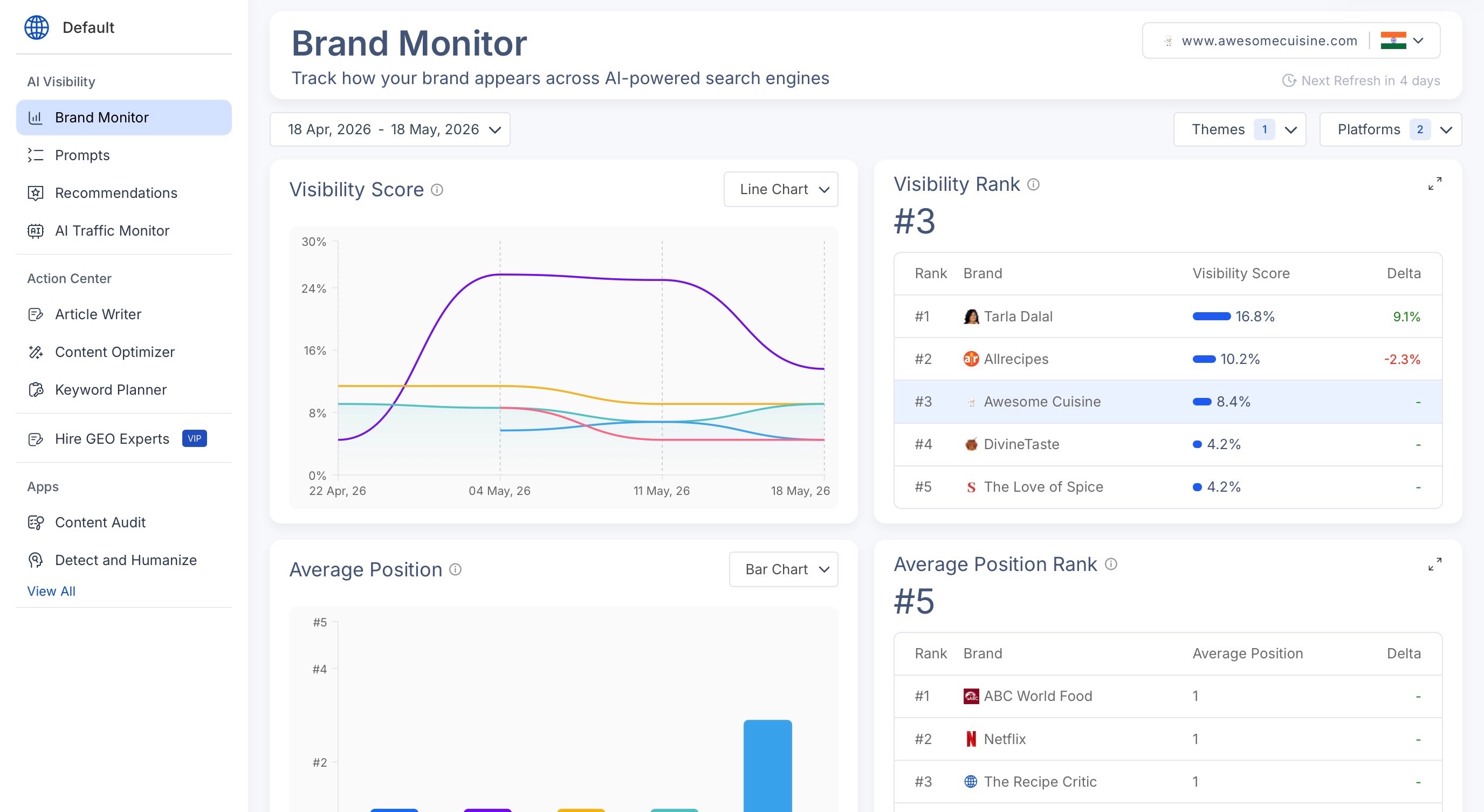
Scalenut helps you track where your brand appears in AI search and how that visibility compares with competitors.
You can monitor visibility score, share of voice, average position, prompt performance, and visibility movement across AI engines. That gives your team a clearer benchmark before deciding what needs to improve.
2. Prompt-Level Insights With Competitive Context
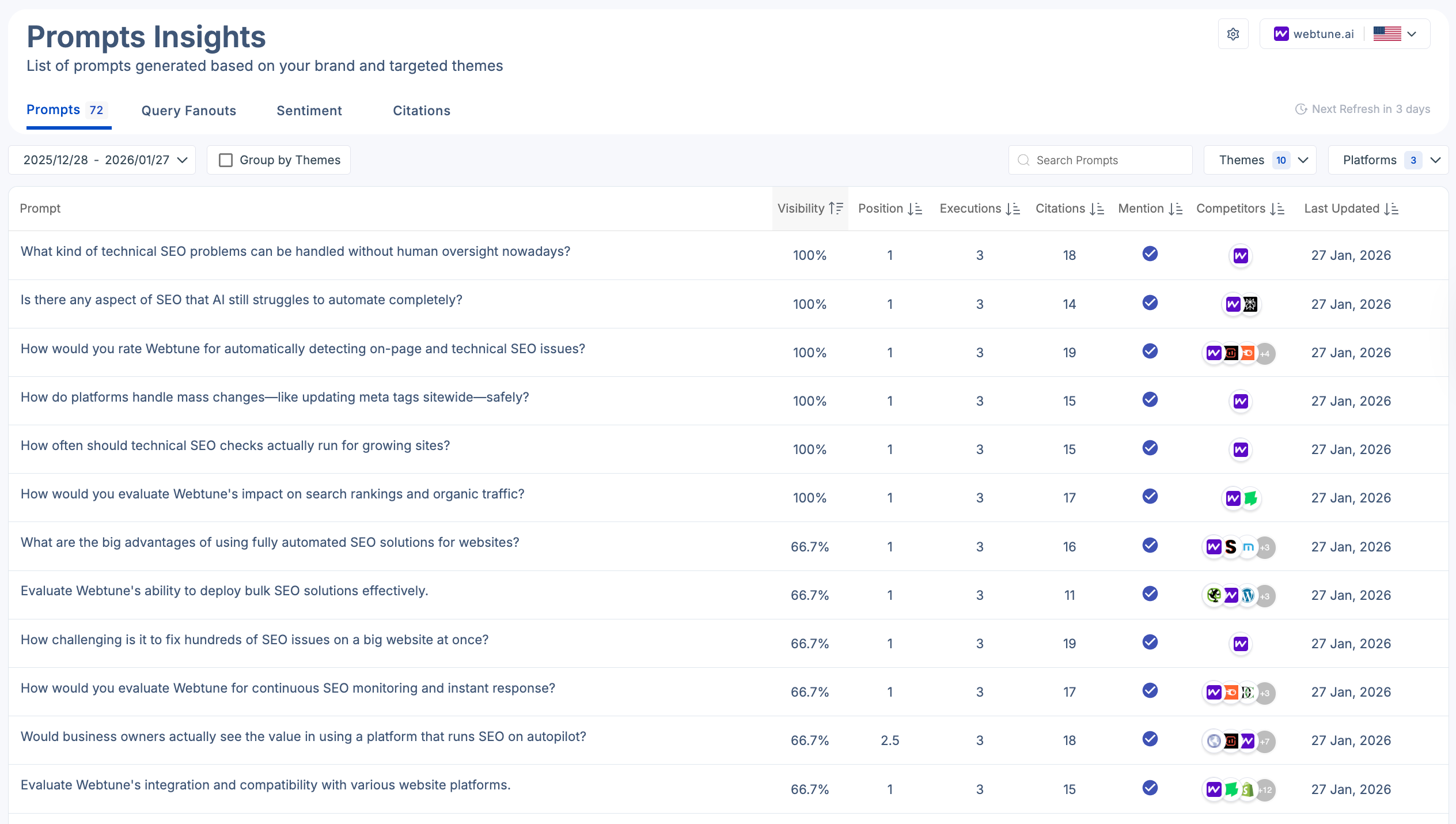
Prompt tracking is more useful when it shows the full picture around each query.
Scalenut helps you see where your brand appears, where it gets skipped, which competitors show up instead, and whether the AI response includes a mention or citation. That context makes it easier to connect AI visibility data with content decisions.
3. GEO Action Center For Content Execution
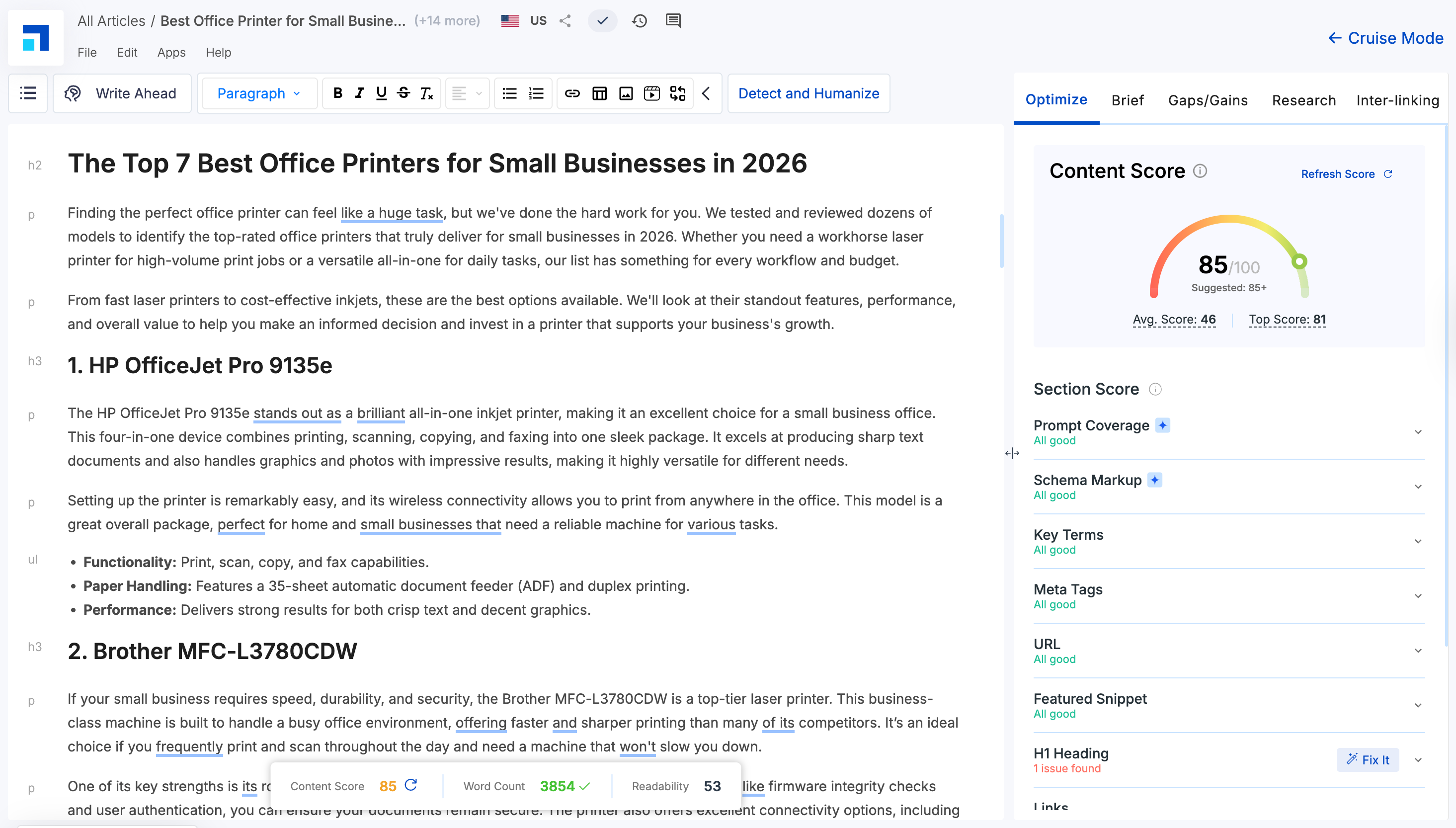
This is where Scalenut feels more practical than a pure monitoring tool.
Once you spot a visibility gap, the GEO Action Center helps you move into next steps like content audits, recommendations, optimization opportunities, and priority fixes. So the workflow does not stop at “we are missing from this prompt.” It helps your team decide what needs attention first.
4. AI Traffic Monitor And LLM Interaction Signals
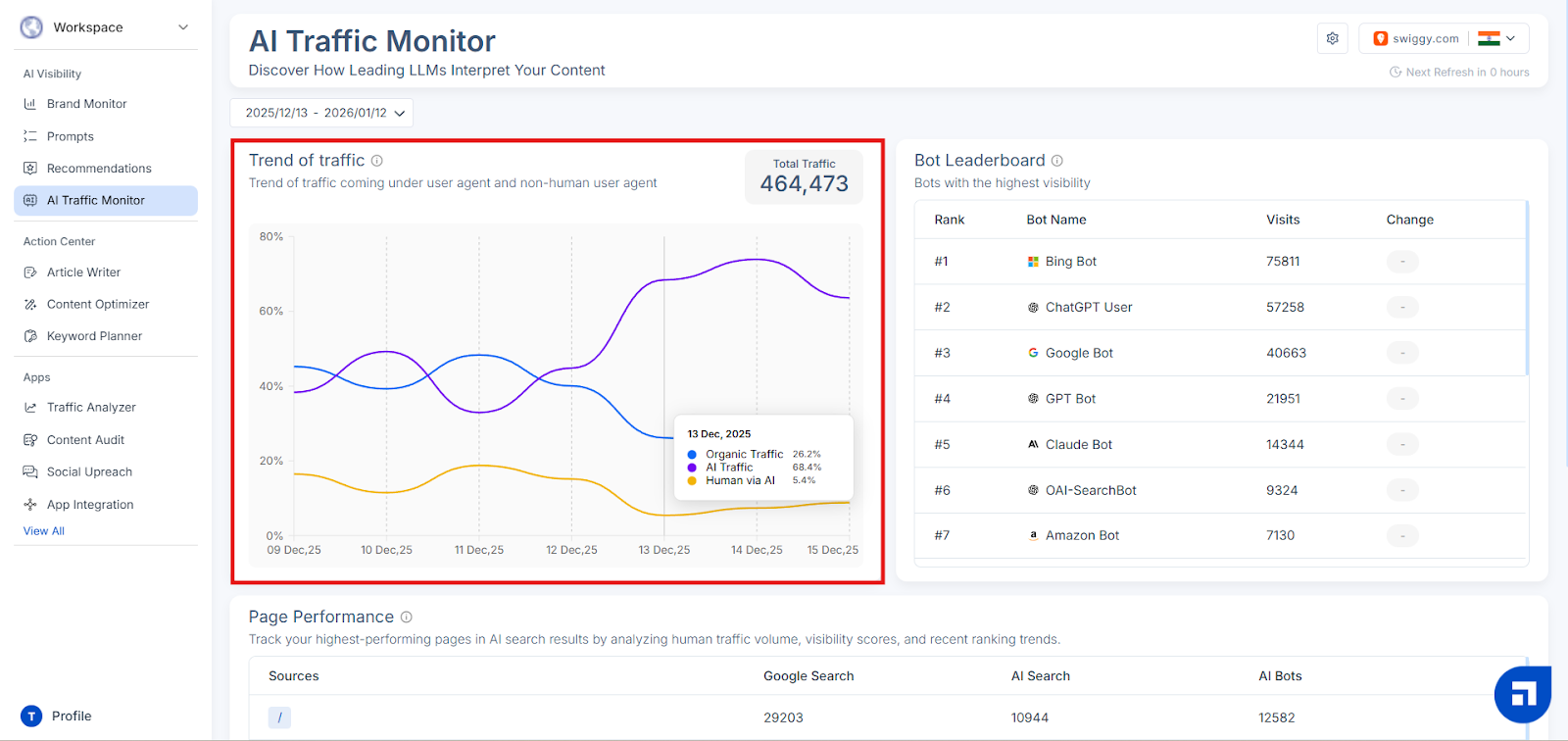
Scalenut’s AI Traffic Monitor helps teams understand how AI systems interact with their website.
You can review AI bot activity, crawl trends, top AI sources, and pages that may be getting attention from AI engines. It is not a replacement for GA4, but it adds a useful AI-specific layer to GEO reporting.
5. GEO Content Creation And Optimization
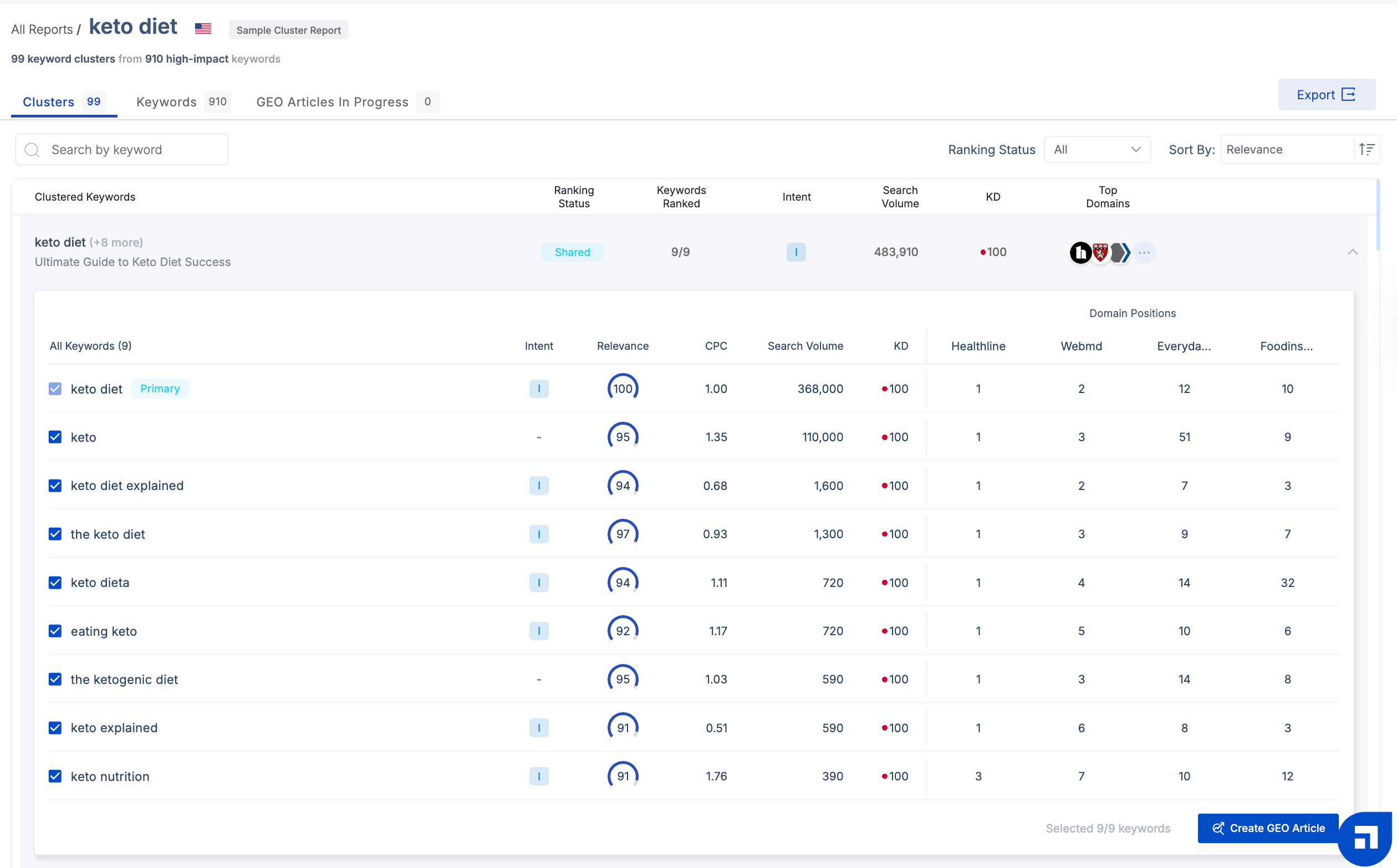
This is where Scalenut goes beyond recommendations and helps with the actual content work.
It supports GEO content creation, content scoring, optimization suggestions, keyword planning, topic clusters, internal linking, content audits, and refresh workflows. That makes it useful for teams that need to create new pages, update existing assets, and optimize for both SEO and AI search.
Another practical advantage is pricing. Scalenut starts at $24/month, which makes it more accessible for small businesses, solo marketers, and individual creators who may not be ready to spend $99/month on AI visibility monitoring alone. That price difference matters if your team wants both visibility tracking and content execution without stacking multiple tools too early.
Overall, Semrush AI Visibility Toolkit is still a solid choice if monitoring and reporting are your main priorities. But if your team wants to turn AI visibility gaps into actual content improvements, Scalenut feels like the more complete and practical option.
Want the deeper breakdown before deciding? Read our full Scalenut review to see where it stands out, where it fits best, and whether it is the right SEO + GEO platform for your team.
Who Should Use Semrush AI Visibility Toolkit?
- Existing Semrush Users: A good fit if your team already uses Semrush and wants AI visibility tracking inside a familiar ecosystem.
- SEO Teams Tracking AI Search: Useful for teams that want to benchmark brand visibility across AI-generated answers and understand where they stand against competitors.
- Agencies Managing AI Visibility Reports: Helpful for agencies that need to show clients AI mentions, citations, sentiment, competitor gaps, and prompt-level visibility.
- Brands Monitoring AI Mentions And Sentiment: A strong option if your priority is understanding how AI platforms describe your brand and whether competitors are being positioned more strongly.
- Teams That Need Prompt And Competitor Research: Useful if you want to discover AI search topics, compare visibility against competitors, and track important prompts over time.
- Stakeholder-Heavy Marketing Teams: Works well if you need clean reporting around AI visibility trends, brand performance, and competitive positioning.
When Should You Choose Scalenut Over Semrush AI Visibility Toolkit?
- SEO + GEO Execution Matters More Than Monitoring: Scalenut is stronger when the goal is to move from visibility gaps to content planning, optimization, audits, and refreshes.
- Content Creation Is A Core Priority: It is a better fit for teams that need to create new blogs, optimize existing pages, build topic clusters, and improve content for both SEO and AI search.
- Actionable Next Steps Are Important: Instead of stopping at visibility data, Scalenut helps identify what needs to be improved next.
- Better Value For Smaller Teams: With pricing starting at $24/month, Scalenut is more accessible for small businesses, solo marketers, and creators who may not be ready to spend $99/month on AI visibility monitoring alone.
- A Leaner Tool Stack Is The Goal: Scalenut makes more sense when a team wants AI visibility tracking, content optimization, keyword planning, audits, and GEO workflows in one place.
- Content Outcomes Are The Main Responsibility: For teams responsible for improving rankings, citations, content quality, and AI visibility, Scalenut feels more practical than a monitoring-first workflow.
Want to turn AI visibility gaps into real content wins? Book a free Scalenut strategy call to see how your team can improve SEO + GEO execution faster.
Final Thoughts: Is Semrush AI Visibility Toolkit Worth It?
The Semrush AI toolkit is a solid choice if your main goal is to understand how your brand appears across AI-driven search engines and search platforms. It gives you actionable insights through visibility tracking, competitor data, prompt monitoring, sentiment analysis, and its site audit tool, which can help you see whether AI crawlers can access your content.
But for small teams that need more than monitoring, the bigger question is execution. If you want actionable recommendations, stronger content optimization tools, and a workflow that connects AI visibility gaps to content strategy, Scalenut offers better overall value for turning visibility insights into content that can reach more potential customers.
Frequently Asked Questions
Can beginners easily get started with the Semrush AI Visibility Toolkit?
Yes, beginners can get started, especially if they already understand basic SEO reporting. The interface is built around familiar ideas like visibility, competitors, prompts, sentiment, and site audits. Still, beginners may need time to interpret AI visibility data correctly.
Is the Semrush AI Toolkit worth the investment for SEO professionals?
Yes, it can be worth it for SEO professionals who need AI visibility monitoring, competitor research, prompt tracking, and client reporting. But if the goal includes content creation and optimization, Scalenut may offer better value because it connects insights with execution.
How accurate is the Semrush AI Visibility Toolkit in tracking brand presence online?
Semrush’s tracking is useful for spotting patterns in brand presence, mentions, citations, and competitor visibility. But I would treat it as directional, not exact attribution. Its AI Visibility Score is based on topic coverage and mention consistency.
What are the main pros and cons of using the Semrush AI Toolkit?
The main pros are clear visibility benchmarking, competitor comparisons, prompt research, sentiment tracking, AI crawler checks, and reporting. The main cons are limited execution, pricing that can rise with scale, prompt limits, and the need for another workflow like Scalenut for content implementation.
What new AI-powered features has Semrush released in their toolkit recently?
Recent AI-powered Semrush updates include AI Visibility tracking, Google AI Mode monitoring, AI-ready Site Audit, Brand Performance, Prompt Research, Prompt Tracking, and AI optimization inside Content Toolkit. These features show Semrush moving beyond classic SEO into broader AI search visibility.
Does the Semrush AI Toolkit help improve brand visibility in AI search results?
Yes, it helps improve brand visibility by showing where your brand appears, which prompts matter, what competitors are winning, and whether AI crawlers can access your site. But Scalenut is stronger when those findings need to become content updates.
Are there any common issues or limitations with the Semrush AI Toolkit?
Common limitations include pricing sensitivity for smaller teams, limited prompt capacity in basic setups, reliance on directional AI visibility data, and a workflow that leans more toward monitoring than content execution. Scalenut can fill that execution gap for content-led teams.
What do real users say about their experience with the Semrush AI Visibility Toolkit?
The Semrush AI Visibility Toolkit is still relatively new, so there are not enough dedicated user reviews on platforms like G2 yet. Most available reviews discuss Semrush as a broader SEO platform, so user feedback on this specific AI toolkit is still limited.


.svg)


.webp)