Which Alternatives to Ahrefs Brand Radar Are Worth It in 2026?
Quick summary: 7 Best alternatives to Ahrefs Brand Radar
- Scalenut
→ Best for: Content and SEO teams that want AI visibility tracking plus SEO execution in one workflow.
→ Price: Starts at $24/month
→ Free trial: Yes, 7-day free trial - Profound
→ Best for: Enterprise teams that need deep AI analytics, prompt demand data, and competitive intelligence.
→ Price: Starts at $82.50/month, billed yearly
→ Free trial: No self-serve free trial - Peec AI
→ Best for: Agencies managing multiple brands that need accurate tracking and clean client reporting.
→ Price: Starts at $80/month, billed yearly
→ Free trial: Yes, 7-day free trial - Semrush AI Visibility Toolkit
→ Best for: SEO teams already using Semrush that want AI visibility data in the same ecosystem.
→ Price: $99/month
→ Free trial: No - Otterly AI
→ Best for: Small teams and solo marketers who want a low-cost way to start tracking AI visibility.
→ Price: Starts at $29/month
→ Free trial: Yes - SE Visible
→ Best for: Brand, SEO, and agency teams that want focused AI visibility, sentiment, and competitor tracking.
→ Price: Starts at $79/month, billed annually
→ Free trial: Yes, 10-day free trial - Scrunch AI
→ Best for: Brand and PR teams focused on AI narrative control, hallucination detection, and brand accuracy.
→ Price: Starts at $250/month
→ Free trial: Yes, 7-day free trial
Ahrefs Brand Radar is useful if you already work inside Ahrefs, but it is not the easiest or most actionable AI visibility tool for every team.
The bigger issue is that Ahrefs Brand Radar pricing can feel expensive as an add-on, especially when you still need to manually validate data, interpret accuracy gaps, and figure out what to do next.
This guide is for SEO, content, brand, and agency teams looking for Ahrefs Brand Radar alternatives that do more than track mentions. The goal is simple: find a tool that helps you monitor, understand, and improve AI visibility.
Let’s get started!
What is Ahrefs Brand Radar?
Ahrefs Brand Radar is an AI visibility tool that helps you track how your brand appears in AI search results. It shows where your brand is mentioned, which pages and domains are cited, how your AI Share of Voice compares with competitors, and where you may have opportunities to improve visibility across AI-generated answers.
Why look for alternatives to Ahrefs Brand Radar?
Ahrefs Brand Radar is useful if you already use Ahrefs and want a broad view of brand visibility across AI answers, search, and competitors. But if you need deeper GEO tracking, clearer actions, sentiment insights, or more flexible pricing, it may feel limited.
Here are the main reasons why teams look for an alternative to Ahrefs Brand Radar:
1. Limited prompt-level tracking unless you use Custom Prompts
Ahrefs now has Custom Prompts, so this is not a total gap. But Brand Radar still feels more built for broad visibility research than prompt-by-prompt monitoring. If you want to track specific BOFU prompts across AI platforms and spot visibility changes quickly, a more prompt-first tool may work better.
2. No clear actionable recommendations
Brand Radar shows mentions, citations, share of voice, and competitor visibility. But it does not clearly tell you what to fix next. You still need to figure out which page to update, what content to create, and which citation gaps to close.
3. No built-in sentiment analysis
Showing up in AI answers is only half the story. How your brand is described matters just as much. Brand Radar focuses on visibility signals, not sentiment. So you may know your brand was mentioned, but not whether the mention was positive, neutral, or damaging.
4. The add-on pricing model can lock you in
Brand Radar is not a simple standalone tool. Ahrefs Brand Radar pricing can rise if you need multiple AI platforms, custom prompts, frequent checks, and deeper Ahrefs usage. For teams that only want AI visibility monitoring, that can feel heavier than necessary.
5. Documented accuracy gaps on ChatGPT and Perplexity
Brand Radar metrics are better treated as directional signals, not perfect prompt-level truth. Some third-party reviews have also pointed out undercounting and snapshot-based gaps in ChatGPT and Perplexity tracking. So if these platforms matter to your GEO strategy, you may still need manual checks.
How I evaluated these Ahrefs Brand Radar alternatives
Not every AI visibility tool is worth your time. I used a simple Track → Analyze → Act framework because monitoring mentions alone is not enough. The best tools here do at least two of these three things well.
The track → analyze → act framework
1. Track: Can It Find Where Your Brand Shows Up?
I looked for tools that track brand visibility across key AI platforms like ChatGPT, Perplexity, Gemini, and Google AI Overviews. I also considered competitor tracking, refresh frequency, and how reliable the data feels for reporting.
2. Analyze: Does It Explain What The Data Means?
A good alternative should show the prompts triggering AI answers, the citations AI engines use, share of voice trends, and ideally, sentiment. Because showing up is useful only if your brand is being framed the right way.
3. Act: Can You Turn Insights Into Next Steps?
The strongest tools do more than show gaps. They help you act on them through content briefs, optimization suggestions, backlink opportunities, on-page SEO, or clear recommendations.
Scoring note
Each Ahrefs Brand Radar competitor below is strong in at least one part of this framework. I have also called out where each one falls short, so you can choose based on your team’s actual workflow.
Other criteria I considered
- Pricing transparency
- Free trial or entry plan quality
- Ease of setup
- Agency and multi-client support
Which Ahrefs Brand Radar alternatives are worth considering in 2026?
Each tool fits a different type of team, so instead of treating this like a generic ranking, I have matched every option to the use case where it makes the most sense. Start with the profile that sounds closest to your current workflow, budget, and AI visibility goals.
Here are the 7 best Ahrefs Brand Radar competitors I think are actually worth considering in 2026.
1. Scalenut: Best overall Ahrefs Brand Radar alternative
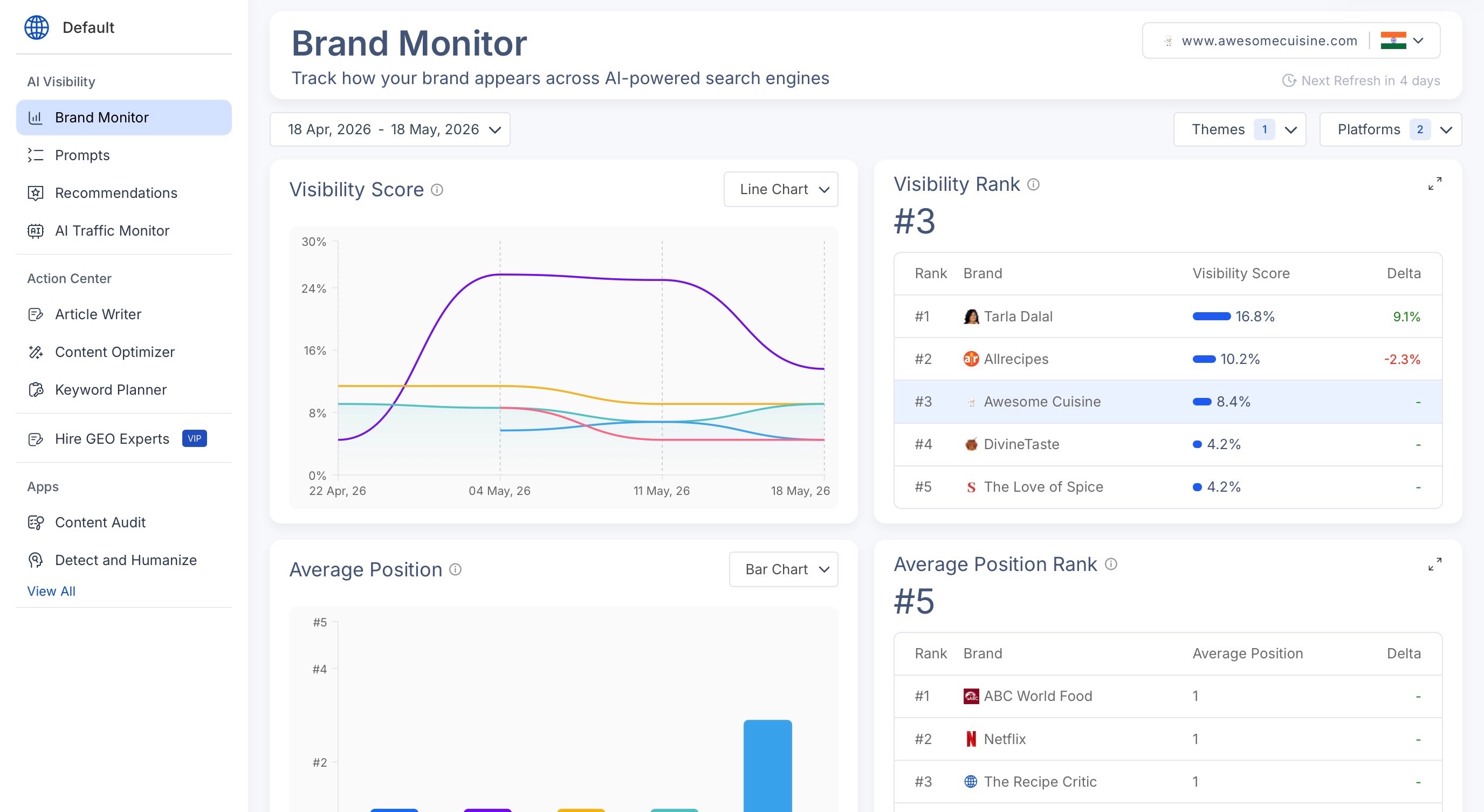
Best for: Content, SEO, and growth teams that want to track AI visibility and act on the gaps inside the same workflow.
G2 rating: 4.7/5 from 315 reviews
Scalenut is the strongest alternative to Ahrefs Brand Radar if you want more than another reporting dashboard. It combines AI visibility tracking, prompt-level intelligence, AI traffic insights, and SEO execution in one platform. So instead of just seeing where your brand is missing, you can understand the gap and move straight into content briefs, optimization, internal linking, and authority-building work.
Key features
- Tracks AI visibility with Visibility Score, Average Position, Share of Voice, Visibility Heatmap, and Brand Visibility Rank.
- Shows prompt-level insights, including mentions, citations, competitors, query fanouts, and sentiment.
- Turns GEO gaps into action with content ideas, backlink suggestions, platform opportunities, and next-step recommendations.
- Tracks AI traffic and bot interactions to show which pages AI systems rely on.
- Includes SEO tools like Cruise Mode, Content Optimizer, Keyword Planner, Content Audit, On-Page Pro, Internal Linking, and Backlinks Marketplace.
Pros
- Combines GEO tracking and SEO execution in one workflow.
- Connects visibility gaps to briefs, optimization, linking, and authority suggestions.
- Covers both traditional search and AI search.
- More affordable than enterprise-heavy AI visibility platforms.
- Strong fit for teams that want output, not just dashboards.
Cons
- Requires some setup to get full value from GEO features.
- Prompt limits depend on the plan.
- Monitoring-only teams may not need the full platform.
Pricing
- Starter: $24/month
- Plus: $36/month
- Professional: $80/month
- VIP Service: Custom pricing
How does Scalenut compare to Ahrefs Brand Radar?
Ahrefs Brand Radar is stronger for broad brand discovery because it has a large search-backed prompt database and wider research coverage across AI, search, Reddit, YouTube, and TikTok. Scalenut is stronger when you want to move from insight to execution. It does not just show AI visibility gaps.
It connects those gaps to content creation, optimization, internal linking, backlink opportunities, AI traffic signals, and GEO recommendations. If your goal is to improve visibility, not just report on it, Scalenut is the more practical choice.
Want the full breakdown before you choose? Read our Scalenut review to see how its GEO tracking, AI visibility insights, and SEO execution workflow work in practice.
2. Profound: Best for enterprise teams needing deep AI analytics
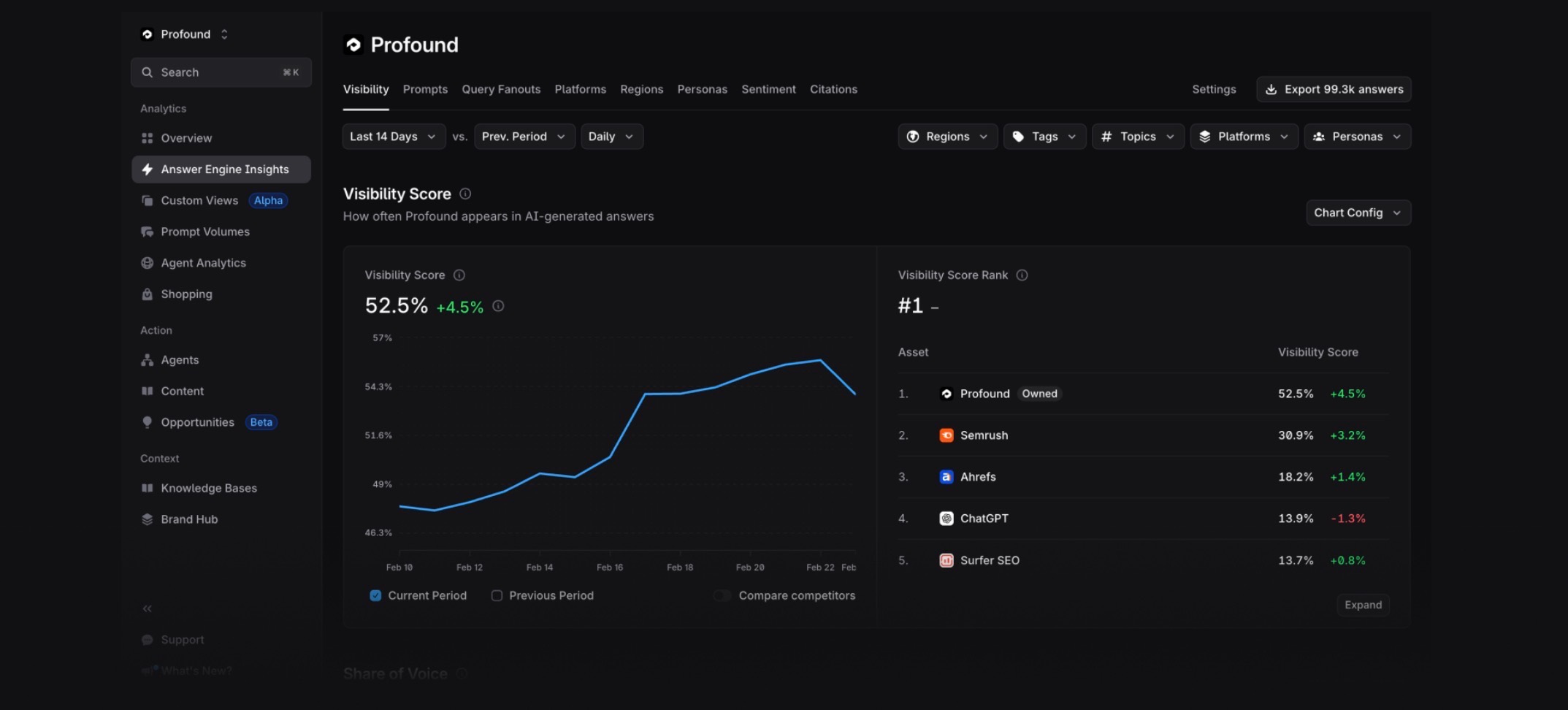
Best for: Enterprise brands and large agencies that need deep AI analytics, prompt demand intelligence, and competitive visibility tracking at scale.
G2 rating: 4.6/5 from 323 reviews
Profound is one of the most research-heavy tools on this list. It is built for teams that want deep AI search intelligence across prompt demand, citations, sentiment, competitors, and AI crawler behavior. If I am being honest, it feels more useful for enterprise teams with analysts than lean content teams that want a simpler workflow.
Key features
- Tracks visibility across major AI platforms like ChatGPT, Perplexity, Claude, Gemini, Grok, and more.
- Prompt Volumes helps estimate what people are asking in AI search.
- Conversation Explorer surfaces audience questions and visibility opportunities.
- Agent Analytics shows how AI crawlers interact with your website.
- Agents support content briefs, landing pages, optimizations, and CMS workflows.
Pros
- Strong for enterprise-level AI visibility research.
- Wide AI platform coverage compared to most tools.
- Useful for competitive intelligence, sentiment, citations, and share of voice.
- Trusted by larger teams and well-known brands.
Cons
- Starter is limited with ChatGPT-only tracking and 50 prompts.
- Can feel too heavy without analysts or a mature GEO workflow.
- Execution features are more enterprise-led than lightweight content workflows.
- Enterprise setup still feels sales-led and onboarding-heavy.
Pricing
- Starter: $82.50/month, billed yearly
- Growth: $332.50/month, billed yearly
- Enterprise: Custom pricing
How does Profound compare to Ahrefs Brand Radar?
Profound is better if you need deeper AI analytics, prompt demand data, agent analytics, sentiment, and competitive intelligence. Ahrefs Brand Radar is stronger if you want broad visibility research inside the Ahrefs ecosystem, especially across AI, search, Reddit, YouTube, and TikTok. For enterprise teams focused only on AI visibility depth, Profound feels more advanced.
Want to know if Profound is worth the enterprise price? Read the full Profound review for a closer look at its AI visibility tracking, prompt data, and analytics depth.
3. Peec AI: Best for agencies managing multiple brands
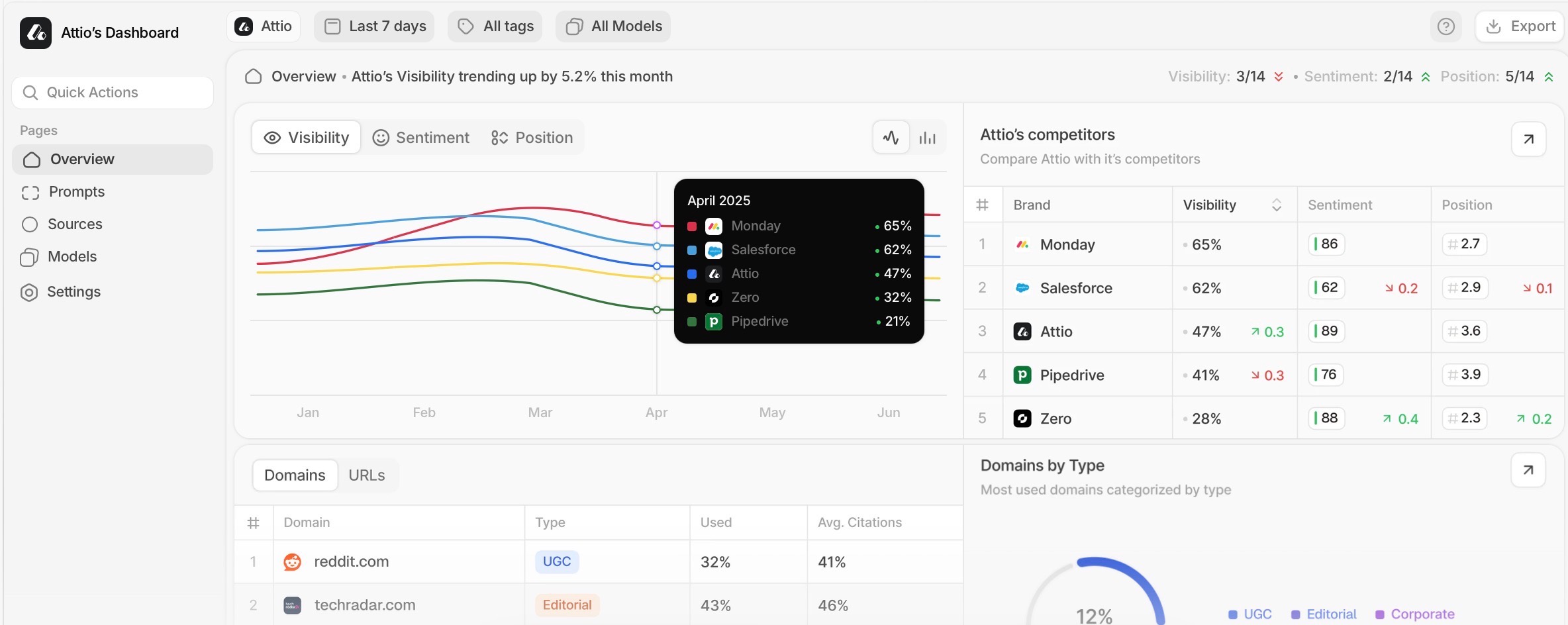
Best for: Agencies and multi-brand teams that need accurate AI visibility tracking, unlimited seats, clean reporting, and strong prompt-level monitoring.
G2 rating: 4.9/5 from 11 reviews
Peec AI is built for teams that care about clean tracking and client-friendly reporting. Its biggest advantage is browser simulation, which helps capture what real users see instead of relying only on API responses. That makes it especially useful for agencies that need AI visibility data they can explain clearly to clients.
Key features
- Uses UI scraping and browser automation to simulate real user interactions.
- Tracks visibility, position, sentiment, sources, competitors, and trends.
- Supports daily prompt tracking, unlimited users, and multi-project workflows.
- Includes Looker Studio integration on Advanced and API access on Enterprise.
- Supports multi-country and multi-language tracking.
Pros
- Strong fit for agency reporting and multi-brand tracking.
- Unlimited users make it cost-effective for collaborative teams.
- Browser simulation makes the data easier to defend.
- Clean UX for prompt setup, visibility checks, citations, and sentiment.
Cons
- Not a full content creation or optimization platform.
- Base plans include only three models.
- API access and SSO are limited to Enterprise.
- Better at showing what is happening than helping you fix it inside the same workflow.
Pricing
- Starter: $80/month, billed yearly
- Pro: $205/month, billed yearly
- Advanced: $420/month, billed yearly
- Enterprise: Custom pricing
How does Peec AI compare to Ahrefs Brand Radar?
Peec AI is better if you want prompt-level tracking, sentiment analysis, browser-based accuracy, unlimited users, and clean agency reporting. Ahrefs Brand Radar is stronger for broad discovery because of its large search-backed database and wider research use cases. But if client reporting, accuracy, and multi-brand workflows matter more, Peec AI feels more practical.
Want to see if Peec AI is the right fit for agency reporting? Read the full Peec AI review for a deeper look at its tracking accuracy, dashboards, and pricing.
4. Semrush AI Visibility Toolkit: best for teams already in the Semrush ecosystem
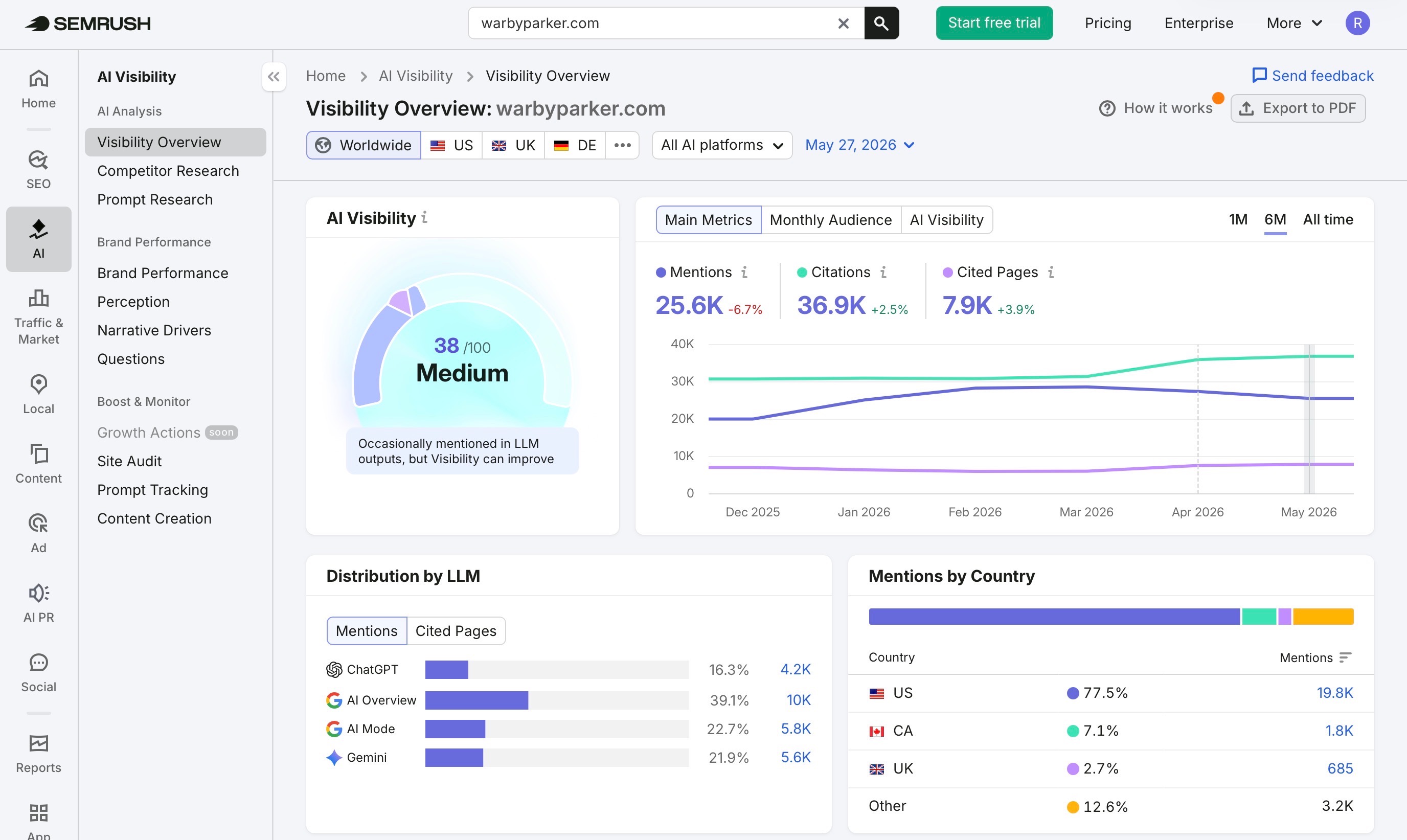
Best for: SEO teams already using Semrush who want AI visibility data without adding another tool to their stack.
Semrush AI Visibility Toolkit makes the most sense if your team already uses Semrush for SEO. It brings AI visibility, competitor benchmarking, sentiment, prompt research, and AI-readiness checks into the same ecosystem. If I am being honest, it works better as a Semrush add-on than as a standalone AI visibility tool.
Key features
- Tracks AI visibility across ChatGPT, Perplexity, Gemini, Google AI Mode, and Google AI Overviews.
- Shows AI Visibility Score, brand mentions, citations, sentiment, and competitor gaps.
- Includes prompt research and daily tracking for custom prompts.
- Adds AI-readiness site audit checks.
- Connects AI visibility insights with Semrush’s broader SEO data.
Pros
- Very low workflow friction for existing Semrush users.
- Keeps AI and SEO data in one dashboard.
- Useful for competitor benchmarking, prompt research, and sentiment analysis.
- Practical if your SEO team already relies on Semrush.
Cons
- Less useful if you are not already in the Semrush ecosystem.
- Narrower coverage than deeper enterprise AI visibility tools.
- Execution still depends on other Semrush tools or your own workflow.
- Costs can add up if you track multiple domains.
Pricing
- AI Visibility Toolkit: $99/month per domain, billed annually
- Semrush One: Starts at $199/month
- Enterprise AIO: Custom pricing
How does Semrush AI Visibility Toolkit compare to Ahrefs Brand Radar?
Semrush is better if you want AI visibility and traditional SEO data in one place. Ahrefs Brand Radar is stronger for broad discovery across AI, search, Reddit, YouTube, and TikTok. But if your team already uses Semrush, its AI Visibility Toolkit is the easier add-on.
Already using Semrush? Read the full Semrush AI Visibility Toolkit review to see whether its AI tracking features are worth adding to your SEO workflow.
5. Otterly AI: best budget-friendly option for getting started
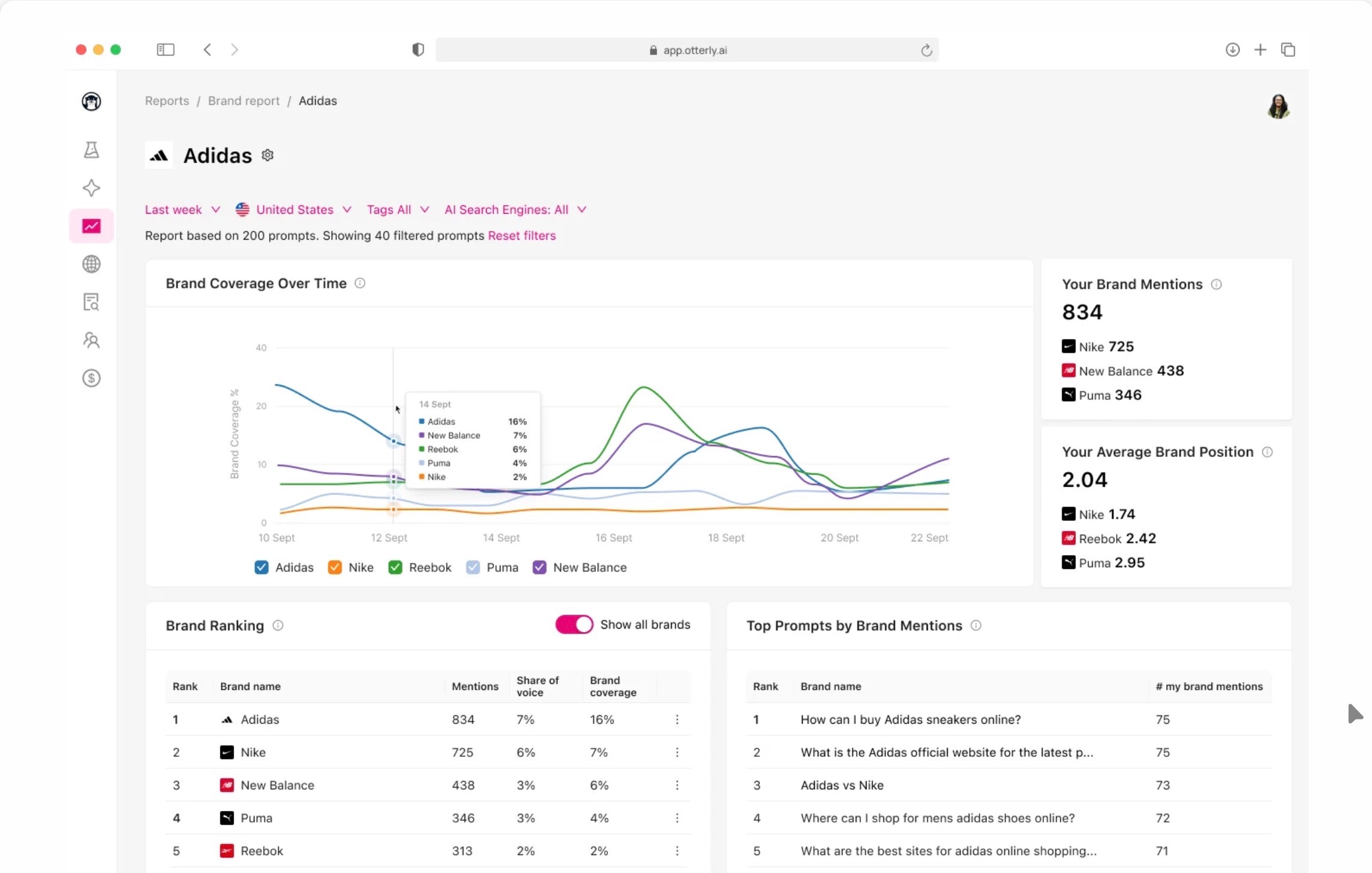
Best for: Small teams, solo marketers, or anyone new to AI visibility tracking who wants a low-risk way to start.
Otterly AI is an affordable alternative to Ahrefs Brand Radar. It gives you prompt tracking, brand mentions, citations, share of voice, and GEO audits without the price tag of enterprise tools. It will not replace a deeper GEO platform as you scale, but it is a practical starting point.
Key features
- Tracks ChatGPT, Google AI Overviews, Perplexity, and Microsoft Copilot on core plans.
- Offers Google AI Mode and Gemini as add-ons.
- Includes prompt tracking, brand reports, citation analysis, and Brand Visibility Index.
- Supports unlimited team members and daily tracking.
- Includes GEO audits, exports, reports, and Looker Studio on higher tiers.
Pros
- Lowest entry price among credible tools on this list.
- Easy to set up and understand.
- Good mix of prompt tracking, citations, share of voice, and reporting.
- Gartner Cool Vendor 2025 recognition adds credibility.
Cons
- Lite plan only includes 15 search prompts.
- Google AI Mode and Gemini cost extra.
- Not built for content creation or deep optimization workflows.
- You may outgrow it once you need advanced competitive analysis or execution.
Pricing
- Lite: $29/month
- Standard: $189/month
- Premium: $489/month
- Enterprise: Custom pricing
How does Otterly AI compare to Ahrefs Brand Radar?
Otterly AI is better if you want a simple, affordable way to start tracking prompts, citations, and brand visibility across major AI search engines. Ahrefs Brand Radar is stronger for broad research because of its larger search-backed database and wider visibility coverage. But for budget, setup speed, and ease of use, Otterly AI feels more practical.
Want a budget-friendly starting point? Read the full Otterly AI review to see how its prompt tracking, citations, and AI visibility reports perform in practice.
6. SE Visible: best for focused AI brand visibility tracking
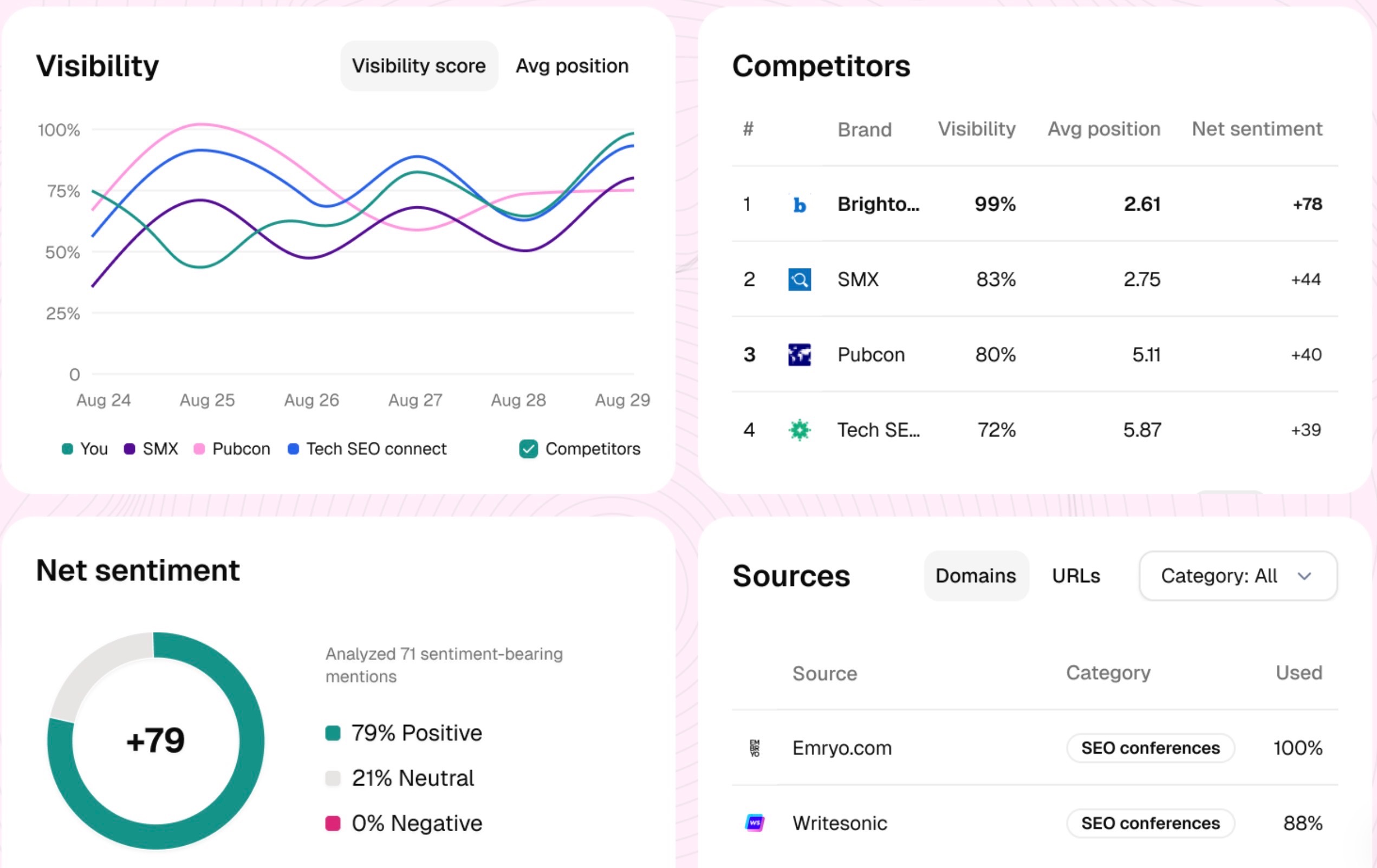
Best for: Brand, SEO, and agency teams that want clean AI visibility tracking across mentions, sentiment, competitors, and sources.
G2 rating: SE Visible does not appear to have a separate G2 profile yet.
SE Visible is SE Ranking’s dedicated AI visibility platform. It helps you see how your brand appears across ChatGPT, Gemini, AI Mode, Perplexity, and AI Overviews, along with sentiment, competitors, and source-level visibility. If I am being honest, it feels stronger for brand tracking and reporting than hands-on SEO execution.
Key features
- Tracks brand visibility across ChatGPT, Gemini, AI Mode, Perplexity, and AI Overviews.
- Monitors mentions, sentiment, competitors, sources, and visibility trends.
- Shows top domains, URLs, topics, and AI engine-level performance.
- Supports multiple projects, unlimited users, exports, and reporting filters.
- Useful for brand, SEO, and agency-level AI visibility reporting.
Pros
- Focused dashboard for AI visibility tracking.
- Strong for sentiment, competitor, and source analysis.
- Easier to use than a broad SEO suite if AI visibility is the main goal.
- Good fit for agencies managing multiple brands or clients.
Cons
- Not a full content creation or optimization platform.
- No separate G2 profile yet.
- AI platform coverage is solid, but not as wide as enterprise GEO tools.
- Better for tracking gaps than fixing them inside the same workflow.
Pricing
- Basic: Starts at $79/month, billed annually
- Core: Starts at $151/month, billed annually
- Plus: Starts at $284/month, billed annually
- 10-day free trial available
How does SE Visible compare to Ahrefs Brand Radar?
SE Visible is better if you want a focused AI visibility dashboard for brand mentions, sentiment, competitors, sources, and client reporting. Ahrefs Brand Radar is stronger for broad discovery because of its larger search-backed prompt database and wider research coverage. But if you want cleaner AI brand tracking without the heavier Ahrefs ecosystem, SE Visible feels more practical.
Want to see how SE Ranking fits into an SEO plus AI visibility workflow? Read the full SE Ranking review for a closer look at its rank tracking, AI visibility features, reporting, and overall value.
7. Scrunch AI: best for brand and PR teams focused on narrative control
Best for: Brand, PR, and enterprise marketing teams that need to control how AI engines describe their company.
G2 rating: 4.6/5 from 72 reviews
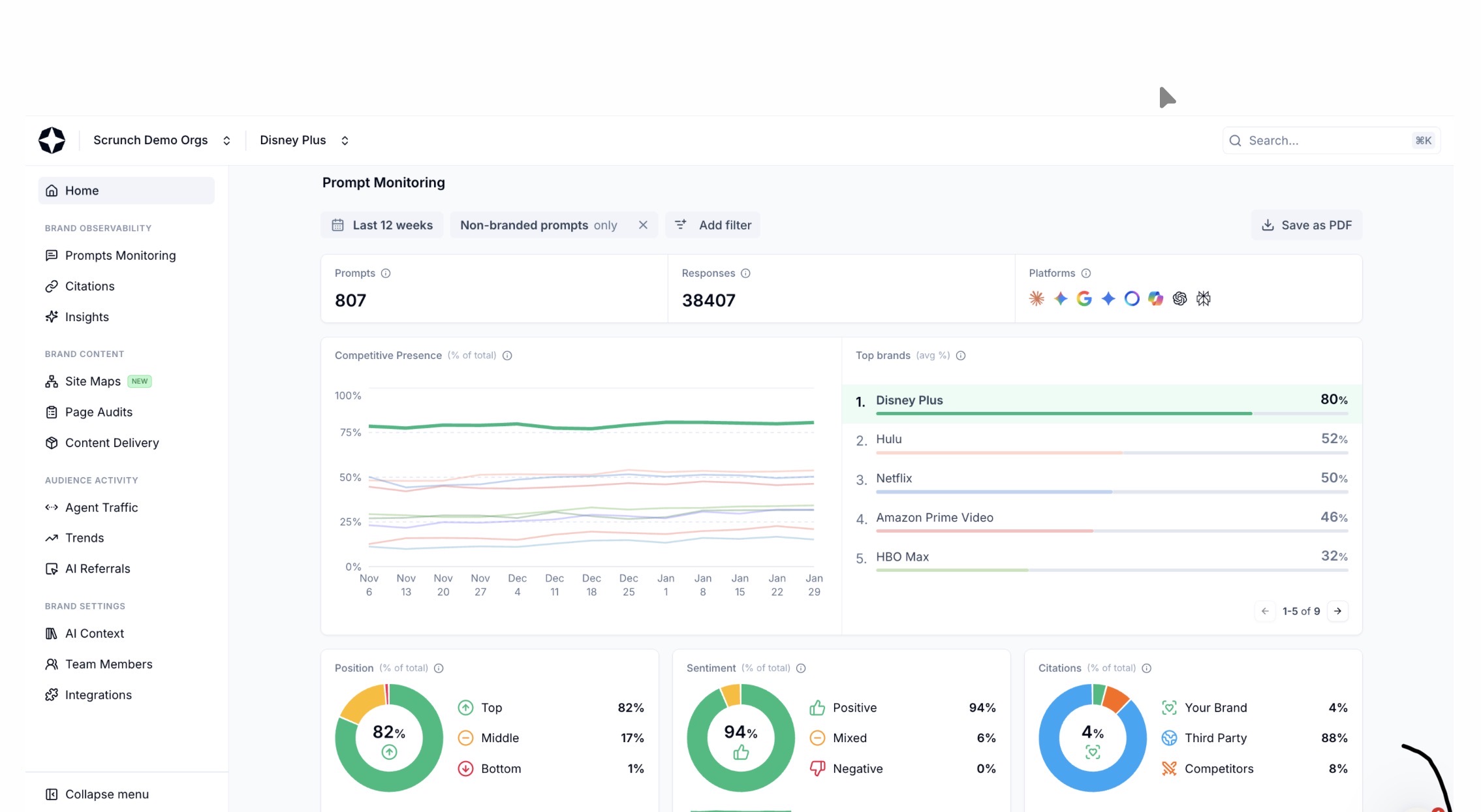
Scrunch AI is less about basic mention tracking and more about brand accuracy. It helps teams monitor visibility, citations, competitors, sentiment, hallucinations, and how AI agents interpret their website. Its standout feature is AXP, which serves AI-readable versions of key pages so AI engines can understand your brand more clearly.
Key features
- Tracks brand presence, prompts, rankings, citations, and competitors.
- Includes sentiment and AI hallucination detection.
- Offers AI bot tracking and crawl visibility.
- Uses AXP to deliver AI-readable content to agents.
- Supports enterprise needs like SOC 2, RBAC, multi-site deployment, and API access.
Pros
- Strong for understanding how AI engines describe your brand.
- AXP adds a real action layer beyond basic monitoring.
- Useful for competitor narrative analysis and citation tracking.
- Good fit for PR, comms, brand, and enterprise marketing teams.
Cons
- Higher starting price than many alternatives.
- Not a full SEO content creation platform.
- Some teams may still need separate tools for content briefs and optimization.
- Better suited to mid-market and enterprise teams than solo marketers.
Pricing
- Core: $250/month
- Enterprise: Custom pricing
How does Scrunch AI compare to Ahrefs Brand Radar?
Scrunch AI is stronger if you care about brand accuracy, hallucination detection, citation quality, and how AI engines interpret your website. Ahrefs Brand Radar is better for broad discovery and large-scale brand research inside the Ahrefs ecosystem. But for narrative control and AI-readable content delivery, Scrunch AI has the sharper angle.
Want to know if Scrunch AI is worth it for brand control? Read the full Scrunch AI review for a closer look at its AXP, hallucination detection, and AI visibility features.
Which Ahrefs Brand Radar alternative is right for your team?
The right Ahrefs Brand Radar alternative depends on what you actually need to improve, not just what you want to track. Some tools are better for deep analytics, some for client reporting, and some for turning AI visibility gaps into content and SEO actions.
Here are the clearest ways to choose based on your team’s current workflow.
1. If you need AI visibility plus execution, choose Scalenut
Choose Scalenut if you want to track AI visibility and act on the gaps inside the same platform. It is the strongest fit for content and SEO teams because it connects visibility tracking with GEO content creation, optimization, prompt discovery, content scoring, and execution-ready workflows.
2. If you need enterprise-grade AI analytics, choose Profound
Choose Profound if your team needs deeper AI search intelligence, prompt demand data, competitor analysis, and agent analytics at scale. It makes the most sense for enterprise brands or larger agencies that already have the team to interpret and act on complex AI visibility data.
3. If you need client-friendly multi-brand reporting, choose Peec AI
Choose Peec AI if you manage multiple brands and need clean dashboards, competitor benchmarking, sentiment insights, and clear AI visibility reporting. It is especially useful for agencies that need data clients can understand without too much explanation.
4. If your team already uses Semrush, choose Semrush AI Visibility Toolkit
Choose Semrush AI Visibility Toolkit if your SEO team already works inside Semrush and wants AI visibility data without adding another platform. It is useful for tracking prompts, competitor gaps, sentiment, AI visibility, and AI-readiness issues in the same ecosystem.
5. If you are just getting started, choose Otterly AI
Choose Otterly AI if you want a low-risk way to understand AI visibility without committing to a bigger platform. It is simple, budget-friendly, and useful for tracking prompts, brand visibility, citations, and AI search performance early on.
6. If you need focused brand tracking, choose SE Visible
Choose SE Visible if your priority is tracking brand mentions, sentiment, competitors, and key sources across AI platforms. It is a good fit for brand, SEO, and agency teams that want focused AI visibility reporting without a heavier enterprise setup.
7. If brand accuracy matters most, choose Scrunch AI
Choose Scrunch AI if your main concern is how AI engines describe your brand. Its Agent Experience Platform helps serve AI-optimized content to agents, which makes it a sharper fit for brand, PR, and enterprise marketing teams focused on narrative control.
The easiest way to decide is this: choose the tool that matches your next bottleneck. If the bottleneck is tracking, pick a monitoring-first tool. If it is reporting, pick a dashboard-first tool. If it is improving visibility, pick a tool like Scalenut that connects insight to execution.
Final thoughts
Ahrefs Brand Radar is useful for broad brand discovery, but the right alternative depends on what your team needs next: deeper analytics, cleaner reporting, brand accuracy, or execution.
For content and SEO teams, Scalenut stands out because it connects AI visibility insights with content creation, optimization, internal linking, and GEO recommendations.
Ready to turn AI visibility gaps into content that can actually win mentions?
Try Scalenut’s GEO Tracking For Free!
Frequently asked questions
Is Ahrefs Brand Radar worth the price?
Ahrefs Brand Radar pricing is worth it if you already use Ahrefs and need broad brand discovery across AI search, competitors, cited pages, and share of voice. But at its price point, it feels less ideal if your team needs recommendations and execution.
How does Ahrefs Brand Radar features and pricing compare to Scalenut?
Ahrefs Brand Radar is stronger for broad AI visibility research and brand discovery. Scalenut is stronger for execution, combining AI visibility tracking with GEO content creation, optimization, and content scoring. Scalenut also starts at a lower price than Ahrefs Brand Radar.
What are the top Ahrefs Brand Radar alternatives for tracking brand visibility in AI search results?
The best alternatives are Scalenut, Profound, Peec AI, Semrush AI Visibility Toolkit, Otterly AI, SE Visible, and Scrunch AI. Scalenut is strongest if you want a search visibility tracker that also supports content planning, optimization, and execution.
How does HubSpot compare to Ahrefs Brand Radar for monitoring brand mentions in AI platforms?
HubSpot is better as a lighter entry point for checking how AI platforms describe your brand, including sentiment and share of voice. Ahrefs Brand Radar is stronger for large-scale research. For deeper search monitoring and execution, Scalenut or Profound go further.
Which free tools can I use instead of Ahrefs Brand Radar to track my brand’s AI visibility?
Free options include HubSpot’s AEO Grader, Ahrefs’ free AI visibility checker, manual checks in ChatGPT and Perplexity, and basic referral review in analytics. They help you spot patterns in AI answer engines, but not enough for serious reporting.
What features should I look for when choosing an alternative to Ahrefs Brand Radar?
Look for prompt-level tracking, citation analysis, competitor benchmarking, sentiment, share of voice trends, traffic signals, and recommendations. The best Ahrefs Brand Radar competitors should also support search optimization through AI visibility features that help you act, not just report.
How does Profound AI compare with Ahrefs Brand Radar for tracking brand presence in AI search?
Profound is stronger for enterprise AI analytics, broad platform coverage, prompt demand, and competitive intelligence. Ahrefs Brand Radar is better for quick, large-scale brand research inside Ahrefs. Scalenut is the better middle ground when you need AI visibility metrics plus execution.
Are there any tools similar to Ahrefs Brand Radar that offer better pricing or value?
Yes. Scalenut, Otterly AI, SE Visible, Peec AI, and Semrush AI Visibility Toolkit can offer better value depending on your workflow. Scalenut stands out because it connects visibility gaps to content briefs, optimization, internal linking, and GEO recommendations.
What are the main pros and cons of using Peec AI instead of Ahrefs Brand Radar?
Peec AI’s main pros are clean dashboards, browser-style tracking, sentiment, competitor benchmarking, and agency-friendly reporting. Its drawback is that it is still mostly a monitoring tool, so teams with specific needs around content execution may prefer Scalenut.
Which is the top Ahrefs Brand Radar alternative for small businesses on a budget?
For small businesses, Scalenut offers the best value as it offers content creation and SEO execution along with AI visibility tracking. Choose Scalenut when visibility insights need to become publishable content.


.svg)


.webp)