
What Are the Top Otterly AI Competitors Worth Trying In 2026?

Quick Answer: Best Otterly AI Competitors
- Scalenut: Best for SEO and GEO teams that want AI visibility tracking, content optimization, and execution in one workflow.
- Profound: Best for enterprise teams that need deeper AI search intelligence, brand visibility insights, and competitive analysis across major AI answer engines.
- Scrunch AI: Best for brands that want AI search monitoring, citation analysis, website diagnostics, and agent experience workflows.
- Peec AI: Best for teams that want a clean AI visibility dashboard for tracking brand mentions, citations, prompts, and competitors.
- AthenaHQ: Best for teams that want AI visibility insights with action-focused recommendations and GEO prioritization.
- Writesonic GEO: Best for teams that want AI search visibility tracking connected with AI content creation and optimization workflows.
- SE Visible: Best for teams that want a focused AI visibility dashboard for tracking brand mentions, sentiment, competitors, prompts, and cited sources.
AI visibility is no longer something SEO teams can ignore. If your brand is not being mentioned, cited, or recommended in AI answers, you are likely missing a growing layer of search visibility that traditional SEO and rank tracking does not fully capture.
Otterly AI is one of the better-known tools in this space, especially for tracking brand mentions, prompts, citations, and competitor visibility across AI search platforms. But it may not be the right fit for every team, especially if you need deeper execution workflows, broader reporting, more prompt flexibility, or SEO and GEO in one place.
So, I tested and compared the top Otterly AI competitors based on AI search coverage, citation tracking, competitor insights, pricing, prompt limits, and how useful each tool feels in a real SEO and GEO workflow. In this review, I’ll break down which alternatives are actually worth considering and who each one is best for.
How Did I Choose The Top Otterly AI Competitors?
I compared best Otterly AI competitors based on how useful they feel in a real SEO and GEO workflow. Here are the main things I looked at:
- AI Search Coverage: Support for important AI platforms like ChatGPT, Perplexity, Gemini, Google AI Overviews, Google AI Mode, Claude, and Copilot.
- Prompt And Citation Tracking: Visibility into prompts, brand mentions, cited pages, source links, share of voice, and performance changes over time.
- Competitor Benchmarking: Clear data on where competitors appear, which prompts they win, and what sources help them get cited.
- Actionability: Practical guidance on what to optimize, refresh, create, or prioritize next.
- SEO Plus GEO Workflow Support: A smoother connection between AI visibility, keyword research, content planning, audits, optimization, and reporting.
- Pricing And Prompt Limits: Fair value as tracking expands across more prompts, products, competitors, clients, or markets.
- Best-Fit Use Case: A clear reason to choose the tool, whether for clean monitoring, enterprise intelligence, AI writing, SEO-suite reporting, or tracking plus execution.
This made the comparison more practical because the best Otterly AI competitor depends on what your team needs after the visibility gaps show up.
What Is Otterly AI?
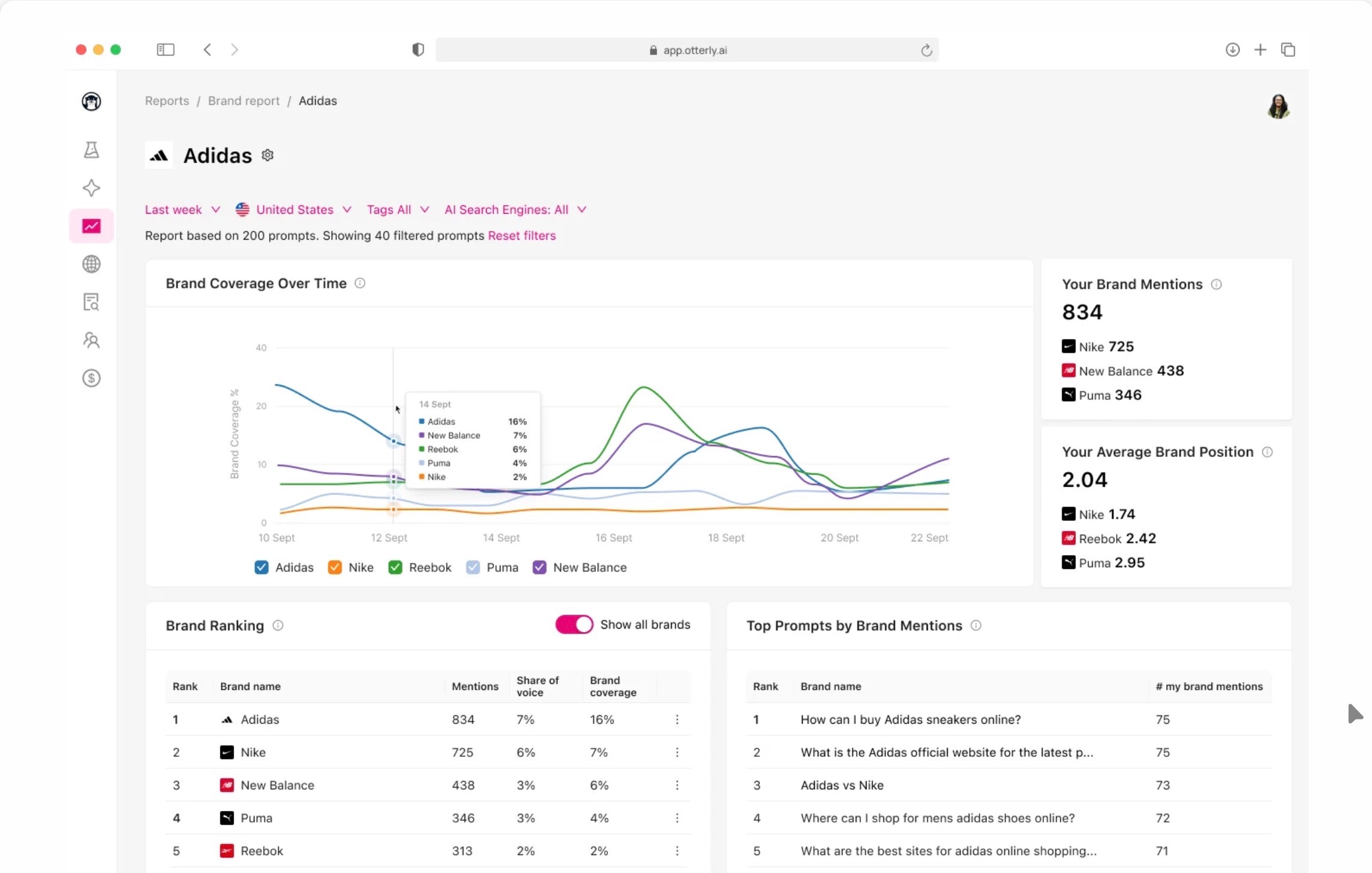
Otterly AI is an AI search monitoring platform that helps brands track how often they are mentioned, ranked, and cited across AI search engines like ChatGPT, Google AI Overviews, Perplexity, Google AI Mode, Gemini, and Microsoft Copilot. It is mainly used for AI visibility tracking, brand monitoring, citation analysis, prompt tracking, competitor comparisons, and GEO reporting.
Why Look For Otterly AI Competitors?
Otterly AI is a solid monitoring tool, but teams may compare competitors when they need more execution, coverage, or workflow depth. Here are the main reasons teams start comparing alternatives:
- More Execution: If your team wants to turn AI visibility gaps into optimized briefs, content audits, refreshes, and new pages, you may need a tool that connects monitoring with actual execution.
- More Platform Coverage: Some teams may want broader LLM or AI search coverage, especially if they need to track newer AI surfaces without relying too heavily on add-ons.
- More Prompt Volume: If you track hundreds of prompts across multiple brands, products, markets, or competitors, pricing and prompt limits become a much bigger part of the decision.
- Deeper Competitor Intelligence: Basic visibility data shows who is appearing in AI answers. Deeper competitor intelligence helps you understand why competitors are getting cited, which sources influence those answers, and where your brand is falling behind.
- SEO Plus GEO Workflows: Many teams do not want AI visibility to sit in a separate tool. They want keyword research, SEO planning, content optimization, GEO tracking, and reporting to work together.
- Enterprise Reporting: Larger teams may need custom dashboards, multi-brand reporting, API access, user controls, exports, and stakeholder-ready reports that fit into their existing workflows.
Want the full breakdown before you compare alternatives? Read our Otterly AI Review to see whether it is actually worth using for GEO in 2026.
Which Top Otterly AI Competitors Are Worth Considering In 2026?
AI visibility tools are not all built for the same kind of team. Some are better for simple monitoring, some go deeper into competitor intelligence, and some help you turn AI visibility gaps into actual SEO and GEO actions.
Here are the best Otterly AI competitors I tested and where each one fits best.
1. Scalenut (G2 Rating: 4.7 From 315 Users)
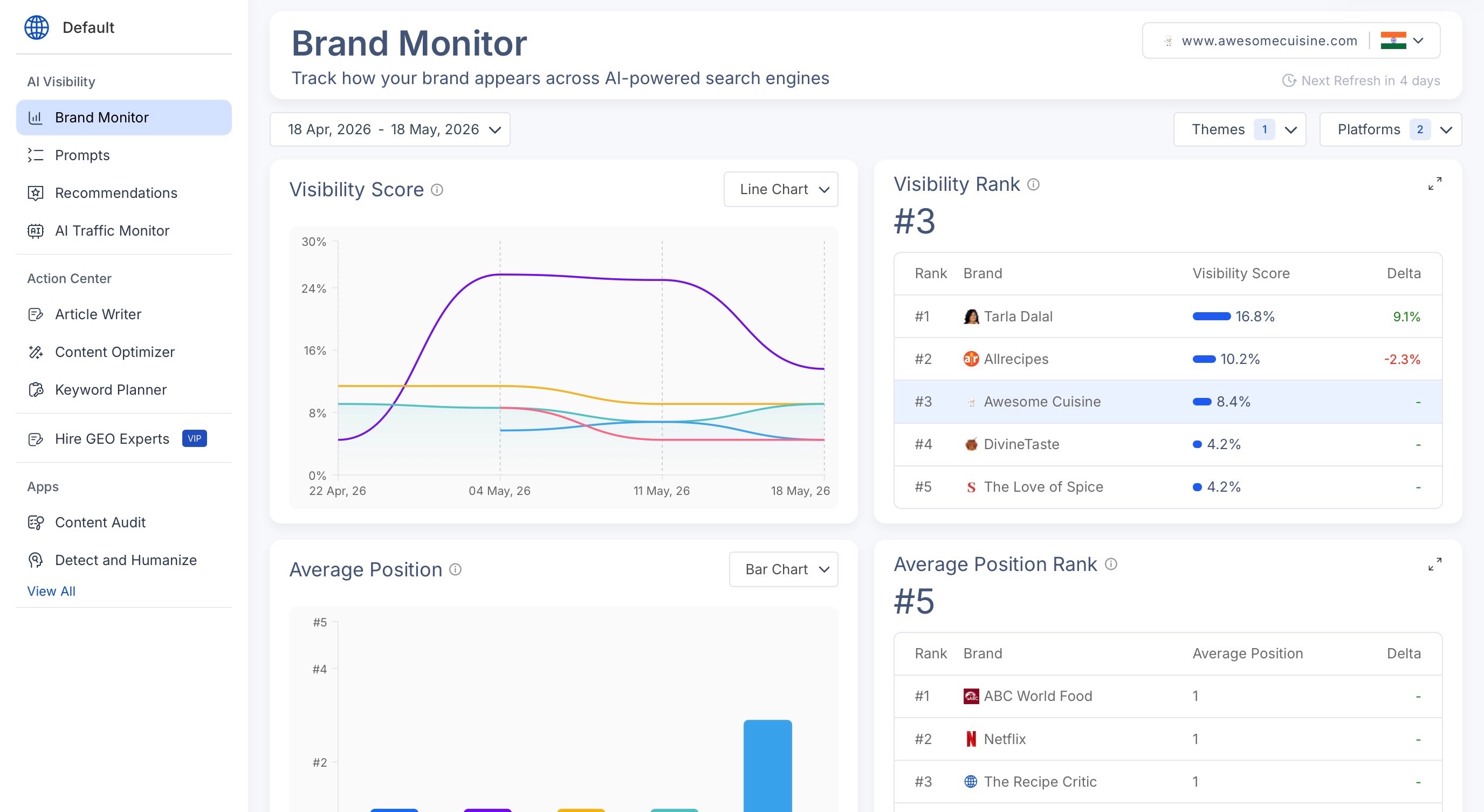
Best For: SEO and GEO teams that want AI visibility tracking, content planning, optimization, and execution in one workflow.
Scalenut is a full-stack GEO platform built to help teams track AI visibility, find content gaps, create GEO-friendly content, optimize existing pages, and monitor how AI bots interact with their site. What I like here is that it does not stop at showing visibility gaps. It gives you the workflow to act on them.
Key Features
- AI visibility tracking for prompts across Google AI Overviews, ChatGPT, and Perplexity on higher plans
- Actionable recommendations that turn visibility gaps into content, backlink, and community engagement actions
- GEO + SEO content creation for building ready-to-rank articles
- GEO + SEO content optimization for improving existing pages
- Content audits to find pages that need fixes or refreshes
- AI Traffic Monitor with Cloudflare integration to track AI bot visits, crawl trends, and AI-driven page performance
Pricing Snapshot
- Starter: $24/month, billed yearly
- Plus: $36/month, billed yearly
- Professional: $80/month, billed yearly
- VIP Service: Custom pricing
Pros
- Strong balance of AI visibility tracking and content execution
- Useful for teams that want SEO and GEO in the same workflow
- Pricing is more accessible than many enterprise-first AI visibility tools
- Recommendations make the data easier to act on
- Includes content creation, optimization, audits, and keyword planning
- AI Traffic Monitor helps connect visibility with real AI bot activity
Cons
- Not ideal if you only want a very lightweight monitoring dashboard
- Some advanced workflows are better suited to higher plans
Why Is Scalenut A Better Option Than Otterly AI?
Scalenut is a better option if your team wants to move beyond monitoring. Otterly AI is useful for tracking AI visibility, prompts, mentions, citations, and competitors, but Scalenut gives you more room to act on those insights through GEO content creation, optimization, audits, recommendations, keyword planning, and AI traffic monitoring.
I would choose Scalenut when the goal is not just to know where your brand is missing, but to actually improve your chances of showing up in AI search. If you want a detailed breakdown, read our complete Scalenut review.
2. Profound (G2 Rating: 4.5 From 951 Users)
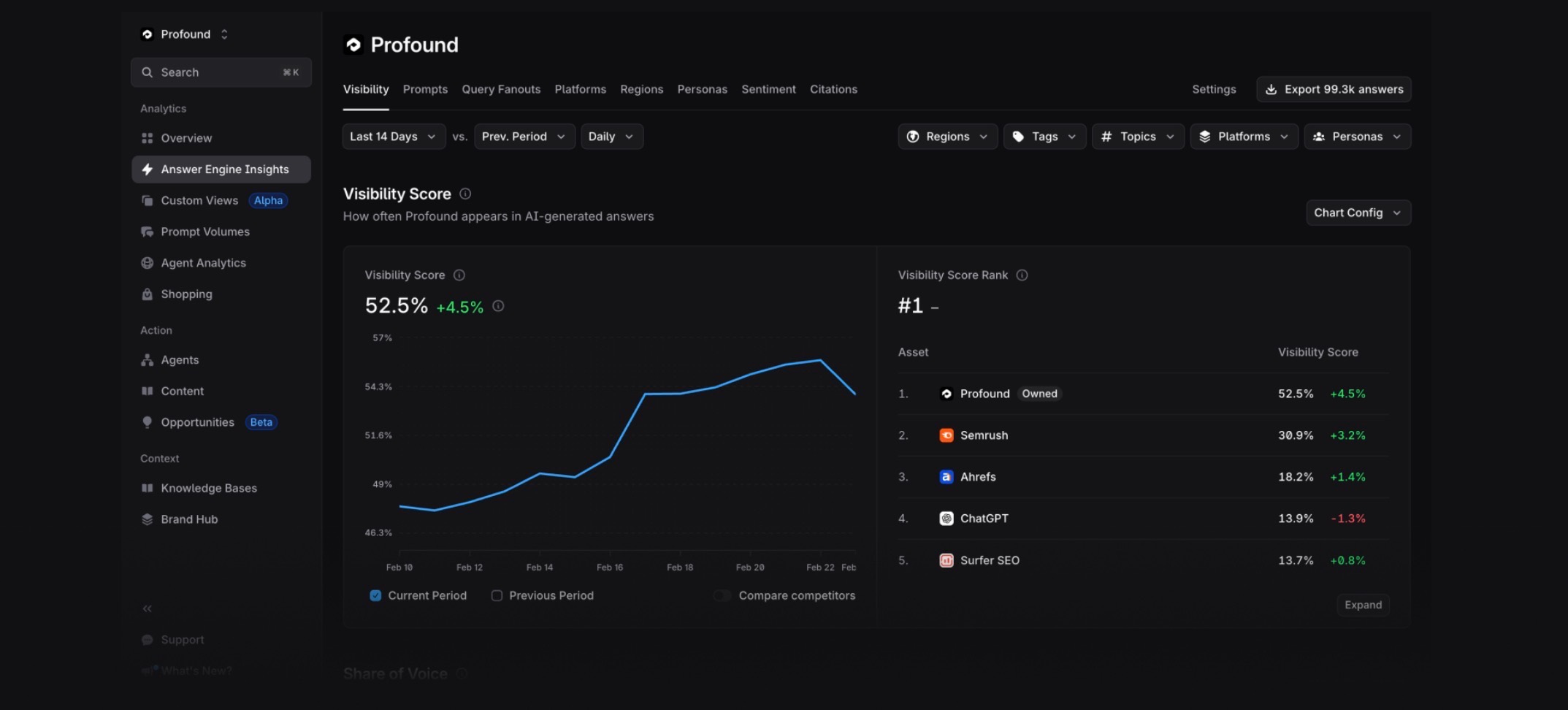
Best For: Enterprise teams that need deep AI search intelligence, prompt demand data, and competitive visibility across AI answer engines.
Profound is an AI visibility and answer engine optimization tool built for teams that want to understand how their brand appears across AI search. It is more intelligence-first than execution-first, so it works best when you already have a team that can act on the insights.
Key Features
- Answer Engine Insights to track how AI platforms represent your brand
- Prompt Volumes to see what people are asking across AI search platforms
- Daily visibility tracking for custom and real-world prompts
- Citation authority insights to find which sources influence AI answers
- Competitive benchmarking across prompts, topics, regions, and platforms
- Agent Analytics to see how AI bots crawl and interpret your site
Pricing Snapshot
- Starter: $82.50/month, billed yearly
- Growth: $332.50/month, billed yearly
- Enterprise: Custom pricing
Pros
- Strong fit for enterprise AI search intelligence
- Useful for tracking prompts, citations, competitors, and AI visibility trends
- Covers a wide range of major AI answer engines
- Prompt Volumes helps you understand real AI search demand
- Good option for brand, PR, content, and AEO teams
Cons
- Can feel expensive for smaller SEO teams
- Starter plan is limited to ChatGPT tracking only
- Growth plan tracks fewer answer engines than Enterprise
- Not the cleanest fit if you want SEO planning, optimization, and publishing in one workflow
When Is Profound A Better Otterly AI Alternative?
Profound is a better fit if your team needs deeper AI search intelligence, prompt demand insights, and enterprise-level reporting. I would choose it over Otterly AI when AI search has become a serious visibility channel and your team needs more detail than a lightweight monitoring dashboard can give.
Want a deeper look before comparing it with Otterly AI? Read our Profound AI Review to see if it is the right GEO tool for your brand.
3. Scrunch AI (G2 Rating: 4.6 From 72 Users)
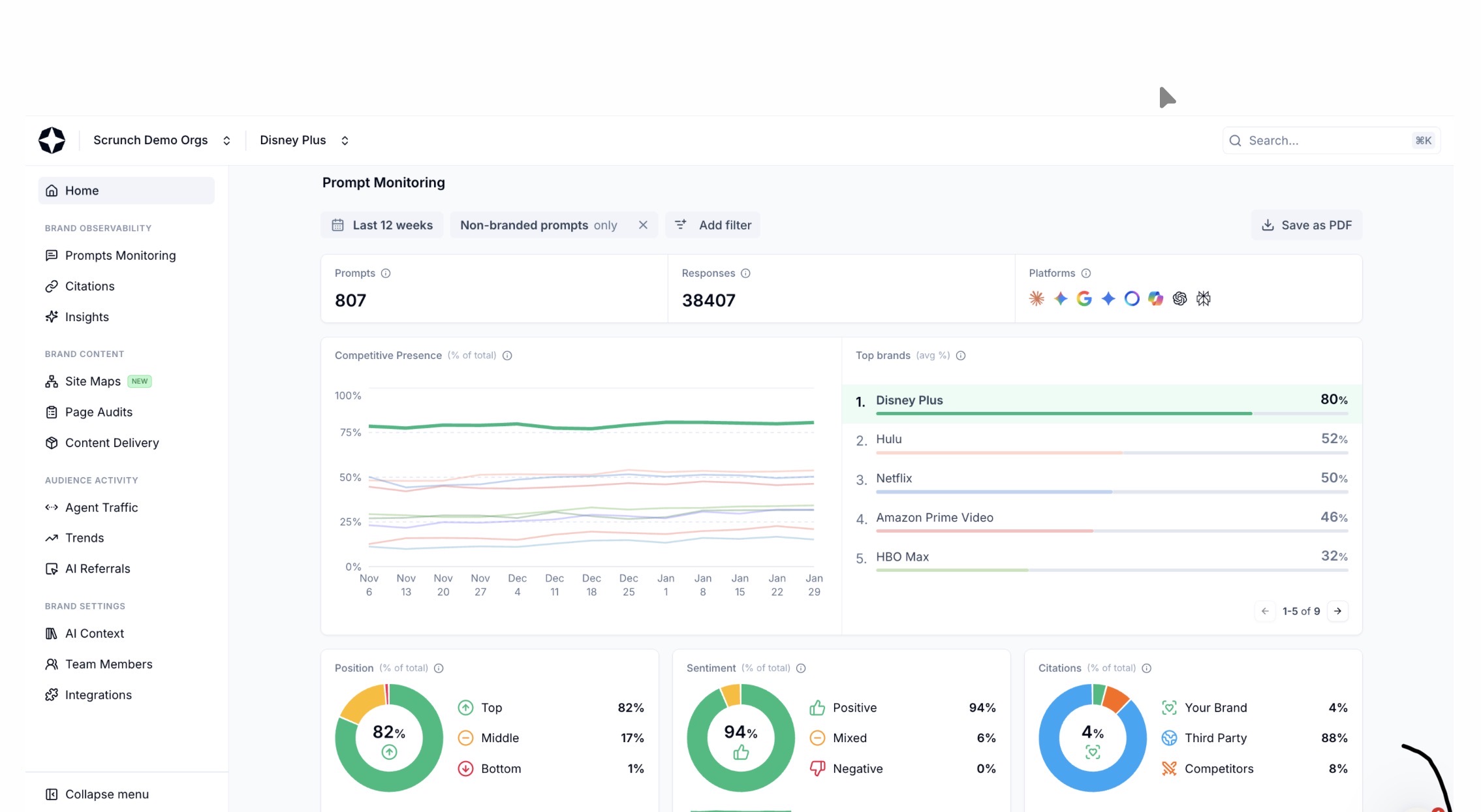
Best For: Brands that want AI search monitoring, citation analysis, site audits, and AI agent readiness.
Scrunch AI is an AI Customer Experience Platform that helps brands monitor how they show up in AI search, understand why they are winning or missing, and make their content easier for AI agents to read.
Key Features
- AI search monitoring for brand presence, performance, and rankings
- Prompt analytics with trends, citations, competitors, and rankings
- Citation analysis to see which sources AI platforms rely on
- AI traffic monitoring to track how AI bots crawl your site
- Site audits to find crawl, content, and accessibility issues
- Agent Experience Platform to deliver AI-optimized content to agents
Pricing Snapshot
- Core: $250/month
- Enterprise: Custom pricing
Pros
- Strong focus on AI agent readiness
- Useful prompt, citation, and competitor tracking
- Site audits make the insights more actionable
- 7-day free trial available on the Core plan
Cons
- Starting price is higher than lightweight AI visibility trackers
- Expanded model coverage is limited to Enterprise
- AXP, API access, integrations, SSO, and dedicated support are Enterprise-only
- Not a full SEO content creation or optimization platform
When Is Scrunch AI A Better Otterly AI Alternative?
Scrunch AI is a better fit if your team cares about more than tracking mentions. I would choose it when you want to understand how AI systems crawl your site, which sources influence citations, and whether your pages are ready for AI agents.
Seriously considering Scrunch AI? Read our complete Scrunch AI review to see if it is really worth investing.
4. Peec AI (G2 Rating: 5.0 From 4 Users)
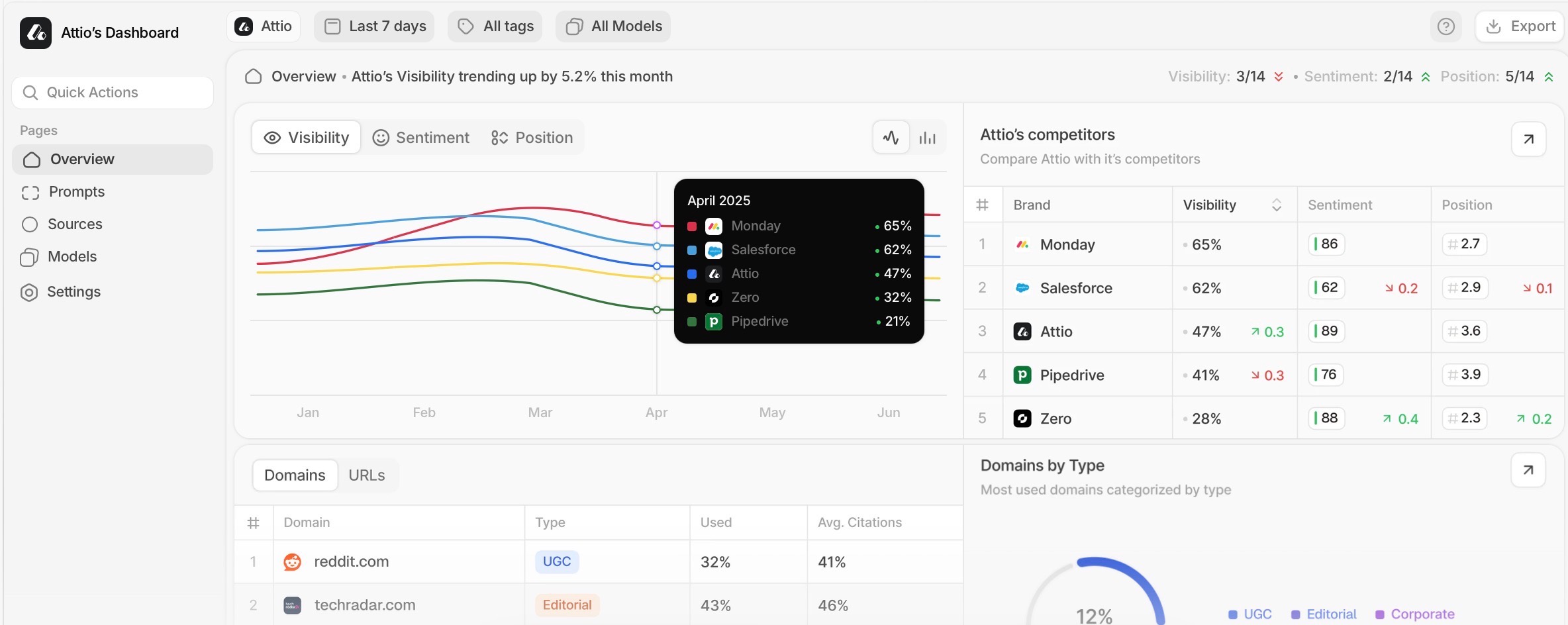
Best For: Marketing teams that want clean, multi-model AI visibility tracking with competitor benchmarking, source analysis, and multi-region monitoring.
Peec AI is an AI search analytics platform that tracks how your brand appears across major AI engines. What sets it apart is its UI scraping methodology. It simulates real browser sessions instead of querying APIs directly, so the data reflects what actual users see, not what sampled responses return.
Key Features
- AI visibility tracking across ChatGPT, Perplexity, Google AI Overviews, and more
- Share of voice and average position metrics across AI-generated responses
- Net Sentiment Score (–100 to +100) to track how AI portrays your brand
- Competitor benchmarking with regional visibility breakdowns
- Source analysis to identify which domains and URLs AI engines cite most often
- Earned Media module tracking citations from Reddit, LinkedIn, YouTube, and review sites
- Multi-country and multi-language monitoring for global brands
Pricing Snapshot
- Starter: ~$95/month
- Pro: ~$241/month
- Enterprise: ~$505/month
- Additional AI models available as paid add-ons ($30–$165/month per model)
- 7-day free trial available
Pros
- UI scraping captures real user-facing responses rather than API-sampled data, which I found made the visibility numbers feel more trustworthy
- Unlimited seats on all plans keeps team access cost-free as you scale
- Source and URL-level citation breakdown is genuinely actionable, not just a vanity metric
- Earned Media module surfaces external citation opportunities across third-party platforms
Cons
- Only 3 AI models included by default; adding more raises the effective monthly cost fast
- Prompt limits on lower tiers feel restrictive if you are tracking a competitive category
- No AI traffic estimation or revenue attribution built in
- No content creation, gap analysis, or optimization execution. It is purely a monitoring layer
When Is Peec AI A Better Otterly AI Alternative?
Peec AI is a better fit if your team needs more than a mention count and wants to understand sentiment, source influence, and how visibility shifts across regions and languages. I would choose it when you want real-user-facing data, need unlimited team access without seat-based pricing, and are tracking how different AI engines portray your brand across multiple markets.
Want the full hands-on breakdown before you decide? Read our Peec AI Review to see whether it is the right AI visibility and GEO tool for your team.
5. AthenaHQ (G2 Rating: 4.9 From 31 Users)
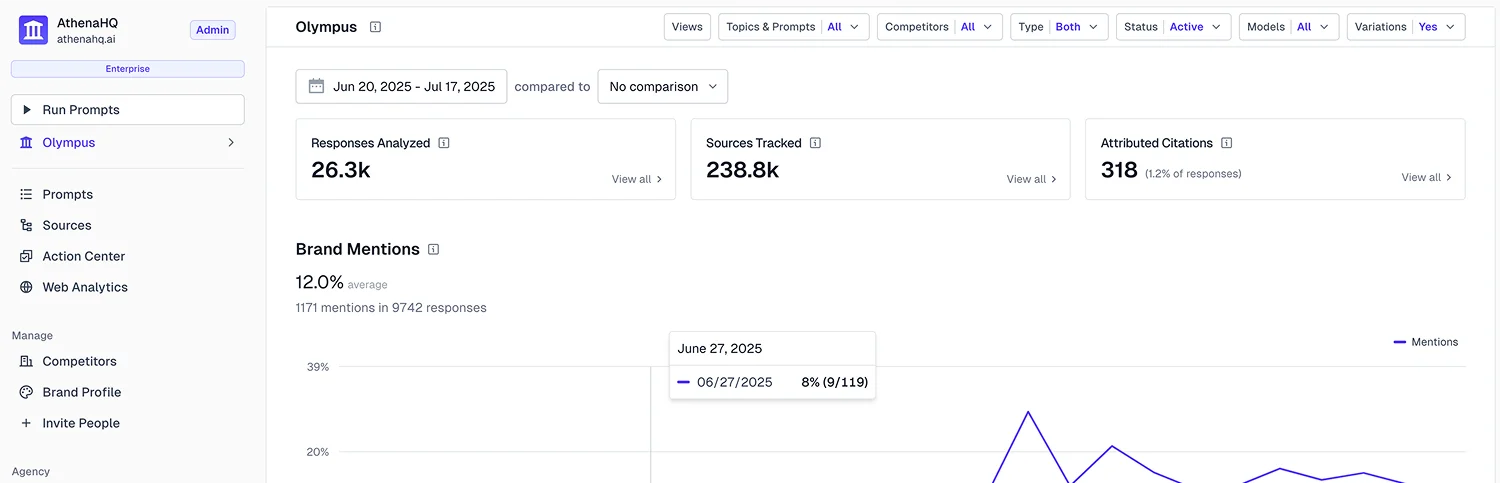
Best For: SaaS brands and content teams that want AI visibility monitoring paired with structured optimization workflows and citation intelligence across 8+ AI engines.
AthenaHQ is a GEO platform built by ex-Google Search and DeepMind engineers, backed by Y Combinator. What separates it from most monitoring tools is its Action Center, which turns visibility data into prioritized next steps rather than leaving you to figure out what to do with the numbers.
Key Features
- AI visibility tracking across 8+ engines including ChatGPT, Perplexity, Gemini, Claude, Copilot, Grok, Google AI Overviews, and AI Mode
- GEO Score that consolidates citation count, sentiment, traffic impact, and query type into one metric
- Action Center with structured optimization recommendations based on your tracking data
- AI Blindspot Detection to surface content gaps where AI engines miss key facts about your brand
- Granular authority and citation intelligence to identify which sources drive your mentions
- Competitor monitoring and impersonation detection
- Dynamic AI crawling to find lost or hidden pages on your site
- On and off-page GEO analysis covering both content improvements and external citation opportunities
- Unlimited seats with role-based access control on all plans
Pricing Snapshot
- Self-Serve: $295/month
- Enterprise: Custom pricing
- No free trial available
Pros
- Covers 8+ AI engines on the Self-Serve plan, which I found unusually generous for the price point
- Action Center gives you actual next steps
- AI Blindspot Detection is genuinely useful for finding where AI systems are getting your brand wrong
- Unlimited seats with RBAC on every tier makes it team-friendly without hidden per-user costs
Cons
- No free trial makes it a harder commitment at $295/month before you have seen the data
- Credit system burns faster than expected once you stack multiple engines and prompts daily
- Athena Citation Engine (ACE), LLM traffic analysis, and the Content Optimization AI Agent are all locked to Enterprise
- Some users report minor bugs and data opacity around how credit usage is calculated
- Premium pricing puts it out of reach for smaller teams with limited monitoring budgets
When Is AthenaHQ A Better Otterly AI Alternative?
AthenaHQ is a better fit if monitoring alone is not enough and you need the platform to tell you what to fix next. I would choose it when you want broad multi-engine coverage from day one, need to detect where AI systems are misrepresenting or ignoring your brand, and want optimization workflows built into the same tool rather than piecing together separate solutions.
Want the full breakdown before you invest? Read our AthenaHQ AI Review 2026 to see whether it is actually worth adding to your GEO stack.
6. Writesonic (G2 Rating: 4.7 From 2,214 Users)
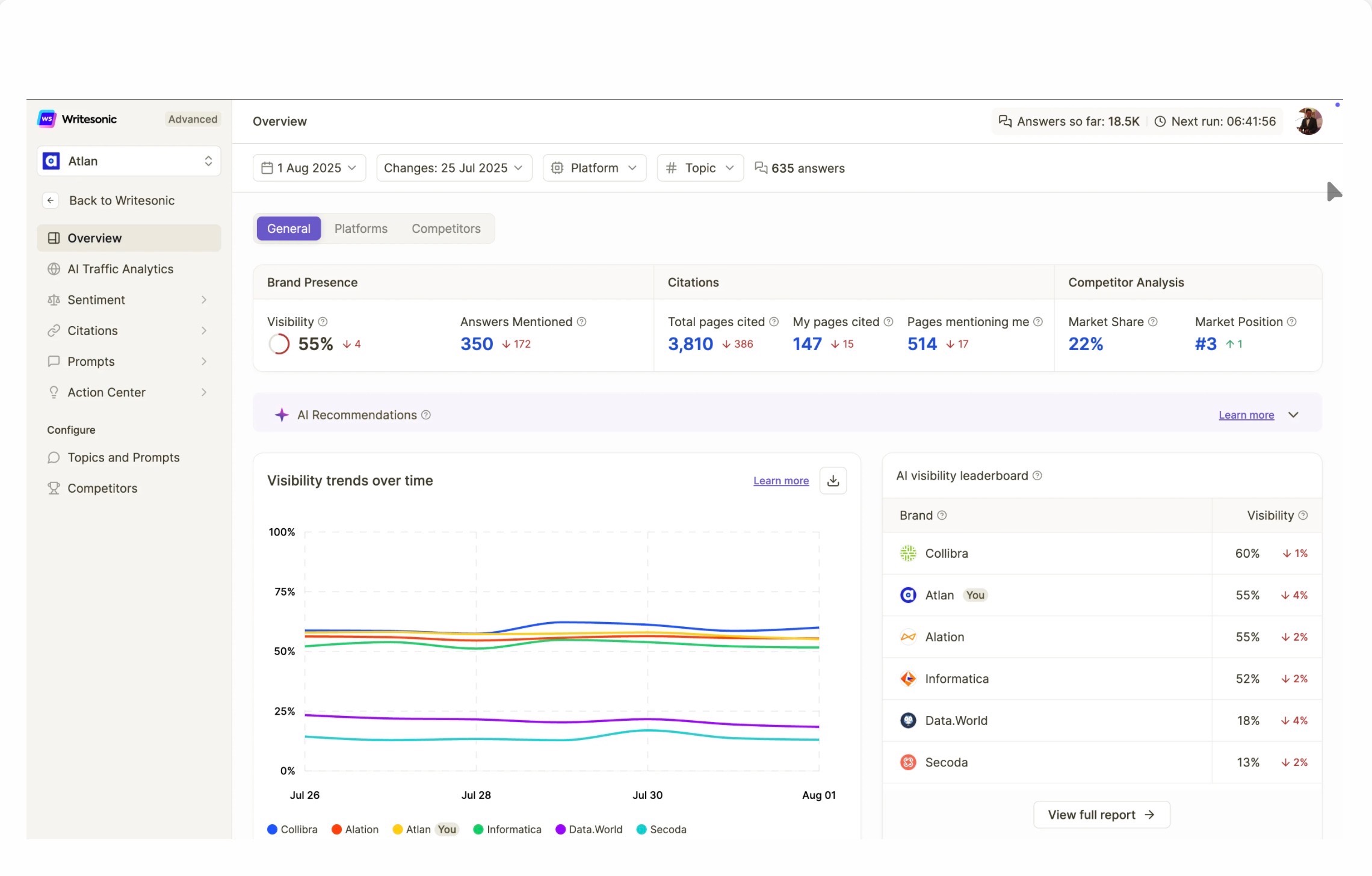
Best For: Content-first marketing teams that want AI visibility monitoring, citation gap analysis, and AI-optimized content creation all in one platform.
Writesonic started as an AI writing tool, but its GEO platform now focuses on AI visibility tracking, content gaps, and optimization workflows. Compared to a pure monitoring tool, it feels more useful when your team wants to connect AI search insights with content creation, though the workflow may feel heavier if you only need simple tracking.
Key Features
- AI visibility tracking across 10+ engines including ChatGPT, Perplexity, Google AI Overviews, AI Mode, Gemini, Claude, Copilot, Grok, Meta AI, and DeepSeek
- Action Center with prioritized recommendations ranked by effort and impact
- Citation gap analysis to find sources that mention competitors but not your brand, with ready-made outreach email templates
- AI traffic analytics to track both human visitors and AI bot traffic at the page level
- Prompt Explorer to discover trending AI queries and actual prompt search volume data
- Sentiment analysis to monitor how AI engines portray your brand
- AI-powered content creation with SEO optimization built into the same flow
Pricing Snapshot
- Lite: $49/month
- Professional: $249/month
- Advanced: $499/month
- Enterprise: Custom pricing
- Free trial available with no credit card required
Pros
- Connect visibility gaps to actual content execution
- Citation gap analysis with outreach templates saves a meaningful amount of manual work
- Prompt search volume data gives you actual query demand, not just visibility percentages
- 10+ AI engines covered at the Professional tier without per-model add-on fees
Cons
- GEO features only start on the $249/month Professional plan.
- AI-generated content still needs editing and fact-checking.
- Advanced plan pricing can feel confusing because it includes fewer articles than Professional.
- Some users report uneven content quality and occasional bugs.
- The platform may feel too broad if you only need focused AI visibility monitoring.
When Is Writesonic A Better Otterly AI Alternative?
Writesonic is a good fit if monitoring alone is not enough and you need to act on what you find. I would choose it when your team is actively publishing content to improve AI visibility and wants citation intelligence, outreach tooling, and content generation all in the same place. But for similar features at a more affordable price, Scalenut is the better choice for overall value. Check out our detailed comparison of Scalenut vs Writesonic.
7. SE Visible
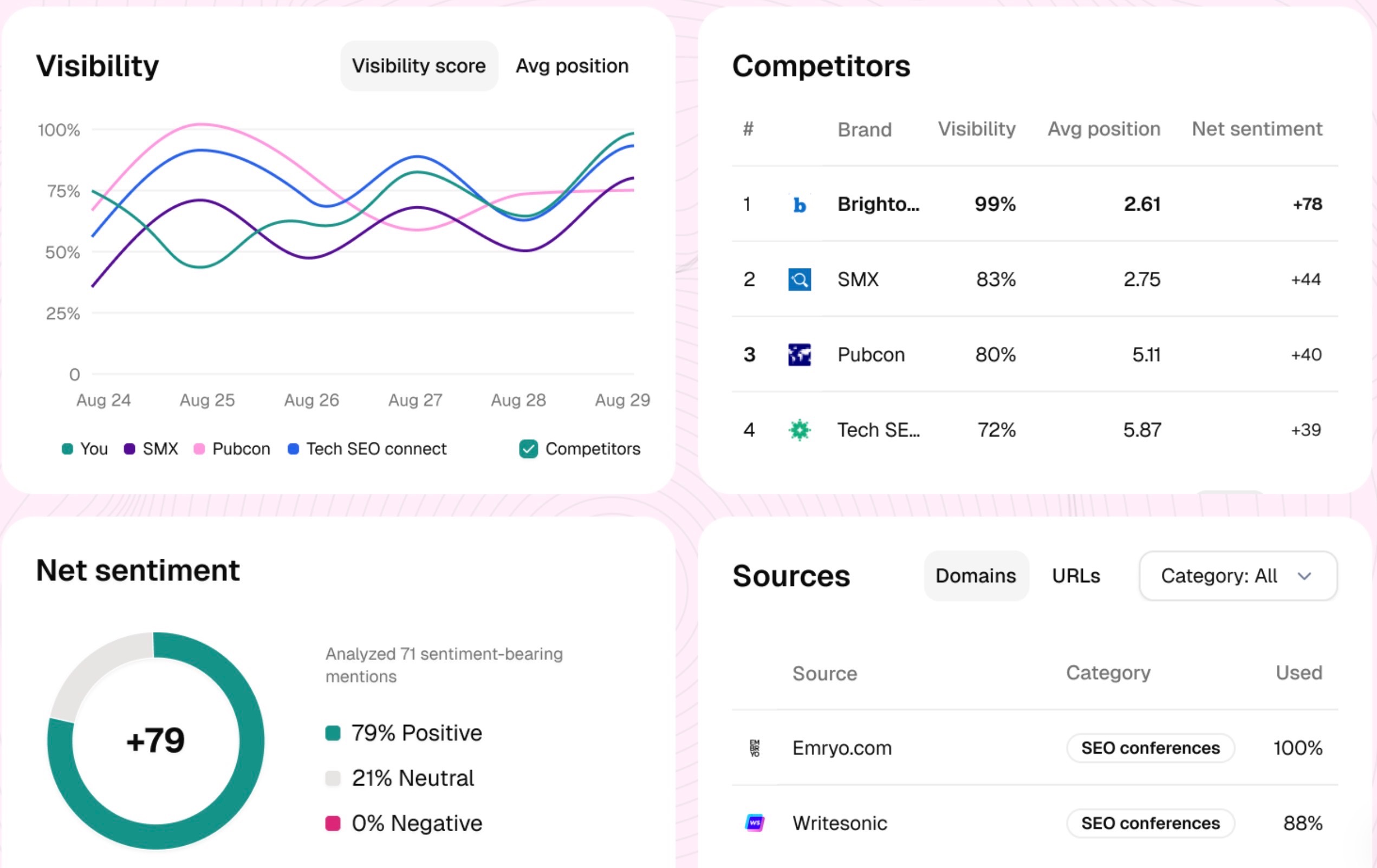
Best For: Teams that want a focused AI visibility dashboard for tracking brand mentions, sentiment, competitors, prompts, and cited sources.
SE Visible is an AI visibility platform built to show how your brand appears across AI-generated answers. It is a better fit for monitoring, benchmarking, and reporting than for hands-on content creation or SEO execution.
Key Features
- AI visibility tracking across ChatGPT, Gemini, Google AI Mode, Perplexity, and Google AI Overviews
- Brand mention tracking with visibility trends and sentiment
- Competitor benchmarking across supported AI platforms
- Prompt and topic analysis to see how AI search results discuss your brand
- Source and URL tracking to identify which domains influence AI answers
- Multi-country and multi-language tracking for regional AI visibility
Pricing Snapshot
- Basic: $79/month, billed annually
- Core: $151/month, billed annually
- Plus: $284/month, billed annually
Pros
- Clean focus on AI visibility, not a crowded SEO suite
- Tracks prompts, sentiment, competitors, and cited sources in one place
- Covers the main AI search surfaces most GEO teams monitor
- Useful for agencies or teams managing multiple projects
- Good for brand, content, and marketing reporting
Cons
- Does not replace keyword research, content optimization, or site audit tools
- No Claude, Copilot, Meta AI, or Grok tracking listed currently
- Pricing may feel high if you only need lightweight monitoring
- Better for visibility analysis than for deciding what content to create next
When Is SE Visible A Better Otterly AI Alternative?
SE Visible is a better fit if your team wants a dedicated AI visibility dashboard with clear tracking for mentions, sentiment, competitors, prompts, and cited sources. I would choose it over Otterly AI when reporting and visibility benchmarking matter more than content execution.
Want a broader tool shortlist before you decide? Explore the 10 best AI tools for generative engine optimization in 2026 to compare more GEO platforms.
Which Otterly AI Competitor Tool Should You Choose For Your Team?
The best Otterly AI competitor depends on what your team needs most: simple monitoring, deeper AI search intelligence, content execution, or an SEO suite that also tracks AI visibility.
Here are the best-fit use cases:
1. Scalenut For Tracking Plus Execution
Choose Scalenut if you want to track AI visibility and act on those insights in the same workflow.
It is a strong fit for SEO and content teams that need more than brand mentions or citation tracking. You can use it to find visibility gaps, optimize content, improve prompt coverage, and build a more complete GEO workflow without jumping between too many disconnected tools.
2. Profound For Enterprise Intelligence
Choose Profound if your team needs deeper AI search intelligence at scale.
It’s enterprise pricing is better suited for teams that want advanced visibility insights, competitive tracking, and reporting across major AI answer engines. It may be more than a smaller team needs, but it makes sense when AI search is already a serious growth channel.
3. Scrunch AI For Agent Readiness
Choose Scrunch AI if you care about how AI agents understand and represent your brand.
It is useful for teams that want AI search monitoring, website diagnostics, citation analysis, and agent-focused workflows. This is a good fit if your goal is not just to appear in AI answers, but to make your site easier for AI systems to understand.
4. Peec AI For Clean Monitoring
Choose Peec AI if you want a simple, focused AI visibility dashboard.
It works well for teams that mainly want to track brand mentions, prompts, citations, sentiment, and competitor visibility without adding a full content workflow on top.
5. AthenaHQ For Prioritized Actions
Choose AthenaHQ if you want AI visibility insights with clearer next steps.
It is a good option for teams that need monitoring, competitor benchmarks, citation intelligence, and recommendations that help prioritize what to improve first.
6. Writesonic For AI Writing
Choose Writesonic if you want GEO tracking connected to AI writing and content creation.
It fits teams that already rely on AI content workflows and want to connect AI visibility tracking with content generation, optimization, and gap-fixing inside one platform.
7. SE Visible For AI Visibility Reporting
Choose SE Visible if your team wants a focused AI visibility dashboard for tracking brand mentions, sentiment, competitors, prompts, and cited sources.
It is a good fit for teams that care more about AI visibility reporting and benchmarking than full SEO execution. You can use it to monitor how your brand appears across AI-generated answers, compare visibility against competitors, and understand which sources influence AI responses.
The simplest way to choose is to match the tool to your biggest bottleneck: Scalenut for execution, Profound for enterprise intelligence, Scrunch AI for agent readiness, Peec AI for clean monitoring, AthenaHQ for recommendations, Writesonic for AI content workflows, and SE Visible for AI visibility reporting.
Final Thoughts And Try The Best Otterly AI Alternative For Free!
Otterly AI is a solid choice if your main goal is to monitor AI visibility, track prompts, check citations, and see how your brand appears across AI search platforms. But once your team needs more execution, deeper content workflows, SEO support, or a clearer path from insights to action, its limitations start to show.
That is where Scalenut stands out as the best Otterly AI alternative for SEO professionals and content teams in 2026. It helps you track AI visibility, find content gaps, optimize existing pages, create GEO-friendly content, and connect AI search insights with real SEO execution in one workflow.
Try Scalenut for free and start improving your AI visibility today.
Frequently Asked Questions
Are there any Otterly AI alternatives that offer LLM monitoring?
Yes. Tools like Scalenut, Profound, Scrunch AI, Peec AI, AthenaHQ, Writesonic GEO, and SE Visible offer some form of AI visibility or LLM monitoring. Scalenut is a good alternative to Otterly AI if you want monitoring connected with SEO and GEO execution.
What are the top alternatives to Otterly AI for improving search visibility?
The top Otterly AI search optimization alternatives include Scalenut, Profound, Scrunch AI, Peec AI, AthenaHQ, Writesonic GEO, and SE Visible. Scalenut is a stronger fit if you want to improve search visibility through content planning, optimization, and GEO workflows.
What are the best alternatives to Otterly AI for brand monitoring?
The best alternatives to Otterly AI for brand monitoring include Scalenut, Profound, Scrunch AI, Peec AI, AthenaHQ, Writesonic GEO, and SE Visible. Scalenut is a stronger fit if you want brand monitoring connected with content optimization, GEO execution, and SEO workflows.
Can you list free and paid alternatives to Otterly AI?
Paid Otterly AI alternatives include Scalenut, Profound, Scrunch AI, Peec AI, AthenaHQ, Writesonic GEO, and SE Visible. Some tools may offer free trials or limited free access, but plan details change often, so always check current pricing.
Which Otterly AI competitors are best suited for GEO workflows?
Scalenut, Scrunch AI, AthenaHQ, Profound, and Writesonic GEO are strong options for GEO workflows. Scalenut stands out if you want AI visibility insights, content planning, optimization, audits, and execution in one connected workflow.
What features should I look for in an Otterly AI competitor?
The best Otterly AI alternative should include AI search coverage, prompt tracking, citation analysis, competitor benchmarking, recommendations, pricing flexibility, and SEO or GEO workflow support. If execution matters, Scalenut is worth considering because it connects visibility insights with content creation and optimization.
What are the main drawbacks of Otterly AI compared to its competitors?
Otterly AI is useful for monitoring, but some teams may need stronger execution, deeper competitor intelligence, broader workflow support, or SEO and GEO in one place. That is where tools like Scalenut, Profound, or Scrunch AI may fit better.
Is there an Otterly AI alternative with better integration options?
Yes, depending on the type of integration you need. Scalenut is a good fit if you want AI visibility connected to SEO and content workflows, while Scrunch AI and Profound may suit teams that need enterprise reporting or API access.
Where can I find user reviews about Otterly AI competitors?
You can find user reviews on platforms like G2, Product Hunt, Capterra, and Trustpilot, depending on the tool. G2 is especially useful for comparing Otterly AI competitors because it shows ratings, categories, alternatives, and reviewer feedback in one place.


.svg)


.webp)