What Is Answer Engine Optimization And How It Shapes Search
TL;DR
- Answer engine optimization helps your content get understood, cited, mentioned, and recommended in AI-generated answers.
- AEO does not replace SEO. It builds on SEO by optimizing for AI search platforms, prompts, citations, and brand visibility.
- AI answers do not always cite pages that rank in the top 10, so traditional rankings alone are not enough.
- To optimize for AEO, structure content with direct answers, question-led headings, extractable blocks, schema, and trust signals.
- Strong AEO content should include clear definitions, FAQs, source-backed claims, updated information, and entity-rich brand context.
- Measure AEO through AI citations, brand mentions, share of voice, sentiment, AI referral traffic, bot visits, and assisted conversions.
- The best AEO workflow is prompt-led: audit visibility gaps, optimize existing pages, create new content, and re-test regularly.
AI search is no longer experimental. Google AI Overviews now has over 2.5 billion monthly active users, while a study by Ahrefs found that only 38% of AI Overview citations come from pages ranking in the top 10.
What does this mean for your brand? It simply means ranking on page one is no longer the full visibility game. Without AEO, your content can rank, but still miss AI citations, brand mentions, and high-intent discovery moments. And with zero-click behavior reducing organic web traffic by an estimated 15% to 25%, your content needs to influence the answer itself before users decide whether to click.
In this guide, we will break down what answer engine optimization means, how it differs from SEO, how to optimize content for AI answers, and how to measure and improve visibility across AI-powered search platforms.
What is answer engine optimization?
Answer engine optimization is the process of creating and structuring content so AI-powered platforms can understand, extract, trust, and cite it in direct answers. These platforms include ChatGPT, Perplexity, Google AI Overviews, Gemini, Copilot, Claude, and voice assistants.
Unlike traditional SEO, where the goal is to rank pages and earn clicks, answer engine optimization focuses on making your content or brand part of AI-generated responses. The goal is to become the cited source, recommended product, or mentioned brand when users ask high-intent questions.
Why does answer engine optimization matter in the age of zero-click search?
Answer engine optimization matters because users are no longer discovering information only through traditional search results. Zero-click behavior is already high, and AI summaries are reducing the need to click through to websites. A 2025 Pew Research Center study found that users who saw a Google AI summary clicked a traditional search result in only 8% of visits, compared to 15% when no AI summary appeared.
Search behavior is also becoming more conversational and comparison-led. Google reported that early AI Mode testers asked queries that were 2–3x longer than traditional searches, especially for complex, exploratory tasks. This means traffic alone is no longer enough to measure search visibility. AI answers can shape brand recall, product consideration, and buying decisions before a user reaches your website. AEO helps brands stay discoverable across both traditional search and AI search by increasing the chances of being cited, mentioned, or recommended in direct AI-generated answers.
Is AEO the same as GEO, LLMO, and AI SEO?
AEO is not exactly the same as GEO, LLMO and AI SEO. AEO, GEO, LLMO, and AI SEO are often used together because they all deal with visibility in AI-driven search. But each term focuses on a slightly different part of the same shift.
Here is the simple difference:
- AEO: Optimizing content to appear as the direct answer to a user’s question.
- GEO: Optimizing content to be cited, mentioned, or accurately represented in generative AI responses.
- LLMO: Optimizing your brand, content, and entity signals so large language models can better understand your business, products, expertise, and relevance.
- AI SEO: A broader term for optimizing search visibility across AI-influenced experiences, including AI Overviews, AI Mode, chatbots, conversational search, and traditional search results.
In practice, marketers often use these terms interchangeably. The labels may differ, but the goal is largely the same: make your brand easier for AI systems to understand, trust, retrieve, cite, and surface when users ask relevant questions.
Also check out our blog on the best AEO tools for AI search visibility in 2026.
How do answer engines choose which sources to cite?
Answer engines do not choose sources based on keywords alone. They look at how well a page answers the user’s question, how trustworthy the source appears, and how easily the information can be extracted, verified, and used in a direct response.
The most important factors that can influence citation and visibility include:
- Topical relevance: The content should closely match the user’s prompt, including related subtopics and follow-up questions.
- Clear answer structure: Pages with direct answers, concise sections, bullets, tables, and FAQs are easier for AI systems to extract.
- Source authority: AI systems are more likely to use sources that appear credible, established, and useful for the topic.
- Freshness: Updated content can matter, especially for topics where information changes often.
- Entity clarity: Your brand, product, category, and expertise should be easy to identify and connect with the topic.
- Original information: First-hand insights, examples, data, reviews, product details, and expert commentary can make a page more useful than generic content.
- Supporting citations: Credible references help AI systems and users verify the information.
- Consistent brand mentions across the web: Mentions on trusted third-party sites, review platforms, communities, and industry publications can reinforce brand relevance.
- Technical accessibility: Pages should be crawlable, indexable, fast, and easy for search systems to understand.
AI answers are also dynamic. The same prompt can return different answers across ChatGPT, Perplexity, Gemini, Copilot, Claude, Google AI Overviews, and other platforms. Even on the same platform, results can change over time as models, indexes, source preferences, and user context change. In our guide on AI search volatility, we explain in detail on its impact on SEO and how brands can stay visible consistently.
How do answer engines work?
Answer engines use AI systems to understand a user’s question, gather relevant information, and generate a direct response. The process varies by platform, but most answer engines depend on a combination of language models, retrieval systems, search results, indexed content, citations, and source quality signals.
For example, ChatGPT Search can provide timely answers with links to relevant web sources. OpenAI says ChatGPT Search may rewrite a user’s prompt into one or more targeted queries before sending them to third-party search providers. This means the original prompt is not always the only query used to find and evaluate sources.
Google also says AI Overviews and AI Mode may use query fan-out, where the system runs multiple related searches across subtopics and data sources before generating a response. That means one user question can expand into several supporting searches behind the scenes.
For example, if someone asks, “What is the best answer engine optimization tool?”, an answer engine may also look for related information such as:
- Best AEO tools
- AI visibility platforms
- Tools for ChatGPT visibility
- How to improve AI citations
- GEO software for content teams
- Answer engine optimization platforms
- Brand visibility in AI search
This is why answer engine optimization cannot depend on one exact keyword. Your content needs to cover the full topic, answer related questions, and connect your brand with the right entities, use cases, competitors, and proof points.
How is AEO different from traditional SEO?
Answer engine optimization and SEO are closely connected, but they do not measure visibility in the same way. SEO focuses on helping pages rank in traditional search results, while AEO focuses on helping your content or brand appear inside AI-generated answers.
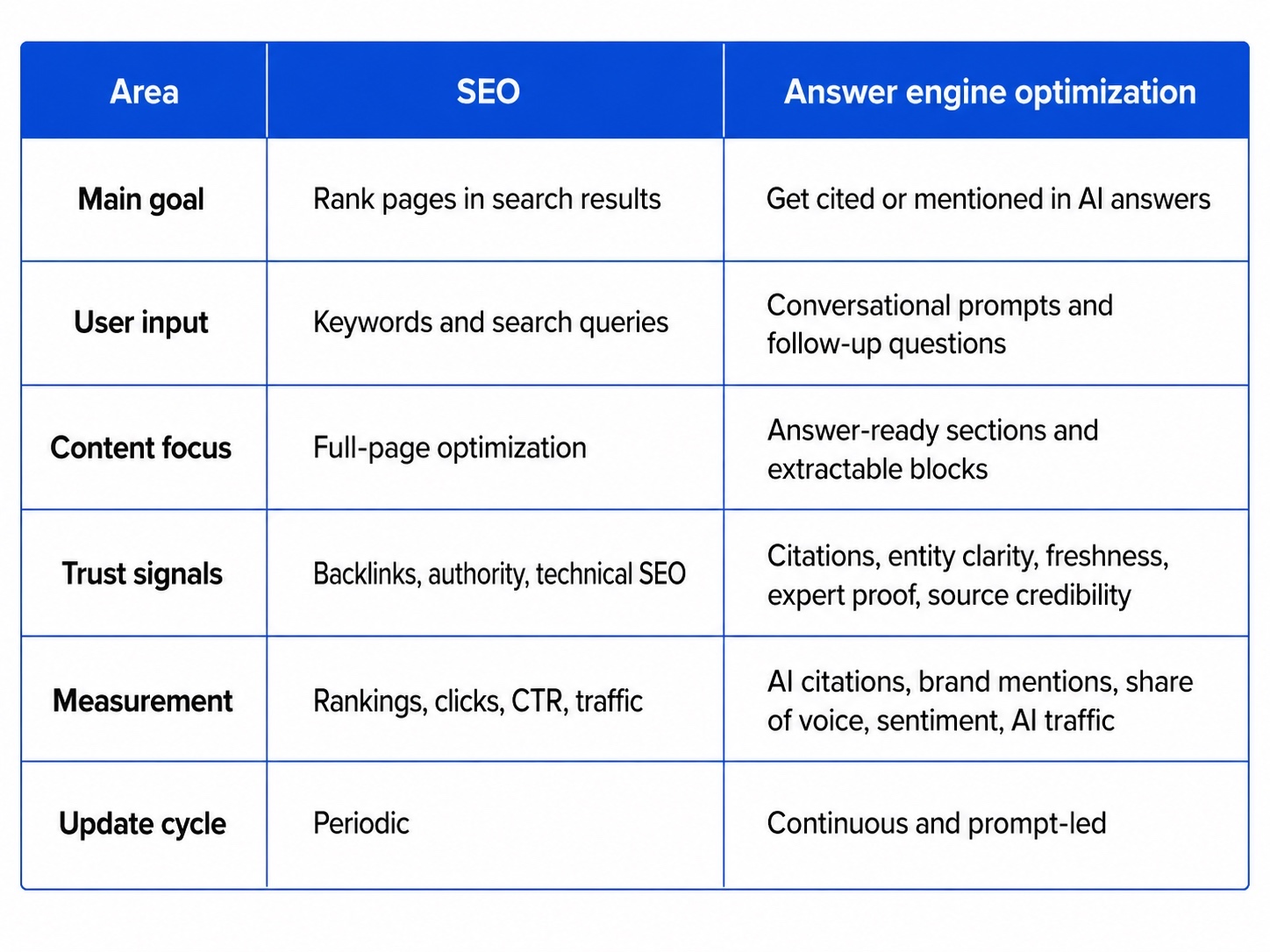
That does not mean AEO replaces SEO. Strong SEO foundations still support AI visibility because AI search systems often depend on crawlable, indexable, high-quality content to generate useful responses. The best strategy is not SEO vs AEO. It is SEO plus AEO, where your content is built to rank in search results and also become easy for AI platforms to understand, trust, cite, and recommend.
How to optimize content for answer engines?
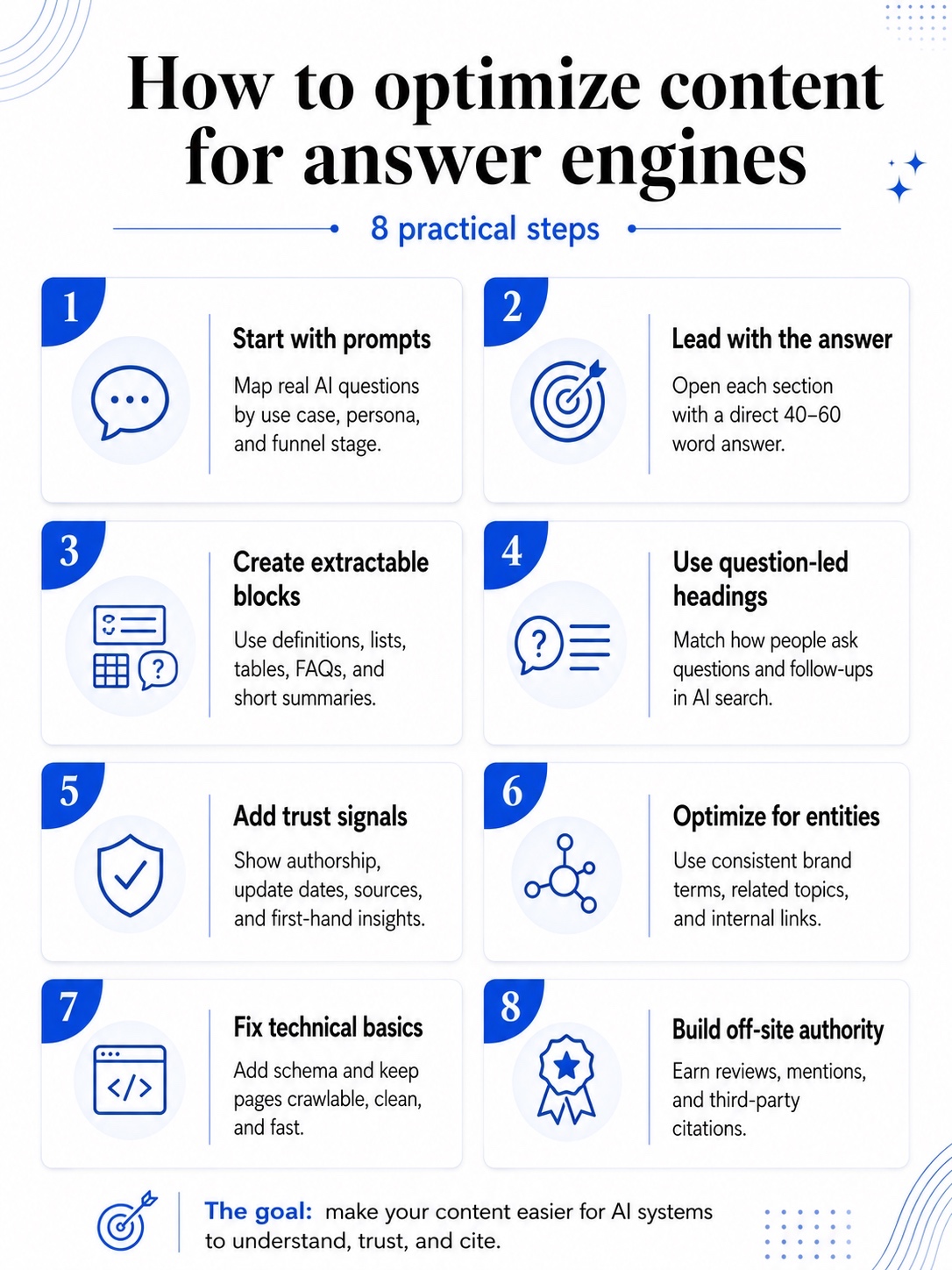
Optimizing for answer engines means making your content easy for AI systems to find, understand, extract, verify, and cite. The goal is not to add more keywords, but to structure every important page around the way users ask questions and the way AI platforms generate answers.
Here are the key steps to optimize your content for answer engines:
1. Start with priority prompts, not only keywords
AEO starts with prompts because AI search queries are often longer, more specific, and more conversational than traditional search queries.
Instead of only targeting short keywords, map the kinds of prompts your audience may ask in AI platforms. For example, a GEO platform may track prompts like:
- “What are the best tools for tracking AI visibility?”
- “How can I check if my brand appears in ChatGPT?”
- “Which platforms help monitor AI citations?”
- “How do I improve brand visibility in AI answers?”
Group these prompts by:
- Product: Which product or feature does the prompt relate to?
- Use case: What is the user trying to solve?
- Persona: Is the query from a founder, SEO manager, content lead, or agency?
- Funnel stage: Is the user learning, comparing, shortlisting, or ready to buy?
- Competitor intent: Is the user comparing your brand with another tool?
Once you have the prompt list, check where your brand appears, where competitors are cited, and which sources AI platforms are using. This helps you decide whether to optimize an existing page or create a new one.
2. Use an answer-first content structure
Answer engines need clear, direct answers. So, avoid long introductions before getting to the point.
For every important section, start with a direct 40–60 word answer. Then add context, examples, steps, or comparisons.
A simple structure to follow is:
- Answer first: Give the direct response in the first few lines.
- Context second: Explain why it matters or how it works.
- Details third: Add examples, data, use cases, or steps.
For example, instead of opening a section with background information, start with the actual answer. This makes the content easier to extract for AI summaries, featured snippets, voice assistants, and AI-generated responses.
3. Create extractable content blocks
AI systems do not always use your full page. They often pull specific sections, definitions, lists, tables, or short explanations.
Make important information easy to extract by using:
- Definition blocks for terms and concepts
- Step-by-step lists for workflows and processes
- Comparison tables for tools, products, pricing, and alternatives
- Pros and cons for decision-stage content
- Short FAQs for common follow-up questions
- Summary blocks after long or complex sections
- Examples that show how the advice works in a real situation
Each block should make sense even if it is read on its own. Avoid vague lines like “this is important for many reasons.” Instead, write complete, useful answers that directly address the query.
4. Add question-based headings
Question-based headings help your content match the way users ask questions in AI platforms.
Use H2s and H3s that sound like real questions your audience may ask. For example, a GEO platform could use headings like:
- “How do you track brand mentions in AI answers?”
- “What is the difference between AI visibility and SEO visibility?”
- “How do AI platforms choose which brands to mention?”
- “How can you improve citations in generative AI responses?”
You can also include conversational variations inside the section. For example, under a heading about AI visibility, you can naturally answer related questions like “Why is my competitor cited more often?” or “Can a page rank on Google but still not appear in AI answers?”
This helps one section cover the main question and the follow-up questions users are likely to ask next.
5. Strengthen trust signals
Answer engines need to trust the information they use. So, every important page should show why the content is reliable.
Add trust signals such as:
- Author name and relevant credentials
- Last updated date
- Credible external sources
- Original examples or first-hand insights
- Screenshots, data, or tested observations where possible
- Clear product details, pricing, features, or process steps
- Transparent claims that users can verify
This is especially important for review, comparison, pricing, health, finance, legal, and B2B buying content. The more specific and verifiable your content is, the stronger it becomes as a source.
6. Optimize for entities, not just keywords
Answer engines need to understand what your brand is, what category you belong to, what problems you solve, and how you relate to other known entities.
To improve entity clarity:
- Use your brand name consistently across important pages.
- Define your product category clearly.
- Mention related tools, platforms, competitors, and use cases.
- Build topic clusters around core themes.
- Use consistent product descriptions across your website, directories, social profiles, and third-party listings.
- Strengthen internal links between related blogs, feature pages, comparison pages, and alternative pages.
For example, if your brand wants to be associated with GEO, AEO, AI SEO, or AI visibility, those terms should appear consistently across relevant content, not just on one page.
7. Use schema and technical SEO
AEO still depends on strong technical foundations. If search systems cannot crawl, index, or understand your content, it is harder for AI platforms to use it.
Start with the basics:
- Keep important pages crawlable and indexable.
- Use clean HTML and descriptive headings.
- Improve page speed and mobile usability.
- Add internal links to important pages.
- Make sure content is not hidden behind scripts or blocked resources.
Then add structured data where relevant:
- Article schema for blogs and editorial content
- FAQ schema for FAQ sections
- Product schema for product pages
- Review schema for review-led content
- HowTo schema for step-by-step guides
When refreshing content, also update fields like datePublished and dateModified where applicable. This helps search systems understand when the content was created and when it was last improved.
8. Build off-site authority and brand mentions
Answer engines do not only learn from your website. They also look at how your brand appears across the web.
To strengthen off-site authority:
- Get mentioned in credible industry blogs.
- Encourage genuine user reviews.
- Appear on trusted comparison pages and listicles.
- Build presence on relevant communities like Reddit, Quora, and niche forums.
- Keep brand descriptions consistent across directories and profiles.
- Contribute expert insights to podcasts, newsletters, reports, and industry publications.
The goal is to make your brand easier to verify from multiple trusted sources. When your website, third-party mentions, reviews, and community discussions all reinforce the same positioning, AI systems get a clearer picture of what your brand does and where it is relevant.
AEO works best when content, technical SEO, brand signals, and off-site authority work together. The more clearly your brand answers the right prompts across the web, the more likely it is to be understood, trusted, and surfaced by answer engines.
Need help creating prompt-optimized content at scale? Read our list of the best AI SEO agencies for prompt-optimized LLM content to help you get cited in 2026.
How do you measure answer engine optimization success?
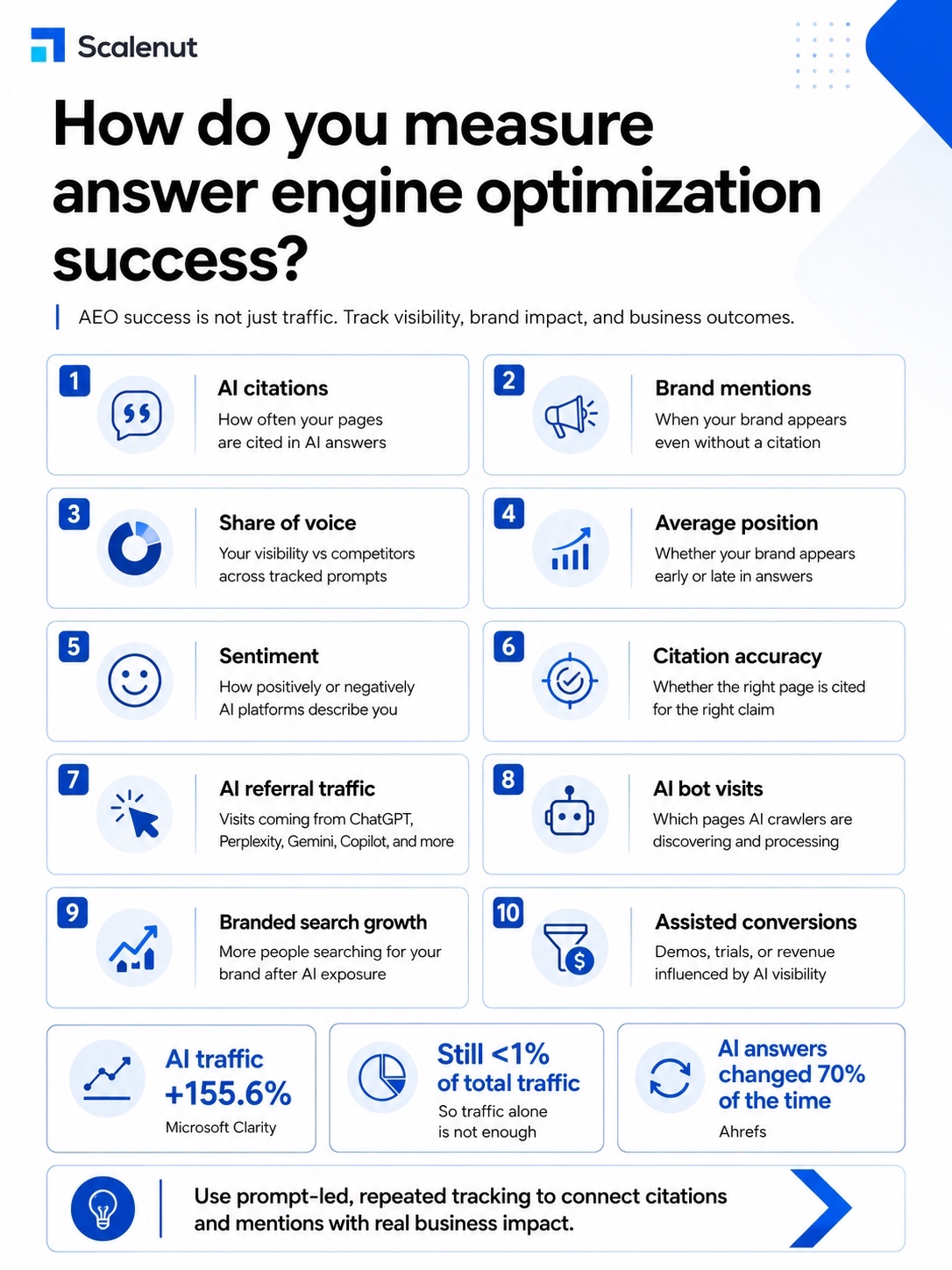
AEO success is not measured only by traffic because users may see your brand, compare your product, or trust your answer without clicking through to your website. Google’s rollout of dedicated generative AI performance reports in Search Console also shows that AI visibility is becoming its own measurement layer, not just another traffic source.
Here are the key metrics to track:
- AI citations: Track how often your website is cited as a source in ChatGPT, Perplexity, Google AI Overviews, Gemini, Copilot, Claude, and other answer engines. Also note which pages are cited, not just whether your domain appears.
- Brand mentions: Measure how often your brand is mentioned in AI responses, even when your website is not cited. This matters because AI answers can influence recall and consideration without sending a visit.
- Share of voice: Compare your brand visibility against competitors for the same set of prompts. For example, if you track 50 priority prompts, check how often your brand appears versus competing brands.
- Average position in AI answers: Note where your brand appears in the response. Being mentioned first in a recommendation list is different from being added near the end or only mentioned as an alternative.
- Sentiment: Review whether AI platforms describe your brand positively, negatively, or neutrally. A mention is not always useful if the framing is outdated, inaccurate, or weaker than competitors.
- Citation accuracy: Check whether the AI answer is citing the right page for the right claim. If an AI platform cites an old blog for pricing, product features, or comparisons, the visibility may create confusion instead of trust.
- AI referral traffic: Track visits from platforms like ChatGPT, Perplexity, Gemini, Copilot, and other AI search experiences in GA4. Microsoft Clarity found that AI-driven traffic grew 155.6%, but still made up less than 1% of overall traffic, so referrals should not be your only AEO metric.
- AI bot visits: Monitor visits from AI crawlers and bots to see which pages are being accessed by AI systems. This can help you identify which pages are being discovered, processed, or considered for AI responses.
- Branded search growth: Watch whether branded searches increase after your brand starts appearing more often in AI answers. Users may discover you in an AI response and later search for your brand on Google.
- Assisted conversions: Look at whether users who come through AI referrals, branded searches, or returning sessions eventually book demos, start trials, request pricing, or convert through another channel.
AEO measurement should be prompt-led and repeated because AI answers can change across platforms, prompts, and time. Ahrefs found that AI Overview content changed 70% of the time between observations, so track visibility metrics alongside business outcomes to see whether citations, mentions, and AI traffic are actually driving impact.
What are the common challenges in answer engine optimization?
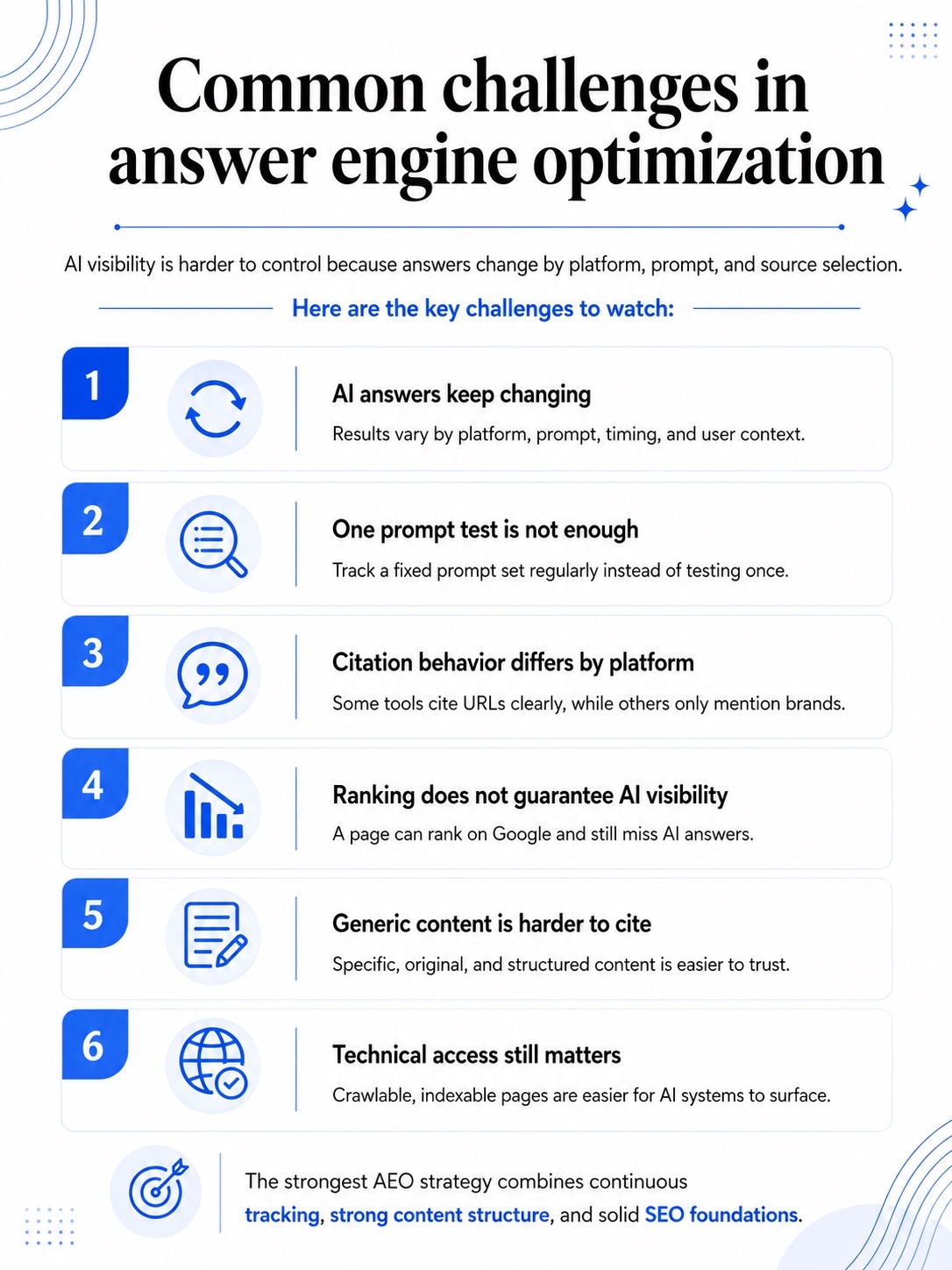
Answer engine optimization is not a one-time content update because AI answers are dynamic, platform-specific, and harder to predict than traditional rankings. A page can rank well on Google and still be ignored, misrepresented, or replaced by another source in an AI-generated answer.
Here are the common challenges to plan for:
- AI answers keep changing: AI-generated answers are not fixed. They can change based on platform, prompt wording, location, user context, source availability, and model updates, so brands need ongoing tracking instead of one-time checks.
- One prompt test is not enough: The same topic can produce different results based on how the question is phrased or followed up. Test a fixed set of priority prompts regularly and compare trends instead of relying on one result.
- Not every platform cites sources the same way: Some platforms cite URLs clearly, while others only mention brands, summarize information, or show sources inconsistently. That is why you should track both citations and brand mentions.
- Ranking does not guarantee AI visibility: A page can rank on Google but still not appear in AI answers. Ahrefs found that only 38% of AI Overview citations came from pages ranking in the top 10, which shows that AI citation behavior does not always mirror traditional rankings.
- Generic content is harder to cite: AI systems have many similar pages to choose from. Pages with specific examples, original insights, updated information, clear structure, and verifiable claims are more useful than generic explanations.
- Technical access still matters: If a page is not crawlable, indexable, or eligible to appear with a snippet in Google Search, it is less likely to show as a supporting link in AI Overviews or AI Mode. Strong technical SEO still supports AEO.
The biggest challenge in AEO is that visibility can change even when your content has not. The safer approach is to monitor prompts consistently, improve pages based on real citation gaps, and build content that is specific, structured, and easy to verify.
What is a practical 90-day AEO strategy?
A 90-day AEO strategy should help you move from visibility gaps to measurable improvements. Instead of rewriting every page at once, start with the prompts that matter most, improve pages with existing potential, and then create new content where your brand is missing.
Here is a practical 90-day workflow:
Days 1–30: Audit prompts, competitors, and existing visibility
Build a list of 30–50 priority prompts around your products, use cases, pricing, alternatives, comparisons, and buying questions. Run them across relevant AI platforms and note where your brand appears, where competitors are cited, which pages are being used, and which existing pages already rank but are not showing up in AI answers.
Days 31–60: Optimize pages with the highest opportunity
Start with pages that already have search visibility or match high-intent prompts. Add direct answers near the top, rewrite weak sections into extractable blocks, add FAQs, improve internal links, update outdated claims, strengthen author and source signals, and add schema where relevant. The goal is to make each page easier to understand, trust, and cite.
Days 61–90: Fill prompt gaps and build authority signals
Create new pages for prompts your current content does not answer well, especially comparison, alternative, pricing, use-case, and problem-aware topics. At the same time, build off-site mentions through reviews, third-party listicles, community discussions, and industry publications. Then re-test the same prompt set to see what changed.
AEO works best as a repeatable cycle: track prompts, diagnose gaps, optimize or create content, strengthen authority, and measure again. The brands that improve are usually not the ones doing one large content refresh, but the ones testing and improving visibility continuously.
Want to know which tools can help you with both SEO and AEO? Check our list of the best AI tools for SEO and AEO to help you not only rank but also get cited.
Answer engine optimization checklist
- Choose 30–50 priority prompts: Start with prompts tied to your products, services, competitors, pricing, alternatives, comparisons, and buyer questions.
- Group prompts by intent: Sort prompts by learning, comparing, shortlisting, validating, pricing, and purchase intent so every page has a clear purpose.
- Check current AI visibility: Run your priority prompts across platforms like ChatGPT, Perplexity, Google AI Overviews, Gemini, Copilot, and Claude.
- Track citations and brand mentions: Note where your website is cited, where your brand is mentioned, and where competitors appear instead.
- Study the sources AI platforms use: Look at the pages, publications, review sites, listicles, and third-party sources that answer engines rely on.
- Map prompts to existing pages: Identify which prompts already have a relevant page, which pages need updates, and which prompts need new content.
- Add direct answers early: Start key sections with a clear answer before adding context, examples, steps, or supporting details.
- Use extractable content blocks: Add definitions, bullets, tables, FAQs, summaries, pros and cons, and step-by-step sections that AI systems can easily pull from.
- Strengthen entity signals: Clearly connect your brand, product category, use cases, competitors, audience, and related topics throughout the page.
- Add trust signals: Include updated dates, credible sources, author details, original insights, screenshots, examples, reviews, or data where relevant.
- Fix technical basics: Keep pages crawlable, indexable, fast, mobile-friendly, and supported with relevant schema.
- Build off-site authority: Improve brand mentions across trusted third-party sites, reviews, communities, directories, and industry publications.
- Measure and repeat: Track AI citations, brand mentions, share of voice, sentiment, AI traffic, bot visits, and assisted conversions every month.
How can Scalenut help you track, optimize, and improve AEO performance?
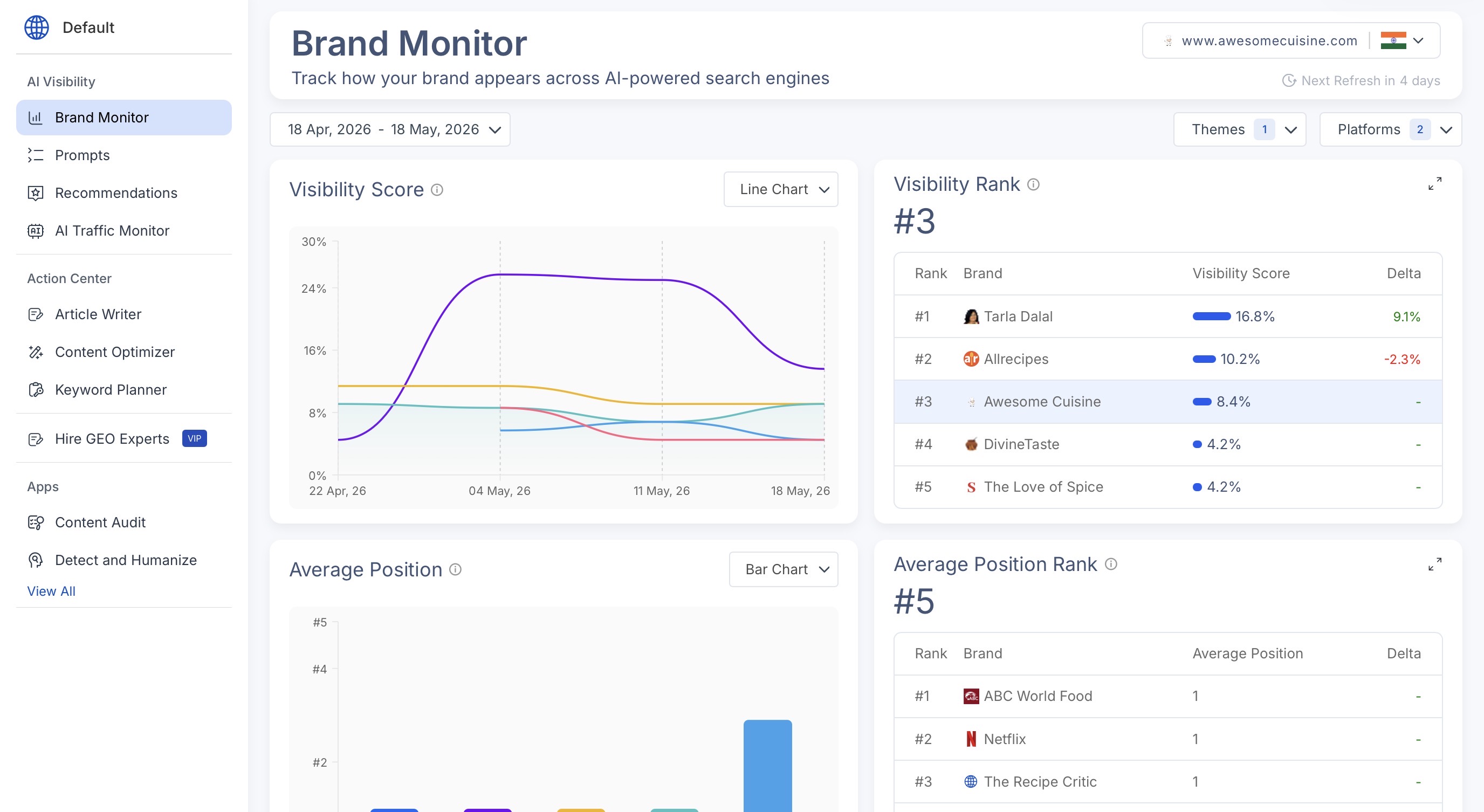
Tracking AI visibility is only the first step. Once you know where your brand is being mentioned, cited, ignored, or outranked by competitors, the real question is: what should you fix next? That is where Scalenut helps. We bring AI visibility tracking and content execution into the same workflow, so teams can move from “where are we missing?” to “what do we need to create, optimize, or strengthen?”
With Scalenut, you can:
- Track AI visibility across major answer engines: See how your brand appears across AI platforms and monitor brand mentions, prompt coverage, visibility trends, and AI-driven citations.
- Monitor prompts that matter: Track the questions your audience is asking, identify prompts where your brand appears, and spot high-intent prompts where competitors are getting more visibility.
- Analyze citations and sources: See which sources AI platforms are using to support their answers, which pages are being cited, and where your content needs stronger authority or clearer coverage.
- Benchmark competitors: Compare your brand’s visibility, share of voice, average position, and relative presence against competitors across prompts and topics.
- Find content and prompt gaps: Identify prompts, topics, and query fanouts where your brand is missing, then turn those gaps into content ideas, updates, or authority-building actions.
- Create GEO-ready content: Use Scalenut’s GEO Action Center to create AI-readable content with topic-driven briefs, strong structure, and comprehensive coverage for AI search engines.
- Optimize existing pages for AI visibility: Improve pages with GEO Score, prompt coverage insights, relevance suggestions, content gaps, internal links, and on-page fixes that support both SEO and AI visibility.
- Monitor AI traffic and bot activity: Track AI bot visits, source engines, crawl trends, and the pages AI systems are discovering or referencing most often.
Scalenut also supports the broader SEO workflow with keyword planning, content optimization, internal linking, content audits, and backlink support. But for AEO, the real advantage is that we do not stop at visibility tracking. We help you act on the data.
If you want to see where your brand stands in AI answers and what to improve next, book a free strategy call with Scalenut today!
Final thoughts
Answer engine optimization is not about replacing SEO. It is about making your content easier for AI systems to understand, trust, cite, and recommend. Start by tracking priority prompts, identify where your brand is missing or misrepresented, optimize pages with clear answers and trust signals, and keep testing visibility across AI platforms as the search landscape evolves.
Frequently Asked Questions
How does answer engine optimization help websites rank in AI-powered search engines?
Answer engine optimization improves AEO visibility by making pages easier for AI systems to understand, extract, cite, and summarize. It helps websites appear in AI answers through clear structure, trusted sources, entity signals, and content that directly matches user intent.
What steps can I take to optimize my content for answer engines?
Start with prompt research, then rewrite important pages with direct answers, question-led headings, short sections, schema, citations, and updated trust signals. The best practices are simple: answer clearly, prove your claims, structure content well, and keep testing visibility.
What types of questions do answer engines commonly show in results?
Answer engines commonly surface informational, comparison, recommendation, how-to, pricing, and troubleshooting questions. These queries are usually longer and more conversational than traditional search engine results because users expect direct answers, follow-up context, and source-backed recommendations in one response.
How does AEO impact local SEO strategies for businesses?
AEO can improve local discovery by helping AI systems understand your services, location, reviews, expertise, and brand presence. Local businesses should keep listings consistent, answer service-specific questions, publish location-based content, and strengthen reviews across trusted platforms.
What tools can I use to improve answer engine optimization on my website?
You can use Scalenut to track AI visibility, monitor prompts, analyze citations, compare competitors, find content gaps, create GEO-ready content, optimize existing pages, and monitor AI traffic. It helps teams move from visibility tracking to content execution in one workflow.
Are there any recent trends in answer engine optimization I should know about?
The biggest trend is that search platforms are becoming more answer-led, conversational, and multimodal. AI Overviews, AI Mode, ChatGPT search, Perplexity, and Copilot are changing how users discover brands, compare options, and make decisions before visiting a website.
How does structured data affect my chances of getting selected by answer engines?
Structured data helps search systems understand your page, but it does not guarantee AI citations. Use Article, FAQ, Product, Review, or HowTo schema where relevant, then pair it with clear answers, crawlable pages, strong sources, and content that satisfies the query.
What is the role of video in AEO?
Video can support the future of search by giving answer engines more formats to understand and surface. Add clear titles, transcripts, summaries, chapters, schema, and supporting text so AI systems can extract key points, verify context, and connect the video to relevant questions.


.svg)


.webp)