.jpg)
Quick Summary: What Are the Key Metrics for Measuring Brand Visibility in AI Search?
The key metrics for measuring brand visibility in AI search are brand mention rate, AI citation rate, share of voice, prompt coverage, average position, brand sentiment and factual accuracy, and visibility consistency.
- Mentions and citations show whether AI platforms include your brand and use your website as a source.
- Share of voice and average position reveal how prominently you appear compared with competitors.
- Prompt coverage and visibility consistency show how broadly and reliably your brand appears across relevant questions and AI platforms.
- Sentiment and factual accuracy reveal whether AI describes your brand positively and correctly.
- Track these metrics across a consistent prompt set and multiple platforms over time to identify visibility gaps, competitive gains, and areas to improve.
You are tracking rankings, traffic, and impressions, but none of them answers a simple question: How visible is your brand when someone asks an AI platform about your category? AI search requires a different measurement framework.
Brand mentions, citations, share of voice, prompt coverage, position, sentiment and accuracy, and visibility consistency reveal whether AI platforms surface your brand, how they position it against competitors, and whether that presence holds up over time. This guide breaks down the 7 metrics that matter and shows you how to measure each one.
What Does Brand Visibility In AI Search Mean?
Brand visibility in AI search refers to how often and prominently your brand appears in AI-generated responses from platforms like ChatGPT, Google Gemini, and Perplexity. Unlike traditional search, which relies on rankings in results pages, AI search visibility is measured by mentions, citations, or recommendations within conversational answers. If your brand isn’t mentioned, you’re invisible to a growing audience.
AI search fundamentally changes brand visibility. Traditional engines drive users to your site via blue links; AI engines synthesize information and present it directly, often without any clicks. As a result, your brand’s reputation and influence are built within the AI’s response, making this first impression critical for reaching potential customers.
Why Measuring Brand Visibility In AI Search Matters?
Tracking your brand’s presence in AI search is essential for buyer discovery and revenue. As more consumers use AI for answers, showing up in results puts your brand on their shortlist early. If you’re not measuring AI visibility, you risk losing ground to competitors who are.
An AI visibility score benchmarks your position against rivals and reveals who captures attention for key topics. This data signals market influence before it appears in traditional metrics.
Measuring AI search awareness is actionable, it uncovers content gaps, highlights technical needs, and guides optimization efforts for maximum impact. Without these insights, you’re navigating a critical channel blindly.
Want the bigger picture? See how visibility in AI connects mentions, citations, positioning, and business impact.
What Are The Key Metrics For Measuring Brand Visibility In AI Search?
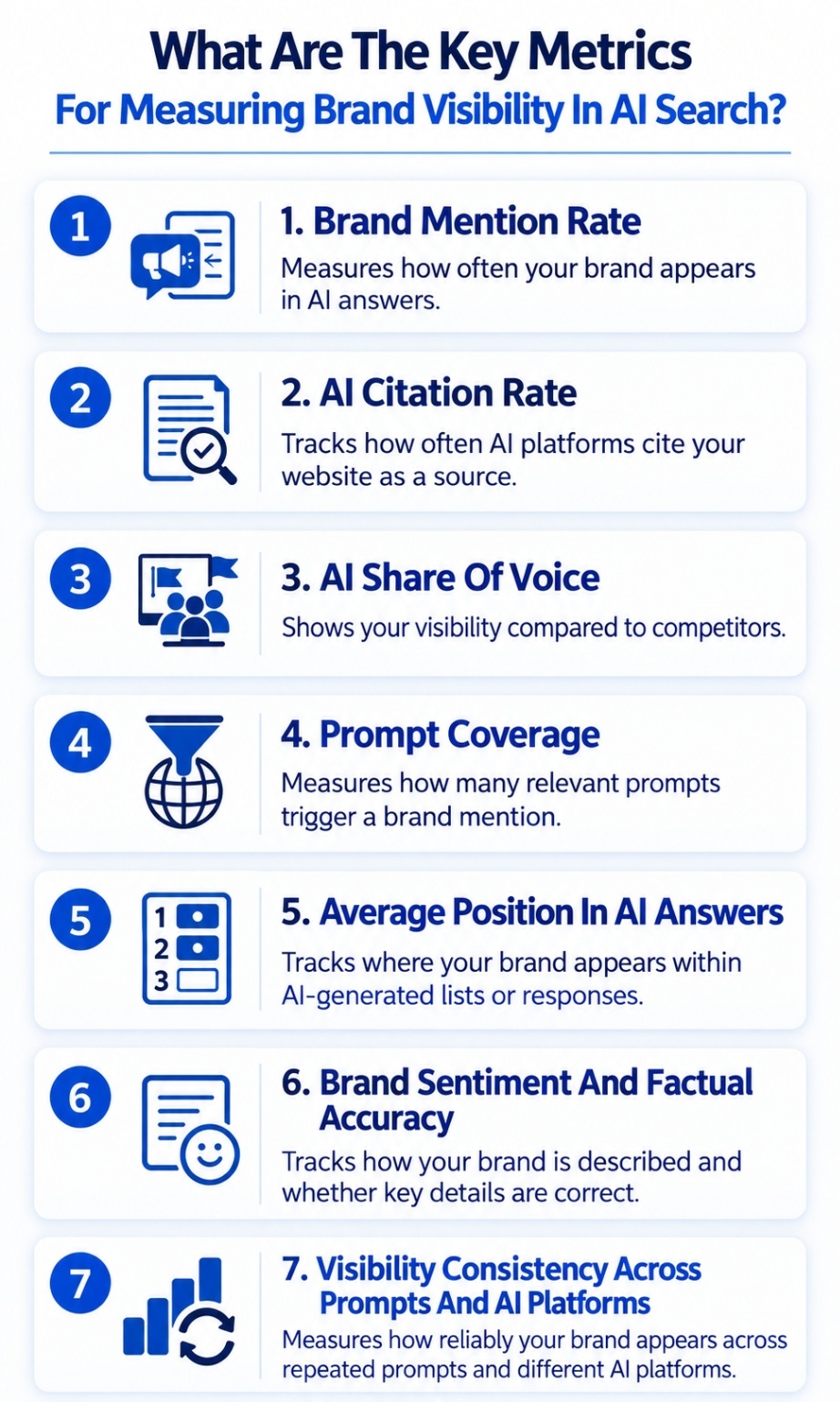
To measure brand visibility in AI search, track brand mention rate, AI citation rate, share of voice, prompt coverage, average position, brand sentiment and factual accuracy, and visibility consistency. Together, these metrics show whether your brand appears, how prominently it appears, how accurately AI describes it, and whether that visibility remains consistent across prompts and platforms.
Let's look at this in detail:
1. Brand Mention Rate
Your brand mention rate is a foundational metric for AI visibility. It simply measures how often your brand name appears in AI-generated responses for a specific set of relevant prompts. Think of it as the AI equivalent of brand awareness. When a potential customer asks an AI platform a question related to your industry, does your brand get mentioned at all?
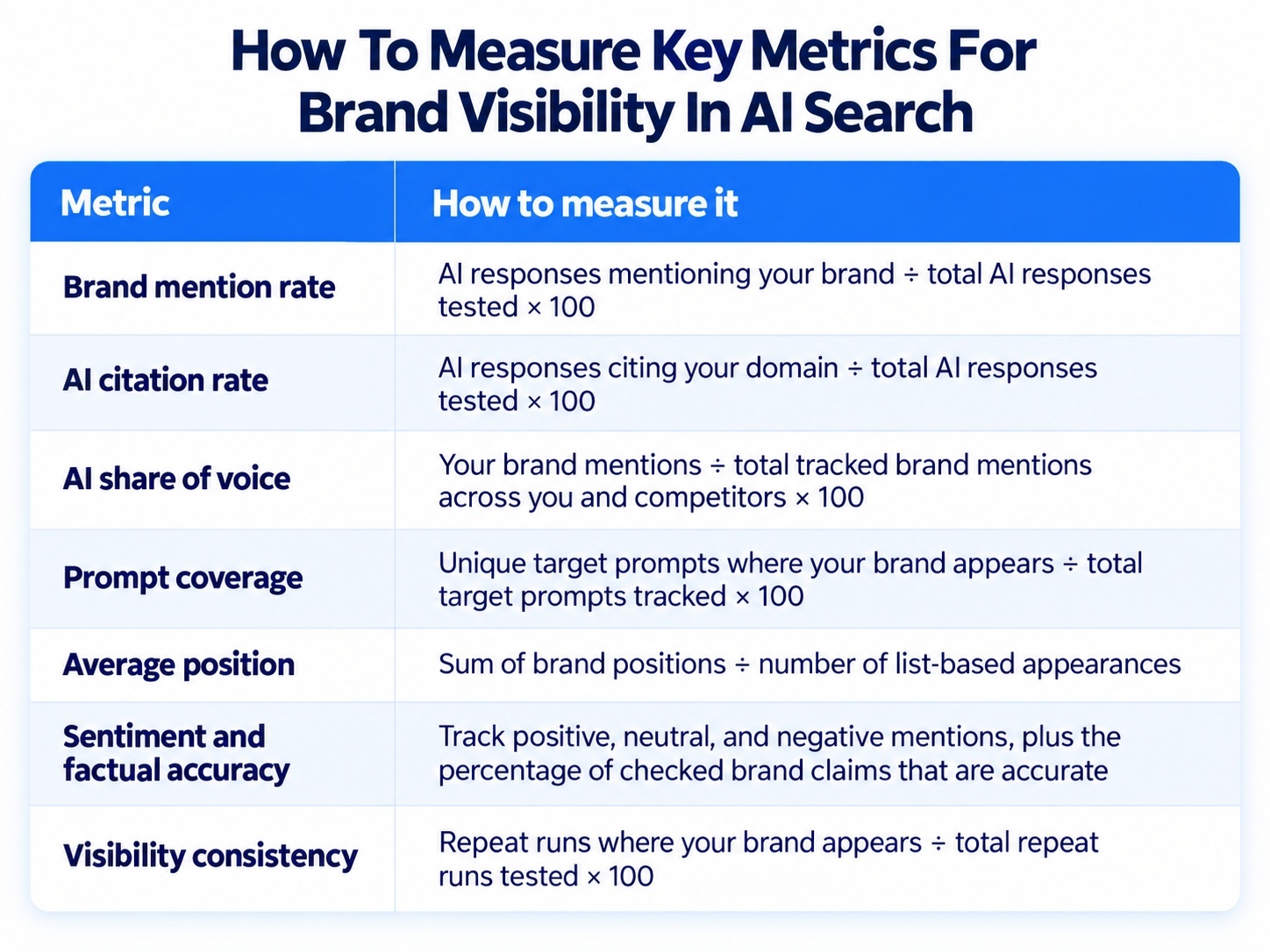
This metric is your North Star for AI search monitoring. It is not about ranking position but about being part of the conversation in the first place. You can calculate it by dividing the number of answers that mention your brand by the total number of relevant answers generated.
A low brand mention rate indicates a significant visibility gap. It means AI engines don't consider your brand a relevant or authoritative player for those topics. Tracking this metric helps you identify where you need to build presence and authority to ensure you are not left out of crucial customer discovery moments.
2. AI Citation Rate
While mentions tell you if you're in the conversation, the AI citation rate tells you why. This metric tracks how often AI platforms cite your website as a source for the information they provide. These citations are the modern equivalent of backlinks and are a powerful signal of credibility and authority to AI models.
Monitoring your citation rate helps you understand which of your pages AI engines trust. Are they citing your blog posts, product pages, or case studies? The quality of these citations also matters. A direct quote from your site holds more weight than a passing reference. An AI visibility tool can help you track citations and their sources effectively.
If your brand’s presence is weak in AI-generated answers, improving your citation rate is a key strategy. By identifying the authoritative sources that AI already trusts and getting your brand featured in them, you can increase the likelihood that AI will mention and cite you, which can positively influence your search rankings over time.
Getting mentioned but rarely cited? Learn how to improve AI citations across search and answer engines.
3. AI Share Of Voice
AI Share of Voice (SOV) measures your brand visibility relative to your competitors within AI-generated answers. It answers the question: "Of all the brands mentioned for a specific topic, what percentage of those mentions are for my brand?" This metric is essential for understanding your competitive positioning in the AI landscape.
Calculating your SOV requires collecting visibility data for both your brand and your direct competitors across a consistent set of prompts. For example, if your brand is mentioned in 20 out of 100 relevant AI responses and your top three competitors are mentioned a combined 60 times, you can start to map out market share.
Tracking your AI Share of Voice over time reveals whether your AI search optimization efforts are helping you gain ground or if you are losing out to more aggressive competitors. It moves beyond simple brand visibility to provide a clear picture of your dominance within a specific category or topic.
4. Prompt Coverage
Prompt coverage is the metric that evaluates the breadth of your brand's visibility across a wide range of relevant user questions. It measures the percentage of your target prompts, the specific queries your audience is likely to ask—that trigger a mention of your brand in AI answers. It helps you identify where your brand is visible and, more importantly, where it is absent.
A high prompt coverage score indicates that your content strategy is effectively addressing the questions your customers are asking on AI platforms. To measure it, you need to:
- Build a library of high-intent prompts based on real customer language.
- Test these prompts across different AI engines.
- Calculate the percentage of prompts that result in a brand mention.
Low prompt coverage highlights content gaps and missed opportunities. By identifying the topics where you are not appearing, you can prioritize content creation and optimization efforts to expand your AI visibility score and ensure you show up in more relevant AI answers.
5. Average Position In AI Answers
While AI answers are more narrative than traditional search results, the order in which brands are mentioned still matters. The average position metric tracks where your brand typically appears within a generated list or response. Being mentioned first or second is generally more valuable than being mentioned tenth.
This metric provides context that simple mention counts lack. Just like with keyword rankings in traditional search engines, a higher position in an AI answer can lead to greater user attention and perceived importance. If an AI lists the "top 5 tools for project management," being in the top three is a significant advantage.
To calculate this, you would note your brand's position each time it's mentioned (e.g., 1st, 3rd, 5th) and then find the average across all relevant prompts. A declining average position could be an early warning sign that your brand's perceived authority is slipping, even if your overall mention rate remains stable.
6. Brand Sentiment And Factual Accuracy
Brand sentiment and factual accuracy measure how your brand is represented in AI answers. Track whether mentions are positive, neutral, or negative, and whether key details such as features, pricing, positioning, and capabilities are correct.
A high mention rate has limited value if AI platforms describe your brand inaccurately. Monitoring sentiment and accuracy helps identify outdated information, misleading claims, and perception gaps.
7. Visibility Consistency Across Prompts And AI Platforms
Visibility consistency measures how reliably your brand appears when the same prompts are tested repeatedly and across platforms such as ChatGPT, Gemini, and Perplexity.
Because AI responses can vary between runs, one appearance does not indicate stable visibility. Track how often your brand appears across repeated tests to distinguish consistent visibility from isolated mentions and identify platform-specific gaps.
Which Metrics Matter Most For Different Business Goals?
Prioritize metrics that align with your business goals, as not all visibility metrics matter equally for every objective. For example, a brand aiming for market leadership should focus on share of voice, while one targeting demand capture should track conversion-related metrics. The best metrics to measure brand visibility in AI-powered search depend on your specific goals.
By choosing the right use cases and metrics, you can turn visibility data into a strategic asset that drives results. Let’s look at which metrics matter most for brand awareness, lead generation, ecommerce, and category leadership.
Best Metrics For Brand Awareness
When your primary goal is to build brand awareness, your focus should be on maximizing your presence in AI search conversations. The most important metrics here are those that measure how often and how widely your brand is seen. Your aim is to become a familiar name that AI platforms associate with your industry.
For a brand awareness campaign, you should prioritize tracking the following metrics:
- Brand Mention Rate: This is your core metric. A high mention rate means you are successfully appearing in relevant AI answers.
- Prompt Coverage: This shows the breadth of your visibility. Increasing coverage means your brand is recognized across a wider range of topics.
- AI Share of Voice: This helps you understand how your brand presence compares to competitors, a key component of overall awareness.
Improving your visibility score across these metrics is a direct indicator of successful AI search optimization. By ensuring your brand is consistently part of the conversation, you build the foundation for recognition and trust with a new generation of search users.
Best Metrics For Lead Generation And Demand Capture
For lead generation and capturing existing demand, your focus shifts from just being seen to driving action. While AI visibility is still the starting point, the metrics that matter most are those that connect AI-generated answers to tangible business outcomes like website traffic and conversions. The goal is to turn mentions into qualified leads.
The most critical metric here is AI referral traffic. This measures the number of users who click through from an AI platform to your website. Visitors from AI search often have incredibly high intent; the AI has already done the work of researching and qualifying them. Therefore, you should also closely monitor the conversion rates of this traffic segment.
To enhance lead generation, your generative engine optimization efforts should focus on earning citations that link directly to high-converting landing pages. By analyzing which prompts drive the most valuable referral traffic, you can refine your content strategy to attract users who are ready to act, effectively turning search platforms into a powerful source of new business.
Best Metrics For Ecommerce And Product Discovery
In ecommerce, AI search is rapidly becoming a key channel for product discovery and comparison. Customers ask AI assistants for product recommendations, feature comparisons, and reviews. The metrics you track should reflect your product's visibility at these critical decision-making moments. The goal is to ensure your products are recommended when a user is ready to buy.
Your answer engine optimization strategy should be tailored to specific product-related search queries. Prioritize metrics that show how your products are being presented and perceived. A low visibility score for queries like "best running shoes for beginners" is a major red flag for a shoe brand.
By optimizing for these metrics, you can influence the product discovery journey and guide AI-driven shoppers directly to your online store.
Best Metrics For Reputation And Category Leadership
When your objective is to establish brand reputation and position yourself as a category leader, the quality of your mentions is just as important as the quantity. You want to be seen not just as an option, but as the best and most authoritative option. This requires a focus on metrics that reflect trust, authority, and positive perception.
The key metric for this goal is AI Share of Voice. Dominating the conversation in AI answers is a clear signal of category leadership. Additionally, you should analyze the sources AI cites when mentioning you. Being referenced by authoritative sources like industry publications or top review sites reinforces your credibility.
Sentiment analysis also becomes crucial. Are AI platforms describing your brand in positive, neutral, or negative terms? Consistently positive mentions are a strong indicator of a good reputation. By tracking this visibility data, you can identify areas where your messaging needs reinforcement and ensure that AI search reflects your status as a trusted leader.
How To Measure Brand Visibility In AI Search?
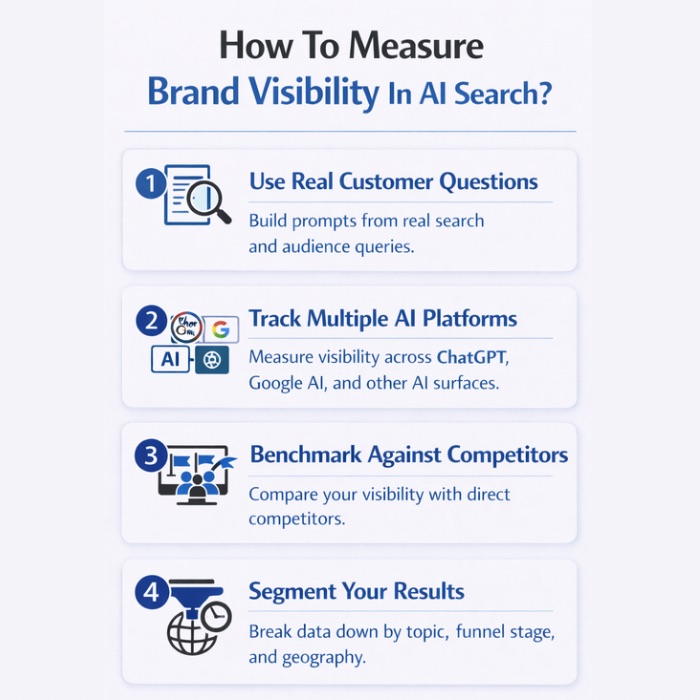
Measuring brand visibility in AI search requires more than traditional SEO tools. Collect AI visibility data directly from platforms using structured methods for accurate insights. Create relevant prompts and monitor performance over time. Manual checks establish baselines, but scaling demands specialized tools.
Google Search Console can now add another layer to this measurement. Its Generative AI Performance report shows impressions from AI Overviews and AI Mode, with breakdowns by page, country, device, and date. Use it alongside prompt-level tracking since it does not cover brand mentions, competitor share of voice, sentiment, or visibility across other AI platforms. These insights rolled out worldwide on August 31, 2026.
To build a more complete view of your AI visibility, use the following measurement steps:
1. Build A Prompt Set Based On Real Customer Questions
The foundation of accurate AI visibility measurement is a well-crafted prompt set. Instead of guessing what users might ask, build your library of prompts based on the actual language your customers use. This ensures you are testing for the questions that matter most to your audience.
To create this prompt set, look at sources where customers ask questions in their own words. Good places to start include:
- Support tickets and sales call transcripts.
- Search console data, especially long-tail queries.
- Social media discussions and online forums like Reddit.
By grounding your prompt coverage strategy in real customer questions, you can measure your brand awareness and AI visibility with far greater accuracy. This approach helps you focus your content optimization efforts on answering the queries that will actually drive discovery and engagement on AI platforms.
2. Measure Visibility Across Google AI Features, ChatGPT, And Other AI Surfaces
To get a complete picture of your brand's AI visibility, you must look beyond a single platform. Limiting your measurement to just one AI engine, such as ChatGPT, can create significant blind spots, as each platform uses different training data and citation logic. A brand that is highly visible on Google Gemini may be completely absent from Perplexity's answers.
Your AI search optimization strategy should include monitoring all major AI engines. This typically includes ChatGPT, Google AI Overviews (part of the main search experience), and other popular platforms. Tracking your visibility score across these different surfaces reveals platform-specific opportunities and weaknesses.
By adopting a multi-platform approach, you can identify which strategies are working best on each engine and apply those learnings more broadly. This ensures your brand builds a consistent and resilient presence across the entire AI search ecosystem, maximizing your reach and impact.
Want a platform-level workflow? See how to monitor brand presence in ChatGPT and Perplexity.
3. Compare Your Brand Against Direct Competitors
Measuring your own AI visibility is only half the battle. To truly understand your market position, you must benchmark your performance against your direct competitors. This comparative data provides essential context, highlighting where you are winning, where you are losing, and where the biggest opportunities for growth lie.
When conducting a competitive analysis, select two or three strategic competitors and track their performance using the same set of prompts and AI platforms you use for your own brand. Pay close attention to your AI Share of Voice and co-mention frequency; how often your brands appear together in the same answer. This reveals how AI is positioning you relative to others.
For SaaS companies and other businesses in competitive markets, this analysis is invaluable. It helps you identify content gaps that your rivals are filling and understand which sources they are leveraging for citations. AI visibility tracking without competitive positioning is like looking at a map with no landmarks.
4. Segment Results By Topic, Funnel Stage, And Geography
To turn raw visibility data into actionable insights, you need to segment your results. Analyzing your overall brand presence is a good start, but deeper understanding comes from breaking down the data by topic, marketing funnel stage, and geography. This allows you to pinpoint specific strengths and weaknesses in your strategy.
For example, you might discover that your brand has high AI visibility for top-of-funnel, awareness-stage topics but disappears in bottom-of-funnel, comparison-stage queries. This signals a need to create more content that directly compares your solution to competitors. Segmentation by topic can reveal that you are an authority on "content marketing" but invisible on "SEO."
Geographic segmentation is also important, as AI responses can vary by location. By breaking down your visibility data in these ways, you can move from broad observations to targeted actions. This granular view helps you allocate resources more effectively and refine your content strategy for maximum impact at every stage of the buyer journey.
What Causes Low Brand Visibility In AI Search And How To Avoid It?
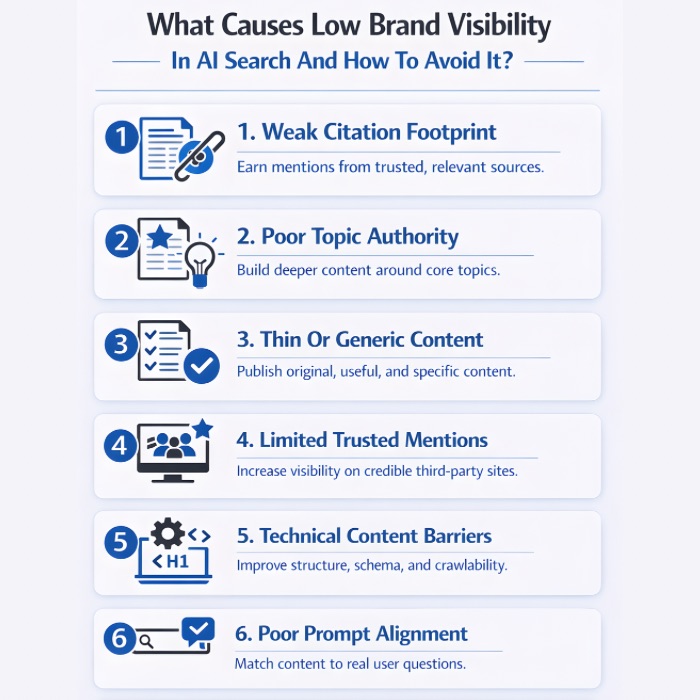
Low brand visibility in AI search often stems from content or technical weaknesses. AI engines favor authoritative, well-structured, fresh content that matches user queries. If your brand rarely appears in AI answers, you likely face content gaps or technical barriers. Here are the key reasons why your brand visibility might be low in AI searches and how you can avoid it:
1. Weak Citation Footprint
A weak citation footprint is a primary reason for low AI visibility. AI engines rely on credible sources to build their answers. If your brand isn't being cited by authoritative websites, the AI has no reason to trust or mention you. Citations from high-quality, relevant sources act as votes of confidence that signal your brand's authority.
To strengthen your citation footprint, you need to focus on earning mentions and links from publications, review sites, and industry blogs that AI engines already trust. This involves strategic digital PR and outreach. Identify the sources that frequently appear in AI answers for your target topics and make it a priority to get your brand featured there.
Using SEO tools to analyze your backlink profile and that of your competitors can help you identify citation opportunities. Improving your citation quality is not just about quantity; it's about being present in the authoritative sources that AI models use to determine credibility, which in turn boosts your AI visibility.
2. Poor Topic Authority
If your content only scratches the surface of a topic, AI engines are unlikely to see you as an authority. Poor topic authority means your website lacks the comprehensive, in-depth content needed to be considered a definitive resource. AI models are designed to find the most thorough and helpful information, and if that's not on your site, they will look elsewhere.
To build topic authority, you need to go beyond single blog posts and create content clusters that cover a subject from multiple angles. This demonstrates expertise and provides the rich context that AI engines crave. Your content optimization efforts should focus on creating pillars of information that are interlinked and showcase deep knowledge.
By consistently publishing high-quality, expert-led content on a specific set of topics, you signal to both users and AI that your brand is a go-to source. This increases your chances of being mentioned and cited, driving both brand awareness and your overall success with generative engine optimization and AI search optimization.
3. Thin Or Generic Content
Thin or generic content that offers little unique value is a major barrier to achieving high brand visibility in AI search. If your articles just rehash what everyone else is saying without adding new insights, data, or perspectives, AI engines have no reason to prioritize them. These models are designed to find distinctive and helpful information, not boilerplate text.
Your content creation process must focus on producing original, high-quality material. Incorporate unique data, customer case studies, expert opinions, and fresh analysis to make your content stand out. Pages that have been updated recently with fresh information are also more likely to earn citations and improve their search rankings.
Instead of publishing broad, generic articles, focus on content that directly answers specific user questions with detailed, well-supported information. This type of content is far more likely to be extracted and featured in AI answers, improving your content optimization results and boosting your brand's presence in AI search.
4. Limited Trusted Mentions
Even if your brand is mentioned, the source of that mention matters. Limited trusted mentions mean that your brand is not being talked about on the high-authority, credible websites that AI platforms rely on for information. AI models learn to trust certain domains over others, and if your brand isn't mentioned on those trusted sites, your visibility score will suffer.
To increase your trusted mentions, you need to actively pursue features, reviews, and links from reputable sources in your industry. This could include major publications, respected industry blogs, or top-tier review platforms. Think of it as building a digital resume; the more credible references you have, the more trustworthy you appear.
These trusted mentions serve as powerful signals to AI engines that your brand is a legitimate and important player in its space. Over time, as AI platforms encounter your brand name in these credible contexts, they are more likely to include you in relevant answers, directly boosting your AI visibility.
5. Technical Content Barriers
Sometimes, the problem isn't your content itself but how it's structured. Technical content barriers can prevent AI engines from effectively parsing and understanding the information on your web pages. If an AI can't easily extract the key points from your content, it won't be able to use it in an answer, no matter how good the information is.
Key technical SEO elements like schema markup and clear heading hierarchies (H1 > H2 > H3) are crucial. Schema provides structured data that explicitly tells search platforms what your content is about, while proper headings make the information easy for AI crawlers to break down and comprehend. Missing or poorly implemented schema can be a significant roadblock.
Ensuring your web pages are technically optimized is a foundational step for improving AI visibility. By making your content as easy as possible for AI engines to read and interpret, you significantly increase the chances that it will be cited and featured in their responses.
6. Poor Prompt Alignment
Your content might be excellent, but if it doesn't directly answer the questions users are asking, it will fail to gain visibility. Poor prompt alignment occurs when your content is not tailored to the specific language and intent of user queries on AI platforms. AI answers are designed to be direct and helpful, so content that is vague or indirect will be overlooked.
To improve prompt alignment, analyze the prompt coverage data you've collected. Identify the high-intent questions where your brand isn't appearing and create or optimize content that addresses those queries head-on. Adding FAQ sections, concise answer blocks, and bulleted lists can make your content more "extractable" for AI.
By focusing your content optimization efforts on aligning with real user prompts, you make it easy for AI platforms to recognize your content as a valuable resource. This direct alignment is key to improving your visibility score and ensuring your brand shows up in the AI answers that matter most.
Found your visibility gaps? Use this AI search optimization checklist to turn them into specific fixes.
What Are The Best Practices For Measuring Brand Visibility In AI Search Results?
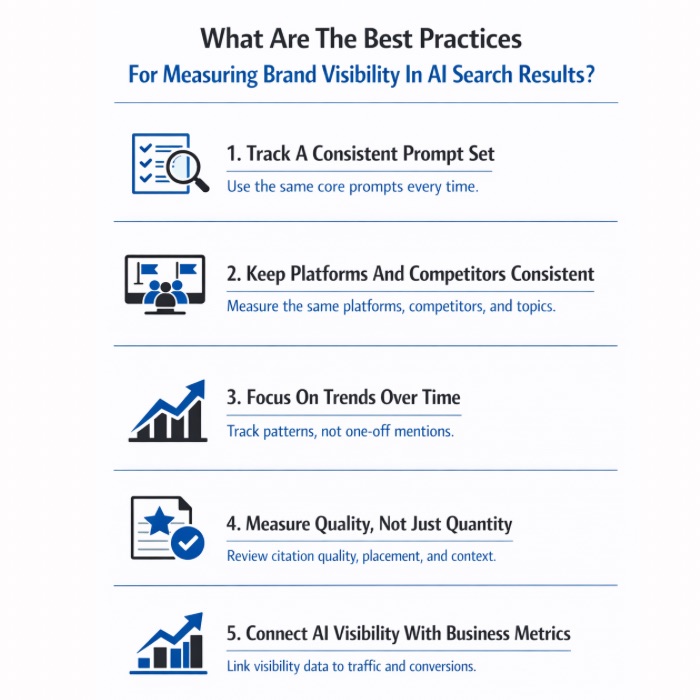
To get reliable, actionable insights from AI visibility tracking, follow best practices with consistency and strategy. Ad-hoc checks and inconsistent methods create confusing data and missed opportunities. These strategies will help you build a strong generative AI measurement program.
1. Track A Consistent Set Of High-Intent Prompts
The key to effective AI visibility measurement is consistency. Use the same set of high-intent queries for each cycle to accurately track performance. Identify 20-50 core prompts covering your most important topics and customer questions; these will be your benchmark for monitoring progress and trends in brand awareness.
While you can expand your prompt library, always keep this core set for historical comparisons. SEO tools can help prioritize which prompts to track by search volume. This disciplined approach ensures reliable data and meaningful insights.
2. Use The Same Platforms, Competitors, And Topics For Every Measurement Cycle
Just as you need consistent prompts, you also need consistency in your measurement variables. For each tracking cycle, use the same AI platforms, monitor the same competitors, and focus on the same core topics. This creates a stable environment for collecting comparative data. Measuring visibility on ChatGPT one month and Google Gemini the next prevents meaningful progress analysis, since each platform operates differently.
Similarly, tracking different competitors distorts your market share results. By keeping these elements constant, you can better attribute changes in visibility to your optimization efforts, such as content updates or digital PR campaigns, making your SEO performance analysis more reliable.
3. Measure Trends Over Time Instead Of One-Off Mentions
AI-generated answers often fluctuate, so single mentions or disappearances aren’t reliable indicators. What matters are long-term trends. Relying on one-off checks can lead to false conclusions and wasted effort—brand visibility is dynamic, not static. To get meaningful data, track your AI visibility consistently over weeks and months.
This reveals if your brand’s visibility or share of voice is trending up or down, and whether your content optimizations are working. Focus on patterns, not isolated events. A long-term view helps you separate real trends from temporary noise. A sudden drop in mentions may be just a blip, but a steady decline signals it’s time to act. This approach is essential for effective AI search optimization across all platforms.
4. Combine Visibility Metrics With Citation Quality And Context
Raw visibility metrics, such as mention counts, only provide partial insight. To fully understand your brand’s AI search presence, combine these numbers with qualitative analysis, like citation quality and context. Ask questions: Who cited your brand? Was it your site or a third-party review? Was the mention a top recommendation or just a passing reference?
This context is essential for accurate performance interpretation. For example, five authoritative mentions as a top recommendation are more valuable than ten low-quality, last-place listings. Adding qualitative analysis reveals the real impact of your AI search presence and supports smarter optimization.
5. Connect AI Search Visibility Data With SEO, Traffic, And Conversion Insights
Integrating AI search visibility data with traditional SEO strategies can significantly enhance traffic and conversion insights. Understanding your brand's visibility score and share of voice across different AI platforms allows for a more nuanced approach to user engagement. Utilizing visibility tools and SEO metrics helps identify content gaps and track citations effectively.
By aligning these insights with referral traffic patterns and brand mentions, businesses can optimize content creation and develop competitive positioning strategies. Ultimately, data-driven decisions informed by AI visibility tracking can lead to improved search rankings and increased brand awareness.
Need to connect visibility to business results? See how to measure AEO ROI across traffic, conversions, and revenue.
Why Choose Scalenut For AI Search Visibility Tracking?
Tracking brand visibility in AI search is only useful when you can turn those insights into action. That is where Scalenut stands out. It combines GEO monitoring, prompt-level intelligence, AI traffic insights, and hands-on SEO workflows in one platform, so you can see how your brand appears in AI answers and improve that visibility with clear next steps.
With Scalenut, you can:
- Monitor AI brand visibility with metrics like Visibility Score, Average Position, Share of Voice, Visibility Heatmap, and Brand Visibility Rank
- Analyze prompt-level performance through brand mentions, rankings, citations, competing brands, query fanouts, and sentiment insights
- Turn insights into action with content ideas, backlink suggestions, and platform engagement opportunities that help grow mentions and citations
- Track AI traffic trends across bots like ChatGPT and Gemini to understand which sources and pages drive AI interactions
- Strengthen execution with built-in tools for content creation, optimization, keyword planning, content audits, internal linking, on-page improvements, and backlink discovery
Instead of treating GEO as a separate reporting layer, Scalenut connects AI visibility insights with the SEO and content workflows needed to improve performance across both AI answers and traditional search.
Book a Scalenut demo to see how its GEO and SEO workflow can help you measure, improve, and grow your brand visibility in AI search.
Conclusion
Measuring brand visibility in AI search is crucial for understanding your market position and refining strategies. Key metrics like brand mentions, AI citation rates, and share of voice help gauge your presence and performance. Tracking high-intent prompts and analyzing trends offer deeper insights into brand effectiveness. Using advanced tools like Scalenut can further enhance your visibility and support business goals.
Frequently Asked Questions
How do agencies measure brand visibility in AI search?
Agencies measure AI visibility by using specialized AI visibility tools and SEO tools to track metrics like brand mentions, citation rates, and share of voice. They test a consistent set of prompts across major answer engines, benchmark against competitors, and analyze the data to guide their AI search optimization strategies for clients.
How does an AI search monitoring platform work?
An AI search monitoring platform automatically sends thousands of prompts to various AI platforms like ChatGPT and Google Gemini. The AI visibility tool then scans the AI answers to track citations, brand mentions, and sentiment. It compiles this visibility data to provide reports on brand presence, competitive positioning, and optimization opportunities.
Is tracking brand visibility in AI search important?
Yes, to track visibility in AI search engines is crucial. As more consumers use AI platforms for discovery, your presence in AI-generated answers directly impacts brand awareness and customer acquisition. If you're not visible, you're excluded from the decision-making process, and your visibility score suffers on these emerging search platforms.
What are the best metrics to track AI search visibility over time?
The best metrics are brand mention rate, AI citation rate, share of voice, prompt coverage, average position, brand sentiment and factual accuracy, and visibility consistency. Track them across the same prompts and AI platforms over time to measure whether your brand is appearing more often, more prominently, and more accurately in AI-generated answers.
Can you recommend the top AI visibility tracker tools for brands in 2026?
Several platforms help brands monitor how they appear in AI-generated answers across engines like ChatGPT, Gemini, and Perplexity. Popular options include Scalenut, Peec AI, Scrunch AI, and Brand24. Among them, Scalenut stands out by combining AI visibility tracking with actionable SEO and content optimization workflows.


.svg)


.webp)