.jpg)
Quick summary
- Programmatic SEO creates keyword-targeted pages at scale using repeatable templates, structured data, and automation instead of building every page manually.
- The process starts with scalable keyword patterns, then uses relevant data to populate page templates and generate pages for specific search queries.
- It works best when each page satisfies a distinct search intent with useful data, information, or functionality, not just keyword-swapped copy.
- The main challenge is maintaining quality at scale. Thin, repetitive, inaccurate, or poorly indexed pages can limit performance, so ongoing monitoring and refinement are essential.
Programmatic SEO is not about publishing thousands of pages as quickly as possible. It is about building a repeatable system that turns real search demand and structured data into useful, targeted pages. A single template can support hundreds or thousands of keyword variations, but only when each page satisfies a distinct search intent and provides genuine value.
In this guide, you’ll learn how programmatic SEO works, the 6-step process for building it, when the strategy makes sense, and how to avoid thin content, duplicate pages, and indexing problems as you scale.
What is programmatic SEO?
Programmatic SEO is the automated or semi-automated process of creating search-optimized pages at scale using structured data and reusable templates. Instead of building each page manually, data from a spreadsheet, database, or API is inserted into a common template to create pages targeting specific keyword variations.
The goal is not simply to publish thousands of pages, but to satisfy a specific user intent with useful, relevant information. For example, instead of one broad page about "digital nomad locations," you could create dedicated pages for "best cities for digital nomads in Costa Rica" or "cost of living for digital nomads in Thailand." Each page targets a distinct long-tail search while using the same scalable framework.
How does programmatic SEO work? A 6-step process
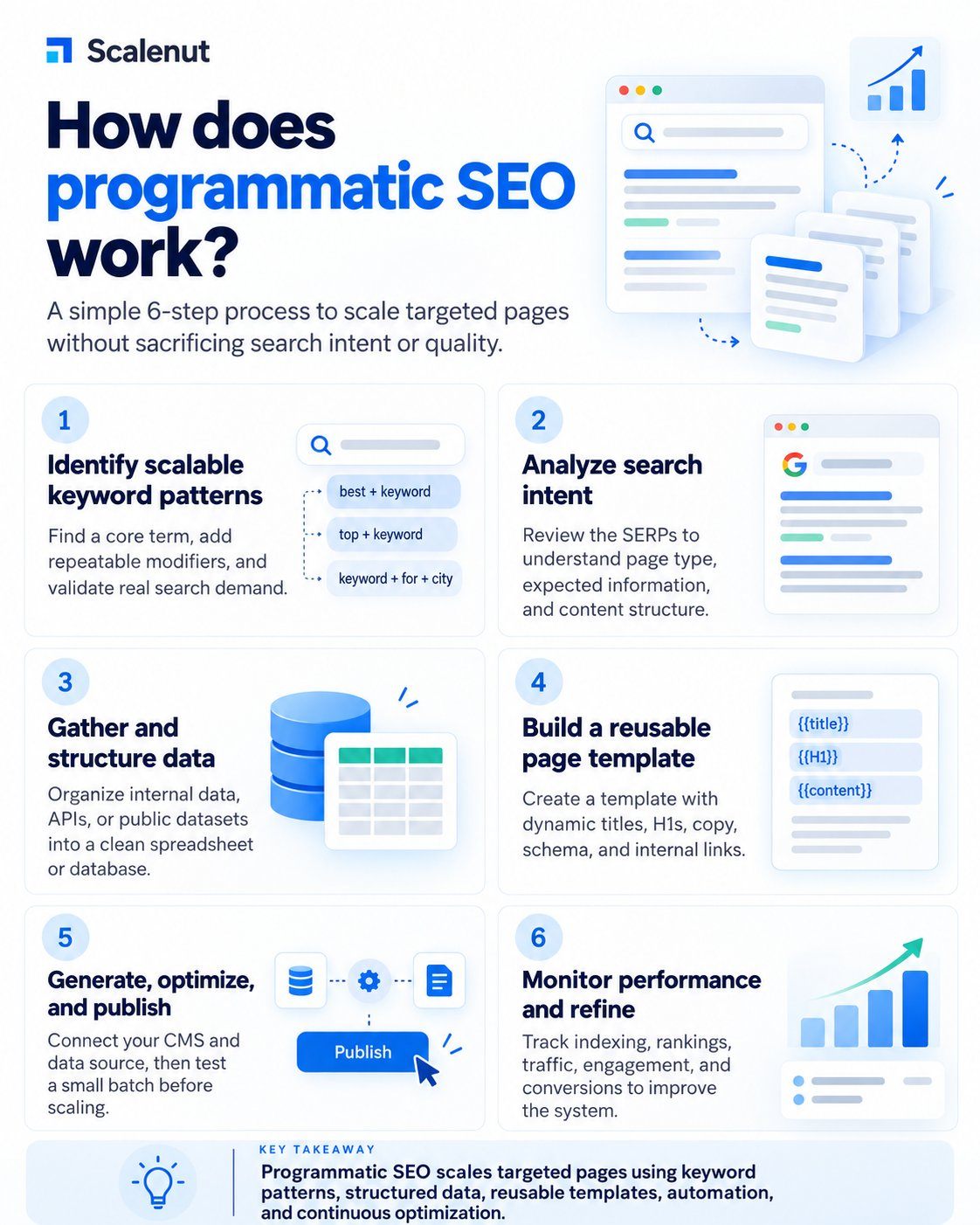
Programmatic SEO works by combining scalable keyword patterns, structured data, reusable page templates, and automation to create targeted pages at scale. Instead of building each page manually, data from a spreadsheet, database, or API is fed into a template to generate pages for specific search queries.
Here’s how the programmatic SEO process works from keyword research to ongoing optimization.
Step 1: Identify scalable keyword patterns
Start by finding a core keyword that can be combined with repeatable modifiers such as locations, categories, features, or prices.
For example, "apartments for rent" could be expanded into "apartments for rent in Chicago," "2-bedroom apartments for rent in Austin," and hundreds of similar variations.
Use keyword research tools to identify:
- A relevant core term tied to your business.
- Repeatable modifiers that produce useful long-tail variations.
- Real search demand for those variations.
The goal isn't to generate as many combinations as possible. Each keyword variation should represent a genuine search need worth creating a page for.
Step 2: Analyze search intent
Next, determine what users expect when they search for these keyword variations.
Review the SERPs for a representative sample and look at:
- Page type: Are directories, product pages, comparisons, or informational pages ranking?
- Expected information: Do users need prices, ratings, maps, reviews, comparisons, or other specific data?
- Page structure: Which sections or elements consistently appear in top results?
For example, pages targeting "best hotels in [city]" may need prices, ratings, amenities, and location information rather than generic copy with the city name changed.
This helps you build a template that consistently matches search intent.
Step 3: Gather and structure your data
Collect the data that will make each page useful and distinct. This can come from internal databases, proprietary data, APIs, public datasets, user-generated content, or manual research.
Organize it in a spreadsheet or database. Typically, each row represents a page, while each column represents a dynamic data point such as:
- Location
- Price
- Rating
- Features
- Description
Keep the data accurate, consistent, and sufficiently different across pages. The quality of your data directly affects the usefulness of the pages you generate.
Step 4: Build a reusable page template
Create a template that defines the common structure of your programmatic pages while allowing the data to change dynamically.
Dynamic elements can include:
- Title tags and meta descriptions
- H1s and subheadings
- Descriptions and supporting copy
- Listings, comparisons, or data points
- Internal links
- Images and other page elements
You can also add relevant structured data markup where appropriate.
The template should be consistent enough to scale but flexible enough that each page reflects its specific keyword, data, and search intent.
Step 5: Generate, optimize, and publish pages at scale
Connect your database to your CMS or automation workflow to generate pages for each relevant keyword and data combination.
As pages are created, optimize key elements such as:
- H1s and metadata: Make them relevant to each page's specific query.
- Internal links: Connect related pages logically for users and search engines.
- Page-level value: Ensure each URL provides useful data, information, or functionality rather than simply swapping keywords.
Before publishing hundreds or thousands of URLs, test a small representative batch. Check the pages for accuracy, duplication, formatting, internal linking, usefulness, and indexability.
Fixing problems at the template level before scaling prevents the same issue from being repeated across your entire page set.
Step 6: Monitor performance and refine your strategy
Once the pages are live, monitor how they perform using tools such as Google Search Console and Google Analytics.
Track:
- Indexing: Are important pages being discovered and indexed?
- Rankings: Are pages appearing for their target queries?
- Organic traffic: Which page groups are gaining clicks and visibility?
- Engagement and conversions: Are visitors finding the pages useful and taking meaningful actions?
Look for patterns across groups of pages rather than evaluating URLs individually. If a keyword cluster, template element, or data source consistently underperforms, improve the underlying system and apply those changes across the relevant pages.
That repeatable combination of keyword targeting, structured data, templates, automation, and continuous refinement is what makes programmatic SEO scalable.
How Does Programmatic SEO Differ From Traditional SEO?
The primary difference between programmatic and traditional SEO lies in the approach to content creation and scale. Regular SEO focuses on manually creating unique, high-quality content for individual pages. This method is ideal for in-depth blog posts or service pages where a distinct voice is required to outrank competitors for a competitive head term. It involves significant manual work for each page.
In contrast, a programmatic approach automates the generation of a large volume of pages targeting thousands of specific keywords. While traditional SEO often targets high-volume keywords, programmatic SEO excels at capturing long-tail search traffic by answering very specific queries. This offers the benefit of faster scalability and more efficient coverage of vast keyword sets, allowing businesses to expand their online presence much more quickly than with manual methods.
What Are the Benefits of Programmatic SEO Over Manual Methods?

Programmatic SEO offers significant advantages, primarily through its ability to produce scalable content at a pace that manual methods cannot match. This efficiency allows you to target a vast number of long-tail keywords, driving substantial organic traffic and creating opportunities for measurable growth.
Let’s look at these benefits in greater detail:
1. Scalable Content Production
Scaling content creation is one of the most powerful benefits of programmatic SEO. Instead of manually writing hundreds of similar pages, you can generate them automatically. This is possible because you create a single, well-designed page structure that can be populated with different data sets.
Imagine you want to create pages for every city in a country. A programmatic approach allows you to do this at a large scale without starting from scratch each time. You simply need a template and a database. This is how you can scale your content creation:
- Identify a head term with many modifiers (e.g., "best restaurants" + city names).
- Create a template that organizes information consistently across all pages.
- Use a database to automatically fill in the unique details for each page.
This process transforms content creation from a time-consuming manual task into an efficient, automated workflow. You can produce programmatic content for countless variations, expanding your website's footprint dramatically.
2. Faster Expansion Across Large Keyword Sets
A key advantage of a programmatic SEO campaign is the ability to quickly target a vast number of relevant keywords. Traditional keyword research often focuses on high-volume terms, but programmatic SEO excels at capturing the "long tail" of search. These are highly specific, low-competition phrases that, when combined, can drive significant traffic.
With automation, you can create dedicated pages for thousands of keyword variations that would be impossible to target manually. This rapid expansion helps you appear in more search results for queries that indicate strong user intent. The process includes:
- Identifying keyword patterns that can be scaled (e.g., "cost of living in [city]").
- Generating pages for each variation to cover a wide range of specific searches.
This strategy allows your website to grow its keyword footprint exponentially. By blanketing a niche with targeted content, you can establish authority and attract users at different stages of their journey.
3. Stronger Long-Tail Keyword Coverage
Programmatic SEO is exceptionally effective at targeting long-tail keywords. These are longer, more specific search queries that tend to have lower search volume but much higher conversion rates. By creating pages that directly answer a precise user intent, you can attract highly qualified organic traffic.
Instead of competing for broad, competitive terms, you can dominate thousands of niche searches. This is because users searching for long-tail keywords often know exactly what they want. For example:
- A user searching for "family-friendly hotels in Orlando with a pool" has a clearer search intent than someone searching for just "hotels."
- A page dedicated to this specific query is more likely to meet their needs and lead to a booking.
By systematically creating pages for these specific queries, you build a comprehensive network of content that captures users at the bottom of the funnel, driving valuable conversions.
4. Reduced Manual Workflows
One of the most immediate benefits of programmatic SEO is the significant reduction in manual workflows. The automation at the core of this strategy eliminates the repetitive tasks associated with large-scale content generation, freeing up your team to focus on more strategic initiatives.
Once the initial setup is complete, including keyword research, data collection, and template design, the system handles the heavy lifting. This efficiency is achieved through:
- Automated page creation: Tools can generate hundreds of programmatic pages from a single spreadsheet or database.
- Streamlined updates: Changes to your database can be automatically reflected across all relevant pages, ensuring content remains current.
This level of automation not only saves time and resources but also minimizes the risk of human error. It allows you to scale your content efforts without proportionally increasing your team's workload.
5. More Efficient Site Growth
Programmatic SEO efforts lead to more efficient and measurable growth for your website. By rapidly increasing the number of indexed pages, you create more opportunities to rank in search results and attract organic traffic. This expansion is not just about quantity; it is about strategic, targeted growth.
This method allows you to track performance and make data-driven decisions to refine your strategy. The benefits for site growth include:
- Broader search coverage: Publishing useful pages for validated query variations gives your site more opportunities to appear for relevant long-tail searches.
- Targeted expansion: You can strategically enter new markets or cover new topics by simply adding new data to your system.
This scalable approach ensures that your website's growth is both fast and sustainable. You can measure the impact of your programmatic SEO efforts through key metrics, demonstrating clear, measurable growth over time.
When does programmatic SEO make sense?
Programmatic SEO is a good fit when your website has:
- Repeatable search demand: Users search for many variations of the same query pattern, such as locations, products, integrations, or comparisons.
- Structured or scalable data: You have enough reliable data to populate pages efficiently.
- Distinct value for each page: Every URL can provide useful information, functionality, or insights specific to that search.
If the pages would only swap keywords while offering essentially the same content, programmatic SEO is unlikely to be the right approach.
What Are the Common Use Cases and Industries Leveraging Programmatic SEO?

Programmatic SEO is highly effective for businesses with large amounts of structured data. Industries like e-commerce, travel, real estate, and SaaS use it to create thousands of targeted pages, such as product listings, location-based landing pages, and comparison pages. For example, a travel site might generate "best hotels for digital nomads in [city]" pages, while an e-commerce store could create category pages for every brand. The following examples show how various industries apply these strategies.
1. Ecommerce Category and Product Pages
E-commerce websites are a prime example of where programmatic SEO can shine. These sites often have thousands of products that can be categorized in multiple ways, creating countless opportunities for targeted pages. Instead of manually creating each page, businesses can automate the generation of product listings and product category pages.
This approach ensures that every product has an optimized page, and categories can be created based on various attributes. For instance, an apparel store could generate pages for:
- "Men's running shoes under $100"
- "Women's waterproof jackets in blue"
By using templates, e-commerce sites can maintain a high level of content quality across all programmatic SEO pages. This allows them to capture very specific search queries from users who are ready to buy, driving both traffic and sales.
2. Travel and Location-Based Landing Pages
The travel industry heavily relies on programmatic SEO to create location-based landing pages at scale. Companies like TripAdvisor generate millions of pages for destinations, hotels, restaurants, and attractions around the world. This allows them to rank for an incredible number of specific search queries.
A user planning a trip to New York might perform a quick search for various needs. A travel website can capture this traffic by creating pages for queries like:
- "Best hotels in New York with a city view"
- "Things to do in Brooklyn this weekend"
These pages are automatically populated with data such as prices, ratings, and availability. By creating these highly targeted landing pages, travel companies can provide immense value to users while dominating search results for countless location-based keywords.
3. SaaS Template and Comparison Pages
SaaS companies can leverage programmatic SEO to create valuable template and comparison pages. Zapier is a classic example, generating thousands of pages for every possible app integration they support, such as "Connect Google Sheets to Slack." This strategy helps them rank for highly specific, solution-oriented keywords.
Another common use case is creating template pages. For example, a graphic design tool like Canva generates landing pages for every type of design template they offer. These pages provide useful information and examples, attracting users searching for specific design needs. Key examples include:
- Comparison pages: "Zapier vs. IFTTT for social media automation"
- Template pages: "Free resume templates for marketing professionals"
This approach allows SaaS businesses to demonstrate their product's capabilities and capture users who are actively looking for solutions, effectively turning search traffic into potential customers.
4. Real Estate and Local Listing Pages
The real estate industry is another perfect fit for programmatic SEO. Real estate websites can generate local listing pages for every neighborhood, city, and zip code they serve. These pages can be populated with data on property listings, school ratings, crime rates, and the local cost of living.
This strategy allows real estate companies to attract significant organic traffic from users searching for properties in specific areas. For example, a user might search for:
- "3-bedroom homes for sale in Austin, TX"
- "Apartments for rent near Central Park"
By creating dedicated pages for these queries, real estate websites can provide hyper-relevant information to potential buyers and renters. This not only improves their search rankings but also establishes them as an authoritative resource in the local market.
5. Marketplace and Directory Websites
Marketplace and directory websites, like Yelp, are built almost entirely on programmatic SEO. These platforms aggregate vast amounts of data about businesses, services, or professionals and present it through a series of templated landing pages. This allows them to cover an enormous range of search queries.
A directory website might create pages for every type of service in every city it covers. This is accomplished by combining a structured database with a consistent page template. Examples include:
- A business directory generating pages for "plumbers in San Diego" or "electricians in Miami."
- A freelance marketplace creating pages for "web developers in Texas" or "graphic designers in California."
By populating these pages with relevant data like reviews, contact information, and hours of operation, these websites become indispensable resources for users and dominate search rankings for local service-based queries.
What are the potential challenges of programmatic SEO?
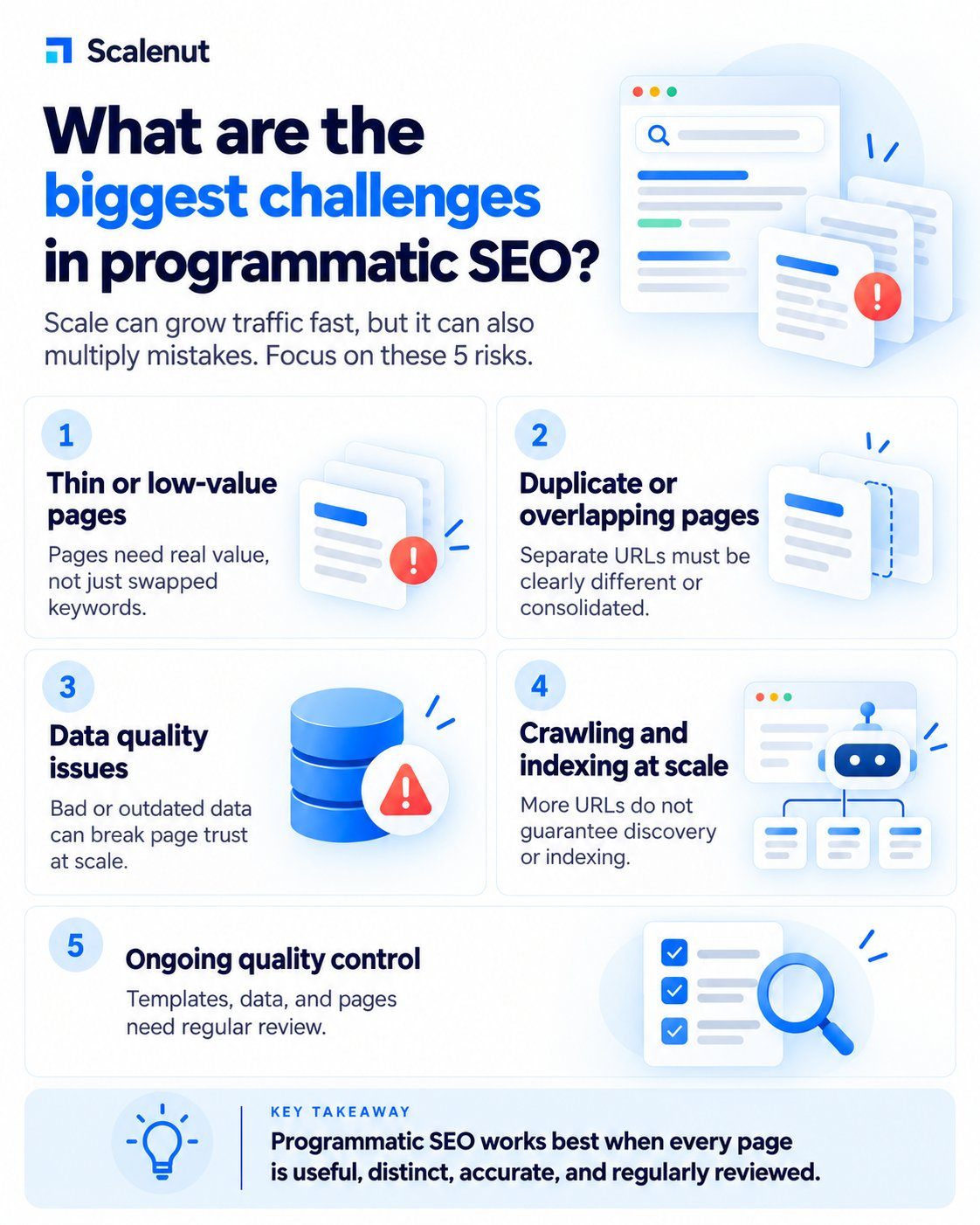
Programmatic SEO can scale organic visibility efficiently, but automation also scales mistakes. The biggest risks are low-value pages, overlapping URLs, poor data, indexing issues, and weak quality control. Addressing these early helps you scale without sacrificing search performance or user experience.
1. Thin or low-value content
The biggest risk is creating thousands of pages that look different but provide little unique value. Simply changing a keyword, location, or product name is not enough.
Google considers large-scale content created primarily to manipulate rankings without helping users a form of scaled content abuse, regardless of whether it is created by AI, automation, or humans.
To avoid this:
- Add meaningful page-specific data, insights, reviews, comparisons, or functionality.
- Make sure every page satisfies a distinct search need.
Each URL should have a clear reason to exist beyond targeting another keyword.
2. Duplicate and overlapping pages
Programmatic templates can produce pages that are too similar or target nearly identical queries. This can make it harder for search engines to determine which page should appear in results.
Before creating separate URLs, ask whether each page provides enough distinct value. If two pages substantially overlap, consolidate them where possible.
Use canonical tags when you genuinely have duplicate or very similar URLs and want to indicate a preferred version, rather than using canonicals as a substitute for creating differentiated pages.
3. Data quality and accuracy issues
Your programmatic pages are only as reliable as the data behind them. Outdated prices, incorrect locations, broken API data, or inconsistent fields can quickly affect thousands of pages.
Reduce this risk by:
- Regularly auditing data sources.
- Validating important fields before publishing.
- Setting clear processes for updating time-sensitive information.
Strong data quality makes your pages more useful and keeps errors from multiplying at scale.
4. Crawling and indexing challenges at scale
Publishing many URLs does not guarantee that search engines will crawl or index all of them.
For most sites, keeping XML sitemaps updated, maintaining logical internal links, and monitoring the Page Indexing report in Google Search Console is sufficient. Crawl-budget optimization becomes more important for very large or rapidly changing sites, or when many URLs remain "Discovered – currently not indexed."
Focus on helping crawlers discover your highest-value pages rather than simply generating more URLs.
5. Ongoing editorial and quality control
Programmatic SEO is not a set-it-and-forget-it strategy. Templates, data sources, and generated pages should be reviewed regularly for:
- Outdated or inaccurate information.
- Formatting or template errors.
- Weak or repetitive content.
- Indexing and performance issues.
Human oversight helps catch problems automation cannot and ensures your programmatic pages continue to provide genuine value as the site grows.
Real-World Programmatic SEO Examples
Many successful companies have mastered the art of programmatic SEO, creating millions of valuable pages that drive massive organic traffic. Examining real-world case studies can provide valuable insights into the best practices for implementing this strategy effectively.
From travel giants to SaaS platforms, these examples showcase how to use programmatic pages to dominate search rankings and provide a great user experience. Let's look at how some of the biggest names in the industry have put these principles into action.
How Companies Like TripAdvisor, Zapier, and Canva Use Programmatic SEO
Companies like TripAdvisor, Zapier, and Canva have built their online empires on the back of programmatic SEO. They each use dynamic content to create millions of programmatic pages that cater to a specific search intent, resulting in a superior user experience.
TripAdvisor, for example, generates pages for every travel destination, hotel, and restaurant. They use data like reviews, prices, and availability to populate these pages, answering user queries with incredible detail. Similarly:
- Zapier creates a landing page for every possible app integration, such as "Connect Gmail and Notion." This captures users looking for specific automation solutions.
- Canva generates pages for every design template they offer, like "free infographic templates," attracting users with specific creative needs.
Each of these companies has mastered the art of using templates and data to scale their content. They provide valuable, relevant information on each page, ensuring that despite the automation, the user experience remains excellent.
Lessons Learned From Leading Programmatic SEO Examples
The success of leading programmatic SEO examples offers several key lessons for anyone looking to implement this strategy. The most important takeaway is that content quality should never be sacrificed for quantity. The best programmatic sites provide genuinely useful information on every page.
Another crucial lesson is the importance of a solid data foundation. The accuracy and uniqueness of your data are what will set your pages apart from the competition. Here are some best practices to follow:
- Focus on user intent: Build pages that directly answer the user's question, providing them with the information they need quickly and efficiently.
- Invest in unique data: Use proprietary data or combine public data in novel ways to create value that competitors cannot easily replicate.
By following these principles, you can achieve measurable growth and build a sustainable competitive advantage, just as the leading companies have done.
Which Tools Help With Programmatic SEO?
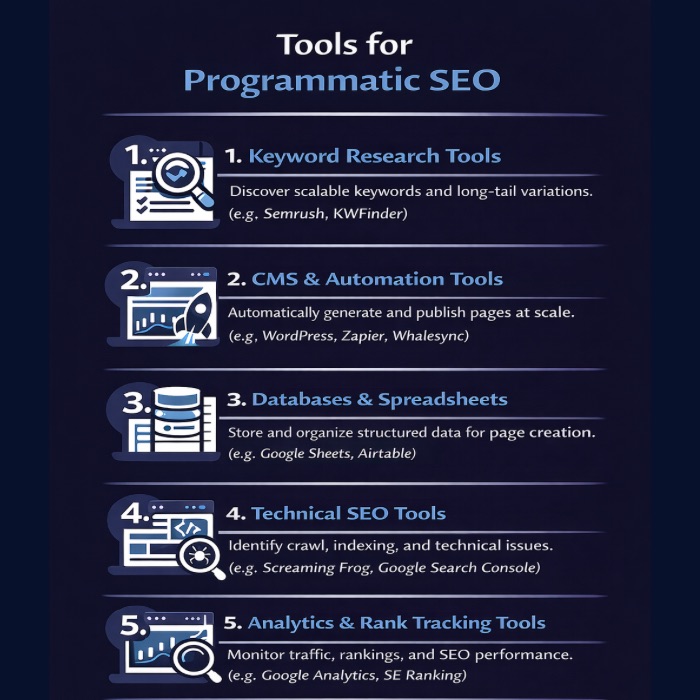
A variety of tools can help you execute a programmatic SEO strategy. These tools span from keyword research and data management to content generation and performance tracking. For data, many start with simple tools like Google Sheets before moving to more advanced databases.
Let’s look at the best tools for each stage of the process.
1. Keyword Research Tools
Keyword research tools are essential for the first step of any programmatic SEO campaign. They help you identify the scalable keyword patterns that will form the basis of your content. These tools can reveal thousands of long-tail variations of a single head term, along with their search volume and competition level.
Using these tools, you can discover what your audience is searching for and find opportunities to create targeted content at scale. Popular keyword research tools allow you to:
- Find a head term and its many modifiers.
- Analyze search volume and keyword difficulty.
- Examine the search results to understand user intent.
Tools like Semrush's Keyword Magic Tool or KWFinder are excellent for this purpose. They provide the data you need to build a comprehensive list of relevant keywords to target.
2. CMS and No-Code Automation Tools
To generate your programmatic pages at scale, you will need a content management system (CMS) and potentially some no-code automation tools. These tools bridge the gap between your database and your website, handling the automated creation of each page.
If you are using WordPress, a plugin like WP All Import is a popular choice. It allows you to upload a CSV file from your spreadsheet and map the data to the fields in your page template. Other tools can create even more seamless automation:
- Whalesync: This tool can sync data between Airtable and Webflow in real time.
- Zapier: You can create workflows that automatically publish a new page whenever a new row is added to your spreadsheet.
These tools are crucial for the automation aspect of programmatic SEO, making it possible to manage thousands of pages efficiently.
3. Databases and Spreadsheets
At the core of any programmatic approach is a well-structured database or spreadsheet. This is where you will store all the relevant data that will be used to populate your pages. For many projects, a simple tool like Google Sheets is sufficient to get started.
As your project grows in complexity, you might need a more robust database solution. However, the principles remain the same. Your database should be organized, clean, and easy to manage. When setting up your data source:
- Use clear column headers that correspond to the data points on your pages.
- Ensure each row contains all the relevant data for a single page.
Tools like Airtable offer a more powerful and flexible alternative to traditional spreadsheets, combining the simplicity of a spreadsheet with the functionality of a database.
4. Technical SEO and Crawling Tools
Technical SEO tools are vital for ensuring your programmatic pages can be crawled and indexed by search engines. When you are dealing with thousands of pages, it is easy for technical issues to arise that can hinder your performance.
Tools like Screaming Frog or Sitebulb can crawl your entire website and identify problems like broken links, duplicate content, and indexing issues. Google Search Console is also essential for monitoring how the search engine interacts with your site. These tools help you:
- Manage your crawl budget by identifying and fixing issues that waste crawler resources.
- Check indexability status to ensure your pages are eligible to appear in search results.
Regularly using these tools is a critical part of maintaining the technical health of your large-scale programmatic site.
5. Analytics and Rank Tracking Platforms
To measure the success of your programmatic SEO efforts, you need analytics and rank tracking platforms. These tools provide the data you need to demonstrate measurable growth and make informed decisions to optimize your strategy.
Google Analytics is the standard for tracking website traffic and user behavior. It can show you how much search traffic your programmatic pages are generating and how users are interacting with them. Rank tracking tools, on the other hand, monitor your keyword positions in search results. These platforms allow you to:
- Track thousands of keywords at once to see how your pages are performing.
- Measure key metrics like average position, visibility, and traffic forecast.
Tools like SE Ranking's Rank Tracker or Semrush's Position Tracking are essential for monitoring your progress and proving the ROI of your programmatic SEO investment.
Programmatic SEO with AI: How will AI shape the future of programmatic SEO?
AI is making programmatic SEO faster and more accessible by automating tasks that once required significant manual work. It can help identify keyword patterns, analyze search intent, generate page elements, enrich templates, and turn structured data into publish-ready pages at scale.
But AI does not solve the quality problem by itself. Unique wording alone does not make a programmatic page valuable. Each page still needs useful data, functionality, insight, or information that meaningfully matches its search intent.
The strongest approach is to use AI as part of the workflow, not as the value proposition. AI can accelerate production and personalization, while human oversight remains essential for choosing the right opportunities, validating data, reviewing output, and maintaining quality across the site.
Scale Your Programmatic SEO Strategy With Scalenut
Programmatic SEO works best when you combine scalable content creation with strong SEO insights. Scalenut brings both together by combining AI visibility tracking (GEO) with SEO research, content creation, and optimization tools in one platform. This helps you understand how your brand appears in AI answers and take action to improve visibility.
Key Scalenut features that support programmatic SEO include:
- AI Visibility Tracking (GEO): Monitor how your brand appears in AI responses across platforms like ChatGPT and Perplexity with metrics like Visibility Score, Share of Voice, and Average Position.
- Prompt & Citation Insights: Identify which prompts trigger brand mentions, what sources AI models cite, and which competitors appear alongside you.
- AI-Powered Content Creation: Use Cruise Mode, Content Optimizer, and AI Humanizer to create and refine SEO-friendly content at scale.
- SEO Research & Planning Tools: Discover keyword clusters, analyze competitor coverage, and uncover growth opportunities with Keyword Planner and Traffic Analyzer.
- Technical SEO & Linking Support: Strengthen site structure and internal linking with tools like Link Manager and On-Page Pro.
By combining AI visibility insights with hands-on SEO execution, Scalenut helps teams scale content efficiently while improving their presence across both search engines and AI-driven discovery platforms.
Want to see how Scalenut can support your SEO strategy? Book a demo today and explore how the platform can help you scale content, improve visibility, and drive better results.
Conclusion
Programmatic SEO is a transformative approach that streamlines the content creation process while maximizing your website's visibility. By leveraging scalable strategies, businesses can efficiently target a broad array of keywords, enhance their digital footprint, and adapt to changing search behaviors. However, it's crucial to remain vigilant against potential challenges such as low-quality content or indexing issues.
As you embark on implementing programmatic SEO, remember that continuous monitoring and refinement are key to success. If you're ready to revolutionize your SEO strategy and explore the power of programmatic techniques, get a free consultation with our experts today to get started!
Frequently Asked Questions
Can programmatic SEO work for small businesses or blogs?
Yes, a programmatic approach can work for small businesses or blogs if they have access to structured data that can be scaled. For example, a blog could create landing pages for every tool in a specific niche. It is an efficient way to scale content creation and drive organic traffic to the search engine.
What are the best programmatic SEO tools available?
The best tools depend on your needs. For keyword research, use tools like Semrush. For data, Google Sheets or Airtable are great. For implementation, use a content management system with plugins like WP All Import or no-code automation tools. For technical SEO, Screaming Frog is essential.
How do I avoid duplicate or low-quality content with programmatic SEO?
To avoid duplicate or low-quality content, make sure each page provides distinct value through unique data, insights, or functionality. Consolidate heavily overlapping pages where possible, and use canonical tags only when genuinely duplicate or very similar URLs need a preferred version.
Is it possible to learn programmatic SEO without coding experience?
Absolutely. Thanks to no-code automation tools and user-friendly content management system plugins, you can implement programmatic SEO without writing a single line of code. Tools that connect Google Sheets to your website make the process accessible to everyone, allowing for a great user experience for the creator.
How do I decide if programmatic SEO is right for my website?
A programmatic approach is right for you if your website can benefit from creating a large number of web pages targeting specific keywords. If you have structured data and can identify scalable keyword patterns, this strategy can lead to measurable growth and improved visibility in search results.


.svg)


.webp)