
.jpg)
Quick summary: How to make your writing not AI detectable?
Make AI-assisted writing more natural by rewriting it in your own voice, adding original insights, and editing for clarity. No tool or technique guarantees that it will pass every AI detector.
- Start with your perspective: Build the draft around your ideas, audience, and outline.
- Add verifiable details: Replace vague claims with genuine examples, checked facts, and source links.
- Edit for readability: Remove repetition and unnecessary jargon. Keep correct grammar and a suitable tone.
- Review the final draft: Check automated rewrites for accuracy and meaning. Treat detector scores as estimates, since human-written content can also be flagged.
Adding mistakes to an AI draft sacrifices clarity without proving who wrote it. Forced slang and endless synonym swaps can create the same problem: a paragraph that reads awkwardly while leaving its detector result uncertain.
If you’re researching how to make writing not AI detectable, focus on what you can verify and improve. Start with your own argument, add genuine examples, check sources, and edit for natural flow. The 6 steps below explain those changes with before-and-after examples, so you can publish stronger writing without treating a detector score as your final quality check.
How do AI detectors identify machine-generated text?
AI detectors use trained models and statistical signals to estimate whether text may be AI-generated. Depending on the tool, they may analyze word predictability, linguistic patterns, or similarities to human and AI text. Their methods differ and evolve. For example, GPTZero says it moved from its original perplexity and burstiness approach to a deep-learning architecture.
These results are estimates, not proof of authorship. Turnitin acknowledges that its detector can incorrectly flag human-written content as AI-generated, so a score should be interpreted alongside other evidence.
Rewording AI writing can improve clarity, flow, and tone, but changing vocabulary or sentence structure does not guarantee a lower detection score. Focus on adding original analysis, genuine examples, and verified information. These edits make the content more useful to readers without relying on assumptions about what a detector will flag.
Why is making writing not AI detectable important?
An AI draft can read smoothly while containing unsupported claims, repeated advice, or examples that do not fit your audience. Editing helps you turn that draft into content you can confidently publish. In Pew Research Center’s 2025 report, 40% of US workers who had used AI models at work found them extremely or very helpful for working faster, compared with 29% for improving work quality.
For website content, prioritize accuracy, original analysis, and useful answers. Google’s guidance on generative AI content emphasizes quality and relevance, including manually checking AI-generated material before publishing. Original research and practical examples also give other publishers something worth referencing, which can help your content earn backlinks.
When clients or publishers use AI checks, keep your sources, notes, and draft history so you can explain how the work developed. Aim for accurate writing that reflects your judgment, while following their requirements for AI use and disclosure.
How to make your writing not AI detectable?
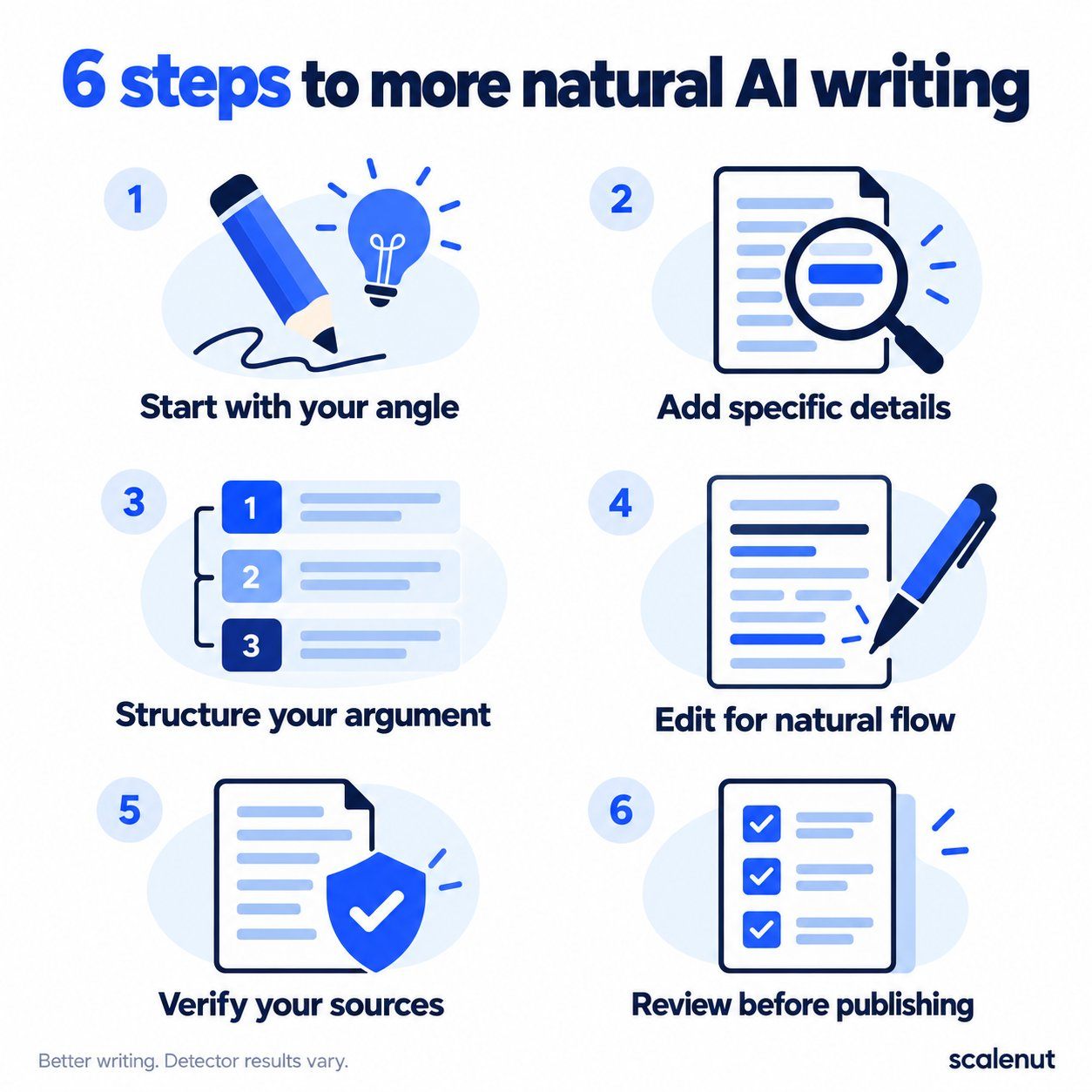
Treat AI output as a draft that needs your ideas, evidence, and editorial judgment throughout the writing process. The following steps help you replace generic language with clear, original, useful writing. They cannot guarantee a particular detector score, as detection tools can misclassify both human-written and AI-generated text.
1. Start with a strong human angle before you write
Before opening an AI writing tool, identify your reader, the problem you want to solve, and the main point you want to make. Use this as a starting point to choose an angle you can support with experience, research, or a clear argument.
Give AI your outline, notes, and relevant facts. Ask it to work within that material and flag missing information. Add personal examples and experiences only when they are real and help explain the topic.
2. Add specificity to vague statements
Replace broad claims with details readers can check: a named source, a defined sample, a dated finding, or an example from your work. The main thing to remember is to verify any facts suggested by AI before including them.
For example:
Before: “AI detectors can sometimes mistake human writing for AI-generated content.”
After: “In a 2023 study of seven AI detectors, researchers tested 91 human-written TOEFL essays from non-native English writers. Across the tested detectors, the average false-positive rate was 61.22%.”
The revised version gives readers a source, sample size, and measured result. The date also keeps the finding tied to the detectors tested then. Apply the same approach to business examples, using verified results and enough context to explain what happened.
3. Build originality with your own thinking framework
Review the argument before polishing the wording. Does the draft answer your reader’s question in a useful order, or simply repeat familiar advice?
Make the structure reflect your reasoning by:
- Creating an outline around the reader’s problem.
- Reordering sections so each point builds on the previous one.
- Adding your interpretation, including when the advice applies and where it has limits.
Explain why you recommend an approach and what would change that recommendation.
4. Edit for natural rhythm and authentic voice
Read the draft aloud. Rewrite repeated sentence openings, awkward transitions, and phrases you would never use. Vary sentence length where it improves the flow.
Hypothetical editing example
Before: “It is important to review AI-generated content carefully before publishing. It is also important to verify the facts. Additionally, it is important to ensure the writing matches your brand voice.”
After: “Review the AI draft before publishing. Check the facts and read it aloud. Does it sound like your brand?”
The edit removes repeated openings and replaces padded phrases with direct instructions. The shorter sentences and closing question give the paragraph a more conversational rhythm.
Match the tone to the format. A blog may suit contractions and conversational phrasing, while technical documentation needs precise, consistent terminology. Keep correct grammar and avoid forcing slang into content that does not need it.
5. Strengthen trust with proof and transparency
Check names, dates, figures, quotations, and links against their original sources. Confirm that each source supports the specific claim you make, including any conditions or limitations.
Keep your research notes, source links, outline, and draft history when you may need to demonstrate how the work developed. Follow any relevant editorial requirements for disclosing AI assistance.
6. Quality checklist before you publish
Use this checklist for your final review of your blog posts:
- Does the draft answer the reader’s main question?
- Have you added original analysis or relevant, genuine examples?
- Are factual claims verified and sources linked?
- Have you removed repeated points and unnecessary filler?
- Does the tone suit your audience and content format?
- Have you checked that automated edits preserve the meaning?
Use content detection results as an additional review signal. A score alone cannot establish authorship.
If your draft still feels a little too AI-generated, try Scalenut’s free AI content detector and AI content humanizer. It helps identify patterns that make text look machine-written and refines them into natural, reader-ready writing.
Want to see how Scalenut can support you content workflows for both AI and SEO? Book a demo today.
What are common mistakes that make AI writing easier to detect, and how to fix them?
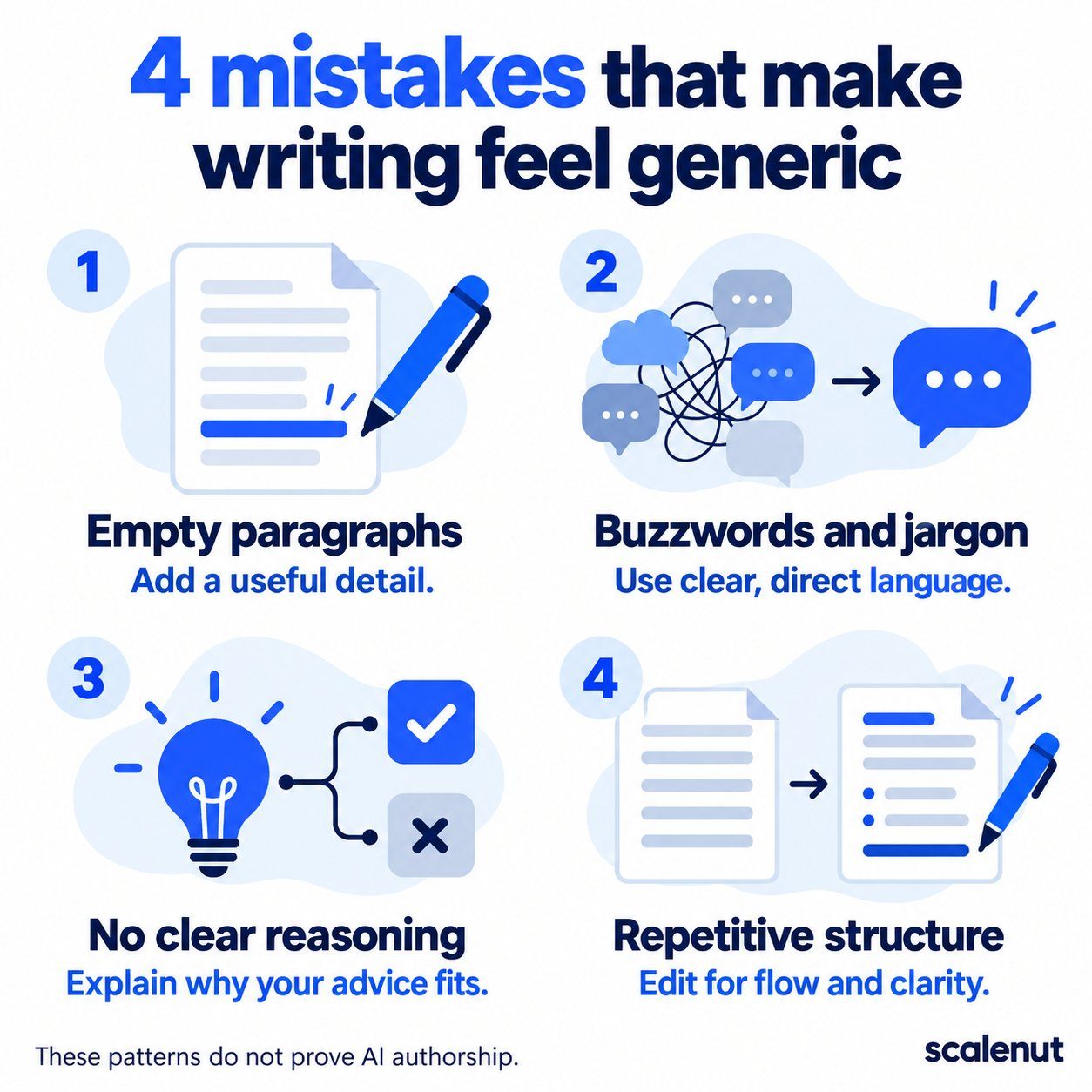
Unedited AI drafts can contain repetitive phrasing, vague claims, and unnecessarily formal language. These issues weaken the reading experience, but they can appear in human voice writing too. They do not prove AI authorship, and detection models can misclassify text.
1. “High-level but empty” paragraphs
A paragraph can sound polished while leaving readers with nothing they can use. Watch for broad statements such as “Businesses must embrace innovation to succeed” without explaining the action, reason, or outcome.
How to fix it: Ask what the paragraph helps readers understand or do. Strengthen it with:
- A specific action and when to take it.
- A verified example or relevant evidence.
- An explanation of why the advice applies.
If the paragraph only repeats the heading or an earlier point, cut it. Add anecdotes when they clarify the topic, rather than filling space.
2. Overuse of buzzwords and unnecessarily formal language
Good grammar improves clarity. The problem is language that makes a simple idea harder to understand, especially jargon and stock phrases that add little meaning.
How to fix it: Replace padded wording with direct language:
- “Leverage innovative solutions” → “Use tools that solve the problem.”
- “In order to facilitate collaboration” → “To help the team work together.”
- “It is important to note that” → Remove it and state the point.
Keep technical terms when your audience needs them. Use contractions where they suit the tone, and avoid adding errors or forcing slang into the draft.
3. No stance, no edge, no specificity
Content becomes less useful when it lists options without explaining how to choose. A recommendation needs reasoning, relevant conditions, and limitations.
How to fix it: When giving advice, explain:
- Who the approach suits.
- Why you recommend it.
- When another option may work better.
For factual or technical content, a neutral tone may be appropriate. Focus on clear explanations and useful context. Turning a draft into stronger human text means adding thoughtful judgment where it helps the reader.
4. Repeating the same sentence shape across sections
Repeated openings such as “This helps…” or “By doing this…” can make a draft monotonous. Similar paragraph structures can also hide repetition in the argument.
How to fix it: Read the draft aloud and check for repeated openings, redundant explanations, and overloaded sentences. Combine closely related points, split sentences that carry too many ideas, and use bullets for genuinely parallel information.
Preserve consistent terminology where precision matters. Edit sentence structure to improve readability, without assuming those changes will produce a particular result from AI detectors.
Conclusion
As a content creator, decide the exact kind of writing your audience needs before using language models. Rework the material in your own words, keep your own voice, and address a lack of personal detail where firsthand experience would help. Your final draft should answer a clear question and support factual claims with verifiable sources.
The most ethical way to use generative tools is to take responsibility for their output and follow relevant disclosure requirements. Base your final verdict on accuracy, clarity, and usefulness for readers and search engines. Attempts to bypass AI checks cannot guarantee a particular result, and a score from a detector today does not establish authorship.
Frequently asked questions
Are there tools that really help humanize AI content?
Yes. AI humanizers can rephrase sentences and adjust tone, but output quality varies. Review changes for factual accuracy, original meaning, and brand voice. These tools do not turn AI-generated text into human-authored work or guarantee that it will pass detection systems.
How to make AI writing not detectable?
Treat AI output as a draft: add genuine examples, verify claims, remove repetition, and revise it in your own personal voice. These steps improve writing quality, but no editing technique guarantees undetectability. Even human-written content can receive a false-positive result.
How does using slang or idiomatic language affect AI detectability in writing?
Slang and idioms can make suitable content sound conversational, but they do not prove human authorship or guarantee lower detector scores. AI tools can generate informal language too. It is important to vary between short and long sentences and use expressions that fit your audience, rather than inserting them solely to influence detection.
What features do AI detection tools look for when flagging text as generated?
Methods vary by tool. Detectors may use statistical analysis or trained classifiers to estimate whether text resembles AI-generated writing. GPTZero, for example, uses deep learning. Good grammar, a polished tone, or missing personal anecdotes alone does not prove AI authorship.
What strategies do writers use to prevent AI detection software from identifying their text?
No strategy guarantees that AI-assisted text will avoid detection. Writers can improve drafts through original analysis, verified sources, and careful editing stages for clarity. Keep research notes and draft history to document your process, and follow the publisher’s requirements for artificial intelligence use.
What should I do if my human-written content is flagged as AI-generated?
Review the flagged result and keep evidence showing the creation of your work, such as notes, outlines, sources, and version history. It is a good idea to ask the reviewer for human assessment rather than repeatedly rewriting to change a score.
Does paraphrasing make AI writing undetectable?
Not necessarily. Paraphrasing can improve readability, but detectors may still identify rewritten AI text. A mixture of sentence length patterns, including shorter and longer sentences, should support clarity. Keep your meaning and reasoning at the core of the final piece.
Is AI detection the same as plagiarism detection?
No. An AI detector estimates whether text resembles machine-generated writing, while a plagiarism checker identifies matches with existing sources. Using both is an easy way to review separate concerns, but neither score alone proves misconduct or confirms the accuracy of your content.
Does Google penalize AI-generated content?
No. Google does not penalize content creation simply because AI was involved. Its guidance emphasizes accuracy, relevance, and added value. Producing large numbers of low-value pages to manipulate rankings can violate spam policies, regardless of whether humans or AI created them.
Can purely human-written content be flagged as AI-generated?
Yes. A detector can misclassify human writing, including text with flawless grammar. Tools apply different rules for interpreting scores, and detection issues remain. Advice from the early days of AI detection may not reflect current models; a score alone cannot establish authorship.


.svg)


.webp)