
.jpg)
How to Make AI Writing More Human with Simple Tips?
Key Highlights
Here are the key takeaways for making your AI writing more human:
- AI writing tools often produce robotic text, but simple edits can add originality.
- Focus on varying sentence structure and using a conversational tone to improve flow.
- An AI humanizer can help polish drafts, but manual editing is crucial for authenticity.
- Avoiding common AI pitfalls like over-explaining and generic claims is essential.
- Strengthening your content with personal anecdotes makes it less vulnerable to detection tools.
- Adopting a human-centric editing process ensures your final output achieves natural writing.
Artificial intelligence has transformed content creation, yet a noticeable gap remains between machine-generated text and genuine human expression. AI text often lacks the warmth, personality, and relatability that connects with an audience. To truly engage readers, you must humanize AI-generated content. This guide will you understand the difference between AI writing vs human writing, explore practical strategies to infuse your automated writing with a natural touch, ensuring your message achieves clarity and resonates on a deeper, more authentic level.
What Does an AI Writing Look Like?
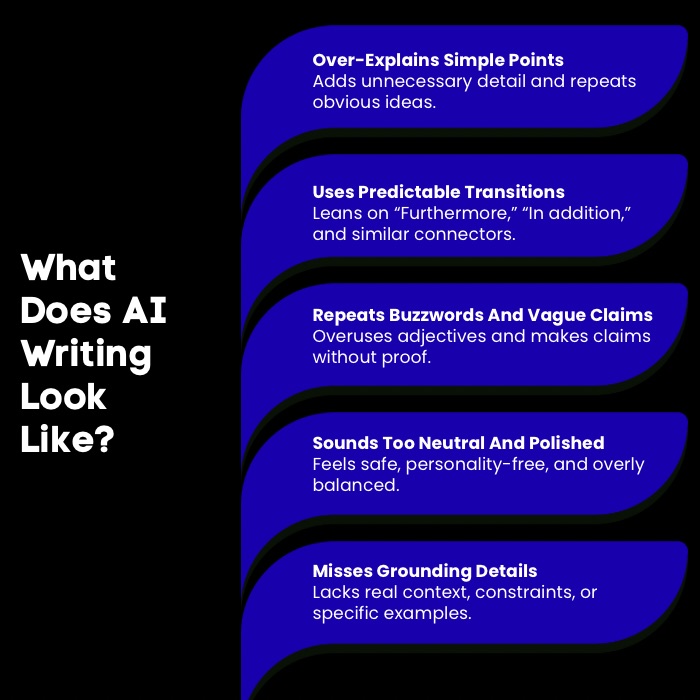
AI-generated text often feels mechanical, with awkward phrasing and excessive passive voice that drains energy from the writing. This makes the content seem disconnected and easy for AI detection tools to identify. While AI produces grammatically correct sentences, it often misses nuance and depth, resulting in flat, generic text. Recognizing these signs is key to turning robotic drafts into engaging content. Here are some examples.
1. Over-Explaining Simple Ideas
One of the most common mistakes that makes AI writing seem robotic is its tendency to over-explain straightforward concepts. AI models are trained to be thorough, but this often results in redundant and condescending prose. The AI might define a term that your audience already understands or elaborate on a point to an unnecessary degree. This can make your content feel bloated and frustrate readers who are looking for concise information.
This habit damages clarity and disrupts the natural flow of your writing. Human writers intuitively gauge their audience's knowledge and skip redundant explanations. An AI, however, follows its programming to cover all bases, which can lead to a less sophisticated writing style.
To fix this, review your AI text and ruthlessly cut any sentences that state the obvious. Assume your reader has a foundational understanding of the topic. This simple editing step will make your content more direct, respectful of your reader's time, and ultimately, more human.
2. Generic Transitions And Predictable Structure
AI-generated content often relies on a formulaic and predictable structure. You'll frequently see paragraphs beginning with phrases like "In addition," "Furthermore," or "On the other hand." While these transitions are grammatically correct, their overuse makes the writing feel stiff and unnatural, signaling that an AI tool was likely involved.
This rigid sentence structure creates a monotonous reading experience. Human conversation and writing are more fluid, connecting ideas in creative and sometimes less direct ways. Rephrasing sentences to vary these transitions is key to making your content flow like a natural conversation.
Instead of relying on the AI's default connectors, try starting sentences with a subordinate clause, a question, or a more subtle transitional phrase. For example, change "Moreover, it is important to consider..." to "But what about...?" This small change breaks the robotic pattern and makes the ai content feel more dynamic and engaging.
3. Repetitive Adjectives And Empty Claims
Another telltale sign of AI writing is the overuse of repetitive adjectives and unsubstantiated claims. AI writing tools often lean on a limited vocabulary, repeatedly using words like "comprehensive," "evolving," or "discover." This makes the AI text sound generic and uninspired, which can negatively impact readability.
These tools also tend to make broad, empty claims without providing evidence. You might see a sentence like, "This is a revolutionary product," without any data or specific examples to back it up. Human writers know that strong arguments are built on proof, not just assertions.
To correct this, scan your document for overused adjectives and replace them with more descriptive and varied language. More importantly, challenge every claim the AI makes. If it calls something "innovative," add a sentence explaining what makes it innovative. This simple habit will make your writing more credible and less robotic.
4. Too Balanced, Too Safe, Too Polished
AI models are designed to be neutral and avoid controversy, which often results in content that is overly balanced and safe. The writing is polished to a fault, lacking any strong opinions or personality. This sterile tone strips the content of its authenticity and fails to create an emotional connection with the reader.
Human writing, in contrast, is often characterized by its unique voice and perspective. We have biases, we take stances, and we aren't afraid to be a little imperfect. This is what makes writing interesting and relatable. A humanizer tool can help smooth out some robotic elements, but genuine authenticity comes from injecting a real point of view.
To improve the tone, don't be afraid to add your own opinions or a touch of personality. You can introduce a counterargument only to dismantle it, or use slightly more passionate language to convey excitement or concern. This brings a sense of conviction to your natural writing that AI alone cannot replicate.
5. Lack Of Lived Detail
In many instances, ai text can fall flat due to a lack of lived detail, which diminishes its authenticity. Experiences that shape human narratives infuse writing with depth and relatability, essential for creating ai content that resonates. Without sensory details or personal anecdotes, writing may lean towards awkward phrasing and complex sentences. Employing a conversational tone can help, but integrating genuine lived experiences is crucial for transforming ai writing tools into authentic humanizers, capable of capturing the essence of human creativity.
Does your draft still feel a little too AI? Try Scalenut’s free AI content detector & AI content humanizer to pinpoint the giveaways and turn it into natural, reader-ready writing.
What Are Some Quick Fixes You Can Do to Make AI Writing Sound Human?
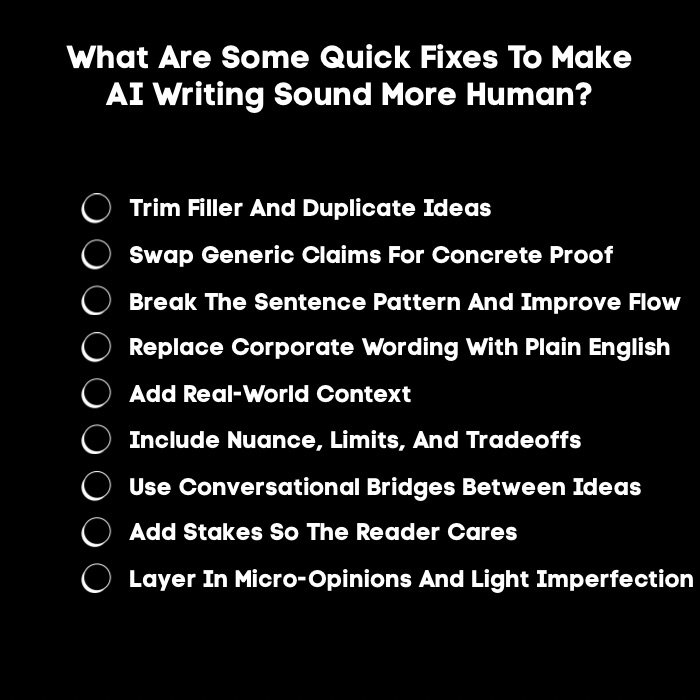
Transforming robotic AI content into something that resonates with readers doesn't have to be a monumental task. Several quick fixes can dramatically improve your text. By focusing on simple edits, you can humanize your writing and make it more engaging and authentic.
Many AI writing tools and AI humanizer platforms can assist in this process, but a manual touch is often what makes the biggest difference. The following tips will help you understand how to make AI writing sound more human in practical and easy to implement ways:
1. Cut Fluff And Repeated Lines
AI-generated text is often verbose. Models can repeat the same idea in slightly different ways or add unnecessary words that dilute your message. Cutting this fluff is one of the quickest ways to improve clarity and make your writing sound more confident and human.
Think of it as a process of rewriting for conciseness. A good AI humanizer might help with this, but a manual review is more effective. Read each sentence and ask yourself: "Does this add new value?" If not, it's probably fluff that can be removed.
Look for and eliminate these common issues:
- Redundant phrases that say the same thing twice.
- Filler words like "in order to," "actually," and "basically."
- Entire sentences that re-state a point already made in the paragraph.
- Vague introductions that delay getting to the main point.
2. Replace Abstract Claims With Specific Proof
AI often makes broad, abstract claims without providing any concrete evidence. Statements like "our solution is highly effective" or "this strategy improves results" lack impact because they aren't backed by specific proof. To build trust and authenticity, you must replace these generalities with tangible details.
This is a crucial step in transforming AI output into compelling human text. Specific proof makes your arguments more persuasive and demonstrates your expertise. It shows your audience that you’ve done your research and aren’t just repeating generic talking points.
Here's how to turn abstract claims into specific proof:
- Add data: Instead of "improves results," write "boosts conversion rates by 25%."
- Cite examples: Replace "a useful tool" with "a tool like Scalenut helps..."
- Include testimonials: Turn "customers love it" into a direct quote from a happy client.
- Use case studies: Show, don't just tell, how your solution solved a real-world problem with case studies.
3. Use More Natural Language (Less Corporate)
AI models often default to a formal, corporate tone that can feel stiff and impersonal. Phrases like "leverage synergies" or "utilize core competencies" create distance between you and your reader. To make your AI content more engaging, switch to natural language and adopt a conversational tone.
Think about how you would explain the topic to a friend. You would likely use simpler words, contractions, and a more relaxed style. This approach makes your writing more accessible and relatable, helping you build a stronger connection with your audience.
Here’s how to make your language more natural:
- Use contractions: "It's" instead of "it is," and "you'll" instead of "you will."
- Ask questions: Engage readers directly by posing questions throughout your text.
- Simplify vocabulary: Swap corporate jargon for everyday words. For example, use "use" instead of "utilize."
- Write like you speak: Read your content aloud to catch any phrasing that sounds unnatural or overly formal.
4. Vary Sentence Length, Rhythm, And Flow
One of the most common signs of AI writing is a monotonous rhythm. AI writing tools often produce a series of medium-length sentences with a similar sentence structure, resulting in text that feels robotic and is boring to read. Varying your sentence length is a powerful way to create a more dynamic and engaging flow.
Short sentences create emphasis. They are punchy. They make a point quickly. Long sentences, on the other hand, allow you to explore complex ideas and add descriptive detail. A mix of both keeps your reader engaged and guides them through your content more effectively.
Here are some ways to improve rhythm and flow:
- Follow a long, descriptive sentence with a short, impactful one.
- Break up complex sentences into two or three simpler ones.
- Start sentences in different ways (e.g., with a prepositional phrase, a clause, or the subject).
- Read your text aloud to hear the rhythm and identify areas that feel monotonous.
5. Add Context Detail That Grounds The Point
AI-generated content often feels like it exists in a vacuum. It presents facts and ideas without the grounding context that makes them meaningful. Adding specific details helps humanize the text by connecting abstract concepts to the real world.
These details can be sensory, anecdotal, or historical. They provide a backdrop that helps the reader better understand and relate to the point you're making. This technique adds depth and color to your writing, making it more memorable and emotionally resonant.
Here’s how to add grounding context:
- Use analogies: Compare a complex idea to a simple, everyday concept.
- Include sensory details: Describe what something looks, sounds, or feels like.
- Provide a brief backstory: Explain the history or origin of an idea.
- Set the scene: If you're telling a story, describe the environment where it takes place.
6. Add Honest Limits, Caveats, And Tradeoffs
AI content often presents information with an unwarranted sense of certainty. It paints a picture where every solution is perfect and every strategy is flawless. This lack of nuance can undermine your credibility. Acknowledging limitations, caveats, and tradeoffs adds a layer of authenticity to your blog post that builds trust with your audience.
No solution works for everyone, and every choice has a downside. Being upfront about these realities shows that you have a deep and honest understanding of your topic. It signals that you are a credible expert, not just a mouthpiece for overly optimistic AI content.
Consider adding these elements for greater authenticity:
- Caveats: Specify who a particular piece of advice is not for.
- Tradeoffs: Explain the potential downsides or costs of a recommended action.
- Honest limits: Acknowledge what your solution can't do.
- Alternative perspectives: Briefly mention other valid approaches to the problem.
7. Use Natural Transitions That Sound Like Thinking
AI writing tools often use formal, clunky transitions like "Furthermore," "In conclusion," or "Moreover." These words disrupt the natural flow and make the text sound like an academic paper. Human writing uses more subtle and conversational transitions that mimic the process of thinking.
These natural transitions guide the reader from one idea to the next without being jarring. They create a conversational tone that feels more like a one-on-one discussion than a formal lecture. Rephrasing AI-generated transitions is a simple way to make your content feel more organic.
Try using these natural-sounding transitions:
- "But here's the thing..." to introduce a complication or nuance.
- "Now, you might be thinking..." to address a potential reader question.
- "Okay, so what does this all mean?" to summarize a point.
- "And that brings me to my next point." to connect related ideas smoothly.
8. Build Emotion And Stakes Without Being Dramatic
AI text is typically devoid of emotion. It presents information logically but fails to convey why the reader should care. To create compelling natural writing, you need to build emotion and establish the stakes, what is gained or lost, without resorting to over-the-top drama.
Subtly connecting your topic to the reader's goals, fears, or aspirations is key. This helps them feel personally invested in what you're saying. When readers understand the stakes, they are more likely to pay attention and take action.
Here are some techniques to build emotion and stakes:
- Focus on the "why": Explain the deeper purpose or benefit behind your advice.
- Use empathetic language: Show that you understand the reader's challenges or frustrations.
- Highlight the cost of inaction: What negative consequences could occur if the reader ignores your advice?
- Paint a picture of success: Describe the positive future the reader can achieve.
9. Add Strategic Imperfection And Micro-Opinions
Perfectly polished text can feel sterile and untrustworthy. Humans are not perfect, and our writing often reflects that. Deliberately adding strategic imperfections and small, personal opinions can inject a surprising amount of authenticity into your content, making it feel more genuine than what a standard humanizer could produce.
Micro-opinions are small, low-stakes judgments that reveal your personality without being overly controversial. They show that a real person with unique tastes and preferences is behind the words. This helps your content stand out and build a stronger connection with your audience.
Try adding these elements for a more human touch:
- Admit a personal bias: "I've always been a fan of this approach, but..."
- Use conversational asides: Add a short comment in parentheses (like this one).
- Share a small preference: "I prefer the second method, but both work well."
- Acknowledge a minor flaw in your own argument: "Of course, this isn't a perfect solution."
Want cleaner reporting and faster decisions? Read which ai monitoring tools can improve your workflow to find the best platforms to track performance, quality, and reliability.
How To Make AI Writing More Human For SEO?

Humanizing AI content improves both readability and SEO. Google prioritizes content that delivers real value to users, while robotic or low-quality AI text often ranks poorly and may trigger detection. By focusing on user experience and showcasing expertise, you send positive signals to search engines. The goal is to create helpful, well-crafted AI content that performs strongly in search results by genuinely serving readers. Here’s how to optimize your humanized content for SEO.
1. Use Search Intent To Drive Structure
Understanding search intent, the "why" behind a user's query, is fundamental to modern SEO. AI can generate text on a topic, but it doesn't inherently understand what a user is trying to accomplish. To create content that ranks, you must structure your article to directly address the user's goal.
Is the user looking for information (informational intent), trying to buy something (transactional intent), or comparing options (commercial intent)? Your content's structure should reflect this. For an informational query, your article might be a step-by-step guide. For a commercial query, it might be a comparison table followed by detailed reviews.
By aligning your content structure with search intent, you provide a better user experience, which is a key ranking factor. This human-centric approach also makes your content less detectable as AI-generated because it's tailored to a specific human need rather than a generic topic summary.
2. Add Real-World Subtopics Google Expects
To rank well in SEO, your content needs to be comprehensive. This means covering the subtopics that Google and your readers expect to see. AI-generated content can sometimes miss these nuances, producing blogs that are technically correct but feel incomplete.
Analyzing the top-ranking pages for your target keyword is the best way to identify these essential subtopics. Look for common themes, questions, and sections across the leading articles. This shows you what Google considers to be a thorough answer to the user's query.
Incorporate these expected subtopics into your AI content:
- "People Also Ask" questions: Directly answer common questions related to your topic.
- Related searches: Cover the concepts that appear in the "related searches" section of Google.
- Competitor analysis: Identify sections that top-ranking competitors cover and ensure your content does too.
- Practical examples: Include real-world applications or case studies that other blogs might be missing.
3. Optimize For Featured Snippets And AI Answers
With the rise of AI answers in search results, optimizing your content for featured snippets and similar formats is more important than ever. These concise, direct answers appear at the top of the search page, offering massive visibility. Humanizing your AI content with clear, scannable formatting makes it a prime candidate for these placements.
Search engines look for content that directly answers a user's question in a simple format, such as a paragraph, a list, or a table. When you structure parts of your content this way, you signal to Google that you have a clear, authoritative answer.
4. Strengthen E-E-A-T Signals
Google's E-E-A-T (Experience, Expertise, Authoritativeness, and Trustworthiness) guidelines are crucial for ranking, especially for topics that impact a person's life or finances. Pure AI content often lacks the signals that demonstrate these qualities. Strengthening your E-E-A-T is a powerful way to improve your SEO and add authenticity.
Adding personal experience is key. The "E" for Experience is the newest addition, highlighting the importance of first-hand knowledge. You can do this by including personal anecdotes, case studies, or unique insights that an AI couldn't generate. This not only boosts your E-E-A-T but also makes your content harder to flag with AI detection.
To build trust, link to authoritative sources, include author bios that showcase expertise, and be transparent about your processes. These elements show both users and search engines that your content is credible and reliable, moving it far beyond the realm of generic AI content.
5. On-Page SEO Checklist
After humanizing your AI content, you need to ensure it's optimized for on-page SEO. This involves a series of checks to make sure your blogs are structured in a way that search engines can easily understand and rank. This final polish helps your high-quality, human-like content get the visibility it deserves.
These on-page SEO elements are foundational. While AI can help generate drafts, a human needs to verify that these technical details are correctly implemented. This is another layer where human oversight improves upon standard AI content.
Here is a quick on-page SEO checklist for your humanized articles:
- Keyword placement: Include your primary keyword in the title, meta description, and first 100 words.
- Internal linking: Add links to other relevant pages on your website to build a strong site structure.
- Image optimization: Use descriptive alt text for all images.
- Meta tags: Write a compelling meta title and description that encourages clicks from search results.
What Tools And Processes Help You Humanize AI Writing Faster Without Losing Accuracy?
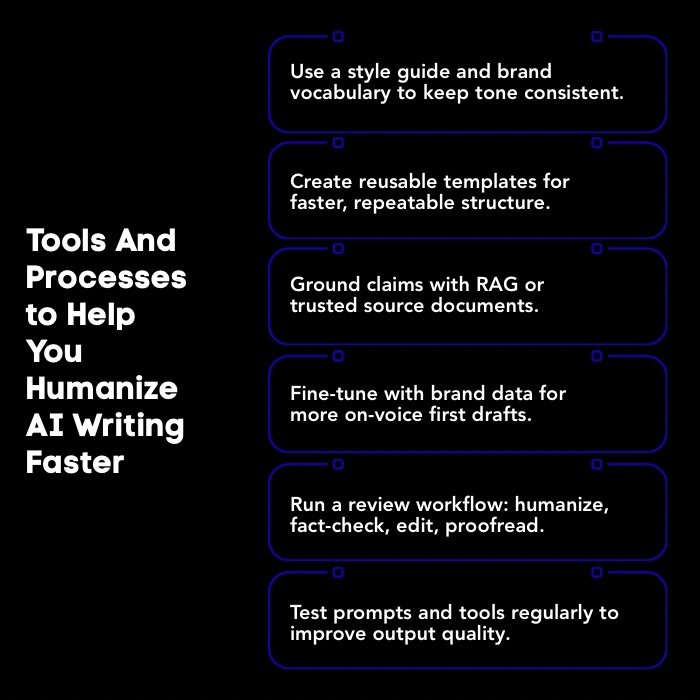
While manual editing is important, you don’t need to start from scratch. Tools and workflows can help humanize AI content efficiently without losing accuracy. A structured process ensures consistency and quality. By combining AI tools with human oversight, you can scale content production effectively. The following methods will help you streamline the process, save time, and avoid issues like factual errors or detection flags.
1. Style Guide + Brand Vocabulary
A comprehensive style guide and brand vocabulary list are your most powerful assets for maintaining consistency when humanizing AI content. These documents define your unique writing style, tone of voice, and preferred terminology, providing clear guidelines for anyone editing AI drafts.
Your style guide should go beyond basic grammar rules. It should capture the personality of your brand. Is your tone witty, authoritative, or empathetic? What words do you love, and which ones do you avoid? Providing these details helps editors make consistent choices.
A strong style guide should include:
- Tone of voice: Define the personality and attitude of your brand's writing.
- Brand vocabulary: A list of on-brand terms to use and jargon to avoid.
- Formatting rules: Guidelines for headings, lists, and other structural elements.
- Grammar and mechanics: Specific rules for things like serial commas or capitalization.
2. Reusable Templates
Creating reusable templates for different types of content can dramatically speed up the humanization process. Instead of starting with a raw AI text dump, you can use a structured template that already incorporates your desired flow and key sections. This provides a solid foundation for the AI content.
Templates ensure consistency and help you remember to include important humanizing elements like personal anecdotes or calls to action. For example, a blog post template might have designated spots for an introduction with a hook, a personal story, and a concluding summary.
Your templates could include placeholders for:
- A compelling hook: A placeholder to add an engaging opening question or statistic.
- A personal anecdote: A reminder to insert a relevant story.
- Key takeaways: A pre-formatted list for summarizing main points.
- A specific call to action: A section to prompt the reader to take the next step.
3. RAG For Factual Grounding
Retrieval-Augmented Generation (RAG) is a powerful technique for improving the factual accuracy of AI-generated content. RAG combines a large language model with access to a specific, up-to-date knowledge base. This "grounds" the AI's output in real data, reducing the risk of factual errors or "hallucinations."
By providing the AI with a curated source of information—like your company's internal data or recent industry reports—you ensure the content it produces is both accurate and relevant. This is far more effective than relying on an AI humanizer to fix errors after the fact and helps evade detection tools that flag generic content.
Using RAG helps you achieve:
- Higher accuracy: Content is based on real, verified information.
- Reduced hallucinations: The AI is less likely to invent facts.
- Greater relevance: Output is tailored to your specific domain or brand.
- Increased trust: Factual grounding makes your content more credible.
4. Fine-Tune With Brand Data
Fine-tuning is the process of training a base AI model on your own brand data. By feeding the model your existing high-quality content—like blog posts, marketing copy, and emails—you can teach it to replicate your unique voice, style, and terminology. This is one of the most effective ways to make AI writing tools generate more human-like content from the start.
When you fine-tune a model, it learns the specific patterns and nuances of your brand's communication. This results in AI content that requires less heavy editing and aligns more closely with your brand identity. It's a proactive approach to humanization.
Fine-tuning an AI model helps it learn your:
- Brand voice and tone: It can mimic whether you are formal, casual, witty, or technical.
- Specific terminology: It will use your industry and brand-specific language correctly.
- Content structure: It can learn to follow your preferred formats for different content types.
- Overall style: The resulting output feels more like it was written by your team.
5. Editorial Review Workflow
No matter how advanced your AI tools are, a human editorial review workflow is non-negotiable. This process ensures that every piece of AI content meets your standards for quality, accuracy, and brand voice before it goes live. It's your final line of defense against robotic text and factual errors.
A structured workflow might involve multiple stages, such as a first pass for structural edits and humanization, followed by a final proofread for grammar and spelling. This systematic approach ensures that nothing slips through the cracks and helps maintain a high level of quality at scale. It's a critical step to avoid issues with AI detection tools.
A typical editorial workflow includes:
- Humanization edit: A review focused on adding personality, anecdotes, and flow.
- Fact-checking: Verifying all data, statistics, and claims for accuracy.
- Copyediting: A detailed check for grammar, spelling, and style guide compliance.
- Final proofread: One last look to catch any remaining typos or formatting errors.
6. Prompt And Tool Testing
The quality of your AI-generated content is heavily dependent on the quality of your prompts and the capabilities of your chosen AI tool. Continuously testing and refining both is essential for improving your results over time. What works today might be outdated tomorrow as AI writing tools evolve.
Experiment with different prompt structures. Try providing detailed personas, specifying a conversational tone, or even asking the AI to include imperfections. Keep a record of which prompts produce the most human-like output. Similarly, test various AI tools and detection tools to find the combination that best fits your workflow.
Your testing process should involve:
- A/B testing prompts: Compare the output from two different prompts for the same task.
- Trying new AI tools: Regularly evaluate new players in the market.
- Evaluating different "humanizer" features: See which settings on your AI tool work best.
- Checking results with multiple detection tools: Understand how different detectors score your content.
How Can You Ensure AI-Generated Content is Not Detectable?
Ensuring AI-generated content isn't easily detectable is less about tricking detection tools and more about creating genuinely high-quality, human-centric content. AI detectors look for patterns common in machine-generated text, such as predictable sentence structures, a lack of personal voice, and overly uniform phrasing. The best way to avoid detection is to eliminate these robotic traits. Instead of relying solely on an AI humanizer, focus on blending AI efficiency with human creativity and insight.
The key to change AI writing to human writing is to add layers of authenticity that AI writing tools cannot replicate on their own. This includes weaving in personal anecdotes, unique opinions, and specific, real-world examples. A thorough manual edit is crucial. By reading the text aloud to check for natural flow, varying your sentence lengths, and injecting your unique brand voice, you create content that is valuable to readers and, as a byproduct, much harder to detect. The goal should be authenticity, not evasion.
Conclusion
It is essential to turn AI writing into human for creating engaging content that resonates with readers. By implementing simple yet effective strategies, such as cutting unnecessary fluff, varying sentence structure, and incorporating relatable details, you can enhance the authenticity of your AI-generated text.
Focusing on search intent and optimizing for SEO will ensure that your content not only connects with your audience but also ranks well in search engines. Embracing these techniques will help bridge the gap between technology and human expression, creating a more compelling reading experience. If you're ready to elevate your AI writing, don't hesitate to explore our resources and tips further.
Frequently Asked Questions
Can I use simple prompts to help AI generate more natural-sounding text?
Yes, simple but specific prompts are very effective. Instead of just asking ChatGPT to write about a topic, instruct it to adopt a persona (e.g., "Write as a friendly expert") or a specific tone. This guides the AI to produce more natural writing from the start, reducing the need for heavy editing or an AI humanizer.
What is the best prompt you've used or created to Humanize AI Text?
One of the best prompts is: "Rewrite the following text to sound more human. Vary sentence length, use contractions, add a personal anecdote related to [topic], and use a conversational tone. Avoid jargon." This multi-layered prompt guides AI writing tools toward creating content with greater authenticity than a simple AI humanizer.
How to tell ChatGPT to write like a human?
To get ChatGPT to humanize its AI text, use prompts that specify human-like qualities. Ask it to "write in a conversational tone," "use personal anecdotes," "vary sentence structure," and "add some subtle opinions." Being explicit about these elements helps it move beyond robotic language and improve clarity.
How do tools like Grammarly or QuillBot humanize AI-written text?
Tools like QuillBot have a dedicated "humanizer" feature that focuses on rewriting sentences to vary structure and word choice, making them sound less robotic. Grammarly helps by suggesting improvements for clarity, tone, and conciseness, which indirectly makes the text more human-readable, though it's less focused on AI detection.
What words or phrases should I avoid to prevent AI writing from sounding automated?
To improve your AI text sound, avoid generic transitions like "moreover," "furthermore," and "in conclusion." Also, watch out for overused, vague words such as "delve," "explore," "landscape," and "unleash." Cutting these and fixing awkward phrasing and passive voice will instantly improve the clarity of your AI content.
Which AI writing sounds most like human?


.svg)


.webp)