
.jpg)
How To Monitor Brand Presence In ChatGPT And Perplexity? (2026 Guide)
Key Highlights
- Monitoring brand presence in ChatGPT and Perplexity helps you understand whether your business is being mentioned, cited, or excluded in AI-generated answers.
- Traditional SEO tools do not fully capture AI visibility, so brands need a separate process to track mentions, citations, and share of voice across answer engines.
- A strong monitoring workflow includes target query selection, prompt testing, documentation, competitor benchmarking, and trend tracking over time.
- Both manual checks and specialized AI visibility tools can help brands measure performance across ChatGPT and Perplexity more effectively.
- Improving brand presence requires stronger topical authority, better content structure, clearer brand signals, and more authoritative mentions across the web.
You may be publishing great content and ranking for important keywords, yet still have no idea whether your brand is showing up in ChatGPT or Perplexity responses. That is the new frustration many teams are facing. Traditional SEO reports can look strong while AI tools quietly cite competitors or skip your brand altogether.
That gap matters because more users now rely on AI-generated answers to research, compare options, and make decisions. If your brand is missing there, you are losing visibility at a key moment, and standard search reporting will not fully show it.
This blog breaks down how to monitor brand presence in ChatGPT and Perplexity in a practical way. You will learn what to track, how to test prompts, how to document mentions and citations, and what to improve when your brand is not showing up enough.
Why Does Monitoring Brand Presence In ChatGPT And Perplexity Matter?
Monitoring brand presence in ChatGPT and Perplexity matters because these platforms are becoming a major way people discover products, services, and recommendations. Even if your website ranks well on Google, your brand may still be missing from AI-generated answers. That creates a visibility gap that traditional SEO tools do not fully capture.
By tracking how often your brand is mentioned or cited in AI responses, you can understand where you are gaining visibility and where competitors are being surfaced instead. This helps you measure your AI search presence, spot missed opportunities, and refine your content strategy to stay relevant as search behavior shifts toward answer engines.
How To Monitor Brand Presence In ChatGPT And Perplexity? (Step By Step)
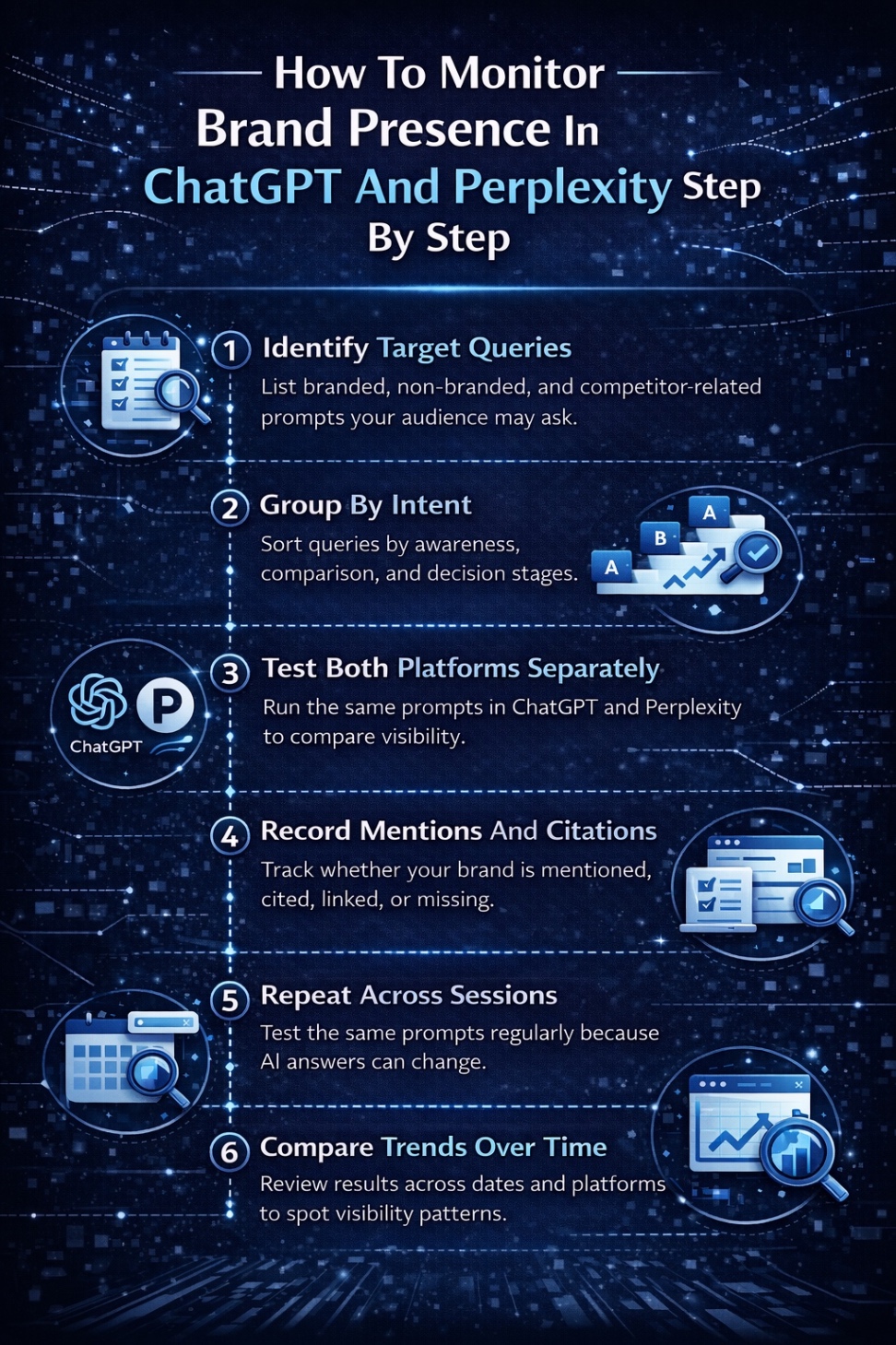
Monitoring your brand across AI answers needs a structured process, not random checks. It helps marketing teams improve brand monitoring, visibility tracking, and content optimization with clearer actionable insights.Unlike traditional search engines, AI platforms can show different responses across sessions.
The steps below will help you review AI search results consistently and build a stronger generative engine optimization workflow.
Step 1: Identify Your High-Value Target Queries
Start by listing the questions your audience is most likely to ask across search engines and AI engines. Focus on queries tied to your products, services, category terms, customer pain points, and competitor comparisons so you can measure where your brand appears in AI answers and where it does not.
Choose a mix of branded and non-branded prompts to reflect real discovery behavior. This gives you a clearer view of search results that influence brand reputation, search visibility, and potential organic traffic from generative AI experiences.
Step 2: Group Queries By Search Intent And Funnel Stage
Once you have your query list, organize it by search intent and funnel stage. Separate informational, comparison, commercial, and decision-stage searches so you can see how AI models position your brand at different moments in the buyer journey.
This makes it easier to identify content gaps and understand whether your visibility is stronger at awareness level or closer to conversion. It also helps AI brand monitoring efforts stay aligned with real business goals instead of isolated prompt testing.
Step 3: Test Prompts In ChatGPT And Perplexity Separately
Run each prompt separately in ChatGPT and Perplexity because different AI agents, AI models, and underlying systems can produce very different outcomes. What appears in one platform may not appear in another, even for the same question.
Testing separately also helps you understand how generative AI handles citations, recommendations, and source selection across different environments. In some cases, you may also notice overlap with AI overviews, but dedicated testing inside these tools is still necessary to evaluate performance across core AI search results.
Step 4: Record Mentions, Citations, And Context
Document whether your brand is mentioned, cited, linked, or completely absent. Go beyond yes-or-no tracking and capture how your brand is framed, which competitors appear beside it, and whether the response supports or weakens brand sentiment.
This is where sentiment analysis becomes useful. Tracking context helps you understand brand sentiment, not just raw presence, and gives you stronger visibility tracking data that can support future search engine optimization and brand reputation work.
Step 5: Repeat Tests Across Multiple Sessions
Do not rely on a single session. AI answers can shift often, so repeat the same prompts over time to see whether your presence is stable, improving, or declining across search platforms.
Repeated testing helps you build a stronger brand monitoring process and reduces the risk of making decisions based on one-off outputs. It also shows whether updates in your content or broader brand signals are influencing visibility across AI platforms.
Step 6: Compare Results Over Time
After collecting enough data, compare results across dates, prompts, and platforms. Look for patterns in where your brand gains mentions, loses citations, or gets outperformed by competitors.
This comparison turns raw monitoring into actionable insights. Over time, it can guide content optimization, reveal missed opportunities in generative engine optimization, and show whether your efforts are improving visibility in AI search without depending only on a free trial or surface-level reporting from tools.
Monitor the right queries, test consistently, document context, and compare trends over time to improve brand visibility across AI search.
What Are The Best Manual Methods To Track Brand Presence?
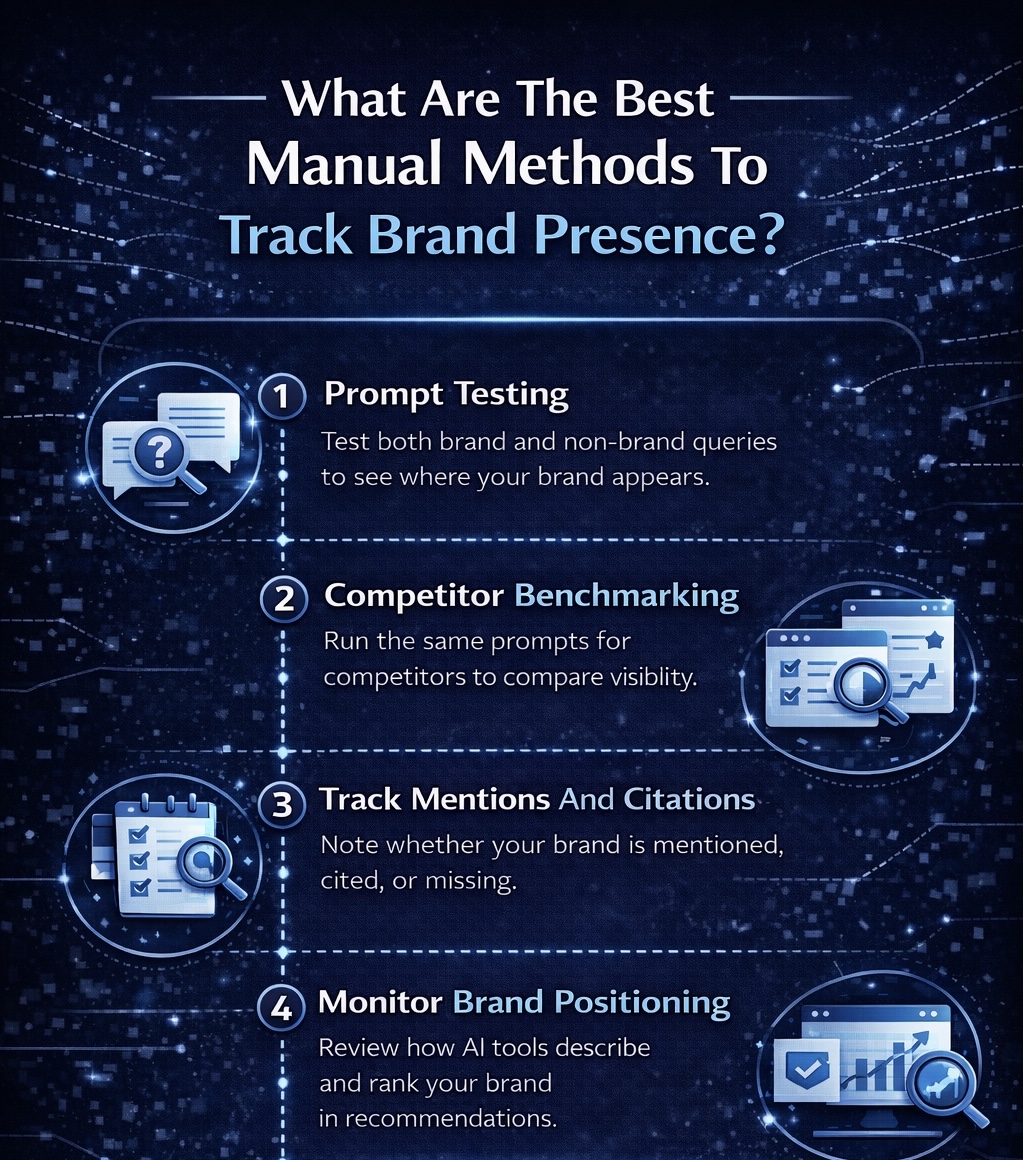
Manual tracking is one of the most practical ways to understand how your brand appears in ChatGPT and Perplexity. It helps you see where your brand is mentioned, cited, ignored, or positioned against competitors in real AI-generated responses.
A simple manual process can reveal visibility gaps long before they show up in standard reporting tools.
1. Prompt Testing For Core Brand And Non-Brand Queries
Prompt testing is the foundation of manual tracking. Start by asking both direct brand questions and broader non-brand queries related to your category, product use cases, and customer problems. This helps you understand whether your brand appears only when users already know you or whether it also surfaces during broader discovery searches.
Using a mix of query types gives you a more realistic view of your visibility. It also helps you identify which topics or intents are most likely to trigger brand mentions and which ones need stronger content support.
2. Competitor Benchmarking Across The Same Prompts
Competitor benchmarking shows how your brand performs against others for the same set of queries. Run identical prompts for your brand and key competitors to see who gets mentioned, cited, or recommended more often.
This method helps you spot gaps in authority, positioning, and topic coverage. It also shows where competitors are winning visibility so you can improve your own content and brand presence more strategically.
3. Tracking Mentions, Citations, And Missing Visibility
When reviewing responses, do not just note whether your brand appears. Track whether it is mentioned by name, cited with a source link, or completely absent from the answer.
This makes your manual review more useful because each outcome tells you something different. Mentions can build awareness, citations can drive visits, and missing visibility can point to content gaps or weak authority signals.
4. Monitoring Brand Positioning In AI Recommendations
It is also important to study how your brand is framed in AI recommendations. A mention alone is not enough if the response presents your brand as secondary, less credible, or less relevant than competitors.
Reviewing positioning helps you understand how AI tools describe your strengths, use cases, and trust signals. This gives you better insight into how your brand is being perceived, not just whether it appears.
Manual tracking works best when you test real prompts, compare competitors, document every outcome, and study how your brand is positioned in AI answers.
What Should You Track When Monitoring Brand Presence?

Tracking brand presence is not just about whether your name appears in an AI answer. You need to measure how often you show up, how you are cited, and how your visibility compares across prompts and competitors.
Reviewing the right signals helps you move from basic observation to meaningful analysis. It also makes your monitoring process more useful for content updates, authority building, and visibility improvement.
1. Brand Mention Rate
Brand mention rate shows how often your brand appears across the prompts you test. This gives you a clear baseline for understanding whether your brand is consistently visible or only showing up for a limited set of queries.
A low mention rate can signal weak topic coverage, low authority, or poor alignment with the questions users are asking. A stronger mention rate usually indicates that your brand is being recognized more often across relevant AI responses.
2. Citation Rate And Source Links
Citation rate measures how often AI tools not only mention your brand but also link to your website or reference your content as a source. This is important because AI citations often carry more value than mentions alone.
Tracking source links helps you identify which pages are actually being surfaced in AI-generated responses. It also shows which assets are performing well and which important pages are being overlooked.
3. Share Of Voice Against Competitors
Share of voice helps you understand how visible your brand is compared to competitors across the same query set. Instead of looking at your performance in isolation, this metric shows how much space your brand occupies within AI responses.
If competitors are consistently mentioned more often, it may point to stronger authority, better topic coverage, or better external validation. This makes share of voice useful for spotting where your brand is falling behind.
4. Query-Level Visibility Patterns
Query-level visibility patterns show which specific prompts trigger mentions, citations, or no visibility at all. This helps you go beyond broad averages and understand performance at the individual query level.
These patterns can reveal where your brand performs well and where gaps exist. They are especially useful for finding missed opportunities in high-intent, comparison, or category-based searches.
5. Changes In Brand Sentiment And Context
It is not enough to track presence alone. You should also review how your brand is described and what role it plays within the answer. A mention in a weak or negative context does not carry the same value as a strong recommendation.
Watching changes in sentiment and context helps you understand how AI tools frame your brand over time. This gives you a more complete picture of visibility, reputation, and perceived authority.
Track how often your brand appears, how often it gets cited, where it wins or loses against competitors, and how it is framed inside AI answers.
How Often Should You Monitor Brand Presence In ChatGPT And Perplexity?

Monitoring brand presence should be an ongoing process, not a one-time check. Regular visibility monitoring helps marketing leaders track brand mentions, measure brand performance, and improve digital marketing, content creation, and AI search optimization.
A mix of weekly, monthly, and quarterly reviews gives you a clearer view of what is changing across AI search platforms and where your answer engine optimization efforts need attention. A consistent review schedule helps you catch short-term shifts while planning longer-term improvements.
1. Weekly Checks For High-Impact Queries
Weekly checks are useful for your most important prompts, especially the ones tied to product discovery, comparisons, and buyer intent. These frequent reviews help you spot early changes in visibility before they affect search rankings, traffic opportunities, or how your brand appears beside competitors.
They also support faster competitor analysis by showing whether rival brands are gaining ground on the same high-value queries. For fast-moving industries, weekly monitoring helps you react quickly and protect your presence across AI-driven discovery.
2. Monthly Reviews For Broader Visibility Trends
Monthly reviews are better for identifying broader visibility patterns across a larger query set. Instead of focusing only on a few prompts, this review helps you understand movement in share of voice metrics, repeated citation trends, and how your brand is being positioned across categories.
This monthly view is especially useful for evaluating whether your content and authority signals are improving overall visibility. It also helps you see whether your brand is being associated with authoritative sources often enough to remain competitive in AI-generated recommendations.
3. Quarterly Content Refresh Decisions Based On AI Visibility Data
Quarterly reviews are the right time to turn monitoring data into action. By this stage, you can use performance patterns to decide which pages need updates, which topics need stronger coverage, and where your content strategy is falling behind.
This makes quarterly analysis valuable for long-term AI search optimization. It helps teams refresh underperforming pages, close visibility gaps, and improve the chances of being cited more consistently across AI answers.
Check often enough to catch changes early, but review broadly enough to turn visibility data into smarter content decisions.
How Can You Improve Brand Presence In ChatGPT And Perplexity?
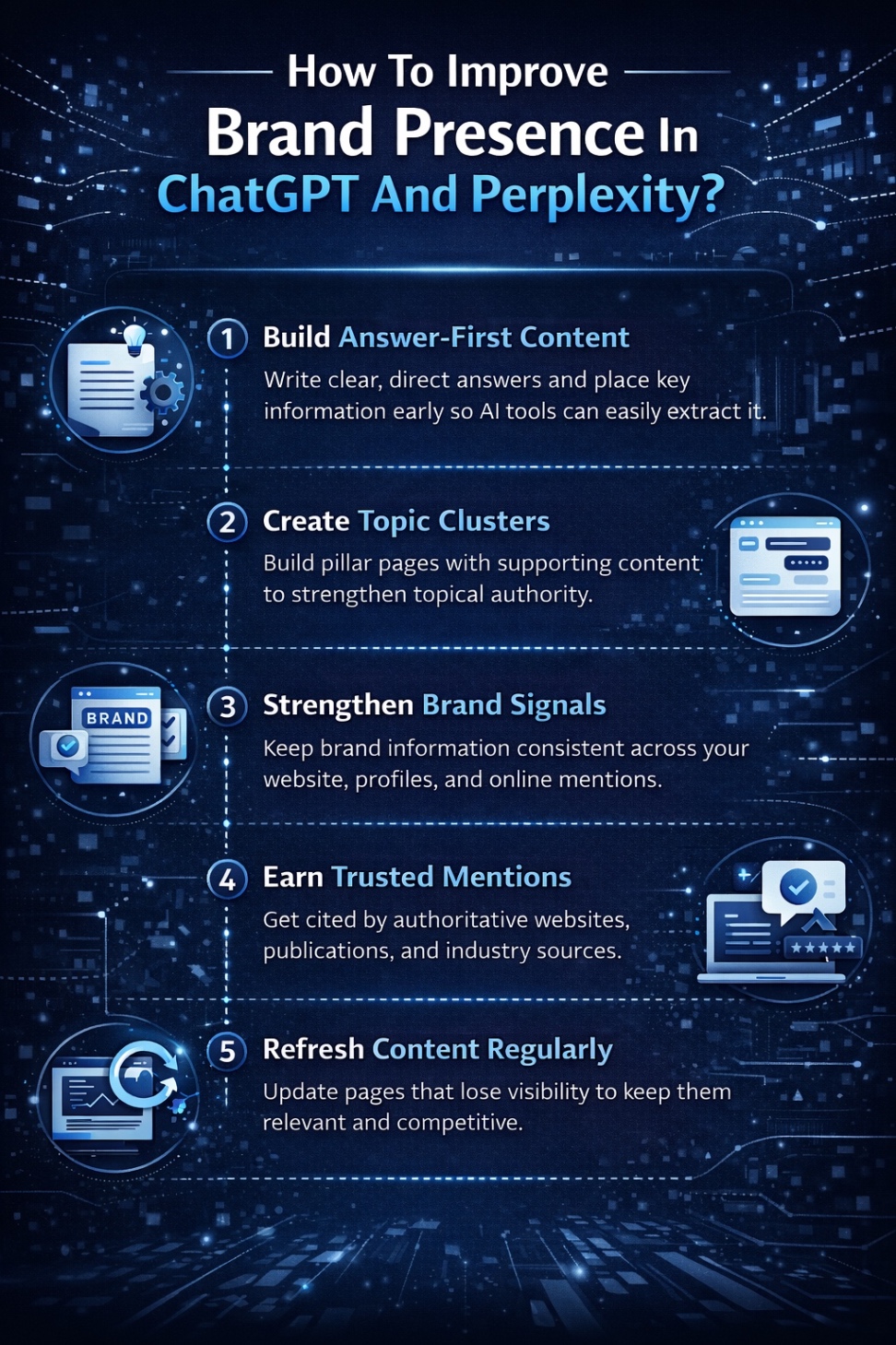
Once you know where your brand is missing, the next step is to improve the signals that AI tools rely on. Stronger structure, stronger topical authority, and stronger brand recognition all increase your chances of being surfaced in AI-generated answers.
This is where monitoring turns into action. The goal is not just to appear more often, but to become a more reliable source across important queries.
1. Build LLM-Friendly, Answer-First Content
AI tools are more likely to use content that is clear, direct, and easy to extract. Structure your pages so key answers appear early, important ideas are easy to scan, and related questions are covered in simple language.
This makes your content easier for AI systems to interpret and increases the chances of being cited or referenced. Pages that bury answers deep in long paragraphs are less likely to perform well.
2. Create Strong Topic Clusters Around Core Themes
Single pages rarely build enough authority on their own. Creating topic clusters around your main themes helps show depth, relevance, and consistency across related subjects.
When you connect pillar pages with supporting content, you give AI tools stronger signals about your expertise. This also helps you cover more query variations where your brand may currently be missing.
3. Strengthen Brand Entity Signals Across Channels
Your brand should be clearly and consistently represented across your website and other digital channels. Consistent company descriptions, branded profiles, and repeated topic associations help AI tools understand who you are and what you are known for.
Stronger entity signals make it easier for your brand to be recognized in relevant contexts. This supports both visibility and trust in AI-generated recommendations.
4. Earn More High-Authority Mentions And Citations
AI tools are more likely to surface brands that are mentioned by trusted third-party sources. When authoritative websites, publications, and industry resources reference your brand, it strengthens your credibility.
This means visibility is not only about what you publish on your own site. It also depends on how often your brand is validated elsewhere across the web.
5. Refresh Pages That Lose AI Visibility Over Time
If a page was visible before but starts disappearing from AI responses, it may need an update. Refreshing content helps keep it relevant, accurate, and competitive against newer or stronger sources.
Use your monitoring data to identify pages that are losing traction. Regular updates can help recover visibility and improve how often your content is surfaced over time.
Improve brand presence by making your content easier to extract, your expertise easier to trust, and your brand easier to recognize across the web.
How Can You Turn AI Visibility Insights Into Action With Scalenut?
Scalenut helps turn AI visibility data into action. It shows how your brand appears across ChatGPT and Perplexity, tracks prompts, citations, and competitor presence, and connects those insights to SEO and content workflows so you can improve visibility, authority, and overall search performance.
What You Can Do With Scalenut
- Track AI visibility across platforms with metrics like Visibility Score, Average Position, Share Of Voice, Visibility Heatmap, and Brand Visibility Rank
- Monitor prompts and citations to see which queries trigger mentions, which sources AI systems rely on, and how competitors appear beside your brand
- Turn gaps into action with AI-led content ideas, authority recommendations, backlink suggestions, and clear next steps for execution
- Measure AI-driven traffic signals through AI bot tracking, top AI sources, referenced pages, and AI traffic trends
- Execute SEO and content improvements using tools for keyword planning, content optimization, audits, internal linking, SERP-based research, and content scoring
For teams trying to improve brand visibility in AI search without adding another disconnected workflow, Scalenut brings monitoring and execution together in one place.
Book a demo to see how Scalenut can help you track, improve, and scale your brand presence across AI search.
Conclusion
Monitoring brand presence in ChatGPT and Perplexity is now essential because AI answer engines are shaping how people discover and evaluate brands. If you are not tracking where your brand is mentioned, cited, or left out, you are missing a growing part of modern search visibility.
The key is to stay consistent with testing, document what you find, and use those insights to improve your content and authority over time. Brands that treat AI visibility as an ongoing process, not a one-time check, will be better positioned to stay visible as search continues to evolve.
Frequently Asked Questions
How can I measure traffic session by AI agents like ChatGPT and Perplexity?
You can measure this by checking referral traffic in analytics tools, reviewing landing pages linked from AI citations, and monitoring engagement patterns from those visits. Pair this with prompt tracking to connect traffic spikes with specific brand mentions or citations in AI-generated responses.
What are the best strategies for optimizing AI answers ChatGPT Perplexity?
The best strategies include creating answer-first content, improving page structure, building topical authority, strengthening brand signals, and earning trusted third-party mentions. Content that is clear, well-organized, and supported by authority signals is more likely to appear in AI-generated answers.
What are the best Peec.ai alternatives for ChatGPT and Perplexity monitoring?
Scalenut is a strong alternative for teams that want to connect AI visibility tracking with SEO execution. Along with other monitoring tools, it helps brands track mentions, identify visibility gaps, and turn those findings into content updates that improve AI search performance.
What are the top Otterly alternatives for ChatGPT and Perplexity monitoring?
Scalenut is one of the top alternatives for brands looking beyond basic prompt monitoring. It helps track AI visibility, analyze brand presence across answer engines, and connect those insights to practical SEO and content actions that support stronger long-term search visibility.
How do I optimize my content for better brand visibility in ChatGPT and Perplexity responses?
Focus on creating clear, answer-first content that directly addresses user questions. Combine that with strong topic clusters, consistent brand signals, and authoritative mentions from trusted sources so AI systems can better recognize, understand, and surface your content in relevant responses.


.svg)


.webp)