
.jpg)
What is AEO? A Comprehensive Overview for 2026

Key Highlights
- Answer Engine Optimization (AEO) is the practice of optimizing content to be the direct answer in AI-powered search results.
- Unlike traditional SEO which focuses on clicks, AEO aims for your content to be the cited source in AI Overviews and chatbot responses.
- AEO is crucial for digital visibility as user queries shift toward conversational questions expecting a direct answer.
- Effective AEO involves using schema markup, creating answer-first content, and building strong brand authority.
- Success is measured by citations and mentions within AI platforms, not just organic traffic from search results.
- The goal of AEO is to enhance search visibility by becoming the definitive response for AI engines.
The way people find information online is undergoing a massive shift. Search engines have evolved into answer engines, and optimizing for a list of links is no longer enough. Users now expect immediate, direct answers from AI platforms. This is where Answer Engine Optimization (AEO) comes in. It’s a new approach to digital visibility, focusing on making your content the source that powers these AI-generated responses. If you're still optimizing only for clicks, you're missing a fundamental change in how your audience discovers information.
What is Answer Engine Optimization (AEO)?
Answer Engine Optimization (AEO) is the process of creating and formatting your content so that AI answer engines can easily understand it and display it to answer user questions. Unlike traditional search engines that provide a list of links, an AI engine aims to deliver a specific, concise answer directly to the user. This might appear as a featured snippet, a knowledge panel, or a response from a voice assistant. At the core, AEO means structuring your information for clarity and directly addressing potential user queries.
The primary goal is to make it effortless for an AI engine to extract and present your information as the definitive response. This strategy recognizes that user behavior is changing; people want answers, not just links. Through content optimization for AEO, you position your brand to be visible and valuable at critical points of customer interaction. This ensures your voice is heard even when users don't click through to your website from the search engine results.
Why is AEO Important for Digital Marketing in 2026?
Answer Engine Optimization is vital for digital marketing because it aligns your content strategy with the modern user’s expectation for instant, direct information. As AI search and voice assistants become more prevalent, your brand risks becoming invisible if it’s not optimized to appear in these answer formats. Even with strong traditional SEO, failing to adapt means you miss out on a massive, growing channel for online visibility.
In 2026, AEO is essential for building brand authority and trust. When an answer engine consistently shows your content as the best response, it positions you as a leader in your field. This is crucial for capturing users seeking quick solutions or factual information without the intent to browse multiple search results. Optimizing for generative AI ensures your content is part of the conversation, future-proofing your brand's presence in an evolving digital landscape.
AEO vs SEO vs GEO: What’s the Difference?
Understanding the distinctions between Answer Engine Optimization (AEO), Search Engine Optimization (SEO), and Generative Engine Optimization (GEO) is key to navigating the modern search landscape. While all three aim to improve search visibility, they focus on different mechanisms and outcomes. SEO is about driving traffic to your site through rankings in traditional search engine results.
AEO, however, specifically targets platforms that provide direct answers, like Google's AI Overview or voice assistants. GEO focuses on making your content favorable for generative AI models to use and cite when creating new, synthesized answers. Each plays a unique role in a comprehensive digital strategy.
How Does AEO Differ from SEO?
The primary difference between Answer Engine Optimization and traditional SEO lies in their ultimate goals. SEO aims to improve your website's ranking on a search engine to drive organic traffic. This involves tactics like keyword research, link building, and technical site health to secure a high position in the list of blue links.
AEO, in contrast, focuses on getting your content featured as the direct answer to user queries within AI answer engines. The objective isn't necessarily a click, but to be the cited source in AI Overviews, featured snippets, or voice search responses. This requires a different approach to content creation, one that prioritizes clear, concise answers over long-form articles designed solely for ranking.
While SEO thinks about content length and backlinks, AEO is about creating highly specific, structured content at scale. You are optimizing for clarity and extractability so that AI systems can easily parse and present your information. A solid foundation in traditional SEO is beneficial, but AEO is the next step to ensure visibility in the new era of search.
What is the Difference between AEO and GEO?
While both Answer Engine Optimization (AEO) and Generative Engine Optimization (GEO) are designed for the AI search era, they have distinct focuses. AEO is about optimizing your content to be the direct, extractable answer within existing answer-providing features on search platforms. Think of it as structuring your content to perfectly fit into a featured snippet or an AI Overview. The goal is to be the chosen source for a specific question.
GEO, on the other hand, is a broader strategy. It focuses on making your content understandable and favorable for generative AI models to use when they synthesize new content. The aim is to influence how an AI thinks and creates, ensuring your information is used and cited in complex, conversational AI responses. While AEO targets direct answers, GEO influences the AI's knowledge base.
New to GEO? Read our beginners guide to learn the core GEO SEO strategies that help your brand show up in AI-generated answers.
What Are the Key Components of an Effective AEO?

An effective AEO strategy is built on several core components that work together to make your content understandable and trustworthy for answer engines. The foundation is ensuring your content is structured in a way that AI can easily parse and extract information. This involves more than just good writing; it requires a technical approach to content presentation.
Key elements include implementing structured data through schema markup, which gives search engines explicit context about your content. Furthermore, understanding user intent and leveraging knowledge graphs are crucial for creating answers that are not only accurate but also directly relevant to the user's query.
1. Structured Data and Schema Markup
Structured data is a standardized format for providing information about a page and classifying its content. By using schema markup, you add code to your website that helps search engines understand the context of your information, making it easier for them to feature you in direct answers. This technical element is a cornerstone of Answer Engine Optimization.
Implementing schema markup can significantly improve your chances of appearing in rich search results, such as a featured snippet or an "AI Overview." For example, using FAQ schema on a question-and-answer page tells the AI engine exactly what the user's question is and what your answer is, making your content a prime candidate for a direct response. It removes ambiguity and makes your content machine-readable.
To effectively implement schema markup, focus on the types most relevant to AEO:
- FAQPage schema: Use this for pages with a list of questions and answers.
- HowTo schema: Ideal for step-by-step guides and instructions.
- Article schema: Helps define the main content of a news or blog post.
2. Natural Language Processing and Understanding User Intent
Natural Language Processing (NLP) is at the heart of how modern answer engines function. This technology allows an AI engine to interpret the context and meaning behind a user's query, rather than just matching keywords. For an effective AEO strategy, you must create content that aligns with this nuanced understanding of human language.
Understanding user intent is about getting to the "why" behind a search. Are users looking for information, a specific website, or to make a purchase? By analyzing the types of questions your audience asks, you can tailor your content to meet their needs directly. This means moving beyond rigid keywords and thinking about conversational phrases and long-tail queries.
Your content optimization efforts should focus on creating natural, helpful responses that feel like a conversation. When you accurately predict and answer the underlying question, you make it easier for an AI engine to recognize your content as the most relevant result. This alignment with user intent is crucial for appearing in AI Overviews and other direct-answer formats.
3. Leveraging Knowledge Graphs for Optimized Answers
Knowledge graphs are vast networks of interconnected facts and data that answer engines use to understand the world. Google's Knowledge Graph, for instance, aggregates information from trusted sources to provide direct answers for queries about people, places, and things. Leveraging these systems is a powerful AEO tactic.
To get your information included, you need to establish your brand as an authoritative entity on a particular topic. This involves creating content that is factual, well-structured, and consistently updated. When your content is recognized as a reliable source, the AI search engine is more likely to pull information from it to construct concise answers for user questions.
Your strategy should focus on building topical authority. By covering a subject comprehensively and linking related content, you create a mini-knowledge graph on your own site. This signals to answer engines that you are an expert, increasing the likelihood that they will use your information to satisfy user queries directly, ultimately improving your visibility and reinforcing your brand's credibility.
What Are the Strategies for an Effective AEO?
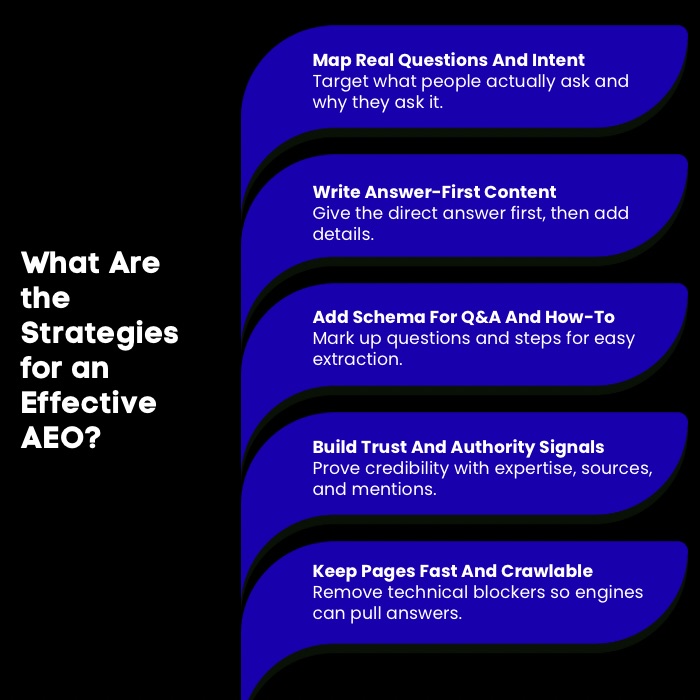
Creating an effective AEO strategy involves a multi-faceted approach that combines content, technical SEO, and authority-building. It begins with a deep understanding of your audience's questions and search intent. The goal is to design content that delivers clear, concise answers in a format that AI can easily parse.
This requires structuring your content with direct answers upfront, using descriptive headings, and implementing the right schema markup. Tools like AI SEO tools can help you identify opportunities and streamline the optimization process. From content structure to technical health, each element plays a role in making your content the preferred source for answer engines.
1. Map Real Questions And Search Intent
The first step in any successful Answer Engine Optimization strategy is to understand what your audience is actually asking. You need to move beyond traditional keyword research and focus on the specific questions people type or speak into search engines. This means mapping out the real user queries related to your topics.
Analyzing search intent is crucial here. You must determine the underlying purpose behind each question. Is the user seeking a quick fact, a step-by-step guide, or a product comparison? By understanding this intent, you can create content that provides the most relevant and satisfying answer, increasing your chances of being featured.
You can use various methods and AI SEO tools to identify these questions:
- Analyze Google's "People Also Ask" boxes for your target topics.
- Use tools like AnswerThePublic or Semrush's Topic Research tool to find common queries.
- Review your own site's search data to see what questions are leading users to you.
- Monitor social media and forums to uncover conversational questions.
2. Write Answer-First Content With Clear Structure
One of the most effective AEO tactics is to adopt an "answer-first" approach to your content strategy. This means providing a direct and concise answer to the main question right at the beginning of your page or section. The ideal length for this initial answer is around 40-60 words, making it perfect for featured snippets and AI Overviews.
After providing the immediate answer, you can then expand on the topic with more detail, context, and related information. This structure satisfies both users looking for a quick solution and those who want to learn more. It also makes your content highly parsable for AI, which can easily extract the initial summary.
A clear structure is essential for this format to work. Use descriptive H2s and H3s that are phrased as questions. Break up information into short paragraphs, bullet points, and numbered lists. Prioritizing high content quality and a logical flow ensures that both humans and machines can easily digest your information, boosting your brand visibility in answer engines.
3. Implement Schema Markup For Q&A And How-To Pages
For Answer Engine Optimization, implementing schema markup on your Q&A and how-to web pages is a non-negotiable strategy. This structured data gives search engines explicit instructions on how to interpret your content, dramatically increasing your chances of being featured in direct-answer formats.
For pages that follow a question-and-answer format, using FAQ schema is critical. This markup clearly identifies each question and its corresponding answer, making it simple for an AI to pull that information directly into a featured snippet or an AI Overview. Without this schema, the engine has to guess which text constitutes the answer.
Similarly, for pages that provide step-by-step instructions, HowTo schema is invaluable. It breaks down the process into a clear sequence that answer engines can easily display. By taking the time to implement these specific schema types, you are essentially spoon-feeding the AI the exact information it needs to position your content as the most helpful and direct response.
4. Build Authority With Strong Entity And Trust Signals
In the world of AEO, being factually correct is not enough; you must also be perceived as a credible and authoritative source. Answer engines prioritize content from entities they trust. An entity can be your brand, a person, or a product that is well-established and recognized within its field. Building this brand authority is a long-term play that pays dividends.
Trust signals are the clues that tell both users and AI that your content is reliable. These signals include things like author bylines with credentials, citations from other reputable sources, and positive reviews. When an answer engine sees that your content is well-researched and backed by evidence, it is more likely to select it as a cited source.
Focus on establishing your expertise online. This means ensuring your business listings are accurate, encouraging customer testimonials, and securing mentions in reputable publications. Every piece of content should reinforce your authority. Over time, these efforts build user trust and signal to AI that your brand is the go-to source of truth in your niche.
5. Improve Technical SEO For Fast, Crawlable Answer Pages
While AEO introduces new strategies, it doesn't replace the fundamentals of technical SEO. A technically sound website is the foundation upon which your answer engine visibility is built. If an AI platform cannot easily access and understand your content, your optimization efforts will be wasted.
Your crawlable answer pages must be fast, mobile-friendly, and free of errors that could hinder indexing. AI crawlers, much like traditional search engine bots, need to be able to render your pages correctly to process the information. This means paying attention to site speed, ensuring proper rendering, and maintaining a clean site architecture.
The goal is to remove any technical barriers that could prevent your content from being surfaced. Regularly monitor your site's health using tools like Google Search Console to detect issues that could impact your online visibility. A smooth, accessible user experience is a strong signal to all search engines and AI platforms that your site is a quality source of information.
What Are the Challenges & Latest AEO Trends in 2026?
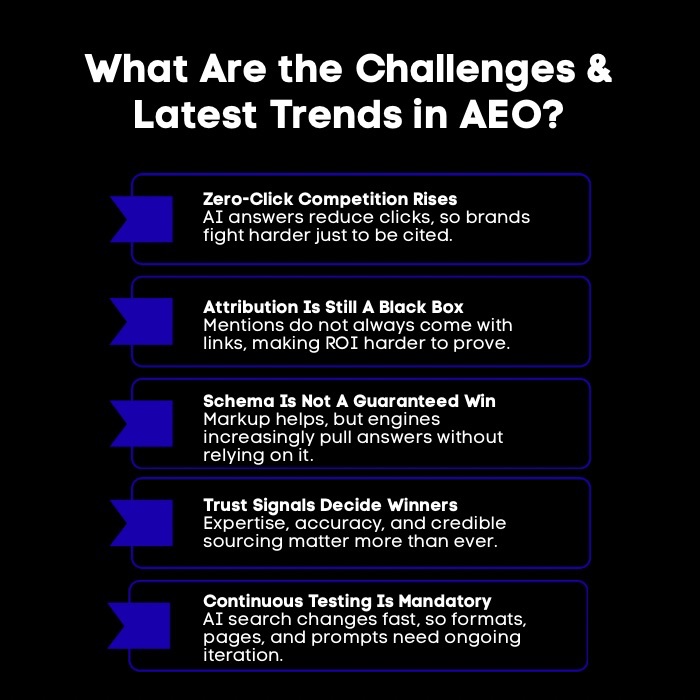
As AEO today continues to evolve, new challenges and trends are shaping the landscape. The rise of AI search is making visibility in "zero-click" environments more competitive, where users get answers without ever visiting a website. This fundamentally changes how we measure success, moving away from clicks and toward brand mentions and citations.
The latest trends indicate a greater emphasis on trust and authenticity, as AI engines work to combat misinformation. Attribution in AI-generated search results remains a significant challenge, making it difficult to track ROI. Staying ahead requires continuous testing and adaptation as the rules of AI visibility are constantly being rewritten.
1. Zero-Click Visibility Gets Harder
The rise of AI Overviews and other direct-answer formats means that an increasing number of searches are becoming "zero-click." Users get the information they need directly on the search engine results page and never click through to a website. While this provides a seamless user experience, it makes achieving zero-click visibility much more difficult for brands.
Competition for these coveted spots is fierce. AI answer engines synthesize information from multiple sources to create a comprehensive direct answer. Your content must not only be accurate and well-structured but also stand out as the most authoritative and concise option to be included.
This shift requires a change in mindset. Success is no longer measured solely by organic traffic. Instead, the goal is to become the brand behind the answer. Even without a click, being cited as the source in an AI-generated response builds authority and keeps your brand top-of-mind, influencing future decisions even if it doesn't drive immediate site visits.
2. Attribution Stays Unclear
One of the biggest challenges in the AEO landscape is the lack of clear attribution. When an AI summarizes information from your site without providing a direct link, how do you measure the impact? Traditional tools like Google Analytics are built to track clicks and sessions, which become less relevant in a zero-click world.
Your brand may be mentioned as a cited source, but tracing that mention back to a conversion or a specific business outcome is incredibly difficult. This "black box" of attribution makes it hard to prove the ROI of your AEO efforts to stakeholders. You might be building significant brand authority, but the data to support it is often indirect.
To navigate this, businesses need to adopt new metrics. Tracking brand mentions, share of voice in AI results, and sentiment analysis are becoming more important. Using specialized AI SEO tools that monitor citations across different content ecosystems can help provide a clearer picture, but the direct line from an AI mention to revenue remains a puzzle to be solved.
3. Schema Wins Are Less Predictable
While implementing schema markup is a best practice for AEO, the results are becoming less predictable. In the past, adding FAQ or How-To schema was a reliable way to secure a rich snippet. However, as AI models become more sophisticated, they rely less on these explicit signals and more on their own ability to understand unstructured content.
Answer engines now use their advanced natural language processing to identify questions and answers on web pages, even without structured data. This means that simply having the right schema is no longer a guarantee of being featured. Your content optimization must go beyond technical markup and focus on overall quality, clarity, and authority.
This doesn't mean you should abandon schema. It's still a valuable signal that can give you an edge. However, you can no longer treat it as a silver bullet. A holistic AEO strategy that combines technical precision with high-quality, answer-first content is necessary to compete for visibility in today's AI Overviews.
4. Trust Signals Matter More
In an era of AI-generated content and misinformation, trust has become the most valuable currency in search. Answer engines are under immense pressure to provide accurate and reliable information, which means they are placing a greater emphasis on trust signals than ever before. Your content's credibility is now a primary ranking factor.
These signals go beyond traditional metrics like backlinks. They include the expertise and authority of the author, the freshness of the content, and whether the information is supported by citations from other reputable sources. A brand's overall reputation and user trust play a significant role in whether its content is deemed worthy of being a cited source.
To succeed in AEO, you must actively build and showcase your credibility. This involves creating high-quality content that is fact-checked and regularly updated. Highlighting author credentials and being transparent about your sources are no longer optional. In the new search landscape, the brands that win will be the ones that are most trusted.
5. Testing Never Stops
The world of Answer Engine Optimization is in a constant state of flux. AI models are updated frequently, search algorithms change without notice, and what works today might not work tomorrow. In this dynamic environment, the only way to stay ahead is to adopt a mindset of continuous testing and iteration.
Your AEO strategy should be treated as a set of living hypotheses, not a fixed checklist. When you make a change, whether it's altering your content structure, implementing new schema, or improving technical SEO, you need to monitor its impact on your visibility in answer engines. This requires a rigorous process of tracking performance and analyzing results.
Using AI SEO tools can help automate this process, allowing you to quickly see how your optimizations affect your citation share and brand mentions. Don't be afraid to experiment with different formats and approaches. The brands that succeed in AEO will be the ones that are most agile and willing to adapt their content optimization strategies based on real-world data.
Want expert help fast? Explore our list of top AEO agencies and see who can boost your visibility in AI-driven search.
How to Choose the Right AEO Tool for Your Business?
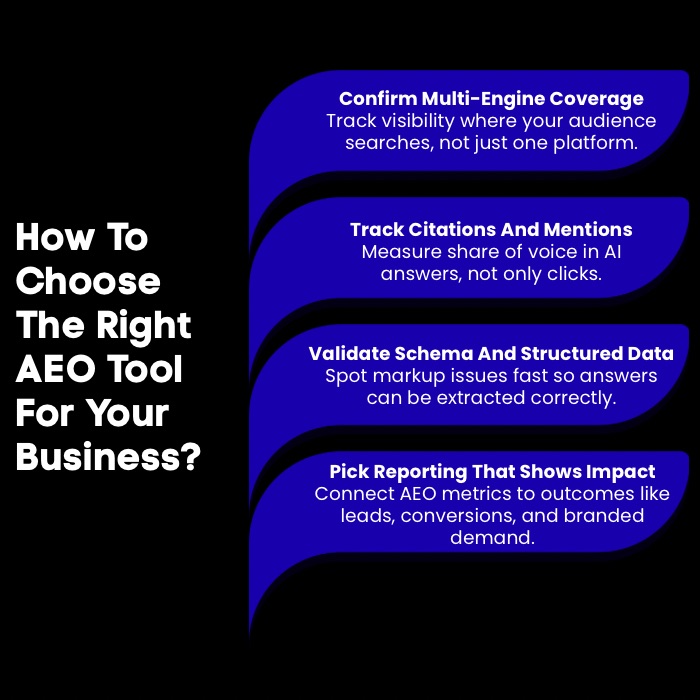
Selecting the right AEO tool is critical for executing a successful strategy at scale. With the growing complexity of AI search, manual tracking is no longer feasible. You need technology that can provide insights into your visibility across multiple answer engines and help you optimize your content effectively.
When evaluating options, look for a platform that offers more than just basic tracking. The ideal tool will help you understand your performance, identify opportunities, and take action, all within a single workflow. Consider factors like multi-engine coverage, citation tracking, and schema validation to ensure the tool meets your business's specific needs.
1. Check Multi-Engine Coverage
When selecting an AEO tool, one of the most important features to consider is its multi-engine coverage. The AI search landscape is not a monolith; users are getting answers from a variety of platforms, including Google's AI Overviews, ChatGPT, Perplexity, and Bing Copilot. A tool that only tracks your visibility on one engine provides an incomplete picture.
Your audience is fragmented across these different AI platforms. To create a truly effective AEO strategy, you need insights into how your brand is performing on each one. A comprehensive tool will monitor your citations and mentions across all major answer engines, giving you a holistic view of your AI search presence.
Look for AI SEO tools that provide data from official API partnerships rather than relying on unstable scraping methods. This ensures the information is accurate and reliable. By understanding where you are visible, and where you are not, you can tailor your content and distribution strategies to target the platforms most relevant to your business and maximize your overall reach.
2. Prioritize Citation And Mention Tracking
In the AEO world, clicks are no longer the primary metric of success. Instead, the focus has shifted to citations and brand mentions within AI-generated answers. Therefore, the AEO tool you choose must have robust capabilities for tracking these new indicators of brand visibility.
It's not enough to know if your website is ranking. You need to know if your content is being used as a cited source. A good tool will be able to distinguish between a direct link (a traditional citation) and a simple brand mention, giving you a complete picture of your share of voice within AI content ecosystems. This data is crucial for understanding your brand's authority and influence.
By prioritizing citation and mention tracking, you can measure what truly matters in AEO. This information allows you to assess the effectiveness of your content strategy, identify which pages are performing best as sources, and demonstrate the value of your AEO efforts beyond traditional traffic metrics.
3. Validate Schema And Structured Data
Technical precision is a key component of AEO, and a crucial aspect of that is the correct implementation of schema markup. An effective AEO tool should include features to help you validate your structured data and ensure it is properly configured for answer engines.
Errors in your schema can prevent AI from understanding your content, effectively making you invisible in certain search results. A platform with built-in schema validation can automatically detect issues and provide actionable recommendations for fixing them. This saves you the time and effort of manual checks and helps you avoid costly mistakes.
Look for AI SEO tools that can analyze your use of important schema types like FAQ schema, HowTo, and Article. The tool should not only confirm that the schema is technically correct but also offer suggestions for optimizing it to better align with AEO best practices. This proactive approach to structured data management is essential for maximizing your visibility.
4. Choose Reporting That Ties To Outcomes
Data is only useful if it helps you make better decisions. When choosing an AEO tool, it's essential to select one that provides reporting that ties your efforts to meaningful business outcomes. Vague metrics and vanity dashboards won't help you prove the value of your AEO strategy.
Look for a platform that allows you to correlate your AEO performance with key business metrics. For example, can you see how an increase in AI citations impacts brand search volume or assisted conversions? The ability to connect your AEO activities to results tracked in tools like Google Analytics is crucial for demonstrating ROI.
The right AI SEO tools will offer customizable reporting that focuses on the metrics that matter most to your business. Whether your goal is to increase online visibility, build brand authority, or drive leads, your AEO tool should provide clear, actionable insights that help you track your progress and justify your investment.
Want To Turn AEO Into Measurable Visibility? Scalenut Helps You Do It
If you are serious about AEO in 2026, you need more than content tips. You need a workflow that shows where your brand appears in AI answers, what prompts drive that visibility, and what to fix next. Scalenut is built for that reality, combining SEO execution with GEO-style visibility tracking so you can move from guesswork to repeatable wins.
With Scalenut, you can plan and write answer-first content faster, optimize pages with clear on-page recommendations, and track how your brand shows up across AI-driven experiences through our features like Brand Monitor and Prompt Insights. Instead of treating AEO like a one-time checklist, you get ongoing signal, citation context, and a practical path to improve your share of voice.
Book a demo and see how AEO-ready content and AI visibility tracking come together in one workflow!
Conclusion
Answer Engine Optimization (AEO) is set to play a pivotal role in digital marketing strategies for 2026 and beyond. As search engines evolve, understanding the nuances of AEO becomes crucial for businesses aiming to enhance their online visibility. By prioritizing structured data, user intent, and authoritative content, you can align your brand with the expectations of users and search engines alike.
Embracing these strategies will not only optimize your content but also ensure that your brand remains relevant in an increasingly competitive landscape. For a deeper dive into how AEO can transform your digital strategy, feel free to reach out for a consultation.
Frequently Asked Questions
What is AEO in marketing and how to rank in it?
The meaning of AEO in marketing is the practice of optimizing content to be the direct answer in AI search results. To rank, focus on answering user queries clearly, using schema markup to structure your content, and building brand authority. The goal of AEO marketing is search visibility within AI platforms, not just traditional search engine rankings.
How does AEO work?
AEO works by structuring content so AI can easily understand and extract it. This involves answering user questions directly, using schema markup to add context, and building trust signals. The AI engine then selects your content to provide a direct answer or feature it in AI Overviews.
How does AEO improve online visibility and search outcomes?
AEO improves online visibility by positioning your content in direct-answer formats like AI Overviews and voice search responses. This captures user attention at the top of search results. By providing concise answers that align with user behavior, you enhance search outcomes and build authority on AI platforms.
What are the most effective AEO tools for 2026?
The most effective AEO visibility tools for 2026 will offer multi-engine coverage to track visibility across platforms like Google and ChatGPT. They should prioritize citation tracking, schema validation, and reporting that connects to business outcomes. A comprehensive platform is better than fragmented point solutions for scaling technical SEO and content efforts.
Is AEO worth investing in for long-term marketing success?
Yes, investing in an AEO strategy is crucial for long-term success. As AI search continues to grow, brands that provide high-quality, direct answers will build lasting brand authority and capture audience attention. It's a fundamental shift in user behavior that marketers cannot afford to ignore.
GEO vs AEO vs AI: Which one is shaping the real future of SEO?
AEO and Generative Engine Optimization (GEO) are both shaping the future of Search Engine Optimization by adapting to AI. While traditional search isn't disappearing, visibility in AI Overviews is becoming critical. A holistic strategy combining SEO, AEO, and GEO is the real future, not just one approach alone.
What is the difference between LLMO and AEO?
Large Language Model Optimization (LLMO) is a broader term, often used interchangeably with GEO, focused on influencing AI model outputs. Answer Engine Optimization (AEO) is more specific, targeting the direct-answer features of an AI engine to have your content selected as the definitive response in search results.
What is the difference between AEO and GEO?
Answer Engine Optimization (AEO) focuses on getting your content featured as the direct, extractable answer in AI search results. Generative Engine Optimization (GEO) is a broader strategy aimed at influencing how AI platforms synthesize information to create new, AI-generated answers, with the goal of being cited.
What are the best answer engine optimization techniques in 2026?
In 2026, the best AEO techniques include mapping real user questions, writing answer-first summaries (40–60 words), structuring pages with Q&A headings and lists, adding FAQ/HowTo schema, strengthening entity and trust signals (E-E-A-T), and improving speed, crawlability, and internal linking.


.svg)


.webp)