
.jpg)
What Is Keyword Clustering And How Does It Improve SEO?

Key Highlights
- Keyword clustering involves grouping related search terms by their shared search intent to target multiple keywords with a single, comprehensive page.
- This strategy helps improve your content's topical relevance, making it easier for a search engine to understand what your page is about.
- Effective keyword clustering starts with thorough keyword research, followed by grouping keywords based on intent and SERP analysis.
- A key benefit is the reduction of keyword cannibalization, which happens when multiple pages on your site compete for the same search term.
- You can choose between manual clustering for full control or automated tools for speed and efficiency, depending on your needs.
- Ultimately, this approach strengthens your content strategy, leading to better rankings and more organic traffic over time.
Are you tired of treating each keyword as a separate target, creating endless pages and hoping one of them sticks in search engine results? This approach can be inefficient and often leads to your own pages competing against each other. It’s time to try a smarter method: keyword clustering. By grouping related keywords into a keyword cluster, you can create powerful, comprehensive content that targets dozens of search terms at once. This guide will walk you through how to master this technique for a more effective SEO strategy.
What Is Keyword Clustering and Why Is It Important For SEO?
Keyword clustering is an SEO technique where you group related keywords that share a similar search intent. Instead of creating a separate page for every minor variation of a keyword, you create a single, in-depth piece of content that targets the entire keyword group. For example, clustering search terms like "best running shoes," "top running shoe reviews," and "running shoe recommendations" all share the same user intent. With keyword clustering SEO, you would address all these queries on one comprehensive page.
This strategy is vital for modern SEO because it aligns with how search engines understand and rank content. SEO professionals find it highly valuable because it helps establish topical authority, prevents internal competition, and ultimately provides a better user experience. By using a keyword research tool to identify these groups, you can create content that is more relevant and authoritative. This approach signals to search engines that your page is a go-to resource for a specific topic, improving your chances of ranking for a wide range of queries.
What Are The Main Benefits Of Using Keyword Clustering Strategies?
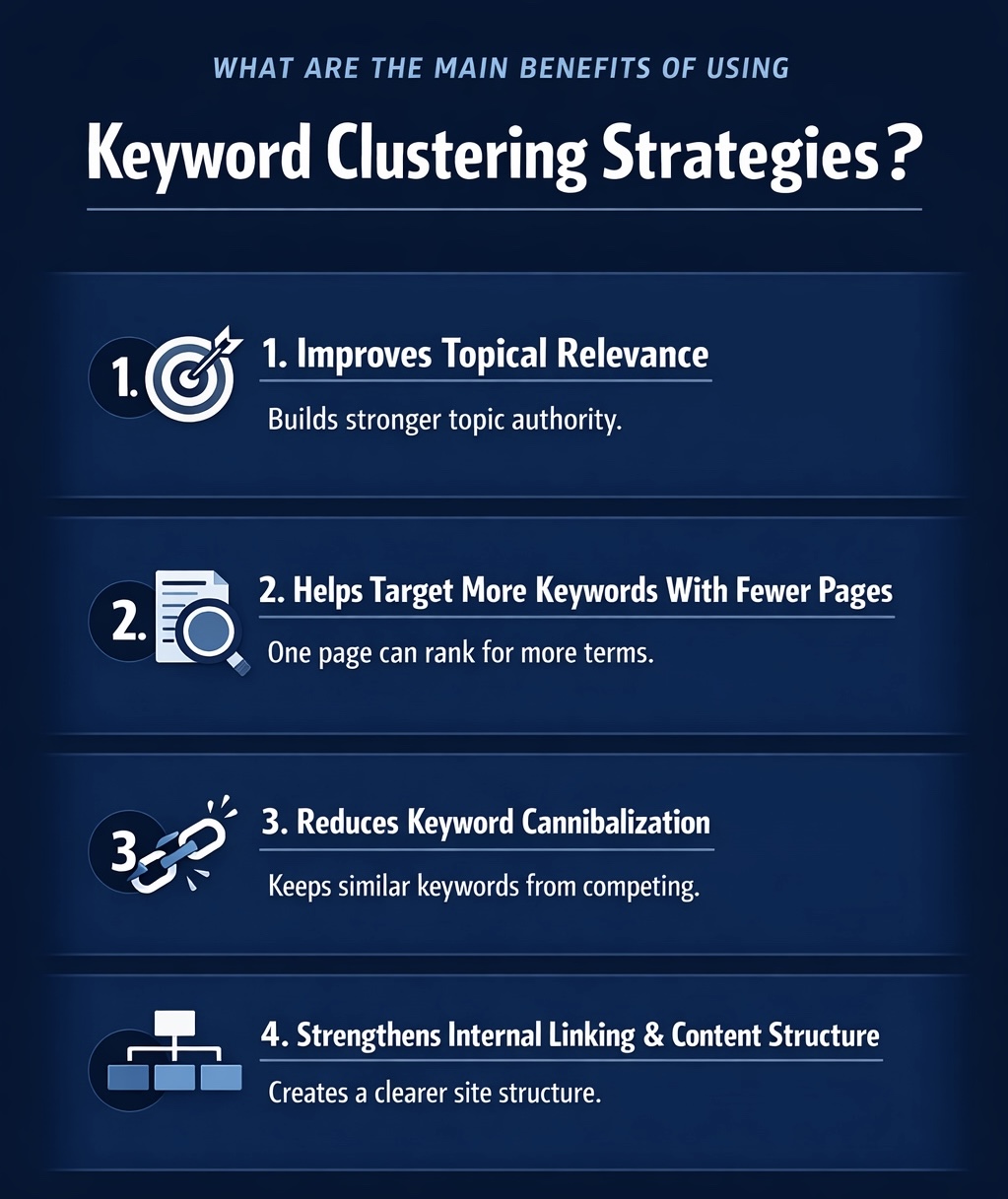
Keyword clustering streamlines content creation by organizing keywords into thematic groups. This approach helps you build comprehensive, user-focused content and simplifies your workflow. Each cluster guides the creation of content that can rank for multiple related terms, maximizing your ROI.
Let's explore some of the specific benefits this method brings to your SEO efforts.
1. Improves Topical Relevance Across Content
One of the biggest advantages of keyword clustering is that it significantly boosts your website's topical authority. When you create comprehensive content that covers a group of related keywords, you signal to search engines that you are an expert on that subject. This deep coverage makes your content more valuable in search results.
Instead of having scattered, thin pages, you can build a strong pillar page that serves as a central hub for a topic. This main page can then be supported by other articles that go into more detail on subtopics. By using relevant anchor text to link these pages together, you create a logical structure that helps both users and search engines navigate your content.
This interconnected web of content establishes you as a thought leader in your niche. As Google crawls your site and sees this well-organized, in-depth information, it will recognize your authority, leading to better rankings for the entire topic cluster, not just a single keyword.
2. Helps Target More Keywords With Fewer Pages
With keyword clustering, you no longer need to create a separate page for every single keyword variation. A single, well-crafted piece of content can rank for dozens, or even hundreds, of different keywords. This efficiency allows you to multiply your organic traffic from one content investment.
Imagine you write an article about "email marketing best practices." Through effective keyword mapping, this one page could also rank for terms like "how to write marketing emails" and "email campaign tips." This approach saves you the time and resources you would have spent creating new content for each of those terms.
By grouping keywords together, you can cover a topic more thoroughly on a single page. This not only makes your content more valuable to readers but also consolidates your ranking power. You can achieve broader SERP visibility with a smaller, more focused content library, making your SEO efforts much more scalable.
3. Reduces Keyword Cannibalization Issues
Keyword cannibalization is a common SEO problem that occurs when multiple web pages on your site compete for the same search query. When search engines can't determine which page is the most relevant, they may rank both pages lower, or neither may get the traffic you want. This essentially means your own pages are fighting against each other.
Clustering prevents this issue by assigning each keyword group to a single, specific page. You designate a primary keyword for the cluster and optimize one page to target it and all its variations. This eliminates internal competition and clarifies your content structure for search engines.
Instead of creating separate pages for similar terms, you consolidate your efforts into one authoritative resource. This ensures that all your ranking signals are directed to a single URL, giving you a much better shot at securing a top position for your target search terms.
4. Strengthens Internal Linking And Content Structure
Keyword clustering naturally leads to a more logical and powerful content structure. As you group cluster keywords into topics and subtopics, you create a clear hierarchy for your content. This organized structure is beneficial for both users and search engines, making your site easier to navigate and understand.
This approach provides a perfect framework for a strong internal linking strategy. You can create a main "pillar" page for a broad topic and then link out to more specific "cluster" pages that cover subtopics in greater detail. These internal links help distribute page authority throughout your site and guide users to relevant results.
By connecting related content with internal links, you show search engines the relationship between your pages. This reinforces your topical authority and helps search crawlers discover and index your content more efficiently. A solid content structure built on keyword clusters makes your entire website more cohesive and authoritative.
What Are The Main Types Of Keyword Clustering?
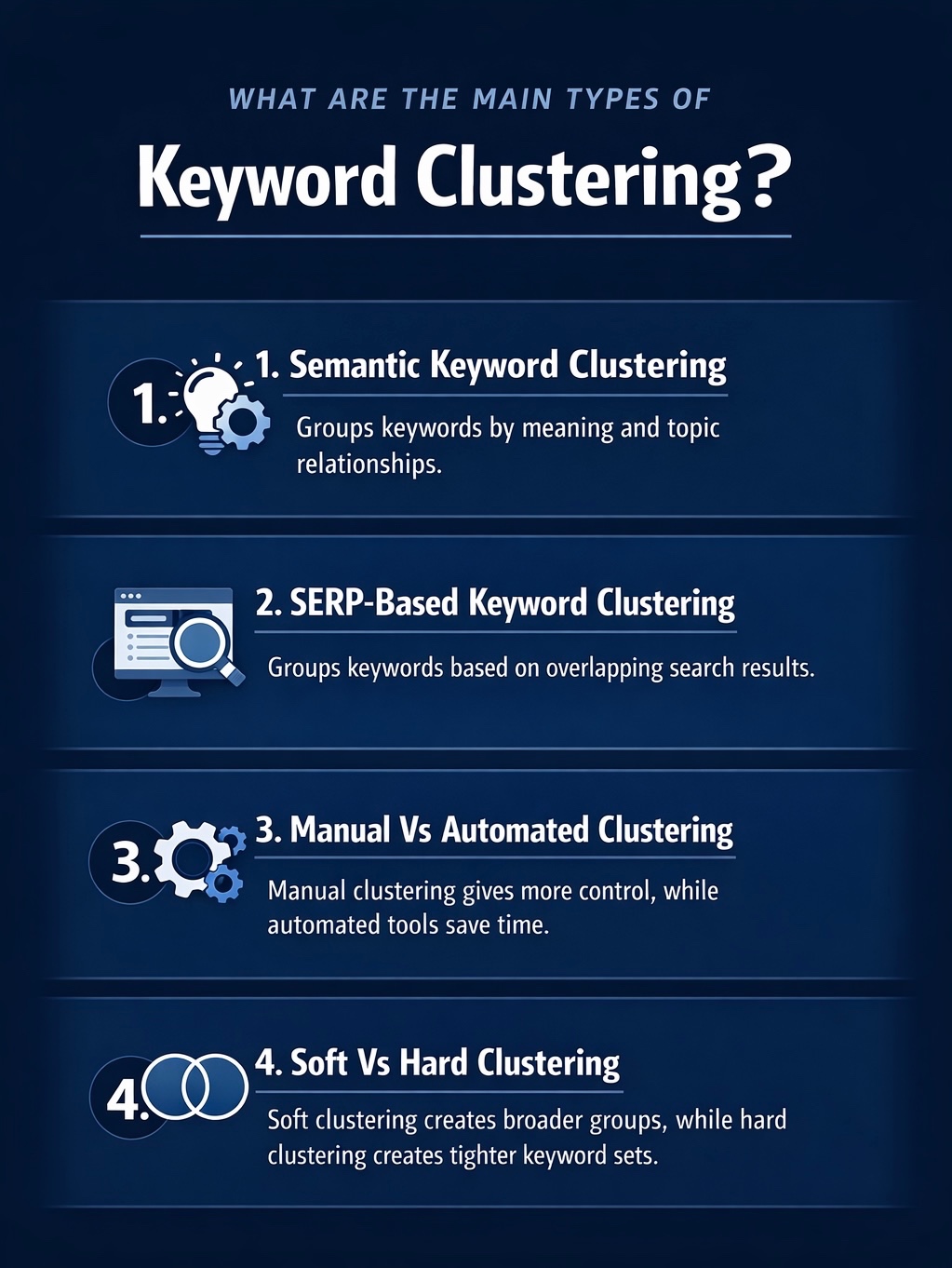
There’s no one-size-fits-all approach to keyword grouping. Different clustering methods suit different goals, resources, and precision needs. Some focus on word meanings; others analyze current search engine rankings. Understanding these approaches helps you choose the best method for building keyword clusters, whether you use advanced tools or do it manually.
Let's look at the main types of clustering you can use.
1. Semantic Keyword Clustering
Semantic keyword clustering is a method that groups terms based on their linguistic meaning and conceptual relationships. This approach uses natural language processing (NLP) to find connections between keywords that might not share the exact same words but are contextually related. It goes beyond simple word matching to understand the underlying topic.
For instance, with semantic keyword clustering, terms like "running sneakers" and "jogging footwear" would be grouped together. Even though they don't share any words, they have similar meanings and relate to the same concept. This type of keyword grouping helps you create content that covers a topic more holistically.
By focusing on the search intent and the relationships between related terms, you can build clusters that truly reflect how users search. This method allows you to create more comprehensive content that answers a broader range of questions, making your pages more relevant and authoritative in the eyes of search engines.
2. SERP-Based Keyword Clustering
SERP-based keyword clustering is the most common and practical method used by SEOs today. This technique involves analyzing the actual search engine results pages (SERPs) to see which keywords trigger the same ranking URLs. The logic is straightforward: if Google shows the same pages for multiple keywords, it considers them related enough to be targeted on one page.
To do this, you would perform a Google search for several keywords you think are related. If you consistently see the same top-ranking pages for each search query, those keywords belong in the same keyword cluster. This method takes the guesswork out of clustering by using real-world data from the SERP.
This approach is highly effective because it validates your keyword groupings based on how search engines already interpret them. It answers the critical question of whether a group of keywords can realistically be targeted with a single page, ensuring your content strategy is aligned with search engine behavior.
3. Manual Vs Automated Clustering
When it comes to creating your keyword clusters, you have two main options: manual clustering or using an automated tool. Manual clustering involves using tools like Google Sheets to sort and group keywords by theme and intent yourself. This approach gives you complete control over the process and costs nothing but your time.
On the other hand, automated clustering uses a specialized keyword clustering tool to analyze SERP data or semantics for you. These tools can process thousands of keywords in minutes, saving a significant amount of time. The trade-off is that you have less direct control, and the results may sometimes need a manual review to ensure accuracy. The choice between manual and automated clustering often comes down to the scale of your project and your available resources.
4. Soft Vs Hard Clustering Methods
Within automated clustering methods, you can often set a threshold for how strict the groupings should be. This is where the concepts of soft and hard clustering come into play. These clustering methods determine how much SERP overlap is required for keywords to be grouped together.
Soft clustering requires minimal overlap between the search results of different keywords. This creates broader, more loosely related groups of cluster keywords. It's useful for understanding general topic relationships and planning a high-level content strategy.
In contrast, hard clustering demands a significant overlap in search results, producing tighter, more precise keyword groups. This method is ideal when you need to be very specific about which keywords can be targeted on a single page. Your choice between soft and hard clustering will depend on whether you’re exploring broad topics or defining precise page targets.
How To Do Keyword Clustering?
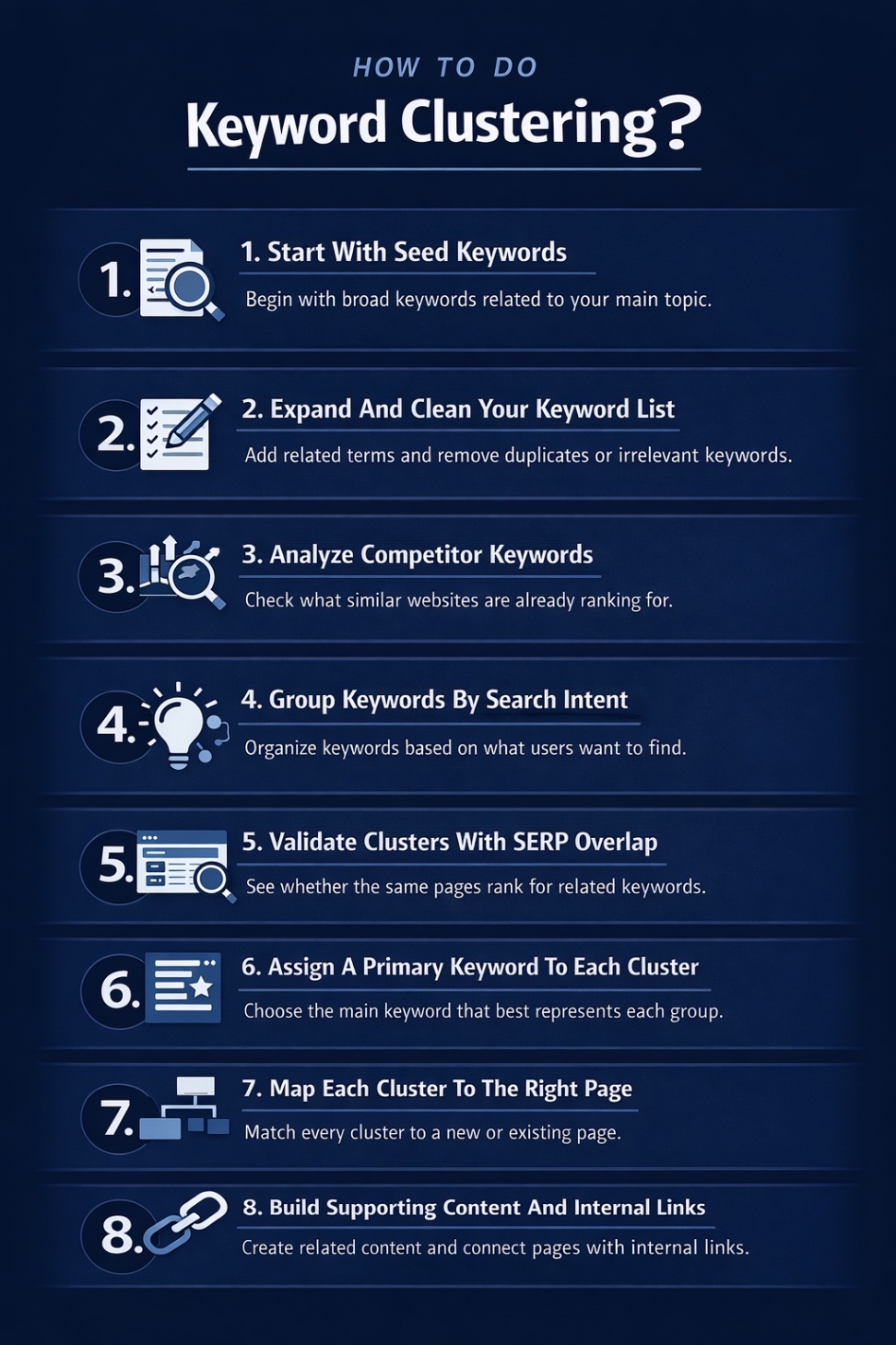
Now that you understand the what and why, it's time to get practical. The process of keyword clustering follows a logical sequence, from gathering an initial list of keywords to mapping your final clusters to pages. It’s about transforming a messy spreadsheet of terms into an organized content plan.
This step-by-step process will provide you with valuable keyword insights and help you group your terms by search intent. By following these steps, you can confidently cluster keywords and build a content strategy that drives results.
1. Start With Seed Keywords
The first step in any keyword research process is to generate a list of seed keywords. These are the broad, foundational terms that describe your main topics and services. Think about the primary keyword someone might use to find your business. For a natural hair care brand, a seed keyword could be "natural hairstyles."
Use a keyword research tool like Ahrefs, Semrush, or even Google Keyword Planner to brainstorm these initial ideas. Enter your main keyword and export all the related search query suggestions. At this stage, your goal is quantity over quality.
Don't worry about organizing the list perfectly just yet. Your focus should be on gathering as many relevant terms as possible. This comprehensive list will serve as the raw material for the rest of your clustering process, so cast a wide net to capture all potential opportunities.
2. Expand And Clean Your Keyword List
Once you have your initial seed keyword list, the next step is to expand it with more related keywords and long-tail variations. Use your keyword tool to find more suggestions, questions, and phrases related to your seed terms. Look for keywords with decent search volume but don't ignore low-volume terms, as they can be highly specific and valuable.
After expanding your list of keywords, it's time to clean it up. Remove any irrelevant or duplicate terms that don't align with your business goals. This is also a good time to filter out keywords that are too broad or too competitive for you to realistically rank for at this stage.
The goal of this step is to create a refined, comprehensive keyword list that is ready for grouping. A clean, well-organized list will make the clustering process much smoother and more effective, setting you up for success in the following steps.
3. Analyze Competitor Keywords
A great way to find more keyword opportunities is to see what your competitors are already ranking for. Analyzing competitor keywords can fill in gaps in your own list and surface terms you might have missed. Most major SEO tools have a feature that allows you to enter a competitor's domain and see the keywords they rank for.
Look at the top-performing pages of your competitors and identify the keyword insights they are leveraging. Pay attention to the terms that drive the most traffic to their site. This analysis can reveal entire topic areas that you haven't considered yet but are clearly valuable in your industry.
You can also use tools like Google Search Console to see which queries are already bringing traffic to your own site. This can uncover unexpected keywords that you can further optimize for. Combining competitor analysis with your own data will give you a much richer set of keywords to work with.
4. Group Keywords By Search Intent
Understanding search intent is the most critical part of keyword grouping. Search intent is the "why" behind a search query—what a user actually wants to accomplish. You need to categorize your keywords based on whether the user intent is informational, commercial, navigational, or transactional.
Informational intent keywords are questions like "what is keyword clustering?" while commercial intent keywords might be "best keyword clustering tools." Transactional keywords, such as "buy Semrush subscription," indicate a readiness to purchase. Grouping keywords with the same intent ensures your content will meet the expectations of your target audience.
By aligning your content with user intent, you create a much better user experience. For example, all informational keywords can be grouped to form a comprehensive guide or pillar page, while commercial keywords can inform a comparison or review article. This alignment is key to creating content that resonates and ranks.
5. Validate Clusters With SERP Overlap
After you’ve grouped your keywords by intent, you need to validate your clusters. The best way to do this is by checking the search engine results pages (SERPs). The goal is to see if the same URLs are ranking for the different keywords in your proposed keyword cluster.
Take a few keywords from a cluster and search for them on Google. If you see a high degree of SERP overlap—meaning the same few pages appear in the top results for each keyword—your cluster is valid. This confirms that the search engine sees these terms as closely related and that they can be targeted with a single page.
If you find that completely different pages rank for each of your cluster keywords, it's a sign that they might belong in separate clusters. This validation step is crucial because it ensures your content strategy is based on how search engines actually interpret queries, leading to more relevant results.
6. Assign A Primary Keyword To Each Cluster
Once you have validated your keyword cluster, the next step is to assign a primary keyword to each group. The primary keyword is typically the term with the highest search volume or the one that most accurately represents the core topic of the cluster. This keyword will be the main focus of your on-page optimization efforts.
This primary keyword should be included in your page's title, H1 tag, meta description, and the opening paragraph. The other keywords in the cluster will serve as secondary or supporting keywords. You should aim to include these naturally throughout your content, in subheadings, and in the body text.
This process of keyword grouping and prioritization is fundamental to a strong content strategy for search engine optimization. It provides a clear focus for each piece of content you create and ensures that your optimization efforts are targeted and effective.
7. Map Each Cluster To The Right Page
With your clusters defined and primary keywords assigned, it's time to map each keyword cluster to a page on your website. For each cluster, you'll need to decide whether to optimize an existing page or create a new one. This mapping process turns your keyword clustering efforts into an actionable content strategy.
If you have an existing page that is already a good fit for a cluster, you can optimize it to better target the entire group of keywords. If there's no relevant page, the cluster represents an opportunity to create new pieces of content. This is how you identify and fill content gaps on your site.
Document this mapping in a spreadsheet or content plan. This will serve as a roadmap for your content team, clarifying which web pages target which keyword groups. This organization is key to avoiding keyword cannibalization and building a cohesive site structure, whether for a blog post or a pillar page.
8. Build Supporting Content And Internal Links
A single page, no matter how comprehensive, can't cover every aspect of a broad topic. This is where supporting content and internal linking come into play. Your content planning should include creating additional articles that dive deeper into the subtopics within your main clusters. This helps you build topical authority around your core subjects.
Once you have this new content, you need to connect it all with internal links. A pillar page covering a broad topic should link out to more detailed cluster pages, and those cluster pages should link back to the pillar. This creates a logical and interconnected content hub.
When creating these internal links, be sure to use descriptive anchor text. This helps both users and search engines understand the context of the linked page. A strong internal linking strategy:
- Distributes link equity throughout your site.
- Guides users to more relevant information.
- Helps search engines discover and index your content.
What Is An Example Of Keyword Clustering In Practice?
A simple way to understand keyword clustering is to see how one broad topic turns into a focused content plan.
Let’s say your main topic is keyword clustering. Instead of creating a different page for every keyword variation, you group together terms that share the same search intent. That way, you build one strong page around a cluster instead of spreading similar keywords across multiple weaker pages.
For example, one cluster might include:
- keyword clustering
- what is keyword clustering
- keyword clustering in SEO
- keyword clustering strategies
These keywords are closely related and point to the same core intent, so they can usually be targeted on a single page. In this cluster, keyword clustering would be the primary keyword, while the others would work as secondary variations woven naturally into the content.
You could then create supporting clusters for related subtopics, such as:
- keyword clustering tools
- how to do keyword clustering
- benefits of keyword clustering
Each of these clusters could map to its own page because the intent is slightly different. One searcher wants tools, another wants a process, and another wants to understand the value.
In practice, keyword clustering helps you organize content the way people actually search. Instead of targeting one keyword per page, you create pages around groups of related terms that deserve to rank together. This makes your content strategy more focused, reduces keyword cannibalization, and helps build topical authority over time.
What Are The Best Practices For Keyword Clustering?
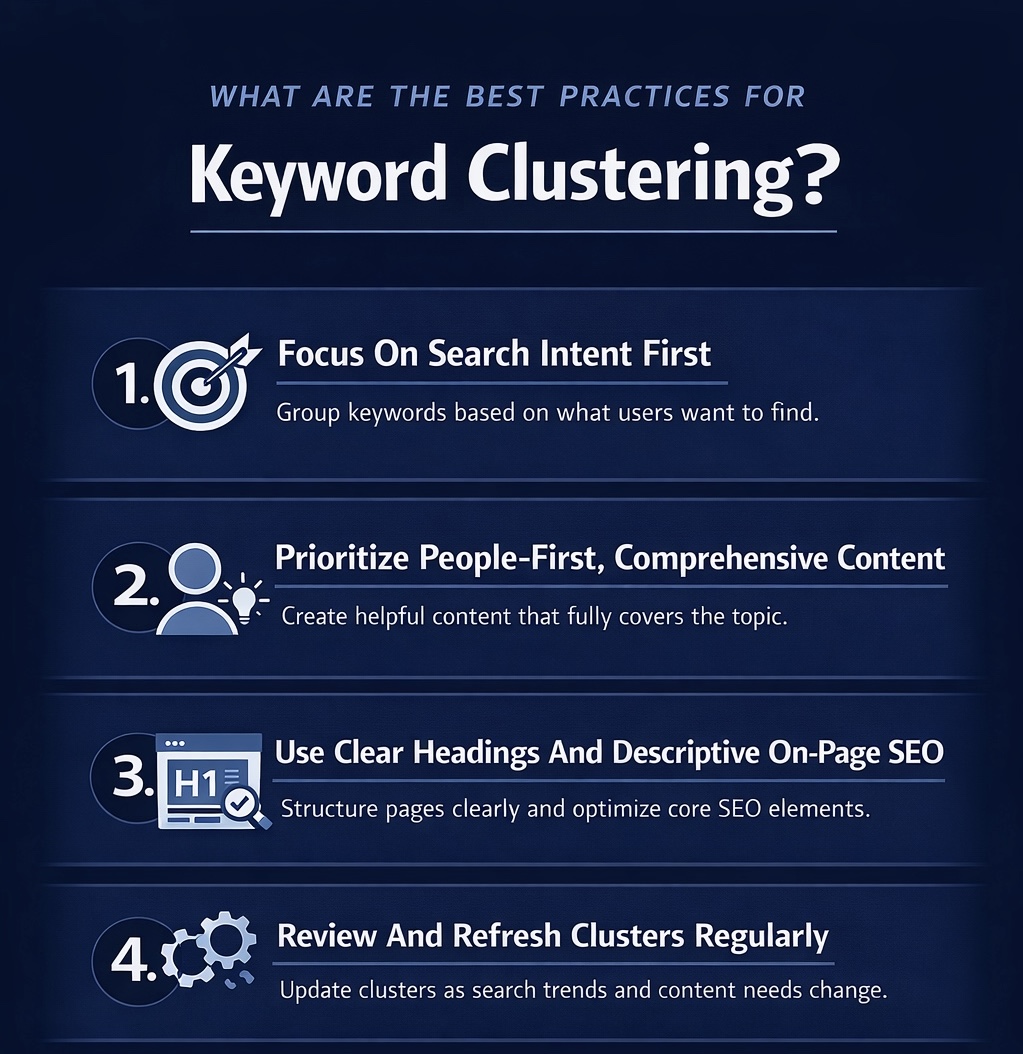
To get the most out of your keyword clustering efforts, it's important to follow some best practices. Simply grouping keywords isn't enough; you also need to ensure your content planning and execution are aligned with modern SEO principles. This means prioritizing the user and creating high-quality, comprehensive content.
Focusing on search intent and creating a great user experience should always be at the forefront of your strategy. Let's explore some of the best keyword clustering practices that will help you turn your keyword grouping work into tangible ranking improvements.
1. Focus On Search Intent First
The most important rule in keyword clustering is to always prioritize search intent. Before you even think about search volume or competition, you need to understand what the user is trying to accomplish. A mismatch between your content and the user's intent will lead to a poor user experience and low rankings.
Your entire content strategy should be built around answering the user's query as effectively as possible. When you group relevant keywords, make sure they all share the same underlying intent. Is the user looking for information, comparing products, or ready to buy?
Creating content that aligns perfectly with search intent is the foundation of a successful pillar page or any other content piece. When you give users exactly what they are looking for, they are more likely to stay on your page, engage with your content, and view you as a trusted resource.
2. Prioritize People-First, Comprehensive Content
Google's updates consistently emphasize the importance of "people-first" content. This means your primary goal during content creation should be to provide value to the reader, not just to rank on search engines. Your content should be helpful, reliable, and offer a great user experience.
When you create new content based on your cluster keywords, aim to be the most comprehensive resource on that topic. Answer all the potential questions a user might have so they don't need to go back to the search results. This thoroughness is what search engines reward.
Instead of just stuffing keywords into your text, focus on covering the topic in-depth and satisfying the user intent. When you create genuinely helpful content, the rankings will follow. Remember, you are writing for people first and search engines second.
3. Use Clear Headings And Descriptive On-Page SEO
Good on-page SEO is crucial for helping both users and search engines understand your content. Use clear headings (H1, H2, H3) to structure your article logically. Your primary keyword should be in your H1, and your secondary keywords should be used in your subheadings where it makes sense.
This clear structure makes your content easier to read and skim. It also provides strong signals to search engines about the main topics and subtopics covered on the page. In addition to headings, pay attention to other on-page SEO elements during content production.
Make sure to optimize the following for every page:
- Meta Title and Description: Write compelling copy that includes your primary keyword and encourages clicks.
- Image Alt Text: Use descriptive alt text for all images to improve accessibility and provide more context to search engines.
- URL Slugs: Create short, descriptive URLs that include your primary keyword.
4. Review And Refresh Clusters Regularly
Keyword clustering is not a one-time task. Search behavior evolves, algorithms change, and new keywords emerge. To maintain a successful content strategy, you need to review and refresh your keyword clusters and content regularly, perhaps every three to six months.
Re-audit your keyword list to see if any new terms have become popular. You might discover that the search intent for some queries has shifted, requiring you to adjust your groupings. Keeping your clusters up-to-date ensures your search engine optimization efforts remain relevant and effective.
Use keyword insights from tools like Google Search Console to see what new queries are driving traffic to your site. This data can help you identify opportunities to expand your existing clusters or create new ones. A proactive approach to refreshing your clusters will keep your content strategy ahead of the curve.
How Can You Measure The Success Of Keyword Clustering?
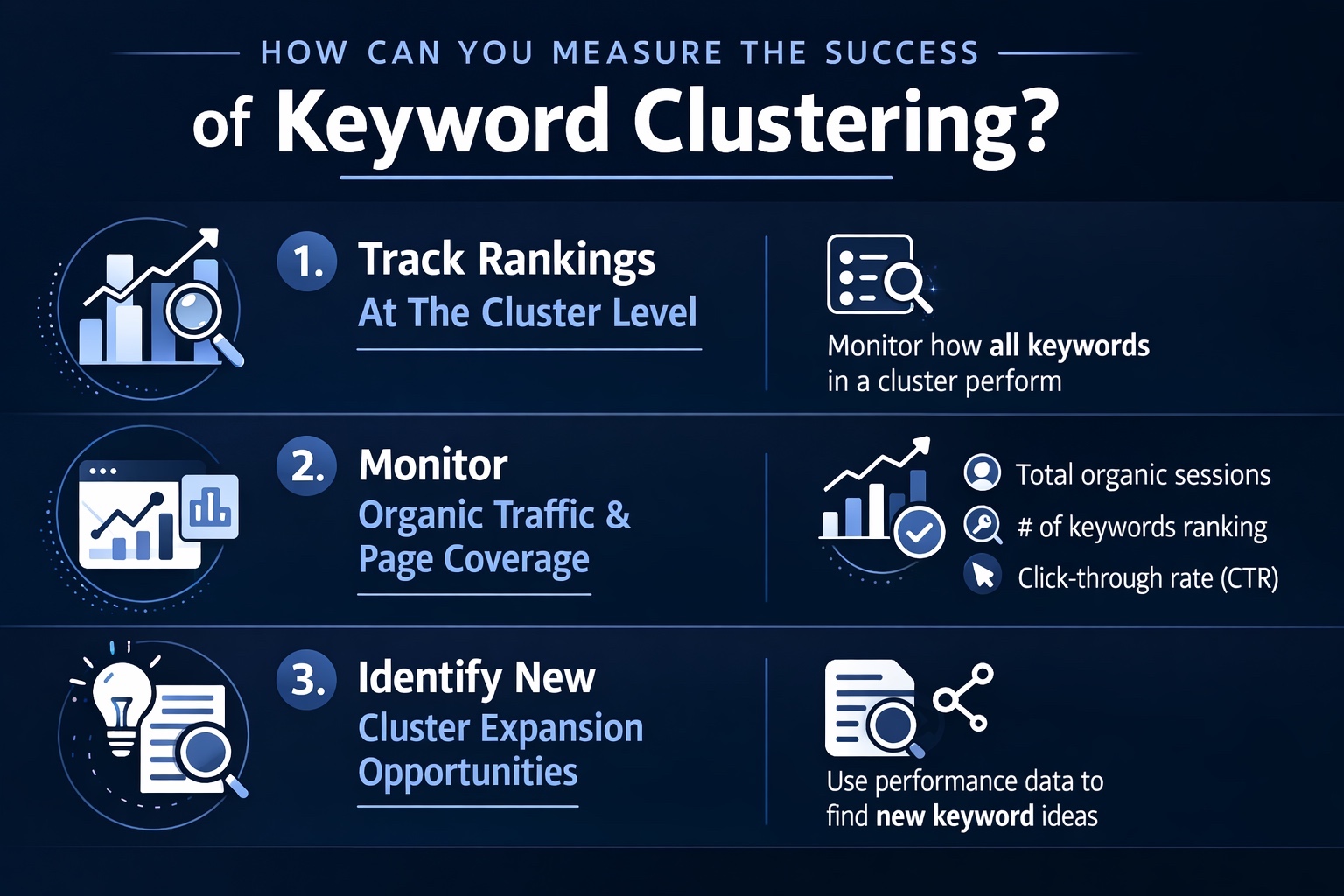
After implementing your keyword clustering strategy, you need to track its performance to understand what's working and where you can improve. Measuring your success metrics is a key part of any search engine optimization effort. By analyzing the right data, you can see the direct impact of your work.
Let's look at a few key ways to measure your success.
1. Track Rankings At The Cluster Level
Instead of just tracking the rank of your primary keyword, you should monitor the search rankings for all the keywords within a keyword cluster. A key benefit of clustering is ranking for many related terms, so tracking the entire group will give you a more accurate picture of your page's performance.
Use a rank tracking tool or Google Search Console to see how your page is performing for the whole cluster. You might find that while your primary keyword's rank is stable, you're gaining visibility for many long-tail variations. This cluster-wide view helps you understand the true impact of your content.
Seeing better rankings across a broad set of keywords is a strong indicator that the search engine views your page as an authoritative resource on the topic. This holistic approach to tracking is essential for measuring the full value of your keyword clustering strategy.
2. Monitor Organic Traffic And Page Coverage
One of the most important success metrics is the amount of organic traffic your clustered pages receive. Use Google Analytics to segment your traffic by content topic or cluster. This will show you which themes are driving the most visitors to your site and which content ideas are resonating most with your audience.
Look for an increase in organic traffic to the web pages you've optimized with your cluster strategy. This is a clear sign that your approach is working. You can also monitor page coverage in Google Search Console to see how many keywords a single page is ranking for.
When analyzing your traffic, pay attention to:
- The total number of organic sessions to your clustered pages.
- The number of unique keywords each page ranks for.
- The click-through rate (CTR) for your top queries.
3. Identify New Cluster Expansion Opportunities
Measuring performance isn't just about looking at past results; it's also about finding future opportunities. As you analyze your data, you'll uncover keyword insights that can guide your future content marketing efforts. Look for related terms and questions that your audience is searching for but you haven't yet covered.
These queries can be used to create new content that supports your existing clusters or to form entirely new clusters. For example, if your page on "natural hairstyles" starts ranking for "protective styles for natural hair," you might have an opportunity to create a new, more detailed article on that subtopic.
This process of continuous discovery and expansion is what makes a content strategy dynamic and successful over the long term. By regularly looking for new cluster keywords, you can keep your content fresh and continue to build your topical authority.
How Can Scalenut Help You Turn Keyword Clustering Into Real SEO Results?
Finding keyword clusters is only the first step. The real challenge is turning those clusters into a content strategy that is clear, scalable, and built for both traditional search and AI discovery. That is where Scalenut stands out. Instead of stopping at keyword grouping or automated keyword clustering, Scalenut helps teams move from AI-generated clusters and search-intent prompts to actual content planning, creation, optimization, and AI visibility tracking in one workflow.
With Scalenut, you can:
- Build keyword clusters around a seed topic or uploaded keyword list
- Use AI prompts and trending prompt insights to understand what users are really asking
- Turn clusters into topic plans, briefs, and long-form content
- Optimize pages for stronger search performance and AI visibility
- Track how your brand shows up across AI search experiences and act on those insights
If you want a platform that does more than just organize keywords, Scalenut gives you a practical way to connect keyword clustering with execution. It helps you go from research to publish-ready content faster, while keeping your strategy aligned with how people search and how AI platforms surface answers.
Book a demo with Scalenut to see how keyword clustering, content creation, and AI SEO workflows can work together in one platform.
Conclusion
In conclusion, keyword clustering is a powerful strategy that can significantly enhance your SEO efforts. By organizing keywords into relevant clusters, you not only improve topical relevance but also streamline your content creation process. This approach helps you target more keywords with fewer pages while reducing keyword cannibalization issues, ultimately strengthening your internal linking and content structure. As you implement the techniques discussed, keep a close eye on the performance of your clusters and be open to reviewing and refreshing them regularly for optimal results. If you’re ready to take your SEO game to the next level, get in touch with us for a free consultation to refine your keyword clustering strategy!
Frequently Asked Questions
What is semantic keyword clustering?
Semantic keyword clustering is a method of keyword grouping that organizes related terms based on their contextual meaning, not just shared words. This approach helps create a comprehensive keyword cluster for a pillar page by identifying all conceptually similar queries, allowing you to cover a topic more thoroughly.
How to cluster keywords with ChatGPT?
To cluster keywords with ChatGPT, you can provide it with a keyword list and a prompt asking it to perform keyword grouping based on search intent or topic. For example, you can say, "Group this list of keywords into relevant clusters." While it's a helpful clustering tool, always review the results.
What is the difference between keyword clustering and keyword mapping?
Keyword clustering is the process of keyword grouping based on shared intent. Keyword mapping is the next step, where you assign each cluster to a specific page on your site, such as a pillar page or blog post. Clustering informs your content planning, while mapping puts that plan into action.
Can keyword clustering help with topic ideation for blog content?
Yes, absolutely. Keyword clustering is a great source for content ideas. Each keyword cluster can become the basis for a new blog post or piece of content. By analyzing the terms within a topic cluster, you can identify specific questions and subtopics that need to be addressed, fueling your new content pipeline.
How does AI make keyword clustering more efficient?
AI makes keyword clustering more efficient by automating the analysis of huge keyword lists and search results. An AI-powered clustering tool can quickly identify patterns and keyword insights that would take a human hours to find, grouping thousands of keywords into relevant clusters in minutes, dramatically speeding up the process.
How does keyword clustering improve search engine rankings?
Keyword clustering improves search engine rankings by helping you create comprehensive content that fully addresses a user's search intent. By targeting a group of cluster keywords, you demonstrate topical authority, which signals to search engines that your page is a high-quality resource, leading to higher rankings for the entire topic.


.svg)


.webp)