
Best Peec AI alternatives in 2026: Quick summary
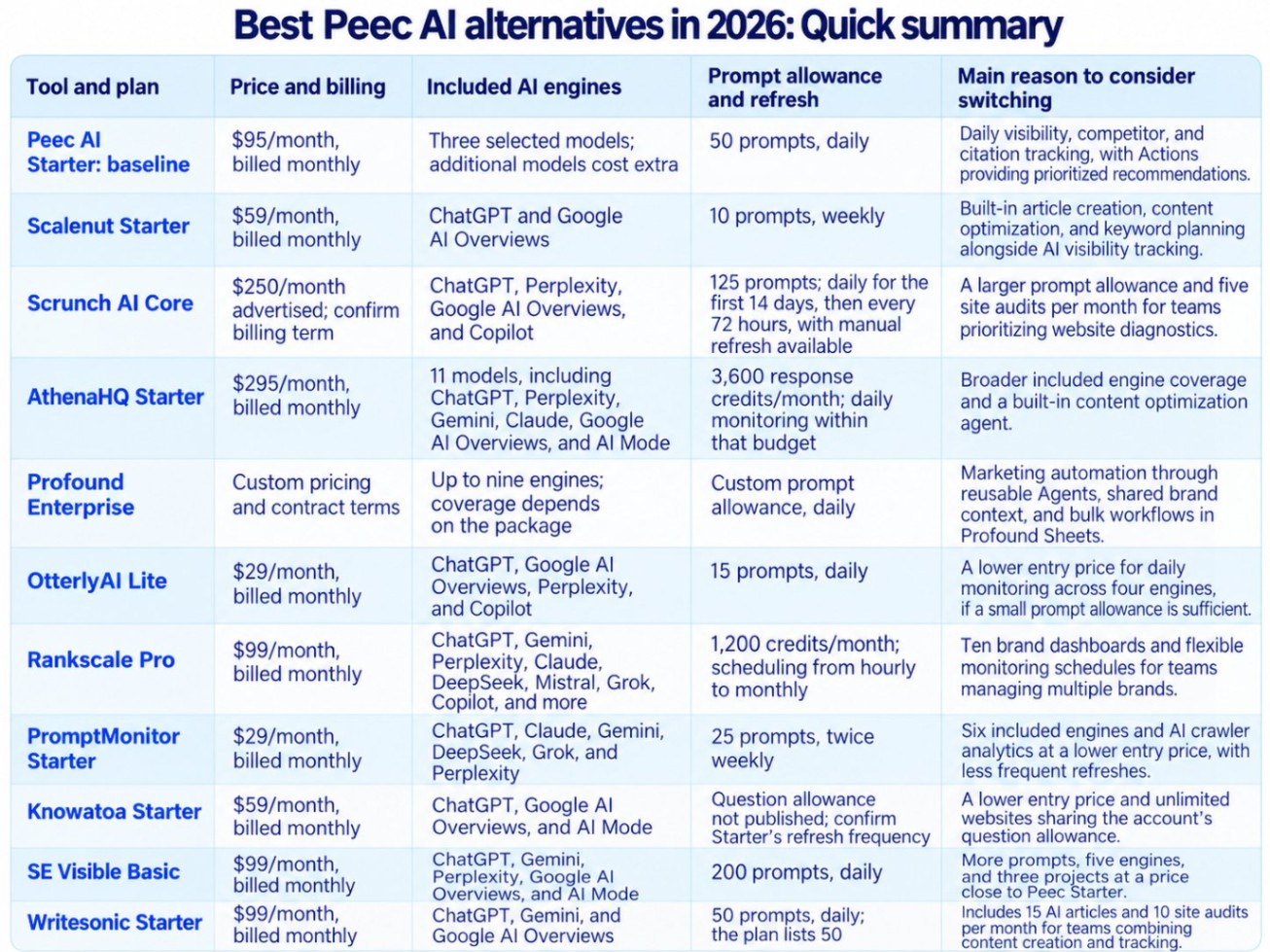
- Scalenut: Choose it over Peec if you want keyword planning, article writing, and content optimization built into your visibility platform, reducing reliance on separate content tools.
- Scrunch AI: Consider it when you need tools that deliver optimized website content directly to AI agents. Its enterprise platform adds this capability alongside monitoring and diagnostics.
- AthenaHQ: Offers broader included model coverage: Starter supports 11 AI models, compared with three selected models on Peec’s standard plans. Usage remains subject to response credits.
- Profound: Consider it over Peec when you need built-in bulk marketing workflows. Profound Sheets runs research and content agents across lists of pages, keywords, or topics.
- OtterlyAI: Costs less to start than Peec while retaining daily monitoring, making it a practical alternative when a smaller prompt allowance meets your needs.
- Rankscale: Offers more flexibility for managing several brands: Pro includes ten brand dashboards and adjustable refresh schedules, compared with Peec Starter’s single project and daily tracking.
- PromptMonitor: Includes six AI models at a lower entry price than Peec, plus crawler analytics, if twice-weekly refreshes on Starter suit your needs.
- Knowatoa: Offers a lower entry price and unlimited websites sharing one question allowance, worth considering if Peec Starter’s single-project limit restricts your setup.
- SE Visible by SE Ranking: Provides more tracking capacity near Peec’s entry price: Basic includes 200 prompts across five engines, versus Peec Starter’s 50 prompts across three.
- Writesonic: Bundles daily visibility tracking with article generation and site audits at a similar monthly entry price to Peec, reducing the need for separate content software.
Better AI visibility tracking is not always the reason to replace Peec.
Peec already tracks visibility, competitors, citations, sentiment, and daily changes, while its Actions feature helps prioritize what to work on next. The real reason to consider an alternative is that your team may need a different workflow around that data: more AI engines, lower pricing, deeper reporting, built-in content optimization, or stronger SEO and GEO execution.
I compared 10 Peec AI alternatives, including Scalenut, Scrunch AI, AthenaHQ, Profound, and OtterlyAI, to show where each one genuinely differs and which type of team each platform is built for.
Why look for a Peec AI alternative?
Peec AI tracks prompts, competitors, sentiment, and citations across AI search platforms. Its Actions feature also identifies competitive gaps and prioritizes what to create, optimize, or pursue next.
A Peec AI alternative may still be a better fit if you need:
- Built-in content production: Peec provides recommendations, while content creation remains with your team. You may want writing, optimization, and publishing tools within the same platform.
- Different tracking allowances or costs: Peec Starter includes 50 prompts and three selected models, with additional models available as paid add-ons. Compare total costs for the prompts and engines you actually need.
- A broader SEO and GEO workflow: Your team may need keyword planning, content audits, and internal linking alongside AI visibility tracking to manage more of its content work in one place.
How I Evaluated These Peec AI Alternatives?
- AI Platform Coverage: I looked at whether each tool covers the AI platforms most teams actually care about, including ChatGPT, Perplexity, Gemini, Claude, Google AI Overviews, and AI Mode.
- Prompt Tracking Quality: A good alternative should not just say your brand appeared. It should show where you appeared, how often, for which prompts, and how that changed over time.
- Citation And Source Insights: I gave more weight to tools that show which websites AI engines are pulling from, because that tells you what is influencing your visibility.
- Content Actionability: This was a big one. I checked whether the tool gives clear next steps, like content gaps, page audits, recommendations, briefs, or optimization workflows.
- Ease Of Use: Some AI visibility tools are powerful but hard to use. I looked at how easily a content team, SEO team, agency, or founder could make sense of the data.
- Pricing And Plan Limits: I compared starting prices, free trials, prompt limits, tracked models, user seats, and whether the lower plans are actually useful.
- Best-Fit Use Case: Not every tool is trying to solve the same problem. So I judged each one based on where it fits best, whether that is monitoring, enterprise reporting, agency work, or content execution.
What Are The Best Alternatives To Peec.ai For AI Visibility Tracking?
Peec.ai is useful for monitoring AI visibility, but it is not the only option. Some alternatives are better for content execution, some are stronger for enterprise reporting, and some are easier for smaller teams to start with.
Below, I’ll break down the best Peec.ai alternatives by features, pricing, pros, cons, and best-fit use cases so you can choose the tool that actually matches your workflow.
1. Scalenut [G2: 4.7/5]: All-In-One GEO And SEO Content Execution Platform
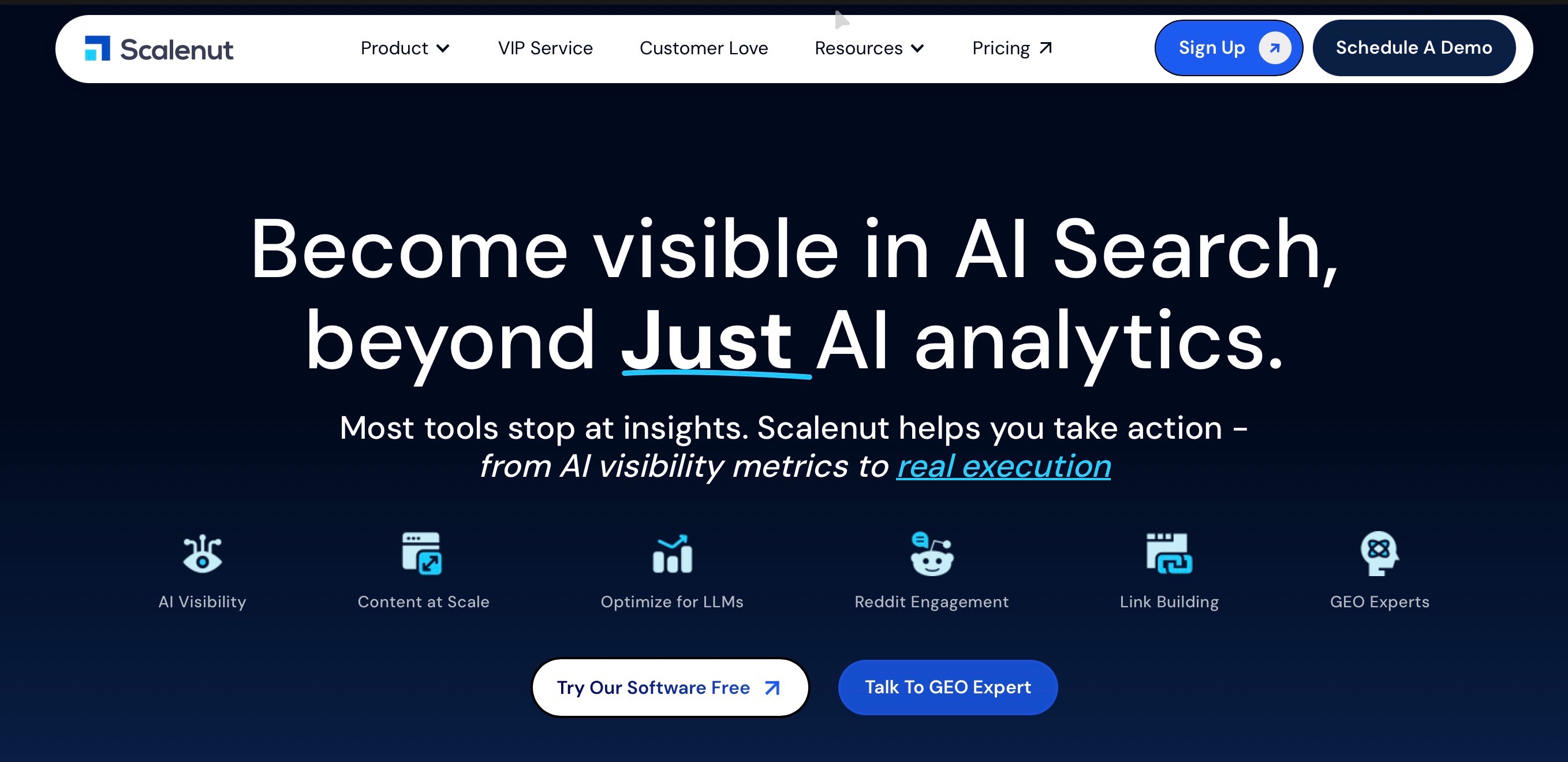
Scalenut is one of the best Peec AI alternatives if you do not want to stop at AI visibility tracking. It helps you monitor how your brand appears across AI engines, understand which prompts and sources influence visibility, and then turn those insights into content briefs, optimized pages, audits, and execution workflows. What I like most is that Scalenut connects GEO tracking with actual SEO and content work, instead of leaving you with dashboards you still need to interpret on your own.
What Are The Key Features Of Scalenut?
- AI Visibility Tracking: Tracks how your brand appears across supported AI engines, including ChatGPT, Google AI Overviews, and Perplexity depending on the plan.
- Brand Monitor: Shows visibility score, share of voice, average position, visibility rank, and competitor benchmarks across tracked prompts.
- Prompt Insights: Reveals which prompts include or exclude your brand, how AI systems reason through query fanouts, and where visibility gaps exist.
- Citations And Sources: Shows the URLs and domains AI engines cite when generating answers in your category.
- Sentiment Analysis: Helps you understand whether AI mentions around your brand are positive, neutral, or negative.
- AI Traffic Monitor: Uses Cloudflare integration to distinguish between human traffic, AI bot activity, and AI-driven referral visits.
- GEO Recommendations: Turns visibility gaps into action items like new article opportunities, backlink suggestions, and platform engagement ideas.
- Cruise Mode: Helps create SEO and GEO-ready long-form content using SERP and intent-based guidance.
- Content Optimizer: Gives real-time recommendations to improve existing pages for SEO, coverage, structure, and AI search readiness.
- Keyword Planner: Clusters keywords and topics so teams can build stronger topical authority instead of chasing isolated keywords.
- Content Audit: Flags pages that may need updates, consolidation, deeper optimization, or performance improvements.
- AI Link Manager: Supports internal linking workflows to improve site structure and content discoverability.
- OnPage Pro: Helps compare titles, meta descriptions, and on-page elements against what is working on the SERP.
- Social UpReach: Helps teams track and act on Reddit and community conversations that may influence brand visibility in AI search.
- Backlinks Marketplace: Gives teams a way to discover backlink opportunities that can support authority-building.
What Are The Pros Of Scalenut?
- It combines AI visibility tracking with content planning, writing, optimization, audits, and execution.
- I like that it does not just tell you where your brand is missing. It also helps you decide what to create, update, or strengthen next.
- The AI Traffic Monitor is useful because it shows how AI bots interact with your site, which traditional analytics tools often do not make obvious.
- Prompt insights, query fanouts, citations, and sentiment make the GEO data more useful than basic mention tracking.
- It is a strong fit for content teams, SEO teams, and agencies that want one workflow instead of stacking multiple tools.
- Features like Cruise Mode, Content Optimizer, Keyword Planner, Content Audit, and AI Link Manager make it more execution-focused than most Peec AI alternatives.
What Are The Cons Of Scalenut?
- AI Traffic Monitor needs Cloudflare integration, which may not work for every website setup.
- Like most AI content tools, generated drafts still need human editing, fact-checking, and brand voice cleanup.
- If you only want a lightweight AI visibility dashboard, Scalenut may feel broader than what you need.
How Much Does Scalenut Cost?
- Starter: $24/month
- Plus: $36/month
- Professional: $80/month
- VIP Service: Custom pricing
- Free Trial: 7-day free trial
Is Scalenut A Good Peec AI Alternative?
Yes, Scalenut is one of the best Peec AI alternative if your team wants to move from tracking AI visibility to actually improving it. Peec AI is useful for monitoring prompts, mentions, and competitors, but Scalenut goes further by connecting AI visibility insights with content creation, optimization, audits, internal linking, and GEO recommendations. I would choose Scalenut if the real goal is not just to know where your brand appears, but to build the content and authority signals that help it appear more often.
If you want to deep dive into Scalenut’s features, pricing, pros and cons, check out our full Scalenut review.
2. Scrunch AI [G2: 4.6/5]: Brand Perception And AI Visibility Monitoring

Scrunch AI is a strong Peec AI alternative if you mainly want to understand how your brand appears across AI search platforms. I like that it goes beyond basic mention tracking by showing prompts, citations, competitors, AI traffic, and page-level issues, so you get a clearer sense of why your brand is showing up and what may need fixing.
What Are The Key Features Of Scrunch AI?
- AI Visibility Monitoring: Tracks your brand presence, performance, and position across major AI platforms.
- Prompt Analytics: Helps you monitor prompts, topics, entities, trends, citations, competitors, and rankings.
- Citation Tracking: Shows which sources AI engines cite when mentioning your brand or competitors.
- Competitor Benchmarking: Lets you compare visibility by competitor, topic, persona, geography, and industry segment.
- Agent Traffic Monitoring: Shows how AI bots crawl your website and which pages they visit.
- Page Audits: Flags technical and content issues that may affect AI visibility.
- Insights And Content Gaps: Surfaces opportunities to improve AI search performance.
- Agent Experience Platform: Creates an AI-friendly version of your site for AI agents while keeping the human experience unchanged.
What Are The Pros Of Scrunch AI?
- It gives strong visibility into AI search performance, not just basic brand mentions.
- I like that it connects prompt tracking with citations, competitors, personas, and AI traffic.
- The dashboard feels easier to understand than many enterprise-heavy AI visibility tools.
- It is useful for brand, PR, and growth teams that care about how AI engines describe and cite them.
- The page audit and insights features make the data feel more actionable than a plain tracking dashboard.
- AXP is a genuinely interesting feature if your team wants to optimize how AI agents read your website.
What Are The Cons Of Scrunch AI?
- The $250/month starting price can feel expensive for smaller teams.
- The Core plan has limits on prompts, site audits, workspaces, users, and supported AI models.
- Expanded model coverage, API access, integrations, SSO, custom workspaces, and dedicated support are locked behind Enterprise.
- It is still stronger for AI visibility monitoring and diagnostics than full content execution.
- If you need built-in content planning, writing, optimization, and SEO workflows, you may need another tool alongside Scrunch.
How Much Does Scrunch AI Cost?
- Core: $250/month
- Enterprise: Custom pricing
- Free Trial: 7-day free trial
Is Scrunch AI A Good Peec AI Alternative?
Scrunch AI is a good Peec AI alternative if your priority is AI visibility monitoring, citation tracking, brand perception, and agent traffic insights. But I would not pick it if your biggest need is content execution. Scrunch is better for diagnosis, while Scalenut is more practical if you want to turn AI visibility insights into SEO and content action.
Also, check out our in-depth review of Scrunch AI.
3. AthenaHQ [G2: 4.9/5]: Action-Focused AI Search Visibility Platform
AthenaHQ is a good Peec AI alternative if you want AI visibility data that feels a bit more action-oriented. It helps you track how your brand shows up across major AI platforms, compare yourself against competitors, and spot content or citation gaps that may be holding you back. I like that it does not just throw dashboards at you, but I still see it as a better fit for teams with a serious GEO budget.
What Are The Key Features Of AthenaHQ?
- AI Visibility Monitoring: Tracks how your brand appears across major AI platforms, including ChatGPT, Perplexity, Gemini, Google AI Mode, Google AI Overviews, Claude, Copilot, and Grok.
- Competitor Monitoring: Shows how your visibility, citations, and positioning compare against competing brands.
- Citation Intelligence: Helps you understand which sources AI engines use when they mention your brand or competitors.
- On-Page And Off-Page GEO Analysis: Looks at both your website content and external signals that may influence AI visibility.
- Basic AI Content Optimization: Gives recommendations to improve how your content performs in AI search.
- Dynamic AI Crawling: Finds hidden or missed parts of your website that may affect AI visibility.
- AI Blind Spot Detection: Highlights areas where your brand is missing from important AI search conversations.
- Integrations: Supports tools like GA4, Google Search Console, Shopify, Webflow, and Framer.
What Are The Pros Of AthenaHQ?
- It feels more actionable than basic AI visibility tracking tools.
- I like that it connects visibility data with citation gaps, content gaps, and competitor movement.
- It covers a strong mix of AI platforms across search, answer engines, and LLMs.
- The reporting seems useful for SEO teams, growth teams, and agencies selling GEO services.
- The GA4 and Google Search Console integrations make it easier to connect AI visibility with actual performance.
- Unlimited seats on the Self-Serve plan are a nice touch for teams that want wider internal access.
What Are The Cons Of AthenaHQ?
- The $245/month annual starting price may still be expensive for smaller teams.
- The credit-based model can become tricky if you track many prompts across multiple AI platforms.
- Some of the stronger features, like LLM traffic analysis, deeper content workflows, ACE, API access, and dedicated support, are available only on Enterprise.
- It is still not a full content execution platform, so you may need another tool for writing, optimization, and publishing.
- If you only need simple AI visibility tracking, AthenaHQ may feel like more tool than you actually need.
How Much Does AthenaHQ Cost?
- Self-Serve: $245/month, billed annually
- Enterprise: Custom pricing
- Annual Benefit: 2 months free
Is AthenaHQ A Good Peec AI Alternative?
Yes, AthenaHQ is a good Peec AI alternative if you want stronger AI visibility tracking, competitor monitoring, citation intelligence, and more useful recommendations. I would consider it for SEO, growth, and agency teams that want clearer direction from their AI search data.
Want the deeper breakdown? Read our full AthenaHQ review to see where it shines, where it falls short, and whether it is worth your budget in 2026.
4. Profound [G2: 4.6/5]: Enterprise-Grade AI Visibility Analytics
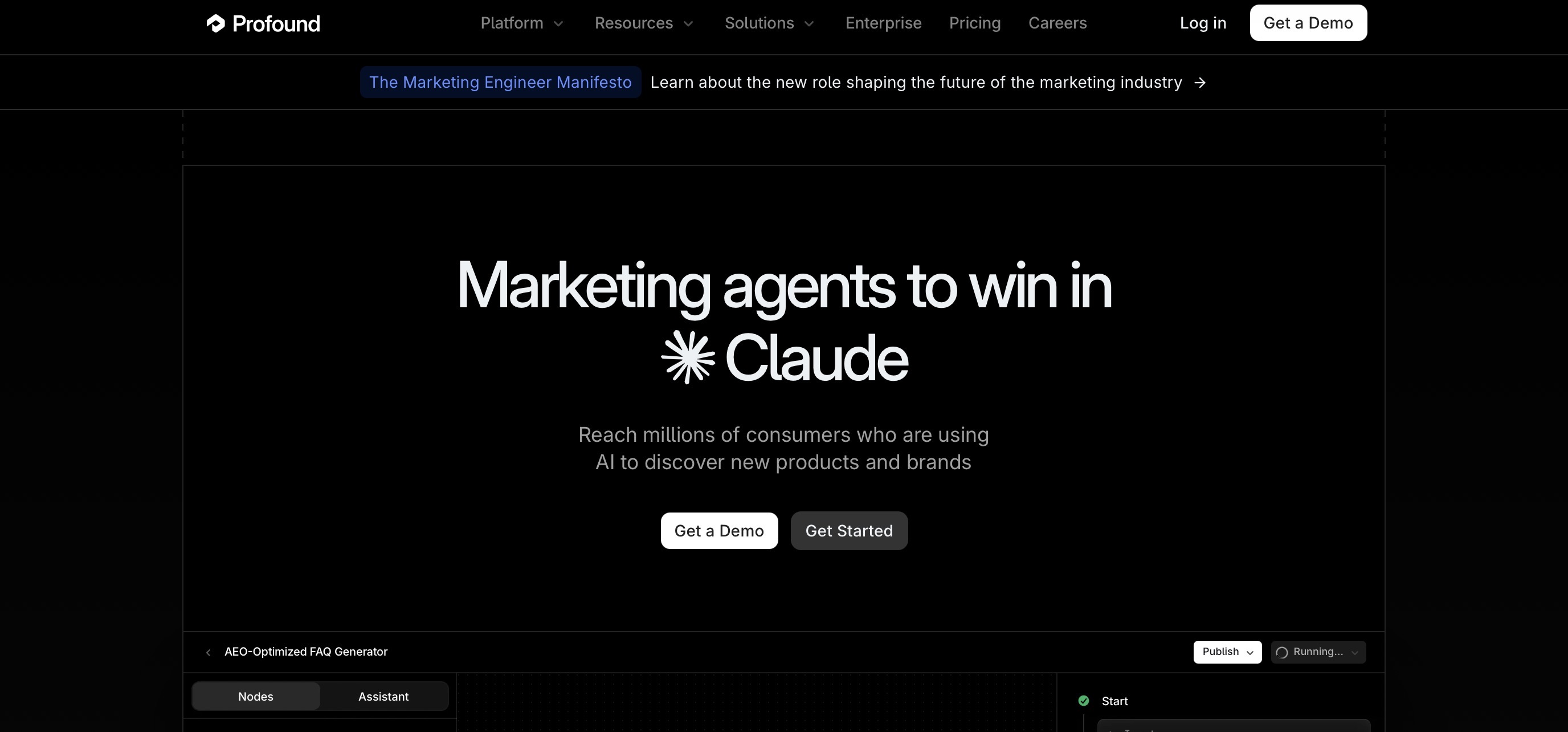
Profound is one of the more advanced Peec AI alternatives, but I would not call it the most beginner-friendly one. It is built for teams that want deep AI visibility analytics, citation tracking, prompt intelligence, agent traffic insights, and content workflows in one place. I like the depth it offers, especially for enterprise and SaaS teams, but the platform can feel heavy if you just want simple AI visibility monitoring.
What Are The Key Features Of Profound?
- Answer Engine Insights: Tracks visibility, citations, sentiment, share of voice, positioning, and brand performance across AI-generated answers.
- Prompt Volumes: Helps you understand what people are asking across AI answer engines using aggregated and anonymized prompt data.
- Citation Tracking: Shows which domains, URLs, and sources AI engines cite when talking about your brand or competitors.
- Agent Analytics: Tracks how AI crawlers and assistants access and use your website content.
- Profound Agents: Helps automate analysis, reporting, content updates, alerts, and other AEO workflows.
- Content Tools: Supports AI-ready content creation and optimization based on visibility insights.
- Shopping Dashboard: Helps track product visibility in ChatGPT Shopping and other AI shopping environments.
- Agency Mode: Helps agencies manage brand workspaces, pitch audits, and client reporting.
What Are The Pros Of Profound?
- It gives much deeper AI visibility data than a basic mention-tracking tool.
- I like that it connects visibility, citations, sentiment, prompts, and content workflows in one platform.
- Prompt Volumes is useful because it helps teams understand what users are actually asking inside AI tools.
- Agent Analytics is strong for teams that want to see how AI crawlers interact with their website.
- It is well suited for enterprise brands, SaaS companies, and agencies that need advanced AI search reporting.
- The platform is clearly built for AEO and GEO, not just adapted from traditional SEO software.
What Are The Cons Of Profound?
- It can feel too complex for smaller teams or marketers who only need simple AI visibility tracking.
- The pricing can get expensive quickly if you need broader answer engine coverage, more prompts, or enterprise-level features.
- There is a learning curve because the platform has a lot of data, workflows, and reporting layers.
- It is not the most practical option if your main need is fast content creation, optimization, and publishing at scale.
How Much Does Profound Cost?
- Starter: $82.50/month, billed yearly
- Growth: $332.50/month, billed yearly
- Enterprise: Custom pricing
- Annual Benefit: 2 months free
Is Profound A Good Peec AI Alternative?
Yes, Profound is a strong Peec AI alternative if you want deeper AI visibility analytics, prompt intelligence, citation tracking, and enterprise-grade reporting. I would consider it if your team has the budget, time, and internal expertise to use the data properly.
Also, read our full Profound AI Review to know if it is really the best option for your team.
5. Otterly.AI [G2: 4.8/5]: Budget-Friendly AI Search Monitoring

If you are looking for cheaper alternatives to Peec AI for GEO, Otterly.AI is a good alternative. It tracks how your brand and website show up across platforms like Google AI Overviews, ChatGPT, Perplexity, Microsoft Copilot, Google AI Mode, and Gemini. I like it more for teams that want clean monitoring and reporting without jumping straight into enterprise-level pricing.
What Are The Key Features Of Otterly AI?
- AI Search Monitoring: Tracks your brand mentions and website citations across major AI search platforms.
- AI Prompt Research: Helps you find the prompts and questions your audience may be asking in AI search.
- Brand Visibility Index: Shows how visible your brand is across tracked AI search experiences.
- Domain Ranking: Tracks which domains and URLs are being cited in AI-generated answers.
- Link Citation Analysis: Helps you understand which pages AI search engines reference and how citations change over time.
- Competitive Benchmarking: Compares your brand visibility, coverage, and citations against competitors.
- Content Audit: Reviews pages for AI readiness and gives suggestions to improve visibility.
- Reports And Exports: Lets teams export prompt and citation data for client reporting or internal analysis.
What Are The Pros Of Otterly.AI?
- It is much more affordable than many enterprise-heavy AI visibility tools.
- I like that it covers the main AI search platforms most teams care about.
- Daily tracking makes it useful for keeping tabs on brand visibility changes.
- The interface is fairly easy to understand, especially for smaller SEO and marketing teams.
- It includes useful reporting features for agencies and teams managing multiple brands.
- The 14-day free trial makes it easier to test before committing.
What Are The Cons Of Otterly.AI?
- The Lite plan includes only 15 search prompts, which may feel limiting once you start tracking more topics.
- Google AI Mode and Gemini are available as extra add-ons, so the base plan may not cover everything you need.
- It is still more of a monitoring and reporting tool than a full content execution platform.
- Some users mention a learning curve during setup, along with occasional slow loading or layout issues.
- If you need deeper enterprise analytics, agent traffic insights, or built-in content workflows, Otterly.AI may feel too lightweight.
How Much Does Otterly.AI Cost?
- Lite: $25/month, billed annually
- Standard: $160/month, billed annually
- Premium: $422/month, billed annually
- Annual Benefit: 15% off
- Free Trial: 14-day free trial
Is Otterly.AI A Good Peec AI Alternative?
If you want affordable AI visibility monitoring, prompt tracking, citation insights, and simple reporting, Otterly.AI can be a good Peec AI alternative. I would consider it for small teams, agencies, and marketers who want to start tracking AI search without spending too much.
6. Rankscale: AI Visibility Tracking For Agencies And Growing Teams
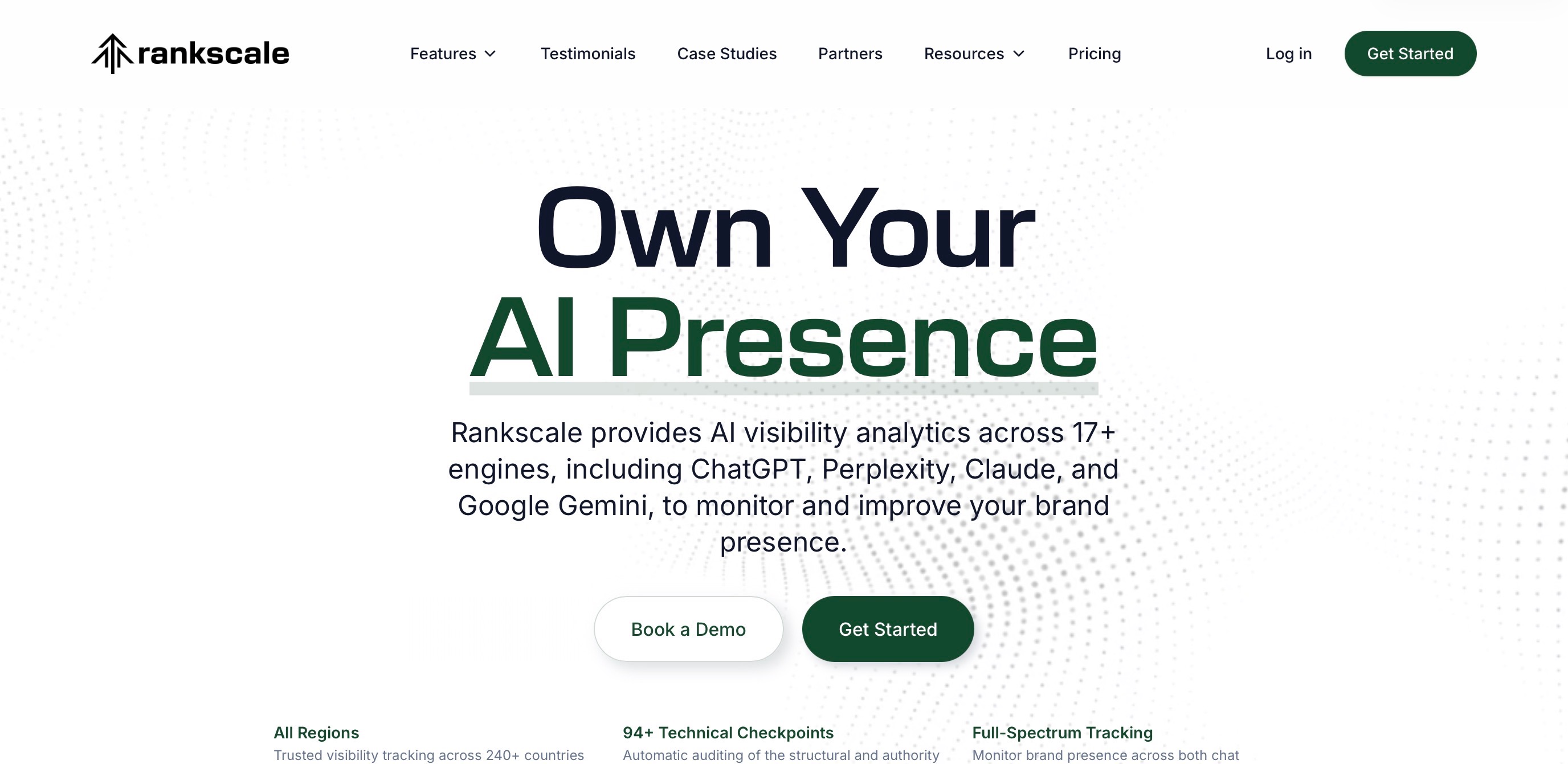
Rankscale is a good Peec AI alternative if you want detailed AI visibility tracking without jumping into the most expensive enterprise tools. It helps you monitor AI responses, citations, competitors, sentiment, page audits, and search terms across a wide set of AI engines. I like it more for agencies and teams that need flexible tracking and client-ready reporting, but the credit-based setup means you need to watch usage carefully.
What Are The Key Features Of Rankscale?
- AI Rank Tracking: Tracks your visibility score, rankings, brand mentions, citations, sentiment, and share of voice across AI engines.
- Competitor Analysis: Compares your brand against competitors across AI visibility, citations, sentiment, and ranking gaps.
- Citation Analysis: Shows which sources AI engines cite when mentioning your brand or competitors.
- Sentiment Analysis: Tracks how AI engines frame your brand by topic, model, and keyword themes.
- Prompt Research: Helps estimate prompt demand, decode intent, and identify question patterns worth targeting.
- Page Audits: Reviews AI readiness, crawlability, site hierarchy, and technical SEO signals.
- Custom Dashboards: Lets teams build saved dashboard views and share results with clients or stakeholders.
- Looker Studio And Exports: Supports reporting through Looker Studio, CSV, Google Sheets, and shareable dashboards.
What Are The Pros Of Rankscale?
- It tracks a strong mix of AI engines, including ChatGPT, Perplexity, Gemini, Claude, Google AI Overviews, AI Mode, DeepSeek, Grok, Mistral, and Copilot.
- I like that it goes deeper than simple brand mention tracking.
- The citation, sentiment, and competitor data are useful for agencies managing multiple clients.
- The page audit feature gives teams a better sense of what may be blocking AI visibility.
- Reporting options like dashboards, share links, exports, and Looker Studio make it easier to present results.
- The Pro plan includes unlimited search terms, which is useful if you want flexibility around topics and prompts.
What Are The Cons Of Rankscale?
- The credit-based pricing can become expensive if you track many prompts, engines, regions, or clients.
- Some stronger agency features, white-label options, REST API access, and larger dashboard limits are tied to higher plans.
- It is still stronger for monitoring and reporting than full content creation, optimization, and publishing.
How Much Does Rankscale Cost?
- Pro: $84/month, billed annually
- Growth: $327/month, billed annually
- Enterprise: $663/month, billed annually
- Annual Benefit: 15% off
- Free trial available for 7 days
Is Rankscale A Good Peec AI Alternative?
If you want detailed AI visibility tracking, competitor benchmarking, citation analysis, and flexible reporting are your priority, then Rankscale is a good Peec AI alternative. I would especially consider it for agencies or teams managing multiple brands.
7. PromptMonitor: Affordable AI Visibility Tracking For SMBs
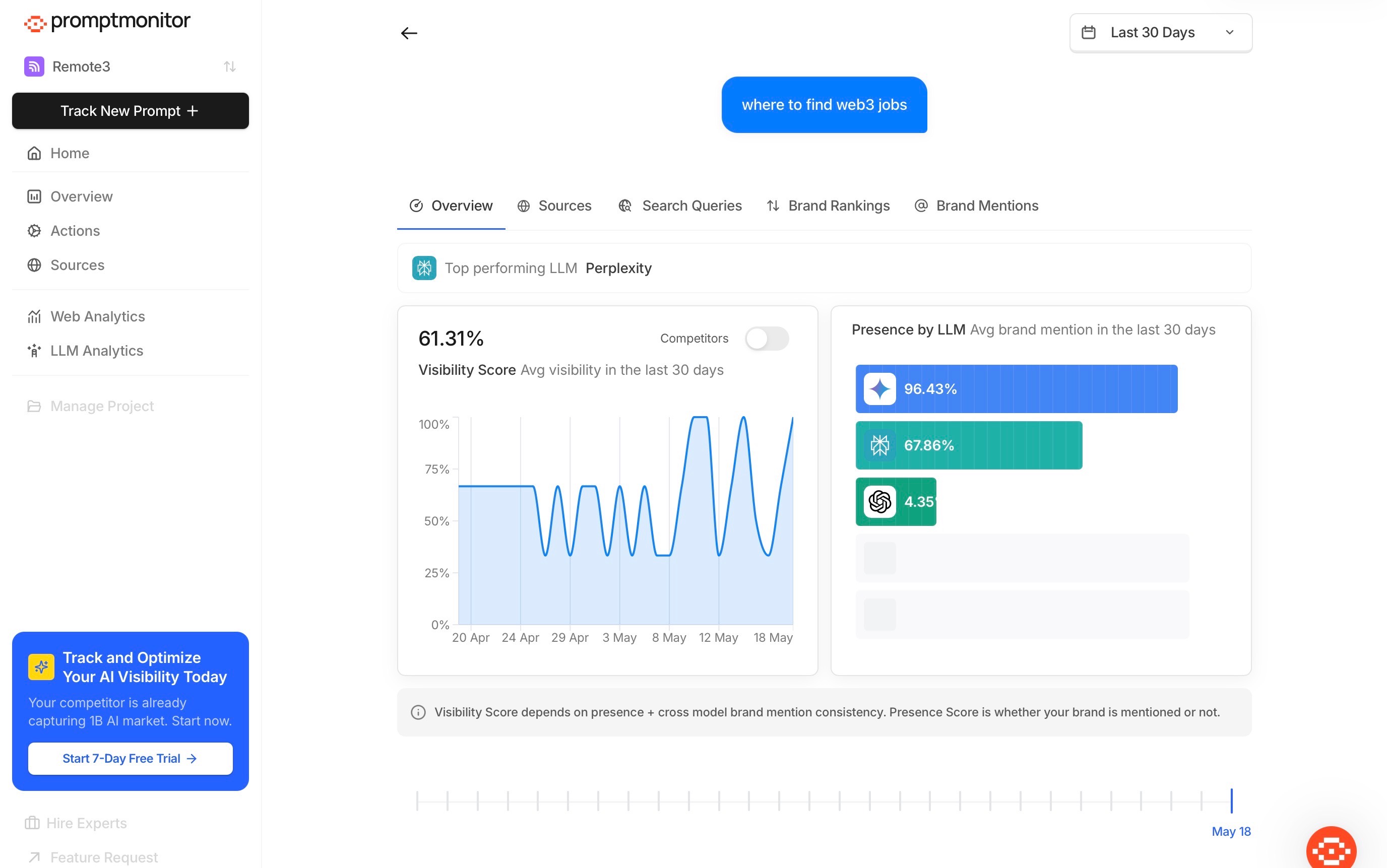
PromptMonitor is a good Peec AI alternative if you want a simple and affordable way to track brand visibility across AI search platforms. I like that it covers the essentials without making the product feel too heavy: prompt tracking, AI mentions, citations, competitor insights, website analytics, and AI crawler tracking. It feels best suited for SMBs, startups, and agencies that want visibility data without enterprise-level pricing.
What Are The Key Features Of PromptMonitor?
- Multi-Model AI Tracking: Tracks brand visibility across AI platforms like ChatGPT, Claude, Gemini, DeepSeek, Grok, Perplexity, Google AI Overview, and Google AI Mode.
- Prompt Tracking: Lets you monitor specific prompts and questions to see whether your brand appears in AI-generated answers.
- AI Visibility Score: Gives you a simple score based on how often your brand appears and how consistently it shows up across models.
- Citation And Source Tracking: Shows which websites and sources AI models use when generating answers in your category.
- Publisher Contact Discovery: Extracts contact details from cited sources so teams can support outreach and PR efforts.
- SEO Metrics: Helps you evaluate cited sources before deciding whether to outreach, create better content, or compete for visibility.
- Website Analytics: Tracks human visitors with privacy-first analytics.
- AI Search Bot And Crawler Analytics: Shows AI bots and crawlers visiting your website.
What Are The Pros Of PromptMonitor?
- It is one of the more affordable AI visibility tools in this category.
- I like that it combines prompt tracking, source tracking, and outreach opportunities in one workflow.
- It supports a strong mix of AI platforms, including ChatGPT, Claude, Gemini, DeepSeek, Grok, Perplexity, Google AI Overview, and Google AI Mode.
- The publisher contact discovery feature is useful if your strategy includes digital PR or citation outreach.
- It includes website analytics and AI bot tracking, which many lightweight tools skip.
- The 7-day free trial makes it easy to test before paying.
What Are The Cons Of PromptMonitor?
- Google AI Mode and AI Overview appear to be available only on the Pro plan.
- It is better for monitoring and outreach than full content execution.
- If you need deeper enterprise analytics, advanced workflows, or built-in content optimization, it may feel limited.
How Much Does PromptMonitor Cost?
- Starter: $29/month
- Growth: $39/month
- Pro: $129/month
- Free Trial: 7-day free trial
Is PromptMonitor A Good Peec AI Alternative?
Yes, PromptMonitor is a good Peec AI alternative if you want affordable AI visibility tracking, prompt monitoring, citation insights, and AI crawler analytics. I would consider it for SMBs, startups, and agencies that want a lighter tracking tool. But if your main goal is to turn AI visibility gaps into content plans, optimized pages, and publish-ready workflows, Scalenut is still the stronger execution-first option.
Want to go beyond basic tracking? Explore the best LLM optimization tools for AI visibility and see which platforms can help you improve how AI engines find, cite, and recommend your brand.
8. Knowatoa: Lightweight AI Search Visibility Tracking

Knowatoa is a good Peec AI alternative if you want a simpler way to track how your brand shows up across AI search platforms. It focuses on question-level visibility, brand mentions, competitor gaps, citations, sentiment, and AI search coverage. I like it for teams that want a clean starting point for GEO tracking, but I would not treat it as a full content execution platform.
What Are The Key Features Of Knowatoa?
- AI Visibility Tracking: Tracks share of voice, ranking positions, and mention frequency across major AI platforms.
- Question-Level Tracking: Shows which questions AI models associate with your brand, competitors, products, or topics.
- AI Search Monitoring: Tracks visibility across platforms like ChatGPT, Claude, Perplexity, Gemini, Google AI Overviews, Meta AI, and AI Mode.
- Competitor Gap Analysis: Helps you see where competitors appear more often and where your brand is missing.
- Source Opportunities Analysis: Highlights sources and citation opportunities that may influence AI search visibility.
- Brand Sentiment Analysis: Shows how AI platforms frame your brand in generated answers.
- AI Search Console: Tests whether AI bots can access your website and flags crawlability issues.
- Data Export: Supports CSV exports, with API, Data Studio, and NinjaCat available on the Growth plan.
What Are The Pros Of Knowatoa?
- It is easy to understand compared to heavier AI visibility platforms.
- I like that it tracks questions directly, because AI search behavior is much more prompt-led than keyword-led.
- Daily data refreshes are useful if you want to monitor visibility changes regularly.
- It includes competitor gaps, source opportunities, and sentiment, not just basic brand mentions.
- The AI Search Console feature is useful for checking whether AI bots can actually access your site.
What Are The Cons Of Knowatoa?
- API access, Looker Studio, NinjaCat, and broader platform coverage are available only on Growth.
- It is better for monitoring and diagnostics than creating, optimizing, and publishing content.
- If you need deeper reporting, advanced workflows, or large-scale content execution, it may feel limited.
How Much Does Knowatoa Cost?
- Starter: $49/month, billed annually
- Growth: $165/month, billed annually
- Free Trial: 7-day free trial
Is Knowatoa A Good Peec AI Alternative?
Knowatoa is a good Peec AI alternative if you want lightweight AI visibility tracking, question monitoring, competitor analysis, and sentiment insights at a lower price point. I would consider it for smaller SEO teams, founders, and marketers getting started with GEO.
9. SE Visible By SE Ranking [G2: 4.8/5]: AI Search Visibility Tracking For SEO Teams
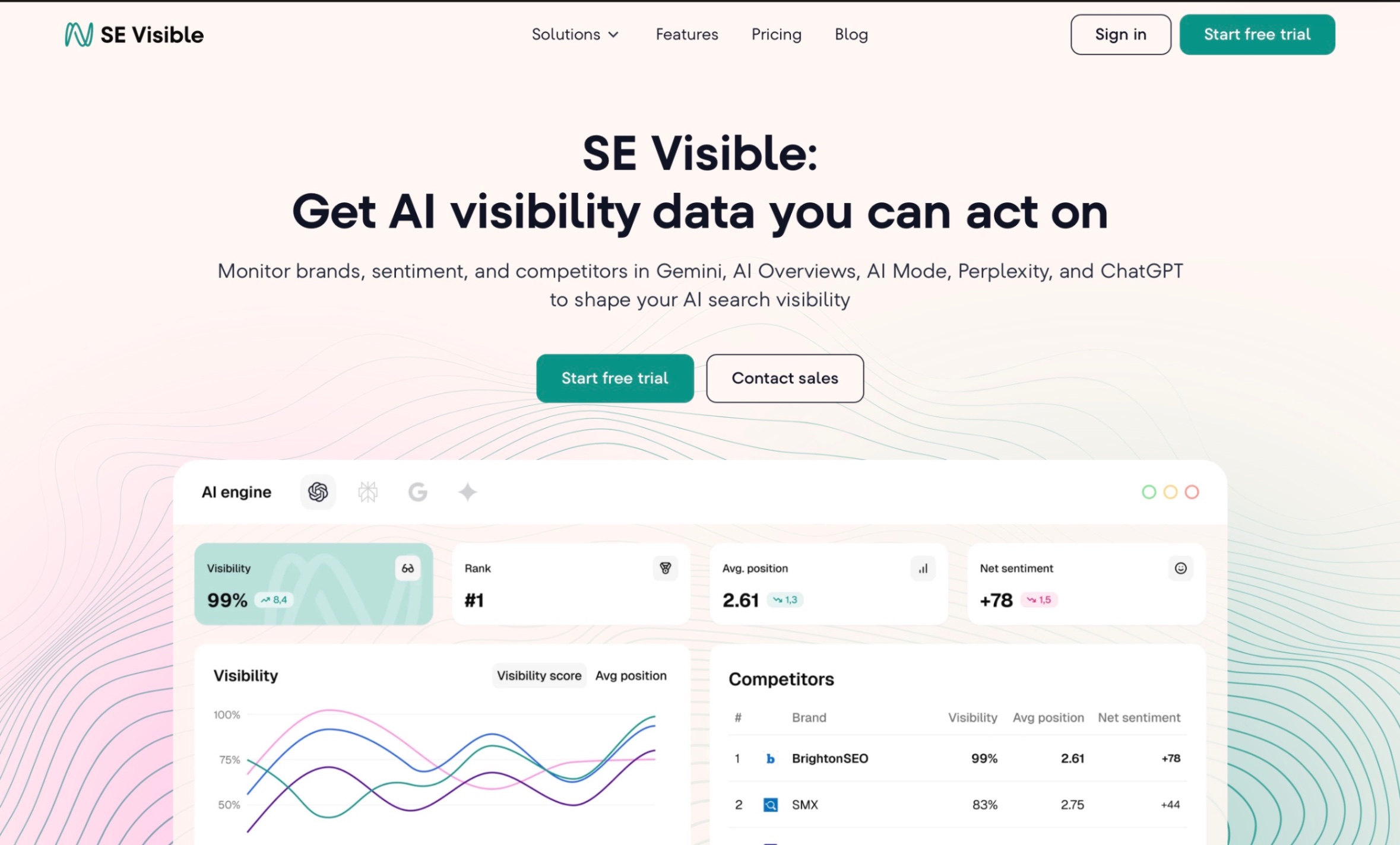
SE Visible is a good Peec AI alternative if you already like SE Ranking’s ecosystem and want a cleaner way to track AI visibility. It helps you monitor brand mentions, sentiment, competitors, prompts, and cited sources across major AI search platforms. I like it for reporting and visibility tracking, but I would not treat it as a full execution tool because most of the actual content work still happens outside SE Visible.
What Are The Key Features Of SE Visible?
- AI Visibility Tracking: Tracks how your brand appears across ChatGPT, Gemini, Google AI Mode, Google AI Overviews, and Perplexity.
- Competitor Benchmarking: Compares visibility share, average position, rankings, and sentiment against competing brands.
- Sentiment Analysis: Shows whether AI answers describe your brand in a positive, neutral, or negative way.
- Prompt Management: Lets you work with suggested prompts and custom prompts based on your brand, topics, and niche.
- Source Insights: Shows which domains and URLs AI engines cite most when generating answers in your category.
- Multi-Country Tracking: Tracks AI visibility across supported countries, including the US, UK, Canada, France, Germany, the Netherlands, and Spain.
- Multi-Language Setup: Supports brand monitoring in English, French, German, Dutch, and Spanish.
- CSV Exports: Lets teams export AI visibility reports for deeper analysis or stakeholder reporting.
What Are The Pros Of SE Visible?
- It is backed by SE Ranking, which already has strong credibility in the SEO software space.
- I like that it gives a clean view of visibility, competitors, sentiment, prompts, and sources in one dashboard.
- It supports multiple brands, which is useful for agencies or teams managing more than one product.
- Unlimited users make it easier for teams to collaborate without paying per seat.
- The source insights are useful if you want to understand which domains influence AI answers in your market.
- It works well for SEO teams that want AI visibility reporting without switching to a completely new ecosystem.
What Are The Cons Of SE Visible?
- It is still mainly a monitoring and reporting tool, not a full content execution platform.
- The lower plans do not support as many prompts or brands as larger teams may need.
- CSV export is useful, but teams that want deeper client-ready reporting may need more flexibility.
- If you need built-in content creation, optimization, and publishing workflows, SE Visible may feel limited.
How Much Does SE Visible Cost?
- Basic: $79/month, billed annually
- Core: $151/month, billed annually
- Plus: $284/month, billed annually
- Annual Benefit: 20% off
- Free Trial: 10-day free trial
Is SE Visible A Good Peec AI Alternative?
Yes, SE Visible is a good Peec AI alternative if you want clean AI visibility tracking, competitor benchmarking, sentiment analysis, and source insights, especially if you already use or trust SE Ranking.
10. Writesonic [G2: 4.7/5]: AI Search Visibility And Content Execution Platform
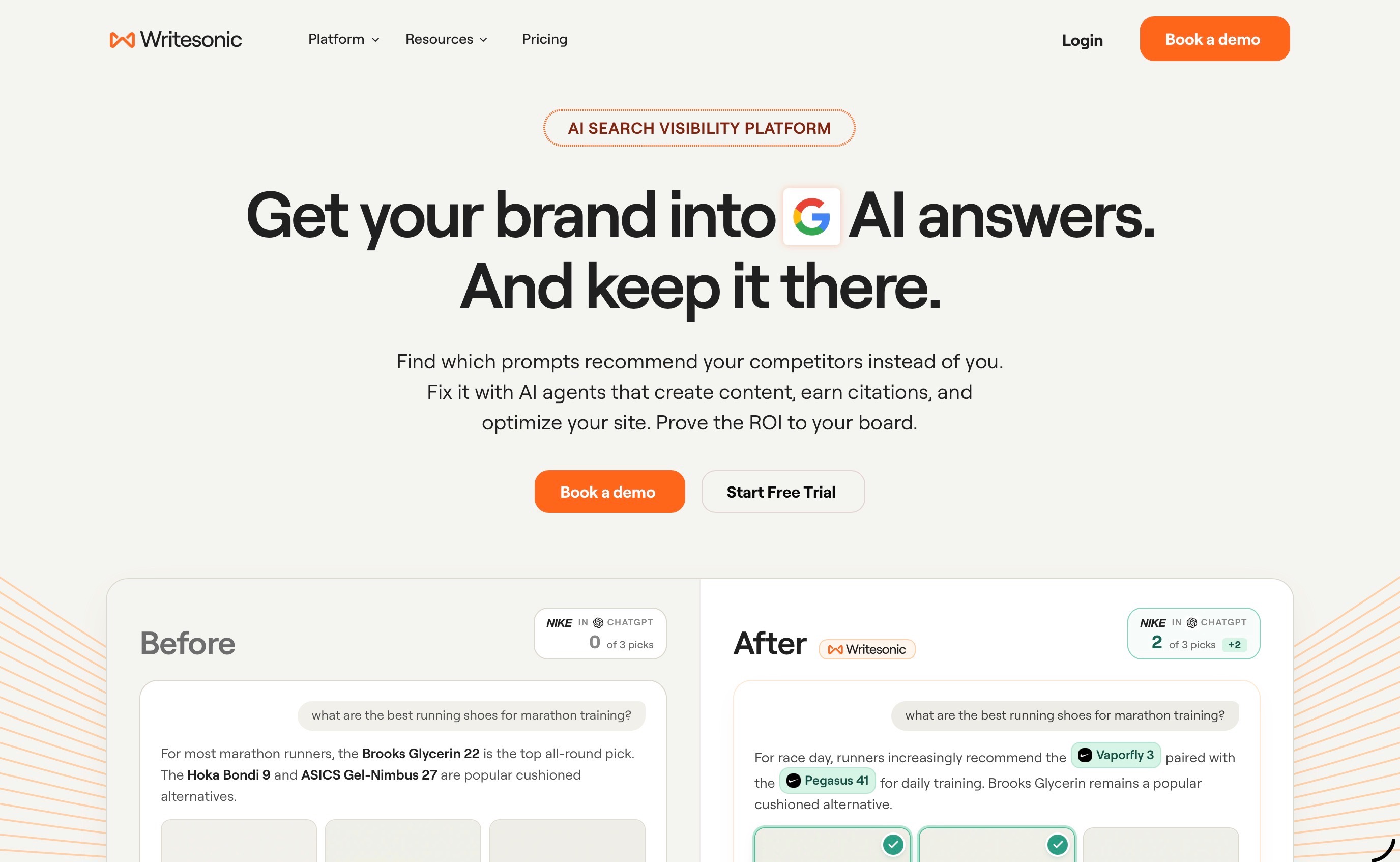
Writesonic is a stronger Peec AI alternative if you want AI visibility tracking and content execution in the same workflow. It helps you track how your brand appears across AI platforms, monitor citations and sentiment, and then act on those gaps through content creation, audits, and optimization. I like that it is not just a reporting tool, but the platform can feel heavy if all you need is simple visibility tracking.
What Are The Key Features Of Writesonic?
- AI Search Visibility Tracking: Tracks brand visibility across AI platforms, with coverage depending on the plan.
- Prompt And Answer Tracking: Shows how your brand appears across tracked prompts and AI-generated responses.
- Citation Tracking: Helps you see which sources AI engines reference when mentioning your brand or competitors.
- Sentiment Analysis: Tracks how AI platforms frame your brand, available from the Growth plan onward.
- Action Center: Turns visibility gaps, citation opportunities, and content issues into recommended actions.
- AI Traffic Analytics: Tracks how AI crawlers interact with your website and which pages they visit.
- Content And SEO Tools: Supports AI article creation, site audits, content refreshes, and SEO workflows.
- Enterprise AI Platform Coverage: Tracks all 10 AI platforms on the Enterprise plan, including ChatGPT, Perplexity, Claude, Gemini, Grok, DeepSeek, Copilot, Meta AI, Google AI Mode, and Google AI Overviews.
What Are The Pros Of Writesonic?
- It combines AI visibility tracking with content creation, audits, and optimization.
- I like that it gives teams a way to move from “we are missing” to “here is what we should fix.”
- The Action Center makes the platform feel more useful than a basic monitoring dashboard.
- It includes AI crawler and traffic analytics, which helps teams understand how AI systems interact with their site.
- It is useful for content and SEO teams that want one platform for SEO and GEO.
- The pricing is more structured than many enterprise-only AI visibility tools.
What Are The Cons Of Writesonic?
- Broader AI platform coverage is available only on higher plans, with all 10 platforms limited to Enterprise.
- The Action Center is limited on Growth and fully available only on Enterprise.
- It may feel too broad or complex if you only need lightweight brand tracking.
- Like most AI writing tools, generated content still needs human editing, fact-checking, and brand voice cleanup.
How Much Does Writesonic Cost?
- Starter: $79/month, billed annually
- Basic: $199/month, billed annually
- Growth: $399/month, billed annually
- Enterprise: Custom pricing
- Annual Benefit: Save 20%
Is Writesonic A Good Peec AI Alternative?
Writesonic is a good Peec AI alternative if you want AI visibility tracking, content workflows, audits, and optimization in one place. I would consider it for SEO and content teams that want to act on AI visibility gaps instead of only reporting on them.
Still unsure about Peec AI? Read our full Peec AI review to see where it works, where it feels limited, and whether it is worth using for AI visibility tracking.
How To Choose The Right Peec AI Alternative For Your Team?
Choosing the right Peec AI competitor tools depend on what you need after visibility tracking. Some tools are better for reporting, some are better for brand monitoring, and some are better when you actually want to turn AI visibility gaps into content action. Here are best options based on your team’s need:
1. Which Is The Best Peec AI Alternative For Content Execution?
Scalenut is the best fit if you want to move beyond tracking and actually create, optimize, audit, and improve content from one place. I’d choose it if your team cares about SEO, GEO, and execution, not just AI visibility dashboards.
2. Which Is The Best Peec AI Alternative For Enterprise AI Visibility?
Profound makes the most sense for enterprise teams that need deep AI visibility analytics, prompt intelligence, citation data, and advanced reporting. I’d pick it only if your team has the budget and bandwidth to actually use all that data.
3. Which Is The Best Peec AI Alternative For Brand Perception Monitoring?
Scrunch AI is a strong choice if your main concern is how AI platforms describe, cite, and position your brand. It works well for brand, PR, and growth teams that need visibility diagnostics more than content execution.
4. Which Is The Best Peec AI Alternative For Action-Focused SEO Teams?
AthenaHQ is useful if you want AI visibility tracking with clearer recommendations and competitor insights. I’d consider it for SEO, growth, and agency teams that want to understand what to fix next, not just where they stand.
5. Which Is The Best Peec AI Alternative For Budget AI Search Tracking?
OtterlyAI is a good pick if you want Peec AI cheaper alternatives without a complicated setup. It gives smaller teams a practical way to track prompts, brand visibility, and citations before investing in a heavier platform.
6. Which Is The Best Peec AI Alternative For Agencies?
Rankscale is one of the better options for agencies managing multiple brands or clients. I’d choose it for flexible reporting, competitor benchmarking, citation tracking, sentiment data, and client-friendly dashboards.
7. Which Is The Best Peec AI Alternative For SMBs And Startups?
PromptMonitor is a practical option for SMBs, startups, and smaller agencies that want affordable prompt tracking. I especially like it for teams that also care about AI crawler analytics and outreach opportunities from cited sources.
8. Which Is The Best Lightweight GEO Tracker Alternative To Peec AI?
Knowatoa is a good fit if you want simple question-level GEO tracking without paying for a heavy enterprise platform. It is useful for monitoring competitor gaps, source opportunities, sentiment, and basic AI visibility trends.
9. Which Is The Best Peec AI Alternative For SE Ranking Users?
SE Visible is the easiest fit if your team already uses SE Ranking or wants AI visibility tracking inside a familiar SEO ecosystem. It is better for reporting, competitor benchmarking, and source insights than full content execution.
10. Which Is The Best Peec AI Alternative For AI Visibility Plus Content Workflows?
Writesonic is worth considering if you want AI visibility tracking and content workflows in the same platform. It gives you monitoring, audits, AI articles, sentiment analysis on higher plans, and action recommendations, but I’d compare it closely with Scalenut if content execution is the main priority.
If you only want visibility data, pick a tracking-first tool. But if your team is asking, “What should we create, fix, or optimize next?”, choose a Peec AI alternative that connects AI visibility insights with real content execution.
Looking for a budget friendly GEO stack? Explore our list of the 11 best GEO tools under $100/month to find your best option in 2026.
Conclusion
The best Peec AI alternative depends on what you need next, not just what looks best on a pricing page. Start by deciding whether your team needs simple monitoring, deeper reporting, or actual content execution. For marketing leaders, the smartest move is to choose a tool that helps you understand visibility across AI search engines, track how large language models mention your brand, and improve the content signals that influence modern search systems.
That is where generative engine optimization becomes practical: audit your gaps, prioritize high-impact pages, and choose a platform that helps you move from visibility data to measurable action.
Frequently Asked Questions
What should I look for when choosing a Peec.ai alternative?
Look for AI platform coverage, prompt tracking depth, citation insights, competitor benchmarking, reporting, pricing, and whether the tool helps you act on the data. If content execution matters, Scalenut is stronger because it connects AI visibility with planning and optimization.
Are there free alternatives to Peec.ai for AI optimization tasks?
Fully free Peec.ai alternatives are limited. Some tools offer free trials or free reports, but ongoing AI visibility tracking usually requires a paid plan. For serious AI optimization, expect to pay once you need citations, reporting, or content workflows.
Are there any Peec.ai alternatives that are better for SEO tracking?
Yes. Scalenut and SE Visible are better fits if SEO tracking matters alongside AI visibility. Scalenut is useful for content teams because it combines GEO tracking with keyword planning, content optimization, audits, and AI visibility workflows in one platform.
What are the main advantages of using a Peec.ai alternative?
The biggest advantage is flexibility. A Peec.ai alternative may offer better pricing, broader AI engine coverage, deeper reporting, easier SEO workflows, or stronger content execution. Scalenut stands out when you need to turn AI visibility insights into actual content improvements.
Which are the top Peec AI competitors with ChatGPT tracking?
Top Peec AI competitors with ChatGPT tracking include Scalenut, Scrunch AI, Rankscale, Writesonic, and OtterlyAI. Scalenut is especially useful if you want ChatGPT visibility insights connected to SEO content planning, optimization, and execution, not just prompt monitoring.
What is the best Peec AI alternative for content teams?
Scalenut is the best Peec AI alternative for content teams that want more than visibility tracking. It combines AI visibility insights with keyword research, content planning, AI writing, optimization, audits, and SEO workflows, making it more useful for teams focused on execution.
What does Peec AI actually do?
Peec AI helps brands track how they appear across AI search platforms. It monitors prompts, brand visibility, share of voice, competitors, sentiment, and citations, so teams can understand where they show up and which sources influence AI-generated answers.
Which Peec AI alternative is best for AI visibility tracking?
Scrunch AI, AthenaHQ, Profound, Rankscale, and SE Visible are strong options for AI visibility tracking. Scrunch is better for brand perception, Profound for enterprise analytics, Rankscale for agencies, and SE Visible for teams already using SE Ranking.
Are there cheaper alternatives to Peec AI?
Yes. Peec.ai lower cost competitors include Scalenut, OtterlyAI, PromptMonitor, and Knowatoa. These are the best options for teams that want to start tracking AI visibility without a heavy budget. They are useful for monitoring, but may feel limited if you need full content execution.
Which Peec AI alternative is best for agencies?
Rankscale and Scalenut are among the best Peec AI competitors for agencies because it supports flexible AI visibility reporting, competitor tracking, sentiment insights, citation analysis, and client-friendly dashboards. PromptMonitor can also work well for smaller agencies that want affordable prompt tracking and outreach-focused features.
Which Peec AI alternative offers better GEO optimization features?
Scalenut, Writesonic, AthenaHQ, and Knowatoa offer stronger GEO optimization support than basic monitoring tools. Scalenut is stronger for content execution, Writesonic for AI visibility plus content workflows, AthenaHQ for recommendations, and Knowatoa for lightweight question-level GEO tracking.
Is Scrunch AI a good Peec AI alternative?
Yes, Scrunch AI is a good Peec AI alternative if your priority is brand perception monitoring, citation insights, competitor tracking, and agent traffic data. It is stronger for diagnosis than execution, so it may not be ideal if you need built-in content workflows.
Which Peec AI alternative is best for AI-driven websites?
SE Visible, Scrunch AI, Rankscale, and Scalenut can help teams understand visibility across AI-driven search experiences. If your goal is tracking, SE Visible or Rankscale may work well. If your goal is improving content performance, Scalenut is more practical.


.svg)


.webp)