.jpg)
How Does SEO Content Automation Help You Scale Faster?

Key Highlights
- SEO content automation uses artificial intelligence and software to streamline the entire content workflow.
- Content automation tools help with tasks like keyword research, drafting, and performance tracking.
- By using natural language processing, these tools can assist in scaling content production efficiently.
- Automation helps marketing teams save time on repetitive tasks, allowing a focus on strategy and creativity.
- While AI handles parts of the process, human oversight is crucial for maintaining brand voice and quality.
- Implementing automation can lead to faster content creation, lower costs, and better operational efficiency.
Are you finding it difficult to keep up with the demands of modern content creation? From blogs to social media, the need for fresh, high-quality content is constant. This is where SEO content automation comes into play. By leveraging artificial intelligence, you can transform your content strategy, making it more efficient and effective. This guide will walk you through what content automation is, how it works, and how you can use it to your advantage without sacrificing quality.
What Is SEO Content Automation?
SEO content automation involves using software and technology, like generative AI, to handle various stages of the content creation process with minimal human intervention. It’s not about replacing your content teams but empowering them. These automation tools are designed to take over repetitive and time-consuming functions within the content lifecycle, from initial planning and research to publishing and analysis.
The way it works is by connecting different parts of your workflow into a cohesive system. For example, a tool might identify relevant topics, generate a draft based on keywords, and then schedule the finished piece for publication. This allows you to scale your content output, improve consistency, and free up your team to focus on more creative and strategic tasks that require a human touch.
Can SEO Content Really Be Automated?
Yes, to a large extent, SEO content can be automated. Modern automation tools powered by artificial intelligence and natural language processing can handle many aspects of content generation, optimization, and management. This includes everything from finding keywords to drafting articles.
However, full automation isn't always the answer. The most effective approach combines the power of technology with human expertise. While tools can generate content quickly, people are essential for ensuring accuracy, maintaining a unique brand voice, and adding creative insights that resonate with your audience.
When Does SEO Content Automation Make Sense?
Deciding when to use SEO content automation is key to its success. It makes the most sense when you're dealing with tasks that are repetitive, scalable, and don't require deep human creativity. This technology shines when you need to increase your content production without overwhelming your marketing teams.
Automation is particularly useful for streamlining your content planning and execution. It helps maintain a consistent brand voice across a large volume of content by using predefined guidelines and templates. By handling the more tedious aspects of content creation, automation frees up your team to focus on higher-value activities like strategy and analysis.
Consider using automation for:
- Generating content for topics with straightforward, data-driven answers.
- Scaling the production of similar content types, like product descriptions or local landing pages.
- Handling repetitive tasks such as keyword research, outline creation, and performance reporting.
When Should You Avoid Or Limit SEO Content Automation?
While automation is powerful, it's not suitable for every content task. You should avoid or limit its use when human creativity, expertise, and a nuanced understanding of your brand are essential. Over-reliance on automation for certain types of content can lead to generic, impersonal, and even inaccurate information.
Maintaining brand consistency and building thought leadership often requires a human touch that AI can't replicate. Your content management strategy should clearly define which parts of the content workflow benefit from automation and which need direct human oversight to ensure quality and authenticity.
Avoid fully automating:
- Content that requires deep expertise or unique perspectives.
- Pieces intended to establish your brand as a thought leader.
- Core brand messaging and narrative pages.
- Highly sensitive or regulated topics where accuracy is paramount.
What Are The Benefits Of SEO Content Automation?
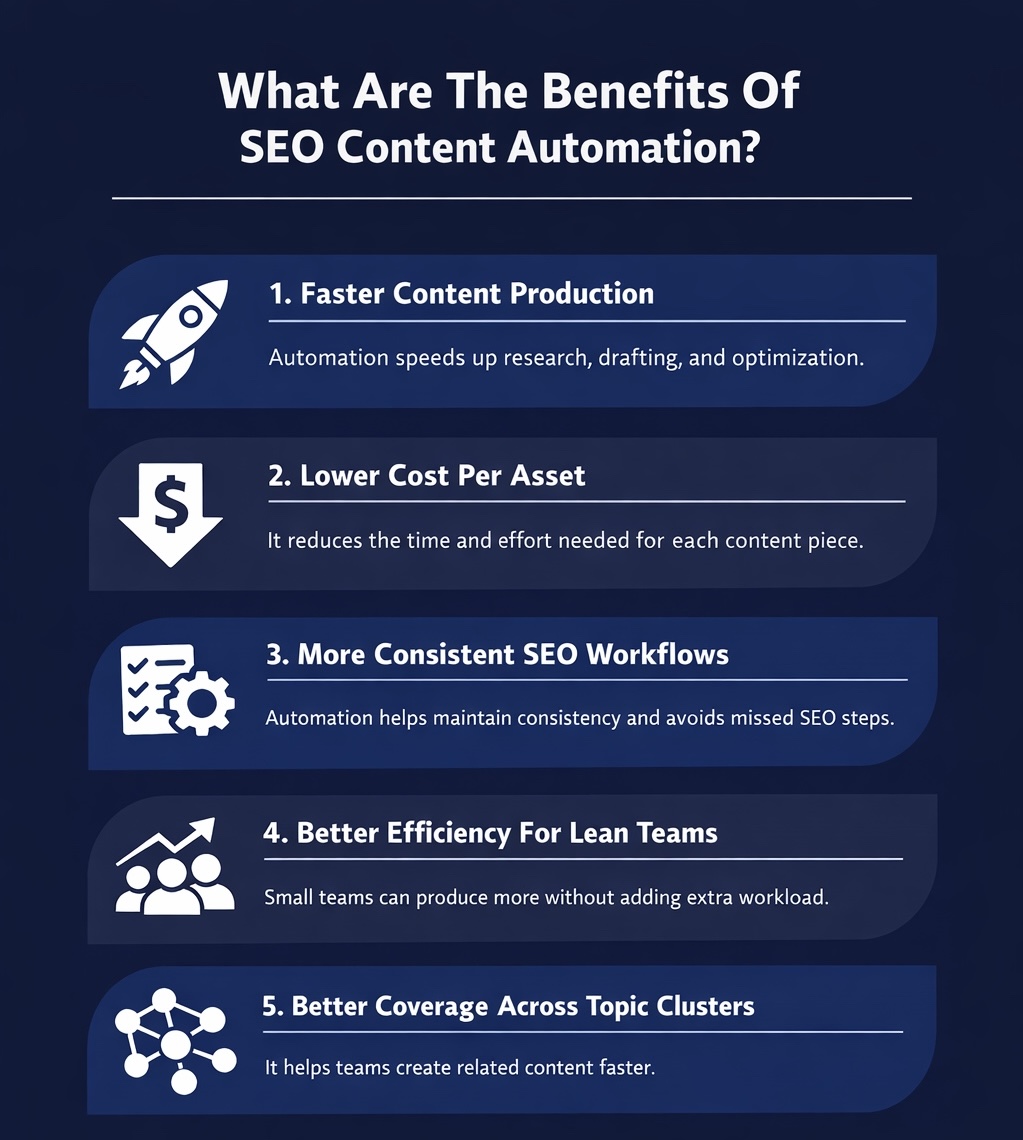
Integrating SEO content automation streamlines workflows, speeds up production, and reduces errors. It enables your team to create more content in less time, ensuring consistency and scaling your marketing efforts efficiently.
Let's explore some of the key benefits you can expect when you implement SEO content automation.
1. Faster Content Production
One of the most significant advantages of automation is the speed it brings to your content production. Manually creating content, from research to writing and editing, can take a significant amount of time. This process often involves multiple team members and several rounds of revisions, leading to delays.
Automation platforms can handle many of these steps in a fraction of the time. For instance, AI can generate a first draft or a detailed outline in minutes, giving your writers a solid starting point. This acceleration allows your team to move from idea to published piece much more quickly.
By automating the more mechanical parts of content creation, you can free up your team to produce more content without sacrificing quality. This means you can publish more frequently, stay on top of trends, and keep your audience engaged with a steady stream of fresh material.
2. Lower Cost Per Asset
Creating content traditionally involves significant costs, including salaries for writers, editors, and strategists. When your content strategy requires a high volume of assets, these costs can add up quickly, especially for smaller teams or businesses with limited budgets.
Content automation tools help reduce these expenses by improving efficiency. Since team members can produce content faster, the cost associated with each blog post, article, or social media update decreases. You can get more done without needing to hire additional staff.
This cost-effectiveness allows you to reallocate your budget to other important areas, such as promoting your content or investing in other marketing initiatives. By optimizing your resources, you can achieve a higher return on investment from your overall content efforts.
3. More Consistent SEO Workflows
Consistency is crucial for successful SEO, but it can be challenging to maintain when multiple people are involved in the content workflow. Different writers may have varying styles, and manual processes can lead to missed steps, such as forgetting to add meta descriptions or internal links.
Automation helps standardize your content management and creation processes. By using templates and predefined rules, you can ensure that every piece of content adheres to your brand's guidelines and SEO best practices. This creates a uniform experience for your audience and sends clear signals to search engines.
When your content teams follow a consistent, automated workflow, there's less room for human error. This leads to higher-quality outputs and a more streamlined process from start to finish, making it easier to manage and scale your content operations.
4. Stronger Operational Efficiency For Lean Teams
For small or lean marketing teams, juggling all the tasks required for a successful content strategy can be overwhelming. Content automation capabilities can be a game-changer in these situations, acting as a force multiplier for your team.
By automating routine tasks, you empower your team members to focus on what they do best: strategy, creativity, and analysis. This shift not only boosts morale but also significantly improves operational efficiency. A small team can achieve the output of a much larger one without burning out.
This enhanced efficiency means you can compete with larger organizations, covering more topics and publishing more frequently. It allows you to make the most of your limited resources and achieve your content goals without needing a massive team.
5. Better Coverage Across Topic Clusters
Building authority in your niche requires comprehensive coverage of relevant topics. The topic cluster model, where you create a pillar page and surround it with related content, is an effective SEO strategy. However, producing all that content can be a massive undertaking.
Automation can accelerate this process significantly. You can use tools to perform extensive keyword research and identify gaps in your content, generating numerous content ideas to build out your topic clusters. This ensures you cover a subject thoroughly, establishing your website as a go-to resource.
With AI assistance, you can quickly generate drafts for cluster content, allowing you to build out your pillars and supporting pages much faster than you could manually. This approach helps you strengthen your topical authority, improve internal linking, and ultimately boost your search engine rankings.
6. Stronger Operational Efficiency For Lean Teams
Achieving high operational efficiency is a common goal for all marketing teams, but it's especially critical for those with fewer resources. Content automation streamlines your entire content workflow, from ideation to publication and analysis, which reduces manual effort and minimizes bottlenecks.
This structured approach ensures that everyone on the team knows their role and that processes run smoothly. When repetitive tasks are automated, your team can dedicate more time to strategic planning and creative development, which are areas where human input is most valuable.
Ultimately, a more efficient content workflow means you can produce a higher volume of quality content consistently. This not only improves your SEO performance but also allows your team to be more agile and responsive to market changes, giving you a competitive edge.
Which SEO Content Tasks Should You Automate First?
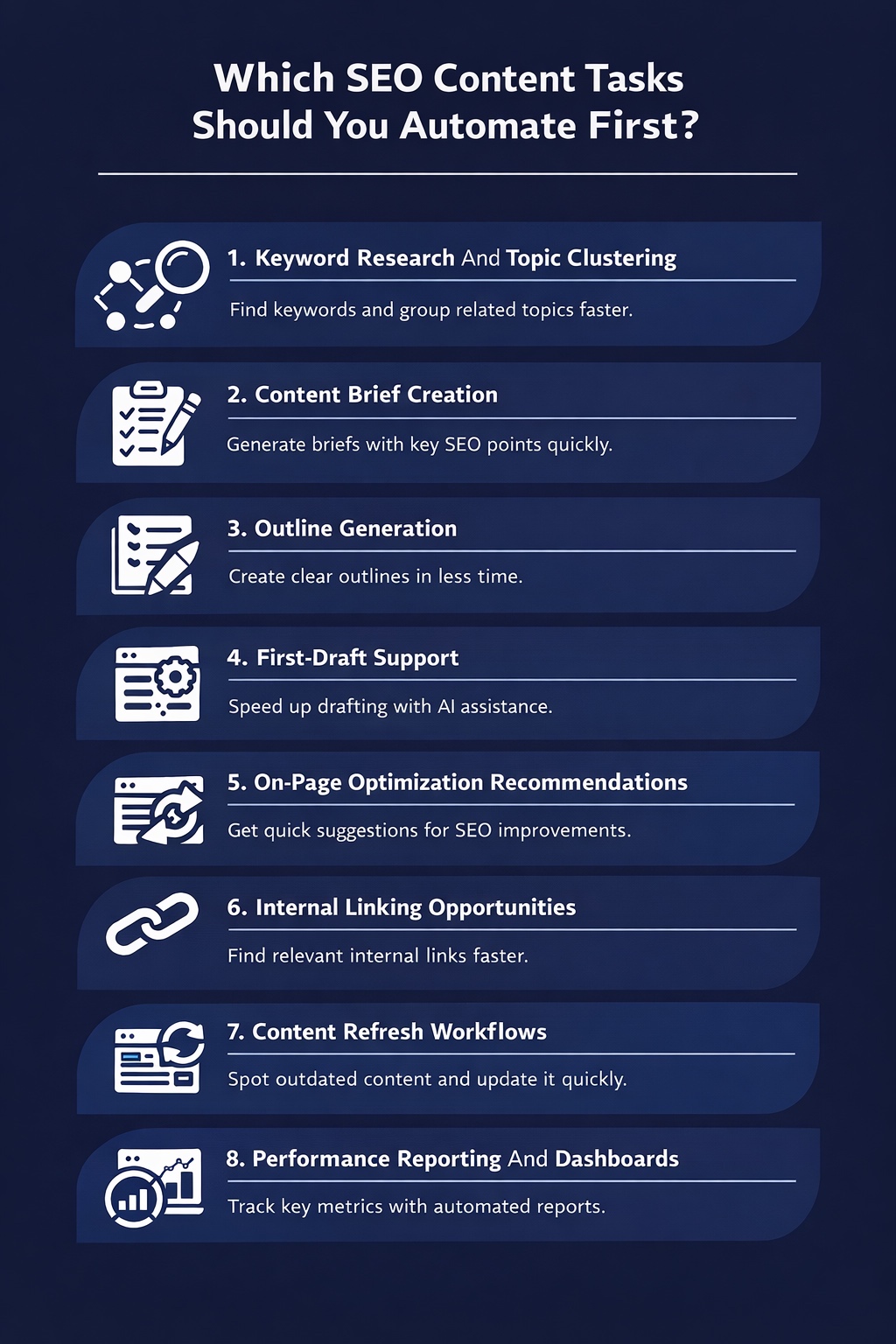
When starting with content automation, focus on your most repetitive and time-consuming tasks for quick wins and to show the value of automation. Begin with keyword research, outline generation, and performance reporting. Automating these basics streamlines your workflow early on. As your team adapts, gradually expand automation to areas like first-draft creation and email marketing.
Below are some of the best tasks to automate first.
1. Keyword Research And Topic Clustering
Keyword research is the foundation of any successful SEO strategy, but it can be an incredibly tedious process. Manually sifting through data to find the right keywords and group them into relevant clusters can take hours, if not days.
This is where automation tools can make a huge impact. These tools can analyze massive amounts of search data in seconds, identifying high-potential keywords and organizing them into logical topic clusters. This process of topic identification becomes much faster and more accurate with AI.
By automating keyword research, you not only save time but also uncover opportunities you might have missed. You can quickly identify content gaps, understand user intent, and build a data-driven content plan that sets you up for success.
2. Content Brief Creation
A detailed content brief is essential for ensuring that your writers produce content that aligns with your goals and SEO strategy. However, creating these briefs manually for every single article can be a repetitive and time-consuming part of content planning.
Automation can streamline this process significantly. Tools can analyze top-ranking pages for a target keyword and automatically generate a comprehensive content brief. This brief can include recommended headings, related keywords to include, word count targets, and other important optimization details.
By providing your content creators with a clear, data-driven brief, you reduce the back-and-forth and ensure everyone is on the same page. This leads to higher-quality content that is more likely to rank well, all while saving your content managers valuable time.
3. Outline Generation
Once you have your topic and keywords, the next step is creating a logical structure for your content. Outline generation is a critical step that guides the writer and ensures the final blog post covers all the necessary points in a coherent way.
Creating an outline from scratch can be challenging, especially when you're trying to come up with fresh content ideas. AI-powered tools can analyze the structure of top-performing articles and generate a detailed outline for you in seconds.
This automated outline serves as a strong foundation for your writer. It can suggest H2s and H3s, key questions to answer, and a logical flow for the article. This not only speeds up the writing process but also helps ensure your content is comprehensive and well-organized.
4. First-Draft Support
Writer's block is a real challenge, and staring at a blank page can be daunting. Providing your writers with a solid first draft can dramatically accelerate the content generation process and help them overcome this initial hurdle.
Using generative AI, you can create a complete first draft of an article based on your outline and content brief. This draft won't be perfect, but it gives your writer a substantial amount of material to work with. Instead of starting from scratch, they can focus on refining, fact-checking, and adding their unique voice to the piece of content.
This approach combines the speed of AI with the expertise of a human writer. It allows you to scale your content production significantly while still maintaining a high level of quality and authenticity in the final product.
5. On-Page Optimization Recommendations
On-page optimization is essential for helping search engines understand your content and rank it appropriately. This involves optimizing elements like titles, headings, meta descriptions, and keyword usage. Manually checking every piece of content for these elements can be time-consuming.
SEO content automation tools can analyze your content and provide real-time optimization recommendations. As you write or edit, the tool can score your content based on target keywords and suggest improvements. This ensures that every article is properly optimized before it goes live.
By leveraging performance data, these tools can also help you understand what works best in your niche. They can provide data-backed suggestions that go beyond basic best practices, helping you create content that is truly optimized for success.
6. Internal Linking Opportunities
Internal linking is a powerful yet often overlooked aspect of SEO. A strong internal linking structure helps search engines discover your content, passes authority between pages, and improves user engagement by guiding visitors to related articles.
Manually finding relevant internal linking opportunities across your entire website can be a monumental task, especially as your site grows. Automation tools can scan all of your existing website content and suggest relevant pages to link to from your new article.
These tools use natural language processing to understand the context of your content and identify the most logical and valuable linking opportunities. By automating this process, you can ensure your internal linking strategy is robust and effective, without spending hours manually searching for links.
7. Content Refresh Workflows
Content isn't static; it has a lifecycle. Over time, information can become outdated, and rankings can decline. A content refresh, where you update and improve existing articles, is a highly effective way to maintain and boost your SEO performance.
Managing the content refresh process manually can be difficult. You need to identify which articles need updating, what changes to make, and track the impact of those changes. Automation can streamline this entire workflow. Tools can perform performance analysis to flag content with declining traffic or rankings.
Once an article is identified for a content refresh, automation can help by suggesting new keywords, providing updated on-page optimization recommendations, and even generating new sections of content. This makes the refresh process faster and more effective, helping you get more value from your existing content.
8. Performance Reporting And Dashboards
Tracking the performance of your content is essential for understanding what's working and what's not. However, manually pulling data from various analytics tools and compiling it into a coherent report can be a major time sink.
Performance reporting is a prime candidate for automation. You can set up automated dashboards that pull key metrics from tools like Google Analytics and Google Search Console into one centralized location. This gives you a real-time view of your content performance without any manual data entry.
By automating data analytics and reporting, you can spend less time on data collection and more time on analysis and strategy. These dashboards can help you quickly identify trends, measure the ROI of your content efforts, and make data-driven decisions to improve your strategy.
Which SEO Content Tasks Should You Not Fully Automate?
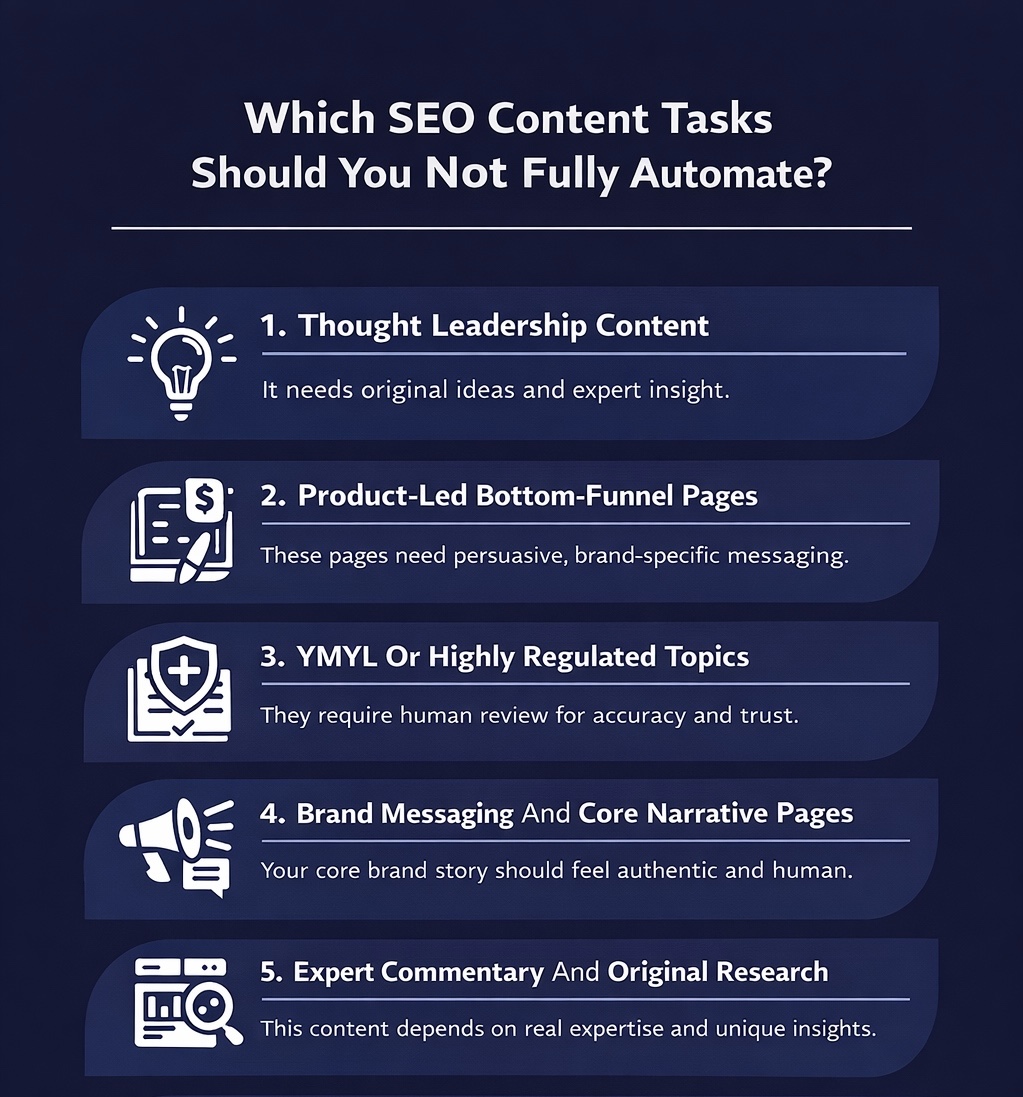
While automation is useful, some SEO content tasks need human expertise. Tasks requiring original thought and a nuanced understanding of your brand should not be fully automated, as this can harm credibility. Relying only on AI can lead to shallow, inauthentic content. Use automation to support, not replace, human creativity and strategy.
Here are the tasks that require significant manual effort.
1. Thought Leadership Content
Thought leadership content is designed to establish your brand as an expert and a leader in your industry. This type of content relies on unique insights, original ideas, and a strong, authoritative brand voice. These are qualities that AI currently cannot replicate.
Creating genuine thought leadership requires deep expertise and personal experience. Your content creators need to draw on their knowledge to offer fresh perspectives and challenge conventional wisdom. This is what builds trust and credibility with your audience.
While AI can assist with research or outlining, the core ideas and narrative must come from a human expert. Fully automating this type of content would result in generic, uninspired pieces that fail to position your brand as a true leader.
2. Product-Led Bottom-Funnel Pages
Bottom-of-the-funnel content, such as landing pages or product feature pages, has a very specific goal: to convert visitors into customers. This requires a deep understanding of your product's value proposition and the specific pain points of your target audience.
Crafting persuasive copy that drives action is an art that requires a human touch. Your sales team and marketers need to collaborate closely during content planning to ensure the messaging is compelling and addresses customer objections effectively. AI-generated content often lacks the nuance and persuasive power needed for these critical pages.
While automation can help with A/B testing headlines or analyzing page performance, the core messaging should be carefully crafted by people who intimately understand your product and your customers.
3. YMYL Or Highly Regulated Topics
YMYL stands for "Your Money or Your Life." This category includes topics that can have a significant impact on a person's health, finances, or well-being. Content in areas like medicine, finance, and law falls under this umbrella, as do other highly regulated topics.
For YMYL content, accuracy, expertise, and authoritativeness are paramount. Search engines like Google have extremely high standards for these topics. AI models can "hallucinate" or generate inaccurate information, which can have serious consequences when dealing with sensitive subjects. Your content creators must be experts in the field.
While you can use tools to analyze performance data, the content itself must be written, reviewed, and fact-checked by qualified human experts to ensure it is safe, accurate, and trustworthy.
4. Brand Messaging And Core Narrative Pages
Your brand messaging is the heart of your company's identity. Core narrative pages, such as your "About Us" or "Our Mission" pages, communicate who you are, what you stand for, and why customers should trust you. This content needs to be authentic and deeply personal.
The content creation process for these pages should be a strategic exercise involving key stakeholders in your company. It's about distilling your brand's essence into words, which requires a level of introspection and strategic thinking that AI cannot provide.
Automating this content would create a disconnect between your brand and your audience. To ensure brand consistency and build a genuine connection, your core messaging must be crafted with human care and attention.
5. Expert Commentary And Original Research
Content that features original research or expert commentary is incredibly valuable for building authority and earning high-quality backlinks. This type of content provides unique value that can't be found anywhere else, making it a cornerstone of a strong SEO strategy.
The process of conducting original research—designing a study, collecting data, and analyzing the results—is a fundamentally human endeavor. Similarly, providing expert commentary requires years of experience and a deep understanding of a subject. AI-powered content generation cannot create new knowledge or insights from scratch.
While AI can help with data analysis or summarizing findings, it cannot replace the human experts who conduct the research and provide the commentary. This is content that must be driven by human intellect and experience.
How Can You Maintain Content Quality While Automating At Scale?
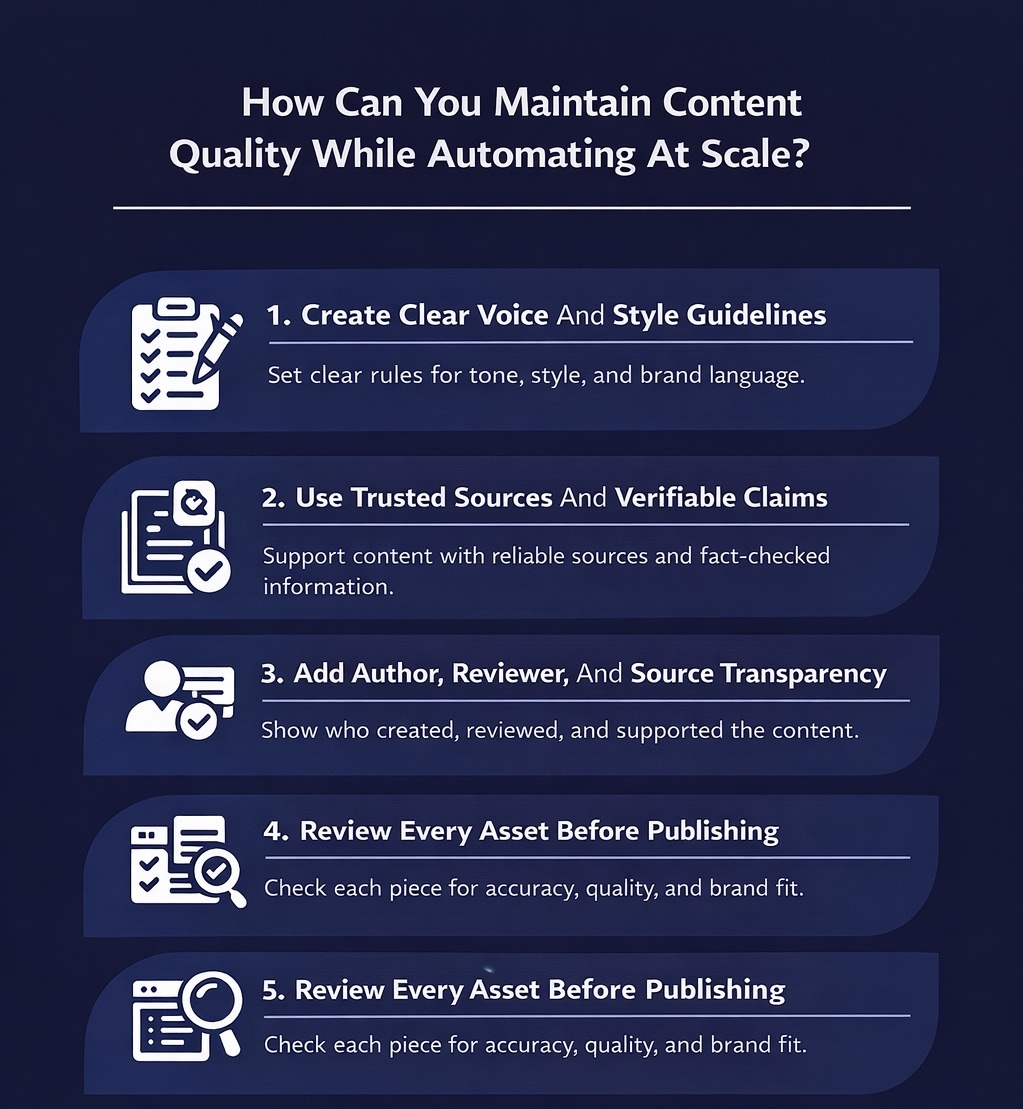
One of the main challenges of scaling with automation is maintaining content quality and brand consistency. As output increases, standards can slip. To prevent this, combine automated tools with thorough review by your content team. Don’t let automation run unattended; set clear guidelines, review all content, and design workflows that support human oversight rather than replace it.
Here are some practical steps to maintain quality.
1. Create Clear Voice And Style Guidelines
Before you even begin automating, it's crucial to have a well-documented set of voice and style guidelines. This document will serve as the "source of truth" for both your human writers and your automation tools, ensuring a consistent brand voice across all your content.
Your guidelines should be a core part of your marketing strategy and should be detailed and specific. They should define your brand's personality, tone, and the specific language to use (and avoid). The more detailed your voice guidelines are, the better you can configure your AI SEO tools to match your style.
Include elements like:
- Your brand's tone (e.g., friendly, professional, witty).
- Specific grammatical rules (e.g., use of the Oxford comma).
- A list of on-brand and off-brand words and phrases.
2. Use Trusted Sources And Verifiable Claims
Content credibility is built on a foundation of accuracy and trustworthiness. When using AI to generate content, it's essential to ensure that any claims, statistics, or facts are drawn from trusted sources and can be verified. AI models can sometimes invent information, so fact-checking is non-negotiable.
Instruct your automation tools to pull information from reputable sources, such as academic journals, government reports, or established industry publications. Always be skeptical of any data that comes from an unverified source.
After the content is generated, have a human editor fact-check every claim. This step is critical for maintaining your brand's reputation and ensuring your audience sees you as a reliable source of information. Regular performance analysis can also help identify content that may have credibility issues based on user behavior.
3. Add Author, Reviewer, And Source Transparency
Transparency builds trust with your audience. When you're using automation in your content process, being open about it can be beneficial. Clearly indicating who wrote and reviewed an article adds a layer of accountability and shows that there is human oversight.
For content on sensitive or expert-level topics, displaying author bios that highlight their credentials can significantly boost credibility. This signals to both users and search engines that the content is written by a knowledgeable individual. Good content management includes tracking these details.
Source transparency is also important. Whenever you make a claim or cite a statistic, link to the original source. This allows your readers to verify the information for themselves and demonstrates that your content is well-researched and reliable, reinforcing trust with your team members and audience.
4. Review Every Asset Before Publishing
No matter how advanced your automation tools are, you should never publish AI-generated content without a thorough human review. This is the most critical step in maintaining quality. A human editor can catch errors, refine the tone, and ensure the content aligns with your brand's standards.
Incorporate a mandatory content review step into your content workflow. This ensures that every single piece of content is checked by a member of your marketing teams before it goes live. The reviewer should be looking for more than just typos and grammatical errors.
They should check for:
- Accuracy and fact-checking of all claims.
- Alignment with your brand's voice and style guide.
This human touch is what elevates AI-generated content from simply being "correct" to being truly valuable and engaging.
5. Refresh Content When Information Changes
The digital world moves fast, and information can become outdated quickly. Part of maintaining content quality is ensuring that your existing content remains accurate and relevant over its entire content lifecycle. A regular content refresh schedule is essential.
Use performance reporting to identify articles with declining traffic or outdated information. Set up a workflow to periodically review your top-performing content to ensure it's still current. This proactive approach helps protect your rankings and maintain your brand's credibility.
When you refresh content, be sure to:
- Update any statistics, dates, or facts that are no longer accurate.
- Note at the top of the article that it has been updated for freshness.
This shows your audience that you are committed to providing them with the most current and reliable information.
How To Choose The Right SEO Content Automation Tools?
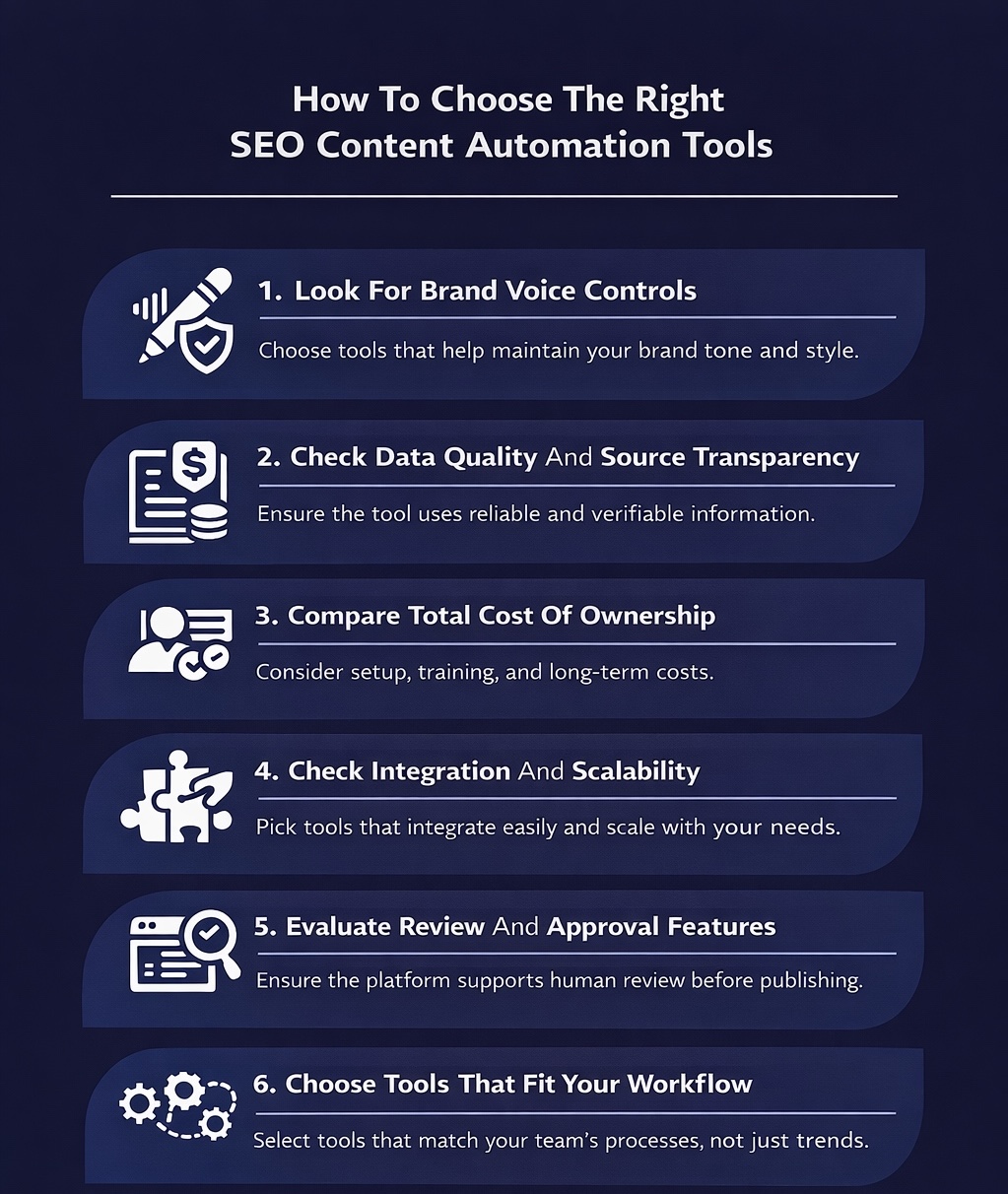
Selecting the right SEO content automation tools is a critical decision that will impact your marketing strategy's success. In this section we’ll explore these considerations in more detail to help you make an informed choice.
1. Look For Brand Voice Controls
One of the biggest concerns with AI-generated content is that it can sound generic and lack personality. To avoid this, it's essential to choose automation tools that offer robust brand voice controls. Your brand voice is what sets you apart and helps you build a connection with your audience.
Look for tools that allow you to create a detailed style guide or "voice profile." This feature enables you to input specific instructions about your tone, vocabulary, and stylistic preferences. The more control you have, the better the AI will be at mimicking your unique voice.
Ultimately, the goal is to create content experiences that feel authentic and on-brand, even when they're created with the help of automation. A tool with strong brand voice controls will help you scale your content production without sacrificing the personality that makes your brand unique.
2. Check Data Quality And Source Transparency
The quality of AI-generated content is directly tied to the quality of the data it's trained on and the sources it pulls from. When evaluating a tool, it's crucial to inquire about its data quality and source transparency. You need to be confident that the information it provides is accurate and reliable.
Some tools may not disclose where their information comes from, which can be a red flag. Look for platforms that are transparent about their data sources or, even better, allow you to specify which sources the AI should use for research. This gives you greater control over the credibility of your content.
Strong content automation capabilities should include the ability to verify information easily. A lack of source transparency can put your brand's reputation at risk, especially when creating content on sensitive or technical topics.
3. Compare Total Cost Of Ownership
When evaluating automation platforms, it's easy to focus solely on the monthly subscription price. However, to get a true sense of the investment, you need to consider the total cost of ownership (TCO). This includes all the costs associated with implementing and using the tool over time.
TCO can include one-time setup fees, training costs for your marketing teams, and any additional expenses for integrations or premium features. A tool that seems cheap upfront might end up being more expensive if it requires significant resources to get it up and running.
When comparing options, create a comprehensive budget that accounts for all potential costs. This will give you a more accurate picture of the financial commitment and help you choose a platform that provides the best value for your specific needs and budget.
4. Compare Total Cost Of Ownership
To expand on the total cost of ownership, consider the long-term operational costs of different automation platforms. Some platforms may have hidden costs related to data storage, API calls, or the number of users. It's important to understand the pricing model completely to avoid surprises down the line.
Also, evaluate how each platform integrates with your existing data analytics and content management systems. A tool that requires custom development for integration will add significant costs and complexity. Conversely, a platform with pre-built integrations can save you time and money.
Think about the scalability of the platform. Will the cost increase dramatically as your content needs grow? A good choice will offer a pricing structure that can scale with your business, ensuring that the tool remains a cost-effective solution in the long run.
5. Evaluate Review And Approval Features
Human oversight is a critical component of a successful content automation strategy. Therefore, the review and approval features of a platform are extremely important. These features ensure that no content goes live without being checked by a human editor.
Look for tools that offer a flexible and intuitive content workflow. You should be able to easily assign content to reviewers, track its status, and leave comments or edits directly within the platform. Seamless approval features help streamline the editing process and prevent bottlenecks.
A robust system with clear review features ensures that your team can maintain quality control even when producing content at a high volume. It bridges the gap between automated generation and human refinement, which is key to creating high-quality, on-brand content at scale.
6. Choose Tools Based On Your Team’s Workflow, Not Hype
It’s easy to get caught up in the hype surrounding the latest AI tools. However, the best tool for your business is not necessarily the most popular one; it's the one that best fits your team’s existing content workflow and addresses your specific needs.
Before you start shopping, take the time to map out your current processes. Identify your biggest pain points and the areas where automation could have the most impact. Involve your team members in this process to get their input and ensure buy-in from the people who will be using the tool every day.
When you evaluate different options, focus on how they would integrate into your workflow. A tool that forces you to completely overhaul your processes may cause more disruption than it's worth. The goal is to find a solution that enhances your team's efficiency, not one that creates new challenges.
Why Choose Scalenut For SEO Content Automation?
SEO content automation works best when it connects planning, creation, optimization, and visibility in one workflow. That is where Scalenut stands out. It goes beyond AI writing support by combining SEO execution with GEO and AI visibility tracking, so teams can scale content with more clarity and control.
Key reasons Scalenut stands out:
- Tracks brand visibility across AI platforms like ChatGPT and Perplexity
- Measures share of voice, average position, visibility rank, and platform-level performance
- Reveals prompt-level insights, citation sources, competitor mentions, and query fanouts
- Turns visibility gaps into actionable recommendations for content, authority, and engagement
- Supports content planning with keyword clustering, audits, and competitor coverage analysis
- Helps create and optimize content with Cruise Mode, Content Optimizer, AI Humanizer, and content scoring
- Improves internal linking and on-page SEO with built-in optimization tools
- Connects AI visibility signals with real traffic trends and referenced pages
Scalenut also helps teams move from strategy to execution without jumping across multiple platforms. You can research, create, optimize, refresh, and monitor performance in one place, making it easier to scale content while staying competitive in both search and AI-driven discovery. Book a demo to see how Scalenut can help you automate smarter and grow faster.
Conclusion
SEO content automation is a powerful strategy that can streamline your content creation process and enhance your overall marketing efforts. By understanding what tasks to automate and which to handle manually, you can achieve a balance that maintains quality while improving efficiency. This approach not only reduces costs and time but also ensures that your content remains relevant and authoritative.
As you explore the various tools available, keep in mind the importance of preserving your brand's voice and delivering valuable insights to your audience. Ready to take your content strategy to the next level? Get started with a free trial of our recommended SEO content automation tools today!
Frequently Asked Questions
What is content automation for SEO?
Content automation for SEO uses artificial intelligence and automation tools to streamline the content creation process for better performance on search engines. This includes tasks like keyword research, draft generation, and on-page optimization, helping you create more optimized content faster.
What is the difference between content automation and content marketing automation?
Content automation focuses on creating the content itself, like writing articles or social posts. Marketing content automation, on the other hand, deals with the distribution and management of that content, such as scheduling emails or social media campaigns, as part of a broader marketing strategy.
Why is content automation important for marketers?
Content automation is important because it allows marketing teams to scale their content production and marketing efforts efficiently. It helps them meet their content goals by saving time on repetitive tasks, reducing costs, and enabling them to publish more consistently, which is key for SEO and audience engagement.
What are the main benefits of using AI content automation tools?
The main benefits of content automation tools include faster content production, lower costs, and increased efficiency. They also help maintain brand consistency across a high volume of content, automate repetitive tasks, and provide valuable performance data to inform your strategy.
What are the common challenges faced when implementing content automation?
Common challenges include maintaining content quality and a consistent brand voice, ensuring user engagement isn't lost, and dealing with poor integration capabilities between tools. Getting team members trained and comfortable with the new technology can also be a hurdle.
How can businesses measure the effectiveness of their content automation efforts?
Businesses can measure the effectiveness of content automation by tracking key content performance metrics like organic traffic, rankings, and conversion rates. Performance analysis using data analytics can reveal changes in user behavior and the ROI of the automated content.
What future trends are shaping content automation in marketing?
Future trends in content automation are being shaped by advancements in artificial intelligence and machine learning. Hyper-personalization, more sophisticated natural language generation, and the increased use of generative AI to create multi-format content are all on the horizon.
What are the best tools for automating content creation and SEO?
The best automation tools for content creation and SEO depend on your specific marketing strategy. Popular options for content marketers include platforms like Scalenut for AI automated content creation, optimization, and all-in-one SEO content automation platforms that integrate multiple functions into a single workflow.


.svg)


.webp)