
.jpg)
AEO vs GEO: What Is the Difference and Which Works Best?

Key Highlights
- Answer Engine Optimization (AEO) focuses on getting content into direct answer formats like featured snippets in traditional search.
- Generative Engine Optimization (GEO) aims to have your brand cited in responses from AI search platforms like ChatGPT and Google's AI Overviews.
- While AEO and GEO have distinct focuses, they share the common goal of providing clear, authoritative answers to user queries.
- Both strategies build upon the foundations of traditional SEO but require new tactics for AI search and voice search.
- Effective optimization involves structuring content for easy extraction and building brand authority to be recognized by generative engines.
- A combined AEO and GEO approach is crucial for comprehensive visibility in the evolving digital marketing landscape.
The world of SEO is rapidly changing as AI search reshapes how people find information online. New optimization strategies are emerging, bringing terms like AEO and GEO to the forefront. For marketers, understanding the distinction between these approaches is essential for staying visible on both traditional search engines and new AI platforms. This guide will explain what is AEO and GEO, the differences between the both and show you how to leverage both for a future-proof strategy.
What Is Answer Engine Optimization (AEO)?
Answer Engine Optimization, or AEO, is a digital marketing strategy designed to provide direct answers to user questions within search engine results. It first gained prominence with the rise of features on Google Search like the featured snippet and knowledge panels. The main objective of AEO is to format your content so that a search engine can easily pull your information and present it as a quick, concise answer, often above the traditional blue links.
For beginners, think of AEO as optimizing for clarity. Instead of just trying to rank a webpage, you are aiming to become the direct answer to a specific user query. This approach assumes users want immediate information rather than a list of websites to sift through. Success in AEO means your content directly addresses common user questions in a clear, scannable format, boosting your visibility in AI search and traditional results.
What Is Generative Engine Optimization (GEO)?
Generative Engine Optimization (GEO) is the practice of optimizing your brand and content to be used, referenced, or cited in AI-generated answers from platforms like Google AI Overviews, ChatGPT, Perplexity, and Gemini. Instead of competing only for page-level rankings, GEO focuses on improving how AI systems retrieve your content, interpret your brand as an entity, and choose sources when generating conversational answers.
GEO vs AEO: What’s the Difference?
While AEO and GEO are closely related, understanding the key difference between AEO and GEO is vital for any modern digital marketing strategy. AEO is about optimizing for direct answers within existing search results, like featured snippets. GEO, on the other hand, is about ensuring your brand is included and cited within the new conversational summaries produced by large language models. The primary distinction lies in the platform and the user experience, with AEO targeting traditional search layouts and GEO focusing on emergent AI chat interfaces.
These differences impact everything from tactics to measurement. Search algorithms for AEO look for structured data and concise answers, whereas AI search models for GEO prioritize topical authority and credibility signals from various sources.
Aspect
Answer Engine Optimization (AEO)
Generative Engine Optimization (GEO)
Primary Goal
Optimize for direct answers (snippets, panels) in search results.
Optimize for inclusion and citation in AI-generated summaries.
Platform Focus
Primarily Google Search and Bing.
Google AI Overviews, ChatGPT, Perplexity, Bing Copilot.
Core Tactics
FAQ schema, concise answers, Q&A formatting.
Entity optimization, building topical authority, trust signals.
Traffic Focus
Designed to drive clicks from featured snippets.
May or may not drive traffic; citations can appear without a direct link.
How Does AEO and GEO Relate to Traditional SEO?
Both Answer Engine Optimization and Generative Engine Optimization are extensions of traditional SEO, not replacements. They build upon the foundational principles that SEO professionals have used for years, such as keyword research, quality content, and authority building. However, they shift the focus from simply achieving high search rankings for web pages to getting specific information directly into search results and AI-powered answers.
The digital marketing landscape is evolving, and AEO and GEO represent the adaptation of traditional SEO practices to a world where users expect immediate answers. Research shows that ranking factors for AI models can differ significantly from those for traditional search. Therefore, while core SEO skills remain relevant, professionals must now also optimize for "chunk-level" retrieval and answer synthesis to succeed in this new environment.
What Are the Key Benefits of Using AEO and GEO for Website Optimization?

Incorporating AEO and GEO into your website optimization strategy goes beyond traditional search rankings. These methods address current user demand for fast, reliable answers. Optimizing for both boosts your brand’s visibility across platforms and strengthens authority in your field. This approach helps you reach users when they need information most, building trust and driving qualified engagement. The following sections will explain these benefits in detail.
1. Enhanced Visibility Across Search and Answer Engines
Combining GEO and AEO greatly increases your brand’s visibility. AEO secures prime spots in Google Search, such as featured snippets and "People Also Ask" boxes, reaching users seeking quick answers. GEO expands your presence into AI platforms by optimizing content for generative engines, getting your brand featured in AI-generated summaries on Google and responses from ChatGPT and Perplexity. Using both creates a comprehensive strategy, ensuring your brand appears in traditional search engines and emerging AI environments.
2. Driving Targeted Traffic with AEO vs GEO Search
AEO is designed to drive targeted traffic by winning featured snippets and rich results with clickable links. Direct answers attract high-intent users, making AEO effective for generating qualified leads. GEO drives traffic differently. AI platforms may reference your content without direct links, but frequent mentions build brand recognition and trust, leading to more direct or branded searches over time.
3. Stronger Authority and Trust Signals
Combining AEO and GEO strengthens your brand’s authority online. AEO ensures clear, accurate answers backed by credible sources, improving search engine quality assessments. GEO builds trust in AI-generated content through consistent, expert entity signals. When your content is frequently chosen as an answer or cited in AI summaries, it signals reliability, boosting credibility and making your brand more likely to be cited, recommended, and remembered.
4. Better Content Efficiency and Faster Performance Gains
AEO and GEO make your content strategy more efficient by boosting page performance across multiple channels. Instead of creating separate content for search and AI platforms, you can structure one asset for both. AEO formatting improves scannability and quick answers, while GEO optimization enhances context, entity coverage, and citation potential. This reduces content waste, streamlines updates, and increases visibility without constant new publishing.
What Are the Best GEO and AEO Strategies to Optimize Content for AI Visibility?
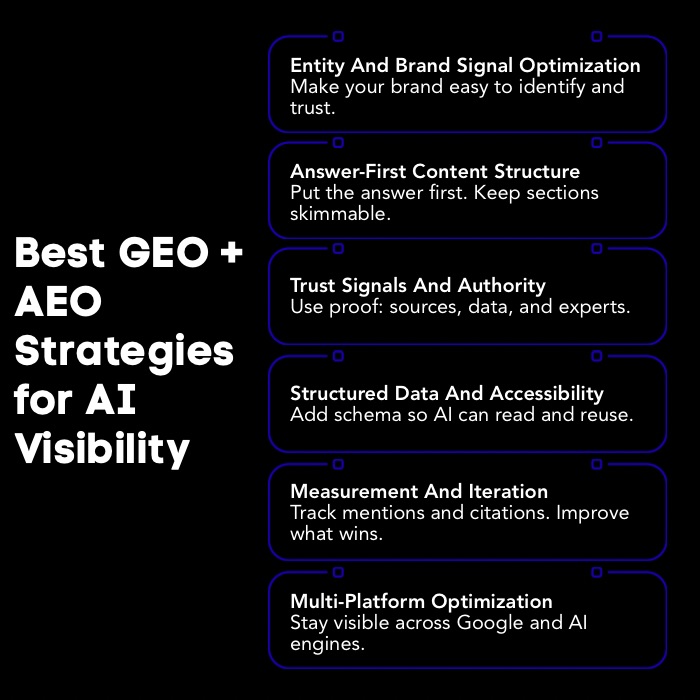
Achieving AI visibility requires intentional optimization strategies. Focusing solely on keywords is insufficient; content must be structured for both direct answers and generative AI synthesis. AEO success and GEO inclusion depend on technical precision and authoritative content. Use these strategies to ensure your content stands out in the AI-driven landscape.
1. Entity And Brand Signal Optimization
In the age of AI search, your brand is an entity. Entity optimization involves making it easy for search engines to understand who you are, what you do, and why you are an authority. This goes beyond keywords to build a strong brand signal that AI systems can recognize and trust.
A crucial part of this digital marketing strategy is using schema markup to clearly define your brand, products, and experts. Consistent naming across your website and third-party platforms reinforces these signals. When AI systems can clearly identify your entity, they are more likely to feature your content in knowledge panels and AI-generated answers, boosting your search rankings.
To strengthen your entity and brand signals, focus on:
- Clearly identifying your brand, products, and experts using structured data.
- Ensuring consistent brand name usage across your site and external platforms.
- Associating your brand with high-authority sources through links and citations.
- Building a robust presence in Google's Knowledge Graph.
2. Answer-First Content Structure And Formatting
Creating content with an answer-first structure is fundamental to both AEO and GEO. This means providing direct answers to user queries right at the beginning of your content before expanding on the details. This approach increases the likelihood of your content being chosen for a featured snippet.
For AI search, this clarity is equally important. AI engines break content down into smaller "chunks" to synthesize answers. A well-structured article with clear headings and concise paragraphs makes it easier for these systems to extract relevant information. Your goal is to format each section as a potential standalone snippet.
Adopt these formatting best practices to improve your content structure:
- Place direct answers to common questions at the top of the page.
- Use descriptive subheadings, often phrased as questions.
- Incorporate lists, tables, and step-by-step guides for scannability.
- Add an FAQ section to address related user queries.
3. Trust Signals And Source-Backed Authority
AI platforms are designed to prioritize factual accuracy and trustworthy information. To earn a place in their answers, your content must be backed by strong trust signals and source-backed authority. This means demonstrating expertise and providing evidence for your claims.
One of the most effective ways to build authority is through citations. Linking to reputable sources, quoting experts, and referencing data all signal to AI that your content is well-researched and reliable. Not every piece of information synthesized by an AI gets a citation; to earn that attribution, your content needs to meet a higher standard of clarity and credibility.
In your digital marketing efforts, focus on building these trust signals:
- Include expert quotes and data citations within your content.
- Link out to reputable, authoritative sources to support your statements.
- Feature clear author bios that highlight expertise and credentials.
4. Structured Data, Schema, And Content Accessibility
Structured data, particularly schema markup, is a powerful AEO GEO tool in your digital marketing arsenal. It provides a standardized format to give search algorithms explicit information about your page's content, making it easier for them to understand and feature it in rich results.
By implementing schema for FAQs, articles, products, and people, you are essentially translating your content into a language that search engines and AI search models can easily process. This technical enhancement improves content accessibility and helps your information stand out in a crowded digital space. When an AI can quickly parse your data, it's more likely to use it.
To improve content accessibility, ensure you are using:
- FAQ schema to mark up question-and-answer sections.
- Article schema to define authors, publication dates, and headlines.
- Organization and Person schema to build entity authority.
- Product schema for e-commerce pages to display price and availability.
5. AI Visibility Measurement And Iteration (Prompts, Mentions, Citations)
Measuring AI brand visibility requires a different approach than tracking a traditional keyword or search rankings. Success in AEO can still be tracked with metrics like featured snippet ownership, but GEO performance is harder to quantify. It involves auditing AI responses to see where, how, and how often your brand gets mentioned.
This process of measurement and iteration is crucial. You need to test different prompts related to your industry and analyze the citations and mentions your brand receives. This allows you to understand which content is resonating with AI models and identify opportunities for improvement.
Key metrics for tracking AI visibility include:
- Monitoring brand mentions and citations within AI-generated answers.
- Auditing LLM outputs for accuracy and sentiment regarding your brand.
- Tracking the ownership of featured snippets and other direct answer formats.
6. Multi-Platform Optimization Across AI Engines
Effective optimization in the AI era cannot be limited to a single platform. While Google remains a dominant force, users are increasingly turning to a variety of AI engines like ChatGPT, Gemini, and Bing Copilot for information. A multi-platform strategy ensures your brand is visible wherever your audience is searching.
Each AI engine has slightly different ways of sourcing and synthesizing information. Your digital marketing strategy should account for these differences, structuring content in a way that is easily reusable across platforms. Building a strong brand presence on social media and other third-party sites also provides more data points for these AI engines to pull from.
To achieve multi-platform optimization, you should:
- Ensure your content is recognized by major AI engines like ChatGPT, Gemini, and Bing Copilot.
- Structure information for easy reuse in AI summaries across platforms.
- Build a credible digital footprint that extends beyond your own website.
How to Choose Between AEO and GEO?
Choosing between AEO and GEO depends on your business goals, audience, and industry. It’s not about choosing one over the other, but knowing where to focus for the best results. Analyze user behavior and search habits to guide your strategy. Some industries benefit more from AEO, others from GEO. The most effective strategies blend both, as search algorithms now combine these approaches. The next sections will explain when each works best, and why they’re stronger together.
When Does AEO Work Best?
Marketers should prioritize AEO when their audience seeks quick answers to informational queries in search engines. This approach is ideal for industries like healthcare, education, and local services, where users want immediate, factual information. If your goal is to drive qualified traffic from Google, AEO can deliver strong results, winning a featured snippet increases visibility and directs users to your site for more details.
For businesses that depend on organic search, AEO is essential. In short, AEO is the best choice when your audience wants direct answers to straightforward questions, bridging traditional SEO with the evolving AI search landscape.
When GEO Matters Most?
GEO is crucial for brands in sectors where AI discovery and conversational search are growing. If your audience uses generative AI to compare products, seek recommendations, or explore topics, a strong GEO strategy is essential, especially for SaaS, B2B, and e-commerce brands. GEO builds brand credibility within AI platforms, ensuring your business appears in AI-generated responses like "best CRM for small businesses."
Achieving this requires ongoing digital marketing to establish topical authority and trust across the web. For industries driven by recommendations and complex choices, prioritizing GEO keeps your brand visible and credible as users turn to conversational AI.
Why AEO and GEO Work Better Together?
AEO and GEO are complementary strategies, most effective when combined. AEO optimizes content for current search results, capturing immediate traffic with structured, answer-focused content. GEO prepares your brand for AI-driven search, leveraging AEO’s authority and clarity to make your information more trustworthy for AI models.
Integrating both creates a unified digital marketing strategy, keeping you competitive today while future-proofing your brand for emerging trends and ensuring visibility across traditional and generative search engines.
Conclusion
Understanding the nuances of Answer Engine Optimization (AEO) and Generative Engine Optimization (GEO) is critical in today's digital landscape. Both strategies offer unique benefits that can enhance your website's visibility and drive targeted traffic. By implementing the best practices outlined in this guide, you can effectively leverage AEO and GEO to ensure your content ranks well across various AI-driven platforms.
Remember, choosing the right approach often depends on your specific goals and audience needs. To dive deeper into these strategies and optimize your content for maximum impact, don’t hesitate to reach out for a free consultation with our experts.
Frequently Asked Questions
What does AEO stand for?
AEO stands for Answer Engine Optimization. It is an SEO strategy focused on optimizing content to provide direct answers to user queries within search results. The goal is to appear in formats like featured snippets and knowledge panels on Google Search, making your content visible in traditional and AI search.
What does GEO stand for?
GEO stands for Generative Engine Optimization. This SEO strategy focuses on ensuring your brand and content are visibly cited in the responses generated by AI search tools and language models. Unlike optimizing for traditional search engines, GEO aims for inclusion in answers from platforms like ChatGPT and Google's AI Overviews.
Are there any risks or challenges in focusing only on AEO or GEO for search optimization?
Yes, focusing on only one carries risks. AEO-only strategies may miss out on visibility in emerging AI chat platforms. A GEO-only approach might neglect valuable traffic from traditional search snippets. A balanced search optimization strategy is crucial for comprehensive digital marketing success in the current landscape.
Why do some experts say that AEO and GEO are essentially the same thing?
Some experts view AEO GEO meaning to be similar because both optimization strategies share the fundamental goal of answering user queries directly. They both rely on creating high-quality, authoritative content that search algorithms can easily understand and surface, blurring the lines between the two approaches.
When should a marketer prioritize AEO over GEO in their strategy?
A marketer should prioritize AEO when their primary goal is to capture immediate, high-intent traffic from traditional search engine results. If your audience is asking straightforward user queries and your SEO strategy relies on winning featured snippets for direct answers, AEO is the more pressing digital marketing priority.
What role does user intent play in choosing between AEO and GEO optimization strategies?
User intent is critical. For informational user queries seeking quick facts, AEO optimization strategies are effective. For more complex or conversational queries where users seek recommendations or synthesized information, GEO is more important. Understanding what users want helps tailor your SEO efforts for AI search effectively.
Answer engine optimization vs search engine optimization: What’s the difference?
Search Engine Optimization (SEO) improves rankings and clicks in traditional results pages. Answer Engine Optimization (AEO) focuses on making your content the direct answer in snippets, “People Also Ask,” and AI responses. SEO optimizes pages; AEO optimizes extractable, answer-ready content.


.svg)


.webp)