.jpg)
What Is AI SEO Optimization and Why Does It Matter Now?

Key Highlights
- AI SEO tools are transforming search engine optimization by automating tasks like keyword research and technical audits.
- The shift from traditional SEO involves a deeper focus on user intent and semantic context rather than just keywords.
- High-performing content excels in both AI and traditional search by being relevant, well-structured, credible, and providing direct answers.
- Effective AI SEO optimization requires a comprehensive content strategy that aligns with search intent and builds topical authority.
- Using a content optimization tool helps you avoid common pitfalls like creating generic content or ignoring trust signals.
- The goal of AI SEO is to enhance human strategy, not replace it, leading to increased organic traffic and better search performance.
The world of search engine optimization is undergoing a significant transformation, driven by the rapid advancements in artificial intelligence. SEO used to be a manual game of data analysis and keyword stuffing, but today, it’s about leveraging smart AI assistants. Modern SEO tools now use AI to uncover patterns and opportunities that human teams might miss.
This guide will walk you through the fundamentals of AI SEO optimization, explaining how you can use these powerful technologies to enhance your strategy and drive meaningful growth.
What Is AI SEO Optimization?
AI SEO optimization is the process of using artificial intelligence tools and platforms to improve your website's visibility and search rankings. These AI tools go beyond simple automation; they use machine learning to analyze massive datasets, providing insights into everything from keyword suggestions to technical site health, including important aspects like link building.
Instead of just spitting out data, these platforms offer strategic recommendations. They can assist with content generation, rank tracking, identify gaps in your content strategy, and even predict emerging search trends. This allows you to create content that not only ranks well but also deeply resonates with your audience's needs.
How Does Generative AI SEO Optimization Differs From Traditional SEO?
Generative AI fundamentally changes the SEO landscape by shifting the focus from manual, repetitive tasks to strategic, insight-driven actions that enhance AI search visibility. Traditional SEO often involves hours of sifting through spreadsheets for keyword data and manually conducting site audits. It's a reactive process where you analyze past performance to make future decisions. Generative AI, however, automates these SEO tasks, processing millions of data points in real time to provide predictive insights.
This new approach, powered by machine learning, is proactive. For example, instead of just suggesting keywords, AI tools can help you understand the context and intent behind search queries. This allows for the creation of content that is semantically rich and directly answers user questions. Tools can analyze top-ranking pages and provide a content score, guiding you to cover a topic more comprehensively than your competitors.
Ultimately, generative AI moves beyond simple keyword matching. It helps you build topical authority and create content that is structured for both human readers and AI crawlers, supported by an AI writer's capabilities. You spend less time on data gathering and more time on high-level strategy, such as refining brand voice and creating original insights that set your content apart.
Why Does AI SEO Optimization Matter in Modern Search?
Adapting your strategy to AI SEO is no longer optional; it's essential for survival in modern search. Search engines are increasingly using AI to understand user intent and deliver hyper-personalized results. This means the old rules of keyword density and keyword difficulty are becoming less important than content quality and relevance. As AI search features like Google's AI Overviews become more prominent, content that provides direct, authoritative answers will win.
Ignoring this shift means risking your visibility in an evolving digital landscape. AI can parse complex search queries and understand nuances that traditional algorithms could not. If your content doesn't meet these new standards, you will be left behind in organic search results.
Here's why you must adapt to AI SEO optimization techniques:
- Personalized Results: AI tailors search results to individual users, making generic content less effective.
- Conversational Queries: Users are asking more complex, conversational questions that require in-depth, well-structured answers.
- AI Overviews Dominance: AI-generated summaries at the top of search results are changing how users interact with content, prioritizing extractable answers.
What Makes Content Perform Well in Both AI and SEO?
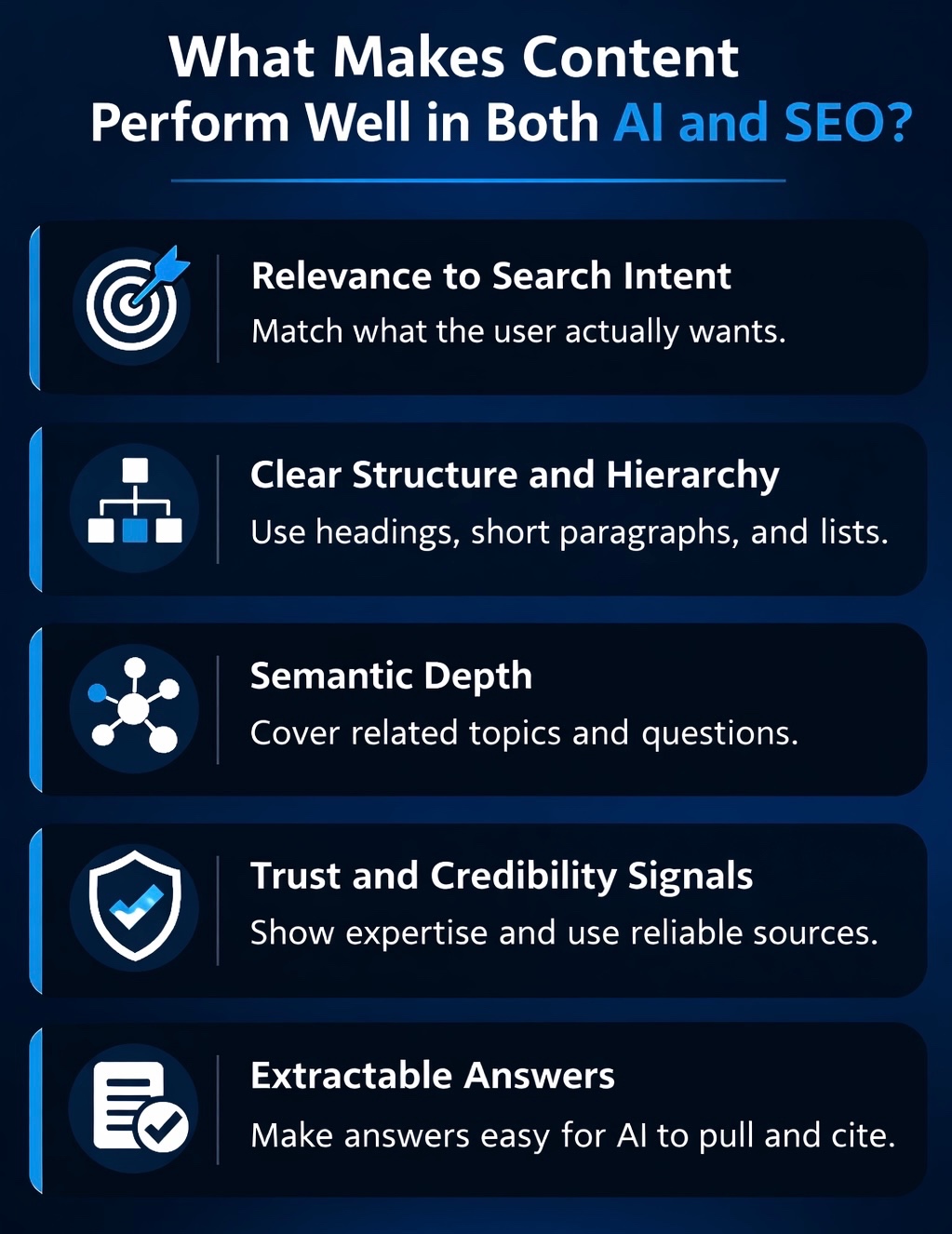
High-performing AI-era content shares the same fundamentals as traditional SEO: focus on quality and search intent. AI-powered search engines reward content that genuinely serves users. Aim to create pages that are not only keyword-optimized but also comprehensive, authoritative, and easily understood by both humans and AI. This approach ensures strong SEO across all search methods.
Here are the key elements of successful AI SEO content:
1. Relevance to Search Intent
Understanding and aligning with search intent is the cornerstone of successful content. It’s no longer enough to target a keyword; you must understand the "why" behind the user's search query. Are they looking for information, trying to buy something, or comparing options? Brands that excel in SEO use AI to analyze millions of search queries and identify the underlying user intent, allowing them to create content that directly addresses the user's needs.
Effective keyword research today goes beyond just search volume. It involves identifying your specific needs and the primary intent for your target topics. AI-powered tools can help you see the questions people are actually asking and the type of content that currently ranks, giving you a clear roadmap for what to create.
To ensure your content is relevant, focus on these areas:
- Answer the Core Question: Directly address the main problem or question the user has.
- Match the Content Format: If the top results for a query are "how-to" guides, creating a product page is unlikely to succeed.
- Address Follow-up Questions: Anticipate what the user might ask next and include that information in your content.
2. Clear Structure and Hierarchy
A well-organized content structure is crucial for both user experience and search engine crawlers. People rarely read web pages from top to bottom; they scan for information. A clear hierarchy with headings, subheadings, and bullet points makes your content easy to digest and helps users find what they need quickly. This same structure helps AI and search engines understand the main topics and key takeaways of your page.
When creating content, think like an architect. Use H1 tags for your main title and logically progress through H2s and H3s for subtopics. This isn't just a formatting exercise; it's about organizing your information in a way that makes sense. Tools with a content editor can guide you by suggesting structural improvements based on top-ranking pages.
Consider these structural elements:
- Descriptive Headings: Use clear, descriptive headings that tell the reader what each section is about.
- Short Paragraphs and Lists: Break up long blocks of text to improve scannability.
- Optimized Meta Descriptions: Write a concise meta description that accurately summarizes the page's content and entices users to click.
3. Semantic Depth
Semantic depth refers to covering a topic comprehensively, exploring related subtopics and concepts. Search engines, using natural language processing (NLP), are getting incredibly good at understanding the relationships between words and ideas. Content that demonstrates a deep understanding of a subject is rewarded with higher rankings because it provides more value to the user. Simply repeating keywords is an outdated tactic.
Achieving semantic depth involves moving beyond a single keyword and building a network of related terms and entities within your content. During the content creation process, AI tools can be invaluable. They analyze top-performing content and identify the subtopics, related questions, and semantic terms you need to include to create a truly comprehensive piece.
To increase the semantic depth of your content, you should:
- Cover Related Subtopics: Explore all relevant facets of your main topic.
- Answer Common Questions: Use tools to find and answer the questions people are asking about your subject.
- Use Synonyms and Related Concepts: Write naturally about your topic, which will inherently include semantically related language.
4. Trust and Credibility Signals
In an internet flooded with information, trust and credibility are more important than ever. Search engines want to promote content from authoritative and trustworthy sources. These trust signals tell both users and algorithms that your content is reliable. Signals can range from expert authorship and customer reviews to data-backed claims, professional website design, and even performance insights you monitor through tools like Google Search Console. Without them, even the most well-written content can fail to rank.
Building credibility is a key part of any successful content marketing strategy. It involves demonstrating expertise and being transparent. Is your content written by a recognized expert in the field? Do you back up your statements with data or link to reputable sources? These are the questions that search engines are asking.
To build trust and credibility, incorporate these signals:
- Expert Authorship: Clearly state who wrote the content and why they are qualified to speak on the topic.
- Cite Reputable Sources: Link to original data, studies, or expert opinions to support your claims, making your content citation-worthy.
- Include Social Proof: Add testimonials, case studies, or reviews to show that others trust your brand.
5. Extractable Answers
As AI search continues to evolve, the ability for search engines to pull "extractable answers" directly from your content has become critical. These are concise, clear pieces of information that directly answer a user's question. They power features like Google's AI Overviews and featured snippets. If your content is structured in a way that makes it easy for AI to find and extract these answers, your visibility in search results can dramatically increase.
This requires you to think about your content not just as a long article, but as a collection of answers. Format your content to make these answers stand out. Use clear headings for questions and provide direct, straightforward responses immediately after. This improves the user experience for scanners and makes your content a prime candidate for being featured.
To optimize for extractable answers, follow these practices:
- Use Question-Based Headings: Structure sections around the questions your audience is asking.
- Provide Concise Answers: Answer the question directly in the first sentence or paragraph before elaborating.
- Use Formatting: Utilize lists, tables, and bold text to make key information easy to identify and pull.
How To Optimize Content For Both AI And Search Engines?

Optimizing for both AI and traditional search engines requires a unified strategy focused on quality and user experience. SEO’s goal is to make your content the best answer for any query. AI tools can help with keyword suggestions and structure. By fully addressing user intent, you meet the standards both algorithms value: comprehensive coverage, authority, and technical excellence.
Here’s how to create content that excels in this environment.
1. Align Content With Search Intent And User Questions
The first step in AI-driven optimization is to deeply understand and align your content with search intent. Modern SEO tools and AI allow you to move beyond guessing what users want. A good keyword research tool will not just show you what people are searching for, but also reveal the questions they are asking and the type of content they expect in return. This insight is your starting point for creating truly helpful content.
Instead of building a page around a single keyword, build it around the problem the user is trying to solve. Analyze the search results for your target query. Are they blog posts, product pages, or videos? This tells you what format users prefer. Use SEO tools to find related user questions from sources like "People Also Ask" boxes and online forums.
To effectively align your content, you should:
- Map Keywords to Intent: Categorize your keywords as informational, navigational, transactional, or commercial.
- Analyze SERPs: Study the top-ranking pages to understand what type of content and format is currently winning.
- Incorporate User Questions: Structure your content to directly answer the most common questions related to your topic.
2. Cover the Topic Comprehensively With Clear Context
To establish authority and perform well in search, your content needs to cover a topic comprehensively. This means going beyond surface-level information and exploring all relevant subtopics and nuances. Creating topic clusters, a main "pillar" page linked to several in-depth "cluster" pages, is an effective content strategy for demonstrating expertise. This structure helps search engines understand that you are an authority on the subject.
Many AI SEO tools have features that can help you build out this comprehensive coverage. They can analyze a topic and generate detailed content briefs that outline all the necessary subheadings, questions, and related concepts to include. This data-driven approach ensures you don't miss critical information that your audience and search engines are looking for.
To ensure comprehensive coverage, consider these actions:
- Create Pillar and Cluster Content: Develop a main resource page for a broad topic and link out to more specific, related articles.
- Address All Angles: Explore different perspectives and facets of your topic to provide a well-rounded view.
- Use Data to Find Gaps: Leverage AI tools to compare your content against competitors and identify areas where you can provide more depth.
3. Use Clear, Scannable Structure And Formatting
In the digital world, readers are scanners. A wall of text is intimidating and will cause most users to leave your page. A clear content structure and scannable formatting are essential for keeping readers engaged and helping them find the information they need. This is just as important for AI crawlers, which use structural elements like headings and lists to understand the hierarchy and key points of your content.
For blog posts and articles, this means using a logical flow of headings (H1, H2, H3), short paragraphs, and bullet points. A good content editor can help with content writing by providing real-time feedback on readability and structure. Proper formatting makes your content more accessible and user-friendly, which are positive signals for search engines.
To improve your content's structure and formatting, you should:
- Use Subheadings Liberally: Break your content into logical, easy-to-read sections.
- Incorporate Bullet Points and Numbered Lists: Make key information stand out and easy to digest.
- Use Bold and Italic Text: Emphasize important terms and concepts, but do so sparingly to avoid clutter.
4. Build Topical Authority With Strong Internal Connections
Topical authority is a signal to search engines that you are a true expert on a particular subject. You build it by creating a deep and interconnected web of content around a core topic. Strong internal linking is the glue that holds this web together. When you link related articles to each other, you help users discover more of your content and signal to search engines the relationship between your pages.
SEO specialists often perform site audits to identify opportunities for better internal linking strategies. A well-planned internal linking strategy can distribute page authority throughout your site and guide crawlers to your most important content. Instead of linking randomly, be strategic and use internal links from high-authority pages to new content, and use descriptive anchor text that tells users and search engines what the linked page is about.
To build topical authority effectively, focus on:
- Creating Topic Clusters: Develop a pillar page for a broad topic and link it to and from more detailed cluster pages.
- Using Descriptive Anchor Text: Avoid generic phrases like "click here." Use anchor text that describes the content of the linked page.
- Linking Deeply: Connect to relevant subpages, not just your homepage or contact page.
5. Optimize for Entities, Semantics, And Structured Data
Modern SEO goes beyond keywords to focus on entities and semantics. An entity is a specific person, place, thing, or concept that search engines can understand. By optimizing for entities, you provide clear context that helps search engines connect your content to the real world. Semantic analysis allows algorithms to understand the meaning and relationships between words, rewarding content that is comprehensive and contextually rich.
One of the most powerful ways to communicate this information is through structured data (or schema markup). This is a standardized code format that you add to your website to explicitly tell search engines what your content is about. For example, you can use structured data to define a recipe, an event, or a product. This can enhance your appearance in search results with rich snippets, boosting your SEO performance.
6. Add Original Insights, Examples, And Trust Signals
In a world where AI can generate content instantly, the value of original insights has skyrocketed. To stand out, your content must offer something that a machine can't: unique perspectives, real-world examples, and genuine expertise. This is what transforms generic content into a high-quality, authoritative resource. Content teams should focus on adding this human layer of value to everything they publish.
Trust signals are another crucial element. These are the cues that tell readers and search engines your information is credible. This can include citing original data, featuring expert authors, or including testimonials. Generic, unsubstantiated claims will hurt your credibility and your rankings. High content quality is defined by its originality and trustworthiness.
To elevate your content, make sure to:
- Include Unique Data or Research: Conduct your own surveys or analyze data in a new way.
- Share Personal Experiences or Case Studies: Provide real-world examples that illustrate your points.
- Feature Expert Quotes: Add insights from recognized experts in your field to build authority.
7. Keep Content Accurate, Fresh, And Citation-Worthy
Accuracy and freshness are critical ranking factors, especially for topics where information changes quickly. Outdated or incorrect content erodes trust and will negatively impact your SEO performance. Regularly review and update your existing content to ensure all facts, statistics, and recommendations are current. This "content pruning" and refreshing process signals to search engines that your site is a reliable and up-to-date source of information.
Furthermore, strive to create content that is citation-worthy. This means producing original, high-quality information that other experts and publications will want to reference and link to. When your content becomes a source for others, it generates valuable backlinks and solidifies your authority on the topic.
To maintain high standards for your content, you should:
- Schedule Regular Content Audits: Periodically check your content for accuracy and opportunities to update it.
- Update Statistics and Dates: Replace old data with the latest available information.
- Add New Insights: Refresh content with new examples, developments, or perspectives to keep it relevant.
AI SEO Optimization Checklist
Here’s a quick AI SEO optimization checklist:
- Match the page to clear search intent
- Answer key questions directly and early
- Use clear H2s and H3s for structure
- Cover the topic with enough semantic depth
- Include relevant entities and contextual terms
- Make content easy to scan with short paragraphs and lists
- Add original insights, examples, or expert input
- Strengthen internal links to related pages
- Use schema markup where relevant
- Keep facts, stats, and examples updated
- Improve trust with accurate, credible information
- Make important points easy for AI systems to extract and cite
Which Content Formats Work Best for AI SEO Optimization?
While there's no single "best" content format, certain types are particularly well-suited for AI SEO optimization because they are structured, informative, and easily digestible for both humans and machines. Long-form blog posts and articles, especially "how-to" guides, comprehensive pillar pages, and detailed listicles, are highly effective. These formats allow you to cover a topic in depth, incorporate a wide range of keywords and entities, and answer numerous user questions in one place. Using a content optimization tool can help you structure these formats for maximum impact.
Other powerful formats include FAQ pages, which are designed to provide direct, extractable answers, and pages with structured data, like product pages with reviews or recipe pages with cooking times. The key is to choose a format that best matches the search intent behind your target query. AI SEO tools can help you analyze the search results to see which formats are currently performing well, giving you a clear direction for your content creation.
What Is the Common Mistakes To Avoid in AI SEO Optimization?
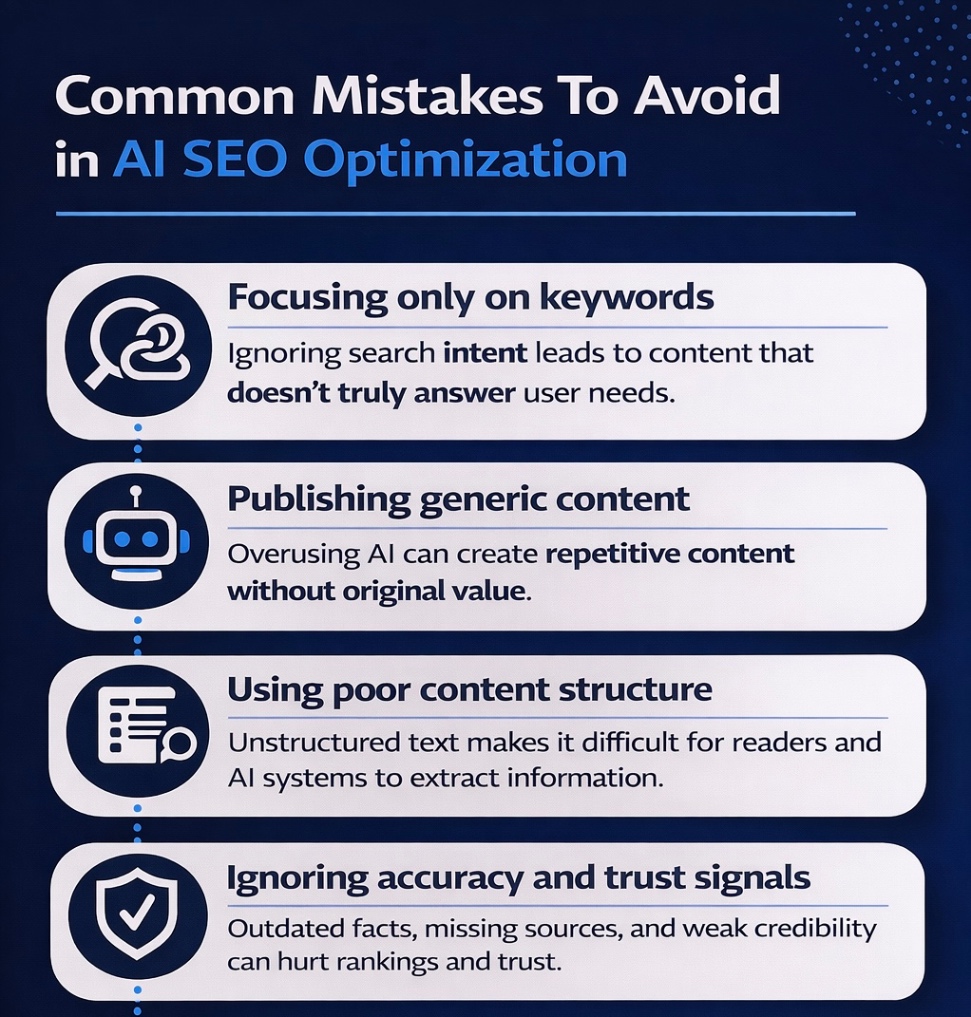
AI provides powerful SEO tools, but mistakes can undermine your efforts. Over-relying on AI for content creation often results in generic, uninspired copy. Focusing solely on keywords while ignoring user intent is another common pitfall. Effective AI SEO requires balance; use AI to support, not replace, human strategy. By avoiding these errors, you can improve content quality and technical SEO while maintaining authority and trust.
1. Focusing Only on Keywords Instead of Real Search Intent
One of the most common mistakes in SEO, even with AI, is an obsessive focus on target keywords at the expense of search intent. While keyword research is still fundamental, simply stuffing relevant keywords into your content is an outdated and ineffective strategy. Modern search engines are sophisticated enough to understand the purpose behind search queries, and they reward content that best satisfies that purpose.
If a user is searching for "best running shoes for beginners," they are looking for comparisons, reviews, and recommendations, not just a page that repeats the keyword ten times. Ignoring this intent will lead to high bounce rates and low rankings, as users will quickly leave your page if it doesn't give them what they are looking for.
To avoid this mistake, you should:
- Analyze the "Why": Before you start writing, ask yourself why a user is searching for this query.
- Look Beyond Volume: Prioritize keywords where you can clearly meet the user's needs, even if the search volume is lower.
- Match Content to Intent: Create informational content for informational queries and transactional content for commercial queries.
2. Publishing Generic Content Without Original Value
With the rise of AI content generation, the internet is becoming flooded with generic, repetitive articles. A major mistake is to use AI for content creation as a shortcut to mass-produce content without adding any original value. Search engines are getting better at identifying low-quality, unoriginal content, and publishing it can harm your site's reputation and rankings. True content quality comes from originality, expertise, and a unique perspective.
Your content teams should use AI as a research assistant or a first-draft generator, not as a replacement for human expertise. The final published piece must contain original insights, real-world examples, or unique data that cannot be found elsewhere. This is what will make your content stand out and build a loyal audience.
To ensure your content has original value:
- Add a Human Touch: Inject your brand's personality and voice into every piece of content.
- Include Unique Perspectives: Share your own experiences or expert opinions on the topic.
- Go Beyond the Obvious: Dig deeper than the surface-level information that everyone else is covering.
3. Using Poor Structure That Makes Content Hard to Extract
In the era of AI-powered search, content that is poorly structured is at a major disadvantage. Features like AI Overviews and featured snippets rely on being able to quickly find and extract specific answers from your page. If your content is a dense wall of text with no clear headings or formatting, you are making it nearly impossible for search engines to feature you. This is a missed opportunity for visibility in modern search engine optimization.
Using a content editor can help you identify structural weaknesses, but the core principle is simple: make your content easy to scan and understand. Think of your page as a resource where a user (or an AI) can quickly pinpoint the exact piece of information they need. Clean, logical content structure is no longer just a "nice-to-have" for user experience; it is a technical requirement for ranking.
To avoid poor structure, you should:
- Use a Logical Hierarchy: Employ H1, H2, and H3 tags to organize your content into clear sections.
- Format for Scannability: Use short paragraphs, bullet points, and bold text to break up content.
- Answer Questions Directly: Place direct answers immediately following question-based headings to create extractable answers.
4. Ignoring Accuracy, Freshness, and Trust Signals
A critical mistake in AI SEO is neglecting the foundational elements of trust: accuracy, freshness, and credibility. You can have a perfectly optimized page, but if the information is outdated or incorrect, it will eventually fail. Search engines prioritize content that is reliable, and users are quick to lose trust in brands that provide inaccurate data. Ensuring data accuracy is non-negotiable.
Trust signals, such as author bios, AI citations, and customer reviews, are vital for demonstrating your authority. Some SEO tools provide a content score that may factor in some of these elements, but it is ultimately a human responsibility to ensure the content is trustworthy. Ignoring these signals is like building a house on a weak foundation.
To maintain trust and credibility, you must:
- Fact-Check Everything: Verify all statistics, claims, and data before publishing.
- Regularly Update Content: Set a schedule to review and refresh your articles to keep them current.
- Clearly Display Trust Signals: Showcase author expertise, cite sources, and include social proof to build confidence with your audience.
How Can You Turn AI SEO Optimization Into Real Visibility With Scalenut?
Optimizing content for both search engines and AI platforms can feel overwhelming. You need to understand where your brand appears in AI answers, identify gaps in visibility, and continuously improve your content strategy. Scalenut simplifies this entire process by combining AI visibility tracking (GEO) with a complete SEO execution platform.
With Scalenut, you don’t just create content; you understand how your brand performs across AI search experiences like ChatGPT and Perplexity and take clear steps to improve that visibility.
Why marketers use Scalenut for AI SEO optimization
- AI Visibility Tracking: Monitor how often your brand appears in AI-generated answers and compare your visibility against competitors.
- Prompt & Citation Insights: Discover which prompts trigger your brand mentions and which sources AI systems rely on.
- GEO Recommendations: Turn AI visibility gaps into actionable content ideas, authority signals, and backlink opportunities.
- Full SEO Workflow: Plan, write, optimize, and scale SEO content with tools like Cruise Mode, Content Optimizer, and AI Humanizer.
- AI Traffic Insights: Track AI bot visits, identify pages frequently referenced by AI, and understand how AI agents interact with your site.
Instead of guessing how AI search impacts your brand, Scalenut helps you measure, optimize, and grow your visibility across both traditional search and AI-driven discovery.
Book a demo to see how Scalenut can improve your AI SEO optimization strategy.
Conclusion
AI SEO optimization is transforming content creation and search engine ranking in digital marketing. By aligning content with user intent, maintaining clear structure, and enhancing semantic depth, you can boost your online visibility. Modern SEO requires evolving alongside technology to meet changing search behaviors. Stay updated on strategies to remain competitive.
Frequently Asked Questions
How to use AI for SEO optimization?
You can use AI tools for SEO optimization to automate and enhance various SEO tasks. This includes conducting in-depth keyword research, generating content ideas, using a content optimization tool to improve on-page elements, and running technical site audits with insights from SEO experts to identify issues that could be harming your search engine optimization efforts.
How to use AI for SEO and content optimization?
Use AI SEO tools for content optimization by leveraging their AI features for content generation and refinement. A content optimization tool can analyze top-ranking pages to provide recommendations on structure, keywords, and topics to cover, helping you create comprehensive content that boosts SEO performance and outranks competitors.
How AI optimization is the new SEO?
AI optimization is considered the new SEO because it shifts the focus from the manual tactics of traditional SEO to a more strategic, data-driven approach. Powered by machine learning, its SEO features analyze user intent and context, preparing content for AI search and improving search rankings in a more sophisticated way.
What are the best AI SEO optimization strategies in 2026?
The best strategies in 2026 will involve using AI SEO tools to create a user-centric content strategy. Use a keyword research tool to understand intent, build topical authority, and optimize for AI search engines. The focus will be on creating high-quality, trustworthy content to improve your visibility score.
Why Is AI SEO Optimization for Website Performance Important?
AI SEO optimization for website performance is important because it helps your content rank in traditional search results while also improving its chances of being understood, surfaced, and cited by AI platforms like ChatGPT, Perplexity, and Google AI Overviews.
What are the best AI SEO optimization tools available right now?
Some of the best AI SEO optimization tools right now include Scalenut, Surfer, and Semrush, because they support content optimization, AI visibility tracking, and stronger search performance across both traditional SEO and AI-driven search experiences.


.svg)


.webp)