.jpg)
Which Answer Engine Optimization AEO Best Practices Work Best?
Key Highlights
- Answer engine optimization (AEO) focuses on getting your content cited by AI engines like Google AI Overviews and ChatGPT.
- Unlike traditional SEO, AEO prioritizes direct answers and understanding user intent over just ranking in search results.
- Key best practices include structuring content to answer questions directly, using clear headings, and supporting claims with facts.
- Implementing structured data, like schema markup, is crucial for helping AI engines interpret your content accurately.
- A successful AEO strategy enhances brand authority and visibility in a search landscape increasingly dominated by AI-generated answers.
The way people find information online is changing. We are moving from a world of blue links to one of direct answers powered by AI. This shift calls for a new approach: answer engine optimization (AEO). As natural language processing becomes more sophisticated, search results are evolving into conversational responses. Mastering AEO is no longer optional; it's essential for any brand that wants to remain visible and authoritative in this new era of search.
What Is Answer Engine Optimization And Why Does It Matter?
Answer engine optimization (AEO) is the strategic process of creating and structuring your content so AI-powered systems can easily find, understand, and feature it as an authoritative answer. When a user asks a question, these engines aim to provide direct answers instead of just a list of links.
How Is AEO Different From Traditional SEO?
Traditional SEO primarily focuses on ranking high in search engine results pages (SERPs) to drive website traffic. The main goal is to secure a top position, encouraging users to click through to your site. This involves targeting specific keywords, building backlinks, and optimizing for metrics like click-through rates and organic sessions.
Answer engine optimization, on the other hand, aims for your content to be cited directly within AI-generated answers. The goal isn't necessarily a click but to own the answer itself and achieve visibility within zero-click results. This requires a sharp focus on user intent and structuring content in a Q&A format that AI engines can easily extract and present.
Ultimately, the strategic difference is visibility without traffic. While SEO gets you traffic, AEO establishes your brand as the go-to authority by providing the answer directly in AI summaries, featured snippets, and voice search responses. This extends your brand’s reach into new conversational contexts where buying decisions often begin.
Why Are Answer Engines Changing Content Strategy?
Answer engines are reshaping content strategy by shifting the focus from attracting clicks to delivering direct answers. With the rise of AI and voice search, users expect immediate, concise information without browsing multiple sites. This forces marketers to create clear, accessible, and well-structured content optimized for machine reading.
Content must now be modular, easily citable, and formatted for quick extraction to improve user experience and appeal to AI. Strategies are moving away from long, narrative articles based on broad keywords toward highly organized content that addresses specific questions. This approach ensures your brand appears in both traditional search results and AI-driven summaries or voice responses.
How Do AI Answer Engines Evaluate And Select Content For Answers?
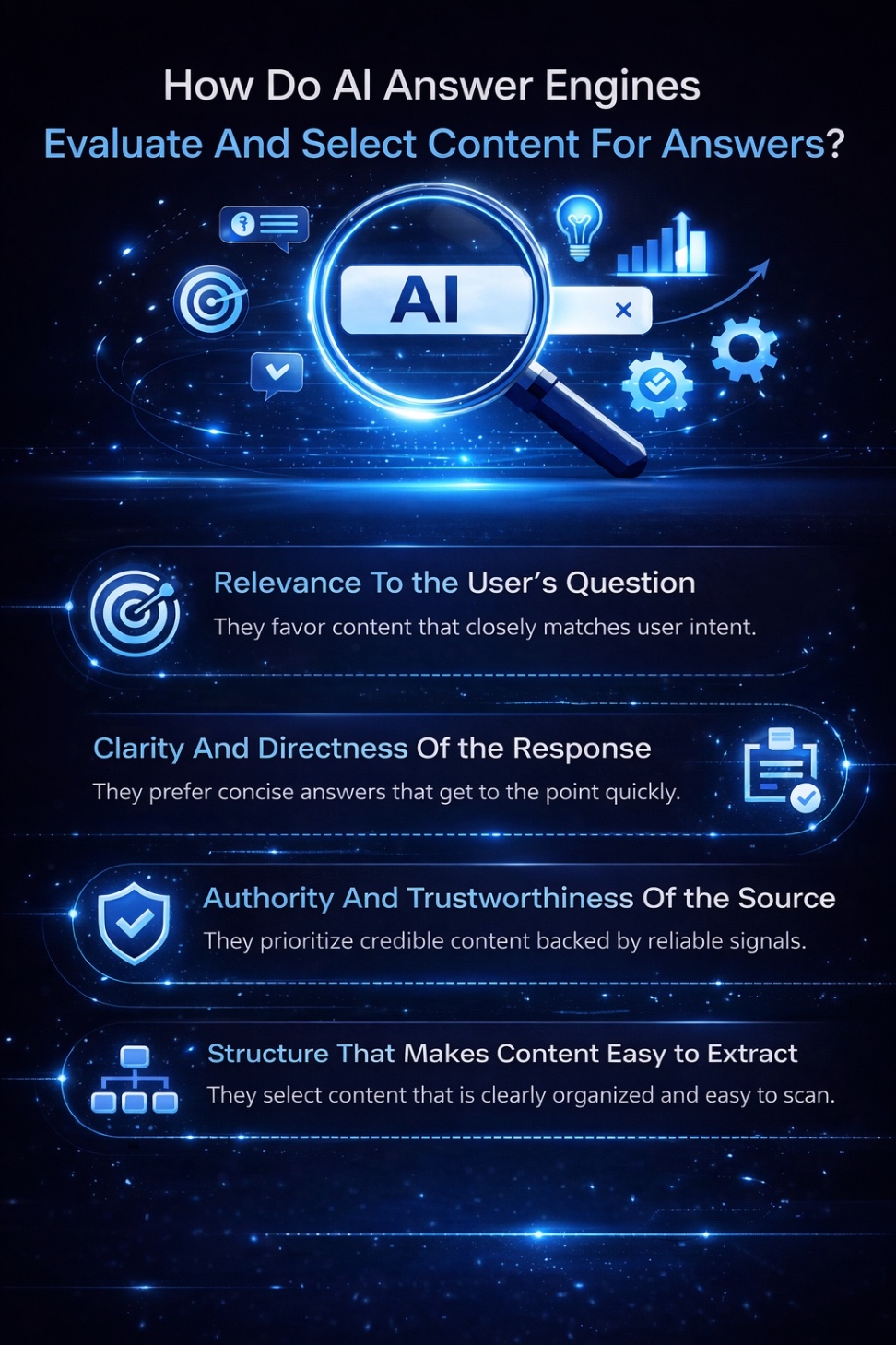
Answer engines use advanced algorithms to find the best answers for user queries. They prioritize pages that offer clear, direct responses and are easy to understand. Structured data and a history of featured snippets signal reliability and organization. Designed to mimic human experts, answer engines favor trustworthy, straightforward content that directly addresses user needs, resulting in more accurate search results. The following sections will cover key factors influencing this selection process.
1. Relevance To The User’s Question
The most critical factor for answer engines is relevance. AI systems use advanced natural language processing to understand the true user intent behind a query, not just the keywords used. They analyze the context and nuance of user questions to find content that provides a precise match.
This means your content must be laser-focused on answering a specific question. Language models are trained to identify the most direct and comprehensive response. If a user performs an AI search for "how to calculate ROI," the engine will look for content that explicitly addresses that calculation, rather than a broad article about marketing metrics.
To achieve this relevance, you need to think like your audience. Anticipate their questions and create content that answers them in clear, unambiguous language. The more closely your content aligns with the specific intent of user questions, the higher the probability that AI language models will select it as the best answer.
2. Clarity And Directness Of The Response
Clarity is paramount for answer engines. AI systems are designed to extract and present information, so they favor content that is straightforward and easy to quote. Long, rambling paragraphs get overlooked in favor of concise, direct answers that get straight to the point.
This is especially important for voice queries. When a user asks a smart speaker a question, the device needs an answer that can be spoken aloud in a few seconds. Content written in simple, natural language is much more likely to be chosen. Think about how you would answer questions in a real conversation and apply that style to your writing.
To optimize for clarity, place your most important information at the beginning of a section. Answer the primary question immediately, then use the rest of the space to provide supporting details and context. This inverted pyramid structure ensures that both users and AI can get the core information they need without any friction.
3. Authority And Trustworthiness Of The Source
Answer engines prioritize content from sources they deem authoritative and trustworthy. Credibility is a key signal that helps an AI determine the quality and reliability of information. Engines evaluate authority by looking at various signals, including brand mentions, citations in reputable publications, and overall brand visibility across the web.
To build this trust, your content must act as a primary source of valuable information. This means backing up all claims with verifiable facts, data, and references to other credible sources. When AI systems see that your content is well-researched and supported by evidence, they are more likely to treat it as a definitive answer.
Establishing your brand as a subject-matter expert is an ongoing process. Consistently publishing high-quality, accurate, and expert-backed content raises your authority profile. The more your brand is recognized as a leader in its field, the more likely answer engines will be to cite your content, boosting your credibility and overall brand visibility.
4. Structure That Makes Content Easy To Extract
A well-organized page structure is crucial for AEO because it helps AI systems parse and extract information efficiently. Content that is broken down into logical sections with clear formatting is much easier for an algorithm to understand and repurpose into an answer. This improves the user experience for both machines and humans.
Your content strategy should incorporate formatting elements that signal importance and hierarchy. This includes using headings and subheadings to break up topics, as well as lists to present information in a scannable way. AI engines recognize these patterns and prioritize content that uses them effectively.
To improve your content's structure for extraction, focus on the following:
- Bulleted and numbered lists: Break down steps, features, or key points into lists.
- Schema markup: Use structured data to explicitly tell search engines what your content is about.
- Tables: Organize comparison data or specifications in a simple table format.
These structural elements make your content more digestible and signal to AI that it is a well-organized source of information.
What Are The Core Answer Engine Optimization AEO Best Practices?
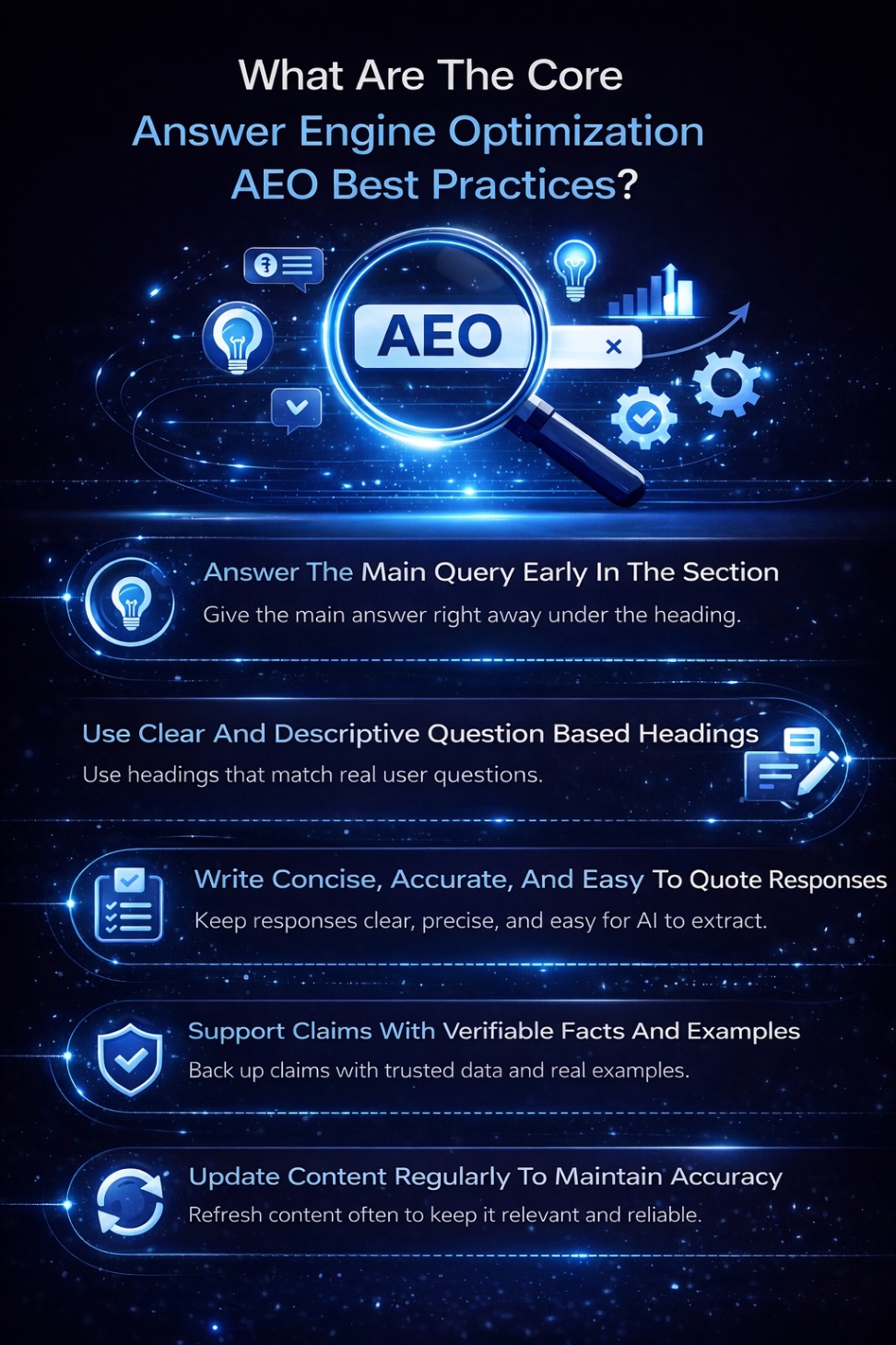
To achieve effective Answer Engine Optimization (AEO), focus on crafting precise, user-centric content that directly answers questions. Emphasize clarity and relevance, ensuring your responses are easily digestible and quotable. This builds authority and increases the chances of being featured prominently in answer engines.
Let’s look at the core best practices for answer engine optimization for AI:
1. Answer The Main Query Early In The Section
One of the most effective AEO practices is to answer the main query immediately. When a user lands on your page, they should find the information they are looking for without having to scroll or read through a long introduction. Place a concise, 40-60 word answer right below the relevant heading.
This "answer-first" approach is highly favored by answer engines. AI systems are designed to find the most efficient path to information, and content that provides immediate value is more likely to be selected. This method directly addresses user queries and signals to the AI that your page contains a relevant and useful response.
By providing concise answers upfront, you cater to both human readers and algorithms. This technique allows you to answer questions clearly in natural language, after which you can expand with more context, examples, and details for those who want to learn more. This structure satisfies the need for a quick answer while still offering depth.
2. Use Clear And Descriptive Question Based Headings
Using descriptive, question-based headings is a powerful AEO tactic. Headings like "What is Answer Engine Optimization?" or "How Do You Calculate ROI?" directly mirror the language patterns users type into search engines. This alignment makes it easy for AI to match your content to a specific query.
These types of headings act as direct signposts for answer engines. When an AI scans your page, it uses headings to understand the structure and topics covered. A question-based heading immediately signals that the following content is intended to be an answer, increasing the likelihood it will be pulled for answer boxes or AI summaries.
This practice also improves the user experience, as scannable, question-based headings help readers quickly find the information they need. As you build out your content, think about the exact questions your audience is asking and use those to frame your sections. This simple change can significantly improve your visibility in search engine results.
3. Write Concise, Accurate, And Easy To Quote Responses
Utilizing straightforward and precise language is fundamental in crafting responses that are easy to quote. Responses should address user intent directly, ensuring they encapsulate the main idea without unnecessary filler. Employing structured data, such as bullet points, enhances clarity and aids comprehension. This approach caters to conversational queries, improving the likelihood of being featured in AI search results. Regularly reviewing and refining your content strategy will nurture brand visibility, making it easier for users to find concise, direct answers that resonate with their specific questions.
4. Support Claims With Verifiable Facts And Examples
Trust is a cornerstone of AEO. Answer engines are designed to provide reliable information, so they prioritize content that supports its claims with verifiable facts and evidence. Every assertion you make should be backed by data, citations from credible sources, or examples that illustrate your point.
Incorporating original research is an excellent way to build authority. When you publish unique data or insights, your content becomes a primary source that other sites will reference. This signals to AI systems that your brand is a thought leader and a trustworthy source of information, increasing the chances your content will be cited.
When you present data, statistics, or quotes, always attribute them to their original source. This not only builds credibility but also demonstrates a commitment to accuracy. Providing concrete examples helps make abstract concepts understandable and reinforces the validity of your claims, making your content more valuable to both users and answer engines.
5. Update Content Regularly To Maintain Accuracy
Content freshness is a critical signal for answer engines. Outdated information can harm your credibility and cause AI systems to stop citing your content. A key component of any successful AEO strategy is to regularly review and update your content to ensure its accuracy and relevance.
Set a schedule for auditing your most important pages, especially those covering fast-changing topics like technology or industry trends. Updating statistics, removing outdated information, and adding new insights helps maintain your content’s value. This practice signals to search engines that your page is a living resource, which can help preserve or even improve its organic search traffic.
Long-term AEO success depends on this commitment to maintenance. As your industry evolves, so should your content. By keeping your information current, you not only provide a better experience for your audience but also reinforce your website's authority in the eyes of AI. This ongoing effort is essential for sustained visibility in answer-driven search results.
How Should You Structure Pages For Better AEO Performance?
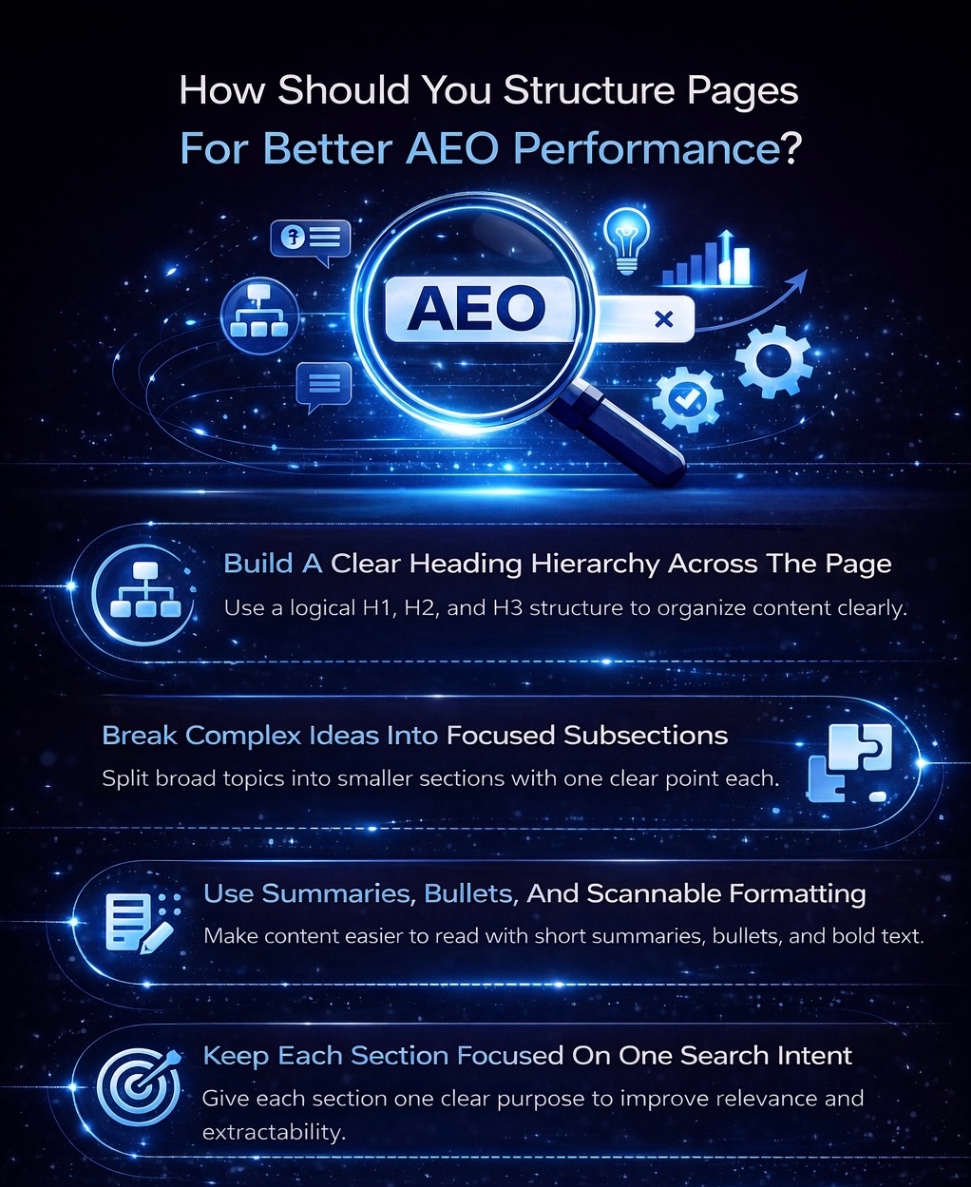
Structuring your pages logically is fundamental to effective search engine optimization and AEO. The following sections detail specific structural tactics you can implement to optimize your pages for answer engines.
1. Build A Clear Heading Hierarchy Across The Page
A logical heading hierarchy is one of the strongest signals you can send to an answer engine about your content's organization. Every page should have a single H1 tag that defines the main topic. Subsequent sections should be broken down using H2s, with H3s and H4s used for subsections within them.
This structure creates a clear outline of your page that AI systems can easily parse. Think of it as a table of contents that guides the algorithm through your information. Skipping heading levels, such as going directly from an H2 to an H4, can confuse crawlers and weaken the structural integrity of your page.
A well-defined heading hierarchy is a core part of a strong content strategy and complements other technical elements like schema markup. It ensures your content is not only readable for users but also machine-friendly. This simple practice of using structured data correctly helps AI systems understand the context and importance of each section, improving its ability to extract answers.
2. Break Complex Ideas Into Focused Subsections
Complex topics can be overwhelming for both readers and language models. To improve comprehension and extractability, break down broad ideas into smaller, focused subsections. Each subsection should address a single, specific concept, making the information more digestible and easier for an AI to categorize.
This approach enhances the user experience by creating scannable formatting that allows readers to quickly find what they need. For language models, these focused subsections act as distinct blocks of information, each with its own clear purpose. This is particularly useful for voice queries, where concise, self-contained answers are essential.
When creating subsections, consider the following:
- Give each subsection a descriptive heading: This helps both users and AI understand what the section is about.
- Focus on one main point per section: Avoid trying to cover too much ground at once.
By dividing complex content into manageable pieces, you make it more accessible and significantly improve its AEO performance.
3. Use Summaries, Bullets, And Scannable Formatting
Scannable formatting is essential for catering to modern reading habits and optimizing for answer engines. Elements like summaries, bullet points, and bolded text help break up long blocks of text, making your content easier to digest. This is crucial for capturing the attention of users who are quickly scanning for information.
From an AEO perspective, this type of formatting helps AI systems identify key information. Bullet points, in particular, are frequently pulled directly into search engine results pages as featured snippets because they present information in a clear, structured list. This directly addresses user intent for queries that seek lists, steps, or multiple features.
To improve your content's scannability, implement these tactics:
- Use bullet points for lists: Perfect for features, benefits, or examples.
- Write short paragraphs: Keep paragraphs to 2-4 sentences.
- Use bold text for emphasis: Highlight key terms or phrases.
- Include summaries: Provide a brief overview at the beginning of long sections.
This approach will improve your organic search performance by making your content more user-friendly and machine-readable.
4. Keep Each Section Focused On One Search Intent
For effective AEO, each section of your content should be dedicated to a single search intent. When you try to address multiple user queries within one paragraph or subsection, you dilute the focus and make it harder for AI systems to determine the primary purpose of that content.
By aligning each section with a specific search intent, you create clear, unambiguous signals for AI powered answer engines. For example, one section might define a term (informational intent), while another compares two products (commercial intent). This clarity helps AI match your content to the correct language patterns and user queries.
This focused approach also allows for more strategic internal linking. You can link between sections that address related but distinct intents, guiding both users and crawlers through a logical content journey. Keeping each section dedicated to one intent is a simple but powerful way to improve your content's extractability and overall AEO performance.
Which Content Types Perform Best In Answer Engines?
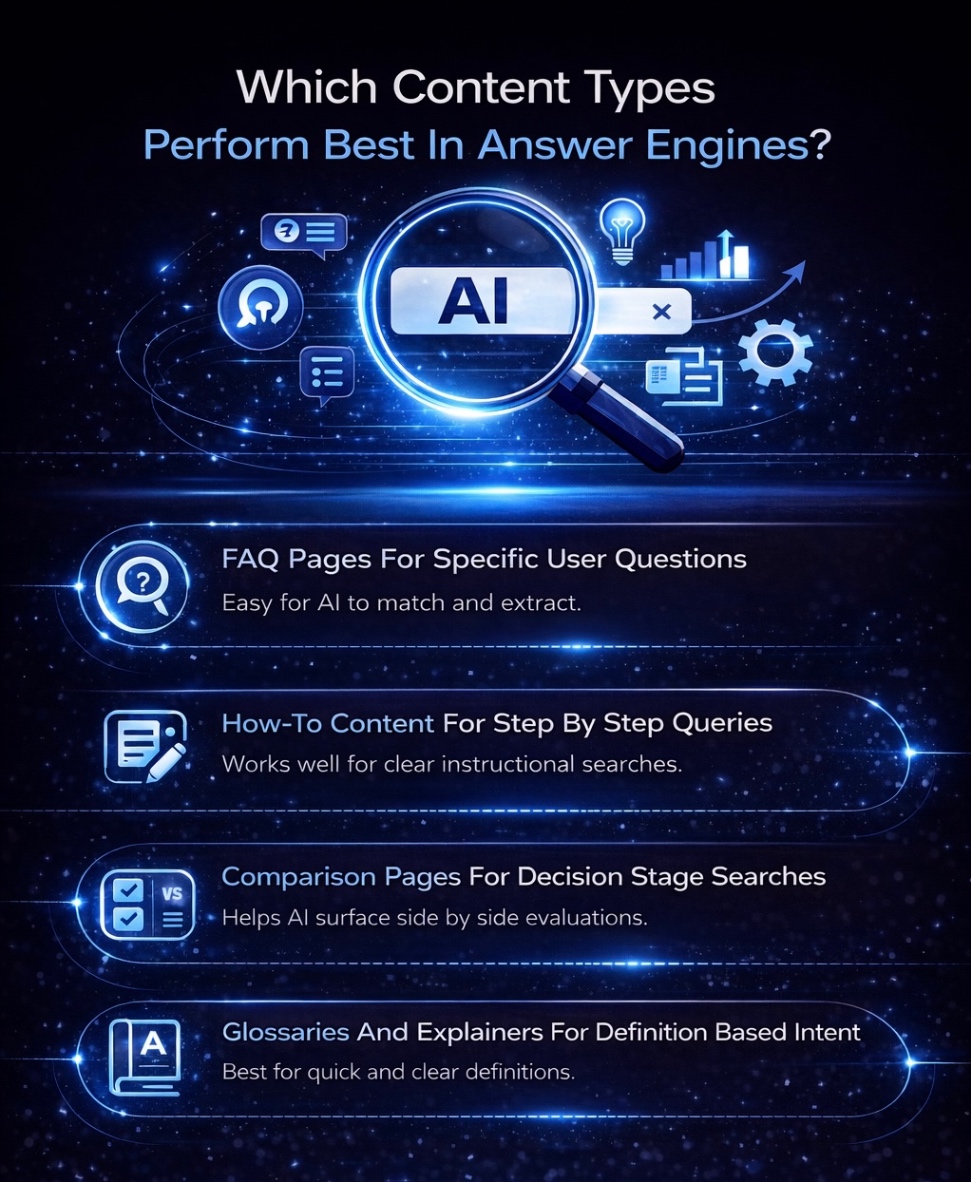
Certain content types are naturally better suited for answer engines because their structure aligns with the Q&A format that AI systems prefer. Content that is designed to provide direct answers to specific questions tends to perform very well. This includes formats like FAQ pages, how-to guides, and glossaries.
While nearly any content can be optimized, from product pages to blog posts, focusing on formats that directly address user intent will give you a competitive edge. The following sections explore the top-performing content types and explain why they are so effective at capturing the attention of AI engines.
1. FAQ Pages For Specific User Questions
FAQ pages are one of the most powerful content types for AEO. Their inherent question-and-answer format closely matches how answer engines work. Each question on the page acts as a clear signal for AI, directly aligning with possible user queries and making the content highly extractable. This is also why FAQ sections AEO performance LLMs remains an important consideration when structuring content for AI visibility.
When you implement FAQPage schema markup, you provide structured data that explicitly tells answer engines what your content is. This technical enhancement dramatically increases your chances of appearing in rich results and featured snippets. The combination of a Q&A format and proper schema is a winning formula for AEO.
To maximize the effectiveness of your FAQ pages, source real user questions from your sales and customer service teams. Addressing actual pain points ensures your content is relevant and valuable. By providing clear, concise answers to these questions, you create a resource that is highly optimized for both users and answer engines.
2. How To Content For Step By Step Queries
"How-to" content is exceptionally effective for AEO, as it directly addresses step-by-step queries. Users frequently search for instructions on how to complete a task, and content that provides a clear, sequential process is highly valued by both users and answer engines. This format is ideal for capturing featured snippets, especially those presented as numbered lists.
To optimize how-to content, structure your instructions using ordered lists (numbered lists) or clear subheadings for each step. This formatting makes the process easy to follow and simple for an AI to extract. Use natural language to explain each step, as this makes the content suitable for voice queries where users ask for instructions aloud.
When creating how-to guides, consider these best practices:
- Use descriptive headings for each step: For example, "Step 1: Gather Your Materials."
- Incorporate HowTo schema: This structured data explicitly marks your content as a set of instructions.
This type of content provides immense value to users and is perfectly structured for AIs to repurpose into direct, actionable answers.
3. Comparison Pages For Decision Stage Searches
Comparison pages are highly effective for targeting users in the decision stage of their journey. When potential customers are evaluating their options, they often use search queries like "[Product A] vs. [Product B]." Content that directly addresses these user questions with a balanced comparison can perform exceptionally well in organic search.
These pages are valuable to answer engines because they provide structured, data-driven answers to complex purchase-related questions. A well-organized comparison, often in a table format, makes it easy for an AI to extract key differences and similarities. This can lead to your content being featured prominently in search results for high-intent queries.
To create effective comparison pages, focus on objectivity. Present the pros and cons of each option clearly, and use tables to organize features side-by-side. By providing a comprehensive and unbiased resource, you build trust with users and create content that is perfectly formatted for AI to summarize and present.
4. Glossaries And Explainers For Definition Based Intent
Glossaries and explainer articles are ideal for capturing definition-based search intent. When users search for "what is [term]?" they are looking for a quick, clear, and authoritative definition. Content designed specifically to answer these types of questions is highly favored by answer engines.
These formats work well because they are structured to provide direct answers. A glossary page, with its list of terms and corresponding definitions, is easy for natural language processing models to parse. An explainer article should lead with a concise, 40-60 word definition before diving into more detail, following the inverted pyramid model.
By creating a dedicated resource for key industry terms, you can establish your brand as an authority. This content becomes a go-to source for users seeking to understand fundamental concepts. When you consistently answer questions with clear definitions, you build a library of content that is perfectly optimized for AEO.
What Are the Best AEO Strategies For Improving Brand Authority?
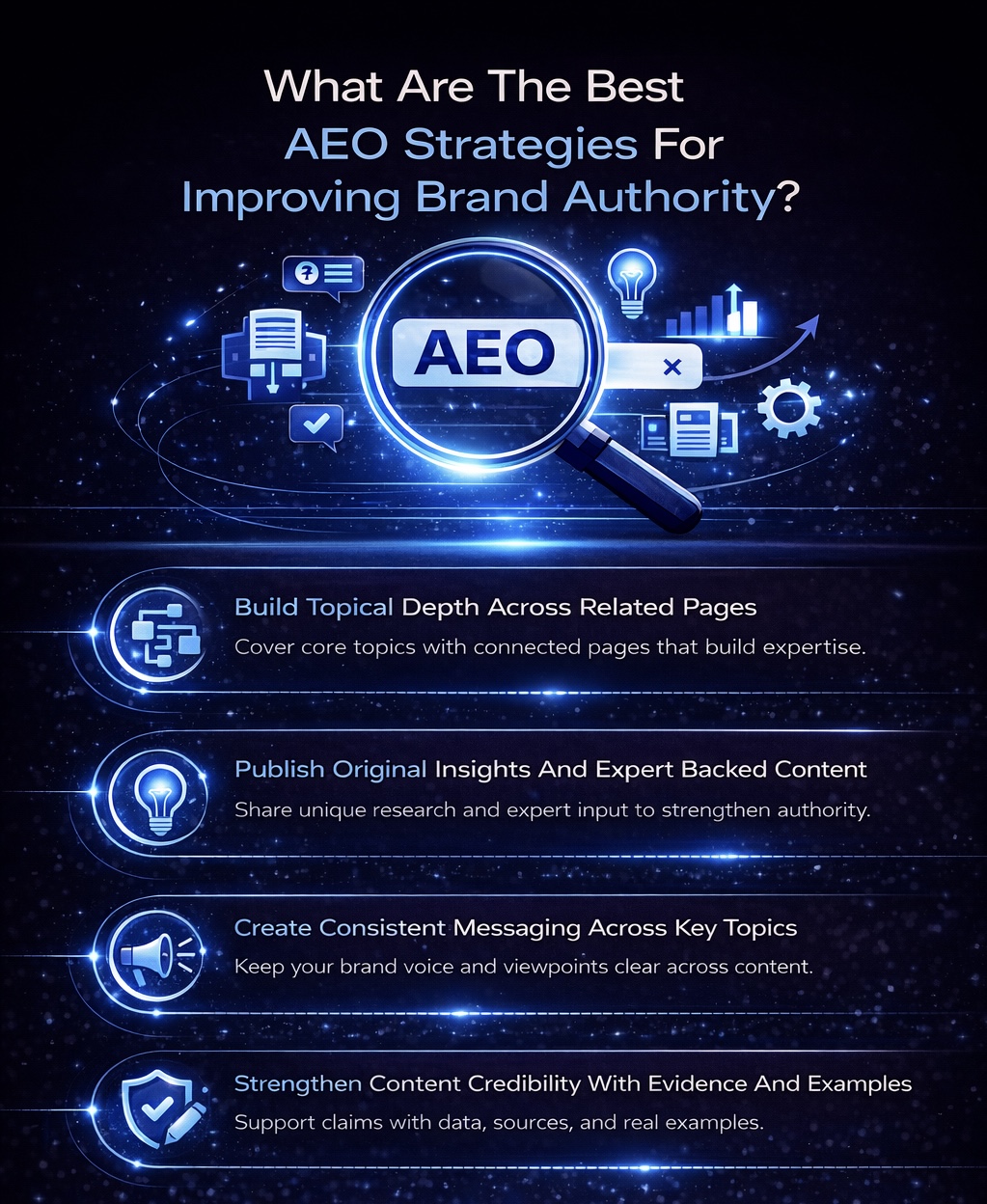
The best AEO strategies for brand authority does more than just win snippets; it builds brand authority. The following answer engine optimization AEO strategies will help you move beyond simple optimizations and use AEO to establish true thought leadership, which is essential for long-term success in an answer-driven world.
1. Build Topical Depth Across Related Pages
Building topical depth is a powerful strategy for signaling expertise to AI engines. Instead of creating isolated articles, develop clusters of content around your core topics. This involves creating a main pillar page that covers a broad subject and supporting it with more detailed articles that explore related terms and subtopics.
This approach demonstrates a comprehensive understanding of a subject area. When AI engines see a network of interconnected pages covering a topic from multiple angles, they are more likely to view your site as an authority. A robust internal linking structure is crucial for this strategy, as it helps crawlers discover and understand the relationships between your pages.
Your content strategy should map out these topic clusters in advance. Identify your main areas of expertise and plan the content needed to cover them thoroughly. By creating a deep and interconnected web of information, you build a strong foundation of authority that AI engines will recognize and reward.
2. Publish Original Insights And Expert Backed Content
Publishing original research and expert-backed content is one of the most effective ways to boost brand authority. When you contribute new data, insights, or analysis to your industry, your content becomes a primary source. This elevates your brand above competitors who are simply curating existing information.
This type of content is highly valued by answer engines because it is unique and authoritative. Citing your own original research or featuring quotes from recognized experts adds significant content credibility. Other credible sources will link back to your findings, creating powerful authority signals that boost brand awareness and AEO performance.
Make original research a cornerstone of your content strategy. This could involve conducting surveys, analyzing industry data, or interviewing subject-matter experts. By creating content that offers unique value, you establish your brand as a thought leader and a trusted source that both users and AI systems will turn to for reliable information.
3. Create Consistent Messaging Across Key Topics
Consistency in your messaging across key topics is crucial for building trust with answer engines. AI systems learn to recognize your brand's voice and point of view by analyzing your content over time. If your messaging is contradictory or varies wildly from one page to another, it can dilute your authority and confuse the algorithm.
Define your core positions on key topics and ensure that all related content aligns with that messaging. This doesn't mean every article should be identical, but your fundamental perspective should remain consistent. This practice helps establish predictable language patterns that AI can learn to associate with your brand, reinforcing your expertise.
This consistency helps solidify your brand's identity in AI search results. When an answer engine repeatedly finds the same clear, consistent viewpoint from your domain on a particular topic, it is more likely to treat your content as a reliable and definitive source. This is a subtle but powerful aspect of answer engine optimization.
4. Strengthen Content Credibility With Evidence And Examples
Strengthening content credibility with concrete evidence is essential for earning the trust of answer engines. AI systems are designed to identify and promote reliable information, so content that is well-supported with verifiable facts is more likely to be featured in answer boxes and AI summaries.
Every claim you make should be backed by supporting evidence. This can take many forms, from citing recent studies to providing real-world examples that illustrate your points. This practice demonstrates a commitment to accuracy and helps users make informed decisions, which is a key goal of answer engines.
To bolster your content credibility, incorporate these elements:
- Link to authoritative sources: Cite studies, reports, and expert opinions.
- Use specific data and statistics: Quantify your claims whenever possible.
- Include case studies or testimonials: Show how your advice works in practice.
By grounding your content in evidence, you build a foundation of trust that is invaluable for both AEO and building a loyal audience.
What Technical Elements Support Answer Engine Optimization?
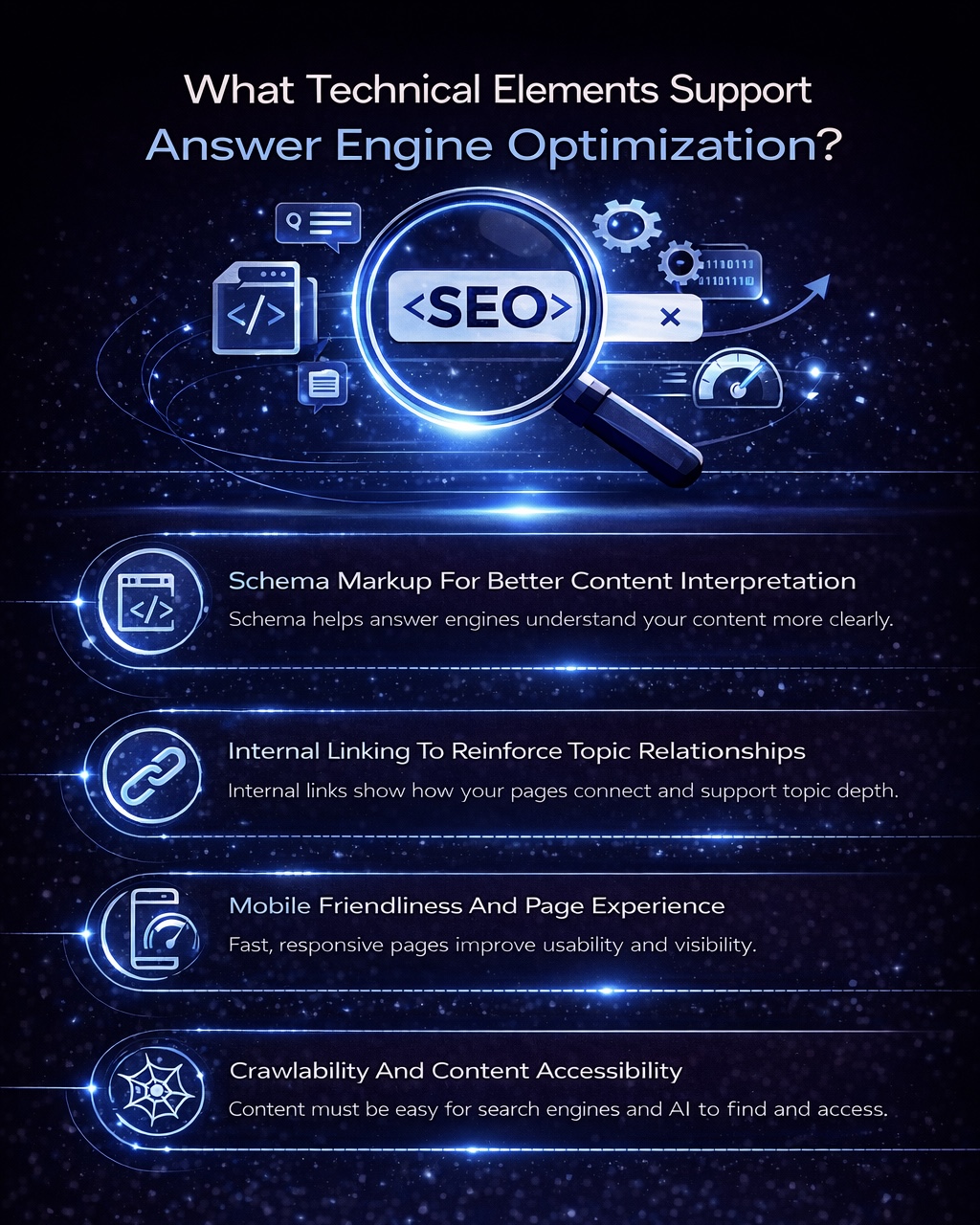
Beyond content quality, technical SEO is vital for effective answer engine optimization (AEO). The next sections outline the essential technical factors that boost AEO and increase your content’s visibility.
1. Schema Markup For Better Content Interpretation
Schema markup is a form of structured data that you add to your website's HTML to help search engines and AI platforms better understand your content. It acts like a label, explicitly telling the search engine what a piece of information represents. For example, you can use schema to identify a page as a how-to guide, an FAQ, or an article.
This clarity is invaluable for AEO. Instead of guessing the context, the AI can use your schema markup to interpret your content with certainty. This increases the likelihood that your content will be used correctly in rich results, knowledge panels, and AI-generated answers. Popular schema types for AEO include FAQPage, HowTo, and Article schema.
2. Internal Linking To Reinforce Topic Relationships
A strategic internal linking plan is a critical component of AEO implementation. Internal links help answer engines understand the structure of your website and the relationships between different pieces of content. When you link from one page to another using descriptive anchor text, you create a pathway that both users and crawlers can follow.
This practice is essential for establishing topical depth. By linking related articles together, you create content clusters that signal to AI systems that you have comprehensive expertise on a subject. For example, a pillar page about "digital marketing" should link out to more specific articles on "SEO," "content marketing," and "social media."
Effective internal linking helps distribute authority throughout your site. It guides crawlers to your most important pages and reinforces the context of your content. This network of links acts as a form of structured data, creating a logical map of your site's knowledge base that is essential for strong AEO performance.
3. Mobile Friendliness And Page Experience
A seamless mobile experience is no longer optional; it's a fundamental requirement for AEO. With a majority of searches happening on mobile devices, answer engines prioritize websites that offer a fast, responsive, and user-friendly mobile experience. Poor mobile friendliness can negatively impact your rankings and visibility in AI-generated answers.
Page experience signals, such as Core Web Vitals, measure how users perceive the experience of interacting with a web page. Factors like loading speed, interactivity, and visual stability are crucial. A site that loads quickly and is easy to navigate on a mobile device provides a better user experience, which is a strong positive signal for answer engines.
Improving mobile friendliness and page experience directly benefits your AEO efforts. It enhances crawlability, reduces bounce rates, and ensures that users who discover your brand through an AI answer have a positive first impression. This focus on user experience is a win-win, boosting both organic search traffic and brand perception.
4. Crawlability And Content Accessibility
For your content to be featured by an answer engine, it must first be discoverable. Crawlability refers to a search engine's ability to access and index the content on your website. If an AI crawler cannot access a page, that content is invisible and cannot be considered for AI-generated answers.
Technical SEO issues like broken links, incorrect robots.txt configurations, or content hidden behind JavaScript can all hinder crawlability. Ensuring that your website's critical content is rendered in the initial HTML and is not blocked from crawlers is a foundational step in any search engine optimization strategy.
Content accessibility also plays a crucial role. This means ensuring your content is available to all users and technologies, including assistive devices and AI crawlers. A clean site structure, proper use of HTML tags, and a logical information architecture all contribute to better accessibility. By prioritizing crawlability and accessibility, you ensure your valuable content can be found and used, which is essential for driving organic search traffic.
What Common Mistakes Should You Avoid In AEO?
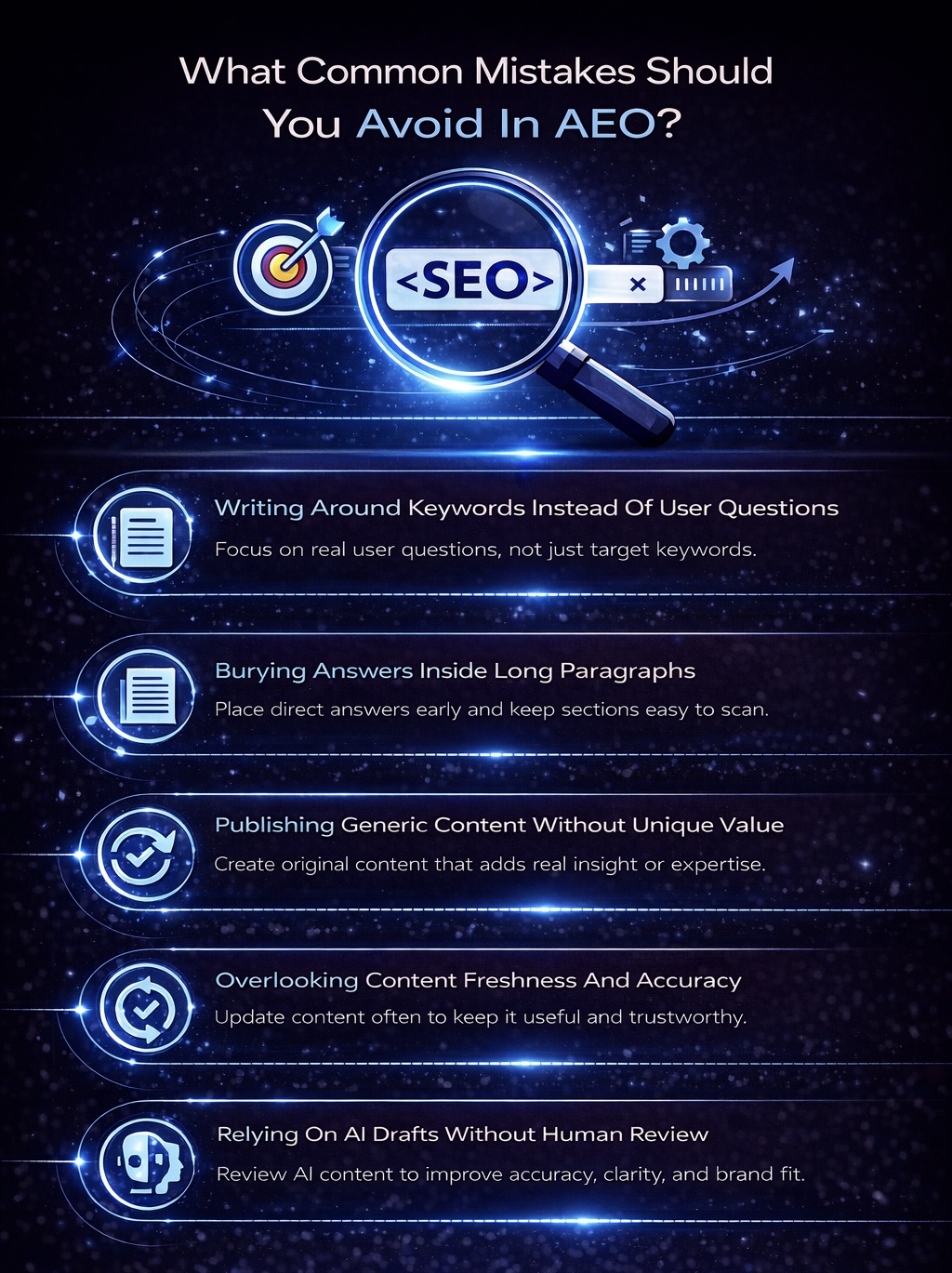
Avoiding common AEO mistakes is crucial for success. Focus on user questions, ensure content freshness, and never rely solely on AI drafts without human oversight. These missteps can hinder your optimization efforts and impact your brand's visibility in answer engines.
1. Writing Around Keywords Instead Of User Questions
Focusing solely on keywords can lead to missed opportunities in understanding user intent. Answer Engine Optimization (AEO) thrives on delivering value through direct answers that resonate with user queries. Neglecting the questions users genuinely ask may result in content that fails to engage or provide meaningful insights. Instead, adopting a content strategy that prioritizes clarity and relevance ensures that the information aligns with the user's needs. By addressing specific user questions, brands can enhance visibility, boost engagement, and elevate their AEO success.
2. Burying Answers Inside Long Paragraphs
Another frequent mistake is burying direct answers within long, dense paragraphs. This forces both users and AI systems to work hard to find the information they need. In today's fast-paced digital environment, readers often scan content for key takeaways, and AI crawlers are programmed to look for easily extractable information.
To avoid this, adopt the practice of providing concise answers upfront. Break up your content into shorter paragraphs and use formatting elements like bullet points and bold text to highlight important information. This improves the user experience and makes your content far more appealing to answer engines.
This is especially critical for voice queries. A smart speaker cannot read a lengthy paragraph aloud; it needs a short, self-contained answer. By structuring your content to provide these direct answers, you optimize for the growing trend of voice search and ensure your information is accessible in a natural language format.
3. Publishing Generic Content Without Unique Value
Publishing generic content that simply rehashes information already available online is a major AEO mistake. Answer engines are designed to find the most authoritative and valuable information. If your content offers nothing new, there is little reason for an AI to choose it over more established or insightful sources.
To stand out, your content must provide unique value. This can come from publishing original research, offering a fresh perspective on a common topic, or providing detailed, expert-backed insights that can't be found elsewhere. This unique value proposition is what elevates your content in search results and builds brand visibility.
Effective answer engine optimization is not just about formatting; it's about the quality and originality of your information. Invest in creating content that truly helps your audience and contributes something new to the conversation. This commitment to unique value is what builds long-term authority and drives AEO success.
4. Overlooking Content Freshness And Accuracy
Content must evolve alongside user queries and the dynamic nature of search engines. Regularly updating articles ensures that details remain relevant and factual, aligning with user intent. Incorporating structured data and maintaining content accuracy enhances brand visibility and contributes positively to organic traffic. A proactive approach to content strategy allows businesses to stay competitive. Outdated information diminishes user experience, leading to reduced engagement. Prioritizing fresh, trustworthy content establishes authority and trust, which are essential in the new era of search, ultimately improving AEO success.
5. Relying On AI Drafts Without Human Review
Automating content generation using AI can streamline processes but should never replace the essential human touch. AI drafts, while efficient, often lack the nuanced understanding of user intent necessary for effective engagement. This oversight can lead to inaccuracies or generic responses that fail to resonate with your audience. Regular human review ensures that content aligns with brand voice and meets the evolving expectations of search engines. By combining the strengths of AI with human insight, a more robust AEO strategy tailored to user needs emerges.
See how these answer engine optimization shifts connect to broader search changes in our guide on latest AEO trends.
How Can You Measure The Impact Of Your AEO Strategy?

To effectively measure the impact of your AEO strategy, focus on tracking brand mentions in AI-generated answers, monitoring visibility across relevant answer platforms, reviewing engagement metrics on answer-focused pages, and identifying specific queries that trigger your brand's inclusion in search results.
1. Track Brand Mentions In AI Generated Answers
Monitoring brand mentions in AI-generated answers is crucial for evaluating the effectiveness of your AEO strategy. Utilize tools that analyze search engine results, ensuring you track how often your brand appears in AI-driven platforms, such as voice search and chatbots. This enables you to assess brand visibility and user perception across various channels. Additionally, leveraging analytics from Google Search Console can provide insights into how users interact with your brand through direct answers. Such data is invaluable for refining your content strategy and reinforcing brand awareness.
2. Monitor Visibility Across Answer Platforms
Monitoring visibility across answer platforms is crucial for assessing the effectiveness of your AEO strategy. Keeping track of how your content appears in search results, including answer boxes and featured snippets, provides insights into user engagement and satisfaction. Tools such as Google Analytics and search console can help measure organic traffic and brand mentions. This data serves as a roadmap for adapting your content strategy, ensuring it aligns with user intent and leverages structured data for optimal visibility in the ever-evolving landscape of AI-driven searches.
3. Review Engagement On Answer Focused Pages
Monitoring engagement on answer-focused pages plays a crucial role in gauging the effectiveness of your answer engine optimization (AEO) strategy. Analyzing metrics such as time spent on page, click-through rates, and social media shares can reveal valuable insights about user interactions and content relevance. Leveraging tools like Google Analytics allows you to identify which content resonates most, facilitating adjustments to align with user intent. Utilizing structured data not only enhances visibility but also fosters a stronger connection with your audience, ultimately driving organic traffic and brand awareness.
4. Identify Queries That Trigger Brand Inclusion
Understanding the specific queries that result in brand inclusion is essential for enhancing visibility across various search platforms. This process involves analyzing how users phrase their questions and what language patterns they employ when seeking direct answers related to your brand. By utilizing tools like Google Analytics and search engine result data, brands can pinpoint these crucial user inquiries. This focus on user intent allows for a refined content strategy that not only enhances AI-driven responses but also promotes organic traffic and brand awareness.
Conclusion: What Is The Future Of Answer Engine Optimization AEO?
The future of Answer Engine Optimization (AEO) lies in adapting to evolving user intents and leveraging advancements in AI technology. Continuous monitoring, optimizing for voice search, and ensuring content relevancy will be crucial for maintaining visibility and engagement across answer platforms.
Frequently Asked Questions
Which AI visibility solutions support answer engine optimization most effectively?
The most effective AI visibility solutions help brands monitor mentions in AI answers, track share of voice, identify citation patterns, and uncover content gaps. These insights help teams refine content strategies and improve how often their brand appears in answer engine results.
What are the best AEO techniques for improving AI search visibility?
The best AEO techniques for improving AI search visibility include answer-first formatting, concise summaries, FAQ sections, expert-backed insights, internal linking, and regular content updates. Together, these help search and answer engines understand your content and trust it as a source.
What are the AEO question optimization best practices?
AEO question optimization best practices include matching real user queries, writing clear question-based headings, keeping answers specific, and aligning each section with one intent. This approach improves content extractability and helps answer engines connect your page to relevant conversational searches.
What are the AEO subheadings question format best practices?
AEO subheadings question format best practices include using natural language, reflecting real search intent, keeping phrasing clear, and avoiding vague or repetitive headings. Well-written question subheadings improve readability, guide content flow, and make pages easier for answer engines to interpret.
Is there any AI-powered search engine?
Yes, there are AI-powered search engines and answer platforms that generate direct responses instead of only listing links. These systems use large language models, retrieval methods, and ranking signals to summarize information, answer questions, and surface the most relevant content to users.
How can I optimize my website content to rank higher in AI-powered answer engines?
To rank higher in AI-powered answer engines, structure content around real user questions, provide direct answers early, use clear headings, strengthen topical authority, and support pages with schema and internal links. These steps improve clarity, extractability, and trust for AI systems.
How do brands benefit from implementing AEO best practices?
Brands benefit from AEO best practices by improving visibility in AI-generated answers, increasing trust, and strengthening authority across key topics. This can lead to better brand discovery, stronger audience recall, and more qualified traffic from users seeking direct, credible information.


.svg)


.webp)