.jpg)
Quick Summary: Latest AEO Trends in 2026
- AI search is becoming more conversational and agentic. Google AI Mode has surpassed one billion monthly users, while search journeys increasingly extend into follow-up questions, comparisons, and task completion.
- Query fan-out is changing content strategy. AI systems can run multiple related searches from one prompt, so brands need broader topic and decision coverage rather than pages for every keyword variation.
- AEO measurement is becoming more concrete. Google Search Console now provides dedicated generative AI visibility reporting for AI Overviews, AI Mode, and other AI features.
- Original evidence and entity consistency matter more. First-party data, expert insights, accurate brand information, and trusted third-party mentions help strengthen credibility.
- There is no special AEO shortcut. Traditional search engine optimization remains foundational, while schema and llms.txt should not be treated as guaranteed routes to AI visibility.
- AEO now extends beyond text. Multimodal search, personalization, product feeds, and AI agents are expanding optimization into images, video, commerce, and action-oriented experiences.
AI search is no longer a side feature. Google says AI Overviews now reach 2.5 billion monthly users, while AI Mode has already surpassed one billion. Search is becoming more conversational, personalized, multimodal, and increasingly capable of completing tasks.
That changes what Answer Engine Optimization (AEO) means in 2026. Visibility is no longer measured only by where a page ranks, but also by whether brands appear in AI-generated answers, citations, comparisons, and recommendations. The latest AEO trends show how content strategy, measurement, building brand authority, and optimization are evolving alongside this new search experience. Let's look at this in detail.
What Are The Latest AEO Trends In 2026?
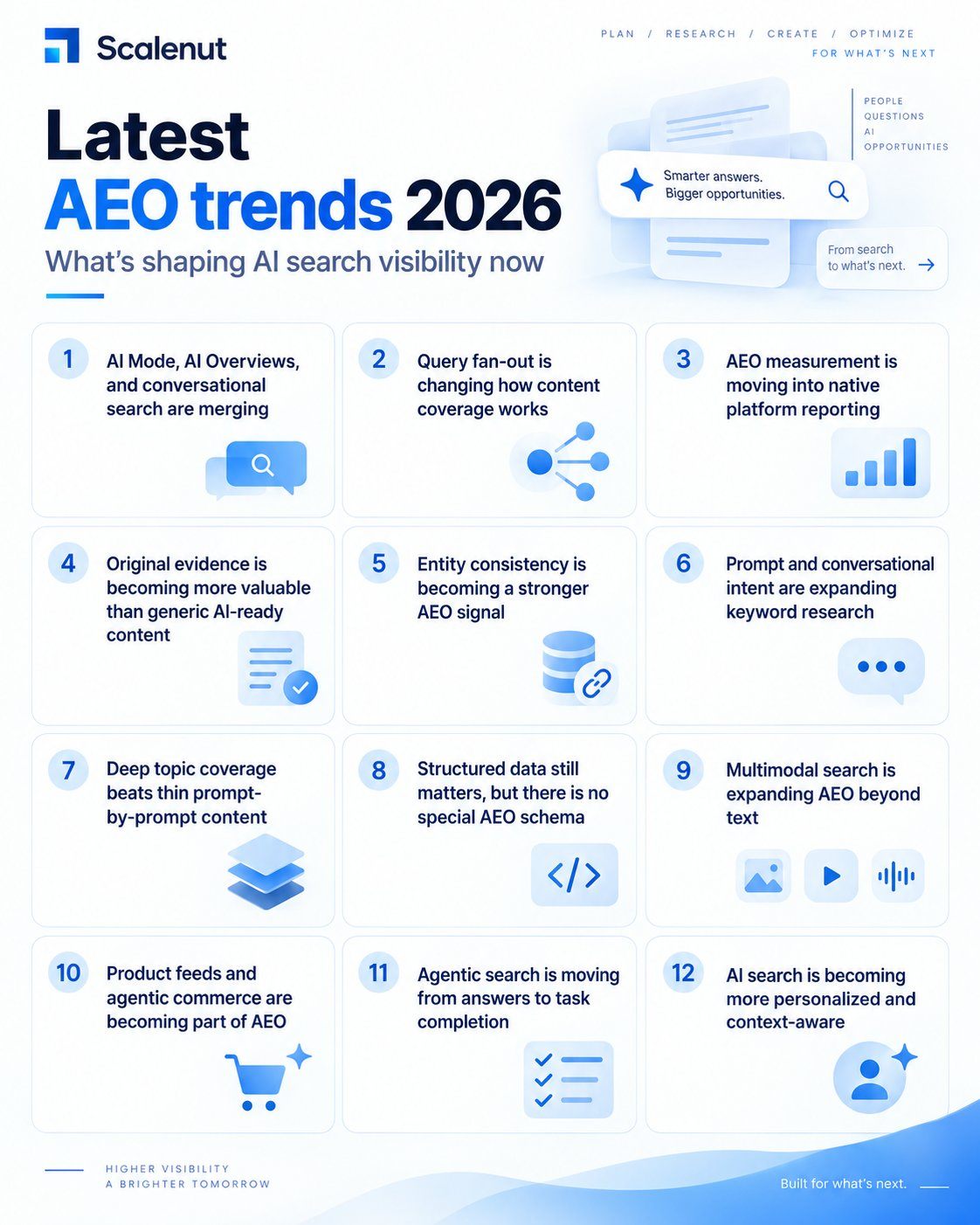
In 2026, key answer engine optimization trends are shaping success in a rapidly evolving landscape. These trends highlight smarter AI platforms and the need for content that appeals to both humans and machines. Effective search optimization now demands a multi-faceted strategy. From AI-generated summaries to stronger brand signals, new rules of visibility are emerging. Let’s look at the key answer engine optimization (AEO) trends in 2026:
1. AI Mode, AI Overviews, and conversational search are merging
Google is bringing AI Overviews and AI Mode into one more seamless experience in Google search results. Users can move from an AI-generated overview into follow-up questions in AI Mode while keeping the context of their original search.
Adoption is accelerating too. Google says AI Mode has surpassed one billion monthly users, with queries more than doubling every quarter since launch.
For brands, AEO now extends beyond appearing in a single AI Overview. Content needs to remain relevant as users move from an initial query into follow-up questions, comparisons, and deeper exploration.
This means:
- AI visibility spans more of the search journey, not just one AI answer.
- Content should anticipate follow-up questions, not only target the primary keyword.
- Traditional SEO still matters, since pages must be indexed and eligible for Google Search to appear as supporting links in AI features.
2. Query fan-out is changing how content coverage works
AI search no longer treats every prompt as a single query. Google uses query fan-out, where AI Mode and AI Overviews can run multiple related searches across subtopics and data sources before building a response. This helps the system explore different parts of a user's question at once.
For example, one prompt about a software product could trigger searches around pricing, features, alternatives, limitations, reviews, and use cases.
For content and marketing teams, this shifts the focus from optimizing for one keyword to covering the broader decision or buying journey around a topic. Pages that clearly answer related questions and provide useful supporting information have more opportunities to become relevant across these fan-out searches.
3. AEO measurement is moving into native platform reporting
AEO measurement is no longer limited to third-party AI search tools. In 2026, major search and analytics platforms began exposing AI performance data directly.
Google Search Console now reports impressions, pages, countries, devices, and visibility over time for generative AI features such as AI Overviews and AI Mode. The report was rolled out worldwide by August 31, 2026.
Bing Webmaster Tools has also introduced AI Performance reporting, showing citation counts, cited URLs, grounding queries, and visibility trends across Microsoft AI experiences.
GA4 now goes a step further by separating traffic from recognized AI assistants such as ChatGPT, Gemini, and Claude into a dedicated AI Assistant channel.
For brands, this means AEO performance can increasingly be measured across visibility, citations, traffic, and downstream outcomes, rather than relying on rankings alone.
4. Entity consistency is becoming a stronger AEO signal
AI systems build their understanding of a brand from multiple sources, including websites, reviews, directories, media coverage, forums, and social platforms.
That makes entity consistency increasingly important. Your brand name, products, services, pricing, positioning, and differentiators should remain accurate across owned and third-party sources. Conflicting information can make it harder for AI systems to understand and represent your brand correctly.
For AEO, off-page authority now extends beyond backlinks. Brands should:
- Earn relevant mentions on trusted third-party sites.
- Keep important brand information consistent across the web.
- Monitor how AI platforms describe the brand and correct outdated source information.
- Align SEO, PR, content, and brand messaging.
5. Prompt and conversational search intent are expanding keyword research
Traditional keywords still matter, but AI search is making queries longer, more specific, and more conversational. Users increasingly include their situation, needs, constraints, and follow-up questions in a single prompt.
For AEO, keyword research should therefore go beyond search terms and uncover the real questions and language buyers use. Useful sources include sales conversations, support tickets, customer reviews, forums, and community discussions.
SEO teams should:
- Target specific problems and use cases, not just broad keywords.
- Use the language customers naturally use when asking questions.
- Address relevant constraints, comparisons, and follow-up questions.
- Combine traditional keyword data with prompt and audience research.
6. Deep topic coverage beats thin prompt-by-prompt content
Topical authority still matters in AEO, but that does not mean creating a separate page for every keyword, prompt, or query variation. Google’s 2026 guidance specifically warns against this approach.
Instead, focus on covering important topics with enough depth to answer related questions, use cases, and decision points naturally. A strong content ecosystem can include a comprehensive pillar page supported by relevant articles where they genuinely add value.
To build topical depth:
- Cover core topics comprehensively instead of chasing every query variation.
- Create supporting content only where it adds distinct value.
- Use internal links to connect related pages and reinforce context.
- Prioritize original insights and useful information over content volume.
7. Structured data still matters, but there is no special AEO schema
Structured data still helps search engines understand entities and page content, but there is no special schema required to appear in AI Overviews or AI Mode. Google also says AI-specific markup or files such as llms.txt do not improve visibility in its AI search features.
The priority is to use relevant structured data accurately and ensure it matches what users can see on the page.
For AEO:
- Use appropriate schema such as
Organization,Product,Offer, andArticlewhere relevant. - Keep product, business, and merchant information accurate and up to date.
- Ensure structured data reflects visible page content.
- Do not treat schema or
llms.txtas shortcuts to AI visibility.
8. Multimodal search is expanding AEO beyond text
AEO is no longer limited to written queries and webpages. Users can increasingly search through voice, images, and video as AI search becomes more multimodal.
In March 2026, Google expanded Search Live to over 200 countries, allowing users to have real-time conversations with AI Mode using both voice and their camera.
For content teams, this means important information should be understandable beyond text alone. To improve multimodal visibility:
- Add clear transcripts and chapter markers to videos.
- Optimize images with descriptive alt text and relevant context.
- Use high-quality product and instructional visuals.
- Structure video and visual content around specific questions and tasks.
9. Product feeds and agentic commerce are becoming part of AEO
AI search is moving deeper into product discovery and comparison. In 2026, OpenAI expanded its Agentic Commerce Protocol to support product discovery in ChatGPT, allowing merchants to provide product feeds and promotions directly.
For commerce brands, AEO now includes keeping product data accurate, structured, and easy for AI systems to use. Important details include:
- Pricing and availability.
- Product variants and identifiers.
- Features and comparison-ready attributes.
- High-quality product images.
- Accurate merchant and catalog data.
For B2B and other commercial queries, the same principle applies: pricing, features, limitations, integrations, and “best for” information should be easy to find and compare.
10. Agentic search is moving from answers to task completion
AI search is evolving from answering questions to completing tasks on a user’s behalf. Google is introducing Search agents that can research across sources, monitor information, compare options, and help users take action while retaining context across the customer journey.
This also changes how AI interacts with websites. Browser agents may analyze rendered pages, DOM structure, and accessibility information to gather what they need for tasks such as product comparisons or bookings.
For AEO, brands should:
- Make key information such as pricing, availability, features, and policies easy to access.
- Maintain clear navigation and technically accessible pages.
- Structure comparison and decision-making information around user intent.
- Prepare websites for both human website visits and emerging browser agents.
11. Original evidence is becoming more valuable than generic AI-ready content
As AI makes it easier to produce generic content at scale, simply structuring a page for AI extraction is no longer enough. Google’s 2026 guidance specifically emphasizes unique, non-commodity content that adds information or perspective users cannot easily find elsewhere.
For AEO, that means strengthening content with evidence such as:
- First-party research and proprietary data.
- Original experiments, observations, and case studies.
- Screenshots, examples, and real-world results.
- Expert commentary and named authors.
- Clear methodology, dates, and primary sources.
The goal is not just to make content easy for AI to extract, but to give AI systems something distinctive and credible worth citing.
12. AI search is becoming more personalized and context-aware
AI search results are becoming less uniform. Google is expanding Personal Intelligence in AI Mode, allowing Search to use individual context and preferences to provide more tailored responses.
For AEO, this means brands cannot optimize for one universal answer alone. Content should clearly communicate who a product, service, or recommendation is for, including relevant needs, use cases, locations, and constraints.
This makes specificity increasingly important. Clear audience signals and detailed use-case information give AI systems more context for deciding when a brand or page is relevant.
Why Does AEO Matter in 2026?
Answer Engine Optimization (AEO) matters because brand discovery is no longer limited to traditional search engines. People increasingly encounter brands inside AI-generated summaries, comparisons, recommendations, and follow-up answers before they ever click a website.
That shift is already happening at scale. Google says AI Overviews now reach 2.5 billion monthly users, making AI-generated search experiences a major part of the discovery journey.
AEO helps your content become easier to understand, retrieve, cite, and represent accurately in those experiences. The goal is not to replace rankings or organic traffic, but to expand visibility beyond them into AI-driven answers and conversations.
From Search Engines to Answer and Action Engines: Why AEO Is Accelerating in 2026
Search behavior is moving from short queries toward more conversational, multi-step journeys. Users can now ask complex questions, compare options, continue with follow-ups, and increasingly use AI systems to help complete tasks.
Google reported that AI Mode queries have more than doubled quarterly since launch. This matters because content is no longer competing for visibility only on one results page. It may need to remain relevant across an entire chain of questions, comparisons, and decisions.
For brands, AEO means creating content that is not only discoverable, but also clear enough to support these deeper search journeys.
Why Is AEO More Important Than Traditional SEO Alone in 2026?
AEO does not replace traditional SEO. Google confirms that AI Overviews and AI Mode still rely on its core Search ranking and quality systems, so indexing, crawlability, relevance, authority, and helpful content remain foundational.
The difference is what happens after discovery. SEO helps your pages become eligible to rank and surface, while AEO focuses on making the information within those pages easy for AI systems to retrieve, understand, and use in generated responses.
That means brands now need to think about both ranking visibility and answer visibility. Strong SEO gets your content into the ecosystem; AEO increases its usefulness within AI-driven search experiences.
What Does This Mean for Content Teams and Brands?
For content teams, the shift requires a more connected content strategy and creation process. Publishing isolated pages is not enough if the information is generic, inconsistent, or difficult to verify.
Content should now combine clarity with credibility. Teams should:
- Answer important questions directly without sacrificing depth.
- Add original research, examples, expert input, or first-hand evidence.
- Keep brand, product, pricing, and entity information accurate across sources.
- Cover related questions and decision points naturally.
- Use clear headings, lists, and internal links to make information easier to navigate and retrieve.
The strongest AEO strategy therefore builds on good SEO while making content more useful to both people and the AI systems helping them search.
A 90-Day AEO Action Plan for 2026
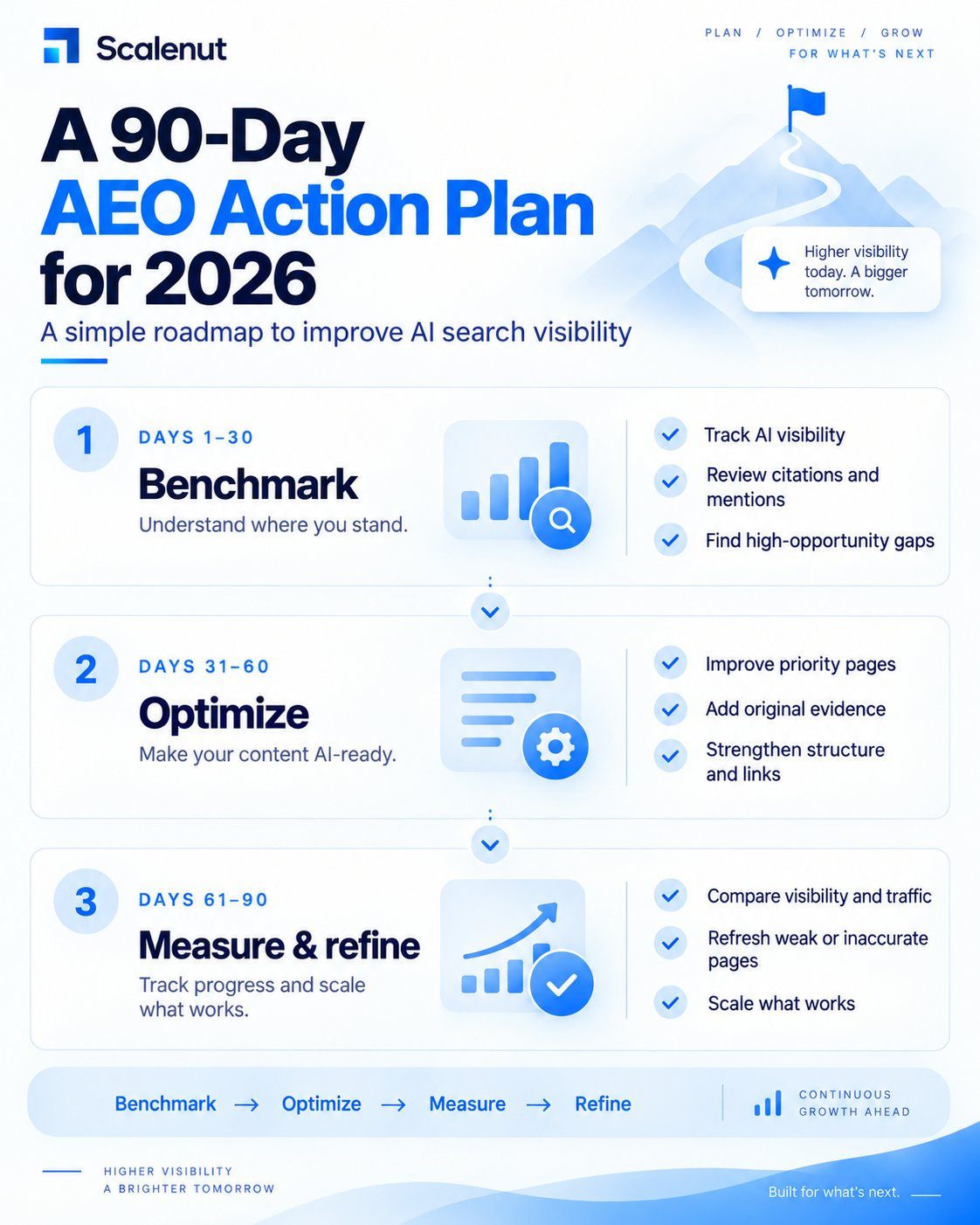
Adapting to the latest AEO trends does not require rebuilding your entire content strategy. Start by understanding where you already appear, improve the pages with the greatest opportunity, and then measure whether those changes increase AI visibility.
Days 1–30: Benchmark your current AI visibility
Start by establishing a baseline across search and AI platforms.
- Identify pages already appearing in AI Overviews, AI Mode, and AI-generated answers.
- Track citations, brand mentions, prompt visibility, and competitor presence.
- Review Google Search Console's generative AI performance data and Bing's AI citation data.
- Check which pages receive AI referral traffic and whether that traffic converts.
- Prioritize high-value topics where your visibility is weak or competitors appear more often.
Google Search Console now provides dedicated generative AI visibility reporting, while Bing Webmaster Tools exposes cited pages and grounding queries, making this baseline much easier to establish in 2026.
Days 31–60: Strengthen your highest-opportunity content
Focus on improving pages with clear search demand, business value, and AI visibility potential rather than creating content for every prompt variation.
- Answer the primary question clearly and early.
- Add original data, examples, expert input, screenshots, or first-hand evidence.
- Cover relevant follow-up questions, comparisons, constraints, and use cases.
- Keep pricing, product details, authorship, and brand information accurate.
- Improve internal linking between genuinely related pages.
- Check technical SEO, crawlability, structured data, images, and video where relevant.
Google's current guidance emphasizes useful, unique, non-commodity content while confirming that established SEO strategies remain foundational for AI search visibility.
Days 61–90: Measure, refine, and scale what works
Revisit the baseline and identify which changes are producing stronger visibility.
- Compare AI impressions, citations, cited URLs, and referral traffic.
- Identify prompts and topics where visibility improved or declined.
- Check whether newly visible pages are driving meaningful engagement or conversions.
- Refresh information that AI platforms are representing inaccurately or incompletely.
- Apply successful formats and approaches to other priority pages.
AEO should become an ongoing optimization cycle: benchmark, improve, measure, and refine. The goal is not simply to generate more content, but to strengthen the pages and information that help your brand appear accurately throughout AI-driven search journeys.
What to Watch Next in AEO?
The future of search is moving beyond simply earning a citation in an AI-generated answer. Search experiences are becoming more agentic, personalized, multimodal, and action-oriented.
The developments to watch include AI agents that research and monitor information over time, persistent context across search journeys, deeper personalization, agentic shopping and commerce, and greater use of images, video, voice, and interactive results. Google and other platforms are also exposing more AI visibility data, making attribution increasingly measurable.
For brands, the priority remains consistent: maintain accurate information, create distinctive content, strengthen authority across the web, and make content and product data easy for both people and AI systems to understand and use.
How to Turn AEO Trends Into Action With Scalenut
Understanding the latest AEO trends is useful. The bigger challenge is knowing where your brand is missing from AI answers and what to do next.
Scalenut connects AI visibility data with content execution, helping teams move from monitoring to optimization in one workflow.
With Scalenut, you can:
- Track AI visibility: Monitor Visibility Score, Share of Voice, Average Position, mentions, and performance across AI engines.
- Understand prompt behavior: See the prompts, themes, and query fan-outs AI engines use when researching a topic.
- Analyze citations and sources: Find which URLs and domains AI engines cite and where competitors are earning visibility instead.
- Identify competitive gaps: Discover prompts and topics where competitors appear but your brand does not.
- Monitor AI traffic: Use AI Traffic Monitor to see AI crawler activity and which pages attract attention from AI engines.
- Audit and improve content: Use GEO Content Audit, Article Writer, Content Optimizer, and Prompt Coverage to act on the gaps you uncover.
This creates a continuous AEO workflow: track visibility → uncover gaps → optimize content → measure the impact.
Book a demo to see how Scalenut can help turn AI search insights into action.
Conclusion
The latest AEO and AI SEO trends show that visibility now extends beyond traditional search results. SEO professionals must think beyond rankings and treat search as more than a single search landscape, where search systems surface information from a brand’s own site and trusted third-party sources.
For a long time, blog posts could focus mainly on keywords and clicks. Today, actual content creation also needs strong trust signals, clear relevance to the target audience, and distinctive information backed by evidence.
Following proven best practices will help brands stay visible as traditional and AI-driven search continue to evolve.
Frequently Asked Questions
What are the biggest AEO trends in 2026?
The biggest AEO trends in 2026 include AI Mode and AI Overviews becoming more conversational, query fan-out, native AI performance reporting, stronger entity consistency, multimodal search, agentic commerce, task-completing AI agents, and greater emphasis on original, non-commodity content.
Does AEO replace SEO in 2026?
No. AEO does not replace SEO. Google says its generative AI(artificial intelligence) features still rely on core Search ranking and quality systems. Technical SEO, indexing, helpful content, authority, and relevance remain foundational, while AEO expands optimization toward AI-generated answers and conversational discovery.
What is query fan-out in AI search?
Query fan-out is a technique where an AI system generates several related searches from one user prompt. Google uses it in AI Mode and AI Overviews to explore subtopics, retrieve supporting information, and build a more comprehensive response than a single query could provide.
Does schema markup help AI Overview visibility?
Structured data can help AI search engines understand page content, but Google says there is no special schema required for AI Overviews or AI Mode. Use relevant schema accurately where appropriate, but do not treat markup as a shortcut to gaining AI visibility.
Do you need llms.txt for AEO?
No. Google explicitly says llms.txt files are not required for Google Search and do not positively or negatively affect visibility or rankings. You may still maintain one for other systems that use it, but it should not be treated as an AEO requirement.
How do you measure AEO in Google Search Console?
Use Search Console’s Generative AI performance report to track how your pages appear in AI Overviews, AI Mode, and other generative AI features. It reports impressions, pages, countries, devices, and performance over time, helping you identify where AI visibility is growing or declining.
What is the difference between AEO and GEO?
AEO and GEO overlap heavily, but the labels emphasize slightly different ideas. AEO focuses on visibility within answer engines, while generative engine optimization focuses on generative AI experiences. Google treats both as terms for AI-search optimization and considers this work part of broader SEO.
What role does local SEO play in answer engine optimization trends for 2026?
Local SEO strengthens AEO for location-based queries by keeping business details accurate across Google Business Profile, websites, directories, and reviews. Google says local visibility depends mainly on relevance, distance, and prominence, making consistent local signals important for AI-driven discovery.


.svg)


.webp)