
.jpg)
What Is Content Engineering & How Does It Help Scale Content?

Key Highlights
- Content engineering shifts the focus from one-off content deliverables to structured, reusable systems.
- In the AI era, this practice transforms content strategy into repeatable execution that scales without losing quality.
- It bridges the gap between content operations and technical implementation for better optimization.
- Content engineering uses metadata, templates, and automation to build scalable content systems.
- The goal is to create content that machines can easily parse, improving visibility in AI search.
- Ultimately, this approach ensures quality, consistency, and scalability across all content efforts.
What Is Content Engineering?
Content engineering is the practice of building systems to help teams create, update, reuse, and distribute content at scale. It transforms content from one-off deliverables into structured infrastructure. This discipline focuses on designing and managing content in a strategic, scalable, and workflow-optimized manner, especially important in the AI era.
This approach bridges the gap between your content strategy and its technical implementation. By applying engineering principles to content creation, you ensure that every piece of content is structured and tagged for efficient management and delivery. It's about turning your content into a powerful asset that drives business results.
Why Content Is Now Treated Like Infrastructure?
Content is the foundation of your customer’s experience. Treating content like infrastructure means building it with structure and rules so it can be managed and scaled effectively, a necessity for maintaining consistency as your library grows. The AI era has increased the need for structured, machine-readable content; AI tools rely on well-organized information for effective search and personalization.
By adopting a systematic approach to content operations, you move from random production to a holistic strategy, enabling end-to-end management, easier adaptation to new channels and technologies, and long-term scalability.
How Does Content Engineering Differs From Traditional Content Operations?
Traditional content operations often focus on the logistics of content production, such as managing editorial calendars and coordinating teams. While important, this approach can lead to ad-hoc publishing habits and inconsistent outputs. Content engineering, on the other hand, introduces a more systematic and technical layer to the process.
Instead of just managing workflows, content engineering builds them. It involves creating repeatable building blocks, using automation to handle repetitive tasks, and structuring content for reuse across multiple channels. This discipline is less about managing individual pieces and more about creating a cohesive, scalable content ecosystem.
The key difference lies in the technical implementation. Content engineering turns strategic goals into executable systems. It ensures that content is not only created but also structured, tagged, and optimized for both human readers and machine parsing. This elevates content from a simple deliverable to a strategic asset.
Why Is Content Engineering Important in 2026?
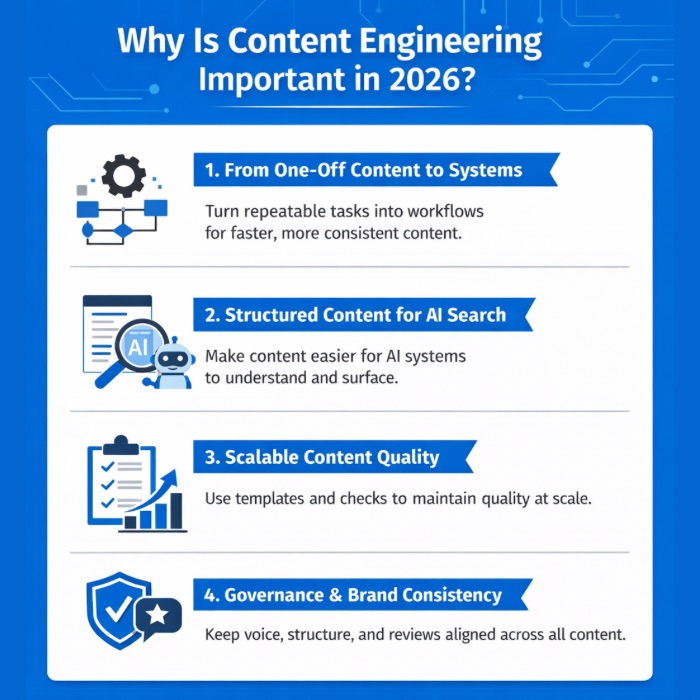
In 2026, AI’s rise makes content engineering crucial. As AI-driven search engines influence discovery, content must be structured for machines to understand and trust. Without systematic content systems, your marketing may be overlooked.
Here’s why content engineering is important in 2026:
1. From One-Off Content to Systems
Many content teams operate on a model of creating one-off pieces, leading to inefficiencies and inconsistent quality. The shift to a systems-based approach begins by identifying repetitive tasks in your content production workflow. This could include research, brief creation, or internal linking checks.
By turning these repetitive steps into standardized, automated workflows, you create building blocks for your content systems. This doesn't mean removing human creativity; it means freeing up your writers to focus on judgment and craft. The system handles the busywork, which increases efficiency and ensures every piece of content adheres to a consistent standard.
This structured approach is the core of technical implementation in content engineering. It ensures that every piece of content contributes to a larger, more scalable library. The result is a process that supports optimization and growth, rather than one that creates friction and rework.
2. Structured Content for AI Search
In the AI era, search engines are evolving into answer engines. To be visible, your content must be structured in a way that machines can easily understand and extract. This is where structured content becomes essential for generative engine optimization (GEO). It involves formatting your content with clear headings, consistent patterns like FAQs, and relevant schema markup.
Content engineering implements this structure systematically. By using metadata and clear formatting, you provide signals to AI systems about what your content is about and how different pieces of information relate to one another. This allows AI to parse your content reliably and surface it in search results and AI-generated responses.
Think of it as making your content machine-readable. When an AI system can confidently interpret your page, it's more likely to trust and cite it as an authoritative source. This structured approach is fundamental to improving your visibility and relevance in the new landscape of AI search.
3. Scalable Content Quality
Maintaining content quality while increasing output is a major challenge. Content engineering addresses this by building quality checks directly into your workflows. Instead of relying on manual reviews alone, you can establish automated rules and governance systems to ensure every piece of content meets your standards for accurate information.
This systematic approach allows you to scale quality alongside quantity. Clear workflows for creating, reviewing, and publishing content make it easier to stay on-brand and compliant, even as your content library grows. It ensures that standards don't break down as the pace of production increases.
Key aspects of scalable content quality include:
- Automated Checks: Implementing rules to flag outdated claims or broken links.
- Standardized Templates: Ensuring consistent structure and formatting across all content.
- Clear Governance: Defining ownership and review paths for different types of content.
- Routine Refreshes: Scheduling regular updates for high-traffic or critical pages.
4. Governance and Brand Consistency
As content is published across more channels, maintaining brand consistency becomes increasingly difficult. Without a system, your brand voice can drift, and messaging can become fragmented. Content engineering establishes governance to ensure every piece of content aligns with your brand standards.
This is achieved by embedding rules and guidelines directly into your content creation process. For example, you can create standardized content models for different content types or define a clear taxonomy for tagging. This ensures that everyone on your team is working from the same playbook, which promotes consistency.
Ultimately, strong governance turns your content strategy into a reality. It ensures that the content you produce is not only high-quality but also a true reflection of your brand. This systematic approach is essential for building trust and a cohesive customer experience across all touchpoints.
What Are the Core Elements of Content Engineering?
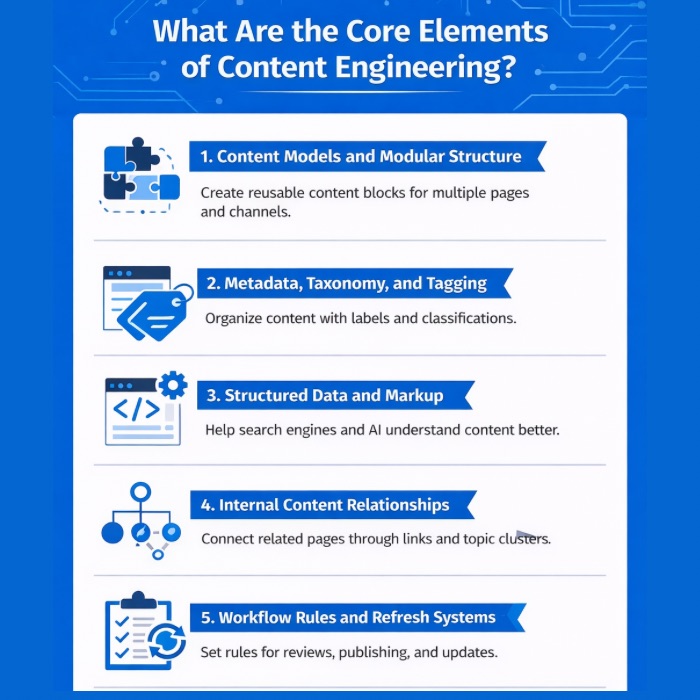
Content engineering centers on breaking content into structured, reusable modules instead of pages. Key elements include content models, modular structure, metadata, taxonomy, and automated workflows. Content models define structure; metadata and taxonomy provide context and boost discoverability; workflows automate processes. Together, these create scalable, efficient content operations. Let’s look at each element in detail.
1. Content Models and Modular Content Structure
Content models are templates that define the structure for different types of content. By breaking content into modular parts, you can reuse components across various pages and channels. This modular content approach reduces duplication and ensures a consistent voice as your content library grows.
For example, a single "product definition" block can be used on a landing page, in documentation, and within onboarding materials. If the definition needs an update, you change it in one place, and the system propagates the change everywhere. This dramatically improves content velocity and simplifies maintenance.
Examples of modular content include:
- A standard "how it works" section for all feature pages.
- A common objections block for pricing and sales pages.
- A reusable customer testimonial module.
- A product definition block shared across different assets.
This structure streamlines workflows and makes optimization easier, as you can test and refine individual components instead of entire pages.
2. Metadata, Taxonomy, and Content Tagging
Metadata is data about your content. It provides context that helps both people and systems understand what each piece of content is for. In content engineering, metadata can include details like the target audience, funnel stage, topic cluster, or last review date. This information is crucial for effective content management.
A taxonomy provides a shared, structured vocabulary for your team. It's a classification system used for content tagging, which makes content easier to find, manage, and relate to other pieces. A well-defined taxonomy supports features like internal linking, content recommendations, and personalized user experiences at scale.
Together, metadata and taxonomy are the backbone of a smart content system. They turn a chaotic library of content into an organized, discoverable asset. This structured approach is fundamental for anyone looking to build a career as a content engineer, as it requires both strategic thinking and technical precision.
3. Structured Data and Markup for Search Visibility
Structured data, often implemented using schema markup, is a standardized format for providing information about a page and classifying its content. For search engines and AI systems, this markup makes your content much easier to parse and understand, which is critical for search visibility.
In the context of SEO, structured data helps search engines interpret your content more reliably. This can lead to rich results in search, like FAQ snippets or product review ratings, which can improve click-through rates. For generative engine optimization, structured data is even more important as it helps AI systems extract accurate information for their responses.
Content engineering ensures that structured data is applied consistently and correctly across your content. By incorporating schema markup for relevant content types like articles, FAQs, or products, you are essentially speaking the language of search engines. This increases the chances that your content will be not just found, but also understood and featured.
4. Internal Content Relationships and Topic Connections
A key part of content engineering is defining the relationships between different pieces of content. This goes beyond simple internal linking and involves creating clear topic connections that build authority and guide users through your site. A well-structured network of content helps both users and search engines understand your expertise on a given subject.
Your content strategy should map out these internal relationships. For example, a pillar page on a broad topic should link out to more detailed cluster pages, and those pages should link back. This creates a logical information architecture that signals topical authority. Content engineering helps automate and maintain these connections as your content library grows.
This system turns your content into a web of interconnected assets, making it smarter with every new piece you publish. .
5. Workflow Rules, Governance, and Refresh Systems
To make a content system work, you need clear rules. Workflow rules, governance, and refresh systems are the operational side of content engineering. They ensure that your content is created, managed, and maintained in a consistent and predictable way.
Governance defines the standards, roles, and processes for your content. This includes things like brand voice guidelines, legal review requirements, and who is responsible for approving content. Automation can be used to enforce these rules, such as routing a draft to the right person for review.
Refresh systems are workflows designed to keep your content up-to-date. For example, you can set up triggers that automatically flag content for review if its traffic drops or if it hasn't been updated in a certain amount of time. These automated systems are essential for maintaining a healthy and accurate content library at scale.
How Can Businesses Start Implementing Content Engineering Practices?
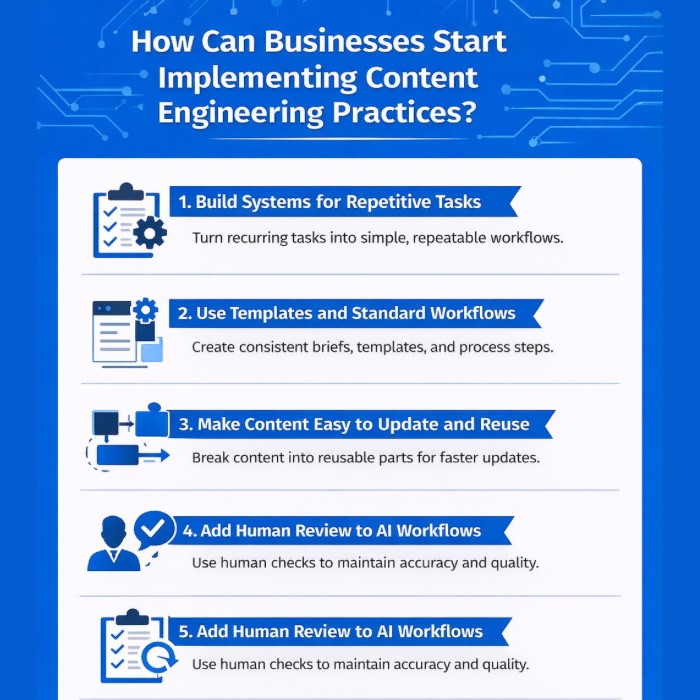
Businesses can implement content engineering by systemizing and automating repetitive tasks, like creating briefs or updating posts. Start small with standardized templates, clear workflows, and reusable content structures. This gradual approach streamlines processes and builds a scalable, efficient content practice over time. This section will cover these steps in detail.
1. Building Systems Around Repetitive Content Tasks
The first step in building content systems is to identify the recurring tasks that consume your team's time. Look at your content production process from start to finish. Do you manually research topics every time? Do you create content briefs from scratch? These are prime candidates for automation.
Once you've identified these tasks, you can start building simple workflows to streamline them. For example, you could create a template for content briefs that automatically pulls in keyword data and competitor information. This not only saves time but also ensures consistency across all your content.
This is the practical side of technical implementation. By turning manual processes into automated systems, you create shared building blocks that your entire team can use. This frees up your content creators to focus on what they do best: producing high-quality, insightful content.
2. Using Templates, Briefs, and Standardized Workflows
Templates, briefs, and standardized workflows are the foundational tools of content engineering. They provide the structure and guidance needed to produce consistent, high-quality content at scale. A content template, for instance, can define the sections and headings for a specific content type, ensuring every piece follows a proven format.
Standardized briefs are equally important. A good brief should provide all the necessary information for a writer to create a successful piece of content, including the target audience, primary keyword, and key points to cover. This reduces back-and-forth communication and helps align the final piece with your strategic goals.
By implementing these elements, you establish clear checkpoints in your content creation process. These standardized workflows make optimization easier and ensure everyone on your team understands what is expected. Key benefits include:
- Faster Production: Teams can move quicker when the basics are already defined.
- Consistent Quality: Standards are built into the process, not added as an afterthought.
- Easier Onboarding: New team members can get up to speed faster.
- Improved Alignment: Everyone works toward the same strategic objectives.
3. Creating Content That Can Be Updated and Reused Easily
Content engineering is not just about creating new content; it's also about making your existing content work harder. By adopting a modular content approach, you can create pieces that are easy to update and reuse. This means breaking down your content into smaller, self-contained chunks that can be assembled in different ways.
This approach makes content refresh workflows much more efficient. Instead of rewriting an entire article, you can simply update the specific module that contains outdated information. This saves a significant amount of time and ensures your content remains accurate and relevant.
Thinking in modules also opens up opportunities for reuse. A single piece of core content can be repurposed for a blog post, a landing page section, a social media update, or a sales enablement snippet. This maximizes the value of your content creation efforts and ensures a consistent message across all channels, which is a cornerstone of smart optimization.
4. Adding Human Review to AI-Assisted Content Processes
In the AI era, automation can significantly speed up content creation. However, relying solely on AI without oversight is risky. Content engineering emphasizes the importance of human review in any AI-assisted process to ensure you publish accurate information that your audience can trust.
Automation can draft, flag, and route work, but people must remain accountable for what is true, useful, and safe to publish. Human review should be a non-negotiable step in your workflow, especially for claims tied to trust, compliance, or brand positioning. Editors, brand owners, and legal partners should all have clear roles in the review process.
This creates essential feedback loops. Human oversight protects your credibility as output grows and ensures that AI-generated content aligns with your brand's voice and standards. It strikes the right balance between the speed of AI and the judgment of human experts.
5. Turning Content Performance Data Into Optimization Loops
Content engineering isn't a "set it and forget it" discipline. It requires continuous optimization based on performance data. By creating feedback loops, you can turn analytics into actionable insights that improve your content over time. This means tracking not just traffic, but also metrics specific to your goals, like AI citations or conversion paths.
For example, if you notice a drop in clicks from Google Search Console for a specific page, your system can automatically trigger a content refresh. This data-driven approach ensures that your optimization efforts are focused on what will have the most impact.
Mature teams use these feedback loops to tie production decisions directly to business outcomes. This systematic approach to analytics helps you refine your content strategy and improve your results with every cycle.
What Are the Benefits of Content Engineering?
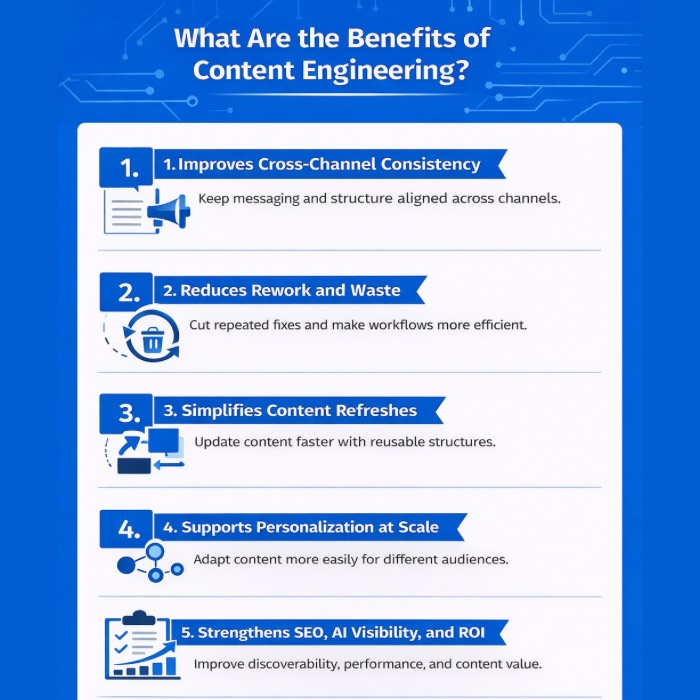
Content engineering streamlines workflows by replacing manual handoffs with shared systems, making content reuse, quality control, and distribution integral to your process. This boosts efficiency and scalability in content marketing. By reducing rework and simplifying management, it enables faster, higher-quality content production and a stronger return on investment. Let’s explore its specific benefits.
1. Improves Content Consistency Across Channels
Maintaining a consistent brand voice and message across multiple channels is a common struggle for many organizations. Content engineering addresses this challenge by establishing standardized workflows and content models. This ensures that every piece of content, regardless of where it's published, aligns with your brand guidelines.
When you have a central system for creating and managing content, you can enforce consistency at scale. Modular content, for example, allows you to use the same core message in different formats, ensuring brand alignment across your blog, social media, and email campaigns.
This consistency is crucial for building a strong brand identity and a trustworthy customer experience. By making brand alignment a built-in feature of your content process, content engineering helps you present a unified front to your audience, no matter how they interact with you.
2. Reduces Rework and Content Waste
Many content teams spend a surprising amount of time on rework, fixing broken links, updating outdated claims, and correcting inconsistencies. This "content waste" is a major drain on resources and a significant barrier to scalability. Content engineering minimizes this by building proactive checks into your workflows.
Instead of constantly cleaning up past mistakes, you can implement routine checks that catch problems early. For example, automated link monitoring can flag broken links before they become a widespread issue. This shifts your team's focus from repair to improvement.
By creating systems that promote optimization from the start, you reduce the need for constant fixes. This leads to a more efficient and effective content operation.
3. Makes Content Easier to Refresh and Maintain
As your content library grows, keeping everything up-to-date can become a monumental task. Content engineering makes content maintenance manageable by structuring content for easy updates. The use of modular content is particularly effective for this.
When your content is built from reusable modules, a content refresh becomes much simpler. Instead of rewriting an entire page, you can just update the specific component that needs a change. This not only saves time but also ensures that updates are applied consistently wherever that module is used.
Furthermore, you can build automated workflows to manage your content refresh schedule. For example, you can set rules to flag high-performing content for review every six months. This systematic approach to content maintenance ensures your library remains accurate, relevant, and valuable over time.
4. Supports Personalization at Scale
Personalization is a powerful way to improve the customer experience, but it's often difficult to implement at scale. Content engineering provides the structure needed to make personalization manageable. By using modular content connected to clear signals, you can tailor content without creating countless unique versions.
For example, you can change examples, calls-to-action, or industry references based on user data, while the core message of the content remains stable. This is possible because the content is broken down into smaller, interchangeable parts.
This approach makes personalization durable rather than fragile. You can adapt surface details to the user's context without having to rebuild the entire piece of content. This balance of stability and flexibility is key to delivering personalized experiences at scale, and it's a direct result of well-designed content engineering workflows.
5. Strengthens SEO, AI Visibility, and Content ROI
Content engineering is highly relevant for modern SEO and generative engine optimization (GEO). By structuring content for machine readability, you make it easier for search engine algorithms to understand and rank your pages. This includes using clear headings, structured data, and a logical internal linking structure to signal topical authority.
For AI visibility, this structure is even more critical. AI answer engines need to extract specific passages to generate responses. Well-engineered content, with its clear, self-contained sections, is more likely to be retrieved and cited by these systems. This increases your brand's presence in an increasingly zero-click search environment.
Ultimately, these improvements in visibility and optimization lead to a stronger content ROI. When your content is easier to find, reuse, and maintain, you get more value from every piece you create. It's a systematic way to ensure your content efforts contribute directly to your business goals.
Content Engineering vs Content Strategy vs Content Operations: What’s the Difference?
Content strategy, operations, and engineering are distinct but connected roles in a successful content program. Strategy sets the direction ("why"), operations manages the process ("how"), and engineering builds the technical systems ("what") to scale execution. Understanding these roles improves alignment, efficiency, and optimization. The next sections detail each function’s focus.
What Content Strategy Focuses On
Content strategy is the high-level planning function that sets the direction for your entire content program. It's focused on understanding your audience, defining your brand's narrative, and setting the goals that your content needs to achieve. A content strategist is responsible for answering the big "why" questions.
This includes identifying audience needs and pain points, mapping out customer journeys, and deciding on editorial priorities. The strategist ensures that all content planning is aligned with broader business objectives, such as driving leads, increasing brand awareness, or improving the customer experience.
The output of content strategy is a clear plan that guides content creation. This includes defining key themes, establishing success metrics, and creating a content roadmap. In essence, content strategy provides the blueprint that content operations and engineering will bring to life.
What Content Operations Manages
Content operations is the function responsible for managing the day-to-day execution of the content strategy. It focuses on the people, processes, and technology needed to get content from idea to publication efficiently. Content operations is all about the "how" of content production.
This involves managing editorial calendars, coordinating with writers and designers, and overseeing the content management system. A key goal of content operations is to create smooth and repeatable workflows that ensure content is delivered on time and on budget.
The scope of content operations includes:
- Workflow Management: Designing and overseeing the content production process.
- Team Coordination: Managing the various people involved in content creation.
- Technology Management: Administering the tools used for content creation, storage, and distribution.
- Process Automation: Implementing tools to streamline repetitive tasks.
What Content Engineering Adds to the Process
Content engineering adds a crucial technical layer to the content process, turning strategy into scalable execution. While content operations manages workflows, content engineering builds the underlying content systems that make those workflows possible and efficient. It is focused on the technical implementation of the content strategy.
This function is responsible for designing content models, defining metadata and taxonomy, and setting up automation rules. A content engineer ensures that content is structured in a way that supports reuse, personalization, and discovery by both humans and machines.
In short, content engineering is the bridge between the strategic vision and the final, published piece. It provides the technical framework that allows a content program to scale without losing consistency or quality. It’s what transforms a collection of individual content pieces into a powerful, interconnected system.
How These Functions Work Together
Content strategy, content operations, and content engineering are most effective when they work in close alignment. In a mature organization, these three functions form a powerful engine for content production and optimization. The process typically flows from strategy to engineering to operations.
First, the content strategist sets the direction, defining the audience, goals, and key messages. Next, the content engineer takes this strategic direction and builds the technical systems to support it. This includes creating content models, setting up workflows, and defining the structure for the content.
Finally, content operations manages the day-to-day execution within the system built by the content engineer. This collaborative approach ensures that the content produced is not only strategically sound and efficiently managed but also technically robust and scalable. It creates a seamless flow from high-level planning to on-the-ground execution.
What Are Common Tools Used in Content Engineering?
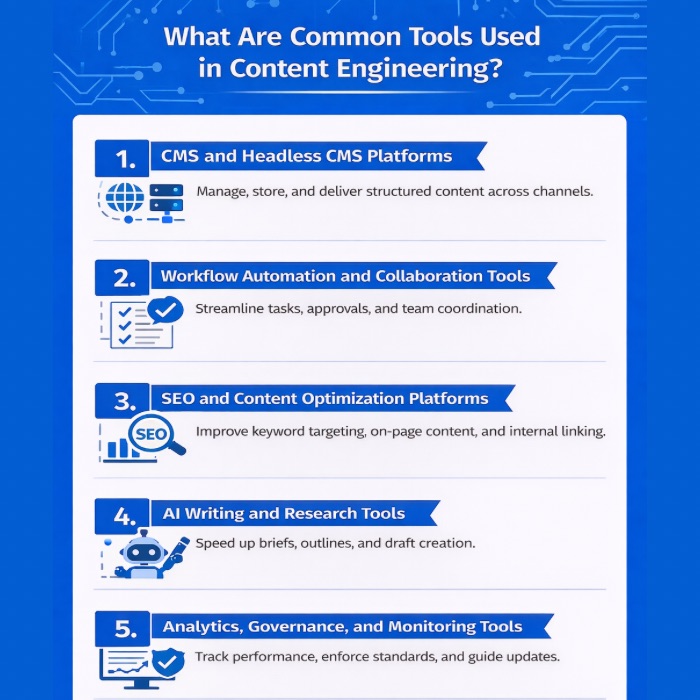
Content engineering uses various tools to build and manage scalable content systems. These include content management systems (CMS), workflow automation platforms, SEO tools, AI writing assistants, and analytics platforms. The goal is to create an integrated tech stack that supports the entire content lifecycle, from research and creation to publishing and measurement. The right tools automate workflows, improve collaboration, and provide data for ongoing optimization. Here are some common tools in each category.
1. CMS and Headless CMS Platforms
A Content Management System (CMS) is the core of any AI content engineering toolkit. It's where content is created, stored, and managed. Traditional CMS platforms couple the back-end content repository with a front-end presentation layer, while headless CMS platforms decouple them.
Headless CMS platforms are particularly well-suited for content engineering because they treat content as structured data, separate from its presentation. This makes it easy to deliver the same piece of content to multiple channels, such as a website, a mobile app, or an IoT device. This flexibility is essential for scalability.
These platforms are designed to support modular content and structured data, which are key principles of content engineering. They provide the foundation for building flexible, future-proof content workflows. Popular platforms include:
- Contentful
- Sanity
- Strapi
- Storyblok
2. Workflow Automation and Collaboration Tools
Workflow automation and collaboration tools help teams manage production at scale. They are used to assign tasks, track approvals, manage deadlines, and keep stakeholders aligned across the content lifecycle.
Tools such as Asana, Trello, and Jira are often used to standardize content workflows and reduce bottlenecks. They create a more consistent process, which is critical in content engineering where repeatability matters as much as creativity.
Scalenut fits naturally into this workflow layer through features that help teams move faster from planning to execution. Its Cruise Mode can speed up first-draft creation, while its planning and optimization workflows reduce manual effort across content production.
3. SEO and Content Optimization Platforms
SEO and content optimization tools are essential for making content discoverable in both traditional search and AI-driven environments. They help teams research keywords, analyze competitors, improve on-page structure, and identify opportunities to strengthen content performance.
Tools like Ahrefs, Semrush, Clearscope, and Google Search Console are widely used for this purpose. In a content engineering workflow, these tools help shape not only what content gets created, but also how it is structured, updated, and connected across the site.
Scalenut supports several core optimization tasks in one place. Its Keyword Planner helps with topic clustering and keyword research, Content Optimizer improves on-page relevance, and Link Manager supports internal linking, which is a key part of structured content systems.
4. AI Writing and Research Tools
AI writing and research tools are increasingly important in content engineering because they help teams speed up research, produce structured first drafts, generate outlines, and support metadata or brief creation. Used well, they reduce repetitive work and free writers to focus on judgment, originality, and refinement.
The role of AI here is not to replace human expertise. Strong content engineering still depends on human review, editorial standards, and quality control. AI works best when it is embedded inside a governed workflow.
Scalenut, with its AI writing capabilities, can help generate briefs, outlines, and long-form drafts, making it useful for teams that want faster content production without disconnecting writing from SEO goals.
5. Analytics, Governance, and Monitoring Tools
Analytics and monitoring tools provide the feedback loop that makes content engineering sustainable. They help teams understand what is performing, what is declining, what needs to be refreshed, and where gaps exist. Governance tools add the rules and standards needed to maintain quality and consistency at scale.
Platforms like Google Analytics and Google Search Console are key sources of performance data, while governance may be handled through checklists, review systems, or dedicated content standards inside the workflow.
Scalenut features like Traffic Analyzer helps track page-level performance and identify optimization opportunities. This supports the continuous improvement cycle that content engineering depends on.
Book a demo with Scalenut to see how your team can streamline content planning, creation, optimization, and performance tracking in one place.
Conclusion
Content engineering is revolutionizing how businesses approach content creation and management. By treating content as a vital infrastructure component, organizations can optimize their processes for efficiency, consistency, and scalability. This method not only enhances the quality of content but also strengthens its visibility in an increasingly competitive digital space.
As we navigate into 2026 and beyond, embracing content engineering will be crucial for those looking to stay ahead, ensuring that their content meets the demands of both users and search engines alike. If you're ready to take your content strategy to the next level, reach out to us for a free consultation to explore how content engineering can benefit your organization.
Frequently Asked Questions
How to optimize content for AI engines?
To optimize for AI engines, use content engineering to create structured, machine-readable content. This includes using clear headings, answering questions directly, and implementing schema markup. This approach supports generative engine optimization by making it easy for AI to parse, understand, and cite your content in its responses.
What are the best content types for answer engines?
The best content types for answer engines are those with a clear, logical structure. FAQs, how-to guides, glossaries, and product descriptions work well because they provide direct answers to specific questions. Creating structured content like this is a key optimization tactic for improving visibility in answer engines.
How to use content engineering to increase conversion rates?
Content engineering can increase conversion rates by enabling personalization at scale. By using modular content and automated workflows, you can tailor messaging and calls-to-action to specific user segments. This targeted approach to optimization creates a more relevant customer experience, which can lead to higher conversion rates.
What skills are needed to become a content engineer?
A content engineer needs a blend of strategic and technical skills. This includes understanding content strategy, designing workflows, and having experience with technical implementation. Skills in analytics, metadata design, and automation are also crucial for success in this role, as is a mindset focused on systems and optimization.
What does content engineering mean and why is it important?
Content engineering is the practice of building structured content systems to manage content at scale. It's important in the AI era because it ensures content is machine-readable and discoverable. This approach is crucial for achieving scalability, maintaining quality, and succeeding in an AI-driven digital landscape.
How is content engineering different from content creation?
Content creation focuses on producing individual pieces of content. Content engineering, however, focuses on building the systems and workflows for creating, managing, and distributing content at scale. It involves the technical implementation and optimization of the entire content ecosystem, rather than just the act of writing.
How does AI impact content engineering?
AI impacts content engineering by increasing the need for structured, machine-readable content and by providing tools for automation. AI can assist in content creation and help automate workflows, but it also requires a well-engineered content system to function effectively. This makes content engineering essential for successful AI optimization.
What is the relationship between answer engines and content engineering?
Content engineering is crucial for visibility in answer engines. By creating structured content with clear headings and schema markup, you make it easy for answer engines to extract and cite your information. This optimization is key to appearing in AI-generated responses and maintaining visibility in modern search.
What are the typical job roles for a content engineer?
A content engineer typically handles the technical implementation of content strategy. Job roles often involve designing content models, defining metadata standards, building automated workflows, and managing the content tech stack. The focus is on systems, optimization, and ensuring content can be managed effectively at scale.
Is content engineering relevant for SEO strategies?
Yes, content engineering is highly relevant for modern SEO. It extends traditional SEO by focusing on structured data, passage-level optimization, and machine readability. This ensures content performs well with today's sophisticated search algorithms and is visible in both traditional search results and AI-powered answer engines.


.svg)


.webp)