
.jpg)
How Often to Update Website Content for SEO?
Key Highlights
- Determining the right update frequency for your website content is crucial for SEO success and maintaining data freshness.
- The ideal schedule for content updates varies based on content type, from monthly checks for time-sensitive posts to annual reviews for evergreen articles.
- Factors like traffic performance, search intent shifts, and industry competition influence how often you should perform data updates.
- Prioritize refreshing pages that are losing rankings, have outdated information, or target important commercial keywords.
- Following best practices, such as keeping the original URL and improving on-page SEO, ensures your updates boost rather than harm your rankings.
Keeping your website content fresh is more than just a good habit; it's a fundamental part of a successful SEO strategy. How often should you perform content updates? The right update frequency signals to a search engine that your site is active and provides current, valuable information. This concept, known as data freshness, ensures your audience receives the most accurate and relevant content, directly impacting your rankings and user trust. This guide will walk you through how often to update your website content for optimal SEO results.
Why Does Updating Website Content Matter For SEO?
Regularly updating your website content is vital for maintaining your position in search engine results. When a search engine crawls your site, it looks for signs of relevance and authority. Stale, outdated information can signal that your site is neglected, causing your rankings to drop. Conversely, frequent data updates show that you are actively maintaining your content, which can improve your site's visibility. Good data quality is essential for providing value to your visitors and search engine bots alike.
Failing to update your content frequently enough carries significant risks. Outdated data can lead to poor user engagement, as visitors who encounter incorrect or irrelevant information are likely to leave your site quickly. This increases your bounce rate and tells search engines your page isn't satisfying user needs. For businesses seeking insights, stale data can lead to flawed decisions and missed opportunities, ultimately impacting operational efficiency and your competitive edge.
How Often Should You Update Website Content For SEO?
There isn't a single, one-size-fits-all answer to how often you should refresh your website content. The ideal update frequency depends on several factors, including the type of content and its purpose. Establishing a regular schedule for content updates is a key practice for maintaining high data quality and relevance.
A strategic approach involves categorizing your content and setting different review cadences for each. High-value pages may need more frequent attention than evergreen articles. Understanding these nuances allows you to create an efficient and effective update plan. Let's explore some general guidelines for different content types.
Review High-Value Pages Every 3 To 6 Months
Your high-value pages are the cornerstones of your website, often driving the most organic traffic and conversions. These pages demand consistent attention to ensure they remain effective. A review every three to six months is a good starting point for this critical content.
During your review, focus on ensuring all information is current and accurate. Fresh data keeps these pages relevant to both users and search engines. Look for opportunities to enhance the content by adding new insights, updating statistics, or refreshing examples. This proactive approach helps protect and even grow the organic traffic these pages generate.
Key areas to check on high-value pages include:
- Outdated statistics or industry benchmarks.
- Broken links or references to old resources.
- Opportunities to add new, relevant keywords.
Check Time-Sensitive Content Monthly Or Quarterly
Content that is tied to specific events, trends, or dates is considered time-sensitive and requires a more frequent review schedule. Think about news-related articles, seasonal promotions, or reports on market trends. These pages can become outdated quickly, so checking them monthly or quarterly is a smart strategy.
The goal with time-sensitive content is to maintain data freshness and accuracy. Regular updates ensure that the date information is current and the content reflects the present moment. If a page is about an annual event, for example, make sure you update it with details for the upcoming year as soon as they are available.
You should prioritize refreshing:
- Pages mentioning specific years or dates.
- Content related to ongoing events or trends.
- Product or service pages with seasonal offers.
Revisit Evergreen Content Every 6 To 12 Months
Evergreen content is designed to be timeless and consistently relevant to your audience. While its core message endures, the details can still become stale over time. For this content type, a review every six to twelve months is one of the best practices to ensure it remains authoritative and valuable. The update frequency for evergreen content is less demanding but no less important.
Even foundational topics evolve. New research might emerge, best practices could change, or you may find better examples to illustrate your points. Refreshing evergreen blog posts can involve adding new sections, updating screenshots, or incorporating recent data points to reinforce your expertise.
Consider making the following updates:
- Adding new internal links to more recent content.
- Updating examples, case studies, or statistics.
- Expanding sections to provide more depth and clarity.
What Is A Good Content Update Frequency By Page Type?
There is no one-size-fits-all update schedule. The right refresh cadence depends on how quickly the topic changes, how important the page is to your business, and whether its search performance is holding steady or slipping. A practical way to manage this is to assign review frequency by page type instead of treating every page the same.
- Blog Posts: Review blog posts every 3 to 6 months. If a post targets competitive keywords or has started losing traffic, update it sooner. Focus on improving outdated information, strengthening internal links, and aligning the content with current search intent.
- Product And Service Pages: Check these pages at least every 3 months, or sooner if your offerings, pricing, features, or positioning change. These pages directly influence conversions, so keeping messaging accurate and up to date is important for both SEO and user trust.
- Landing Pages: Review landing pages every 2 to 3 months, especially if they support campaigns or bottom-funnel keywords. Small updates to copy, calls to action, keyword targeting, and page structure can improve both search visibility and conversion performance.
- Evergreen Guides: Review evergreen content every 6 to 12 months. These pages usually stay relevant longer, but they still need occasional updates to examples, statistics, screenshots, and links so they remain useful and competitive in search results.
- News And Trend-Driven Content: Review these pages monthly or even more often if the topic changes quickly. Content tied to trends, industry shifts, or current events can become outdated fast, so regular checks are necessary to maintain relevance and accuracy.
What Factors Decide How Frequently You Should Refresh Content?
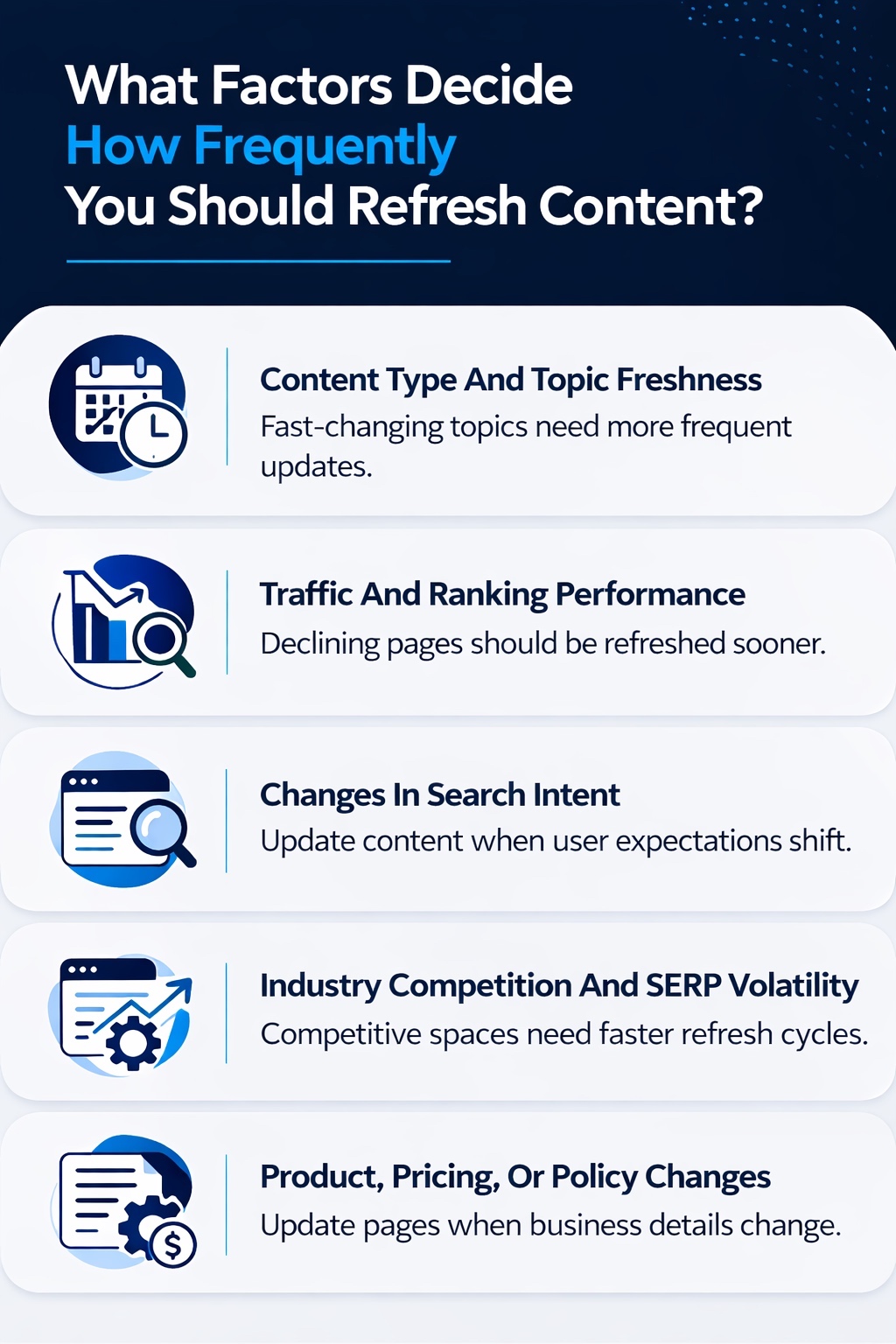
Choosing the right content update frequency is a strategic decision shaped by internal and external factors. Content type, performance, and competition all influence how often updates are needed to maintain quality. Analyzing these elements helps you prioritize refreshes, allocate resources effectively, and boost SEO impact.
Let’s examine the key factors that should guide your update schedule.
1. Content Type And Topic Freshness
The type of content you publish is a primary determinant of its required update frequency. As discussed, time-sensitive news articles need more frequent attention than foundational evergreen guides. Topic freshness, or how quickly information in a specific niche evolves, is also a critical consideration.
For example, content in fast-moving fields like technology or digital marketing requires constant data processing and updates to remain accurate. A blog post about social media algorithms from two years ago is likely outdated. In contrast, a piece on the history of ancient Rome might remain relevant for much longer with minimal changes.
Assess each piece of content based on its category. Is it a news piece, a how-to guide, a product review, or an opinion piece? Aligning your update schedule with the content type and its inherent need for freshness is the first step toward an effective refresh strategy.
2. Traffic And Ranking Performance
Your analytics data provides a clear roadmap for your content refresh priorities. Monitoring key metrics like organic traffic and keyword rankings can tell you which pages are performing well and which are in decline. A sudden or gradual drop in ranking performance is a strong signal that a page needs attention.
Use tools like Google Search Console to track the performance of your most important pages. If you notice a page that once drove significant organic traffic is now slipping in the search results, it's time for a refresh. This decline could be due to new competition or your content becoming outdated.
Conversely, don't ignore your high-performing pages. Regularly updating these assets can help you defend your rankings and even climb higher. Analyzing these key metrics helps you focus your efforts where they will have the greatest impact on your overall SEO health.
3. Changes In Search Intent
Search intent, the underlying reason for a user's query, can change over time. What searchers wanted from a keyword last year might be different today. For instance, a query that once returned informational blog posts might now show more product comparison pages. Ignoring these shifts can make your content irrelevant, even if it's factually accurate.
One of the best practices for content maintenance is to periodically re-evaluate the search engine results page (SERP) for your target keywords. See what types of content are currently ranking at the top. Are they lists, guides, videos, or product pages? This analysis will reveal if the dominant search intent has shifted.
If you notice significant data changes in the SERP landscape, it's a clear sign you need to update your content to better align with the new user expectation. This might mean restructuring your article, changing the format, or even rewriting it completely to match what searchers are looking for now.
4. Industry Competition And SERP Volatility
Your content doesn't exist in a vacuum. It competes with content from other players in your industry. In a highly competitive niche, SERP volatility is common, with rankings fluctuating frequently as competitors publish new content or update existing pages. To stay ahead, you must be just as agile.
Monitor your key competitors' content strategies. Are they frequently updating their articles? Are they producing more comprehensive or in-depth content on topics you also cover? This competitive intelligence helps you gauge the level of effort required to maintain and improve your rankings within your specific data ecosystems.
If your industry is characterized by intense competition, a more aggressive update schedule is necessary. You can't afford to let your content become stale when your rivals are constantly pushing out fresh, high-quality material. Staying competitive often means treating content as a living asset that requires ongoing investment.
5. Product, Pricing, Or Policy Changes
For businesses, some of the most critical content to keep updated are the pages related to your offerings. Any changes to your products, services, pricing, or company policies must be reflected on your website immediately. Outdated information on these pages can lead to customer confusion, frustration, and lost sales.
Product pages are especially important. If you launch a new feature, update a model, or change your pricing structure, these data changes must be made promptly. The same applies to pages detailing your terms of service, privacy policy, or shipping information. Accuracy on these pages is a matter of customer service and, in some cases, legal compliance.
Establish a process to ensure that whenever an internal business change occurs, the relevant website content is updated as part of the rollout. This proactive approach prevents the spread of misinformation and ensures a smooth customer experience.
Which Pages Should You Update First?
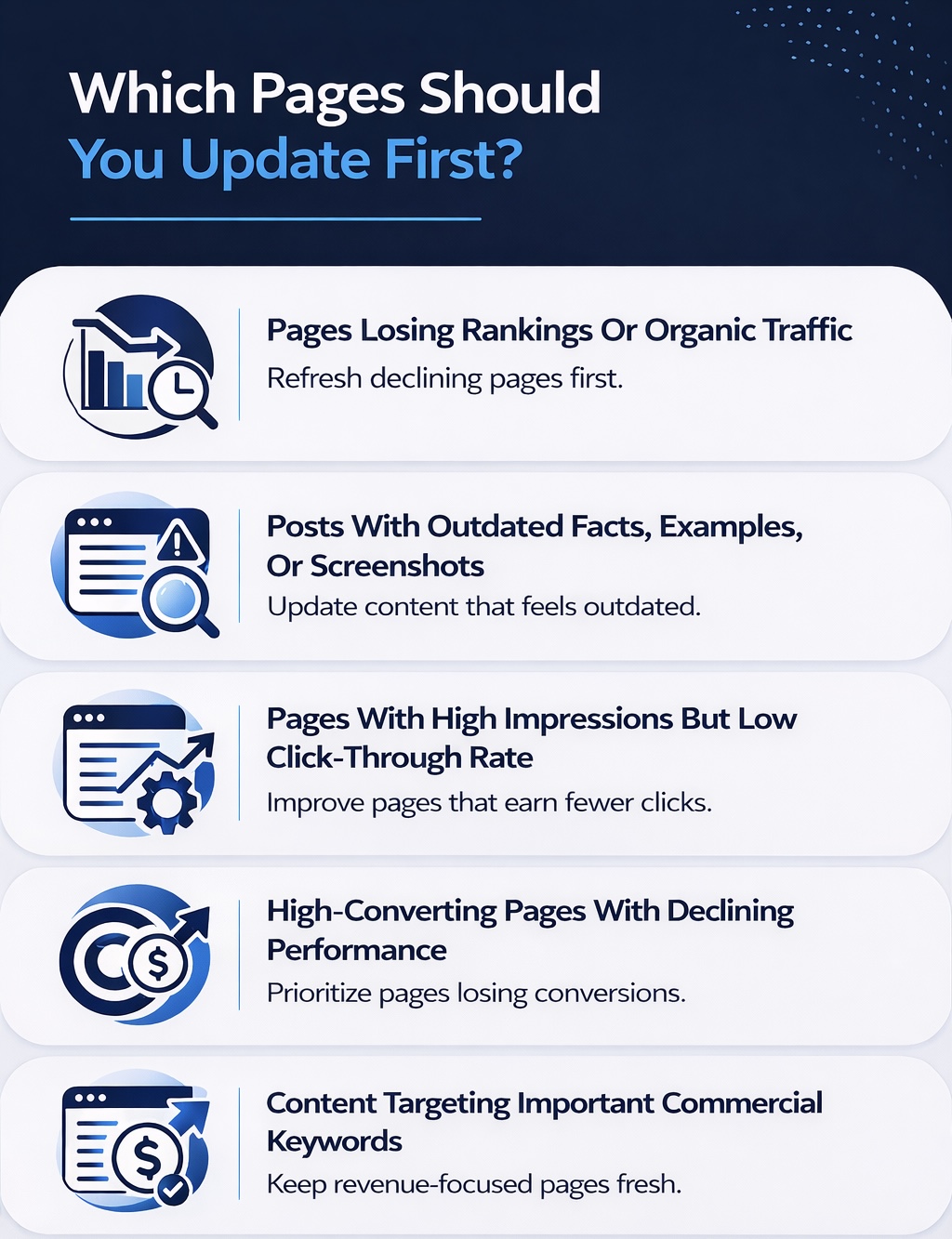
With limited time and resources, prioritize which content to refresh first. Use data observability to identify pages with the biggest issues or highest potential for improvement. Focusing on these pages maximizes your ROI. Improving key pages can significantly boost SEO and user experience. Update frequency matters, but choosing where to start is just as important.
Here are five types of pages that should be at the top of your refresh list.
1. Pages Losing Rankings Or Organic Traffic
Pages that are actively losing rankings or experiencing a decline in organic traffic need immediate attention. This drop is often a direct symptom of content decay or other data quality issues. Your analytics tools are your best friend here; they can help you pinpoint these underperforming assets quickly.
Once you've identified a page that's slipping, conduct a thorough audit. Compare it to the pages that are now outranking you. Is your content less comprehensive? Is the information outdated? Are your on-page SEO elements weaker? Answering these questions will reveal the reasons for its declining performance.
Addressing the issues on these pages can often stop the slide and help you reclaim your lost positions. A content refresh might involve adding more depth, updating facts, or improving the overall user experience to make it more competitive in the current SERP landscape.
2. Posts With Outdated Facts, Examples, Or Screenshots
Nothing erodes trust faster than outdated information. Blog posts and articles containing old statistics, irrelevant examples, or screenshots of obsolete user interfaces can make your entire brand look behind the times. These pages are prime candidates for regular data updates.
Periodically scan your content for any information that is no longer accurate. This is especially critical in tech-focused industries where software and platforms change rapidly. A tutorial with screenshots from a two-year-old version of an application is not helpful to today's users.
Following best practices for content maintenance includes scheduling regular reviews to catch and correct this outdated information. Replacing old data with fresh, current examples demonstrates your commitment to providing accurate and valuable content, which builds authority with both your audience and search engines.
3. Pages With High Impressions But Low Click-Through Rate
A page that earns a lot of impressions in search results but has a low click-through rate (CTR) presents a unique opportunity. This pattern indicates that while Google finds your page relevant enough to show it to users, your title tag and meta description aren't compelling enough to earn the click. This is an issue with your SERP "packaging," not necessarily the content itself.
The data collection process in Google Search Console makes it easy to identify these pages. Sort your queries by impressions and look for those with a CTR that is significantly lower than your site average. These are your prime targets for optimization.
A refresh should focus on rewriting the page's title and meta description to be more engaging and better aligned with search intent. You can A/B test different versions to see what resonates most with your audience.
4. High-Converting Pages With Declining Performance
Your high-converting pages are your business's most valuable digital assets. Even a small drop in the conversion rate on these pages can have a significant impact on your bottom line. If you notice declining performance on a page that historically converted well, it's a red flag that requires immediate investigation.
The decline could be caused by several factors. The data age might be an issue, with outdated offers or statistics reducing trust. Alternatively, new competitors might have created a more persuasive landing page, or a shift in user expectations could be making your page feel less relevant.
Analyze the page to identify potential weaknesses. Are your calls-to-action still compelling? Is the page loading quickly? Is the content still addressing the primary pain points of your target audience? Refreshing these high-converting pages is crucial for protecting your revenue streams and maintaining business momentum.
5. Content Targeting Important Commercial Keywords
Content that targets commercial keywords—queries that indicate a user is close to making a purchase—is directly tied to your revenue. These pages, such as product comparisons, reviews, and "best of" lists, must be kept meticulously up-to-date to remain competitive and trustworthy.
For these pages, you need to constantly monitor market trends and ensure your information is current. Is there a new product on the market that should be included in your comparison? Has a product's pricing or features changed? Your content should be a reliable data source for users making purchase decisions.
Regularly refreshing content targeting commercial keywords helps you maintain authority and capture high-intent traffic. Failing to do so can lead to users choosing a competitor's more current and comprehensive resource, resulting in lost sales opportunities for your business.
How Do You Refresh Website Content Without Hurting SEO?
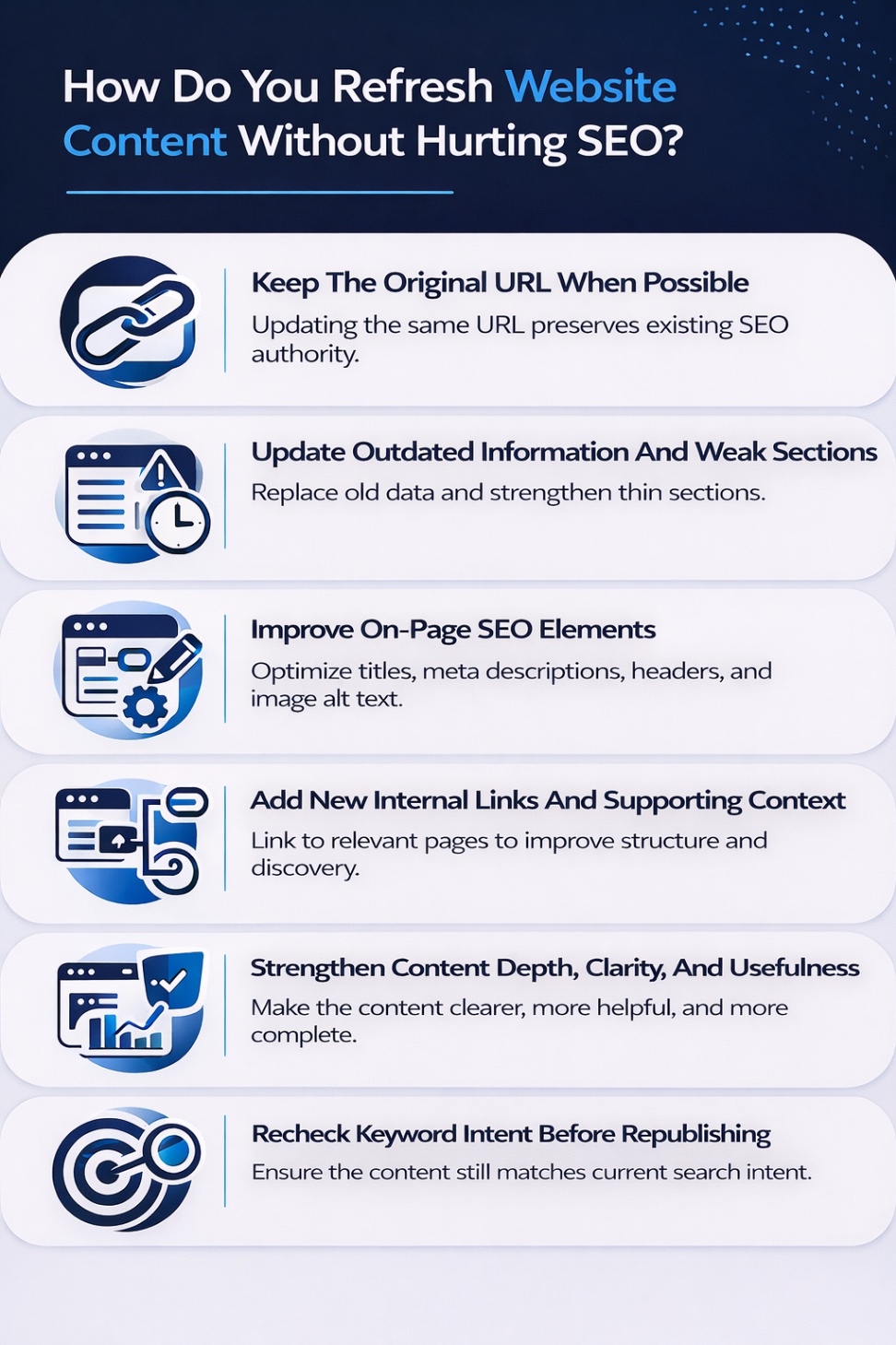
Refreshing your content is vital, but if done poorly, it can hurt your SEO. Follow best practices when updating data to boost rankings without losing existing authority. The key is to make strategic improvements while preserving what Google already values. Enhance value and relevance to ensure your content refreshes benefit SEO.
Here are some key steps to follow when updating your website content.
1. Keep The Original URL When Possible
One of the most important rules of content refreshing is to keep the original URL whenever possible. A URL accumulates authority over time through backlinks and user history. Changing the URL effectively resets this authority, forcing you to start from scratch. It's like moving to a new house and not telling anyone your new address.
When you perform a content update, even a major one, make the changes directly on the existing page. This ensures that all the "SEO equity" the page has earned remains intact. The updated content will benefit from the URL's established authority, giving it a better chance to rank well.
The only time you should consider changing a URL is if the original is completely unoptimized or no longer reflects the page's topic. In that rare case, be sure to implement a 301 redirect from the old URL to the new one. This tells search engines that the page has permanently moved, passing most of the link equity to the new address.
2. Update Outdated Information And Weak Sections
The core of any content refresh is the process of performing data updates to improve data quality. Start by conducting a thorough audit of the page to identify any outdated information. This includes old statistics, broken links, and references to discontinued products or defunct companies.
Look for weak or thin sections of the content that could be expanded. Are there parts of the article that lack depth or fail to fully answer the user's question? These are prime areas for improvement. Strengthening these sections makes your content more comprehensive and valuable.
Your update checklist should include:
- Replacing old statistics with the latest available data.
- Fixing or removing broken outbound links.
- Expanding on topics that are only briefly covered.
3. Improve On-Page SEO Elements
A content refresh is a perfect opportunity to fine-tune your on-page SEO elements. These components help search engines understand the topic and structure of your content, and optimizing them can provide a quick ranking boost. Good data quality isn't just about the words on the page; it's also about how the page is structured.
Review your title tag, meta description, and headers (H1, H2s, etc.). Ensure they accurately reflect the updated content and strategically include your target keywords. Following on-page SEO best practices also involves optimizing your images by adding descriptive alt text.
Key on-page SEO improvements include:
- Rewriting the title tag to be more compelling and keyword-rich.
- Updating the meta description to improve click-through rates.
- Adding alt text to all images to improve accessibility and image search visibility.
4. Add New Internal Links And Supporting Context
Internal links are a powerful yet often underutilized SEO tool. When you refresh a piece of content, look for opportunities to add internal links to other relevant pages on your site. This helps users discover more of your content and allows search engines to better understand the relationship between different pages within your data ecosystems.
Adding these links provides supporting context for both users and search engines. For example, if you mention a related concept in your updated article, link to a page on your site that explains that concept in more detail. This creates a more cohesive user experience and helps spread link equity throughout your site.
When updating, be sure to:
- Link to newer, relevant blog posts you've published.
- Add links to important product or service pages.
- Go to other pages on your site and add links back to the updated article.
5. Strengthen Content Depth, Clarity, And Usefulness
The ultimate goal of a content refresh is to make the page more helpful for the user. Go beyond simple factual updates and focus on improving the overall content depth and clarity. Ask yourself: "How can I make this the single best resource on this topic?" This commitment to quality is what earns top rankings.
Improve data clarity by simplifying complex topics, using shorter sentences and paragraphs, and adding visuals like charts or infographics. Enhance content depth by adding new sections that cover related subtopics, answering common questions, or including expert quotes for valuable insights. Improving data quality in this way directly addresses user needs.
A more useful page leads to better engagement signals, such as longer time on page and lower bounce rates. These signals tell search engines that users are finding your content valuable, which is a strong positive ranking factor.
6. Recheck Keyword Intent Before Republishing
Before you hit the "publish" button on your refreshed content, take one final step: re-evaluate the keyword intent. As mentioned earlier, what users are looking for when they search a term can change. Your updated content needs to align with the current search intent to be successful.
Perform a quick search for your main target keyword and analyze the top-ranking results. Look at the format, angle, and depth of the content that is currently performing well. This fresh market data gives you a clear picture of what Google considers to be the best answer for that query right now.
If your refreshed content is misaligned with the current keyword intent, it's unlikely to rank well, no matter how high-quality it is. Make any necessary adjustments to the structure or focus of your article to ensure it meets the expectations of today's searchers.
When Should You Create New Content Instead of Refreshing It?
While content updates are powerful, they aren't always the right solution. Sometimes, creating entirely new content is the better strategic move. The decision between refreshing and new data creation often comes down to the topic's relevance to your existing page and the degree of change required. If the search intent for a keyword has shifted so dramatically that your original article is no longer a good fit, a complete rewrite under a new URL might be necessary. This is especially true if the original page targets a keyword that is now obsolete.
Similarly, if you want to target a new, distinct keyword or a completely different angle on a topic, data generation from a new data source is the way to go. For instance, if you have an article on "social media tips for beginners," and you want to create a guide on "advanced B2B social media strategies," that warrants a new post rather than a simple refresh. Creating new content allows you to build authority on a wider range of topics and attract different segments of your audience.
How Can Scalenut Help You Refresh Old Content More Effectively?
If your older pages are starting to lose traffic, Scalenut can help you refresh them with more direction and less guesswork. Its Content Audit feature helps you identify underperforming pages, uncover gaps in structure and optimization, and pinpoint the updates most likely to improve performance. Instead of manually sorting through what needs work, your team gets a clearer view of where content is falling behind.
Scalenut also makes it easier to act on those insights. You can update metadata, improve page structure, refine keyword targeting, and strengthen content in a more focused way without rebuilding everything from scratch. This helps your team refresh old content faster, improve search visibility, and recover lost organic traffic.
Book a demo with Scalenut to see how it can streamline your content refresh workflow.
Frequently Asked Questions
How often to update content strategy?
Your content strategy should be reviewed and updated at least once or twice a year. This update frequency allows you to adapt to market changes, analyze performance data, and refine your approach. Following this best practice in data management ensures your content updates align with your evolving business goals.
How often to refresh signage content?
For digital signage, the update frequency depends on the business context. Retail promotions or restaurant menus may require daily updates to ensure data freshness. For general branding, quarterly content updates may suffice. The key is to keep the information relevant to the customer experience and current business activities.
How often to refresh channel enablement content?
Channel enablement content, such as sales playbooks and training materials, should be refreshed quarterly or whenever there's a product or strategy update. A frequent update frequency ensures high data quality and operational efficiency for your sales teams. Data observability platforms can help track content usage and identify refresh needs.
How often to refresh content for competitiveness?
In a competitive market, you should monitor top-ranking content monthly. The update frequency for your own content should be at least quarterly to maintain competitiveness. Effective data management and a focus on fresh data will empower marketing teams to stay ahead of rivals and capture audience attention.
How often to refresh content for ongoing campaigns?
For ongoing campaigns, content should be refreshed based on performance data, often weekly or bi-weekly. This high update frequency allows you to optimize based on what's working. Using fresh data to ensure high data quality is crucial for making smart, timely business decisions that improve campaign ROI.
How often to review content performance reports?
You should review content performance reports at least monthly. This review frequency ensures data accuracy and helps you identify which pages need data updates. Tracking key metrics like traffic, rankings, and conversions allows you to make informed decisions about your content strategy in a timely manner.
How often should businesses update content marketing strategy?
A business should formally update its content marketing strategy annually, with quarterly check-ins to make small adjustments. This update frequency balances long-term vision with the need to adapt to new market trends. Continuous data collection is vital to inform these updates based on the current business context.
How often to update content in fast-evolving tech field?
In a fast-evolving tech field, content may need data updates quarterly or even monthly. The update frequency must be high to incorporate new data and developments. Staying current is critical for maintaining authority within these dynamic data ecosystems, as information can become obsolete very quickly.
How often should data refresh for meaningful insights?
The ideal frequency for a data refresh depends on the use case. For meaningful insights in fast-paced environments like finance or e-commerce, real-time or daily refreshes are needed. For long-term strategic analysis, weekly or monthly refreshes might suffice to ensure data freshness and quality in your data lake.


.svg)


.webp)